
Joel 3:2

Hebrew (Westminster Leningrad Codex) Joel 3:2 appears in the Hebrew Old Testament. The text above is from the Westminster Leningrad Codex. Each word links to its Strong’s number, a concise gloss, and parsing drawn from the Open Scriptures Hebrew Bible morphology. Click any word for its full Brown-Driver-Briggs (BDB) entry.
Download image
Cite this verse

Joel 3:2 (World English Bible). Public Domain. Lemma interlinear Bible study tool, https://lemma.gebible.app/v/joel/3/2.

Show BibTeX & RIS
BibTeX
RIS
English Translation
I will gather all nations, And will bring them down into the valley of Jehoshaphat; And I will execute judgment on them there for my people, And for my heritage, Israel, whom they have scattered among the nations. They have divided my land,
World English Bible · Public Domain
Download a study sheet

One document with this verse’s original text, its word-by-word gloss line, the meaning frame, cross-references with their text, attributed commentary, and full source and license credits — printable, and it pastes into notes with its structure intact.

This verse Autodidact and up

Study sheet (.html) Plain text (.txt)

A passage Seminary Student

Up to 50 verses in one chapter. A passage sheet keeps up to 6 commentary sources and 12 cross-references per verse, in the order this page ranks them, and says so on the sheet whenever that leaves anything out. Ask for a single verse and you get the Autodidact verse sheet above.

Everything on this page stays free to read, with no account — the sheet is a download of what is already on screen, not access to it.

Want to remove ads? Support Godless Engineer
Compare translations 3

The same verse in 3 English versions, stacked beneath the original-language interlinear above. Click any original word for its lexicon entry.

Each is an independent rendering of the whole verse — the interlinear is not word-aligned to these translations.

Highlighted words mark where these versions differ — a whole-verse word diff, not a word-by-word alignment.

  • World English Bible Public Domain
    I will gather all nations, And will bring them down into the valley of Jehoshaphat; And I will execute judgment on them there for my people, And for my heritage, Israel, whom they have scattered among the nations. They have divided my land,
  • King James Version Public Domain
    I will also gather all nations, and will bring them down into the valley of Jehoshaphat, and will plead with them there for my people and for my heritage Israel, whom they have scattered among the nations, and parted my land.
  • unfoldingWord Literal Text CC BY-SA 4.0
    then I will gather all of the nations, and I will bring them down to the Valley of Jehoshaphat, and I will judge them there because of my people and my inheritance, Israel, whom they scattered among the nations, and they divided up my land.

unfoldingWord Literal Text — © unfoldingWord, licensed CC BY-SA 4.0. Word-aligned USFM3 via Door43 (git.door43.org/unfoldingWord/en_ult).

Versions to compare (up to 4)

3 of 4 selected

Show all 18 translations

Every available English version of this verse, each an independent rendering of the whole verse.

  • World English Bible Public Domain
    I will gather all nations, And will bring them down into the valley of Jehoshaphat; And I will execute judgment on them there for my people, And for my heritage, Israel, whom they have scattered among the nations. They have divided my land,
  • Berean Standard Bible Public Domain
    I will gather all the nations and bring them down to the Valley of Jehoshaphat. There I will enter into judgment against them concerning My people, My inheritance, Israel, whom they have scattered among the nations as they divided up My land.
  • Majority Standard Bible Public Domain
    I will gather all the nations and bring them down to the Valley of Jehoshaphat. There I will enter into judgment against them concerning My people, My inheritance, Israel, whom they have scattered among the nations as they divided up My land.
  • King James Version Public Domain
    I will also gather all nations, and will bring them down into the valley of Jehoshaphat, and will plead with them there for my people and for my heritage Israel, whom they have scattered among the nations, and parted my land.
  • American Standard Version (1901) Public Domain
    I will gather all nations, and will bring them down into the valley of Jehoshaphat; and I will execute judgment upon them there for my people and for my heritage Israel, whom they have scattered among the nations: and they have parted my land,
  • Revised Version (1885) Public Domain
    I will gather all nations, and will bring them down into the valley of Jehoshaphat; and I will plead with them there for my people and for my heritage Israel, whom they have scattered among the nations, and parted my land.
  • Geneva Bible (1599) Public Domain
    I will also gather all nations, and wil bring them downe into the valley of Iehoshaphat, and will pleade with them there for my people, and for mine heritage Israel, whom they haue scattered among the nations, and parted my land.
  • Douay-Rheims (1899) Public Domain
    I will gather together all nations, and will bring them down into the valley of Josaphat: and I will plead with them there for my people, and for my inheritance Israel, whom they have scattered among the nations, and have parted my land.
  • Young's Literal Translation Public Domain
    Then I have gathered all the nations, And caused them to go down unto the valley of Jehoshaphat, And I have been judged with them there, Concerning My people and Mine inheritance -- Israel, Whom they scattered among nations, And My land they have apportioned.
  • Literal Standard Version CC BY-SA 4.0
    Then I have gathered all the nations, || And caused them to go down to the Valley of Jehoshaphat, || And I have been in judgment with them there, || Concerning My people and My inheritance—Israel, || Whom they scattered among nations, || And My land they have apportioned.
  • Unlocked Literal Bible CC BY-SA 4.0
    I will gather all the nations, and bring them down to the Valley of Jehoshaphat. I will judge them there, because of my people and my inheritance Israel, whom they scattered among the nations, and because they divided up my land.
  • unfoldingWord Literal Text CC BY-SA 4.0
    then I will gather all of the nations, and I will bring them down to the Valley of Jehoshaphat, and I will judge them there because of my people and my inheritance, Israel, whom they scattered among the nations, and they divided up my land.
  • Darby Bible Public Domain
    I will also gather all the nations, and will bring them down into the valley of Jehoshaphat, and I will enter into judgment with them there on account of my people and mine inheritance, Israel, whom they have scattered among the nations: and they have parted my land;
  • World Messianic Bible Public Domain
    I will gather all nations, and will bring them down into the valley of Jehoshaphat; and I will execute judgment on them there for my people, and for my heritage, Israel, whom they have scattered among the nations. They have divided my land,
  • Webster's Bible Public Domain
    \\2:29\\And also upon the servants and upon the handmaids in those days will I pour out my spirit.
  • Free Bible Version CC BY-SA 4.0
    I will gather together all the nations in the valley of Jehoshaphat and I will judge them there over my people Israel, my inheritance, whom they have scattered among the nations, and have divided up my land.
  • Bible in Basic English Public Domain
    And on the servants and the servant-girls in those days I will send my spirit.
  • JPS Tanakh (1917) Public Domain
    (4-2) I will gather all nations, and will bring them down into the valley of Jehoshaphat; and I will enter into judgment with them there for My people and for My heritage Israel, whom they have scattered among the nations, and divided My land.

Literal Standard Version (2020), Covenant Press — licensed CC BY-SA 4.0. Text via the HelloAO Bible API (eBible.org). Unlocked Literal Bible (unfoldingWord) — licensed CC BY-SA 4.0. Text via the HelloAO Bible API (eBible.org). unfoldingWord Literal Text — © unfoldingWord, licensed CC BY-SA 4.0. Word-aligned USFM3 via Door43 (git.door43.org/unfoldingWord/en_ult). Free Bible Version, Dr. Jonathan Gallagher — licensed CC BY-SA 4.0. Text via the HelloAO Bible API (eBible.org).

Word by word

More ways to search: Search by grammar → Find every occurrence → Compare this word →

Practice this passage: Drill this verse → Learn its vocabulary →

פִּזְּר֣וּ
pâzar
H6340
“to scatter”
Verb, Piel, Perfect, 3rd Person, Common, Plural
Part of Speech
Verb
Stem
Piel
Form
Perfect
Person
3rd Person
Gender
Common
Number
Plural
Full BDB Definition

Origin: a primitive root

TWOT: 1755

to scatter, disperse - (Qal) - to scatter - scattered (participle) - (Niphal) to be scattered - (Piel) to scatter - (Pual) to be scattered
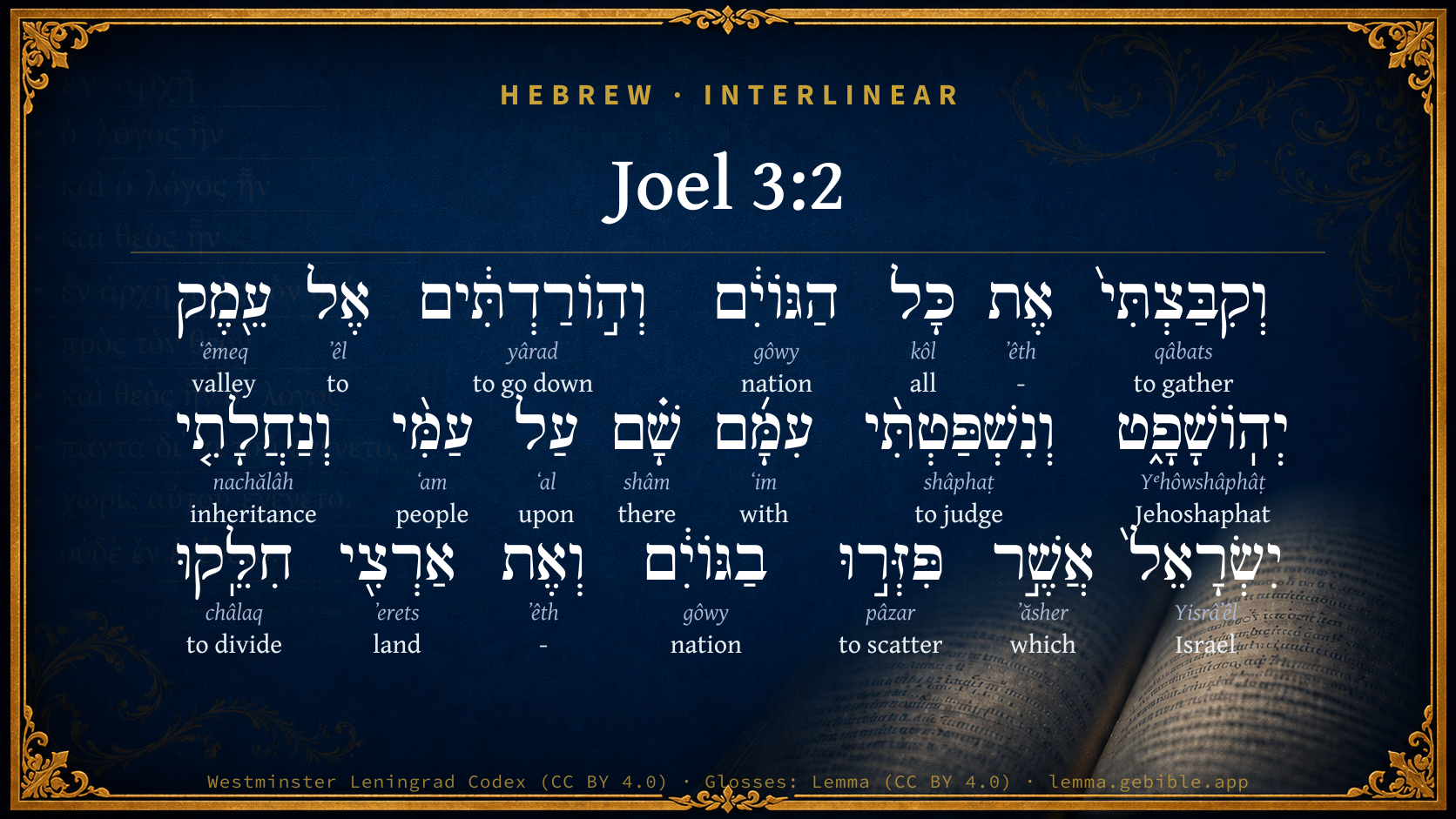
  1. וְקִבַּצְתִּי֙ qâbats H6908 “and · to gather” Conjunction + Verb, Piel, Sequential Perfect, 1st Person, Common, Singular
  2. אֶת ʼêth H853 “-” Particle, Direct Object
  3. כָּל kôl H3605 “all of” Noun, Common, Masculine, Singular, Construct
  4. הַגּוֹיִ֔ם gôwy H1471 “the · nations” Particle, Definite Article + Noun, Common, Masculine, Plural, Absolute
  5. וְה֣וֹרַדְתִּ֔ים yârad H3381 “and · to go down · them” Conjunction + Verb, Hiphil, Perfect, 1st Person, Common, Singular + Suffix, Personal, 3rd Person, Masculine, Plural
  6. אֶל ʼêl H413 “to” Preposition
  7. עֵ֖מֶק ʻêmeq H6010 “valley of” Noun, Common, Masculine, Singular, Construct
  8. יְהֽוֹשָׁפָ֑ט Yᵉhôwshâphâṭ H3092 “Jehoshaphat” Noun, Proper
  9. וְנִשְׁפַּטְתִּ֨י shâphaṭ H8199 “and · to judge” Conjunction + Verb, Niphal, Perfect, 1st Person, Common, Singular
  10. עִמָּ֜ם ʻim H5973 “with · them” Preposition + Suffix, Personal, 3rd Person, Masculine, Plural
  11. שָׁ֗ם shâm H8033 “there” Adverb
  12. עַל ʻal H5921 “upon” Preposition
  13. עַמִּ֨י ʻam H5971 “people · my” Noun, Common, Masculine, Singular, Construct + Suffix, Personal, 1st Person, Common, Singular
  14. וְנַחֲלָתִ֤י nachălâh H5159 “and · inheritance · my” Conjunction + Noun, Common, Feminine, Singular, Construct + Suffix, Personal, 1st Person, Common, Singular
  15. יִשְׂרָאֵל֙ Yisrâʼêl H3478 “Israel” Noun, Proper
  16. אֲשֶׁ֣ר ʼăsher H834 “which” Particle, Relative
  17. בַגּוֹיִ֔ם gôwy H1471 “in/at the · nations” Preposition, Determined + Noun, Common, Masculine, Plural, Absolute
  18. וְאֶת ʼêth H853 “and · -” Conjunction + Particle, Direct Object
  19. אַרְצִ֖י ʼerets H776 “land · my” Noun, Common, Both, Singular, Construct + Suffix, Personal, 1st Person, Common, Singular
  20. חִלֵּֽקוּ châlaq H2505 “to divide” Verb, Piel, Perfect, 3rd Person, Common, Plural

About this verse

These counts appear in no published source. They are computed here, from the morphology-tagged text and Lemma’s own curated glosses. What Lemma adds →

21
words
19
distinct lemmas
Prophets
section

Notable vocabulary

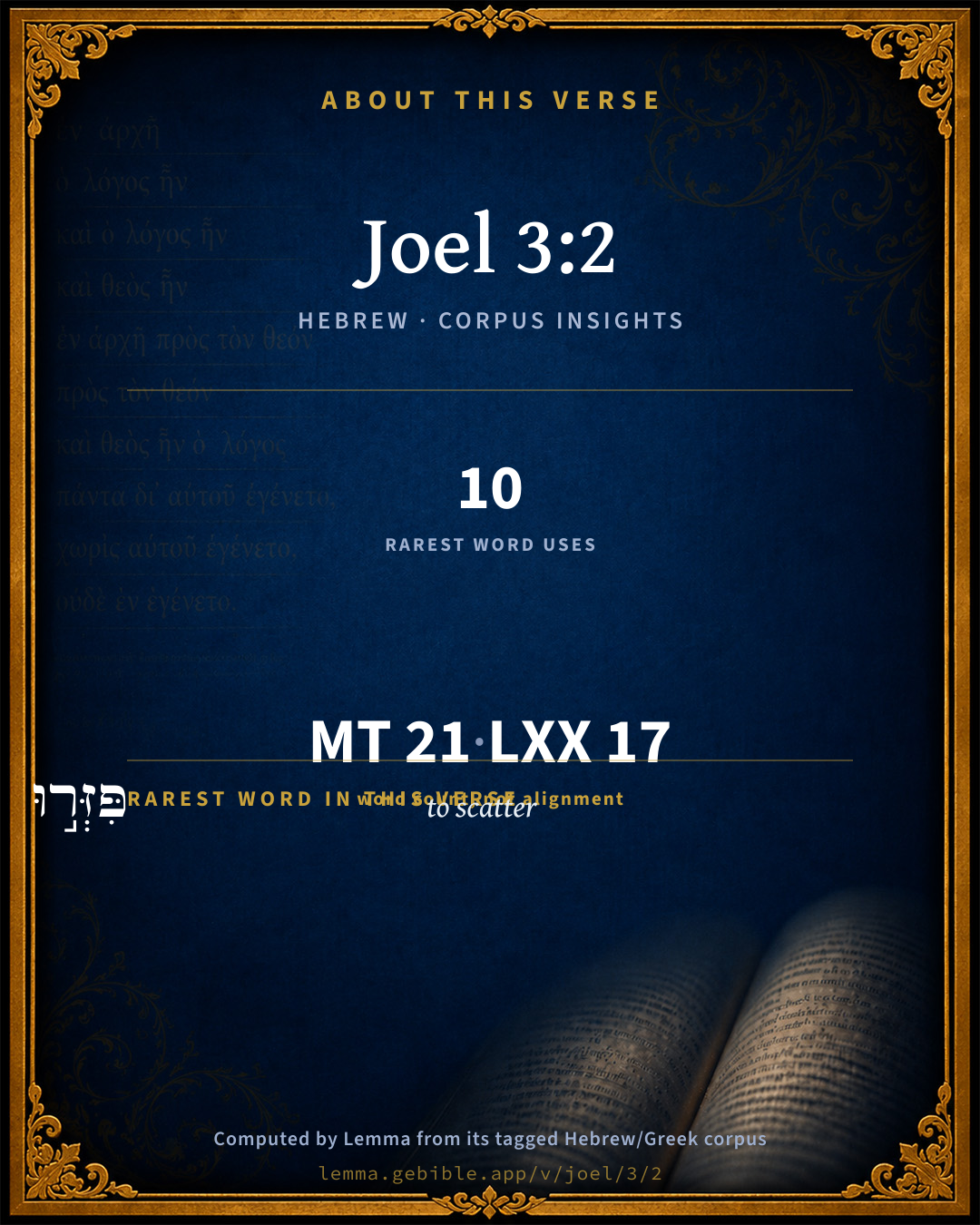
The rarest word here is פִּזְּר֣וּ to scatter H6340 — appearing just 10 times in the whole Hebrew Bible.

Shared distinctive vocabulary

פִּזְּר֣וּ to scatter H6340 occurs in 10 verses of the Hebrew Bible. Also found in:

Grammatical profile

  • 5 verbs
  • 9 nouns
  • 3 prepositions
  • 1 adverb
  • 3 particles

Verb forms

  • וְקִבַּצְתִּי֙ Piel · Sequential Perfect
  • וְה֣וֹרַדְתִּ֔ים Hiphil · Perfect
  • וְנִשְׁפַּטְתִּ֨י Niphal · Perfect
  • פִּזְּר֣וּ Piel · Perfect
  • חִלֵּֽקוּ Piel · Perfect

Repetition

A word recurs within this verse — often emphatic in Hebrew:

  • הַגּוֹיִ֔ם nation H1471 ×2

Hebrew & Septuagint length

In English translation the verse runs 43 words from the Hebrew and 43 from the Septuagint (LXX English) — the same length.

A rough comparison of the two English renderings, which tokenize alike — not a word-level alignment.

Word counts can differ between the Hebrew and the Greek without any difference in meaning — e.g. the Hebrew direct-object marker אֵת has no separate Greek word, and Greek often adds the article ὁ.

In the original languages it is 21 Hebrew tokens and 17 Greek tokens — but the two are counted differently (Hebrew bundles its prefixes and suffixes into one token; the Greek is in lemma form), so that isn’t a like-for-like length.

Cross-references

24

Topical passages linked to Joel 3:2 in the Treasury of Scripture Knowledge — connected by theme and wording, ordered by reader-vote popularity; previews shown in the World English Bible.

  • Zechariah 14:2–4 For I will gather all nations against Jerusalem to battle; and the city will be taken, the houses rifled, and the women ravished. half of the city will go out into captivity, and the rest of the people will not be cut off from the city.
  • Isaiah 66:16 For by fire will Yahweh execute judgment, and by his sword, on all flesh; and the slain of Yahweh shall be many.
  • Zephaniah 3:8 "Therefore wait for me," says Yahweh, "until the day that I rise up to the prey, for my determination is to gather the nations, that I may assemble the kingdoms, to pour on them my indignation, even all my fierce anger, for all the earth will be devoured with the fire of my jealousy.
  • Ezekiel 38:22 With pestilence and with blood will I enter into judgment with him; and I will rain on him, and on his hordes, and on the many peoples who are with him, an overflowing shower, and great hailstones, fire, and sulfur.
  • Jeremiah 25:31 A noise shall come even to the end of the earth; for Yahweh has a controversy with the nations; he will enter into judgment with all flesh: as for the wicked, he will give them to the sword, says Yahweh.
  • Ezekiel 35:10 Because you have said, These two nations and these two countries shall be mine, and we will possess it; whereas Yahweh was there:
  • Ezekiel 39:11 It shall happen in that day, that I will give to Gog a place for burial in Israel, the valley of those who pass through on the east of the sea; and it shall stop those who pass through: and there shall they bury Gog and all his multitude; and they shall call it The valley of Hamon Gog.
  • Joel 3:12 "Let the nations arouse themselves, And come up to the valley of Jehoshaphat; For there will I sit to judge all the surrounding nations.
  • Zechariah 12:3–4 It will happen in that day, that I will make Jerusalem a burdensome stone for all the peoples. All who burden themselves with it will be severely wounded, and all the nations of the earth will be gathered together against it.
  • Revelation 16:16 He gathered them together into the place which is called in Hebrew, Megiddo.
  • 2 Chronicles 20:26 On the fourth day they assembled themselves in the valley of Beracah; for there they blessed Yahweh: therefore the name of that place was called The valley of Beracah to this day.
  • Jeremiah 12:14 Thus says Yahweh against all my evil neighbors, who touch the inheritance which I have caused my people Israel to inherit: behold, I will pluck them up from off their land, and will pluck up the house of Judah from among them.
  • Jeremiah 49:1 Of the children of Ammon. Thus says Yahweh: Has Israel no sons? has he no heir? why then does Malcam possess Gad, and his people well in the cities of it?
  • Ezekiel 36:5 therefore thus says the Lord Yahweh: Surely in the fire of my jealousy have I spoken against the residue of the nations, and against all Edom, that have appointed my land to themselves for a possession with the joy of all their heart, with despite of soul, to cast it out for a prey.
  • Amos 1:11 Thus says Yahweh: "For three transgressions of Edom, yes, for four, I will not turn away its punishment; Because he pursued his brother with the sword, And cast off all pity, And his anger raged continually, And he kept his wrath forever;
  • Obadiah 1:10–16 For the violence done to your brother Jacob, shame will cover you, and you will be cut off forever.
  • Zephaniah 2:8–10 I have heard the reproach of Moab, and the insults of the children of Ammon, with which they have reproached my people, and magnified themselves against their border.
  • Revelation 16:6 For they poured out the blood of the saints and the prophets, and you have given them blood to drink. They deserve this."
  • Revelation 18:20–21 Rejoice over her, O heaven, you saints, apostles, and prophets; for God has judged your judgment on her."
  • Revelation 20:8 and he will come out to deceive the nations which are in the four corners of the earth, Gog and Magog, to gather them together to the war; the number of whom is as the sand of the sea.
  • Ezekiel 25:8 Thus says the Lord Yahweh: Because Moab and Seir say, Behold, the house of Judah is like all the nations;
  • Revelation 11:18 The nations were angry, and your wrath came, as did the time for the dead to be judged, and to give your bondservants the prophets, their reward, as well as to the saints, and those who fear your name, to the small and the great; and to destroy those who destroy the earth."
  • Revelation 16:14 for they are spirits of demons, performing signs; which go forth to the kings of the whole inhabited earth, to gather them together for the war of that great day of God, the Almighty.
  • Revelation 19:19–21 I saw the beast, and the kings of the earth, and their armies, gathered together to make war against him who sat on the horse, and against his army.

Cross-references courtesy of OpenBible.info (CC BY 4.0).

Hebrew and Greek witnesses Masoretic Hebrew ↔ Greek Septuagint

The same verse in the two great witnesses to the Old Testament, shown verse-for-verse.

These are two independent witnesses, not word-aligned to each other, and the Septuagint is shown in lemma (dictionary) form.

Hebrew Joel 3:2 Masoretic · Westminster Leningrad Codex

וְקִבַּצְתִּי֙ אֶת כָּל הַגּוֹיִ֔ם וְה֣וֹרַדְתִּ֔ים אֶל עֵ֖מֶק יְהֽוֹשָׁפָ֑ט וְנִשְׁפַּטְתִּ֨י עִמָּ֜ם שָׁ֗ם עַל עַמִּ֨י וְנַחֲלָתִ֤י יִשְׂרָאֵל֙ אֲשֶׁ֣ר פִּזְּר֣וּ בַגּוֹיִ֔ם וְאֶת אַרְצִ֖י חִלֵּֽקוּ

I will gather all nations, And will bring them down into the valley of Jehoshaphat; And I will execute judgment on them there for my people, And for my heritage, Israel, whom they have scattered among the nations. They have divided my land,

World English Bible · Public Domain

Greek LXX Joel 3:2 Septuagint · lemma form

καί ἐπί ὁ δοῦλος καί ἐπί ὁ δούλη ἐν ὁ ἡμέρα ἐκεῖνος ἐκχέω ἀπό ὁ πνεῦμα ἐγώ

I will also gather all the Gentiles, and bring them down to the valley of Josaphat, and will plead with them there for my people and my heritage Israel, who have been dispersed among the Gentiles; and these Gentiles have divided my land,

LXX2012 (modern English Septuagint) · Public Domain

Hebrew: Westminster Leningrad Codex (CC BY 4.0). Greek: Septuagint (public domain); English from LXX2012 (modern English Septuagint) (Public Domain). How the Septuagint differs from the Hebrew →

Targum (Aramaic paraphrase)

1

The Targum is the ancient Jewish Aramaic paraphrase of the Hebrew Scriptures — an interpretive translation, not the Hebrew text itself. Onkelos (literal) and Pseudo-Jonathan (expansive) render the Torah, and Jonathan the Prophets. Coverage is partial: where no permissively-licensed English translation exists for a verse, only the Aramaic is shown. This is verse-level text, not a word-by-word alignment to the Hebrew.

  1. Targum Jonathan Prophets (Joshua–Malachi)
    וְאַף עַל עַבְדִין וְעַל אַמְהָן בְּיוֹמֵי הָאִנוּן אֶשְׁפַּךְ יַת רוּחַ קוּדְשִׁי:

    (no public-domain English translation for this verse)

    Targum Jonathan — Aramaic: “Mikraot Gedolot” (public domain). English: “Sefaria Community Translation” (CC0 1.0 (public-domain dedication)); “London "Chaldee Paraphrase," 1871” (public domain). Text via Sefaria.

Commentary

Notes on Joel 3:2 from classic Christian and Jewish commentators (each source and its license shown beneath its notes). The classic Christian expositions comment on the surrounding passage and are grouped to its opening verse, so a note may address several verses; the Jewish commentaries on the Tanakh (Rashi and others) are per-verse, so they appear only where the commentator wrote on this verse.

Lemma curates 59 commentaries, every one of them public domain or Creative Commons licensed, each selected and text-cleaned for this edition rather than reprinted as found. About our sources →

Trapp's Complete Commentary

John Trapp

Joe 3:2 I will also gather all nations, and will bring them down into the valley of Jehoshaphat, and will plead with them there for my people and [for] my heritage Israel, whom they have scattered among the nations, and parted my land.

Ver. 2. I will also gather all nations] That are adverse to my Church, that I may have my pennyworths of them, and do execution upon them with ease (troubling those troublers of his Israel, 2Th 1:6, licet videantur plures et potiores), as he dealt by Jehoshaphat’s enemies, 2Ch 20:25, and leaving them no more place to escape than those have who are surrounded in a valley by a potent enemy, who hath gotten them into a pound, as the proverb is. And this God will do in the valley of Jehoshaphat (a valley, saith Lyra, Adrichomius, and Montanus, between Jerusalem and Mount Olivet), in the very view of the Church, that the righteous may rejoice when he seeth the vengeance, and wash his feet in the blood of the wicked. So that a man shall say, Verily, there is a reward for the righteous, see Joe 3:4; verily, he is a God that judgeth in the earth, as in the valley of divine judgment (so some render Jehoshaphat here, as if it were an appellative, Chaldeus R. Salmon, Mercer), called, Joe 3:14, the valley of decision, and the words that next follow seem to favour, "and I will plead with them" ( iudicio I judge again), judicially plead with them there, for my people; which word also God useth when he foretelleth the destruction of Gog and Magog in Ezekiel. So that the valley of Jehoshaphat, saith Mercer, is the place wheresoever God shall please to punish the enemies of his people. As for that conceit of Lyra and others, who gather out of this text that this valley near Jerusalem shall be the very place where Christ shall sit to judge the world at the last day, and for confirmation allege Act 1:11. Mercer judgeth it to be a childish conceit, and Luther asketh where all mankind shall have room to stand in so small a valley? Though others judge it not unlikely that it shall be thereabouts, because Jerusalem is in the middle and about the centre of the earth, and besides, it will be the more for the glory of Christ, to sit there as judge where he himself was judged; but it is probable he will sit in the air, near the earth, whither the elect shall be raptured up to meet the Lord. 1Th 4:17, that the devils may be subdued and sentenced in the air, where they have ruled and played Rex, king, Eph 2:2, and that the wicked may be doomed on the earth, where they have offended.

For my people and for my heritage Israel] All was his, and the wrongs done to them were done to God’s self, as the injury done to the subject is said to be done to the sovereign, his crown and dignity. See Act 9:4 Mat 25:45. So that ye cannot tread upon the least toe in Christ’s mystical body, but the head cries out from heaven, Why hurtest thou me? The saints’ sufferings are his, Col 1:24, their reproach his, Heb 13:13. Manet compassio, etiam cum impassibilitate (Bern.). Christ retaineth still compassion, though free from personal passion; and though without feeling, yet not without fellow feeling. He doth condolere proportionate ad miseriam, as Pareus rendereth the apostle, Heb 5:2, condole, and that proportionably to his people’s misery, μετριοπαθειν.

And for my heritage Israel] Israel, εμφατικως, saith Mercer, the people of God’s purchase, that comprehend all his gettings, and are much more dear to him than Naboth’s inheritance was to him. He sets them before his face for ever, Psa 41:12, as loving to look upon them; yea, upon the very "walls of the houses where they dwell," Isa 49:16. They are his portion, Deu 32:9; his inheritance, Isa 19:25; the dearly beloved of his soul, Jer 12:7; his glory, Isa 46:13; dear to God, though despised and dispersed in the world. He may suffer them to be Anathema secundum dici, as Bucholcer said, but not secundum esse.

Whom they have scattered among the nations] The Jewish doctors refer this to Titus and Adrian, the Roman emperors. The first carried 97,000 of them captives, saith Josephus; the second drove them utterly out of Jewry, and by proclamation, commanded them not so much as look toward that land from any tower or high mountain. But all this was for their sedition and other wickednesses. And ever since they have continued a dejected and despised people, exiled out of the world, as it were, by a common consent of nations, specially for their inexpiable guilt in murdering Christ, and persecuting his people, concerning whom, therefore, this text is to be understood, Deu 28:64. See how Christians were soon scattered abroad throughout the regions, Act 8:1 Jas 1:1 1Pe 1:1, where they are called strangers of the dispersion. Afterwards the heathen persecutors relegated and confined them to isles and mines, and scattered them into corners. So did the pope and his agents: forcing them to flee for their lives.

And parted my land] As Shalmaneser did to his new colonies; as Sennacherib also designed to do, had not God prevented him; as the pope taketh upon him to do, those countries whom he counteth heretical. He gave this land, in Henry VIII’s time, primo occupaturo, to him that could first seize it. He declared John, King of Navarre, schismatic, a heretic, an enemy to the see apostolic, and gave his kingdom to the Spaniard, because he took part with the French, and would not allow the Spaniard to march through his kingdom against the French; and what work he hath lately made in the palatinate and other parts of Germany, who knows not?

John Trapp, A Commentary or Exposition upon All the Books of the Old and New Testament (1647–1656) — public domain. Text from a community e-Sword module.

Keil & Delitzsch

C. F. Keil & F. Delitzsch

In Joe 3:2 and Joe 3:3 Joel is speaking not of events belonging to his own time, or to the most recent past, but of that dispersion of the whole of the ancient covenant nation among the heathen, which was only completely effected on the conquest of Palestine and destruction of Jerusalem by the Romans, and which continues to this day; though we cannot agree with Hengstenberg, that this furnishes an argument in favour of the allegorical interpretation of the army of locusts in ch. 1 and 2. For since Moses had already foretold that Israel would one day be driven out among the heathen (Lev 26:33.; Deu 28:36.), Joel might assume that this judgment was a truth well known in Israel, even though he had not expressed it in his threatening of punishment in ch. 1 and 2. Joe 3:3 depicts the ignominious treatment of Israel in connection with this catastrophe. The prisoners of war are distributed by lot among the conquerors, and disposed of by them to slave-dealers at most ridiculous prices, - a boy for a harlot, a girl for a drink of wine. Even in Joel's time, many Israelites may no doubt have been scattered about in distant heathen lands (cf. v. 5); but the heathen nations had not yet cast lots upon the nation as a whole, to dispose of the inhabitants as slaves, and divide the land among themselves. This was not done till the time of the Romans.

(Note: After the conquest and destruction of Jerusalem, Titus disposed of the prisoners, whose number reached 97,000 in the course of the war, in the following manner: Those under seventeen years of age were publicly sold; of the remainder, some were executed immediately, some sent away to work in the Egyptian mines, some kept for the public shows to fight with wild beasts in all the chief cities of Rome; and only the tallest and most handsome for the triumphal procession in Rome (compare Josephus, de bell. Jud. vi. 9, 2, 3). And the Jews who were taken prisoners in the Jewish war in the time of Hadrian, are said to have been sold in the slave-market at Hebron at so low a price, that four Jews were disposed of for a measure of barley. Even in the contests of the Ptolemaeans and Seleucidae for the possession of Palestine, thousands of Jews were sold as prisoners of war. Thus, for example, the Syrian commander Nicanor, in his expedition against the Jews in the Maccabaean war, sold by anticipation, in the commercial towns along the Mediterranean, such Jews as should be made prisoners, at the rate of ninety prisoners for one talent; whereupon 1000 slave-dealers accompanied the Syrian army, and carried fetters with them for the prisoners (1 Maccabees 3:41; 2 Maccabees 8:11, 25; Jos. Ant. xii. 7, 3).)

But, as many of the earlier commentators have clearly seen, we must not stop even at this. The people and inheritance of Jehovah are not merely the Old Testament Israel as such, but the church of the Lord of both the old and new covenants, upon which the Spirit of God is poured out; and the judgment which Jehovah will hold upon the nations, on account of the injuries inflicted upon His people, is the last general judgment upon the nations, which will embrace not merely the heathen Romans and other heathen nations by whom the Jews have been oppressed, but all the enemies of the people of God, both within and without the earthly limits of the church of the Lord, including even carnally-minded Jews, Mohammedans, and nominal Christians, who are heathens in heart.

(Note: As J. Marck correctly observes, after mentioning the neighbouring nations that were hostile to Judah, and then the Syrians and Romans: "We might proceed in the same way to all the enemies of the Christian church, from its very cradle to the end of time, such as carnal Jews, Gentile Romans, cruel Mohammedans, impious Papists, and any others who either have borne or yet will bear the punishment of their iniquity, according to the rule and measure of the restitution of the church, down to those enemies who shall yet remain at the coming of Christ, and be overthrown at the complete and final redemption of His church.")

Before depicting the final judgment upon the hostile nations of the world, Joel notices in Joe 3:4-8 the hostility which the nations round about Judah had manifested towards it in his own day, and foretels to these a righteous retribution for the crimes they had committed against the covenant nation. Joe 3:4. "And ye also, what would ye with me, O Tyre and Sidon, and all ye coasts of Philistia? will ye repay a doing to me, or do anything to me? Quickly, hastily will I turn back your doing upon your head. Joe 3:5. That ye have taken my silver and my gold, and have brought my best jewels into your temples. Joe 3:6. And the sons of Judah and the sons of Jerusalem ye have sold to the sons of Javan, to remove them far from their border. Joe 3:7. Behold, I waken them from the place whither ye have sold them, and turn back your doing upon your head. Joe 3:8. And sell your sons and your daughters into the hand of Javan, and they sell them to the Sabaeans, to a people far off; for Jehovah has spoken it." By vegam the Philistines and Phoenicians are added to the gōyim already mentioned, as being no less culpable than they; not, however, in the sense of, "and also if one would inquire more thoroughly into the fact" (Ewald), or, "and even so far as ye are concerned, who, in the place of the friendship and help which ye were bound to render as neighbours, have oppressed my people" (Rosenmller), for such additions as these are foreign to the context; but rather in this sense, "and yea also ... do not imagine that ye can do wrong with impunity, as though he had a right so to do." מה־אתּם לי does not mean, "What have I to do with you?" for this would be expressed differently (compare Jos 22:24; Jdg 11:12); but, "What would ye with me?" The question is unfinished, because of its emotional character, and is resumed and completed immediately afterwards in a disjunctive form (Hitzig). Tyre and Sidon, the two chief cities of the Phoenicians (see at Jos 19:29 and Jos 11:8), represent all the Phoenicians. כל גּלילות פל, "all the circles or districts of the Philistines," are the five small princedoms of Philistia (see at Jos 13:2). גּמוּל, the doing, or inflicting (sc., of evil), from gâmal, to accomplish, to do (see at Isa 3:9). The disjunctive question, "Will ye perhaps repay to me a deed, i.e., a wrong, that I have done to you, or of your own accord attempt anything against me?" has a negative meaning: "Ye have neither cause to avenge yourselves upon me, i.e., upon my people Israel, nor any occasion to do it harm. But if repayment is the thing in hand, I will, and that very speedily (qal mehērâh, see Isa 5:26), bring back your doing upon your own head" (cf. Psa 7:17). To explain what is here said, an account is given in Joe 3:5, Joe 3:6 of what they have done to the Lord and His people, - namely, taken away their gold and silver, and brought their costly treasures into their palaces or temples. These words are not to be restricted to the plundering of the temple and its treasury, but embrace the plundering of palaces and of the houses of the rich, which always followed the conquest of towns (cf. Kg1 14:26; Kg2 14:14). היכליכם also are not temples only, but palaces as well (cf. Isa 13:22; Amo 8:3; Pro 30:28). Joel had no doubt the plundering of Judah and Jerusalem by the Philistines and Arabians in the time of Jehoram in his mind (see Ch2 21:17). The share of the Phoenicians in this crime was confined to the fact, that they had purchased from the Philistines the Judaeans who had been taken prisoners, by them, and sold them again as salves to the sons of Javan, i.e., to the Ionians or Greeks of Asia Minor.

(Note: On the widespread slave-trade of the Phoenicians, see Movers, Phnizier, ii. 3, p. 70ff.)

The clause, "that ye might remove them far from their border," whence there would be no possibility of their returning to their native land, serves to bring out the magnitude of the crime. This would be repaid to them according to the true lex talionis (Joe 3:7, Joe 3:8). The Lord would raise up the members of His own nation from the place to which they had been sold, i.e., would bring them back again into their own land, and deliver up the Philistines and Phoenicians into the power of the Judaeans (mâkhar beyâd as in Jdg 2:14; Jdg 3:8, etc.), who would then sell their prisoners as slaves to the remote people of the Sabaeans, a celebrated trading people in Arabia Felix (see at Kg1 10:1). This threat would certainly be fulfilled, for Jehovah had spoken it (cf. Isa 1:20). This occurred partly on the defeat of the Philistines by Uzziah (Ch2 26:6-7) and Hezekiah (Kg2 18:8), where Philistian prisoners of war were certainly sold as slaves; but principally after the captivity, when Alexander the Great and his successors set many of the Jewish prisoners of war in their lands at liberty (compare the promise of King Demetrius to Jonathan, "I will send away in freedom such of the Judaeans as have been made prisoners, and reduced to slavery in our land," Josephus, Ant. xiii. 2, 3), and portions of the Philistian and Phoenician lands were for a time under Jewish sway; when Jonathan besieged Ashkelon and Gaza (1 Maccabees 10:86; 11:60); when King Alexander (Balas) ceded Ekron and the district of Judah (1 Maccabees 10:89); when the Jewish king Alexander Jannaeaus conquered Gaza, and destroyed it (Josephus, Ant. xiii. 13, 3; bell. Jud. i. 4, 2); and when, subsequent to the cession of Tyre, which had been conquered by Alexander the Great, to the Seleucidae, Antiochus the younger appointed Simon commander-in-chief from the Ladder of Tyre to the border of Egypt (1 Maccabees 1:59).

Keil & Delitzsch — Biblical Commentary on the Old Testament (1861–1891) — public domain (CC PDM 1.0). Text via the HelloAO Bible API. (Old Testament only.)

Tyndale Open Study Notes

Tyndale Open Resources

3:2-3 The Lord would assemble the armies of the world (literally all the nations) in the valley of Jehoshaphat. This valley was not connected with King Jehoshaphat of Judah (1 Kgs 22:41); rather, this description, which means “the valley where the Lord judges,” identifies the site as the place where God would render his decision (see Joel 3:14) regarding the fate of the nations. • The sins of the nations include exiling God’s covenant people and victimizing helpless boys and girls in an inhuman slave trade (cp. Ezek 27:13; Rev 18:13).

Tyndale Open Study Notes — © Tyndale Open Resources, licensed CC BY-SA 4.0. Text via the HelloAO Bible API.

Geneva Bible (1599)

Geneva Bible translators

It appeareth that he alludeth to that great victory of Jehoshaphat, when as God without man’s help destroyed the enemies, 2 Chron. 20:26, also he hath respect to this word Jehoshaphat which signifieth pleading or judgment, because God would judge the enemies of his Church, as he did there.

Geneva Bible (1599) marginal notes — public domain. Text via Bolls.life.

Jamieson, Fausset & Brown

Robert Jamieson, A. R. Fausset & David Brown

Parallel to Zac 14:2-4, where the "Mount of Olives" answers to the "Valley of Jehoshaphat" here. The latter is called "the valley of blessing" (Berachah) (Ch2 20:26). It lies between Jerusalem and the Mount of Olives and has the Kedron flowing through it. As Jehoshaphat overthrew the confederate foes of Judah, namely, Ammon, Moab, &c. (Psa 83:6-8), in this valley, so God was to overthrow the Tyrians, Zidonians, Philistines, Edom, and Egypt, with a similar utter overthrow (Joe 3:4, Joe 3:19). This has been long ago fulfilled; but the ultimate event shadowed forth herein is still future, when God shall specially interpose to destroy Jerusalem's last foes, of whom Tyre, Zidon, Edom, Egypt, and Philistia are the types. As "Jehoshaphat" means "the judgment of Jehovah," the valley of Jehoshaphat may be used as a general term for the theater of God's final judgments on Israel's foes, with an allusion to the judgment inflicted on them by Jehoshaphat. The definite mention of the Mount of Olives in Zac 14:4, and the fact that this was the scene of the ascension, makes it likely the same shall be the scene of Christ's coming again: compare "this same Jesus . . . shall so come in like manner as ye have seen Him go into heaven" (Act 1:11).

all nations--namely, which have maltreated Judah.

plead with them-- (Isa 66:16; Eze 38:22).

my heritage Israel-- (Deu 32:9; Jer 10:16). Implying that the source of Judah's redemption is God's free love, wherewith He chose Israel as His peculiar heritage, and at the same time assuring them, when desponding because of trials, that He would plead their cause as His own, and as if He were injured in their person.

Jamieson, Fausset & Brown — Commentary Critical and Explanatory on the Whole Bible (1871) — public domain (CC PDM 1.0). Text via the HelloAO Bible API.

Adam Clarke's Commentary

Verse 2. The valley of Jehoshaphat] There is no such valley in the land of Judea; and hence the word must be symbolical. It signifies the judgment of God, or Jehovah judgeth; and may mean some place (as Bp. Newcome imagines) where Nebuchadnezzar should gain a great battle, which would utterly discomfit the ancient enemies of the Jews, and resemble the victory which Jehoshaphat gained over the Ammonites, Moabites, and Edomites, 2Ch 20:22-26.

And parted my land.] The above nations had frequently entered into the territories of Israel; and divided among themselves the lands they had thus overrun.

While the Jews were in captivity, much of the land of Israel was seized on, and occupied by the Philistines, and other nations that bordered on Judea.

Adam Clarke's Commentary on the Bible (1810–1826) — public domain. Text from a community e-Sword/MySword module.

John Calvin's Commentaries

We also see that the Prophet Haggai speaks in the same manner of the second temple, — that the glory of the second temple shall be greater than that of the first, (Haggai 2) He, however referred, no doubt, to the prophecy of Ezekiel; and Ezekiel speaks of the second temple, which was to be built after the return of the people from exile. Be it so, yet Ezekiel did not confine to four or five ages what he said of the second temple: on the contrary he meant that the favor of God would be continued to the coming of Christ: so also Joel means here, when he says, When God shall restore the captivity of Judah and Jerusalem, he will then call together all the nations; as though he said, “God will pour out not a small portion of grace, but will become the complete Redeemer of his people; and when the whole world shall rise against him, he will yet prevail; he will undertake the cause of his Church, and will secure the salvation of his people. Whosoever then will attempt to delay or hinder the restoration of the Church, shall by no means succeed; for the Lord, the defender of his people, will judge all nations.”

Let us now see why the Prophet particularly mentions the valley of Jehoshaphat. Many think that valley to be intended, which was called the Valley of Blessing, where Jehoshaphat obtained a signal and a memorable victory, when yet he was not provided with large forces, and when many nations conspired against him. Though Jehoshaphat fought against a large army with a few people, he yet wonderfully succeeded; and the people there presented thanks to God, and gave a name to the place. Hence, many think that this valley is mentioned, that the Prophet might remind the Jews how wonderfully they were saved; for their enemies had come for the very purpose of destroying the whole of God’s people, and thought that this was wholly in their power. The memory then of this history must have animated the minds of the godly with a good hope; for God then undertook the cause of a small number against a vast multitude; yea, against many and powerful nations. And this view seems to me probable. Some place this valley of Jehoshaphat half way between the Mount of Olives and the city; but how probable their conjecture is I know not.

Unquestionably, with regard to this passage, their opinion, in my judgment, is the most correct, who think that there is here a recalling to mind of God’s favor, which may in all ages encourage the faithful to entertain hope of their salvation. Some, however, prefer to take the word as an appellative; and no doubt יהושפט ieushaphath means the judgment of God; and so they render it, “The valley of the judgment of God.” If this is approved I do not oppose. And, doubtless, though it be a proper name, and the Prophet speak here of that holy King, to encourage the Jews to follow his example, he yet alludes, no doubt, to the judgment of God, or to the contest which he would undertake for the sake of his people: for it immediately follows וכ שפטתי עמם שם uneshaphathti omem shim, “And I will contend with them there:” and this verb is derived from שפט shephath. Hence also, if it be the proper name of a place, and taken from that of the King, the Prophet here meant, that its etymology should be considered; as though he said, “God will call all nations to judgment, and for this end, that he may dwell in the midst of his people, and really testify and prove this.”

Some apply this passage to the last judgment, but in too strained a manner. Hence also has arisen the figment, that the whole world shall be assembled in the valley of Jehoshaphat: but the world, we know, became infected with such delirious things, when the light of sound doctrine was extinguished; and no wonder, that the world should be fascinated with such gross comments, after it had so profaned the worship of God.

But with respect to the intention of the Prophets he, no doubt, mentions here the valley of Jehoshaphat, that the Jews might entertain the hope that God would be the guardian of their safety; for he says everywhere that he would dwell among them, as we have also seen in the last chapter, “And God will dwell in the midst of you.” So also now he means the same, I will assemble all nations, and make them to come down to the valley of Jehoshaphat; that is, though the land shall for a time be uncultivated and waste, yet the Lord will gather his people, and show that he is the judge of the whole world; he will raise a trophy in the land of Judah, which will be nobler than if the people had ever been safe and entire: for how much soever all nations may strive to destroy the remnant, as we know they did, though few remained; yet God will sit in the valley of Jehoshaphat, he will have there his own tribunal, that he may keep his people, and defend them from all injuries. At the same time, what I have before noticed must be borne in mind; for he names here the valley of Jehoshaphat rather than Jerusalem, because of the memorable deliverance they had there, when God discomfited so many people, when great armies were in an instant destroyed and without the aid of men. Since God then delivered his people at that time in an especial manner through his incredible power, it is no wonder that he records here the name of the valley of Jehoshaphat.

I will contend, he says, with them there for my people, and for my heritage, Israel. By these words the Prophet shows how precious to God is the salvation of his chosen people; for it is no ordinary thing for God to condescend to undertake their cause, as though he himself were offended and wronged; and God contends, because he would have all things in common with us. We now then, see the reason of this contention, — even because God so regards the salvation of his people, that he deems himself wronged in their person; as it is said in another place, “He who toucheth you toucheth the apple of mine eye”. And to confirm his doctrine still more, the Prophet adds, For mine heritage, Israel. God calls Israel here his heritage, to strengthen distressed minds, and also to comfort them; for if the Jews had only fixed their minds on their own state, they could not but think themselves unworthy of being regarded by God; for they were deemed abominable by all nations; and we also know that they were severely chastised for having departed from all godliness and for having, as it were, wholly alienated themselves from God. Since, then, they were like a corrupted body, they could not but despond in their adversity: but the Prophet here comes to their assistance, and brings forward the word heritage, as though he said, “God will execute judgment for you, not that ye are worthy, but because he has chosen you: for he will never forget the covenant which he made with your father Abraham ” We see, then, the reason he mentions heritage: it was, that the Jews might not despair on account of their sins; and at the same time he commends, as before, the gratuitous mercy of God, as though he had said, “The reason for your redemption is no other, but that God has allotted to himself the posterity of Abraham and designed them to be his peculiar people ” What remains we must defer until to-morrow.

John Calvin's Commentaries (1540-1563) — public domain. Text from the Calvin Translation Society English edition (1840s-50s) via the Christian Classics Ethereal Library (ccel.org). Calvin's coverage is partial (roughly two-thirds of the Bible); uncommented books and verses are honest gaps, never fabricated. The 19th-century editor's footnotes and remarks are omitted so the notes are faithfully Calvin's own voice.

Ellicott's Commentary for English Readers

(2) The valley of Jehoshaphat.—Some fifty years before Joel prophesied the kingdom of Judah had been menaced by an imposing confederacy of hostile tribes. It was an occasion of great anxiety. A national fast was proclaimed, and after it Jehoshaphat engaged and completely routed the enemy in a valley in the wilderness of Tekoa. (See 2 Chronicles 20) The victory was an occasion of immense exultation, and seems to supply the imagery with which Joel describes the day of the Lord. The name of Jehoshaphat was at some period given to the Kedron Valley, but it is here used rather in its grammatical meaning as the scene of the Divine judgment, the words signifying “the valley where Jehovah judgeth.”

A Bible Commentary for English Readers, edited by Charles John Ellicott (1878–1897) — public domain. Text from a community e-Sword module.

The Cambridge Bible for Schools and Colleges

gen. ed. J. J. S. Perowne

2. I will also gather] I will gather: ‘also’ is a misrendering of the Heb. idiom employed (cf. Amo_3:14).

the valley of Jehoshaphat] as is shewn by the play upon the name, which, both here and in Joe_3:12, immediately follows, the place is chosen as the scene of Jehovah’s judgement on account of its name (which means “Jah judgeth”). No doubt there was an actual valley, so named after the king, though where it was, is quite uncertain. It may have been the spot (though this is not called a “valley”) in which, according to a tradition reported by the Chronicler (2Ch_20:20-24), the Moabites, Ammonites, and Edomites, who invaded Judah in the days of Jehoshaphat, fell upon, and slaughtered one another; or it may have been identical with the “valley of Berachah” (or of Blessing) in which four days afterwards (2Ch_20:26) the victorious Judahites assembled to “bless” Jehovah; or, as Joel seems to have in view some spot nearer Jerusalem than this valley (cf. ib. 2Ch_20:27-28), it may have been the fairly broad and open valley between Jerusalem and the Mount of Olives, which already in Eusebius’ time[47] (though we know not upon what grounds) bore, as it bears still, the name, “valley of Jehoshaphat.” This valley is elsewhere always called the Wâdy (Heb. naḥal: see on Amo_5:24) of the Kidron (2Sa_15:23; 2Ki_23:4; 2Ki_23:6 al.), but it seems to be sufficiently wide to have been termed an ‘çmeḳ, especially as even the ‘ravine’ (gai’) of Hinnom (Jos_15:8), on the S. of Jerusalem, appears to be so designated in Jer_31:40. Happily, nothing turns here upon the identification of the spot meant, the symbolism of the name being alone significant.

[47] See the Onomasticon, ed. Lagarde, p. 273.

valley] or vale: Heb. ‘çmeḳ, lit. deepening, “a highlander’s word for a valley as he looks down into it, always applied to wide avenues running up into a mountainous country, like the Vale of Elah, the Vale of Hebron, and the Vale of Ajalon” (G. A. Smith, Geogr. p. 384). In both A.V. and R.V. much confusion is occasioned by the same English word “valley” being used unfortunately for both ‘çmeḳ and gai’, though the latter denoted a much narrower opening, such as we should describe as a ravine or glen. For a list of both the ‘çmeḳs and the gai’s named in the O.T., see Stanley, S. and P. Appendix, §§ 1, 2; and comp. G. A. Smith, l.c. p. 654 f.

plead] the reflexive, or reciprocal, conjugation of shâphat, to judge. The play cannot be preserved exactly in English; though one might paraphrase the “valley of Jehoshaphat” by “the valley of God’s judgement,” and say that Jehovah intended to “contend there in judgement with all nations” on behalf of His people. Plead means dispute in judgement, as a litigant, Jehovah standing on one side, and the nations on the other: for the same term, similarly applied, see Jer_25:31; Eze_38:22; Isa_66:16.

scattered among the nations] evidently a considerable dispersion of Israel among the Gentiles is presupposed by these words: comp. Eze_11:17; Eze_12:15; Eze_20:34; Eze_20:41; Eze_22:15; Eze_28:25; Eze_36:19, with reference to the Jews exiled by Nebuchadnezzar in b.c. 597 and 586.

divided my land] viz. among new occupants: cp. for the expression Jos_13:7; Amo_7:17; Mic_2:4.

The Cambridge Bible for Schools and Colleges (gen. ed. J. J. S. Perowne; Cambridge University Press, 1878–1918) — public domain. Text from a community e-Sword module.

John Gill's Exposition

I will also gather all nations,.... Or cause or suffer them to be gathered together against his people; not the Moabites, Ammonites, and Edomites, in the times of Jehoshaphat, as Aben Ezra; but either the Turks, prophesied of under the name of Gog and Magog in Ezekiel, Eze 38:1; and a multitude of other nations with them, who shall be gathered together against the Jews, to regain the land of Judea from them, they will upon their conversion inhabit; or else all the antichristian kings and nations, which shall be gathered to the battle of the great day of God Almighty, Rev 16:14;

and will bring them down into the valley of Jehoshaphat: Kimchi thinks this was some valley near to Jerusalem, in which Jehoshaphat built or wrought some works, and so was called by his name: Joseph Ben Gorion (x) speaks of a valley, called the valley of Jehoshaphat, which was near Jerusalem, to the further end of which one Zachariah, a good man, in the times of the Jewish wars, was rolled and died, being cast down from the top of a tower upon the wall east of Jerusalem; and which is confirmed by R. Abraham, as quoted by Lively; and the true Josephus says (y), that the valley into which this man was cast lay directly under Jerusalem; and Benjamin of Tudela (z) makes mention of a valley of this name, which he says lies between Jerusalem and the mount of Olives; where Jerom (a) places it by the name of Caelas; with whom Mr. Maundrell (b) agrees, who says that this valley lies between Mount Moriah and Mount Olivet, and has its name from the sepulchre of Jehoshaphat: and, according to Lyra on the place, who is followed by Adrichomius (c), it is the same with the valley of Kidron, which was so situated; but, why that should be called the valley of Jehoshaphat, no reason is given. Aben Ezra and others are of opinion that this is the same with the valley of Berachah, where Jehoshaphat obtained a very great victory over many nations, Ch2 20:1; but it does not appear to have been called by his name, and, besides, seems to be at a great distance from Jerusalem; though there may be an allusion to it, that as many nations were there collected together and destroyed, so shall it be in the latter day; and I am of opinion that no proper name of a place is here meant, as going by it in common, but is so called from the judgment of God here executed upon his and his people's enemies. So Jarchi calls it "the valley of judgments"; Jehoshaphat signifying "the judgment" of the Lord: Kimchi says it may be so called because of judgment, the Lord there pleading with the nations, and judging them: and in the Targum it is rendered,

"the valley of the division of judgment:''

and to me it designs no other than Armageddon, the seat of the battle of Almighty God, Rev 16:16; and which may signify the destruction of their troops; See Gill on Rev 16:16;

and will plead with them there for my people, and for my heritage Israel; the people of the Jews, who will now be converted, who will have the "loammi", Hos 1:9, taken off of them, and will be called the people of the living God again, and be reckoned by him as his portion and inheritance; though not them only, but all the saints; all that have separated from antichrist, his doctrine and worship, and have suffered by him:

whom they have scattered among the nations, and parted my land; Kimchi refers this to the scattering of the Jews by Titus and his army, and the partition of Judea among them, which is not amiss; in consequence of which they are still a scattered people, and their land has been parted between Turks and Papists (d); sometimes inhabited by the one, and sometimes by the other, and now by both, on whom God will take vengeance; he will plead the cause of his people, by the severe judgments he will inflict on his and their enemies. This may respect the persecuting of the Christians from place to place, and seizing on their lands and estates, and parting them, as well as the dispersion of the Jews, and the partition of the land of Canaan.

(x) Hist. Heb. l. 6. c. 27. (y) De Bello Jud. l. 4. c. 5. sect. 4. (z) Massaot, sive ltinera, p. 44. (a) De locis Hebr. fol. 92. C. (b) Journey from Aleppo to Jerusalem, p. 103, 106. Ed. 7. (c) Theatrum Terrae Sanctae, p. 172. (d) Written about 1750. Editor.

John Gill's Exposition of the Whole Bible (1746–1763) — public domain (CC PDM 1.0). Text via the HelloAO Bible API.

Albert Barnes' Notes on the Bible

I will gather all nations and bring them down to the valley of Jehoshaphat - It may be that the imagery is furnished by that great deliverance which God gave to Jehoshaphat, when “Ammon and Moab and Edom come against” him, “to cast God’s people out of” His “possession,” which “He gave” them “to inherit” 2Ch 20:11, and Jehoshaphat appealed to God, “O our God, wilt Thou not judge them?” and God said, “the battle is not yours but God’s,” and God turned their swords everyone against the other, “and none escaped. And on the fourth day they assembled themselves in the valley of Berachah” (blessing); “for there they blesed the Lord” 2 Chr. 24, 26. So, in the end, He shall destroy antichrist, not by human aid, but “by the breath of His mouth,” and then the end shall come and lie shall sit on the throne of His glory to judge all nations. Then shall none escape of those gathered against Judah and Jerusalem, but shall be judged of their own consciences, as those former enemies of His people fell by their own swords.

That valley, however, is nowhere called “the valley of Jehoshaphat.” It continued to be “called the valley of Berachah,” the writer adds, “to this day.” And it is so called still. Caphar Barucha, “the village of blessing,” was still known in that neighborhood in the time of Jerome ; it had been known in that of Josephus . Southwest of Bethlehem and east of Tekoa are still 3 or 4 acres of ruins , bearing the name Bereikut , and a valley below them, still bearing silent witness to God’s ancient mercies, in its but slightly disguised name, “the valley of Bereikut” (Berachah). The only valley called the “valley of Jehoshaphat” , is the valley of Kedron, lying between Jerusalem and the Mount of Olives, incircling the city on the east.

There Asa, Hezekiah, and Josiah cast the idols, which they had burned 1Ki 15:13; 2Ch 30:14; 2Ki 23:6, 2Ki 23:12. The valley was the common burying-place for the inhabitants of Jerusalem . “There” was the garden where Jesus oftentimes resorted with His disciples; “there” was His Agony and Bloody Sweat; there Judas betrayed Him; thence He was dragged by the rude officers of the high priest. The temple, the token of God’s presence among them, the pledge of His accepting their sacrifices which could only be offered there, overhung it on the one side. There, under the rock on which that temple stood, they dragged Jesus, “as a lamb to the slaughter” Isa 53:7. On the other side, it was overhung by the Mount of “Olives,” from where, “He beheld the city and wept over it,” because it “knew” not “in” that its “day, the things which belong to its peace;” whence, after His precious Death and Resurrection, Jesus ascended into, heaven.

There the Angels foretold His return, “This heaven shall so come in like manner as ye have seen Him go into heaven” Act 1:11. It has been a current opinion, that our Lord should descend to judgment, not only in like manner, and in the like Form of Man, but in the same place, over this valley of Jehoshaphat. Certainly, if so it be, it were appropriate, that He should appear in His Majesty, where, for us, He bore the extremest shame; that He should judge “there,” where for us, He submitted to be judged. “He sheweth,” says Hilary (in Matt. 25), “that the Angels bringing them together, the assemblage shall be in the place of His Passion; and meetly will His Coming in glory be looked for there, where He won for us the glory of eternity by the sufferings of His humility in the Body.” But since the Apostle says, “we shall meet the Lord in the air,” then, not “in” the valley of Jehoshaphat, but “over” it, in the clouds, would His throne be. : “Uniting, as it were, Mount Calvary and Olivet, the spot would be well suited to that judgment wherein the saints shall partake of the glory of the Ascension of Christ and the fruit of His Blood and Passion, and Christ shall take deserved vengeance of His persecutors and of all who would not be cleansed by His Blood.”

God saith, “I will gather all nations,” of the gathering together of the nations against Him under antichrist, because He overrules all things, and while they, in “their” purpose, are gathering themselves against His people and elect, He, in His purpose secret to them, is gathering them to sudden destruction and judgment, “and will bring them down;” for their pride shall be brought down, and themselves laid low. Even Jewish writers have seen a mystery in the word, and said, that it hinteth “the depth of God’s judgments,” that God “would descend with them into the depth of judgment” , “a most exact judgment even the most hidden things.”

His very presence there would say to the wicked , “In this place did I endure grief for you; here, at Gethsemane, I poured out for you that sweat of water and Blood; here was I betrayed and taken, bound as a robber, dragged over Cedron into the city; hard by this valley, in the house of Caiaphas and then of Pilate, I was for you judged and condemned to death, crowned with thorns, buffeted, mocked and spat upon; here, led through the whole city, bearing the Cross, I was at length crucified for you on Mount Calvary; here, stripped, suspended between heaven and earth, with hands, feet, and My whole frame distended, I offered Myself for you as a Sacrifice to God the Father. Behold the Hands which ye pierced; the Feet which ye perforated; the Sacred prints which ye anew imprinted on My Body. Ye have despised My toils, griefs, sufferings; ye have counted the Blood of My covenant an unholy thing; ye have chosen to follow your own concupiscences rather than Me, My doctrine and law; ye have preferred momentary pleasures, riches, honors, to the eternal salvation which I promised; ye have despised Me, threatening the fires of hell.

Now ye see whom ye have despised; now ye see that My threats and promises were not vain, but true; now ye see that vain and fallacious were your loves, riches, and dignities; now ye see that ye were fools and senseless in the love of them; but too late. “Depart, ye cursed, into everlasting fire, prepared for the devil and his angels.” But ye who believed, hoped, loved, worshiped Me, your Redeemer, who obeyed My whole law; who lived a Christian life worthy of Me; who lived soberly, godly and righteously in this world, looking for the blessed hope and this My glorious Coming, “Come ye blessed of My Father, inherit the kingdom of heaven prepared for you from the foundation of the World - And these shall go into everlasting fire; but the righteous into life eternal.” Blessed he whoso continually thinketh or foreseeth, provideth for these things.”

And will plead with them there - Woe to him, against whom God pleadeth! He saith not, “judgeth” but “pleadeth,” making Himself a party, the Accuser as well as the Judge , “Solemn is it indeed when Almighty God saith, “I will plead. He that hath ears to hear let him hear.” For terrible is it. Wherefore also that “Day of the Lord” is called “great and terrible.” For what more terrible than, at such a time, the pleading of God with man? For He says, “I will plead,” as though He had never yet pleaded with man, great and terrible as have been His judgments since that first destruction of the world by water. Past are those judgments on Sodom and Gomorrah, on Pharaoh and his hosts, on the whole people in the wilderness from twenty years old and upward, the mighty oppressions of the enemies into whose hands He gave them in the land of promise; past were the four Empires; but now, in the time of antichrist, “there shall be tribulation, such as there had not been from the beginning of the world.” But all these are little, compared with that great and terrible Day; and so He says, “I will plead,” as though all before had not been, to “plead.””

God maketh Himself in such wise a party, as not to condemn those unconvicted; yet the “pleading” has a separate awfulness of its own. God impleads, so as to allow Himself to be impleaded and answered; but there is no answer. He will set forth what He had done, and how we have requited Him. And we are without excuse. Our memories witness against us; our knowledge acknowledges His justice; our conscience convicts us; our reason condemns us; all unite in pronouncing ourselves ungrateful, and God holy and just. For a sinner to see himself is to condemn himself; and in the Day of Judgment, God will bring before each sinner his whole self.

For My people - o: “God’s people are the one true Israel, “princes with God,” the whole multitude of the elect, foreordained to eternal life.” Of these, the former people of Israel, once chosen of God, was a type. As Paul says, “They are not all Israel which are of Israel” Rom 9:6; and again, “As many as walk according to this rule” of the Apostle’s teaching, “peace be on them and mercy, and upon the Israel of God” Gal 6:16, i. e., not among the Galatians only, but in the whole Church throughout the world. Since the whole people and Church of God is one, He lays down one law, which shall be fulfilled to the end; that those who, for their own ends, even although therein the instruments of God, shall in any way injure the people of God, shall be themselves punished by God. God makes Himself one with His people. “He that toucheth you, toucheth the apple of My eye” Zec 2:8. So our Lord said, “Saul, Saul, why persecutest thou Me?” Act 9:4 and in the Day of Judgment He will say, “I was an hungered and ye gave me no meat. Forasmuch as ye did it not unto one of the least of these My brethern, ye did it not to Me” Mat 25:34-35. : “By calling them “My heritage,” He shows that He will not on any terms part with them or suffer them to be lost, but will vindicate them to Himself forever.”

Whom they have scattered among the nations - Such was the offence of the Assyrians and Babylonians, the first ““army,” which God sent against His people. And for it, Nineveh and Babylon perished. : “Yet he does not speak of that ancient people, or of its enemies only, but of all the elect both in that people and in the Church of the Gentiles, and of all persecutors of the elect. For that people were a figure of the Church, and its enemies were a type of those who persecute the saints.” The dispersion of God’s former people by the pagan was renewed in those who persecuted Christ’s disciples from “city to city,” banished them, and confiscated their goods. Banishment to mines or islands were the slightest punishments of the early Christians .

Albert Barnes' Notes on the Bible (1834–1885) — public domain. Text from a community e-Sword/MySword module.

Haydock's Catholic Bible Commentary

Josaphat, "the judgment of the Lord," (Haydock) marks the place where the Judge will sit, on the east of Jerusalem, between the temple and Olivet, whence our Lord ascended into heaven. (Worthington) --- There also had been seized and treated contumeliously. (Haydock) --- But many of the Fathers assert that the whole world will be the scene of judgment, and the first author who determines the situation of Josaphat, is one in the works of Ven. Bede. Here it may denote the great plain reaching from Carmel to the Jordan, where the army of Cambyses perished with its chief. People of almost all nations were there, Ezechiel xxxviii. --- Land. The Chaldeans, now governed by a Persian, had scattered the Jews, and the Idumeans had seized part of their land.

George Leo Haydock (1774–1849), Haydock's Catholic Family Bible and Commentary, 1859 edition — public domain. Excludes Psalms (Douay-Rheims chapter numbering differs from Protestant) and Deuterocanonical books (Catholic canon only).

Matthew Poole's English Annotations

I will also gather all nations: in the type, it is not simply all nations, but all those nations that have with hostile minds oppressed and scattered Judah; in the antitype, it is all nations that have been enemies to Christ and the church.

And will bring them down: this is spoken with respect to the low situation of the place, being a valley, and we descend into low parts; so here they are caused to go down

into the valley of Jehoshaphat: much difficulty interpreters find in explaining this; we must look to it as a type to somewhat signified by it, and so apply it. The valley of blessing where Jehoshaphat discomfited mighty and numerous enemies, and then triumphed in God with praises to him, 2Ch 20:22, &c.: so the whole church may be this valley of blessing, and in this God will judge the enemies of his people, and give them occasions of praising God for his righteous judgments; and Jerusalem his church shall see this, as the inhabitants of Jerusalem might see what is done in the valley of Jehoshaphat, if they would be at a little pains to go out of the city.

Will plead with them; after the manner of a just and impartial judge I will debate my people’s cause, and do them right.

There; in midst of my church, signified by the valley of Jehoshaphat, the valley of the judgment of God.

For my people; Judah, the two tribes, but, as in their history, bearing a type of the church of Christ.

For my heritage Israel; purchased and possessed by me ever since they were brought out of Egypt; though many times invaded and injured by their unjust neighbours, who were so much their enemies because they were my peculiar people, and kept to my worship.

Whom they have scattered among the nations; either by force driving them out of their habitations, or else carrying them into captivity, and dispersing them in their insolent humour, of which dispersion more follows, Joe 3:3,6,8.

And parted my land; divided among themselves the land I gave to my people to hold immediately of me; so it was my land that they divided, their robbery and spoil was sacrilege. Such is the injustice and oppression of persecutors of the church now, and so God will judge them in due time.

Matthew Poole's English Annotations on the Holy Bible (1683–1685) — public domain. Text from a community e-Sword/MySword module.

Whedon's Commentary on the Bible

Daniel D. Whedon

2. At the time of the restoration Jehovah will gather all nations — All that are guilty of hostility toward the people of God; and that included all the nations known to the prophet, for all had sinned at some time against the covenant people.

Valley of Jehoshaphat — This name is given to the scene of the final conflict because of the meaning of the name: Jehovah judges. It is thought by some that the place is to be identified with the valley in which several nations were conquered by Jehoshaphat (2Ch_20:26 ff.), and which received the name, valley of blessing. That valley, however, was farther from Jerusalem than the scene of this conflict. Tradition, from the time of Eusebius on, has identified the valley of Jehoshaphat with the depression between Jerusalem and the Mount of Olives, otherwise called valley of the Kidron. This may be a correct identification; but it is by no means certain that the prophet had in mind any particular spot; the meaning of the name would account satisfactorily for the use of the same. Hostility against the people was hostility against the God of the people; he now interferes on their behalf.

Plead — Or, enter into judgment; R.V., “execute judgment.”

Heritage — They belong to Jehovah, and they are as dear and precious to him as an heirloom; therefore he will not “on any terms part with them or suffer them to be lost.”

Now follow the specific charges against the nations; they are twofold: (1) they have deported the Jews, and (2) they have parted — divided among themselves — the land of Jehovah.

Scattered among the nations,… parted my land — These words cannot refer to the invasion of Judah by the Philistines and Arabians in the time of Jehoram (2Ch_21:16-17), for their deeds of violence would not warrant the use of these expressions; they can refer only to a dispersion of great numbers of Jews and the occupying of their territory by foreign invaders. But the statement of Keil, that this takes us to the dispersion of the Jews after the fall of Jerusalem in 70 A.D., and that therefore we have the prediction of an event in the distant future, finds no support in the context. The words are explained best as presupposing the exiles of 597 and 586 B.C. (Eze_11:17; Eze_12:15). The attempt of Koenig to identify Israel with the northern kingdom only cannot be considered successful, since the terms Israel and Judah are used interchangeably in the Book of Joel. For the expression “parted my land” compare Mic_2:4; Amo_7:17.

Joe_3:3 depicts the ignominious treatment which the captive Jews received from their conquerors.

Cast lots — The distribution of captives among their captors by lot seems to have been a common custom with ancient peoples (Oba_1:11; Nah_3:10; Thucid., 3:50). This made the captives the absolute property of their masters, who could do with them as they pleased, even might dispose of them if they could do so to greater advantage.

Boy — Since he would be of little immediate use, they exchanged him for a harlot — To satisfy their lusts.

A girl — Too young to serve their purposes, or after having satisfied their lusts, they give away for wine — To indulge in licentious revelry.

Daniel D. Whedon (gen. ed.), Commentary on the Old and New Testaments (1874–1909) — public domain. Text from a community e-Sword module.

The Pulpit Commentary

Ver. 2 represents pictorially God"s passing sentence on the nations that had been hostile to his people, with a general summary of the injuries inflicted on them. I will also gather all nations, and will bring them down into the valley of Jehoshaphat. More than eight centuries before the Christian era King Jehoshaphat had gained a splendid victory over the allied army of the neighbouring peoples Moabites, Ammonites, and Edomites who had united their forces against Jerusalem. The king had been assured of this victory by the prophecy of Jahaziel. Songs of praise had preceded the battle, and songs of thanksgiving had succeeded the victory; hence the place was called the valley of Berachah, or blessing. The remembrance of such a remarkable deliverance, not more than half a century before the prophet"s time, would make a vivid impression on the mind of the prophet and his people. Accordingly, this splendid piece of past history is interwoven with the prophet"s prediction of the future, and forms its groundwork. It is as though he said, "On a memorable occasion and in a well-known valley God was pleased to vouchsafe to his people and prince a glorious victory over the combined forces of their enemies; so at a future period, under the reign of Prince Messiah, God will subdue and destroy the Gentile nations that had oppressed his people." It matters little whether we understand the valley of Jehoshaphat in the literal sense, as perhaps the valley of the Kedron between Jerusalem and Olivet, or in a figurative sense; the representation is equally appropriate, and the imagery equally impressive. "This," says Aben Ezra, "was the war in which the children of Moab and Ammon and Seir combined their force together to a very great multitude, while Jehoshaphat had out of Judah and Benjamin mighty men of valour; and the valley of Jehoshaphat is the valley of Berachah, for Jehoshaphat called its name so." Kimchi gives the following alternative sense: "There shall be the war, and this valley belonged to King Jehoshaphat; perhaps he built there, or made there a work, and it was called after his name, and the valley was near to the city of Jerusalem; or it is called the valley of Jehoshaphat after the name of the judgment, as he said, "I will plead with them there. And will plead with them there for my people and for my heritage Israel, whom they have scattered among the nations. God would plead, or contend, with the nations, and pass sentence upon them on account of their dispersion of his heritage nachalathi, his peculiar people, and their partition of his land, artsi, or kingdom. This must be referred to the long subsequent time when Palestine became a Roman province, and its capital levelled with the ground; then the great dispersion of the covenant people among the nations commenced, and continues till the present day.

Vers. 2-8. Retribution.

Joel"s prophetic foresight beholds the calamities that are to come upon the Jews, his countrymen. Looking back upon the past, we are able by the records of history to verify the justice of these predictions. The transportations into the East, the oppression under Antiochus, the dispersion by the Romans, these awful events in Hebrew history rise before our view. But where shall we look for a fulfilment of the predictions of vengeance and of retribution? Surely God in his providence has spoiled the spoilers, and led captivity captive! There is but a name and a memory left of the proud conquerors and the mighty nations that oppressed and scattered Israel. An omen this of final judgment a picture of the purposes of the Eternal. The Lord reigneth, and none can stay his hand.

I THE OPPRESSION OF GOD"S PEOPLE BY THEIR FOES.

1. The laud is parted. The sacred soil is divided among strangers, for the tribes to whom it was allotted are dispossessed. The heirs become slaves, and toil upon their own inheritance.

1. The treasures are carried away. The silver, the gold, the pleasant things, which have been a delight to the eyes and an enrichment to the population, these are carried off to adorn the palaces and temples of the conquerors and captors.

2. The inhabitants of the land are led into captivity, are scattered among the nations, far from the homes of their ancestors and the scenes of their childhood.

3. Nay, even worse, the children are sold as slaves, as worthless trifles, or as ministers to the luxury or the lust of heathen masters.

II THE RESCUE OF GOD"S PEOPLE FROM THEIR FOES.

1. The enemies and oppressors shall be themselves defeated and vanquished. The valley of Jehoshaphat, or "the judgment of Jehovah," is to be the scene of a righteous retribution, in which the cause of God"s people shall be maintained, and their enemies judged.

2. The people of God shall be restored to their dwelling-places, and their former happiness and privileges; the mischief shall be undone.

3. And the oppressors shall in turn endure the fate they inflicted upon the Lord"s people; they who sold Israelites into captivity in the West shall themselves be deported as slaves into the East. From this prediction the great lesson may be learned that the Lord reigneth that he suffers nothing to happen to his people that he will not overrule for their good and for his glory. T.

The Pulpit Commentary (1880–1919), ed. H.D.M. Spence-Jones & Joseph S. Exell — public domain. Text from a community e-Sword module.

John Wesley's Explanatory Notes

All nations - In the type it is all those nations that have oppressed Judah, in the anti-type, all nations that have been enemies to Christ and the church. Into the valley of Jehoshaphat - I will debate my people's cause, and do them right in the midst of my church, signified by the valley of Jehoshaphat. Parted my land - Such is the injustice of the persecutors of the church now, and so God will judge them in due time.

John Wesley, Explanatory Notes Upon the Whole Bible (1754–1765) — public domain. Text via the GEBible commentary corpus.

Lesson kit

Teaching starters — assembled from the data on this page, not authored interpretation. Every prompt links to the verse data it draws on. Edit before teaching.

Joel, in the Prophets, opens this verse with 21 words (19 distinct Hebrew lemmas). Its most distinctive word is pâzar (“to scatter”). A historical commentator’s framing appears above. Read the whole chapter for the surrounding context.

Discussion questions

  1. How does “to scatter” (pâzar) shape what this verse is saying?
  2. How does Esther 3:8, which shares the word «to scatter», read alongside this verse?
  3. What does the repetition of “nation” (2× in this one verse) do in this verse?
  4. The translations on this page render this verse differently — a whole-verse word diff, not a word-by-word alignment. What might account for the different wordings?
  5. «וְקִבַּצְתִּי֙» is a Piel Sequential Perfect verb. How does that grammatical form shape the action described?
  6. Compare how Trapp's Complete Commentary and Keil & Delitzsch read this verse. Where do they agree or differ?

Things to notice

Reading settings

Reading text

Shown beneath each verse's original-language words.

Old Testament
Old Testament edition

Read the OT as the Masoretic Hebrew (MT) or the Greek Septuagint (LXX).

English shown for the Greek Septuagint (in the Hebrew ↔ Greek comparison).

Comparing translations? Open the Compare panel on any verse page to stack up to four side by side.