Judges 12:14

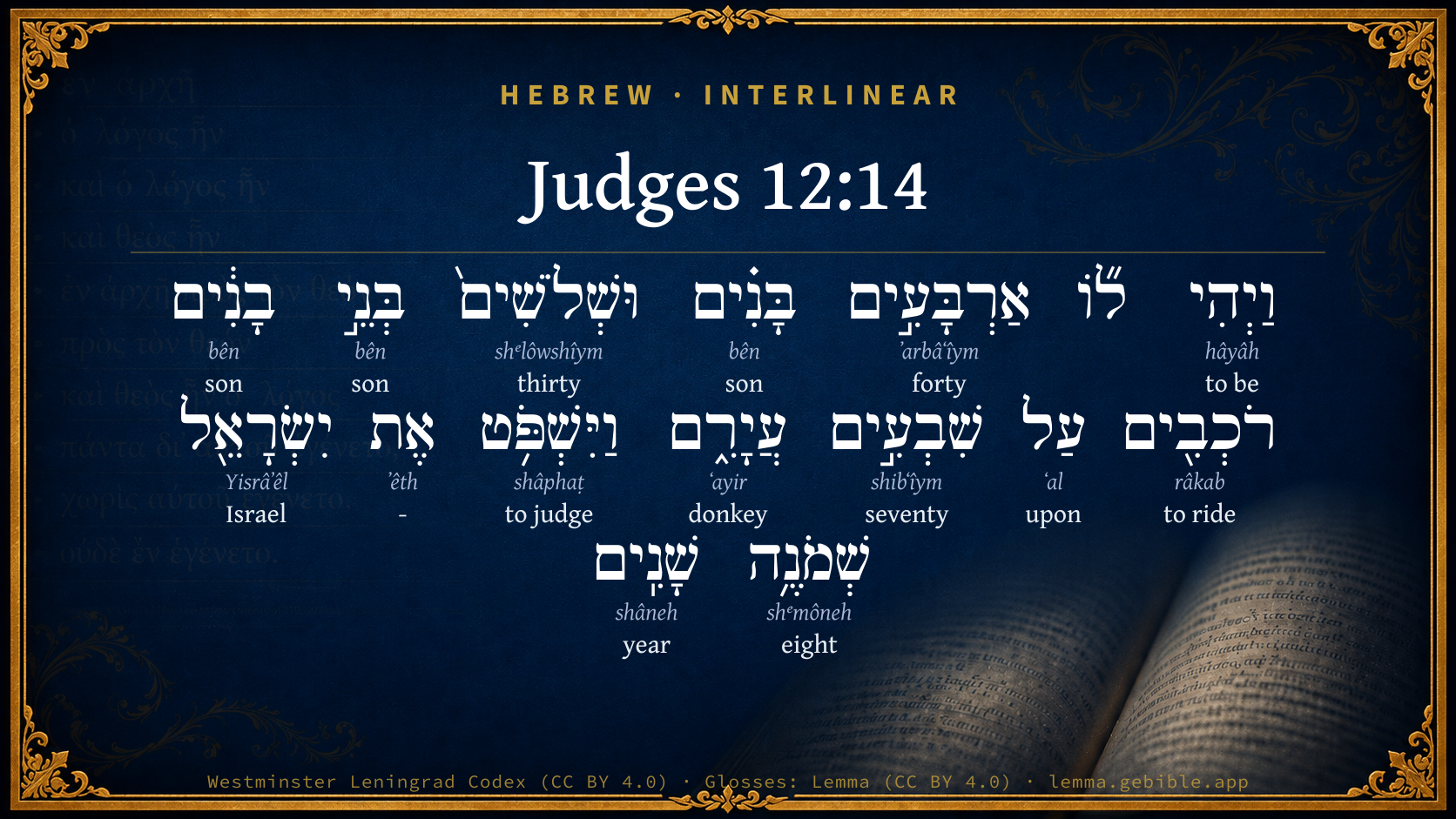
Hebrew (Westminster Leningrad Codex) Judges 12:14 appears in the Hebrew Old Testament. The text above is from the Westminster Leningrad Codex. Each word links to its Strong’s number, a concise gloss, and parsing drawn from the Open Scriptures Hebrew Bible morphology. Click any word for its full Brown-Driver-Briggs (BDB) entry.
Download image
Cite this verse

Judges 12:14 (World English Bible). Public Domain. Lemma interlinear Bible study tool, https://lemma.gebible.app/v/judges/12/14.

Show BibTeX & RIS
BibTeX
RIS
English Translation
He had forty sons and thirty sons' sons, who rode on seventy donkey colts: and he judged Israel eight years.
World English Bible · Public Domain
Download a study sheet

One document with this verse’s original text, its word-by-word gloss line, the meaning frame, cross-references with their text, attributed commentary, and full source and license credits — printable, and it pastes into notes with its structure intact.

This verse Autodidact and up

Study sheet (.html) Plain text (.txt)

A passage Seminary Student

Up to 50 verses in one chapter. A passage sheet keeps up to 6 commentary sources and 12 cross-references per verse, in the order this page ranks them, and says so on the sheet whenever that leaves anything out. Ask for a single verse and you get the Autodidact verse sheet above.

Everything on this page stays free to read, with no account — the sheet is a download of what is already on screen, not access to it.

Want to remove ads? Support Godless Engineer
Compare translations 3

The same verse in 3 English versions, stacked beneath the original-language interlinear above. Click any original word for its lexicon entry.

Each is an independent rendering of the whole verse — the interlinear is not word-aligned to these translations.

Highlighted words mark where these versions differ — a whole-verse word diff, not a word-by-word alignment.

  • World English Bible Public Domain
    He had forty sons and thirty sons' sons, who rode on seventy donkey colts: and he judged Israel eight years.
  • King James Version Public Domain
    And he had forty sons and thirty nephews, that rode on threescore and ten ass colts: and he judged Israel eight years.
  • unfoldingWord Literal Text CC BY-SA 4.0
    And 40 sons and 30 sons of sons were to him, riding on 70 donkeys. And he judged Israel eight years.

unfoldingWord Literal Text — © unfoldingWord, licensed CC BY-SA 4.0. Word-aligned USFM3 via Door43 (git.door43.org/unfoldingWord/en_ult).

Versions to compare (up to 4)

3 of 4 selected

Show all 18 translations

Every available English version of this verse, each an independent rendering of the whole verse.

  • World English Bible Public Domain
    He had forty sons and thirty sons' sons, who rode on seventy donkey colts: and he judged Israel eight years.
  • Berean Standard Bible Public Domain
    He had forty sons and thirty grandsons, who rode on seventy donkeys. And he judged Israel eight years.
  • Majority Standard Bible Public Domain
    He had forty sons and thirty grandsons, who rode on seventy donkeys. And he judged Israel eight years.
  • King James Version Public Domain
    And he had forty sons and thirty nephews, that rode on threescore and ten ass colts: and he judged Israel eight years.
  • American Standard Version (1901) Public Domain
    And he had forty sons and thirty sons' sons, that rode on threescore and ten ass colts: and he judged Israel eight years.
  • Revised Version (1885) Public Domain
    And he had forty sons and thirty sons’ sons, that rode on threescore and ten ass colts: and he judged Israel eight years.
  • Geneva Bible (1599) Public Domain
    And he had fourty sonnes and thirtie nephewes that rode on seuentie assecoltes: and he iudged Israel eight yeeres.
  • Douay-Rheims (1899) Public Domain
    And he had forty sons, and of them thirty grandsons, mounted upon seventy ass colts, and he judged Israel eight years:
  • Young's Literal Translation Public Domain
    and he hath forty sons, and thirty grandsons, riding on seventy ass-colts, and he judgeth Israel eight years.
  • Literal Standard Version CC BY-SA 4.0
    and he has forty sons, and thirty grandsons, riding on seventy donkey-colts, and he judges Israel [for] eight years.
  • Unlocked Literal Bible CC BY-SA 4.0
    He had forty sons and thirty grandsons. They rode on seventy donkeys, and he judged Israel for eight years.
  • unfoldingWord Literal Text CC BY-SA 4.0
    And 40 sons and 30 sons of sons were to him, riding on 70 donkeys. And he judged Israel eight years.
  • Darby Bible Public Domain
    He had forty sons and thirty grandsons, who rode on seventy asses; and he judged Israel eight years.
  • World Messianic Bible Public Domain
    He had forty sons and thirty sons’ sons who rode on seventy donkey colts. He judged Israel eight years.
  • Webster's Bible Public Domain
    And he had forty sons and thirty nephews, that rode on seventy ass colts: and he judged Israel eight years.
  • Free Bible Version CC BY-SA 4.0
    He had forty sons and thirty grandsons, who rode seventy donkeys. He led Israel as judge for eight years.
  • Bible in Basic English Public Domain
    He had forty sons and thirty sons' sons who went on seventy young asses; and he was judge of Israel for eight years.
  • JPS Tanakh (1917) Public Domain
    And he had forty sons and thirty sons' sons, that rode on threescore and ten ass colts; and he judged Israel eight years.

Literal Standard Version (2020), Covenant Press — licensed CC BY-SA 4.0. Text via the HelloAO Bible API (eBible.org). Unlocked Literal Bible (unfoldingWord) — licensed CC BY-SA 4.0. Text via the HelloAO Bible API (eBible.org). unfoldingWord Literal Text — © unfoldingWord, licensed CC BY-SA 4.0. Word-aligned USFM3 via Door43 (git.door43.org/unfoldingWord/en_ult). Free Bible Version, Dr. Jonathan Gallagher — licensed CC BY-SA 4.0. Text via the HelloAO Bible API (eBible.org).

Word by word

More ways to search: Search by grammar → Find every occurrence → Compare this word →

Practice this passage: Drill this verse → Learn its vocabulary →

עֲיָרִ֑ם
ʻayir
H5895
“donkeys”
Noun, Common, Masculine, Plural, Absolute
Part of Speech
Noun
Type
Common
Gender
Masculine
Number
Plural
State
Absolute
Full BDB Definition

Origin: from H5782 in the sense of raising (ie bearing a burden)

TWOT: 1616a

he-ass, male ass
  1. וַיְהִי hâyâh H1961 “and · to be” Conjunction + Verb, Qal, Sequential Imperfect, 3rd Person, Masculine, Singular
  2. אַרְבָּעִ֣ים ʼarbâʻîym H705 “forty” Adjective, Cardinal number, Both, Plural, Absolute
  3. בָּנִ֗ים bên H1121 “sons” Noun, Common, Masculine, Plural, Absolute
  4. וּשְׁלֹשִׁים֙ shᵉlôwshîym H7970 “and · thirty” Conjunction + Adjective, Cardinal number, Both, Plural, Absolute
  5. בְּנֵ֣י bên H1121 “sons of” Noun, Common, Masculine, Plural, Construct
  6. בָנִ֔ים bên H1121 “sons” Noun, Common, Masculine, Plural, Absolute
  7. רֹכְבִ֖ים râkab H7392 “riding” Verb, Qal, Participle Active, Masculine, Plural, Absolute
  8. עַל ʻal H5921 “upon” Preposition
  9. שִׁבְעִ֣ים shibʻîym H7657 “seventy” Adjective, Cardinal number, Both, Plural, Absolute
  10. וַיִּשְׁפֹּ֥ט shâphaṭ H8199 “and · to judge” Conjunction + Verb, Qal, Sequential Imperfect, 3rd Person, Masculine, Singular
  11. אֶת ʼêth H853 “-” Particle, Direct Object
  12. יִשְׂרָאֵ֖ל Yisrâʼêl H3478 “Israel” Noun, Proper
  13. שְׁמֹנֶ֥ה shᵉmôneh H8083 “eight” Adjective, Cardinal number, Feminine, Singular, Absolute
  14. שָׁנִֽים shâneh H8141 “years” Noun, Common, Feminine, Plural, Absolute

About this verse

These counts appear in no published source. They are computed here, from the morphology-tagged text and Lemma’s own curated glosses. What Lemma adds →

16
words
13
distinct lemmas
Historical
section

Notable vocabulary

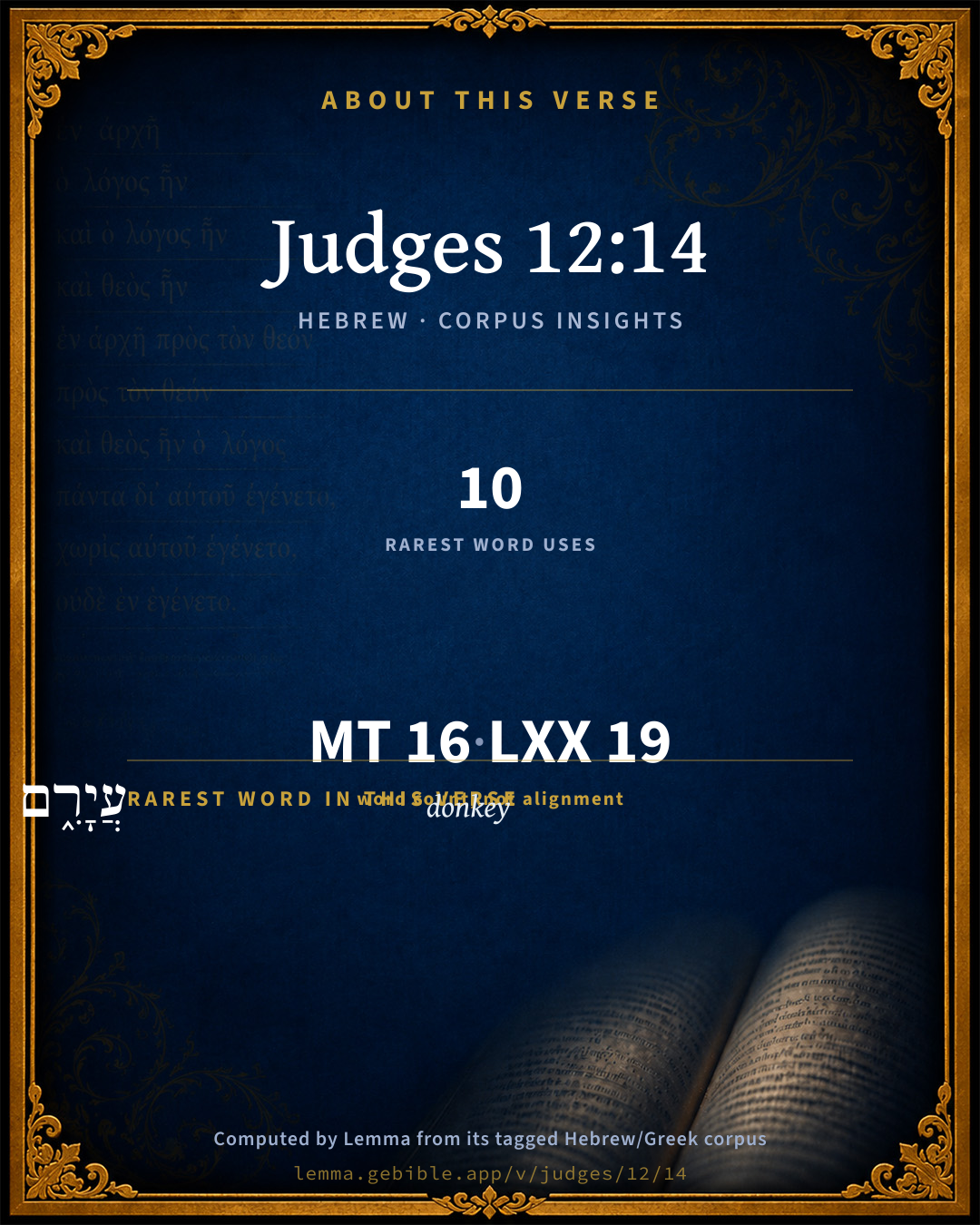
The rarest word here is עֲיָרִ֑ם donkey H5895 — appearing just 10 times in the whole Hebrew Bible.

Shared distinctive vocabulary

עֲיָרִ֑ם donkey H5895 occurs in 8 verses of the Hebrew Bible. Also found in:

Grammatical profile

  • 3 verbs
  • 6 nouns
  • 4 adjectives
  • 2 prepositions
  • 1 particle

Verb forms

  • וַיְהִי Qal · Sequential Imperfect
  • רֹכְבִ֖ים Qal · Participle Active
  • וַיִּשְׁפֹּ֥ט Qal · Sequential Imperfect

Repetition

A word recurs within this verse — often emphatic in Hebrew:

  • בָּנִ֗ים son H1121 ×3

Hebrew & Septuagint length

In English translation the verse runs 20 words from the Hebrew and 19 from the Septuagint (LXX English) — closely comparable.

A rough comparison of the two English renderings, which tokenize alike — not a word-level alignment.

Word counts can differ between the Hebrew and the Greek without any difference in meaning — e.g. the Hebrew direct-object marker אֵת has no separate Greek word, and Greek often adds the article ὁ.

In the original languages it is 16 Hebrew tokens and 19 Greek tokens — but the two are counted differently (Hebrew bundles its prefixes and suffixes into one token; the Greek is in lemma form), so that isn’t a like-for-like length.

Cross-references

2

Topical passages linked to Judges 12:14 in the Treasury of Scripture Knowledge — connected by theme and wording, ordered by reader-vote popularity; previews shown in the World English Bible.

  • Judges 5:10 Tell [of it], you who ride on white donkeys, You who sit on rich carpets, You who walk by the way.
  • Judges 10:4 He had thirty sons who rode on thirty donkey colts, and they had thirty cities, which are called Havvoth Jair to this day, which are in the land of Gilead.

Cross-references courtesy of OpenBible.info (CC BY 4.0).

Hebrew and Greek witnesses Masoretic Hebrew ↔ Greek Septuagint

The same verse in the two great witnesses to the Old Testament, shown verse-for-verse.

These are two independent witnesses, not word-aligned to each other, and the Septuagint is shown in lemma (dictionary) form.

Hebrew Judges 12:14 Masoretic · Westminster Leningrad Codex

וַיְהִי ל֞וֹ אַרְבָּעִ֣ים בָּנִ֗ים וּשְׁלֹשִׁים֙ בְּנֵ֣י בָנִ֔ים רֹכְבִ֖ים עַל שִׁבְעִ֣ים עֲיָרִ֑ם וַיִּשְׁפֹּ֥ט אֶת יִשְׂרָאֵ֖ל שְׁמֹנֶ֥ה שָׁנִֽים

He had forty sons and thirty sons' sons, who rode on seventy donkey colts: and he judged Israel eight years.

World English Bible · Public Domain

Greek LXX Judges 12:14 Septuagint · lemma form

καί εἰμί αὐτός τεσσαράκοντα υἱός καί τριάκοντα υἱός υἱός ἐπιβαίνω ἐπί ἑβδομήκοντα πῶλος καί κρίνω ὁ ἰσραήλ ὀκτώ ἔτος

And he had forty sons, and thirty grandsons, that rode upon seventy colts: and he judged Israel eight years.

LXX2012 (modern English Septuagint) · Public Domain

On this verse, Ellicott's Commentary for English Readers discusses the Septuagint’s reading. Read the note in Commentary ↓

Hebrew: Westminster Leningrad Codex (CC BY 4.0). Greek: Septuagint (public domain); English from LXX2012 (modern English Septuagint) (Public Domain). How the Septuagint differs from the Hebrew →

Targum (Aramaic paraphrase)

1

The Targum is the ancient Jewish Aramaic paraphrase of the Hebrew Scriptures — an interpretive translation, not the Hebrew text itself. Onkelos (literal) and Pseudo-Jonathan (expansive) render the Torah, and Jonathan the Prophets. Coverage is partial: where no permissively-licensed English translation exists for a verse, only the Aramaic is shown. This is verse-level text, not a word-by-word alignment to the Hebrew.

  1. Targum Jonathan Prophets (Joshua–Malachi)
    וַהֲוָה לֵיהּ אַרְבְּעִין בְּנִין וּתְלָתִין בְּנֵי בְנִין רְכִיבִין עַל שַׁבְעִין עַיְלִין וְדָן יַת יִשְׂרָאֵל תְּמַנְיָא שְׁנִין:

    (no public-domain English translation for this verse)

    Targum Jonathan — Aramaic: “Mikraot Gedolot” (public domain). English: “Sefaria Community Translation” (CC0 1.0 (public-domain dedication)); “London "Chaldee Paraphrase," 1871” (public domain). Text via Sefaria.

Commentary

Notes on Judges 12:14 from classic Christian and Jewish commentators (each source and its license shown beneath its notes). The classic Christian expositions comment on the surrounding passage and are grouped to its opening verse, so a note may address several verses; the Jewish commentaries on the Tanakh (Rashi and others) are per-verse, so they appear only where the commentator wrote on this verse.

Lemma curates 59 commentaries, every one of them public domain or Creative Commons licensed, each selected and text-cleaned for this edition rather than reprinted as found. About our sources →

Trapp's Complete Commentary

John Trapp

Jdg 12:14 And he had forty sons and thirty nephews, that rode on threescore and ten ass colts: and he judged Israel eight years.

Ver. 14. And he had forty sons and thirty nephews, that rode.] Equestris ordinis, potent and opulent. In Persia the peasant never rides; the gentleman never goes on foot, but fights, trades, confers, doth all on horseback. {a}

{a} The Preacher’s Travels, 63.

John Trapp, A Commentary or Exposition upon All the Books of the Old and New Testament (1647–1656) — public domain. Text from a community e-Sword module.

Geneva Bible (1599)

Geneva Bible translators

Hebrew, sons’ sons.

Or, horse colts.

Geneva Bible (1599) marginal notes — public domain. Text via Bolls.life.

Ellicott's Commentary for English Readers

(14) Thirty nephews.—The Hebrew has “sons of sons” (benî bhanîm), and the word nephews in our version always means “grandsons” (nepoles), e.g., in Job_18:19, Isa_14:22, 1Ti_5:4, as in old English generally; similarly nieces means “granddaughters” in Wiclif’s Bible (Gen_31:43, &c). “The Emperor Augustus . . . saw ere he died the nephew of his niece, that is to say, his progenie to the fourth degree of lineal descent” (Holland’s Pliny, vii. 13; Bible Word Book).

That rode on threescore and ten ass colts.—Riding on asses’ foals in trappings of state implies that they were all wealthy and distinguished persons (Jdg_10:4)—perhaps, like the Turkish pennon on the horsetail, that they commanded a division (Ewald, 2:38, 39). Again the LXX. euphemise the ass-colts into the grand and poetic word pôlous. Josephus says that Abdon used to ride in state with his seventy sons and grandsons, “who were all very skilful in riding horses.”

A Bible Commentary for English Readers, edited by Charles John Ellicott (1878–1897) — public domain. Text from a community e-Sword module.

Haydock's Catholic Bible Commentary

Forty sons. At this we need not be surprised, in a country where polygamy prevailed. Priam had 50 sons, and the Turks have often as many. --- Colts. This was as great a distinction as to keep one’s coach among us, chap. x. 4. (Calmet) --- This judge succeeded Ahialon, in the year of the world 2872, in the year before Christ 1182, the year after Troy was taken, having endured a ten years’ siege, by the treachery of Antenor, and of Æneas, Dictys, &c. Dares says the Greeks lost 886,000, and the Trojans 676,000, before the city was taken. (Salien)

George Leo Haydock (1774–1849), Haydock's Catholic Family Bible and Commentary, 1859 edition — public domain. Excludes Psalms (Douay-Rheims chapter numbering differs from Protestant) and Deuterocanonical books (Catholic canon only).

Whedon's Commentary on the Bible

Daniel D. Whedon

14. Thirty nephews — Rather, grandsons. His family greatness was much like that of Ibzan and of Jair. Forty sons and thirty grandsons, seventy in all, made up a perfect number, and was of itself a fact worth recording.

Threescore and ten ass colts — One for each child. Compare notes on Jdg_5:10; Jdg_10:4.

Daniel D. Whedon (gen. ed.), Commentary on the Old and New Testaments (1874–1909) — public domain. Text from a community e-Sword module.

The Pulpit Commentary

Nephews. Rather, grandsons. Hebrew, sons son. The number of his family, and their being all mounted on asses, are indications of his wealth and state, (see above, Jud_1:8:30 10:4) and perhaps also of peaceful and prosperous times.

The Pulpit Commentary (1880–1919), ed. H.D.M. Spence-Jones & Joseph S. Exell — public domain. Text from a community e-Sword module.

Lesson kit

Teaching starters — assembled from the data on this page, not authored interpretation. Every prompt links to the verse data it draws on. Edit before teaching.

Judges, in the Historical, opens this verse with 16 words (13 distinct Hebrew lemmas). Its most distinctive word is ʻayir (“donkey”). A historical commentator’s framing appears above. Read the whole chapter for the surrounding context.

Discussion questions

  1. What does “donkey” (ʻayir) contribute to the verse as a whole?
  2. Genesis 32:15 shares the word «donkey» with this verse. How do the two illuminate each other?
  3. “son” occurs 3× in this one verse. What is the effect of the repetition?
  4. The translations on this page render this verse differently — a whole-verse word diff, not a word-by-word alignment. What might account for the different wordings?
  5. The verb «וַיְהִי» is Qal Sequential Imperfect. How does its form color the action?
  6. Reading how Trapp's Complete Commentary and Geneva Bible (1599) read this verse, where do the two commentators agree and where do they part?

Things to notice

Reading settings

Reading text

Shown beneath each verse's original-language words.

Old Testament
Old Testament edition

Read the OT as the Masoretic Hebrew (MT) or the Greek Septuagint (LXX).

English shown for the Greek Septuagint (in the Hebrew ↔ Greek comparison).

Comparing translations? Open the Compare panel on any verse page to stack up to four side by side.