1 Samuel 12:7

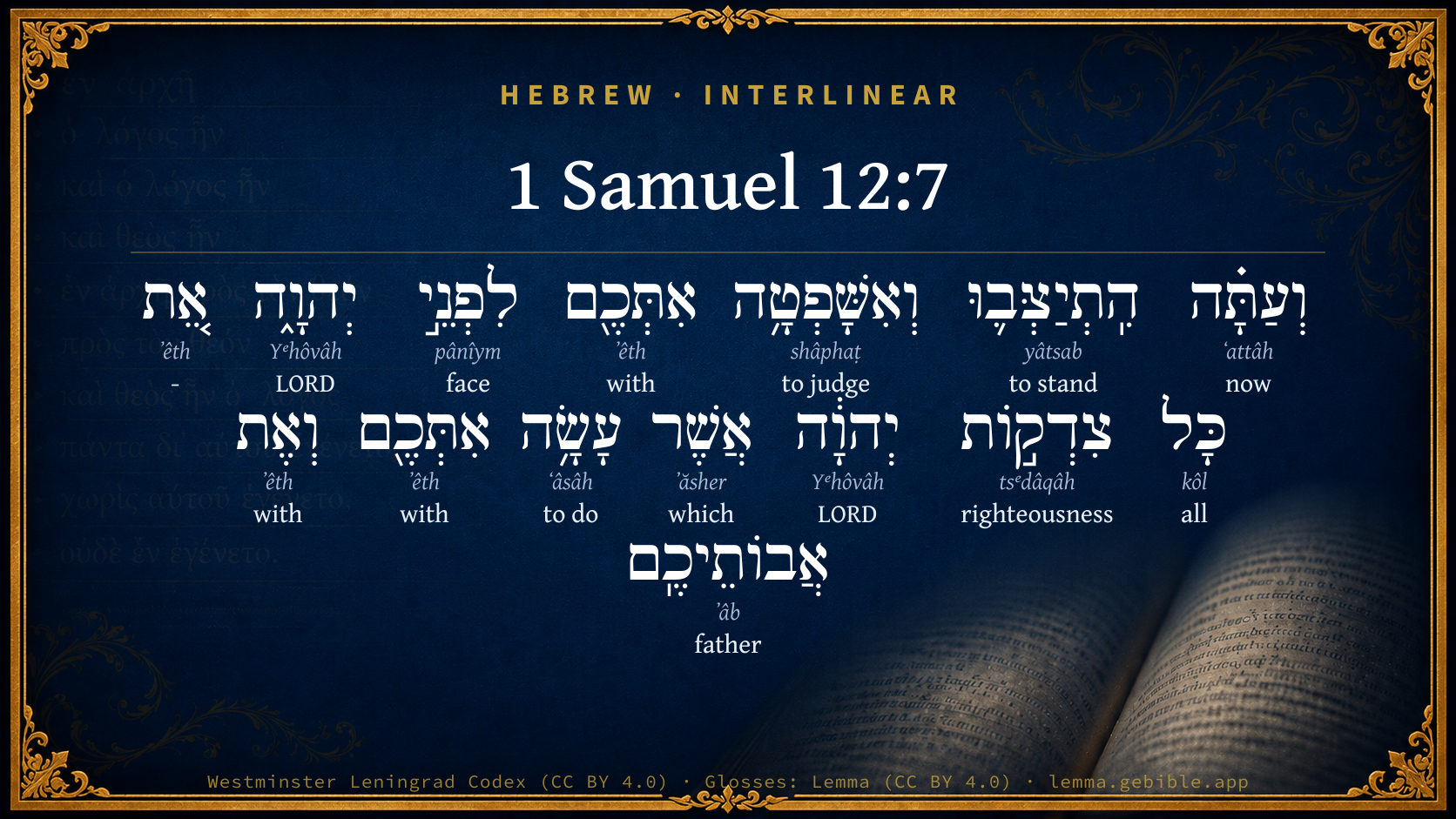
Hebrew (Westminster Leningrad Codex) 1 Samuel 12:7 appears in the Hebrew Old Testament. The text above is from the Westminster Leningrad Codex. Each word links to its Strong’s number, a concise gloss, and parsing drawn from the Open Scriptures Hebrew Bible morphology. Click any word for its full Brown-Driver-Briggs (BDB) entry.
Download image
Cite this verse

1 Samuel 12:7 (World English Bible). Public Domain. Lemma interlinear Bible study tool, https://lemma.gebible.app/v/1-samuel/12/7.

Show BibTeX & RIS
BibTeX
RIS
English Translation
Now therefore stand still, that I may plead with you before Yahweh concerning all the righteous acts of Yahweh, which he did to you and to your fathers.
World English Bible · Public Domain
Download a study sheet

One document with this verse’s original text, its word-by-word gloss line, the meaning frame, cross-references with their text, attributed commentary, and full source and license credits — printable, and it pastes into notes with its structure intact.

This verse Autodidact and up

Study sheet (.html) Plain text (.txt)

A passage Seminary Student

Up to 50 verses in one chapter. A passage sheet keeps up to 6 commentary sources and 12 cross-references per verse, in the order this page ranks them, and says so on the sheet whenever that leaves anything out. Ask for a single verse and you get the Autodidact verse sheet above.

Everything on this page stays free to read, with no account — the sheet is a download of what is already on screen, not access to it.

Want to remove ads? Support Godless Engineer
Compare translations 3

The same verse in 3 English versions, stacked beneath the original-language interlinear above. Click any original word for its lexicon entry.

Each is an independent rendering of the whole verse — the interlinear is not word-aligned to these translations.

Highlighted words mark where these versions differ — a whole-verse word diff, not a word-by-word alignment.

  • World English Bible Public Domain
    Now therefore stand still, that I may plead with you before Yahweh concerning all the righteous acts of Yahweh, which he did to you and to your fathers.
  • King James Version Public Domain
    Now therefore stand still, that I may reason with you before the LORD of all the righteous acts of the LORD, which he did to you and to your fathers.
  • unfoldingWord Literal Text CC BY-SA 4.0
    And now, station yourselves and let me be judged with you to the face of Yahweh with all of the righteousness of Yahweh that he has done with you and with your fathers.

unfoldingWord Literal Text — © unfoldingWord, licensed CC BY-SA 4.0. Word-aligned USFM3 via Door43 (git.door43.org/unfoldingWord/en_ult).

Versions to compare (up to 4)

3 of 4 selected

Show all 18 translations

Every available English version of this verse, each an independent rendering of the whole verse.

  • World English Bible Public Domain
    Now therefore stand still, that I may plead with you before Yahweh concerning all the righteous acts of Yahweh, which he did to you and to your fathers.
  • Berean Standard Bible Public Domain
    Now present yourselves, so that I may confront you before the LORD with all the righteous acts He has done for you and your fathers.
  • Majority Standard Bible Public Domain
    Now present yourselves, so that I may confront you before the LORD with all the righteous acts He has done for you and your fathers.
  • King James Version Public Domain
    Now therefore stand still, that I may reason with you before the LORD of all the righteous acts of the LORD, which he did to you and to your fathers.
  • American Standard Version (1901) Public Domain
    Now therefore stand still, that I may plead with you before Jehovah concerning all the righteous acts of Jehovah, which he did to you and to your fathers.
  • Revised Version (1885) Public Domain
    Now therefore stand still, that I may plead with you before the LORD concerning all the righteous acts of the LORD, which he did to you and to your fathers.
  • Geneva Bible (1599) Public Domain
    Nowe therefore stand still, that I may reason with you before the Lord according to all the righteousnesse of the Lord, which he shewed to you and to your fathers.
  • Douay-Rheims (1899) Public Domain
    Now therefore stand up, that I may plead in judgment against you before the Lord, concerning all the kindness of the Lord, which he hath shewn to you, and to your fathers:
  • Young's Literal Translation Public Domain
    and, now, station yourselves, and I judge you before Jehovah, with all the righteous acts of Jehovah, which He did with you, and with your fathers.
  • Literal Standard Version CC BY-SA 4.0
    And now, station yourselves, and I judge you before YHWH, with all the righteous acts of YHWH, which He did with you, and with your fathers.
  • Unlocked Literal Bible CC BY-SA 4.0
    Now then, present yourself, so that I may plead with you before Yahweh about all of the righteous deeds of Yahweh, which he did for you and your fathers.
  • unfoldingWord Literal Text CC BY-SA 4.0
    And now, station yourselves and let me be judged with you to the face of Yahweh with all of the righteousness of Yahweh that he has done with you and with your fathers.
  • Darby Bible Public Domain
    And now stand still, that I may plead with you before Jehovah of all the righteous acts of Jehovah which he did to you and to your fathers.
  • World Messianic Bible Public Domain
    Now therefore stand still, that I may plead with you before the LORD concerning all the righteous acts of the LORD, which he did to you and to your fathers.
  • Webster's Bible Public Domain
    Now therefore stand still, that I may reason with you before the LORD of all the righteous acts of the LORD, which he did to you and to your fathers.
  • Free Bible Version CC BY-SA 4.0
    So stand here as I present to you in the presence of the Lord the evidence of all the good things the Lord has done for you and your forefathers.
  • Bible in Basic English Public Domain
    Keep your places now, while I take up the argument with you before the Lord, and give you the story of the righteousness of the Lord, which he has made clear by his acts to you and to your fathers.
  • JPS Tanakh (1917) Public Domain
    Now therefore stand still, that I may plead with you before the LORD concerning all the righteous acts of the LORD, which He did to you and to your fathers.

Literal Standard Version (2020), Covenant Press — licensed CC BY-SA 4.0. Text via the HelloAO Bible API (eBible.org). Unlocked Literal Bible (unfoldingWord) — licensed CC BY-SA 4.0. Text via the HelloAO Bible API (eBible.org). unfoldingWord Literal Text — © unfoldingWord, licensed CC BY-SA 4.0. Word-aligned USFM3 via Door43 (git.door43.org/unfoldingWord/en_ult). Free Bible Version, Dr. Jonathan Gallagher — licensed CC BY-SA 4.0. Text via the HelloAO Bible API (eBible.org).

Word by word

More ways to search: Search by grammar → Find every occurrence → Compare this word →

Practice this passage: Drill this verse → Learn its vocabulary →

הִֽתְיַצְּב֛וּ
yâtsab
H3320
“stand”
Verb, Hithpael, Imperative, 2nd Person, Masculine, Plural
Part of Speech
Verb
Stem
Hithpael
Form
Imperative
Person
2nd Person
Gender
Masculine
Number
Plural
Full BDB Definition

Origin: a primitive root

TWOT: 894

to place, set, stand, set or station oneself, present oneself - (Hithpael) to station oneself, take one's stand, stand, present oneself, stand with someone
  1. וְעַתָּ֗ה ʻattâh H6258 “and · now” Conjunction + Adverb
  2. וְאִשָּׁפְטָ֥ה shâphaṭ H8199 “and · to judge” Conjunction + Verb, Niphal, Cohortative, 1st Person, Common, Singular
  3. אִתְּכֶ֖ם ʼêth H854 “with · you” Preposition + Suffix, Personal, 2nd Person, Masculine, Plural
  4. לִפְנֵ֣י pânîym H6440 “to/for · face(s) of” Preposition + Noun, Common, Both, Plural, Construct
  5. יְהוָ֑ה Yᵉhôvâh H3068 “LORD” Noun, Proper
  6. אֵ֚ת ʼêth H853 “-” Particle, Direct Object
  7. כָּל kôl H3605 “all of” Noun, Common, Masculine, Singular, Construct
  8. צִדְק֣וֹת tsᵉdâqâh H6666 “righteous acts of” Noun, Common, Feminine, Plural, Construct
  9. יְהוָ֔ה Yᵉhôvâh H3068 “LORD” Noun, Proper
  10. אֲשֶׁר ʼăsher H834 “which” Particle, Relative
  11. עָשָׂ֥ה ʻâsâh H6213 “to do” Verb, Qal, Perfect, 3rd Person, Masculine, Singular
  12. אִתְּכֶ֖ם ʼêth H854 “with · you” Preposition + Suffix, Personal, 2nd Person, Masculine, Plural
  13. וְאֶת ʼêth H854 “and · with” Conjunction + Preposition
  14. אֲבוֹתֵיכֶֽם ʼâb H1 “fathers · your” Noun, Common, Masculine, Plural, Construct + Suffix, Personal, 2nd Person, Masculine, Plural

About this verse

These counts appear in no published source. They are computed here, from the morphology-tagged text and Lemma’s own curated glosses. What Lemma adds →

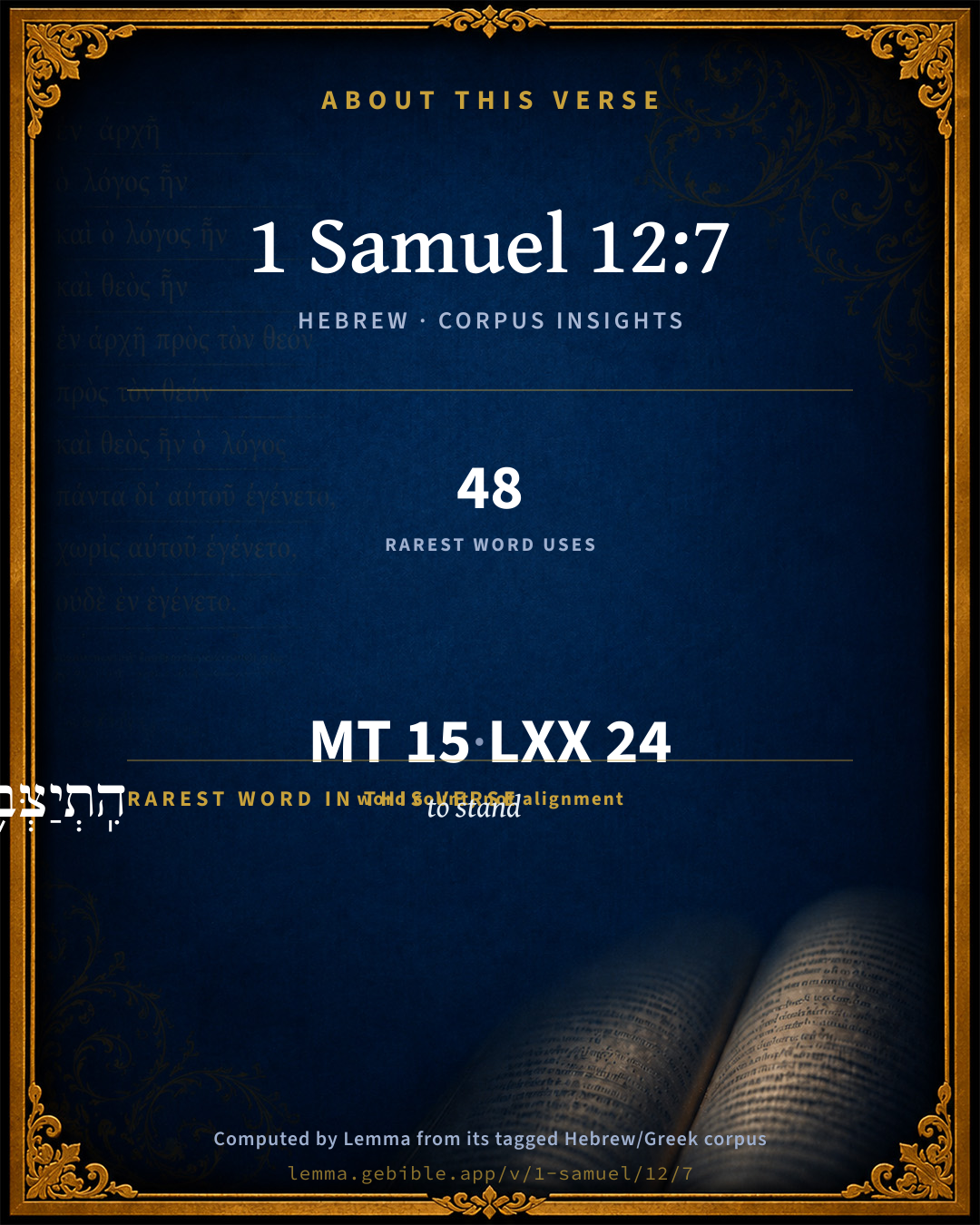
15
words
12
distinct lemmas
Historical
section

Shared distinctive vocabulary

הִֽתְיַצְּב֛וּ to stand H3320 occurs in 45 verses of the Hebrew Bible. Also found in:

Grammatical profile

  • 3 verbs
  • 6 nouns
  • 3 prepositions
  • 1 adverb
  • 2 particles

Verb forms

  • הִֽתְיַצְּב֛וּ Hithpael · Imperative
  • וְאִשָּׁפְטָ֥ה Niphal · Cohortative
  • עָשָׂ֥ה Qal · Perfect

Repetition

Words recur within this verse — often emphatic in Hebrew:

  • יְהוָ֑ה LORD H3068 ×2
  • אִתְּכֶ֖ם with H854 ×3

Hebrew & Septuagint length

In English translation the verse runs 28 words from the Hebrew and 35 from the Septuagint (LXX English) — closely comparable.

A rough comparison of the two English renderings, which tokenize alike — not a word-level alignment.

Word counts can differ between the Hebrew and the Greek without any difference in meaning — e.g. the Hebrew direct-object marker אֵת has no separate Greek word, and Greek often adds the article ὁ.

In the original languages it is 15 Hebrew tokens and 24 Greek tokens — but the two are counted differently (Hebrew bundles its prefixes and suffixes into one token; the Greek is in lemma form), so that isn’t a like-for-like length.

Cross-references

6

Topical passages linked to 1 Samuel 12:7 in the Treasury of Scripture Knowledge — connected by theme and wording, ordered by reader-vote popularity; previews shown in the World English Bible.

  • Isaiah 1:18 "Come now, and let us reason together," says Yahweh: "Though your sins be as scarlet, they shall be as white as snow. Though they be red like crimson, they shall be as wool.
  • Isaiah 5:3–4 "Now, inhabitants of Jerusalem and men of Judah, Please judge between me and my vineyard.
  • Ezekiel 18:25–30 Yet you say, The way of the Lord is not equal. Hear now, house of Israel: Is my way not equal? Aren't your ways unequal?
  • Micah 6:1–5 Listen now to what Yahweh says: "Arise, plead your case before the mountains, And let the hills hear what you have to say.
  • Acts 17:3 explaining and demonstrating that the Christ had to suffer and rise again from the dead, and saying, "This Jesus, whom I proclaim to you, is the Christ."
  • Judges 5:11 Far from the noise of archers, in the places of drawing water, There shall they rehearse the righteous acts of Yahweh, [Even] the righteous acts of his rule in Israel. Then the people of Yahweh went down to the gates.

Cross-references courtesy of OpenBible.info (CC BY 4.0).

Hebrew and Greek witnesses Masoretic Hebrew ↔ Greek Septuagint

The same verse in the two great witnesses to the Old Testament, shown verse-for-verse.

These are two independent witnesses, not word-aligned to each other, and the Septuagint is shown in lemma (dictionary) form.

Hebrew 1 Samuel 12:7 Masoretic · Westminster Leningrad Codex

וְעַתָּ֗ה הִֽתְיַצְּב֛וּ וְאִשָּׁפְטָ֥ה אִתְּכֶ֖ם לִפְנֵ֣י יְהוָ֑ה אֵ֚ת כָּל צִדְק֣וֹת יְהוָ֔ה אֲשֶׁר עָשָׂ֥ה אִתְּכֶ֖ם וְאֶת אֲבוֹתֵיכֶֽם

Now therefore stand still, that I may plead with you before Yahweh concerning all the righteous acts of Yahweh, which he did to you and to your fathers.

World English Bible · Public Domain

Greek LXX 1 Samuel 12:7 Septuagint · lemma form

καί νῦν καταἵστημι καί δικάζω σύ ἐνώπιον κύριος καί ἀποἀγγέλλω σύ ὁ πᾶς δικαιοσύνη κύριος ὅς ποιέω ἐν σύ καί ἐν ὁ πατήρ σύ

And now stand still, and I will judge you before the Lord; and I will relate to you all the righteousness of the Lord, the things which he has wrought among you and your fathers.

LXX2012 (modern English Septuagint) · Public Domain

On this verse, Haydock's Catholic Bible Commentary discusses the Septuagint’s reading. Read the note in Commentary ↓

Hebrew: Westminster Leningrad Codex (CC BY 4.0). Greek: Septuagint (public domain); English from LXX2012 (modern English Septuagint) (Public Domain). How the Septuagint differs from the Hebrew →

Targum (Aramaic paraphrase)

1

The Targum is the ancient Jewish Aramaic paraphrase of the Hebrew Scriptures — an interpretive translation, not the Hebrew text itself. Onkelos (literal) and Pseudo-Jonathan (expansive) render the Torah, and Jonathan the Prophets. Coverage is partial: where no permissively-licensed English translation exists for a verse, only the Aramaic is shown. This is verse-level text, not a word-by-word alignment to the Hebrew.

  1. Targum Jonathan Prophets (Joshua–Malachi)
    וּכְעַן אִתְעַתָּדוּ וְאִיתְוַכַּח עִמְכוֹן קֳדָם יְיָ יַת כָּל זַכְוָתָא דַייָ דַעֲבַד עִמְכוֹן וְעִם אַבָהַתְכוֹן:

    (no public-domain English translation for this verse)

    Targum Jonathan — Aramaic: “Mikraot Gedolot” (public domain). English: “Sefaria Community Translation” (CC0 1.0 (public-domain dedication)); “London "Chaldee Paraphrase," 1871” (public domain). Text via Sefaria.

Commentary

Notes on 1 Samuel 12:7 from classic Christian and Jewish commentators (each source and its license shown beneath its notes). The classic Christian expositions comment on the surrounding passage and are grouped to its opening verse, so a note may address several verses; the Jewish commentaries on the Tanakh (Rashi and others) are per-verse, so they appear only where the commentator wrote on this verse.

Lemma curates 59 commentaries, every one of them public domain or Creative Commons licensed, each selected and text-cleaned for this edition rather than reprinted as found. About our sources →

Trapp's Complete Commentary

John Trapp

1Sa 12:7 Now therefore stand still, that I may reason with you before the LORD of all the righteous acts of the LORD, which he did to you and to your fathers.

Ver. 7. Now therefore stand still.] Bustle not, bristle not, but suffer the words of reproof and admonition. A proud person would have replied, Who can stand still to have his eyes picked out? A headstrong horse casteth his rider, and riseth up against him.

That I may reason with you.] Or, Contend with you in judgment. Sweetly said Epictetus, A faithful and prudent reprover is a Mercury, or messenger sent from God, to reduce a man to better practice.

John Trapp, A Commentary or Exposition upon All the Books of the Old and New Testament (1647–1656) — public domain. Text from a community e-Sword module.

Joseph Benson's Commentary

1Sa 12:7. Now, therefore, stand still — Having obtained an honourable testimony from them as to his own conduct, he would not dismiss them till he had represented to them the great benefits which they had received from God, and their ingratitude to him. Of all the righteous acts of the Lord — Hebrews the righteousnesses; that is, mercies or benefits, the chief subject of the following discourse; some of their calamities being but briefly named, and that for the illustration of God’s mercy in their deliverances.

Joseph Benson's Commentary on the Old and New Testaments (1811–1818) — public domain. Text from a community e-Sword module.

Geneva Bible (1599)

Geneva Bible translators

Or, benefits.

Geneva Bible (1599) marginal notes — public domain. Text via Bolls.life.

Jamieson, Fausset & Brown

Robert Jamieson, A. R. Fausset & David Brown

HE REPROVES THE PEOPLE FOR INGRATITUDE. (Sa1 12:6-16)

Now therefore stand still, that I may reason with you--The burden of this faithful and uncompromising address was to show them, that though they had obtained the change of government they had so importunely desired, their conduct was highly displeasing to their heavenly King; nevertheless, if they remained faithful to Him and to the principles of the theocracy, they might be delivered from many of the evils to which the new state of things would expose them. And in confirmation of those statements, no less than in evidence of the divine displeasure, a remarkable phenomenon, on the invocation of the prophet, and of which he gave due premonition, took place.

Jamieson, Fausset & Brown — Commentary Critical and Explanatory on the Whole Bible (1871) — public domain (CC PDM 1.0). Text via the HelloAO Bible API.

Adam Clarke's Commentary

Verse 7. Now therefore stand still] I have arraigned myself before God and you; I now arraign you before God.

Adam Clarke's Commentary on the Bible (1810–1826) — public domain. Text from a community e-Sword/MySword module.

Ellicott's Commentary for English Readers

(7) Now therefore . . .—Samuel proceeds in his painful work. See now, he says, we have advanced thus far in my solemn pleading. Stand up now, ye elders, while I proceed. My innocence, as your judge, you have thus borne witness to, before God and the king, yet in spite of this you have wished to be quit of me, and of One who stood high above me—of One who has worked for you such mighty deeds, even the Eternal. See now, ye elders, what He has done for your fathers and for you, this invisible King, whom ye have just deliberately replaced by an earthly king.

A Bible Commentary for English Readers, edited by Charles John Ellicott (1878–1897) — public domain. Text from a community e-Sword module.

The Cambridge Bible for Schools and Colleges

gen. ed. J. J. S. Perowne

7. stand still, that I may reason with you] Present yourselves that I may plead with you. The figure of a trial (1Sa_12:3 note) is still kept up; but the relation of the parties is changed. Samuel is now the accuser, Israel the defendant. Cp. Eze_20:35-36; Mic_6:1-5.

the righteous acts of the Lord] Punishments for sin and deliverances from distress alike proved the righteousness of Jehovah in His covenant with Israel. Cp. Jdg_5:11.

The Cambridge Bible for Schools and Colleges (gen. ed. J. J. S. Perowne; Cambridge University Press, 1878–1918) — public domain. Text from a community e-Sword module.

John Gill's Exposition

Now therefore stand still,.... Keep your place, and do not as yet break up the assembly, but wait a little longer patiently, and with reverence and attention hearken to what I have further to say:

that I may reason with you before the Lord; as in his presence; and which he observes to command the greater awe upon their mind, and the greater regard to the subject of his discourse and resolutions; which would be:

of all the righteous acts of the Lord, which he did to you and to your fathers; not only in a way of judgment delivering them into the hands of their enemies, when they sinned against him, but rather in a way of mercy and kindness in delivering them out of their hands.

John Gill's Exposition of the Whole Bible (1746–1763) — public domain (CC PDM 1.0). Text via the HelloAO Bible API.

Haydock's Catholic Bible Commentary

Stand up, like people cited to the bar. Having undergone his own trial with applause, Samuel shews that the people will not come off so well at the tribunal of God, whom they had treated with greater disrespect, injustice, and ingratitude than they had himself, as he convinced them by an astonishing and terrible storm. (Haydock) --- Kindness. Septuagint, "justice," as the same Hebrew word implies both. God had treated his people with mercy and with justice (Calmet) alternately. (Haydock)

George Leo Haydock (1774–1849), Haydock's Catholic Family Bible and Commentary, 1859 edition — public domain. Excludes Psalms (Douay-Rheims chapter numbering differs from Protestant) and Deuterocanonical books (Catholic canon only).

Matthew Poole's English Annotations

That I may reason with you: since God hath laid so great obligations upon you, let us a little consider whether you have answered them.

The righteous acts, Heb. the righteousnesses, i.e. mercies or benefits; for so that word is oft used, as Psa 24:5; 36:10; Pro 10:2; 11:4; and that is the chief subject of the following discourse; some of their calamities being but briefly named, and that for the illustration of God’s mercy in their deliverances.

Matthew Poole's English Annotations on the Holy Bible (1683–1685) — public domain. Text from a community e-Sword/MySword module.

Whedon's Commentary on the Bible

Daniel D. Whedon

7. All the righteous acts of the Lord — A remembrance of these would show them how ill-advised and impious it was to revolutionize their form of government, and establish a kingdom like that of the heathen nations. Jehovah had never failed them when they obeyed his word and cried unto him; why, then, should they desire a human king? For a fuller historical record of the several acts referred to, see the marginal references.

Daniel D. Whedon (gen. ed.), Commentary on the Old and New Testaments (1874–1909) — public domain. Text from a community e-Sword module.

The Pulpit Commentary

Vers. 7, 8. Stand still. Literally, station yourselves, take your places, stand forth. (see 1Sa_10:23) That I may reason with you. Literally, "that I may deal as judge," i.e. that with all the authority of my office I may declare that Jehovah has acted justly by you, and that you have dealt unjustly with him. Righteous acts. The margin, benefits, is wrong. Samuel vindicates God"s dealings with them against the charge of his having failed to protect them implied in their demand for a king.

The Pulpit Commentary (1880–1919), ed. H.D.M. Spence-Jones & Joseph S. Exell — public domain. Text from a community e-Sword module.

John Wesley's Explanatory Notes

Righteous acts - Hebrew. the righteousnesses; that is, mercies or benefits the chief subject of the following discourse; some of their calamities being but briefly named, and that for the illustration of God's mercy in their deliverances.

John Wesley, Explanatory Notes Upon the Whole Bible (1754–1765) — public domain. Text via the GEBible commentary corpus.

Keil & Delitzsch

C. F. Keil & F. Delitzsch

"And now come hither, and I will reason with you before the Lord with regard to all the righteous acts which He has shown to you and your fathers." צדקות, righteous acts, is the expression used to denote the benefits which Jehovah had conferred upon His people, as being the results of His covenant fidelity, or as acts which attested the righteousness of the Lord in the fulfilment of the covenant grace which He had promised to His people.

Sa1 12:8-12

The first proof of this was furnished by the deliverance of the children of Israel out of Egypt, and their safe guidance into Canaan ("this place" is the land of Canaan). The second was to be found in the deliverance of the people out of the power of their foes, to whom the Lord had been obliged to give them up on account of their apostasy from Him, through the judges whom He had raised up for them, as often as they turned to Him with penitence and cried to Him for help. Of the hostile oppressions which overtook the Israelites during this period of the judges, the following are singled out in Sa1 12:9 : (1) that by Sisera, the commander-in-chief of Hazor, i.e., that of the Canaanitish king Jabin of Hazor (Jdg 4:2.); (2) that of the Philistines, by which we are to understand not so much the hostilities of that nation described in Jdg 3:31, as the forty years' oppression mentioned in Jdg 10:2 and Jdg 13:1; and (3) the Moabitish oppression under Eglon (Jdg 3:12.). The first half of Jdg 13:10 agrees almost word for word with Jdg 10:10, except that, according to Jdg 10:6, the Ashtaroth are added to the Baalim (see at Sa1 7:4 and Jdg 2:13). Of the judges whom God sent to the people as deliverers, the following are named, viz., Jerubbaal (see at Jdg 6:32), i.e., Gideon (Judg 6), and Bedan, and Jephthah (see Judg 11), and Samuel. There is no judge named Bedan mentioned either in the book of Judges or anywhere else. The name Bedan only occurs again in Ch1 7:17, among the descendants of Machir the Manassite: consequently some of the commentators suppose Jair of Gilead to be the judge intended. But such a supposition is perfectly arbitrary, as it is not rendered probable by any identity in the two names, and Jair is not described as having delivered Israel from any hostile oppression. Moreover, it is extremely improbable that Samuel should have mentioned a judge here, who had been passed over in the book of Judges on account of his comparative insignificance. There is also just as little ground for rendering Bedan as an appellative, e.g., the Danite (ben-Dan), as Kimchi suggests, or corpulentus as Bttcher maintains, and so connecting the name with Samson. There is no other course left, therefore, than to regard Bedan as an old copyist's error for Barak (Judg 4), as the lxx, Syriac, and Arabic have done, - a conclusion which is favoured by the circumstance that Barak was one of the most celebrated of the judges, and is placed by the side of Gideon and Jephthah in Heb 11:32. The Syriac, Arabic, and one Greek MS (see Kennicott in the Addenda to his Dissert. Gener.), have the name of Samson instead of Samuel. But as the lxx, Chald., and Vulg. all agree with the Hebrew text, there is no critical ground for rejecting Samuel, the more especially as the objection raised to it, viz., that Samuel would not have mentioned himself, is far too trivial to overthrow the reading supported by the most ancient versions; and the assertion made by Thenius, that Samuel does not come down to his own times until the following verse, is altogether unfounded. Samuel could very well class himself with the deliverers of Israel, for the simple reason that it was by him that the people were delivered from the forty years' tyranny of the Philistines, whilst Samson merely commenced their deliverance and did not bring it to completion. Samuel appears to have deliberately mentioned his own name along with those of the other judges who were sent by God, that he might show the people in the most striking manner (Sa1 12:12) that they had no reason whatever for saying to him, "Nay, but a king shall reign over us," as soon as the Ammonites invaded Gilead. "As Jehovah your God is your king," i.e., has ever proved himself to be your King by sending judges to deliver you.

Keil & Delitzsch — Biblical Commentary on the Old Testament (1861–1891) — public domain (CC PDM 1.0). Text via the HelloAO Bible API. (Old Testament only.)

Rashi

Rabbi Shlomo Yitzchaki (Rashi)

And I shall enter into judgment. I.e., I shall debate with you.

Rashi on the Tanakh — English translations: “The Judaica Press complete Tanach with Rashi, translated by A. J. Rosenberg” (CC BY 4.0); “Pentateuch with Rashi's commentary by M. Rosenbaum and A.M. Silbermann, 1929-1934” (public domain); “The Metsudah Tanach series, Lakewood, N.J” (CC BY 4.0); and “The Book of Joshua, Metsudah Publications, 1997” (CC BY 4.0). Text via Sefaria.

Lesson kit

Teaching starters — assembled from the data on this page, not authored interpretation. Every prompt links to the verse data it draws on. Edit before teaching.

1 Samuel, in the Historical, opens this verse with 15 words (12 distinct Hebrew lemmas). Its most distinctive word is yâtsab (“to stand”). A historical commentator’s framing appears above. Read the whole chapter for the surrounding context.

Discussion questions

  1. What does “to stand” (yâtsab) contribute to the verse as a whole?
  2. Exodus 2:4 shares the word «to stand» with this verse. How do the two illuminate each other?
  3. “LORD” occurs 2× in this one verse. What is the effect of the repetition?
  4. These translations render this verse differently; the difference is in the English rendering, not the original. What questions does that raise?
  5. The verb «הִֽתְיַצְּב֛וּ» is Hithpael Imperative. How does its form color the action?
  6. Reading how Trapp's Complete Commentary and Joseph Benson's Commentary read this verse, where do the two commentators agree and where do they part?

Things to notice

Reading settings

Reading text

Shown beneath each verse's original-language words.

Old Testament
Old Testament edition

Read the OT as the Masoretic Hebrew (MT) or the Greek Septuagint (LXX).

English shown for the Greek Septuagint (in the Hebrew ↔ Greek comparison).

Comparing translations? Open the Compare panel on any verse page to stack up to four side by side.