
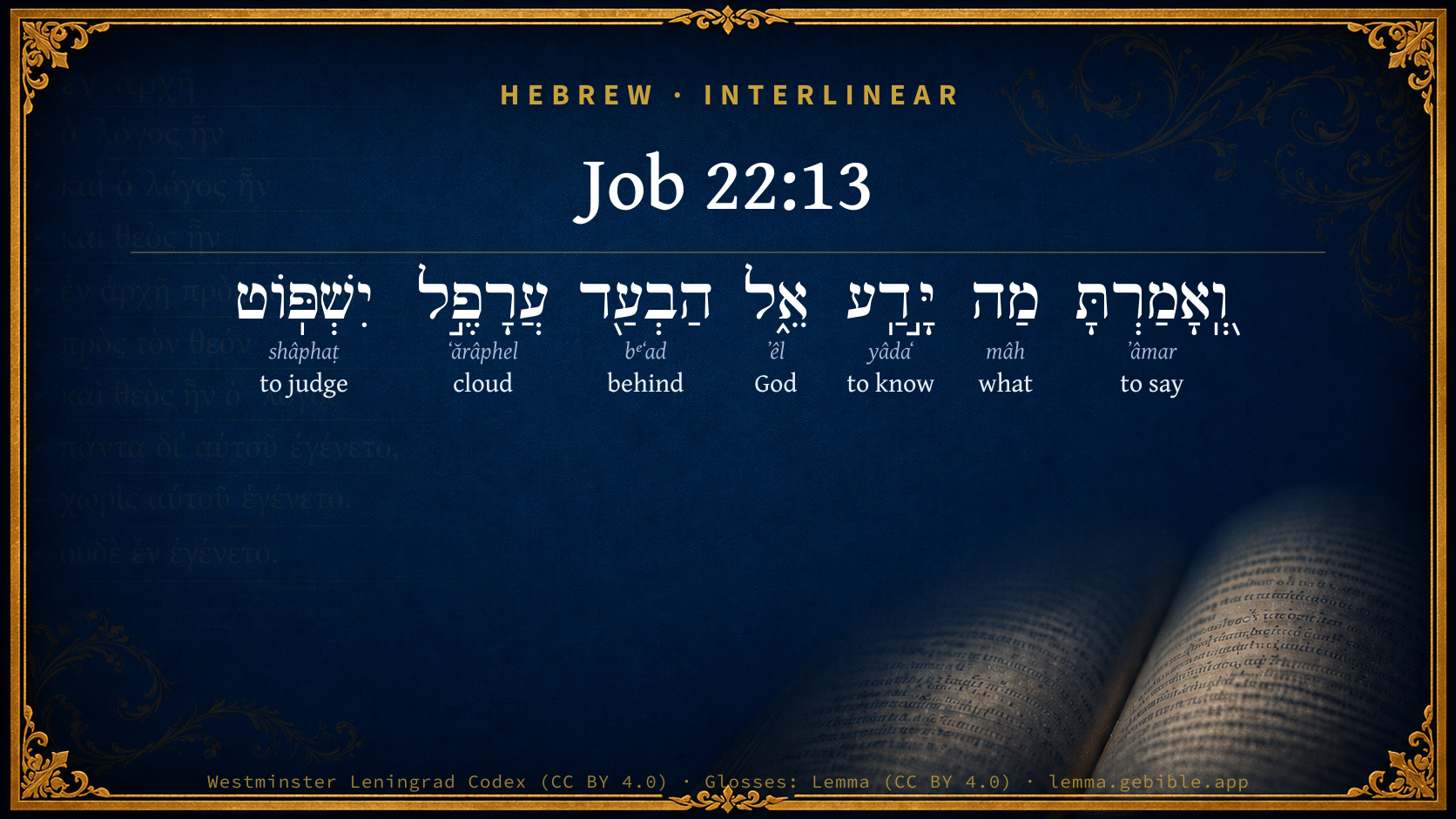
Job 22:13

Hebrew (Westminster Leningrad Codex) Job 22:13 appears in the Hebrew Old Testament. The text above is from the Westminster Leningrad Codex. Each word links to its Strong’s number, a concise gloss, and parsing drawn from the Open Scriptures Hebrew Bible morphology. Click any word for its full Brown-Driver-Briggs (BDB) entry.
Download image
Cite this verse

Job 22:13 (World English Bible). Public Domain. Lemma interlinear Bible study tool, https://lemma.gebible.app/v/job/22/13.

Show BibTeX & RIS
BibTeX
RIS
English Translation
You say, 'What does God know? Can he judge through the thick darkness?
World English Bible · Public Domain
Download a study sheet

One document with this verse’s original text, its word-by-word gloss line, the meaning frame, cross-references with their text, attributed commentary, and full source and license credits — printable, and it pastes into notes with its structure intact.

This verse Autodidact and up

Study sheet (.html) Plain text (.txt)

A passage Seminary Student

Up to 50 verses in one chapter. A passage sheet keeps up to 6 commentary sources and 12 cross-references per verse, in the order this page ranks them, and says so on the sheet whenever that leaves anything out. Ask for a single verse and you get the Autodidact verse sheet above.

Everything on this page stays free to read, with no account — the sheet is a download of what is already on screen, not access to it.

Want to remove ads? Support Godless Engineer
Compare translations 3

The same verse in 3 English versions, stacked beneath the original-language interlinear above. Click any original word for its lexicon entry.

Each is an independent rendering of the whole verse — the interlinear is not word-aligned to these translations.

Highlighted words mark where these versions differ — a whole-verse word diff, not a word-by-word alignment.

  • World English Bible Public Domain
    You say, 'What does God know? Can he judge through the thick darkness?
  • King James Version Public Domain
    And thou sayest, How doth God know? can he judge through the dark cloud?
  • unfoldingWord Literal Text CC BY-SA 4.0
    But you say, ‘What does God know? Will he judge through thick darkness?

unfoldingWord Literal Text — © unfoldingWord, licensed CC BY-SA 4.0. Word-aligned USFM3 via Door43 (git.door43.org/unfoldingWord/en_ult).

Versions to compare (up to 4)

3 of 4 selected

Show all 18 translations

Every available English version of this verse, each an independent rendering of the whole verse.

  • World English Bible Public Domain
    You say, 'What does God know? Can he judge through the thick darkness?
  • Berean Standard Bible Public Domain
    Yet you say: ‘What does God know? Does He judge through thick darkness?
  • Majority Standard Bible Public Domain
    Yet you say: ‘What does God know? Does He judge through thick darkness?
  • King James Version Public Domain
    And thou sayest, How doth God know? can he judge through the dark cloud?
  • American Standard Version (1901) Public Domain
    And thou sayest, What doth God know? Can he judge through the thick darkness?
  • Revised Version (1885) Public Domain
    And thou sayest, What doth God know? can he judge through the thick darkness?
  • Geneva Bible (1599) Public Domain
    But thou sayest, How should God know? can he iudge through the darke cloude?
  • Douay-Rheims (1899) Public Domain
    And thou sayst: What doth God know? and he judgeth as it were through a mist.
  • Young's Literal Translation Public Domain
    And thou hast said, `What -- hath God known? Through thickness doth He judge?
  • Literal Standard Version CC BY-SA 4.0
    And you have said, How has God known? Does He judge through thickness?
  • Unlocked Literal Bible CC BY-SA 4.0
    You say, 'What does God know? Can he judge through the thick darkness?
  • unfoldingWord Literal Text CC BY-SA 4.0
    But you say, ‘What does God know? Will he judge through thick darkness?
  • Darby Bible Public Domain
    And thou sayest, What doth ùGod know? will he judge through the dark cloud?
  • World Messianic Bible Public Domain
    You say, ‘What does God know? Can he judge through the thick darkness?
  • Webster's Bible Public Domain
    And thou sayest, How doth God know? can he judge through the dark cloud?
  • Free Bible Version CC BY-SA 4.0
    But you ask, ‘What does God know? How can he see and judge what happens down here in darkness?
  • Bible in Basic English Public Domain
    And you say, What knowledge has God? is he able to give decisions through the deep dark?
  • JPS Tanakh (1917) Public Domain
    And thou sayest: 'What doth God know? Can He judge through the dark cloud?

Literal Standard Version (2020), Covenant Press — licensed CC BY-SA 4.0. Text via the HelloAO Bible API (eBible.org). Unlocked Literal Bible (unfoldingWord) — licensed CC BY-SA 4.0. Text via the HelloAO Bible API (eBible.org). unfoldingWord Literal Text — © unfoldingWord, licensed CC BY-SA 4.0. Word-aligned USFM3 via Door43 (git.door43.org/unfoldingWord/en_ult). Free Bible Version, Dr. Jonathan Gallagher — licensed CC BY-SA 4.0. Text via the HelloAO Bible API (eBible.org).

Word by word

More ways to search: Search by grammar → Find every occurrence → Compare this word →

Practice this passage: Drill this verse → Learn its vocabulary →

About this verse

These counts appear in no published source. They are computed here, from the morphology-tagged text and Lemma’s own curated glosses. What Lemma adds →

7
words
7
distinct lemmas
Wisdom
section

Notable vocabulary

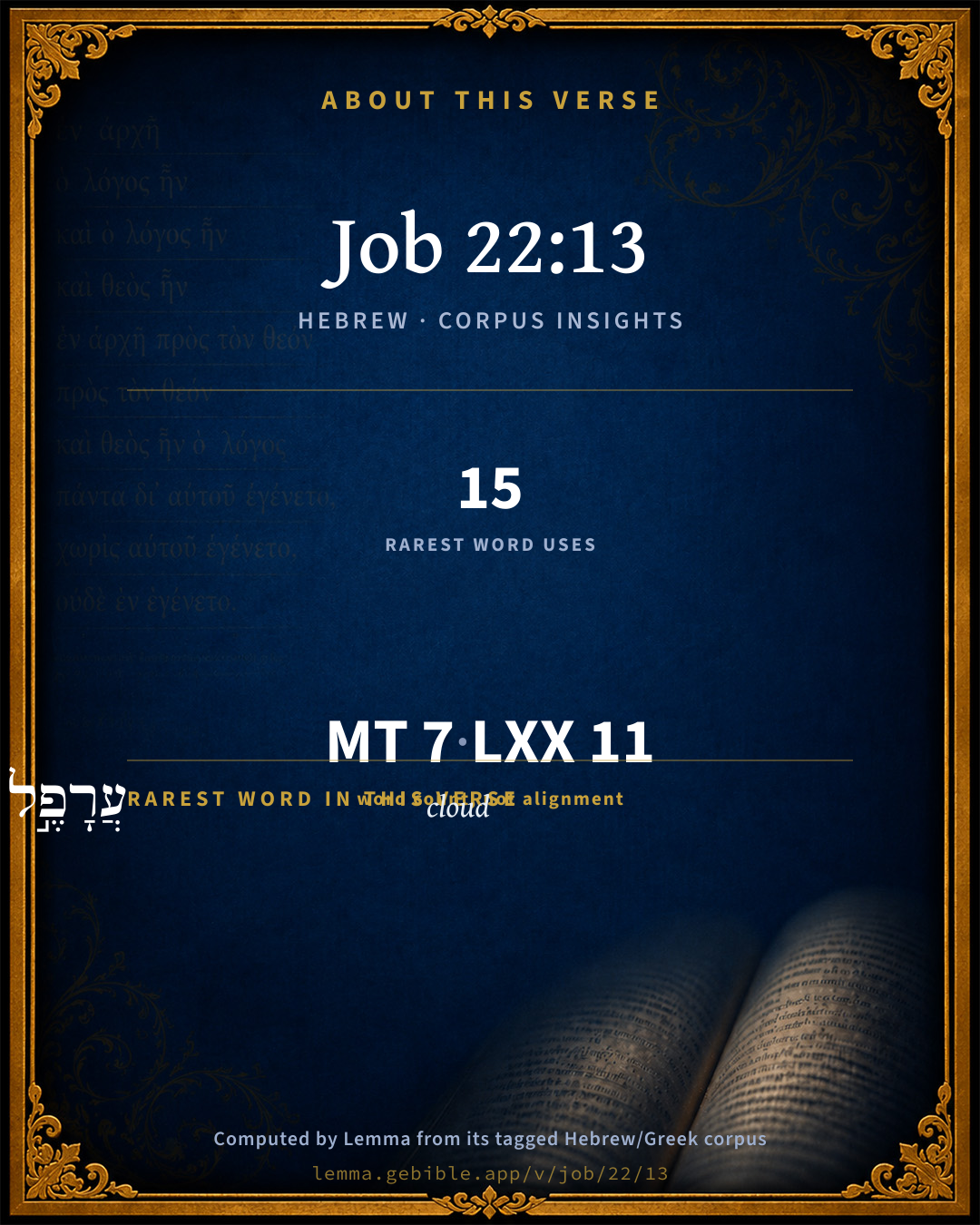
The rarest word here is עֲרָפֶ֣ל cloud H6205 — appearing just 15 times in the whole Hebrew Bible.

Shared distinctive vocabulary

עֲרָפֶ֣ל cloud H6205 occurs in 15 verses of the Hebrew Bible. Also found in:

Grammatical profile

  • 3 verbs
  • 2 nouns
  • 1 preposition
  • 1 particle

Verb forms

  • וְֽ֭אָמַרְתָּ Qal · Sequential Perfect
  • יָּ֣דַֽע Qal · Perfect
  • יִשְׁפּֽוֹט Qal · Imperfect

Hebrew & Septuagint length

In English translation the verse runs 13 words from the Hebrew and 16 from the Septuagint (LXX English) — closely comparable.

A rough comparison of the two English renderings, which tokenize alike — not a word-level alignment.

Word counts can differ between the Hebrew and the Greek without any difference in meaning — e.g. the Hebrew direct-object marker אֵת has no separate Greek word, and Greek often adds the article ὁ.

In the original languages it is 7 Hebrew tokens and 11 Greek tokens — but the two are counted differently (Hebrew bundles its prefixes and suffixes into one token; the Greek is in lemma form), so that isn’t a like-for-like length.

Cross-references

9

Topical passages linked to Job 22:13 in the Treasury of Scripture Knowledge — connected by theme and wording, ordered by reader-vote popularity; previews shown in the World English Bible.

  • Ezekiel 8:12 Then said he to me, Son of man, have you seen what the elders of the house of Israel do in the dark, every man in his chambers of imagery? for they say, Yahweh doesn't see us; Yahweh has forsaken the land.
  • Psalms 10:11 He says in his heart, "God has forgotten. He hides his face. He will never see it."
  • Psalms 73:11 They say, "How does God know? Is there knowledge in the Most High?"
  • Ezekiel 9:9 Then said he to me, The iniquity of the house of Israel and Judah is exceeding great, and the land is full of blood, and the city full of wrestling [of judgment]: for they say, Yahweh has forsaken the land, and Yahweh doesn't see.
  • Psalms 59:7 Behold, they spew with their mouth. Swords are in their lips, "For," they say, "who hears us?"
  • Psalms 94:7–9 They say, "Yah will not see, Neither will Jacob's God consider."
  • Isaiah 29:15 Woe to those who hide deep their counsel from Yahweh, and whose works are in the dark, and who say, Who sees us? and who knows us?
  • Psalms 64:5 They encourage themselves in evil plans. They talk about laying snares secretly. They say, "Who will see them?"
  • Zephaniah 1:12 It will happen at that time, that I will search Jerusalem with lamps, and I will punish the men who are settled on their dregs, who say in their heart, "Yahweh will not do good, neither will he do evil."

Cross-references courtesy of OpenBible.info (CC BY 4.0).

Hebrew and Greek witnesses Masoretic Hebrew ↔ Greek Septuagint

The same verse in the two great witnesses to the Old Testament, shown verse-for-verse.

These are two independent witnesses, not word-aligned to each other, and the Septuagint is shown in lemma (dictionary) form.

Hebrew Job 22:13 Masoretic · Westminster Leningrad Codex

וְֽ֭אָמַרְתָּ מַה יָּ֣דַֽע אֵ֑ל הַבְעַ֖ד עֲרָפֶ֣ל יִשְׁפּֽוֹט

You say, 'What does God know? Can he judge through the thick darkness?

World English Bible · Public Domain

Greek LXX Job 22:13 Septuagint · lemma form

καί εἶπον τίς γιγνώσκω ὁ ἰσχυρός ἦ κατά ὁ γνόφος κρίνω

And you have said, What does the Mighty One know? does he judge in the dark?

LXX2012 (modern English Septuagint) · Public Domain

Hebrew: Westminster Leningrad Codex (CC BY 4.0). Greek: Septuagint (public domain); English from LXX2012 (modern English Septuagint) (Public Domain). How the Septuagint differs from the Hebrew →

Commentary

Notes on Job 22:13 from classic Christian and Jewish commentators (each source and its license shown beneath its notes). The classic Christian expositions comment on the surrounding passage and are grouped to its opening verse, so a note may address several verses; the Jewish commentaries on the Tanakh (Rashi and others) are per-verse, so they appear only where the commentator wrote on this verse.

Lemma curates 59 commentaries, every one of them public domain or Creative Commons licensed, each selected and text-cleaned for this edition rather than reprinted as found. About our sources →

Trapp's Complete Commentary

John Trapp

Job 22:13 And thou sayest, How doth God know? can he judge through the dark cloud?

Ver. 13. And thou sayest, How doth God know?] A brutish question, Psa 94:7-8, and never of Job’s making. There are a sort of such miscreants as believe nothing but what they see with their bodily eyes; and indeed, for a finite creature to believe the infinite attributes of God, he is not able to do it thoroughly, without supernatural grace; which therefore must be begged of God, Jas 1:5, that he would give us "the spirit of wisdom and revelation in the knowledge of him; the eyes of our understanding being enlightened," &c., Eph 1:17-18. For want whereof, the wicked, blinded with sin, ask such senseless and blasphemous questions as this in the text, and those like this, Psa 10:11 Zep 1:12; {See Trapp on "Psa 10:11"} {See Trapp on "Zep 1:12"} It is a ridiculous thing, saith Pliny, to think that the highest Majesty taketh care of human affairs; a service, doubtless, far below him, and unworthy of his greatness.

Can he judge through the dark cloud?] Can he discern through such a dark medium? Men cannot see God; and therefore some fools are apt to think that neither can he see them, Sicut pueri vultum obvelant, putantes sese tum non conspici (Lavat.). But that Job was far from any such thought, see Job 21:16; Job 21:22. To blame therefore was Eliphaz to charge him with such a wickedness; and all because he had said that in this life bad men oft prosper and better men suffer; which yet is verum tanquam ex tripode, very true, and not at all derogatory to the Divine providence.

John Trapp, A Commentary or Exposition upon All the Books of the Old and New Testament (1647–1656) — public domain. Text from a community e-Sword module.

Joseph Benson's Commentary

Job 22:13. And — Or therefore, thou sayest, How doth God know? &c. — From this true and certain principle, thou drawest a false and wicked conclusion, and fanciest, perhaps, that because he is so high he minds not what is done here below: or, that he cannot discern the difference of things so very remote, through those immense and innumerable clouds which lie between the heaven and the earth.

Joseph Benson's Commentary on the Old and New Testaments (1811–1818) — public domain. Text from a community e-Sword module.

Geneva Bible (1599)

Geneva Bible translators

He reproveth Job, as though he denied God’s providence and that he could not see the things that were done in this world.

Geneva Bible (1599) marginal notes — public domain. Text via Bolls.life.

Jamieson, Fausset & Brown

Robert Jamieson, A. R. Fausset & David Brown

Rather, And yet thou sayest, God does not concern Himself with ("know") human affairs (Psa 73:11).

Jamieson, Fausset & Brown — Commentary Critical and Explanatory on the Whole Bible (1871) — public domain (CC PDM 1.0). Text via the HelloAO Bible API.

John Gill's Exposition

Thick clouds are a covering to him, that he seeth not,.... Thus Job is made to speak, or to reason as atheistical persons, or such who are inclined to atheism would, who take God to be altogether such an one as themselves; as that because thick clouds hide objects, as the sun, and moon, and stars, from their sight, therefore they must hide men and their actions from the sight of God; whereas there is nothing between God and man to hide them from him, let them be what they will, clouds as thick and as dark as can be imagined, yet his eyes are upon the ways of man, and see all his goings, nor is there any darkness that can hide from him, Job 34:21;

and he walketh in the circuit of heaven; within which he keeps himself, and never looks down upon the earth, or takes any notice of what is done there; quite contrary to Psa 14:3; as if he only took his walks through the spacious orb of heaven, and delighted himself in viewing the celestial mansions, and the furniture of them, but had no regard to anything below them; whereas, though he walks in the circuit of heaven, he also sits upon the circle of the earth, Isa 41:22; Eliphaz seems here to ascribe the sentiments perhaps of the Zabians in former times to Job, and since adopted by some philosophers; that God only regards the heavenly bodies, and supports them in their beings, and regulates and directs their motions, and leaves all things below to be governed and influenced by them, as judging it unworthy of him to be concerned with things on earth. Indeed the earth and the inhabitants of it are unworthy of his notice and care, and of his providential visits, but he does humble himself to look upon things on earth as well as in heaven, Psa 8:4; to make Job reason after this Epicurean manner was doing great injustice to his character, who most firmly believed both the being and providence of God, and that as extending to all things here below, see Job 12:13.

John Gill's Exposition of the Whole Bible (1746–1763) — public domain (CC PDM 1.0). Text via the HelloAO Bible API.

Albert Barnes' Notes on the Bible

And thou sayest, How doth God know? - That is, it “follows” from what you have said; or the opinion which you have advanced is “the same” as if you had affirmed this. How common it is to charge a man with holding what we “infer,” from something which he has advanced, he must hold, and then to proceed to argue “as if” he actually held that. The philosophy of this is plain. He advances a certain opinion. “We” infer at once that he can hold that only on certain grounds, or that if he holds that he must hold something else also. We can see that if “we” held that opinion, we should also, for the sake of consistency, be compelled to hold something which seems to follow from it, and we cannot see how this can be avoided, and we at once charge him with holding it. But the truth may be, that “he” has not seen that such consequences follow, or that he has some other way of accounting for the fact than we have; or that he may hold to the fact and yet deny wholly the consequences which legitimately follow from it. Now we have a right to show him “by argument” that his opinions, if he would follow them out, would lead to dangerous consequences, but we have a right to charge him with holding only what he “professes” to hold. He is not answerable for our inferences; and we have no right to charge them on him as being his real opinions. Every man has a right to avow what he actually believes, and to be regarded as holding that, and that only.

How doth God know? - That is, How can one so exalted see what is done on the distant earth, and reward and punish people according to their deserts? This opinion was actually held by many of the ancients. It was supposed that the supreme God did not condescend to attend to the affairs of mortals, but had committed the government of the earth to inferior beings. This was the foundation of the Gnostic philosophy, which prevailed so much in the East in the early ages of the Christian church. Milton puts a similar sentiment into the mouth of Eve in her reflections after she had eaten the forbidden fruit:

And I, perhaps, am secret: heaven is high,

High and remote from thence to see distinct

Each thing on earth; and other care perhaps

May have diverted from continual watch

Our great Forbidder, safe with all his spies about him.

Paradise Lost, B. ix.

Can he judge through the dark cloud? - Can he look down through the clouds which interpose between man and him? Eliphaz could not see how Job could maintain his opinions without holding that this was impossible for God. He could see no other reason why God did not punish the wicked than because “he did not see them,” and he, therefore, charges this opinion on Job.

Albert Barnes' Notes on the Bible (1834–1885) — public domain. Text from a community e-Sword/MySword module.

Matthew Poole's English Annotations

And, or, therefore; from this true and certain principle thou drawest this false and wicked conclusion. Or, yet, notwithstanding this undeniable argument.

Thou sayest; thou reasonest thus within thyself, as it may seem by thy discourses.

How doth God know? i.e. God cannot discern, and therefore doth not mind things so far below him and distant from him.

Can he judge through the dark cloud, i.e. through those immense and innumerable clouds which lie between the heaven and the earth, although our eyes see but few of them?

Matthew Poole's English Annotations on the Holy Bible (1683–1685) — public domain. Text from a community e-Sword/MySword module.

Whedon's Commentary on the Bible

Daniel D. Whedon

13. How — What doth God know? The sentiment ascribed to Job was subsequently that of Epicurus and the English Deists. “Eliphaz here attributes to Job (who in Job_21:22 had appealed to the exaltation of God in opposition to the friends) a complete misconception of the truth, and thus skilfully turns against Job himself the weapon which the latter had sought to wrest from him.” — Schlottmann.

Daniel D. Whedon (gen. ed.), Commentary on the Old and New Testaments (1874–1909) — public domain. Text from a community e-Sword module.

The Pulpit Commentary

And thou sayest, How doth God know? Job had not said this in so many words, but, by equalizing the godly and the wicked, (Job_9:22 Job_21:23-26) he might be supposed to mean that God took no note of men"s conduct, and therefore had not a perfect knowledge of all things. The psalmist implies that many men so thought. (Psa_10:11 Psa_73:11 Psa_94:7) Can he judge through the dark cloud? rather, through the thick darkness. God was supposed to dwell remote from man, in the highest heaven, and, according to many, "clouds and darkness were round about him" (Psa_97:2) he "dwelt in the thick darkness" (1Ki_8:12) he "made darkness his secret place; his pavilion round about him was waters, and thick clouds of the skies". (Psa_18:11) The imagery was, no doubt, at first used in reference to man"s inability to see and know God; but when men became familiar with it, they turned the metaphor round, and questioned God"s ability to see and know anything about man. Job had not really ever shared in these doubts; but it suits Eliphaz"s purpose to malign and misrepresent him.

Vers. 13, 14. The unseen eye.

God is exalted; he is "in the height of heaven." He is unseen by man, and therefore often forgotten. He is above, beyond; and the frail judgment perverts this great truth into

I A SUPPOSITION OF THE DIVINE IGNORANCE OF HUMAN AFFAIRS. "How doth God know?" "Thick clouds are a covering to him, that he seeth not." Thus ignorance or folly perverts the right and the good. Either the judgment or the moral character is at fault. Men sin in forgetfulness that the Divine eye is upon them. "Thou God seest me" is a hedge of fire to prevent from evil-doing. How great a departure from right reason is the foolish supposition that, because God is not seen, therefore he seeth not! So the Divine is measured by the human. Only godlessness the indifference of the soul to God can lead men to such perversions. The pure, they who, communing with the pure One, are changed into his image, see God. They discern his eye. t is the light and the joy of their life. The evil with darkened eye seeth not. A cloud of ignorance covers him, as a cloud of mystery the Most High.

II This ignorance is further perverted into A SUPPOSITION OF THE INCOMPETENCY OF THE DIVINE JUDGMENT. "Can he judge through the dark cloud?" Thus the blind falls into the pit of error. One fault follows another in quick succession. The faulty view which shuts God out from his own world, which thinks of him as too far exalted above human affairs to take knowledge of them, must needs complete itself in denying the Divine judgment of human actions. It is the perilous perversion of ignorance and of sin the blindness of mind which springs from a hardness of heart The moral sensibilities being blunted, moral truth is not apprehended. Spiritual things are foolishness to the unspiritual; he cannot discern them. The heart loving evil bribes the conscience into doubt as to the judgment upon evil, and finally wins it over to a denial of it. God cannot judge. So does the frail, ignorant, foolish creature judge of the Creator, and thus assumes to itself what it denies to its Maker.

Mark

(1) the error,

(2) the folly,

(3) the wickedness,

(4) the danger, of this. R.G.

God"s knowledge.

I THE APPARENT DIFFICULTY OF IT. It may not be asserted that God does not know all, and yet people act as though they could hide from God. In distress and loneliness it sometimes seems as though God could not know whet were the troubles of his children, or he would not permit them to be so grievously tried. The vastness of the universe raises the same difficulty. Many things are covered up, and it is not easy for us to believe that he can "judge through the thick cloud.

II THE REAL TRUTH OF IT. If God is the infinite Being whom we know him to be, all difficulties will vanish before him. We may not be able to conceive of the method by which he comes to know all things; but this is not wonderful, for that method itself must have an infinity about it quite beyond our comprehension. On the other hand, God frequently gives startling evidence that he sees in secret and knows all things. He surprised Hagar by discovering her in the desert. (Gen_16:13) Achan"s stolen booty could not be hidden. (Jos_7:16-21) Our own lives must bear witness to the searching knowledge of God. At first, perhaps, his treatment of us may have seemed to go on without any regard to our requirements, but that was only because we were short-sighted and superficial; for when we have been able to look back over a long stretch of life, have we not been surprised again and again at observing how wonderfully God has wrought just the very thing that was needed to bring out what was best in the end?

III THE CONSEQUENCES DEPENDENT ON IT.

1. It is vain to try to hide from God He sees through the thickest cloud. Thus we only waste our efforts when we try to make a darkness that shall shut off the piercing gaze of God. He knows all now. He does not need to wait for the future revelation of the judgment-day. Already all hypocritical pretences are perfectly open and apparent to him.

2. It is foolish to distrust Gods wisdom. We see a little corner of life; he has the whole field of it before him. Therefore he must have vastly greater materials for his judgment than we possess for ours. It is not to be wondered at that his decision often differs from ours. But if his ways are not as our ways and his thoughts not as our thoughts, the simple explanation is that his ways and thoughts are higher than ours. (Isa 4)

3. It is well to seek Gods guidance. When we follow his lead we are conducted by One who knows the end from the beginning. Our difficulties arise from partial lights and intercepted views. We see enough to lead us astray. But the perfect, all-penetrating knowledge of God invites us to renounce our prejudices and look up for the indications of God"s guiding hand. These may be given to us

a. in the course of events;

b. in the admonitions of conscience;

c. in the teachings of Scripture;

d. in the life, the teaching, and the example of Jesus Christ.

Browning says"Our times are in his hand Who said, "A whole I planned;" Youth shows but half; trust God; see all nor be afraid. W.F.A.

The Pulpit Commentary (1880–1919), ed. H.D.M. Spence-Jones & Joseph S. Exell — public domain. Text from a community e-Sword module.

Rashi

Rabbi Shlomo Yitzchaki (Rashi)

‘What does God know?’ of what occurs in the dark?

Does He judge through the dark cloud? Does He see and judge facing this darkness? Behold...

Rashi on the Tanakh — English translations: “The Judaica Press complete Tanach with Rashi, translated by A. J. Rosenberg” (CC BY 4.0); “Pentateuch with Rashi's commentary by M. Rosenbaum and A.M. Silbermann, 1929-1934” (public domain); “The Metsudah Tanach series, Lakewood, N.J” (CC BY 4.0); and “The Book of Joshua, Metsudah Publications, 1997” (CC BY 4.0). Text via Sefaria.

Lesson kit

Teaching starters — assembled from the data on this page, not authored interpretation. Every prompt links to the verse data it draws on. Edit before teaching.

Job, in the Wisdom, opens this verse with 7 words (7 distinct Hebrew lemmas). Its most distinctive word is ʻărâphel (“cloud”). A historical commentator’s framing appears above. Read the whole chapter for the surrounding context.

Discussion questions

  1. How does “cloud” (ʻărâphel) shape what this verse is saying?
  2. How does Exodus 20:21, which shares the word «cloud», read alongside this verse?
  3. These translations render this verse differently; the difference is in the English rendering, not the original. What questions does that raise?
  4. «וְֽ֭אָמַרְתָּ» is a Qal Sequential Perfect verb. How does that grammatical form shape the action described?
  5. Compare how Trapp's Complete Commentary and Joseph Benson's Commentary read this verse. Where do they agree or differ?

Things to notice

Reading settings

Reading text

Shown beneath each verse's original-language words.

Old Testament
Old Testament edition

Read the OT as the Masoretic Hebrew (MT) or the Greek Septuagint (LXX).

English shown for the Greek Septuagint (in the Hebrew ↔ Greek comparison).

Comparing translations? Open the Compare panel on any verse page to stack up to four side by side.