Leviticus 19:15

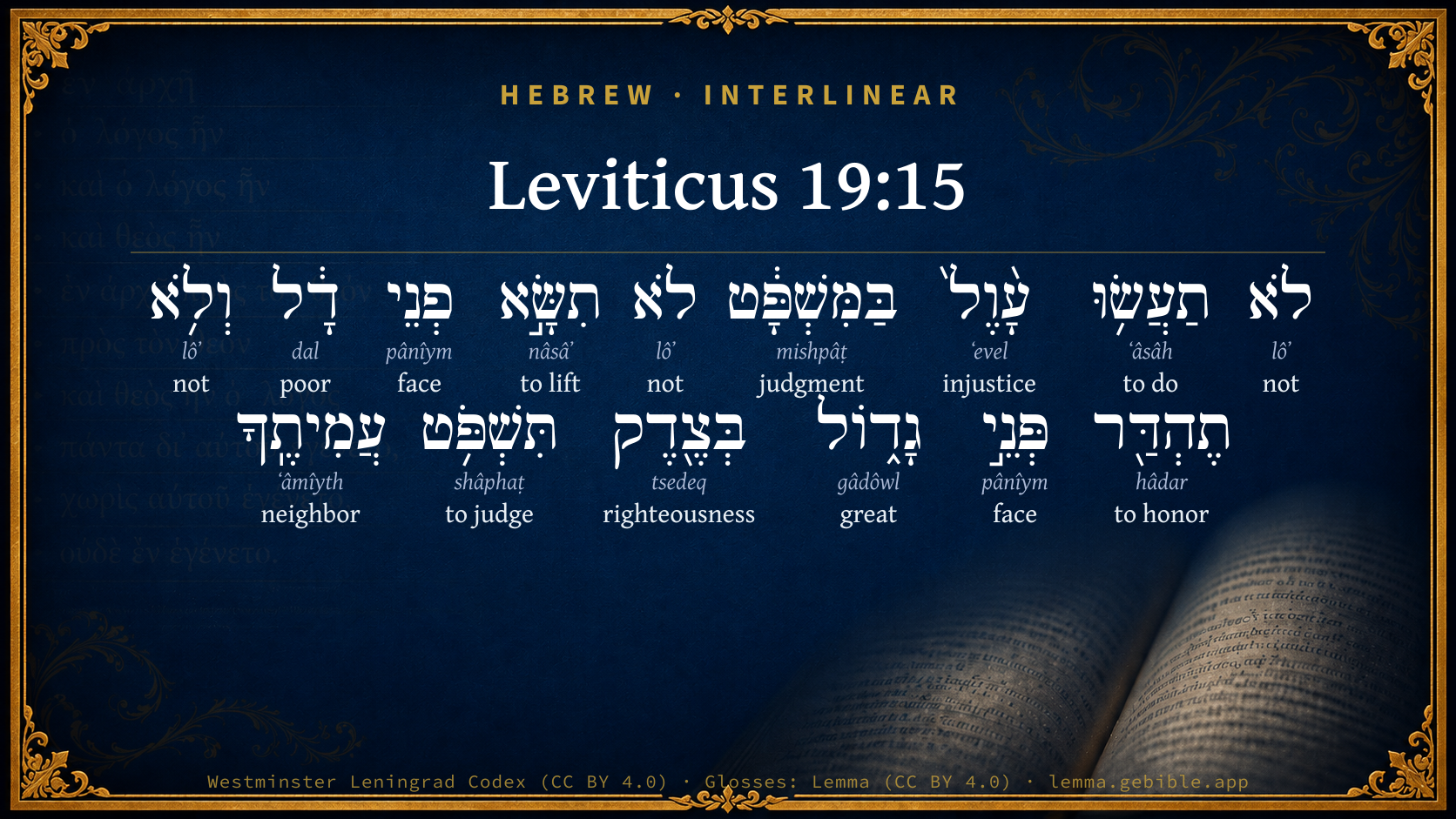
Hebrew (Westminster Leningrad Codex) Leviticus 19:15 appears in the Hebrew Old Testament. The text above is from the Westminster Leningrad Codex. Each word links to its Strong’s number, a concise gloss, and parsing drawn from the Open Scriptures Hebrew Bible morphology. Click any word for its full Brown-Driver-Briggs (BDB) entry.
Download image
Cite this verse

Leviticus 19:15 (World English Bible). Public Domain. Lemma interlinear Bible study tool, https://lemma.gebible.app/v/leviticus/19/15.

Show BibTeX & RIS
BibTeX
RIS
English Translation
"'You shall do no injustice in judgment: you shall not be partial to the poor, nor show favoritism to the great; but in righteousness shall you judge your neighbor.
World English Bible · Public Domain
Highlights
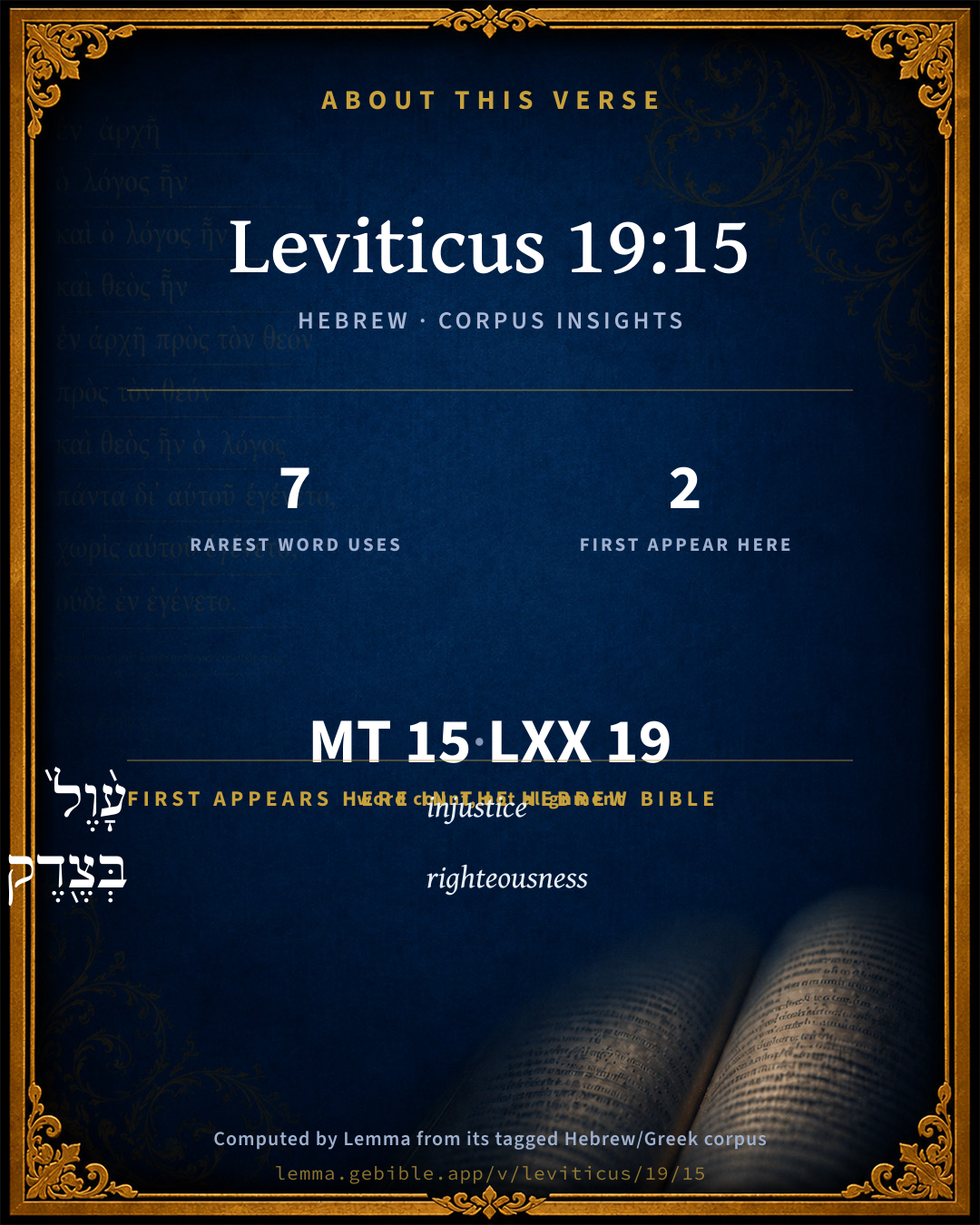
  • 2 first appearances in the Hebrew Bible
Full analysis ↓
Download a study sheet

One document with this verse’s original text, its word-by-word gloss line, the meaning frame, cross-references with their text, attributed commentary, and full source and license credits — printable, and it pastes into notes with its structure intact.

This verse Autodidact and up

Study sheet (.html) Plain text (.txt)

A passage Seminary Student

Up to 50 verses in one chapter. A passage sheet keeps up to 6 commentary sources and 12 cross-references per verse, in the order this page ranks them, and says so on the sheet whenever that leaves anything out. Ask for a single verse and you get the Autodidact verse sheet above.

Everything on this page stays free to read, with no account — the sheet is a download of what is already on screen, not access to it.

Want to remove ads? Support Godless Engineer
Compare translations 3

The same verse in 3 English versions, stacked beneath the original-language interlinear above. Click any original word for its lexicon entry.

Each is an independent rendering of the whole verse — the interlinear is not word-aligned to these translations.

Highlighted words mark where these versions differ — a whole-verse word diff, not a word-by-word alignment.

  • World English Bible Public Domain
    "'You shall do no injustice in judgment: you shall not be partial to the poor, nor show favoritism to the great; but in righteousness shall you judge your neighbor.
  • King James Version Public Domain
    Ye shall do no unrighteousness in judgment: thou shalt not respect the person of the poor, nor honor the person of the mighty: but in righteousness shalt thou judge thy neighbor.
  • unfoldingWord Literal Text CC BY-SA 4.0
    You shall not do injustice with judgment. You shall not lift the face of an insignificant, and you shall not honor the face of a great. In righteousness, you shall judge your fellow citizen.

unfoldingWord Literal Text — © unfoldingWord, licensed CC BY-SA 4.0. Word-aligned USFM3 via Door43 (git.door43.org/unfoldingWord/en_ult).

Versions to compare (up to 4)

3 of 4 selected

Show all 18 translations

Every available English version of this verse, each an independent rendering of the whole verse.

  • World English Bible Public Domain
    "'You shall do no injustice in judgment: you shall not be partial to the poor, nor show favoritism to the great; but in righteousness shall you judge your neighbor.
  • Berean Standard Bible Public Domain
    You must not pervert justice; you must not show partiality to the poor or favoritism to the rich; you are to judge your neighbor fairly.
  • Majority Standard Bible Public Domain
    You must not pervert justice; you must not show partiality to the poor or favoritism to the rich; you are to judge your neighbor fairly.
  • King James Version Public Domain
    Ye shall do no unrighteousness in judgment: thou shalt not respect the person of the poor, nor honor the person of the mighty: but in righteousness shalt thou judge thy neighbor.
  • American Standard Version (1901) Public Domain
    Ye shall do no unrighteousness in judgment: thou shalt not respect the person of the poor, nor honor the person of the mighty; but in righteousness shalt thou judge thy neighbor.
  • Revised Version (1885) Public Domain
    Ye shall do no unrighteousness in judgment: thou shalt not respect the person of the poor, nor honour the person of the mighty: but in righteousness shalt thou judge thy neighbour.
  • Geneva Bible (1599) Public Domain
    Ye shall not doe vniustly in iudgement. Thou shalt not fauour the person of the poore, nor honour the person of the mightie, but thou shalt iudge thy neighbour iustly.
  • Douay-Rheims (1899) Public Domain
    Thou shalt not do that which is unjust, nor judge unjustly. Respect not the person of the poor, nor honour the countenance of the mighty. But judge thy neighbour according to justice.
  • Young's Literal Translation Public Domain
    `Ye do not do perversity in judgment; thou dost not lift up the face of the poor, nor honour the face of the great; in righteousness thou dost judge thy fellow.
  • Literal Standard Version CC BY-SA 4.0
    You do not do perversity in judgment; you do not lift up the face of the poor, nor honor the face of the great; you judge your fellow in righteousness.
  • Unlocked Literal Bible CC BY-SA 4.0
    Do not cause judgment to be false. You must not show favoritism to someone because he is poor, and you must not show favoritism to someone because he is important. Instead, judge your neighbor righteously.
  • unfoldingWord Literal Text CC BY-SA 4.0
    You shall not do injustice with judgment. You shall not lift the face of an insignificant, and you shall not honor the face of a great. In righteousness, you shall judge your fellow citizen.
  • Darby Bible Public Domain
    Ye shall do no unrighteousness in judgment; thou shalt not respect the person of the lowly, nor honour the person of the great; in righteousness shalt thou judge thy neighbour.
  • World Messianic Bible Public Domain
    “‘You shall do no injustice in judgment. You shall not be partial to the poor, nor show favoritism to the great; but you shall judge your neighbor in righteousness.
  • Webster's Bible Public Domain
    Ye shall do no unrighteousness in judgment; thou shalt not respect the person of the poor, nor honor the person of the mighty: but in righteousness shalt thou judge thy neighbor.
  • Free Bible Version CC BY-SA 4.0
    Don't be a corrupt judge. Don't show favoritism to the poor or to the rich. Judge others fairly.
  • Bible in Basic English Public Domain
    Do no wrong in your judging: do not give thought to the position of the poor, or honour to the position of the great; but be a judge to your neighbour in righteousness.
  • JPS Tanakh (1917) Public Domain
    Ye shall do no unrighteousness in judgment; thou shalt not respect the person of the poor, nor favour the person of the mighty; but in righteousness shalt thou judge thy neighbour.

Literal Standard Version (2020), Covenant Press — licensed CC BY-SA 4.0. Text via the HelloAO Bible API (eBible.org). Unlocked Literal Bible (unfoldingWord) — licensed CC BY-SA 4.0. Text via the HelloAO Bible API (eBible.org). unfoldingWord Literal Text — © unfoldingWord, licensed CC BY-SA 4.0. Word-aligned USFM3 via Door43 (git.door43.org/unfoldingWord/en_ult). Free Bible Version, Dr. Jonathan Gallagher — licensed CC BY-SA 4.0. Text via the HelloAO Bible API (eBible.org).

Word by word

More ways to search: Search by grammar → Find every occurrence → Compare this word →

Practice this passage: Drill this verse → Learn its vocabulary →

תֶהְדַּ֖ר
hâdar
H1921
“to honor”
Verb, Qal, Imperfect, 2nd Person, Masculine, Singular
Part of Speech
Verb
Stem
Qal
Form
Imperfect
Person
2nd Person
Gender
Masculine
Number
Singular
Full BDB Definition

Origin: a primitive root

TWOT: 477

to honour, adorn, glorify, be high - (Qal) - to swell - swelling (passive participle) - to honour, pay honour to, show partiality - to adorn - adorned (passive participle) - (Niphal) to be honoured - (Hithpael) to honour oneself, claim honour
  1. לֹא lôʼ H3808 “not” Particle, Negative
  2. תַעֲשׂ֥וּ ʻâsâh H6213 “to do” Verb, Qal, Imperfect, 2nd Person, Masculine, Plural
  3. עָ֨וֶל֙ ʻevel H5766 “injustice” Noun, Common, Both, Singular, Absolute
  4. בַּמִּשְׁפָּ֔ט mishpâṭ H4941 “in/at the · judgment” Preposition, Determined + Noun, Common, Masculine, Singular, Absolute
  5. לֹא lôʼ H3808 “not” Particle, Negative
  6. תִשָּׂ֣א nâsâʼ H5375 “to lift” Verb, Qal, Imperfect, 2nd Person, Masculine, Singular
  7. פְנֵי pânîym H6440 “face(s) of” Noun, Common, Both, Plural, Construct
  8. דָ֔ל dal H1800 “poor” Adjective, Adjective, Masculine, Singular, Absolute
  9. וְלֹ֥א lôʼ H3808 “and · not” Conjunction + Particle, Negative
  10. פְּנֵ֣י pânîym H6440 “face(s) of” Noun, Common, Both, Plural, Construct
  11. גָד֑וֹל gâdôwl H1419 “great” Adjective, Adjective, Masculine, Singular, Absolute
  12. בְּצֶ֖דֶק tsedeq H6664 “in/at · righteousness” Preposition + Noun, Common, Masculine, Singular, Absolute
  13. תִּשְׁפֹּ֥ט shâphaṭ H8199 “to judge” Verb, Qal, Imperfect, 2nd Person, Masculine, Singular
  14. עֲמִיתֶֽךָ ʻâmîyth H5997 “neighbor · your” Noun, Common, Masculine, Singular, Construct + Suffix, Personal, 2nd Person, Masculine, Singular

About this verse

These counts appear in no published source. They are computed here, from the morphology-tagged text and Lemma’s own curated glosses. What Lemma adds →

15
words
12
distinct lemmas
Pentateuch
section

Notable vocabulary

The rarest word here is תֶהְדַּ֖ר to honor H1921 — appearing just 7 times in the whole Hebrew Bible.

First appearance in Scripture

These words make their first canonical appearance in the Hebrew Bible here:

  • עָ֨וֶל֙ injustice H5766
  • בְּצֶ֖דֶק righteousness H6664

Shared distinctive vocabulary

תֶהְדַּ֖ר to honor H1921 occurs in 7 verses of the Hebrew Bible. Also found in:

Grammatical profile

  • 4 verbs
  • 6 nouns
  • 2 adjectives
  • 3 particles

Verb forms

  • תַעֲשׂ֥וּ Qal · Imperfect
  • תִשָּׂ֣א Qal · Imperfect
  • תֶהְדַּ֖ר Qal · Imperfect
  • תִּשְׁפֹּ֥ט Qal · Imperfect

Repetition

Words recur within this verse — often emphatic in Hebrew:

Hebrew & Septuagint length

In English translation the verse runs 29 words from the Hebrew and 30 from the Septuagint (LXX English) — closely comparable.

A rough comparison of the two English renderings, which tokenize alike — not a word-level alignment.

Word counts can differ between the Hebrew and the Greek without any difference in meaning — e.g. the Hebrew direct-object marker אֵת has no separate Greek word, and Greek often adds the article ὁ.

In the original languages it is 15 Hebrew tokens and 19 Greek tokens — but the two are counted differently (Hebrew bundles its prefixes and suffixes into one token; the Greek is in lemma form), so that isn’t a like-for-like length.

Cross-references

13

Topical passages linked to Leviticus 19:15 in the Treasury of Scripture Knowledge — connected by theme and wording, ordered by reader-vote popularity; previews shown in the World English Bible.

  • Deuteronomy 1:17 You shall not show partiality in judgment; you shall hear the small and the great alike; you shall not be afraid of the face of man; for the judgment is God's: and the cause that is too hard for you, you shall bring to me, and I will hear it.
  • Deuteronomy 27:19 Cursed be he who wrests the justice [due] to the foreigner, fatherless, and widow. All the people shall say, Amen.
  • Proverbs 24:23 These also are sayings of the wise. To show partiality in judgment is not good.
  • Exodus 23:2–3 You shall not follow a crowd to do evil; neither shall you testify in court to side with a multitude to pervert justice;
  • Exodus 23:6–8 "You shall not deny justice to your poor people in their lawsuits.
  • Leviticus 19:35 "'You shall do no unrighteousness in judgment, in measures of length, of weight, or of quantity.
  • Deuteronomy 16:19 You shall not wrest justice: you shall not respect persons; neither shall you take a bribe; for a bribe does blind the eyes of the wise, and pervert the words of the righteous.
  • Deuteronomy 25:13–16 You shall not have in your bag diverse weights, a great and a small.
  • 2 Chronicles 19:6–7 and said to the judges, Consider what you do: for you don't judge for man, but for Yahweh; and [he is] with you in the judgment.
  • Psalms 82:2 "How long will you judge unjustly, And show partiality to the wicked?" Selah.
  • Proverbs 18:5 To be partial to the faces of the wicked is not good, Nor to deprive the innocent of justice.
  • James 2:6–9 But you have dishonored the poor man. Don't the rich oppress you, and personally drag you before the courts?
  • Exodus 18:21 Moreover you shall provide out of all the people able men, such as fear God: men of truth, hating unjust gain; and place such over them, to be rulers of thousands, rulers of hundreds, rulers of fifties, and rulers of tens.

Cross-references courtesy of OpenBible.info (CC BY 4.0).

Hebrew and Greek witnesses Masoretic Hebrew ↔ Greek Septuagint

The same verse in the two great witnesses to the Old Testament, shown verse-for-verse.

These are two independent witnesses, not word-aligned to each other, and the Septuagint is shown in lemma (dictionary) form.

Hebrew Leviticus 19:15 Masoretic · Westminster Leningrad Codex

לֹא תַעֲשׂ֥וּ עָ֨וֶל֙ בַּמִּשְׁפָּ֔ט לֹא תִשָּׂ֣א פְנֵי דָ֔ל וְלֹ֥א תֶהְדַּ֖ר פְּנֵ֣י גָד֑וֹל בְּצֶ֖דֶק תִּשְׁפֹּ֥ט עֲמִיתֶֽךָ

"'You shall do no injustice in judgment: you shall not be partial to the poor, nor show favoritism to the great; but in righteousness shall you judge your neighbor.

World English Bible · Public Domain

Greek LXX Leviticus 19:15 Septuagint · lemma form

οὐ ποιέω ἄδικος ἐν κρίσις οὐ λαμβάνω πρόσωπον πτωχός οὐδέ θαυμάζω πρόσωπον δυνάστης ἐν δικαιοσύνη κρίνω ὁ πλησίον σύ

You shall not act unjustly in judgment: you shall not accept the person of the poor, nor admire the person of the mighty; with justice shall you judge your neighbor.

LXX2012 (modern English Septuagint) · Public Domain

Hebrew: Westminster Leningrad Codex (CC BY 4.0). Greek: Septuagint (public domain); English from LXX2012 (modern English Septuagint) (Public Domain). How the Septuagint differs from the Hebrew →

Targum (Aramaic paraphrase)

2

The Targum is the ancient Jewish Aramaic paraphrase of the Hebrew Scriptures — an interpretive translation, not the Hebrew text itself. Onkelos (literal) and Pseudo-Jonathan (expansive) render the Torah, and Jonathan the Prophets. Coverage is partial: where no permissively-licensed English translation exists for a verse, only the Aramaic is shown. This is verse-level text, not a word-by-word alignment to the Hebrew.

  1. Targum Onkelos Torah (Genesis–Deuteronomy)
    לָא תַעְבְּדוּן שְׁקַר בְּדִינָא לָא תִסַב אַפֵּי מַסְכֵּנָא וְלָא תֶהְדַר אַפֵּי רַבָּא בְּקוּשְׁטָא תְּדִינֵהּ לְחַבְרָךְ

    (no public-domain English translation for this verse)

    Targum Onkelos — Aramaic: “Onkelos Genesis” (public domain); “Onkelos Exodus” (public domain); “Onkelos Leviticus” (public domain); “Onkelos Numbers” (public domain); “Onkelos Deuteronomy” (public domain). English: “Sefaria Community Translation” (CC0 1.0 (public-domain dedication)); “J.W. Etheridge. The Targums of Onkelos and Jonathan Ben Uzziel on the Pentateuch. London: Longmans, Green, 1862” (public domain). Text via Sefaria.

  2. Targum Pseudo-Jonathan Torah (Genesis–Deuteronomy)
    לָא תַעַבְדוּן שְׁקַר בְּסֵדֶר דִינָא לָא תִסְבּוּן אַפִּין לְמַסְכְּנָא וְלָא תְיַיקְרוּן אַפֵּי רַבָּא בְּקוּשְׁטָא תְדוּנוּן חַבְרֵיכוֹן

    Thou shalt not act falsely in the order of judgment ment neither accept the face of the poor, nor honour the face of the great but in truthfulness shalt thou judge thy neighbour.

    Targum Pseudo-Jonathan — Aramaic: “Targum Jonathan on Genesis” (public domain); “Targum Jonathan on Exodus” (public domain); “Targum Jonathan on Leviticus” (public domain); “Targum Jonathan on Numbers” (public domain); “Targum Jonathan on Deuteronomy” (public domain). English: “The Targum of Jonathan ben Uzziel, trans. J. W. Etheridge, London, 1862” (public domain). Text via Sefaria.

Commentary

Notes on Leviticus 19:15 from classic Christian and Jewish commentators (each source and its license shown beneath its notes). The classic Christian expositions comment on the surrounding passage and are grouped to its opening verse, so a note may address several verses; the Jewish commentaries on the Tanakh (Rashi and others) are per-verse, so they appear only where the commentator wrote on this verse.

Lemma curates 59 commentaries, every one of them public domain or Creative Commons licensed, each selected and text-cleaned for this edition rather than reprinted as found. About our sources →

Trapp's Complete Commentary

John Trapp

Lev 19:15 Ye shall do no unrighteousness in judgment: thou shalt not respect the person of the poor, nor honour the person of the mighty: [but] in righteousness shalt thou judge thy neighbour.

Ver. 15. Thou shalt not respect.] Spare not the great for their might, nor the mean for their misery. Causes must be heard, and not persons.

John Trapp, A Commentary or Exposition upon All the Books of the Old and New Testament (1647–1656) — public domain. Text from a community e-Sword module.

The Biblical Illustrator

Joseph S. Exell

Lev_19:15

In righteousness shalt thou judge thy neighbour.

On judging our neighbour in righteousness

To judge our neighbour in righteousness, it is our duty to consider those motives which may corrupt our judgment. When we set ourselves to reflect how far we have cultivated this species of justice, we deceive ourselves by quoting the examples of those who have become dear to us from particular circumstances; by citing the judgments we have made of friends, of kindred, of men who have embarked with us in common designs, and been actuated by the same principles. Doubtless, we are just enough in all these instances; here we feel real sorrow at the faults of others, and do all, and even more than the most righteous judges ought to do; but if we really, and faithfully, wish to fulfil this great duty, we are to examine how far we have righteously judged those to whom we never have been connected in friendship; those whom chance has separated from us by rank, and wealth; nature by talents; education by opinions; those who have been opposed to us in questions which try the passions; those from whom we have suffered disrespect, injury, and contempt. If, in the awful moments of self-judgment, we can satisfy ourselves that we never wished that calumny to be true which accorded with our warmest passions; that we have never been disappointed by that innocence which baffled our resentment, that the infirmities of our nature have rarely stifled this tenderness for the good fame of others; then, and not till then, are we entitled to conceive that we have obeyed this precept of the Scriptures, and judged our fellow creatures in righteousness. (S. Smith, M. A.)

Just judgment to be administered

There must be in us no affectation of kindness to the poor, any more than fawning flattery of the great. Especially in matters of judgment the judge must be impartial. The eye of God is on him; and as He is a just God, and without iniquity, He delights to see His own attributes shadowed forth in the strict integrity of an earthly judge. If these are Gods holy principles, ah! then the misery and oppression and suffering of the lower classes will in no way serve as a reason for their acquittal at His bar, if they be found guilty. Suffering in this world is no blotting out of sin. Hence, we find at Christs appearing the great men and the mighty men, and every bondman, cried to the rocks, Fall on us, and hide us from the face of Him that sitteth on the throne (Rev_7:15). (A. A. Bonar.)

Righteous judgment

The power of the court of Areopagus at Athens was very great; and it is said to have been the first court that ever determined upon questions of life and death. It was customary to bold its sittings in the night only, and without light. The reason of this singular practice is said to have been, that the members might not be prejudiced for or against any accused person, by seeing his gestures and looks. Truth only was regarded, and no attempt to warp the opinion of the judges was permitted. (Univ. Hist.)

Impartiality in judgment

The Grecians placed justice betwixt Leo and Libra, thereby signifying that there must not be only courage in executing, but also indifferency in determining. The Egyptians express the same by the hieroglyphical figure of man without hands, winking with his eyes; whereby is meant an uncorrupt judge, who hath no hands to receive bribes, no eyes to behold the person of the poor, or respect the person of the rich. And before our tribunals, we commonly have the picture of a man holding a balance in one hand, and a sword in the other, signfying by the balance, just judgment; by the sword, execution of judgment. For as the balance putteth no difference between gold and lead, but giveth an equal or unequal poise to them both, not giving a greater weight to the gold for the excellency of the metal because it is gold, nor a less to the lead for the baseness of it because it is lead: so they were with an even hand to weigh the poor mans cause as well as the rich. But it is most notably set out by the throne of the house of David (Psa_122:5), which was placed in the gate of the city toward the sun rising; in the gate, to signify that all which came in and out by the gate of the city might indifferently be heard, the poor as well as the rich, and might have free access and regress to and from the judgment-seat; and toward the rising of the sun, in token that their judgment should be as clear from corruption as the sun is clear in his chiefest brightness. (J. Spencer.)

The Biblical Illustrator, edited by Joseph S. Exell (c. 1880s–1900s) — public domain. Text from a community e-Sword module.

Joseph Benson's Commentary

Lev 19:15. The poor — So as, through pity to him, to give an unrighteous sentence.

Joseph Benson's Commentary on the Old and New Testaments (1811–1818) — public domain. Text from a community e-Sword module.

Tyndale Open Study Notes

Tyndale Open Resources

19:15 Neither the poor nor the rich were to be favored in a legal case. Justice was the priority at all times (see Exod 23:3, 6).

Tyndale Open Study Notes — © Tyndale Open Resources, licensed CC BY-SA 4.0. Text via the HelloAO Bible API.

Ellicott's Commentary for English Readers

(15) Do no unrighteousness in judgment.—That is, the judges are not to abuse the authority vested in them by virtue of their office, by administering what ought to be justice in an arbitrary manner.

Thou shalt not respect the person of the poor.—The general statement in the preceding clause is here more minutely defined. The consideration for the infirm enjoined in Lev_19:14 is not to influence the decision of the judge, who is to administer justice, even if the poor is thereby reduced to greater poverty, and though the rich party to the suit may benevolently desire a verdict against himself to save the needy (Exo_23:3). The authorities during the second Temple illustrate it as follows:—“If the rich man should say I am by law obliged to provide for the poor, I will therefore let him win the suit, and he will thus have his wants supplied without being subjected to the humiliation of receiving alms; for this reason it is said thou shalt not respect the person of the poor.”

Nor honour the person of the mighty.—Jewish juries, in their extreme desire to be impartial, have gone so far as to urge, that whilst the case between a rich man and a poor is being tried, they should both be dressed alike, both alike should either stand or sit, both should have the same right of speech, and both should be addressed by the judge in the same courteous manner. “If ye have respect to persons,” says the Apostle, in allusion to this passage, “ye commit sin, and are convinced of the law as transgressors” (Jas_2:9, with Lev_19:2-4).

A Bible Commentary for English Readers, edited by Charles John Ellicott (1878–1897) — public domain. Text from a community e-Sword module.

The Cambridge Bible for Schools and Colleges

gen. ed. J. J. S. Perowne

15. Ye shall do no unrighteousness in judgement] Cp. Lev_19:35.

15, 16. Against unrighteousness in judgement, and slander. Cp. Exo_23:1-3; Exo_23:6-7; Deu_1:17; Deu_16:19; Deu_27:19; Psa_82:2; Pro_24:23.

The Cambridge Bible for Schools and Colleges (gen. ed. J. J. S. Perowne; Cambridge University Press, 1878–1918) — public domain. Text from a community e-Sword module.

John Gill's Exposition

Ye shall do no unrighteousness in judgment,.... This is said with respect to judges and witnesses, as Aben Ezra notes; that the one should not bear false witness in a court of judicature to the perversion of justice, and the other should not pronounce an unrighteous sentence, justifying the wicked and condemning the righteous:

thou shalt not respect the person of the poor; that is, in judgment, or in a court of judicature, when a cause of his is brought before it; though privately his person may be respected, and he relieved in his distress as a poor man; but in a court of justice his person and character as a poor man are not to be regarded; the cause is not to be given either for him or against him on that account, without regard to the justice and equity of it; he may be pitied in other respects but in a cause between him and another, even a rich man, not pity, but justice, must take place; see Gill on Exo 23:3,

nor honour the person of the mighty; not fear to put him to shame and blushing, by giving the cause against him, if he is in the wrong; his riches, his grandeur, his honour, must not came into any account, or have any weight or influence on the court to pervert justice: the Jewish writers, particularly Maimonides (z) suggest that there was to be no difference between a rich man and a poor man while their cause was trying; that they were to be clothed either both in a rich habit, or both in a mean one; and that their posture was to be alike, whether sitting or standing; as well as that no favour should be shown to one more than to another; as that one might have liberty to speak as much and as long as he pleased, and the other bid to be short; or the one be spoken tenderly to, and the other harshly:

but in righteousness shall thou judge thy neighbour; be he rich or poor, doing justice to both, and showing no partiality to either; see Pro 18:5.

(z) Hilchot Sanhedrin, c. 21. sect. 1, 2, 3.

John Gill's Exposition of the Whole Bible (1746–1763) — public domain (CC PDM 1.0). Text via the HelloAO Bible API.

Matthew Poole's English Annotations

Thou shalt not respect the person of the poor, so as through pity to him to give an unrighteous sentence. Compare Deu 1:17; 10:17; Pro 24:23.

Matthew Poole's English Annotations on the Holy Bible (1683–1685) — public domain. Text from a community e-Sword/MySword module.

Whedon's Commentary on the Bible

Daniel D. Whedon

15. Not respect the person of the poor — From no unmanly and unjust pity shall the poor man go unwhipped of justice. To “respect the person” is to give sentence not in view of proved guilt, but in view of other considerations. The person of the mighty is honoured in the court of justice, when the verdict is so influenced by the rank, power, or the money of the accused, as to secure impunity. The scales of justice should be held evenly between all classes of men.

Daniel D. Whedon (gen. ed.), Commentary on the Old and New Testaments (1874–1909) — public domain. Text from a community e-Sword module.

The Pulpit Commentary

Justice is to be done to all. The less danger of respecting the person of the poor has to be guarded against, as well as the greater and more obvious peril of honouring the person of the mighty. The scales of Justice must be held even and her eyes bandaged, that she may not prefer one appellant to another on any ground except that of merit and demerit. "If ye have respect to persons, ye commit sin, and are convinced of the law as transgressors". (Jam_2:9)

Vers. 15-18. Justice.

As charity is sister to piety, so is justice related to both. This virtue is enjoined upon us

I IN RESPECT TO CONDUCT.

1. In judgment justice should be impartial.

(1) Pity for the poor is, in the abstract, good. Yet must it not lead us to favour them against the right. (Exo_23:3)

(2) Respect for those who enjoy rank and station is not only lawful but laudable. But this must not lead us to favour them in judgment. (see Jam_2:1-4)

(3) The balances of justice are those of the sanctuary. They are true. They must be held by an impartial hand. It must not tremble under the excitement of pity, or of hope, or fear.

2. In dealings justice should be strict.

(1) "Thou shalt not go up and down as a talebearer among thy people." Pedlaring is the vice here interdicted. This is rather the meaning of the word (lykr) rendered "talebearer." Tramps, who have no settled residence, are oftentimes dishonest, and otherwise so dangerous to society, that every nation has its vagrant acts to control them.

(2) The Jews in their dispersion are much given to pedlaring. It has been to them a necessity owing to the unfriendly laws of the nations with respect to them. How dreadfully their sin has been visited upon their head when their necessities urge them to violate their law!

(3) Pedlars have, amongst other evils, been notorious tale-bearers. By the slanders they have circulated not only has the peace of families been invaded, but communities and nations have been embroiled. The Jews say, "One evil tongue hurts three persons the speaker, the hearer, and- the person spoken of". (see Pro_11:13 Pro_20:19)

3. The evils of injustice are serious.

(1) "Neither shalt thou stand against the blood of thy neighbour." Some are wicked enough of purpose to compass the blood of the innocent by falsehood. (Pro_2:11, 12 Eze_22:9)

(2) Slander may have this result without the intention of the slanderer. Who can control a conflagration? (see Jam_3:6)

II IN RESPECT TO MOTIVE.

1. Thou shalt not hate thy brother in thine heart.

(1) He is thy brother. He has a common fatherhood with thee in God. He has a common nature with thee.

(2) He is therefore amenable with thee to the same tribunal. God, the Judge of all, surveys not the conduct only, but also the motive.

2. "Thou shalt in any wise rebuke thy neighbour.

(1) Not to reprove his sin is to hate him. This is eminently so when he hath trespassed against thee. To conceal it in such a case is to nurse wrath against the opportunity for revenge. (2Sa_13:22) Such conduct is utterly at variance with the spirit of the gospel. (see Mat_18:15 Luk_17:3)

(2) To "suffer sin upon him" is to be an accomplice in his sin. The words may be construed, "nor bear his sin." This suggests that the accomplice, with the guilt, is also obnoxious to the punishment of the sinner. Men wreak their vengeance upon themselves.

(3) In rebuking we should remember that the sinner is our "neighbour." It should be done in a neighbourly way. Thus, as far as practicable, privately. "Charity covereth a multitude of sins," viz. from others, though not from the sinner. And kindly. It is thus more likely to be well received, as it ought to be. (see Psa_141:5 Pro_27:5, Pro_27:6)

3. The root of justice is love.

(1) "Thou shalt not avenge." This is another way of saying, "Thou shalt forgive." With the spirit of vengeance there can be no peace in the world. God says, "Vengeance is mine;" he claims the right to avenge because he alone is superior to all retaliation.

(2) "Nor bear any grudge." Thou shalt not insidiously watch the children of thy people. How the Jews violated this law in their malignity against Jesus! (see Mar_3:2 Luk_6:7 Luk_14:1 Luk_20:2)

(3) Contrarywise, "Thou shalt love thy neighbour as thyself." This is the spirit of the Law as well as of the gospel. The same Holy Spirit of love is the author of both. J.A.M. (see Mat_7:12 Mat_22:39 Rom_13:9, 10 1Co_9:19 Gal_5:14)

The Pulpit Commentary (1880–1919), ed. H.D.M. Spence-Jones & Joseph S. Exell — public domain. Text from a community e-Sword module.

John Wesley's Explanatory Notes

The poor - So as through pity to him to give an unrighteous sentence.

John Wesley, Explanatory Notes Upon the Whole Bible (1754–1765) — public domain. Text via the GEBible commentary corpus.

unfoldingWord translationNotes

Door43 World Missions Community

Do not cause judgment to be false

This double negative is used for emphasis. It can be expressed in a positive way. AT: "Always judge rightly" (See: Litotes)

You must not show favoritism to someone because he is poor, and you must not show favoritism to someone because he is important

The words "poor" and "important" are two extremes, which together mean "anyone." You can translate this to clarify the terms. AT: "You must not show favoritism to anyone based on how much money they have" (See: Merism)

judge your neighbor righteously

"judge everyone according to what is right"

slander

untrue, hurtful messages about other people

translationWords

judge

favor

righteous

walk

gossip

people group

neighbor

life

unfoldingWord translationNotes — © Distant Shores Media and the Door43 World Missions Community, licensed CC BY-SA 4.0. Source: git.door43.org/Door43/en_tn.

Rashi

Rabbi Shlomo Yitzchaki (Rashi)

לא תעשו עול במשפט YE SHALL NOT DO INJUSTICE IN JUDGMENT — This teaches us that the judge who perverts judgment is called an "unjust person" (עַוָּל), hateful and detested, doomed to destruction, and an abomination. He is rightly called thus for the unjust person (עַוָּל) is called by Scripture "abomination", as it is said (Deuteronomy 25:16) "For all that do [such things] all that do injustice (עַוָּל=עֹשֵׂה עָוֶל) are an abomination (תועבה) unto the Lord thy God”. The abomination (תועבה), on its part, is called by Scripture חרם and שקץ, as it is said (Deuteronomy 7:26) "Neither shalt thou bring an abomination (תועבה) into thine house, lest thou be a doomed thing (חרם) like it; but thou shall regard it as שקץ.

לא תשא פני דל THOU SHALT NOT RESPECT THE PERSON OF THE INDIGENT — i. e. thou shalt not say, "This is a poor man, and the rich man has in any case the duty of supporting him; I will find in favor of him (the poor man) and he will consequently obtain some support in a respectable fashion (Sifra, Kedoshim, Chapter 4 2).

ולא תהדר פני גדול NOR HONOR THE PERSON OF THE MIGHTY — thou shalt not say, “This is a rich man, or, this man is of noble descent (lit., the son of great people) how can I possibly put him to shame and be witness to his shame? There is punishment for such a thing!” It is for this reason that Scripture states, "thou shalt not honor the person of the mighty” (Sifra, Kedoshim, Chapter 4 3).

בצדק תשפט עמיתך IN RIGHTEOUSNESS SHALT THOU JUDGE THY COMPANION — Take this as the words imply (i.e. take the word צדק as what it usually implies: strict right). Another explanation is: Judge thy fellow man with an inclination in his favour (Sifra, Kedoshim, Chapter 4 4; Shevuot 30a).

Rashi on the Tanakh — English translations: “The Judaica Press complete Tanach with Rashi, translated by A. J. Rosenberg” (CC BY 4.0); “Pentateuch with Rashi's commentary by M. Rosenbaum and A.M. Silbermann, 1929-1934” (public domain); “The Metsudah Tanach series, Lakewood, N.J” (CC BY 4.0); and “The Book of Joshua, Metsudah Publications, 1997” (CC BY 4.0). Text via Sefaria.

Lesson kit

Teaching starters — assembled from the data on this page, not authored interpretation. Every prompt links to the verse data it draws on. Edit before teaching.

Leviticus, in the Pentateuch, opens this verse with 15 words (12 distinct Hebrew lemmas). Its most distinctive word is hâdar (“to honor”). A historical commentator’s framing appears above. Read the whole chapter for the surrounding context.

Discussion questions

  1. How does “to honor” (hâdar) shape what this verse is saying?
  2. 2 words here appear for the first time in Scripture. What is being introduced at this debut?
  3. Exodus 23:3 shares the word «to honor» with this verse. How do the two illuminate each other?
  4. “face” occurs 2× in this one verse. What is the effect of the repetition?
  5. These translations render this verse differently; the difference is in the English rendering, not the original. What questions does that raise?
  6. The verb «תַעֲשׂ֥וּ» is Qal Imperfect. How does its form color the action?
  7. Reading how Trapp's Complete Commentary and The Biblical Illustrator read this verse, where do the two commentators agree and where do they part?

Things to notice

Reading settings

Reading text

Shown beneath each verse's original-language words.

Old Testament
Old Testament edition

Read the OT as the Masoretic Hebrew (MT) or the Greek Septuagint (LXX).

English shown for the Greek Septuagint (in the Hebrew ↔ Greek comparison).

Comparing translations? Open the Compare panel on any verse page to stack up to four side by side.