
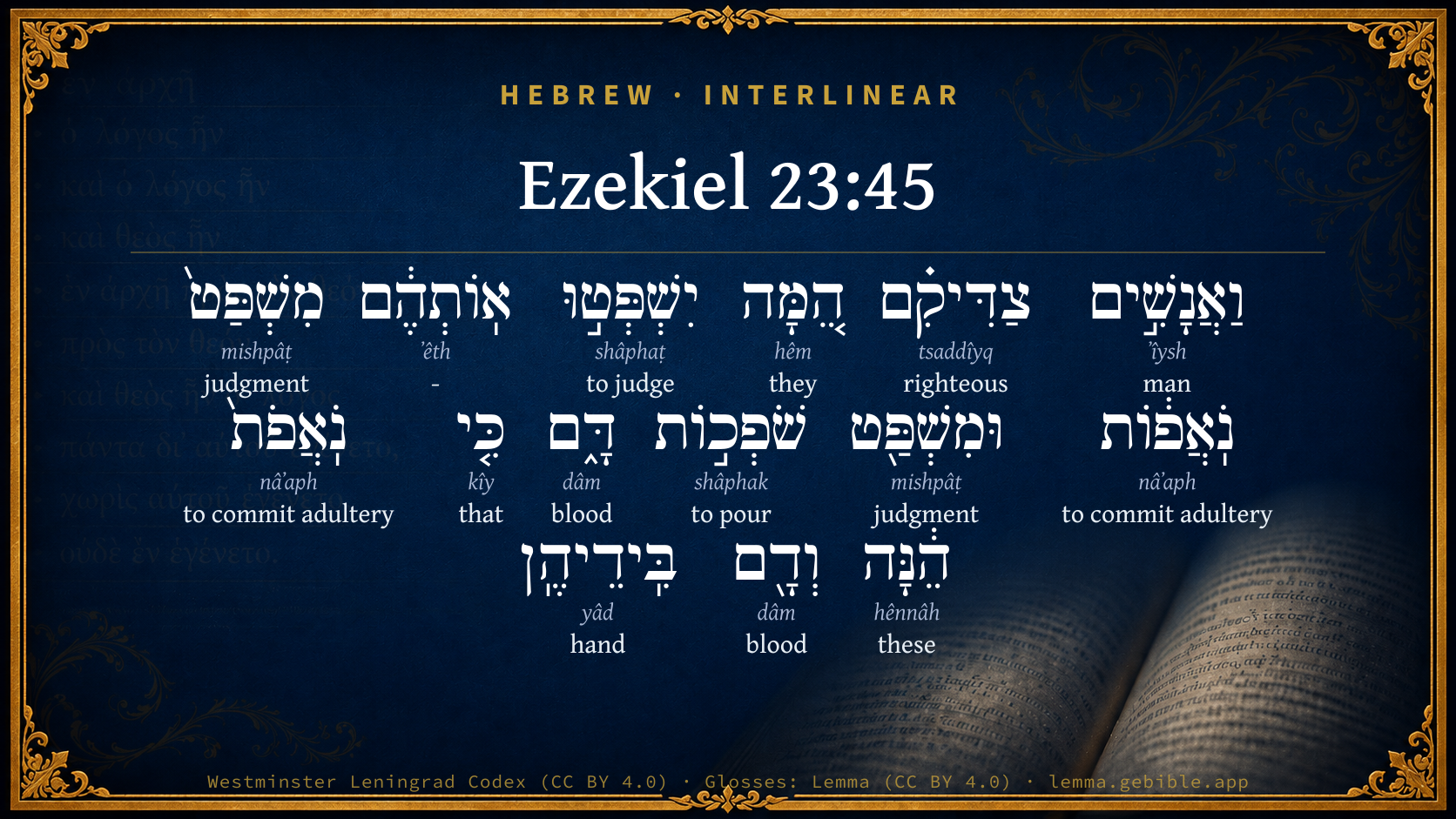
Ezekiel 23:45

Hebrew (Westminster Leningrad Codex) Ezekiel 23:45 appears in the Hebrew Old Testament. The text above is from the Westminster Leningrad Codex. Each word links to its Strong’s number, a concise gloss, and parsing drawn from the Open Scriptures Hebrew Bible morphology. Click any word for its full Brown-Driver-Briggs (BDB) entry.
Download image
Cite this verse

Ezekiel 23:45 (World English Bible). Public Domain. Lemma interlinear Bible study tool, https://lemma.gebible.app/v/ezekiel/23/45.

Show BibTeX & RIS
BibTeX
RIS
English Translation
Righteous men, they shall judge them with the judgment of adulteresses, and with the judgment of women who shed blood; because they are adulteresses, and blood is in their hands.
World English Bible · Public Domain
Download a study sheet

One document with this verse’s original text, its word-by-word gloss line, the meaning frame, cross-references with their text, attributed commentary, and full source and license credits — printable, and it pastes into notes with its structure intact.

This verse Autodidact and up

Study sheet (.html) Plain text (.txt)

A passage Seminary Student

Up to 50 verses in one chapter. A passage sheet keeps up to 6 commentary sources and 12 cross-references per verse, in the order this page ranks them, and says so on the sheet whenever that leaves anything out. Ask for a single verse and you get the Autodidact verse sheet above.

Everything on this page stays free to read, with no account — the sheet is a download of what is already on screen, not access to it.

Want to remove ads? Support Godless Engineer
Compare translations 3

The same verse in 3 English versions, stacked beneath the original-language interlinear above. Click any original word for its lexicon entry.

Each is an independent rendering of the whole verse — the interlinear is not word-aligned to these translations.

Highlighted words mark where these versions differ — a whole-verse word diff, not a word-by-word alignment.

  • World English Bible Public Domain
    Righteous men, they shall judge them with the judgment of adulteresses, and with the judgment of women who shed blood; because they are adulteresses, and blood is in their hands.
  • King James Version Public Domain
    And the righteous men, they shall judge them after the manner of adulteresses, and after the manner of women that shed blood; because they are adulteresses, and blood is in their hands.
  • unfoldingWord Literal Text CC BY-SA 4.0
    But righteous men will pass judgment and punish them as adulteresses, and they will punish them with the sentence for those who shed blood, because they are adulteresses and blood is on their hands.

unfoldingWord Literal Text — © unfoldingWord, licensed CC BY-SA 4.0. Word-aligned USFM3 via Door43 (git.door43.org/unfoldingWord/en_ult).

Versions to compare (up to 4)

3 of 4 selected

Show all 18 translations

Every available English version of this verse, each an independent rendering of the whole verse.

  • World English Bible Public Domain
    Righteous men, they shall judge them with the judgment of adulteresses, and with the judgment of women who shed blood; because they are adulteresses, and blood is in their hands.
  • Berean Standard Bible Public Domain
    But righteous men will sentence them to the punishment of those who commit adultery and bloodshed, because they are adulteresses with blood on their hands.
  • Majority Standard Bible Public Domain
    But righteous men will sentence them to the punishment of those who commit adultery and bloodshed, because they are adulteresses with blood on their hands.
  • King James Version Public Domain
    And the righteous men, they shall judge them after the manner of adulteresses, and after the manner of women that shed blood; because they are adulteresses, and blood is in their hands.
  • American Standard Version (1901) Public Domain
    And righteous men, they shall judge them with the judgment of adulteresses, and with the judgment of women that shed blood; because they are adulteresses, and blood is in their hands.
  • Revised Version (1885) Public Domain
    And righteous men, they shall judge them with the judgment of adulteresses, and with the judgment of women that shed blood; because they are adulteresses, and blood is in their hands.
  • Geneva Bible (1599) Public Domain
    And ye righteous men they shall iudge them, after the maner of harlots, and after the maner of murtherers: for they are harlots, and blood is in their hands.
  • Douay-Rheims (1899) Public Domain
    They therefore are k just men: these shall judge them as adulteresses are judged, and as shedders of blood are judged: because they are adulteresses, and blood is in their hands.
  • Young's Literal Translation Public Domain
    As to righteous men, they judge them with the judgment of adulteresses, And the judgment of women shedding blood, For they `are' adulteresses, And blood `is' in their hands.
  • Literal Standard Version CC BY-SA 4.0
    As for righteous men, they judge them with the judgment of adulteresses, || And the judgment of women shedding blood, || For they [are] adulteresses, || And blood [is] in their hands.
  • Unlocked Literal Bible CC BY-SA 4.0
    But righteous men will pass judgment and punish them as adulteresses, and they will punish them with the sentence for those who shed blood, because they are adulteresses and blood is on their hands.
  • unfoldingWord Literal Text CC BY-SA 4.0
    But righteous men will pass judgment and punish them as adulteresses, and they will punish them with the sentence for those who shed blood, because they are adulteresses and blood is on their hands.
  • Darby Bible Public Domain
    And righteous men, they shall judge them with the judgment of adulteresses, and with the judgment of women that shed blood; for they are adulteresses, and blood is in their hands.
  • World Messianic Bible Public Domain
    Righteous men will judge them with the judgment of adulteresses and with the judgment of women who shed blood, because they are adulteresses, and blood is in their hands.
  • Webster's Bible Public Domain
    And the righteous men, they shall judge them after the manner of adulteresses, and after the manner of women that shed blood; because they are adulteresses, and blood is in their hands.
  • Free Bible Version CC BY-SA 4.0
    But men who believe in doing what's right will judge them and impose the punishment for committing adultery and murder, because they are adulterers and murderers.
  • Bible in Basic English Public Domain
    And upright men will be her judges, judging her as false wives and women who take lives are judged; because she has been untrue to me and blood is on her hands.
  • JPS Tanakh (1917) Public Domain
    But righteous men, they shall judge them as adulteresses are judged, and as women that shed blood are judged; because they are adulteresses, and blood is in their hands.

Literal Standard Version (2020), Covenant Press — licensed CC BY-SA 4.0. Text via the HelloAO Bible API (eBible.org). Unlocked Literal Bible (unfoldingWord) — licensed CC BY-SA 4.0. Text via the HelloAO Bible API (eBible.org). unfoldingWord Literal Text — © unfoldingWord, licensed CC BY-SA 4.0. Word-aligned USFM3 via Door43 (git.door43.org/unfoldingWord/en_ult). Free Bible Version, Dr. Jonathan Gallagher — licensed CC BY-SA 4.0. Text via the HelloAO Bible API (eBible.org).

Word by word

More ways to search: Search by grammar → Find every occurrence → Compare this word →

Practice this passage: Drill this verse → Learn its vocabulary →

נֹֽאֲפ֔וֹת
nâʼaph
H5003
“committing adultery”
Verb, Qal, Participle Active, Feminine, Plural, Absolute
Part of Speech
Verb
Stem
Qal
Form
Participle Active
Gender
Feminine
Number
Plural
State
Absolute
Full BDB Definition

Origin: a primitive root

TWOT: 1273

to commit adultery - (Qal) - to commit adultery - usually of man - always with wife of another - adultery (of women) (participle) - idolatrous worship (figuratively) - (Piel) - to commit adultery - of man - adultery (of women) (participle) - idolatrous worship (figuratively)
  1. וַאֲנָשִׁ֣ים ʼîysh H376 “and · men” Conjunction + Noun, Common, Masculine, Plural, Absolute
  2. צַדִּיקִ֗ם tsaddîyq H6662 “righteous” Adjective, Adjective, Masculine, Plural, Absolute
  3. הֵ֚מָּה hêm H1992 “they” Pronoun, Personal, 3rd Person, Masculine, Plural
  4. יִשְׁפְּט֣וּ shâphaṭ H8199 “to judge” Verb, Qal, Imperfect, 3rd Person, Masculine, Plural
  5. אֽוֹתְהֶ֔ם ʼêth H853 “- · them” Particle, Direct Object + Suffix, Personal, 3rd Person, Masculine, Plural
  6. מִשְׁפַּט֙ mishpâṭ H4941 “judgment of” Noun, Common, Masculine, Singular, Construct
  7. וּמִשְׁפַּ֖ט mishpâṭ H4941 “and · judgment of” Conjunction + Noun, Common, Masculine, Singular, Construct
  8. שֹׁפְכ֣וֹת shâphak H8210 “pouring” Verb, Qal, Participle Active, Feminine, Plural, Construct
  9. דָּ֑ם dâm H1818 “blood” Noun, Common, Masculine, Singular, Absolute
  10. כִּ֤י kîy H3588 “that” Conjunction
  11. נֹֽאֲפֹת֙ nâʼaph H5003 “committing adultery” Verb, Qal, Participle Active, Feminine, Plural, Absolute
  12. הֵ֔נָּה hênnâh H2007 “these” Pronoun, Personal, 3rd Person, Feminine, Plural
  13. וְדָ֖ם dâm H1818 “and · blood” Conjunction + Noun, Common, Masculine, Singular, Absolute
  14. בִּֽידֵיהֶֽן yâd H3027 “in/at · hands · their” Preposition + Noun, Common, Both, Dual, Construct + Suffix, Personal, 3rd Person, Feminine, Plural

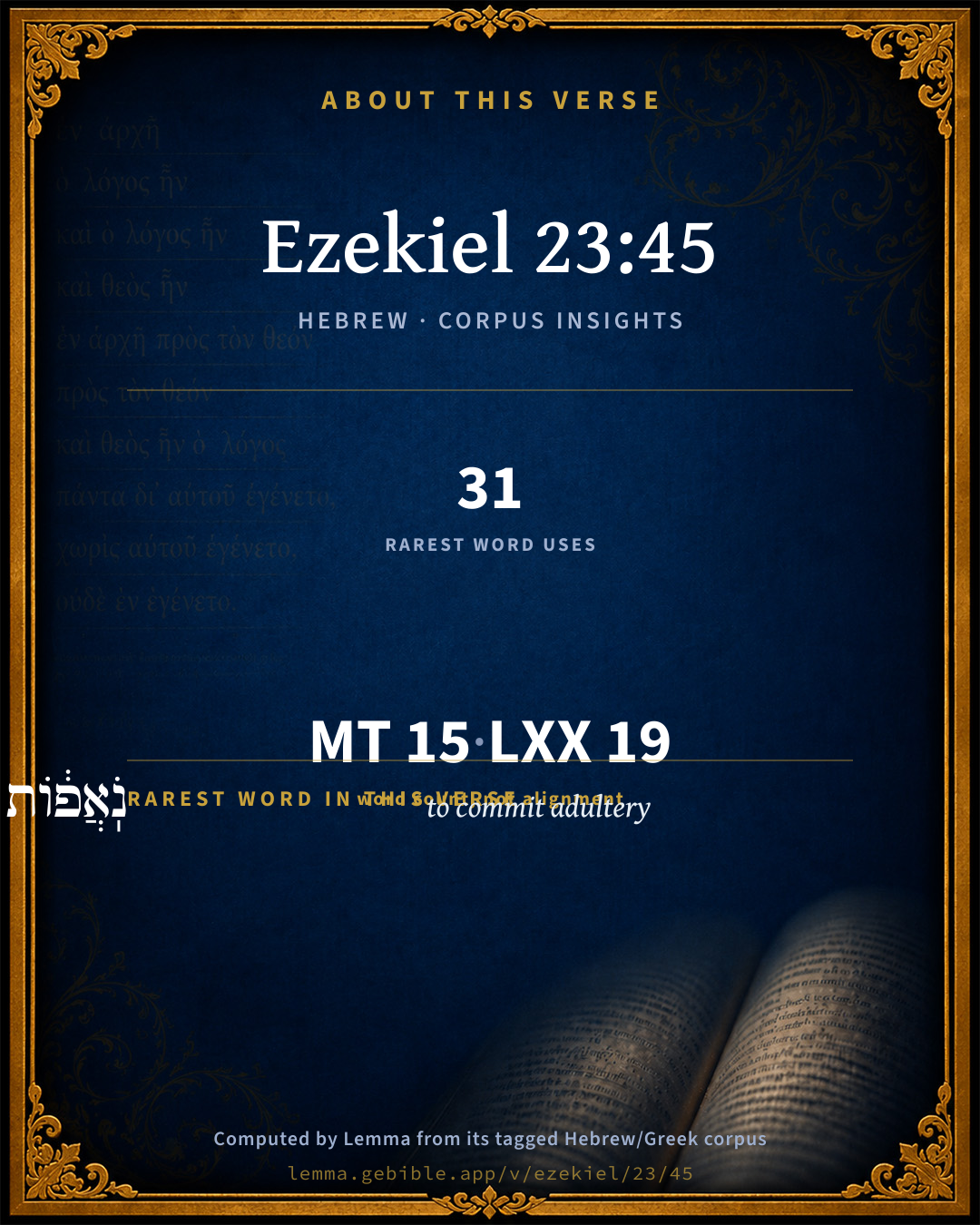
About this verse

These counts appear in no published source. They are computed here, from the morphology-tagged text and Lemma’s own curated glosses. What Lemma adds →

15
words
12
distinct lemmas
Prophets
section

Shared distinctive vocabulary

נֹֽאֲפ֔וֹת to commit adultery H5003 occurs in 26 verses of the Hebrew Bible. Also found in:

Grammatical profile

  • 4 verbs
  • 6 nouns
  • 1 adjective
  • 2 pronouns
  • 1 conjunction
  • 1 particle

Verb forms

  • יִשְׁפְּט֣וּ Qal · Imperfect
  • נֹֽאֲפ֔וֹת Qal · Participle Active
  • שֹׁפְכ֣וֹת Qal · Participle Active
  • נֹֽאֲפֹת֙ Qal · Participle Active

Repetition

Words recur within this verse — often emphatic in Hebrew:

  • מִשְׁפַּט֙ judgment H4941 ×2
  • נֹֽאֲפ֔וֹת to commit adultery H5003 ×2
  • דָּ֑ם blood H1818 ×2

Hebrew & Septuagint length

In English translation the verse runs 30 words from the Hebrew and 32 from the Septuagint (LXX English) — closely comparable.

A rough comparison of the two English renderings, which tokenize alike — not a word-level alignment.

Word counts can differ between the Hebrew and the Greek without any difference in meaning — e.g. the Hebrew direct-object marker אֵת has no separate Greek word, and Greek often adds the article ὁ.

In the original languages it is 15 Hebrew tokens and 19 Greek tokens — but the two are counted differently (Hebrew bundles its prefixes and suffixes into one token; the Greek is in lemma form), so that isn’t a like-for-like length.

Cross-references

9

Topical passages linked to Ezekiel 23:45 in the Treasury of Scripture Knowledge — connected by theme and wording, ordered by reader-vote popularity; previews shown in the World English Bible.

  • Leviticus 20:10 "'The man who commits adultery with another man's wife, even he who commits adultery with his neighbor's wife, the adulterer and the adulteress shall surely be put to death.
  • Ezekiel 16:38–43 I will judge you, as women who break wedlock and shed blood are judged; and I will bring on you the blood of wrath and jealousy.
  • Ezekiel 23:36–39 Yahweh said moreover to me: Son of man, will you judge Oholah and Oholibah? then declare to them their abominations.
  • Hosea 6:5 Therefore I have cut them to pieces with the prophets; I killed them with the words of my mouth. Your judgments are like a flash of lightning.
  • Leviticus 21:9 "'The daughter of any priest, if she profanes herself by playing the prostitute, she profanes her father: she shall be burned with fire.
  • Deuteronomy 22:21–24 then they shall bring out the young lady to the door of her father's house, and the men of her city shall stone her to death with stones, because she has done folly in Israel, to play the prostitute in her father's house: so shall you put away the evil from the midst of you.
  • Jeremiah 5:14 Therefore thus says Yahweh, the God of hosts, Because you speak this word, behold, I will make my words in your mouth fire, and this people wood, and it shall devour them.
  • Zechariah 1:6 But my words and my decrees, which I commanded my servants the prophets, didn't they overtake your fathers? "Then they repented and said, 'Just as Yahweh of Hosts determined to do to us, according to our ways, and according to our practices, so he has dealt with us.'"
  • John 8:3–7 The scribes and the Pharisees brought a woman taken in adultery. Having set her in the midst,

Cross-references courtesy of OpenBible.info (CC BY 4.0).

Hebrew and Greek witnesses Masoretic Hebrew ↔ Greek Septuagint

The same verse in the two great witnesses to the Old Testament, shown verse-for-verse.

These are two independent witnesses, not word-aligned to each other, and the Septuagint is shown in lemma (dictionary) form.

Hebrew Ezekiel 23:45 Masoretic · Westminster Leningrad Codex

וַאֲנָשִׁ֣ים צַדִּיקִ֗ם הֵ֚מָּה יִשְׁפְּט֣וּ אֽוֹתְהֶ֔ם מִשְׁפַּט֙ נֹֽאֲפ֔וֹת וּמִשְׁפַּ֖ט שֹׁפְכ֣וֹת דָּ֑ם כִּ֤י נֹֽאֲפֹת֙ הֵ֔נָּה וְדָ֖ם בִּֽידֵיהֶֽן

Righteous men, they shall judge them with the judgment of adulteresses, and with the judgment of women who shed blood; because they are adulteresses, and blood is in their hands.

World English Bible · Public Domain

Greek LXX Ezekiel 23:45 Septuagint · lemma form

καί ἀνήρ δίκαιος αὐτός ἐκδικέω αὐτός ἐκδίκησις μοιχαλίς καί ἐκδίκησις αἷμα ὅτι μοιχαλίς εἰμί καί αἷμα ἐν χείρ αὐτός

And they are just men, and shall take vengeance on them with the judgment of an adulteress and the judgment of blood: for they are adulteresses, and blood is in their hands.

LXX2012 (modern English Septuagint) · Public Domain

Hebrew: Westminster Leningrad Codex (CC BY 4.0). Greek: Septuagint (public domain); English from LXX2012 (modern English Septuagint) (Public Domain). How the Septuagint differs from the Hebrew →

Targum (Aramaic paraphrase)

1

The Targum is the ancient Jewish Aramaic paraphrase of the Hebrew Scriptures — an interpretive translation, not the Hebrew text itself. Onkelos (literal) and Pseudo-Jonathan (expansive) render the Torah, and Jonathan the Prophets. Coverage is partial: where no permissively-licensed English translation exists for a verse, only the Aramaic is shown. This is verse-level text, not a word-by-word alignment to the Hebrew.

  1. Targum Jonathan Prophets (Joshua–Malachi)
    וְגַבְרִין זַכָּאִין בְּקִבְלֵיהוֹן יִתְפָּרְעוּן מִנְהֶן פּוּרְעֲנוּת נַיָפִין וּפוּרְעֲנוּת אַשְׁדַת דַם אֲרֵי זַנְאִין בְּהֶן וְדַם זַכַּאִי אֲשָׁדוּ בִּידֵיהוֹן:

    (no public-domain English translation for this verse)

    Targum Jonathan — Aramaic: “Mikraot Gedolot” (public domain). English: “Sefaria Community Translation” (CC0 1.0 (public-domain dedication)); “London "Chaldee Paraphrase," 1871” (public domain). Text via Sefaria.

Commentary

Notes on Ezekiel 23:45 from classic Christian and Jewish commentators (each source and its license shown beneath its notes). The classic Christian expositions comment on the surrounding passage and are grouped to its opening verse, so a note may address several verses; the Jewish commentaries on the Tanakh (Rashi and others) are per-verse, so they appear only where the commentator wrote on this verse.

Lemma curates 59 commentaries, every one of them public domain or Creative Commons licensed, each selected and text-cleaned for this edition rather than reprinted as found. About our sources →

Trapp's Complete Commentary

John Trapp

Eze 23:45 And the righteous men, they shall judge them after the manner of adulteresses, and after the manner of women that shed blood; because they [are] adulteresses, and blood [is] in their hands.

Ver. 45. And the righteous men.] So the Chaldees are called, because less wicked than the Jews (as the Scythians were better than the Athenians, and now the Indians than the Spaniards), and because they executed the righteous sentence of God upon those flagitious Jews.

John Trapp, A Commentary or Exposition upon All the Books of the Old and New Testament (1647–1656) — public domain. Text from a community e-Sword module.

Albert Barnes' Notes on the Bible

The judgment to be executed by the hands of their allies.

Eze 23:45

The righteous men - Or, righteous men. The allies are so called as the instruments of God’s righteous judgments.

Eze 23:48

To cease - Because they are stricken and consumed. Compare marginal reference.

All women - i. e., all countries.

Albert Barnes' Notes on the Bible (1834–1885) — public domain. Text from a community e-Sword/MySword module.

Joseph Benson's Commentary

Eze 23:45-49. And the righteous men, they shall judge them — All just judges, yea, all men that have any sense of common honesty, will condemn their conduct, and pronounce them deserving of the punishment of adulteresses and murderers. Or, as others interpret the words, “As upright magistrates used to condemn and execute judgment upon adulterers and murderers, so did the prophets, in the name of God, denounce sentence against Jerusalem and Samaria; and even the heathen princes, who executed the sentence, were more righteous than the apostate sufferers.” — Scott. I will bring a company upon them, &c. — This is spoken of the Babylonians, who were to plunder and carry away a great part of the inhabitants of Jerusalem. And the company shall stone them with stones, and despatch them with swords — Stoning was the punishment of adulterers, and putting to death with the sword that of murderers. The Babylonian army might be properly said to be the executioners of both these punishments upon the inhabitants of Jerusalem, as, without doubt, they killed many of them during the siege by the stones they cast from their engines, and slew many by the sword when they took the city by assault. Thus will I cause lewdness to cease, &c. — Thus will I put an end to idolatry in the Jewish nation. That all women may be taught not to do after your lewdness — That is, that all nations may dread defiling themselves with the guilt of your idolatries. For as the kingdoms of Israel and Judah are here described as two women, therefore, by all women here must be meant all nations. And ye shall bear the sins of your idols — Ye shall bear the punishment due to your sins of idolatry. To bear sin, or iniquity, is an expression often used in the Scriptures to signify undergoing the punishment due to it.

Joseph Benson's Commentary on the Old and New Testaments (1811–1818) — public domain. Text from a community e-Sword module.

Geneva Bible (1599)

Geneva Bible translators

That is, worthy of death, read Ezek. 16:38.

Geneva Bible (1599) marginal notes — public domain. Text via Bolls.life.

Jamieson, Fausset & Brown

Robert Jamieson, A. R. Fausset & David Brown

the righteous men--the Chaldeans; the executioners of God's righteous vengeance (Eze 16:38), not that they were "righteous" in themselves (Hab 1:3, Hab 1:12-13).

Jamieson, Fausset & Brown — Commentary Critical and Explanatory on the Whole Bible (1871) — public domain (CC PDM 1.0). Text via the HelloAO Bible API.

Adam Clarke's Commentary

Verse 45. And the righteous men] אנשים צדיקים anashim tsaddikim. The Chaldeans, thus called because they are appointed by God to execute judgment on these criminals.

Adam Clarke's Commentary on the Bible (1810–1826) — public domain. Text from a community e-Sword/MySword module.

Ellicott's Commentary for English Readers

(45) The righteous men.—That is, men to whom the judgment of righteousness is committed.

A Bible Commentary for English Readers, edited by Charles John Ellicott (1878–1897) — public domain. Text from a community e-Sword module.

The Cambridge Bible for Schools and Colleges

gen. ed. J. J. S. Perowne

45–49. Judgment on the adulterous women

45. the righteous] righteous men. The prophet carries on the figure of the punishment of adulteresses. They are judged by righteous men. He has not in his mind the nations, the actual executors of judgment in the case of Israel. The word “righteous” throws no light on Isa_49:24.

The Cambridge Bible for Schools and Colleges (gen. ed. J. J. S. Perowne; Cambridge University Press, 1878–1918) — public domain. Text from a community e-Sword module.

John Gill's Exposition

And the righteous men,.... Some understand this of the prophets, who were really righteous men; and foretold the righteous judgments of God that should come upon the idolatrous Jews, which was a judging them: others, of righteous men in general, who will one and all agree that persons guilty of such crimes ought to suffer the punishment adequate to them, and usually inflicted on such; but rather the Babylonians are here meant; who, though not righteous in themselves, or truly so, yet were so in comparison of the wicked Jews, who had a divine revelation, and knew better than to commit such idolatries; whereas these were Gentiles that knew not God, nor his will. So the Targum,

"and righteous men in respect (or comparison) of them;''

that is, of Israel and Judah; and they may be also called so, because they were the executioners of justice, the instruments of inflicting God's righteous judgments on the Jews; and, among other things, for their perfidy and treachery to them; so that they would appear just in the eyes of other nations for treating them as they did:

they shall judge them after the manner of adulteresses, and after the manner of women that shed blood; that is, according to the law concerning such persons; and shall condemn them to suffer the punishment denounced on such, and shall execute it on them:

because they are adulteresses, the blood is in their hands; are guilty, not only of corporeal uncleanness, but of spiritual adultery; that is, idolatry; and of the murder of their prophets and righteous men, and even of their own children sacrificed to idols; than which nothing can be more unnatural and barbarous for women to do.

John Gill's Exposition of the Whole Bible (1746–1763) — public domain (CC PDM 1.0). Text via the HelloAO Bible API.

Haydock's Catholic Bible Commentary

Just, compared with the Jews, whom they shall chastise. (Calmet)

George Leo Haydock (1774–1849), Haydock's Catholic Family Bible and Commentary, 1859 edition — public domain. Excludes Psalms (Douay-Rheims chapter numbering differs from Protestant) and Deuterocanonical books (Catholic canon only).

Matthew Poole's English Annotations

Righteous men; men that kept the law of their God, for some such there were about Aholibah herself; or prophets, such as Jeremiah and Ezekiel, and some few more: or else the Babylonians, who in the present controversy between Jerusalem and its king on the one part, and Nebuchadnezzar and the Babylonians on the other part, were comparatively the righteous men.

After the manner of adulteresses; which was, to be put to death by stoning, Lev 20:10; and murder was punished with death.

Matthew Poole's English Annotations on the Holy Bible (1683–1685) — public domain. Text from a community e-Sword/MySword module.

Whedon's Commentary on the Bible

Daniel D. Whedon

45. Righteous men; they shall judge them — As righteous men would execute lawful punishment upon such adulteresses, stoning them with stones (Lev_20:10; Deu_22:22; Deu_22:24), so a company of God’s executioners shall come upon Jerusalem and Samaria and they shall be removed (literally, tossed to and fro), spoiled, stoned, destroyed with fire and sword (Eze_5:2; Eze_6:4-10; Eze_16:40-41). The result shall be a world-wide warning against idolatry and its complete extermination in Israel (Eze_23:48-49). The influence of this chapter is seen throughout all Jewish literature. Take for example, this pathetic extract from the Hebrew Divan of R. Judah Halevy: —

O cup of woe! Give pause! Give breathing space!

My veins and soul are full of bitterness. I think on Aholah —

I drink thy cup; On Aholibah — then I drain its dregs.

O Zion, “perfect beauty,” grace and love

Of old thou bindest on thee — yea, the souls

Of sages, too, are bound up in thy life,

These gladden in thy weal, these wail thy woe,

These weep thy ruin. Still from captive pit

Toward thee they yearn, and toward thy sacred gates

Each from his place they bow them down in prayer.

Daniel D. Whedon (gen. ed.), Commentary on the Old and New Testaments (1874–1909) — public domain. Text from a community e-Sword module.

The Pulpit Commentary

The righteous men are in effect the ministers of God"s wrath. The doom comes at last on both the sisters, who are murderers as well as adulteresses. They shall suffer the punishment of stoning which the Law commanded (Lev_20:10; Deu_22:22, Deu_22:24; Joh_8:5) and after that their bodies were to be hacked to pieces. The result of that judgment would be that all women should learn not to do after their lewdness, i.e. that idolatry should cease from being the sin of the cities of Israel.

The Pulpit Commentary (1880–1919), ed. H.D.M. Spence-Jones & Joseph S. Exell — public domain. Text from a community e-Sword module.

John Wesley's Explanatory Notes

Righteous men - Men that keep the law of their God.

John Wesley, Explanatory Notes Upon the Whole Bible (1754–1765) — public domain. Text via the GEBible commentary corpus.

Rashi

Rabbi Shlomo Yitzchaki (Rashi)

And righteous men Judges, the princes of the king of Babylon and the king of Assyria. But Jonathan renders: righteous, as compared to them. According to the deeds of these harlots, the nations are more righteous than they.

the judgment of adulteresses, etc. as is delineated further.

Rashi on the Tanakh — English translations: “The Judaica Press complete Tanach with Rashi, translated by A. J. Rosenberg” (CC BY 4.0); “Pentateuch with Rashi's commentary by M. Rosenbaum and A.M. Silbermann, 1929-1934” (public domain); “The Metsudah Tanach series, Lakewood, N.J” (CC BY 4.0); and “The Book of Joshua, Metsudah Publications, 1997” (CC BY 4.0). Text via Sefaria.

Lesson kit

Teaching starters — assembled from the data on this page, not authored interpretation. Every prompt links to the verse data it draws on. Edit before teaching.

Ezekiel, in the Prophets, opens this verse with 15 words (12 distinct Hebrew lemmas). Its most distinctive word is nâʼaph (“to commit adultery”). A historical commentator’s framing appears above. Read the whole chapter for the surrounding context.

Discussion questions

  1. The word nâʼaph carries the sense “to commit adultery.” How does it shape the verse?
  2. How does Exodus 20:14, which shares the word «to commit adultery», read alongside this verse?
  3. What does the repetition of “judgment” (2× in this one verse) do in this verse?
  4. The translations on this page render this verse differently — a whole-verse word diff, not a word-by-word alignment. What might account for the different wordings?
  5. «יִשְׁפְּט֣וּ» is a Qal Imperfect verb. How does that grammatical form shape the action described?
  6. Compare how Trapp's Complete Commentary and Albert Barnes' Notes on the Bible read this verse. Where do they agree or differ?

Things to notice

Reading settings

Reading text

Shown beneath each verse's original-language words.

Old Testament
Old Testament edition

Read the OT as the Masoretic Hebrew (MT) or the Greek Septuagint (LXX).

English shown for the Greek Septuagint (in the Hebrew ↔ Greek comparison).

Comparing translations? Open the Compare panel on any verse page to stack up to four side by side.