
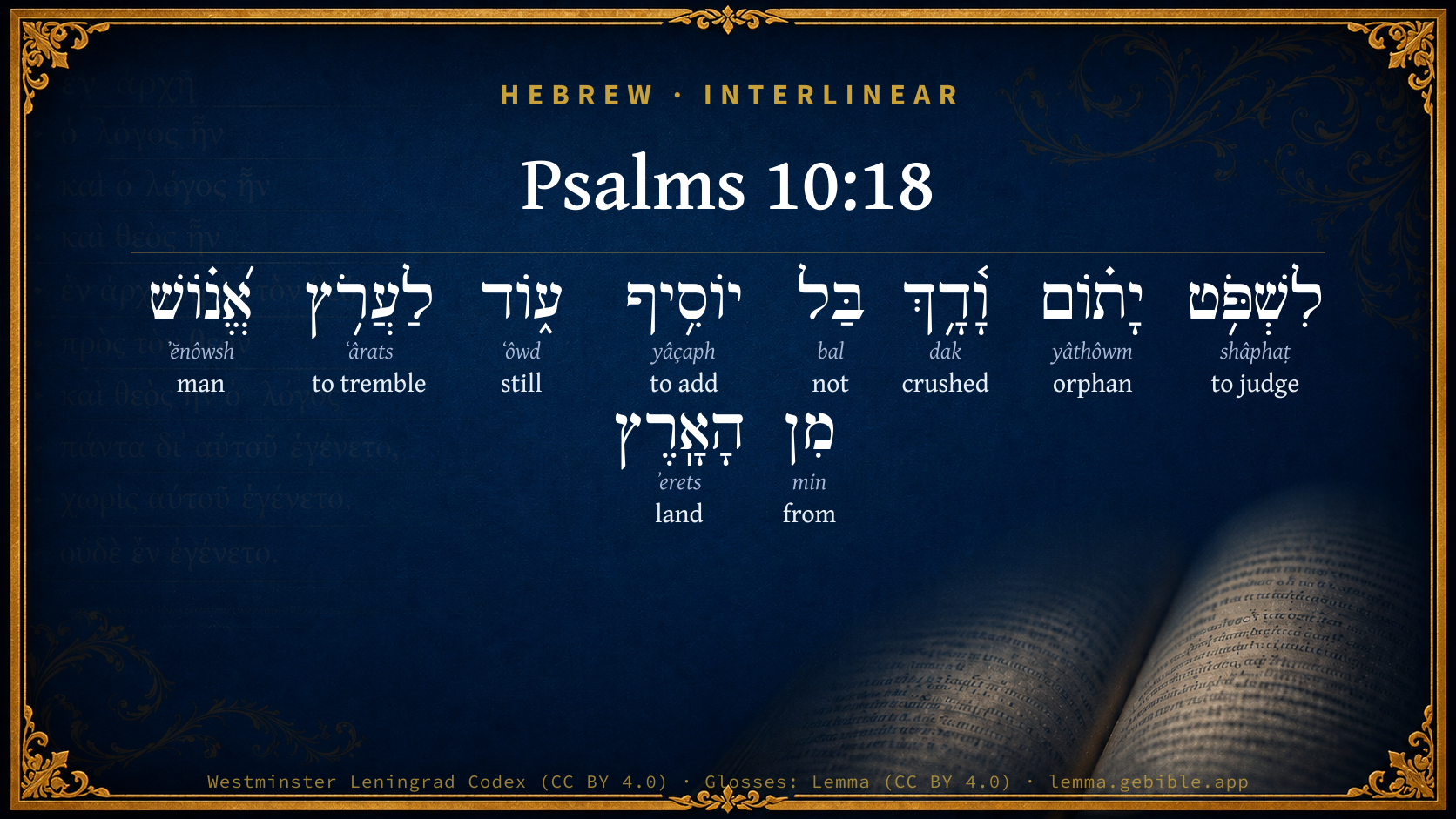
Psalms 10:18

Hebrew (Westminster Leningrad Codex) Psalms 10:18 appears in the Hebrew Old Testament. The text above is from the Westminster Leningrad Codex. Each word links to its Strong’s number, a concise gloss, and parsing drawn from the Open Scriptures Hebrew Bible morphology. Click any word for its full Brown-Driver-Briggs (BDB) entry.
Download image
Cite this verse

Psalms 10:18 (World English Bible). Public Domain. Lemma interlinear Bible study tool, https://lemma.gebible.app/v/psalms/10/18.

Show BibTeX & RIS
BibTeX
RIS
English Translation
To judge the fatherless and the oppressed, That man who is of the earth may terrify no more.
World English Bible · Public Domain
Download a study sheet

One document with this verse’s original text, its word-by-word gloss line, the meaning frame, cross-references with their text, attributed commentary, and full source and license credits — printable, and it pastes into notes with its structure intact.

This verse Autodidact and up

Study sheet (.html) Plain text (.txt)

A passage Seminary Student

Up to 50 verses in one chapter. A passage sheet keeps up to 6 commentary sources and 12 cross-references per verse, in the order this page ranks them, and says so on the sheet whenever that leaves anything out. Ask for a single verse and you get the Autodidact verse sheet above.

Everything on this page stays free to read, with no account — the sheet is a download of what is already on screen, not access to it.

Want to remove ads? Support Godless Engineer
Compare translations 3

The same verse in 3 English versions, stacked beneath the original-language interlinear above. Click any original word for its lexicon entry.

Each is an independent rendering of the whole verse — the interlinear is not word-aligned to these translations.

Highlighted words mark where these versions differ — a whole-verse word diff, not a word-by-word alignment.

  • World English Bible Public Domain
    To judge the fatherless and the oppressed, That man who is of the earth may terrify no more.
  • King James Version Public Domain
    To judge the fatherless and the oppressed, that the man of the earth may no more oppress.
  • unfoldingWord Literal Text CC BY-SA 4.0
    to judge the orphan and oppressed; mankind from the earth will never again terrify.

unfoldingWord Literal Text — © unfoldingWord, licensed CC BY-SA 4.0. Word-aligned USFM3 via Door43 (git.door43.org/unfoldingWord/en_ult).

Versions to compare (up to 4)

3 of 4 selected

Show all 17 translations

Every available English version of this verse, each an independent rendering of the whole verse.

  • World English Bible Public Domain
    To judge the fatherless and the oppressed, That man who is of the earth may terrify no more.
  • Berean Standard Bible Public Domain
    to vindicate the fatherless and oppressed, that the men of the earth may strike terror no more.
  • Majority Standard Bible Public Domain
    to vindicate the fatherless and oppressed, that the men of the earth may strike terror no more.
  • King James Version Public Domain
    To judge the fatherless and the oppressed, that the man of the earth may no more oppress.
  • American Standard Version (1901) Public Domain
    To judge the fatherless and the oppressed, That man who is of the earth may be terrible no more. Psalm 11 For the Chief Musician. `A Psalm' of David.
  • Revised Version (1885) Public Domain
    To judge the fatherless and the oppressed, that man which is of the earth may be terrible no more.
  • Geneva Bible (1599) Public Domain
    To iudge the fatherlesse and poore, that earthly man cause to feare no more.
  • Young's Literal Translation Public Domain
    To judge the fatherless and bruised: He addeth no more to oppress -- man of the earth!
  • Literal Standard Version CC BY-SA 4.0
    To judge the fatherless and bruised: He adds no more to oppress—man of the earth!
  • Unlocked Literal Bible CC BY-SA 4.0
    You defend the fatherless and the oppressed so that no man on the earth will cause terror again.
  • unfoldingWord Literal Text CC BY-SA 4.0
    to judge the orphan and oppressed; mankind from the earth will never again terrify.
  • Darby Bible Public Domain
    To do justice to the fatherless and the oppressed one, that the man of the earth may terrify no more.
  • World Messianic Bible Public Domain
    to judge the fatherless and the oppressed, that man who is of the earth may terrify no more.
  • Webster's Bible Public Domain
    To judge the fatherless and the oppressed, that the man of the earth may no more oppress.
  • Free Bible Version CC BY-SA 4.0
    You will defend the rights of orphans and the oppressed so that those who are mere human beings here on earth will never terrorize them again.
  • Bible in Basic English Public Domain
    To give decision for the child without a father and for the broken-hearted, so that the man of the earth may no longer be feared.
  • JPS Tanakh (1917) Public Domain
    To right the fatherless and the oppressed, that man who is of the earth may be terrible no more.

Literal Standard Version (2020), Covenant Press — licensed CC BY-SA 4.0. Text via the HelloAO Bible API (eBible.org). Unlocked Literal Bible (unfoldingWord) — licensed CC BY-SA 4.0. Text via the HelloAO Bible API (eBible.org). unfoldingWord Literal Text — © unfoldingWord, licensed CC BY-SA 4.0. Word-aligned USFM3 via Door43 (git.door43.org/unfoldingWord/en_ult). Free Bible Version, Dr. Jonathan Gallagher — licensed CC BY-SA 4.0. Text via the HelloAO Bible API (eBible.org).

Word by word

More ways to search: Search by grammar → Find every occurrence → Compare this word →

Practice this passage: Drill this verse → Learn its vocabulary →

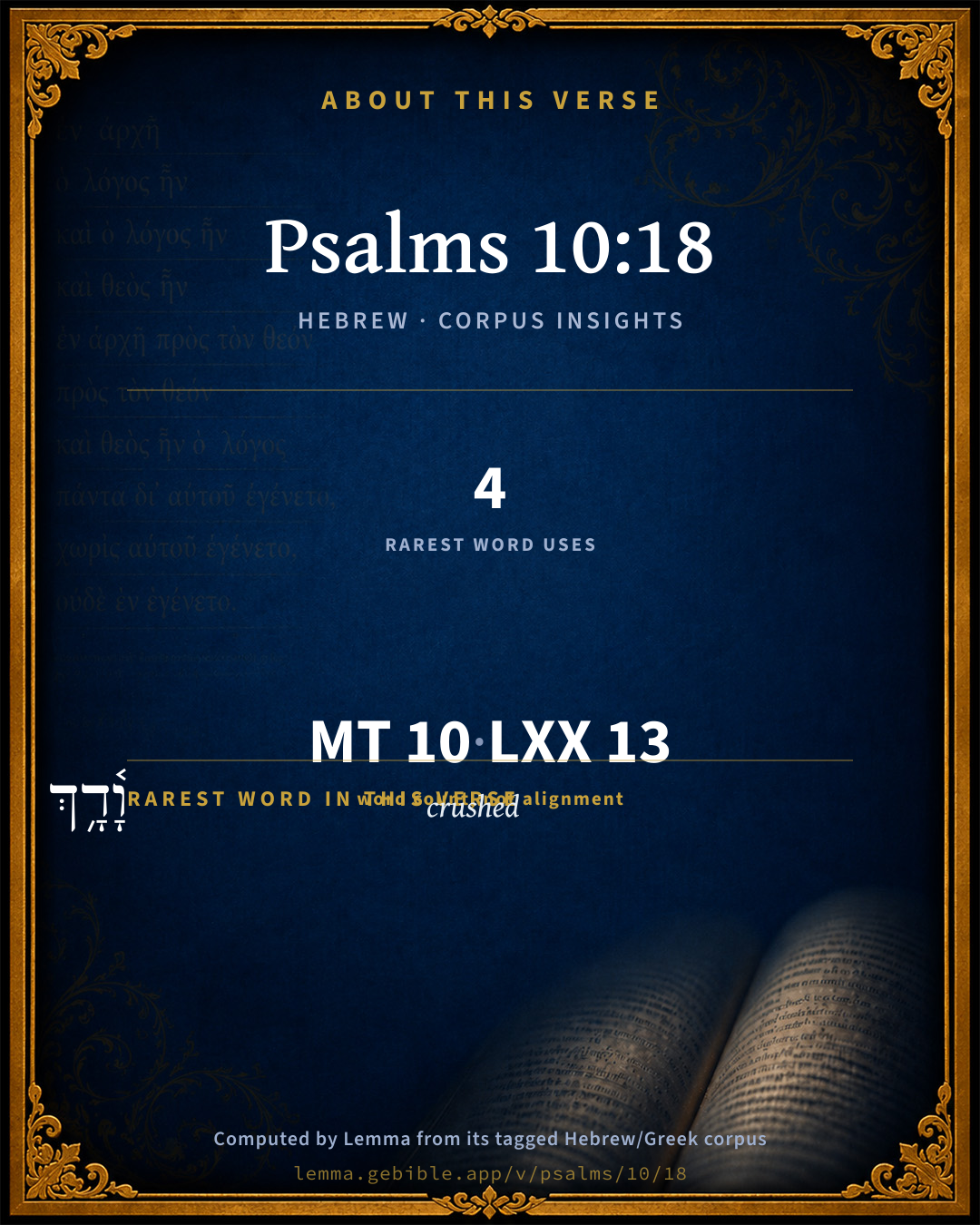
About this verse

These counts appear in no published source. They are computed here, from the morphology-tagged text and Lemma’s own curated glosses. What Lemma adds →

10
words
10
distinct lemmas
Wisdom
section

Notable vocabulary

The rarest word here is וָ֫דָ֥ךְ crushed H1790 — appearing just 4 times in the whole Hebrew Bible.

Shared distinctive vocabulary

וָ֫דָ֥ךְ crushed H1790 occurs in 4 verses of the Hebrew Bible. Also found in:

Grammatical profile

  • 3 verbs
  • 3 nouns
  • 1 adjective
  • 1 preposition
  • 1 adverb
  • 1 particle

Verb forms

  • לִשְׁפֹּ֥ט Qal · Infinitive Construct
  • יוֹסִ֥יף Hiphil · Imperfect
  • לַעֲרֹ֥ץ Qal · Infinitive Construct

Hebrew & Septuagint length

In English translation the verse runs 18 words from the Hebrew and 20 from the Septuagint (LXX English) — closely comparable.

A rough comparison of the two English renderings, which tokenize alike — not a word-level alignment.

Word counts can differ between the Hebrew and the Greek without any difference in meaning — e.g. the Hebrew direct-object marker אֵת has no separate Greek word, and Greek often adds the article ὁ.

In the original languages it is 10 Hebrew tokens and 13 Greek tokens — but the two are counted differently (Hebrew bundles its prefixes and suffixes into one token; the Greek is in lemma form), so that isn’t a like-for-like length.

Cross-references

12

Topical passages linked to Psalms 10:18 in the Treasury of Scripture Knowledge — connected by theme and wording, ordered by reader-vote popularity; previews shown in the World English Bible.

  • Psalms 9:9 Yahweh will also be a high tower for the oppressed; A high tower in times of trouble.
  • Psalms 82:3 "Defend the weak, the poor, and the fatherless. Maintain the rights of the poor and oppressed.
  • Isaiah 11:4 but with righteousness shall he judge the poor, and decide with equity for the humble of the earth; and he shall strike the earth with the rod of his mouth; and with the breath of his lips shall he kill the wicked.
  • Psalms 17:14 From men by your hand, Yahweh, From men of the world, whose portion is in this life. You fill the belly of your cherished ones. Your sons have plenty, And they store up wealth for their children.
  • Luke 18:7–8 Won't God avenge his chosen ones, who are crying out to him day and night, and yet he exercises patience with them?
  • 1 Corinthians 15:47–48 The first man is of the earth, made of dust. The second man is the Lord from heaven.
  • Psalms 10:14 But you do see trouble and grief; You consider it to take it into your hand. You help the victim and the fatherless.
  • Psalms 72:4 He will judge the poor of the people. He will save the children of the needy, And will break the oppressor in pieces.
  • Psalms 74:21 Don't let the oppressed return ashamed. Let the poor and needy praise your name.
  • Psalms 94:1–6 Yahweh, you God to whom vengeance belongs, You God to whom vengeance belongs, shine forth.
  • Luke 16:25 "But Abraham said, 'Son, remember that you, in your lifetime, received your good things, and Lazarus, in like manner, bad things. But now here he is comforted and you are in anguish.
  • Philippians 3:18–19 For many walk, of whom I told you often, and now tell you even weeping, as the enemies of the cross of Christ,

Cross-references courtesy of OpenBible.info (CC BY 4.0).

Hebrew and Greek witnesses Masoretic Hebrew ↔ Greek Septuagint

The same verse in the two great witnesses to the Old Testament, shown verse-for-verse.

You’re reading Greek Psalm 9 (Hebrew Psalm 10). The Septuagint counts the superscription, so verse numbers can differ from the Hebrew — chapter-level alignment, not verse-by-verse. Numbering follows Rahlfs.

These are two independent witnesses, not word-aligned to each other, and the Septuagint is shown in lemma (dictionary) form.

Hebrew Psalms 10:18 Masoretic · Westminster Leningrad Codex

לִשְׁפֹּ֥ט יָת֗וֹם וָ֫דָ֥ךְ בַּל יוֹסִ֥יף ע֑וֹד לַעֲרֹ֥ץ אֱ֝נ֗וֹשׁ מִן הָאָֽרֶץ

To judge the fatherless and the oppressed, That man who is of the earth may terrify no more.

World English Bible · Public Domain

Greek LXX Greek Psalm 9:18 Septuagint · lemma form

ἀποστρέφω ὁ ἁμαρτωλός εἰς ὁ ᾅδης πᾶς ὁ ἔθνος ὁ ἐπιλανθάνω ὁ θεός

For the poor shall not be forgotten for ever: the patience of the needy ones shall not perish for ever.

LXX2012 (modern English Septuagint) · Public Domain

Hebrew: Westminster Leningrad Codex (CC BY 4.0). Greek: Septuagint (public domain); English from LXX2012 (modern English Septuagint) (Public Domain). How the Septuagint differs from the Hebrew →

Commentary

Notes on Psalms 10:18 from classic Christian and Jewish commentators (each source and its license shown beneath its notes). The classic Christian expositions comment on the surrounding passage and are grouped to its opening verse, so a note may address several verses; the Jewish commentaries on the Tanakh (Rashi and others) are per-verse, so they appear only where the commentator wrote on this verse.

Lemma curates 59 commentaries, every one of them public domain or Creative Commons licensed, each selected and text-cleaned for this edition rather than reprinted as found. About our sources →

Adam Clarke's Commentary

Verse 18. That the man of the earth may no more oppress.] I believe the Hebrew will be better translated thus: "That he may not add any more to drive away the wretched man from the land." Destroy the influence of the tyrant; and let him not have it again in his power to add even one additional act of oppression to those which he has already committed.

How many for the sake of their religion, and because they would serve God with a pure conscience, have, by wicked lords, proud and arrogant land owners, been driven off their farms, turned out of their houses, deprived of their employments, and exposed to wretchedness! While they served the devil, and were regardless of their souls, they had quiet and peaceable possession; but when they turned to the Lord, and became sober and industrious, attended the means of grace, read their Bible, and were frequent in prayer, then the vile man of the earth drove them from their dwellings! In the sight of such Philistines, piety towards God is the highest of crimes. What a dreadful account must these give to the Judge of the fatherless and the oppressed!

ANALYSIS OF THE TENTH PSALM

This Psalm divides itself into three parts: -

I. A complaint against the enemies of the godly.

II. A narration of the enemies' malice.

III. A petition to be delivered from them.

I. 1. He complains of God's absence, which is quickened by the question, 1. "Why standest thou afar off?" 2. "Why hidest thou myself in times of trouble?" Ps 10:1.

II. He complains of the enemies: "The wicked in his pride doth persecute the poor."

These he describes by eight characters: -

1. Insolence, pride, and the effect, persecution of good men. Having acquired dignity, places of honour, and riches, they become persecutors, they conspire to oppress good men. "Let them be taken in their own devices," Ps 10:2. Amen.

2. The wicked man glories in mischief which is a sign of extreme malice: "The wicked boasteth of his heart's desire," Ps 10:3.

3. He applauds and encourages others in their rapine and spoil, to which they are moved by their covetousness: "He blesseth the covetous," Ps 10:3.

4. He contemns God and man. 1. MAN. He never thinks of being called to an account: God's "judgments are out of his sight, and he puffs at his enemies." 2. GOD. Him he reverences not: "He will not seek after God; neither is he in all his thoughts," Ps 10:4-5.

5. He lives in profane security: "He saith in his heart, I shall never be moved; I shall never be in adversity;" I am elevated beyond the reach of misfortune, Ps 10:6.

6. He is full of falsehood and deceit: "His mouth is full of cursing, deceit, and fraud." He will not stick at an oath. He will curse himself; and take God to witness in his exactions, that he is doing nothing but what is right, Ps 10:7.

7. He is cruel. See the 9th and 10th verses, where he is compared to a thief, an archer, an assassin, a lion, c. He is bad in heart, Ps 10:6 in tongue, Ps 10:7; in work, Ps 10:8; Ps 10:10: - he is altogether bad.

8. He is a close atheist: "He hath said in his heart, God hath forgotten; he hideth his face, and will never see it:" which is the cause of his cruelty, falsehood, security, c., Ps 10:11.

III. The THIRD part is a petition to be freed from the wicked man: "Arise, O Lord, lift up thy hand, forget not the humble," Ps 10:12. To induce God thus to act, he uses two arguments:-

1. That thereby God would assert his own glory. For why should the wicked be suffered thus to blaspheme? "Wherefore doth the wicked contemn God? He hath said in his heart, Thou wilt not require it," Ps 10:13.

2. The second argument is taken from God's nature and work. 1. In punishing wicked men. 2. In defending the helpless. "Surely thou hast seen it for thou beholdest mischief and spite to requite it," c., Ps 10:14.

Then he returns to his prayer, and enforces his second argument taken from the justice and office of God:

1. That he would deprive the wicked of his power and strength: "Break thou the arm of the wicked - seek out his wickedness till thou find none," Ps 10:15. Let none escape-let them appear no more.

2. That he would hear and defend the righteous. Be to thy people what thou hast been in times past. 1. "The Lord is King for ever and ever." 2. He had expelled the Canaanites before them: "The heathen are perished out of the land." 3. "Thou hast heard the desire of the humble," Ps 10:16-17.

Upon which he concludes with profession of strong confidence:-

1. "Thou wilt prepare the heart of the humble."

2. "Thou wilt cause thine ear to hear." 1. To the safety of the oppressed: "To judge the fatherless and the poor," Ps 10:18. 2. To the ruin of the oppressor: "That the man of the earth may no more oppress" that he may have neither power nor influence left by which he may be a plague to the upright, or a supporter of infidelity, Ps 10:18.

Adam Clarke's Commentary on the Bible (1810–1826) — public domain. Text from a community e-Sword/MySword module.

Trapp's Complete Commentary

John Trapp

Psa 10:18 To judge the fatherless and the oppressed, that the man of the earth may no more oppress.

Ver. 18. To judge the fatherless, &c] The Vulgate hath it, to judge for the fatherless and for the oppressed. It is one thing (saith Austin) to judge the fatherless and another thing to judge for him; this latter is to pass sentence on his side; which God, the righteous Judge, will be sure to do without writhing or warping; for he hath all that is required of a judge originally and eminently, viz. wisdom, justice, courage, constance, and power.

That the man of the earth may no more oppress] Or, terrify, daunt with terror, as Php 1:28. {See Trapp on "Php 1:28"} Why should one man be terrible to another, since we are all mortales e terra, worms of the earth, clods of clay, and shall shortly return to the dust whence we were taken? unde superbit homo? "I, even I, am he that comforteth you: who art thou, that thou shouldest be afraid of a man that shall die, and of the son of man which shall be made as grass; and forgettest the Lord thy Maker, and hast feared continually every day because of the fury of the oppressor, as if he were ready to destroy? And where is the fury of the oppressor?" Isa 51:12-13. Some observe that the close of this psalm is much like that of the former. How they have been taken (by the Greek Fathers especially) for one entire psalm. {See Trapp on "Psa 10:1"}

John Trapp, A Commentary or Exposition upon All the Books of the Old and New Testament (1647–1656) — public domain. Text from a community e-Sword module.

The Treasury of David

Charles H. Spurgeon

Ver. 18. Man of the earth, etc. In the eighth Psalm (which is a circular Psalm, ending as it did begin, "O Lord our God, how excellent is thy name in all the world!" That whithersoever we turn our eyes, upwards or downwards, we may see ourselves beset with his glory round about), how doth the prophet base and discountenance the nature and whole race of man; as may appear by his disdainful and derogatory interrogation, "What is man that thou art mindful of him; and the Son of Man, that thou regardest him?" In Ps 9:19-20, "Rise, Lord; let not man have the upper hand; let the nations be judged in thy sight. Put them in fear, O Lord, that the heathen may know themselves to be but men." Further, in Ps 10:18, "Thou judgest the fatherless and the poor, that the man of the earth do no more violence."

The Psalms, as they go in order, so, I think they grow in strength, and each hath a weightier force to throw down our presumption. 1. We are "men, "and the "sons of men, "to show our descent and propagation.

2. "Men in our own knowledge, "to show that conscience and experience of infirmity doth convict us. 3. "Men of the earth, "to show our original matter whereof we are framed. In Ps 22:1-31, he addeth more disgrace; for either in his own name, regarding the misery and contempt wherein he was held, or in the person of Christ, whose figure he was, as if it were robbery for him to take upon him the nature of man, he falleth to a lower style, at ego sum vermis et non vir; but I am a worm, and no man. For as corruption is the father of all flesh, so are the worms his brethren and sisters according to the old verse-

"First man, next worms, then stench and loathsomeness, Thus man to no man alters by changes."

Abraham, the father of the faithful (Ge 18:27), sifts himself into the coarsest man that can be, and resolves his nature into the elements whereof it first rose: "Behold I have begun to speak to my Lord, being dust and ashes." And if any of the children of Abraham, who succeed him in the faith, or any of the children of Adam, who succeed him in the flesh, thinketh otherwise, let him know that there is a threefold cord twisted by the finger of God, that shall tie him to his first original, though he contend till his heart break. "O earth, earth, earth, hear the word of the Lord" (Jer 22:29); that is, earth by creation, earth by continuance, earth by resolution. Thou camest earth, thou remainest earth, and to earth thou must return. John King.

Ver. 18. The man of the earth. Man dwelling in the earth, and made of earth. Thomas Wilcocks.

None.

Charles H. Spurgeon's The Treasury of David (1869–1885) — public domain. Psalms only. Text from a community e-Sword/MySword module.

Tyndale Open Study Notes

Tyndale Open Resources

10:18 Mere people misuse their power and enslave the very people God wants them to serve (see 9:19-20; Luke 22:25-26).

Tyndale Open Study Notes — © Tyndale Open Resources, licensed CC BY-SA 4.0. Text via the HelloAO Bible API.

Geneva Bible (1599)

Geneva Bible translators

God helpeth when man’s help ceaseth.

Or, destroy no more man upon the earth.

Geneva Bible (1599) marginal notes — public domain. Text via Bolls.life.

John Calvin's Commentaries

18. That thou mayest judge. Here the Psalmist applies the last sentence of the preceding verse to a special purpose, namely, to prevent the faithful, when they are unjustly oppressed, from doubting that God will at length take vengeance on their enemies, and grant them deliverance. By these words he teaches us, that we ought to bear with patience and fortitude the crosses and afflictions which are laid upon us, since God often withholds assistance from his servants until they are reduced to extremity. This is, indeed, a duty of difficult performance, for we would all desire to be entirely exempted from trouble; and, therefore, if God does not quickly come to our relief, we think him remiss and inactive. But if we are anxiously desirous of obtaining his assistance, we must subdue our passion, restrain our impatience, and keep our sorrows within due bounds, waiting until our afflictions call forth the exercise of his compassion, and excite him to manifest his grace in succouring us.

That the man who is of earth may no more terrify them. David again commends the power of God in destroying the ungodly; and he does it for this purpose, - that in the midst of their tumultuous assaults we may have this principle deeply fixed in our minds, that God, whenever he pleases, can bring all their attempts to nothing. Some understand the verb ארף, arots, which we have translated to terrify, as neuter, and read the words thus, — that mortal man may be no more afraid. But it agrees better with the scope of the passage to render it transitively, as we have done. And although the wicked prosper in their wicked course, and lift up their heads above the clouds, there is much truth in describing them as mortal, or men liable to many calamities. The design of the Psalmist is indirectly to condemn their infatuated presumption, in that, forgetful of their condition, they breathe out cruel and terrible threatenings, as if it were beyond the power of even God himself to repress the violence of their rage. The phrase, of earth, contains a tacit contrast between the low abode of this world and the height of heaven. For whence do they go forth to assault the children of God? Doubtless, from the earth, just as if so many worms should creep out of the crevices of the ground; but in so doing, they attack God himself, who promises help to his servants from heaven.

John Calvin's Commentaries (1540-1563) — public domain. Text from the Calvin Translation Society English edition (1840s-50s) via the Christian Classics Ethereal Library (ccel.org). Calvin's coverage is partial (roughly two-thirds of the Bible); uncommented books and verses are honest gaps, never fabricated. The 19th-century editor's footnotes and remarks are omitted so the notes are faithfully Calvin's own voice.

Ellicott's Commentary for English Readers

(18) Oppressed.—See Psa_9:9. “God’s choice acquaintances are humble men.”—Leighton.

That the man.—Literally, that may not continue to terrify (or defy) mere man from the earth, which may mean that mere mortals may have to confess their weakness in comparison with God. But Psa_9:20, where the same word is used, indicates that it is here used in a contemptuous sense of the “heathen.” “That the nations from the earth (i.e., spread over the earth) may know themselves to be but men, and no longer defy Israel and Israel’s God.”

A Bible Commentary for English Readers, edited by Charles John Ellicott (1878–1897) — public domain. Text from a community e-Sword module.

The Cambridge Bible for Schools and Colleges

gen. ed. J. J. S. Perowne

18. So justice will be done to the orphan (Psa_10:14) and the downtrodden (Psa_9:9); that mortal man which is of the earth may be terrible no more: may no more insolently defy God, and do violence to men. Cp. Psa_9:19-20; Psa_37:35, note.

The Cambridge Bible for Schools and Colleges (gen. ed. J. J. S. Perowne; Cambridge University Press, 1878–1918) — public domain. Text from a community e-Sword module.

John Gill's Exposition

To judge the fatherless and the oppressed,.... That is, God will cause his ear to hear the cries of his people, so as to avenge the wrongs done to the fatherless, and them that are oppressed by the man of sin; see Rev 11:18;

that the man of the earth may no more oppress: or "terrify" (p), the dear children of God, and faithful witnesses of Christ, as he has done; for by "the man of the earth" is not meant carnal worldly men in general, "the wicked of the earth", as the Targum renders it; who are so called because their original is from the earth, and they dwell in earthly tabernacles, and shall return to the earth again, and are earthly minded men, and have much of this world's things; and are therefore sometimes called the men and children of this world, and who, generally speaking, are oppressors of the saints; and who shall cease to be so in the latter day, when the kingdom shall be given to the saints of the most High; but particularly the man of sin, the Romish antichrist, seems intended, who is the beast that is risen up out of the earth, Rev 13:11; and so the words may be rendered here, "the man out of the earth" (q); whose kingdom and government is an earthly one, and is supported by the kings of the earth, and with earthly power and grandeur, and with earthly views and worldly ends: he has been the great oppressor and terrifier of the poor people of God; but when Christ comes to avenge them on him, he will no more oppress, he will be taken and cast alive into the lake of fire; see Rev 13:10. The words may be rendered according to the accents thus, "to judge the fatherless and the oppressed; he shall not add any more": for there is an "athnach" which makes a proposition "under" "any more": and the sense is, God shall so thoroughly avenge the injuries of the fatherless and the oppressed, that there will be no need to add thereunto or repeat the vengeance, it will be an utter destruction; and then follows another distinct end of causing his ear to hear, namely, "to shake terribly the man of the earth", or "to shake terribly man from off the earth" (r), the man of sin, as before; see Isa 2:19; or, as Jarchi interprets the words, "to beat and break in pieces"; that is, antichrist and his kingdom; so Montanus.

(p) "perterrefacere", Piscator; "terrere", Musculus, Vatablus; so Ainsworth. (q) "homines de terra", Pagninus, Montanus. (r) So Jarchi from Aben Ezra.

Next: Psalms Chapter 11

John Gill's Exposition of the Whole Bible (1746–1763) — public domain (CC PDM 1.0). Text via the HelloAO Bible API.

Albert Barnes' Notes on the Bible

To judge the fatherless - That is, to vindicate the orphan; to rescue him from the hand of those who would oppress and wrong him. In other words, the psalmist prays that God would manifest himself in his real and proper character as the vindicator of the fatherless (see the note at Psa 10:14), or of those who are represented by the fatherless - the feeble and the helpless.

And the oppressed - Those who are downtrodden, crushed, and wronged. See the note at Psa 9:9.

That the man of the earth - literally, “the man from the earth;” that is, that man springing from the earth, or created of the dust Gen 2:7 - man frail, short-lived, feeble - should no more set up an unjust authority, trample on the rights of his fellow-worms, or suppose that he is superior to his fellow-creatures.

May no more oppress - Margin, “terrify.” The original word means properly to terrify, to make afraid; that is, in this place, to terrify by his harsh and oppressive conduct. It is to be observed here that the original word - ערץ ‛ârats - has a very close resemblance in sound to the word rendered earth - ארץ 'erets - and that this is commonly supposed to be an instance of the figure of speech called paronomasia, when the words have the same sound, but are of different significations. It is not certain, however, that there is in this case any designed resemblance, but it is rather to be supposed that it was accidental. In regard to the prayer in this verse, it may be proper to observe that there is always occasion to utter it, and will be until the Gospel shall pervade the hearts of all men. One of the most common forms of wickedness in our world is oppression - the oppression of the fatherless, of the poor, of the dependent - the oppression of the subjects of government, and the oppression of the slave. One of the most affecting things in regard to this is, that it is done by a man made “from the earth,” - a child of dust - a creature composed of clay - of no better mould than others, and soon to return “to” the dust from which he was taken. Yet frail and weak man strives to feel that he is better than those clothed with a skin not colored like his own, or those born in a more bumble condition of life; and, in defiance of all the laws of God, and all the rights of his fellow-men, he crushes and grinds them to the earth. For such sins God will interpose, and he will yet show himself to be the helper of the fatherless and the oppressed. May He hasten the day when oppression and wrong shall cease in the world!

Albert Barnes' Notes on the Bible (1834–1885) — public domain. Text from a community e-Sword/MySword module.

Matthew Poole's English Annotations

To judge, i.e. to defend them, and give sentence for them, and against their enemies, as this word is used, Deu 32:36; Psa 7:8; 135:14.

The man of the earth, i.e. earthly and mortal men, who are made of the dust, and must return to it, such as the oppressors of thy people are; who yet presume most audaciously and madly to contend with thee their Maker and Judge. Therefore it is time for thee to repress such insolency, and to show how unable they are to stand before thee.

May no more oppress, to wit, the fatherless last mentioned.

Matthew Poole's English Annotations on the Holy Bible (1683–1685) — public domain. Text from a community e-Sword/MySword module.

Whedon's Commentary on the Bible

Daniel D. Whedon

18. Man of the earth—Man, (אנושׁ), enosh,) frail man, as in Psa_9:19-20, is not here designated as simply made of earth, but as having his abode here, and choosing this world as his portion. See note on Psa_17:14.

Oppress—The word commonly means to affright, terrify, and the sentence may read: “That frail man of the earth shall not continue to terrify.” This is in harmony with the wish expressed Psa_9:19-20. Let not man continue to be a terror to his fellow man, but let God appear for judgment, and let all fear him.

Daniel D. Whedon (gen. ed.), Commentary on the Old and New Testaments (1874–1909) — public domain. Text from a community e-Sword module.

The Pulpit Commentary

To judge the fatherless (see ver. 14) and the oppressed; i.e. to vindicate them to judge between them and their oppressors. That the man of the earth may no more oppress; or, that terrene man may no longer terrify. There is a play upon the two words in the original, which might thus be rendered. But it has been said, with truth, that this sort of rhetorical ornament "does not suit the genius of our language" (Erle).

The Pulpit Commentary (1880–1919), ed. H.D.M. Spence-Jones & Joseph S. Exell — public domain. Text from a community e-Sword module.

John Wesley's Explanatory Notes

To judge - To give sentence for them, and against their enemies. The man - Earthly and mortal men, who yet presume to contend with thee their maker.

John Wesley, Explanatory Notes Upon the Whole Bible (1754–1765) — public domain. Text via the GEBible commentary corpus.

J. A. Alexander on Psalms

Joseph Addison Alexander

18. To judge, or do justice to, the orphan and the bruised, or oppressed. See above, on Psa 9:10 (9). This clause seems properly to form a part of the preceding verse; thou wilt incline thine ear to judge, etc. The remainder of the verse is a distinct proposition. He shall not add (or continue) any longer to resist, or defy, i. e. to set God at defiance. The subject of these verbs is placed last for the sake of greater emphasis. Man, frail man, from the earth, springing from it, and belonging to it; see Gen 3:19. For the full sense of the word translated man, see above, on Psa 8:5 (4), Psa 9:20 (19), and compare the whole prayer in the latter passage with the one before us. The sense here is, that weak and short-lived man shall not continue to insult and defy Almighty God. It implies a wish or prayer, but is in form a strong expression of the Psalmist's confident assurance that it will be so, and in connection with the similar expressions of the two preceding verses, forms a worthy and appropriate close of the entire composition. The original of this verse is commonly supposed to exhibit an example of the figure called paronomasia, an intentional resemblance, both in form and sound, between two words of very different meaning. The words supposed to be so related here are those translated to defy (Crf) and earth (Crx). This peculiarity of form, if really designed and significant, is one which cannot be completely reproduced in any version. There is reason to suspect, however, that in this, as in many other cases, the resemblance is fortuitous, like that which frequently occurs in a translation, without anything to match it in the original; e.g. in the Vulgate version of Gen 8:22, æstus and æstas, and in that of Gen 12:16, oves et boves.

Joseph Addison Alexander, The Psalms Translated and Explained (1850) — public domain. Text from a community e-Sword module.

Rashi

Rabbi Shlomo Yitzchaki (Rashi)

To judge the orphan To perform judgments for Israel, the orphans, and crushed people.

that he no longer continue Ishmael and Esau.

to break the weak To crush and break the weak and sick.

Rashi on the Tanakh — English translations: “The Judaica Press complete Tanach with Rashi, translated by A. J. Rosenberg” (CC BY 4.0); “Pentateuch with Rashi's commentary by M. Rosenbaum and A.M. Silbermann, 1929-1934” (public domain); “The Metsudah Tanach series, Lakewood, N.J” (CC BY 4.0); and “The Book of Joshua, Metsudah Publications, 1997” (CC BY 4.0). Text via Sefaria.

Radak

Rabbi David Kimhi (Radak)

To judge the fatherless and the downtrodden: – And what was their prayer? (For Thee) to judge the fatherless and downtrodden. And its interpretation is: to exact their judgment from their oppressors. For

No longer shall terrify – them or affright them any more

man (that is) of the earth: – and they shall only be in fear of Thee. לערץ (terrify) is (here) a transitive verb, and is similarly transitive (in the passages): “when He ariseth to terrify (לערץ) the earth” (Is. 2:19); “Wilt thou harass (תערוץ) a driven leaf?” (Job 13:25).

Radak on the Tanakh — English translations: “Sefaria Community Translation” (CC0 1.0 (public-domain dedication)); “Eliyahu Munk, HaChut Hameshulash” (CC BY 4.0); “Rabbi Mike Feuer, Jerusalem Anthology” (CC BY 4.0); and “R. David Kimhi on the first book of Psalms, Translated by R.G. Finch, London, 1919” (public domain). Text via Sefaria.

Lesson kit

Teaching starters — assembled from the data on this page, not authored interpretation. Every prompt links to the verse data it draws on. Edit before teaching.

Psalms, in the Wisdom, opens this verse with 10 words (10 distinct Hebrew lemmas). Its most distinctive word is dak (“crushed”). A historical commentator’s framing appears above. Read the whole chapter for the surrounding context.

Discussion questions

  1. What does “crushed” (dak) contribute to the verse as a whole?
  2. Psalms 9:9 shares the word «crushed» with this verse. How do the two illuminate each other?
  3. These translations render this verse differently; the difference is in the English rendering, not the original. What questions does that raise?
  4. The verb «לִשְׁפֹּ֥ט» is Qal Infinitive Construct. How does its form color the action?
  5. Reading how Adam Clarke's Commentary and Trapp's Complete Commentary read this verse, where do the two commentators agree and where do they part?

Things to notice

Reading settings

Reading text

Shown beneath each verse's original-language words.

Old Testament
Old Testament edition

Read the OT as the Masoretic Hebrew (MT) or the Greek Septuagint (LXX).

English shown for the Greek Septuagint (in the Hebrew ↔ Greek comparison).

Comparing translations? Open the Compare panel on any verse page to stack up to four side by side.