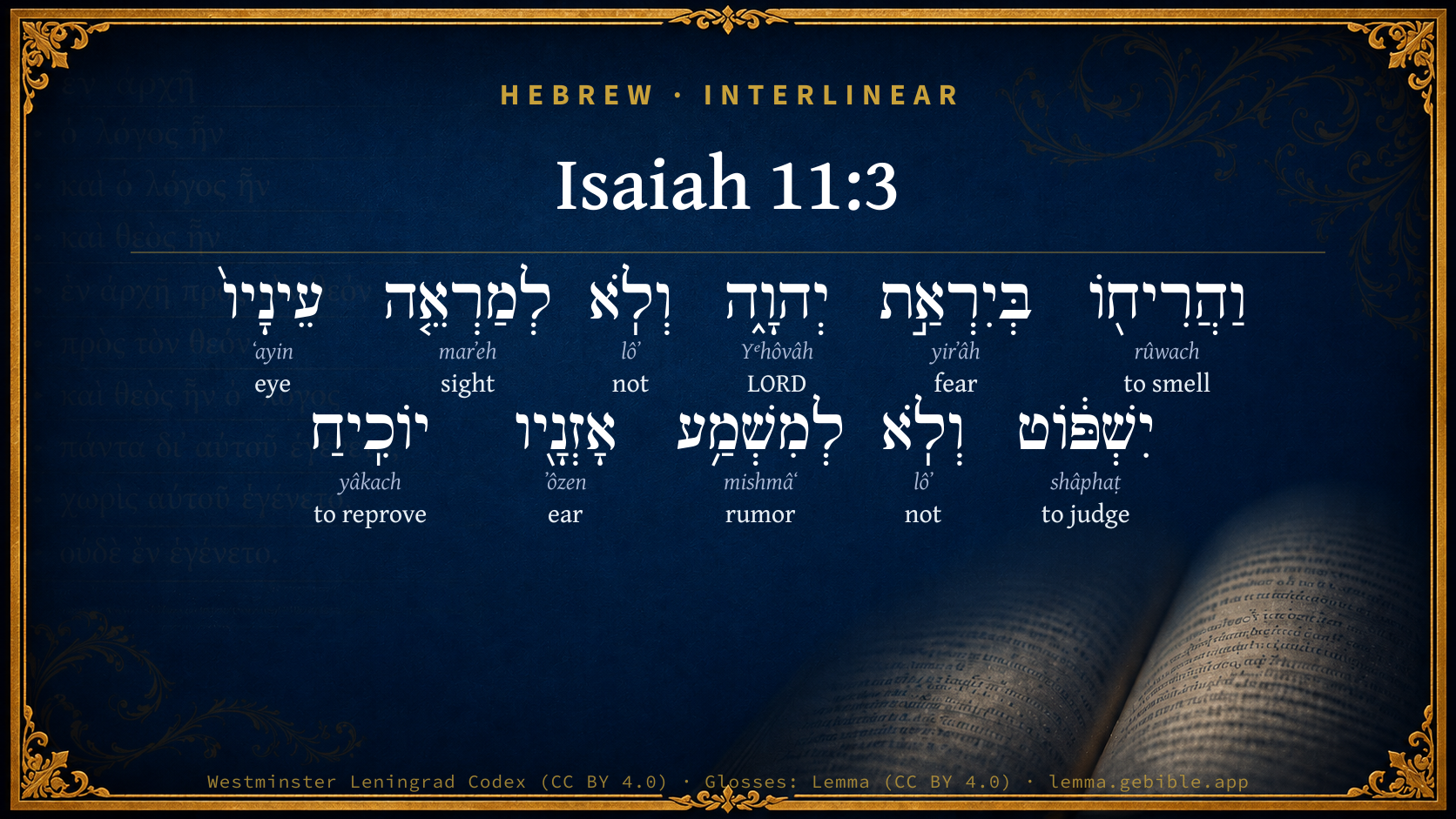
Isaiah 11:3

Hebrew (Westminster Leningrad Codex) Isaiah 11:3 appears in the Hebrew Old Testament. The text above is from the Westminster Leningrad Codex. Each word links to its Strong’s number, a concise gloss, and parsing drawn from the Open Scriptures Hebrew Bible morphology. Click any word for its full Brown-Driver-Briggs (BDB) entry.
Download image
Cite this verse

Isaiah 11:3 (World English Bible). Public Domain. Lemma interlinear Bible study tool, https://lemma.gebible.app/v/isaiah/11/3.

Show BibTeX & RIS
BibTeX
RIS
English Translation
His delight shall be in the fear of Yahweh; and he shall not judge after the sight of his eyes, neither decide after the hearing of his ears;
World English Bible · Public Domain
Highlights Full analysis ↓
Download a study sheet

One document with this verse’s original text, its word-by-word gloss line, the meaning frame, cross-references with their text, attributed commentary, and full source and license credits — printable, and it pastes into notes with its structure intact.

This verse Autodidact and up

Study sheet (.html) Plain text (.txt)

A passage Seminary Student

Up to 50 verses in one chapter. A passage sheet keeps up to 6 commentary sources and 12 cross-references per verse, in the order this page ranks them, and says so on the sheet whenever that leaves anything out. Ask for a single verse and you get the Autodidact verse sheet above.

Everything on this page stays free to read, with no account — the sheet is a download of what is already on screen, not access to it.

Want to remove ads? Support Godless Engineer
Compare translations 3

The same verse in 3 English versions, stacked beneath the original-language interlinear above. Click any original word for its lexicon entry.

Each is an independent rendering of the whole verse — the interlinear is not word-aligned to these translations.

Highlighted words mark where these versions differ — a whole-verse word diff, not a word-by-word alignment.

  • World English Bible Public Domain
    His delight shall be in the fear of Yahweh; and he shall not judge after the sight of his eyes, neither decide after the hearing of his ears;
  • King James Version Public Domain
    And shall make him of quick understanding in the fear of the LORD: and he shall not judge after the sight of his eyes, neither reprove after the hearing of his ears:
  • unfoldingWord Literal Text CC BY-SA 4.0
    And his breathing in the fear of Yahweh, and he will not judge by the sight of his eyes, and he will not decide by the hearing of his ears,

unfoldingWord Literal Text — © unfoldingWord, licensed CC BY-SA 4.0. Word-aligned USFM3 via Door43 (git.door43.org/unfoldingWord/en_ult).

Versions to compare (up to 4)

3 of 4 selected

Show all 18 translations

Every available English version of this verse, each an independent rendering of the whole verse.

  • World English Bible Public Domain
    His delight shall be in the fear of Yahweh; and he shall not judge after the sight of his eyes, neither decide after the hearing of his ears;
  • Berean Standard Bible Public Domain
    And He will delight in the fear of the LORD. He will not judge by what His eyes see, and He will not decide by what His ears hear,
  • Majority Standard Bible Public Domain
    And He will delight in the fear of the LORD. He will not judge by what His eyes see, and He will not decide by what His ears hear,
  • King James Version Public Domain
    And shall make him of quick understanding in the fear of the LORD: and he shall not judge after the sight of his eyes, neither reprove after the hearing of his ears:
  • American Standard Version (1901) Public Domain
    And his delight shall be in the fear of Jehovah; and he shall not judge after the sight of his eyes, neither decide after the hearing of his ears;
  • Revised Version (1885) Public Domain
    And his delight shall be in the fear of the LORD: and he shall not judge after the sight of his eyes, neither reprove after the hearing of his ears:
  • Geneva Bible (1599) Public Domain
    And shall make him prudent in the feare of the Lord: for he shall not iudge after the sight of his eies, neither reproue by ye hearing of his eares.
  • Douay-Rheims (1899) Public Domain
    And he shall be filled with the spirit of the fear of the Lord. He shall not judge according to the sight of the eyes, nor reprove according to the hearing of the ears.
  • Young's Literal Translation Public Domain
    To refresh him in the fear of Jehovah, And by the sight of his eyes he judgeth not, Nor by the hearing of his ears decideth.
  • Literal Standard Version CC BY-SA 4.0
    To refresh Him in the fear of YHWH, || And He does not judge by the sight of His eyes, || Nor decides by the hearing of His ears.
  • Unlocked Literal Bible CC BY-SA 4.0
    His delight will be the fear of the Lord; he will not judge by what his eyes see, nor decide by what his ears hear.
  • unfoldingWord Literal Text CC BY-SA 4.0
    And his breathing in the fear of Yahweh, and he will not judge by the sight of his eyes, and he will not decide by the hearing of his ears,
  • Darby Bible Public Domain
    And his delight will be in the fear of Jehovah; and he shall not judge after the sight of his eyes, neither reprove after the hearing of his ears;
  • World Messianic Bible Public Domain
    His delight will be in the fear of the LORD. He will not judge by the sight of his eyes, neither decide by the hearing of his ears;
  • Webster's Bible Public Domain
    And will make him of quick understanding in the fear of the LORD: and he will not judge after the sight of his eyes, neither reprove after the hearing of his ears:
  • Free Bible Version CC BY-SA 4.0
    His happiness will be in giving reverence to the Lord. He will not judge by what he sees, and he will not make decisions based on what he hears.
  • Bible in Basic English Public Domain
    And he will not be guided in his judging by what he sees, or give decisions by the hearing of his ears:
  • JPS Tanakh (1917) Public Domain
    And his delight shall be in the fear of the LORD; and he shall not judge after the sight of his eyes, neither decide after the hearing of his ears;

Literal Standard Version (2020), Covenant Press — licensed CC BY-SA 4.0. Text via the HelloAO Bible API (eBible.org). Unlocked Literal Bible (unfoldingWord) — licensed CC BY-SA 4.0. Text via the HelloAO Bible API (eBible.org). unfoldingWord Literal Text — © unfoldingWord, licensed CC BY-SA 4.0. Word-aligned USFM3 via Door43 (git.door43.org/unfoldingWord/en_ult). Free Bible Version, Dr. Jonathan Gallagher — licensed CC BY-SA 4.0. Text via the HelloAO Bible API (eBible.org).

Word by word

More ways to search: Search by grammar → Find every occurrence → Compare this word →

Practice this passage: Drill this verse → Learn its vocabulary →

לְמִשְׁמַ֥ע
mishmâʻ
H4926
“to/for · rumor of”
Preposition + Noun, Common, Masculine, Singular, Construct
Part of Speech
Preposition + Noun
Type
Common
Gender
Masculine
Number
Singular
State
Construct
Full BDB Definition

Origin: from H8085

TWOT: 2412f

thing heard, rumour
  1. וַהֲרִיח֖וֹ rûwach H7306 “and · to smell · him” Conjunction + Verb, Hiphil, Infinitive Construct + Suffix, Personal, 3rd Person, Masculine, Singular
  2. בְּיִרְאַ֣ת yirʼâh H3374 “in/at · fear of” Preposition + Noun, Common, Feminine, Singular, Construct
  3. יְהוָ֑ה Yᵉhôvâh H3068 “LORD” Noun, Proper
  4. וְלֹֽא lôʼ H3808 “and · not” Conjunction + Particle, Negative
  5. לְמַרְאֵ֤ה marʼeh H4758 “to/for · sight of” Preposition + Noun, Common, Masculine, Singular, Construct
  6. עֵינָיו֙ ʻayin H5869 “eyes · his” Noun, Common, Both, Dual, Construct + Suffix, Personal, 3rd Person, Masculine, Singular
  7. יִשְׁפּ֔וֹט shâphaṭ H8199 “to judge” Verb, Qal, Imperfect, 3rd Person, Masculine, Singular
  8. וְלֹֽא lôʼ H3808 “and · not” Conjunction + Particle, Negative
  9. אָזְנָ֖יו ʼôzen H241 “ears · his” Noun, Common, Feminine, Dual, Construct + Suffix, Personal, 3rd Person, Masculine, Singular
  10. יוֹכִֽיחַ yâkach H3198 “to reprove” Verb, Hiphil, Imperfect, 3rd Person, Masculine, Singular

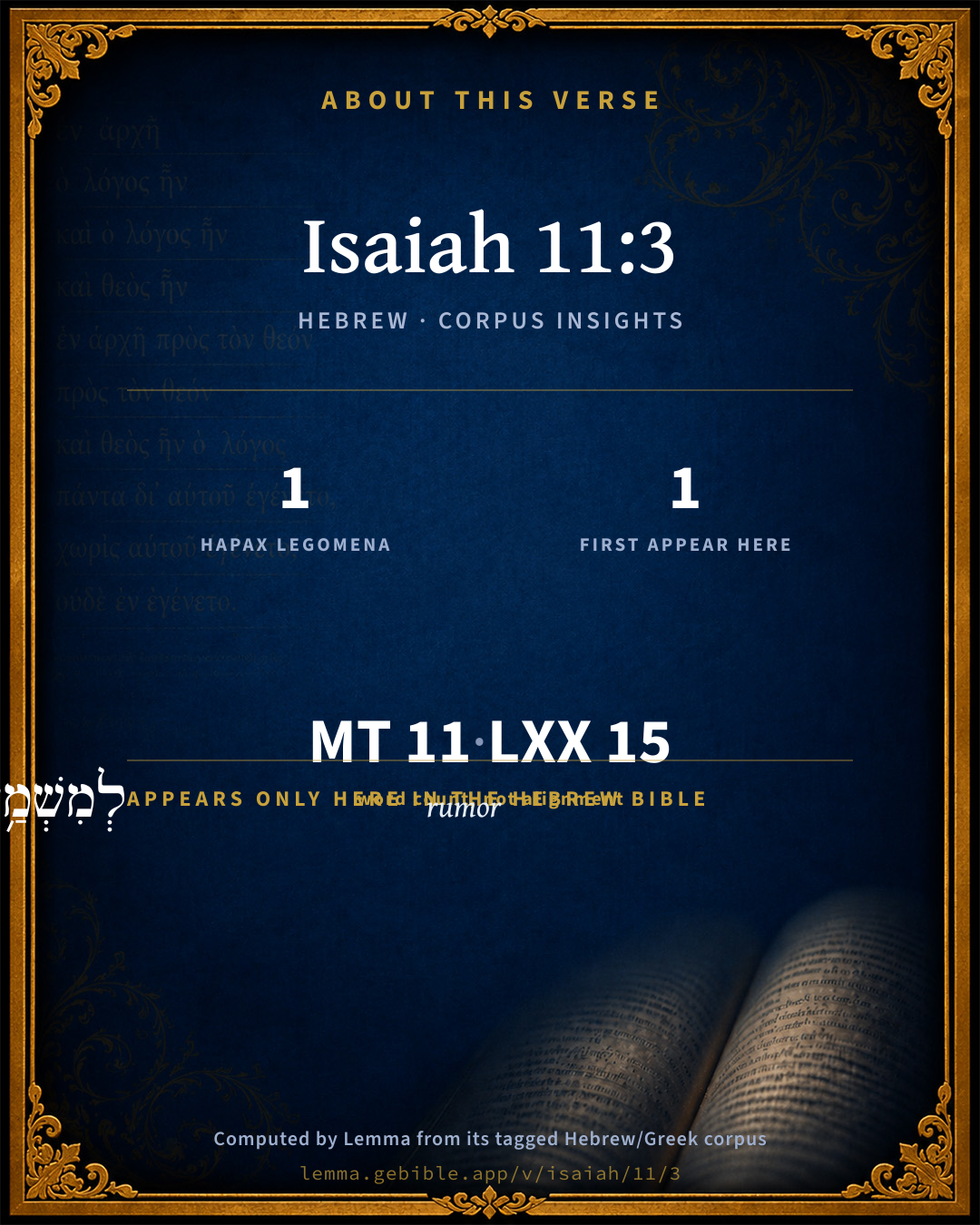
About this verse

These counts appear in no published source. They are computed here, from the morphology-tagged text and Lemma’s own curated glosses. What Lemma adds →

11
words
10
distinct lemmas
Prophets
section

Notable vocabulary

1 hapax legomenon — a word that appears only here in the entire Hebrew Bible:

  • לְמִשְׁמַ֥ע rumor H4926

First appearance in Scripture

This word makes its first canonical appearance in the Hebrew Bible here:

  • לְמִשְׁמַ֥ע rumor H4926

Shared distinctive vocabulary

וַהֲרִיח֖וֹ to smell H7306 occurs in 11 verses of the Hebrew Bible. Also found in:

Grammatical profile

  • 3 verbs
  • 6 nouns
  • 2 particles

Verb forms

  • וַהֲרִיח֖וֹ Hiphil · Infinitive Construct
  • יִשְׁפּ֔וֹט Qal · Imperfect
  • יוֹכִֽיחַ Hiphil · Imperfect

Repetition

A word recurs within this verse — often emphatic in Hebrew:

  • וְלֹֽא not H3808 ×2

Hebrew & Septuagint length

In English translation the verse runs 28 words from the Hebrew and 19 from the Septuagint (LXX English) — the Septuagint runs noticeably shorter here. See the side-by-side →

A rough comparison of the two English renderings, which tokenize alike — not a word-level alignment.

Word counts can differ between the Hebrew and the Greek without any difference in meaning — e.g. the Hebrew direct-object marker אֵת has no separate Greek word, and Greek often adds the article ὁ.

In the original languages it is 11 Hebrew tokens and 15 Greek tokens — but the two are counted differently (Hebrew bundles its prefixes and suffixes into one token; the Greek is in lemma form), so that isn’t a like-for-like length.

Cross-references

17

Topical passages linked to Isaiah 11:3 in the Treasury of Scripture Knowledge — connected by theme and wording, ordered by reader-vote popularity; previews shown in the World English Bible.

  • John 7:24 Don't judge according to appearance, but judge righteous judgment."
  • Luke 2:52 And Jesus increased in wisdom and stature, and in favor with God and men.
  • John 8:15–16 You judge according to the flesh. I judge no one.
  • 1 Samuel 16:7 But Yahweh said to Samuel, "Don't look on his face, or on the height of his stature; because I have rejected him: for [Yahweh sees] not as man sees; for man looks at the outward appearance, but Yahweh looks at the heart."
  • Proverbs 2:5 Then you will understand the fear of Yahweh, And find the knowledge of God.
  • 1 Corinthians 2:13–15 Which things also we speak, not in words which man's wisdom teaches, but which the Holy Spirit teaches, comparing spiritual things with spiritual things.
  • 1 Kings 3:28 All Israel heard of the judgment which the king had judged; and they feared the king: for they saw that the wisdom of God was in him, to do justice.
  • John 2:25 and because he didn't need for anyone to testify concerning man; for he himself knew what was in man.
  • Philippians 1:9–10 This I pray, that your love may abound yet more and more in knowledge and all discernment;
  • Hebrews 5:14 But solid food is for those who are full grown, who by reason of use have their senses exercised to discern good and evil.
  • 2 Samuel 14:17 Then your handmaid said, Please let the word of my lord the king be comfortable; for as an angel of God, so is my lord the king to discern good and bad: and Yahweh your God be with you.
  • 1 Kings 3:9 Give your servant therefore an understanding heart to judge your people, that I may discern between good and evil; for who is able to judge this your great people?
  • Proverbs 2:9 Then you will understand righteousness and justice, Equity and every good path.
  • Job 12:11 Doesn't the ear try words, Even as the palate tastes its food?
  • Job 34:3 For the ear tries words, As the palate tastes food.
  • Isaiah 33:6 There shall be stability in your times, abundance of salvation, wisdom, and knowledge: the fear of Yahweh is your treasure.
  • 1 Corinthians 4:3–5 But with me it is a very small thing that I should be judged by you, or by man's judgment. Yes, I don't judge my own self.

Cross-references courtesy of OpenBible.info (CC BY 4.0).

Hebrew and Greek witnesses Masoretic Hebrew ↔ Greek Septuagint

The same verse in the two great witnesses to the Old Testament, shown verse-for-verse.

Here the Septuagint runs noticeably shorter than the Hebrew — LXX2012 (modern English Septuagint) 19 words vs World English Bible 28. A rough length comparison of the two English translations, not a word-level alignment — read both below.

These are two independent witnesses, not word-aligned to each other, and the Septuagint is shown in lemma (dictionary) form.

Hebrew Isaiah 11:3 Masoretic · Westminster Leningrad Codex

וַהֲרִיח֖וֹ בְּיִרְאַ֣ת יְהוָ֑ה וְלֹֽא לְמַרְאֵ֤ה עֵינָיו֙ יִשְׁפּ֔וֹט וְלֹֽא לְמִשְׁמַ֥ע אָזְנָ֖יו יוֹכִֽיחַ

His delight shall be in the fear of Yahweh; and he shall not judge after the sight of his eyes, neither decide after the hearing of his ears;

World English Bible · Public Domain

Greek LXX Isaiah 11:3 Septuagint · lemma form

ἐνπίμπλημι αὐτός πνεῦμα φόβος θεός οὐ κατά ὁ δόξα κρίνω οὐδέ κατά ὁ λαλιά ἐλέγχω

the spirit of the fear of God. He shall not judge according to appearance, nor reprove according to report:

LXX2012 (modern English Septuagint) · Public Domain

On this verse, Albert Barnes' Notes on the Bible discusses the Septuagint’s reading. Read the note in Commentary ↓

Hebrew: Westminster Leningrad Codex (CC BY 4.0). Greek: Septuagint (public domain); English from LXX2012 (modern English Septuagint) (Public Domain). How the Septuagint differs from the Hebrew →

Targum (Aramaic paraphrase)

1

The Targum is the ancient Jewish Aramaic paraphrase of the Hebrew Scriptures — an interpretive translation, not the Hebrew text itself. Onkelos (literal) and Pseudo-Jonathan (expansive) render the Torah, and Jonathan the Prophets. Coverage is partial: where no permissively-licensed English translation exists for a verse, only the Aramaic is shown. This is verse-level text, not a word-by-word alignment to the Hebrew.

  1. Targum Jonathan Prophets (Joshua–Malachi)
    וִיקָרְבִינֵיהּ לִדְחַלְתֵּיהּ יְיָ לָא לְחֵיזוּ עֵינוֹהִי יְהֵי דָאַן וְלָא לְמִשְׁמָע אוּדְנוֹהִי יְהִי מוֹכַח:

    He shall bring him to the fear of the Lord: and he shall not judge according to the sight of His eyes, neither reprove after the hearing of his ears.

    Targum Jonathan — Aramaic: “Mikraot Gedolot” (public domain). English: “Sefaria Community Translation” (CC0 1.0 (public-domain dedication)); “London "Chaldee Paraphrase," 1871” (public domain). Text via Sefaria.

Commentary

Notes on Isaiah 11:3 from classic Christian and Jewish commentators (each source and its license shown beneath its notes). The classic Christian expositions comment on the surrounding passage and are grouped to its opening verse, so a note may address several verses; the Jewish commentaries on the Tanakh (Rashi and others) are per-verse, so they appear only where the commentator wrote on this verse.

Lemma curates 59 commentaries, every one of them public domain or Creative Commons licensed, each selected and text-cleaned for this edition rather than reprinted as found. About our sources →

Trapp's Complete Commentary

John Trapp

Isa 11:3 And shall make him of quick understanding in the fear of the LORD: and he shall not judge after the sight of his eyes, neither reprove after the hearing of his ears:

Ver. 3. And shall make him of quick understanding.] Heb., It shall make him scent or smell - sc., by a singular sagacity and sharpness of judgment in smelling out a hypocrite, as Simon Peter did Simon Magus, who had deceived Philip, even unto baptism; but Peter soon found him out: how much more will Christ? His sharp nose easily discerneth and is offended with the stinking breath of the hypocrite’s rotten lungs, though his words be never so scented and perfumed with shows of holiness. So for the innocence of the godly, when "being defamed they pray" as Paul, apologise and cannot be heard, as the primitive Christians; Christ will "bring forth their righteousness as the light, and their judgment as the noonday." {Psa 37:6}

And he shall not judge after the sight of his eyes.] He cannot be deceived, as knowing all hearts, and as having all things naked and dissected before his eyes. {Heb 4:13 Mat 9:12 Joh 2:24} Others judge by relation of others, and secundum allegata et probata - not so Jesus Christ; but he shall always proceed upon his own knowledge, and so pass a most righteous sentence. Oecolampadius thinks the prophet here alludeth to Solomon’s sentence passed on the two harlots. {1Ki 3:16-28}

John Trapp, A Commentary or Exposition upon All the Books of the Old and New Testament (1647–1656) — public domain. Text from a community e-Sword module.

The Biblical Illustrator

Joseph S. Exell

Isa_11:3

And shall make Him of quick understanding in the fear of the Lord

Of quick understanding in the fear of the Lord

Of quick understanding in the fear of the Lord a word which relates to the power of smell or scent; He is to have that keen sense which the hound has when the game is not far away, and yet is deeply hidden; He is to know wisdom and right and truth as the thirsty hart smells the water brooks; or, by another etymology, He is to draw His breath in the fear of the Lord; i.., the fear of the Lord is to be His native breath. Religion is to be no burden to Him, no superimposition which He must carry, whether He will or no; His religion is His breath, He will pray because He breathes, He will speak because He breathes; it is part of Himself, of His very nature; it belongs to a great system of voluntariness, which constantly and continually gives itself out for the benefit of those who are within the range of its influence. (J. Parker, D. D.)

Christs penetrating insight

This prediction was fully verified in our Lord Jesus Christ, who was of such quick discernment and acute understanding in the dispositions of the human heart, that He could infallibly determine with respect to mens characters, of which some memorable instances are recorded in the New Testament. Such was His penetrating sagacity that, at first sight, He could easily discover a true Israelite in whom was the fear of the Lord, from those that were wicked, hypocritical or formal, and destitute of this internal qualification (Joh_1:47-48). He showed that He was perfectly acquainted with the character of the woman who was a sinner. According to this prophecy the Messiah, in admitting persons into His kingdom, was not to have respect to their external advantages, their descent or their riches, their reputation and condition in the world, or their exterior appearances of feigned piety; but to judge of them simply by their fear and reverence of the Lord, which forms the beauty of the inward man, and is inseparably connected with every other Divine grace and the exercises of dutiful obedience to God. (R. Macculloch.)

Christ and the fear of Jehovah

Fear of Jehovah is fragrance to Him. It is not meant that He has as regards Himself pleasure in fear of God, but that fear of God when He perceives it in men is fragrance to Him Gen_8:21); for the fear of God is a sacrifice of adoration, continually ascending to God. (F. Delitzsch.)

Religion quickens the intelligence

1. Those are most truly and valuably intelligent that are so in the fear of the Lord, in the business of religion; for that is both the foundation and topstone of wisdom.

2. By this it will appear that we have the Spirit of God if we have spiritual senses exercised, and are of quick understanding in the fear of the Lord. Those have Divine illumination that know their duty and know how to go about it.

3. Therefore Jesus Christ had the Spirit without measure, that He might perfectly understand His undertaking. (M. Henry.)

The fear of the Lord

The fear of the Lord may here denote the devout affection of reverence, which arises in the mind by means of the contemplation of the grandeur and dominion, the power and righteousness, with the other Divine excellences of Jehovah. It adores His greatness; it venerates His purity; it respects His omniscience; it does homage to His goodness; it stands in awe of His power; it honours His justice, and is solicitous to avoid His displeasure. It is such a profound reverence for God as is accompanied with love, and a becoming concern to yield an exact obedience to all His commands; it resembles the affection which a dutiful son discovers towards his esteemed parent, and faithful subjects entertain for a good prince. (R. Maccolloch.)

Effects of the fear of the Lord

When this principle reigns in the heart it produces the most powerful effects, and hath an extensive happy influence over all the purposes, affections, desires, and actions. It dispels the fear of man that bringeth a snare, and renders superior to all the threatenings and terrors of the world; it restrains from sin, and closely adheres to God and His ways; it renders cautious and circumspect, and proves the watchful guardian of the heart; it presides in every act of worship, and excites to the performance of every duty that may please the Lord. (R. Maccolloch.)

The relation of the fear of the Lord to other graces

This filial fear and reverence of Jehovah is the fruit of the Spirit; the offspring of faith, whereby it is cherished; the concomitant of love, which preserves it from degenerating into slavish dread; the companion of hope, which it keeps from falling into presumption, whilst hope preserves fear from sinking into despair; it qualifies joy and keeps it from levity, whilst joy shows that fear is genuine, and of the right kind. (R. Maccolloch.)

And He shall not Judge after the sight of His eyes

Christs impartial judgment

Impartial judgment and equitable reproof are foretold to be administered by Him. In the exercise of His penetrating judgment He was impartially to pronounce upon the characters of those who were to be admitted to participate in the privileges of His people, to determine according to the perfect rules of equity the differences that might arise among them respecting their conduct and interests, to defend them from the injuries to which they might be exposed, and to avenge the wrongs which they sustained. (R. Maccolloch.)

The Biblical Illustrator, edited by Joseph S. Exell (c. 1880s–1900s) — public domain. Text from a community e-Sword module.

Joseph Benson's Commentary

Isa 11:3. And shall make him of quick understanding — Hebrew, והריחו, shall make him of quick scent, smell, or perception; or, of quick discernment, as Bishop Lowth renders it; in the fear of the Lord — In things which concern the worship and service of God, and every part of religion. Or the meaning may be, He shall not judge rashly and partially, but considerately and justly, as the fear of God obliges all judges to do. And he shall not judge — Of persons, things, or causes; after the sight of the eyes — According to outward appearance, as men do, because they cannot search men’s hearts; neither reprove — Condemn, or pass sentence against any person; after the hearing of the ears — By uncertain rumours or suggestions, but shall thoroughly examine all causes, and search out the truth of things, and the very hearts of men. It implies also, that, “in collecting the people who shall compose his kingdom, he shall principally regard in them this quality of fear, or reverence for the Lord; and with the greatest sagacity and perspicuity of judgment, shall discern and separate those subjects in whom he finds this quality; not suffering that judgment to be deluded by the external appearance of truth or honesty, but, penetrating into the interior recesses of the mind by his prophetic spirit, he shall discriminate truth from error, the good from the bad, the sincere and pious from the hypocritical and impious.” All the churches shall know, says he, that I am he who searcheth the reins and the hearts.

Joseph Benson's Commentary on the Old and New Testaments (1811–1818) — public domain. Text from a community e-Sword module.

Tyndale Open Study Notes

Tyndale Open Resources

11:3 obeying the Lord: Literally the fear of the Lord, as in 11:2 (see Prov 1:7).

Tyndale Open Study Notes — © Tyndale Open Resources, licensed CC BY-SA 4.0. Text via the HelloAO Bible API.

Jamieson, Fausset & Brown

Robert Jamieson, A. R. Fausset & David Brown

make him of quick understanding--literally, "quick-scented in the fear of Jehovah"; endowed with a singular sagacity in discerning the genuine principle of religious fear of God, when it lies dormant in the yet unawakened sinner (Mat 12:20; Acts 10:1-48; Act 16:14) [HORSLEY]. But MAURER, "He shall delight in the fear of God." The Hebrew means "to delight in the odors" of anything (Exo 30:38; Amo 5:21); "smell," that is, "delight in."

after . . . sight--according to mere external appearances (Joh 7:24; Joh 8:15; Jam 2:1; Sa1 16:7). Herein Messiah is represented a just Judge and Ruler (Deu 1:16-17).

reprove--"decide," as the parallelism shows.

after . . . ears--by mere plausible hearsays, but by the true merits of each case (Joh 6:64; Rev 2:23).

Jamieson, Fausset & Brown — Commentary Critical and Explanatory on the Whole Bible (1871) — public domain (CC PDM 1.0). Text via the HelloAO Bible API.

Ellicott's Commentary for English Readers

(3) And shall make him of quick understanding . . .—Better, he shall draw his breath in the fear of the Lord. It shall be, as it were, the very air in which he lives and breathes. Some commentators, however, interpret he shall find a sweet savour. The Hebrew word rendered “understanding” means primarily, as the margin shows, “scent” or “smell,” either as the organ or the object of perception.

He shall not judge after the sight of his eyes . . .—Earthly kings are apt to judge “according to the appearance” (Joh_7:24), and the reports of interested or corrupt advisers, but the true King shall “know what is in man” (Joh_2:25), and judge righteous judgment.

A Bible Commentary for English Readers, edited by Charles John Ellicott (1878–1897) — public domain. Text from a community e-Sword module.

The Cambridge Bible for Schools and Colleges

gen. ed. J. J. S. Perowne

3. and shall make him … Lord] The best translation is that of R.V. and his delight shall be in the fear of Jehovah, lit. “his scent shall be in, &c.” The Messiah shall not only possess true religion himself, but shall be quick to recognise its presence in others and shall take delight in it wherever he finds it. The sense is perhaps appropriate, but the expression is very peculiar, and hence some critics consider that the clause is a corrupt repetition of the preceding words. (See Cheyne’s Commentary, crit. note.)

he shall not judge after the sight of his eyes, &c.] i.e. in virtue of the spirit with which he is endowed, he shall not be dependent on the evidence of his senses, but shall immediately and infallibly discern the moral condition of men’s hearts (cf. 2Sa_14:20). The second member of the parallelism shews that more than mere impartiality in judgment is intended. For reprove render decide, as R.V. marg.

3–5. Thus equipped with all the personal qualities needful for his high office, the ideal King will exercise a perfectly just and equitable government over his subjects. The Hebrew conception of kingship includes two functions, leadership in war and the administration of justice in time of peace (1Sa_8:20). Here, for an obvious reason (ch. Isa_9:5), only the civil aspect of the office is dwelt upon.

The Cambridge Bible for Schools and Colleges (gen. ed. J. J. S. Perowne; Cambridge University Press, 1878–1918) — public domain. Text from a community e-Sword module.

John Gill's Exposition

And shall make him of quick understanding in the fear of the Lord,.... Or "cause him to smell the fear of the Lord" (w); that is, to discern in whom it was: this is one effect of the Spirit's resting upon him, and particularly as the spirit of understanding, and of the fear of the Lord, whereby he has a quick and sharp discerning of it; not merely of the grace of fear, so as to know what that is, and what the exercise of it; or so as to make it the rule of his actions, though all this is true; but so as to discern where and in whom it was, and was not; he could distinguish between him that feared God and him that feared him not; he knew Nathanael to be an Israelite indeed, in whom there was no guile, Joh 1:47 and the Scribes and Pharisees to be hypocrites, Mat 22:18. As the Jews (x) understand this passage of the Messiah, and of his quick smell, as the word used signifies, or of his discerning of good and bad men, they make this to be a rule of judging the Messiah by; and accordingly made use of it with one that set up himself for the Messiah, and took the name of Barcochab, the son of a star, referring to Num 24:17 and tried him whether he could discern a good man from a bad man; and because he could not, they rejected him as a false Messiah, and called him Barcoziba, the son of a lie (y): compare with this Luk 7:39 where it may be seen the same notion obtained among the Jews in Christ's time:

and, he shall not judge after the sight of his eyes; or according to the outward appearance, the external guise of sanctity and religion men might put on; as the Scribes and Pharisees were outwardly righteous before men, but not to Christ, who knew their hearts; they seemed to be somewhat to others, but nothing to him, because he judged not by appearances to the eyes:

neither reprove after the hearing of his ears; he needed no testimony of men, for he knew what was in men; nor did he regard the words of men, the boastings of a Pharisee, any more than his outward actions; nor would he reprove or condemn, nor will he, upon a human testimony.

(w) "et faciet odorari eum timorem Jehovae", Munster, Vatablus; "et odorabitur timorem Jehovae", Cocceius. (x) Zohar in Exod. fol. 31. 3. & 86. 1. Tzeror Hammor, fol. 62. 3. (y) T. Bab. Sanhedrin. fol. 93. 2.

John Gill's Exposition of the Whole Bible (1746–1763) — public domain (CC PDM 1.0). Text via the HelloAO Bible API.

Albert Barnes' Notes on the Bible

And shall make him of quick understanding - (והריחו vahărı̂ychô) The Septuagint renders this, ‘And the spirit of the fear of God shall fill him.’ The Chaldee, ‘And the Lord shall draw him near to him in his fear.’ The Syriac, ‘And he shall be resplendent (like the sun, or the stars) in the fear of the Lord.’ The Hebrew word used here is probably derived from ריח rêyach, used only in Hiphil, “to smell;” and is kindred with רוח rûach, “wind, breath,” for fragrant substances “breathe out” an odor. - “Gesenius.” It then denotes “to take delight in smelling” Exo 30:38; Lev 26:31; and thence, by an easy transition, to take delight in anything; Amo 5:21. The reason is, that the objects of smell are usually pleasant and agreeable; and especially such as were the aromatics used in public worship. The sense here is, probably, that he would take pleasure in the fear of Yahweh, that is, in piety, and in devoting himself to his service. The interpretation given in our translation, is that given by many expositors; though that above suggested is probably the correct one. The word is used to denote “pleasure” in a thing; it is not used anywhere, it is believed, to denote a quick understanding; compare Exo 5:21; Phi 4:18. The idea which is conveyed by our translators is, probably, derived from “the discernment of the quality” of objects by an acute sense of smell, and hence, they interpreted the word to denote an acute discrimination of any objects.

And he shall not judge after the sight of his eyes - He sha 1 not judge of things by their external appearance. or with partiality. This is language which is applicable to a magistrate, and is spoken of the Messiah as the descendant of David, and as sitting on his throne as a ruler of his people. He who judges ‘after the sight of his eyes,’ does it according to external appearances, showing favor to rank, to the rich, and the great; or judging as things “appear” without a close and careful inquiry into their true nature and bearings; compare Joh 7:24 : ‘Judge not according to the appearance, but judge righteous judgment;’ Deu 1:16-17.

Neither reprove - יוכיח yôkiyach. This word means “to show, to prove; to correct, reprove, convince; to reproach, or censure; to punish; to judge, decide, etc.” Here it is evidently used as synonymous with ‘shall he judge’ in the former part of the parallelism - retaining the idea of a just judge, who decides not according to the hearing of the ears, but according to justice.

After the hearing of his ears - Not by plausible statements, and ingenious defenses, but by weighing evidence, and by an impartial examination of the true merits of the case. This belonged to the Lord Jesus, because,

(1) He was never influenced by any undue regard to rank, honor, or office. His opinions were always impartial; his judgments without bias or favoritism.

(2) He was able to discern the true merits of every case. He knew what was in man, saw the true state of the heart, and, therefore, was not deceived or imposed upon as human judges are; see Joh 2:24-25; compare Rev 2:28; Joh 6:64.

Albert Barnes' Notes on the Bible (1834–1885) — public domain. Text from a community e-Sword/MySword module.

Haydock's Catholic Bible Commentary

Filled. Hebrew, "breath or smell." So St. Paul says, (2 Corinthians ii. 15.) we are the good odour of Christ. (Calmet) --- Protestants, "he shall make him of quick understanding (marginal note, smell) in the fear," &c. (Haydock) --- Ears. Which are often deceived. (Menochius)

George Leo Haydock (1774–1849), Haydock's Catholic Family Bible and Commentary, 1859 edition — public domain. Excludes Psalms (Douay-Rheims chapter numbering differs from Protestant) and Deuterocanonical books (Catholic canon only).

Matthew Poole's English Annotations

Shall make him of quick understanding, Heb. he shall make him smell, i.e. perceive, as that word is used, Jdg 16:9; Job 39 25; understand or judge, as it is explained in the next clause. Or, his smelling shall be. Smelling is put for judging, because the sense of smelling, where it is quick and good, is more exact and sure in the judging of its proper objects, than the senses of seeing and hearing are.

In the fear of the Lord; which is added, either,

1. As the object of his judging; he is most perspicacious and judicious in the things which concern the fear, i.e. the worship and service of God, which he was to order and establish in his church. Or rather,

2. As the rule and manner of his judging, as may be gathered from the opposite and following clause. So the sense is, He shall not judge rashly and partially, but considerately and justly, as the fear of God obligeth all judges to do.

He shall not judge, of persons or causes. And judging seems to be here synecdochically put for absolving or giving sentence for a person, as it is used Psa 7:8,11, and in many other places, because this is opposed to reproving in the next clause.

After the sight of his eyes; according to outward appearance, as men must do, because they cannot search men’s hearts, 1Sa 16:7, or with respect of persons, but with righteous judgment, which is opposed to judging by appearance, Joh 7:24. Reprove, i.e. condemn or pass sentence against a person; for Christ is here supposed to be a Judge, and so he speaks of a judicial reproof. After the hearing of his ears, by false or uncertain rumours or suggestions, but shall thoroughly examine all causes, and search out the truth of things, and the very hearts of men.

Matthew Poole's English Annotations on the Holy Bible (1683–1685) — public domain. Text from a community e-Sword/MySword module.

Whedon's Commentary on the Bible

Daniel D. Whedon

3. Shall make him — The Spirit of Jehovah is still the subject.

Of quick understanding — This is a peculiar expression. Literally, Of quick smell, or his fragrance. The meaning seems to be, that he breathes in the fear of the Lord, as in a sweet fragrance, the element natural to him. Normally he takes delight in it. Gracious deeds are to him the greatest pleasure.

Not judge after the sight of his eyes — After the external appearance.

Neither reprove — Nor shall he decide or judge.

After the hearing of his ears — Or, by what sounds to the ear plausible merely. If the fear of Jehovah is fragrance to him, all his faculties are quick discerners for him of what is true, right, and good.

Daniel D. Whedon (gen. ed.), Commentary on the Old and New Testaments (1874–1909) — public domain. Text from a community e-Sword module.

The Pulpit Commentary

And shall make him of quick understanding. This rendering of the original, though defended by Dr. Kay, is quite without support from any other passage where the same word is used. Modern writers almost all translate, either "the breath of his nostrils shall be in the fear of the Lord" (Herder, Ewald, Meier, Cheyne), or "a sweet savor shall he find in the fear of the Lord" (Gesenius, Delitzsch, Rosenm Knobel). He shall not judge after the sight of his eyes. "God sooth the heart." Our Lord "knew men"s thoughts", (Mat_9:4, etc.) and therefore did not need to "judge according to the appearance". (Joh_7:24) Thus his judgments were always righteous.

Vers. 3-5. The principles of Messianic rule.

These are exemplified in the actual administration of the head of the Messianic kingdom. The picture presented here is designed to be in sharp contrast with that of the unjust judges referred to in Isa_1:23 Isa_2:14, 15 10:1, 2. The figure of clothing one"s self, or being clothed, with moral attributes is not infrequent in the Scriptures. The girdle is mentioned as an essential part of Oriental dress, and that which keeps the other garments in their proper place and qualifies the wearer for exertion. The rules, or characteristics, of the Messianic or spiritual kingdom may be illustrated under the following headings.

I RIGHTEOUSNESS AS BEFORE GOD. The absolutely right is to be sought; and it will be found in what

(1) God is;

(2) what God commands;

(3) what God approves.

Matthew Henry says, "He shall be righteous in the administration of his government, and his righteousness shall be his girdle; it shall constantly compass him and cleave to him, shall be his ornament and honor; he shall gird himself for every action, shall gird on his sword for war in righteousness; his righteousness shall be his strength, and shall make him expeditious in his undertakings, as a man with his loins girt." Compare the kingdom ruled by considerations of righteousness with the kingdoms ruled by considerations of expediency.

II EQUITY BETWEEN MAN AND MAN. The determination that every man shall get his due, and bear his due. Many cases arise in which strict justice must be toned by consideration of circumstances. In view of human infirmity, the equitable must sometimes be put instead of the right.

III EFFICIENT PUNISHMENT OF THE WICKED. The strong hand on the wrong-doer is ever an essential of good government.

IV FAITHFULNESS TO DUTY. Duty being distinguished from right in this, that it is something we are bound to do, upon the authority of some one who has the right to command us. "Faithfulness" is closely kin with "loyalty." And Messiah is a theocratic King, a Vicegerent of Jehovah.

V PEACE EVERYWHERE. Because, if righteousness prevails, nobody will wrong others, and nobody will have wrongs to avenge. Jealousies, envyings, violence, covetings, all fade before advancing righteousness; and when Jesus, the righteous King, reigns over mind and heart and life, then the glory-day will have come, and "no war or battle-sound" will then be "heard the world around. R.T.

The Pulpit Commentary (1880–1919), ed. H.D.M. Spence-Jones & Joseph S. Exell — public domain. Text from a community e-Sword module.

John Wesley's Explanatory Notes

In the fear - He shall not judge rashly and partially, but considerately and justly, as the fear of God obliges all Judges to do. Judge - Of persons or causes. After the sight - According to outward appearance, as men do, because they cannot search mens hearts. Reprove - Condemn or pass sentence against a person. His ears - By uncertain rumours or suggestions.

John Wesley, Explanatory Notes Upon the Whole Bible (1754–1765) — public domain. Text via the GEBible commentary corpus.

Keil & Delitzsch

C. F. Keil & F. Delitzsch

And His regal conduct is regulated by this His thoroughly spiritual nature."And fear of Jehovah is fragrance to Him; and He judges not according to outward sight, neither does He pass sentence according to outward hearing." We must not render it: His smelling is the smelling of the fear of God, i.e., the penetration of it with a keen judicial insight (as Hengstenberg and Umbreit understand it); for hērı̄ach with the preposition Beth has not merely the signification to smell (as when followed by an accusative, Job 39:25), but to smell with satisfaction (like בּ ראה, to see with satisfaction), Exo 30:38; Lev 26:31; Amo 5:21. The fear of God is that which He smells with satisfaction; it is rēach nı̄choach to Him. Meier's objection, that fear of God is not a thing that can be smelt, and therefore that hērı̄ach must signify to breathe, is a trivial one. Just as the outward man has five senses for the material world, the inner man has also a sensorium for the spiritual world, which discerns different things in different ways. Thus the second David scents the fear of God, and only the fear of God, as a pleasant fragrance; for the fear of God is a sacrifice of adoration continually ascending to God. His favour or displeasure does not depend upon brilliant or repulsive external qualities; He does not judge according to outward appearances, but according to the relation of the heart to His God.

Keil & Delitzsch — Biblical Commentary on the Old Testament (1861–1891) — public domain (CC PDM 1.0). Text via the HelloAO Bible API. (Old Testament only.)

J. A. Alexander on Isaiah

Joseph Addison Alexander

The Messiah is now described as taking pleasure in true piety and recognizing its existence by an infallible sagacity or power of discerning good and evil, which would render Him superior to the illusions of the senses and to every external influence. This faculty is figuratively described as an exquisite olfactory perception, such as enables its possessor to distinguish between different odours. “And His sense of smelling (i.e., His power of perception, with a seeming reference to the pleasure it affords Him, shall be exercised) in (or upon) the fear of Jehovah (as an attribute of others), and (being thus infallible) not by the sight (or according to the sight) of His eyes shall He judge, and not by the hearing of His ears shall He decide.” He shall take delight in goodness, and be able to distinguish it without fail from its counterfeits. The sight of the eyes and the hearing of the ears are put for the testimony of those senses by which men are chiefly governed in their judgments. He should not judge of character at all by the senses, but by an infallible sagacity or power of discerning good and evil, His consolation shall be in the fear of the Lord (i.e., afforded by religion). “He shall not judge according to the sight of His eyes” (i.e., shall not despair even under the most discouraging appearances). “He shall not reason according to the hearing of his ears” (i.e., He shall draw no conclusions from the rumors that may reach Him, but believe the declarations of the Prophets).

Joseph Addison Alexander, The Prophecies of Isaiah (1846–1847; New York: Scribner, 1870–1878) — public domain. Text from a community e-Sword module.

Scofield Reference Notes

C. I. Scofield

fear

(See Scofield Psa 19:9).

The Scofield Reference Bible (1917 edition), notes by C. I. Scofield — public domain. Text from a community e-Sword module.

unfoldingWord translationNotes

Door43 World Missions Community

Connecting Statement:

Isaiah continues to describe the king.

he will not judge by what his eyes see

The phrase "what his eyes see" refers to seeing things that are not important for judging a person rightly. AT: "he will not judge a person simply by seeing what the person looks like" (See: Assumed Knowledge and Implicit Information)

nor decide by what his ears hear

"and he will not decide by what his ears hear." The phrase "what his ears hear" refers to hearing what people say about someone. AT: "and he will not judge a person simply by hearing what others say about him" (See: Assumed Knowledge and Implicit Information)

the poor ... the humble ... the wicked

These phrases refer to people who have these qualities. AT: "poor people ... humble people ... wicked people" (See: Nominal Adjectives)

He will strike the earth with the rod of his mouth ... with the breath of his lips he will slay the wicked

These two phrases mean basically the same thing. (See: Parallelism)

He will strike the earth with the rod of his mouth

The word "earth" here represents the people on earth. Striking them with the rod of his mouth represents judging them, and that judgement will lead to punishment. AT: "He will judge the people of the earth, and they will be punished" (See: Metonymy)

with the breath of his lips he will slay the wicked

The "breath of his lips" represents him judging them. AT: "he will judge wicked people, and they will be killed" (See: Metonymy)

the belt of his waist ... the belt around his hips

Possible meanings are 1) the belt is used to secure one's clothes so he can work, or 2) the belt is an undergarment, or 3) the belt is a sash that a king wears to show his authority.

Righteousness will be the belt of his waist

Wearing righteousness like a belt represents being righteous. Possible meanings are 1) the king's righteousness will enable him to rule. AT: "His righteousness will be a like a belt around his waist" or 2) the king's righteousness would show his authority to rule. AT: "He will rule righteously" (See: Metaphor)

faithfulness the belt around his hips

The words "will be" are understood in this phrase. AT: "faithfulness will be the belt around his hips" (See: Ellipsis)

faithfulness the belt around his hips

Wearing faithfulness like a belt represents being faithful. Possible meanings are 1) the king's faithfulness will enable him to rule, or 2) the king's faithfulness will show his authority to rule. AT: "his faithfulness will be a like a belt around his hips" or "he will rule faithfully" (See: Metaphor)

translationWords

fear

lord

judge

righteous

humble

rod

faithful

unfoldingWord translationNotes — © Distant Shores Media and the Door43 World Missions Community, licensed CC BY-SA 4.0. Source: git.door43.org/Door43/en_tn.

Rashi

Rabbi Shlomo Yitzchaki (Rashi)

And he shall be animated by the fear of the Lord He shall be filled with the fear of the Lord. [ed enos mera il luy in O.F., and He shall be enlivened.]

and neither with the sight of his eyes shall he judge For, with the wisdom of the Holy One, blessed be He, which is within him, will he know and understand who is innocent and who is guilty.

Rashi on the Tanakh — English translations: “The Judaica Press complete Tanach with Rashi, translated by A. J. Rosenberg” (CC BY 4.0); “Pentateuch with Rashi's commentary by M. Rosenbaum and A.M. Silbermann, 1929-1934” (public domain); “The Metsudah Tanach series, Lakewood, N.J” (CC BY 4.0); and “The Book of Joshua, Metsudah Publications, 1997” (CC BY 4.0). Text via Sefaria.

Ibn Ezra

Rabbi Abraham ibn Ezra

והריחו And his enquiry. The ear is sometimes deceived in hearing sounds, which are only imaginary; the eye, too, sees things in motion, which in reality are at rest; the sense of smell alone is not deceived. He will properly investigate the question before him by his piety; he will not judge according to what he seems to see or to hear, because the testimony of the witnesses might be false.

The rebuking and judging mentioned in this verse are privileges of royalty.

Ibn Ezra on the Tanakh — English translations: “Sefaria Community Translation” (CC0 1.0 (public-domain dedication)); “Yalkut, Sifsei Chachomim Chumash, Metsudah Publications, 2009” (CC BY 4.0); and “Commentary of Ibn Ezra on Isaiah - trans. by M. Friedlander, 1873” (public domain). Text via Sefaria.

Lesson kit

Teaching starters — assembled from the data on this page, not authored interpretation. Every prompt links to the verse data it draws on. Edit before teaching.

Isaiah, in the Prophets, opens this verse with 11 words (10 distinct Hebrew lemmas). Its most distinctive word is mishmâʻ (“rumor”). The Greek Septuagint runs shorter here. A historical commentator’s framing appears above. Read the whole chapter for the surrounding context.

Discussion questions

  1. The word mishmâʻ carries the sense “rumor.” How does it shape the verse?
  2. This verse holds 1 word here found nowhere else in the Hebrew Bible. What might the rare word draw attention to?
  3. The word “rumor” first appears here in Scripture. What is being introduced at this debut?
  4. Genesis 8:21 shares the word «to smell» with this verse. How do the two illuminate each other?
  5. “not” occurs 2× in this one verse. What is the effect of the repetition?
  6. Compared with the Hebrew, the Septuagint runs shorter here. What questions does that raise?
  7. These translations render this verse differently. What is at stake in choosing one wording over another?
  8. The verb «וַהֲרִיח֖וֹ» is Hiphil Infinitive Construct. How does its form color the action?

Things to notice

  • 1 word in this verse appears nowhere else in the Hebrew Bible.
  • 1 word makes its first canonical appearance in Scripture here.
  • This verse counts 11 Hebrew ↔ 15 Greek words.
  • These translations choose different wording for 14 words in this verse.
  • “not” occurs 2× in this single verse.

Reading settings

Reading text

Shown beneath each verse's original-language words.

Old Testament
Old Testament edition

Read the OT as the Masoretic Hebrew (MT) or the Greek Septuagint (LXX).

English shown for the Greek Septuagint (in the Hebrew ↔ Greek comparison).

Comparing translations? Open the Compare panel on any verse page to stack up to four side by side.