
1 Chronicles 16:33

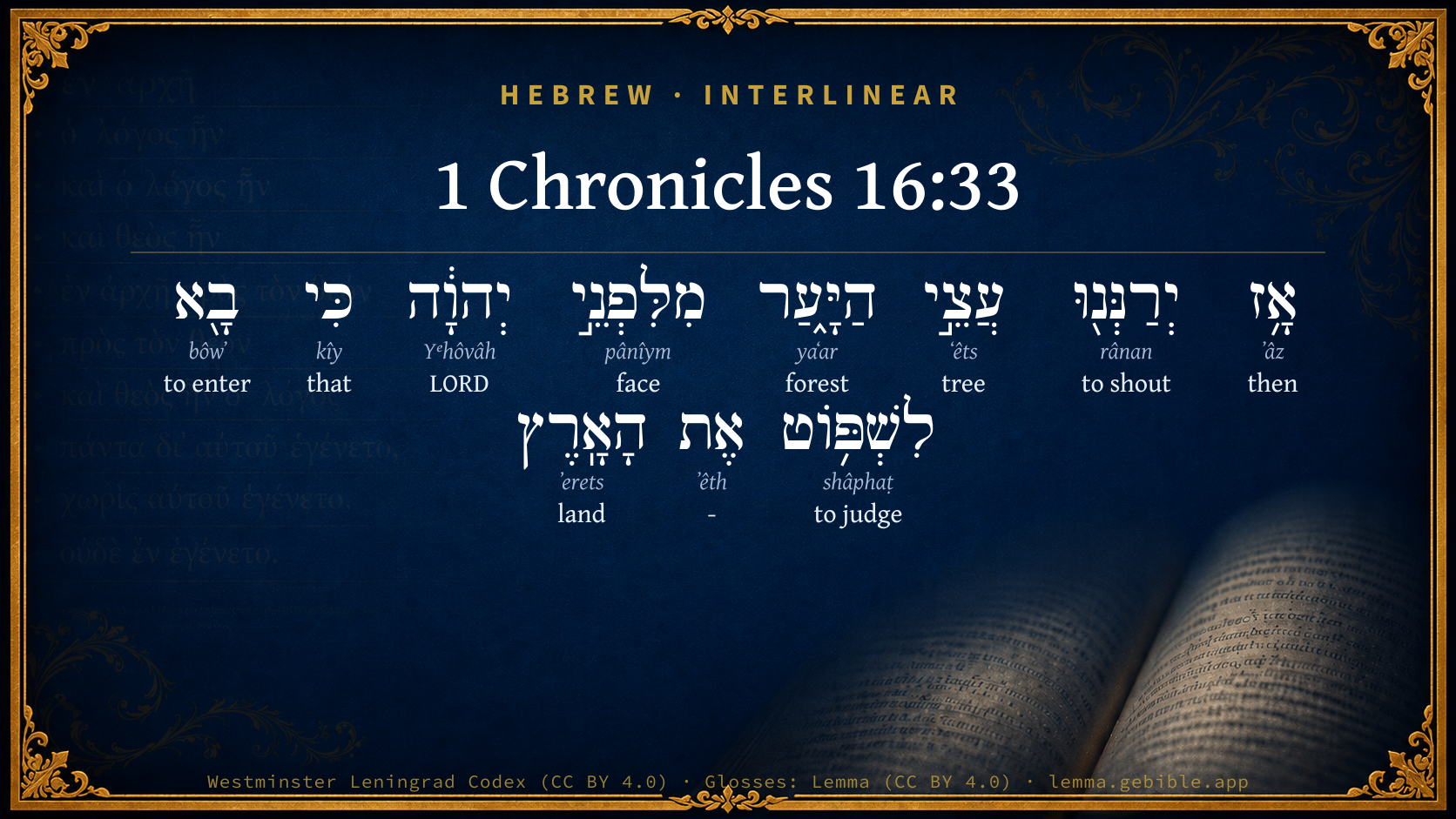
Hebrew (Westminster Leningrad Codex) 1 Chronicles 16:33 appears in the Hebrew Old Testament. The text above is from the Westminster Leningrad Codex. Each word links to its Strong’s number, a concise gloss, and parsing drawn from the Open Scriptures Hebrew Bible morphology. Click any word for its full Brown-Driver-Briggs (BDB) entry.
Download image
Cite this verse

1 Chronicles 16:33 (World English Bible). Public Domain. Lemma interlinear Bible study tool, https://lemma.gebible.app/v/1-chronicles/16/33.

Show BibTeX & RIS
BibTeX
RIS
English Translation
Then shall the trees of the wood sing for joy before Yahweh; For he comes to judge the earth.
World English Bible · Public Domain
Download a study sheet

One document with this verse’s original text, its word-by-word gloss line, the meaning frame, cross-references with their text, attributed commentary, and full source and license credits — printable, and it pastes into notes with its structure intact.

This verse Autodidact and up

Study sheet (.html) Plain text (.txt)

A passage Seminary Student

Up to 50 verses in one chapter. A passage sheet keeps up to 6 commentary sources and 12 cross-references per verse, in the order this page ranks them, and says so on the sheet whenever that leaves anything out. Ask for a single verse and you get the Autodidact verse sheet above.

Everything on this page stays free to read, with no account — the sheet is a download of what is already on screen, not access to it.

Want to remove ads? Support Godless Engineer
Compare translations 3

The same verse in 3 English versions, stacked beneath the original-language interlinear above. Click any original word for its lexicon entry.

Each is an independent rendering of the whole verse — the interlinear is not word-aligned to these translations.

Highlighted words mark where these versions differ — a whole-verse word diff, not a word-by-word alignment.

  • World English Bible Public Domain
    Then shall the trees of the wood sing for joy before Yahweh; For he comes to judge the earth.
  • King James Version Public Domain
    Then shall the trees of the wood sing out at the presence of the LORD, because he cometh to judge the earth.
  • unfoldingWord Literal Text CC BY-SA 4.0
    Then let the trees of the forest shout joyfully from to the face of Yahweh, for he is coming to judge the earth.

unfoldingWord Literal Text — © unfoldingWord, licensed CC BY-SA 4.0. Word-aligned USFM3 via Door43 (git.door43.org/unfoldingWord/en_ult).

Versions to compare (up to 4)

3 of 4 selected

Show all 18 translations

Every available English version of this verse, each an independent rendering of the whole verse.

  • World English Bible Public Domain
    Then shall the trees of the wood sing for joy before Yahweh; For he comes to judge the earth.
  • Berean Standard Bible Public Domain
    Then the trees of the forest will sing for joy before the LORD, for He is coming to judge the earth.
  • Majority Standard Bible Public Domain
    Then the trees of the forest will sing for joy before the LORD, for He is coming to judge the earth.
  • King James Version Public Domain
    Then shall the trees of the wood sing out at the presence of the LORD, because he cometh to judge the earth.
  • American Standard Version (1901) Public Domain
    Then shall the trees of the wood sing for joy before Jehovah; For he cometh to judge the earth.
  • Revised Version (1885) Public Domain
    Then shall the trees of the wood sing for joy before the LORD, for he cometh to judge the earth.
  • Geneva Bible (1599) Public Domain
    Let the trees of the wood then reioyce at the presence of the Lord: for he commeth to iudge the earth.
  • Douay-Rheims (1899) Public Domain
    Then shall the trees of the wood give praise before the Lord: because he is come to judge the earth.
  • Young's Literal Translation Public Domain
    Then sing do trees of the forest, From the presence of Jehovah, For He hath come to judge the earth!
  • Literal Standard Version CC BY-SA 4.0
    Then trees of the forest sing, || From the presence of YHWH, || For He has come to judge the earth!
  • Unlocked Literal Bible CC BY-SA 4.0
    Then let the trees in the forest shout for joy before Yahweh, for he is coming to judge the earth.
  • unfoldingWord Literal Text CC BY-SA 4.0
    Then let the trees of the forest shout joyfully from to the face of Yahweh, for he is coming to judge the earth.
  • Darby Bible Public Domain
    Then shall the trees of the forest sing out at the presence of Jehovah, For he cometh to judge the earth.
  • World Messianic Bible Public Domain
    Then the trees of the forest will sing for joy before the LORD, for he comes to judge the earth.
  • Webster's Bible Public Domain
    Then shall the trees of the wood sing at the presence of the LORD, because he cometh to judge the earth.
  • Free Bible Version CC BY-SA 4.0
    Let all the trees in the forest sing for joy, for he is coming to judge the earth.
  • Bible in Basic English Public Domain
    Then let all the trees of the wood be sounding with joy before the Lord, for he is come to be the judge of the earth.
  • JPS Tanakh (1917) Public Domain
    Then shall the trees of the wood sing for joy, before the LORD, for He is come to judge the earth.

Literal Standard Version (2020), Covenant Press — licensed CC BY-SA 4.0. Text via the HelloAO Bible API (eBible.org). Unlocked Literal Bible (unfoldingWord) — licensed CC BY-SA 4.0. Text via the HelloAO Bible API (eBible.org). unfoldingWord Literal Text — © unfoldingWord, licensed CC BY-SA 4.0. Word-aligned USFM3 via Door43 (git.door43.org/unfoldingWord/en_ult). Free Bible Version, Dr. Jonathan Gallagher — licensed CC BY-SA 4.0. Text via the HelloAO Bible API (eBible.org).

Word by word

More ways to search: Search by grammar → Find every occurrence → Compare this word →

Practice this passage: Drill this verse → Learn its vocabulary →

יְרַנְּנ֖וּ
rânan
H7442
“to shout”
Verb, Piel, Imperfect, 3rd Person, Masculine, Plural
Part of Speech
Verb
Stem
Piel
Form
Imperfect
Person
3rd Person
Gender
Masculine
Number
Plural
Full BDB Definition

Origin: a primitive root

TWOT: 2134 , 2179

to overcome - (Hithpolel) to be overcome - to cry out, shout for joy, give a ringing cry - (Qal) - to give a ringing cry (in joy, exaltation, distress) - to cry aloud (in summons, exhortation of wisdom) - (Piel) to give a ringing cry (in joy, exultation, praise - (Pual) ringing cry, singing out (passive) - (Hiphil) to cause to ring or sing out (for joy) - (Hithpolel) rejoicing (participle)
  1. אָ֥ז ʼâz H227 “then” Adverb
  2. עֲצֵ֣י ʻêts H6086 “trees of” Noun, Common, Masculine, Plural, Construct
  3. הַיָּ֑עַר yaʻar H3293 “the · forest” Particle, Definite Article + Noun, Common, Masculine, Singular, Absolute
  4. מִלִּפְנֵ֣י pânîym H6440 “from · to/for · face(s) of” Preposition + Preposition + Noun, Common, Both, Plural, Construct
  5. יְהוָ֔ה Yᵉhôvâh H3068 “LORD” Noun, Proper
  6. כִּי kîy H3588 “that” Conjunction
  7. בָ֖א bôwʼ H935 “to enter” Verb, Qal, Perfect, 3rd Person, Masculine, Singular
  8. לִשְׁפּ֥וֹט shâphaṭ H8199 “to judge” Preposition + Verb, Qal, Infinitive Construct
  9. אֶת ʼêth H853 “-” Particle, Direct Object
  10. הָאָֽרֶץ ʼerets H776 “the · land” Particle, Definite Article + Noun, Common, Both, Singular, Absolute

About this verse

These counts appear in no published source. They are computed here, from the morphology-tagged text and Lemma’s own curated glosses. What Lemma adds →

11
words
11
distinct lemmas
Historical
section

Shared distinctive vocabulary

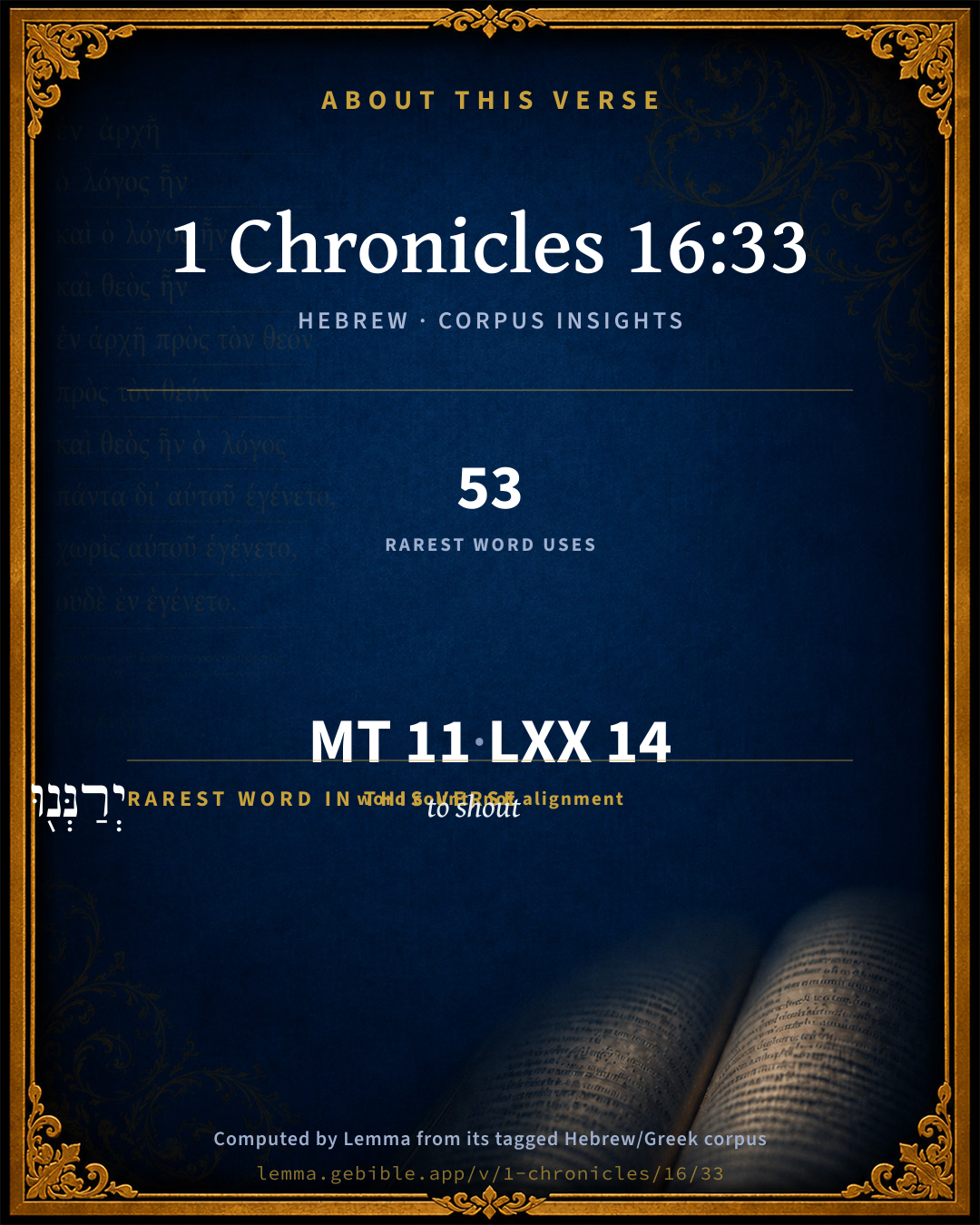
יְרַנְּנ֖וּ to shout H7442 occurs in 53 verses of the Hebrew Bible. Also found in:

Grammatical profile

  • 3 verbs
  • 5 nouns
  • 1 conjunction
  • 1 adverb
  • 1 particle

Verb forms

  • יְרַנְּנ֖וּ Piel · Imperfect
  • בָ֖א Qal · Perfect
  • לִשְׁפּ֥וֹט Qal · Infinitive Construct

Hebrew & Septuagint length

In English translation the verse runs 19 words from the Hebrew and 19 from the Septuagint (LXX English) — the same length.

A rough comparison of the two English renderings, which tokenize alike — not a word-level alignment.

Word counts can differ between the Hebrew and the Greek without any difference in meaning — e.g. the Hebrew direct-object marker אֵת has no separate Greek word, and Greek often adds the article ὁ.

In the original languages it is 11 Hebrew tokens and 14 Greek tokens — but the two are counted differently (Hebrew bundles its prefixes and suffixes into one token; the Greek is in lemma form), so that isn’t a like-for-like length.

Cross-references

7

Topical passages linked to 1 Chronicles 16:33 in the Treasury of Scripture Knowledge — connected by theme and wording, ordered by reader-vote popularity; previews shown in the World English Bible.

  • Psalms 96:12–13 Let the field and all that is in it exult! Then all the trees of the woods shall sing for joy
  • Psalms 98:9 Let them sing before Yahweh, For he comes to judge the earth. He will judge the world with righteousness, And the peoples with equity.
  • Ezekiel 17:22–24 Thus says the Lord Yahweh: I will also take of the lofty top of the cedar, and will set it; I will crop off from the topmost of its young twigs a tender one, and I will plant it on a high and lofty mountain:
  • 2 Thessalonians 1:8 giving vengeance to those who don't know God, and to those who don't obey the Gospel of our Lord Jesus,
  • 2 Peter 3:14 Therefore, beloved, seeing that you look for these things, be diligent to be found in peace, without blemish and blameless in his sight.
  • Revelation 11:17–18 saying: "We give you thanks, Lord God, the Almighty, the one who is and who was; because you have taken your great power, and reigned.
  • 2 Thessalonians 1:10 when he comes to be glorified in his saints, and to be admired among all those who have believed (because our testimony to you was believed) in that day.

Cross-references courtesy of OpenBible.info (CC BY 4.0).

Hebrew and Greek witnesses Masoretic Hebrew ↔ Greek Septuagint

The same verse in the two great witnesses to the Old Testament, shown verse-for-verse.

These are two independent witnesses, not word-aligned to each other, and the Septuagint is shown in lemma (dictionary) form.

Hebrew 1 Chronicles 16:33 Masoretic · Westminster Leningrad Codex

אָ֥ז יְרַנְּנ֖וּ עֲצֵ֣י הַיָּ֑עַר מִלִּפְנֵ֣י יְהוָ֔ה כִּי בָ֖א לִשְׁפּ֥וֹט אֶת הָאָֽרֶץ

Then shall the trees of the wood sing for joy before Yahweh; For he comes to judge the earth.

World English Bible · Public Domain

Greek LXX 1 Chronicles 16:33 Septuagint · lemma form

τότε εὐφραίνω ὁ ξύλον ὁ δρυμός ἀπό πρόσωπον κύριος ὅτι ἔρχομαι κρίνω ὁ γῆ

Then shall the trees of the wood rejoice before the Lord, for he is come to judge the earth.

LXX2012 (modern English Septuagint) · Public Domain

Hebrew: Westminster Leningrad Codex (CC BY 4.0). Greek: Septuagint (public domain); English from LXX2012 (modern English Septuagint) (Public Domain). How the Septuagint differs from the Hebrew →

Commentary

Notes on 1 Chronicles 16:33 from classic Christian and Jewish commentators (each source and its license shown beneath its notes). The classic Christian expositions comment on the surrounding passage and are grouped to its opening verse, so a note may address several verses; the Jewish commentaries on the Tanakh (Rashi and others) are per-verse, so they appear only where the commentator wrote on this verse.

Lemma curates 59 commentaries, every one of them public domain or Creative Commons licensed, each selected and text-cleaned for this edition rather than reprinted as found. About our sources →

Geneva Bible (1599)

Geneva Bible translators

To restore all things to their estate.

Geneva Bible (1599) marginal notes — public domain. Text via Bolls.life.

The Cambridge Bible for Schools and Colleges

gen. ed. J. J. S. Perowne

33. to judge the earth] The joy with which the coming judgement is greeted arises from the fact that the Hebrews regarded a judge as a champion of the oppressed and not as a pedantic interpreter of statutes.

The Cambridge Bible for Schools and Colleges (gen. ed. J. J. S. Perowne; Cambridge University Press, 1878–1918) — public domain. Text from a community e-Sword module.

The Pulpit Commentary

God always coming to judge.

is, in Scripture, a large and comprehensive term. It is sometimes synonymous with "rule," or "government," because in ancient monarchies actual magistracy due personal consideration and decision of rival claims, or accusations of crimes took a prominent place. Sometimes reference is intended to that appointment of deserts in men"s earthly experiences which may be regarded as a Divine judgment continually working. And sometimes the allusion is to that great occasion on which the anomalies of life are to gain permanent adjustment, and the issues of human conduct to be eternally fixed. Whatever other figures for God may gain attraction to us, we may not lose our thought of him as the "Judge of all the earth." We fix attention on the fact that the judging of God is no merely future thing, the glory of a coming day. It may be urged that

I GOD IS "EVER COMING TO JUDGE" IN THE WITNESS OF MEN"S CONSCIENCES. No man has to wait for his judgment. He has it at once in the inward conviction of the rightness or wrongness of his action. We should never, in our thought, separate conscience from the inward voice of God our Judge.

II GOD IS EVER "COMING TO JUDGE" IN THE CONNECTIONS BETWEEN SIN AND SUFFERING. Suffering being the proper issue of sin, and necessarily connected with it by God in order to reveal its character. All suffering may be regarded as a beginning and present illustration of God"s judgment.

III GOD IS EVER "COMING TO JUDGE" IN THE CONVICTIONS WROUGHT BY THE PRESENCE AMONG US OF HOLY MEN. Illustrate how Enoch and Noah carried God"s judgment on their sinful generation, in the conviction produced by their holy lives. And in the fullest sense this was true of the Lord Jesus as the holiest of men. His presence among them was God"s abiding judgment on a sinful and adulterous generation.]n measure the same is true still of both private and public spheres the presence of holy men and women tests us, and, too often, both judges and condemns.

IV GOD IS EVER "COMING TO JUDGE" IN THE ORDERINGS OF DIVINE PROVIDENCE. Calamities, and even disappointments, are signs of the Divine presence recognizing and dealing with wilfulness and sin. And this is quite as true when we are able to trace the natural laws according to whose legitimate workings the calamities or failures may have come.

V GOD IS SURELY ALSO COMING WITH HIS FINAL JUDGEMENT ON THE LIVES AND RECORDS OF NATIONS AND OF MEN. Of that fact we are well assured; of the manner and method of it we have only as yet vague poetical figures, which we are unable to translate into earthly fact. Enough is told us to make the thought of coming judgment a present moral power. David connected the Divine "judgment" with "righteousness" and with "truth," as these, he knew, had been so gloriously manifested in the fulfilment of ancient promises. "These being the characteristics of Jehovah"s judgment to which the view is directed in this psalm, the essentially joyous tone of it is accounted for." Think aright of God"s judgment, and of it we may even learn to sing. R.T.

The Pulpit Commentary (1880–1919), ed. H.D.M. Spence-Jones & Joseph S. Exell — public domain. Text from a community e-Sword module.

Lesson kit

Teaching starters — assembled from the data on this page, not authored interpretation. Every prompt links to the verse data it draws on. Edit before teaching.

1 Chronicles, in the Historical, opens this verse with 11 words (11 distinct Hebrew lemmas). Its most distinctive word is rânan (“to shout”). A historical commentator’s framing appears above. Read the whole chapter for the surrounding context.

Discussion questions

  1. The word rânan carries the sense “to shout.” How does it shape the verse?
  2. Leviticus 9:24 shares the word «to shout» with this verse. How do the two illuminate each other?
  3. The translations on this page render this verse differently — a whole-verse word diff, not a word-by-word alignment. What might account for the different wordings?
  4. The verb «יְרַנְּנ֖וּ» is Piel Imperfect. How does its form color the action?
  5. Reading how Geneva Bible (1599) and The Cambridge Bible for Schools and Colleges read this verse, where do the two commentators agree and where do they part?

Things to notice

Reading settings

Reading text

Shown beneath each verse's original-language words.

Old Testament
Old Testament edition

Read the OT as the Masoretic Hebrew (MT) or the Greek Septuagint (LXX).

English shown for the Greek Septuagint (in the Hebrew ↔ Greek comparison).

Comparing translations? Open the Compare panel on any verse page to stack up to four side by side.