2 Chronicles 1:10

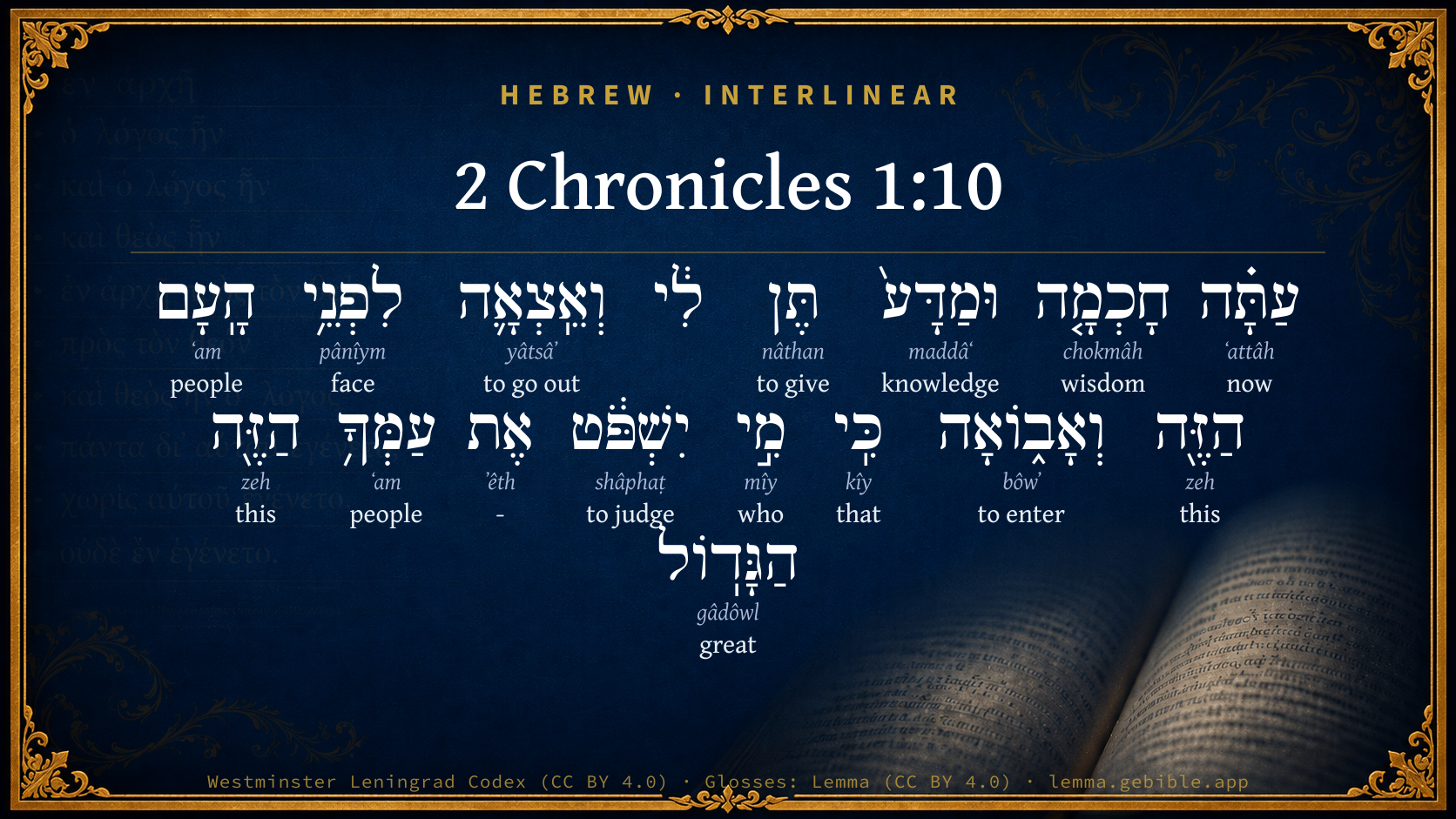
Hebrew (Westminster Leningrad Codex) 2 Chronicles 1:10 appears in the Hebrew Old Testament. The text above is from the Westminster Leningrad Codex. Each word links to its Strong’s number, a concise gloss, and parsing drawn from the Open Scriptures Hebrew Bible morphology. Click any word for its full Brown-Driver-Briggs (BDB) entry.
Download image
Cite this verse

2 Chronicles 1:10 (World English Bible). Public Domain. Lemma interlinear Bible study tool, https://lemma.gebible.app/v/2-chronicles/1/10.

Show BibTeX & RIS
BibTeX
RIS
English Translation
Give me now wisdom and knowledge, that I may go out and come in before this people; for who can judge this your people, that is so great?
World English Bible · Public Domain
Highlights
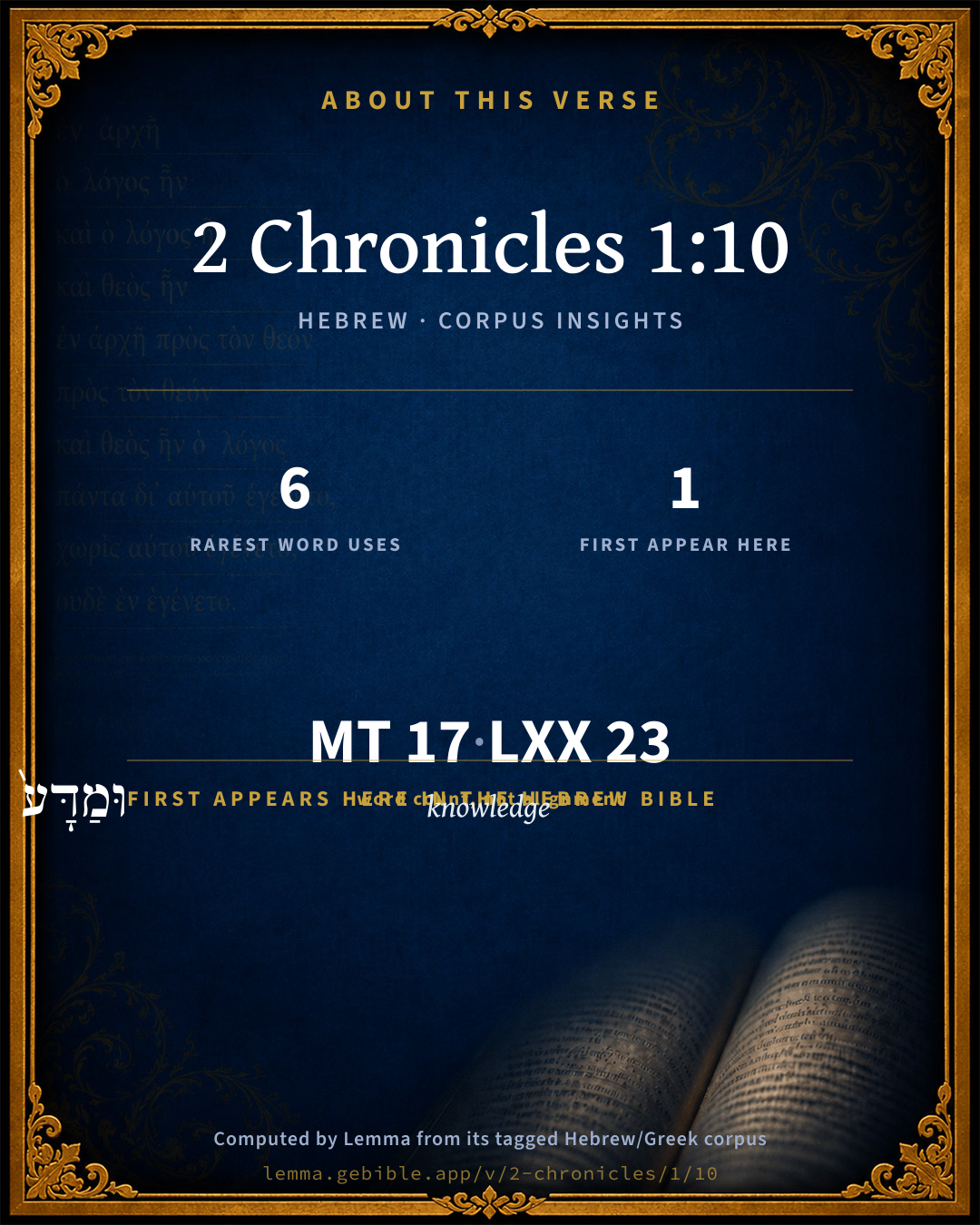
  • 1 first appearance in the Hebrew Bible
Full analysis ↓
Download a study sheet

One document with this verse’s original text, its word-by-word gloss line, the meaning frame, cross-references with their text, attributed commentary, and full source and license credits — printable, and it pastes into notes with its structure intact.

This verse Autodidact and up

Study sheet (.html) Plain text (.txt)

A passage Seminary Student

Up to 50 verses in one chapter. A passage sheet keeps up to 6 commentary sources and 12 cross-references per verse, in the order this page ranks them, and says so on the sheet whenever that leaves anything out. Ask for a single verse and you get the Autodidact verse sheet above.

Everything on this page stays free to read, with no account — the sheet is a download of what is already on screen, not access to it.

Want to remove ads? Support Godless Engineer
Compare translations 3

The same verse in 3 English versions, stacked beneath the original-language interlinear above. Click any original word for its lexicon entry.

Each is an independent rendering of the whole verse — the interlinear is not word-aligned to these translations.

Highlighted words mark where these versions differ — a whole-verse word diff, not a word-by-word alignment.

  • World English Bible Public Domain
    Give me now wisdom and knowledge, that I may go out and come in before this people; for who can judge this your people, that is so great?
  • King James Version Public Domain
    Give me now wisdom and knowledge, that I may go out and come in before this people: for who can judge this thy people, that is so great?
  • unfoldingWord Literal Text CC BY-SA 4.0
    Now wisdom and knowledge give to me, and I will go out before this people, and I will come in, for who can judge this great people of yours?”

unfoldingWord Literal Text — © unfoldingWord, licensed CC BY-SA 4.0. Word-aligned USFM3 via Door43 (git.door43.org/unfoldingWord/en_ult).

Versions to compare (up to 4)

3 of 4 selected

Show all 18 translations

Every available English version of this verse, each an independent rendering of the whole verse.

  • World English Bible Public Domain
    Give me now wisdom and knowledge, that I may go out and come in before this people; for who can judge this your people, that is so great?
  • Berean Standard Bible Public Domain
    Now grant me wisdom and knowledge, so that I may lead this people. For who is able to govern this great people of Yours?”
  • Majority Standard Bible Public Domain
    Now grant me wisdom and knowledge, so that I may lead this people. For who is able to govern this great people of Yours?”
  • King James Version Public Domain
    Give me now wisdom and knowledge, that I may go out and come in before this people: for who can judge this thy people, that is so great?
  • American Standard Version (1901) Public Domain
    Give me now wisdom and knowledge, that I may go out and come in before this people; for who can judge this thy people, that is so great?
  • Revised Version (1885) Public Domain
    Give me now wisdom and knowledge, that I may go out and come in before this people: for who can judge this thy people, that is so great?
  • Geneva Bible (1599) Public Domain
    Giue me now wisdome and knowledge, that I may go out and go in before this people: for who can iudge this thy great people?
  • Douay-Rheims (1899) Public Domain
    Give me wisdom and knowledge that I may come in and go out before thy people: for who can worthily judge this thy people, which is so great?
  • Young's Literal Translation Public Domain
    now, wisdom and knowledge give to me, and I go out before this people, and I come in, for who doth judge this Thy great people?'
  • Literal Standard Version CC BY-SA 4.0
    now, give wisdom and knowledge to me, and I go out before this people, and I come in, for who judges this—Your great people?”
  • Unlocked Literal Bible CC BY-SA 4.0
    Now give me wisdom and knowledge, so that I may lead this people, for who can judge your people, who are so many in number?”
  • unfoldingWord Literal Text CC BY-SA 4.0
    Now wisdom and knowledge give to me, and I will go out before this people, and I will come in, for who can judge this great people of yours?”
  • Darby Bible Public Domain
    Give me now wisdom and knowledge, that I may go out and come in before this people; for who can judge this thy great people?
  • World Messianic Bible Public Domain
    Now give me wisdom and knowledge, that I may go out and come in before this people; for who can judge this great people of yours?”
  • Webster's Bible Public Domain
    Give me now wisdom and knowledge, that I may go out and come in before this people: for who can judge this thy great people?
  • Free Bible Version CC BY-SA 4.0
    Please give me wisdom and knowledge to lead this people—for who can rule with justice this great people of yours?”
  • Bible in Basic English Public Domain
    Give me now wisdom and knowledge, so that I may go out and come in before this people: for who is able to be the judge of this great people of yours?
  • JPS Tanakh (1917) Public Domain
    Give me now wisdom and knowledge, that I may go out and come in before this people; for who can judge this Thy people, that is so great?'

Literal Standard Version (2020), Covenant Press — licensed CC BY-SA 4.0. Text via the HelloAO Bible API (eBible.org). Unlocked Literal Bible (unfoldingWord) — licensed CC BY-SA 4.0. Text via the HelloAO Bible API (eBible.org). unfoldingWord Literal Text — © unfoldingWord, licensed CC BY-SA 4.0. Word-aligned USFM3 via Door43 (git.door43.org/unfoldingWord/en_ult). Free Bible Version, Dr. Jonathan Gallagher — licensed CC BY-SA 4.0. Text via the HelloAO Bible API (eBible.org).

Word by word

More ways to search: Search by grammar → Find every occurrence → Compare this word →

Practice this passage: Drill this verse → Learn its vocabulary →

וּמַדָּע֙
maddâʻ
H4093
“and · knowledge”
Conjunction + Noun, Common, Masculine, Singular, Absolute
Part of Speech
Conjunction + Noun
Type
Common
Gender
Masculine
Number
Singular
State
Absolute
Full BDB Definition

Origin: from H3045

TWOT: 848g

knowledge, thought - knowledge - mind, thought, place of knowledge
  1. עַתָּ֗ה ʻattâh H6258 “now” Adverb
  2. חָכְמָ֤ה chokmâh H2451 “wisdom” Noun, Common, Feminine, Singular, Absolute
  3. תֶּן nâthan H5414 “give” Verb, Qal, Imperative, 2nd Person, Masculine, Singular
  4. וְאֵֽצְאָ֛ה yâtsâʼ H3318 “and · to go out” Conjunction + Verb, Qal, Cohortative, 1st Person, Common, Singular
  5. לִפְנֵ֥י pânîym H6440 “to/for · face(s) of” Preposition + Noun, Common, Both, Plural, Construct
  6. הָֽעָם ʻam H5971 “the · people” Particle, Definite Article + Noun, Common, Masculine, Singular, Absolute
  7. הַזֶּ֖ה zeh H2088 “the · this” Particle, Definite Article + Pronoun, Demonstrative, Masculine, Singular
  8. וְאָב֑וֹאָה bôwʼ H935 “and · to enter” Conjunction + Verb, Qal, Cohortative, 1st Person, Common, Singular
  9. כִּֽי kîy H3588 “that” Conjunction
  10. מִ֣י mîy H4310 “who” Particle, Interrogative
  11. יִשְׁפֹּ֔ט shâphaṭ H8199 “to judge” Verb, Qal, Imperfect, 3rd Person, Masculine, Singular
  12. אֶת ʼêth H853 “-” Particle, Direct Object
  13. עַמְּךָ֥ ʻam H5971 “people · your” Noun, Common, Masculine, Singular, Construct + Suffix, Personal, 2nd Person, Masculine, Singular
  14. הַזֶּ֖ה zeh H2088 “the · this” Particle, Definite Article + Pronoun, Demonstrative, Masculine, Singular
  15. הַגָּדֽוֹל gâdôwl H1419 “the · great” Particle, Definite Article + Adjective, Adjective, Masculine, Singular, Absolute

About this verse

These counts appear in no published source. They are computed here, from the morphology-tagged text and Lemma’s own curated glosses. What Lemma adds →

17
words
14
distinct lemmas
Historical
section

Notable vocabulary

The rarest word here is וּמַדָּע֙ knowledge H4093 — appearing just 6 times in the whole Hebrew Bible.

First appearance in Scripture

This word makes its first canonical appearance in the Hebrew Bible here:

  • וּמַדָּע֙ knowledge H4093

Shared distinctive vocabulary

וּמַדָּע֙ knowledge H4093 occurs in 6 verses of the Hebrew Bible. Also found in:

Grammatical profile

  • 4 verbs
  • 5 nouns
  • 1 adjective
  • 2 pronouns
  • 1 preposition
  • 1 conjunction
  • 1 adverb
  • 2 particles

Verb forms

  • תֶּן Qal · Imperative
  • וְאֵֽצְאָ֛ה Qal · Cohortative
  • וְאָב֑וֹאָה Qal · Cohortative
  • יִשְׁפֹּ֔ט Qal · Imperfect

Repetition

Words recur within this verse — often emphatic in Hebrew:

  • הָֽעָם people H5971 ×2
  • הַזֶּ֖ה this H2088 ×2

Hebrew & Septuagint length

In English translation the verse runs 28 words from the Hebrew and 25 from the Septuagint (LXX English) — closely comparable.

A rough comparison of the two English renderings, which tokenize alike — not a word-level alignment.

Word counts can differ between the Hebrew and the Greek without any difference in meaning — e.g. the Hebrew direct-object marker אֵת has no separate Greek word, and Greek often adds the article ὁ.

In the original languages it is 17 Hebrew tokens and 23 Greek tokens — but the two are counted differently (Hebrew bundles its prefixes and suffixes into one token; the Greek is in lemma form), so that isn’t a like-for-like length.

Cross-references

12

Topical passages linked to 2 Chronicles 1:10 in the Treasury of Scripture Knowledge — connected by theme and wording, ordered by reader-vote popularity; previews shown in the World English Bible.

  • 1 Kings 3:9 Give your servant therefore an understanding heart to judge your people, that I may discern between good and evil; for who is able to judge this your great people?
  • Proverbs 4:7 Wisdom is supreme. Get wisdom. Yes, though it costs all your possessions, get understanding.
  • Proverbs 2:2–6 So as to turn your ear to wisdom, And apply your heart to understanding;
  • 2 Samuel 5:2 In times past, when Saul was king over us, it was you who led out and brought in Israel: and Yahweh said to you, You shall be shepherd of my people Israel, and you shall be prince over Israel.
  • Psalms 119:34 Give me understanding, and I will keep your law. Yes, I will obey it with my whole heart.
  • Psalms 119:73 Your hands have made me and formed me. Give me understanding, that I may learn your commandments.
  • Proverbs 3:13–18 Happy is the man who finds wisdom, The man who gets understanding.
  • James 1:5 But if any of you lacks wisdom, let him ask of God, who gives to all liberally and without reproach; and it will be given to him.
  • Numbers 27:17 who may go out before them, and who may come in before them, and who may lead them out, and who may bring them in; that the congregation of Yahweh not be as sheep which have no shepherd.
  • 2 Corinthians 3:5 not that we are sufficient of ourselves, to account anything as from ourselves; but our sufficiency is from God;
  • Deuteronomy 31:2 He said to them, I am one hundred twenty years old this day; I can no more go out and come in: and Yahweh has said to me, You shall not go over this Jordan.
  • 2 Corinthians 2:16 to the one a stench from death to death; to the other a sweet aroma from life to life. Who is sufficient for these things?

Cross-references courtesy of OpenBible.info (CC BY 4.0).

Hebrew and Greek witnesses Masoretic Hebrew ↔ Greek Septuagint

The same verse in the two great witnesses to the Old Testament, shown verse-for-verse.

These are two independent witnesses, not word-aligned to each other, and the Septuagint is shown in lemma (dictionary) form.

Hebrew 2 Chronicles 1:10 Masoretic · Westminster Leningrad Codex

עַתָּ֗ה חָכְמָ֤ה וּמַדָּע֙ תֶּן לִ֔י וְאֵֽצְאָ֛ה לִפְנֵ֥י הָֽעָם הַזֶּ֖ה וְאָב֑וֹאָה כִּֽי מִ֣י יִשְׁפֹּ֔ט אֶת עַמְּךָ֥ הַזֶּ֖ה הַגָּדֽוֹל

Give me now wisdom and knowledge, that I may go out and come in before this people; for who can judge this your people, that is so great?

World English Bible · Public Domain

Greek LXX 2 Chronicles 1:10 Septuagint · lemma form

νῦν σοφία καί σύνεσις δίδωμι ἐγώ καί ἐκἔρχομαι ἐνώπιον ὁ λαός οὗτος καί εἰςἔρχομαι ὅτι τίς κρίνω ὁ λαός σύ ὁ μέγας οὗτος

Now give me wisdom and understanding, that I may go out and come in before this people: for who shall judge this your great people?

LXX2012 (modern English Septuagint) · Public Domain

Hebrew: Westminster Leningrad Codex (CC BY 4.0). Greek: Septuagint (public domain); English from LXX2012 (modern English Septuagint) (Public Domain). How the Septuagint differs from the Hebrew →

Commentary

Notes on 2 Chronicles 1:10 from classic Christian and Jewish commentators (each source and its license shown beneath its notes). The classic Christian expositions comment on the surrounding passage and are grouped to its opening verse, so a note may address several verses; the Jewish commentaries on the Tanakh (Rashi and others) are per-verse, so they appear only where the commentator wrote on this verse.

Lemma curates 59 commentaries, every one of them public domain or Creative Commons licensed, each selected and text-cleaned for this edition rather than reprinted as found. About our sources →

Trapp's Complete Commentary

John Trapp

2Ch 1:10 Give me now wisdom and knowledge, that I may go out and come in before this people: for who can judge this thy people, [that is so] great?

Ver. 10. Give me now wisdom and knowledge.] Knowledge to discern, and wisdom to do that which is right.

That I may go out, &c.] See on 1Ki 3:7.

John Trapp, A Commentary or Exposition upon All the Books of the Old and New Testament (1647–1656) — public domain. Text from a community e-Sword module.

Joseph Benson's Commentary

2Ch 1:10. Give me now wisdom and knowledge — Like a genuine son of David and Abraham, he chose spiritual blessings rather than temporal. That I may go out and come in before this people — This is a proverbial speech for governing the people both at home and abroad, in peace and war. See Num 27:17; Deu 31:2. For who can judge this thy people, that is so great? — Among such a numerous people he knew there would be so many, and so various, and, many times, difficult cases brought before him, that it would be impossible for him to hear them and judge aright, without wisdom more than human. See note on 1Ki 3:9.

Joseph Benson's Commentary on the Old and New Testaments (1811–1818) — public domain. Text from a community e-Sword module.

Tyndale Open Study Notes

Tyndale Open Resources

1:10 Solomon received wisdom and knowledge so he could govern (Hebrew shapat) well. The word shapat, often rendered “judge” (e.g., in Judges), can also mean “govern.”

Tyndale Open Study Notes — © Tyndale Open Resources, licensed CC BY-SA 4.0. Text via the HelloAO Bible API.

Geneva Bible (1599)

Geneva Bible translators

That I may govern this people, read 1 Chron. 27:1 and 1 Kings 3:7.

Geneva Bible (1599) marginal notes — public domain. Text via Bolls.life.

Ellicott's Commentary for English Readers

(10) Give me now wisdom and knowledge.—Now wisdom and knowledge give thou me; a petition co-ordinate with that of 2Ch_1:9 : “Now, O Lord God,” &c. The clause answers to 1Ki_3:9. The word rendered “knowledge” (madda’) is late, and occurs besides only in Dan_1:4; Dan_1:17; Ecc_10:20.

That I may go out and come in before this people.—See 1Ki_3:7; Num_27:17; Deu_31:2.

For who can judge.—The simple impf.; Kings has, “who is able to judge?”

This thy people, that is so great (gâdôl).—Kings: “This thy numerous (kôbçd) people.” For the king as judge comp. 1Sa_8:20.

A Bible Commentary for English Readers, edited by Charles John Ellicott (1878–1897) — public domain. Text from a community e-Sword module.

The Cambridge Bible for Schools and Colleges

gen. ed. J. J. S. Perowne

10. go out and come in] The phrase denotes the transaction of business of all kinds.

judge] Although every village by its headmen dispensed its own justice to its inhabitants, yet enough cases too hard for local decision remained over to make the king’s judicial functions of very great importance; cp. 2Sa_14:4 ff; 2Sa_15:2-4.

The Cambridge Bible for Schools and Colleges (gen. ed. J. J. S. Perowne; Cambridge University Press, 1878–1918) — public domain. Text from a community e-Sword module.

Haydock's Catholic Bible Commentary

People, as a king ought to do. (Menochius)

George Leo Haydock (1774–1849), Haydock's Catholic Family Bible and Commentary, 1859 edition — public domain. Excludes Psalms (Douay-Rheims chapter numbering differs from Protestant) and Deuterocanonical books (Catholic canon only).

Matthew Poole's English Annotations

What one man is sufficient to govern so numerous a people?

Matthew Poole's English Annotations on the Holy Bible (1683–1685) — public domain. Text from a community e-Sword/MySword module.

The Pulpit Commentary

Give me now wisdom and knowledge. The force of the opening of this verse, and the relation of it to the former, are both prejudiced by the "now" (hT) being deposed from its right position as the first word in the verse. For the rest of this verse, the parallel passage has "an understanding heart" in place of our "wisdom and knowledge; " and "that I may discern between good and bad," in place of our that I may go out and come in before this people . In using the words, "wisdom and knowledge," Solomon seems to have remembered well the prayer of his father. (1Ch_22:12) (For the pedigree of the simple and effective phrase, "know how to go out and come in," (see Num_27:17; Deu_31:2; 1Sa_18:13, 1Sa_18:16; 2Sa_3:25) It is at the same time refreshing to revisit the times when the most exalted nominal ruler was also the real ruler, as being the leader, the judge, the teacher in the highest sense, and "the feeder" of his people. Nor is it less refreshing to notice how, in Israel at least, the fact was so well recognized and honoured, that justice and to judge just judgment lay at the deepest foundation of civil society.

The Pulpit Commentary (1880–1919), ed. H.D.M. Spence-Jones & Joseph S. Exell — public domain. Text from a community e-Sword module.

Rashi

Rabbi Shlomo Yitzchaki (Rashi)

and I shall go forth before this people and come in And also, a king requires a wise heart to know how to judge, and I am young and tender. Even a thousand wise men would have difficulty judging such a large nation, because it is impossible that they should not have many disputes, which they come to litigate, and he has no time to deliberate on their case, for while this one is complaining and does not stop talking, another one comes and cries. Now who can decide a thousand legal decisions in one day, except one who is wise and astute, endowed with the spirit of God? Therefore, this I request, that You give me wisdom and knowledge to judge this great people of Yours, for this is what I require that You give me.

Rashi on the Tanakh — English translations: “The Judaica Press complete Tanach with Rashi, translated by A. J. Rosenberg” (CC BY 4.0); “Pentateuch with Rashi's commentary by M. Rosenbaum and A.M. Silbermann, 1929-1934” (public domain); “The Metsudah Tanach series, Lakewood, N.J” (CC BY 4.0); and “The Book of Joshua, Metsudah Publications, 1997” (CC BY 4.0). Text via Sefaria.

Lesson kit

Teaching starters — assembled from the data on this page, not authored interpretation. Every prompt links to the verse data it draws on. Edit before teaching.

2 Chronicles, in the Historical, opens this verse with 17 words (14 distinct Hebrew lemmas). Its most distinctive word is maddâʻ (“knowledge”). A historical commentator’s framing appears above. Read the whole chapter for the surrounding context.

Discussion questions

  1. How does “knowledge” (maddâʻ) shape what this verse is saying?
  2. The word “knowledge” first appears here in Scripture. What is being introduced at this debut?
  3. 2 Chronicles 1:11 shares the word «knowledge» with this verse. How do the two illuminate each other?
  4. “people” occurs 2× in this one verse. What is the effect of the repetition?
  5. These translations render this verse differently; the difference is in the English rendering, not the original. What questions does that raise?
  6. The verb «תֶּן» is Qal Imperative. How does its form color the action?
  7. Reading how Trapp's Complete Commentary and Joseph Benson's Commentary read this verse, where do the two commentators agree and where do they part?

Things to notice

Reading settings

Reading text

Shown beneath each verse's original-language words.

Old Testament
Old Testament edition

Read the OT as the Masoretic Hebrew (MT) or the Greek Septuagint (LXX).

English shown for the Greek Septuagint (in the Hebrew ↔ Greek comparison).

Comparing translations? Open the Compare panel on any verse page to stack up to four side by side.