
Judges 12:13

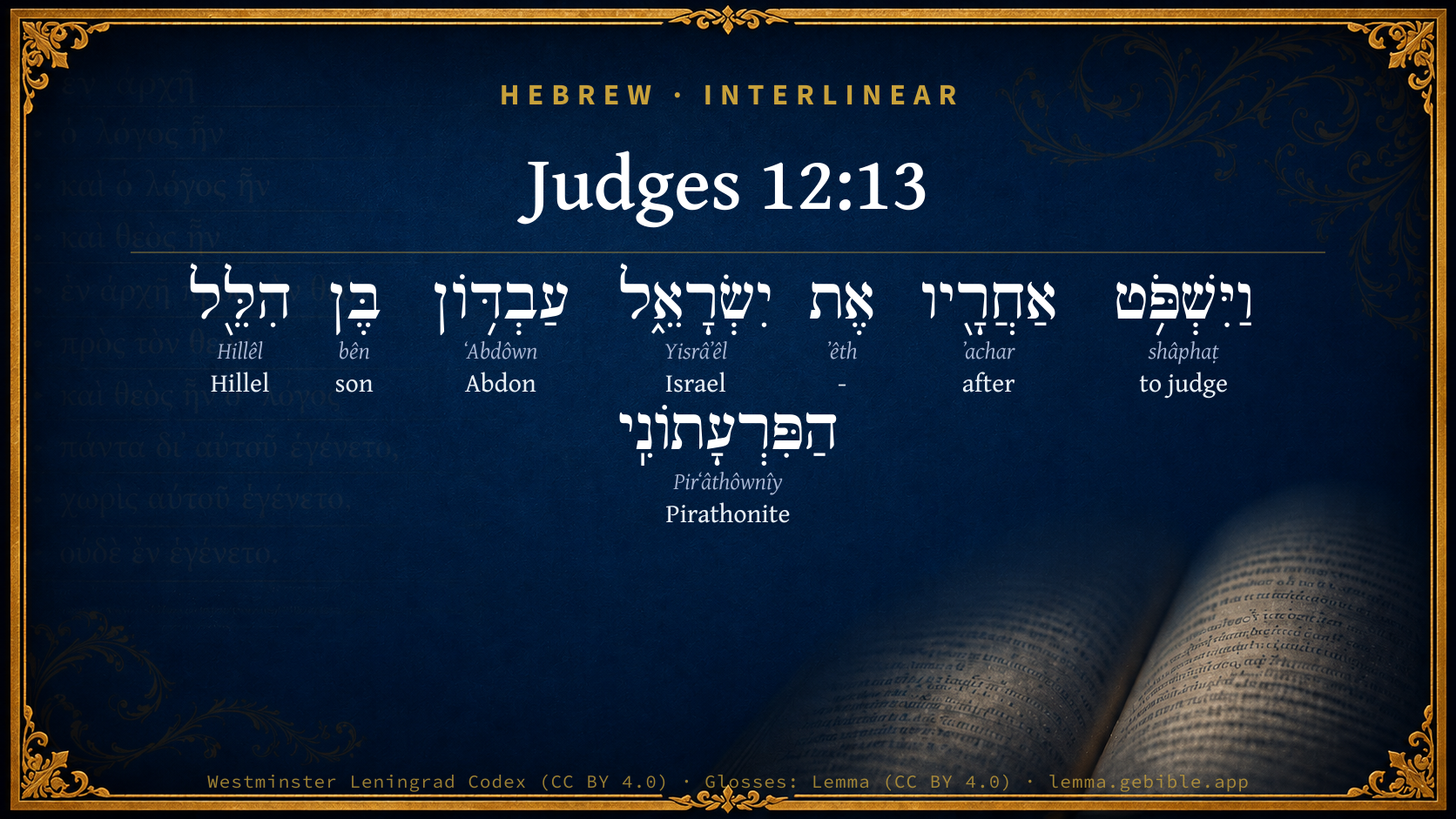
Hebrew (Westminster Leningrad Codex) Judges 12:13 appears in the Hebrew Old Testament. The text above is from the Westminster Leningrad Codex. Each word links to its Strong’s number, a concise gloss, and parsing drawn from the Open Scriptures Hebrew Bible morphology. Click any word for its full Brown-Driver-Briggs (BDB) entry.
Download image
Cite this verse

Judges 12:13 (World English Bible). Public Domain. Lemma interlinear Bible study tool, https://lemma.gebible.app/v/judges/12/13.

Show BibTeX & RIS
BibTeX
RIS
English Translation
After him Abdon the son of Hillel the Pirathonite judged Israel.
World English Bible · Public Domain
Highlights
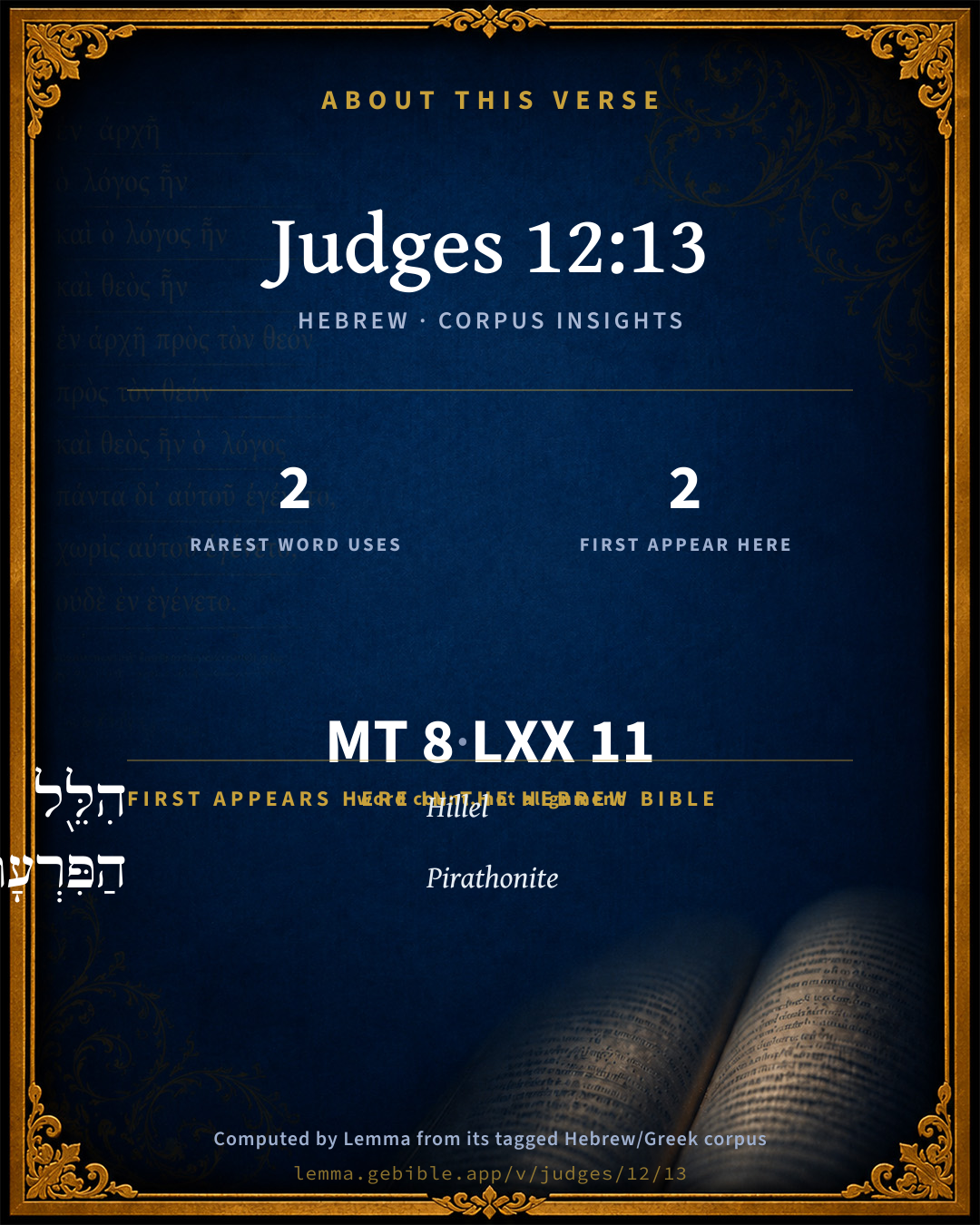
  • 2 first appearances in the Hebrew Bible
Full analysis ↓
Download a study sheet

One document with this verse’s original text, its word-by-word gloss line, the meaning frame, cross-references with their text, attributed commentary, and full source and license credits — printable, and it pastes into notes with its structure intact.

This verse Autodidact and up

Study sheet (.html) Plain text (.txt)

A passage Seminary Student

Up to 50 verses in one chapter. A passage sheet keeps up to 6 commentary sources and 12 cross-references per verse, in the order this page ranks them, and says so on the sheet whenever that leaves anything out. Ask for a single verse and you get the Autodidact verse sheet above.

Everything on this page stays free to read, with no account — the sheet is a download of what is already on screen, not access to it.

Want to remove ads? Support Godless Engineer
Compare translations 3

The same verse in 3 English versions, stacked beneath the original-language interlinear above. Click any original word for its lexicon entry.

Each is an independent rendering of the whole verse — the interlinear is not word-aligned to these translations.

Highlighted words mark where these versions differ — a whole-verse word diff, not a word-by-word alignment.

  • World English Bible Public Domain
    After him Abdon the son of Hillel the Pirathonite judged Israel.
  • King James Version Public Domain
    And after him Abdon the son of Hillel, a Pirathonite, judged Israel.
  • unfoldingWord Literal Text CC BY-SA 4.0
    And after him Abdon, the son of Hillel, the Pirathonite, judged Israel.

unfoldingWord Literal Text — © unfoldingWord, licensed CC BY-SA 4.0. Word-aligned USFM3 via Door43 (git.door43.org/unfoldingWord/en_ult).

Versions to compare (up to 4)

3 of 4 selected

Show all 18 translations

Every available English version of this verse, each an independent rendering of the whole verse.

  • World English Bible Public Domain
    After him Abdon the son of Hillel the Pirathonite judged Israel.
  • Berean Standard Bible Public Domain
    After Elon, Abdon son of Hillel, from Pirathon, judged Israel.
  • Majority Standard Bible Public Domain
    After Elon, Abdon son of Hillel, from Pirathon, judged Israel.
  • King James Version Public Domain
    And after him Abdon the son of Hillel, a Pirathonite, judged Israel.
  • American Standard Version (1901) Public Domain
    And after him Abdon the son of Hillel the Pirathonite judged Israel.
  • Revised Version (1885) Public Domain
    And after him Abdon the son of Hillel the Pirathonite judged Israel.
  • Geneva Bible (1599) Public Domain
    And after him Abdon the sonne of Hillel the Pirathonite iudged Israel.
  • Douay-Rheims (1899) Public Domain
    After him Abdon, the son of Illel, a Pharathonite, judged Israel:
  • Young's Literal Translation Public Domain
    And after him, Abdon son of Hillel, the Pirathonite, judgeth Israel,
  • Literal Standard Version CC BY-SA 4.0
    And after him, Abdon son of Hillel, the Pirathonite, judges Israel,
  • Unlocked Literal Bible CC BY-SA 4.0
    After him, Abdon son of Hillel the Pirathonite served as a judge over Israel.
  • unfoldingWord Literal Text CC BY-SA 4.0
    And after him Abdon, the son of Hillel, the Pirathonite, judged Israel.
  • Darby Bible Public Domain
    After him Abdon the son of Hillel the Pira'thonite judged Israel.
  • World Messianic Bible Public Domain
    After him, Abdon the son of Hillel the Pirathonite judged Israel.
  • Webster's Bible Public Domain
    And after him Abdon the son of Hillel, a Pirathonite, judged Israel.
  • Free Bible Version CC BY-SA 4.0
    After him, Abdon, son of Hillel, from Pirathon, led Israel as judge.
  • Bible in Basic English Public Domain
    And after him, Abdon, the son of Hillel, the Pirathonite, was judge of Israel.
  • JPS Tanakh (1917) Public Domain
    And after him Abdon the son of Hillel the Pirathonite judged Israel.

Literal Standard Version (2020), Covenant Press — licensed CC BY-SA 4.0. Text via the HelloAO Bible API (eBible.org). Unlocked Literal Bible (unfoldingWord) — licensed CC BY-SA 4.0. Text via the HelloAO Bible API (eBible.org). unfoldingWord Literal Text — © unfoldingWord, licensed CC BY-SA 4.0. Word-aligned USFM3 via Door43 (git.door43.org/unfoldingWord/en_ult). Free Bible Version, Dr. Jonathan Gallagher — licensed CC BY-SA 4.0. Text via the HelloAO Bible API (eBible.org).

Word by word

More ways to search: Search by grammar → Find every occurrence → Compare this word →

Practice this passage: Drill this verse → Learn its vocabulary →

About this verse

These counts appear in no published source. They are computed here, from the morphology-tagged text and Lemma’s own curated glosses. What Lemma adds →

8
words
8
distinct lemmas
Historical
section

Notable vocabulary

The rarest word here is הִלֵּ֖ל Hillel H1985 — appearing just 2 times in the whole Hebrew Bible.

First appearance in Scripture

These words make their first canonical appearance in the Hebrew Bible here:

  • הִלֵּ֖ל Hillel H1985
  • הַפִּרְעָתוֹנִֽי Pirathonite H6553

Shared distinctive vocabulary

הִלֵּ֖ל Hillel H1985 occurs in 2 verses of the Hebrew Bible. Also found in:

Grammatical profile

  • 1 verb
  • 5 nouns
  • 1 preposition
  • 1 particle

Verb forms

  • וַיִּשְׁפֹּ֥ט Qal · Sequential Imperfect

Hebrew & Septuagint length

In English translation the verse runs 11 words from the Hebrew and 12 from the Septuagint (LXX English) — closely comparable.

A rough comparison of the two English renderings, which tokenize alike — not a word-level alignment.

Word counts can differ between the Hebrew and the Greek without any difference in meaning — e.g. the Hebrew direct-object marker אֵת has no separate Greek word, and Greek often adds the article ὁ.

In the original languages it is 8 Hebrew tokens and 11 Greek tokens — but the two are counted differently (Hebrew bundles its prefixes and suffixes into one token; the Greek is in lemma form), so that isn’t a like-for-like length.

Hebrew and Greek witnesses Masoretic Hebrew ↔ Greek Septuagint

The same verse in the two great witnesses to the Old Testament, shown verse-for-verse.

These are two independent witnesses, not word-aligned to each other, and the Septuagint is shown in lemma (dictionary) form.

Hebrew Judges 12:13 Masoretic · Westminster Leningrad Codex

וַיִּשְׁפֹּ֥ט אַחֲרָ֖יו אֶת יִשְׂרָאֵ֑ל עַבְדּ֥וֹן בֶּן הִלֵּ֖ל הַפִּרְעָתוֹנִֽי

After him Abdon the son of Hillel the Pirathonite judged Israel.

World English Bible · Public Domain

Greek LXX Judges 12:13 Septuagint · lemma form

καί κρίνω μετά αὐτός ὁ ἰσραήλ αβδων υἱός ελληλ ὁ φαραθωνίτης

And after him Abdon the son of Ellel, the Pharathonite, judged Israel.

LXX2012 (modern English Septuagint) · Public Domain

Hebrew: Westminster Leningrad Codex (CC BY 4.0). Greek: Septuagint (public domain); English from LXX2012 (modern English Septuagint) (Public Domain). How the Septuagint differs from the Hebrew →

Targum (Aramaic paraphrase)

1

The Targum is the ancient Jewish Aramaic paraphrase of the Hebrew Scriptures — an interpretive translation, not the Hebrew text itself. Onkelos (literal) and Pseudo-Jonathan (expansive) render the Torah, and Jonathan the Prophets. Coverage is partial: where no permissively-licensed English translation exists for a verse, only the Aramaic is shown. This is verse-level text, not a word-by-word alignment to the Hebrew.

  1. Targum Jonathan Prophets (Joshua–Malachi)
    וְדָן בַּתְרוֹהִי יַת יִשְׂרָאֵל עַבְדוֹן בַּר הִלֵל דְמִפִּרְעָתוֹן:

    (no public-domain English translation for this verse)

    Targum Jonathan — Aramaic: “Mikraot Gedolot” (public domain). English: “Sefaria Community Translation” (CC0 1.0 (public-domain dedication)); “London "Chaldee Paraphrase," 1871” (public domain). Text via Sefaria.

Commentary

Notes on Judges 12:13 from classic Christian and Jewish commentators (each source and its license shown beneath its notes). The classic Christian expositions comment on the surrounding passage and are grouped to its opening verse, so a note may address several verses; the Jewish commentaries on the Tanakh (Rashi and others) are per-verse, so they appear only where the commentator wrote on this verse.

Lemma curates 59 commentaries, every one of them public domain or Creative Commons licensed, each selected and text-cleaned for this edition rather than reprinted as found. About our sources →

Trapp's Complete Commentary

John Trapp

Jdg 12:13 And after him Abdon the son of Hillel, a Pirathonite, judged Israel.

Ver. 13. Judged Israel.] See Jdg 12:11.

John Trapp, A Commentary or Exposition upon All the Books of the Old and New Testament (1647–1656) — public domain. Text from a community e-Sword module.

The Biblical Illustrator

Joseph S. Exell

Jdg_12:13-15

Abdon . . . had forty sons and thirty nephews.

The time of peace

For our instruction this we may learn, that in the time of peace, when there is freedom from war and persecution in a land, there is great prosperity in every kind, as multitudes of people, building, purchasing, and growing in wealth and promotion. For though the plague and famine sometimes sweep away and diminish the number of people, yet they through Gods goodness not continuing long, nor sore, are the sooner outgrown; but the other, I mean war and persecution, make strip and waste, as we say, even as the violent fire burneth all where it cometh, and the raging waters drown. But when they cease, there is plenty for the most part going with peace, and there is with both great outward prosperity. Which is to be acknowledged a singular great favour of God, and to such as are able to use it aright it giveth much liberty and encouragement to live well and happily. And otherwise what is all jollity and abundance, if we have not learned and be not fitted for the right use of it? The which how few regard or look after, but only seek to pass their precious time in ease, vanity, play, idleness, drinking and such like; and the civiller sort to mind little else than to increase and gather wealth, the most of them not knowing why, but to content and please themselves thereby; to see how fondly, nay madly, so many do use this peace and liberty of quiet living, it is much more to be bewailed than the benefit itself is to be rejoiced for. And to think how in this time of peace good preaching should be in use throughout all parts of the land to hold down atheism, profaneness, and other sin, and that which should be all in all with us to bring many people to God, and yet how little is done this way, it cannot without much bewailing be thought on. Now if in this earthly mansion of ours He can allow His people so liberal and comfortable a supply of earthly refreshings meet for them, until they shall no longer stand in need of them; then what is like to be their entertainment at home in heaven, and what provision will the Lord make for them there, where all sound rejoicing is without end or measure? A great means to provoke them to serve out their time with cheerfulness and faithfulness when they consider that all things are theirs, both here and hereafter. All good things serve to make up the happiness of them who are Christs, who is Lord of all. (R. Rogers.)

.

The Biblical Illustrator, edited by Joseph S. Exell (c. 1880s–1900s) — public domain. Text from a community e-Sword module.

Ellicott's Commentary for English Readers

(13) Abdon.—The name means “servant.” Some suppose that he is the unknown Bedan of 1Sa_12:11.

Hillel.—The first occurrence of a name (“praising”) afterwards destined to be so famous in the annals of Jewish theology. Hillel, the rival of Shammai, shortly before our Lord’s day, may be regarded, with all his faults, as by far the greatest and best of the Rabbis.

A Pirathonite.—And, therefore, of the tribe of Ephraim.

A Bible Commentary for English Readers, edited by Charles John Ellicott (1878–1897) — public domain. Text from a community e-Sword module.

The Cambridge Bible for Schools and Colleges

gen. ed. J. J. S. Perowne

13. Abdon … the Pirathonite] Pir‘athon (2Sa_23:30 etc.) prob. = Far‘atâ, situated on a high rock a little to the S.W. of Nâblus; if this is correct, Abdon belonged to an Ephraimite family. In 1Ch_8:23 Abdon is a Benjamite; but the name was a common one.

The Cambridge Bible for Schools and Colleges (gen. ed. J. J. S. Perowne; Cambridge University Press, 1878–1918) — public domain. Text from a community e-Sword module.

John Gill's Exposition

And Abdon the son of Hillell the Pirathonite died,.... At the end of his eight years' government:

and was buried at Pirathon, in the land of Ephraim, in the mount of the Amalekites; in the place where he was born, and from whence he had the name of a Pirathonite; and this was in the tribe of Ephraim, and the particular spot was Mount Amalek; so called either from the name of the person to whom it belonged, or because the Amalekites formerly dwelt in it; or rather because of some remarkable advantage got over them at this place: here, Josephus says (e), this judge had a magnificent funeral.

(e) Ut supra, (Antiqu. l. 5. c. 7.) sect. 15.

Next: Judges Chapter 13

John Gill's Exposition of the Whole Bible (1746–1763) — public domain (CC PDM 1.0). Text via the HelloAO Bible API.

Albert Barnes' Notes on the Bible

A Pirathonite - He was, therefore, an Ephraimite 1Ch 27:14. Its name still lingers in “Feratah,” 6 miles west of Shechem. The 25 years, apparently consecutive, occupied by the judgeship of Ibzan, Elon, and Abdon, seem to have been very uneventful and prosperous, since the only record of them, preserved in the annals of their country, relates to the flourishing families and peaceful magnificence of two of the number.

Albert Barnes' Notes on the Bible (1834–1885) — public domain. Text from a community e-Sword/MySword module.

Haydock's Catholic Bible Commentary

Illel. Josephus reads "the son or servant of Helon," whom some have confounded with Ahialon, though contrary to the Hebrew. (Calmet) --- The author supposes that Abdon reigned in peace. But it seems that he and the two others preceding him in the government of the people, were forced to purchase rest by paying tribute. (Salien, in the year before Christ 1193.)

George Leo Haydock (1774–1849), Haydock's Catholic Family Bible and Commentary, 1859 edition — public domain. Excludes Psalms (Douay-Rheims chapter numbering differs from Protestant) and Deuterocanonical books (Catholic canon only).

Whedon's Commentary on the Bible

Daniel D. Whedon

13. A Pirathonite — A native and resident of Pirathon, a. city in the tribe of Ephraim, the modern Ferata, about six miles southwest of Shechem. In Jdg_12:15 it is described as being in the mount of the Amalekites, from which we infer that a colony of this people had early settled on this hill, and given it its most common name. Hence Ephraim’s root was in Amalek. See note on Jdg_5:14.

Daniel D. Whedon (gen. ed.), Commentary on the Old and New Testaments (1874–1909) — public domain. Text from a community e-Sword module.

The Pulpit Commentary

A Pirathonite, i.e. an inhabitant of Pirathon in the tribe of Ephraim, in the mount of the Amalekites (ver. 15), afterwards famous as the birthplace of Benaiah, one of David"s mighty men. (2Sa_23:30) The Pharathon which is mentioned in RAPC 1Ma 9:50, and by Josephus, following its authority, as fortified by Jonathan the brother of Judas may have been the same, though its collocation between Titans and Tekoah rather suggests a more southern position; and the Ferata found by Robinson between two and three hours from Samaria, south-south-west, on the way to Jerusalem, seems certainly to represent Pirathon.

The Pulpit Commentary (1880–1919), ed. H.D.M. Spence-Jones & Joseph S. Exell — public domain. Text from a community e-Sword module.

unfoldingWord translationNotes

Door43 World Missions Community

Abdon ... Hillel

These are the names of men. (See: How to Translate Names)

Pirathonite ... Pirathon

Pirathon is the name of a place, someone who is from that place is called a Pirathonite. (See: How to Translate Names)

They rode on seventy donkeys

These men owned seventy donkeys, which they did ride. Here the word "rode" is used instead of "owned." AT: "They owned seventy donkeys" (See: Metonymy)

forty sons ... thirty grandsons ... seventy donkeys

"40 sons ... 30 grandsons ... 70 donkeys (See: Numbers)

translationWords

judge, judges

Israel

donkey

Ephraim

Amalek

unfoldingWord translationNotes — © Distant Shores Media and the Door43 World Missions Community, licensed CC BY-SA 4.0. Source: git.door43.org/Door43/en_tn.

Lesson kit

Teaching starters — assembled from the data on this page, not authored interpretation. Every prompt links to the verse data it draws on. Edit before teaching.

Judges, in the Historical, opens this verse with 8 words (8 distinct Hebrew lemmas). Its most distinctive word is Hillêl (“Hillel”). A historical commentator’s framing appears above. Read the whole chapter for the surrounding context.

Discussion questions

  1. The word Hillêl carries the sense “Hillel.” How does it shape the verse?
  2. 2 words make their first appearance in Scripture here. What does this debut establish?
  3. How does Judges 12:15, which shares the word «Hillel», read alongside this verse?
  4. «וַיִּשְׁפֹּ֥ט» is a Qal Sequential Imperfect verb. How does that grammatical form shape the action described?
  5. Compare how Trapp's Complete Commentary and The Biblical Illustrator read this verse. Where do they agree or differ?

Things to notice

Reading settings

Reading text

Shown beneath each verse's original-language words.

Old Testament
Old Testament edition

Read the OT as the Masoretic Hebrew (MT) or the Greek Septuagint (LXX).

English shown for the Greek Septuagint (in the Hebrew ↔ Greek comparison).

Comparing translations? Open the Compare panel on any verse page to stack up to four side by side.