
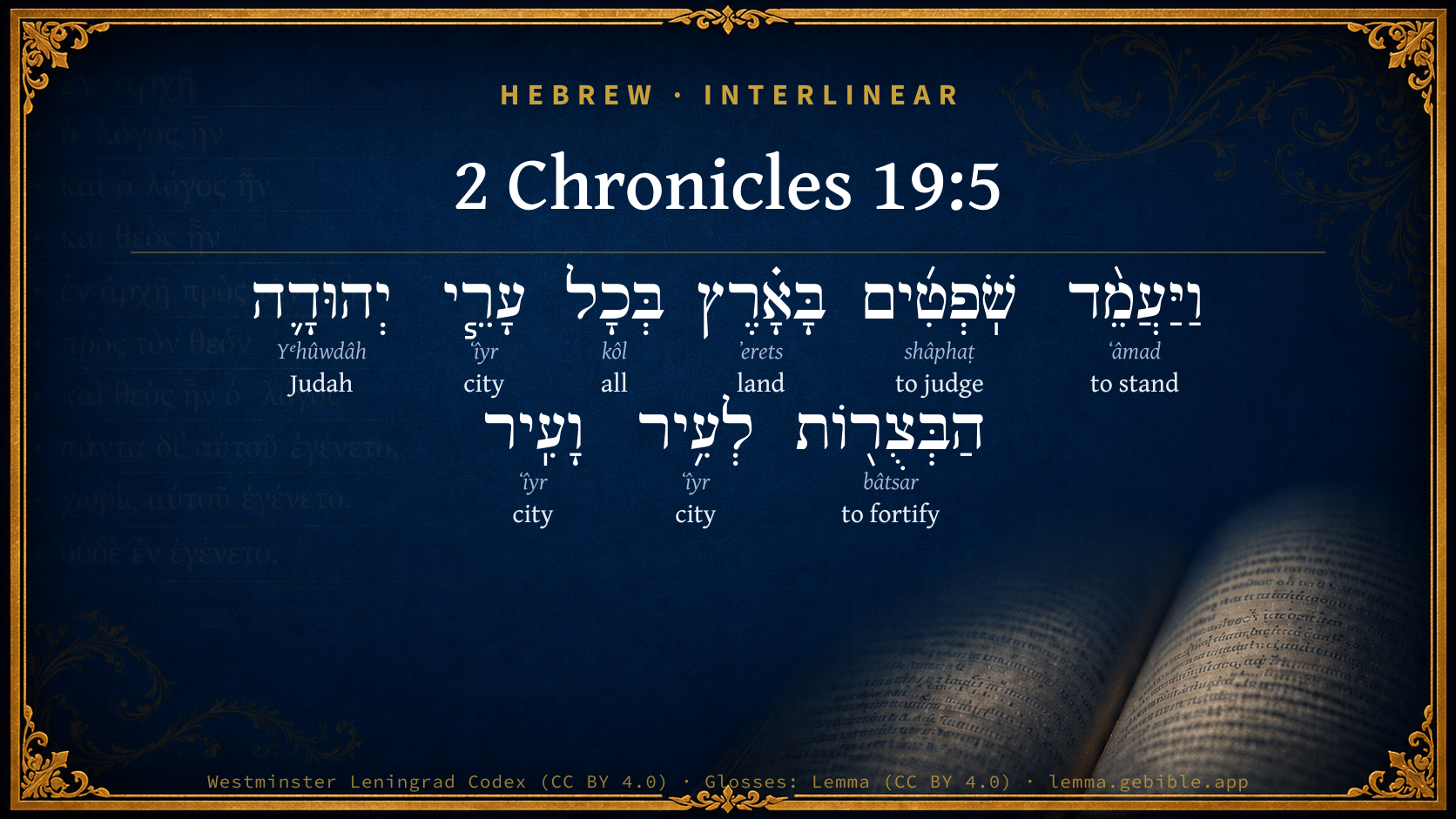
2 Chronicles 19:5

Hebrew (Westminster Leningrad Codex) 2 Chronicles 19:5 appears in the Hebrew Old Testament. The text above is from the Westminster Leningrad Codex. Each word links to its Strong’s number, a concise gloss, and parsing drawn from the Open Scriptures Hebrew Bible morphology. Click any word for its full Brown-Driver-Briggs (BDB) entry.
Download image
Cite this verse

2 Chronicles 19:5 (World English Bible). Public Domain. Lemma interlinear Bible study tool, https://lemma.gebible.app/v/2-chronicles/19/5.

Show BibTeX & RIS
BibTeX
RIS
English Translation
He set judges in the land throughout all the fortified cities of Judah, city by city,
World English Bible · Public Domain
Download a study sheet

One document with this verse’s original text, its word-by-word gloss line, the meaning frame, cross-references with their text, attributed commentary, and full source and license credits — printable, and it pastes into notes with its structure intact.

This verse Autodidact and up

Study sheet (.html) Plain text (.txt)

A passage Seminary Student

Up to 50 verses in one chapter. A passage sheet keeps up to 6 commentary sources and 12 cross-references per verse, in the order this page ranks them, and says so on the sheet whenever that leaves anything out. Ask for a single verse and you get the Autodidact verse sheet above.

Everything on this page stays free to read, with no account — the sheet is a download of what is already on screen, not access to it.

Want to remove ads? Support Godless Engineer
Compare translations 3

The same verse in 3 English versions, stacked beneath the original-language interlinear above. Click any original word for its lexicon entry.

Each is an independent rendering of the whole verse — the interlinear is not word-aligned to these translations.

Highlighted words mark where these versions differ — a whole-verse word diff, not a word-by-word alignment.

  • World English Bible Public Domain
    He set judges in the land throughout all the fortified cities of Judah, city by city,
  • King James Version Public Domain
    And he set judges in the land throughout all the fenced cities of Judah, city by city,
  • unfoldingWord Literal Text CC BY-SA 4.0
    And he appointed judges in the land in all the fortified cities of Judah, for city and city.

unfoldingWord Literal Text — © unfoldingWord, licensed CC BY-SA 4.0. Word-aligned USFM3 via Door43 (git.door43.org/unfoldingWord/en_ult).

Versions to compare (up to 4)

3 of 4 selected

Show all 18 translations

Every available English version of this verse, each an independent rendering of the whole verse.

  • World English Bible Public Domain
    He set judges in the land throughout all the fortified cities of Judah, city by city,
  • Berean Standard Bible Public Domain
    He appointed judges in the land, in each of the fortified cities of Judah.
  • Majority Standard Bible Public Domain
    He appointed judges in the land, in each of the fortified cities of Judah.
  • King James Version Public Domain
    And he set judges in the land throughout all the fenced cities of Judah, city by city,
  • American Standard Version (1901) Public Domain
    And he set judges in the land throughout all the fortified cities of Judah, city by city,
  • Revised Version (1885) Public Domain
    And he set judges in the land throughout all the fenced cities of Judah, city by city,
  • Geneva Bible (1599) Public Domain
    And hee set iudges in the lande throughout all the strong cities of Iudah, citie by citie,
  • Douay-Rheims (1899) Public Domain
    And he set judges of the land in all the fenced cities of Juda, in every place.
  • Young's Literal Translation Public Domain
    And he establisheth judges in the land, in all the fenced cities of Judah, for every city,
  • Literal Standard Version CC BY-SA 4.0
    And he establishes judges in the land, in all the fortified cities of Judah, for every city,
  • Unlocked Literal Bible CC BY-SA 4.0
    He placed judges in the land throughout all the fortified cities of Judah, city by city.
  • unfoldingWord Literal Text CC BY-SA 4.0
    And he appointed judges in the land in all the fortified cities of Judah, for city and city.
  • Darby Bible Public Domain
    And he set judges in the land throughout the fortified cities of Judah, city by city.
  • World Messianic Bible Public Domain
    He set judges in the land throughout all the fortified cities of Judah, city by city,
  • Webster's Bible Public Domain
    And he set judges in the land throughout all the fortified cities of Judah, city by city,
  • Free Bible Version CC BY-SA 4.0
    He appointed judges throughout the country, in all of the fortified towns of Judah.
  • Bible in Basic English Public Domain
    And he put judges through all the land, in every walled town of Judah,
  • JPS Tanakh (1917) Public Domain
    And he set judges in the land throughout all the fortified cities of Judah, city by city,

Literal Standard Version (2020), Covenant Press — licensed CC BY-SA 4.0. Text via the HelloAO Bible API (eBible.org). Unlocked Literal Bible (unfoldingWord) — licensed CC BY-SA 4.0. Text via the HelloAO Bible API (eBible.org). unfoldingWord Literal Text — © unfoldingWord, licensed CC BY-SA 4.0. Word-aligned USFM3 via Door43 (git.door43.org/unfoldingWord/en_ult). Free Bible Version, Dr. Jonathan Gallagher — licensed CC BY-SA 4.0. Text via the HelloAO Bible API (eBible.org).

Word by word

More ways to search: Search by grammar → Find every occurrence → Compare this word →

Practice this passage: Drill this verse → Learn its vocabulary →

הַבְּצֻר֖וֹת
bâtsar
H1219
“the · fortified”
Particle, Definite Article + Adjective, Adjective, Feminine, Plural, Absolute
Part of Speech
Particle + Adjective
Type
Adjective
Gender
Feminine
Number
Plural
State
Absolute
Full BDB Definition

Origin: a primitive root

TWOT: 270

to gather, restrain, fence, fortify, make inaccessible, enclose - (Qal) - to cut off - fortified, cut off, made inaccessible (passive participle) - secrets, mysteries, inaccessible things (substantive) - (Niphal) to be withheld - (Piel) to fortify
  1. וַיַּעֲמֵ֨ד ʻâmad H5975 “and · to stand” Conjunction + Verb, Hiphil, Sequential Imperfect, 3rd Person, Masculine, Singular
  2. שֹֽׁפְטִ֜ים shâphaṭ H8199 “judging” Verb, Qal, Participle Active, Masculine, Plural, Absolute
  3. בָּאָ֗רֶץ ʼerets H776 “in/at the · land” Preposition, Determined + Noun, Common, Both, Singular, Absolute
  4. בְּכָל kôl H3605 “in/at · all of” Preposition + Noun, Common, Masculine, Singular, Construct
  5. עָרֵ֧י ʻîyr H5892 “cities of” Noun, Common, Feminine, Plural, Construct
  6. יְהוּדָ֛ה Yᵉhûwdâh H3063 “Judah” Noun, Proper
  7. לְעִ֥יר ʻîyr H5892 “to/for · city” Preposition + Noun, Common, Feminine, Singular, Absolute
  8. וָעִֽיר ʻîyr H5892 “and · city” Conjunction + Noun, Common, Feminine, Singular, Absolute

About this verse

These counts appear in no published source. They are computed here, from the morphology-tagged text and Lemma’s own curated glosses. What Lemma adds →

9
words
7
distinct lemmas
Historical
section

Shared distinctive vocabulary

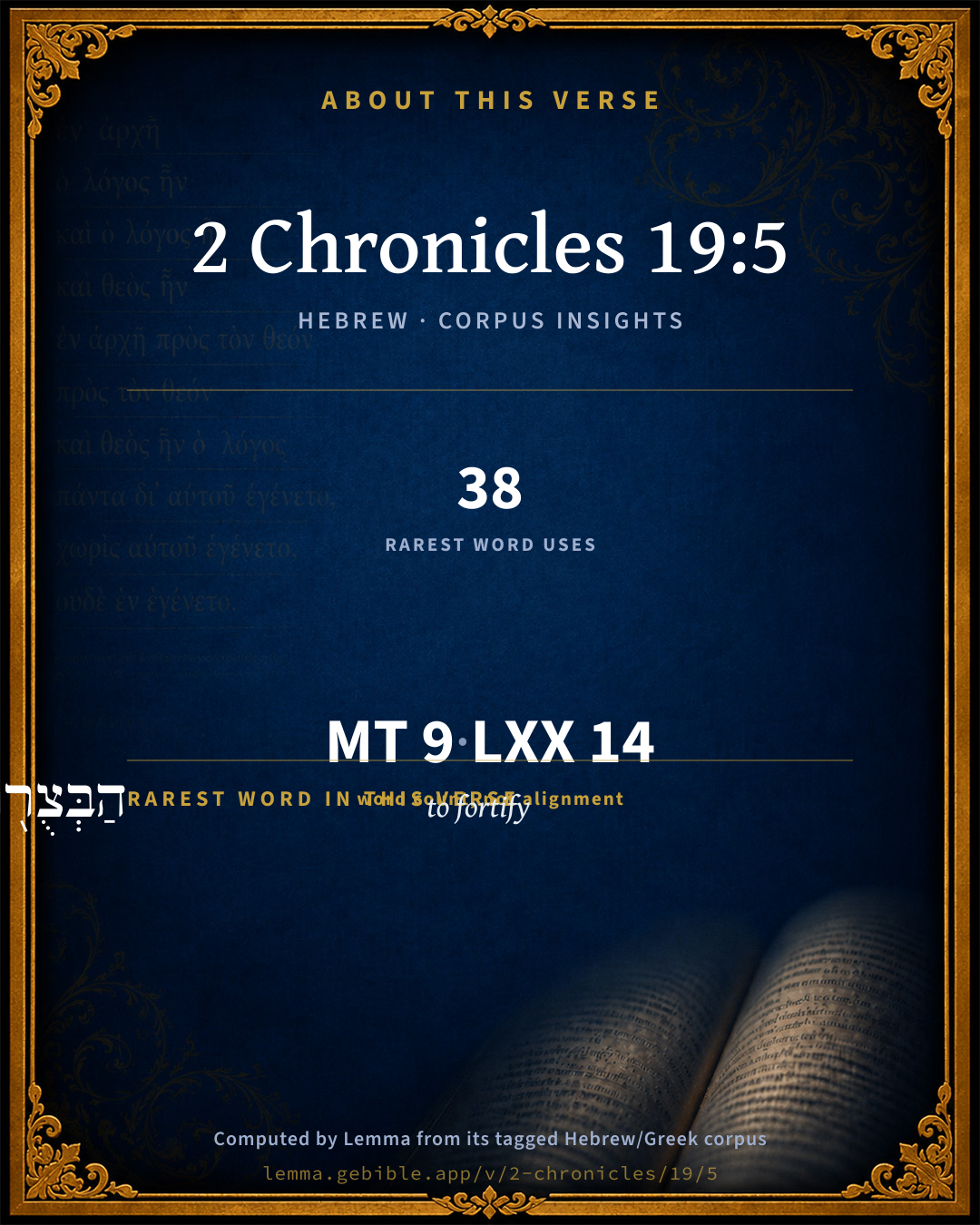
הַבְּצֻר֖וֹת to fortify H1219 occurs in 38 verses of the Hebrew Bible. Also found in:

Grammatical profile

  • 2 verbs
  • 6 nouns
  • 1 adjective

Verb forms

  • וַיַּעֲמֵ֨ד Hiphil · Sequential Imperfect
  • שֹֽׁפְטִ֜ים Qal · Participle Active

Repetition

A word recurs within this verse — often emphatic in Hebrew:

  • עָרֵ֧י city H5892 ×3

Hebrew & Septuagint length

In English translation the verse runs 16 words from the Hebrew and 14 from the Septuagint (LXX English) — closely comparable.

A rough comparison of the two English renderings, which tokenize alike — not a word-level alignment.

Word counts can differ between the Hebrew and the Greek without any difference in meaning — e.g. the Hebrew direct-object marker אֵת has no separate Greek word, and Greek often adds the article ὁ.

In the original languages it is 9 Hebrew tokens and 14 Greek tokens — but the two are counted differently (Hebrew bundles its prefixes and suffixes into one token; the Greek is in lemma form), so that isn’t a like-for-like length.

Cross-references

4

Topical passages linked to 2 Chronicles 19:5 in the Treasury of Scripture Knowledge — connected by theme and wording, ordered by reader-vote popularity; previews shown in the World English Bible.

  • Deuteronomy 16:18–20 Judges and officers shall you make you in all your gates, which Yahweh your God gives you, according to your tribes; and they shall judge the people with righteous judgment.
  • 2 Chronicles 19:8 Moreover in Jerusalem did Jehoshaphat set of the Levites and the priests, and of the heads of the fathers' [houses] of Israel, for the judgment of Yahweh, and for controversies. They returned to Jerusalem.
  • Romans 13:1–5 Let every soul be in subjection to the higher authorities, for there is no authority except from God, and those who exist are ordained by God.
  • 1 Peter 2:13–14 Therefore subject yourselves to every ordinance of man for the Lord's sake: whether to the king, as supreme;

Cross-references courtesy of OpenBible.info (CC BY 4.0).

Hebrew and Greek witnesses Masoretic Hebrew ↔ Greek Septuagint

The same verse in the two great witnesses to the Old Testament, shown verse-for-verse.

These are two independent witnesses, not word-aligned to each other, and the Septuagint is shown in lemma (dictionary) form.

Hebrew 2 Chronicles 19:5 Masoretic · Westminster Leningrad Codex

וַיַּעֲמֵ֨ד שֹֽׁפְטִ֜ים בָּאָ֗רֶץ בְּכָל עָרֵ֧י יְהוּדָ֛ה הַבְּצֻר֖וֹת לְעִ֥יר וָעִֽיר

He set judges in the land throughout all the fortified cities of Judah, city by city,

World English Bible · Public Domain

Greek LXX 2 Chronicles 19:5 Septuagint · lemma form

καί καταἵστημι κριτής ἐν πᾶς ὁ πόλις ἰουδά ὁ ὀχυρός ἐν πόλις καί πόλις

And he appointed judges in all the strong cities of Juda, city by city.

LXX2012 (modern English Septuagint) · Public Domain

Hebrew: Westminster Leningrad Codex (CC BY 4.0). Greek: Septuagint (public domain); English from LXX2012 (modern English Septuagint) (Public Domain). How the Septuagint differs from the Hebrew →

Commentary

Notes on 2 Chronicles 19:5 from classic Christian and Jewish commentators (each source and its license shown beneath its notes). The classic Christian expositions comment on the surrounding passage and are grouped to its opening verse, so a note may address several verses; the Jewish commentaries on the Tanakh (Rashi and others) are per-verse, so they appear only where the commentator wrote on this verse.

Lemma curates 59 commentaries, every one of them public domain or Creative Commons licensed, each selected and text-cleaned for this edition rather than reprinted as found. About our sources →

Matthew Henry's Commentary

Jehoshaphat, having done what he could to make his people good, is here providing, if possible, to keep them so by the influence of a settled magistracy. He had sent preachers among them, to instruct them (Ch2 17:7-9), and that provision did well; but now he saw it further requisite to send judges among them, to see the laws put in execution, and to be a terror to evil-doers. It is probable that there were judges up and down the country before, but either they neglected their business or the people slighted them, so that the end of the institution was not answered; and therefore it was necessary it should be new-modelled, new men employed, and a new charge given them. That is it which is here done.

I. He erected inferior courts of justice in the several cities of the kingdom, Ch2 19:5. The judges of these courts were to keep the people in the worship of God, to punish the violations of the law, and to decide controversies between man and man. Here is the charge he gave them (Ch2 19:6), in which we have,

1. The means he prescribes to them for the keeping of them closely to their duty; and these are two: - (1.) Great caution and circumspection: Take heed what you do, Ch2 19:6. And again, "Take heed and do it, Ch2 19:7. Mind your business; take heed of making any mistakes; be afraid of misunderstanding any point of law, or the matter of fact." Judges, of all men, have need to be cautious, because so much depends upon the correctness of their judgment. (2.) Great piety and religion: "Let the fear of God be upon you, and that will be a restraint upon you to keep you from doing wrong (Neh 5:15; Gen 42:18) and an engagement to you to be active in doing the duty of your place." Let destruction from God be a terror to them, as Job speaks (Job 31:23), and then they will be a terror to none but evil-doers.

2. The motives he would have them consider, to engage them to faithfulness. These are three, all taken from God: - (1.) That from him they had their commission; his ministers they were. The powers that be are ordained by him and for him: "You judge not for man, but for the Lord; your business is to glorify him, and serve the interests of his kingdom among men." (2.) That his eye was upon them: "He is with you in the judgment, to take notice what you do and call you to an account if you do amiss." (3.) That he is the great example of justice to all magistrates: There is no iniquity with him, no bribery, nor respect of persons. Magistrates are called gods, and therefore must endeavour to resemble him.

II. He erected a supreme court at Jerusalem, which was advised with, and appealed to, in all the difficult causes that occurred in the inferior courts, and which gave judgment upon demurrers (to speak in the language of our own law), special verdicts, and writs of error. This court sat in Jerusalem; for there were set the thrones of judgment: there they would be under the inspection of the king himself. Observe,

1. The causes cognizable in this court; and they were of two kinds, as with us: - (1.) Pleas of the crown, called here the judgment of the Lord, because the law of God was the law of the realm. All criminals were charged with the breach of some part of his law and were said to offend against his peace, his crown and dignity. (2.) Common pleas, between party and party, called here controversies (Ch2 19:8) and causes of their brethren (Ch2 19:10), differences between blood and blood (this refers to Deu 17:8), between the blood of the person slain and the blood of the man-slayer. Since the revolt of the ten tribes all the cities of refuge, except Hebron, belonged to the kingdom of Israel; and therefore, we may suppose, the courts of the temple, or the horns of the altar, were chiefly used as sanctuaries in that case, and hence the trial of homicides was reserved for the court at Jerusalem. If the inferior judges did not agree about the sense of any law or commandment, any statute or judgment, this court must determine the controversy.

2. The judges of this court were some of the Levites and priests that were most learned in the law, eminent for wisdom, and of approved integrity, and some of the chief of the fathers of Israel, peers of the realm, as I may call them, or persons of age and experience, that had been men of business, who would be the most competent judges of matters of fact, as the priests and Levites were of the sense of the law.

3. The two chiefs, or presidents, of this court. Amariah, the high priest, was to preside in ecclesiastical causes, to direct the court and be the mouth of it, or perhaps to be last consulted in cases which the judges themselves doubted of. Zebadiah, the prime-minister of that state, was to preside in all civil causes, Ch2 19:11. Thus there are diversities of gifts and operations, but all from the same Spirit, and for the good of the body. Some best understand the matters of the Lord, others the king's matters; neither can say to the other, I have no need of thee, for God's Israel has need of both; and, as every one has received the gift, so let him minister the same. Blessed be God both for magistrates and ministers, scribes and statesmen, men of books and men of business.

4. The inferior officers of the court. "Some of the Levites (such as had not abilities to qualify them for judges) shall be officers before you," Ch2 19:11. They were to bring causes into the court, and to see the sentence of the judges executed. And these hands and feet were as necessary in their places as the eyes and heads (the judges) in theirs.

5. The charge which the king gave them. (1.) They must see to it that they acted from a good principle; they must do all in the fear of the Lord, setting him always before them, and then they would act faithfully, conscientiously, and with a perfect upright heart, Ch2 19:9. (2.) They must make it their great and constant care to prevent sin, to warn the people that they trespass not against the Lord, inspire them with a dread of sin, not only as hurtful to themselves and the public peace, but as an offence to God, and that which would bring wrath upon the people if they committed it and upon the magistrates if they did not punish it. "This do, and you shall not trespass;" this implies that those who have power in their hands contract the guilt of sin themselves if they do not use their power for the preventing and restraining of sin in others. "You trespass if you do not keep them from trespassing." (3.) They must act with resolution. "Deal courageously, and fear not the face of man; be bold and daring in the discharge of your duty, and, whoever is against you, God will protect you: The Lord shall be with the good." Wherever he finds a good man, a good magistrate, he will be found a good God.

Matthew Henry's Commentary on the Whole Bible (1708–1710) — public domain (CC PDM 1.0). Text via the HelloAO Bible API.

Jamieson, Fausset & Brown

Robert Jamieson, A. R. Fausset & David Brown

HIS INSTRUCTIONS TO THE JUDGES. (Ch2 19:5-7)

he set judges in the land--There had been judicial courts established at an early period. But Jehoshaphat was the first king who modified these institutions according to the circumstances of the now fragmentary kingdom of Judah. He fixed local courts in each of the fortified cities, these being the provincial capitals of every district (see on Deu 16:18).

Jamieson, Fausset & Brown — Commentary Critical and Explanatory on the Whole Bible (1871) — public domain (CC PDM 1.0). Text via the HelloAO Bible API.

Trapp's Complete Commentary

John Trapp

2Ch 19:5 And he set judges in the land throughout all the fenced cities of Judah, city by city,

Ver. 5. And he set judges in the land.] Judges they had before; but some of them, haply, fell in the late war with the Syrians, or were otherwise wanting to their places and duties. It is a mercy to have judges, modo audeant quae sentiunt, saith the orator, {a} so they be as they should be.

Throughout all the fenced cities.] Lest soldiers should abuse their power unto violence and wrong, as they are apt to do. {Luk 3:14}

{a} Cic., pro Milone.

John Trapp, A Commentary or Exposition upon All the Books of the Old and New Testament (1647–1656) — public domain. Text from a community e-Sword module.

The Biblical Illustrator

Joseph S. Exell

2Ch_19:5-11

And he set Judges in the land.

Good government should be the result of piety in rulers

Alfred the Great was a distinguished statesman and warrior, as well as zealous for true religion. St. Louis of France exercised a wise control over Church and State. On the other hand, Charlemagnes successor, the Emperor Louis the Pious, and our own Kings Edward the Confessor and the saintly Henry VI were alike feeble and inefficient; the zeal of the Spanish kings and their kinswoman, Mary Tudor, is chiefly remembered for its ghastly cruelty; and in comparatively modem times the misgovernment of the States of the Church was a byword throughout Europe. Many causes combined to produce this mingled record. The one most clearly contrary to the chroniclers teaching was an immoral opinion that the Christian should cease to be a citizen, and that the saint has no duties to society. This view is often considered to be the special vice of monasticism, but it reappears in one form or another in every generation. In our own day there are those who think that a newspaper should have no interest for a really earnest Christian. According to their ideas, Jehoshaphat should have divided his time between a private oratory in his palace and the public services of the temple, and have left his kingdom to the mercy of unjust judges at home and heathen enemies abroad, or else have abdicated in favour of some kinsmen whose heart was not so perfect with Jehovah. (W. H. Bennett, M.A.)

The origin and right of human judicature

The administration is for the Lord.

I. The power of the judgment is Gods right.

II. The matter of the judgment is Gods cause.

III. The issue of the judgment is Gods end. Is with you in the judgment. (Dean Young.)

The Biblical Illustrator, edited by Joseph S. Exell (c. 1880s–1900s) — public domain. Text from a community e-Sword module.

Joseph Benson's Commentary

2Ch 19:5-6. He set judges in the land, city by city — In every city, for itself and the country adjacent, that justice might be administered with the most ease and convenience to the people, and they might not all be forced to go up to Jerusalem. And said to the judges, Take heed, &c. — Mind your business; take heed of making any mistakes; be afraid of misunderstanding any point of law, or the matter of fact. Judges, of all men, have need to be cautious, because so much depends on their understanding a matter right. For ye judge not for man, but for the Lord — You represent God’s person, to whom judgment belongeth; you have your commission from God, and not from man only; and your administration of justice is not only for man’s good, but also for God’s honour and service. Who is with you in judgment — Both to observe your carriage, and to defend you against all those enemies whom the impartial exercise of justice may provoke.

Joseph Benson's Commentary on the Old and New Testaments (1811–1818) — public domain. Text from a community e-Sword module.

Ellicott's Commentary for English Readers

(5) And he set.—Appointed, or stationed.

The fenced cities.—As being the chief centres of each district.

City by city.—For every city, according to the Law, Deu_16:18, “in all thy gates.” (Comp. 1Ch_23:4; 1Ch_26:29.) The judges would be Levites, and probably also priests and family chiefs, as in the case of Jerusalem (2Ch_19:8).

A Bible Commentary for English Readers, edited by Charles John Ellicott (1878–1897) — public domain. Text from a community e-Sword module.

The Cambridge Bible for Schools and Colleges

gen. ed. J. J. S. Perowne

5. and he set judges] Cp. 2Ch_19:11 “also the Levites shall be officers”; and Deu_16:18 “judges and officers shalt thou make thee in all thy gates.”

In the earliest days justice was administered in Israel, as among the Bedouin of to-day, probably by all heads of families and (in difficult cases) by the one head who was distinguished above the rest for impartiality and for knowledge of tribal custom. In later days when Israel was settled in Canaan the “elders of the cities” and the “elders of the priests” exercised the same functions.

Jehoshaphat’s measures were twofold, (1) to establish judges throughout the cities of Judah, (2) to establish (in accordance with Deu_17:8 ff.) a kind of court of appeal in Jerusalem itself.

As to the first measure no doubt the work consisted in removing evil judges and confirming the good in their office, rather than in appointing judges for the first time. The second measure, however, was probably altogether new; David (2Sa_14:4 ff; 2Sa_15:3) and Solomon (1Ki_3:16) had kept judgment in their own hands. The prominent position assigned to the priests as judges is in accordance with Deu_17:9; Deu_19:17.

The Cambridge Bible for Schools and Colleges (gen. ed. J. J. S. Perowne; Cambridge University Press, 1878–1918) — public domain. Text from a community e-Sword module.

John Gill's Exposition

And he set judges in the land throughout all the fenced cities of Judah, city by city,.... Inferior judges in lesser courts of judicature than that at Jerusalem, and that in every city, that judgment and justice might be executed everywhere; such were appointed by David, but had been neglected, and now restored, see Ch1 26:29.

.

2 Chronicles 19:6

ch2 19:6

ch2 19:6

ch2 19:6And said to the judges, take heed what you do,.... In judgment, that they judged righteous judgment according to the law of God, without partiality and respect of persons:

for ye judge not for man, but for the Lord; not for man only, but for the Lord; and not so much for man as for the Lord, whom they represented in judgment; whose law was the rule of their judgment, and whose glory their end, and to whom they were accountable:

who is with you in the judgment: as to guide and direct you, so to observe how they behaved, and be a witness for or against them; the Targum is,"ye judge not before men, but before the Word of the Lord, whose Shechinah dwells with you in the affair of judgment.''

John Gill's Exposition of the Whole Bible (1746–1763) — public domain (CC PDM 1.0). Text via the HelloAO Bible API.

Albert Barnes' Notes on the Bible

What exact change Jehoshaphat made in the judicial system of Judah Deu 16:18; 1Ch 23:4, it is impossible to determine. Probably he found corruption widely spread 2Ch 19:7, and the magistrates in some places tainted with the prevailing idolatry. He therefore made a fresh appointment of judges throughout the whole country; concentrating judicial authority in the hands of a few, or creating superior courts in the chief towns (“fenced cities”), with a right of appeal to such courts from the village judge.

Albert Barnes' Notes on the Bible (1834–1885) — public domain. Text from a community e-Sword/MySword module.

Matthew Poole's English Annotations

In every city, for itself and the country adjacent, that justice might be administered with the most ease and convenience to the people, and they might not all be forced to go up to Jerusalem.

Matthew Poole's English Annotations on the Holy Bible (1683–1685) — public domain. Text from a community e-Sword/MySword module.

Whedon's Commentary on the Bible

Daniel D. Whedon

5. Set judges in the land… city by city — Appointed local magistrates in all the principal cities to attend to the administration of justice, according to the directions of the law. Deu_16:18-20. Probably Jehoshaphat discovered irregularities and wrongs in the administration of justice, such as respect of persons, and taking of bribes, (2Ch_19:7,) and he accordingly undertook an extensive reform in the matter, and solemnly charged his newly-appointed judges to exercise their office in the fear of Jehovah.

Daniel D. Whedon (gen. ed.), Commentary on the Old and New Testaments (1874–1909) — public domain. Text from a community e-Sword module.

The Pulpit Commentary

Judges fenced cities. Jehoshaphat proceeds from direct religious reforms to that which is of importance only second in the life of a nation reform in the matter of civil administration of justice. The skeleton here given of what should be the character of a judge, and why, harmonizes well with the uniform stress laid in Scripture upon "justice and judgment." It is hard indeed to see, rather impossible, upon what foundation a sure structure of civil growth and stability can be laid, except on that of positive religion. Note the positions and the succinct arguments of vers. 6, 7; and how unequivocally they are based upon faith in a personal God, and upon his revealed character. It can scarcely be that this was the first time of judges being set in the cities of Judah but possibly the meaning intended to be conveyed with emphasis is, that now, looking well round his kingdom, he took care that all the cities should be properly provided with the necessary judges, while of late some had been, and some had not, and some, though they had been officered with judges, had found them not what judges ought to be. The immense majority of the "six thousand" Levite "officers and judges" of David"s regulation (1Ch_23:4) had, with their superiors, kings and prophets, gone astray. With our present passage may be compared; Deu_16:18-20, where the original enactment of judges and officers is narrated. Fenced cities. Hebrew for "fenced," twOrxuB kal passive part. plur. The word occurs twenty-six times from the Book of Numbers to the Book of the Prophet Zechariah, and is rendered in the Authorized Version "fenced" or "defenced" twenty-two times, "walled" twice, "strong" once, and "mighty" once. The "gates" of the original institution in Deuteronomy are now (probably still the gates of) fenced cities.

Vers. 5-9.

Ennobling the earthly, or making sacred the secular.

Jehoshaphat made his reign over Judah a continuous act of Divine service. For while that reign was not without blemish and mistake, the king was evidently ruling "in the fear of the Lord," and was trying to bring his people into willing and loyal subjection to their Divine Sovereign. In taking the measure be now took he acted with great intelligence. For nothing would be so likely to lead the people to discontentment and rebellion against the existing order as a sense of prevailing injustice, of wrongs unredressed, of rights that could not be realized; nothing, on the other hand, was so fitted to infuse a spirit of loyalty to the administration and to Jehovah himself as a well-regulated system of justice, extending over the whole land. The piety which Jehoshaphat was thus illustrating he exemplified in detail by giving the instructions he delivered to the judges (vers. 6, 7, 9, 10). In these he showed that the ordinary act of judgment in secular matters might and should be made a true and sacred service rendered unto God, an act of piety. For he charged them to do everything in their courts, as we should do everything in our homes and in our houses of businessI UNTO THE LORD. They were to do all "in the fear of the Lord" (ver. 9); they were to judge "not for man, but for the Lord" (ver. 6). This is an anticipation of the instruction given by Paul in his letter to the Church at Colosse, where he bids the slaves serve their masters "not with eye-service, as men-pleasers; but in singleness of heart, fearing God;" whatsoever they do, doing it "heartily, as to the Lord, and not unto men". (Col_3:22, Col_3:23) There is nothing in which we are engaged, of the humblest kind and in the lowliest sphere, which we may not do and which we should not do "for the Lord" or "unto the Lord," by acting "faithfully and with a perfect heart," in such wise as we are assured he will approve, and with the distinct view of pleasing and honouring him; thus doing we "make drudgery Divine," as George Herbert tells us.

II WITH HIS FELT PRESENCE AND HIS DIVINE AID. The Lord "is with you in the judgment" (ver. 6); "the Lord shall be with the good" (ver. 11). If we can but feel that God is "with us," that our Divine Master is by our side, with his sympathizing and sustaining presence, then we are satisfied, then we are strong. The position we occupy may be very humble, the situation may be a lonely or a perilous one, the opponents may be numerous and their opposition may be severe, the duties may be very onerous; but Christ is with us, his smile is upon us, his arm is working with us and for us, his reward is in his hand; we will go happily and cheerily on our way.

III IN HIS OWN WAY. "For there is no iniquity with the Lord our God" etc. (ver. 7). They were to judge even as God himself did, in the same spirit and on the same principles; as impartially, as righteously, as he did. And our Lord calls upon us to elevate our earthly life, to make every part of it sacred and noble, by introducing into everything the spirit and the principles which are Divine. "Be ye perfect," he says, "even as your Father in heaven is perfect, "Be ye holy, for I am holy;" "As I have loved you, that ye also love one another;" "Follow thou me." It is, indeed, a very excellent and positively invaluable enlargement and ennoblement of this human life that every hour and every act of it may be spent and wrought as God is spending his eternity and is ruling in his Divine domain. The very same principles of purity, righteousness, and equity, the very same spirit of unselfishness and love, of gentleness and considerateness, which he displays in his government of the universe, we may be manifesting in the lowliest paths in which we walk from day to day. As he is, so may we be. His life we may be living. There need be nothing mean or small about us, for we may be everywhere and in everything "the children of our Father who is in heaven". (Mat_5:45) In every walk of life we may be closely following Christ. C.

The Pulpit Commentary (1880–1919), ed. H.D.M. Spence-Jones & Joseph S. Exell — public domain. Text from a community e-Sword module.

Kretzmann's Popular Commentary

Paul E. Kretzmann

Judges and Levites in Judah

v. 5. And he set judges in the land throughout all the fenced cities of Judah, Cf Deu 16:18-20, establishing local courts in every fortified city, after the manner of our county seats with their court-houses, city by city,

v. 6. and said to the judges, in reminding them of the instructions as given by the Lord, Take heed what ye do; for ye judge not for man, but for the Lord, whose representatives they were in the work of their office, who is with you in the judgment, in the matter of passing judicial decisions, of pronouncing sentence.

v. 7. Wherefore, now, let the fear of the Lord be upon you, keep them in the way of justice. Take heed and do it; for there is no iniquity with the Lord, our God, He Himself is never guilty of injustice, nor respect of persons, nor taking of gifts, to pervert the way of justice. These facts were intended to make the judges most carefully conscientious in all their work, in every decision, whether it concerned a very minor matter or a great and important sentence. It would be well and fortunate if judges everywhere would keep this ideal in mind and act accordingly.

v. 8. Moreover, in Jerusalem did Jehoshaphat set of the Levites and of the priests and of the chief of the fathers of Israel for the judgment of the Lord, for the adjudication of very difficult matters, and for controversies, when they returned to Jerusalem, when a case was appealed from a lower court. These men constituted a supreme court of the Jews, and they had jurisdiction first over all matters pertaining to the religion of the land, and then also in all civil and criminal cases.

v. 9. And he charged them, saying, Thus shall ye do in the fear of the Lord, which should be the motive in all acts of the believers, faithfully, and with a perfect heart, one given to the Lord in undivided loyalty.

v. 10. And what cause soever shall come to you of your brethren that dwell in their cities, being appealed to this highest tribunal, between blood and blood, in cases involving murder and bloodshed, between law and commandment, statutes and judgments, in any dispute concerning the meaning or application of any precepts or instructions contained in the Book of the Law, ye shall even warn them that they trespass not against the Lord, and so wrath come upon you and upon your brethren, the entire people being held responsible for the transgressions of individuals if the matter were not righted in time. This do, and ye shall not trespass.

v. 11. And, behold, Amariah, the chief priest, is over you in all matters of the Lord, he had the final decision in all religious questions; and Zebadiah, the son of Ishmael, the ruler of the house of Judah, for all the king’s matters, in all civil questions; also the Levites shall be officers before you, in the tasks assigned to them in the Temple, 1Ch 23:4; 1Ch 26:29. Deal courageously, taking up the matter with all cheerful courage, as they had been bidden to do, and the Lord shall be with the good, with all the judges who would discharge the work of their office in accordance with His will. Mark: If a believer has blundered into error and sin, he should lose no time in returning to the Lord and in serving Him with all diligence. In that case the evil which he has committed will be forgotten.

Paul E. Kretzmann, Popular Commentary of the Bible (1921–1924) — public domain. Text from a community e-Sword module.

Rashi

Rabbi Shlomo Yitzchaki (Rashi)

And he appointed judges When the seer told him, “good things were found in you, for you abolished the asheroth,” he approached the Sepher Torah [to see] whether he had abolished them properly. He first saw that it was written (Deut. 12:2f.): “You shall utterly destroy...and you shall burn their asherim with fire and cut down the images of their gods,” and he remembered that it is written in כִּי תִשָׂא (Exod. 34:13): “And you shall break down their monuments, etc.” He wondered why he had pleased the Lord by abolishing the asherim, the Jewish asherim, for [the Torah] only warned about their asherim. He went back to [the Torah portion] (Deut. 16:18): “Judges and law enforcing agents,” and found written (verse 21): “You shall not plant an asherah.” Then he rejoiced that he had abolished them. He also saw written there: “Judges and law enforcing agents you shall appoint for yourself,” and immediately “he appointed judges,” strong ones.

in all the fortified cities of Judah, for every city He first appointed strong [judges] in all the fortified cities of Judah to coerce them [the people] and compel them to [accept] judgment. He later appointed judges who were not as strong for the cities that were not fortified, for they [the inhabitants] were more afraid to rebel than those who dwelt in the fortified cities, for they felt secure in their fortified cities.

Rashi on the Tanakh — English translations: “The Judaica Press complete Tanach with Rashi, translated by A. J. Rosenberg” (CC BY 4.0); “Pentateuch with Rashi's commentary by M. Rosenbaum and A.M. Silbermann, 1929-1934” (public domain); “The Metsudah Tanach series, Lakewood, N.J” (CC BY 4.0); and “The Book of Joshua, Metsudah Publications, 1997” (CC BY 4.0). Text via Sefaria.

Lesson kit

Teaching starters — assembled from the data on this page, not authored interpretation. Every prompt links to the verse data it draws on. Edit before teaching.

2 Chronicles, in the Historical, opens this verse with 9 words (7 distinct Hebrew lemmas). Its most distinctive word is bâtsar (“to fortify”). A historical commentator’s framing appears above. Read the whole chapter for the surrounding context.

Discussion questions

  1. What does “to fortify” (bâtsar) contribute to the verse as a whole?
  2. How does Genesis 11:6, which shares the word «to fortify», read alongside this verse?
  3. What does the repetition of “city” (3× in this one verse) do in this verse?
  4. These translations render this verse differently; the difference is in the English rendering, not the original. What questions does that raise?
  5. «וַיַּעֲמֵ֨ד» is a Hiphil Sequential Imperfect verb. How does that grammatical form shape the action described?
  6. Compare how Matthew Henry's Commentary and Jamieson, Fausset & Brown read this verse. Where do they agree or differ?

Things to notice

Reading settings

Reading text

Shown beneath each verse's original-language words.

Old Testament
Old Testament edition

Read the OT as the Masoretic Hebrew (MT) or the Greek Septuagint (LXX).

English shown for the Greek Septuagint (in the Hebrew ↔ Greek comparison).

Comparing translations? Open the Compare panel on any verse page to stack up to four side by side.