
2 Samuel 18:31

Hebrew (Westminster Leningrad Codex) 2 Samuel 18:31 appears in the Hebrew Old Testament. The text above is from the Westminster Leningrad Codex. Each word links to its Strong’s number, a concise gloss, and parsing drawn from the Open Scriptures Hebrew Bible morphology. Click any word for its full Brown-Driver-Briggs (BDB) entry.
Download image
Cite this verse

2 Samuel 18:31 (World English Bible). Public Domain. Lemma interlinear Bible study tool, https://lemma.gebible.app/v/2-samuel/18/31.

Show BibTeX & RIS
BibTeX
RIS
English Translation
Behold, the Cushite came; and the Cushite said, News for my lord the king; for Yahweh has avenged you this day of all those who rose up against you.
World English Bible · Public Domain
Download a study sheet

One document with this verse’s original text, its word-by-word gloss line, the meaning frame, cross-references with their text, attributed commentary, and full source and license credits — printable, and it pastes into notes with its structure intact.

This verse Autodidact and up

Study sheet (.html) Plain text (.txt)

A passage Seminary Student

Up to 50 verses in one chapter. A passage sheet keeps up to 6 commentary sources and 12 cross-references per verse, in the order this page ranks them, and says so on the sheet whenever that leaves anything out. Ask for a single verse and you get the Autodidact verse sheet above.

Everything on this page stays free to read, with no account — the sheet is a download of what is already on screen, not access to it.

Want to remove ads? Support Godless Engineer
Compare translations 3

The same verse in 3 English versions, stacked beneath the original-language interlinear above. Click any original word for its lexicon entry.

Each is an independent rendering of the whole verse — the interlinear is not word-aligned to these translations.

Highlighted words mark where these versions differ — a whole-verse word diff, not a word-by-word alignment.

  • World English Bible Public Domain
    Behold, the Cushite came; and the Cushite said, News for my lord the king; for Yahweh has avenged you this day of all those who rose up against you.
  • King James Version Public Domain
    And, behold, Cushy came; and Cushy said, Tidings, my lord the king: for the LORD hath avenged thee this day of all them that rose up against thee.
  • unfoldingWord Literal Text CC BY-SA 4.0
    And behold, the Cushite came. And the Cushite said, “May my lord the king receive the good news that Yahweh has judged you today out of the hand of all of the ones having arisen against you.”

unfoldingWord Literal Text — © unfoldingWord, licensed CC BY-SA 4.0. Word-aligned USFM3 via Door43 (git.door43.org/unfoldingWord/en_ult).

Versions to compare (up to 4)

3 of 4 selected

Show all 18 translations

Every available English version of this verse, each an independent rendering of the whole verse.

  • World English Bible Public Domain
    Behold, the Cushite came; and the Cushite said, News for my lord the king; for Yahweh has avenged you this day of all those who rose up against you.
  • Berean Standard Bible Public Domain
    Just then the Cushite came and said, “May my lord the king hear the good news: Today the LORD has avenged you of all who rose up against you!”
  • Majority Standard Bible Public Domain
    Just then the Cushite came and said, “May my lord the king hear the good news: Today the LORD has avenged you of all who rose up against you!”
  • King James Version Public Domain
    And, behold, Cushy came; and Cushy said, Tidings, my lord the king: for the LORD hath avenged thee this day of all them that rose up against thee.
  • American Standard Version (1901) Public Domain
    And, behold, the Cushite came; and the Cushite said, Tidings for my lord the king; for Jehovah hath avenged thee this day of all them that rose up against thee.
  • Revised Version (1885) Public Domain
    And, behold, the Cushite came; and the Cushite said, Tidings for my lord the king: for the LORD hath avenged thee this day of all them that rose up against thee.
  • Geneva Bible (1599) Public Domain
    And beholde, Cushi came, and Cushi saide, Tidings, my lorde the King: for the Lord hath deliuered thee this day out of the hande of all that rose against thee.
  • Douay-Rheims (1899) Public Domain
    And when he bad passed, and stood still, Chusai appeared: and coming up he said: I bring good tidings, my lord, the king, for the Lord hath judged for thee this day from the hand of all that have risen up against thee.
  • Young's Literal Translation Public Domain
    And lo, the Cushite hath come, and the Cushite saith, `Let tidings be proclaimed, my lord, O king; for Jehovah hath delivered thee to-day out of the hand of all those rising up against thee.'
  • Literal Standard Version CC BY-SA 4.0
    And behold, the Cushite has come, and the Cushite says, “Let tidings be proclaimed, my lord, O king; for today YHWH has delivered you out of the hand of all those rising up against you.”
  • Unlocked Literal Bible CC BY-SA 4.0
    Immediately then the Cushite arrived and said, “There is good news for my master the king, for Yahweh has avenged you today from all who rose up against you.”
  • unfoldingWord Literal Text CC BY-SA 4.0
    And behold, the Cushite came. And the Cushite said, “May my lord the king receive the good news that Yahweh has judged you today out of the hand of all of the ones having arisen against you.”
  • Darby Bible Public Domain
    And behold, the Cushite came; and the Cushite said, Let my lord the king receive good tidings, for Jehovah has avenged thee this day of all them that rose up against thee.
  • World Messianic Bible Public Domain
    Behold, the Cushite came. The Cushite said, “Good news for my lord the king, for the LORD has avenged you today of all those who rose up against you.”
  • Webster's Bible Public Domain
    And behold, Cushi came; and Cushi said, Tidings, my lord the king: for the LORD hath avenged thee this day of all them that rose up against thee.
  • Free Bible Version CC BY-SA 4.0
    Right then the Ethiopian arrived and said, “Your Majesty, listen to the good news! Today the Lord has defeated all those who rebelled against you!”
  • Bible in Basic English Public Domain
    And then the Cushite came and said, I have news for my lord the king: today the Lord has done right in your cause against all those who took up arms against you.
  • JPS Tanakh (1917) Public Domain
    And, behold, the Cushite came; and the Cushite said: 'Tidings for my lord the king; for the LORD hath avenged thee this day of all them that rose up against thee.'

Literal Standard Version (2020), Covenant Press — licensed CC BY-SA 4.0. Text via the HelloAO Bible API (eBible.org). Unlocked Literal Bible (unfoldingWord) — licensed CC BY-SA 4.0. Text via the HelloAO Bible API (eBible.org). unfoldingWord Literal Text — © unfoldingWord, licensed CC BY-SA 4.0. Word-aligned USFM3 via Door43 (git.door43.org/unfoldingWord/en_ult). Free Bible Version, Dr. Jonathan Gallagher — licensed CC BY-SA 4.0. Text via the HelloAO Bible API (eBible.org).

Word by word

More ways to search: Search by grammar → Find every occurrence → Compare this word →

Practice this passage: Drill this verse → Learn its vocabulary →

הַכּוּשִׁ֖י
Kûwshîy
H3569
“the · Cushite”
Particle, Definite Article + Noun, Gentilic, Masculine, Singular, Absolute
Part of Speech
Particle + Noun
Type
Gentilic
Gender
Masculine
Number
Singular
State
Absolute
Full BDB Definition

Origin: patronymically from H3568

TWOT: 969a

Cushi or Ethiopian = see Cushan " their blackness" - one of the descendants of Cush the grandson of Noah through Ham and a member of that nation or people - one of Joab's couriers - (TWOT) Ethiopian
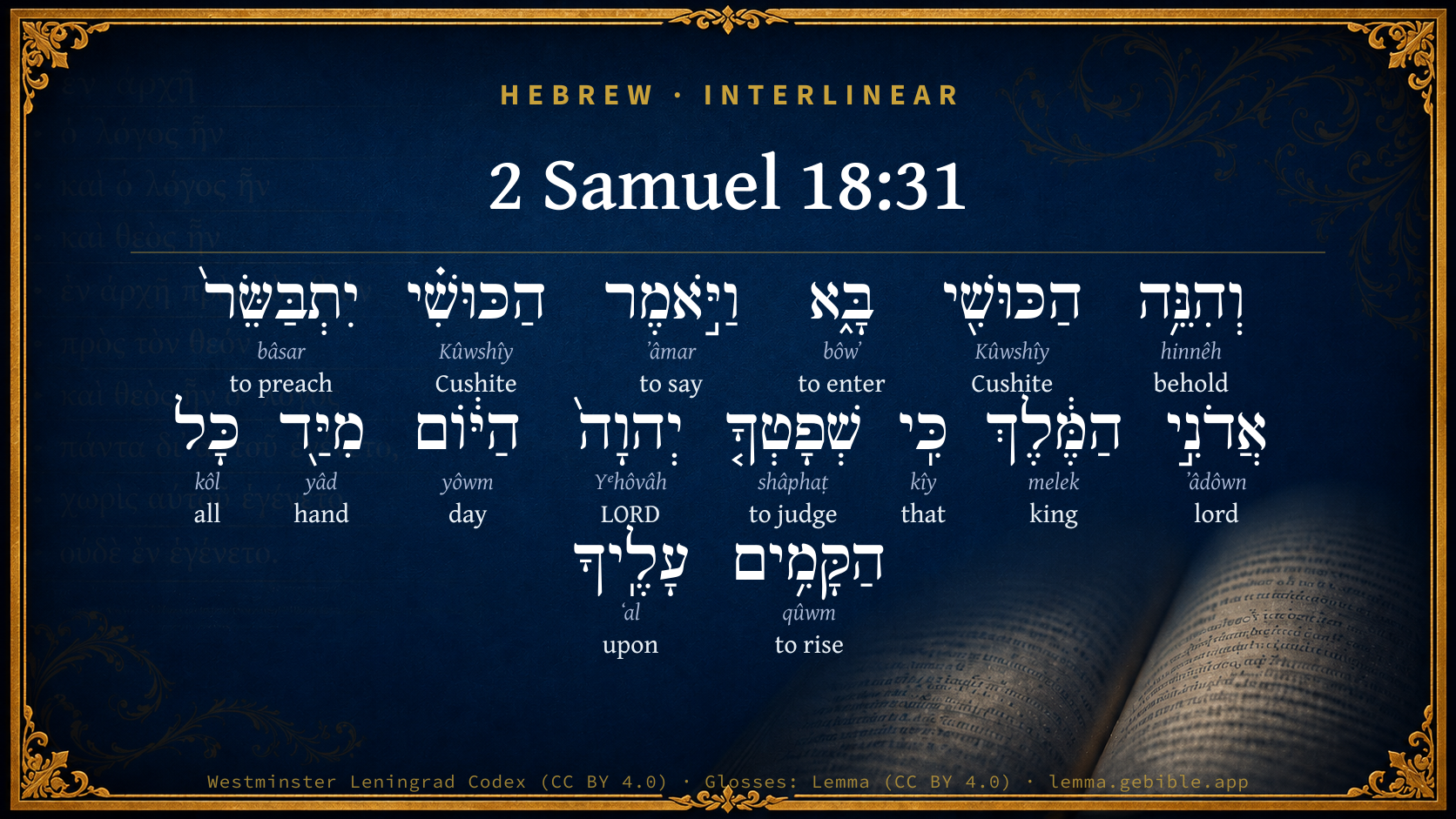
  1. וְהִנֵּ֥ה hinnêh H2009 “and · behold” Conjunction + Particle, Demonstrative
  2. בָּ֑א bôwʼ H935 “to enter” Verb, Qal, Perfect, 3rd Person, Masculine, Singular
  3. וַיֹּ֣אמֶר ʼâmar H559 “and · to say” Conjunction + Verb, Qal, Sequential Imperfect, 3rd Person, Masculine, Singular
  4. הַכּוּשִׁ֗י Kûwshîy H3569 “the · Cushite” Particle, Definite Article + Noun, Gentilic, Masculine, Singular, Absolute
  5. יִתְבַּשֵּׂר֙ bâsar H1319 “to preach” Verb, Hithpael, Imperfect, 3rd Person, Masculine, Singular
  6. אֲדֹנִ֣י ʼâdôwn H113 “lord · my” Noun, Common, Masculine, Singular, Construct + Suffix, Personal, 1st Person, Common, Singular
  7. הַמֶּ֔לֶךְ melek H4428 “the · king” Particle, Definite Article + Noun, Common, Masculine, Singular, Absolute
  8. כִּֽי kîy H3588 “that” Conjunction
  9. שְׁפָטְךָ֤ shâphaṭ H8199 “to judge · you” Verb, Qal, Perfect, 3rd Person, Masculine, Singular + Suffix, Personal, 2nd Person, Masculine, Singular
  10. יְהוָה֙ Yᵉhôvâh H3068 “LORD” Noun, Proper
  11. הַיּ֔וֹם yôwm H3117 “the · day” Particle, Definite Article + Noun, Common, Masculine, Singular, Absolute
  12. מִיַּ֖ד yâd H3027 “from · hand of” Preposition + Noun, Common, Both, Singular, Construct
  13. כָּל kôl H3605 “all of” Noun, Common, Masculine, Singular, Construct
  14. הַקָּמִ֥ים qûwm H6965 “the · rising” Particle, Definite Article + Verb, Qal, Participle Active, Masculine, Plural, Absolute
  15. עָלֶֽיךָ ʻal H5921 “upon · you” Preposition + Suffix, Personal, 2nd Person, Masculine, Singular

About this verse

These counts appear in no published source. They are computed here, from the morphology-tagged text and Lemma’s own curated glosses. What Lemma adds →

16
words
15
distinct lemmas
Historical
section

Notable vocabulary

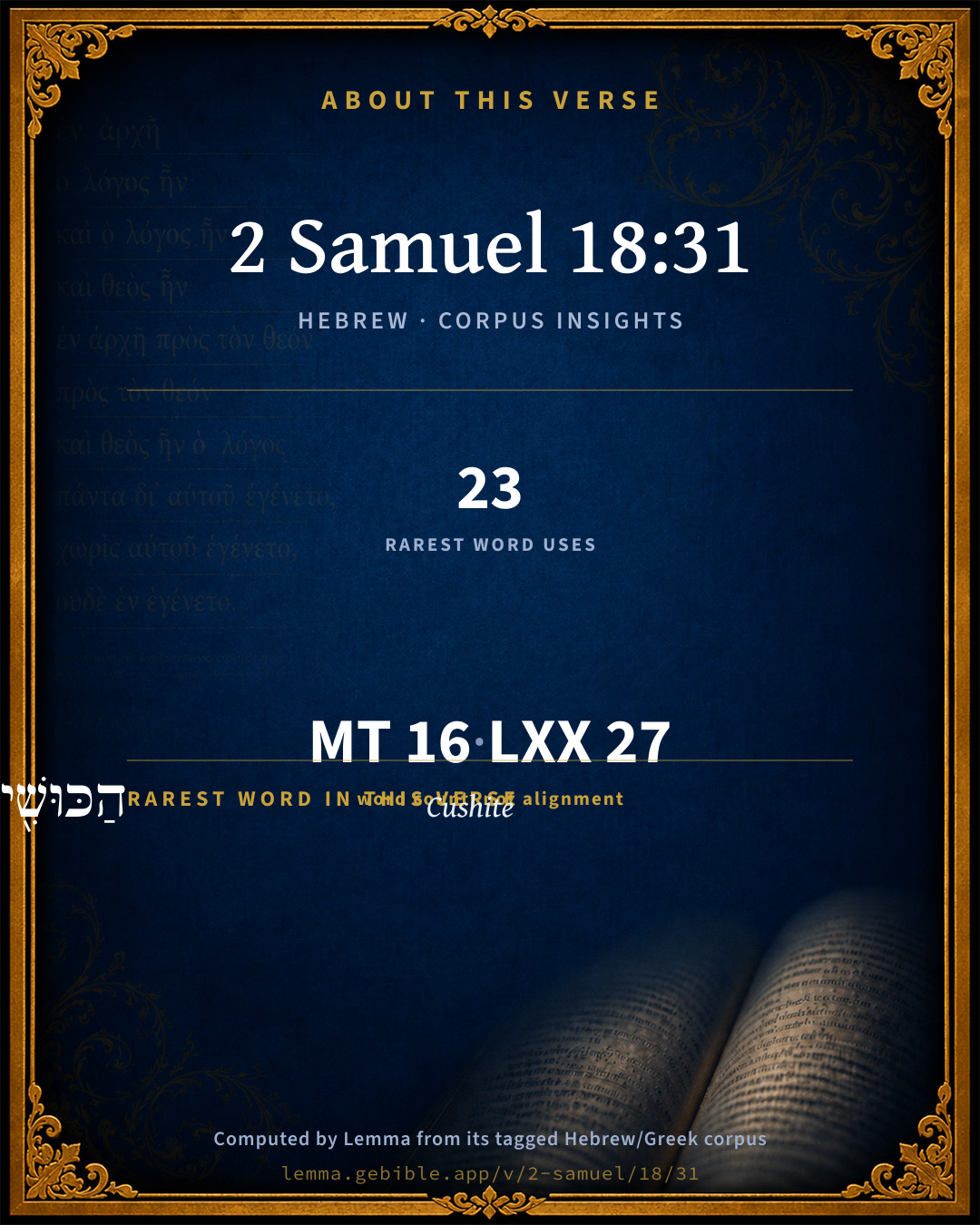
The rarest word here is הַכּוּשִׁ֖י Cushite H3569 — appearing just 23 times in the whole Hebrew Bible.

Shared distinctive vocabulary

הַכּוּשִׁ֖י Cushite H3569 occurs in 19 verses of the Hebrew Bible. Also found in:

Grammatical profile

  • 5 verbs
  • 8 nouns
  • 1 preposition
  • 1 conjunction
  • 1 particle

Verb forms

  • בָּ֑א Qal · Perfect
  • וַיֹּ֣אמֶר Qal · Sequential Imperfect
  • יִתְבַּשֵּׂר֙ Hithpael · Imperfect
  • שְׁפָטְךָ֤ Qal · Perfect
  • הַקָּמִ֥ים Qal · Participle Active

Repetition

A word recurs within this verse — often emphatic in Hebrew:

  • הַכּוּשִׁ֖י Cushite H3569 ×2

Hebrew & Septuagint length

In English translation the verse runs 29 words from the Hebrew and 34 from the Septuagint (LXX English) — closely comparable.

A rough comparison of the two English renderings, which tokenize alike — not a word-level alignment.

Word counts can differ between the Hebrew and the Greek without any difference in meaning — e.g. the Hebrew direct-object marker אֵת has no separate Greek word, and Greek often adds the article ὁ.

In the original languages it is 16 Hebrew tokens and 27 Greek tokens — but the two are counted differently (Hebrew bundles its prefixes and suffixes into one token; the Greek is in lemma form), so that isn’t a like-for-like length.

Cross-references

8

Topical passages linked to 2 Samuel 18:31 in the Treasury of Scripture Knowledge — connected by theme and wording, ordered by reader-vote popularity; previews shown in the World English Bible.

  • 2 Samuel 18:19 Then said Ahimaaz the son of Zadok, Let me now run, and bear the king news, how that Yahweh has avenged him of his enemies.
  • Deuteronomy 32:35–36 Vengeance is mine, and recompense, At the time when their foot shall slide: For the day of their calamity is at hand, The things that are to come on them shall make haste.
  • 2 Samuel 18:28 Ahimaaz called, and said to the king, All is well. He bowed himself before the king with his face to the earth, and said, Blessed be Yahweh your God, who has delivered up the men who lifted up their hand against my lord the king.
  • 2 Samuel 22:48–49 Even the God who executes vengeance for me, Who brings down peoples under me,
  • Psalms 58:10 The righteous shall rejoice when he sees the vengeance. He shall wash his feet in the blood of the wicked;
  • Psalms 94:1–4 Yahweh, you God to whom vengeance belongs, You God to whom vengeance belongs, shine forth.
  • Psalms 124:2–3 If it had not been Yahweh who was on our side, When men rose up against us;
  • Luke 18:7–8 Won't God avenge his chosen ones, who are crying out to him day and night, and yet he exercises patience with them?

Cross-references courtesy of OpenBible.info (CC BY 4.0).

Hebrew and Greek witnesses Masoretic Hebrew ↔ Greek Septuagint

The same verse in the two great witnesses to the Old Testament, shown verse-for-verse.

These are two independent witnesses, not word-aligned to each other, and the Septuagint is shown in lemma (dictionary) form.

Hebrew 2 Samuel 18:31 Masoretic · Westminster Leningrad Codex

וְהִנֵּ֥ה הַכּוּשִׁ֖י בָּ֑א וַיֹּ֣אמֶר הַכּוּשִׁ֗י יִתְבַּשֵּׂר֙ אֲדֹנִ֣י הַמֶּ֔לֶךְ כִּֽי שְׁפָטְךָ֤ יְהוָה֙ הַיּ֔וֹם מִיַּ֖ד כָּל הַקָּמִ֥ים עָלֶֽיךָ

Behold, the Cushite came; and the Cushite said, News for my lord the king; for Yahweh has avenged you this day of all those who rose up against you.

World English Bible · Public Domain

Greek LXX 2 Samuel 18:31 Septuagint · lemma form

καί ἰδού ὁ χουσι παραγίγνομαι καί εἶπον ὁ βασιλεύς εὐαγγελίζω ὁ κύριος ἐγώ ὁ βασιλεύς ὅτι κρίνω σύ κύριος σήμερον ἐκ χείρ πᾶς ὁ ἐπιἐγείρω ἐπί σύ

And, behold, Chusi came up, and said to the king, Let my lord the king hear glad tidings, for the Lord has avenged you this day upon all them that rose up against you.

LXX2012 (modern English Septuagint) · Public Domain

Hebrew: Westminster Leningrad Codex (CC BY 4.0). Greek: Septuagint (public domain); English from LXX2012 (modern English Septuagint) (Public Domain). How the Septuagint differs from the Hebrew →

Targum (Aramaic paraphrase)

1

The Targum is the ancient Jewish Aramaic paraphrase of the Hebrew Scriptures — an interpretive translation, not the Hebrew text itself. Onkelos (literal) and Pseudo-Jonathan (expansive) render the Torah, and Jonathan the Prophets. Coverage is partial: where no permissively-licensed English translation exists for a verse, only the Aramaic is shown. This is verse-level text, not a word-by-word alignment to the Hebrew.

  1. Targum Jonathan Prophets (Joshua–Malachi)
    וְהָא כוּשִׁי אֲתָא וַאֲמַר כוּשִׁי יִתְבַּסַר רִבּוֹנִי מַלְכָּא אֲרֵי אִתְפְּרַע לָךְ יְיָ יוֹמָא דֵין מִיַד כָּל דְקָמוּ עֲלָךְ:

    (no public-domain English translation for this verse)

    Targum Jonathan — Aramaic: “Mikraot Gedolot” (public domain). English: “Sefaria Community Translation” (CC0 1.0 (public-domain dedication)); “London "Chaldee Paraphrase," 1871” (public domain). Text via Sefaria.

Commentary

Notes on 2 Samuel 18:31 from classic Christian and Jewish commentators (each source and its license shown beneath its notes). The classic Christian expositions comment on the surrounding passage and are grouped to its opening verse, so a note may address several verses; the Jewish commentaries on the Tanakh (Rashi and others) are per-verse, so they appear only where the commentator wrote on this verse.

Lemma curates 59 commentaries, every one of them public domain or Creative Commons licensed, each selected and text-cleaned for this edition rather than reprinted as found. About our sources →

Trapp's Complete Commentary

John Trapp

2Sa 18:31 And, behold, Cushi came; and Cushi said, Tidings, my lord the king: for the LORD hath avenged thee this day of all them that rose up against thee.

Ver. 31. And, behold, Cushi came.] Who was the king’s servant, {2Sa 18:29} and likely one of his footmen; but outrun by Ahimaaz, who left him the worst of the news to tell; as knowing that sick men do naturally loathe the very cup out of which they drink bitter potions.

John Trapp, A Commentary or Exposition upon All the Books of the Old and New Testament (1647–1656) — public domain. Text from a community e-Sword module.

Geneva Bible (1599)

Geneva Bible translators

Hebrew, tidings is brought.

Geneva Bible (1599) marginal notes — public domain. Text via Bolls.life.

The Cambridge Bible for Schools and Colleges

gen. ed. J. J. S. Perowne

31. Tidings, &c.] The phrase is not so abrupt in the Heb., and more suitable in the slave’s mouth. Let my lord the king receive the good tidings, that, &c.

hath avenged] See note on 2Sa_18:19.

The Cambridge Bible for Schools and Colleges (gen. ed. J. J. S. Perowne; Cambridge University Press, 1878–1918) — public domain. Text from a community e-Sword module.

John Gill's Exposition

And, behold, Cushi came,.... A little after:

and Cushi said, tidings, my lord the king; news is sent and brought by me, and good news it is:

for the Lord hath avenged thee this day of all them that rose up against thee; they are either killed or dispersed; there is an entire victory over them, and deliverance from them.

John Gill's Exposition of the Whole Bible (1746–1763) — public domain (CC PDM 1.0). Text via the HelloAO Bible API.

Albert Barnes' Notes on the Bible

Tidings ... - Rather, “Let my lord the king receive the good tidings.”

Albert Barnes' Notes on the Bible (1834–1885) — public domain. Text from a community e-Sword/MySword module.

The Pulpit Commentary

Tidings, etc. The literal meaning is more fit for the mouth of a slave. "Let my lord the king learn the tidings that Jehovah hath judged (and delivered) thee this day from the hand," etc., that is, God, sitting as Judge at the assize of battle; hath given sentence for thee, and pronounced thy acquittal. The same phrase occurs in ver. 19.

The Pulpit Commentary (1880–1919), ed. H.D.M. Spence-Jones & Joseph S. Exell — public domain. Text from a community e-Sword module.

Keil & Delitzsch

C. F. Keil & F. Delitzsch

The Cushite said, "Let my lord the king receive good tidings, for Jehovah hath procured thee justice to-day out of the hand of all who have risen up against thee" (cf. Sa2 18:19).

Keil & Delitzsch — Biblical Commentary on the Old Testament (1861–1891) — public domain (CC PDM 1.0). Text via the HelloAO Bible API. (Old Testament only.)

unfoldingWord translationNotes

Door43 World Missions Community

rose up against

This means to oppose. AT: "opposed" (See: Idiom)

The enemies of my master the king, ... should be as that young man is

The Cushite uses a comparison as a polite way to tell the king that Absalom is dead. This can be stated more directly. AT: "I would like all your enemies ... to die the way that young man died" (See: Simile and Euphemism)

was deeply unnerved

"was very unhappy" or "was trembling with grief"

translationWords

avenge

die

unfoldingWord translationNotes — © Distant Shores Media and the Door43 World Missions Community, licensed CC BY-SA 4.0. Source: git.door43.org/Door43/en_tn.

Lesson kit

Teaching starters — assembled from the data on this page, not authored interpretation. Every prompt links to the verse data it draws on. Edit before teaching.

2 Samuel, in the Historical, opens this verse with 16 words (15 distinct Hebrew lemmas). Its most distinctive word is Kûwshîy (“Cushite”). A historical commentator’s framing appears above. Read the whole chapter for the surrounding context.

Discussion questions

  1. How does “Cushite” (Kûwshîy) shape what this verse is saying?
  2. 2 Samuel 18:21 shares the word «Cushite» with this verse. How do the two illuminate each other?
  3. “Cushite” occurs 2× in this one verse. What is the effect of the repetition?
  4. These translations render this verse differently; the difference is in the English rendering, not the original. What questions does that raise?
  5. The verb «בָּ֑א» is Qal Perfect. How does its form color the action?
  6. Reading how Trapp's Complete Commentary and Geneva Bible (1599) read this verse, where do the two commentators agree and where do they part?

Things to notice

Reading settings

Reading text

Shown beneath each verse's original-language words.

Old Testament
Old Testament edition

Read the OT as the Masoretic Hebrew (MT) or the Greek Septuagint (LXX).

English shown for the Greek Septuagint (in the Hebrew ↔ Greek comparison).

Comparing translations? Open the Compare panel on any verse page to stack up to four side by side.