Judges 12:7

Hebrew (Westminster Leningrad Codex) Judges 12:7 appears in the Hebrew Old Testament. The text above is from the Westminster Leningrad Codex. Each word links to its Strong’s number, a concise gloss, and parsing drawn from the Open Scriptures Hebrew Bible morphology. Click any word for its full Brown-Driver-Briggs (BDB) entry.
Download image
Cite this verse

Judges 12:7 (World English Bible). Public Domain. Lemma interlinear Bible study tool, https://lemma.gebible.app/v/judges/12/7.

Show BibTeX & RIS
BibTeX
RIS
English Translation
Jephthah judged Israel six years. Then died Jephthah the Gileadite, and was buried in [one of] the cities of Gilead.
World English Bible · Public Domain
Download a study sheet

One document with this verse’s original text, its word-by-word gloss line, the meaning frame, cross-references with their text, attributed commentary, and full source and license credits — printable, and it pastes into notes with its structure intact.

This verse Autodidact and up

Study sheet (.html) Plain text (.txt)

A passage Seminary Student

Up to 50 verses in one chapter. A passage sheet keeps up to 6 commentary sources and 12 cross-references per verse, in the order this page ranks them, and says so on the sheet whenever that leaves anything out. Ask for a single verse and you get the Autodidact verse sheet above.

Everything on this page stays free to read, with no account — the sheet is a download of what is already on screen, not access to it.

Want to remove ads? Support Godless Engineer
Compare translations 3

The same verse in 3 English versions, stacked beneath the original-language interlinear above. Click any original word for its lexicon entry.

Each is an independent rendering of the whole verse — the interlinear is not word-aligned to these translations.

Highlighted words mark where these versions differ — a whole-verse word diff, not a word-by-word alignment.

  • World English Bible Public Domain
    Jephthah judged Israel six years. Then died Jephthah the Gileadite, and was buried in [one of] the cities of Gilead.
  • King James Version Public Domain
    And Jephthah judged Israel six years. Then died Jephthah the Gileadite, and was buried in one of the cities of Gilead.
  • unfoldingWord Literal Text CC BY-SA 4.0
    And Jephthah judged Israel six years. And Jephthah the Gileadite died and was buried among the cities of Gilead.

unfoldingWord Literal Text — © unfoldingWord, licensed CC BY-SA 4.0. Word-aligned USFM3 via Door43 (git.door43.org/unfoldingWord/en_ult).

Versions to compare (up to 4)

3 of 4 selected

Show all 18 translations

Every available English version of this verse, each an independent rendering of the whole verse.

  • World English Bible Public Domain
    Jephthah judged Israel six years. Then died Jephthah the Gileadite, and was buried in [one of] the cities of Gilead.
  • Berean Standard Bible Public Domain
    Jephthah judged Israel six years, and when he died, he was buried in one of the cities of Gilead.
  • Majority Standard Bible Public Domain
    Jephthah judged Israel six years, and when he died, he was buried in one of the cities of Gilead.
  • King James Version Public Domain
    And Jephthah judged Israel six years. Then died Jephthah the Gileadite, and was buried in one of the cities of Gilead.
  • American Standard Version (1901) Public Domain
    And Jephthah judged Israel six years. Then died Jephthah the Gileadite, and was buried in `one of' the cities of Gilead.
  • Revised Version (1885) Public Domain
    And Jephthah judged Israel six years. Then died Jephthah the Gileadite, and was buried in one of the cities of Gilead.
  • Geneva Bible (1599) Public Domain
    And Iphtah iudged Israel sixe yeere: then dyed Iphtah the Gileadite, and was buryed in one of the cities of Gilead.
  • Douay-Rheims (1899) Public Domain
    And Jephte the Galaadite judged Israel six years: and he died, and was buried in his city of Galaad.
  • Young's Literal Translation Public Domain
    And Jephthah judged Israel six years, and Jephthah the Gileadite dieth, and is buried in `one of' the cities of Gilead.
  • Literal Standard Version CC BY-SA 4.0
    And Jephthah judged Israel [for] six years, and Jephthah the Gileadite dies, and is buried in [one of] the cities of Gilead.
  • Unlocked Literal Bible CC BY-SA 4.0
    Jephthah served as a judge over Israel for six years. Then Jephthah the Gileadite died and was buried in one of the cities of Gilead.
  • unfoldingWord Literal Text CC BY-SA 4.0
    And Jephthah judged Israel six years. And Jephthah the Gileadite died and was buried among the cities of Gilead.
  • Darby Bible Public Domain
    Jephthah judged Israel six years. Then Jephthah the Gileadite died, and was buried in his city in Gilead.
  • World Messianic Bible Public Domain
    Jephthah judged Israel six years. Then Jephthah the Gileadite died, and was buried in the cities of Gilead.
  • Webster's Bible Public Domain
    And Jephthah judged Israel six years: then died Jephthah the Gileadite, and was buried in one of the cities of Gilead.
  • Free Bible Version CC BY-SA 4.0
    Jephthah led Israel as judge for six years. Then he died and was buried in one of Gilead's towns.
  • Bible in Basic English Public Domain
    Now Jephthah was judge of Israel for six years. And Jephthah the Gileadite came to his death, and his body was put to rest in his town, Mizpeh of Gilead.
  • JPS Tanakh (1917) Public Domain
    And Jephthah judged Israel six years. Then died Jephthah the Gileadite, and was buried in one of the cities of Gilead.

Literal Standard Version (2020), Covenant Press — licensed CC BY-SA 4.0. Text via the HelloAO Bible API (eBible.org). Unlocked Literal Bible (unfoldingWord) — licensed CC BY-SA 4.0. Text via the HelloAO Bible API (eBible.org). unfoldingWord Literal Text — © unfoldingWord, licensed CC BY-SA 4.0. Word-aligned USFM3 via Door43 (git.door43.org/unfoldingWord/en_ult). Free Bible Version, Dr. Jonathan Gallagher — licensed CC BY-SA 4.0. Text via the HelloAO Bible API (eBible.org).

Word by word

More ways to search: Search by grammar → Find every occurrence → Compare this word →

Practice this passage: Drill this verse → Learn its vocabulary →

הַגִּלְעָדִ֔י
Gilʻâdîy
H1569
“the · Gileadite”
Particle, Definite Article + Noun, Gentilic, Masculine, Singular, Absolute
Part of Speech
Particle + Noun
Type
Gentilic
Gender
Masculine
Number
Singular
State
Absolute
Full BDB Definition

Origin: patronymically from H1568

TWOT: 356a

Gileadite = "rocky region" - an inhabitant of Gilead - a branch of the tribe of Manasseh, descended of Gilead - of Jephthah as the son of Gilead
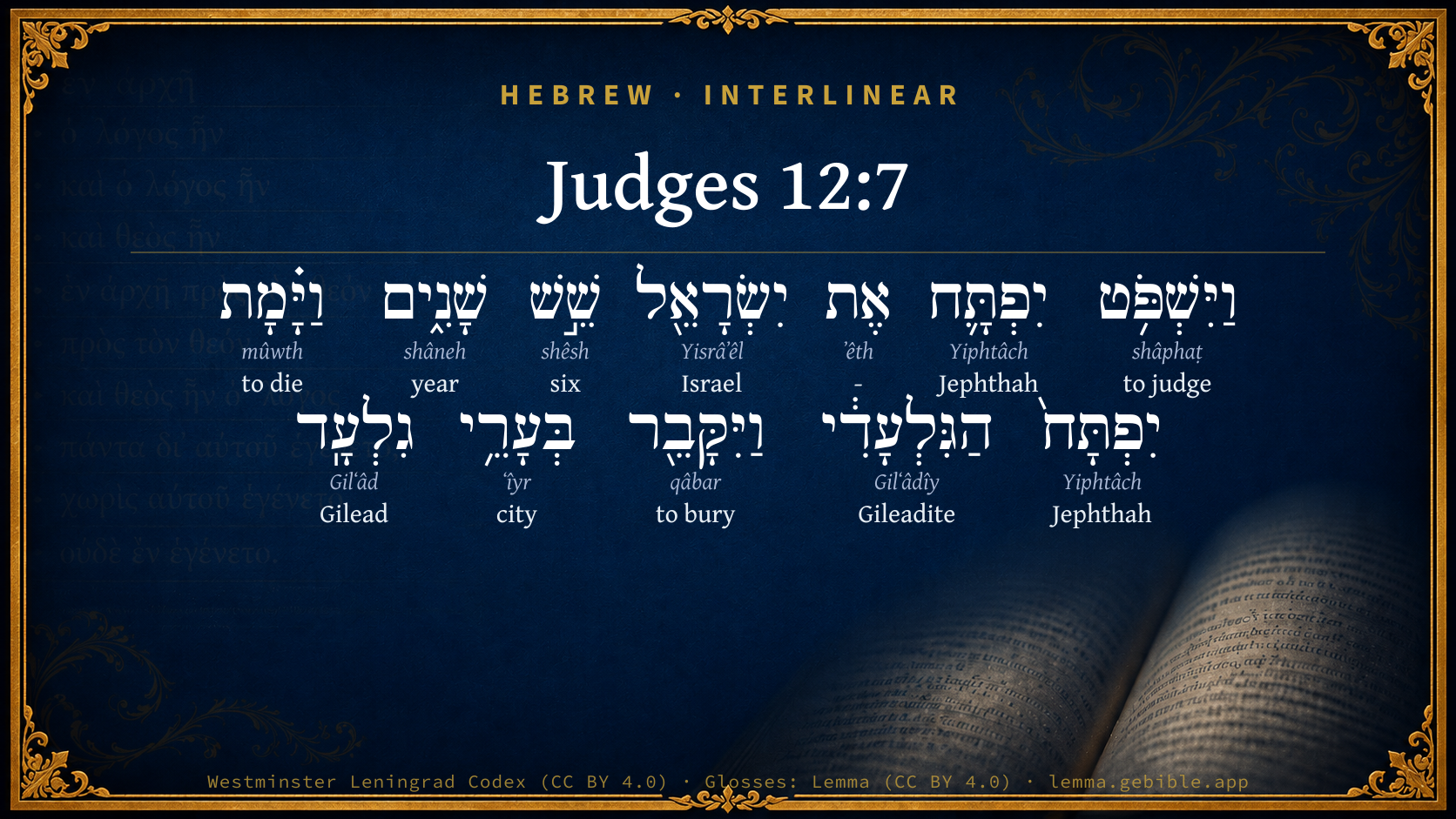
  1. וַיִּשְׁפֹּ֥ט shâphaṭ H8199 “and · to judge” Conjunction + Verb, Qal, Sequential Imperfect, 3rd Person, Masculine, Singular
  2. יִפְתָּ֛ח Yiphtâch H3316 “Jephthah” Noun, Proper
  3. אֶת ʼêth H853 “-” Particle, Direct Object
  4. יִשְׂרָאֵ֖ל Yisrâʼêl H3478 “Israel” Noun, Proper
  5. שֵׁ֣שׁ shêsh H8337 “six” Adjective, Cardinal number, Feminine, Singular, Absolute
  6. שָׁנִ֑ים shâneh H8141 “years” Noun, Common, Feminine, Plural, Absolute
  7. וַיָּ֗מָת mûwth H4191 “and · to die” Conjunction + Verb, Qal, Sequential Imperfect, 3rd Person, Masculine, Singular
  8. יִפְתָּח֙ Yiphtâch H3316 “Jephthah” Noun, Proper
  9. וַיִּקָּבֵ֖ר qâbar H6912 “and · to bury” Conjunction + Verb, Niphal, Sequential Imperfect, 3rd Person, Masculine, Singular
  10. בְּעָרֵ֥י ʻîyr H5892 “in/at · cities of” Preposition + Noun, Common, Feminine, Plural, Construct
  11. גִלְעָֽד Gilʻâd H1568 “Gilead” Noun, Proper

About this verse

These counts appear in no published source. They are computed here, from the morphology-tagged text and Lemma’s own curated glosses. What Lemma adds →

12
words
11
distinct lemmas
Historical
section

Notable vocabulary

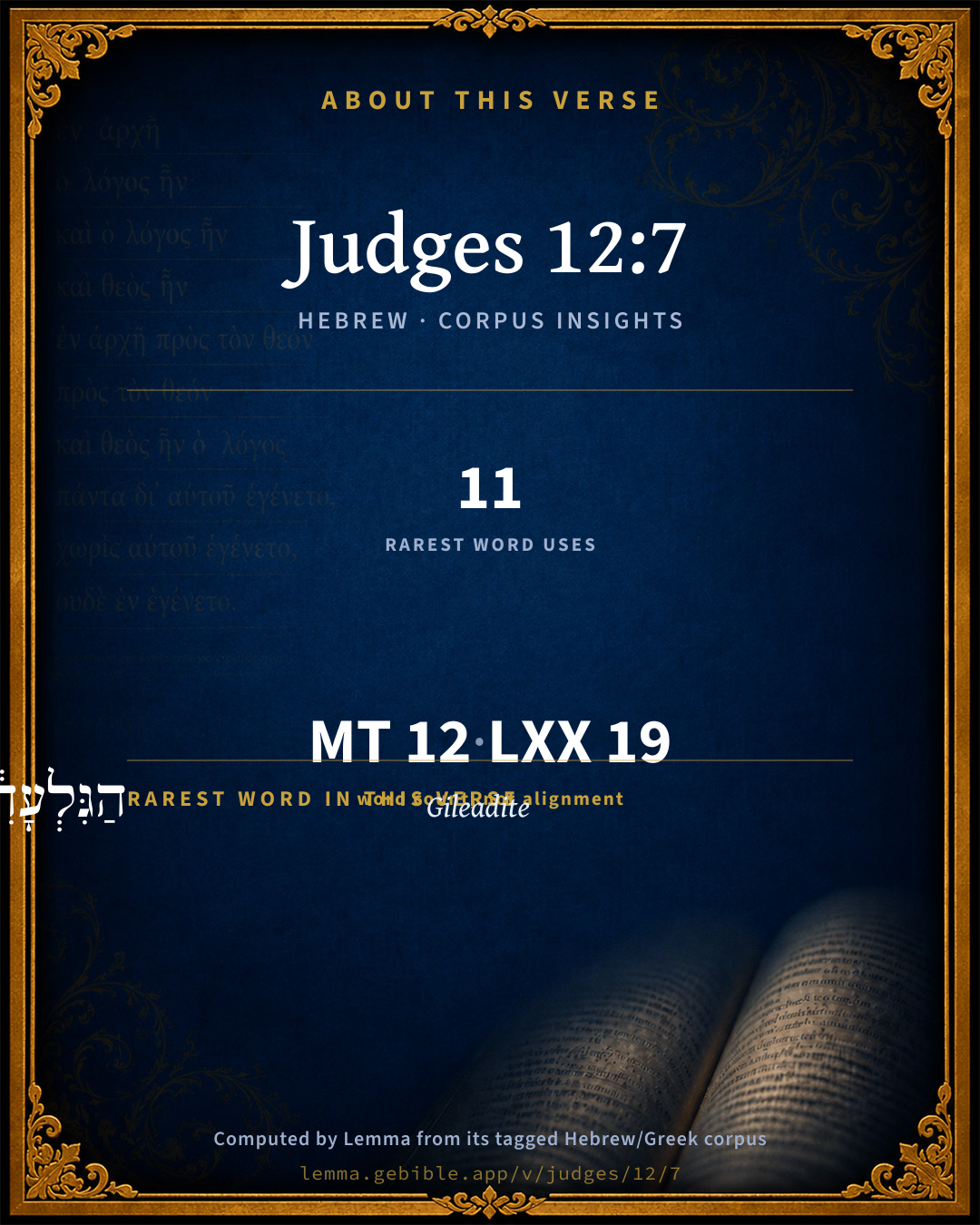
The rarest word here is הַגִּלְעָדִ֔י Gileadite H1569 — appearing just 11 times in the whole Hebrew Bible.

Shared distinctive vocabulary

הַגִּלְעָדִ֔י Gileadite H1569 occurs in 11 verses of the Hebrew Bible. Also found in:

Grammatical profile

  • 3 verbs
  • 7 nouns
  • 1 adjective
  • 1 particle

Verb forms

  • וַיִּשְׁפֹּ֥ט Qal · Sequential Imperfect
  • וַיָּ֗מָת Qal · Sequential Imperfect
  • וַיִּקָּבֵ֖ר Niphal · Sequential Imperfect

Repetition

A word recurs within this verse — often emphatic in Hebrew:

  • יִפְתָּ֛ח Jephthah H3316 ×2

Hebrew & Septuagint length

In English translation the verse runs 20 words from the Hebrew and 18 from the Septuagint (LXX English) — closely comparable.

A rough comparison of the two English renderings, which tokenize alike — not a word-level alignment.

Word counts can differ between the Hebrew and the Greek without any difference in meaning — e.g. the Hebrew direct-object marker אֵת has no separate Greek word, and Greek often adds the article ὁ.

In the original languages it is 12 Hebrew tokens and 19 Greek tokens — but the two are counted differently (Hebrew bundles its prefixes and suffixes into one token; the Greek is in lemma form), so that isn’t a like-for-like length.

Hebrew and Greek witnesses Masoretic Hebrew ↔ Greek Septuagint

The same verse in the two great witnesses to the Old Testament, shown verse-for-verse.

These are two independent witnesses, not word-aligned to each other, and the Septuagint is shown in lemma (dictionary) form.

Hebrew Judges 12:7 Masoretic · Westminster Leningrad Codex

וַיִּשְׁפֹּ֥ט יִפְתָּ֛ח אֶת יִשְׂרָאֵ֖ל שֵׁ֣שׁ שָׁנִ֑ים וַיָּ֗מָת יִפְתָּח֙ הַגִּלְעָדִ֔י וַיִּקָּבֵ֖ר בְּעָרֵ֥י גִלְעָֽד

Jephthah judged Israel six years. Then died Jephthah the Gileadite, and was buried in [one of] the cities of Gilead.

World English Bible · Public Domain

Greek LXX Judges 12:7 Septuagint · lemma form

καί κρίνω ιεφθαε ὁ ἰσραήλ ἑξήκοντα ἔτος καί ἀποθνήσκω ιεφθαε ὁ γαλααδίτης καί θάπτω ἐν πόλις αὐτός ἐν γαλαάδ

And Jephthae judged Israel six years; and Jephthae the Galaadite died, and was buried in his city Galaad.

LXX2012 (modern English Septuagint) · Public Domain

On this verse, The Cambridge Bible for Schools and Colleges discusses the Septuagint’s reading. Read the note in Commentary ↓

Hebrew: Westminster Leningrad Codex (CC BY 4.0). Greek: Septuagint (public domain); English from LXX2012 (modern English Septuagint) (Public Domain). How the Septuagint differs from the Hebrew →

Targum (Aramaic paraphrase)

1

The Targum is the ancient Jewish Aramaic paraphrase of the Hebrew Scriptures — an interpretive translation, not the Hebrew text itself. Onkelos (literal) and Pseudo-Jonathan (expansive) render the Torah, and Jonathan the Prophets. Coverage is partial: where no permissively-licensed English translation exists for a verse, only the Aramaic is shown. This is verse-level text, not a word-by-word alignment to the Hebrew.

  1. Targum Jonathan Prophets (Joshua–Malachi)
    וְדָן יִפְתָּח יַת יִשְׂרָאֵל שִׁית שְׁנִין וּמִית יִפְתָּח גִלְעָדָאָה וְאִתְקְבַר בְּקִרְוֵי גִלְעָד:

    (no public-domain English translation for this verse)

    Targum Jonathan — Aramaic: “Mikraot Gedolot” (public domain). English: “Sefaria Community Translation” (CC0 1.0 (public-domain dedication)); “London "Chaldee Paraphrase," 1871” (public domain). Text via Sefaria.

Commentary

Notes on Judges 12:7 from classic Christian and Jewish commentators (each source and its license shown beneath its notes). The classic Christian expositions comment on the surrounding passage and are grouped to its opening verse, so a note may address several verses; the Jewish commentaries on the Tanakh (Rashi and others) are per-verse, so they appear only where the commentator wrote on this verse.

Lemma curates 59 commentaries, every one of them public domain or Creative Commons licensed, each selected and text-cleaned for this edition rather than reprinted as found. About our sources →

The Cambridge Bible for Schools and Colleges

gen. ed. J. J. S. Perowne

7. The story of Jephthah is brought to a close with the formula which is used of the Minor Judges, Jdg_12:8-15, Jdg_10:2-5.

was buried in one of the cities of Gilead] The text has in the cities of G.! Can this mean that Jephthah was buried somewhere or other in Gilead? The vagueness of the expression is supposed to be an indication of the vaguely historical character of the whole story (Meyer, Die Israeliten, p. 535). Probably, however, the text is incorrect. The LXX. cod. B reads ‘in his city in G.’, cod. A ‘in his city G.’; Vulgate in civitate sua Galaad. Some cursive mss. of LXX read ‘in his city in Sephe Gilead,’ cf. Jos., Ant. Jdg_12:7; Jdg_12:12 ‘in Sebee of G.’; this suggests that the text originally ran in his city, in Mizpeh of G., cf. Jdg_8:27, Jdg_11:29. The rabbis are driven to explain ‘limb after limb fell off his body and was buried each in a different place,’ Midrash Rabba Levit. § 37, Bereshith § 60.

The Cambridge Bible for Schools and Colleges (gen. ed. J. J. S. Perowne; Cambridge University Press, 1878–1918) — public domain. Text from a community e-Sword module.

Trapp's Complete Commentary

John Trapp

Jdg 12:7 And Jephthah judged Israel six years. Then died Jephthah the Gileadite, and was buried in [one of] the cities of Gilead.

Ver. 7. And was buried in one of the cities of Gilead.] Heb., In the cities; whereupon some have founded a conceit that Jephthah was so esteemed for his valour, that they cut his body in pieces when he was dead, and carried a part to each of their cities, and there buried it. Peter Martyr by "cities" understandeth some one city so called, as Accius called Athens Quatrurbem.

John Trapp, A Commentary or Exposition upon All the Books of the Old and New Testament (1647–1656) — public domain. Text from a community e-Sword module.

Whedon's Commentary on the Bible

Daniel D. Whedon

JEPHTHAH’S DEATH, Jdg_12:7.

7. Judged Israel six years — His dominion, probably, never extended to the west of the Jordan. The elders of Gilead had made him their “head and captain,” (Jdg_11:11,) and after his victory over the Ammonites, and his defeat of the Ephraimite invasion, he seems to have been content to rule over the inhabitants of Gilead.

Buried in one of the cities of Gilead — From this indefiniteness about the place of his burial, compared with the fact that the burial of Abimelech is not mentioned at all, Wordsworth infers that a dark shadow hung over the name and memory of Jephthah. But he seems to have been honoured and respected among the eastern tribes, though we have no record of his making any efforts to lead back his people to the first principles of the theocracy, from which they had greatly departed. The eastern tribes still felt themselves to be of Israel, and never lost that feeling; but their isolation from the western tribes, causing the dialectic variation noticed Jdg_12:6, and their remoteness from the tabernacle, whereby they were cut off in a great measure from the practice of the divine worship, greatly weakened the ties of nationality. Jephthah’s offering, too, of a human sacrifice, taken in connexion with the fact that it seems not to have occasioned any feelings of horror among the people, creates the belief that they had become generally ignorant of the requirements of their own law, and estranged from the principles of Moses.

{Our impression of Jephthah’s character is reverent. Driven by wrong from home and country, he wrought for himself a heroic name that made the chiefs of eastern Israel realize him to be their only hope. Recalled by their repentance, he, like Camillus, forgave all, and returned to his native home and altars. The dark vow that shades his character was an act of mistaken piety; yet his very fidelity to his vow shows it to have been a profoundly conscientious piety. At the same time it furnishes, in the self-devoting response of the daughter, one of the most touching strokes of pathos in all history. His diplomacy was as honest as his chivalry was brave. No shadow but his mistaken vow rests upon this heroic chief.}

Daniel D. Whedon (gen. ed.), Commentary on the Old and New Testaments (1874–1909) — public domain. Text from a community e-Sword module.

Jamieson, Fausset & Brown

Robert Jamieson, A. R. Fausset & David Brown

Jephthah died--After a government of six years, this mighty man of valor died; and however difficult it may be for us to understand some passages in his history, he has been ranked by apostolic authority among the worthies of the ancient church. He was followed by a succession of minor judges, of whom the only memorials preserved relate to the number of their families and their state [Jdg 12:8-15].

Next: Judges Chapter 13

Jamieson, Fausset & Brown — Commentary Critical and Explanatory on the Whole Bible (1871) — public domain (CC PDM 1.0). Text via the HelloAO Bible API.

Ellicott's Commentary for English Readers

(7) Judged Israel.—The word implies that he was one of the recognised Shophetim, but there are no details to show in the case of any of the judges either what were the limits of their jurisdiction or what amount of authority it implied.

In one of the cities of Gilead.—The Hebrew only says, “in cities of Gilead.” This may, no doubt. mean “one of the cities of Gilead,” as in Gen_19:29 “the cities in the which Lot dwelt” means “in one of which Lot dwelt.” But the burial-place of so renowned a hero as Jephthah was not likely to be forgotten, and the reading adopted by the LXX. and Vulg., “in his city, Gilead” (i.e., Ramoth-Gilead or Mizpeh of Gilead), is furnished by a mere change of into The Sebee, in which Josephus says he was buried, may be a corruption of Mizpeh.

A Bible Commentary for English Readers, edited by Charles John Ellicott (1878–1897) — public domain. Text from a community e-Sword module.

John Gill's Exposition

And Jephthah judged Israel six years,.... After the affair of the Ephraimites, he was acknowledged by all Israel as their judge and supreme governor, but did not live long; being perhaps depressed and worn away with grief, on account of his daughter, and other troubles that attended him:

then died Jephthah the Gileadite, and was buried in one of the cities of Gilead: it is not said in what city he was buried, but very probably it was in his own city Mizpeh, where he dwelt. Josephus (w) says it was in his own country, Sebee, a city of Gilead.

(w) Antiqu. l. 5. c. 7. sect. 12.

John Gill's Exposition of the Whole Bible (1746–1763) — public domain (CC PDM 1.0). Text via the HelloAO Bible API.

Haydock's Catholic Bible Commentary

His city. Maspha, in the country of Galaad, chap. xi. 34. (Calmet) --- Hebrew, "in the cities;" whence the Rabbins have idly conjectured, that parts of his body were interred in different cities out of respect, or that they rotted off, in punishment of the sacrifice of his daughter. (Munster) --- Grotius compares Jepthe with the renowned Viriatus. His character, both in peace and war, deserves the highest commendations; and in many respects, he was a striking figure of Jesus Christ. (Calmet) --- The uncertainty of his birth, and the subsequent persecution which he endured from his brethren, foreshewed the deformity of the synagogues, and the conduct of the Jews (Haydock) towards their Messias, from whom alone they could expect salvation. Hence they are forced to have recourse to him, as the Israelites found themselves under a necessity of recalling Jepthe to lead them on to victory. Those who refused obedience to him, were deservedly exterminated, as the faithless Jews were by the arms of the Romans. Whether the daughter of Jepthe was immolated, or only consecrated to God, we may discover in her person a figure of the death and of the resurrection of our Saviour, who voluntarily made a sacrifice of his human nature to the justice of his father. See St. Augustine, q. 49.; Serarius, q. 26. (Calmet)

George Leo Haydock (1774–1849), Haydock's Catholic Family Bible and Commentary, 1859 edition — public domain. Excludes Psalms (Douay-Rheims chapter numbering differs from Protestant) and Deuterocanonical books (Catholic canon only).

Matthew Poole's English Annotations

In one of the cities, Heb. in the cities; the plural number put for the singular, as Gen 19:29, where Lot is said to dwell in the cities, i.e. one of the cities; and 1Sa 18:21, the twain is put for one of the twain; and Jdg 18:11, houses for house; and Jon 1:5, the sides for one of the sides.

Matthew Poole's English Annotations on the Holy Bible (1683–1685) — public domain. Text from a community e-Sword/MySword module.

The Pulpit Commentary

Six years. Perhaps his sorrow for his daughter shortened his life. Then died Jephthah the Gileadite. Better, And Jephthah the Gileadite died. In one of the cities. His exact burial-place was perhaps unknown, and therefore the general phrase in the cities of Judah was used, Gen_13:12. Lot is said to have dwelt in the cities of the plain, Neh_6:2 San-ballat asked Nehemiah to meet him in the villages of the plain. Still the phrase is not what you would expect here, and it seems unlikely that Jephthah"s burial-place should be unknown. The Septuagint, Vulgate, Syriac, and Arabic versions read, "in his city Gilead," as if Gilead had been the name of Jephthah"s paternal city. Another conjecture is that there might have been an Ar of Gilead as well as the well-known Ar of Moab, or there might have been a collection of towns called Arey-Gilead (the towns of Gilead), after the analogy of Havoth-jair Jud_1:10:4), but there is no evidence in support of these conjectures.

The Pulpit Commentary (1880–1919), ed. H.D.M. Spence-Jones & Joseph S. Exell — public domain. Text from a community e-Sword module.

Keil & Delitzsch

C. F. Keil & F. Delitzsch

Jephthah judged Israel six years, though most probably only the tribes on the east of the Jordan. When he died, he was buried in one of the towns of Gilead. The plural גלעד בּערי is used quite indefinitely, as in Gen 13:12; Neh 6:2, etc. (see Ges. Lehrgeb. p. 665), simply because the historian did not know the exact town.

Keil & Delitzsch — Biblical Commentary on the Old Testament (1861–1891) — public domain (CC PDM 1.0). Text via the HelloAO Bible API. (Old Testament only.)

unfoldingWord translationNotes

Door43 World Missions Community

Jephthah the Gileadite died and was buried

This can be stated in active form. AT: "Jephthah the Gileadite died and they buried him" (See: Active or Passive)

translationWords

Jephthah

servant

judge, judges

Israel

Gilead

die

unfoldingWord translationNotes — © Distant Shores Media and the Door43 World Missions Community, licensed CC BY-SA 4.0. Source: git.door43.org/Door43/en_tn.

Lesson kit

Teaching starters — assembled from the data on this page, not authored interpretation. Every prompt links to the verse data it draws on. Edit before teaching.

Judges, in the Historical, opens this verse with 12 words (11 distinct Hebrew lemmas). Its most distinctive word is Gilʻâdîy (“Gileadite”). A historical commentator’s framing appears above. Read the whole chapter for the surrounding context.

Discussion questions

  1. The word Gilʻâdîy carries the sense “Gileadite.” How does it shape the verse?
  2. Numbers 26:29 shares the word «Gileadite» with this verse. How do the two illuminate each other?
  3. “Jephthah” occurs 2× in this one verse. What is the effect of the repetition?
  4. The translations on this page render this verse differently — a whole-verse word diff, not a word-by-word alignment. What might account for the different wordings?
  5. The verb «וַיִּשְׁפֹּ֥ט» is Qal Sequential Imperfect. How does its form color the action?
  6. Reading how The Cambridge Bible for Schools and Colleges and Trapp's Complete Commentary read this verse, where do the two commentators agree and where do they part?

Things to notice

Reading settings

Reading text

Shown beneath each verse's original-language words.

Old Testament
Old Testament edition

Read the OT as the Masoretic Hebrew (MT) or the Greek Septuagint (LXX).

English shown for the Greek Septuagint (in the Hebrew ↔ Greek comparison).

Comparing translations? Open the Compare panel on any verse page to stack up to four side by side.