
Ezekiel 23:24

Hebrew (Westminster Leningrad Codex) Ezekiel 23:24 appears in the Hebrew Old Testament. The text above is from the Westminster Leningrad Codex. Each word links to its Strong’s number, a concise gloss, and parsing drawn from the Open Scriptures Hebrew Bible morphology. Click any word for its full Brown-Driver-Briggs (BDB) entry.
Download image
Cite this verse

Ezekiel 23:24 (World English Bible). Public Domain. Lemma interlinear Bible study tool, https://lemma.gebible.app/v/ezekiel/23/24.

Show BibTeX & RIS
BibTeX
RIS
English Translation
They shall come against you with weapons, chariots, and wagons, and with a company of peoples; they shall set themselves against you with buckler and shield and helmet round about; and I will commit the judgment to them, and they shall judge you according to their judgments.
World English Bible · Public Domain
Highlights
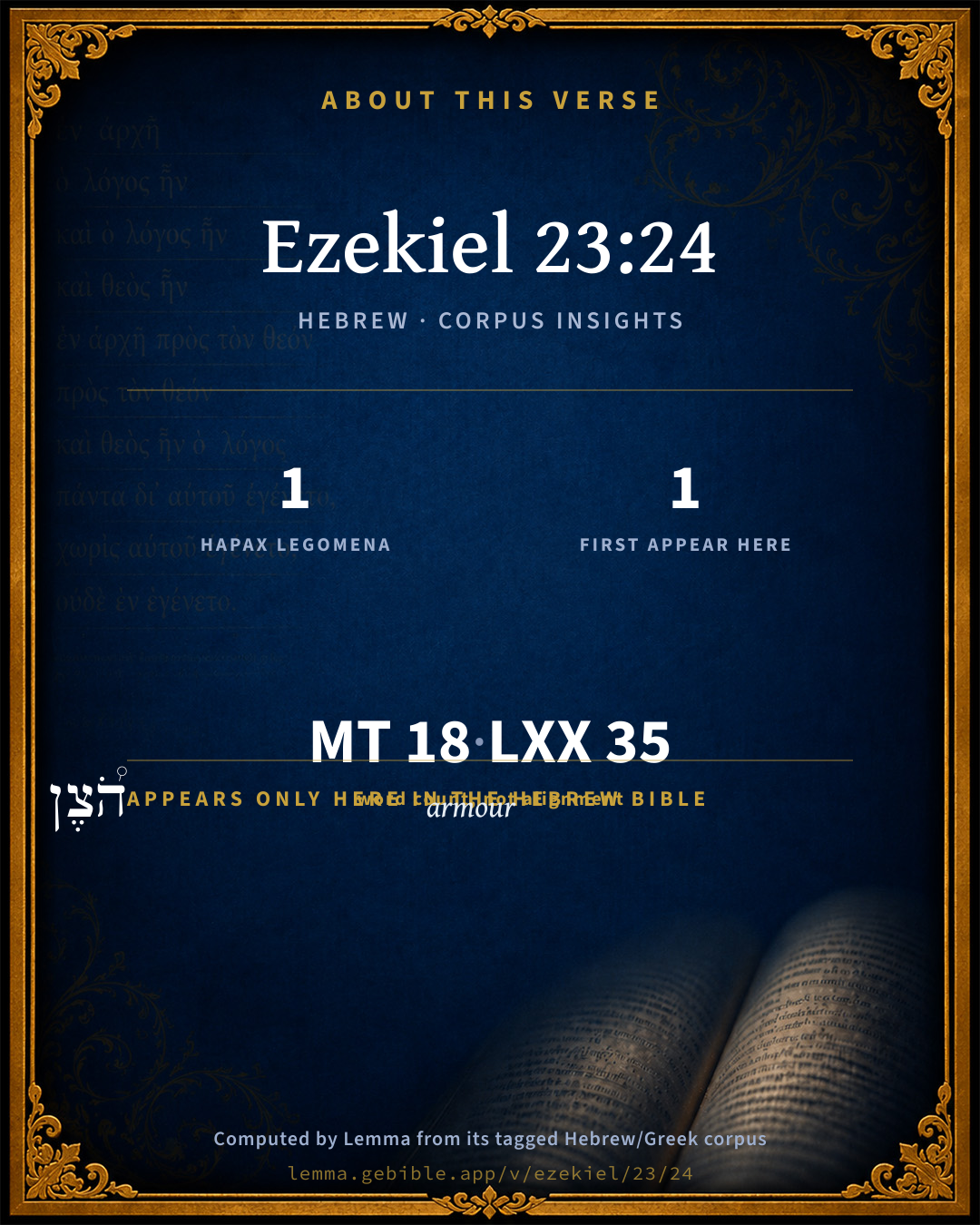
  • 1 hapax legomenon — only here in the Hebrew Bible
  • 1 first appearance in the Hebrew Bible
Full analysis ↓
Download a study sheet

One document with this verse’s original text, its word-by-word gloss line, the meaning frame, cross-references with their text, attributed commentary, and full source and license credits — printable, and it pastes into notes with its structure intact.

This verse Autodidact and up

Study sheet (.html) Plain text (.txt)

A passage Seminary Student

Up to 50 verses in one chapter. A passage sheet keeps up to 6 commentary sources and 12 cross-references per verse, in the order this page ranks them, and says so on the sheet whenever that leaves anything out. Ask for a single verse and you get the Autodidact verse sheet above.

Everything on this page stays free to read, with no account — the sheet is a download of what is already on screen, not access to it.

Want to remove ads? Support Godless Engineer
Compare translations 3

The same verse in 3 English versions, stacked beneath the original-language interlinear above. Click any original word for its lexicon entry.

Each is an independent rendering of the whole verse — the interlinear is not word-aligned to these translations.

Highlighted words mark where these versions differ — a whole-verse word diff, not a word-by-word alignment.

  • World English Bible Public Domain
    They shall come against you with weapons, chariots, and wagons, and with a company of peoples; they shall set themselves against you with buckler and shield and helmet round about; and I will commit the judgment to them, and they shall judge you according to their judgments.
  • King James Version Public Domain
    And they shall come against thee with chariots, wagons, and wheels, and with an assembly of people, which shall set against thee buckler and shield and helmet round about: and I will set judgment before them, and they shall judge thee according to their judgments.
  • unfoldingWord Literal Text CC BY-SA 4.0
    They will come against you with weapons, and with chariots and wagons, and with a great crowd of people. They will set large shields, small shields, and helmets against you all around. I will give them the opportunity to punish you, and they will punish you with their actions.

unfoldingWord Literal Text — © unfoldingWord, licensed CC BY-SA 4.0. Word-aligned USFM3 via Door43 (git.door43.org/unfoldingWord/en_ult).

Versions to compare (up to 4)

3 of 4 selected

Show all 18 translations

Every available English version of this verse, each an independent rendering of the whole verse.

  • World English Bible Public Domain
    They shall come against you with weapons, chariots, and wagons, and with a company of peoples; they shall set themselves against you with buckler and shield and helmet round about; and I will commit the judgment to them, and they shall judge you according to their judgments.
  • Berean Standard Bible Public Domain
    They will come against you with a host of peoples, with weapons, chariots, and wagons. They will array themselves against you on every side with buckler and shield and helmet. I will delegate judgment to them, and they will punish you according to their own standards.
  • Majority Standard Bible Public Domain
    They will come against you with a host of peoples, with weapons, chariots, and wagons. They will array themselves against you on every side with buckler and shield and helmet. I will delegate judgment to them, and they will punish you according to their own standards.
  • King James Version Public Domain
    And they shall come against thee with chariots, wagons, and wheels, and with an assembly of people, which shall set against thee buckler and shield and helmet round about: and I will set judgment before them, and they shall judge thee according to their judgments.
  • American Standard Version (1901) Public Domain
    And they shall come against thee with weapons, chariots, and wagons, and with a company of peoples; they shall set themselves against thee with buckler and shield and helmet round about; and I will commit the judgment unto them, and they shall judge thee according to their judgments.
  • Revised Version (1885) Public Domain
    And they shall come against thee with weapons, chariots, and wagons, and with an assembly of peoples; they shall set themselves against thee with buckler and shield and helmet round about: and I will commit the judgment unto them, and they shall judge thee according to their judgments.
  • Geneva Bible (1599) Public Domain
    Euen these shall come against thee with charets, waggons, and wheeles, and with a multitude of people, which shall set against thee, buckler and shield, and helmet round about: and I will leaue the punishment vnto them, and they shall iudge thee according to their iudgements.
  • Douay-Rheims (1899) Public Domain
    And they shall come upon thee well appointed with chariot and wheel, a multitude of people: they shall be armed against thee on every side with breastplate, and buckler, and helmet: and I will set judgment before them, and they shall judge thee by their judgments.
  • Young's Literal Translation Public Domain
    And they have come in against thee, With arms, rider, and wheel, And with an assembly of peoples; Target, and shield, and helmet, They do set against thee round about, And I have set before them judgment, They have judged thee in their Judgments.
  • Literal Standard Version CC BY-SA 4.0
    And they have come in against you, || With arms, rider, and wheel, || And with an assembly of peoples; Buckler, and shield, and helmet, || They set against you all around, || And I have set judgment before them, || They have judged you in their judgments.
  • Unlocked Literal Bible CC BY-SA 4.0
    They will come against you with weapons, and with chariots and wagons, and with a great crowd of people. They will set large shields, small shields, and helmets against you all around. I will give them the opportunity to punish you, and they will punish you with their actions.
  • unfoldingWord Literal Text CC BY-SA 4.0
    They will come against you with weapons, and with chariots and wagons, and with a great crowd of people. They will set large shields, small shields, and helmets against you all around. I will give them the opportunity to punish you, and they will punish you with their actions.
  • Darby Bible Public Domain
    And they shall come against thee [with] armour, chariots and wheels, and with an assemblage of peoples; they shall set themselves against thee [with] target, and shield, and helmet round about; and I will put judgment before them, and they shall judge thee according to their judgments.
  • World Messianic Bible Public Domain
    They will come against you with weapons, chariots, and wagons, and with a company of peoples. They will set themselves against you with buckler, shield, and helmet all around. I will commit the judgment to them, and they will judge you according to their judgments.
  • Webster's Bible Public Domain
    And they shall come against thee with chariots, wagons, and wheels, and with an assembly of people, which shall set against thee buckler and shield and helmet on every side: and I will set judgment before them, and they shall judge thee according to their judgments.
  • Free Bible Version CC BY-SA 4.0
    They will attack you from the north, invading with a great army, chariots, and wagons. They will come with their shields and helmets and surround you. I will hand you over to them for punishment, and they will judge and punish you following their own laws.
  • Bible in Basic English Public Domain
    And they will come against you from the north on horseback, with war-carriages and a great band of peoples; they will put themselves in order against you with breastplate and body-cover and metal head-dress round about you: and I will make them your judges, and they will give their decision against you as seems right to them.
  • JPS Tanakh (1917) Public Domain
    And they shall come against thee with hosts, chariots, and wheels, and with an assembly of peoples; they shall set themselves in array against thee with buckler and shield and helmet round about; and I will commit the judgment unto them, and they shall judge thee according to their judgments.

Literal Standard Version (2020), Covenant Press — licensed CC BY-SA 4.0. Text via the HelloAO Bible API (eBible.org). Unlocked Literal Bible (unfoldingWord) — licensed CC BY-SA 4.0. Text via the HelloAO Bible API (eBible.org). unfoldingWord Literal Text — © unfoldingWord, licensed CC BY-SA 4.0. Word-aligned USFM3 via Door43 (git.door43.org/unfoldingWord/en_ult). Free Bible Version, Dr. Jonathan Gallagher — licensed CC BY-SA 4.0. Text via the HelloAO Bible API (eBible.org).

Word by word

More ways to search: Search by grammar → Find every occurrence → Compare this word →

Practice this passage: Drill this verse → Learn its vocabulary →

הֹ֠צֶן
hôtsen
H2021
“armour of”
Noun, Common, Masculine, Singular, Construct
Part of Speech
Noun
Type
Common
Gender
Masculine
Number
Singular
State
Construct
Full BDB Definition

Origin: from an unused root meaning apparently to be sharp or strong

TWOT: TWOT - 513

armour?, weapons? (meaning uncertain)
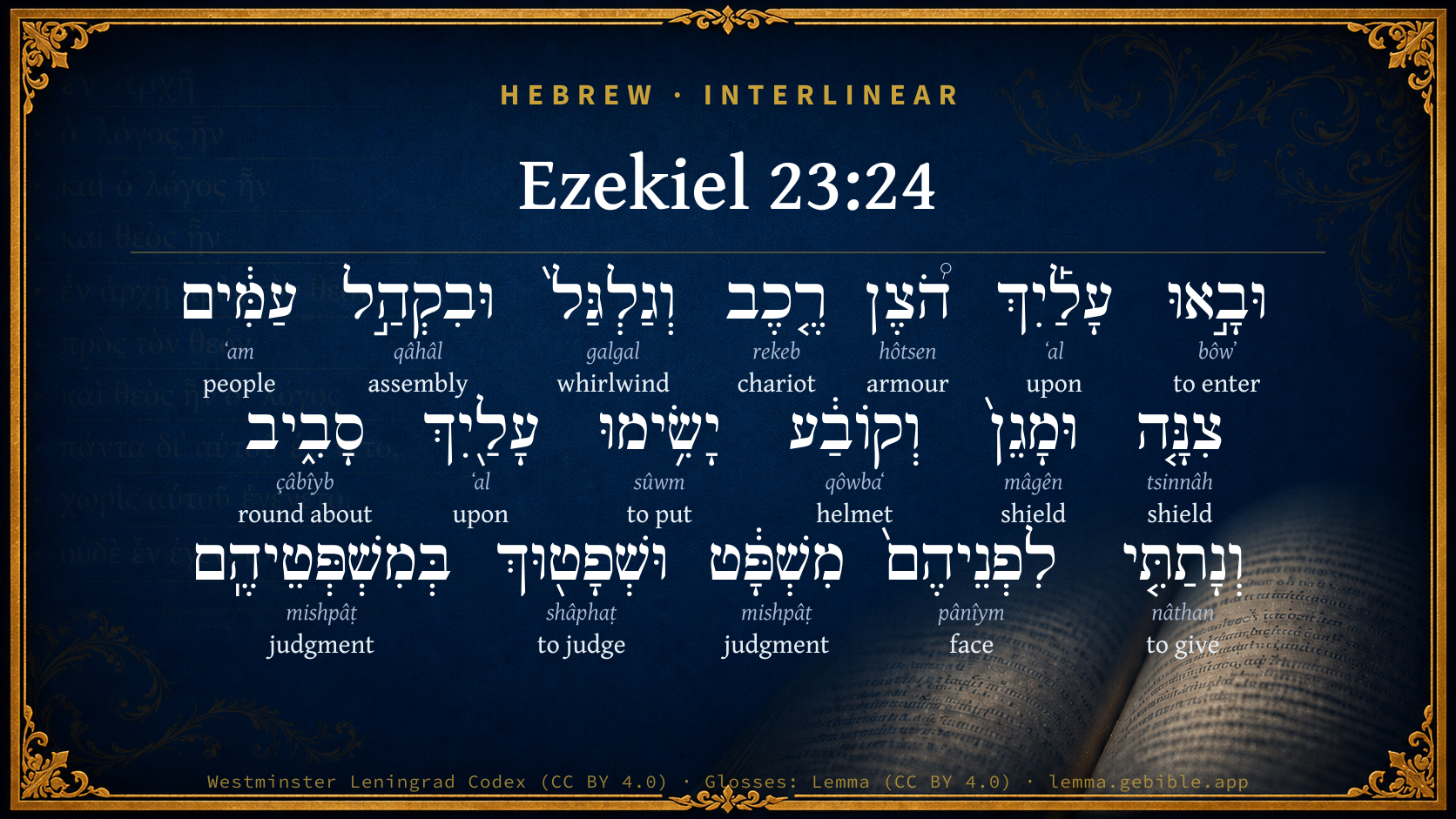
  1. וּבָ֣אוּ bôwʼ H935 “and · to enter” Conjunction + Verb, Qal, Sequential Perfect, 3rd Person, Common, Plural
  2. עָלַ֡יִךְ ʻal H5921 “upon · you” Preposition + Suffix, Personal, 2nd Person, Feminine, Singular
  3. רֶ֤כֶב rekeb H7393 “chariot” Noun, Common, Masculine, Singular, Absolute
  4. וְגַלְגַּל֙ galgal H1534 “and · whirlwind” Conjunction + Noun, Common, Masculine, Singular, Absolute
  5. וּבִקְהַ֣ל qâhâl H6951 “and · in/at · assembly of” Conjunction + Preposition + Noun, Common, Masculine, Singular, Construct
  6. עַמִּ֔ים ʻam H5971 “peoples” Noun, Common, Masculine, Plural, Absolute
  7. צִנָּ֤ה tsinnâh H6793 “shield” Noun, Common, Feminine, Singular, Absolute
  8. וּמָגֵן֙ mâgên H4043 “and · shield” Conjunction + Noun, Common, Both, Singular, Absolute
  9. וְקוֹבַ֔ע qôwbaʻ H6959 “and · helmet” Conjunction + Noun, Common, Masculine, Singular, Absolute
  10. יָשִׂ֥ימוּ sûwm H7760 “to put” Verb, Qal, Imperfect, 3rd Person, Masculine, Plural
  11. עָלַ֖יִךְ ʻal H5921 “upon · you” Preposition + Suffix, Personal, 2nd Person, Feminine, Singular
  12. סָבִ֑יב çâbîyb H5439 “round about” Noun, Common, Both, Singular, Absolute
  13. וְנָתַתִּ֤י nâthan H5414 “and · to give” Conjunction + Verb, Qal, Sequential Perfect, 1st Person, Common, Singular
  14. לִפְנֵיהֶם֙ pânîym H6440 “to/for · face(s) · their” Preposition + Noun, Common, Both, Plural, Construct + Suffix, Personal, 3rd Person, Masculine, Plural
  15. מִשְׁפָּ֔ט mishpâṭ H4941 “judgment” Noun, Common, Masculine, Singular, Absolute
  16. וּשְׁפָט֖וּךְ shâphaṭ H8199 “and · to judge · you” Conjunction + Verb, Qal, Sequential Perfect, 3rd Person, Common, Plural + Suffix, Personal, 2nd Person, Feminine, Singular
  17. בְּמִשְׁפְּטֵיהֶֽם mishpâṭ H4941 “in/at · judgments · their” Preposition + Noun, Common, Masculine, Plural, Construct + Suffix, Personal, 3rd Person, Masculine, Plural

About this verse

These counts appear in no published source. They are computed here, from the morphology-tagged text and Lemma’s own curated glosses. What Lemma adds →

18
words
16
distinct lemmas
Prophets
section

Notable vocabulary

1 hapax legomenon — a word that appears only here in the entire Hebrew Bible:

  • הֹ֠צֶן armour H2021

First appearance in Scripture

This word makes its first canonical appearance in the Hebrew Bible here:

  • הֹ֠צֶן armour H2021

Shared distinctive vocabulary

וְקוֹבַ֔ע helmet H6959 occurs in 2 verses of the Hebrew Bible. Also found in:

Grammatical profile

  • 4 verbs
  • 12 nouns
  • 2 prepositions

Verb forms

  • וּבָ֣אוּ Qal · Sequential Perfect
  • יָשִׂ֥ימוּ Qal · Imperfect
  • וְנָתַתִּ֤י Qal · Sequential Perfect
  • וּשְׁפָט֖וּךְ Qal · Sequential Perfect

Repetition

Words recur within this verse — often emphatic in Hebrew:

  • עָלַ֡יִךְ upon H5921 ×2
  • מִשְׁפָּ֔ט judgment H4941 ×2

Hebrew & Septuagint length

In English translation the verse runs 47 words from the Hebrew and 49 from the Septuagint (LXX English) — closely comparable.

A rough comparison of the two English renderings, which tokenize alike — not a word-level alignment.

Word counts can differ between the Hebrew and the Greek without any difference in meaning — e.g. the Hebrew direct-object marker אֵת has no separate Greek word, and Greek often adds the article ὁ.

In the original languages it is 18 Hebrew tokens and 35 Greek tokens — but the two are counted differently (Hebrew bundles its prefixes and suffixes into one token; the Greek is in lemma form), so that isn’t a like-for-like length.

Cross-references

9

Topical passages linked to Ezekiel 23:24 in the Treasury of Scripture Knowledge — connected by theme and wording, ordered by reader-vote popularity; previews shown in the World English Bible.

  • 2 Samuel 24:14 David said to Gad, I am in a great strait: let us fall now into the hand of Yahweh; for his mercies are great; and let me not fall into the hand of man.
  • Jeremiah 39:5–6 But the army of the Chaldeans pursued after them, and overtook Zedekiah in the plains of Jericho: and when they had taken him, they brought him up to Nebuchadrezzar king of Babylon to Riblah in the land of Hamath; and he gave judgment on him.
  • Jeremiah 47:3 At the noise of the stamping of the hoofs of his strong ones, at the rushing of his chariots, at the rumbling of his wheels, the fathers don't look back to their children for feebleness of hands;
  • Ezekiel 16:38 I will judge you, as women who break wedlock and shed blood are judged; and I will bring on you the blood of wrath and jealousy.
  • Ezekiel 23:45 Righteous men, they shall judge them with the judgment of adulteresses, and with the judgment of women who shed blood; because they are adulteresses, and blood is in their hands.
  • Ezekiel 26:10 By reason of the abundance of his horses their dust shall cover you: your walls shall shake at the noise of the horsemen, and of the wagons, and of the chariots, when he shall enter into your gates, as men enter into a city in which is made a breach.
  • Nahum 2:3–4 The shield of his mighty men is made red. The valiant men are in scarlet. The chariots flash with steel in the day of his preparation, and the pine spears are brandished.
  • Ezekiel 21:23 It shall be to them as a false divination in their sight, who have sworn oaths to them; but he brings iniquity to memory, that they may be taken.
  • Nahum 3:2–3 The noise of the whip, the noise of the rattling of wheels, prancing horses, and bounding chariots,

Cross-references courtesy of OpenBible.info (CC BY 4.0).

Hebrew and Greek witnesses Masoretic Hebrew ↔ Greek Septuagint

The same verse in the two great witnesses to the Old Testament, shown verse-for-verse.

These are two independent witnesses, not word-aligned to each other, and the Septuagint is shown in lemma (dictionary) form.

Hebrew Ezekiel 23:24 Masoretic · Westminster Leningrad Codex

וּבָ֣אוּ עָלַ֡יִךְ הֹ֠צֶן רֶ֤כֶב וְגַלְגַּל֙ וּבִקְהַ֣ל עַמִּ֔ים צִנָּ֤ה וּמָגֵן֙ וְקוֹבַ֔ע יָשִׂ֥ימוּ עָלַ֖יִךְ סָבִ֑יב וְנָתַתִּ֤י לִפְנֵיהֶם֙ מִשְׁפָּ֔ט וּשְׁפָט֖וּךְ בְּמִשְׁפְּטֵיהֶֽם

They shall come against you with weapons, chariots, and wagons, and with a company of peoples; they shall set themselves against you with buckler and shield and helmet round about; and I will commit the judgment to them, and they shall judge you according to their judgments.

World English Bible · Public Domain

Greek LXX Ezekiel 23:24 Septuagint · lemma form

καί πᾶς ἥκω ἐπί σύ ἀπό βορέας ἅρμα καί τροχός μετά ὄχλος λαός θυρέος καί πέλτη καί βάλλω φυλακή ἐπί σύ κύκλος καί δίδωμι πρό πρόσωπον αὐτός κρίμα καί ἐκδικέω σύ ἐν ὁ κρίμα αὐτός

And they all shall come upon you from the north, chariots and wheels, with a multitude of nations, shields and targets; and the enemy shall set a watch against you round about: and I will set judgment before them, and they shall take vengeance on you with their judgments.

LXX2012 (modern English Septuagint) · Public Domain

On this verse, Jamieson, Fausset & Brown discusses the Septuagint’s reading. Read the note in Commentary ↓

Hebrew: Westminster Leningrad Codex (CC BY 4.0). Greek: Septuagint (public domain); English from LXX2012 (modern English Septuagint) (Public Domain). How the Septuagint differs from the Hebrew →

Targum (Aramaic paraphrase)

1

The Targum is the ancient Jewish Aramaic paraphrase of the Hebrew Scriptures — an interpretive translation, not the Hebrew text itself. Onkelos (literal) and Pseudo-Jonathan (expansive) render the Torah, and Jonathan the Prophets. Coverage is partial: where no permissively-licensed English translation exists for a verse, only the Aramaic is shown. This is verse-level text, not a word-by-word alignment to the Hebrew.

  1. Targum Jonathan Prophets (Joshua–Malachi)
    וְיֵיתוּן עֲלָךְ בְּמָאנֵי זְיָנָא בִּרְתִיכִין וְגַלְגַלִין וּמַשִׁרְיַת עַמְמִין דִמְזַיְנִין בַּעֲגִילִין וְקוּלְסִין יְמַנוּן עֲלָךְ סְחוֹר סְחוֹר וְאֶתֵּן קֳדָמֵיהוֹן פּוּרְעֲנוּת דִינִין וְיִתְפְּרָעוּן מִנִיךְ בְּנִימוּסֵיהוֹן:

    (no public-domain English translation for this verse)

    Targum Jonathan — Aramaic: “Mikraot Gedolot” (public domain). English: “Sefaria Community Translation” (CC0 1.0 (public-domain dedication)); “London "Chaldee Paraphrase," 1871” (public domain). Text via Sefaria.

Commentary

Notes on Ezekiel 23:24 from classic Christian and Jewish commentators (each source and its license shown beneath its notes). The classic Christian expositions comment on the surrounding passage and are grouped to its opening verse, so a note may address several verses; the Jewish commentaries on the Tanakh (Rashi and others) are per-verse, so they appear only where the commentator wrote on this verse.

Lemma curates 59 commentaries, every one of them public domain or Creative Commons licensed, each selected and text-cleaned for this edition rather than reprinted as found. About our sources →

Trapp's Complete Commentary

John Trapp

Eze 23:24 And they shall come against thee with chariots, wagons, and wheels, and with an assembly of people, [which] shall set against thee buckler and shield and helmet round about: and I will set judgment before them, and they shall judge thee according to their judgments.

Ver. 24. I will set judgment before them,] i.e., I will put thee into their hands to be punished.

And they shall judge thee according to their judgment.] Without mixture of mercy; whereas I use in the midst of judgment to remember mercy.

John Trapp, A Commentary or Exposition upon All the Books of the Old and New Testament (1647–1656) — public domain. Text from a community e-Sword module.

Geneva Bible (1599)

Geneva Bible translators

Or, laws.

Hebrew, I will give judgment before them.

Geneva Bible (1599) marginal notes — public domain. Text via Bolls.life.

Jamieson, Fausset & Brown

Robert Jamieson, A. R. Fausset & David Brown

with chariots--or, "with armaments"; so the Septuagint; "axes" [MAURER]; or, joining it with "wagons," translate, "with scythe-armed wagons," or "chariots" [GROTIUS].

weels--The unusual height of these increased their formidable appearance (Eze 1:16-20).

their judgments--which awarded barbarously severe punishments (Jer 52:9; Jer 29:22).

Jamieson, Fausset & Brown — Commentary Critical and Explanatory on the Whole Bible (1871) — public domain (CC PDM 1.0). Text via the HelloAO Bible API.

Ellicott's Commentary for English Readers

(24) With chariots, wagons, and wheels.—The word translated “chariots” occurs only here, and is thought to mean some weapon of war. It would be better to translate, with weapons, chariots, and wheels. The clause “I will set judgment before them,” is equivalent to I will entrust to them the judgment upon thee.

A Bible Commentary for English Readers, edited by Charles John Ellicott (1878–1897) — public domain. Text from a community e-Sword module.

The Cambridge Bible for Schools and Colleges

gen. ed. J. J. S. Perowne

24. with chariots] The term is entirely unknown; LXX. from the north. Boettcher suggested the word “multitude” (Eze_26:10), a sense which Frd. Del. (Baer, Ez. p. xi.) thinks can be reached through the Assyr., the present word remaining unchanged. For people peoples.

set judgment] i.e. commit it unto them, Deu_11:26; 1Ki_8:46.

according to their judgments] lit. with their judgments, which are cruel and savage, Eze_23:25.

The Cambridge Bible for Schools and Colleges (gen. ed. J. J. S. Perowne; Cambridge University Press, 1878–1918) — public domain. Text from a community e-Sword module.

John Gill's Exposition

And they shall come against thee with chariots, wagons, and wheels,.... With "chariots", in which were their princes and great men, their chief commanders, generals, and captains, and in which they fought, as was usual in those times; and with "wagons", to carry their provisions and warlike stores; and with "wheels", that is, either with chariots and wagons that ran upon wheels, or with wheels for them in case they should break down; the first of these words here, according to some Jewish interpreters, as Donesh in Jarchi, signifies warlike instruments in general; and the second word is used for chariots: and so the whole is paraphrased by the Targum,

"and they shall come against thee with instruments of war, with chariots and wheels;''

all which denotes how well prepared they should be, and with what swiftness they would come:

and with an assembly of people, which shall set against thee buckler, and shield, and helmet, round about; a multitude of people, a vast army gathered out of all the provinces of Babylon, having bucklers and shields about their bodies, and helmets on their heads to protect and defend them; and these should surround the city of Jerusalem. So the Targum,

"an army of people, armed with shields and helmets, shall set themselves against thee round about:''

and I will set judgment before them, and they shall judge thee according to their judgments; that is, I will deliver you into their hands, and they shall judge and condemn you; not according to my laws and yours, but according to their own laws, according to the customs and usages among them, according to the law of nations; they shall deal with you as rebels and covenant breakers, such Zedekiah was; he broke covenant with the king of Babylon, and rebelled against him: and this was fulfilled when he fell into his hands, and when he slew his children before his face, and then put out his eyes.

John Gill's Exposition of the Whole Bible (1746–1763) — public domain (CC PDM 1.0). Text via the HelloAO Bible API.

Albert Barnes' Notes on the Bible

With chariots ... - Better “with armor, horsemen, and chariot.”

Albert Barnes' Notes on the Bible (1834–1885) — public domain. Text from a community e-Sword/MySword module.

Haydock's Catholic Bible Commentary

Judgments, at Reblatha, 4 Kings xxv. 6.

George Leo Haydock (1774–1849), Haydock's Catholic Family Bible and Commentary, 1859 edition — public domain. Excludes Psalms (Douay-Rheims chapter numbering differs from Protestant) and Deuterocanonical books (Catholic canon only).

Matthew Poole's English Annotations

They, mentioned before, Eze 23:23,

shall come against thee, or upon thee, surprise thee with a speedy march, for they were swift in their course.

With chariots; the Hebrew is of larger sense, and more properly speaks all kind of arms for the war, a thorough furniture; so the Chaldee paraphrase, with instruments of war, or arms.

Wagons, Heb. chariots, and is oftener so rendered; for expedition, for ease of their commanders on their march, and for strength against the enemy in the battle.

Wheels; whether distinct from all other, or whether prepared lest in their march the carriage wheels should break, and they be at a stand, therefore beforehand store of these were provided.

An assembly; a mighty confluence of people, and a mixture, where the worst and cruellest are the most numerous.

Which shall set against thee buckler, and shield, and helmet; yet for their own defence well armed, and with armature fitted to defeat the arrows and offensive weapons of their enemy, and to maintain a siege, such as they should weary Jerusalem with.

I will set judgment before them; give them a power by their victory, and in right of conquest over their rebels, as well as mine; and I will give them a spirit of judgment to discern the greatness of this people’s sins.

They shall judge thee; plead with thee, convince, condemn, and execute sentence upon thee.

According to their judgments; to their will, power, wrath, and custom against rebels, for these are their rules of judgment; all which appeared when the chief of all the people were condemned to slavery, the wise counsellors and valiant commanders sentenced to die, Zedekiah’s children slain, his own eyes put out, and city and temple to be burnt.

Matthew Poole's English Annotations on the Holy Bible (1683–1685) — public domain. Text from a community e-Sword/MySword module.

Whedon's Commentary on the Bible

Daniel D. Whedon

24. Chariots, wagons, and wheels, and… people — R.V., “weapons, chariots, and wagons, and… peoples.” Delitzsch gives an Assyrian word, meaning “multitude,” which is very like the unknown Hebrew word translated “chariots” in A.V.

Daniel D. Whedon (gen. ed.), Commentary on the Old and New Testaments (1874–1909) — public domain. Text from a community e-Sword module.

The Pulpit Commentary

With chariots, wagons, and wheels, etc. The first word is only found here, and probably means" armor." So the Revised Version, with weapons, chariots, and wagons. They shall judge thee according to their judgments ; sc. shall execute the judgment which God has assigned to them after their own manner, so their usual cruel treatment of barbarous nations.

The Pulpit Commentary (1880–1919), ed. H.D.M. Spence-Jones & Joseph S. Exell — public domain. Text from a community e-Sword module.

John Wesley's Explanatory Notes

And wheels - Lest in their march the carriage wheels should break, a store of these were provided. An assembly - A mighty confluence of people. I will set - Give them a power in right of conquest over their rebels, as well as mine, and I will give them a spirit of judgment to discern the greatness of this people's sins. Judge - Condemn, and execute sentence upon thee. According - To their will, power, wrath, and custom, against rebels; for these are their rules of judgment.

John Wesley, Explanatory Notes Upon the Whole Bible (1754–1765) — public domain. Text via the GEBible commentary corpus.

unfoldingWord translationNotes

Door43 World Missions Community

General Information:

Yahweh continues his metaphor in which he speaks of the cities of Jerusalem and Samaria as if they were two prostitutes. This metaphor continues through Ezekiel 23:34. (See: Metaphor)

will come against you

This is an idiom. AT: "will attack you" (See: Idiom)

with weapons

The Hebrew word translated here as "weapons" is rare. Many modern versions translate it in this way, but some versions leave this phrase out.

They will set large shields, small shields, and helmets against you all around

These defensive items are used to refer to various types of soldiers. AT: "Soldiers will attack you on all sides carrying large shields, small shields, and wearing helmets" (See: Metonymy)

For I will set my jealous anger on you, and they will deal with you in fury

Here Yahweh speaks of causing the armies to attack them because he is angry with them as if his anger where something that he was placing upon them. AT: Because I am very jealous for you, I will cause them to act furiously towards you" (See: Metaphor)

They will cut off your noses and your ears

This describes the punishment in Babylon for married women who slept with men that are not their husbands. AT: "They will punish you as an adulteress, by cutting of your noses and your ears" (See: Assumed Knowledge and Implicit Information)

your survivors will fall by the sword

The word "fall" is a euphemism for "die." The word "sword" is a metonym for soldiers who kill with swords. AT: "men will kill your survivors with their swords" (See: Euphemism and Metonymy)

your survivors will be devoured by fire

This speaks of the survivors being burned by fire as if the fire were an animal attacking and eating them. This can be stated in active form. AT: "your survivors will be burned by fire" or "fire will burn your survivors" (See: Personification and Active or Passive)

translationWords

chariot

punish

anger

remnant

sword

descend

devour

fire

unfoldingWord translationNotes — © Distant Shores Media and the Door43 World Missions Community, licensed CC BY-SA 4.0. Source: git.door43.org/Door43/en_tn.

Rashi

Rabbi Shlomo Yitzchaki (Rashi)

weapons [Heb. הֹצֶן]. Dunash (p. 59) explained it as one type of weapon, but I say that it is an expression of the surroundings of camps like (Num. 33:55): “and camps (וְלִצְנִינִים) in your sides,” [which Onkelos renders:] and camps surrounding you. Menachem (p. 150) explains הֹצֶן like (Ps. 91:4): “His truth is an encompassing shield (צִנָה וְסֹחֵרָה), but Dunash does not agree with him, and the Targum supports Dunash, rendering: they will come upon you with weapons. הֹצֶן is like בְּהֹצֶן, with weapons, and הֹצֶן could mean the same as חֹצֶן, from (Isa. 49:22): “and they shall bring your sons בְּחֹצֶן,”which means with the arm, and so too: “And they will come upon you הֹצֶן,” meaning [as with] an army, as (Dan. 11:15), “and the arms (וּזְרוֹעוֹת) of the south,” meaning the armies of the south.

and I shall place judgment before them What is incumbent upon Me to judge. I will make them My agents to execute the judgment.

with their judgments A judgment that I did not write in My Torah, but which is one of the judgments of their customs, and what is it? Blinding the eyes, that they blinded Zedekiah’s eyes.

Rashi on the Tanakh — English translations: “The Judaica Press complete Tanach with Rashi, translated by A. J. Rosenberg” (CC BY 4.0); “Pentateuch with Rashi's commentary by M. Rosenbaum and A.M. Silbermann, 1929-1934” (public domain); “The Metsudah Tanach series, Lakewood, N.J” (CC BY 4.0); and “The Book of Joshua, Metsudah Publications, 1997” (CC BY 4.0). Text via Sefaria.

Lesson kit

Teaching starters — assembled from the data on this page, not authored interpretation. Every prompt links to the verse data it draws on. Edit before teaching.

Ezekiel, in the Prophets, opens this verse with 18 words (16 distinct Hebrew lemmas). Its most distinctive word is hôtsen (“armour”). A historical commentator’s framing appears above. Read the whole chapter for the surrounding context.

Discussion questions

  1. The word hôtsen carries the sense “armour.” How does it shape the verse?
  2. This verse holds 1 word here found nowhere else in the Hebrew Bible. What might the rare word draw attention to?
  3. The word “armour” first appears here in Scripture. What is being introduced at this debut?
  4. 1 Samuel 17:38 shares the word «helmet» with this verse. How do the two illuminate each other?
  5. “upon” occurs 2× in this one verse. What is the effect of the repetition?
  6. The translations on this page render this verse differently — a whole-verse word diff, not a word-by-word alignment. What might account for the different wordings?
  7. The verb «וּבָ֣אוּ» is Qal Sequential Perfect. How does its form color the action?
  8. Reading how Trapp's Complete Commentary and Geneva Bible (1599) read this verse, where do the two commentators agree and where do they part?

Things to notice

  • 1 word in this verse appears nowhere else in the Hebrew Bible.
  • 1 word makes its first canonical appearance in Scripture here.
  • This verse counts 18 Hebrew ↔ 35 Greek words.
  • These translations choose different wording for 33 words in this verse.
  • “upon” occurs 2× in this single verse.

Reading settings

Reading text

Shown beneath each verse's original-language words.

Old Testament
Old Testament edition

Read the OT as the Masoretic Hebrew (MT) or the Greek Septuagint (LXX).

English shown for the Greek Septuagint (in the Hebrew ↔ Greek comparison).

Comparing translations? Open the Compare panel on any verse page to stack up to four side by side.