
Job 9:15

Hebrew (Westminster Leningrad Codex) Job 9:15 appears in the Hebrew Old Testament. The text above is from the Westminster Leningrad Codex. Each word links to its Strong’s number, a concise gloss, and parsing drawn from the Open Scriptures Hebrew Bible morphology. Click any word for its full Brown-Driver-Briggs (BDB) entry.
Download image
Cite this verse

Job 9:15 (World English Bible). Public Domain. Lemma interlinear Bible study tool, https://lemma.gebible.app/v/job/9/15.

Show BibTeX & RIS
BibTeX
RIS
English Translation
Whom, though I were righteous, yet would I not answer. I would make supplication to my judge.
World English Bible · Public Domain
Download a study sheet

One document with this verse’s original text, its word-by-word gloss line, the meaning frame, cross-references with their text, attributed commentary, and full source and license credits — printable, and it pastes into notes with its structure intact.

This verse Autodidact and up

Study sheet (.html) Plain text (.txt)

A passage Seminary Student

Up to 50 verses in one chapter. A passage sheet keeps up to 6 commentary sources and 12 cross-references per verse, in the order this page ranks them, and says so on the sheet whenever that leaves anything out. Ask for a single verse and you get the Autodidact verse sheet above.

Everything on this page stays free to read, with no account — the sheet is a download of what is already on screen, not access to it.

Want to remove ads? Support Godless Engineer
Compare translations 3

The same verse in 3 English versions, stacked beneath the original-language interlinear above. Click any original word for its lexicon entry.

Each is an independent rendering of the whole verse — the interlinear is not word-aligned to these translations.

Highlighted words mark where these versions differ — a whole-verse word diff, not a word-by-word alignment.

  • World English Bible Public Domain
    Whom, though I were righteous, yet would I not answer. I would make supplication to my judge.
  • King James Version Public Domain
    Whom, though I were righteous, yet would I not answer, but I would make supplication to my judge.
  • unfoldingWord Literal Text CC BY-SA 4.0
    whom, if I were righteous, I would not answer; I would plead to my judge for mercy.

unfoldingWord Literal Text — © unfoldingWord, licensed CC BY-SA 4.0. Word-aligned USFM3 via Door43 (git.door43.org/unfoldingWord/en_ult).

Versions to compare (up to 4)

3 of 4 selected

Show all 18 translations

Every available English version of this verse, each an independent rendering of the whole verse.

  • World English Bible Public Domain
    Whom, though I were righteous, yet would I not answer. I would make supplication to my judge.
  • Berean Standard Bible Public Domain
    For even if I were right, I could not answer. I could only beg my Judge for mercy.
  • Majority Standard Bible Public Domain
    For even if I were right, I could not answer. I could only beg my Judge for mercy.
  • King James Version Public Domain
    Whom, though I were righteous, yet would I not answer, but I would make supplication to my judge.
  • American Standard Version (1901) Public Domain
    Whom, though I were righteous, yet would I not answer; I would make supplication to my judge.
  • Revised Version (1885) Public Domain
    Whom, though I were righteous, yet would I not answer; I would make supplication to mine adversary.
  • Geneva Bible (1599) Public Domain
    For though I were iust, yet could I not answere, but I would make supplication to my Iudge.
  • Douay-Rheims (1899) Public Domain
    I, who although I should have any just thing, would not answer, but would make supplication to my judge.
  • Young's Literal Translation Public Domain
    Whom, though I were righteous, I answer not, For my judgment I make supplication.
  • Literal Standard Version CC BY-SA 4.0
    Whom, though I were righteous, I do not answer, || For my judgment I make supplication.
  • Unlocked Literal Bible CC BY-SA 4.0
    Even if I were righteous, I could not answer him; I could only plead for mercy with my judge.
  • unfoldingWord Literal Text CC BY-SA 4.0
    whom, if I were righteous, I would not answer; I would plead to my judge for mercy.
  • Darby Bible Public Domain
    Whom, though I were righteous, [yet] would I not answer; I would make supplication to my judge.
  • World Messianic Bible Public Domain
    Though I were righteous, yet I wouldn’t answer him. I would make supplication to my judge.
  • Webster's Bible Public Domain
    Whom, though I were righteous, yet would I not answer, but I would make supplication to my judge.
  • Free Bible Version CC BY-SA 4.0
    Even though I'm right, I can't answer him. I must plead for mercy from my judge.
  • Bible in Basic English Public Domain
    Even if my cause was good, I would not be able to give an answer; I would make request for grace from him who was against me.
  • JPS Tanakh (1917) Public Domain
    Whom, though I were righteous, yet would I not answer; I would make supplication to Him that contendeth with me.

Literal Standard Version (2020), Covenant Press — licensed CC BY-SA 4.0. Text via the HelloAO Bible API (eBible.org). Unlocked Literal Bible (unfoldingWord) — licensed CC BY-SA 4.0. Text via the HelloAO Bible API (eBible.org). unfoldingWord Literal Text — © unfoldingWord, licensed CC BY-SA 4.0. Word-aligned USFM3 via Door43 (git.door43.org/unfoldingWord/en_ult). Free Bible Version, Dr. Jonathan Gallagher — licensed CC BY-SA 4.0. Text via the HelloAO Bible API (eBible.org).

Word by word

More ways to search: Search by grammar → Find every occurrence → Compare this word →

Practice this passage: Drill this verse → Learn its vocabulary →

צָ֭דַקְתִּי
tsâdaq
H6663
“to be righteous”
Verb, Qal, Perfect, 1st Person, Common, Singular
Part of Speech
Verb
Stem
Qal
Form
Perfect
Person
1st Person
Gender
Common
Number
Singular
Full BDB Definition

Origin: a primitive root

TWOT: 1879

to be just, be righteous - (Qal) - to have a just cause, be in the right - to be justified - to be just (of God) - to be just, be righteous (in conduct and character) - (Niphal) to be put or made right, be justified - (Piel) justify, make to appear righteous, make someone righteous - (Hiphil) - to do or bring justice (in administering law) - to declare righteous, justify - to justify, vindicate the cause of, save - to make righteous, turn to righteousness - (Hithpael) to justify oneself
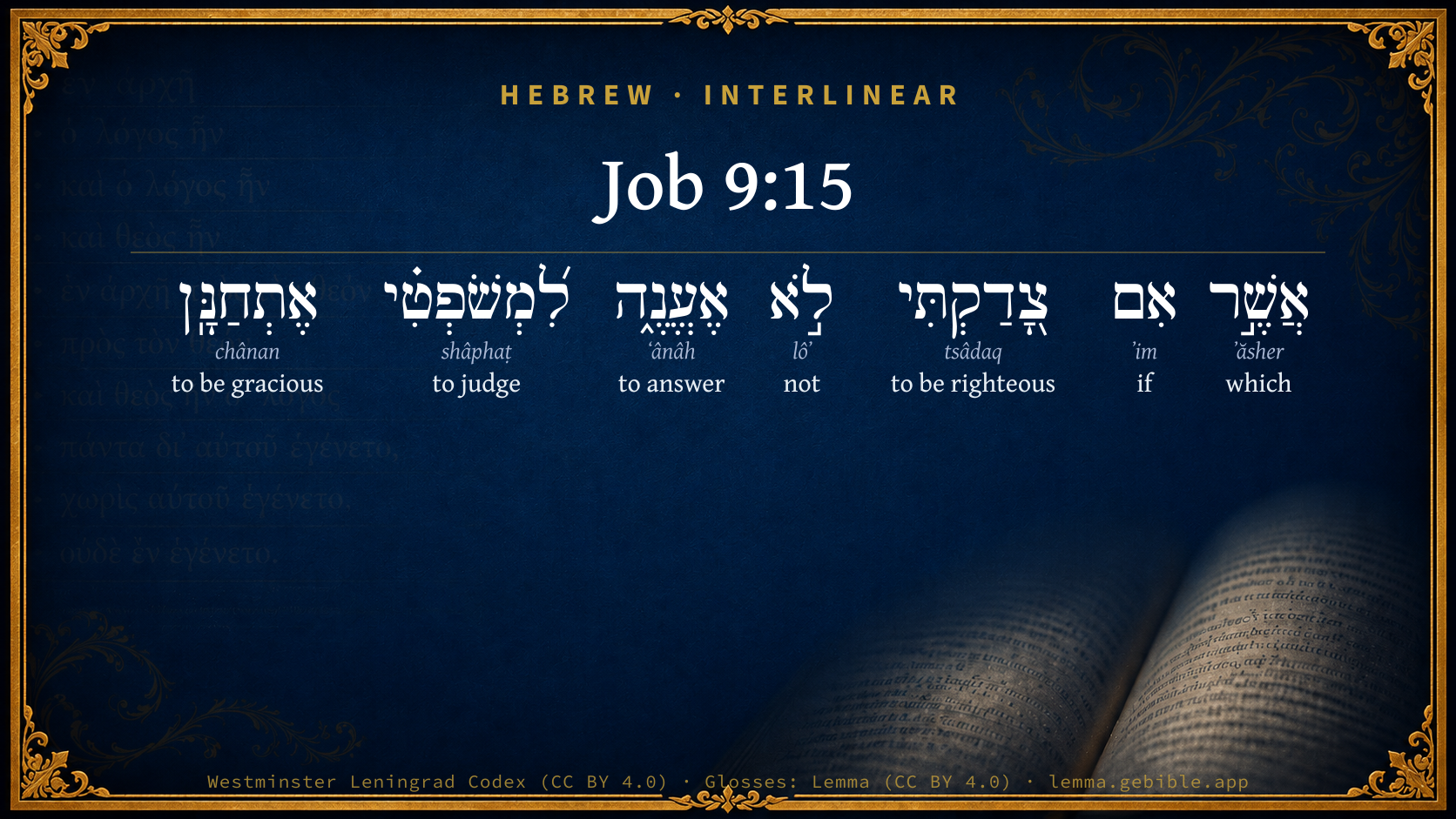
  1. אֲשֶׁ֣ר ʼăsher H834 “which” Particle, Relative
  2. אִם ʼim H518 “if” Conjunction
  3. לֹ֣א lôʼ H3808 “not” Particle, Negative
  4. אֶעֱנֶ֑ה ʻânâh H6030 “to answer” Verb, Qal, Imperfect, 1st Person, Common, Singular
  5. לִ֝מְשֹׁפְטִ֗י shâphaṭ H8199 “to/for · judging · me” Preposition + Verb, Poel, Participle Active, Masculine, Singular, Construct + Suffix, Personal, 1st Person, Common, Singular
  6. אֶתְחַנָּֽן chânan H2603 “to be gracious” Verb, Hithpael, Imperfect, 1st Person, Common, Singular

About this verse

These counts appear in no published source. They are computed here, from the morphology-tagged text and Lemma’s own curated glosses. What Lemma adds →

7
words
7
distinct lemmas
Wisdom
section

Shared distinctive vocabulary

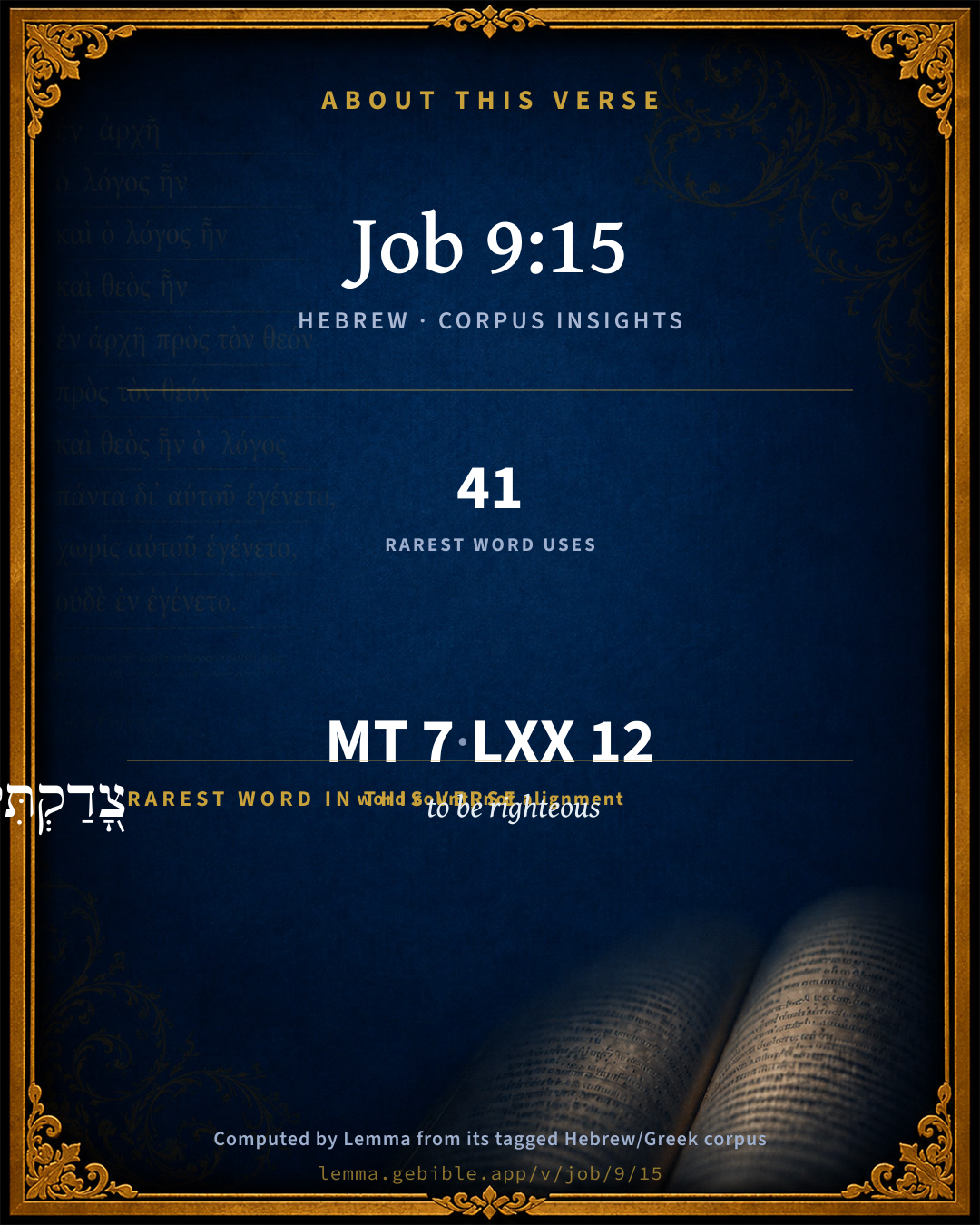
צָ֭דַקְתִּי to be righteous H6663 occurs in 40 verses of the Hebrew Bible. Also found in:

Grammatical profile

  • 4 verbs
  • 1 conjunction
  • 2 particles

Verb forms

  • צָ֭דַקְתִּי Qal · Perfect
  • אֶעֱנֶ֑ה Qal · Imperfect
  • לִ֝מְשֹׁפְטִ֗י Poel · Participle Active
  • אֶתְחַנָּֽן Hithpael · Imperfect

Hebrew & Septuagint length

In English translation the verse runs 17 words from the Hebrew and 16 from the Septuagint (LXX English) — closely comparable.

A rough comparison of the two English renderings, which tokenize alike — not a word-level alignment.

Word counts can differ between the Hebrew and the Greek without any difference in meaning — e.g. the Hebrew direct-object marker אֵת has no separate Greek word, and Greek often adds the article ὁ.

In the original languages it is 7 Hebrew tokens and 12 Greek tokens — but the two are counted differently (Hebrew bundles its prefixes and suffixes into one token; the Greek is in lemma form), so that isn’t a like-for-like length.

Cross-references

14

Topical passages linked to Job 9:15 in the Treasury of Scripture Knowledge — connected by theme and wording, ordered by reader-vote popularity; previews shown in the World English Bible.

  • Job 10:15 If I am wicked, woe to me. If I am righteous, I still shall not lift up my head, Being filled with disgrace, And conscious of my affliction.
  • Job 8:5 If you want to seek God diligently, Make your supplication to the Almighty.
  • Job 5:8 "But as for me, I would seek God, To God would I commit my cause;
  • Job 10:2 I will tell God, 'Do not condemn me, Show me why you contend with me.
  • Job 22:27 You shall make your prayer to him, and he will hear you. You shall pay your vows.
  • 1 Peter 2:23 Who, when he was cursed, didn't curse back. When he suffered, didn't threaten, but committed himself to him who judges righteously;
  • 1 Kings 8:38–39 whatever prayer and supplication be made by any man, [or] by all your people Israel, who shall know every man the plague of his own heart, and spread forth his hands toward this house:
  • 2 Chronicles 33:13 He prayed to him; and he was entreated of him, and heard his supplication, and brought him again to Jerusalem into his kingdom. Then Manasseh knew that Yahweh he was God.
  • Job 23:7 There the upright might reason with him, So I should be delivered forever from my judge.
  • Job 34:31–32 "For has any said to God, 'I am guilty, but I will not offend any more.
  • Jeremiah 31:9 They shall come with weeping; and with petitions will I lead them: I will cause them to walk by rivers of waters, in a straight way in which they shall not stumble; for I am a father to Israel, and Ephraim is my firstborn.
  • Daniel 9:3 I set my face to the Lord God, to seek by prayer and petitions, with fasting and sackcloth and ashes.
  • Daniel 9:18 My God, turn your ear, and hear; open your eyes, and see our desolations, and the city which is called by your name: for we do not present our petitions before you for our righteousness, but for your great mercies' sake.
  • 1 Corinthians 4:4 For I know nothing against myself. Yet I am not justified by this, but he who judges me is the Lord.

Cross-references courtesy of OpenBible.info (CC BY 4.0).

Hebrew and Greek witnesses Masoretic Hebrew ↔ Greek Septuagint

The same verse in the two great witnesses to the Old Testament, shown verse-for-verse.

These are two independent witnesses, not word-aligned to each other, and the Septuagint is shown in lemma (dictionary) form.

Hebrew Job 9:15 Masoretic · Westminster Leningrad Codex

אֲשֶׁ֣ר אִם צָ֭דַקְתִּי לֹ֣א אֶעֱנֶ֑ה לִ֝מְשֹׁפְטִ֗י אֶתְחַנָּֽן

Whom, though I were righteous, yet would I not answer. I would make supplication to my judge.

World English Bible · Public Domain

Greek LXX Job 9:15 Septuagint · lemma form

ἐάν τε γάρ εἰμί δίκαιος οὐ εἰςἀκούω ἐγώ ὁ κρίμα αὐτός δέω

For though I be righteous, he will not listen to me: I will entreat his judgment.

LXX2012 (modern English Septuagint) · Public Domain

Hebrew: Westminster Leningrad Codex (CC BY 4.0). Greek: Septuagint (public domain); English from LXX2012 (modern English Septuagint) (Public Domain). How the Septuagint differs from the Hebrew →

Commentary

Notes on Job 9:15 from classic Christian and Jewish commentators (each source and its license shown beneath its notes). The classic Christian expositions comment on the surrounding passage and are grouped to its opening verse, so a note may address several verses; the Jewish commentaries on the Tanakh (Rashi and others) are per-verse, so they appear only where the commentator wrote on this verse.

Lemma curates 59 commentaries, every one of them public domain or Creative Commons licensed, each selected and text-cleaned for this edition rather than reprinted as found. About our sources →

Trapp's Complete Commentary

John Trapp

Job 9:15 Whom, though I were righteous, [yet] would I not answer, [but] I would make supplication to my judge.

Ver. 15. Whom though I were righteous] Legally righteous, as none ever were, but the first and second Adam.

Yet would I not answer] viz. By pleading mine own righteousness, since no created righteousness can answer God. Some render it, non attollam vocem, ne hiscere quidem audebo, I will not lift up my voice, nor dare to mute against him. {see 1Co 4:4} No, though I were never so innocent, and did suffer this misery undeservedly.

But I would make supplication to my judge] As he doth, though it were a good while first, in the end of the next chapter. It is likely that he intended to do it sooner, but was put by by his passions; which, when they fume up into the head, gather oft into so thick a cloud, that we lose the sight of ourselves, and what is best to be done. Jonah thought to have prayed, Jon 4:1-2, but it proved a brawl; and when as by prayer he thought to overcome his anger, anger overcame him and his prayer too.

John Trapp, A Commentary or Exposition upon All the Books of the Old and New Testament (1647–1656) — public domain. Text from a community e-Sword module.

Geneva Bible (1599)

Geneva Bible translators

Meaning, in his own opinion, signifying, that man will sometimes flatter himself to be righteous, which before God is abomination.

Geneva Bible (1599) marginal notes — public domain. Text via Bolls.life.

Jamieson, Fausset & Brown

Robert Jamieson, A. R. Fausset & David Brown

(Job 10:15). Though I were conscious of no sin, yet I would not dare to say so, but leave it to His judgment and mercy to justify me (Co1 4:4).

Jamieson, Fausset & Brown — Commentary Critical and Explanatory on the Whole Bible (1871) — public domain (CC PDM 1.0). Text via the HelloAO Bible API.

Adam Clarke's Commentary

Verse 15. Though I were righteous] Though clear of all the crimes, public and secret, of which you accuse me, yet I would not dare to stand before his immaculate holiness. Man's holiness may profit man, but in the sight of the infinite purity of God it is nothing. Thus sung an eminent poet: -

"I loathe myself when God I see,

And into nothing fall;

Content that thou exalted be,

And Christ be all in all."

I would make supplication to my Judge.] Though not conscious of any sin, I should not think myself thereby justified; but would, from a conviction of the exceeding breadth of the commandment, and the limited nature of my own perfection, cry out, "Cleanse thou me from secret faults!"

Adam Clarke's Commentary on the Bible (1810–1826) — public domain. Text from a community e-Sword/MySword module.

Ellicott's Commentary for English Readers

(15) Though I were righteous.—He now puts the alternative case: that he were actually righteous; yet even then supplication, and not assertion, would best become him.

A Bible Commentary for English Readers, edited by Charles John Ellicott (1878–1897) — public domain. Text from a community e-Sword module.

The Cambridge Bible for Schools and Colleges

gen. ed. J. J. S. Perowne

15. though I were righteous] i. e. though I were in the right, though my cause was just against Him.

make supplication to my judge] Rather, to mine adversary, or opponent. Had Job right on his side he could not maintain it; overpowered by the irresistible and awful might of his opponent he would desert his own just plea and supplicate his adversary.

The Cambridge Bible for Schools and Colleges (gen. ed. J. J. S. Perowne; Cambridge University Press, 1878–1918) — public domain. Text from a community e-Sword module.

John Gill's Exposition

If I had called, and he had answered me,.... Mr. Broughton reads the words, "if I cry, will he answer me?" as if Job had some doubt upon his mind whether God would vouchsafe to answer him, though he should make his supplication to him, as he proposed; seeing he had so sorely afflicted him, and still continued his hand upon him; or the words may be rendered, "though I have called, and he has answered" (q), in times past. Job was a praying person, he had often prayed to God in his closet, and in his family, for himself, and for his children, and for his friends, and he had found God to be a God hearing and answering prayer, but seems to question whether he would answer him now, if he did pray to him:

yet would I not believe that he had hearkened unto my voice, or "would hearken" (r), at this time, and under the present circumstances; or should he, the mercy would be so great, that he could hardly believe it; so sometimes through joy men cannot believe what they hear and see, as the apostles, when Christ appeared to them after his resurrection; or as it was with the Jews returned from Babylon, they were like them that dream, they could scarcely tell whether their deliverance was a real fact, or whether they only dreamed of it, see Luk 24:41; so Job intimates, that should he pray to God, and be heard and delivered, it would be so astonishing and transporting, that at first he should not be able to give credit to it; or, however, he should not believe that it was for his prayers and supplications, for any worth and value, virtue and efficacy, there was in them, that he was heard; but it must be purely for his mercy's sake, for the sake of the mediation of Christ, and because these prayers were the breathings of his own spirit: or else the sense is, that though he had heard and answered him formerly, when he prayed in a supplicating way, yet if he should contend with him in a judicial way, and insist upon his own righteousness, and present his supplication to God on that account, he could never expect to be heard; and, indeed, he could not believe he should be heard on any account, so long as his present sufferings lasted; which seems to be the sense of what follows, where he gives his reasons for such belief, or rather unbelief.

(q) "etiamsi clamavi et respondit mihi", Schmidt. (r) "quod exauditurus esset", Schmidt.

John Gill's Exposition of the Whole Bible (1746–1763) — public domain (CC PDM 1.0). Text via the HelloAO Bible API.

Albert Barnes' Notes on the Bible

Whom, though I were righteous - That is, if I felt the utmost confidence that I was righteous, yet, if God judged otherwise, and regarded me as a sinner, I would not reply to him, but would make supplication to him as a sinner. I would have so much confidence in him, and would feel that he was so much better qualified than I am to judge, and that I am so liable to be deceived, that I would come to him as a sinner, if he judged and declared me to be one, and would plead for pardon. The meaning is, that God is a much better judge of our character than we can possibly be, and that his regarding us as sinners is the highest proof that we are such, whatever may be our views to the contrary. This shows the extent of the confidence which Job had in God and is an indication of true piety. And it is founded in reason as well as in piety. Men often suppose that they are righteous, and yet they know that God adjudges otherwise, and regards them as sinners. He offers them pardon as sinners. He threatens to punish them as sinners. The question is, whether they shall act on their own feelings and judgment in the case, or on his? Shall they adhere obstinately to their views, and refuse to yield to God, or shall they act on the truth of his declarations? Now that Job was right in his views of the case, may appear from the following considerations.

(1) God knows the heart. He cannot be deceived; we may be. In nothing are we more liable to be deceived than in regard to our own character. We should, therefore, distrust our own judgment in this case, but we should never distrust God.

(2) God is infinitely benevolent, and will not judge unkindly. He has no wish to find us sinners; he will have no pleasure in making us out to be transgressors. A heart of infinite benevolence would prefer to find all people holy, and would look on every favorable circumstance in the case with all the kindness which it would deserve. No being would be so likely to make a favorable decision in our case as the infinitely benevolent God; none would so delight to find that we were free from the charge of guilt.

(3) God will act on his own views of our character, and not on ours; and it is prudent and wise, therefore, for us to act on his views now. He will judge us in the last day according to his estimate of our character, and not according to the estimate which we may form.

(4) At the same time, we cannot but accord with his views of our own character. Our reason and conscience tell us that we have violated his laws, and that we have no claim to his mercy. No man can persuade himself that he is wholly righteous; and being conscious of guilt, though in the slightest degree, he should make supplication to his Judge.

Albert Barnes' Notes on the Bible (1834–1885) — public domain. Text from a community e-Sword/MySword module.

Matthew Poole's English Annotations

Though I were righteous; though I had a most just cause, and were not conscious to myself of any sin.

Yet would I not answer, i.e. I durst not undertake to plead my cause against him, or maintain my integrity before him, because he knows me better than I know myself, and because I am wholly in his hands, and at his mercy.

I would make supplication to my Judge, to wit, that he would hear me meekly, and judge favourably of me and my cause, and not according to the rigours of his justice.

Matthew Poole's English Annotations on the Holy Bible (1683–1685) — public domain. Text from a community e-Sword/MySword module.

Whedon's Commentary on the Bible

Daniel D. Whedon

15. Righteous — In the right, used in a forensic sense.

Daniel D. Whedon (gen. ed.), Commentary on the Old and New Testaments (1874–1909) — public domain. Text from a community e-Sword module.

The Pulpit Commentary

Whom, though I were righteous, yet would I not answer. Even perfect righteousness, so far as possible in a creature, would not enable a non to stand up in controversy with him who "charges his angels with folly"; (Job_4:18) and, moreover, to such righteousness Job does not pretend. (see Job_7:20, Job_7:21) But I would make supplication to my Judge; rather, to mine adversary (see the Revised Version). Prayer is the only rightful attitude of even the best man before his Maker prayer for mercy, prayer for pardon"prayer for grace, prayer for advance in holiness.

Vers. 15, 16. The true attitude of the afflicted.

Job makes a suitable reflection on the almightiness of Jehovah, seen in his control over the visible world. The lofty and deep-seated mountains, the very types of might and stability, he "removeth" without their knowing, and "overturneth in his wrath." He "shaketh" the whole "earth out of her place," and maketh the "pillars thereof to tremble." In the high heavens "he commandeth the sun, and it riseth not;" and "the stars" he "sealeth up" in darkness. The earth and the heavens obey him; and he "treadeth upon the waves of the sea." He doeth hidden and numberless things, and none can hinder him. Job, in view of this, and with a lowly recognition of his own powerlessness before the Lord of all, bows himself down in the attitude most becoming to the feeble, afflicted, and sinful child of man. It is

I AN ATTITUDE OF LOWLY HUMILITY. How becoming! How just! Let the creature bow low before the Creator. Let the feeble thing of a day humble himself before the Eternal and the Almighty. Let him who is powerless before the mountains and the sea, who cannot touch the stars, take his place in the dust, whence he is, in presence of him who by his power setteth fast the mountains; who by his word Created the heavens and the earth, and upholdeth all by his own unaided strength. Lowliness will be followed by

II AN ATTITUDE OF SELF-DISTRUST. Knowing himself as he only can who reflects on the greatness of the Most High, the wise, afflicted one will not trust to an arm of strength; but, in the painful consciousness of his own weakness, will commit himself to the strong Lord who is over all. Job knows, as every afflicted one, that his suffering holds him as in a net, from which he cannot break loose. He has no power. He is chained, held down. His own flesh triumphs over him. He is a prisoner to disease. In his helplessness, with self-distrustfulness he casts himself into the arms of God. He would not pretend to make answer, or to "choose out words to reason with him." His self-distrust is followed by

III PENITENCE the one attitude of all the most becoming to man. In penitence he acknowledges his unrighteousness. And so deep is that penitence, that he declares, "Though I were able to establish my righteousness, yet I could not presume to answer." Penitence is the pathway to heaven"s gate. He who lowly walks, walks surely. And God lifteth up them who thus bow themselves down. But he rises

IV TO THE ATTITUDE OF PRAYER. He lifts his voice to God. He makes his "supplication." He who is led to pray is led to the feet of him who casts away no needy suppliant. It is his high prerogative to hear prayer. Therefore all flesh, in their want, their sorrow, their sin, or with their songs of praise, come to him. Man"s safety is here. The lowly, self-distrustful, humble penitent cannot raise his voice on high without the gracious response of the Divine mercy reaching him. To this men are driven

(1) by their sense of impotence;

(2) by the consciousness of sin;

(3) by the assurance of the Divine mercy.

Happy he who thus learns! R.G.

The Pulpit Commentary (1880–1919), ed. H.D.M. Spence-Jones & Joseph S. Exell — public domain. Text from a community e-Sword module.

John Wesley's Explanatory Notes

Tho' - Though I were not conscious to myself of any sin. Would not - I durst not undertake to plead my cause against him; or maintain my integrity before him, because he knows me better than I know myself. Supplication - That he would judge favourably of me and my cause, and not according to the rigor of his justice.

John Wesley, Explanatory Notes Upon the Whole Bible (1754–1765) — public domain. Text via the GEBible commentary corpus.

Rashi

Rabbi Shlomo Yitzchaki (Rashi)

I will not reply I will fear to raise my voice before Him.

my Judge Heb. למשפטי, like לשופטי.

Rashi on the Tanakh — English translations: “The Judaica Press complete Tanach with Rashi, translated by A. J. Rosenberg” (CC BY 4.0); “Pentateuch with Rashi's commentary by M. Rosenbaum and A.M. Silbermann, 1929-1934” (public domain); “The Metsudah Tanach series, Lakewood, N.J” (CC BY 4.0); and “The Book of Joshua, Metsudah Publications, 1997” (CC BY 4.0). Text via Sefaria.

Lesson kit

Teaching starters — assembled from the data on this page, not authored interpretation. Every prompt links to the verse data it draws on. Edit before teaching.

Job, in the Wisdom, opens this verse with 7 words (7 distinct Hebrew lemmas). Its most distinctive word is tsâdaq (“to be righteous”). A historical commentator’s framing appears above. Read the whole chapter for the surrounding context.

Discussion questions

  1. How does “to be righteous” (tsâdaq) shape what this verse is saying?
  2. Genesis 38:26 shares the word «to be righteous» with this verse. How do the two illuminate each other?
  3. These translations render this verse differently. What is at stake in choosing one wording over another?
  4. The verb «צָ֭דַקְתִּי» is Qal Perfect. How does its form color the action?
  5. Reading how Trapp's Complete Commentary and Geneva Bible (1599) read this verse, where do the two commentators agree and where do they part?

Things to notice

Reading settings

Reading text

Shown beneath each verse's original-language words.

Old Testament
Old Testament edition

Read the OT as the Masoretic Hebrew (MT) or the Greek Septuagint (LXX).

English shown for the Greek Septuagint (in the Hebrew ↔ Greek comparison).

Comparing translations? Open the Compare panel on any verse page to stack up to four side by side.