

Psalms 141:6

Hebrew (Westminster Leningrad Codex) Psalms 141:6 appears in the Hebrew Old Testament. The text above is from the Westminster Leningrad Codex. Each word links to its Strong’s number, a concise gloss, and parsing drawn from the Open Scriptures Hebrew Bible morphology. Click any word for its full Brown-Driver-Briggs (BDB) entry.
Download image
Cite this verse

Psalms 141:6 (World English Bible). Public Domain. Lemma interlinear Bible study tool, https://lemma.gebible.app/v/psalms/141/6.

Show BibTeX & RIS
BibTeX
RIS
English Translation
Their judges are thrown down by the sides of the rock. They will hear my words, for they are well spoken.
World English Bible · Public Domain
Download a study sheet

One document with this verse’s original text, its word-by-word gloss line, the meaning frame, cross-references with their text, attributed commentary, and full source and license credits — printable, and it pastes into notes with its structure intact.

This verse Autodidact and up

Study sheet (.html) Plain text (.txt)

A passage Seminary Student

Up to 50 verses in one chapter. A passage sheet keeps up to 6 commentary sources and 12 cross-references per verse, in the order this page ranks them, and says so on the sheet whenever that leaves anything out. Ask for a single verse and you get the Autodidact verse sheet above.

Everything on this page stays free to read, with no account — the sheet is a download of what is already on screen, not access to it.

Want to remove ads? Support Godless Engineer
Compare translations 3

The same verse in 3 English versions, stacked beneath the original-language interlinear above. Click any original word for its lexicon entry.

Each is an independent rendering of the whole verse — the interlinear is not word-aligned to these translations.

Highlighted words mark where these versions differ — a whole-verse word diff, not a word-by-word alignment.

  • World English Bible Public Domain
    Their judges are thrown down by the sides of the rock. They will hear my words, for they are well spoken.
  • King James Version Public Domain
    When their judges are overthrown in stony places, they shall hear my words; for they are sweet.
  • unfoldingWord Literal Text CC BY-SA 4.0
    Their judges are thrown down beside a cliff; and they hear my words, that they are pleasant.

unfoldingWord Literal Text — © unfoldingWord, licensed CC BY-SA 4.0. Word-aligned USFM3 via Door43 (git.door43.org/unfoldingWord/en_ult).

Versions to compare (up to 4)

3 of 4 selected

Show all 18 translations

Every available English version of this verse, each an independent rendering of the whole verse.

  • World English Bible Public Domain
    Their judges are thrown down by the sides of the rock. They will hear my words, for they are well spoken.
  • Berean Standard Bible Public Domain
    When their rulers are thrown down from the cliffs, the people will listen to my words, for they are pleasant.
  • Majority Standard Bible Public Domain
    When their rulers are thrown down from the cliffs, the people will listen to my words, for they are pleasant.
  • King James Version Public Domain
    When their judges are overthrown in stony places, they shall hear my words; for they are sweet.
  • American Standard Version (1901) Public Domain
    Their judges are thrown down by the sides of the rock; And they shall hear my words; for they are sweet.
  • Revised Version (1885) Public Domain
    Their judges are thrown down by the sides of the rock; and they shall hear my words; for they are sweet.
  • Geneva Bible (1599) Public Domain
    When their iudges shall be cast downe in stonie places, they shall heare my wordes, for they are sweete.
  • Douay-Rheims (1899) Public Domain
    the proud have hidden a net for me. And they have stretched out cords for a snare: they have laid for me a stumblingblock by the wayside.
  • Young's Literal Translation Public Domain
    Their judges have been released by the sides of a rock, And they have heard my sayings, For they have been pleasant.
  • Literal Standard Version CC BY-SA 4.0
    Their judges have been released by the sides of a rock, || And they have heard my sayings, || For they have been pleasant.
  • Unlocked Literal Bible CC BY-SA 4.0
    Their leaders will be thrown down from the top of cliffs; they will hear that my own words are pleasant.
  • unfoldingWord Literal Text CC BY-SA 4.0
    Their judges are thrown down beside a cliff; and they hear my words, that they are pleasant.
  • Darby Bible Public Domain
    When their judges are thrown down from the rocks, they shall hear my words, for they are sweet.
  • World Messianic Bible Public Domain
    Their judges are thrown down by the sides of the rock. They will hear my words, for they are well spoken.
  • Webster's Bible Public Domain
    When their judges are overthrown in stony places, they shall hear my words; for they are sweet.
  • Free Bible Version CC BY-SA 4.0
    They shall be thrown down by the power of the rock that judges them, and then they will recognize what I said was true!
  • Bible in Basic English Public Domain
    When destruction comes to their judges by the side of the rock, they will give ear to my words, for they are sweet.
  • JPS Tanakh (1917) Public Domain
    Their judges are thrown down by the sides of the rock; and they shall hear my words, that they are sweet.

Literal Standard Version (2020), Covenant Press — licensed CC BY-SA 4.0. Text via the HelloAO Bible API (eBible.org). Unlocked Literal Bible (unfoldingWord) — licensed CC BY-SA 4.0. Text via the HelloAO Bible API (eBible.org). unfoldingWord Literal Text — © unfoldingWord, licensed CC BY-SA 4.0. Word-aligned USFM3 via Door43 (git.door43.org/unfoldingWord/en_ult). Free Bible Version, Dr. Jonathan Gallagher — licensed CC BY-SA 4.0. Text via the HelloAO Bible API (eBible.org).

Word by word

More ways to search: Search by grammar → Find every occurrence → Compare this word →

Practice this passage: Drill this verse → Learn its vocabulary →

About this verse

These counts appear in no published source. They are computed here, from the morphology-tagged text and Lemma’s own curated glosses. What Lemma adds →

8
words
8
distinct lemmas
Wisdom
section

Notable vocabulary

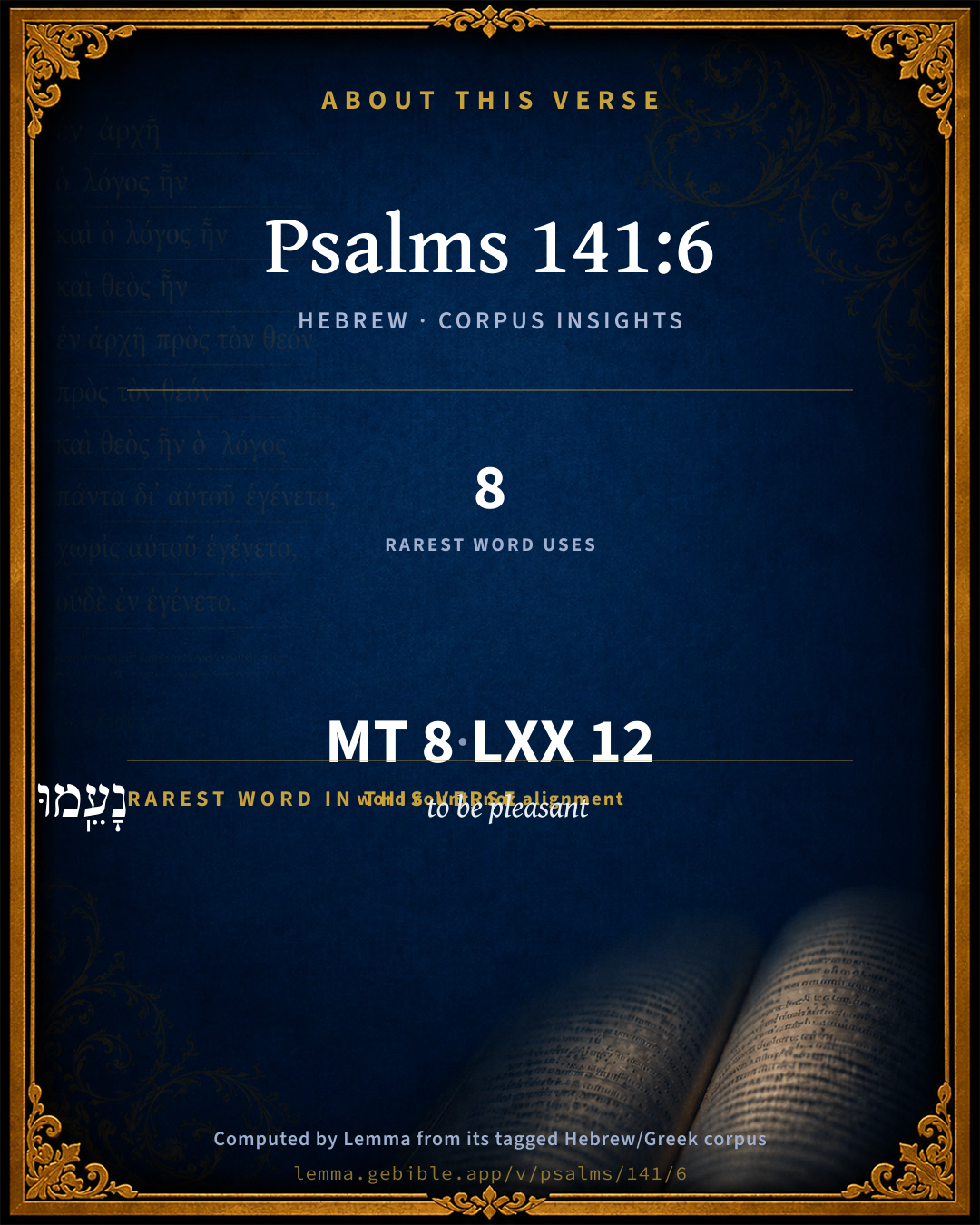
The rarest word here is נָעֵֽמוּ to be pleasant H5276 — appearing just 8 times in the whole Hebrew Bible.

Shared distinctive vocabulary

נָעֵֽמוּ to be pleasant H5276 occurs in 8 verses of the Hebrew Bible. Also found in:

Grammatical profile

  • 4 verbs
  • 3 nouns
  • 1 conjunction

Verb forms

  • נִשְׁמְט֣וּ Niphal · Perfect
  • שֹׁפְטֵיהֶ֑ם Qal · Participle Active
  • וְשָׁמְע֥וּ Qal · Sequential Perfect
  • נָעֵֽמוּ Qal · Perfect

Hebrew & Septuagint length

In English translation the verse runs 21 words from the Hebrew and 19 from the Septuagint (LXX English) — closely comparable.

A rough comparison of the two English renderings, which tokenize alike — not a word-level alignment.

Word counts can differ between the Hebrew and the Greek without any difference in meaning — e.g. the Hebrew direct-object marker אֵת has no separate Greek word, and Greek often adds the article ὁ.

In the original languages it is 8 Hebrew tokens and 12 Greek tokens — but the two are counted differently (Hebrew bundles its prefixes and suffixes into one token; the Greek is in lemma form), so that isn’t a like-for-like length.

Cross-references

12

Topical passages linked to Psalms 141:6 in the Treasury of Scripture Knowledge — connected by theme and wording, ordered by reader-vote popularity; previews shown in the World English Bible.

  • 2 Chronicles 25:12 [other] ten thousand did the children of Judah carry away alive, and brought them to the top of the rock, and cast them down from the top of the rock, so that they all were broken in pieces.
  • 1 Samuel 31:1–8 Now the Philistines fought against Israel: and the men of Israel fled from before the Philistines, and fell down slain on Mount Gilboa.
  • 2 Samuel 1:17–27 David lamented with this lamentation over Saul and over Jonathan his son
  • 2 Samuel 2:4–6 The men of Judah came, and there they anointed David king over the house of Judah. They told David, saying, The men of Jabesh Gilead were those who buried Saul.
  • 2 Samuel 5:1–3 Then came all the tribes of Israel to David to Hebron, and spoke, saying, Behold, we are your bone and your flesh.
  • 2 Samuel 23:1 Now these are the last words of David. David the son of Jesse says, The man who was raised on high says, The anointed of the God of Jacob, The sweet psalmist of Israel:
  • 1 Chronicles 10:1–7 Now the Philistines fought against Israel: and the men of Israel fled from before the Philistines, and fell down slain on Mount Gilboa.
  • 1 Chronicles 11:1–3 Then all Israel gathered themselves to David to Hebron, saying, Behold, we are your bone and your flesh.
  • 1 Chronicles 12:38 All these being men of war, who could order the battle array, came with a perfect heart to Hebron, to make David king over all Israel: and all the rest also of Israel were of one heart to make David king.
  • 1 Chronicles 13:2 David said to all the assembly of Israel, If it seem good to you, and if it be of Yahweh our God, let us send abroad everywhere to our brothers who are left in all the land of Israel, with whom the priests and Levites are in their cities that have suburbs, that they may gather themselves to us;
  • Psalms 45:2 You are the most excellent of the sons of men. Grace has anointed your lips, Therefore God has blessed you forever.
  • Luke 4:22 All testified about him, and wondered at the gracious words which proceeded out of his mouth, and they said, "Isn't this Joseph's son?"

Cross-references courtesy of OpenBible.info (CC BY 4.0).

Hebrew and Greek witnesses Masoretic Hebrew ↔ Greek Septuagint

The same verse in the two great witnesses to the Old Testament, shown verse-for-verse.

You’re reading Greek Psalm 140 (Hebrew Psalm 141). The Septuagint counts the superscription, so verse numbers can differ from the Hebrew — chapter-level alignment, not verse-by-verse. Numbering follows Rahlfs.

These are two independent witnesses, not word-aligned to each other, and the Septuagint is shown in lemma (dictionary) form.

Hebrew Psalms 141:6 Masoretic · Westminster Leningrad Codex

נִשְׁמְט֣וּ בִֽידֵי סֶ֭לַע שֹׁפְטֵיהֶ֑ם וְשָׁמְע֥וּ אֲ֝מָרַ֗י כִּ֣י נָעֵֽמוּ

Their judges are thrown down by the sides of the rock. They will hear my words, for they are well spoken.

World English Bible · Public Domain

Greek LXX Greek Psalm 140:6 Septuagint · lemma form

καταπίνω ἔχω πέτρα ὁ κριτής αὐτός ἀκούω ὁ ῥῆμα ἐγώ ὅτι ἡδύνω

Their mighty ones have been swallowed up near the rock: they shall hear my words, for they are sweet.

LXX2012 (modern English Septuagint) · Public Domain

Hebrew: Westminster Leningrad Codex (CC BY 4.0). Greek: Septuagint (public domain); English from LXX2012 (modern English Septuagint) (Public Domain). How the Septuagint differs from the Hebrew →

Commentary

Notes on Psalms 141:6 from classic Christian and Jewish commentators (each source and its license shown beneath its notes). The classic Christian expositions comment on the surrounding passage and are grouped to its opening verse, so a note may address several verses; the Jewish commentaries on the Tanakh (Rashi and others) are per-verse, so they appear only where the commentator wrote on this verse.

Lemma curates 59 commentaries, every one of them public domain or Creative Commons licensed, each selected and text-cleaned for this edition rather than reprinted as found. About our sources →

Trapp's Complete Commentary

John Trapp

Psa 141:6 When their judges are overthrown in stony places, they shall hear my words; for they are sweet.

Ver. 6. When their judges are overthrown] As I like just reprehensions, so I suffer unjust persecutions from the grandees of the nation, who shall shortly be dejected from their dignity, and dashed, as it were, against the rocks. And then,

They shall hear my words] The common people that have been seduced by their evil rulers to think the worst of me, shall be brought to a right understanding of things, and undeceived; so that they shall set by those words of mine that they have been treated contemptuously and slighted.

John Trapp, A Commentary or Exposition upon All the Books of the Old and New Testament (1647–1656) — public domain. Text from a community e-Sword module.

Joseph Benson's Commentary

Psa 141:6. When their judges are overthrown, &c. — “Of this verse, as it stands in our translation,” says Dr. Horne, “I know not what can be made. When literally rendered from the Hebrew, it runs thus; Their judges have been dismissed in the sides of the rock,” נשׁמשׂו בירי סלע, “and have heard my words that they were sweet. David, reflecting on Saul’s cruelty in driving him out of his country to wander among aliens and idolaters, very naturally calls to mind, and mentions his own different behaviour toward that implacable enemy, whose life he had spared two several times, when he had it in his power to destroy him as he pleased.” This is also Mr. Peters’s interpretation of the passage, who translates it as above, understanding, by שׁפשׂיהם, rendered their judges, their leaders, or generals, according to the frequent usage of the word in Scripture. The sense evidently is, “Their princes have been dismissed in safety when I had them at an advantage in those rocky deserts, and they only heard me expostulate with them in the gentlest words;” indeed, “in a manner so mild and humble that even Saul himself was overcome, and lift up his voice and wept, saying, My son David, thou art more righteous than I: the Lord reward thee good for what thou hast done unto me this day, 1Sa 24:16. Such has been my conduct toward the servants of Saul; yet how have my people, alas! been by them most miserably butchered!”

Joseph Benson's Commentary on the Old and New Testaments (1811–1818) — public domain. Text from a community e-Sword module.

J. A. Alexander on Psalms

Joseph Addison Alexander

6. (Psa 141:6) Thrown down among the rocks are their judges; and (then) they hear my words, for they are sweet. When the judgments in reserve for the leaders of my enemies shall come upon them, they will perceive too late how reasonable are my words, and wish that they had hearkened to them sooner. Thrown down, originally let go, here used as in 2Ki 9:33. Among the rocks, literally in (or into) the hands of the rock. Some understand this to mean into its power (see Psa 141:9 below); others, against its sides (see Psa 140:6); but the simplest explanation is that which supposes the rock to be personified and represented as standing below and holding out its hands to catch the person or thing falling. Some in the last clause read, that they are sweet. Then, when it is too late, they shall perceive how sweet my words are.

Joseph Addison Alexander, The Psalms Translated and Explained (1850) — public domain. Text from a community e-Sword module.

Geneva Bible (1599)

Geneva Bible translators

The people which followeth their wicked rulers in persecuting the Prophet, shall repent and turn to God, when they see their wicked rulers punished.

Geneva Bible (1599) marginal notes — public domain. Text via Bolls.life.

Adam Clarke's Commentary

Verse 6. When their judges are overthrown in stony places] בידי סלע biyedey sela, "In the hands of the rock." Does this rock signify a strong or fortified place; and its hands the garrison which have occupied it, by whom these judges were overthrown? If we knew the occasion on which this Psalm was made, we might be the better able to understand the allusions in the text.

They shall hear my words; for they are sweet.] Some think there is here an allusion to David's generous treatment of Saul in the cave of En-gedi, and afterwards at the hill of Hachilah, in this verse, which might be translated: "Their judges have been dismissed in the rocky places; and have heard my words, that they were sweet." Or perhaps there may be a reference to the death of Saul and his sons, and the very disastrous defeat of the Israelites at Gilboa. If so, the seventh verse will lose its chief difficulty, Our bones are scattered at the grave's mouth; but if we take them as referring to the slaughter of the priests at Nob, then, in stead of translating לפי שאול lephi sheol, at the grave's mouth, we may translate at the command of Saul; and then the verse will point out the manner in which those servants of the Lord were massacred; Doeg cut them in pieces; hewed them down as one cleaveth wood. Some understand all this of the cruel usage of the captives in Babylon. I could add other conjectures, and contend for my own; but they are all too vague to form a just ground for decided opinion.

Adam Clarke's Commentary on the Bible (1810–1826) — public domain. Text from a community e-Sword/MySword module.

John Calvin's Commentaries

6. Their judges have been thrown down upon stony places Those who understand this verse as containing an allusion to the generous manner in which David acted towards Saul in the cave of En-gedi, and to his mild expostulation after they had both left the cave, translate thus: —

“Their princes on the sides of the rock were dismissed, or let go in safety; And they heard my words that they were pleasant.”

This exactly corresponds with the occurrences referred to. In correspondence with the first line, it, is said in 1 Samuel 24:2, that Saul and his chosen men went to seek David upon the rocks of the wild goats; and the terms in which David expostulated with Saul, were so gentle, dutiful and affecting, as for the time to melt into tenderness and contrition the heart of Saul, and to impress the minds of all who heard them.

John Calvin's Commentaries (1540-1563) — public domain. Text from the Calvin Translation Society English edition (1840s-50s) via the Christian Classics Ethereal Library (ccel.org). Calvin's coverage is partial (roughly two-thirds of the Bible); uncommented books and verses are honest gaps, never fabricated. The 19th-century editor's footnotes and remarks are omitted so the notes are faithfully Calvin's own voice.

Ellicott's Commentary for English Readers

(6) This verse again is full of obscurities. The first clause probably should be rendered, Let their judges be broken to pieces by the force (literally, hands) of the rock; or, let their judges be cast down by the sides of the cliff—i.e., hurled down the precipitous face of the ravine (See 2Ch_25:12, and notice that the word here is “Sela‘,” the name of the capital of Edom; comp. Hos_10:14; Psa_137:9, where, however, the expression is “against the cliff.”)

They shall . . .—Better, then shall they hear my words; how dainty they are, &c. The expression is ironical. The ungodly party, when their power is broken, instead of being entertained by the poet at a licentious banquet, will listen indeed to his words—shall hear a “dainty song” from him—viz., “a song of triumph.”

A Bible Commentary for English Readers, edited by Charles John Ellicott (1878–1897) — public domain. Text from a community e-Sword module.

The Cambridge Bible for Schools and Colleges

gen. ed. J. J. S. Perowne

6. When their judges have been thrown down by the sides of the cliff,

They (or men) will hear my words, that they are sweet.

6, 7. It is not difficult to translate these verses, but it seems impossible to give any satisfactory explanation of them in their present context. They may be rendered:

The Cambridge Bible for Schools and Colleges (gen. ed. J. J. S. Perowne; Cambridge University Press, 1878–1918) — public domain. Text from a community e-Sword module.

John Gill's Exposition

When their judges are overthrown in stony places,.... The judges of David's adversaries, the workers of iniquity; meaning Saul, Abner, &c. Arama refers this to Saul and his sons being slain on the mountains of Gilboa, Sa1 31:1; which might be here prophetically spoken of. Or, as it is by some rendered, "when their judges are let down by the sides of the rock" (d); or let go free, as Saul was by David more than once; when it was in the power of his hands to have taken away his life, which his principal friends urged him to do, Sa1 24:2. Some render the words as an imprecation or wish, "let their judges be cast down" (e); or as a prophecy, they "shall be cast dozen in stony places", or "by the sides of a rock": so the word is used of casting or throwing down, Kg2 9:33; and may allude to the manner of punishment used in some places, by casting down from a precipice, from rocks and hills; see Ch2 25:12. Or, "when they slip by the sides of the rock" (f); endeavouring to get up it; as ambitious men are desirous of getting to the top of honour, power, and authority, but stand in slippery places, and often slip and fall. And when this should be the case of these judges, then should David be raised up on high; the anointed of the God of Jacob, the sweet psalmist of Israel. And then

they shall hear my words, for these are sweet: that is, the common people should hear them, and be pleased with them, who had been set against him by their judges; by which they would easily perceive that he had no enmity nor malice, nor ill design against Saul. This may respect either his very affectionate lamentation at the death of Saul and his sons, Sa2 1:17; or what he delivered at the several times he spared the life of Saul, when he could have taken it away, Sa1 24:9; and it is especially true of all the words which David spoke by inspiration, or the Spirit of God spake to him; particularly in his book of Psalms, concerning the Messiah, the covenant of grace, and the blessings of it; of the rich experiences of grace he had, and the several doctrines of the Gospel declared by him; which were sweet, delightful, and entertaining to those who have ears to hear such things; or whose ears are opened to hear them, so as to understand them and distinguish them; but to others not.

(d) "demittentur per loca saxosa", Tigurine version; "demissi sunt in manus petrae", Montanus; "dimittunt se in lateribue petrarum", Piscator. (e) "Praecipitentur", Munster; "dejiciantur", Gejerus; "praecipites dentur", Musculus; so Kimchi. (f) "Lubricati sunt per latere petrae", Cocceius.

John Gill's Exposition of the Whole Bible (1746–1763) — public domain (CC PDM 1.0). Text via the HelloAO Bible API.

Albert Barnes' Notes on the Bible

When ... - This passage is no less difficult than the preceding, and it seems almost impossible to determine its exact meaning. What is meant by “judges”? What judges are referred to by the word “their”? What is meant by their being “overthrown”? What is the sense of the words “in stony places”? Does the passage refer to some certain prospect that they “would be” overthrown, or is it a mere supposition which relates to something that “might” occur? Who are meant by “they,” in the phrase “they shall hear my words?” It seems to me that the most plausible interpretation of the passage is founded on that which has been assumed thus far in the explanation of the psalm, as referring to the state of things recorded in 1Sa 24:1-7. David was in the wilderness of En-gedi, in the midst of a rocky region. Saul, apprised of his being there, came with three thousand chosen men to apprehend him, and went into a cave to lie down to rest. Unknown, probably, to him, David and his men were in the “sides of the cave.” They now saw that Saul was completely in their power, and that it would be an easy thing to enter the cave, and kill him when off his guard. The men urgently advised David to do this. David entered the cave, and cut off the skirt of Saul’s robe, showing how completely Saul was in his power, but he proceeded no further; he did not follow the suggestions of his friends; he did not take the life of Saul, as he might have done; and he even regretted what he had done, as implying a want of due respect for the anointed of the Lord, 1Sa 24:11. Yet he had the fullest confidence that the king and his forces would be overthrown, and that it would be done in a way consistent with open and manly war, and not in an underhanded and stealthful way, as it would have been if he had cut him off in the cave. With this in view, it seems to me that the difficult passage before us may be explained with, at least, some degree of plausibility.

Their judges - By the judges, are to be understood the rulers of the people; the magistrates; those in office and power - referring to Saul and the officers of his government. “Their judges;” to wit, the judges or rulers of the hosts in opposition to me - of those against whom I war; Saul and the leaders of his forces.

Are overthrown - Are discomfited, vanquished, subdued; as I am confident they will be, in the regular prosecution of the war, and not by treachery and stealth.

In stony places - literally, “in the hands of the rock;” or, as the word “hands” may sometimes be used, “in the sides of the rock.” It might mean “by the power of the rock,” as thrown upon them; or, “against its sides.” The essential idea is, that the “rocks,” the rocky places, would be among the means by which they would be overthrown; and the sense is, that now that Saul was in the cave - or was in that rocky region, better known to David than to him - Saul was so completely in his power, that David felt that the victory, in a regular course of warfare, would be his.

They shall hear my words - The followers of Saul; the people of the land; the nation. Saul being removed - subdued - slain - the people will become obedient to me who have been anointed by a prophet as their king, and designated as the successor of Saul. David did not doubt that he would himself reign when Saul was overcome, or that the people would hear his words, and submit to him as king.

For they are sweet - They shall be pleasant; mild; gentle; equitable; just. After the harsh and severe enactments of Saul, after enduring his acts of tyranny, the people will be glad to welcome me, and to live under the laws of a just and equal administration. The passage, therefore, expresses confidence that Saul and his hosts would be overthrown, and that the people of the land would gladly hail the accession to the throne of one who had been anointed to reign over them.

Albert Barnes' Notes on the Bible (1834–1885) — public domain. Text from a community e-Sword/MySword module.

Matthew Poole's English Annotations

Their judges; the chief of mine enemies, their governors civil and military.

Are overthrown; or, shall be overthrown, or cast down headlong by thine exemplary vengeance. Or, as others, were left free, unhurt by me, when it was in my power to destroy them; of which see 1Sa 24; 26; to which histories this place is by divers learned interpreters thought to allude. And then by their judges he means Saul, although he thought not fit distinctly to mention him, but only to intimate him in an obscure and general way.

In stony places, Heb. in the hands or by the sides of the rock; which may relate either,

1. To the rocky nature of those places in which Saul fell into David’s hands. See 1Sa 24:2. Or,

2. To the ancient manner of punishing malefactors, which was by throwing them down from the tops of rocks; of which see 2Ch 25:12. Or,

3. To aggravate their overthrow; for falls in stony places are, as most easy and frequent, so also most mischievous.

They shall hear my words, for they are sweet: then they; either the judges, who will be wise too late; or the people spared by my favour, when others were overthrown and warned by that fearful example; will hear my words, i.e. hearken to my counsels and offers, which now they despise, and then they, my words, will be sweet and acceptable to them, which now they reject. Others thus, then they did hear my words that they were sweet; then they acknowledged that my words and carriage towards Saul were full of meekness and gentleness, and that I was not so false and malicious as they had represented me to be.

Matthew Poole's English Annotations on the Holy Bible (1683–1685) — public domain. Text from a community e-Sword/MySword module.

The Treasury of David

Charles H. Spurgeon

Ver. 6. This is a verse of which the meaning seems far to seek. Does it refer to the righteous among the Israelites? We think so. David surely means that when their leaders fell never to rise again, they would then turn to him and take delight in listening to his voice. When their judges are overthrown in stony places, they shall hear my words; for they are sweet. And so they did: the death of Saul made all the best of the nation look to the son of Jesse as the Lord's anointed; his words became sweet to them. Many of those good men who had spoken severely of David's quitting his country, and going over to the Philistines, were nevertheless dear to his heart for their fidelity, and to them he returned nothing but good will, loving prayers, and sweet speeches, knowing that by and by they would overlook his faults, and select him to be their leader. They smote him when he erred, but they recognized his excellences. He, on his part, bore no resentment, but loved them for their honesty. He would pray for them when their land lay bleeding at the feet of their foreign enemies; he would come to their rescue when their former leaders were slain; and his words of courageous hopefulness would be sweet in their ears. This seems to me to be a good sense, consistent with the context. At the same time, other and more laboured interpretations have their learned admirers, and to these we will refer in our notes from other authors.

Ver. 6. When their judges are overthrown, etc. When the judgments in reserve for the leaders of my enemies shall come upon them, they will perceive too late how reasonable are my words, and wish that they had hearkened to them sooner. Joseph Addison Alexander.

Ver. 6. Overthrown. The verb rendered "overthrown" is used of Jezebel in 2Ki 9:33; "Throw her down. So they threw her down." Speaker's Commentary.

Ver. 6. They shall hear my words; for they are sweet. This is especially true of all the words which David spake by inspiration, or the Spirit of God spake to him; articulately in his book of Psalms; concerning the Messiah, the covenant of grace, and the blessings of it; of the rich experiences of grace he had, and the several doctrines of the gospel declared by him; which were sweet, delightful, and entertaining to those who have ears to hear such things; or whose ears are opened to hear them, so as to understand them and distinguish them, but to others not. John Gill.

Ver. 6. They shall hear my words; for they are sweet. Those that slighted the word of God before, will relish it and be glad of it when they are in affliction; for that opens the ear to instruction. When the world is bitter the word is sweet. Oppressed innocency cannot gain a hearing with those that live in pomp and pleasure; but when they come to be overthrown themselves, they will have more compassionate thoughts of the afflicted. Matthew Henry.

Ver. 6. For they are sweet. They shall be pleasant; mild; gentle; equitable; just. After the hash and severe enactments of Saul, after enduring his acts of tyranny, the people will be glad to welcome me, and to live under the laws of a just and equal administration. The passage, therefore, expresses confidence that Saul and his hosts would be overthrown, and that the people of the land would gladly hail the accession to the throne of one who had been anointed to reign over them. Albert Barnes.

Ver. 6-7. The mild and dutiful behaviour of David towards Saul and his friends are set together by way of contrast, in the strongest light, from the instances of each sort here produced. The first is, David's humanity towards Saul, in giving him his life at two several times, when he had it in his power to destroy him as he pleased. "Their judges have been dismissed in the rocky places; and have heard my words that they are sweet"; that is, "Their princes have been dismissed in safety, when I had them at an advantage in those rocky deserts; and only heard me expostulate with them in the gentlest words."

The other is, Saul's barbarity and cruelty towards David (or his friends, which is much the same) in the horrid massacre of Ahimelech and the priests, by the hand of Doeg the Edomite, done in such a savage manner, that he compares it to the chopping and cleaving wood; "Like as when one cutteth and cleaveth, so have our bones been scattered on the earth at the command of Saul"; for so I read the Hebrew words, le-pi Saul, at the mouth, that is, the command of Saul.

Should we suppose this passage to refer to the first time of David's sparing Saul, viz., when he had him in his power in the cave of Engedi (here called jede selay), the sides of the rock, or the rocky places, the speech he made on this occasion when he called after Saul (and which is recorded in 1Sa 24:8-16.) might well be called sweet or pleasant words. For they set his own innocence and the king's unjust behaviour to him in so strong a light, and with all that gentleness and mildness, and even this hard hearted prince could not forbear being greatly affected with it for the present; and we are told (1Sa 24:16-17) that "he lifted up his voice and wept." Charles Peters.

Ver. 6.

1. Times of trouble will come to the careless.

2. Then they will be more ready to hear the gospel.

3. Then they will find sweetness in that which they formerly refused.

Ver. 6. A Desert Oasis.

1. The world is a stony place, hard, barren.

2. Often pride and self trust suffer overthrowing there.

3. Then words of God by his sent servant make an oasis in the desert. W. B. H.

Psalms 141:7*

Charles H. Spurgeon's The Treasury of David (1869–1885) — public domain. Psalms only. Text from a community e-Sword/MySword module.

Whedon's Commentary on the Bible

Daniel D. Whedon

6. When their judges are overthrown in stony places—Literally, Their judges [princes] have been cast down by the sides of the rock. The verb is in Niphal (passive) perfect, and applies to David’s enemies, whom he beholds as already condemned and punished by being thrown from a cliff, a mode of punishment not unknown to the ancients, (2Ch_25:12,) and probably the mode advised against David should he be arrested. French and Skinner translate:—

“Their rulers shall be hurled over the sides of the rock,

And men shall hearken to my words, for they are sweet.”

But more probably shamat (rendered “overthrown”) should here be taken in the sense of release, dismiss, which it repeatedly bears, and read, “Their princes, or judges, were dismissed by the sides of the cliff, or rock,” referring to the hill or cliff of Hachilah, which David hastily descended on one side while Saul approached and encamped on the other. 1Sa_23:19-25; 1Sa_26:3. And this is the more probable, as it was from the sides of this rocky cliff that Saul finally abandoned all further pursuit of David, and returned home, while David departed the second time to Gath.

They shall hear my words; for they are sweet—Literally, And they heard my words, for they were pleasant. Both at Hachilah and Engedi David spared Saul’s life, and his mild and pacific addresses to Saul from a distant cliff awakened in that fickle king tears of gratitude and relenting. 1 Samuel 24, 26

Daniel D. Whedon (gen. ed.), Commentary on the Old and New Testaments (1874–1909) — public domain. Text from a community e-Sword module.

The Pulpit Commentary

When their judges are overthrown in stony places, they shall hear my words. Calamity opens the heart to receive instruction. The "judgesi.e. the leaders among David"s enemies are visited with a grievous calamity, expressed metaphorically by their being dashed upon rocks. This disposes them to listen to David"s words, which are well worth listening to, since they are sweet.

The Pulpit Commentary (1880–1919), ed. H.D.M. Spence-Jones & Joseph S. Exell — public domain. Text from a community e-Sword module.

John Wesley's Explanatory Notes

Judges - The chief of mine enemies. Overthrown - Or, cast down headlong by thine exemplary vengeance. Hear - Hearken unto my counsels and offers which now they despise.

John Wesley, Explanatory Notes Upon the Whole Bible (1754–1765) — public domain. Text via the GEBible commentary corpus.

Rashi

Rabbi Shlomo Yitzchaki (Rashi)

Their judges were led astray by [their hearts of] stone For the judges and leaders of these [people] have been led astray from the good way by the evil inclination and the heart of stone, and it is as hard as a rock.

although they heard my words [my] pleasant [words], which I speak of the commandments, and they do not repent of their evil way. Our Rabbis in the Baraitha of Sifrei (Deut. 3: 23) interpreted it concerning Moses and Aaron, but I cannot reconcile the end of the verse with its beginning. I can perhaps reconcile it and say that in stubbornness, these people equal the stubbornness of those through whom Moses and Aaron died through the rock, for these too heard the pleasant words but do not repent.

Rashi on the Tanakh — English translations: “The Judaica Press complete Tanach with Rashi, translated by A. J. Rosenberg” (CC BY 4.0); “Pentateuch with Rashi's commentary by M. Rosenbaum and A.M. Silbermann, 1929-1934” (public domain); “The Metsudah Tanach series, Lakewood, N.J” (CC BY 4.0); and “The Book of Joshua, Metsudah Publications, 1997” (CC BY 4.0). Text via Sefaria.

Lesson kit

Teaching starters — assembled from the data on this page, not authored interpretation. Every prompt links to the verse data it draws on. Edit before teaching.

Psalms, in the Wisdom, opens this verse with 8 words (8 distinct Hebrew lemmas). Its most distinctive word is nâʻêm (“to be pleasant”). A historical commentator’s framing appears above. Read the whole chapter for the surrounding context.

Discussion questions

  1. The word nâʻêm carries the sense “to be pleasant.” How does it shape the verse?
  2. Genesis 49:15 shares the word «to be pleasant» with this verse. How do the two illuminate each other?
  3. These translations render this verse differently; the difference is in the English rendering, not the original. What questions does that raise?
  4. The verb «נִשְׁמְט֣וּ» is Niphal Perfect. How does its form color the action?
  5. Reading how Trapp's Complete Commentary and Joseph Benson's Commentary read this verse, where do the two commentators agree and where do they part?

Things to notice

Reading settings

Reading text

Shown beneath each verse's original-language words.

Old Testament
Old Testament edition

Read the OT as the Masoretic Hebrew (MT) or the Greek Septuagint (LXX).

English shown for the Greek Septuagint (in the Hebrew ↔ Greek comparison).

Comparing translations? Open the Compare panel on any verse page to stack up to four side by side.