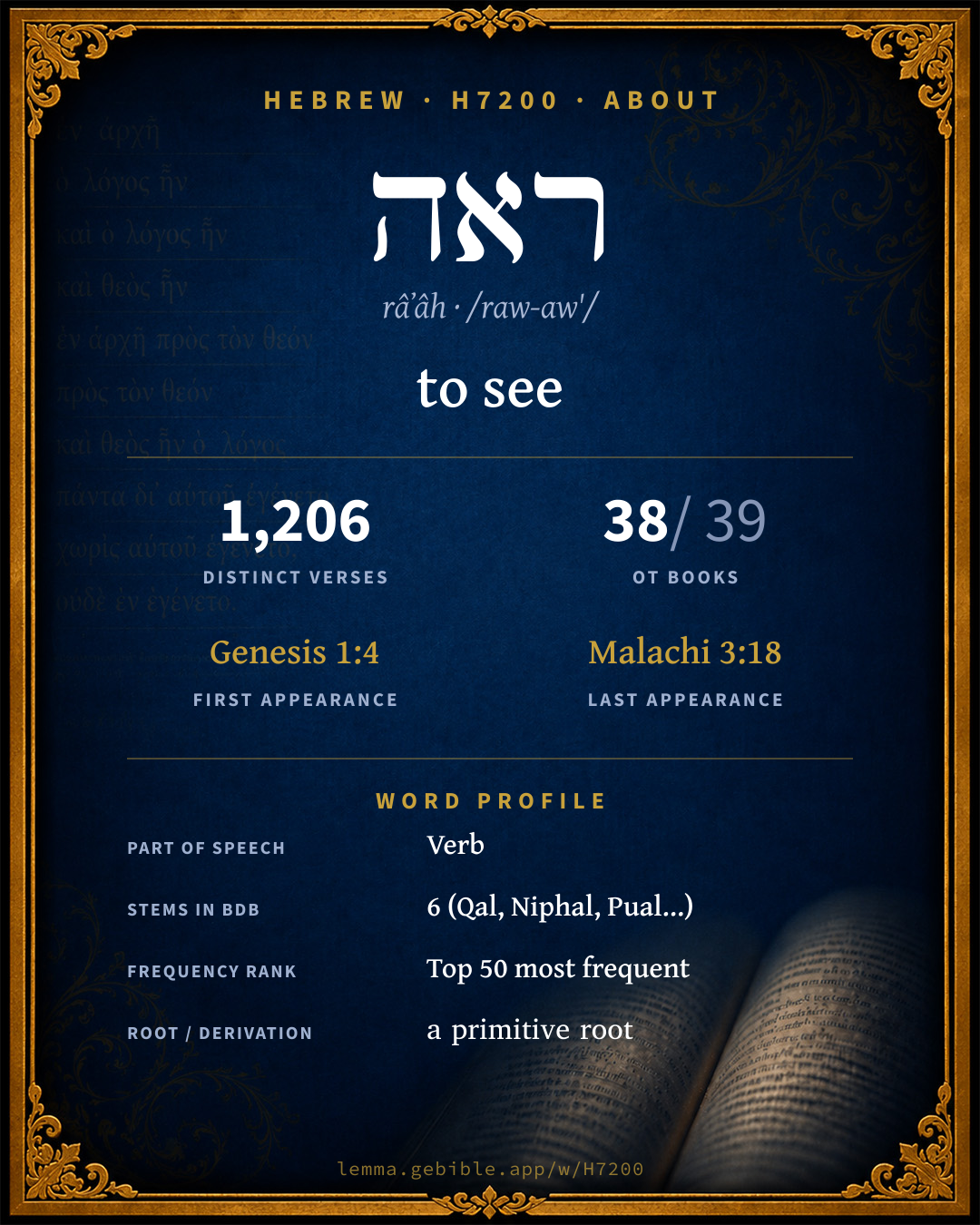
רָאָה
to see
also: look at, inspect, perceive, consider fuller range ↓
Full lexicon entry — Brown-Driver-Briggs (BDB)
From Brown-Driver-Briggs (BDB)
Where this word appears
See every Qal verb in the Hebrew Bible →
Grammar key — what these labels mean
Part of speech
- Verb
- An action or state-of-being word.
Noun type
- Common
- A common noun — a general class of person, place, or thing (“king,” “city,” “water”), not a specific name.
Stem
- Qal
- The basic, simple active stem — the plain form of the verb (“he wrote”). Here: ‘see’
- Niphal
- Usually the simple passive or reflexive of the Qal (“he was written”). Here: ‘appear’
- Hiphil
- The causative active stem (“he caused / brought about”). Here: ‘cause one to see something’
- Hithpael
- The reflexive or reciprocal stem (the subject acts on itself). Here: ‘recipr. look at each other’
- Hophal
- The passive counterpart of the Hiphil (“he was caused to…”). Here: ‘be caused to see’
- Qal Passive
- An archaic passive of the Qal, preserved in a few forms.
Form
- Sequential Imperfect
- An imperfect with prefixed waw — the standard past-narrative form (waw-consecutive imperfect).
- Perfect
- A completed action or state — Hebrew marks aspect (completeness) more than strict tense (“he wrote”).
- Infinitive Construct
- A bound verbal noun, frequently with prepositions (“to write / in writing”).
- Imperative
- A direct command (“write!”).
- Imperfect
- An incomplete, ongoing, or future action (“he will / would write”).
- Participle Active
- A verbal adjective expressing ongoing or characteristic action (“writing / one who writes”).
- Sequential Perfect
- A perfect with prefixed waw continuing a preceding imperfect or command (waw-consecutive perfect).
- Infinitive Absolute
- An unbound verbal noun, often intensifying or standing in for a finite verb.
- Cohortative
- A first-person volitional form expressing wish or resolve (“let me / let us write”).
- Jussive
- A third- or second-person volitional form expressing wish or command (“let him write”).
- Participle Passive
- A verbal adjective expressing action received (“written”).
State
- Absolute
- The independent form of a noun, not bound to a following word.
- Construct
- A noun bound to a following noun in a possessive / “of” relationship (the construct chain).
Person
- 3rd Person
- The one spoken about (“he / she / it / they”).
- 1st Person
- The speaker (“I / we”).
- 2nd Person
- The one addressed (“you”).
Gender
- Masculine
- Grammatically masculine.
- Common
- Either gender — not distinguished for this form.
- Feminine
- Grammatically feminine.
Number
- Singular
- One.
- Plural
- More than one (in Hebrew, generally three or more).
Every verse where H7200 appears in the Book of Isaiah — 76 distinct verses. Click any verse to open its interlinear word-by-word view. Verse text shown in the World English Bible for context — . Each verse’s Hebrew form is shown with its reference; the English is not keyword-highlighted, since the data carries no word-level English alignment. Use “Compare translations” on any verse to read it across multiple English versions. This concordance covers the Hebrew Bible; Septuagint (Greek Old Testament) occurrences are not indexed here.
Isaiah
- Isaiah 1:12 לֵ/רָא֖וֹת prep + Niphal inf.cs When you come to appear before me, Who has required this at your hand, to trample my courts?
- Isaiah 5:12 רָאֽוּ Qal pf 3cp The harp, lyre, tambourine, and flute, with wine, are at their feasts; But they don't regard the work of Yahweh, Neither have they considered the operation of his hands.
- Isaiah 5:19 נִרְאֶ֑ה Qal impf 1cp Who say, "Let him make speed, let him hasten his work, that we may see it; And let the counsel of the Holy One of Israel draw near and come, That we may know it!"
- Isaiah 6:1 וָ/אֶרְאֶ֧ה conj + Qal wimpf 1cs In the year that king Uzziah died, I saw the Lord sitting on a throne, high and lifted up; and his train filled the temple.
- Isaiah 6:5 רָא֥וּ Qal pf 3cp Then I said, "Woe is me! For I am undone, because I am a man of unclean lips, and I dwell in the midst of a people of unclean lips: for my eyes have seen the King, Yahweh of Hosts!"
- Isaiah 6:9 וּ/רְא֥וּ רָא֖וֹ conj + Qal impv 2mp Qal inf.abs He said, "Go, and tell this people, 'You hear indeed, But don't understand; And you see indeed, But don't perceive.'
- Isaiah 6:10 יִרְאֶ֨ה Qal impf 3ms Make the heart of this people fat; Make their ears heavy, and shut their eyes; Lest they see with their eyes, And hear with their ears, And understand with their heart, And turn again, and be healed."
- Isaiah 9:2 רָא֖וּ Qal pf 3cp The people who walked in darkness have seen a great light: those who lived in the land of the shadow of death, on them has the light shined.
- Isaiah 14:16 רֹאֶ֨י/ךָ֙ Qal ptcp.act mp cs + sfx pers 2ms Those who see you shall gaze at you, they shall consider you, [saying], "Is this the man who made the earth to tremble, who shook kingdoms;
- Isaiah 16:12 נִרְאָ֛ה Niphal pf 3ms It shall happen, when Moab presents himself, when he wearies himself on the high place, and shall come to his sanctuary to pray, that he shall not prevail.
- Isaiah 17:7 תִּרְאֶֽינָה Qal impf 3fp In that day shall men look to their Maker, and their eyes shall have respect to the Holy One of Israel.
- Isaiah 17:8 יִרְאֶ֔ה Qal impf 3ms They shall not look to the altars, the work of their hands; neither shall they have respect to that which their fingers have made, either the Asherim, or the sun-images.
- Isaiah 18:3 תִּרְא֔וּ Qal impf 2mp All you inhabitants of the world, and you dwellers on the earth, when an ensign is lifted up on the mountains, look; and when the trumpet is blown, listen.
- Isaiah 21:3 מֵ/רְאֽוֹת prep + Qal inf.cs Therefore are my loins filled with anguish; pangs have taken hold on me, as the pangs of a woman in travail: I am pained so that I can't hear; I am dismayed so that I can't see.
- Isaiah 21:6 יִרְאֶ֖ה Qal impf 3ms For thus has the Lord said to me, Go, set a watchman: let him declare what he sees:
- Isaiah 21:7 וְ/רָ֣אָה conj + Qal wpf 3ms and when he sees a troop, horsemen in pairs, a troop of donkeys, a troop of camels, he shall listen diligently with much heed.
- Isaiah 22:9 רְאִיתֶ֖ם Qal pf 2mp You saw the breaches of the city of David, that they were many; and you gathered together the waters of the lower pool;
- Isaiah 22:11 רְאִיתֶֽם Qal pf 2mp you made also a reservoir between the two walls for the water of the old pool. But you didn't look to him who had done this, neither did you have respect for him who purposed it long ago.
- Isaiah 26:10 יִרְאֶ֖ה Qal impf 3ms Let favor be shown to the wicked, yet will he not learn righteousness; in the land of uprightness will he deal wrongfully, and will not see the majesty of Yahweh.
- Isaiah 28:4 יִרְאֶ֤ה הָֽ/רֹאֶה֙ Qal impf 3ms ptcl def.art + Qal ptcp.act ms and the fading flower of his glorious beauty, which is on the head of the fat valley, shall be as the first-ripe fig before the summer; which when he who looks on it sees, while it is yet in his hand he eats it up.
- Isaiah 29:15 רֹאֵ֖/נוּ Qal ptcp.act ms cs + sfx pers 1cp Woe to those who hide deep their counsel from Yahweh, and whose works are in the dark, and who say, Who sees us? and who knows us?
- Isaiah 29:18 תִּרְאֶֽינָה Qal impf 3fp In that day shall the deaf hear the words of the book, and the eyes of the blind shall see out of obscurity and out of darkness.
- Isaiah 29:23 בִ֠/רְאֹת/וֹ prep + Qal inf.cs + sfx pers 3ms But when he sees his children, the work of my hands, in the midst of him, they shall sanctify my name; yes, they shall sanctify the Holy One of Jacob, and shall stand in awe of the God of Israel.
- Isaiah 30:10 לָֽ/רֹאִים֙ תִרְא֔וּ prep det + Qal ptcp.act mp Qal impf 2mp who tell the seers, "Don't see;" and to the prophets, "Don't prophesy to us right things, speak to us smooth things, prophesy deceits,
- Isaiah 30:20 רֹא֥וֹת Qal ptcp.act fp Though the Lord give you the bread of adversity and the water of affliction, yet shall not your teachers be hidden anymore, but your eyes shall see your teachers;
- Isaiah 30:30 יַרְאֶ֔ה Hiphil impf 3ms Yahweh will cause his glorious voice to be heard, and will show the lighting down of his arm, with the indignation of [his] anger, and the flame of a devouring fire, with a blast, and tempest, and hailstones.
- Isaiah 32:3 רֹאִ֑ים Qal ptcp.act mp The eyes of those who see shall not be dim, and the ears of those who hear shall listen.
- Isaiah 33:15 מֵ/רְא֥וֹת prep + Qal inf.cs He who walks righteously, and speaks blamelessly; he who despises the gain of oppressions, who shakes his hands from taking a bribe, who stops his ears from hearing of blood, and shuts his eyes from looking on evil:
- Isaiah 33:17 תִּרְאֶ֖ינָה Qal impf 3fp Your eyes shall see the king in his beauty: they shall see a land that reaches afar.
- Isaiah 33:19 תִרְאֶ֑ה Qal impf 2ms You shall not see the fierce people, a people of a deep speech that you can not comprehend, of a strange language that you can not understand.
- Isaiah 33:20 תִרְאֶ֨ינָה Qal impf 3fp Look on Zion, the city of our solemnities: your eyes shall see Jerusalem a quiet habitation, a tent that shall not be removed, the stakes of it shall never be plucked up, neither shall any of the cords of it be broken.
- Isaiah 35:2 יִרְא֥וּ Qal impf 3mp It shall blossom abundantly, and rejoice even with joy and singing; the glory of Lebanon shall be given to it, the excellency of Carmel and Sharon: they shall see the glory of Yahweh, the excellency of our God.
- Isaiah 37:17 וּ/רְאֵ֑ה conj + Qal impv 2ms Turn your ear, Yahweh, and hear; open your eyes, Yahweh, and behold; and hear all the words of Sennacherib, who has sent to defy the living God.
- Isaiah 38:5 רָאִ֖יתִי Qal pf 1cs Go, and tell Hezekiah, Thus says Yahweh, the God of David your father, I have heard your prayer, I have seen your tears: behold, I will add to your days fifteen years.
- Isaiah 38:11 אֶרְאֶ֣ה Qal impf 1cs I said, I shall not see Yah, Yah in the land of the living: I shall see man no more with the inhabitants of the world.
- Isaiah 39:2 וַ/יַּרְאֵ֣/ם הֶרְאָ֧/ם conj + Hiphil wimpf 3ms + sfx pers 3mp Hiphil pf 3ms + sfx pers 3mp Hezekiah was glad of them, and shown them the house of his precious things, the silver, and the gold, and the spices, and the precious oil, and all the house of his armor, and all that was found in his treasures: there was nothing in his house, nor in all his dominion, that Hezekiah didn't show them.
- Isaiah 39:4 רָא֖וּ רָא֔וּ הִרְאִיתִ֖י/ם Qal pf 3cp Qal pf 3cp Hiphil pf 1cs + sfx pers 3mp Then said he, What have they seen in your house? Hezekiah answered, All that is in my house have they seen: there is nothing among my treasures that I have not shown them.
- Isaiah 40:5 וְ/רָא֤וּ conj + Qal wpf 3cp and the glory of Yahweh shall be revealed, and all flesh shall see it together; for the mouth of Yahweh has spoken it.
- Isaiah 40:26 וּ/רְאוּ֙ conj + Qal impv 2mp Lift up your eyes on high, and see who has created these, who brings out their host by number; he calls them all by name; by the greatness of his might, and because he is strong in power, not one is lacking.
- Isaiah 41:5 רָא֤וּ Qal pf 3cp The isles have seen, and fear; the ends of the earth tremble; they draw near, and come.
- Isaiah 41:20 יִרְא֣וּ Qal impf 3mp that they may see, and know, and consider, and understand together, that the hand of Yahweh has done this, and the Holy One of Israel has created it.
- Isaiah 41:23 ו/נרא וְ/נִרְאֶ֥ה conj + Qal impf 1cp conj + Qal coh 1cp Declare the things that are to come hereafter, that we may know that you are gods: yes, do good, or do evil, that we may be dismayed, and see it together.
- Isaiah 41:28 וְ/אֵ֨רֶא֙ conj + Qal impf 1cs When I look, there is no man: even among them there is no counselor who, when I ask of them, can answer a word.
- Isaiah 42:18 לִ/רְאֽוֹת prep + Qal inf.cs Hear, you deaf; and look, you blind, that you may see.
- Isaiah 42:20 ראית רָא֥וֹת Qal pf 2ms Qal inf.abs You see many things, but don't observe. His ears are open, but he doesn't hear.
- Isaiah 44:9 יִרְא֛וּ Qal impf 3mp Those who fashion an engraved image are all of them vanity; and the things that they delight in shall not profit; and their own witnesses don't see, nor know: that they may be disappointed.
- Isaiah 44:16 רָאִ֥יתִי Qal pf 1cs He burns part of it in the fire; with part of it he eats flesh; he roasts roast, and is satisfied; yes, he warms himself, and says, Aha, I am warm, I have seen the fire.
- Isaiah 44:18 מֵֽ/רְאוֹת֙ prep + Qal inf.cs They don't know, neither do they consider: for he has shut their eyes, that they can't see; and their hearts, that they can't understand.
- Isaiah 47:3 תֵּרָאֶ֖ה Niphal impf 3fs Your nakedness shall be uncovered, yes, your shame shall be seen: I will take vengeance, and will spare no man.
- Isaiah 47:10 רֹאָ֔/נִי Qal ptcp.act ms cs + sfx pers 1cs For you have trusted in your wickedness; you have said, None sees me; your wisdom and your knowledge, it has perverted you, and you have said in your heart, I am, and there is none else besides me.
- Isaiah 49:7 יִרְא֣וּ Qal impf 3mp Thus says Yahweh, the Redeemer of Israel, [and] his Holy One, to him whom man despises, to him whom the nation abhors, to a servant of rulers: Kings shall see and arise; princes, and they shall worship; because of Yahweh who is faithful, [even] the Holy One of Israel, who has chosen you.
- Isaiah 49:18 וּ/רְאִ֔י conj + Qal impv 2fs Lift up your eyes round about, and see: all these gather themselves together, and come to you. As I live, says Yahweh, you shall surely clothe you with them all as with an ornament, and gird yourself with them, like a bride.
- Isaiah 52:8 יִרְא֔וּ Qal impf 3mp The voice of your watchmen! they lift up the voice, together do they sing; for they shall see eye to eye, when Yahweh returns to Zion.
- Isaiah 52:10 וְ/רָאוּ֙ conj + Qal wpf 3cp Yahweh has made bare his holy arm in the eyes of all the nations; and all the ends of the earth have seen the salvation of our God.
- Isaiah 52:15 רָא֔וּ Qal pf 3cp so shall he sprinkle many nations; kings shall shut their mouths at him: for that which had not been told them shall they see; and that which they had not heard shall they understand.
- Isaiah 53:2 וְ/נִרְאֵ֥/הוּ conj + Qal impf 1cp + sfx pers 3ms For he grew up before him as a tender plant, and as a root out of a dry ground: he has no form nor comeliness; and when we see him, there is no beauty that we should desire him.
- Isaiah 53:10 יִרְאֶ֥ה Qal impf 3ms Yet it pleased Yahweh to bruise him; he has put him to grief: when you shall make his soul an offering for sin, he shall see [his] seed, he shall prolong his days, and the pleasure of Yahweh shall prosper in his hand.
- Isaiah 53:11 יִרְאֶ֣ה Qal impf 3ms He shall see of the travail of his soul, [and] shall be satisfied: by the knowledge of himself shall my righteous servant justify many; and he shall bear their iniquities.
- Isaiah 57:18 רָאִ֖יתִי Qal pf 1cs I have seen his ways, and will heal him: I will lead him also, and restore comforts to him and to his mourners.
- Isaiah 58:3 רָאִ֔יתָ Qal pf 2ms Why have we fasted, [say they], and you don't see? [why] have we afflicted our soul, and you take no knowledge? Behold, in the day of your fast you find [your own] pleasure, and exact all your labors.
- Isaiah 58:7 תִרְאֶ֤ה Qal impf 2ms Isn't it to deal your bread to the hungry, and that you bring the poor who are cast out to your house? when you see the naked, that you cover him; and that you not hide yourself from your own flesh?
- Isaiah 59:15 וַ/יַּ֧רְא conj + Qal wimpf 3ms Yes, truth is lacking; and he who departs from evil makes himself a prey. Yahweh saw it, and it displeased him who there was no justice.
- Isaiah 59:16 וַ/יַּרְא֙ conj + Qal wimpf 3ms He saw that there was no man, and wondered that there was no intercessor: therefore his own arm brought salvation to him; and his righteousness, it upheld him.
- Isaiah 60:2 יֵרָאֶֽה Niphal impf 3ms For, behold, darkness shall cover the earth, and gross darkness the peoples; but Yahweh will arise on you, and his glory shall be seen on you.
- Isaiah 60:4 וּ/רְאִ֔י conj + Qal impv 2fs Lift up your eyes round about, and see: they all gather themselves together, they come to you; your sons shall come from far, and your daughters shall be carried in the arms.
- Isaiah 60:5 תִּרְאִי֙ Qal impf 2fs Then you shall see and be radiant, and your heart shall thrill and be enlarged; because the abundance of the sea shall be turned to you, the wealth of the nations shall come to you.
- Isaiah 61:9 רֹֽאֵי/הֶם֙ Qal ptcp.act mp cs + sfx pers 3mp Their seed shall be known among the nations, and their offspring among the peoples; all who see them shall acknowledge them, that they are the seed which Yahweh has blessed.
- Isaiah 62:2 וְ/רָא֤וּ conj + Qal wpf 3cp The nations shall see your righteousness, and all kings your glory, and you shall be called by a new name, which the mouth of Yahweh shall name.
- Isaiah 63:15 וּ/רְאֵ֔ה conj + Qal impv 2ms Look down from heaven, and see from the habitation of your holiness and of your glory: where are your zeal and your mighty acts? the yearning of your heart and your compassion is restrained toward me.
- Isaiah 64:4 רָאָ֗תָה Qal pf 3fs For from of old men have not heard, nor perceived by the ear, neither has the eye seen a God besides you, who works for him who waits for him.
- Isaiah 66:5 וְ/נִרְאֶ֥ה conj + Qal impf 1cp Hear the word of Yahweh, you who tremble at his word: Your brothers who hate you, who cast you out for my name's sake, have said, Let Yahweh be glorified, that we may see your joy; but it is those who shall be disappointed.
- Isaiah 66:8 רָאָה֙ Qal pf 3ms Who has heard such a thing? who has seen such things? Shall a land be born in one day? shall a nation be brought forth at once? for as soon as Zion travailed, she brought forth her children.
- Isaiah 66:14 וּ/רְאִיתֶם֙ conj + Qal wpf 2mp You shall see [it], and your heart shall rejoice, and your bones shall flourish like the tender grass: and the hand of Yahweh shall be known toward his servants; and he will have indignation against his enemies.
- Isaiah 66:18 וְ/רָא֥וּ conj + Qal wpf 3cp For I [know] their works and their thoughts: [the time] comes, that I will gather all nations and languages; and they shall come, and shall see my glory.
- Isaiah 66:19 רָא֣וּ Qal pf 3cp I will set a sign among them, and I will send such as escape of them to the nations, to Tarshish, Pul, and Lud, who draw the bow, to Tubal and Javan, to the isles afar off, who have not heard my fame, neither have seen my glory; and they shall declare my glory among the nations.
- Isaiah 66:24 וְ/רָא֔וּ conj + Qal wpf 3cp They shall go forth, and look on the dead bodies of the men who have transgressed against me: for their worm shall not die, neither shall their fire be quenched; and they shall be an abhorring to all flesh.
About this entry
At a glance — auto-summarized from this page’s data, not written by a person. Every figure links to its source below. This summary describes the numbers; it doesn’t interpret them.
ראה (râʼâh) is a Hebrew verb most often rendered “to see.” Read the stem: it spans 6 stems, including Qal and Niphal. Spanning 1,206 verses in 38 books, it ranks among the most common words of the Hebrew Bible. It first appears in Genesis 1:4. Related forms include מראה, מראה and ראה. The sections below give every sense, occurrence, and version rendering.
Gloss history
Strong's 1890 vs modern scholarship
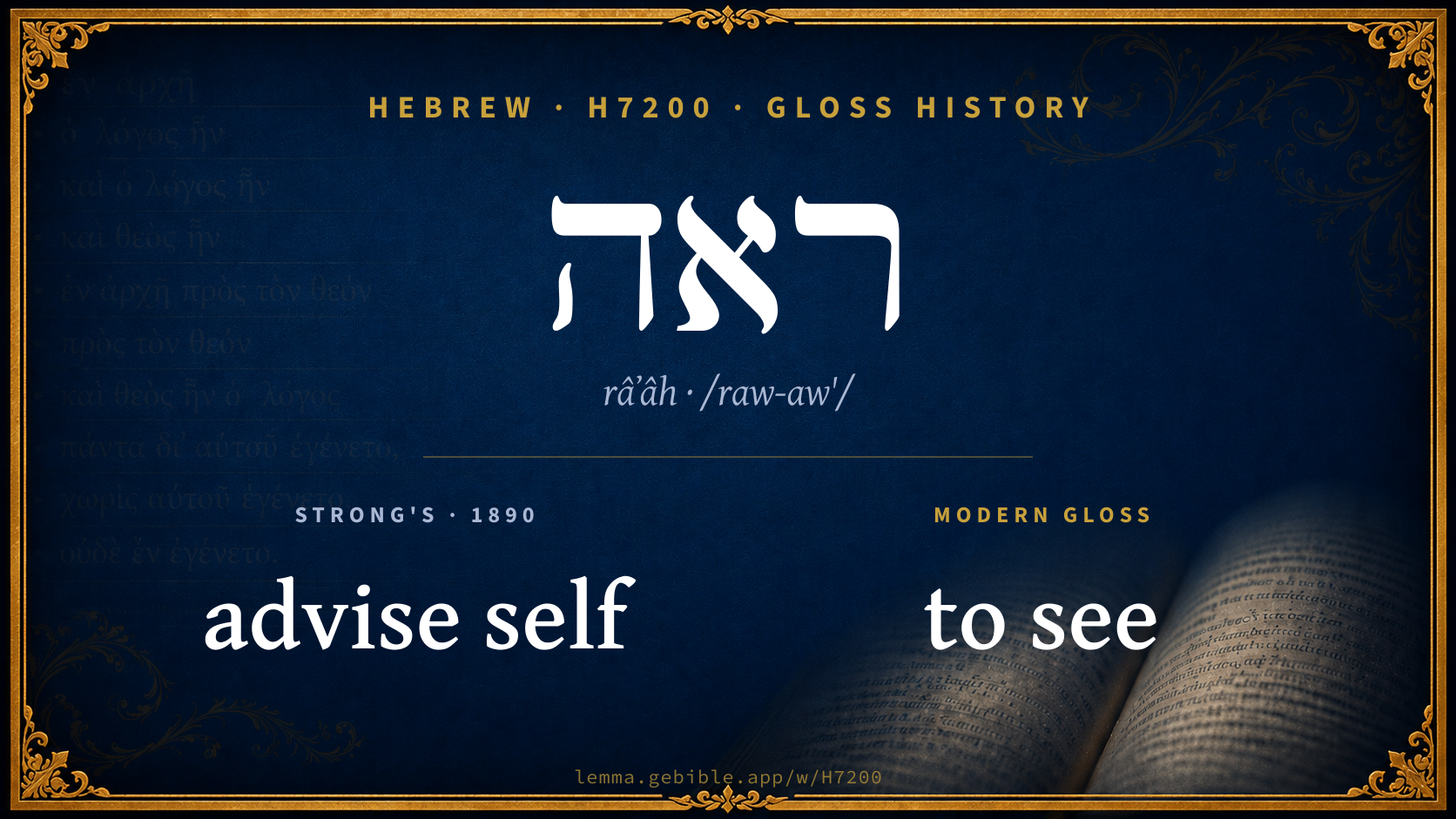
About this word
Strong's H7200 catalogs a Hebrew word from the Hebrew Old Testament.
These counts are not copied from any lexicon or concordance. They are computed here, from the morphology-tagged Hebrew Old Testament. What Lemma adds →
- 1,206
- distinct verses
- The word appears in 1,206 distinct verses.
- 38 / 39
- OT books
- The word appears in 38 of 39 Old Testament books.
- #27
- by frequency
- Top 50 most frequent Hebrew words (rank 27 of 8,640 Hebrew words by occurrence).
View all 1,206 occurrences in the concordance →
By section of the Old Testament
By traditional corpus
Conventional, traditional groupings — biblical authorship is debated, so this is a traditional corpus grouping, not an authorship claim. Each share is this word’s portion of its verses in that division of the Hebrew canon. Each figure is a share of the word’s 1,206 distinct verses.
- Prophets (Nevi'im) 517 verses · 43%
- Torah (Pentateuch) 366 verses · 30%
- Writings (Ketuvim) 323 verses · 27%
How translations render this word
Counts come from each version’s own published word-to-Strong’s tagging or interlinear alignment — an approximate guide to how each version renders this word, not a word-level alignment the data otherwise carries. Because each total is that version’s own tagged count, the per-version totals vary from one another and need not match the appearance or distinct-verse counts above. These counts may also differ from a printed concordance because Lemma counts each distinctly tagged rendering and does not collapse phrase taggings into a single head-word total. This is a fixed set of word-tagged versions (KJV, ASV, BSB, ULT) and does not change with the reading translation you choose elsewhere. Each version’s license is shown beside its name below (and on Sources).
BDB lists this Strong’s number as 4 distinct words (homographs). Each count above pools all of them and is not split by sense — see the Senses section below. A low-frequency rendering may belong to a different one of those words, not the primary meaning.
- King James Version†: Saw 183×, See 141×, I saw 43×
- American Standard Version†: Saw 184×, See 122×, I saw 41×
- Berean Standard Bible†: See 188×, Saw 166×, I saw 34×
- unfoldingWord Literal Text†: See 265×, Saw 165×, And 152×
King James Version Public Domain
Renders H7200 across 1,312† tagged occurrences — most commonly:
Plus other, less common renderings. Plus 283 renderings that appear only once — usually multi-word phrases or single function words the recovered tagging swept in, not distinct renderings. Not rendered by a distinct English word in 2 further occurrences.
American Standard Version Public Domain
Renders H7200 across 1,316† tagged occurrences — most commonly:
Plus other, less common renderings. Plus 358 renderings that appear only once — usually multi-word phrases or single function words the recovered tagging swept in, not distinct renderings.
Berean Standard Bible Public Domain
Renders H7200 across 1,266† tagged occurrences — most commonly:
Plus other, less common renderings. Plus 294 renderings that appear only once — usually multi-word phrases or single function words the recovered tagging swept in, not distinct renderings. Not rendered by a distinct English word in 31 further occurrences.
unfoldingWord Literal Text CC BY-SA 4.0
Renders H7200 across 1,632† tagged occurrences — most commonly:
Plus other, less common renderings. Plus 194 renderings that appear only once — usually multi-word phrases or single function words the recovered tagging swept in, not distinct renderings.
49 senses and sub-senses in the full BDB
Hebrew verbs can shift meaning by stem (binyan): Qal is the basic action, Niphal is often passive or reflexive, Piel often intensifies or makes it factitive, and Hiphil is typically causative. The senses below are grouped under the stem BDB assigns to each. This entry also uses Pual (the passive of Piel), Hithpael (reflexive or reciprocal), and Hophal (the passive of Hiphil).
What do BDB’s symbols mean?
BDB uses these scholarly abbreviations:
| Symbol | Meaning |
|---|---|
| 𝔊 | the Septuagint (the ancient Greek translation, LXX) |
| 𝔙 | the Vulgate (the Latin translation) |
| 𝔖 | the Syriac version (the Peshitta) |
| 𝔗 | the Targum (the Aramaic translation) |
| ψ | the Psalms |
| √ | root (the underlying root or stem) |
| ‖ | parallel passage (a synonymous or contrasted parallel) |
| † | the dagger: every passage where the word occurs is cited |
The 49 senses and sub-senses the full Brown-Driver-Briggs lexicon distinguishes for this word, in lexicon order (not ranked by frequency), with BDB’s own verbatim wording and sub-sense lettering. Shown in Hebrew script with BDB’s own scholarly abbreviations. The condensed entry is in the Lexicon Entry tab. See also the Forms in the corpus table below.
ראה I
Qal
- Pf. 3 ms. ר׳ Gn 29:10 +, sf. וְרָֽאֲךָ consec. Ex 4:14, רָאָהוּ 2 K 2:12 +; 3 fs. רָֽאֲתָה Gn 38:14, sf. רָאָֽתְךָ Jb 42:5; 2 ms. רָאִיתָ Gn 20:10 +, etc.; Impf. 3 ms. יִרְאֶה 22:8 +, juss. יֵרֵא Gn 41:33 (Baer Gi, Ges§ 75 p, hh Köi.561; van d. H. יֵרֶא), יֵ֫רֶא Ex 5:21 +, וַיַּרְא Gn 18:2 + (1 S 19:20 read pl. 𝔊 Comm., i.e. וַיִּרְאֻ DrSm lxiii), sf. יִרְאַנִי Ex 33:20, וַיִּרְאֵ֑נִי 2 S 1:7; 3 fs. תִּרְאֶה Lv 20:17; Jb 33:28, juss. תֵּרֵא Mi 7:10; Zc 9:5 (Baer Gi, cf. Ges Kö supr.; van d. H. תֵּרֶא), וַתֵּ֫רֶא Gn 3:6 +; i s. אֶרְאֶה 21:16 +, וָאֵרֶא 31:10 +, etc.; Imv. רְאֵה 27:27 +, etc.; Inf. abs. רָאֹה Ex 3:7 +, רָאוֹ Gn 26:28; Is 6:9; cstr. רְאֹה Gn 48:11, רְאוֹת Ex 10:28 +, רַאֲוָה Ez 28:17, etc.; Pt. act. רֹאֶה Gn 13:15 +, etc.; pass. רְאֻיוֹת (Baer Gi; van d. H. רְאֻיּוֹת):— e.g. Genesis 29:10
- 1.
- a. see, subj. עַיִן, עֵינַיִם, c. acc. pers. Is 6:5; 30:20; Je 42:2 + 5 times Jb Pr; subj. pers., c. acc. pers. Gn 12:12, 15 + (מִי רָאָהוּ 1 S 23:22, read הַמְּהֵרָה 𝔊 Th We al. [not HPS]); רֹאִי 16:13 (pt. sf., cf.בְּאֵר לַחַי רֹאִי v 14, p. 91 supr.); acc. of God 32:31 (פָּנִים אֶל־פָּנִים); acc. pers. om. 18:2; 19:1 +; c. acc. פְּנֵי 31:2; 46:30; 48:11; Ex 33:20, opp. אֶת־אֲחֹרָ֑י v 23; c. acc. פְּנֵי specif. of having access to man of rank Gn 43:3, 5 + (v. [פָּנֶה] 2 b). e.g. Isaiah 6:5
- b. see, c. acc. rei: subj. עַיִן, עֵינַיִם Jos 24:7 (E) 1 S 24:11 (van d. H. Baer; v 10 Gi), Dt 3:21 + 5 times Dt, +; וְעֵינָיו אֶת־עֵינָיו תִּרְאֶינָה Je 32:4, cf. 34:3; acc. om. 2 S 24:3 Dt 21:7 + 9 times (לִרְאוֹת 1 S 6:13 read לִקְרָאתוֹ 𝔊 We Dr Kit Bu HPS Now); subj. pers. Gn 13:15; 31:12 + very often; c. acc. cogn. מַרְאֶה Ex 3:3 + 7 times, מַרְאָה Dn 10:7(×2), 8, חָזוֹן 8:15, חֶזְיֹנוֹת Jo 3:1; hence see abs. = receive revelation, Is 30:10 (‖ חזה), cf.Ez 13:3 and v. 1. רֹאֶה; c.acc. עֶרְוָה, v. ע׳, p. 788 f.; see war, i.e. see it impending Ex 13:17 (E); ר׳ אֶת־הַקּוֹלֹת וְאֶת־הַלַּפִּידִים 20:18 (Gi v 15); רֹאֵי הַשֶּׁמֶשׁ Ec 7:11 those who see the sun = living men; acc. rei om. Ex 22:9;2 S 13:5 +, וָאֶרְאֶה בֶּחָזוֹן Dn 8:2(×2) (abs.); לֹא יֵדעוּ רְלֹא יִרְאוּ Ne 4:5; עֵינֵי רֹאִים Is 32:3, מְקוֹם רֹאִים Jb 34:26; c. adv. or adv. phr. instead of acc. rei: כָּהֵנָּה Gn 41:19 cf. Is 66:8; Ez 1:27(×2), כַּאֲשֶׁר 2 K 2:19; 2 Ch 29:8; 30:7; Jb 4:8; Ez 16:50; Dn 1:13, כֵּן ψ 48:9. e.g. Joshua 24:7
- 2. see, sq. acc. + cl. or phr. of closer design.: (1) + epex. cl. c. כִּי, acc. pers. Gn 6:2 saw them that they were fair, 12:14 (both J), Ex 2:2; 32:25 (both E), 1 K 11:28, acc. of face + id. Gn 31:5 (E), Ex 34:25 (P); acc. rei Gn 49:15 (poem), Is 22:9; Gn 1:4 (P), Ec 2:24; 4:4 and prob. 2 K 14:26 (reading כִּי מַר הוּא); (2) ר׳ כָּל־הַבָּא עָלָיו וְעָמָ֑ד 2 S 20:12; (3) + adj. (incl. pt.), acc. pers. Gn 7:1 (J), Am 9:1; 2 S 18:10 + 39 times (Je 46:5 del. ר׳ 𝔊 Gie), + acc. אֲשֶׁר Ex 14:13(×2) (J); acc. rei, †Ex 23:5; 33:10 (both E), Dt 22:4; Ez 33:3, 6; Dn 1:10; 8:4, 6, 7; †(4) + מָה, acc. rei Nu 13:18 (JE), Hg 2:3; †(5) + prep. phr., acc. pers. Ex 5:19 (J), Zc 4:10; Ec 10:7; Est 5:9; acc. rei + בִּכְבוֹדוֹ Hg 2:3, + ב pers. Je 23:13, 14, + כ pers. Ju 9:36, כ rei 2 S 18:27; (6) acc. pers. + adv. acc. + כ pers. Je 30:6. e.g. Genesis 6:2
- 3. see, so as to learn to know: c. acc. pers. Dt 33:9 (‖ הִכִּיר, יַדַע);c. acc. rei Dt 1:19, 31; 11:2; Jb 11:11 (‖ יַדַע), ψ 16:10; 49:10; = have experience of, Je 5:12; 14:13; 20:18; 42:14; Zp 3:15; ψ 89:49; Ec 5:17, שֵׁנָה בְּעֵינָיו אֵינֶנּוּ רֹאֶה Ec 8:16; מָה ראית Gn 20:10 i.e. what hast thou encountered, that …? BacherZAW xix (1899), 345 ff.; Terminol. 177 f. e.g. Deuteronomy 33:9
- 4. abs. see, have (power of) vision, Gn 27:1 (J), 48:10 (E), 1 S 3:2; 4:15; 1 K 14:4, miraculous 2 K 6:17(×2), 20(×2); denied of idols Dt 4:28 ψ 115:5; 135:16; fig. of spiritual vision Is 6:10; 29:18; 42:18; 44:18; Je 5:21; Dt 29:3; Ez 12:2(×2) ψ 40:13; 69:24; עַיִן רֹאָה Pr 20:12.—1 S 14:27 read Qr v. אור. e.g. Genesis 27:1
- 5. see = perceive:
- a. sq. cl. c. כִּי, Ex 3:4; 8:11; Gn 1:10, 12 + often (1 S 23:15 read וַיִּרָא and he feared We Dr Kit Bu HPS Now); om. כִּי (late) †La 1:10 ψ 49:11 Ec 3:16; sq. מָה of indirect question Gn 2:19 (J), 37:20 (E), Ju 9:48; Dt 32:20; Je 7:17; 33:24; Ez 8:6; Jon 4:5 +; בַּמָּה Ju 16:5 cf. 1 S 14:38, כַּמָּה Zc 2:6 ψ 35:17; sq. מִי of indirect question 1 S 14:17; Is 40:26; La 2:20 (+ הַבִּיטָה); sq. אֵי 1 S 26:16, אֵיכֹה 2 K 6:13, אֵיפֹה Je 3:2; sq. cl. c. הֲ whether, Gn 8:8; 18:21; Nu 11:23 (all J), Ex 4:18 (E), ψ 14:2; 53:3 Ct 6:11 b Est 3:4, אִם whether Je 30:6; La 1:12 ψ 139:24 Ct 7:13, אֲשֶׁר that or how 1 S 18:15, אֵי Ec 2:3, שֶׁ that v 13, שְׁ 3:18. e.g. Exodus 3:4
- b. c. acc. צָרַת נַפִשׁוֹ Gn 42:21 (i.e. saw it by out-ward signs), cf. Ho 5:13. [Note, under 5 (rarely in other cases, and only S K Je), †Imv. + ידע Imv.: דַּע וּרְאֵה 1 S 24:12; 2 S 24:13; 1 K 20:22; דְּעִי וּרְאִי 1 S 25:17; Je 2:19; דְּעוּ וּרְאוּ 1 S 12:17; 14:38; 23:22; 1 K 20:7; 2 K 5:7; in reverse order, רְאוּ וּדְעוּ 1 S 23:23; Je 5:1.]. e.g. Genesis 42:21
- 6. look at, see, by direct volition:
- a. subj. men, c. acc. rei, Gn 9:22, 23 (J), 42:9, 12 (E), Lv 13:3, 15 +; c. acc. of land = reconnoitre Jos 2:1; look at sun, etc., for worship †Dt 4:19; Jb 31:26; = inspect 1 K 9:12; Lv 14:36(×2); c. acc. pers. Nu 24:20, 21 (JE), Ex 2:25; Lv 13:3, 5 (all P), 1 S 9:16 +, (1 S 19:15 HPS proposes אֶל־בֵּית for לִרְאוֹת); c. prep. ר׳ אַחֲרִי רֹאִי Gn 16:13 (J) I have looked after one seeing me (interpr. v. Di). e.g. Genesis 9:22
- b. subj. God, c. acc. rei Gn 9:16 (P); = inspect 11:5 (J); look at with favour, acc. pers. Jb 37:24 ψ 138:6; so perhaps fig., subj. man, regard, c. acc. אָוֶן ψ 66:18 (Hup-Now; Che Bae Dr al. intend); look with pleasure (acc. om., + מִן by reason of, as a fruit of) Is 53:11 (si vera l.; ins. acc. אוֹר 𝔊 Houb Klo Du CheHpt Kit [perhaps], with Hiph. יַרְאֵה 𝔊 Du CheHpt, rescues from travail his soul, makes it see light). e.g. Genesis 9:16
- c. without acc., look, take a look, etc. (of man and God; often + וְהִנֵּה), Gn 8:13; 18:2;Ex 3:2; Lv 13:8; La 3:50 (מִן loc.), Gn 13:14 (מִן loc. + ה loc.), Dt 3:27; Ez 40:4; 44:5 (all בְּעֵינֶיךָ), + often; peculiarly, מִמֶּנִּי תִרְאוּ וְכֵן תַּעֲשׂוּ Ju 7:17 (cf. GFM). e.g. Genesis 8:13
- d. look after, see after, learn about, c. acc. rei Gn 37:14 (J), c. acc. pers. = visit (go to see) 1 S 15:35; 20:29; 2 S 13:5, 6; 2 K 8:29 = 2 Ch 22:6; 2 K 9:16, cf. Ez 20:28, עֵין רֹאִי Jb 7:8 (Di Bu al.). e.g. Genesis 37:14
- e. observe, watch, abs. 1 S 6:9, 16; 17:28; Ec 8:16 (‖ ידע). e.g. 1 Samuel 6:9
- f. look upon = endure to see, c. acc. rei Hb 1:13 (‖ הִבִּיט). e.g. Habakkuk 1:13
- g. look out, find out, acc. pers. 2 K 9:2; Gn 41:33 (E), + ל pers. 1 S 16:17; select, acc. pers. + מִן from among 2 K 10:3, + ב among + ל pers. 1 S 16:1; provide, furnish, c. acc. rei Dt 33:21 (poem), + ל pers. Gn 22:8 (E), cf. abs. י׳ יִרְאֶה as n.pr.loc. = י׳ seeth v 14 a (E;? read יֵרָאֶה, cf. v b, Niph. and Di); רְאֻיוֹת Est 2:9 looked out = suitable (as often NH). e.g. 2 Kings 9:2
- h. look at = concern oneself about, acc. rei (+ בְּיָדוֹ) Gn 39:23 (J). e.g. Genesis 39:23
- 7. of mental observation:
- a. Imv. see! observe! consider! exclam. (nearly = הִנֵּה), sq. cl.: Gn 27:27; 31:50 see! God is witness 39:14; 41:41; Ex 4:21; Dt 1:8 +; sq. nom. independ. 2 S 24:22 (‖ 1 Ch 21:23 sq. cl.). e.g. Genesis 27:27
- b. look at, i.e. inquire into, a matter, acc. rei om., of י׳, 1 S 24:16 (Gi v 15). e.g. 1 Samuel 24:16
- c. give attention to, acc. rei, Je 2:31, abs. give attention! 2 S 13:28; 2 K 6:32; Ex 25:40 ψ 45:11; take heed to, acc. rei, 1 K 12:16 = 2 Ch 10:16; abs. take heed! Ex 10:10, + פֶּן 2 K 10:23. e.g. Jeremiah 2:31
- d. discern, לִבִּי ר׳ חָכְמָה Ec 1:16, ר׳ טוֹב 3:13. e.g. Ecclesiastes 1:16
- e. distinguish, c. בֵּין … לְ of pers. Mal 3:18; e.g. Malachi 3:18
- f. consider, reflect, Ec 7:14 (sq. cl orat. rect.). e.g. Ecclesiastes 7:14
- 8.
- a. c. ב, lit., look into, hence look at with interest (Germ. ‘sich vertiefen in’): (1) gaze at 1 S 6:19 (on context v. We Dr HPS), so as to become acquainted with Gn 34:1 (P); so as to find out Ec 3:22; inspect liver (for omens) Ez 21:26; somewhat weakened = behold Jb 3:9; 2 Ch 7:3 ψ 64:9. (2) look at with kindness, helpfulness, of י׳, בָּעֳנִי Gn 29:32; 1 S 1:11 (+ inf. abs.), 2 S 16:12, בַּצַּר ψ 106:44. (3) upon a spectacle causing anger Ex 2:11 (E), grief Gn 21:16; (E), 44:34; Nu 11:15 (both J), 2 K 22:20 (subj. עֵינַיִם) = 2 Ch 34:28; Est 8:6(×2), abhorrence Is 66:24. (4) gaze at with apprehension Ec 11:4. (5) with joy, pleasure, 2 K 10:16; Mi 7:9; Je 29:32; Is 52:8 (עַיִן בְּעַיִן, cf. Niph. Nu 14:14); Jb 20:17; 33:28 ψ 54:9; 106:5; 128:5; Ct 3:11; 6:11 a Ec 2:1. (6) especially with exultation, triumph = feast eyes upon, sometimes gloat over enemies (cf. MI7) Ju 16:27; Mi 7:10; Ez 28:17 Ob 12, 13 ψ 22:18; 54:9; 112:8; 118:7. e.g. 1 Samuel 6:19
- b. c. אֶל Je 4:23. Is 17:7 (subj. עֵינַיִם; ‖ שָׁעָה עַל); עַל pers. Ex 5:21 (J); ר׳ עַל־הָאָבְנָ֑יִם Ex 1:16 v. [אֹבֶן] and Comm., also SpiegelbZA xiv (June 1900), 269 ff.. e.g. Jeremiah 4:23
- c. c. ל, הָאָדָם יִר׳ לַעֵינַיִם וְיהוה יִר׳ לַלֵּבָב 1 S 16:7, מִי יִרְאֶה־לָּ֑מוֹ ψ 64:6.—Corrupt is וּרְאִתַנִי כְתוֹר הָאָדָם 1 Ch 17:17 (and ‖ וְזֹאת תּוֹרַת הָאָדָם 2 S 7:19), read וַתַּרְאֵנִי (with other changes) We Dr Kau Bu HPS Now; Ez 12:12; read prob. Niph. 𝔊 Hi Co Krae; Mi 6:9; read prob. יִרְאָה cf. Now GASm. e.g. 1 Samuel 16:7
Niphal
- Pf. 3 ms. נִרְאָה Gn 48:3 +, etc.; Impf. 3 ms. יֵרָאֶה Gn 22:14 +, juss. יֵרָא Ex 34:3; Lv 9:6, וַיֵּרָא Gn 12:7 +; 1 s. וָאֵרָא Ex 6:3; etc.; Imv. ms. הֵרָאֵה 1 K 18:1; Inf. cstr. לְהֵרָאוֹת 1 S 17:17 +, לֵרָאוֹת Is 1:12 + 2 times, הֵרָאֹה Ju 13:21; 1 S 3:21; etc.;— e.g. Genesis 48:3
- 1. appear, especially
- a. of י׳ (God): c. אֶל pers. Gn 12:7(×2) + 6 times J, Gn 35:1 (E), v 9 48:3; Ex 6:3; (בְּאֵל שַׁדַּי, ב essent.), Lv 9:4 (all P), 1 K 3:5; 9:2(×2) = 2 Ch 7:12; 1 K 11:9; c. ל pers. Je 31:3; 2 Ch 1:7; 3:1 (ins. י׳ 𝔊 Kau Kit); abs. Gn 22:14 in the mt. where י׳ appeareth (prob., Di Sta G i. 450 DrHast. DB ii. 563; E), Nu 14:14; (JE; עַיִן בְּעַיִן, v Is 52:8 Qal 8 a (5)), Lv 16:2 (P; ב loc. + עַל), 1 S 3:21 (ב loc.), 2 S 22:11 (עַל־כַּנְפֵי־רוּחַ; וַיֵּדֶא ‖ ψ 18:11), + 5 times; of מַלְאַךְ י׳, c. אֶל pers. Ex 3:2 (E), Ju 13:21; of כְּבוֹד י׳; c. אֶל pers. Lv 9:6, 23; Nu 14:10 (ב loc.), 16:19; 20:6 (all P), Ju 6:12; 13:3; עַל pers. Is 60:2; abs. Ex 16:10 (ב loc.), Nu 17:7 (both P). e.g. Genesis 12:7
- b. appear, of man, = present oneself: c. אֶל pers. Gn 46:29 (J), Ju 13:10; 1 K 18:1, 2, 15; Lv 13:7(×2), 19, אֶל of God ψ 84:8 (ב loc.), אֶל־פְּנֵי הָאָדֹן Ex 23:17 (E); abs. Is 16:12 (del. as dittogr. Lo Du CheHpt Marti al.); especially (Mass.) sq. אֶת־פְּנֵי) of י׳, rendered appear before י׳: so וְנִרְאָה 1 S 1:22, יֵרָאֶה Ex 34:23 (JE), Dt 16:16, וְאֵרָאֶה ψ 42:3, יֵרָאוּ Ex 23:15 (E), 34:20 (JE), Dt 16:16, לֵרָאוֹת Ex 34:24 (JE), Dt 31:11; Is 1:12; read prob. in all Qal (v. [פָּנֶה] II. 2). e.g. Genesis 46:29
- c. appear, of things: late (Hex only P), abs. Gn 1:9; 8:5, c. ב loc. 9:14; Lv 13:14, 57; elsewhere poet. ψ 18:16 = 2 S 22:16, ψ 90:16 Pr 27:25 (of דֶּשֶׁא), Ct 2:12 (ב loc.; of blossoms); subj. מַרְאֵיהֶם Dn 1:15 (+ adj. pred.), v 13 (+ לְפָנֶיךָ); subj. חָזוֹן, c. אֶל pers. Dn 8:1(×2); subj. כְּנֶגַע Lv 14:35 (c. ל pers.). e.g. Genesis 1:9
- 2. be seen:
- a. subj. rei, 1 K 10:12 = 2 Ch 9:11 (where כָּהֶם subj.) Ez 19:11, of sins 21:29 (‖ חִגָּלוֹת), subj. כָּזֹאת Ju 19:30, כְּאֶבֶן etc. Ez 10:1. e.g. 1 Kings 10:12
- b. subj. pers. 2 S 17:17 (+ לָבוֹא) be seen to come. e.g. 2 Samuel 17:17
- c. be seen = occur 2 K 23:24 (ב loc.); = exist, + ל pers. Ex 13:7(×2) (JE), Dt 16:4, cf. Ez 10:8; = be present, + ב loc. Ju 5:8 Ex 34:3 (JE). e.g. 2 Kings 23:24
- 3. be visible, Ex 33:23 (JE; subj. י׳’s face), אֵין אֶבֶן נִרְאָה 1 K 6:18, 8:8(×2) = 2 Ch 5:9(×2), Je 13:26 Is 47:3. e.g. Exodus 33:23
Pual
- Pf. 3 pl. עַצְמֹתָיו לֹא רֻאוּ Jb 33:21 (Baer Gi; d. f. Ki Köi. 41, 563, Mappik\ Ges§ 14 d; van d. H. רֻאוּ), appar. his bones are not seen, detected; De which were (formerly) not seen; Di are insignificant (‘unscheinbar’), so Bae; prob. corrupt, Bu נָאווּ, Du del. as doublet. e.g. Job 33:21
Hithpael
- recipr. look at each other: Impf. 2 mpl. לָ֫מָּה תִּתְרָאוּ Gn 42:1 (E); techn. 3 mpl. וַיִּתְרָאוּ פָנִים 2 K 14:11 = 2 Ch 25:21 and they looked each other in the face, i.e. met in combat, so i pl. נִתְרָאֶה פ׳ 2 K 14:8 = 2 Ch 25:17, cf. (perhaps) 2 K 23:29, where Wkl Benz conj. כְּהִתְרָאוֹת אִתּוֹ (or Niph. כְּהֵרָאוֹת אִתּוֹ) for MT כִּרְאֹתוֹ אֹתוֹ. e.g. Genesis 42:1
Hiphil
- Pf. 3 ms. הֶרְאָה Gn 41:28 +, sf. הִרְאַנִי Am 7:1 +, הֶרְאָ֑נִי Ez 11:25, הֶרְאָנוּ Dt 5:21; Ju 13:23, הֶרְאֲךָ Dt 4:36; i s. וְהַרְאֵיתִ֫י Na 3:5 (Ges§ 53 p), sf. הֶרְאִיתִיךָ Dt 34:4, הִרְאִיתִים Is 39:4 cf. ‖ 2 K 20:15, etc.; Impf. 3 ms. יַרְאֶה Is 30:30, וַיַּרְא 2 K 11:4, sf. יַרְאֵנִי Nu 23:3 ψ 59:11; i s. sf. אַרְאֶךָּ Gn 12:1 +, etc.; Imv. ms. sf. הַרְאֵנִי Ex 33:18, etc.; Inf. cstr. הַרְאוֹת Dt 3:24 +, sf. הַרְאוֹתְכָה Ez 40:4, לַרְאֹתְכֶם Dt 1:33, etc.; Pt. מַרְאֶה Ex 25:9 Ez 40:4;— e.g. Genesis 41:28
- 1.
- a. cause one to see something, shew: (1) subj. man, c. acc. pers. + rei, Nu 13:26 b (JE), Ju 1:24, 25; 2 K 20:13(×2), 15 = Is 39:2(×2), 4 + 4 times, acc. rei om. Ez 40:4; Est 4:8, acc. refl. נַפְשׁוֹ + acc. rei Ec 2:24; מִי יַרְאֵנוּ טוֹב ψ 4:7, acc. pers. om., = exhibit Est 1:4; c. 2 acc. pers. Ju 4:22; 2 K 11:4. (2) especially subj. י׳ (God), c. acc. pers. + rei, Gn 12:1; Ex 9:16 (both J), Gn 41:28; 48:11 (both E), Ex 33:18; Dt 34; 1 b (both JE), Dt 3:24; 4:36; 5:21; Jos 5:6 (D), Ex 25:9 (P), Ju 13:23 + 5 times + (of revelation to prophets) Nu 23:3 (JE), Je 38:21; Ez 11:25, also, c. acc. rei cogn., Nu 8:4 (P), acc. rei om. Dt 34:4 (JE), acc. pers. om. = exhibit, Is 30:30; of visions, י׳ subj., c. acc. pers. + כֹּה Am 7:1, 4, 7; 8:1, + כַּאֲשֶׁר Ex 27:8 (P), c. acc. pers. only = cause to see [a vision] Je 24:1; c. 2 acc. pers. + appos. 2 K 8:13, acc. pers. + cl. c. כִּי v 10. (3) subj. angel, acc. pers. + rei, of revelation to prophet Zc 2:3; 3:1; acc. pers. + cl. c. מָה Zc 1:9. e.g. Numbers 13:26
- b. cause to experience something, c. acc. pers. + rei, subj. י׳, Hb 1:3 ψ 60:5; 71:20; 85:8. e.g. Habakkuk 1:3
- 2. cause to look intently at, to behold, c. acc. pers. + ב rei (cf. Qal 8), subj. י׳:
- a. cause to gaze at, with joy ψ 50:23; 91:16. e.g. Psalms 50:23
- b. in exultation, cause to feast one’s eyes upon, fallen enemies ψ 59:11 (cf. MI4). e.g. Psalms 59:11
- c. in weakened sense, cause to behold Dt 1:33 (cf. Dr). e.g. Deuteronomy 1:33
Hophal
- 1. be caused to see, be shewn: Pf. 2 ms. הָרְאֵיתָ, subj. man, acc. rei, Ex 26:30 (P; ב loc.); so Pt. מָרְאֶה 25:40 (P; ב loc.); sq. inf. אַתָּה הָרְאֵתָ לָדַעַת כִּי Dt 4:35. e.g. Exodus 26:30
- 2. be exhibited to, subj. rei, acc. pers., Pf. 3 ms. consec. וְהָרְאָה אֶת־הַכֹּהֵן Lv 13:49 (P). e.g. Leviticus 13:49
ראה II seeing, assumed by Thes al. to explain cstr. וּרְאֵה עָנְיִי Jb 10
ראה III look
Senses from the full Brown-Driver-Briggs lexicon (Brown, Driver, Briggs; Oxford 1906 — public domain), digitized via Sefaria, supplemented by the OpenScriptures HebrewLexicon (CC BY 4.0). Full attribution on Sources.
Word origin
I. Dt 14:13 textual error; v. דָּאָה.
II. vb. see (NH id.; וארא MI4, הראני l7, cf. רית spectacle l12; Sab. ראי see, expect, DHM ZMG xxix (1875), 596, 599; Arabic رَأَى see, so Ethiopic ርእየ: 𝔗 רֵו, רֵיוָא human appearance, features, etc. (cf. Heb. רֳאִי 2));—
I. adj. seeing, assumed by Thes al. to explain cstr. וּרְאֵה עָנְיִי Jb 10:15, but improb.; Mass. appar. intended Imv. (unsuitable); Ew al. וְרֹאֵה; Di Bu Du (After Lag Gei) רְוֵה עֹ֑נִי drenched (i.e. sated) with affliction.
I. n.f. look;—cstr. רְאוּת עֵינָיו Ec 5:10 Qr (Kt ראית).
— Brown-Driver-Briggs (Oxford 1906, public domain), digitized via Sefaria, supplemented by the OpenScriptures HebrewLexicon (CC BY 4.0). See Sources.
Origin: a primitive root
Jastrow Dictionary
A second Hebrew/Aramaic lexicon for comparison, covering Aramaic and post-biblical (Talmudic, Targumic, Midrashic) usage that the biblical-Hebrew BDB does not. Matched by lemma rather than by Strong’s number, so a lemma may carry more than one Jastrow headword (shown separately below), and the entries cover usage well beyond the Bible.
רָאָה I
- , v. ראי
רָאָה II
- (b. h.) raah, name of an unclean bird. Ḥull. 63ᵇ דאה ור׳ וכ׳, v. דָּאָה II. Ib. ר׳ זו איה … ר׳ שרואה ביותר raah is the same as ayah, and it is called raah, because its sight is exceedingly acute (ref. to Job XXVIII, 7). e.g. Job 28:7
A Dictionary of the Targumim, the Talmud Babli and Yerushalmi, and the Midrashic Literature (Marcus Jastrow; London, Luzac, 1903) — Public Domain. Digitized via Sefaria. Digitized via Sefaria. Full attribution on Sources.
Forms in the corpus
The 652 distinct written forms H7200 takes in the Hebrew Bible, most frequent first — each parse links to that stem’s occurrences in the concordance. Hebrew forms include their vowel points and cantillation, so a single lemma takes many written forms.
The 60 most common forms are shown; 592 rarer forms follow in the full concordance.
Same root — word family
Other BDB entries built from the same root as H7200, grouped by Strong’s listed origin. These share a root / origin per the lexicon — not necessarily a shared meaning. Each links to that word’s own entry.
Derived from this word
- מראה marʼeh H4758 sight
- מראה murʼâh H4760 crop
- ראה râʼâh H7201 bird of prey
- ראה râʼeh H7202 seeing
- ראה rôʼeh H7203 seer
- ראוה raʼăvâh H7207 beholding
- ראי rᵉʼîy H7209 mirror
- ראי rŏʼîy H7210 appearance
- ראית rᵉʼîyth H7212 beholding
- רו rêv H7299 appearance
Proper names from this root
People and places named from this root — a name, not an additional meaning of the word.
Compare all same-root words → Showing 4 of 14 — not the complete family. 3 of the same-root words are proper names (people or places). They share a root, not necessarily a meaning.
Septuagint verse parallels
This word appears in 1,149 verses that also exist in the Greek Old Testament (Septuagint), out of the 1,206 Hebrew verses it occurs in. You can read those verses in Greek by switching the Old Testament edition to the Septuagint.
Read these verses in the Septuagint
- Genesis 1:4
- Exodus 1:16
- Leviticus 5:1
- Numbers 4:20
- Deuteronomy 1:8
- Joshua 2:1
- Judges 1:24
- Ruth 1:18
- 1 Samuel 1:11
- 2 Samuel 1:7
- 1 Kings 1:48
- 2 Kings 2:10
This is a verse-level parallel only — the same verses exist in both the Hebrew and Greek Old Testaments. No word-level Hebrew↔Greek correspondence is claimed: the data carries no such alignment, so no Greek word is shown as this Hebrew word’s translation. Coverage is not total — the Septuagint omits the deuterocanon and renumbers the Psalms, so some Hebrew verses have no direct Greek parallel.