
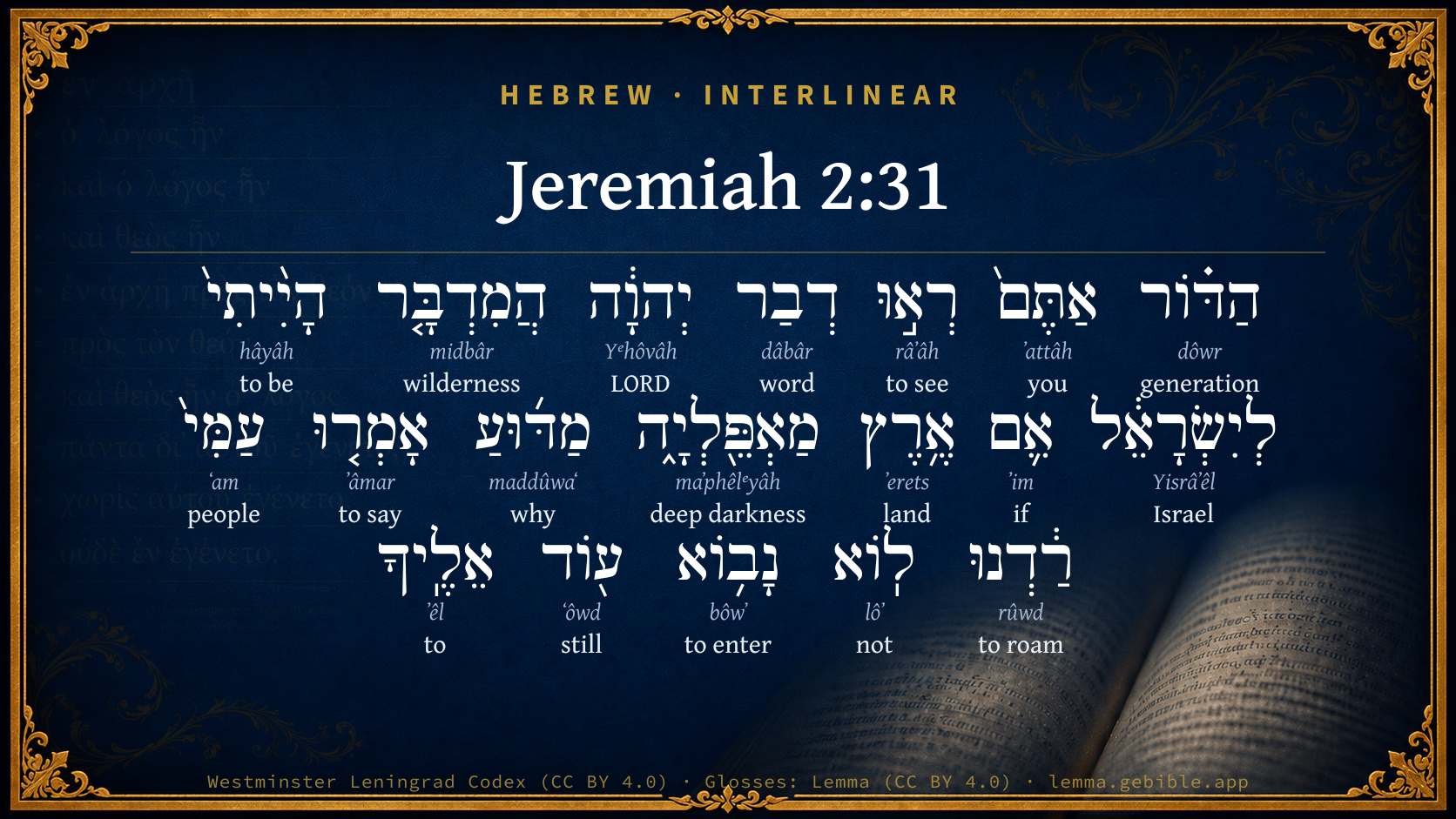
Jeremiah 2:31

Hebrew (Westminster Leningrad Codex) Jeremiah 2:31 appears in the Hebrew Old Testament. The text above is from the Westminster Leningrad Codex. Each word links to its Strong’s number, a concise gloss, and parsing drawn from the Open Scriptures Hebrew Bible morphology. Click any word for its full Brown-Driver-Briggs (BDB) entry.
Download image
Cite this verse

Jeremiah 2:31 (World English Bible). Public Domain. Lemma interlinear Bible study tool, https://lemma.gebible.app/v/jeremiah/2/31.

Show BibTeX & RIS
BibTeX
RIS
English Translation
Generation, see the word of Yahweh. Have I been a wilderness to Israel? or a land of thick darkness? why say my people, We are broken loose; we will come no more to you?
World English Bible · Public Domain
Highlights
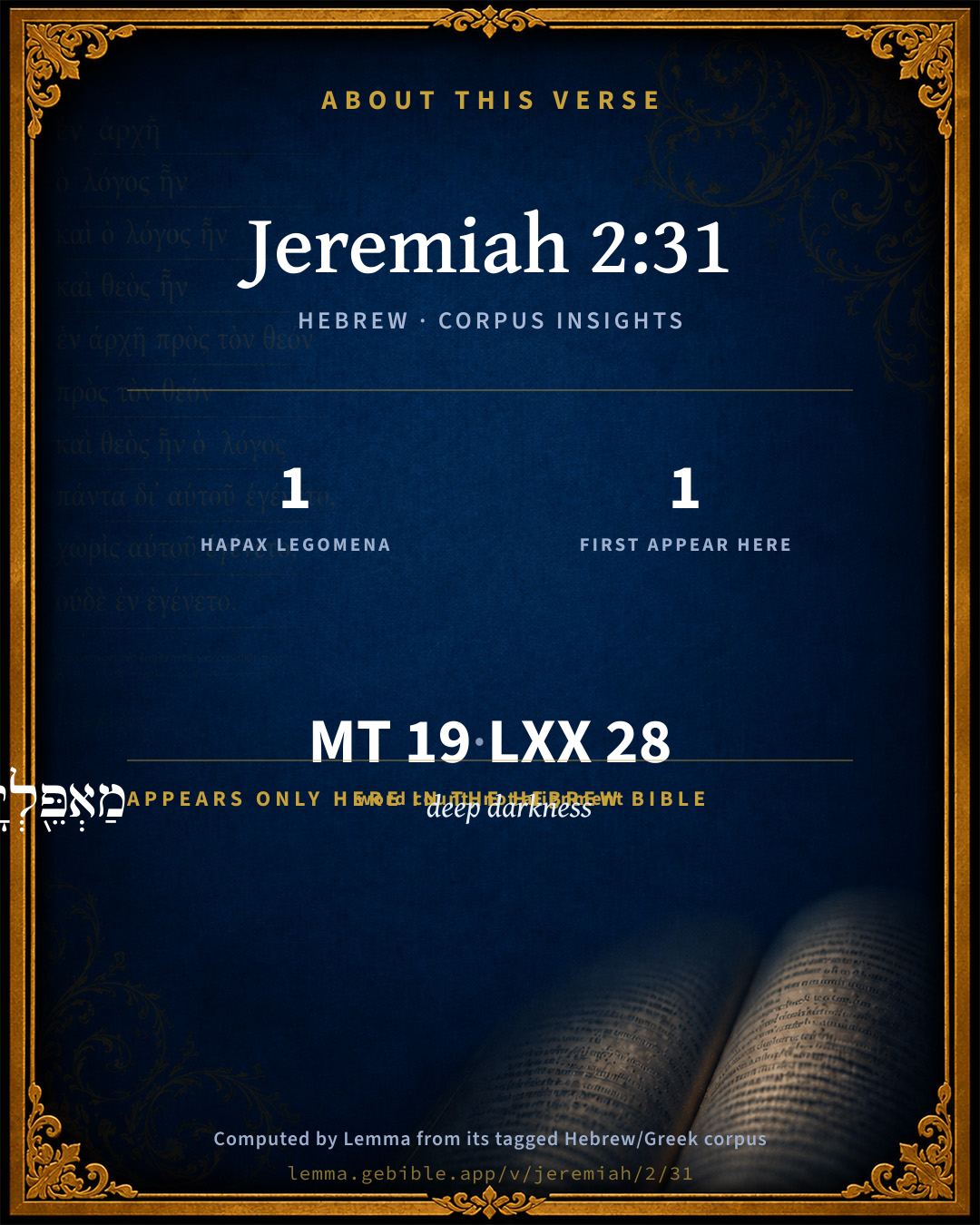
  • 1 hapax legomenon — only here in the Hebrew Bible
  • 1 first appearance in the Hebrew Bible
Full analysis ↓
Download a study sheet

One document with this verse’s original text, its word-by-word gloss line, the meaning frame, cross-references with their text, attributed commentary, and full source and license credits — printable, and it pastes into notes with its structure intact.

This verse Autodidact and up

Study sheet (.html) Plain text (.txt)

A passage Seminary Student

Up to 50 verses in one chapter. A passage sheet keeps up to 6 commentary sources and 12 cross-references per verse, in the order this page ranks them, and says so on the sheet whenever that leaves anything out. Ask for a single verse and you get the Autodidact verse sheet above.

Everything on this page stays free to read, with no account — the sheet is a download of what is already on screen, not access to it.

Want to remove ads? Support Godless Engineer
Compare translations 3

The same verse in 3 English versions, stacked beneath the original-language interlinear above. Click any original word for its lexicon entry.

Each is an independent rendering of the whole verse — the interlinear is not word-aligned to these translations.

Highlighted words mark where these versions differ — a whole-verse word diff, not a word-by-word alignment.

  • World English Bible Public Domain
    Generation, see the word of Yahweh. Have I been a wilderness to Israel? or a land of thick darkness? why say my people, We are broken loose; we will come no more to you?
  • King James Version Public Domain
    O generation, see ye the word of the LORD. Have I been a wilderness unto Israel? a land of darkness? wherefore say my people, We are lords; we will come no more unto thee?
  • unfoldingWord Literal Text CC BY-SA 4.0
    You the generation! See the word of Yahweh! Have I been a wilderness to Israel? Or a land of thick darkness? Why do my people say, ‘We shall roam free, we shall not go to you anymore’?

unfoldingWord Literal Text — © unfoldingWord, licensed CC BY-SA 4.0. Word-aligned USFM3 via Door43 (git.door43.org/unfoldingWord/en_ult).

Versions to compare (up to 4)

3 of 4 selected

Show all 18 translations

Every available English version of this verse, each an independent rendering of the whole verse.

  • World English Bible Public Domain
    Generation, see the word of Yahweh. Have I been a wilderness to Israel? or a land of thick darkness? why say my people, We are broken loose; we will come no more to you?
  • Berean Standard Bible Public Domain
    You people of this generation, consider the word of the LORD: “Have I been a wilderness to Israel or a land of dense darkness? Why do My people say, ‘We are free to roam; we will come to You no more’?
  • Majority Standard Bible Public Domain
    You people of this generation, consider the word of the LORD: “Have I been a wilderness to Israel or a land of dense darkness? Why do My people say, ‘We are free to roam; we will come to You no more’?
  • King James Version Public Domain
    O generation, see ye the word of the LORD. Have I been a wilderness unto Israel? a land of darkness? wherefore say my people, We are lords; we will come no more unto thee?
  • American Standard Version (1901) Public Domain
    O generation, see ye the word of Jehovah. Have I been a wilderness unto Israel? or a land of thick darkness? wherefore say my people, We are broken loose; we will come no more unto thee?
  • Revised Version (1885) Public Domain
    O generation, see ye the word of the LORD. Have I been a wilderness unto Israel? or a land of thick darkness? wherefore say my people, We are broken loose; we will come no more unto thee?
  • Geneva Bible (1599) Public Domain
    O generation, take heede to the worde of the Lord: haue I bene as a wildernesse vnto Israel? or a lande of darkenesse? Wherefore sayeth my people then, We are lordes, we will come no more vnto thee?
  • Douay-Rheims (1899) Public Domain
    See ye the word of the Lord: Am I become a wilderness to Israel, or a lateward springing land? why then have my people said: We are revolted, we will come to thee no more.
  • Young's Literal Translation Public Domain
    O generation, see ye the word of Jehovah: A wilderness have I been to Israel? A land of thick darkness? Wherefore have My people said, `We mourned, We come not in again unto Thee.'
  • Literal Standard Version CC BY-SA 4.0
    O generation, see the word of YHWH: Have I been a wilderness to Israel? A land of thick darkness? Why have My people said, || We wandered freely, || We do not come to You again.
  • Unlocked Literal Bible CC BY-SA 4.0
    You who belong to this generation! Pay attention to my word, the word of Yahweh! Have I been a wilderness to Israel? Or a land of deep darkness? Why would my people say, 'Let us wander around, we will not go to you anymore'?
  • unfoldingWord Literal Text CC BY-SA 4.0
    You the generation! See the word of Yahweh! Have I been a wilderness to Israel? Or a land of thick darkness? Why do my people say, ‘We shall roam free, we shall not go to you anymore’?
  • Darby Bible Public Domain
    O generation, mark ye the word of Jehovah. Have I been a wilderness unto Israel, or a land of thick darkness? Wherefore say my people, We have dominion; we will come no more unto thee?
  • World Messianic Bible Public Domain
    Generation, consider the LORD’s word. Have I been a wilderness to Israel? Or a land of thick darkness? Why do my people say, ‘We have broken loose. We will come to you no more’?
  • Webster's Bible Public Domain
    O generation, see ye the word of the LORD. Have I been a wilderness to Israel? a land of darkness? why say my people, We are lords; we will come no more to thee?
  • Free Bible Version CC BY-SA 4.0
    You people of today, think about what the Lord is saying: Israel, have I treated you like an empty desert, or a land of thick darkness? Why are my people saying, “We can go where we like! We don't have to come and worship you any more”?
  • Bible in Basic English Public Domain
    O generation, see the word of the Lord. Have I been a waste land to Israel? or a land of dark night? why do my people say, We have got loose, we will not come to you again?
  • JPS Tanakh (1917) Public Domain
    O generation, see ye the word of the LORD: have I been a wilderness unto Israel? or a land of thick darkness? Wherefore say My people: 'We roam at large; we will come no more unto Thee'?

Literal Standard Version (2020), Covenant Press — licensed CC BY-SA 4.0. Text via the HelloAO Bible API (eBible.org). Unlocked Literal Bible (unfoldingWord) — licensed CC BY-SA 4.0. Text via the HelloAO Bible API (eBible.org). unfoldingWord Literal Text — © unfoldingWord, licensed CC BY-SA 4.0. Word-aligned USFM3 via Door43 (git.door43.org/unfoldingWord/en_ult). Free Bible Version, Dr. Jonathan Gallagher — licensed CC BY-SA 4.0. Text via the HelloAO Bible API (eBible.org).

Word by word

More ways to search: Search by grammar → Find every occurrence → Compare this word →

Practice this passage: Drill this verse → Learn its vocabulary →

מַאְפֵּ֖לְיָ֑ה
maʼphêlᵉyâh
H3991
“deep darkness”
Noun, Common, Feminine, Singular, Absolute
Part of Speech
Noun
Type
Common
Gender
Feminine
Number
Singular
State
Absolute
Full BDB Definition

Origin: from H3990

TWOT: 145f

deep darkness, darkness
  1. הַדּ֗וֹר dôwr H1755 “the · generation” Particle, Definite Article + Noun, Common, Masculine, Singular, Absolute
  2. אַתֶּם֙ ʼattâh H859 “you” Pronoun, Personal, 2nd Person, Masculine, Plural
  3. רְא֣וּ râʼâh H7200 “see” Verb, Qal, Imperative, 2nd Person, Masculine, Plural
  4. דְבַר dâbâr H1697 “word of” Noun, Common, Masculine, Singular, Construct
  5. יְהוָ֔ה Yᵉhôvâh H3068 “LORD” Noun, Proper
  6. הֲמִדְבָּ֤ר midbâr H4057 “wilderness” Particle, Interrogative + Noun, Common, Masculine, Singular, Absolute
  7. הָיִ֨יתִי֙ hâyâh H1961 “to be” Verb, Qal, Perfect, 1st Person, Common, Singular
  8. לְיִשְׂרָאֵ֔ל Yisrâʼêl H3478 “to/for · Israel” Preposition + Noun, Proper
  9. אִ֛ם ʼim H518 “if” Conjunction
  10. אֶ֥רֶץ ʼerets H776 “land of” Noun, Common, Both, Singular, Construct
  11. מַדּ֜וּעַ maddûwaʻ H4069 “why” Particle, Interrogative
  12. אָמְר֤וּ ʼâmar H559 “to say” Verb, Qal, Perfect, 3rd Person, Common, Plural
  13. עַמִּי֙ ʻam H5971 “people · my” Noun, Common, Masculine, Singular, Construct + Suffix, Personal, 1st Person, Common, Singular
  14. רַ֔דְנוּ rûwd H7300 “to roam” Verb, Qal, Perfect, 1st Person, Common, Plural
  15. לֽוֹא lôʼ H3808 “not” Particle, Negative
  16. נָב֥וֹא bôwʼ H935 “to enter” Verb, Qal, Imperfect, 1st Person, Common, Plural
  17. ע֖וֹד ʻôwd H5750 “still” Adverb
  18. אֵלֶֽיךָ ʼêl H413 “to · you” Preposition + Suffix, Personal, 2nd Person, Masculine, Singular

About this verse

These counts appear in no published source. They are computed here, from the morphology-tagged text and Lemma’s own curated glosses. What Lemma adds →

19
words
19
distinct lemmas
Prophets
section

Notable vocabulary

1 hapax legomenon — a word that appears only here in the entire Hebrew Bible:

  • מַאְפֵּ֖לְיָ֑ה deep darkness H3991

First appearance in Scripture

This word makes its first canonical appearance in the Hebrew Bible here:

  • מַאְפֵּ֖לְיָ֑ה deep darkness H3991

Shared distinctive vocabulary

רַ֔דְנוּ to roam H7300 occurs in 4 verses of the Hebrew Bible. Also found in:

Grammatical profile

  • 5 verbs
  • 8 nouns
  • 1 pronoun
  • 1 preposition
  • 1 conjunction
  • 1 adverb
  • 2 particles

Verb forms

  • רְא֣וּ Qal · Imperative
  • הָיִ֨יתִי֙ Qal · Perfect
  • אָמְר֤וּ Qal · Perfect
  • רַ֔דְנוּ Qal · Perfect
  • נָב֥וֹא Qal · Imperfect

Hebrew & Septuagint length

In the original languages it is 19 Hebrew tokens and 28 Greek tokens — but the two are counted differently (Hebrew bundles its prefixes and suffixes into one token; the Greek is in lemma form), so that isn’t a like-for-like length.

Cross-references

18

Topical passages linked to Jeremiah 2:31 in the Treasury of Scripture Knowledge — connected by theme and wording, ordered by reader-vote popularity; previews shown in the World English Bible.

  • Deuteronomy 32:15 But Jeshurun grew fat, and kicked: You have grown fat, you are grown thick, you are become sleek; Then he forsook God who made him, Lightly esteemed the Rock of his salvation.
  • 2 Samuel 12:7–9 Nathan said to David, "You are the man. This is what Yahweh, the God of Israel, says: 'I anointed you king over Israel, and I delivered you out of the hand of Saul.
  • Deuteronomy 8:12–14 lest, when you have eaten and are full, and have built goodly houses, and lived therein;
  • Deuteronomy 31:20 For when I shall have brought them into the land which I swore to their fathers, flowing with milk and honey, and they shall have eaten and filled themselves, and grown fat; then will they turn to other gods, and serve them, and despise me, and break my covenant.
  • 2 Chronicles 31:10 Azariah the chief priest, of the house of Zadok, answered him and said, Since [the people] began to bring the offerings into the house of Yahweh, we have eaten and had enough, and have left plenty: for Yahweh has blessed his people; and that which is left is this great store.
  • Nehemiah 9:21–25 Yes, forty years did you sustain them in the wilderness, [and] they lacked nothing; their clothes didn't grow old, and their feet didn't swell.
  • Psalms 10:4 The wicked, in the pride of his face, Has no room in his thoughts for God.
  • Psalms 12:4 Who have said, "With our tongue we will prevail. Our lips are our own. Who is lord over us?"
  • Proverbs 30:9 Lest I be full, deny you, and say, 'Who is Yahweh?' Or lest I be poor, and steal, And so dishonor the name of my God.
  • Isaiah 45:19 I have not spoken in secret, in a place of the land of darkness; I didn't say to the seed of Jacob, Seek you me in vain: I, Yahweh, speak righteousness, I declare things that are right.
  • Jeremiah 2:5–6 thus says Yahweh, What unrighteousness have your fathers found in me, that they have gone far from me, and have walked after vanity, and are become vain?
  • Hosea 2:7–8 She will follow after her lovers, But she won't overtake them; And she will seek them, But won't find them. Then she will say, 'I will go and return to my first husband; For then was it better with me than now.'
  • Hosea 13:6 According to their pasture, so were they filled; They were filled, and their heart was exalted. Therefore they have forgotten me.
  • Amos 1:1 The words of Amos, who was among the herdsmen of Tekoa, which he saw concerning Israel in the days of Uzziah king of Judah, and in the days of Jeroboam the son of Joash king of Israel, two years before the earthquake.
  • Micah 6:9 Yahweh's voice calls to the city, And wisdom sees your name: "Listen to the rod, And he who appointed it.
  • Malachi 3:9–11 You are cursed with the curse; for you rob me, even this whole nation.
  • 1 Corinthians 4:8 You are already filled. You have already become rich. You have come to reign without us. Yes, and I wish that you did reign, that we also might reign with you.
  • Revelation 3:15–17 "I know your works, that you are neither cold nor hot. I wish you were cold or hot.

Cross-references courtesy of OpenBible.info (CC BY 4.0).

Hebrew and Greek witnesses Masoretic Hebrew ↔ Greek Septuagint

The same verse in the two great witnesses to the Old Testament, shown verse-for-verse.

These are two independent witnesses, not word-aligned to each other, and the Septuagint is shown in lemma (dictionary) form.

Hebrew Jeremiah 2:31 Masoretic · Westminster Leningrad Codex

הַדּ֗וֹר אַתֶּם֙ רְא֣וּ דְבַר יְהוָ֔ה הֲמִדְבָּ֤ר הָיִ֨יתִי֙ לְיִשְׂרָאֵ֔ל אִ֛ם אֶ֥רֶץ מַאְפֵּ֖לְיָ֑ה מַדּ֜וּעַ אָמְר֤וּ עַמִּי֙ רַ֔דְנוּ לֽוֹא נָב֥וֹא ע֖וֹד אֵלֶֽיךָ

Generation, see the word of Yahweh. Have I been a wilderness to Israel? or a land of thick darkness? why say my people, We are broken loose; we will come no more to you?

World English Bible · Public Domain

Greek LXX Structure differs

In the Septuagint, Jeremiah is about an eighth shorter than the Hebrew and arranges its material differently — the Oracles Against the Nations (Hebrew chapters 46–51) appear in the middle of the Greek book, after 25:13. Because the chapter and verse boundaries do not line up, a verse-for-verse comparison with the Hebrew is not shown.

A verse-for-verse comparison isn’t shown here because the chapters and verses don’t line up. Switch to the LXX edition with the MT / LXX toggle above to read the Greek directly.

On this verse, John Gill's Exposition discusses the Septuagint’s reading. Read the note in Commentary ↓

Hebrew: Westminster Leningrad Codex (CC BY 4.0). Greek: Septuagint (public domain); English from a public-domain English Septuagint. How the Septuagint differs from the Hebrew →

Targum (Aramaic paraphrase)

1

The Targum is the ancient Jewish Aramaic paraphrase of the Hebrew Scriptures — an interpretive translation, not the Hebrew text itself. Onkelos (literal) and Pseudo-Jonathan (expansive) render the Torah, and Jonathan the Prophets. Coverage is partial: where no permissively-licensed English translation exists for a verse, only the Aramaic is shown. This is verse-level text, not a word-by-word alignment to the Hebrew.

  1. Targum Jonathan Prophets (Joshua–Malachi)
    עַם דָרָא אַתּוּן קַבִּילוּ פִּתְגָמָא דַייָ הָא כְּמִדְבָּר צָדֵי דְלֵית בֵּיהּ הֲנָאָה וַהֲוָה מֵימְרִי לְיִשְׂרָאֵל אִם כַּאֲרַע חוּרְבָּא מַה דֵין אֲמָרוּ עַמִי אִטַלְטֵילְנָא לָא נְתוּב עוֹד לְפוּלְחָנָךְ:

    (no public-domain English translation for this verse)

    Targum Jonathan — Aramaic: “Mikraot Gedolot” (public domain). English: “Sefaria Community Translation” (CC0 1.0 (public-domain dedication)); “London "Chaldee Paraphrase," 1871” (public domain). Text via Sefaria.

Commentary

Notes on Jeremiah 2:31 from classic Christian and Jewish commentators (each source and its license shown beneath its notes). The classic Christian expositions comment on the surrounding passage and are grouped to its opening verse, so a note may address several verses; the Jewish commentaries on the Tanakh (Rashi and others) are per-verse, so they appear only where the commentator wrote on this verse.

Lemma curates 59 commentaries, every one of them public domain or Creative Commons licensed, each selected and text-cleaned for this edition rather than reprinted as found. About our sources →

Trapp's Complete Commentary

John Trapp

Jer 2:31 O generation, see ye the word of the LORD. Have I been a wilderness unto Israel? a land of darkness? wherefore say my people, We are lords; we will come no more unto thee?

Ver. 31. O generation, see ye the word of the Lord,] q.d., O generation, rather leonine than human! as Jer 2:30. "See ye the word"; I say not to you, Hear; no more than I would to a savage beast; for ye have no ears to hear reason; but see with your eyes, for so even beasts can do. See now, and say sooth.

Have I been a wilderness unto Israel?] Such as is described before. {Jer 2:6} Or, Have I not rather been a paradise unto you, and a storehouse of all accommodations and comforts? It well appeareth that they have wanted nothing but thankful hearts, by this, that fulness hath bred forgetfulness; for so stout they are grown by reason of their great wealth, that they will not come at me, nor acknowledge my sovereignty over them, but will needs be petty gods within themselves. We are lords, say they, and will not now take it as we have done. The ancient Greek rendereth it, We will not be ruled.

John Trapp, A Commentary or Exposition upon All the Books of the Old and New Testament (1647–1656) — public domain. Text from a community e-Sword module.

The Biblical Illustrator

Joseph S. Exell

Jer_2:31-37

Have I been a wilderness unto Israel?

Divine questions

The people were required to answer two questions: Have I been a wilderness unto Israel? have I been a land of darkness unto Israel? Speak out. If you have an impeachment to bring even against God, do not fear to bring it. He asks for it. A wondrous tenderness inspires the inquiry. It seems, indeed, to bring its own answer with it. So the father might plead with his child, Have I been a wilderness unto thee, or a land of darkness? have I been deaf to entreaty? have I been without sympathy in the time of affliction? have I but half-opened the door when you have sought to return to my love and my confidence? The very inquiry is a defence; the very method of the inquiry means, It is impossible to answer this but in one way. Having answered a question respecting God, they have next to answer a question respecting themselves: Wherefore say My people, We are lords; we will come no more unto Thee? Literally, Why do My people say, We will rove at will? That is licence, not liberty. They have lost the centre, and are plunging evermore in chaos, without being able to give an account of themselves or to use what benefit might lie within their power. Why this new cry, namely, We will do as we like? Why this so-called free thought? why this progress which means running round and round and never advancing by one measurable inch? How very early men begin to be free-thinkers! How soon sin says to a man, Rove at will; do what you like: you are a man! Then the poor fool thinks he is a man, and begins to play fantastic tricks before high heaven. He forgets that we have only, liberty to obey. Then the Lord seems to adopt a kind of taunting tone: Can a maid forget her ornaments, or a bride her attire? When did either of them forget a pin, a jewel, a toy, a feather? What, a memory for little things, for dressing, for adornment, for outgoing, for public excitement! What a recollection for dates, when the date is filled up with an amusement, a new sensation! But no memory for sacrifice, for prayer, for holy sacrament, for consecrated day, for revelations from heaven,--a memory that will hold all the fiction that ever was written, but a memory like a sieve in respect of everything that is written in the Bible! What a voice is the Lords! How strident, how mocking! how tender, beseeching, importunate, full of lamentation! My people have forgotten Me days without number. Could the complaint have been stated more pensively? The very voice in which it is uttered adds to the poignancy of the distress. Who likes to be forgotten? Who likes to be the one member of the family for whom no flower is brought, for whose birthday no provision is made, for whose little wants, or great, no one cares? Now the voice changes, and the element of accusation enters into it very sharply (Jer_2:33): Why trimmest thou thy way to seek love? --why this continual invention in incidental reforms? why not go to the root of the matter? A corrupt tree cannot bring forth good fruit. It is useless to paint the branches, or hang bird cages upon them, or tie to them fruit gathered from other orchards. Down with the tree, up with the roots, burn them, and in its place let there be a tree of the Lords right-hand planting. But all this trimming and adaptation and partial reform indicates a species of ingenuity and cleverness--therefore hast thou also taught the wicked ones thy ways. The substantive is feminine--therefore hast thou also taught wicked women thy ways: you have been inventive, you have issued new programmes of evil; you have said in effect: See how clever we are: here is a new method of profanity, here a novelty in blasphemy, here a cloak that baffles scrutiny, here an impervious garment--waterproof and fireproof, deluge and lightning cannot get through this covering. No doubt there is a great deal of ingenuity in wickedness. Bad men have wonderful sagacity in some cases, great mental penetration, and quite a striking method of doing their own work in their own way; they are inventive, mentally fertile; as to their fecundity in the way of devising evil methods and evil practices, it is immeasurable. But God knows it, and founds a charge upon it. Mark the hardening process of sin in the thirty-fourth verse: Also in thy skirts is found the blood of the souls of the poor innocents: I have not found it by secret search, but upon all these. The blood of the prophets was found in the skirts of those who had slain the good men. But in thy skirts,--is not that a term which indicates concealment? God says, I have not found out this blood, or the sin with which it is connected, by secret search--by digging down and finding a hole in the wall, as the prophet Ezekiel found a hole in the wall and entered into the chamber of imagery; this is not a cellarful of blood; this sin is not confined to the basement of the life house: you have advanced beyond that. Cain, who introduced social sin into the world, performed his murder in secret, wiped his lips, and stood before God as an innocent man. We have made advances upon that infantile crime. Now our crime is public. The sin which you are half afraid of today, you will make a boon companion of before very long. The words you now use with blushing and trembling of voice, you will use familiarly by continued practice. We cannot rest at a certain point, saying, I will go no farther than this. Such may be our intention at the time being, but we subtly and imperceptibly advance until we become adept in evil. Why gaddest thou about so much to change thy way? thou also shalt be ashamed of Egypt, as thou wast ashamed of Assyria (verse 36). Literally, Why all these shifting policies? why all these new alliances? why be performing a kind of moral conjuring? Are there not many people who are all things by turns and nothing long--men who are wanting in conviction and thorough persuasion of soul, incapable of enthusiasm, driven about by every wind of doctrine; men who have called at all the hovels of heresy, and have, never settled in the sanctuary of truth? We need not alter the terms; they are simple as our best-known mother tongue, and they will stand for the purposes of scrutiny all the while, not needing change or modification. Be something. Belong to somebody. Do not mistake roving at will for a safe dwelling at home. What was the result of this trimming and gadding about, this changing between Assyria and Egypt? Yea, thou shalt go forth from him, and thine hands upon thine head, etc. (verse 37). Observe the expression, Thine hands upon thine head. It was the Oriental sign of dejection and despair. Seeing a man in that attitude, the meaning was: He has no more hope; his spirit is full of chagrin; he has been utterly disappointed, and his soul is dead within him; and his confidences are all battered down; the day of prosperity, even nominal and superficial, is gone forever. There are many confidences, and they look well. What can look better from the outside than golden wealth: the foundations silver, the gates made of precious stones, the front of the house gleaming white marble, the roof of the house one sheet of gold; and behind horses and chariots, and man servants and maid servants, and a retinue endless? What can look better as a confidence than health--rude health, rosy-cheeked health, bright-eyed health: the voice as sound as a bell, the arm as strong as iron, a strength that never knew what it was to be weary--real genuine health of blood and bone and sinew and skin; a man whom death dare not touch? Or the confidence of invention--that fertility of mind which always has a new shift, which can always see a back door out of every difficulty? Or pleasure--sunny, merry, dancing pleasure, with a tune for every hour of the day, and as happy in the night season as in the daytime; bells ringing the whole four-and-twenty hours round; and as for laughter and joke and all kinds of mirthfulness, why here they are? The Lord hath rejected thy confidences. One bolt of lightning, and the whole gold house has gone down. One chill some damp night, and the health house is ruined from attic to basement. One touch by the invisible hand, and the brain that had in it a thousand inventions trembles, and cannot remember. One keen disappointment, and pleasure is struck dead; its face is an annoyance, its rattle is an insult, its invitations are blasphemies, in face of a woe so terrible. There is but one abiding confidence--Rock of Ages, cleft for me. There is but one refuge from the storm--Jesus, refuge of my soul, (J. Parker, D. D.)

An unjust imputation repelled by Jehovah

To an ingenuous mind God never appears so irresistible, so overpowering, as when He addresses His creatures in the language of tender expostulation. Did all men possess such a disposition, He would seldom address them in any other language, and even now, destitute of it as they naturally are, He condescends occasionally to employ it one instance of its use we have in our text.

I. Show when professed Christians treat their God and Redeemer as if he were to them a wilderness, a land of darkness. The mention of a wilderness, especially of a wilderness as it appears at night, when darkness prevails, suggests to us ideas of dreariness, solitude, and gloom; of a place where there is nothing to cheer, to nourish, or shelter us, where numberless obstacles impede the wanderers progress, and through which is no discoverable path. Every declining professor of religion, every one who serves God with reluctance, who does not find pleasure in His service, regards Him precisely in this light, and treats Him as if He were a wilderness, a land of darkness. When a professor becomes slack and remiss in waiting upon God, careless in walking with Him, and negligent in seeking communion with Him, does he not practically say, God is, to me, a wilderness? In the same manner does every one regard it, who in any place of worship, whether private, social, or public, feels as if he were detained there, and as if he would prefer some other situation or employment. Still more loudly does the professing Christian declare that he regards God as a wilderness, when he repairs, in search of happiness, to the scenes of worldly pleasure, or to the society of worldly-minded men. He then says to them in effect, the ways of wisdom are not ways of pleasantness; a religious life is a life of constraint and melancholy; I should die with hunger and thirst, did I not occasionally forsake the wilderness in which I am doomed to live, and refresh myself with the fruits on which you are feasting.

II. Apply to all, who have treated him in this manner, the pathetic, melting expostulation in our text.

1. The temporal blessings which you enjoy. Look at your comforts, your possessions, your children, your friends, your liberty, your security. Did you find all these blessings in a wilderness, or did they come to you out of a land of darkness?

2. The religious privileges with which you have been favoured. Did you find the Bible, the sanctuary of God, and the Gospel of salvation, in a wilderness? Surely, a wilderness, where such blessings are to be found, must be preferable to the most fertile spot on earth!

3. Those who are professors of religion, we may remind of the spiritual blessings which they have, or profess to have enjoyed.

(1) You have found the table of Christ spread for your refreshment. You have enjoyed precious seasons of communion with Him. You have tasted the first-fruits of the heavenly inheritance, celestial fruits, the food of angels, such as earth does not produce. Was it a wilderness which produced the celestial fruits, on which you have feasted?

(2) Has God been a wilderness, a land of darkness to this Church, considered as a body? Look back and see what it was twenty years since. Consider how it has been preserved, blessed, increased, during the intervening period.

4. Yet, notwithstanding all that has been said, there are probably some who feel as if, in one respect at least, God has been to them no better than a dark and dreary wilderness. We allude to those who, though they have professedly paid some attention to religious subjects, and have perhaps enrolled themselves among the visible followers of Christ, have found no happiness in religion. Such persons often say in their hearts, We have spent much time in religious pursuits, and have made many endeavours to find that rest and peace and consolation which Christ promises to His disciples, and of which many Christians talk so much. But all our endeavours have been in vain; and we must say, if we speak the truth, that our way has been like that of a man travelling through a wilderness, where he finds no path, no refreshment, but meets with thorns and briars and obstacles at every step. In reply to such complaints, we remark, that the persons who make them compose several different classes, and that the complaints of each of these classes are wholly unreasonable and without foundation.

(1) The first class we shall mention, is composed of those who, to use the apostles language, go about to establish their own righteousness, and do not submit to the righteousness of God. That such persons find no happiness in God, in religion, is not wonderful; for to God, and to religion, they are entire strangers. It is only by believing in Jesus Christ, that men are filled with joy and peace.

(2) The second class we shall mention, is composed of the slothful. That they should find no happiness in religion, is not surprising; for inspiration declares, that the way of the slothful man is a hedge of thorns.

(3) A third class of complainers is composed of such as an apostle calls double-minded men, who are unstable in all their ways. They are engaged in a vain attempt to reconcile the service of God and that of mammon. In making this attempt they wander from God, and lose themselves in a wilderness; and then inconsistently complain, that wisdoms ways are not paths of peace, that God is to them a land of darkness. But their complaints are as unreasonable as those of a man, who should bury himself in a dungeon, and then complain that the sun gave no light. Permit me now to improve the subject--

1. By applying it to the members of this Church, and to all the professed disciples of Christ before me. Let me say to each of them, Have you never treated your God and Redeemer as if He were a wilderness, a land of darkness?

2. In the second place, let me apply this subject to impenitent sinners. (E. Payson, D. D.)

God no barren wilderness

I. A demand.

1. It has the force of a remonstrance or protestation. Men are wrongly opinionated respecting God.

(1) Because God is pleased sometimes to suspend and delay the expressions of His goodness to them.

(2) Because God does not always reward them as they desire and expect.

2. It has the force of a remembrance or seasonable intimation; i.e., I have been the contrary, I have in reality been a paradise.

3. It has the force of a reproach; i.e., Israel hath rather been a wilderness to Me! And so it represents to us the unfruitfulness of Gods people. Three things aggravate this.

(1) The mercies they enjoy.

(2) The means (of improvement, advantages) they partake of.

(3) The expectations which are upon them.

4. It has the force of an appeal or provocation to them; i.e., let Israel speak what they know of Me.

II. An expostulation.

1. The charge is two fold.

(1) Their assertion: We are lords, whereby they hold forth their own greatness, self-sufficiency, and independence.

(2) Their resolution: We will come no more, etc.

2. The censure, wherefore? signifies that--

(1) It was without reason.

(2) Against reason. Consider--

(a) Their relation. My people.

(b) Their indebtedness.

III. An invitation. By generation He meant the people of the time. There is a reflection in the phrase upon the sinfulness and wretchedness of the age, as if to say, Into what a time and age are we fallen!

1. Unto what this generation is invited. To see the Word of the Lord, i.e., mind it and attend to it.

2. The weightiness and seriousness of it.

(1) As it respects Gods own justification.

(2) As it respects Israels condemnation. (T. Horton, D. D.)

A just challenge

You cannot hear such a text as this without feeling greatly solemnised. I do not suppose they said this literally, but practically they said, We are lords; we will come no more unto Thee. Also, how the words impress us with the necessity of a better dispensation,--in other words, of a better covenant, of a better religion, that should take a saving hold of the people, and make them all that which the Lord Himself would approve.

I. The just challenge.

1. What the Lord was to them. Salvation. Those among them who were spiritually minded, and were taught of God, saw in the Paschal lamb, Christ Jesus; saw in the salvation from Egypt, Christ Jesus; saw in the victory that was wrought for them, Christ Jesus.

2. How it was they failed. They defiled the land.

II. The self-exaltation. We are lords. What does it mean? It means that they set their authority above the truth of God. Now it becomes us to see that all the parts of our religion are of Divine authority. So far from the Christian as he goes on finding that he is lord over his own self, and lord over this, and that, and the other, he finds out, as he goes along, more and more of his poverty; he decreases more and more. Ah! he says, If I were black in my own eyes a few years ago, I am blacker now: if vile in my own estimation a few years ago, I am viler now. And thus as we sink the Saviour rises, grace reigns, and we glory in being poor sinners at the feet of Jesus, indebted to God from first to last for our eternal salvation.

III. The blind decision. We will come no more unto Thee. I do not apprehend that this means that they would give up the supreme God, but that they would come no more unto Him in that representation of Him which His truth gave, in that representation of Him which His prophets gave. We will thus come no more unto Thee--not in that way. In Isa_29:1-24 you have these instructive words, This people draw near Me with their mouth, and with their lips do honour Me, but have removed their heart far from Me. They are not conscious of that, You say to the Pharisee in the Saviours day, Do you love God? Of course I do. But is not your heart removed from Him? No;--they were not conscious of it. Every erroneous seeker says he loves God; what, then, is the sense in which their hearts were removed from God? what is the sense in which they would come no more to Him? Their fear, saith Isaiah (29), toward Me is taught by the precept of men. The Saviour comes to the same point when He says, Ye will not come unto Me that ye might have life. And when He had opened up the beauties of the everlasting Gospel in Joh_6:1-71, it was not the supreme God abstractedly, but it was God in His own way of saving a sinner that they hated, and they went back and walked no more with Him. (J. Wells.)

The Biblical Illustrator, edited by Joseph S. Exell (c. 1880s–1900s) — public domain. Text from a community e-Sword module.

Joseph Benson's Commentary

Jer 2:31-32. O generation — O wicked generation; see ye the word of the Lord — Consider what I say to you from the mouth of God. Have I been a wilderness unto Israel? — Have ye not been plentifully provided for by me? Have I been backward in bestowing favours upon you? Have I not accommodated you with all necessaries? A land of darkness — Hebrew, ארצ מאפליה, rendered by the Vulgate, terra serotina, a land backward or late in producing its fruits. Our translation of the clause, however, a land of darkness, seems preferable, as darkness is often used to denote calamity and distress: see Jer 13:16; Isa 5:30; Isa 8:22. “The meaning of the passage,” says Blaney, “is, Have I been wanting to you, while ye have been under my guidance, in providing you with good things, or have I brought you unto the gloom of trouble and distress?” Wherefore say my people, We are lords, &c. — We are our own masters, and will no more acknowledge thee as Lord over us, nor obey thy laws. This was the language, probably, not of the lips, but of the hearts and lives of the idolatrous Jews, who would not return to the worship and service of the true God. Can a maid forget her ornaments — How seldom is it, and unlikely, that a maid should forget her ornaments? or a bride her attire? — On which her thoughts and affections are placed? Yet my people have forgotten me — Their chief glory and ornament, on whose favour and protection they were wont justly to value themselves, and whereby they were distinguished from all other nations. Such was the folly and wickedness of God’s ancient people, called by his name, rescued from bondage and misery by his power, enriched with all temporal and spiritual blessings by his bounty, and guarded as the apple of his eye. Strange infatuation and weakness this, we are ready to exclaim, of the Jews! But are not multitudes of persons called Christians equally weak and foolish? Do not things of very small worth, and short duration, frequently occupy their thoughts, and even possess their hearts; things of as little value as the ornaments which vain women delight in, while things of the highest excellence and greatest necessity, things far superior to every visible and temporal object, such as salvation, grace, and glory, God, and Christ, and heaven, are overlooked and neglected? Reader, is not this thy practice? does not thy conscience accuse thee of this wickedness and folly?

Joseph Benson's Commentary on the Old and New Testaments (1811–1818) — public domain. Text from a community e-Sword module.

Tyndale Open Study Notes

Tyndale Open Resources

2:31 The Lord’s anger turned to an appeal. He questioned why the Israelites considered life in obedience to him a desert of death and deprivation (Num 21:5), full of the evil and terror of darkness (Job 24:17; 1 Jn 1:5-6).

Tyndale Open Study Notes — © Tyndale Open Resources, licensed CC BY-SA 4.0. Text via the HelloAO Bible API.

Geneva Bible (1599)

Geneva Bible translators

But will trust in our own power and policy.

Have I not given them abundance of all things?

Geneva Bible (1599) marginal notes — public domain. Text via Bolls.life.

Jamieson, Fausset & Brown

Robert Jamieson, A. R. Fausset & David Brown

The Hebrew collocation is, "O, the generation, ye," that is, "O ye who now live." The generation needed only to be named, to call its degeneracy to view, so palpable was it.

wilderness--in which all the necessaries of life are wanting. On the contrary, Jehovah was a never-failing source of supply for all Israel's wants in the wilderness, and afterwards in Canaan.

darkness--literally, "darkness of Jehovah," the strongest Hebrew term for "darkness; the densest darkness"; compare "land of the shadow of death" (Jer 2:6).

We are lords--that is, We are our own masters. We will worship what gods we like (Psa 12:4; Psa 82:6). But it is better to translate from a different Hebrew root: "We ramble at large," without restraint pursuing our idolatrous lusts.

Jamieson, Fausset & Brown — Commentary Critical and Explanatory on the Whole Bible (1871) — public domain (CC PDM 1.0). Text via the HelloAO Bible API.

Adam Clarke's Commentary

Verse 31. Have I been a wilderness unto Israel?] Have I ever withheld from you any of the blessings necessary for your support?

A land of darkness] Have you, since you passed through the wilderness, and came out of the darkness of Egypt, ever been brought into similar circumstances? You have had food and all the necessaries of life for your bodies; and my ordinances and word to enlighten and cheer your souls. I have neither been a wilderness nor a land of darkness to you.

We are lords] We wish to be our own masters; we will neither brook religious nor civil restraint; we will regard no laws, human or Divine. It was this disposition that caused them to fall in so fully with the whole system of idolatry.

Adam Clarke's Commentary on the Bible (1810–1826) — public domain. Text from a community e-Sword/MySword module.

John Calvin's Commentaries

The prophet assumes the character, no doubt, of one in astonishment, that he might render the sin of the people more detestable: for he speaks as one astonished, generation! The word, דור, dur; as it is well known, means an age. It is then the same as if he had said, “On what time are we fallen? or in what an age do we now live?” We now then perceive the import of the word. Then he adds, See ye the word of Jehovah The word, see, seems not to be suitable; for he ought to have said, “Attend to, “or “hear.” But he bids them to see, and most appropriate is the term; for he does not require the people to hear, but, on the contrary, to know, as though he had said, “See ye yourselves what this is which the Lord declares.” And he emphatically says, אתם atem, “ye yourselves.” For the Jews might have been deservedly condemned by all nations, were they brought into judgment. But the Prophet shews, that however blind they were, they might see with their own eyes what the Lord now says. He does not refer to instruction, but to a fact, as though he had said, “The Lord by me expostulates with you; and though there should not be present any witnesses or a judge or an umpire, ye yourselves are able to understand and know the whole matter.” We hence see how fitly the Prophet speaks, when he bids them to see the word of Jehovah

For he immediately adds, Have I been a desert to Israel? He makes the Jews themselves the umpires and judges of the cause, whether they had not experienced the bounty of God and had forsaken him, according to his former complaint, when he said that God was the fountain of living waters, and that they had dug for themselves broken cisterns. Hence he says, “How has it happened that ye have departed from me? Have I in vain promised to be bountiful and kind to you? Did I disappoint you or your expectation, while ye served me? Since then I had not been to you a dark and a gloomy land, a land without the light of the sun; but as abundance of blessings had ever been found in me, how has it been that you have departed from me?”

He afterwards mentions another crime, Why has my people said, We are lords The verb רדנו, redenu, is variously explained by interpreters. Some derive it from ידר, ired, to descend, and think that the י, iod, is supplied by a point. But these differ in their views: some refer to the calamities with which the Jews had been visited, and others to their apostasy. The first give this explanation, “We have descended;” that is, “We have been oppressed with calamities, what then can we gain by calling on God, since our affairs are in so hopeless a state?” The second draw forth another meaning, “We have gone back;” that is, “There is no reason for the prophets to stun our ears by their clamors, for we have once for all resolved never to return to God; we have wholly renounced him; away with him, let him begone together with his exhortations, for we will not attend to them.” Both these expounders think it to be the language of despair: but we perceive how they differ; the first apply “descend” to the calamities of the people, and the second to their perfidy, because they had bidden adieu, as it were, to God, and wished not to have any farther intercourse with him.

But there are others who take the word more grammatically: for רדה, rede, and רוד, rud, signifies to be lord, or to rule. I therefore prefer the view of those who render the word, We are lords Some take the verb in a passive sense, but I know not for what reason: and the comment of others is very diluted, “We have kings and counselors.” I consider it to be the language of pride and of vain boasting: for the Jews thought themselves to be kings, according to what Paul says of the Corinthians,

“Ye are rich, ye have reigned without us, and I would ye did reign.” (1 Corinthians 4:8.)

The Corinthians, being inflated with pride on account of the opulence of their city, despised the simplicity of the Gospel; they looked for refined things, and were much addicted to novelties. Hence Paul, seeing that they despised the grace of God, ironically reproved them, and said, that they wished to be rich and to be kings without him, to whom yet as an instrument they owed everything. The same vice is what Jeremiah now condemns in that people, We are lords, we will not come to thee; as though he had said, “Your happiness has hitherto proceeded from me; for whatever you have been, and whatever has been given you, ought to be ascribed to me and to my bounty: but now without me (for God himself speaks) ye are kings, but by what right and by what title? What have you as your own? Why then has my people said, We will come no more to thee?” We now understand the real meaning of the Prophet.

As to the subject itself, he in the first place, as I have already said, is in a manner astonished at the wickedness of the people, as at something monstrous. Hence he exclaims, O generation! as though he had said, that what he saw was incredible. Then he immediately adds, see ye yourselves the word of Jehovah, This was much more severe, than if he had summoned them before God’s tribunal; for he thus proved that their wickedness was extremely gross; for they had, without any cause, nay, without any pretext, and without shame, renounced God, who had been so bountiful towards them. He also in an indirect manner reproved them, because they refused to be instructed; for he commanded them to look on the fact itself, inasmuch as they were deaf, or having ears they closed them against all instruction; for, as we have said, he calls away their attention from the word to the fact itself, and this is what interpreters have not observed.

Then follows an upbraiding, — that God had not been a desert to them; but, as the Prophet had before shewed, abundance of all blessings had flowed to them so as fully to satisfy them. Since then God had enriched them through his blessing, their sin in departing from him was thereby more increased.

In the last part of the verse God expostulates with them on their ingratitude, because they thought themselves to be lords. They were indeed a royal priesthood, but it was through God’s favor. They did not reign through their own right, they did not reign because they had attained power through their own valor or efforts, or through their own merits or their own good fortune; how then? only through the favor of another. Though then they were kings only on the condition of being subject to the supreme King, yet they wished to reign alone, that is, according to their own pleasure; and thus trod under their feet the favor of God. It is with this wickedness then that the Prophet charges them. And the end of the verse is of the same import, we will come no more to thee; as though they stood in no need of God’s aid; for they thought that they could supply themselves with whatever was necessary to support them. As then they were inflated with much pride, they despised the favor of God, as though they stood in no need of the aid of another. It follows —

John Calvin's Commentaries (1540-1563) — public domain. Text from the Calvin Translation Society English edition (1840s-50s) via the Christian Classics Ethereal Library (ccel.org). Calvin's coverage is partial (roughly two-thirds of the Bible); uncommented books and verses are honest gaps, never fabricated. The 19th-century editor's footnotes and remarks are omitted so the notes are faithfully Calvin's own voice.

Ellicott's Commentary for English Readers

(31) O generation, see ye.—The pronoun occupies a different position in the Hebrew, “O generation, you, I mean, see ye.” The prophet speaks to the men who are actually his contemporaries. They are to look to the word of the Lord. Has He been to them as a waste land, a land of thick darkness (literally, according to one interpretation, darkness of Jah, in the sense of intensity), that they are thus unmindful of Him? So in Son_8:6 we have “flame of Jah,” as representing the Hebrew, in the margin, and “very vehement flame” in the text, of the Authorised version.

We are lords.—Better, We rove at will, as in Gen_27:40, where, however, the Authorised version gives “when thou shalt have the dominion.” The sense is practically the same. Israel claims the power to do as she likes.

A Bible Commentary for English Readers, edited by Charles John Ellicott (1878–1897) — public domain. Text from a community e-Sword module.

The Cambridge Bible for Schools and Colleges

gen. ed. J. J. S. Perowne

31–37. Israel’s disregard of Jehovah’s past favours

31. O generation, see ye] O generation that ye are, see.

a wilderness] Have I been like a place where ye lacked sustenance? Not so. Cp. Hos_2:8.

thick darkness] On the contrary ye have had the light of prophetic teaching. The mg. darkness from Jah (i.e. Jehovah) is a less likely expression to put into the Divine mouth.

We are broken loose] Cp. Gen_27:40 (R.V.) “shalt break loose.” The notion of having power to carry out one’s own will, is at the bottom in each case.

The Cambridge Bible for Schools and Colleges (gen. ed. J. J. S. Perowne; Cambridge University Press, 1878–1918) — public domain. Text from a community e-Sword module.

John Gill's Exposition

Can a maid forget her ornaments,.... Which she has provided for her wedding day, and is then to wear, and which may be the next; such as ear rings, bracelets, and jewels, which are never out of her mind, and can scarce sleep for thinking of them, how richly she shall be adorned with them; wherefore it follows:

or a bride her attire? or, "her bindings" (o); her knots about her head or breast. The word is rendered "head bands" in Isa 3:20 and here, by the Septuagint version, "her stomacher"; set with sparkling precious stones; see Isa 61:10, these things her heart being set upon, and priding herself with, cannot be forgotten by her, at least not long:

yet, my people have forgotten me days without number; which shows great stupidity and ingratitude; the Lord not being so much to them, from whom they had received so many favours, as the ornaments of a maid, and the attire of a bride, are to them.

(o) "fasciae suae", Tigurine version; "ligaminum suorum", Munster, Calvin; "ligamentorum suorum", Piscator.

John Gill's Exposition of the Whole Bible (1746–1763) — public domain (CC PDM 1.0). Text via the HelloAO Bible API.

Albert Barnes' Notes on the Bible

Or, “O generation” that ye are! An exclamation Of indignation at their hardened resistance to God.

A land of darkness - This word is written in Hebrew with two accents, as being a compound, signifying not merely darkness, but the darkness of Yahweh, i. e., very great darkness.

We are lords - Others render it: We rove about, wander about at our will, go where we like.

Albert Barnes' Notes on the Bible (1834–1885) — public domain. Text from a community e-Sword/MySword module.

Haydock's Catholic Bible Commentary

See, or hear. The sword seems to be animated. (Calmet) --- Lateward. Hebrew, "darksome land." Have I not heaped blessings on my people? --- Revolted. Protestants, "Lords." (Haydock)

George Leo Haydock (1774–1849), Haydock's Catholic Family Bible and Commentary, 1859 edition — public domain. Excludes Psalms (Douay-Rheims chapter numbering differs from Protestant) and Deuterocanonical books (Catholic canon only).

Matthew Poole's English Annotations

O generation; or, O ye men of this generation, a note of admiration; or rather, O generation, a note of compellation: it is to you I speak,

see ye the word of the Lord, i.e. look well to it, consider it; as the rod is to teach, and therefore ought to be heard, Mic 6:9, so the word is to be considered of, and therefore ought to be looked into, Jer 2:19. He speaketh here not so much of the doctrine of the word as of the thing itself: q.d. You shall see the thing with your eyes, because you give the doctrine the hearing only, as we use to say, i.e. your ears are shut against it.

Have I been a wilderness? here God challengeth them again to tell him what unkindness he had showed them, as before, Jer 2:5. Have I been like the wilderness of Arabia? have not I accommodated you with all necessaries at all times? Deu 32:13,14; Eze 34:13-15; nay, in the wilderness itself I was not a wilderness unto you: an account whereof Nehemiah gives, Neh 9:15-23. And you have the story of it Psa 78.

A land of darkness: divers interpreters derive this word from a different root, and accordingly render the sense variously. Some from a root that signifies to fade or fall, as a land where fruits fall off before they be ripe, bringing nothing to perfection; and so Tremelius and Junius translate it, Isa 28:1,4; q.d. Have you found me to fail your expectations in any thing that I have promised you? Jos 21:45; 23:14. Others derive it from a word that signifies late, as a land that brings forth its fruit late in the year, which either ripeneth not, or ripeneth unkindly: q.d. Have you found me backward in any thing to do you good? have I not fed you to the full? Others from darkness, properly thick darkness, Exo 10:22; Joe 2:2. And it is the more significant, because Jah, the name of God, is added to it; q.d. the darkness of God; as a sleep of God, for a deep sleep, 1Sa 26:12; flame of God, for a vehement flame, Son 8:6; as if it were a land uninhabitable, because of the total want of light: q.d. Have I been a God of no use or comfort to them, that they thus leave me? Have they had nothing from me but misery and affliction? as this notion of darkness may import, Isa 8:22 Lam 3:2. Hence the LXX. express it by a land bringing forth thorns. Or this expression, a land of darkness, may be put by apposition to the former.

Say, i.e. in their heart.

We are lords; words of pride and boasting: God had endeavoured to make them sensible that all their happiness they owed to him, and now, q.d. you rule as lords without us; see 1Co 4:8; now you cast me off: or rather, We are well enough established in our government by foreign aids, and compacts with the Egyptians, and Assyrians, &c., and have rulers of our own; we have no such great need of thee. Hence the LXX. render it in the passive voice, We will not be ruled; which agrees with the text words of the verse, Deu 32:15,16. Something of this appeared in Uzziah, 2Ch 26:15,16, and Hezekiah, 2Ch 32:25; neither was David wholly clear, Psa 30:6.

Matthew Poole's English Annotations on the Holy Bible (1683–1685) — public domain. Text from a community e-Sword/MySword module.

Whedon's Commentary on the Bible

Daniel D. Whedon

31. O generation, see ye — Rather, O generation that ye are. The pronoun belongs with the appellative, and not, as in the English, with the verb, and so emphasizes God’s sorrow and indignation.

Have I been a wilderness… a land of darkness — There is a mingled sternness and tenderness in this passage which the Authorized Version does not adequately convey.

We are lords — Better, with the Chaldee, Syriac, and Vulgate, We will wander at will, that is, we will not be held in restraint.

This verb is also used in Gen_27:40; Hos_11:12; and Psa_55:2; in each of which places the sense is missed in the Anglican Version.

Daniel D. Whedon (gen. ed.), Commentary on the Old and New Testaments (1874–1909) — public domain. Text from a community e-Sword module.

The Pulpit Commentary

O generation, see ye. It is doubtful whether generation here means "contemporaries" (equivalent to "men of this generation"), or, like genea sometimes in the New Testament, a class of men united by moral affinity. (comp. Psa_14:5 Psa_78:8) In the latter case we should rather attach the pronoun in "see ye" to "O generation," and render "O (evil) generation that ye are!" So Hitzig, Keil, and Payne Smith; Ewald and Delitzsch adopt the first rendering. Have I been a wilderness, etc.? "Have I not been the source of light and happiness to my people, and of all temporal blessings?". (comp. Jer_2:6) So the Divine speaker in Isa_45:19, "I said not unto the seed of Jacob, Seek ye me in vain," or more literally, "in chaos"; (same word as in Gen_1:2) "chaos" and "the wilderness" are both images of that which is utterly unremunerative. A land of darkness. This is, of course, not literally accurate as a description of the Arabian desert. "Darkness" is here used as a synonym for "misery." Cloud and rain occupy precisely opposite places in the estimation of nomadic and agricultural peoples respectively. "The Bedouins," says an Arabic scholast, "always follow the rain and the places where raindrops fall;" whereas a townsman of Mecca calls himself "child of the sun." So Indra and Varuna, originally belonging to the cloudy and rainy sky, are in the Vedic hymns endowed with solar traits. It should be added here that it is an old problem, and too difficult a one for us to investigate, whether we should render "the darkness of Jah" (Jehovah) or (as Authorized Version) simply "darkness." The former rendering will mean very great darkness, such as Jehovah sends in judgment. (e.g. to the Egyptians, Exo_10:21-23) On this question, see Dr. Ginsburg on Son_8:6 (where a similar doubt exists), Geiger"s "Urschrift und Uebersetzungen der Bibel," p. 276; Ewald, "Lehrbuch der Hebraischen Sprache," e. We are lords; rather, we have broken loose. It is, however, a difficult word, which only occurs elsewhere in Gen_26:4 Hos_12:1 Psa_55:3.

The Pulpit Commentary (1880–1919), ed. H.D.M. Spence-Jones & Joseph S. Exell — public domain. Text from a community e-Sword module.

John Wesley's Explanatory Notes

O generation - O ye men of this generation. See - You shall see the thing with your eyes, because your ears are shut against it. A wilderness - Have I been like the wilderness of Arabia, have not I accommodated you with all necessaries? A land of darkness - As it were a land uninhabitable, because of the total want of light. Have I been a God of no use or comfort to them, that they thus leave me? Have they had nothing from me but misery and affliction? We - Words of pride and boasting.

John Wesley, Explanatory Notes Upon the Whole Bible (1754–1765) — public domain. Text via the GEBible commentary corpus.

Rashi

Rabbi Shlomo Yitzchaki (Rashi)

See the word of the Lord He took out to them the jar of manna. He said to them, “See here how helpful the word of the Lord is.” was I a desert to Israel Heb. המדבר. This is the interrogative form. Therefore, the ‘mem’ is punctuated ‘weak,’ i.e., without a ‘dagesh’ and the ‘heh’ with a ‘hataph- pattah.’ Did it seem to your forefathers that it was a desert when they traversed it? For I brought down for them this bread, the necessity of each day in its day.

thick darkness מאפליה, an expression of darkness.

Why have My people said, “We have been separated...”? Heb. רדנו, we have been separated from You. Like one who separates (רודֶה) bread from the oven. So is the midrash of Rabbi Tanhuma (Bamidbar 2). Menahem, however, explains רדנוּ as an expression of descending (ירידה) and also in other manners (Machbereth Menahem, p. 162).

Rashi on the Tanakh — English translations: “The Judaica Press complete Tanach with Rashi, translated by A. J. Rosenberg” (CC BY 4.0); “Pentateuch with Rashi's commentary by M. Rosenbaum and A.M. Silbermann, 1929-1934” (public domain); “The Metsudah Tanach series, Lakewood, N.J” (CC BY 4.0); and “The Book of Joshua, Metsudah Publications, 1997” (CC BY 4.0). Text via Sefaria.

Lesson kit

Teaching starters — assembled from the data on this page, not authored interpretation. Every prompt links to the verse data it draws on. Edit before teaching.

Jeremiah, in the Prophets, opens this verse with 19 words (19 distinct Hebrew lemmas). Its most distinctive word is maʼphêlᵉyâh (“deep darkness”). A historical commentator’s framing appears above. Read the whole chapter for the surrounding context.

Discussion questions

  1. How does “deep darkness” (maʼphêlᵉyâh) shape what this verse is saying?
  2. 1 word here appears nowhere else in the Hebrew Bible. Why might the author reach for such rare wording?
  3. This is the first place “deep darkness” appears in Scripture (first appears here). What does its debut here establish?
  4. How does Genesis 27:40, which shares the word «to roam», read alongside this verse?
  5. These translations render this verse differently. What is at stake in choosing one wording over another?
  6. «רְא֣וּ» is a Qal Imperative verb. How does that grammatical form shape the action described?
  7. Compare how Trapp's Complete Commentary and The Biblical Illustrator read this verse. Where do they agree or differ?

Things to notice

Reading settings

Reading text

Shown beneath each verse's original-language words.

Old Testament
Old Testament edition

Read the OT as the Masoretic Hebrew (MT) or the Greek Septuagint (LXX).

English shown for the Greek Septuagint (in the Hebrew ↔ Greek comparison).

Comparing translations? Open the Compare panel on any verse page to stack up to four side by side.