
Isaiah 66:8

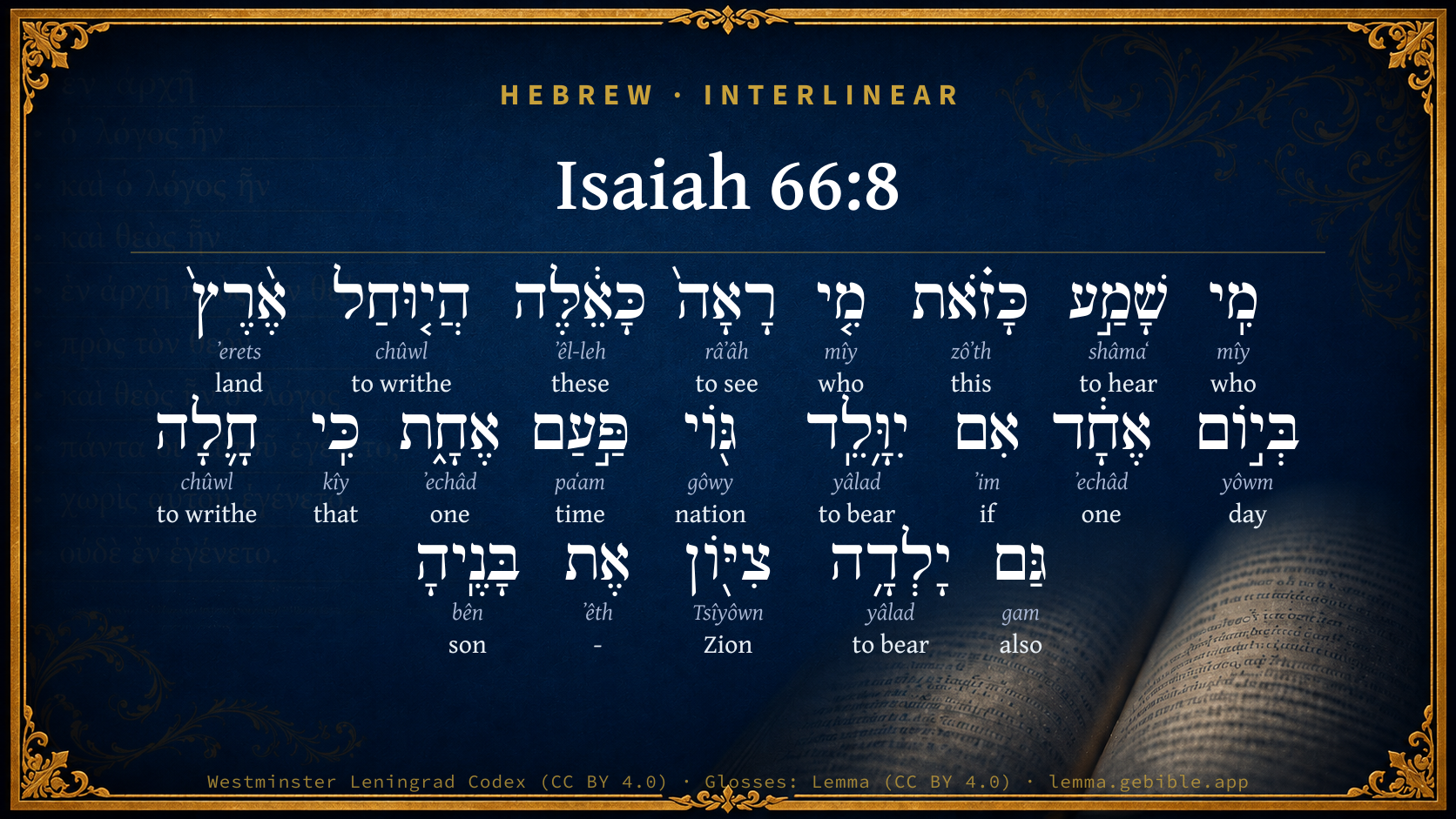
Hebrew (Westminster Leningrad Codex) Isaiah 66:8 appears in the Hebrew Old Testament. The text above is from the Westminster Leningrad Codex. Each word links to its Strong’s number, a concise gloss, and parsing drawn from the Open Scriptures Hebrew Bible morphology. Click any word for its full Brown-Driver-Briggs (BDB) entry.
Download image
Cite this verse

Isaiah 66:8 (World English Bible). Public Domain. Lemma interlinear Bible study tool, https://lemma.gebible.app/v/isaiah/66/8.

Show BibTeX & RIS
BibTeX
RIS
English Translation
Who has heard such a thing? who has seen such things? Shall a land be born in one day? shall a nation be brought forth at once? for as soon as Zion travailed, she brought forth her children.
World English Bible · Public Domain
Download a study sheet

One document with this verse’s original text, its word-by-word gloss line, the meaning frame, cross-references with their text, attributed commentary, and full source and license credits — printable, and it pastes into notes with its structure intact.

This verse Autodidact and up

Study sheet (.html) Plain text (.txt)

A passage Seminary Student

Up to 50 verses in one chapter. A passage sheet keeps up to 6 commentary sources and 12 cross-references per verse, in the order this page ranks them, and says so on the sheet whenever that leaves anything out. Ask for a single verse and you get the Autodidact verse sheet above.

Everything on this page stays free to read, with no account — the sheet is a download of what is already on screen, not access to it.

Want to remove ads? Support Godless Engineer
Compare translations 3

The same verse in 3 English versions, stacked beneath the original-language interlinear above. Click any original word for its lexicon entry.

Each is an independent rendering of the whole verse — the interlinear is not word-aligned to these translations.

Highlighted words mark where these versions differ — a whole-verse word diff, not a word-by-word alignment.

  • World English Bible Public Domain
    Who has heard such a thing? who has seen such things? Shall a land be born in one day? shall a nation be brought forth at once? for as soon as Zion travailed, she brought forth her children.
  • King James Version Public Domain
    Who hath heard such a thing? who hath seen such things? Shall the earth be made to bring forth in one day? or shall a nation be born at once? for as soon as Zion travailed, she brought forth her children.
  • unfoldingWord Literal Text CC BY-SA 4.0
    Who has heard like this? Who has seen like these? Will a land be writhed in one day? If a nation will be birthed one moment? For she writhed, Zion also birthed her sons.

unfoldingWord Literal Text — © unfoldingWord, licensed CC BY-SA 4.0. Word-aligned USFM3 via Door43 (git.door43.org/unfoldingWord/en_ult).

Versions to compare (up to 4)

3 of 4 selected

Show all 18 translations

Every available English version of this verse, each an independent rendering of the whole verse.

  • World English Bible Public Domain
    Who has heard such a thing? who has seen such things? Shall a land be born in one day? shall a nation be brought forth at once? for as soon as Zion travailed, she brought forth her children.
  • Berean Standard Bible Public Domain
    Who has heard of such as this? Who has seen such things? Can a country be born in a day or a nation be delivered in an instant? Yet as soon as Zion was in labor, she gave birth to her children.
  • Majority Standard Bible Public Domain
    Who has heard of such as this? Who has seen such things? Can a country be born in a day or a nation be delivered in an instant? Yet as soon as Zion was in labor, she gave birth to her children.
  • King James Version Public Domain
    Who hath heard such a thing? who hath seen such things? Shall the earth be made to bring forth in one day? or shall a nation be born at once? for as soon as Zion travailed, she brought forth her children.
  • American Standard Version (1901) Public Domain
    Who hath heard such a thing? who hath seen such things? Shall a land be born in one day? shall a nation be brought forth at once? for as soon as Zion travailed, she brought forth her children.
  • Revised Version (1885) Public Domain
    Who hath heard such a thing? who hath seen such things? Shall a land be born in one day? shall a nation be brought forth at once? for as soon as Zion travailed, she brought forth her children.
  • Geneva Bible (1599) Public Domain
    Who hath heard such a thing? who hath seene such things? shall ye earth be brought forth in one day? or shall a nation be borne at once? for assoone as Zion trauailed, she brought foorth her children.
  • Douay-Rheims (1899) Public Domain
    Who hath ever heard such a thing? and who hath seen the like to this? shall the earth bring forth in one day? or shall a nation be brought forth at once, because Sion hath been in labour, and hath brought forth her children?
  • Young's Literal Translation Public Domain
    Who hath heard anything like this? Who hath seen anything like these? Is earth caused to bring forth in one day? Born is a nation at once? For she hath been pained, Zion also hath borne her sons.
  • Literal Standard Version CC BY-SA 4.0
    Who has heard anything like this? Who has seen anything like these? Is earth caused to bring forth in one day? Is a nation born at once? For she has been pained, || Zion has also borne her sons.
  • Unlocked Literal Bible CC BY-SA 4.0
    Who has heard of such a thing? Who has seen such things? Will a land be born in one day? Can a nation be established in one moment? Yet as soon as Zion goes into labor, she gives birth to her children.
  • unfoldingWord Literal Text CC BY-SA 4.0
    Who has heard like this? Who has seen like these? Will a land be writhed in one day? If a nation will be birthed one moment? For she writhed, Zion also birthed her sons.
  • Darby Bible Public Domain
    Who hath heard such a thing? who hath seen such things? Can a land be made to bring forth in one day? shall a nation be born at once? For as soon as Zion travailed, she brought forth her sons.
  • World Messianic Bible Public Domain
    Who has heard of such a thing? Who has seen such things? Shall a land be born in one day? Shall a nation be born at once? For as soon as Zion travailed, she gave birth to her children.
  • Webster's Bible Public Domain
    Who hath heard such a thing? who hath seen such things? shall the earth be made to bring forth in one day? or shall a nation be born at once? for as soon as Zion travailed, she brought forth her children.
  • Free Bible Version CC BY-SA 4.0
    Who has ever heard of anything like this? Who has seen this kind of thing before? Can a country be delivered in a day, can a nation be born in a moment? Yet as soon as Zion went into labor, she gave birth to her children.
  • Bible in Basic English Public Domain
    When has such a story come to men's ears? who has seen such things? will a land come to birth in one day? will a nation be given birth in a minute? For when Zion's pains came on her, she gave birth to her children straight away.
  • JPS Tanakh (1917) Public Domain
    Who hath heard such a thing? Who hath seen such things? Is a land born in one day? Is a nation brought forth at once? For as soon as Zion travailed, she brought forth her children.

Literal Standard Version (2020), Covenant Press — licensed CC BY-SA 4.0. Text via the HelloAO Bible API (eBible.org). Unlocked Literal Bible (unfoldingWord) — licensed CC BY-SA 4.0. Text via the HelloAO Bible API (eBible.org). unfoldingWord Literal Text — © unfoldingWord, licensed CC BY-SA 4.0. Word-aligned USFM3 via Door43 (git.door43.org/unfoldingWord/en_ult). Free Bible Version, Dr. Jonathan Gallagher — licensed CC BY-SA 4.0. Text via the HelloAO Bible API (eBible.org).

Word by word

More ways to search: Search by grammar → Find every occurrence → Compare this word →

Practice this passage: Drill this verse → Learn its vocabulary →

הֲי֤וּחַל
chûwl
H2342
“to writhe”
Particle, Interrogative + Verb, Hophal, Imperfect, 3rd Person, Masculine, Singular
Part of Speech
Particle + Verb
Stem
Hophal
Form
Imperfect
Person
3rd Person
Gender
Masculine
Number
Singular
Full BDB Definition

Origin: a primitive root

TWOT: 623

to twist, whirl, dance, writhe, fear, tremble, travail, be in anguish, be pained - (Qal) - to dance - to twist, writhe - to whirl, whirl about - (Polel) - to dance - to writhe (in travail with), bear, bring forth - to wait anxiously - (Pulal) - to be made to writhe, be made to bear - to be brought forth - (Hophal) to be born - (Hithpolel) - whirling (participle) - writhing, suffering torture (participle) - to wait longingly - (Hithpalpel) to be distressed
  1. מִֽי mîy H4310 “who” Particle, Interrogative
  2. שָׁמַ֣ע shâmaʻ H8085 “to hear” Verb, Qal, Perfect, 3rd Person, Masculine, Singular
  3. כָּזֹ֗את zôʼth H2063 “like/as · this” Preposition + Pronoun, Demonstrative, Feminine, Singular
  4. מִ֤י mîy H4310 “who” Particle, Interrogative
  5. רָאָה֙ râʼâh H7200 “to see” Verb, Qal, Perfect, 3rd Person, Masculine, Singular
  6. כָּאֵ֔לֶּה ʼêl-leh H428 “like/as · these” Preposition + Pronoun, Demonstrative, Common, Plural
  7. אֶ֨רֶץ֙ ʼerets H776 “land” Noun, Common, Both, Singular, Absolute
  8. בְּי֣וֹם yôwm H3117 “in/at · day” Preposition + Noun, Common, Masculine, Singular, Absolute
  9. אֶחָ֔ד ʼechâd H259 “one” Adjective, Cardinal number, Masculine, Singular, Absolute
  10. אִם ʼim H518 “if” Conjunction
  11. יִוָּ֥לֵֽד yâlad H3205 “to bear” Verb, Niphal, Imperfect, 3rd Person, Masculine, Singular
  12. גּ֖וֹי gôwy H1471 “nation” Noun, Common, Masculine, Singular, Absolute
  13. פַּ֣עַם paʻam H6471 “time” Noun, Common, Feminine, Singular, Absolute
  14. אֶחָ֑ת ʼechâd H259 “one” Adjective, Cardinal number, Feminine, Singular, Absolute
  15. כִּֽי kîy H3588 “that” Conjunction
  16. חָ֛לָה chûwl H2342 “to writhe” Verb, Qal, Perfect, 3rd Person, Feminine, Singular
  17. גַּם gam H1571 “also” Particle, Accusative
  18. יָלְדָ֥ה yâlad H3205 “to bear” Verb, Qal, Perfect, 3rd Person, Feminine, Singular
  19. צִיּ֖וֹן Tsîyôwn H6726 “Zion” Noun, Proper
  20. אֶת ʼêth H853 “-” Particle, Direct Object
  21. בָּנֶֽיהָ bên H1121 “sons · her” Noun, Common, Masculine, Plural, Construct + Suffix, Personal, 3rd Person, Feminine, Singular

About this verse

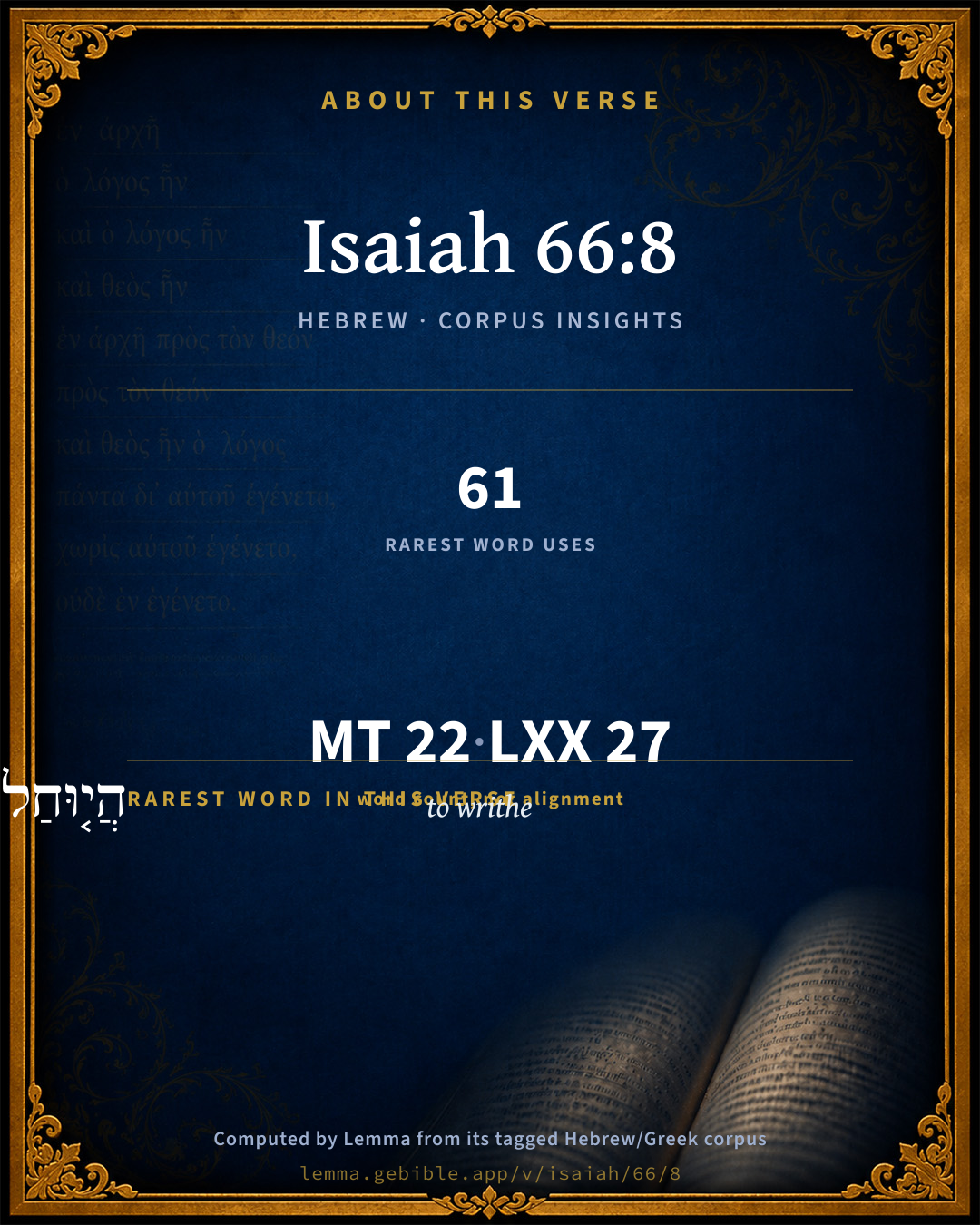
These counts appear in no published source. They are computed here, from the morphology-tagged text and Lemma’s own curated glosses. What Lemma adds →

22
words
18
distinct lemmas
Prophets
section

Grammatical profile

  • 6 verbs
  • 6 nouns
  • 2 adjectives
  • 2 pronouns
  • 2 conjunctions
  • 4 particles

Verb forms

  • שָׁמַ֣ע Qal · Perfect
  • רָאָה֙ Qal · Perfect
  • הֲי֤וּחַל Hophal · Imperfect
  • יִוָּ֥לֵֽד Niphal · Imperfect
  • חָ֛לָה Qal · Perfect
  • יָלְדָ֥ה Qal · Perfect

Repetition

Words recur within this verse — often emphatic in Hebrew:

  • הֲי֤וּחַל to writhe H2342 ×2
  • אֶחָ֔ד one H259 ×2
  • יִוָּ֥לֵֽד to bear H3205 ×2
  • מִֽי who H4310 ×2

Hebrew & Septuagint length

In English translation the verse runs 38 words from the Hebrew and 38 from the Septuagint (LXX English) — the same length.

A rough comparison of the two English renderings, which tokenize alike — not a word-level alignment.

Word counts can differ between the Hebrew and the Greek without any difference in meaning — e.g. the Hebrew direct-object marker אֵת has no separate Greek word, and Greek often adds the article ὁ.

In the original languages it is 22 Hebrew tokens and 27 Greek tokens — but the two are counted differently (Hebrew bundles its prefixes and suffixes into one token; the Greek is in lemma form), so that isn’t a like-for-like length.

Cross-references

4

Topical passages linked to Isaiah 66:8 in the Treasury of Scripture Knowledge — connected by theme and wording, ordered by reader-vote popularity; previews shown in the World English Bible.

  • Isaiah 64:4 For from of old men have not heard, nor perceived by the ear, neither has the eye seen a God besides you, who works for him who waits for him.
  • Isaiah 49:20–22 The children of your bereavement shall yet say in your ears, The place is too small for me; give place to me that I may dwell.
  • 1 Corinthians 2:9 But as it is written, "Things which an eye didn't see, and an ear didn't hear, Which didn't enter into the heart of man, These God has prepared for those who love him."
  • Romans 15:18–21 For I will not dare to speak of any things except those which Christ worked through me, for the obedience of the Gentiles, by word and deed,

Cross-references courtesy of OpenBible.info (CC BY 4.0).

Hebrew and Greek witnesses Masoretic Hebrew ↔ Greek Septuagint

The same verse in the two great witnesses to the Old Testament, shown verse-for-verse.

These are two independent witnesses, not word-aligned to each other, and the Septuagint is shown in lemma (dictionary) form.

Hebrew Isaiah 66:8 Masoretic · Westminster Leningrad Codex

מִֽי שָׁמַ֣ע כָּזֹ֗את מִ֤י רָאָה֙ כָּאֵ֔לֶּה הֲי֤וּחַל אֶ֨רֶץ֙ בְּי֣וֹם אֶחָ֔ד אִם יִוָּ֥לֵֽד גּ֖וֹי פַּ֣עַם אֶחָ֑ת כִּֽי חָ֛לָה גַּם יָלְדָ֥ה צִיּ֖וֹן אֶת בָּנֶֽיהָ

Who has heard such a thing? who has seen such things? Shall a land be born in one day? shall a nation be brought forth at once? for as soon as Zion travailed, she brought forth her children.

World English Bible · Public Domain

Greek LXX Isaiah 66:8 Septuagint · lemma form

τίς ἀκούω τοιοῦτος καί τίς ὁράω οὕτως ἤ ὠδίνω γῆ ἐν εἷς ἡμέρα ἤ καί τίκτω ἔθνος εἰς ἅπαξ ὅτι ὠδίνω καί τίκτω σιων ὁ παιδεία αὐτός

Who has heard such a thing? and who has seen after this manner? Has the earth travailed in one day? or has even a nation been born at once, that Sion has travailed, and brought forth her children?

LXX2012 (modern English Septuagint) · Public Domain

Hebrew: Westminster Leningrad Codex (CC BY 4.0). Greek: Septuagint (public domain); English from LXX2012 (modern English Septuagint) (Public Domain). How the Septuagint differs from the Hebrew →

Targum (Aramaic paraphrase)

1

The Targum is the ancient Jewish Aramaic paraphrase of the Hebrew Scriptures — an interpretive translation, not the Hebrew text itself. Onkelos (literal) and Pseudo-Jonathan (expansive) render the Torah, and Jonathan the Prophets. Coverage is partial: where no permissively-licensed English translation exists for a verse, only the Aramaic is shown. This is verse-level text, not a word-by-word alignment to the Hebrew.

  1. Targum Jonathan Prophets (Joshua–Malachi)
    מַן שְׁמַע כַּחֲדָא מַן חֲזָא כְּאִלֵין הָאֶפְשַׁר דְתִתְעֲבֵיד אַרְעָא בְּיוֹמָא חָד אִם יִתְבְּרֵי עַמָא זְמַן חֲדָא אֲרֵי עֲתִידָא דְתִתְנְחֵים צִיוֹן וְתִתְמְלֵי מֵעַם שְׁבִי גַלְוָתָהָא:

    Who hath heard such a thing? who hath seen such things? Is it possible that a country be made in one day, and a nation be created at once? but Zion shall be comforted, and shall be filled with the people of the captivity of her captivity.

    Targum Jonathan — Aramaic: “Mikraot Gedolot” (public domain). English: “Sefaria Community Translation” (CC0 1.0 (public-domain dedication)); “London "Chaldee Paraphrase," 1871” (public domain). Text via Sefaria.

Commentary

Notes on Isaiah 66:8 from classic Christian and Jewish commentators (each source and its license shown beneath its notes). The classic Christian expositions comment on the surrounding passage and are grouped to its opening verse, so a note may address several verses; the Jewish commentaries on the Tanakh (Rashi and others) are per-verse, so they appear only where the commentator wrote on this verse.

Lemma curates 59 commentaries, every one of them public domain or Creative Commons licensed, each selected and text-cleaned for this edition rather than reprinted as found. About our sources →

Trapp's Complete Commentary

John Trapp

Isa 66:8 Who hath heard such a thing? who hath seen such things? Shall the earth be made to bring forth in one day? [or] shall a nation be born at once? for as soon as Zion travailed, she brought forth her children.

Ver. 8. Who hath heard such a thing? who hath seen such things?] The birth of a man would seem a miracle, were it not so ordinary, miracula assiduitate vilescunt; but the birth of a whole nation at once, how much more!

Shall the earth be made to bring forth in one day?] Yes, if the day be long enough, as among the Hyperboreans, of whom it is written that they sow shortly after the sun rising, and reap before the sunset; because the whole half year is one continual day with them. {a} But the words here should be rather read, Can a land or a country be brought forth in one day? a nation be born at once? Cardinal Pool abused this scripture in a letter to Pope Julius III, applying it to the bringing in of Popery again here so universally and suddenly in Queen Mary’s days. So he did also another, when at his first return hither from beyond sea, he blasphemously saluted the same Queen Mary with those words of the angel, "Hail, Mary, full of grace, the Lord is with thee."

{a} Heresbach. de re rust.

John Trapp, A Commentary or Exposition upon All the Books of the Old and New Testament (1647–1656) — public domain. Text from a community e-Sword module.

The Biblical Illustrator

Joseph S. Exell

Isa_66:8

Shall the earth be made to bring forth in one day?

--

The acceleration of Gods movements

We are taught that in these latter days God is to shorten normal processes, accelerate events, and so make a short work in righteousness.

I. THE TRUTH OF GOD HAS WEIGHT, THEREFORE MOMENTUM.

II. THIS INHERENT MOMENTUM INCREASES WITH THE PROGRESS OF GODS TRUTH, IN HARMONY WITH THE NATURAL LAW OF FORCES.

III. GOD IS BEGINNING TO GIVE IT NOW AN ADDED CELERITY. (E. W.Thwing, M. D.)

As soon as Zion travailed, she brought forth her children

Travailing for souls

I. THERE MUST BE TRAVAIL BEFORE THERE WILL BE SPIRITUAL BIRTH.

1. Let me, first, establish this fact from history. Before there has fallen a great benediction upon Gods people, it has been preceded by great searchings of heart. Israel was so oppressed in Egypt, that it would have been very easy, and almost a natural thing for the people to become so utterly crushed in spirit as to submit to be hereditary bondslaves, making the best they could of their miserable lot: but God would not have it so; He meant to bring them out with a high hand and an outstretched arm. Before, however, He began to work He made them begin to cry. Let us take a long leap in history to the days of David. The era of the son of Jesse was evidently a time of religious revival. But David was the subject of spiritual throes and pangs of the most intense kind. What petitions he poured forth that God would visit Zion, and make the vine which He had planted to flourish once again. Now, David was only the mouth of hundreds of others, who with equal fervency cried unto God that the blessing might rest upon His people. Remember also the days of Josiah, the king. The book of the law was found neglected in the temple, and when it was brought before the king, he rent his clothes, for he saw that the nation had revolted, and that wrath must come upon it to the uttermost. The young kings heart, which was tender, for he feared God, was ready to break with anguish to think of the misery that would come upon his people on account of their sins. Then there came a glorious reformation, which purged the land of idols, and caused the passover to be observed as never before. Travail of heart among the godly produced the delightful change. It was the same with the work of Nehemiah. In the early dawn of Christian history, there was a preparation of the Church before it received an increase. The like living zeal and vehement desire have always been perceptible in the Church of God before any season of refreshing. Think not that Luther was the only man that wrought the Reformation. There were hundreds who sighed and cried in secret. And this, while true on the large scale, is true also in every individual case. As a rule, those who bring souls to Christ are those who first of all have felt an agony of desire that souls should be saved. This is imaged to us in our Masters character. His ministering servants who have been most useful have always been eagerly desirous to be so.

2. The reasons for it. Why is it that there must be this anxiety before desirable results are gained? It might suffice us to say that God has so appointed it. It is the order of nature. The child is not born into the world without the sorrows of the mother, nor is the bread which sustains life procured from the earth without toil. As it is in the natural, so is it in the spiritual; there shall not come the blessing we seek, without first of all the earnest yearning for it. It is so even in ordinary business. We say, No sweat no sweet, No pains no gains, No mill no meal. But better still, He has ordained this for our good. Every grace within the man is educated and increased by his travail for souls. Besides, the zeal that God excites within us is often the means of effecting the purpose which we desire. The Holy Ghost usually breaks hard hearts by tender hearts. Besides, the travail qualifies for the proper taking care of the offspring. Who is so fit to encourage a new-born believer as the man who first anguished before the Lord for his conversion? The Church that never travailed, should God send her a hundred converts, would be unfit to train them. Once more, there is it eat benefit in the law which makes travail necessary to spiritual birth, because It secures all the glory to God. Your longing that others should be saved, and your vehemence of spirit, shall secure to God all the glory of His own work.

3. Notice how this travail shows itself. Usually when God intends greatly to bless a Church, it will begin in this way: Two or three persons in it are distressed at the low state of affairs, and become troubled even to anguish. Perhaps they do not speak to one another, or know of their common grief, but they begin to pray with flaming desire and untiring importunity. The passion to see the Church revived rules them. They suffer great heaviness and continual sorrow in heart for perishing sinners; they travail in birth for souls. By degrees the individuals are drawn together by sacred affinity, and the prayer-meetings become very different. Meanwhile, not with the preacher only will be the blessing, but with his hearers who love the Lord. One will be trying a plan for getting in the young people: another will be looking after the strangers in the aisles, who come only now and then. One brother will make a vehement attempt to preach the Gospel at t e corner of the street; another will open a room down a dark court; another will visit lodging-houses and hospitals: all sorts of holy plans will be invented, and zeal will break out in many directions. All this will be spontaneous, nothing will be forced.

II. THE RESULT IS OFTEN VERY SURPRISING.

1. Frequently for rapidity. As soon as Zion travailed, she brought forth her children. During the ten years which ended in 1870 such wondrous changes were wrought throughout the world that no prophet would have been believed had he foretold them. Reforms have been accomplished in England, in the United States, in Germany, in Spain, in Italy, which, according to ordinary reckoning, would have occupied at least one hundred years.

2. For the greatness of it. It is said, Shall a nation be born at once? for as soon as ever Zion was in distress about her children, tens of thousands came and built up Jerusalem, and re-established the fallen state. So in answer to prayer, God does not only give speedy blessings, but great blessings. There were fervent prayers in that upper room before the day of Pentecost had fully come, and what a great answer it was when, after Peters sermon, some three thousand were ready to confess their faith in Christ, and to be baptized.

III. THIS TRAVAIL AND ITS RESULT ARE ABUNDANTLY DESIRABLE. There is no hope for China, for the world, for our own city, while the Church is lethargic. It is through the Church the blessing is bestowed. Besides this, when a Church is not serving God, mischief is brewing within herself. The Church must either bring forth children unto God, or die of consumption: she has no alternative but that. A Church must either be fruitful or rot, and of all things a rotting Church is the most offensive. And then, worst of all, God is not glorified.

IV. THE WOE WHICH WILL SURELY COME TO THOSE WHO HINDER THE TRAVAIL OF THE CHURCH, and so prevent the bringing forth of her children. An earnest spirit cannot complete its exhortations to zeal without pronouncing a denunciation upon the indifferent. What said the heroine of old who had gone forth against the enemies of Israel, when she remembered coward spirits? Curse ye, Meroz, saith the angel of the Lord, curse ye bitterly the inhabitants thereof; because they came not to the help of the Lord, against the mighty. Some such curse will assuredly come upon every professing Christian who is backward in helping the Church in the day of her souls travail. Who are they that hinder her Every worldly Christian hinders the progress of the Gospel. They are also guilty who distract the mind of the Church from the subject in hand. Above all, we shall be hindering the travail of the Church if we do not share in it. Many Church-members think that if they do nothing wrong, and make no trouble, then they are all right. Not at all.

V. I shall close with A WORD OF BLESSING. There shall come a great blessing to any who feel the soul travail that brings souls to God. Your own heart will be watered. Moreover, will it not be a joy to feel that you have done what you could? (C. H. Spurgeon.)

The Biblical Illustrator, edited by Joseph S. Exell (c. 1880s–1900s) — public domain. Text from a community e-Sword module.

The Preacher's Complete Homiletical Commentary

Joseph S. Exell (gen. ed.)

TRAVAILING FOR SOULS

Isa_66:8. As soon as Zion travailed, she brought forth, &c.

That we may obtain a clear, comprehensive, and impressive view of the doctrine involved in this declaration, let us inquire—I. What does this travail of the Church imply? Intense prayerful desire for the salvation of souls; a strong and unwavering faith that souls will be saved when the right means are used, &c. Will manifest itself in various ways. The Word of God, and the annals of the Church furnish numerous and stimulating illustrations. What do you know of this travail? II. Why is it necessary?

1. God has so appointed it.

(1) It is the order of nature. Lies at the basis of all secular success—if there be no labour there will be no profit, &c.

(2) As in the natural so in the spiritual world. The history of the Church is a continuous illustration. Equally true with individuals.

2. The appointment is highly advantageous, e.g.—

(1) Exercises the graces.

(2) Qualifies for the proper nurture of the offspring. III. How can it be realised? Not by simply desiring it, &c. Such is the constitution of the mind, that if you want to awaken concern respecting any subject, you must fix your attention upon facts adapted to induce it. No laek of facts suited to awaken intense longing for the salvation of souls. When this concern is awakened, take care that it is cherished. IV. What will be the result? The rapid increase of the Church (see context). When the Church is really anxious for conversions to Christ, sinners will soon become anxious to be converted. What a privilege and responsibility is placed in our hands! Conclusion: Are you deeply concerned for your own salvation, &c.? (See Dr. Jenkyn’s, “The Union of the Holy Spirit and the Church,” pp. 265–288; C. H. Spurgeon, “Metropolitan Tabernacle Pulpit,” No. 1009).—Alfred Tucker.

Isa_66:8-9. I. Zion’s increase. Unprecedented. Sudden. Extensive. Certain. Continuous. II. The effect of Divine power in conjunction with human efforts.

Isa_66:10-13. I. The consolations awaiting Zion. II. The joy of those that love her.—Dr. Lyth. (See outlines on Isa_54:1-3; Isa_60:8.)

The Preacher's Complete Homiletical Commentary (gen. ed. Joseph S. Exell; Funk & Wagnalls, c. 1892) — public domain (pre-1929). A full-Bible homiletical/sermon-outline anthology covering 65 of 66 books (2 John is absent from the source module). Text from a community e-Sword module.

Tyndale Open Study Notes

Tyndale Open Resources

66:8 by the time . . . her children will be born: A miraculous repopulation of Zion would occur (see 49:19-20; 54:1-3; cp. 1:8-9).

Tyndale Open Study Notes — © Tyndale Open Resources, licensed CC BY-SA 4.0. Text via the HelloAO Bible API.

Geneva Bible (1599)

Geneva Bible translators

This shall pass the capacity of man to see such a multitude that shall come up at once, meaning, under the preaching of the Gospel, whereof they that came up out of Babylon were a sign.

Geneva Bible (1599) marginal notes — public domain. Text via Bolls.life.

Jamieson, Fausset & Brown

Robert Jamieson, A. R. Fausset & David Brown

earth--rather, to suit the parallelism, "is a country (put for the people in it) brought forth in one day?" [LOWTH]. In English Version it means, The earth brings forth its productions gradually, not in one day (Mar 4:28).

at once--In this case, contrary to the usual growth of the nations by degrees, Israel starts into maturity at once.

for--rather, "is a nation born at once, that Zion has, so soon as she travailed, brought forth?" [MAURER].

Jamieson, Fausset & Brown — Commentary Critical and Explanatory on the Whole Bible (1871) — public domain (CC PDM 1.0). Text via the HelloAO Bible API.

Adam Clarke's Commentary

Verse 8. Who hath seen - "And who hath seen"] Twenty MSS., (four ancient,) of Kennicott's, and twenty-nine of De Rossi's, and two ancient of my own, and the two oldest editions, with two others, have umi, adding the conjunction vau; and so read all the ancient versions. AND who hath seen?

Adam Clarke's Commentary on the Bible (1810–1826) — public domain. Text from a community e-Sword/MySword module.

Ellicott's Commentary for English Readers

(8) Shall the earth be made . . .—Better, Shall a land be made to travail. The usually slow processes of national development are contrasted with the supernatural rapidity of the birth and growth of the new Israel.

A Bible Commentary for English Readers, edited by Charles John Ellicott (1878–1897) — public domain. Text from a community e-Sword module.

The Cambridge Bible for Schools and Colleges

gen. ed. J. J. S. Perowne

8. Shall the earth &c.] Render: Shall (the people of) a land be travailed with in one day? For “land” in the sense of “population” there do not seem to be any real parallels; Jdg_18:30 is hardly a case in point. Possibly the word for “people” (‘am) should be inserted (Duhm).

The Cambridge Bible for Schools and Colleges (gen. ed. J. J. S. Perowne; Cambridge University Press, 1878–1918) — public domain. Text from a community e-Sword module.

John Gill's Exposition

Who hath heard such a thing? who hath seen such things?.... Such numerous conversions, as after related; suggesting that they were wonderful and surprising, unheard of, what had never been seen in the world before, and which were amazing and astonishing to the church herself; see Isa 49:21,

shall the earth be made to bring forth in one day? as if it was said the thing about to be related was as wonderful as if all the women in the world should bring forth their children in one day, or bring forth as many at once as would fill the whole earth; or as surprising as if the earth should all at once send out its herbs, plants, and trees, as it did on the third day of the creation, Gen 1:11 which now gradually spring up, some in one month, and some in another, and some are months in their production:

or shall a nation be born at once? was ever such a thing heard of? yet this will be the case of the Jews in the latter day, when they shall be all converted and saved; and which shall be done suddenly and at once; see Hos 1:10, of which the conversion of them, in the first times of the Gospel, was an earnest and pledge, when three thousand were convinced, converted, and regenerated, in one day, under one sermon; and at another time, under the word, two thousand, if not five thousand: thus Christ had,

from the womb of the morning, or at the first break of the Gospel day, "the dew of his youth", or numbers of souls born again to him, like the drops of the morning dew; see Act 2:41,

for as soon as Zion travailed she brought forth her children; this shows that the preceding verse must be understood of some travail and pain, though comparatively little, and so soon over, that it was as if none; and this is to be understood of the pains which Gospel ministers take in preaching the word, which is the means of regeneration, and they the instruments of it; and so are called fathers, who through the Gospel beget souls to Christ; and of their anxious concern for the conversion of sinners, and the formation of Christ in them, which is called a travailing in birth; see Pe1 1:23, Rom 8:22 and it may also design the earnest prayers of the church and its members, striving and wrestling with God, being importunate with him, that the word preached might be useful for the good of souls; and particularly their earnest and fervent prayers for the conversion of the Jews, which will soon be brought about, when a spirit of grace and supplication is not only poured on them, but upon the saints in general, to pray fervently and earnestly for it.

John Gill's Exposition of the Whole Bible (1746–1763) — public domain (CC PDM 1.0). Text via the HelloAO Bible API.

Albert Barnes' Notes on the Bible

Who hath heard such a thing? - Of a birth so sudden. Usually in childbirth there are the pains of protracted parturition. The earth brings forth its productions gradually and slowly. Nations rise by degrees, and are long in coming to maturity. But here is such an event as if the earth should in a day be covered with a luxurious vegetation, or as if a nation should spring at once into being. The increase in the church would be as great and wonderful as if these changes were to occur in a moment.

Shall the earth be made to bring forth in one day? - That is, to produce its grass, and flowers, and fruit, and trees. The idea is, that it usually requires much longer time for it to mature its productions. The germ does not start forth at once; the flower, the fruit, the yellow harvest, and the lofty tree are not produced in a moment. Months and years are required before the earth would be covered with its luxuriant and beautiful productions But here would be an event as remarkable as if the earth should bring forth its productions in a single day.

Or shall a nation be born at once? - Such an event never has occurred. A nation is brought into existence by degrees. Its institutions are matured gradually, and usually by the long process of years. But here is an event as remarkable as if a whole nation should be born at once, and stand before the world, mature in its laws, its civil institutions, and in all that constitutes greatness. In looking for the fulfillment of this, we naturally turn the attention to the rapid progress of the gospel in the times of the apostles, when events occurred as sudden and as remarkable as if the earth, after the desolation of winter or of a drought, should be covered with rich luxuriance in a day, or as if a whole nation should start into existence, mature in all its institutions, in a moment. But there is no reason for limiting it to that time. Similar sudden changes are to be expected still on the earth; and I see no reason why this should not be applied to the spread of the gospel in pagan lands, and why we should not yet look for the rapid propagation of Christianity in a manner as surprising and wonderful as would be such an instantaneous change in the appearance of the earth, or such a sudden birth of a kingdom.

Albert Barnes' Notes on the Bible (1834–1885) — public domain. Text from a community e-Sword/MySword module.

Haydock's Catholic Bible Commentary

Day. Shall a whole nation be born at once? Twelve fishermen effect the most surprising change in the manners of the world.

George Leo Haydock (1774–1849), Haydock's Catholic Family Bible and Commentary, 1859 edition — public domain. Excludes Psalms (Douay-Rheims chapter numbering differs from Protestant) and Deuterocanonical books (Catholic canon only).

Matthew Poole's English Annotations

The prophet calls either to the whole world, or to such as feared God amongst the Jews, to admire God in his stupendous works of providence, either in the easy manner of the deliverance of the Jews out of the captivity of Babylon, without any pain, without so much as one throe; or else in the erecting of his gospel church, into which all the Jews that received Christ were gathered as well as Gentiles, making both one, Eph 2:14; which seems to be meant by the earth’s bringing forth in one day; as great a work of Providence as if all the women in the world should have brought forth in a day, or as if all the plants of the earth had brought forth their flowers and fruit in one day.

As soon as Zion travailed, she brought forth children; as soon as the church of the Jews began to move out of the captivity of Babylon, God put it into the hearts of multitudes to go up, Exo 1:5; Isa 2:1,2, &c. Or, as soon as the voice of the gospel put the church of the Jews into her travail, in John the Baptist’s, Christ’s, and the apostles’ times, it presently brought forth. In John Baptist’s time, the kingdom of heaven suffered violence, and the violent took it by force, Mat 11:12; and it continued so, as three thousand were converted at Peter’s sermon, Ac 2. The Gentiles were the children of Zion, being planted into their stock, tho law of the gospel first going out of Zion.

Matthew Poole's English Annotations on the Holy Bible (1683–1685) — public domain. Text from a community e-Sword/MySword module.

John Wesley's Explanatory Notes

For - As soon as the voice of the gospel put the church of the Jews into her travail, in Christ's and the Apostles time, it presently brought forth.

John Wesley, Explanatory Notes Upon the Whole Bible (1754–1765) — public domain. Text via the GEBible commentary corpus.

J. A. Alexander on Isaiah

Joseph Addison Alexander

“Who hath heard such a thing? who hath seen such things? Shall a land be brought forth in one day, or shall a nation be born at once? For Zion hath travailed, she hath also brought forth her children.” This verse, in the form of pointed interrogation, represents the event previously mentioned as without example. The terms of the sentence are exceedingly appropriate both to the return from Babylon and the future restoration of the Jews, but admit at the same time of a wider application to the change of dispensations as the birth of the church of the New Testament. The reference is merely to the short time required for the birth, as if he had said, ‘she has (already) travailed, she has also brought forth.’

Joseph Addison Alexander, The Prophecies of Isaiah (1846–1847; New York: Scribner, 1870–1878) — public domain. Text from a community e-Sword module.

Rashi

Rabbi Shlomo Yitzchaki (Rashi)

Is a land born in one day? Can a pain come to a woman in confinement to bear a land full of sons in one day?

Rashi on the Tanakh — English translations: “The Judaica Press complete Tanach with Rashi, translated by A. J. Rosenberg” (CC BY 4.0); “Pentateuch with Rashi's commentary by M. Rosenbaum and A.M. Silbermann, 1929-1934” (public domain); “The Metsudah Tanach series, Lakewood, N.J” (CC BY 4.0); and “The Book of Joshua, Metsudah Publications, 1997” (CC BY 4.0). Text via Sefaria.

Lesson kit

Teaching starters — assembled from the data on this page, not authored interpretation. Every prompt links to the verse data it draws on. Edit before teaching.

Isaiah, in the Prophets, opens this verse with 22 words (18 distinct Hebrew lemmas). Its most distinctive word is chûwl (“to writhe”). A historical commentator’s framing appears above. Read the whole chapter for the surrounding context.

Discussion questions

  1. What does “to writhe” (chûwl) contribute to the verse as a whole?
  2. How does Isaiah 64:4, which shares this passage’s theme, read alongside this verse?
  3. What does the repetition of “to writhe” (2× in this one verse) do in this verse?
  4. These translations render this verse differently. What is at stake in choosing one wording over another?
  5. «שָׁמַ֣ע» is a Qal Perfect verb. How does that grammatical form shape the action described?
  6. Compare how Trapp's Complete Commentary and The Biblical Illustrator read this verse. Where do they agree or differ?

Things to notice

Reading settings

Reading text

Shown beneath each verse's original-language words.

Old Testament
Old Testament edition

Read the OT as the Masoretic Hebrew (MT) or the Greek Septuagint (LXX).

English shown for the Greek Septuagint (in the Hebrew ↔ Greek comparison).

Comparing translations? Open the Compare panel on any verse page to stack up to four side by side.