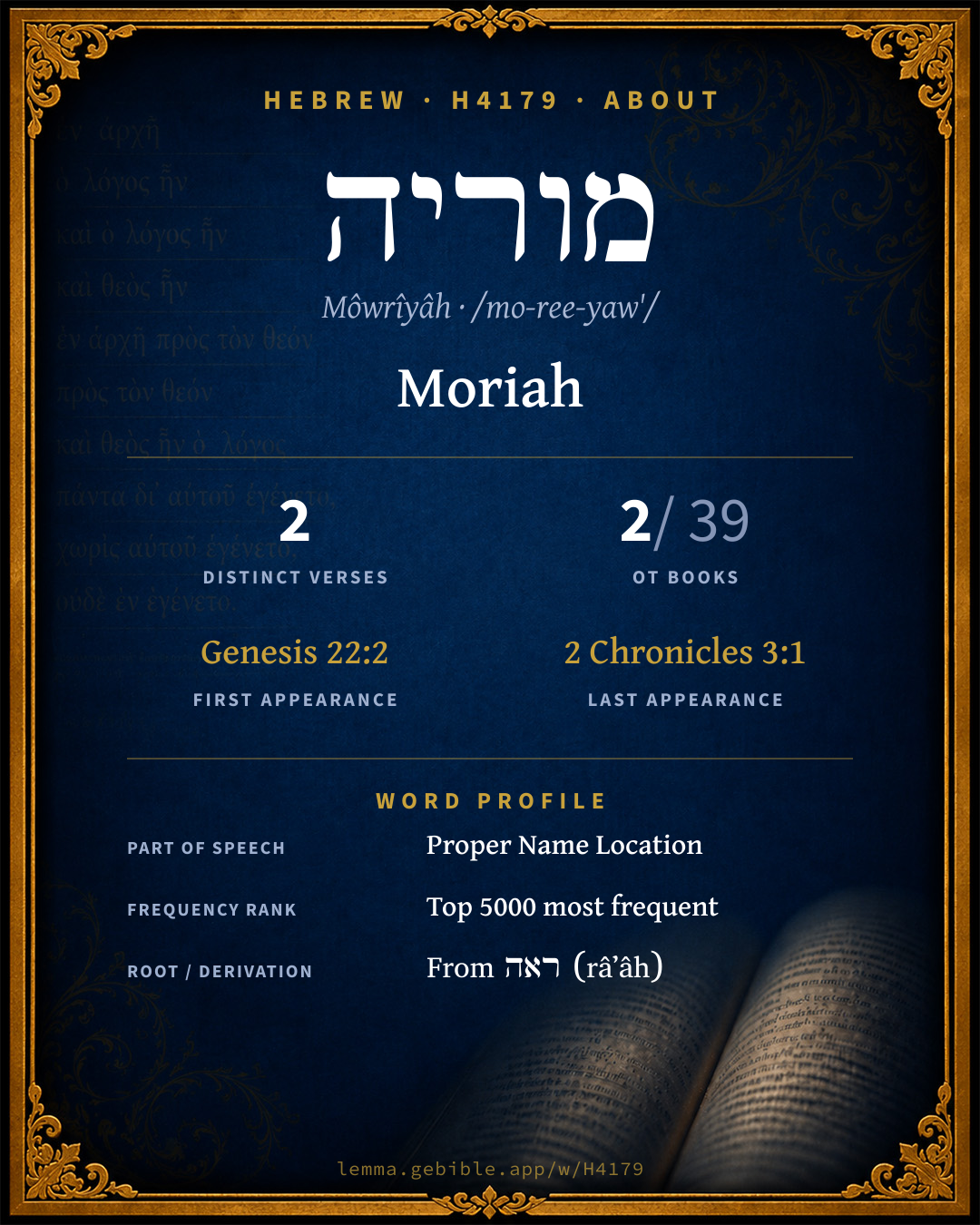
מֹרִיָּה
Moriah
BDB lists 3 entries for ‘Moriah’ fuller range ↓
Full lexicon entry — Brown-Driver-Briggs (BDB)
From Brown-Driver-Briggs (BDB)
Where this word appears
Grammar key — what these labels mean
Noun type
- Proper
- A name of a specific person, place, or people (e.g. Abraham, Zion, Israel).
Every verse where H4179 appears — 2 distinct verses across 2 books. Click any verse to open its interlinear word-by-word view. Verse text shown in the World English Bible for context — . Each verse’s Hebrew form is shown with its reference; the English is not keyword-highlighted, since the data carries no word-level English alignment. Use “Compare translations” on any verse to read it across multiple English versions. This concordance covers the Hebrew Bible; Septuagint (Greek Old Testament) occurrences are not indexed here.
Genesis 1 verse
2 Chronicles 1 verse
About this entry
At a glance — auto-summarized from this page’s data, not written by a person. Every figure links to its source below. This summary describes the numbers; it doesn’t interpret them.
The Hebrew name מוריה centers on the idea of “Moriah.” It occurs a mere 2 verses across Scripture. Genesis dominates its distribution — 1 of 2 verses. Debuting at Genesis 22:2, it then recurs through the corpus. For the data behind this summary, explore 2-verse concordance and the renderings breakdown below.
Gloss history
Strong's 1890 vs modern scholarship
About this word
Strong's H4179 catalogs a Hebrew word from the Hebrew Old Testament.
These counts are not copied from any lexicon or concordance. They are computed here, from the morphology-tagged Hebrew Old Testament. What Lemma adds →
- 2
- distinct verses
- The word appears in 2 distinct verses.
- 2 / 39
- OT books
- The word appears in 2 of 39 Old Testament books.
- #4,807
- by frequency
- Top 5000 most frequent Hebrew words (rank 4,807 of 8,640 Hebrew words by occurrence).
View all 2 occurrences in the concordance →
Most concentrated in
- Genesis 1 verse 50%
- 2 Chronicles 1 verse 50%
By section of the Old Testament
By traditional corpus
Conventional, traditional groupings — biblical authorship is debated, so this is a traditional corpus grouping, not an authorship claim. Each share is this word’s portion of its verses in that division of the Hebrew canon. Each figure is a share of the word’s 2 distinct verses.
- Torah (Pentateuch) 1 verse · 50%
- Writings (Ketuvim) 1 verse · 50%
How translations render this word
Counts come from each version’s own published word-to-Strong’s tagging or interlinear alignment — an approximate guide to how each version renders this word, not a word-level alignment the data otherwise carries. Because each total is that version’s own tagged count, the per-version totals vary from one another and need not match the appearance or distinct-verse counts above. These counts may also differ from a printed concordance because Lemma counts each distinctly tagged rendering and does not collapse phrase taggings into a single head-word total. This is a fixed set of word-tagged versions (KJV, ASV, BSB, ULT) and does not change with the reading translation you choose elsewhere. Each version’s license is shown beside its name below (and on Sources).
- King James Version: Moriah 2×
- American Standard Version: Moriah 2×
- Berean Standard Bible: Moriah 2×
- unfoldingWord Literal Text: Moriah 2×
King James Version Public Domain
Renders H4179 across 2 tagged occurrences — most commonly:
American Standard Version Public Domain
Renders H4179 across 2 tagged occurrences — most commonly:
Berean Standard Bible Public Domain
Renders H4179 across 2 tagged occurrences — most commonly:
unfoldingWord Literal Text CC BY-SA 4.0
Renders H4179 across 2 tagged occurrences — most commonly:
Senses in BDB
The 3 senses BDB distinguishes for this word, in lexicon order (not ranked by frequency or importance). The full entry — with sub-senses — is in the Lexicon Entry tab.
- Moriah = "chosen by Jehovah"
- the place where Abraham took Isaac for sacrifice
- the mount on the eastern edge of Jerusalem on which Solomon built the temple
Word origin
מֹרִיָּה, מוֹרִיָּה n.pr.loc. place for sacrificing Isaac; site of temple
— Brown-Driver-Briggs (Oxford 1906, public domain), digitized via Sefaria, supplemented by the OpenScriptures HebrewLexicon (CC BY 4.0). See Sources.
Derived from ראה (râʼâh) (H7200) — to see.
Jastrow Dictionary
A second Hebrew/Aramaic lexicon for comparison, covering Aramaic and post-biblical (Talmudic, Targumic, Midrashic) usage that the biblical-Hebrew BDB does not. Matched by lemma rather than by Strong’s number, so a lemma may carry more than one Jastrow headword (shown separately below), and the entries cover usage well beyond the Bible.
מוֹרִיָּה
- (b. h.) Mount Moriah, the Temple mount. Taan. II, 4, sq. מי שענה … בהר המ׳ וכ׳ may He who answered Abraham on M. M. answer your prayer &c. Ib. 16ᵃ; Y. Ber. IV, 8ᶜ top; Cant. R. to IV, 4; Gen. R. s. 55; Pesik. R. s. 40 (homiletical etymologies).
A Dictionary of the Targumim, the Talmud Babli and Yerushalmi, and the Midrashic Literature (Marcus Jastrow; London, Luzac, 1903) — Public Domain. Digitized via Sefaria. Digitized via Sefaria. Full attribution on Sources.
Forms in the corpus
The 2 distinct written forms H4179 takes in the Hebrew Bible, most frequent first — each parse links to that state’s occurrences in the concordance. Hebrew forms include their vowel points and cantillation, so a single lemma takes many written forms.
| Form | Parsing | Example | Uses |
|---|---|---|---|
| הַ/מּ֣וֹרִיָּ֔ה | Noun, Proper | 2 Chronicles 3:1 | 1 |
| הַ/מֹּרִיָּ֑ה | Noun, Proper | Genesis 22:2 | 1 |
Same root — word family
Other BDB entries built from the same root as H4179, grouped by Strong’s listed origin. These share a root / origin per the lexicon — not necessarily a shared meaning. Each links to that word’s own entry.
Derives from
Shares the same root
- מראה marʼeh H4758 sight
- מראה murʼâh H4760 crop
- ראה râʼâh H7201 bird of prey
- ראה râʼeh H7202 seeing
- ראה rôʼeh H7203 seer
- ראוה raʼăvâh H7207 beholding
- ראי rᵉʼîy H7209 mirror
- ראי rŏʼîy H7210 appearance
- ראית rᵉʼîyth H7212 beholding
- רו rêv H7299 appearance
Proper names from this root
People and places named from this root — a name, not an additional meaning of the word.
Compare all same-root words → Showing 4 of 14 — not the complete family. 2 of the same-root words are proper names (people or places). They share a root, not necessarily a meaning.
Bible dictionary
Public-domain dictionary articles matched to this entry by name (Moriah). A biblical name can be shared by more than one person or place, so an article may treat several.
Easton's Bible Dictionary · M. G. Easton, 1897
The chosen of Jehovah. Some contend that Mount Gerizim is meant, but most probably we are to regard this as one of the hills of Jerusalem. Here Solomon's temple was built, on the spot that had been the threshing-floor of Ornan the Jebusite (2 Sam. 24:24, 25; 2 Chr. 3:1). It is usually included in Zion, to the north-east of which it lay, and from which it was separated by the Tyropoean valley. This was "the land of Moriah" to which Abraham went to offer up his son Isaac (Gen. 22:2). It has been supposed that the highest point of the temple hill, which is now covered by the Mohammedan Kubbetes-Sakhrah, or "Dome of the Rock," is the actual site of Araunah's threshing-floor. Here also, one thousand years after Abraham, David built an altar and offered sacrifices to God. (See JERUSALEM; NUMBERING THE PEOPLE.)
Smith's Bible Dictionary · William Smith, 1863
(chosen by Jehovah).
+ The land of Moriah--On "one of the mountains" in this district took place the sacrifice of Isaac. (Genesis 22:2) Its position is doubtful, some thinking it to be Mount MOriah, others that Moreh, near Shechem, is meant. [See Mount, Mount, Mountain MORIAH] + Mount Moriah .--The elevation on which Solomon built the temple, where God appeared to David "in the threshing floor of Araunah the Jebusite." it is the Eastern eminence of Jerusalem, separated from Mount Zion by the Tyropoeon valley. The tope was levelled by Solomon, and immense walls were built around it from the base to enlarge the level surface for the temple area. A tradition which first appears in a definite shape in Josephus, and is now almost universally accepted, asserts that the "Mount Moriah" of the Chronicles is identical with the "mountain" in "the land of Moriah" of Genesis, and that the spot on which Jehovah appeared to David, and on which the temple was built, was the very spot of the sacrifice of Isaac. (Smith, Stanley and Grove are, however, inclined to doubt this tradition.)
Hitchcock's Bible Names Dictionary · Roswell D. Hitchcock, 1869
bitterness of the Lord
Classic public-domain reference works; full attribution on Sources.
Septuagint verse parallels
This word appears in 2 verses that also exist in the Greek Old Testament (Septuagint), out of the 2 Hebrew verses it occurs in. You can read those verses in Greek by switching the Old Testament edition to the Septuagint.
Read these verses in the Septuagint
This is a verse-level parallel only — the same verses exist in both the Hebrew and Greek Old Testaments. No word-level Hebrew↔Greek correspondence is claimed: the data carries no such alignment, so no Greek word is shown as this Hebrew word’s translation. Coverage is not total — the Septuagint omits the deuterocanon and renumbers the Psalms, so some Hebrew verses have no direct Greek parallel.