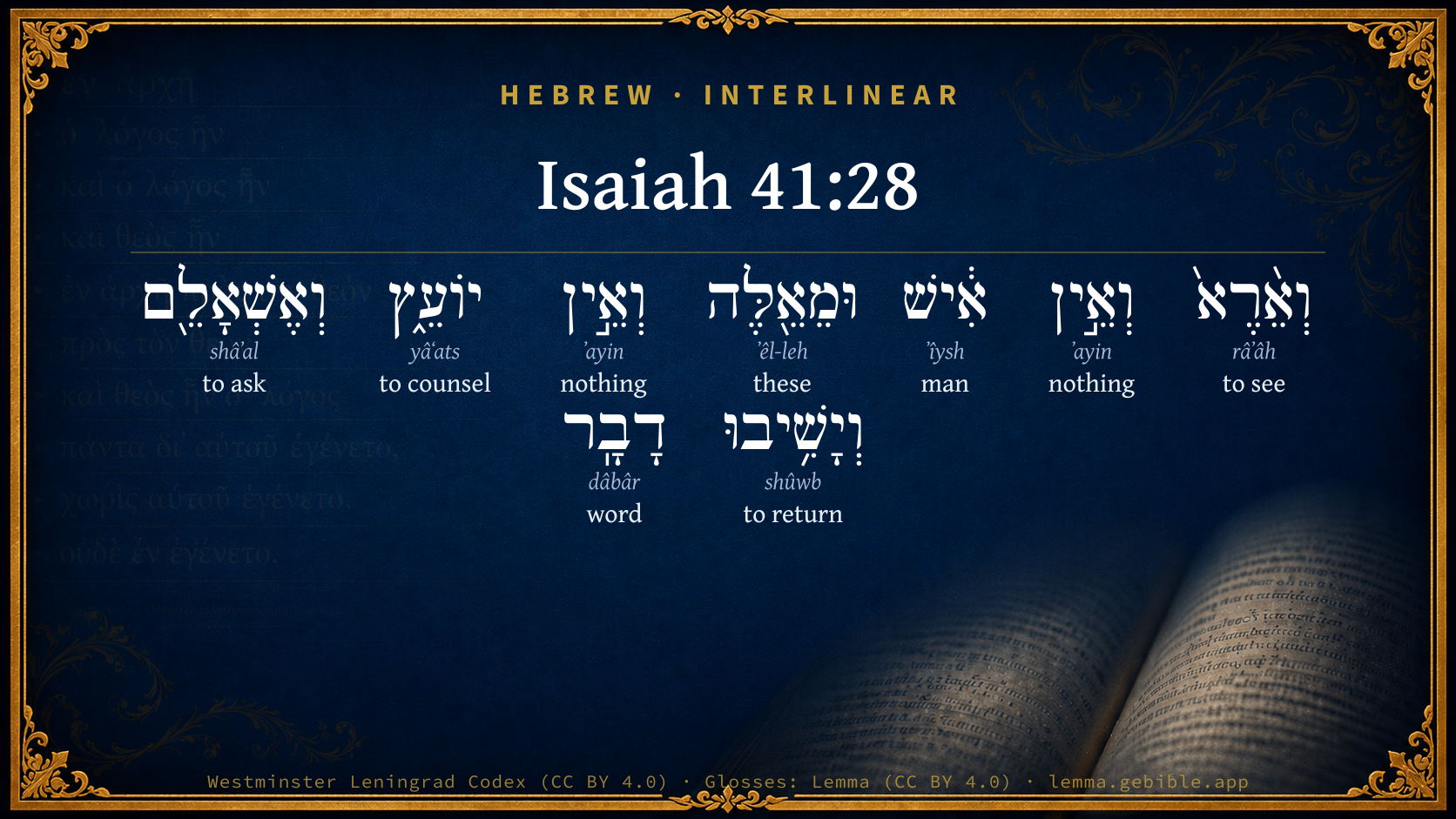
Isaiah 41:28

Hebrew (Westminster Leningrad Codex) Isaiah 41:28 appears in the Hebrew Old Testament. The text above is from the Westminster Leningrad Codex. Each word links to its Strong’s number, a concise gloss, and parsing drawn from the Open Scriptures Hebrew Bible morphology. Click any word for its full Brown-Driver-Briggs (BDB) entry.
Download image
Cite this verse

Isaiah 41:28 (World English Bible). Public Domain. Lemma interlinear Bible study tool, https://lemma.gebible.app/v/isaiah/41/28.

Show BibTeX & RIS
BibTeX
RIS
English Translation
When I look, there is no man: even among them there is no counselor who, when I ask of them, can answer a word.
World English Bible · Public Domain
Download a study sheet

One document with this verse’s original text, its word-by-word gloss line, the meaning frame, cross-references with their text, attributed commentary, and full source and license credits — printable, and it pastes into notes with its structure intact.

This verse Autodidact and up

Study sheet (.html) Plain text (.txt)

A passage Seminary Student

Up to 50 verses in one chapter. A passage sheet keeps up to 6 commentary sources and 12 cross-references per verse, in the order this page ranks them, and says so on the sheet whenever that leaves anything out. Ask for a single verse and you get the Autodidact verse sheet above.

Everything on this page stays free to read, with no account — the sheet is a download of what is already on screen, not access to it.

Want to remove ads? Support Godless Engineer
Compare translations 3

The same verse in 3 English versions, stacked beneath the original-language interlinear above. Click any original word for its lexicon entry.

Each is an independent rendering of the whole verse — the interlinear is not word-aligned to these translations.

Highlighted words mark where these versions differ — a whole-verse word diff, not a word-by-word alignment.

  • World English Bible Public Domain
    When I look, there is no man: even among them there is no counselor who, when I ask of them, can answer a word.
  • King James Version Public Domain
    For I beheld, and there was no man; even among them, and there was no counsellor, that, when I asked of them, could answer a word.
  • unfoldingWord Literal Text CC BY-SA 4.0
    For I looked, but there was no man, and from these, indeed, none was counseling. And I asked them, but they did return a word.

unfoldingWord Literal Text — © unfoldingWord, licensed CC BY-SA 4.0. Word-aligned USFM3 via Door43 (git.door43.org/unfoldingWord/en_ult).

Versions to compare (up to 4)

3 of 4 selected

Show all 18 translations

Every available English version of this verse, each an independent rendering of the whole verse.

  • World English Bible Public Domain
    When I look, there is no man: even among them there is no counselor who, when I ask of them, can answer a word.
  • Berean Standard Bible Public Domain
    When I look, there is no one; there is no counselor among them; when I ask them, they have nothing to say.
  • Majority Standard Bible Public Domain
    When I look, there is no one; there is no counselor among them; when I ask them, they have nothing to say.
  • King James Version Public Domain
    For I beheld, and there was no man; even among them, and there was no counsellor, that, when I asked of them, could answer a word.
  • American Standard Version (1901) Public Domain
    And when I look, there is no man: even among them there is no counsellor, that, when I ask of them, can answer a word.
  • Revised Version (1885) Public Domain
    And when I look, there is no man; even among them there is no counsellor, that, when I ask of them, can answer a word.
  • Geneva Bible (1599) Public Domain
    But when I behelde, there was none, and when I inquired of them, there was no counsellor, and when I demaunded of them, they answered not a woorde.
  • Douay-Rheims (1899) Public Domain
    And I saw, and there was no one even among them to consult, or who, when I asked, could answer a word.
  • Young's Literal Translation Public Domain
    And I see that there is no man, Yea, of these that there is no counsellor, And I ask them, and they return word:
  • Literal Standard Version CC BY-SA 4.0
    And I see that there is no man, || Indeed, of these that there is no counselor, || And I ask them, and they return word:
  • Unlocked Literal Bible CC BY-SA 4.0
    When I look, there is no one, not one among them who can give good advice, who, when I ask, can answer a word.
  • unfoldingWord Literal Text CC BY-SA 4.0
    For I looked, but there was no man, and from these, indeed, none was counseling. And I asked them, but they did return a word.
  • Darby Bible Public Domain
    And I beheld, and there was no man; even among them, -- and there was no counsellor, that, when I asked of them, could answer a word.
  • World Messianic Bible Public Domain
    When I look, there is no man, even among them there is no counselor who, when I ask, can answer a word.
  • Webster's Bible Public Domain
    For I beheld, and there was no man; even among them, and there was no counselor, that, when I asked of them, could answer a word.
  • Free Bible Version CC BY-SA 4.0
    I look at these idols, and find there is no one who can say anything. None of them can give advice; when I ask them something, they can't even answer.
  • Bible in Basic English Public Domain
    And I saw that there was no man, even no wise man among them, who might give an answer to my questions.
  • JPS Tanakh (1917) Public Domain
    And I look, but there is no man; even among them, but there is no counsellor, that, when I ask of them, can give an answer.

Literal Standard Version (2020), Covenant Press — licensed CC BY-SA 4.0. Text via the HelloAO Bible API (eBible.org). Unlocked Literal Bible (unfoldingWord) — licensed CC BY-SA 4.0. Text via the HelloAO Bible API (eBible.org). unfoldingWord Literal Text — © unfoldingWord, licensed CC BY-SA 4.0. Word-aligned USFM3 via Door43 (git.door43.org/unfoldingWord/en_ult). Free Bible Version, Dr. Jonathan Gallagher — licensed CC BY-SA 4.0. Text via the HelloAO Bible API (eBible.org).

Word by word

More ways to search: Search by grammar → Find every occurrence → Compare this word →

Practice this passage: Drill this verse → Learn its vocabulary →

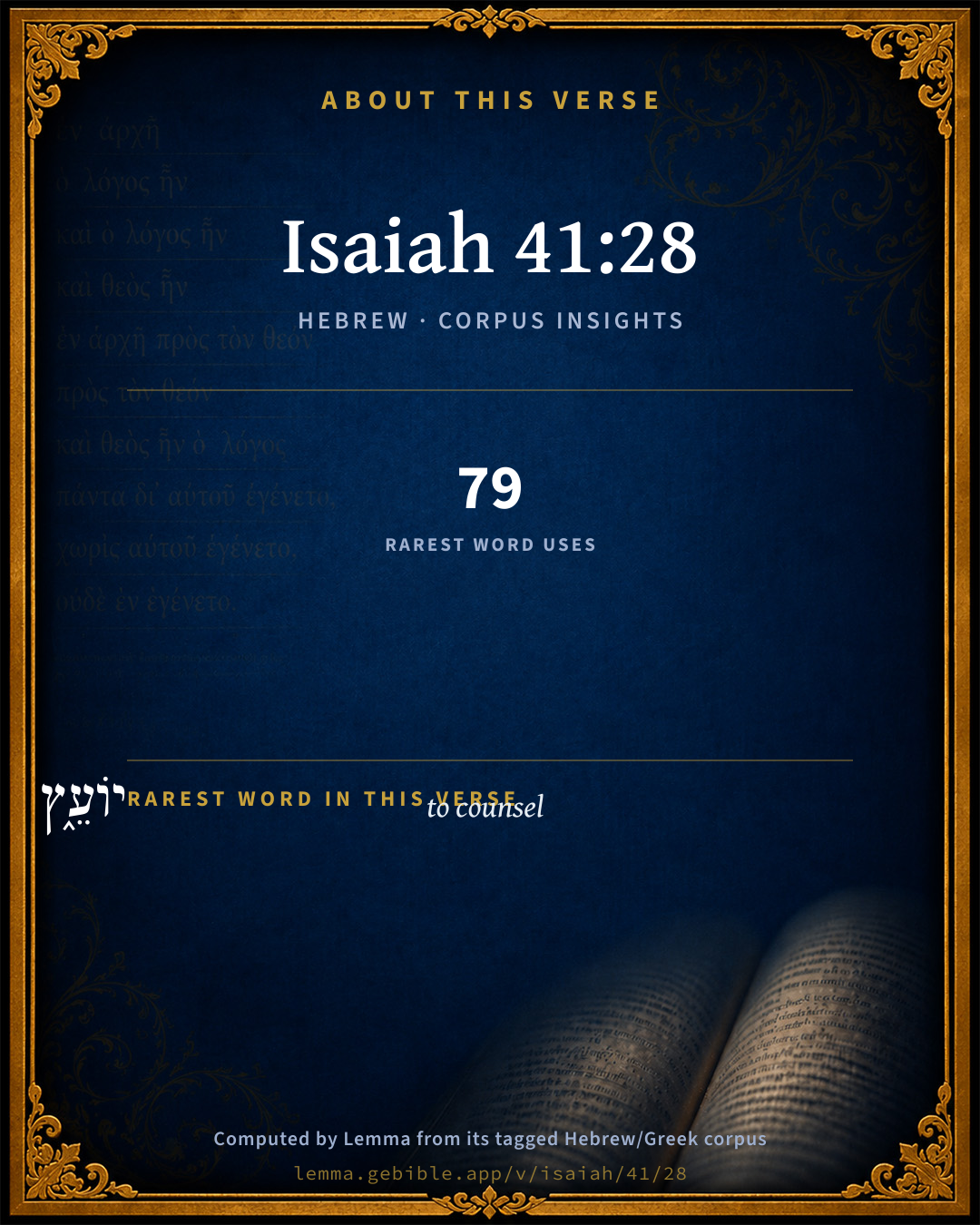
יוֹעֵ֑ץ
yâʻats
H3289
“counseling”
Verb, Qal, Participle Active, Masculine, Singular, Absolute
Part of Speech
Verb
Stem
Qal
Form
Participle Active
Gender
Masculine
Number
Singular
State
Absolute
Full BDB Definition

Origin: a primitive root

TWOT: 887

to advise, consult, give counsel, counsel, purpose, devise, plan - (Qal) - to advise, counsel, give counsel, consult - counsellor (participle) - (Niphal) to consult together, exchange counsel, deliberate, counsel together - (Hithpael) to conspire
  1. וְאֵ֨רֶא֙ râʼâh H7200 “and · to see” Conjunction + Verb, Qal, Imperfect, 1st Person, Common, Singular
  2. וְאֵ֣ין ʼayin H369 “and · nothing” Conjunction + Particle, Negative
  3. אִ֔ישׁ ʼîysh H376 “man” Noun, Common, Masculine, Singular, Absolute
  4. וּמֵאֵ֖לֶּה ʼêl-leh H428 “and · from · these” Conjunction + Preposition + Pronoun, Demonstrative, Common, Plural
  5. וְאֵ֣ין ʼayin H369 “and · nothing” Conjunction + Particle, Negative
  6. וְאֶשְׁאָלֵ֖ם shâʼal H7592 “and · to ask · them” Conjunction + Verb, Qal, Imperfect, 1st Person, Common, Singular + Suffix, Personal, 3rd Person, Masculine, Plural
  7. וְיָשִׁ֥יבוּ shûwb H7725 “and · to return” Conjunction + Verb, Hiphil, Imperfect, 3rd Person, Masculine, Plural
  8. דָבָֽר dâbâr H1697 “word” Noun, Common, Masculine, Singular, Absolute

About this verse

These counts appear in no published source. They are computed here, from the morphology-tagged text and Lemma’s own curated glosses. What Lemma adds →

9
words
8
distinct lemmas
Prophets
section

Grammatical profile

  • 4 verbs
  • 2 nouns
  • 1 pronoun
  • 2 particles

Verb forms

  • וְאֵ֨רֶא֙ Qal · Imperfect
  • יוֹעֵ֑ץ Qal · Participle Active
  • וְאֶשְׁאָלֵ֖ם Qal · Imperfect
  • וְיָשִׁ֥יבוּ Hiphil · Imperfect

Repetition

A word recurs within this verse — often emphatic in Hebrew:

  • וְאֵ֣ין nothing H369 ×2

Hebrew & Septuagint length

In English translation the verse runs 24 words from the Hebrew and 34 from the Septuagint (LXX English) — the Septuagint runs noticeably longer here. See the side-by-side →

A rough comparison of the two English renderings, which tokenize alike — not a word-level alignment.

Word counts can differ between the Hebrew and the Greek without any difference in meaning — e.g. the Hebrew direct-object marker אֵת has no separate Greek word, and Greek often adds the article ὁ.

Cross-references

7

Topical passages linked to Isaiah 41:28 in the Treasury of Scripture Knowledge — connected by theme and wording, ordered by reader-vote popularity; previews shown in the World English Bible.

  • Isaiah 63:5 I looked, and there was none to help; and I wondered that there was none to uphold: therefore my own arm brought salvation to me; and my wrath, it upheld me.
  • Isaiah 40:13–14 Who has directed the Spirit of Yahweh, or being his counselor has taught him?
  • Isaiah 50:2 Why, when I came, was there no man? when I called, was there none to answer? Is my hand shortened at all, that it can't redeem? or have I no power to deliver? Behold, at my rebuke I dry up the sea, I make the rivers a wilderness: their fish stink, because there is no water, and die for thirst.
  • Isaiah 59:16 He saw that there was no man, and wondered that there was no intercessor: therefore his own arm brought salvation to him; and his righteousness, it upheld him.
  • Daniel 2:10–11 The Chaldeans answered before the king, and said, There is not a man on the earth who can show the king's matter, because no king, lord, or ruler, has asked such a thing of any magician, or enchanter, or Chaldean.
  • Daniel 4:7–8 Then came in the magicians, the enchanters, the Chaldeans, and the soothsayers; and I told the dream before them; but they did not make known to me the interpretation of it.
  • Daniel 5:8 Then came in all the king's wise men; but they could not read the writing, nor make known to the king the interpretation.

Cross-references courtesy of OpenBible.info (CC BY 4.0).

Hebrew and Greek witnesses Masoretic Hebrew ↔ Greek Septuagint

The same verse in the two great witnesses to the Old Testament, shown verse-for-verse.

Here the Septuagint runs noticeably longer than the Hebrew — LXX2012 (modern English Septuagint) 34 words vs World English Bible 24. A rough length comparison of the two English translations, not a word-level alignment — read both below.

These are two independent witnesses, not word-aligned to each other, and the Septuagint is shown in lemma (dictionary) form.

Hebrew Isaiah 41:28 Masoretic · Westminster Leningrad Codex

וְאֵ֨רֶא֙ וְאֵ֣ין אִ֔ישׁ וּמֵאֵ֖לֶּה וְאֵ֣ין יוֹעֵ֑ץ וְאֶשְׁאָלֵ֖ם וְיָשִׁ֥יבוּ דָבָֽר

When I look, there is no man: even among them there is no counselor who, when I ask of them, can answer a word.

World English Bible · Public Domain

Greek LXX Isaiah 41:28 Septuagint · lemma form

ἀπό γάρ ὁ ἔθνος ἰδού οὐδείς καί ἀπό ὁ εἴδωλον αὐτός οὐ εἰμί ὁ ἀναἀγγέλλω καί ἐάν ἐρωτάω αὐτός πόθεν εἰμί οὐ μή ἀποκρίνω ἐγώ

For from among the nations, behold, there was no one; and of their idols there was none to declare anything: and if I should ask them, Whence are you⌃? they could not answer me.

LXX2012 (modern English Septuagint) · Public Domain

On this verse, Adam Clarke's Commentary discusses the Septuagint’s reading. Read the note in Commentary ↓

Hebrew: Westminster Leningrad Codex (CC BY 4.0). Greek: Septuagint (public domain); English from LXX2012 (modern English Septuagint) (Public Domain). How the Septuagint differs from the Hebrew →

Targum (Aramaic paraphrase)

1

The Targum is the ancient Jewish Aramaic paraphrase of the Hebrew Scriptures — an interpretive translation, not the Hebrew text itself. Onkelos (literal) and Pseudo-Jonathan (expansive) render the Torah, and Jonathan the Prophets. Coverage is partial: where no permissively-licensed English translation exists for a verse, only the Aramaic is shown. This is verse-level text, not a word-by-word alignment to the Hebrew.

  1. Targum Jonathan Prophets (Joshua–Malachi)
    וּגְלֵי קֳדְמַי וְלֵית גְבַר דְלֵיהּ עוֹבָדִין טָבִין וּמֵאִלֵין לֵית דְמָלִיךְ מֵילַךְ וּשְׁאִילְתִּינוּן אִם יְתוּבוּן פִּתְגָם:

    And it was made known to me, that there was no man whose works were good, and of these there was none who would take counsel, that I should ask them, and they would answer a word.

    Targum Jonathan — Aramaic: “Mikraot Gedolot” (public domain). English: “Sefaria Community Translation” (CC0 1.0 (public-domain dedication)); “London "Chaldee Paraphrase," 1871” (public domain). Text via Sefaria.

Commentary

Notes on Isaiah 41:28 from classic Christian and Jewish commentators (each source and its license shown beneath its notes). The classic Christian expositions comment on the surrounding passage and are grouped to its opening verse, so a note may address several verses; the Jewish commentaries on the Tanakh (Rashi and others) are per-verse, so they appear only where the commentator wrote on this verse.

Lemma curates 59 commentaries, every one of them public domain or Creative Commons licensed, each selected and text-cleaned for this edition rather than reprinted as found. About our sources →

Trapp's Complete Commentary

John Trapp

Isa 41:28 For I beheld, and [there was] no man; even among them, and [there was] no counsellor, that, when I asked of them, could answer a word.

Ver. 28. For I beheld, and there was no man.] None to say anything for these dumb idols, why I should not pass a definitive sentence against them. It is, therefore, this -

John Trapp, A Commentary or Exposition upon All the Books of the Old and New Testament (1647–1656) — public domain. Text from a community e-Sword module.

Joseph Benson's Commentary

Isa 41:28-29. For I beheld — I looked to see if I could find any of them that could certainly foretel future events; and there was no man — Not any of the idols; for the word man is sometimes used by the Hebrews of brute creatures, and even of lifeless things. There was no counsellor — Though these idols were often consulted, yet none of them were able to give any solid or certain advice concerning future things. Behold, they are all vanity — This is the conclusion of the whole dispute, and the just sentence which God passes upon idols: they are vain things, and falsely called gods. Their molten images are wind — Empty and unsatisfying things, and which, like the wind, do quickly pass away and come to nothing; and confusion — Confused, useless things, like that rude heap in the beginning of God’s creation, of which this word, תהו, is used, Gen 1:2. He mentions molten images particularly, because their materials were most precious, and more cost and art were commonly bestowed upon them than upon others: but under these he comprehends all images whatsoever.

Joseph Benson's Commentary on the Old and New Testaments (1811–1818) — public domain. Text from a community e-Sword module.

Geneva Bible (1599)

Geneva Bible translators

When I looked whether the idols could do these things, I found that they had neither wisdom nor power to do anything: therefore he concludeth that all are wicked, that trust in such vanities.

Geneva Bible (1599) marginal notes — public domain. Text via Bolls.life.

Jamieson, Fausset & Brown

Robert Jamieson, A. R. Fausset & David Brown

no counsellor--no one of the idolatrous soothsayers who could inform (Num 24:14) those who consulted them what would take place. Compare "counsel of His messenger" (Isa 44:26).

when I asked--that is, challenged them, in this chapter.

Jamieson, Fausset & Brown — Commentary Critical and Explanatory on the Whole Bible (1871) — public domain (CC PDM 1.0). Text via the HelloAO Bible API.

Adam Clarke's Commentary

Verse 28. Among them - "Among the idols"] For ומאלה umeelleh, I read ומאלים umeellim, with the Septuagint, και απο των ειδωλων, "and from or among the idols." See Ex 15:11; Isa 57:5.

R. D. Kimchi has many good observations on this chapter. Bishop Lowth follows him in applying it to Abraham, and not to Cyrus; the whole being spoken in the past tense, which is not used, or rarely, in such a case for the future. Almost the whole of the rabbins understand it of Abraham. On Kimchi's plan, the following is a paraphrase.

The righteous man - Abram, from the east - the land of his nativity, called the land of the children of the east, Ge 29:1.

Brought him to his feet - Whithersoever his feet went, he preached righteousness and truth; as it is written, "There he proclaimed in the name of JEHOVAH," Ge 21:31. And he called it ויקראהו vaiyikraehu - that is, צרק tsedek, righteousness, to his feet, enabled him to hold it forth wherever he went.

He called the nations - To leave their idols and worship him who made the universe. He taught them the way of righteousness, truth, and faith. Was there ever a prodigy like to this? A man who had been an idolater, rising up against all the nations of the earth, reproving their faith, and not fearing before them nor their kings! Who stirred up his heart to do this? Was it not the Lord?

Gave the nations before him - And made him rule over kings - Chedorlaomer, and the kings which were with him: whom the Lord gave as dust to his sword, and stubble to his bow.

He pursued them - He and his three hundred and eighteen servants.

He passed safely - שלום shalom for בשלום beshalom, in safety; so said, because he lost not one of his men in this expedition. See Kimchi.

Adam Clarke's Commentary on the Bible (1810–1826) — public domain. Text from a community e-Sword/MySword module.

Ellicott's Commentary for English Readers

(28) For I beheld, and there was no man—i.e., no one who had foretold the future. Jehovah, speaking through the prophet, looks round in vain for that.

A Bible Commentary for English Readers, edited by Charles John Ellicott (1878–1897) — public domain. Text from a community e-Sword module.

The Cambridge Bible for Schools and Colleges

gen. ed. J. J. S. Perowne

28. For I beheld, and there was] Rather as R.V. And when I look, there is. Cf. Isa_50:2 even amongst them] Better: and among these, viz., the idols; the previous clause referring to their worshippers.

no counseller] None who can advise in the present crisis.

The Cambridge Bible for Schools and Colleges (gen. ed. J. J. S. Perowne; Cambridge University Press, 1878–1918) — public domain. Text from a community e-Sword module.

John Gill's Exposition

For I beheld, and there was no man,.... Among all the Pagan priests and prophets, that could foretell things to come; or could prove that their idols did or could say anything in favour of them:

even amongst them, and there was no counsellor: none that could be advocates for these idols, and plead their cause; or could give any good advice and counsel to persons that needed it, and who applied to them or their idols for it:

that, when I asked of them, could answer a word; when asked what they had to say on behalf of their gods they worshipped, were dumb and speechless; moreover, all this may be said of the idols themselves, that there was none among them that could foretell a future event, or give any wholesome counsel to their worshippers, or could say anything in their own defence; and therefore, to close the controversy, the following sentence is pronounced.

John Gill's Exposition of the Whole Bible (1746–1763) — public domain (CC PDM 1.0). Text via the HelloAO Bible API.

Albert Barnes' Notes on the Bible

For I beheld - I looked upon the pagan world, among all the pretended prophets, and the priests of pagan idolatry.

And there was no man - No man among them who could predict these future events.

No counselor - No one qualified to give counsel, or that could anticipate by his sagacity what would take place.

That, when I asked of them - In the manner referred to in this chapter. There is no one of whom it could be inquired what would take place in future times.

Could answer a word - They were unable to discern what would come to pass, or to predict the events which are referred to here.

Albert Barnes' Notes on the Bible (1834–1885) — public domain. Text from a community e-Sword/MySword module.

Haydock's Catholic Bible Commentary

I. Isaias, (Menochius) or God, (Haydock) pronounces sentence against the speechless idols. (Menochius)

George Leo Haydock (1774–1849), Haydock's Catholic Family Bible and Commentary, 1859 edition — public domain. Excludes Psalms (Douay-Rheims chapter numbering differs from Protestant) and Deuterocanonical books (Catholic canon only).

Matthew Poole's English Annotations

For I beheld, Heb. And I beheld; I looked about me to see if I could find any man of them that could certainly and of themselves foretell such future events.

No man; not any, to wit, of the idols; for the word man is sometimes used by the Hebrews of brute creatures, and even of lifeless things, as Isa 34:15; 40:26, and elsewhere.

There was no counsellor; though these idols were oft consulted, and by the help of the devil did sometimes deliver oracles, yet none of them were able to give any solid and certain advice concerning future things.

That, when I asked of them, could answer a word; when I tried their divinity by this character, they had nothing to say for themselves.

Matthew Poole's English Annotations on the Holy Bible (1683–1685) — public domain. Text from a community e-Sword/MySword module.

Whedon's Commentary on the Bible

Daniel D. Whedon

28, 29. I beheld — All opportunities were given the prophets of idolatry, pagan priests, soothsayers, necromancers, etc., to furnish the first indication of predictive power; but not one ever appeared.

There was no man — No one among all the pretenders, no idol divinity, could answer a word.

They are all vanity — Nothingness. Idol and his worshippers are utter nothingness! All among them, when they attempt to speak, are wind and confusion.

The address is thus rounded off in this last return to the idol priests and prophets with whom it first started. The first part, as some divide it, (Isa_41:1-24,) contains the judicial pleadings; the second part, (Isa_41:25-29,) recapitulates the evidence and the verdict.

Daniel D. Whedon (gen. ed.), Commentary on the Old and New Testaments (1874–1909) — public domain. Text from a community e-Sword module.

The Pulpit Commentary

For I beheld. "Jehovah once more looks round to see if any of the idols possess an ability to prophesy, but in vain" (Cheyne). He finds no counsellor, i.e. no prophet, among them. Hence the final "outburst of scorn" in ver. 29, which, however, is directed primarily against the idol-worshippers, and, only through them, against the idols.

The Pulpit Commentary (1880–1919), ed. H.D.M. Spence-Jones & Joseph S. Exell — public domain. Text from a community e-Sword module.

John Wesley's Explanatory Notes

For - I looked to see if I could find any man that could foretel future events. No man - Not any, of the idols; for the word man is sometimes used by the Hebrew of brute creatures, and even of lifeless things. No counsellor - Though these idols were often consulted, yet none of them were able to give any solid and certain advice concerning future things.

John Wesley, Explanatory Notes Upon the Whole Bible (1754–1765) — public domain. Text via the GEBible commentary corpus.

J. A. Alexander on Isaiah

Joseph Addison Alexander

“And I will look, but there is no man; and of these, but there is no one advising (or informing); and I will ask them, and they will return a word (or answer).” He allows them as it were another opportunity of proving their divinity. In the first two clauses, the expectation and the disappointment are described together; in the third, the expectation only is expressed, the result being given in the following verse. First He looks, but finds not what He seeks. Then again, but with the same result. Once more He interrogates them and awaits an answer, but (as the next verse adds) discovers them to be impostors. There is something singularly beautiful in this peculiar structure of the sentence, which is wholly marred by the indirect constructions that are commonly adopted, ‘that when I asked them could answer a word’, or, ‘that I should question them and they return an answer’. The verse is full of laconic and elliptical expressions, which however may be easily completed, as will appear from the following brief paraphrase. ‘I will look (once more to see whether any of these idols or their prophet can predict the future), but there is no one (who attempts it). From among (all) these (I seek for a response, but there is none.) (Yet once more) I will ask them, and (perhaps) they will return an answer.’ The same application of the verb translated ‘advising’ to the prediction of the future occurs below in Isa 44:26. The form here used is to be strictly construed as a participle.

Joseph Addison Alexander, The Prophecies of Isaiah (1846–1847; New York: Scribner, 1870–1878) — public domain. Text from a community e-Sword module.

Rashi

Rabbi Shlomo Yitzchaki (Rashi)

And I look and there is no man [lit. and I will see, in the future tense.] I always look at the prophets of Baal, and there is no man who tells of a future event.

and of these of all these destined to come, and none of them is a counselor who stood in God’s counsel and will know them.

and I ask them that they reply with a word That they should reply with a word if I should ask them.

Rashi on the Tanakh — English translations: “The Judaica Press complete Tanach with Rashi, translated by A. J. Rosenberg” (CC BY 4.0); “Pentateuch with Rashi's commentary by M. Rosenbaum and A.M. Silbermann, 1929-1934” (public domain); “The Metsudah Tanach series, Lakewood, N.J” (CC BY 4.0); and “The Book of Joshua, Metsudah Publications, 1997” (CC BY 4.0). Text via Sefaria.

Ibn Ezra

Rabbi Abraham ibn Ezra

For I beheld and there was no man of the idolaters that could tell this.

Ibn Ezra on the Tanakh — English translations: “Sefaria Community Translation” (CC0 1.0 (public-domain dedication)); “Yalkut, Sifsei Chachomim Chumash, Metsudah Publications, 2009” (CC BY 4.0); and “Commentary of Ibn Ezra on Isaiah - trans. by M. Friedlander, 1873” (public domain). Text via Sefaria.

Lesson kit

Teaching starters — assembled from the data on this page, not authored interpretation. Every prompt links to the verse data it draws on. Edit before teaching.

Isaiah, in the Prophets, opens this verse with 9 words (8 distinct Hebrew lemmas). Its most distinctive word is yâʻats (“to counsel”). The Greek Septuagint runs longer here. A historical commentator’s framing appears above. Read the whole chapter for the surrounding context.

Discussion questions

  1. How does “to counsel” (yâʻats) shape what this verse is saying?
  2. Isaiah 63:5 shares this passage’s theme. How do the two illuminate each other?
  3. “nothing” occurs 2× in this one verse. What is the effect of the repetition?
  4. Compared with the Hebrew, the Septuagint runs longer here. What questions does that raise?
  5. The translations on this page render this verse differently — a whole-verse word diff, not a word-by-word alignment. What might account for the different wordings?
  6. The verb «וְאֵ֨רֶא֙» is Qal Imperfect. How does its form color the action?
  7. Reading how Trapp's Complete Commentary and Joseph Benson's Commentary read this verse, where do the two commentators agree and where do they part?

Things to notice

Reading settings

Reading text

Shown beneath each verse's original-language words.

Old Testament
Old Testament edition

Read the OT as the Masoretic Hebrew (MT) or the Greek Septuagint (LXX).

English shown for the Greek Septuagint (in the Hebrew ↔ Greek comparison).

Comparing translations? Open the Compare panel on any verse page to stack up to four side by side.