
Isaiah 47:10

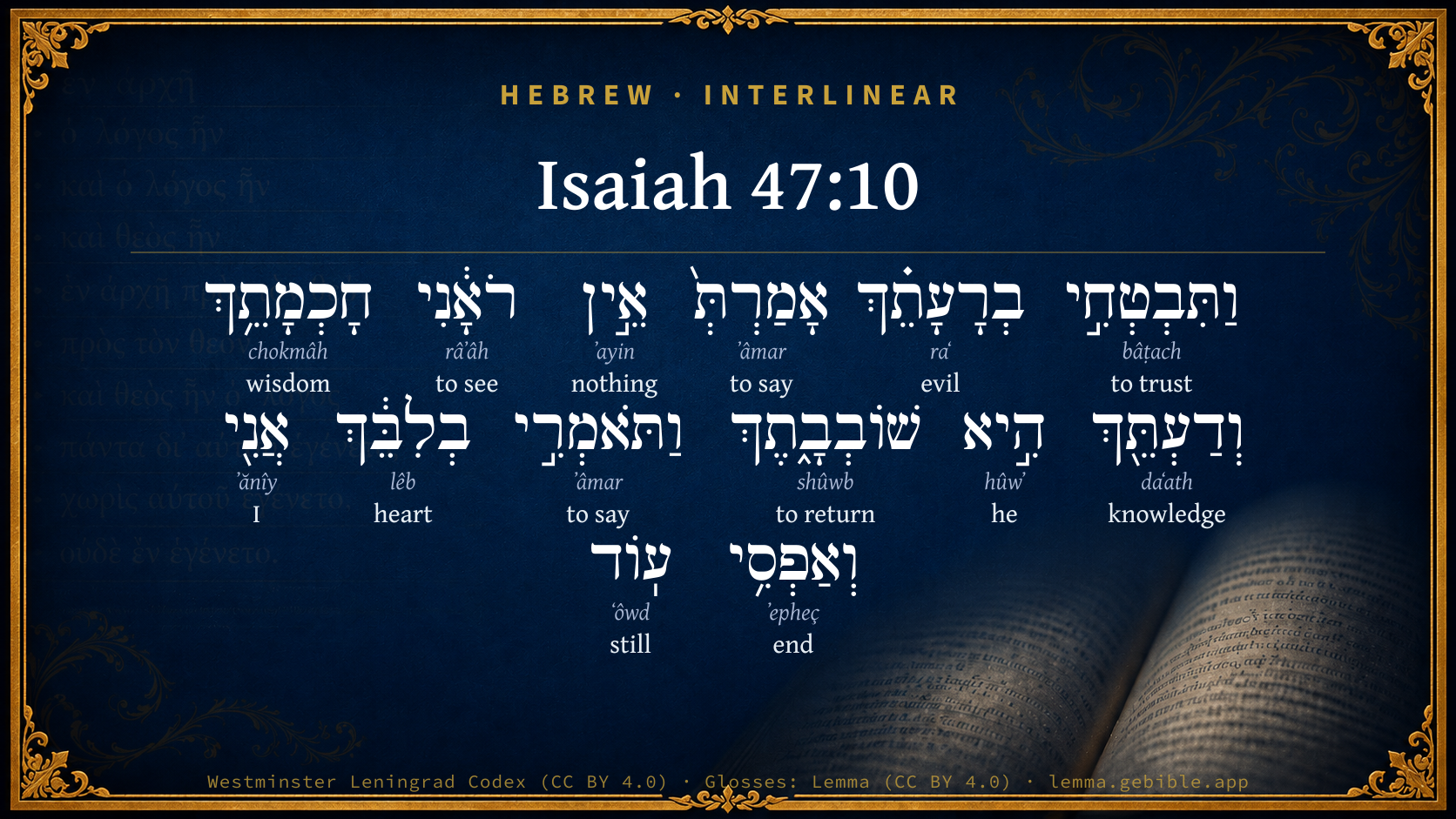
Hebrew (Westminster Leningrad Codex) Isaiah 47:10 appears in the Hebrew Old Testament. The text above is from the Westminster Leningrad Codex. Each word links to its Strong’s number, a concise gloss, and parsing drawn from the Open Scriptures Hebrew Bible morphology. Click any word for its full Brown-Driver-Briggs (BDB) entry.
Download image
Cite this verse

Isaiah 47:10 (World English Bible). Public Domain. Lemma interlinear Bible study tool, https://lemma.gebible.app/v/isaiah/47/10.

Show BibTeX & RIS
BibTeX
RIS
English Translation
For you have trusted in your wickedness; you have said, None sees me; your wisdom and your knowledge, it has perverted you, and you have said in your heart, I am, and there is none else besides me.
World English Bible · Public Domain
Download a study sheet

One document with this verse’s original text, its word-by-word gloss line, the meaning frame, cross-references with their text, attributed commentary, and full source and license credits — printable, and it pastes into notes with its structure intact.

This verse Autodidact and up

Study sheet (.html) Plain text (.txt)

A passage Seminary Student

Up to 50 verses in one chapter. A passage sheet keeps up to 6 commentary sources and 12 cross-references per verse, in the order this page ranks them, and says so on the sheet whenever that leaves anything out. Ask for a single verse and you get the Autodidact verse sheet above.

Everything on this page stays free to read, with no account — the sheet is a download of what is already on screen, not access to it.

Want to remove ads? Support Godless Engineer
Compare translations 3

The same verse in 3 English versions, stacked beneath the original-language interlinear above. Click any original word for its lexicon entry.

Each is an independent rendering of the whole verse — the interlinear is not word-aligned to these translations.

Highlighted words mark where these versions differ — a whole-verse word diff, not a word-by-word alignment.

  • World English Bible Public Domain
    For you have trusted in your wickedness; you have said, None sees me; your wisdom and your knowledge, it has perverted you, and you have said in your heart, I am, and there is none else besides me.
  • King James Version Public Domain
    For thou hast trusted in thy wickedness: thou hast said, None seeth me. Thy wisdom and thy knowledge, it hath perverted thee; and thou hast said in thine heart, I am, and none else beside me.
  • unfoldingWord Literal Text CC BY-SA 4.0
    But you trusted in your wickedness; you said, ‘No one is seeing me.’ Your wisdom and your knowledge, it led you astray, and you said in your heart, ‘I, and besides me none.’

unfoldingWord Literal Text — © unfoldingWord, licensed CC BY-SA 4.0. Word-aligned USFM3 via Door43 (git.door43.org/unfoldingWord/en_ult).

Versions to compare (up to 4)

3 of 4 selected

Show all 18 translations

Every available English version of this verse, each an independent rendering of the whole verse.

  • World English Bible Public Domain
    For you have trusted in your wickedness; you have said, None sees me; your wisdom and your knowledge, it has perverted you, and you have said in your heart, I am, and there is none else besides me.
  • Berean Standard Bible Public Domain
    You were secure in your wickedness; you said, ‘No one sees me.’ Your wisdom and knowledge led you astray; you told yourself, ‘I am, and there is none besides me.’
  • Majority Standard Bible Public Domain
    You were secure in your wickedness; you said, ‘No one sees me.’ Your wisdom and knowledge led you astray; you told yourself, ‘I am, and there is none besides me.’
  • King James Version Public Domain
    For thou hast trusted in thy wickedness: thou hast said, None seeth me. Thy wisdom and thy knowledge, it hath perverted thee; and thou hast said in thine heart, I am, and none else beside me.
  • American Standard Version (1901) Public Domain
    For thou hast trusted in thy wickedness; thou hast said, None seeth me; thy wisdom and thy knowledge, it hath perverted thee, and thou hast said in thy heart, I am, and there is none else besides me.
  • Revised Version (1885) Public Domain
    For thou hast trusted in thy wickedness; thou hast said, None seeth me; thy wisdom and thy knowledge, it hath perverted thee: and thou hast said in thine heart, I am, and there is none else beside me.
  • Geneva Bible (1599) Public Domain
    For thou hast trusted in thy wickednesse: thou hast sayd, None seeth me. Thy wisdom and thy knowledge, they haue caused thee to rebel, and thou hast saide in thine heart, I am, and none els.
  • Douay-Rheims (1899) Public Domain
    And thou best trusted in thy wickedness, and hast said: There is none that seeth me. Thy wisdom, and thy knowledge, this hath deceived thee. And thou best said in thy heart: I am, and besides me there is no other.
  • Young's Literal Translation Public Domain
    And thou art confident in thy wickedness, Thou hast said, `There is none seeing me,' Thy wisdom and thy knowledge, It is turning thee back, And thou sayest in thy heart, `I `am', and none else.'
  • Literal Standard Version CC BY-SA 4.0
    And you are confident in your wickedness, || You have said, There is none seeing me, || Your wisdom and your knowledge, || It is turning you back, || And you say in your heart, I [am], and none else.
  • Unlocked Literal Bible CC BY-SA 4.0
    You have trusted in your wickedness; you have said, “No one sees me”; your wisdom and your knowledge lead you astray, but you say in your heart, “I exist, and there is no one else like me.”
  • unfoldingWord Literal Text CC BY-SA 4.0
    But you trusted in your wickedness; you said, ‘No one is seeing me.’ Your wisdom and your knowledge, it led you astray, and you said in your heart, ‘I, and besides me none.’
  • Darby Bible Public Domain
    For thou hast confided in thy wickedness: thou hast said, None seeth me. Thy wisdom and thy knowledge, it hath seduced thee; and thou hast said in thy heart, It is I, and there is none but me.
  • World Messianic Bible Public Domain
    For you have trusted in your wickedness. You have said, ‘No one sees me.’ Your wisdom and your knowledge has perverted you. You have said in your heart, ‘I am, and there is no one else besides me.’
  • Webster's Bible Public Domain
    For thou hast trusted in thy wickedness: thou hast said, None seeth me. Thy wisdom and thy knowledge, it hath perverted thee; and thou hast said in thy heart, I am, and none else besides me.
  • Free Bible Version CC BY-SA 4.0
    You put your trust in your evil actions, saying, “No one can see what I'm doing.” Your wisdom and knowledge seduced you, and you told yourself, “I am supreme—there's nobody besides me.”
  • Bible in Basic English Public Domain
    For you had faith in your evil-doing; you said, No one sees me; by your wisdom and knowledge you have been turned out of the way: and you have said in your heart, I am, and there is no other.
  • JPS Tanakh (1917) Public Domain
    And thou hast been secure in thy wickedness, thou hast said: 'None seeth me'; thy wisdom and thy knowledge, it hath perverted thee; and thou hast said in thy heart. 'I am, and there is none else beside me.'

Literal Standard Version (2020), Covenant Press — licensed CC BY-SA 4.0. Text via the HelloAO Bible API (eBible.org). Unlocked Literal Bible (unfoldingWord) — licensed CC BY-SA 4.0. Text via the HelloAO Bible API (eBible.org). unfoldingWord Literal Text — © unfoldingWord, licensed CC BY-SA 4.0. Word-aligned USFM3 via Door43 (git.door43.org/unfoldingWord/en_ult). Free Bible Version, Dr. Jonathan Gallagher — licensed CC BY-SA 4.0. Text via the HelloAO Bible API (eBible.org).

Word by word

More ways to search: Search by grammar → Find every occurrence → Compare this word →

Practice this passage: Drill this verse → Learn its vocabulary →

וְאַפְסִ֥י
ʼepheç
H657
“and · end · my”
Conjunction + Noun, Common, Masculine, Singular, Construct + Suffix, Personal, 1st Person, Common, Singular
Part of Speech
Conjunction + Noun
Type
Common
Gender
Masculine
Number
Singular
State
Construct
Full BDB Definition

Origin: from H656

TWOT: 147a

ceasing, end, finality
  1. וַתִּבְטְחִ֣י bâṭach H982 “and · to trust” Conjunction + Verb, Qal, Sequential Imperfect, 2nd Person, Feminine, Singular
  2. בְרָעָתֵ֗ךְ raʻ H7451 “in/at · evil · your” Preposition + Noun, Common, Feminine, Singular, Construct + Suffix, Personal, 2nd Person, Feminine, Singular
  3. אָמַרְתְּ֙ ʼâmar H559 “to say” Verb, Qal, Perfect, 2nd Person, Feminine, Singular
  4. אֵ֣ין ʼayin H369 “nothing” Particle, Negative
  5. רֹאָ֔נִי râʼâh H7200 “seeing · me” Verb, Qal, Participle Active, Masculine, Singular, Construct + Suffix, Personal, 1st Person, Common, Singular
  6. חָכְמָתֵ֥ךְ chokmâh H2451 “wisdom · your” Noun, Common, Feminine, Singular, Construct + Suffix, Personal, 2nd Person, Feminine, Singular
  7. וְדַעְתֵּ֖ךְ daʻath H1847 “and · knowledge · your” Conjunction + Noun, Common, Feminine, Singular, Construct + Suffix, Personal, 2nd Person, Feminine, Singular
  8. הִ֣יא hûwʼ H1931 “he” Pronoun, Personal, 3rd Person, Feminine, Singular
  9. שׁוֹבְבָ֑תֶךְ shûwb H7725 “to return · you” Verb, Polel, Perfect, 3rd Person, Feminine, Singular + Suffix, Personal, 2nd Person, Feminine, Singular
  10. וַתֹּאמְרִ֣י ʼâmar H559 “and · to say” Conjunction + Verb, Qal, Sequential Imperfect, 2nd Person, Feminine, Singular
  11. בְלִבֵּ֔ךְ lêb H3820 “in/at · heart · your” Preposition + Noun, Common, Masculine, Singular, Construct + Suffix, Personal, 2nd Person, Feminine, Singular
  12. אֲנִ֖י ʼănîy H589 “I” Pronoun, Personal, 1st Person, Common, Singular
  13. עֽוֹד ʻôwd H5750 “still” Adverb

About this verse

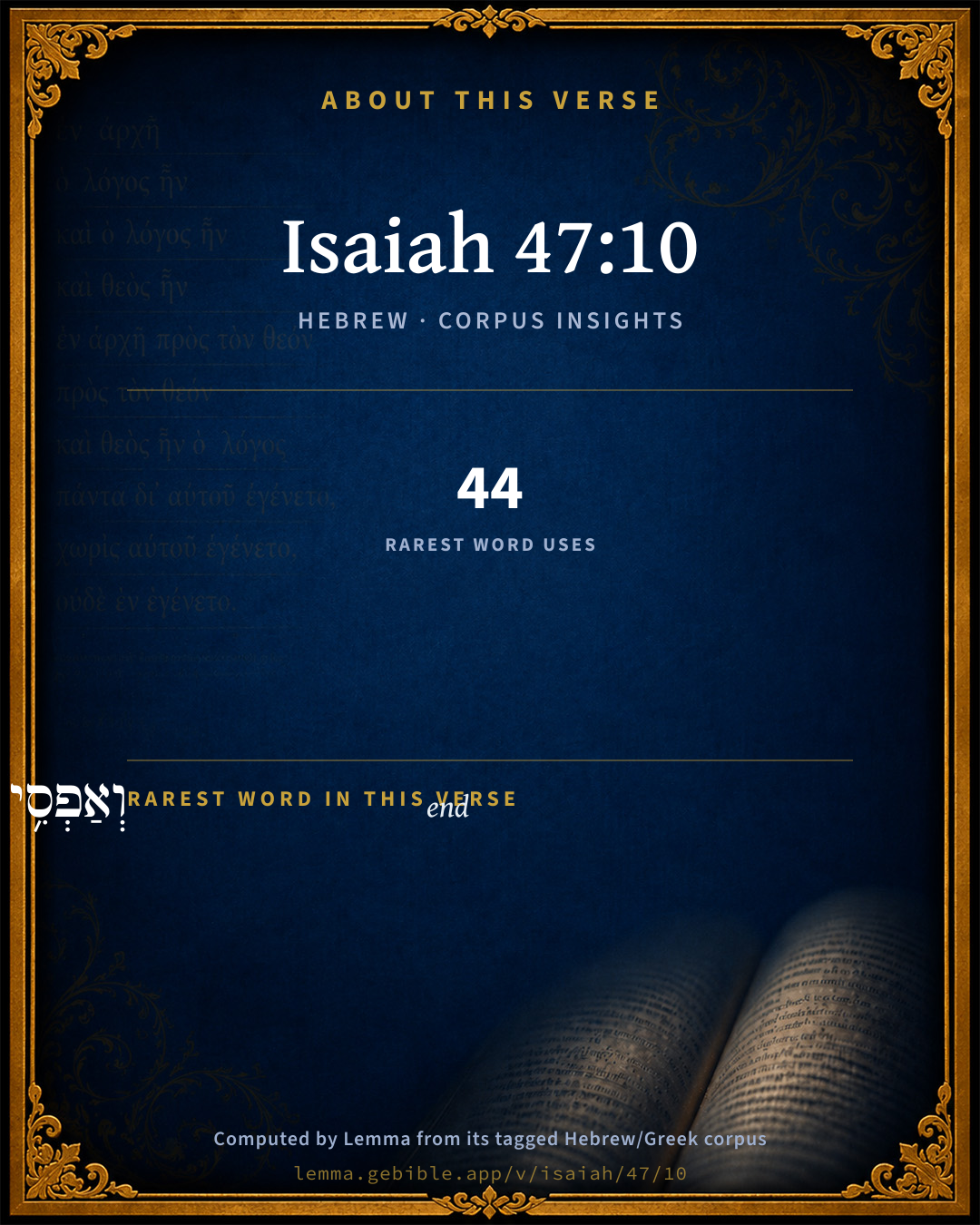
These counts appear in no published source. They are computed here, from the morphology-tagged text and Lemma’s own curated glosses. What Lemma adds →

14
words
13
distinct lemmas
Prophets
section

Shared distinctive vocabulary

וְאַפְסִ֥י end H657 occurs in 43 verses of the Hebrew Bible. Also found in:

Grammatical profile

  • 5 verbs
  • 5 nouns
  • 2 pronouns
  • 1 adverb
  • 1 particle

Verb forms

  • וַתִּבְטְחִ֣י Qal · Sequential Imperfect
  • אָמַרְתְּ֙ Qal · Perfect
  • רֹאָ֔נִי Qal · Participle Active
  • שׁוֹבְבָ֑תֶךְ Polel · Perfect
  • וַתֹּאמְרִ֣י Qal · Sequential Imperfect

Repetition

A word recurs within this verse — often emphatic in Hebrew:

  • אָמַרְתְּ֙ to say H559 ×2

Hebrew & Septuagint length

In English translation the verse runs 38 words from the Hebrew and 42 from the Septuagint (LXX English) — closely comparable.

A rough comparison of the two English renderings, which tokenize alike — not a word-level alignment.

Word counts can differ between the Hebrew and the Greek without any difference in meaning — e.g. the Hebrew direct-object marker אֵת has no separate Greek word, and Greek often adds the article ὁ.

Cross-references

19

Topical passages linked to Isaiah 47:10 in the Treasury of Scripture Knowledge — connected by theme and wording, ordered by reader-vote popularity; previews shown in the World English Bible.

  • Isaiah 5:21 Woe to those who are wise in their own eyes, And prudent in their own sight!
  • Isaiah 29:15 Woe to those who hide deep their counsel from Yahweh, and whose works are in the dark, and who say, Who sees us? and who knows us?
  • Romans 1:22 Professing themselves to be wise, they became fools,
  • Psalms 52:7 "Behold, this is the man who didn't make God his strength, But trusted in the abundance of his riches, And strengthened himself in his wickedness."
  • Ezekiel 8:12 Then said he to me, Son of man, have you seen what the elders of the house of Israel do in the dark, every man in his chambers of imagery? for they say, Yahweh doesn't see us; Yahweh has forsaken the land.
  • Isaiah 59:4 None sues in righteousness, and none pleads in truth: they trust in vanity, and speak lies; they conceive mischief, and bring forth iniquity.
  • Psalms 94:7–9 They say, "Yah will not see, Neither will Jacob's God consider."
  • Jeremiah 23:24 Can any hide himself in secret places so that I shall not see him? says Yahweh. Don't I fill heaven and earth? says Yahweh.
  • Ezekiel 9:9 Then said he to me, The iniquity of the house of Israel and Judah is exceeding great, and the land is full of blood, and the city full of wrestling [of judgment]: for they say, Yahweh has forsaken the land, and Yahweh doesn't see.
  • 1 Corinthians 1:19–21 For it is written, "I will destroy the wisdom of the wise, I will bring the discernment of the discerning to nothing."
  • 1 Corinthians 3:19 For the wisdom of this world is foolishness with God. For it is written, "He has taken the wise in their craftiness."
  • Psalms 64:5 They encourage themselves in evil plans. They talk about laying snares secretly. They say, "Who will see them?"
  • Ecclesiastes 8:8 There is no man who has power over the spirit to contain the spirit; neither does he have power over the day of death. There is no discharge in war; neither shall wickedness deliver those who practice it.
  • Isaiah 44:20 He feeds on ashes; a deceived heart has turned him aside; and he can't deliver his soul, nor say, Is there not a lie in my right hand?
  • Ezekiel 28:2–6 Son of man, tell the prince of Tyre, Thus says the Lord Yahweh: Because your heart is lifted up, and you have said, I am a god, I sit in the seat of God, in the midst of the seas; yet you are man, and not God, though you did set your heart as the heart of God;-
  • Job 22:13–14 You say, 'What does God know? Can he judge through the thick darkness?
  • Psalms 10:11 He says in his heart, "God has forgotten. He hides his face. He will never see it."
  • Psalms 62:9–10 Surely men of low degree are just a breath, And men of high degree are a lie. In the balances they will go up. They are together lighter than a breath.
  • Isaiah 28:15 Because you have said, We have made a covenant with death, and with Sheol are we at agreement; when the overflowing scourge shall pass through, it shall not come to us; for we have made lies our refuge, and under falsehood have we hid ourselves:

Cross-references courtesy of OpenBible.info (CC BY 4.0).

Hebrew and Greek witnesses Masoretic Hebrew ↔ Greek Septuagint

The same verse in the two great witnesses to the Old Testament, shown verse-for-verse.

These are two independent witnesses, not word-aligned to each other, and the Septuagint is shown in lemma (dictionary) form.

Hebrew Isaiah 47:10 Masoretic · Westminster Leningrad Codex

וַתִּבְטְחִ֣י בְרָעָתֵ֗ךְ אָמַרְתְּ֙ אֵ֣ין רֹאָ֔נִי חָכְמָתֵ֥ךְ וְדַעְתֵּ֖ךְ הִ֣יא שׁוֹבְבָ֑תֶךְ וַתֹּאמְרִ֣י בְלִבֵּ֔ךְ אֲנִ֖י וְאַפְסִ֥י עֽוֹד

For you have trusted in your wickedness; you have said, None sees me; your wisdom and your knowledge, it has perverted you, and you have said in your heart, I am, and there is none else besides me.

World English Bible · Public Domain

Greek LXX Isaiah 47:10 Septuagint · lemma form

ὁ ἐλπίς ὁ πονηρία σύ σύ γάρ εἶπον ἐγώ εἰμί καί οὐ εἰμί ἕτερος γιγνώσκω ὅτι ὁ σύνεσις οὗτος καί ὁ πορνεία σύ εἰμί σύ αἰσχύνη καί εἶπον ὁ καρδία σύ ἐγώ εἰμί καί οὐ εἰμί ἕτερος

for your trusting in wickedness: for you said, I am, and there is not another: know you, the understanding of these things and your harlotry shall be your shame; for you said in your heart, I am, and there is not another.

LXX2012 (modern English Septuagint) · Public Domain

Hebrew: Westminster Leningrad Codex (CC BY 4.0). Greek: Septuagint (public domain); English from LXX2012 (modern English Septuagint) (Public Domain). How the Septuagint differs from the Hebrew →

Targum (Aramaic paraphrase)

1

The Targum is the ancient Jewish Aramaic paraphrase of the Hebrew Scriptures — an interpretive translation, not the Hebrew text itself. Onkelos (literal) and Pseudo-Jonathan (expansive) render the Torah, and Jonathan the Prophets. Coverage is partial: where no permissively-licensed English translation exists for a verse, only the Aramaic is shown. This is verse-level text, not a word-by-word alignment to the Hebrew.

  1. Targum Jonathan Prophets (Joshua–Malachi)
    וְאִתְרְחֵיצְתְּ בְּבִישְׁתִּיךְ אֲמַרְתְּ לֵית דְחָזֵי לִי חוּכְמְתִיךְ וּמַדְעִיךְ הִיא קַלְקַלְתִיךְ וַאֲמַרְתְּ בְּלִבֵּיךְ אֲנָא וְלֵית בַּר מִינִי עוֹד:

    For thou hast trusted in thy wickedness; thou hast said, None seeth thee. Thy wisdom and thy knowledge have corrupted thee; thou hast said in thine heart, I am, and there is none else besides me.

    Targum Jonathan — Aramaic: “Mikraot Gedolot” (public domain). English: “Sefaria Community Translation” (CC0 1.0 (public-domain dedication)); “London "Chaldee Paraphrase," 1871” (public domain). Text via Sefaria.

Commentary

Notes on Isaiah 47:10 from classic Christian and Jewish commentators (each source and its license shown beneath its notes). The classic Christian expositions comment on the surrounding passage and are grouped to its opening verse, so a note may address several verses; the Jewish commentaries on the Tanakh (Rashi and others) are per-verse, so they appear only where the commentator wrote on this verse.

Lemma curates 59 commentaries, every one of them public domain or Creative Commons licensed, each selected and text-cleaned for this edition rather than reprinted as found. About our sources →

Trapp's Complete Commentary

John Trapp

Isa 47:10 For thou hast trusted in thy wickedness: thou hast said, None seeth me. Thy wisdom and thy knowledge, it hath perverted thee; and thou hast said in thine heart, I [am], and none else beside me.

Ver. 10. Thou hast trusted in thy wickedness.] God calleth that "wickedness" which they counted wisdom.

None seeth me.] Ne Deus quidem novit rationes mess. Graceless men, having hid God from themselves, think also to hide themselves from God.

Thy wisdom and thy knowledge.] Thy magical arts and practices. Quantus artifex pereo? quadrabit in te peritum et periturum.

John Trapp, A Commentary or Exposition upon All the Books of the Old and New Testament (1647–1656) — public domain. Text from a community e-Sword module.

The Biblical Illustrator

Joseph S. Exell

Isa_47:10

Thou hast said, None seeth me

Omniscience ignored

I.

THIS NOTION HAS GREAT INFLUENCE UPON THE CONDUCT OF MAN. Such a notion is convenient. Concealment is the helpmeet of wrong. It is not necessary that this be formulated. It is sufficient if the mind accustoms itself to question whether God sees. The sinner will take advantage of a doubt.

II. THIS NOTION IS UTTERLY UNTRUTHFUL AND DELUSIVE.

III. GOD HAS OFTEN, IN HUMAN EXPERIENCE, SHOWN THE DELUSIVENESS OF THIS NOTION, AND THE TIME IS FIXED FOR THE COMPLETE DEMONSTRATION OF ITS DELUSIVENESS.

1. Character is often seen through by man.

2. Retribution often follows mans deeds in the present world.

3. The future state will show what God saw. (Pulpit Analyst.)

Practical atheism and genuine piety

(with Gen_16:13):--

I. PRACTICAL ATHEISM. Thou hast said, None seeth me, i.e. God is indifferent to our conduct. This is the practical denial of Divine omniscience. This haughty language suggests a sad tendency in human nature. The causes of this tendency are--

1. Dislike of God.

2. Dread of God.

II. GENUINE PIETY. Thou God seest me.

1. The very nature of God implies this.

2. The Bible teaches it.

III. GENERAL INSTRUCTIONS which this subject conveys.

1. It warns the wicked.

2. It should restrain from evil.

3. It should incite to a beautiful and useful life.

4. It should comfort and strengthen the people of God amid the duties and conflicts and trials of life. (A. Tucker.)

None seeth me

Graceless men, having hid God from themselves, think also to hide themselves from God. (J. Trapp.)

Thy wisdom and thy knowledge, it hath perverted thee

Pernicious knowledge

I. EXAMINE AND VINDICATE THIS DECLARATION.

1. Of what wisdom and knowledge does Isaiah thus speak? It was human wisdom and science in the highest perfection! To this Babylon even the sages of Greece came as learners.

2. Against this wisdom and knowledge the Scriptures bring the charge of perverting mens minds in morals and religion (text; Eze_28:3-7; 1Co_1:21-27; 1Co_3:18-20; Rom_1:22-23).

3. That this testimony is not overcharged, all history proclaims.

4. All this is accounted for by the Scriptural account of the fall of man. Intellectual blindness is upon the heart of man; all his rational faculties are incapable of just conclusions on any religious subject, except they be assisted by a supernatural power.

5. Hence it inevitably follows that the cultivation of the intellectual parts of man can of itself have no tendency towards moral or spiritual good. If all the mental powers of man be in themselves depraved, the increase of his intelligence can only increase his faculty of evil; so that secular education, apart from religious and moral control, must be in itself a curse and not a blessing. It may create a generation of philosophic sceptics and apologists for vice, or even praters about virtue, but a moral and religious people it never has produced, and never can.

II. THE REMEDY WHICH GOD HATH PROVIDED AGAINST ALL THESE INTELLECTUAL EVILS.

1. The supreme need is instruction in the wisdom and knowledge which are of God, above those which are of men.

2. This wisdom and knowledge must be imparted by those means which God has appointed. The Bible. Preaching. The instruction of children in Divine truth. (F. Close, M. A.)

The Biblical Illustrator, edited by Joseph S. Exell (c. 1880s–1900s) — public domain. Text from a community e-Sword module.

Joseph Benson's Commentary

Isa 47:10-11. For thou hast trusted in thy wickedness — Thou hast thought that thy cunning and policy would still preserve thee; and hast said, None seeth me — My counsels are so deeply and craftily laid, and my designs so secretly carried on, that none can discover them or prevent their execution. And thou hast supposed that God himself either did not regard thee, or would not call thee to an account for thy wicked conduct. Thy wisdom and thy knowledge — Thy skill in the arts of human policy, or thy pretended foreknowledge of future events by astrology; hath perverted thee — Hath misled thee into the way of transgression and perdition; and thou hast said, I am, &c. — This is repeated from Isa 47:8, to signify their intolerable arrogance and self-confidence. Therefore shall evil come upon thee — Which thou shalt neither have time nor means to provide against or to prepare for; thou shalt not know from whence it riseth — Or, rather, when it shall come; Hebrew, שׁחרה, the morning of it, the day, or time, of its approach. With all thy skill in astrology and fortune-telling, thou shalt neither be able to foresee the evil that is coming upon thee, nor to prevent it. This interpretation agrees with the history, Babylon being surprised by Cyrus when they were in a state of the greatest security, as is manifest both from the Scriptures and from other authentic records: see Jer 51:31; Daniel 5. And desolation shall come upon thee suddenly — As a thief in the night; which thou shalt not know — Or, when thou shalt not know. Thou shalt not apprehend thy danger till it be too late. Fair warning was indeed given them, by this and other prophets of the Lord, of this desolation; but they slighted that notice, and would give no credit to it; and therefore justly was it so ordered, that they should have no other warning of it, but that partly through their own security, and partly through the swiftness and subtlety of the enemy, when it came it should be a perfect surprise to them.

Joseph Benson's Commentary on the Old and New Testaments (1811–1818) — public domain. Text from a community e-Sword module.

The Preacher's Complete Homiletical Commentary

Joseph S. Exell (gen. ed.)

PRACTICAL ATHEISM AND GENUINE PIETY

Isa_47:10. Thou hast said, None seeth me.

Gen_16:13. And she called the name of the Lord that spake unto her, Thou God seest me.

Here is—

I. PRACTICAL ATHEISM. “Thou hast said, None seeth me,” i.e., God is indifferent to our conduct. This is the practical denial of Divine Omniscience (Psa_10:11; Psa_94:7). That the self-existent and eternal God should not see is a palpable absurdity (Psa_94:8-10). This haughty language suggests a sad tendency in human nature.

“This practical atheism is very prevalent and pernicious at the present time. Immense numbers utter the ‘Apostles’ Creed’ regularly, who exclude God from almost every province of their life. In the formation of their plans, in the management of their business, in their relations to society, &c., ‘God is not in all their thoughts.’ ” They act as if God did not see them. They are no more restrained in their conduct than they would be if this was their deliberate conviction, or than if they had settled it in their minds that God is regardless of human actions. “The causes of this tendency are not inherent in human nature, but are

(1.) Dislike of God.

(2.) Dread of God.”

II. GENUINE PIETY. “Thou God seest me.” Heb.: “Thou (art a) God of seeing—of vision.” God sees as well as hears (Jacobus). This pious utterance suggests a solemn fact in human history—that God sees us.

1. The very nature of God implies this. The supposition that there is anything that God does not see involves a contradiction.

2. The Bible teaches this (Job_34:21-22; Psa_139:1-4; Psa_139:11-12; Psa_139:15-16; Jer_23:24; Amo_9:2-3; Act_17:27-28; Heb_4:13). The case of Hagar is a remarkable illustration—a sudden and surprising conviction that God sees and knows all (Gen_16:13-14).

III. GENERAL INSTRUCTIONS WHICH THIS SUBJECT CONVEYS.

Such as these:—

1. It warns the wicked. Secret as their sins may seem, they are all discerned and known by Him who is their Judge (Job_34:21-22).

2. It should restrain us from evil. “The eye of a child will effectually check the execution of some evil purposes; more the eye of man or woman; yet more the eye of a holy man or woman. But God’s eye sees all things everywhere. And He is perfectly holy!”

3. It should incite us to a beautiful and useful life—beautiful in its spirit, and useful in its moral influence. “The athletes of Greece and Rome were inspired to run or wrestle by the knowledge of the fact that they were surrounded by a vast assembly of spectators (Heb_12:1). Oh! if we but, realised God’s presence, our life would become brave and beautiful and holy. God is not only present everywhere, but everywhere present to inspire, and aid, and bless.”

4. It should comfort and strengthen the people of God amid the duties and conflicts and trials of life. There is One who knows all things that relate to them, and who can with the utmost ease adapt all circumstances and events to their good. They are always under their great Master’s eye.—Alfred Tucker.

OMNISCIENCE IGNORED

Isa_47:10. Thou hast said, None seeth me.

I. This notion has great influence upon the conduct of man. Such a notion is convenient. Offenders against man retire to the dark when they mean to perpetrate their evil deeds. Concealment is the helpmeet of wrong. Because they sometimes, perhaps often, escape the most watchful human eyes, they fancy it possible to escape the eye of God. They would have no interest whatever in reaching this conclusion, if they never wished to do anything wrong. The sinner persuades himself of two or three things: he has gained his end; he has escaped observation; he has avoided the punishment. It is not necessary that all this be formulated. It is sufficient if the mind accustoms itself to question whether God sees. The sinner will take advantage of a doubt.

II. This notion is utterly untruthful and delusive. Whether our sinful deeds are seen by man or not, there is One to whom they are open as the day. If there is a God at all, this must be so. If you persuade yourself that God does not see, you persuade yourself that God is not. That part of the universe which God does not know, has no God. He who does not know everything is limited; therefore he is not God. But you cannot see Him. When you cannot see a man, you infer that he is not present. So with God. Thus you require that which would argue Him nothing more than a man after all. The spirituality of the Divine nature makes it possible for Him to be everywhere and see everything.

III. God has often, in human experiences, shown the delusiveness of this notion, and the time is fixed for the complete demonstration of its delusiveness.

1. Character is often seen through by man.

2. Retribution often follows man’s deeds in the present world. Joseph’s brethren, Achan, and Saul.

3. The future state will show that God saw. At the judgment day the books will be opened. What is written there will prove that sin was seen. Hell will be an everlasting proof.

CONCLUSION.—Sinner, God sees you; has seen you all along. Be warned, Christian!

1. Be encouraged and comforted by the thought that God sees. He sees the good and their goodness. Be more constantly influenced by this thought.

(1.) Let it restrain from sin.

(2.) Let it stimulate to holy obedience and earnest work (H. E. I. 2257–2267).—J. R., in the Pulpit Analyst.

It would probably be an aid to excellence of life, if we would suppose some distinguished person always looking upon us. We are often deterred from evil by fear of the disapproval of some one whose good opinion we value. The thought of the Divine observation exerts an important influence on the conduct of such as believe it. It is unspeakably pleasant to those who regard Him as an ever-present friend, with whom they are in full sympathy, whom they desire to please. To those who do not regard Him as their friend, who are not in sympathy with Him, and who pursue a course of conduct contrary to His nature, it is repugnant. Hence men who desire to live in sin persuade themselves that He does not see their actions. This persuasion of sinners is convenient to them, but it is delusive and mischievous.

I. IT IS A CONVENIENT PERSUASION.

1. It is adopted because of its convenience. It is on that account open to suspicion. The mind, in taking it, was not in the most favourable condition for the ascertainment of truth. Why is it convenient to say God does not see? Because there is a desire to do what He does not approve. When the fraudulent merchant remains alone in his office, manipulating his accounts so as to defraud his creditors; when the impure retire behind the curtains of the night and of the chamber; when the burglar disguises himself, and in darkness plies his nefarious occupation; when the murderer watches for his victim in the depths of the forest, it is for the same reason.

2. It rests on an insecure negation. In its most pronounced form, it amounts to a denial of the Divine existence. We will not say that all Atheists are persons whose immoral lives have rendered it impossible to retain comfort along with belief in God (H. E. I. 369); but it is certain that a large proportion of the Atheism around us has no better ground than this. A man in conflict with God’s character takes refuge in the denial of His existence. Or, while not formally denying it, he persuades himself that the Divine Being is too great to concern Himself with the small affairs and acts of mortals. Or, perhaps more frequently in the strong confidence that no human eye is upon him, the sinner crowds out of his mind the fact that the Divine Eye is upon him. He does not distinctly deny it, but he practically ignores it; and, hurried on by the strength of passion, forgets that he should have taken more than his fellow-men into consideration. Hence—

3. It becomes a welcome encouragement to sin. The heart is inclined to sin, and only restrained by the fear of punishment. Then if the fear of punishment is removed by the persuasion that there is no witness, the barrier is thrown down, the sinful inclination will be indulged. Gehazi never thought that the watchful eye of God had been upon his proceedings. Beware upon what grounds you release yourself from the restraint imposed by the recognition of God’s personal presence everywhere.

II. IT IS A DELUSIVE PERSUASION.

The sinner says none sees him. But there are moments when he suspects that he may have deceived himself. Conscience will sometimes whisper the question, “What if God, after all, has been observant of the sin?”

How frequently do transgressors find that they have not been so secluded from man as they supposed! Some unclosed crevice through which the deed has been seen. Subtle links of evidence are discovered and placed together so as to make a chain by which the most hidden crimes are dragged to light.

And it is unquestionably a delusion that GOD does not see. The sinner forgets the immense difficulties in the way of his convenient persuasion. He forgets that before he is in a position to say there is no God to see, he must know everything in the universe. Because the thing beyond his present knowledge may be this—that there is a God. Or if he supposes that, a God existing, He does not concern Himself with men, he forgets that the idea of a personal God carries with it this notion of His intimate acquaintance with everything about His creatures.—(H. E. I. 4015.)

What does He say about Himself in this respect? Does not the idea that He sees man’s acts run through His Word? (Psa_94:9; Psa_139:1-12). In other words, God’s acquaintance with our life and ways comprehends everything, however minute. Men practise a delusion on themselves when they imagine He does not see them.

III. IT IS A MISCHIEVOUS PERSUASION.

Inasmuch as human nature is so largely influenced by the fact that there are witnesses of our conduct, it is a mischievous withdrawment of influence for good when the witness whose approbation is the most important is supposed to be withdrawn. From those who are only deterred from evil by the consciousness of being seen or the fear of punishment, it is like the withdrawment of the master’s eye from the unfaithful servant. It opens the way to the commission and multiplication of sin. It increases the danger and the measure of punishment. Sin is the material out of which punishment is made. It sometimes overtakes sinners in the present world. For the most part it is deferred to the future state, perhaps to afford time and opportunity for the sinner’s repentance. It only falls in its full weight when the sinner has finally rejected the overtures of God’s grace. However secretly sin may have been committed, the judgment-day will reveal it (Matthew 25.; H. E. I. 3055). The conduct we are building up in our daily life is preparing the sentence of the Judge. Beware of the deceitfulness of sin. It fascinates with its eye, but it destroys with its sting. It will find out the sinner, though he retire to the deepest darkness or the remotest corner of the earth.

Cherish the belief in God’s constant presence and inspection. The very fact of unwillingness to be seen by Him shows a consciousness of something that dare not meet His eye. But is it not better to abandon that something, whatever it is, than delude ourselves with the persuasion that God does not see? Drusus would have all the city see his manner of life. Oh that we all so lived that the thought of God’s constant supervision could be a joy! The eye of His infinite holiness is upon us. With infinite approbation He sees the struggle against evil. With sorrowful condemnation He sees the sin. Fear to sin. Cultivate the disposition to please God. Suppress the inclination to the thing that would wish to elude His eye (H. E. I. 2257–2261).—J. Rawlinson.

PERNICIOUS KNOWLEDGE

(Sunday School Sermon.)

Isa_47:10. Thy wisdom and thy knowledge, it hath perverted thee.

Heavy are the charges laid against the great and guilty city of Babylon. Not only had she dealt unmercifully with God’s people (Isa_47:6), but her profligacy, luxury, pride, effeminacy, and wickedness were excessive (Isa_47:7-8; Isa_47:10). she was withal superstitious and idolatrous in the highest degree (Isa_47:9; Isa_47:12-13). What was the fruitful cause of all these abominations? Was it brutal ignorance, or barbarous uncultivation? No: it was just the reverse. Alas for the philosophers and wise men of this world! all the abominations of Babylon are here traced to human wisdom and science: “Thy wisdom and thy knowledge, it hath perverted thee.” A proposition which runs counter to many prevalent opinions and prejudices. Let us, then,

I. EXAMINE AND VINDICATE THIS DECLARATION.

1. Of what wisdom and knowledge does Isaiah thus speak? It was human wisdom and science in the highest perfection! The same which opposed Moses in Egypt, Daniel in Babylon, Paul at Athens: secular learning, the cultivation of the intellect, philosophy in its deepest and most subtle forms; for to this Babylon even the sages of Greece came as learners! in a word, it was all that the mind of man could attain without revelation.

2. Against this wisdom and knowledge the Scriptures bring the charge of perverting men’s minds in morals and religion. This is expressly done in this chapter. Ezekiel affirms the same of the great mercantile city of Tyre (Eze_28:3-6). St. Paul came more into contact with this worldly wisdom than any of the Apostles, and he was perhaps more capable of appreciating its true character; and he uniformly condemns it (1Co_1:21-27; 1Co_3:18-20; Rom_1:22-23).

3. That this testimony is not overcharged, all history proclaims. Superstitions, vices, and infidelity have prevailed in those countries where, and exactly at those times when, carnal wisdom has been most highly cultivated. Egypt was the birthplace and cradle of science; and in no country was idolatry more degrading. The scriptural account of the state of Babylon, where science was nurtured and developed, is corroborated by profane history. Its abominable vices could not be here detailed. The greatest sages of Greece are all chargeable with either practising or inculcating the grossest vices. The moral atrocities of the French Revolution, when Reason was deified in the person of an infamous woman, prove that time cannot alter the deteriorating tendency of unassisted human intellect.

4. All this is accounted for by the Scripture account of the fall of man. If that account is correct, no other results can follow (Job_14:4). Equally with his other powers, the intellect of man was impaired by the fall of Adam, and became the ally of his polluted heart. The first example of its exercise was an instance of false reasoning against God Himself (Gen_3:12). See also Gen_6:5; Gen_8:21; Eph_4:18. Hence it follows that intellectual blindness is upon the heart of man; all his rational faculties are incapable of just conclusions on any religious subject, except they be assisted by a supernatural power.

5. Hence it inevitably follows that the cultivation of the intellectual parts of man can of itself have no tendency towards moral or spiritual good. If all the mental powers of man be in themselves depraved, the increase of his intelligence can only increase his faculty of evil; so that secular education, apart from religious and moral control, must be in itself a curse and not a blessing. It may create a generation of philosophic sceptics and apologists for vice, or even praters about virtue; but a moral and religious people it never has produced, and never can. Let us therefore consider—

II. THE REMEDY WHICH GOD HATH PROVIDED AGAINST ALL THESE INTELLECTUAL EVILS.

Because we declare the moral powerlessness of merely human knowledge, our enemies affirm that we are the patrons of ignorance and bigotry, wish the mind to stagnate, and desire to repress scientific inquiries. Groundless charges. We fear not the progress of philosophy, if she be guided by religion; nor the wisdom of man, if it be in subordination to the wisdom of God. This is the remedy of the intellectual and moral evils of our time.

1. The supreme need of this generation is instruction in the wisdom and knowledge which are of God, above those which are of men (see vol. i. pp. 373–378).

2. This wisdom and knowledge must be imparted to mankind by those means which God has appointed. The Bible. The preaching of the Gospel. The instruction of children in Divine truth (H. E. I. 793, 794, 803–806, 1751, 1771).

CONCLUDING REMARKS.—

1. Let us beware of the pride of mental cultivation.

2. Let all our knowledge, and all our mental powers, be consecrated to the service of God.

3. Let the poor and simple rejoice that moral and spiritual excellence are attainable by them.—F. Close, A. M.: Fifty-Two Sketches of Sermons, pp. 177–183.

THE SECURITY OF PROUD SINNERS

Isa_47:10-11. For thou hast trusted in thy wickedness, &c.

In the Babylonians we have types of proud sinners in every age—both in regard to their fancied security and the end of it.

I. THEIR FANCIED SECURITY. “I shall be a lady for ever. I am, and none else beside me; I shall not sit as a widow, neither shall I know the loss of children” (Isa_47:7-8). The calamities that might come upon other men would not touch them! They were vainly confident of the perpetuity of their pomps and pleasures. Observe—

1. The cause of their fancied security. They thought themselves safe and out of danger, not because they were ignorant of the uncertainty of all earthly enjoyments, and the inevitable fate that attends states and kingdoms as well as particular persons, but because they did not lay this to heart (Isa_47:7), did not apply it to themselves, nor give it a due consideration. They lulled themselves asleep in ease and pleasure (chap. Isa_56:12). They did not remember the latter end (Isa_47:7) of their prosperity, that it is a fading flower, and will wither; of their iniquity, that it will be bitterness; and that the day will come when their injustice and oppression must be reckoned for and punished. To-day ungodly men are easy in their sinful ways, because they never think of death, and judgment, and their future state.

2. The ground of their fancied security.

(1.) Their power and wealth, which they had gotten by fraud and oppression, were their confidence (Isa_47:10). Like Doeg (Psa_52:7). Many have so debauched their own consciences, and are got to such a daring pitch of wickedness, that they stick at nothing; and this they trust to, to carry them through those difficulties which embarrass men who make conscience of what they say and do.

(2.) Their policy and craft, which they called their wisdom, were their confidence. They thought they could out-wit all mankind, and therefore might set their enemies at defiance; but their wisdom and knowledge perverted them—made them forget themselves and the preparation necessary to be made for hereafter.

3. The foolish boastings into which their fancied security betrayed them.

(1.) “I shall be a lady for ever” (Isa_47:7). Babylon looked upon the patent of her honour to be not merely during the pleasure of the sovereign Lord, the fountain of honour, or during her own good behaviour, but to be perpetual (cf. Rev_18:7). Those great ones mistake themselves who think they shall be exalted for ever; death will shortly lay them and their honour in the dust. Saints shall be saints for ever, but those who are merely this world’s great ones will be what they are only for a little while (H. E. I. 1537).

(2.) “I shall not sit as a widow, neither shall I know the loss of children” (Isa_47:8), i.e., she would never lack a monarch to espouse and protect her, nor would there be any diminution in the numbers of her people. Those that are in the height of prosperity are apt to fancy themselves out of the reach of adverse fate (Psa_10:4-6).

(3.) “None seeth me” (Isa_47:10), i.e., “No one sees me when I do amiss, and therefore there will be none to call me to an account.” It is common for sinners to trust to their wicked arts and designs to stand them in stead, because they think they have carried them on so plausibly that none can discern the wickedness and deceit of them. How foolish are they in their wickedness! (Psa_139:11-12.)

II. ITS END. It will be ruin (Isa_47:11)

1. It will be a complete ruin—the ruin of all their comforts and confidences. “These two things shall come upon thee (the very two things thou didst set at defiance), loss of children and widowhood. Both thy princes and thy people shall be cut off, so that thou shalt be no more a government, no more a nation.” Note, God often brings upon secure sinners those very mischiefs which they thought themselves least in danger of; “they shall come upon thee in their perfection, with all their aggravating circumstances, and without anything to allay or mitigate them.” What a contrast between the afflictions of the godly and of the godless!

2. It will be a sudden and surprising ruin. The evil shall come in one day, nay in a moment (Isa_47:9), which will make it much the more terrible, especially to those who were so very secure. “Evil shall come upon thee, and thou shalt have neither time nor way to provide against it, or to prepare for it; for ‘thou shalt not know from whence it rises,’ and therefore shalt not know where to stand upon thy guard.” “Thou shalt not know the morning thereof;” so the Hebrew phrase is. We know just when and where the day will break and the sun rise, but we know not what the day, when it is come, will bring forth, nor when or where trouble will arise; perhaps the storm may come from that point of the compass which we little thought of. Babylon pretended to great wisdom and knowledge (Isa_47:10), but with all her wisdom cannot foresee, nor with all her wisdom prevent, the ruin threatened (Isa_47:11). Fair warning of this desolation was indeed given them by the prophets of the Lord; but they slighted that notice, and therefore justly is it so ordered that they should have no other notice of it, but that, partly through their own security, and partly through the swiftness and subtility of the enemy, when it came it should be a perfect surprise to them. Those that slight the warnings of the written Word, let them not expect any other premonition.

3. It will be an irresistible ruin (Isa_47:11). There is no opposing the judgments of God when they come with commission. Babylon herself, with all her wealth, power, and multitude, is not able to put off the mischief that comes.—Matthew Henry: Commentary, in loco.

The Preacher's Complete Homiletical Commentary (gen. ed. Joseph S. Exell; Funk & Wagnalls, c. 1892) — public domain (pre-1929). A full-Bible homiletical/sermon-outline anthology covering 65 of 66 books (2 John is absent from the source module). Text from a community e-Sword module.

Tyndale Open Study Notes

Tyndale Open Resources

47:10 In this context, ‘wisdom’ and ‘knowledge’ probably refer sarcastically to the pseudo-knowledge gained through occult practices, which actually led Babylon away from the truth and into disaster (47:11).

Tyndale Open Study Notes — © Tyndale Open Resources, licensed CC BY-SA 4.0. Text via the HelloAO Bible API.

Geneva Bible (1599)

Geneva Bible translators

Thou didst think that thine own wisdom and policy would have saved thee.

Geneva Bible (1599) marginal notes — public domain. Text via Bolls.life.

Jamieson, Fausset & Brown

Robert Jamieson, A. R. Fausset & David Brown

wickedness--as in Isa 13:11, the cruelty with which Babylon treated its subject states.

None seeth me-- (Psa 10:11; Psa 94:7). "There is none to exact punishment from me." Sinners are not safe, though seeming secret.

Thy wisdom--astrological and political (Isa 19:11, &c., as to Egypt).

perverted--turns thee aside from the right and safe path.

Jamieson, Fausset & Brown — Commentary Critical and Explanatory on the Whole Bible (1871) — public domain (CC PDM 1.0). Text via the HelloAO Bible API.

Ellicott's Commentary for English Readers

(10) For thou hast trusted in thy wickedness . . .—Babylon, like other nations that have followed in her steps, took for its law that Might was Right, practically denied the existence of a Ruler who saw and judged, and boasted of its wisdom. The context implies that the special form of wisdom spoken of was that of astrology and magic.

A Bible Commentary for English Readers, edited by Charles John Ellicott (1878–1897) — public domain. Text from a community e-Sword module.

The Cambridge Bible for Schools and Colleges

gen. ed. J. J. S. Perowne

10. thou hast trusted &c.] Better perhaps: thou hast been confident in thy wickedness; hast perpetrated wickedness without a misgiving or a thought of retribution. “Wickedness” probably means “tyranny,” as Nah_3:19.

None seeth me] No holy and righteous God takes notice. Cf. Psa_10:11; Psa_94:7.

10 b–12. The fourth strophe gives the reason for Babylon’s security: the elaborate system of magic for which she was famous, and in which her practical religion largely consisted. For an account of Babylonian sorcery &c., see Lenormant, Chaldaean Magic (transl.), esp. chs. 1–4.

Thy wisdom and thy knowledge] The context shews that it is the occult knowledge of sorcery, astrology &c., that is meant.

The Cambridge Bible for Schools and Colleges (gen. ed. J. J. S. Perowne; Cambridge University Press, 1878–1918) — public domain. Text from a community e-Sword module.

John Gill's Exposition

For thou hast trusted in thy wickedness,.... In wealth and power wickedly obtained; in political schemes wickedly contrived; in her ambition and pride, tyranny and cruelty; and especially in her wicked arts of astrology, divination, and magic:

thou hast said, none seeth me; lay her schemes of policy, which she thought so deeply laid, as not to be discovered; perform her magic arts, which were secretly done, and other her wicked actions done in the dark; but nothing can be hid from the omniscient God:

thy wisdom and thy knowledge, it hath perverted thee: her high opinion of her own wisdom and knowledge in political affairs, or in magic arts, deceived her, and turned her from right to wrong ways, which issued in her ruin. This rightly describes the Jesuits, and other emissaries of the church of Rome, who trust in their wickedness, their craft and cunning, which none can penetrate into; but there is an all seeing eye upon them, which discovers their intrigues, blasts their designs, and brings them into confusion:

and thou hast said in thine heart, I am, and none else besides me; none so wise and knowing as myself. This is what the oracle said of the Chaldeans (n),

"the Chaldeans and the Hebrews are the only wise.''

This is repeated, to observe the haughty and insolent boasts of themselves.

(n) Apud Euseb. Praepar. Evang. l. 9. c. 10. p. 413.

John Gill's Exposition of the Whole Bible (1746–1763) — public domain (CC PDM 1.0). Text via the HelloAO Bible API.

Albert Barnes' Notes on the Bible

For thou hast trusted in thy wickedness - The word ‘wickedness’ here refers doubtless to the pride, arrogance, ambition, and oppressions of Babylon. It means, that she had supposed that she was able by these to maintain the ascendancy over other nations, and perpetuate her dominion. She supposed that by her great power, her natural advantages, and her wealth, she could resist the causes which had operated to destroy other nations. Men often confide in their own wickedness - their cunning, their artifices, their frauds, their acts of oppression and cruelty, and suppose that they are secure against the judgments of God.

None seeth me - Compare Psa 10:11 : ‘He said in his heart, God hath forgotten; he hideth his thee; he will never see it.’ See also Psa 94:7.

Thy wisdom - Probably the wisdom here referred to, was that for which Babylon was distinguished, the supposed science of astrology, and the arts of divination and of incantation. It may, however, refer to the purposes of the kings and princes of Babylon; and the meaning may be, that it had been perverted and ruined by relying on their counsels. But it more probably refers to the confidence in the wisdom and science which prevailed there.

Hath perverted thee - Margin, ‘Caused thee to turn away.’ That is, hath turned thee away from the path of virtue, truth, and safety. It has been the cause of thy downfall.

I am ... - (See Isa 47:8)

Albert Barnes' Notes on the Bible (1834–1885) — public domain. Text from a community e-Sword/MySword module.

Matthew Poole's English Annotations

Thou hast trusted in thy wickedness; confidently expecting to preserve thyself by these and other wicked arts and policies. Thou hast said,

None seeth me; my counsels are so deeply and cunningly laid, that God himself can neither discover nor prevent the execution of them.

Thy wisdom and thy knowledge in state policy, and the arts mentioned above and below,

hath perverted thee; hath misled thee into the way of transgression and perdition.

Thou hast said in thine heart, I am, and none else beside me; which was said Isa 47:8, and is here repeated, to note their intolerable arrogancy and self-confidence.

Matthew Poole's English Annotations on the Holy Bible (1683–1685) — public domain. Text from a community e-Sword/MySword module.

Whedon's Commentary on the Bible

Daniel D. Whedon

10, 11. Fancying thyself secure in thy wickedness, thou sayest,

None seeth me. Therefore — As a reason for the chastisement about to fall on thee.

Not know… whence it riseth — That day of thy woe shall come unexpectedly; because of thy untiring defiance, thou shalt not know how or whence it so suddenly comes. It hath no dawn to thee. In astrological divining the Chaldeans were expert, but it had no availing power in their extremity. When the morn appeared the Egyptians were destroyed; at sunrise Sodom and Gomorrah were overwhelmed; so, also, Babylon had no warning of coming evil.

Daniel D. Whedon (gen. ed.), Commentary on the Old and New Testaments (1874–1909) — public domain. Text from a community e-Sword module.

The Pulpit Commentary

Thou hast trusted in thy wickedness; i.e. in thy incantations and spells, which were supposed to work in secret, and which could not be counteracted if their victim was not aware of them. Thy wisdom and thy knowledge, it hath perverted thee. The astronomical "wisdom and knowledge" of the Babylonians, confessed by the Greeks to have been the origin of their own astronomical knowledge (Plat., "Epiuomis," p. 987; Hipparch. ap. Procl., "In Tim.," p. 71; Phoenix Coloph. ap. Athen., "Deipnos.," 12: p. 530, E.; Diod. Sic., 2 31, etc.), led them on to that perversion of true science, astrology, which, when once entered upon, seduces the mind from all genuine and fruitful study of the celestial phenomena, and leads it into a labyrinth of absurdities. It also puffed them up, and made them regard themselves as altogether superior to other nations (see the comment on ver. 8, sub fin. ).

The Pulpit Commentary (1880–1919), ed. H.D.M. Spence-Jones & Joseph S. Exell — public domain. Text from a community e-Sword module.

John Wesley's Explanatory Notes

Trusted - Confidently expecting to preserve thyself by these and other wicked arts. None seeth - My counsels are so deeply laid. Perverted - Hath misled thee into the way of perdition. None seeth - Which is repeated, to denote their intolerable self- confidence.

John Wesley, Explanatory Notes Upon the Whole Bible (1754–1765) — public domain. Text via the GEBible commentary corpus.

J. A. Alexander on Isaiah

Joseph Addison Alexander

“And (yet) thou art (or wast) secure in thy wickedness.” There is no sufficient reason for departing from the wide sense of the last word as descriptive of the whole congeries of crimes with which the Babylonians were chargeable. But neither in the wide nor the restricted sense could their wickedness itself be an object of trust. It is better, therefore, to give the verb the absolute meaning which it frequently has elsewhere, and to explain the whole phrase as denoting that they went on in their wickedness without a fear of change or punishment. The idea of security in wickedness agrees precisely with what follows. “Thou hast said, there is no one seeing me,” a form of speech frequently ascribed to presumptuous sinners and unbelievers in the doctrine of providential retribution. (See Psa 10:11; Psa 94:7; Eze 8:12; Eze 9:9; Job 22:14). This, on the other hand, is not a natural expression of specific trust in any form of wickedness. He who relies upon his power or his cunning as a complete protection will be not so apt to say "None seeth me" as to feel indifferent whether he is seen or not. “Thy wisdom and thy knowledge, it has seduced thee.” The insertion of the pronoun ‘it’ admits of a twofold explanation. It may mean, ‘thy very wisdom, upon which thou hast so long relied for guidance, has itself misled thee’. But at the same time it may serve to show that wisdom and knowledge are not here to be distinguished but considered as identical. He does not say ‘they have’, but ‘it has seduced thee’. By ‘wisdom and knowledge’ some understand astronomy and astrology, others political sagacity and diplomatic skill, for which it is inferred that the Babylonians were distinguished, from the places where their wise men are particularly mentioned. (See for example Jer 50:35; Jer 51:57). But in these descriptions of the Babylonian empire, and the analogous accounts of Tyre (Eze 28:4) and Egypt, (Isa 19:11) the reference seems not so much to anything peculiar to the state in question, as to that political wisdom which is presupposed in the very existence, much more in the prosperity, of every great empire. The remainder of the verse describes the effect of this perversion or seduction in the same terms that had been employed above in v. 8, and which occur elsewhere only in Zep 2:15, which appears to be an imitation of the place before us. “And thou saidst (or hast said) in thy heart.” The indirect construction, ‘so that thou hast said’, contains more than is expressed, but not more than is implied, in the original. “I am and there is no other.” I am what no one else is; there is no one like me much less equal to me. (See above, on v. 8.) This arrogant presumption is ascribed to their wisdom and knowledge, not as its legitimate effect, but as a necessary consequence of its perversion and abuse, as well as of men’s native disposition to exaggerate the force and authority of unassisted reason. (Compare Isa 5:21).

Joseph Addison Alexander, The Prophecies of Isaiah (1846–1847; New York: Scribner, 1870–1878) — public domain. Text from a community e-Sword module.

Scofield Reference Notes

C. I. Scofield

trusted

(See Scofield "Psa 2:12")

The Scofield Reference Bible (1917 edition), notes by C. I. Scofield — public domain. Text from a community e-Sword module.

unfoldingWord translationNotes

Door43 World Missions Community

Connecting Statement:

Yahweh continues to speak to Babylon about her downfall as if she were a queen who is humiliated. (See: Metaphor and Personification)

you say in your heart

Here the word "heart" refers to the inner person. AT: "you say to yourself" (See: Metonymy)

Disaster will overcome you

Yahweh speaks of disaster as if it were a person who captures Babylon. AT: "You will experience disaster" (See: Metaphor)

Destruction will fall on you

Yahweh speaks Babylon being destroyed as if destruction were an object that falls upon the city. AT: "You will experience destruction" or "Others will destroy you" (See: Metaphor)

Calamity will strike you

Yahweh speaks of Babylon experiencing calamity as if calamity were a person who strikes Babylon. AT: "You will experience calamity" (See: Metaphor)

translationWords

trust

evil

wise

know

astray

heart

unfoldingWord translationNotes — © Distant Shores Media and the Door43 World Missions Community, licensed CC BY-SA 4.0. Source: git.door43.org/Door43/en_tn.

Rashi

Rabbi Shlomo Yitzchaki (Rashi)

your wisdom and your knowledge Your wisdom and the evil of your heart that perverted you. They turned your heart to be perverted, envesede in O.F. It perverted you from the way of other people (other daughters [mss. and K’li Paz]).

Rashi on the Tanakh — English translations: “The Judaica Press complete Tanach with Rashi, translated by A. J. Rosenberg” (CC BY 4.0); “Pentateuch with Rashi's commentary by M. Rosenbaum and A.M. Silbermann, 1929-1934” (public domain); “The Metsudah Tanach series, Lakewood, N.J” (CC BY 4.0); and “The Book of Joshua, Metsudah Publications, 1997” (CC BY 4.0). Text via Sefaria.

Ibn Ezra

Rabbi Abraham ibn Ezra

And thy knowledge. The prophet here alludes to that rationalism which denies the existence of God.

רוֹאׇגׅי Seeth me. The א has Kamez, because it is a guttural letter.

Thy wisdom. That which was wisdom in thy imagination.

שובבתך Hath perverted thee, has made thee obstinate, that thou art not inclined to return from thy evil way.

ואפסי And none. It has here the same meaning as above (ver. 8). I am, and none else beside me, I am wise, and there is none as wise as I am.

Ibn Ezra on the Tanakh — English translations: “Sefaria Community Translation” (CC0 1.0 (public-domain dedication)); “Yalkut, Sifsei Chachomim Chumash, Metsudah Publications, 2009” (CC BY 4.0); and “Commentary of Ibn Ezra on Isaiah - trans. by M. Friedlander, 1873” (public domain). Text via Sefaria.

Lesson kit

Teaching starters — assembled from the data on this page, not authored interpretation. Every prompt links to the verse data it draws on. Edit before teaching.

Isaiah, in the Prophets, opens this verse with 14 words (13 distinct Hebrew lemmas). Its most distinctive word is ʼepheç (“end”). A historical commentator’s framing appears above. Read the whole chapter for the surrounding context.

Discussion questions

  1. The word ʼepheç carries the sense “end.” How does it shape the verse?
  2. How does Numbers 13:28, which shares the word «end», read alongside this verse?
  3. What does the repetition of “to say” (2× in this one verse) do in this verse?
  4. These translations render this verse differently; the difference is in the English rendering, not the original. What questions does that raise?
  5. «וַתִּבְטְחִ֣י» is a Qal Sequential Imperfect verb. How does that grammatical form shape the action described?
  6. Compare how Trapp's Complete Commentary and The Biblical Illustrator read this verse. Where do they agree or differ?

Things to notice

Reading settings

Reading text

Shown beneath each verse's original-language words.

Old Testament
Old Testament edition

Read the OT as the Masoretic Hebrew (MT) or the Greek Septuagint (LXX).

English shown for the Greek Septuagint (in the Hebrew ↔ Greek comparison).

Comparing translations? Open the Compare panel on any verse page to stack up to four side by side.