
1 Kings 10:12

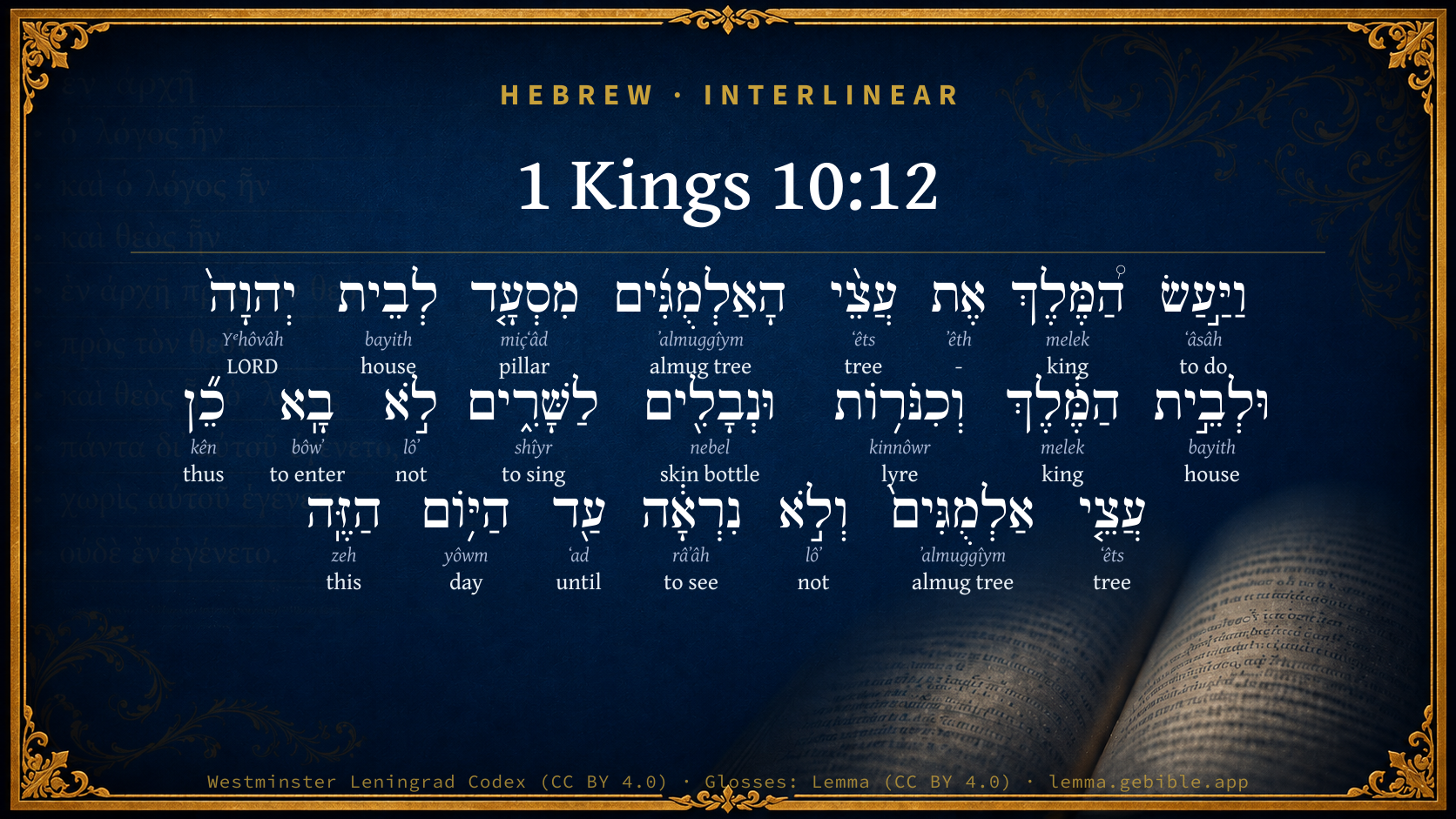
Hebrew (Westminster Leningrad Codex) 1 Kings 10:12 appears in the Hebrew Old Testament. The text above is from the Westminster Leningrad Codex. Each word links to its Strong’s number, a concise gloss, and parsing drawn from the Open Scriptures Hebrew Bible morphology. Click any word for its full Brown-Driver-Briggs (BDB) entry.
Download image
Cite this verse

1 Kings 10:12 (World English Bible). Public Domain. Lemma interlinear Bible study tool, https://lemma.gebible.app/v/1-kings/10/12.

Show BibTeX & RIS
BibTeX
RIS
English Translation
The king made of the almug trees pillars for the house of Yahweh, and for the king's house, harps also and psalteries for the singers: there came no such almug trees, nor were seen, to this day.
World English Bible · Public Domain
Highlights
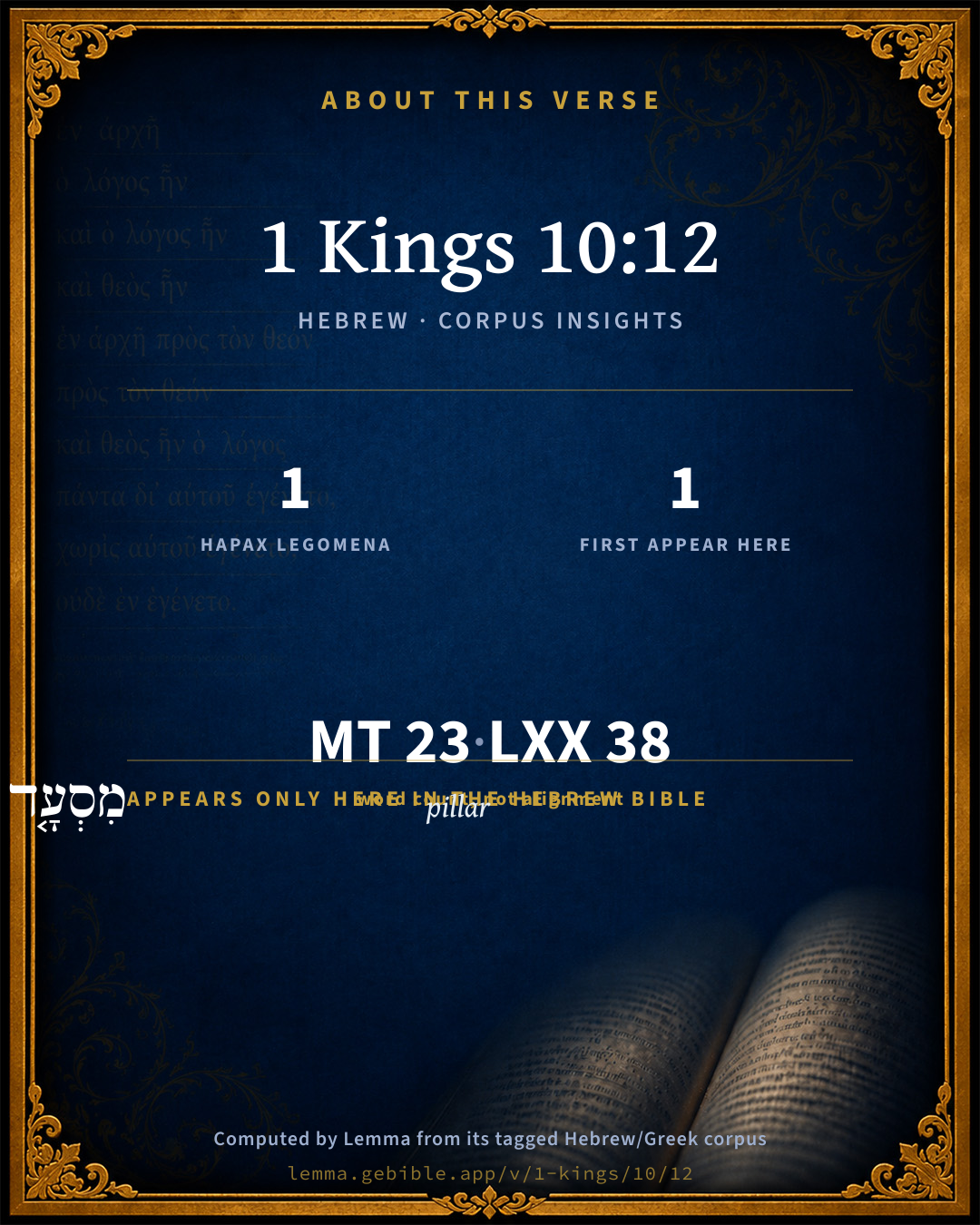
  • 1 hapax legomenon — only here in the Hebrew Bible
  • 1 first appearance in the Hebrew Bible
Full analysis ↓
Download a study sheet

One document with this verse’s original text, its word-by-word gloss line, the meaning frame, cross-references with their text, attributed commentary, and full source and license credits — printable, and it pastes into notes with its structure intact.

This verse Autodidact and up

Study sheet (.html) Plain text (.txt)

A passage Seminary Student

Up to 50 verses in one chapter. A passage sheet keeps up to 6 commentary sources and 12 cross-references per verse, in the order this page ranks them, and says so on the sheet whenever that leaves anything out. Ask for a single verse and you get the Autodidact verse sheet above.

Everything on this page stays free to read, with no account — the sheet is a download of what is already on screen, not access to it.

Want to remove ads? Support Godless Engineer
Compare translations 3

The same verse in 3 English versions, stacked beneath the original-language interlinear above. Click any original word for its lexicon entry.

Each is an independent rendering of the whole verse — the interlinear is not word-aligned to these translations.

Highlighted words mark where these versions differ — a whole-verse word diff, not a word-by-word alignment.

  • World English Bible Public Domain
    The king made of the almug trees pillars for the house of Yahweh, and for the king's house, harps also and psalteries for the singers: there came no such almug trees, nor were seen, to this day.
  • King James Version Public Domain
    And the king made of the almug trees pillars for the house of the LORD, and for the king's house, harps also and psalteries for singers: there came no such almug trees, nor were seen unto this day.
  • unfoldingWord Literal Text CC BY-SA 4.0
    And the king made the wood of almug a support for the house of Yahweh and for the house of the king and harps and lyres for the singers. Such wood of almug had not come and has not been seen to this day.)

unfoldingWord Literal Text — © unfoldingWord, licensed CC BY-SA 4.0. Word-aligned USFM3 via Door43 (git.door43.org/unfoldingWord/en_ult).

Versions to compare (up to 4)

3 of 4 selected

Show all 18 translations

Every available English version of this verse, each an independent rendering of the whole verse.

  • World English Bible Public Domain
    The king made of the almug trees pillars for the house of Yahweh, and for the king's house, harps also and psalteries for the singers: there came no such almug trees, nor were seen, to this day.
  • Berean Standard Bible Public Domain
    The king made the almug wood into steps for the house of the LORD and for the king’s palace, and into lyres and harps for the singers. Never before had such almug wood been brought in, nor has such been seen to this day.)
  • Majority Standard Bible Public Domain
    The king made the almug wood into steps for the house of the LORD and for the king’s palace, and into lyres and harps for the singers. Never before had such almug wood been brought in, nor has such been seen again to this day.)
  • King James Version Public Domain
    And the king made of the almug trees pillars for the house of the LORD, and for the king's house, harps also and psalteries for singers: there came no such almug trees, nor were seen unto this day.
  • American Standard Version (1901) Public Domain
    And the king made of the almug-trees pillars for the house of Jehovah, and for the king's house, harps also and psalteries for the singers: there came no such almug-trees, nor were seen, unto this day.
  • Revised Version (1885) Public Domain
    And the king made of the almug trees pillars for the house of the LORD, and for the king’s house, harps also and psalteries for the singers: there came no such almug trees, nor were seen, unto this day.
  • Geneva Bible (1599) Public Domain
    And the King made of ye Almuggim trees pillars for the house of the Lord, and for ye Kings palace, and made harpes and psalteries for singers. There came no more such Almuggim trees, nor were any more seene vnto this day.
  • Douay-Rheims (1899) Public Domain
    And the king made of the thyine trees the rails of the house of the Lord, and of the king's house, and citterns and harps for singers: there were no such thyine trees as these brought, nor seen unto this day.)
  • Young's Literal Translation Public Domain
    and the king maketh the almug-trees a support for the house of Jehovah, and for the house of the king, and harps and psalteries for singers; there have not come such almug-trees, nor have there been seen `such' unto this day.
  • Literal Standard Version CC BY-SA 4.0
    and the king makes the almug-trees a support for the house of YHWH, and for the house of the king, and harps and psalteries for singers; there have not come such almug-trees, nor have there been seen [such] to this day.
  • Unlocked Literal Bible CC BY-SA 4.0
    The king made almug wood pillars for the temple of Yahweh and for the king's palace, and harps and lyres for the singers. No such quantity of almug wood has ever come or been seen again to this day.
  • unfoldingWord Literal Text CC BY-SA 4.0
    And the king made the wood of almug a support for the house of Yahweh and for the house of the king and harps and lyres for the singers. Such wood of almug had not come and has not been seen to this day.)
  • Darby Bible Public Domain
    And the king made of the sandal-wood a balustrade for the house of Jehovah, and for the king's house, and harps and lutes for the singers. There came no such sandal-wood, nor was there seen to this day.)
  • World Messianic Bible Public Domain
    The king made of the almug trees pillars for the LORD’s house and for the king’s house, harps also and stringed instruments for the singers; no such almug trees came or were seen to this day.
  • Webster's Bible Public Domain
    And the king made of the almug trees pillars for the house of the LORD, and for the king's house, harps also and psalteries for singers: there came no such almug-trees, nor have they been seen to this day.
  • Free Bible Version CC BY-SA 4.0
    The king used the algum wood to make steps for the Temple and for the royal palace, and into lyres and harps for the musicians. Nothing like them had ever been seen before in the land of Judah.)
  • Bible in Basic English Public Domain
    And from the sandal-wood the king made pillars for the house of the Lord, and for the king's house, and instruments of music for the makers of melody: never has such sandal-wood been seen to this day.
  • JPS Tanakh (1917) Public Domain
    And the king made of the sandal-wood pillars for the house of the LORD, and for the king's house, harps also and psalteries for the singers; there came no such sandal-wood, nor was seen, unto this day.

Literal Standard Version (2020), Covenant Press — licensed CC BY-SA 4.0. Text via the HelloAO Bible API (eBible.org). Unlocked Literal Bible (unfoldingWord) — licensed CC BY-SA 4.0. Text via the HelloAO Bible API (eBible.org). unfoldingWord Literal Text — © unfoldingWord, licensed CC BY-SA 4.0. Word-aligned USFM3 via Door43 (git.door43.org/unfoldingWord/en_ult). Free Bible Version, Dr. Jonathan Gallagher — licensed CC BY-SA 4.0. Text via the HelloAO Bible API (eBible.org).

Word by word

More ways to search: Search by grammar → Find every occurrence → Compare this word →

Practice this passage: Drill this verse → Learn its vocabulary →

מִסְעָ֤ד
miçʻâd
H4552
“pillar”
Noun, Common, Masculine, Singular, Absolute
Part of Speech
Noun
Type
Common
Gender
Masculine
Number
Singular
State
Absolute
Full BDB Definition

Origin: from H5582

TWOT: 1525a

support, pillar
  1. וַיַּ֣עַשׂ ʻâsâh H6213 “and · to do” Conjunction + Verb, Qal, Sequential Imperfect, 3rd Person, Masculine, Singular
  2. הַ֠מֶּלֶךְ melek H4428 “the · king” Particle, Definite Article + Noun, Common, Masculine, Singular, Absolute
  3. אֶת ʼêth H853 “-” Particle, Direct Object
  4. עֲצֵ֨י ʻêts H6086 “trees of” Noun, Common, Masculine, Plural, Construct
  5. הָאַלְמֻגִּ֜ים ʼalmuggîym H484 “the · almug trees” Particle, Definite Article + Noun, Common, Masculine, Plural, Absolute
  6. לְבֵית bayith H1004 “to/for · house of” Preposition + Noun, Common, Masculine, Singular, Construct
  7. יְהוָה֙ Yᵉhôvâh H3068 “LORD” Noun, Proper
  8. וּלְבֵ֣ית bayith H1004 “and · to/for · house of” Conjunction + Preposition + Noun, Common, Masculine, Singular, Construct
  9. הַמֶּ֔לֶךְ melek H4428 “the · king” Particle, Definite Article + Noun, Common, Masculine, Singular, Absolute
  10. וְכִנֹּר֥וֹת kinnôwr H3658 “and · lyres” Conjunction + Noun, Common, Masculine, Plural, Absolute
  11. וּנְבָלִ֖ים nebel H5035 “and · skin bottles” Conjunction + Noun, Common, Masculine, Plural, Absolute
  12. לַשָּׁרִ֑ים shîyr H7891 “to/for the · singing” Preposition, Determined + Verb, Qal, Participle Active, Masculine, Plural, Absolute
  13. לֹ֣א lôʼ H3808 “not” Particle, Negative
  14. בָֽא bôwʼ H935 “to enter” Verb, Qal, Perfect, 3rd Person, Masculine, Singular
  15. כֵ֞ן kên H3651 “thus” Adverb
  16. עֲצֵ֤י ʻêts H6086 “trees of” Noun, Common, Masculine, Plural, Construct
  17. אַלְמֻגִּים֙ ʼalmuggîym H484 “almug trees” Noun, Common, Masculine, Plural, Absolute
  18. וְלֹ֣א lôʼ H3808 “and · not” Conjunction + Particle, Negative
  19. נִרְאָ֔ה râʼâh H7200 “to see” Verb, Niphal, Perfect, 3rd Person, Masculine, Singular
  20. עַ֖ד ʻad H5704 “until” Preposition
  21. הַיּ֥וֹם yôwm H3117 “the · day” Particle, Definite Article + Noun, Common, Masculine, Singular, Absolute
  22. הַזֶּֽה zeh H2088 “the · this” Particle, Definite Article + Pronoun, Demonstrative, Masculine, Singular

About this verse

These counts appear in no published source. They are computed here, from the morphology-tagged text and Lemma’s own curated glosses. What Lemma adds →

23
words
18
distinct lemmas
Historical
section

Notable vocabulary

1 hapax legomenon — a word that appears only here in the entire Hebrew Bible:

  • מִסְעָ֤ד pillar H4552

First appearance in Scripture

This word makes its first canonical appearance in the Hebrew Bible here:

  • מִסְעָ֤ד pillar H4552

Shared distinctive vocabulary

הָאַלְמֻגִּ֜ים almug tree H484 occurs in 2 verses of the Hebrew Bible. Also found in:

Grammatical profile

  • 4 verbs
  • 13 nouns
  • 1 pronoun
  • 1 preposition
  • 1 adverb
  • 3 particles

Verb forms

  • וַיַּ֣עַשׂ Qal · Sequential Imperfect
  • לַשָּׁרִ֑ים Qal · Participle Active
  • בָֽא Qal · Perfect
  • נִרְאָ֔ה Niphal · Perfect

Repetition

Words recur within this verse — often emphatic in Hebrew:

  • הַ֠מֶּלֶךְ king H4428 ×2
  • עֲצֵ֨י tree H6086 ×2
  • הָאַלְמֻגִּ֜ים almug tree H484 ×2
  • לְבֵית house H1004 ×2
  • לֹ֣א not H3808 ×2

Hebrew & Septuagint length

In English translation the verse runs 37 words from the Hebrew and 42 from the Septuagint (LXX English) — closely comparable.

A rough comparison of the two English renderings, which tokenize alike — not a word-level alignment.

Word counts can differ between the Hebrew and the Greek without any difference in meaning — e.g. the Hebrew direct-object marker אֵת has no separate Greek word, and Greek often adds the article ὁ.

In the original languages it is 23 Hebrew tokens and 38 Greek tokens — but the two are counted differently (Hebrew bundles its prefixes and suffixes into one token; the Greek is in lemma form), so that isn’t a like-for-like length.

Cross-references

5

Topical passages linked to 1 Kings 10:12 in the Treasury of Scripture Knowledge — connected by theme and wording, ordered by reader-vote popularity; previews shown in the World English Bible.

  • 1 Chronicles 23:5 and four thousand were doorkeepers; and four thousand praised Yahweh with the instruments which I made, [said David], for giving praise.
  • 1 Chronicles 25:1–31 Moreover, David and the captains of the host set apart for the service certain of the sons of Asaph, and of Heman, and of Jeduthun, who should prophesy with harps, with psalteries, and with cymbals: and the number of those who did the work according to their service was:
  • Psalms 92:1–3 It is a good thing to give thanks to Yahweh, To sing praises to your name, Most High;
  • Psalms 150:3–5 Praise him with the sounding of the trumpet! Praise him with harp and lyre!
  • Revelation 14:2–3 I heard a sound from heaven, like the sound of many waters, and like the sound of a great thunder. The sound which I heard was like that of harpists playing on their harps.

Cross-references courtesy of OpenBible.info (CC BY 4.0).

Hebrew and Greek witnesses Masoretic Hebrew ↔ Greek Septuagint

The same verse in the two great witnesses to the Old Testament, shown verse-for-verse.

These are two independent witnesses, not word-aligned to each other, and the Septuagint is shown in lemma (dictionary) form.

Hebrew 1 Kings 10:12 Masoretic · Westminster Leningrad Codex

וַיַּ֣עַשׂ הַ֠מֶּלֶךְ אֶת עֲצֵ֨י הָאַלְמֻגִּ֜ים מִסְעָ֤ד לְבֵית יְהוָה֙ וּלְבֵ֣ית הַמֶּ֔לֶךְ וְכִנֹּר֥וֹת וּנְבָלִ֖ים לַשָּׁרִ֑ים לֹ֣א בָֽא כֵ֞ן עֲצֵ֤י אַלְמֻגִּים֙ וְלֹ֣א נִרְאָ֔ה עַ֖ד הַיּ֥וֹם הַזֶּֽה

The king made of the almug trees pillars for the house of Yahweh, and for the king's house, harps also and psalteries for the singers: there came no such almug trees, nor were seen, to this day.

World English Bible · Public Domain

Greek LXX 1 Kings 10:12 Septuagint · lemma form

καί ποιέω ὁ βασιλεύς ὁ ξύλον ὁ ἀπελέκητος ὑποστήριγμα ὁ οἶκος κύριος καί ὁ οἶκος ὁ βασιλεύς καί νάβλα καί κινύρα ὁ ᾠδός οὐ ἔρχομαι τοιοῦτος ξύλον ἀπελέκητος ἐπί ὁ γῆ οὐδέ ὁράω που ἕως ὁ ἡμέρα οὗτος

And the king made the hewn timber into buttresses of the house of the Lord and the king's house, and lyres and harps for singers: such hewn timber had not come upon the earth, nor have been seen anywhere until this day.

LXX2012 (modern English Septuagint) · Public Domain

On this verse, The Cambridge Bible for Schools and Colleges discusses the Septuagint’s reading. Read the note in Commentary ↓

Hebrew: Westminster Leningrad Codex (CC BY 4.0). Greek: Septuagint (public domain); English from LXX2012 (modern English Septuagint) (Public Domain). How the Septuagint differs from the Hebrew →

Targum (Aramaic paraphrase)

1

The Targum is the ancient Jewish Aramaic paraphrase of the Hebrew Scriptures — an interpretive translation, not the Hebrew text itself. Onkelos (literal) and Pseudo-Jonathan (expansive) render the Torah, and Jonathan the Prophets. Coverage is partial: where no permissively-licensed English translation exists for a verse, only the Aramaic is shown. This is verse-level text, not a word-by-word alignment to the Hebrew.

  1. Targum Jonathan Prophets (Joshua–Malachi)
    וַעֲבַד מַלְכָּא יַת אֲעֵי אַלְמוֹגַיָא סָעִיד לְבֵית מַקְדְשָׁא דַייָ וּלְבֵית מַלְכָּא וְכִנוֹרַיָא וְנִבְלַיָא לִבְנֵי לֵוִי לָא אֲתוֹ כֵן אֲעֵי אַלְמוֹגִין וְלָא אִתְחֲזִיאוּ עַד יוֹמָא הָדֵין:

    (no public-domain English translation for this verse)

    Targum Jonathan — Aramaic: “Mikraot Gedolot” (public domain). English: “Sefaria Community Translation” (CC0 1.0 (public-domain dedication)); “London "Chaldee Paraphrase," 1871” (public domain). Text via Sefaria.

Commentary

Notes on 1 Kings 10:12 from classic Christian and Jewish commentators (each source and its license shown beneath its notes). The classic Christian expositions comment on the surrounding passage and are grouped to its opening verse, so a note may address several verses; the Jewish commentaries on the Tanakh (Rashi and others) are per-verse, so they appear only where the commentator wrote on this verse.

Lemma curates 59 commentaries, every one of them public domain or Creative Commons licensed, each selected and text-cleaned for this edition rather than reprinted as found. About our sources →

Trapp's Complete Commentary

John Trapp

1Ki 10:12 And the king made of the almug trees pillars for the house of the LORD, and for the king’s house, harps also and psalteries for singers: there came no such almug trees, nor were seen unto this day.

Ver. 12. Nor were seen unto this day.] Therefore they were not the same, but far better than those algum trees that came from Lebanon. {2Ch 2:8}

John Trapp, A Commentary or Exposition upon All the Books of the Old and New Testament (1647–1656) — public domain. Text from a community e-Sword module.

The Biblical Illustrator

Joseph S. Exell

1Ki_10:12

The king made of the almug-trees pillars for the house of the Lord.

Strength and sweetness

Pillars and psalteries were made out of the same timber, and in this respect we may take the tree of the text as a symbol of the strength and sweetness which inhere in the Christian character.

I. The first characteristic of the true Christian is strength. Pillars for the house of the Lord, and for the kings house. The almug-tree was close in grain, firm in fibre, only such wood being fit for pillars. The people of God must first be strong in spirit. Our Lord Himself was distinguished by sublime faith and bravery, and His apostles and disciples shared His supreme power and confidence, bearing triumphantly immense strain and suffering, as a pillar its tremendous burden. Another point to be noted is this: in the various catalogues of the virtues which occur in the New Testament the virile virtues are as amply recognised as in the most austere ethical systems of Greece and Rome. And this strength of conviction, sternness of principle, and constancy of purpose, this force of character and conduct, formed the basis of the beauty and sweetness which distinguished the primitive Christians.

1. Without strength there is no beauty of life. Without depth and thoroughness character does not attain to sweetness. We say, Beauty is skin deep; but really this is a consolation of philosophy in which the consolation is much in excess of the philosophy, for beauty springs from the roots and foundations of things. The loveliness of the earth is maintained by forces which operate below the surface; the bloom of the human face is secured by the health of organs concealed in the depths of the body; and the loveliness and sweetness of character spring from the soul--spring from the soul when pure and strong. Without firmness and vigour character does not attain beauty and sweetness. Reality, solidity, and energy underlie all satisfying winsomeness of manner and conduct. Hidden within the leaves of the tree are stout boughs, beneath the blooming skin hide well-knit bones, the greensward rests on granite, and the basis of flowers is not rarely iron and flint. So genuine charm of character is impossible without strong conscientiousness, serious views, unbending principle, firm, pure, uncompromising purity of mind and heart. There is no short and easy way to grace of life; its secret is the strength and integrity of the soul. Seeking to make life sweet, first make your heart sound, for out of radical, organic purity blossoms real courtesy, gentleness, and the manifold graces of life. Whatsoever things are pure, whatsoever things are lovely. The pure comes before the lovely. Do not patch, powder, and paint the face, get health at the centre; do not coax your dress, get a better figure; do not revise your etiquette, be transformed in the spirit of your mind. Depth, strength, vitality, freedom, harmony, love, joyfulness are the roots of beautiful Christian character. Out of the heart are the issues of life, and in the love of God, the grace of the Lord Jesus Christ, and the fellowship of the Holy Spirit, do we find the secret of satisfying and abiding sweetness.

2. As there is no real grace of life without strength, so there is no efficient service without it. He made pillars for the house of the Lord. Men efficient for high holy service in Gods Church must possess positive qualities, elements of strength and stability, independence of thought, uprightness of character, steadfastness of faith, and power of patience and sacrifice. Fussy men in all the denominations seem to be pillars, but in fact are poor creatures of little moment. The secret of efficiency is reality. Lath-painted iron is soon detected; without sincerity, strength, and self-forgetfulness service is shallow and sterile. And he made pillars for the kings house. If we are to render real and permanent service to the State, we shall need the strong, fine qualities of the Christian character. We cannot make a pillar of bamboo: there must be something in it, something of heart of oak, solidity of marble, texture of iron and bronze. He who would become a pillar in Church or State must first be a pillar in deed and truth. Him that overcometh will I make a pillar in the temple of my God, and he shall go no more out.

II. The complementary characteristic of true christian character is sweetness, Harps also and psalteries for singers. Fragrance and music proceeded from the wood that furnished the pillars: so Christian character suggests harmoniousness, smoothness, sweetness. Mr. St. John, the naturalist, relates that when exploring the recesses of the Highlands he frequently came into contact with men living in the rude Highland way, and at first he thought them morose, unobservant, stupid; but as he continued to live amongst them the truth appeared: they appreciated their majestic hills and lakes more keenly than their visitor did, in their soul was the love of beauty, and in their lips the law of kindness; they were really thinkers, poets, saints. Many Christians who ruffle the polite and provoke the reproach of aestheticism are really the gentlest and loveliest of men and women. Forbidding to the hasty glance and superficial judgment of dilettantism, it is the exterior only that is uncut and unpolished, which is, after all, infinitely better than social refinement hiding moral rottenness. Harriet Martineau, writing about the disappointing revelation of the true Walter Scott in Lockharts Life, ends with this just reflection: If great men fall below our expectation, let it be remembered that there is another point of view from which the matter should be looked at--that we gain thus a new sense of the glory and beauty of virtue and incorruptibleness in the humble matter of everyday life. Dexterous exhibitors introduce into the flower-shew blooms which put to shame their modest neighbours, but when the prizes are adjudged these pretentious flowers are rejected when it is discovered that their leaves and petals are artificial and doctored; so the great Day will doom many a manufactured article, and confer the final reward upon flowers of the field whose whole charm was truth and sweetness. We, therefore, magnify conscience at every turn, and think to show how much we have of it by ignoring the obligations of grace, and blurring the beauty of holiness whenever it tends to reveal itself. A perverse conception of the Puritan deforms our sanctuaries, impoverishes our worship, and blights our character. In the house study to express the sweetness of Christian character. One of the finest aspects of modem times is the art that is finding its way into lowly homes, and giving the touch of grace to every humblest, household, necessary thing. The aim of art is to express the sublime in the trivial, said J. F. Millet; and if in the home we reveal our sublime faith and righteousness in doing gracefully many little things, the home will be far happier than it sometimes is. In the business sphere is much need of sweetness. Nowhere is gentleness more effective than in the stern world of toil and trade. Silk is said to be stronger than steel, and the graciousness of a strong man renders him as nearly omnipotent as a mortal may come. The lyre ought to figure in business as well as the firm, hard columns; and fine behaviour and persuasive speech in those who rule without a moments surrender of right and authority, are more influential than any outburst of vulgar wrath. Instead of a cudgel try a psaltery. In our entire intercourse with general society we need to cultivate this grace of spirit and life. A sceptical writer in a current magazine argues that the old evidences for Christianity are utterly discredited, and that the one consideration which now gives sanction and effectiveness to its claim is the beauty of the character of Jesus Christ. We do not for a moment agree with this contention; but it is undeniable that no evidence for Christianity is so commanding as that drawn from the incomparable, transcending loveliness of our Lord. (W. L. Watkinson.)

The Biblical Illustrator, edited by Joseph S. Exell (c. 1880s–1900s) — public domain. Text from a community e-Sword module.

The Cambridge Bible for Schools and Colleges

gen. ed. J. J. S. Perowne

12. pillars for the house of the Lord] The noun signifies ‘a prop,’ and it may be that some ornamental work like that indicated in the margin of the R.V. ‘a railing’ is intended. It was some later addition, not any part of the fabric, which was already completed. In the parallel place of 2 Chron. (1Ki_9:11) there is a different word in the Hebrew, and one usually applied to a ‘highway.’ Both A. V. and R.V. have ‘terraces’ in that passage. If we combine the two narratives it may be that what is intended is a staircase with handrail and balustrade. The former word would suit in Chronicles, where A. V. has ‘stairs’ on the margin, and the latter here.

for singers] The word is definite, the singers. Cf. Ecc_2:8.

almug trees] Here the LXX. adds ‘unto the land,’ and the thought is perhaps of the things brought by the fleet of Hiram. In all their voyages they could not find the like.

The Cambridge Bible for Schools and Colleges (gen. ed. J. J. S. Perowne; Cambridge University Press, 1878–1918) — public domain. Text from a community e-Sword module.

John Gill's Exposition

And the king made of the almug trees pillars for the house of the Lord, and for the king's house,.... Or terraces, as in Ch2 9:11, causeways; and means the ascent or causeway he made from his own house to the temple; the pavement of which, as Jarchi interprets the word here, was made of the wood of these trees; or the supports of it, or rather the rails on each side, on which men might stay themselves as they passed along, as Ben Gersom; and since this ascent was admired by the queen of Sheba, it is particularly observed what wood it was made of, and from whence it came:

harps also, and psalteries for singers; these musical instruments were made of the same wood; Josephus (i) says of amber, and that their number was 400,000:

there came no such almug trees, nor were seen unto this day; not in the land of Israel, neither before nor since, see Ch2 9:11.

(i) Antiqu. l. 8. c. 3. sect. 8.

John Gill's Exposition of the Whole Bible (1746–1763) — public domain (CC PDM 1.0). Text via the HelloAO Bible API.

Albert Barnes' Notes on the Bible

Pillars - The Hebrew word signifies ordinarily a “prop” (margin). It is generally supposed to mean in this place a “railing,” or “balustrade,” a sense which connects and harmonises the present passage with the parallel passage in Chronicles (marginal reference), where Solomon is said to have made of the almug-wood “stairs” for the temple and for his own house.

Harps - The Jewish harp כנור kı̂nnôr was of a triangular shape, and had ordinarily ten strings. It probably resembled the more ancient harp of the Assyrians, which was played with a plectrum, as was (ordinarily) the “kinnor.”

Psalteries - The psaltery, or viol. Hebrew: נבל nebel; Greek: νάβλα nabla, was a stringed instrument played with the hand; perhaps a lyre, like those on Hebrew coins, the sounding-board of which is shaped like a jug; or, perhaps, a sort of guitar, with a hollow jug-shaped body at the lower end.

Albert Barnes' Notes on the Bible (1834–1885) — public domain. Text from a community e-Sword/MySword module.

Haydock's Catholic Bible Commentary

Rails. Hebrew mihsad, "pillars, supporters, or banisters." (Haydock) --- Most interpreters suppose the rails were on each side of the road, leading from the palace to the temple. (Calmet) --- Paralipomenon stairs. --- Citterns, or harps and lyres. (Haydock) --- Hebrew, "kinnoroth and nebalim."

George Leo Haydock (1774–1849), Haydock's Catholic Family Bible and Commentary, 1859 edition — public domain. Excludes Psalms (Douay-Rheims chapter numbering differs from Protestant) and Deuterocanonical books (Catholic canon only).

Matthew Poole's English Annotations

Almug trees, called also (by an inversion of the letters, which is usual among the Hebrews) algum trees, 2Ch 2:8; 9:10; whereof there were some in Lebanon, 2Ch 2:8, but the best sort came from Ophir, as is here said.

Pillars, or supporters, either for the ascent or stairs, by which they went from the king’s house to the temple; see 1Ch 26:16; 2Ch 9:11; or for divers parts both of the Lord’s and of the king’s house.

Matthew Poole's English Annotations on the Holy Bible (1683–1685) — public domain. Text from a community e-Sword/MySword module.

Whedon's Commentary on the Bible

Daniel D. Whedon

12. Pillars — Rather, a balustrade to fend the side of some elevated passage or stairway. 2Ch_9:11 reads מסלות, which may mean either an elevated walkingplace or a staircase. The latter meaning is here the more probable. The balustrades of the stairways in the temple and in the palace were made of this celebrated wood.

Harps… psalteries — See note on 1Sa_10:5.

No such almug trees — Those supplied by Hiram (2Ch_2:8) were of an inferior quality. Compare note at chap. 1Ki_5:8.

Daniel D. Whedon (gen. ed.), Commentary on the Old and New Testaments (1874–1909) — public domain. Text from a community e-Sword module.

The Pulpit Commentary

And the king made of the almug trees pillars lit., props. In 2Ch_9:11 we have a different word, twOlsim (cf. Jud_1:20:31, 32; 1Sa_6:12, etc.) there translated stairs. The word in the text dsmi is apax leg. Keil understands "steps with bannisters;" Bahr (after Jarchi) "tesselated pavements;" Gesenius, "balusters;" Thenius, "divans;" Bottcher, "benches and similar moveables." But was not the pavement already laid, and of cedar; and would the sanctuary have divans, etc.? for the house of the Lord, and for the king"s house, harps also and psalteries also mentioned together. (Psa_71:22 Psa_108:2; cf. 3) They were stringed instruments, but their precise shape and character is quite uncertain. One species of sandalwood, or of wood closely allied to it, is said to have been much sought after for musical instruments for the singers: there came no such almug trees, nor were seen unto this day.

The Pulpit Commentary (1880–1919), ed. H.D.M. Spence-Jones & Joseph S. Exell — public domain. Text from a community e-Sword module.

Rashi

Rabbi Shlomo Yitzchaki (Rashi)

A pathway to the Beis Hamikdosh of Adonoy. But in Divrei Hayomim it is written, “paths [מסילות] to the House of Adonoy.” I therefore say, that this support [מסעד] is an expression of a pavement.

For the singers. For the Leviyim.

Rashi on the Tanakh — English translations: “The Judaica Press complete Tanach with Rashi, translated by A. J. Rosenberg” (CC BY 4.0); “Pentateuch with Rashi's commentary by M. Rosenbaum and A.M. Silbermann, 1929-1934” (public domain); “The Metsudah Tanach series, Lakewood, N.J” (CC BY 4.0); and “The Book of Joshua, Metsudah Publications, 1997” (CC BY 4.0). Text via Sefaria.

Lesson kit

Teaching starters — assembled from the data on this page, not authored interpretation. Every prompt links to the verse data it draws on. Edit before teaching.

1 Kings, in the Historical, opens this verse with 23 words (18 distinct Hebrew lemmas). Its most distinctive word is miçʻâd (“pillar”). A historical commentator’s framing appears above. Read the whole chapter for the surrounding context.

Discussion questions

  1. How does “pillar” (miçʻâd) shape what this verse is saying?
  2. 1 word here appears nowhere else in the Hebrew Bible. Why might the author reach for such rare wording?
  3. This is the first place “pillar” appears in Scripture (first appears here). What does its debut here establish?
  4. How does 1 Kings 10:11, which shares the word «almug tree», read alongside this verse?
  5. What does the repetition of “king” (2× in this one verse) do in this verse?
  6. These translations render this verse differently. What is at stake in choosing one wording over another?
  7. «וַיַּ֣עַשׂ» is a Qal Sequential Imperfect verb. How does that grammatical form shape the action described?
  8. Compare how Trapp's Complete Commentary and The Biblical Illustrator read this verse. Where do they agree or differ?

Things to notice

  • 1 word in this verse appears nowhere else in the Hebrew Bible.
  • 1 word makes its first canonical appearance in Scripture here.
  • This verse counts 23 Hebrew ↔ 38 Greek words.
  • These translations choose different wording for 16 words in this verse.
  • “king” occurs 2× in this single verse.

Reading settings

Reading text

Shown beneath each verse's original-language words.

Old Testament
Old Testament edition

Read the OT as the Masoretic Hebrew (MT) or the Greek Septuagint (LXX).

English shown for the Greek Septuagint (in the Hebrew ↔ Greek comparison).

Comparing translations? Open the Compare panel on any verse page to stack up to four side by side.