
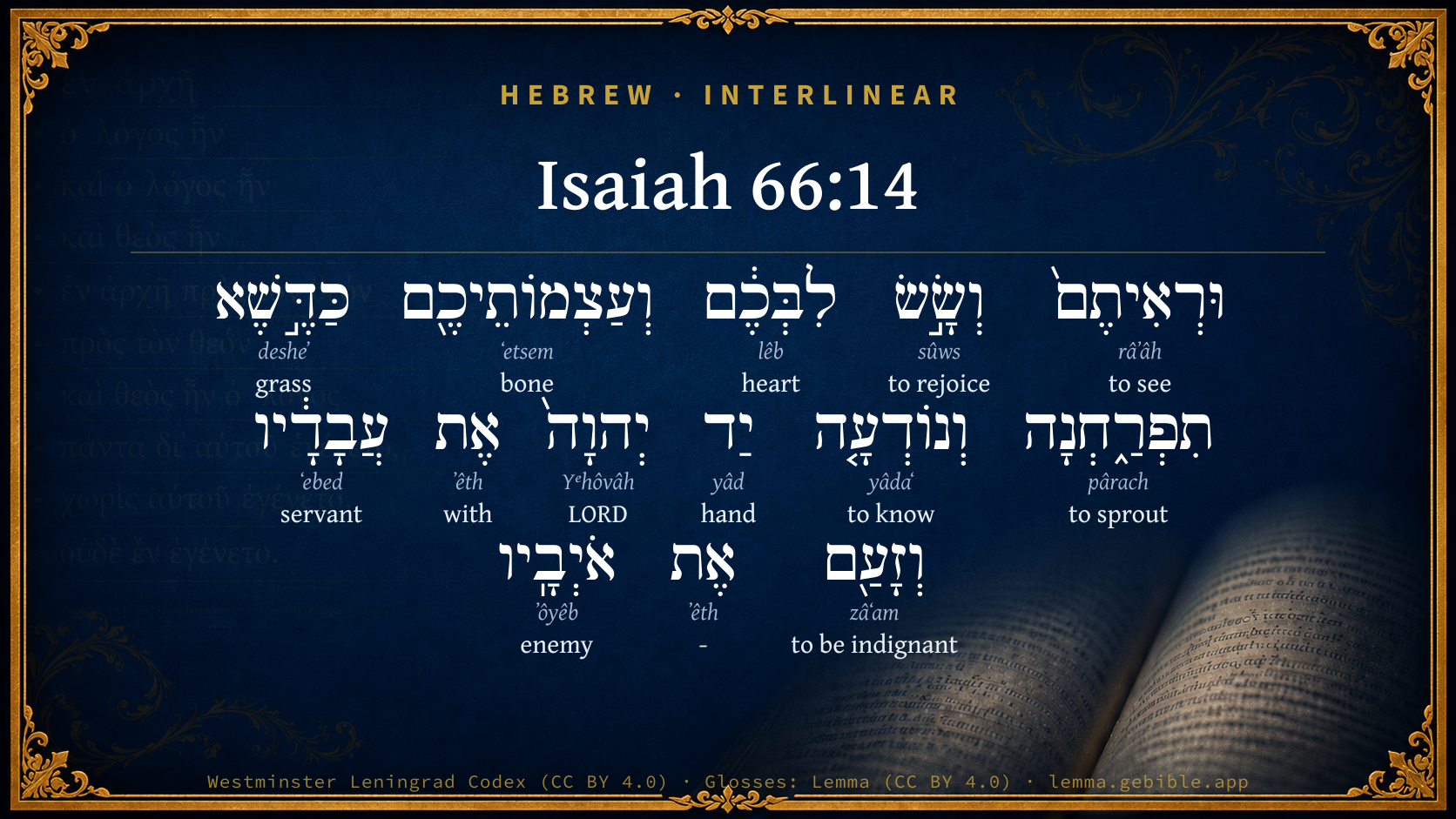
Isaiah 66:14

Hebrew (Westminster Leningrad Codex) Isaiah 66:14 appears in the Hebrew Old Testament. The text above is from the Westminster Leningrad Codex. Each word links to its Strong’s number, a concise gloss, and parsing drawn from the Open Scriptures Hebrew Bible morphology. Click any word for its full Brown-Driver-Briggs (BDB) entry.
Download image
Cite this verse

Isaiah 66:14 (World English Bible). Public Domain. Lemma interlinear Bible study tool, https://lemma.gebible.app/v/isaiah/66/14.

Show BibTeX & RIS
BibTeX
RIS
English Translation
You shall see [it], and your heart shall rejoice, and your bones shall flourish like the tender grass: and the hand of Yahweh shall be known toward his servants; and he will have indignation against his enemies.
World English Bible · Public Domain
Download a study sheet

One document with this verse’s original text, its word-by-word gloss line, the meaning frame, cross-references with their text, attributed commentary, and full source and license credits — printable, and it pastes into notes with its structure intact.

This verse Autodidact and up

Study sheet (.html) Plain text (.txt)

A passage Seminary Student

Up to 50 verses in one chapter. A passage sheet keeps up to 6 commentary sources and 12 cross-references per verse, in the order this page ranks them, and says so on the sheet whenever that leaves anything out. Ask for a single verse and you get the Autodidact verse sheet above.

Everything on this page stays free to read, with no account — the sheet is a download of what is already on screen, not access to it.

Want to remove ads? Support Godless Engineer
Compare translations 3

The same verse in 3 English versions, stacked beneath the original-language interlinear above. Click any original word for its lexicon entry.

Each is an independent rendering of the whole verse — the interlinear is not word-aligned to these translations.

Highlighted words mark where these versions differ — a whole-verse word diff, not a word-by-word alignment.

  • World English Bible Public Domain
    You shall see [it], and your heart shall rejoice, and your bones shall flourish like the tender grass: and the hand of Yahweh shall be known toward his servants; and he will have indignation against his enemies.
  • King James Version Public Domain
    And when ye see this, your heart shall rejoice, and your bones shall flourish like an herb: and the hand of the LORD shall be known toward his servants, and his indignation toward his enemies.
  • unfoldingWord Literal Text CC BY-SA 4.0
    And you will see, and your heart will rejoice, and your bones will blossom like the grass, and the hand of Yahweh will be made known to his servants, but he will be indignant against his enemies.

unfoldingWord Literal Text — © unfoldingWord, licensed CC BY-SA 4.0. Word-aligned USFM3 via Door43 (git.door43.org/unfoldingWord/en_ult).

Versions to compare (up to 4)

3 of 4 selected

Show all 18 translations

Every available English version of this verse, each an independent rendering of the whole verse.

  • World English Bible Public Domain
    You shall see [it], and your heart shall rejoice, and your bones shall flourish like the tender grass: and the hand of Yahweh shall be known toward his servants; and he will have indignation against his enemies.
  • Berean Standard Bible Public Domain
    When you see, you will rejoice, and you will flourish like grass; then the hand of the LORD will be revealed to His servants, but His wrath will be shown to His enemies.
  • Majority Standard Bible Public Domain
    When you see, you will rejoice, and you will flourish like grass; then the hand of the LORD will be revealed to His servants, but His wrath will be shown to His enemies.
  • King James Version Public Domain
    And when ye see this, your heart shall rejoice, and your bones shall flourish like an herb: and the hand of the LORD shall be known toward his servants, and his indignation toward his enemies.
  • American Standard Version (1901) Public Domain
    And ye shall see `it', and your heart shall rejoice, and your bones shall flourish like the tender grass: and the hand of Jehovah shall be known toward his servants; and he will have indignation against his enemies.
  • Revised Version (1885) Public Domain
    And ye shall see it, and your heart shall rejoice, and your bones shall flourish like the tender grass: and the hand of the LORD shall be known toward his servants, and he will have indignation against his enemies.
  • Geneva Bible (1599) Public Domain
    And when ye see this, your hearts shall reioyce, and your bones shall flourish like an herbe: and the hand of the Lord shall be knowen among his seruants, and his indignation against his enemies.
  • Douay-Rheims (1899) Public Domain
    You shah see and your heart shall rejoice, and your bones shall flourish like an herb, and the hand of the Lord shall be known to his servants, and he shall be angry with his enemies.
  • Young's Literal Translation Public Domain
    And ye have seen, and rejoiced hath your heart, And your bones as tender grass do flourish, And the hand of Jehovah hath been known unto His servants, And He hath been indignant with His enemies.
  • Literal Standard Version CC BY-SA 4.0
    And you have seen, and your heart has rejoiced, || And your bones flourish as tender grass, || And the hand of YHWH has been known to His servants, || And He has been indignant with His enemies.
  • Unlocked Literal Bible CC BY-SA 4.0
    You will see this, and your heart will rejoice, and your bones will sprout like the tender grass. The hand of Yahweh will be made known to his servants, but he will show his anger against his enemies.
  • unfoldingWord Literal Text CC BY-SA 4.0
    And you will see, and your heart will rejoice, and your bones will blossom like the grass, and the hand of Yahweh will be made known to his servants, but he will be indignant against his enemies.
  • Darby Bible Public Domain
    And ye shall see [this], and your heart shall rejoice, and your bones shall flourish like the grass; and the hand of Jehovah shall be known toward his servants, and he will have indignation toward his enemies.
  • World Messianic Bible Public Domain
    You will see it, and your heart shall rejoice, and your bones will flourish like the tender grass. The LORD’s hand will be known among his servants; and he will have indignation against his enemies.
  • Webster's Bible Public Domain
    And when ye see this, your heart shall rejoice, and your bones shall flourish like an herb: and the hand of the LORD shall be known towards his servants, and his indignation towards his enemies.
  • Free Bible Version CC BY-SA 4.0
    When you see this happening, you'll be happy deep inside, and you'll prosper like growing grass. The Lord's power will be recognized as blessing his servants and cursing his enemies.
  • Bible in Basic English Public Domain
    And you will see it and your heart will be glad, and your bones will get new strength, like young grass: and the hand of the Lord will be seen at work for his servants, and his wrath against his haters.
  • JPS Tanakh (1917) Public Domain
    And when ye see this, your heart shall rejoice, and your bones shall flourish like young grass; and the hand of the LORD shall be known toward His servants, and He will have indignation against His enemies.

Literal Standard Version (2020), Covenant Press — licensed CC BY-SA 4.0. Text via the HelloAO Bible API (eBible.org). Unlocked Literal Bible (unfoldingWord) — licensed CC BY-SA 4.0. Text via the HelloAO Bible API (eBible.org). unfoldingWord Literal Text — © unfoldingWord, licensed CC BY-SA 4.0. Word-aligned USFM3 via Door43 (git.door43.org/unfoldingWord/en_ult). Free Bible Version, Dr. Jonathan Gallagher — licensed CC BY-SA 4.0. Text via the HelloAO Bible API (eBible.org).

Word by word

More ways to search: Search by grammar → Find every occurrence → Compare this word →

Practice this passage: Drill this verse → Learn its vocabulary →

וְזָעַ֖ם
zâʻam
H2194
“and · to be indignant”
Conjunction + Verb, Qal, Sequential Perfect, 3rd Person, Masculine, Singular
Part of Speech
Conjunction + Verb
Stem
Qal
Form
Sequential Perfect
Person
3rd Person
Gender
Masculine
Number
Singular
Full BDB Definition

Origin: a primitive root

TWOT: 568

to denounce, express indignation, be indignant - (Qal) - to have indignation, be indignant, be angrily indignant, be defiant - to be abhorrent - to express indignation in speech, denounce, curse - (Niphal) to show indignation, show anger
  1. וּרְאִיתֶם֙ râʼâh H7200 “and · to see” Conjunction + Verb, Qal, Sequential Perfect, 2nd Person, Masculine, Plural
  2. וְשָׂ֣שׂ sûws H7797 “and · to rejoice” Conjunction + Verb, Qal, Sequential Perfect, 3rd Person, Masculine, Singular
  3. לִבְּכֶ֔ם lêb H3820 “heart · your” Noun, Common, Masculine, Singular, Construct + Suffix, Personal, 2nd Person, Masculine, Plural
  4. וְעַצְמוֹתֵיכֶ֖ם ʻetsem H6106 “and · bones · your” Conjunction + Noun, Common, Feminine, Plural, Construct + Suffix, Personal, 2nd Person, Masculine, Plural
  5. כַּדֶּ֣שֶׁא desheʼ H1877 “like/as the · grass” Preposition, Determined + Noun, Common, Masculine, Singular, Absolute
  6. תִפְרַ֑חְנָה pârach H6524 “to sprout” Verb, Qal, Imperfect, 3rd Person, Feminine, Plural
  7. וְנוֹדְעָ֤ה yâdaʻ H3045 “and · to know” Conjunction + Verb, Niphal, Sequential Perfect, 3rd Person, Feminine, Singular
  8. יַד yâd H3027 “hand of” Noun, Common, Both, Singular, Construct
  9. יְהוָה֙ Yᵉhôvâh H3068 “LORD” Noun, Proper
  10. אֶת ʼêth H854 “with” Preposition
  11. עֲבָדָ֔יו ʻebed H5650 “servants · his” Noun, Common, Masculine, Plural, Construct + Suffix, Personal, 3rd Person, Masculine, Singular
  12. אֶת ʼêth H853 “-” Particle, Direct Object
  13. אֹיְבָֽיו ʼôyêb H341 “enemy · him” Verb, Qal, Participle Active, Masculine, Plural, Construct + Suffix, Personal, 3rd Person, Masculine, Singular

About this verse

These counts appear in no published source. They are computed here, from the morphology-tagged text and Lemma’s own curated glosses. What Lemma adds →

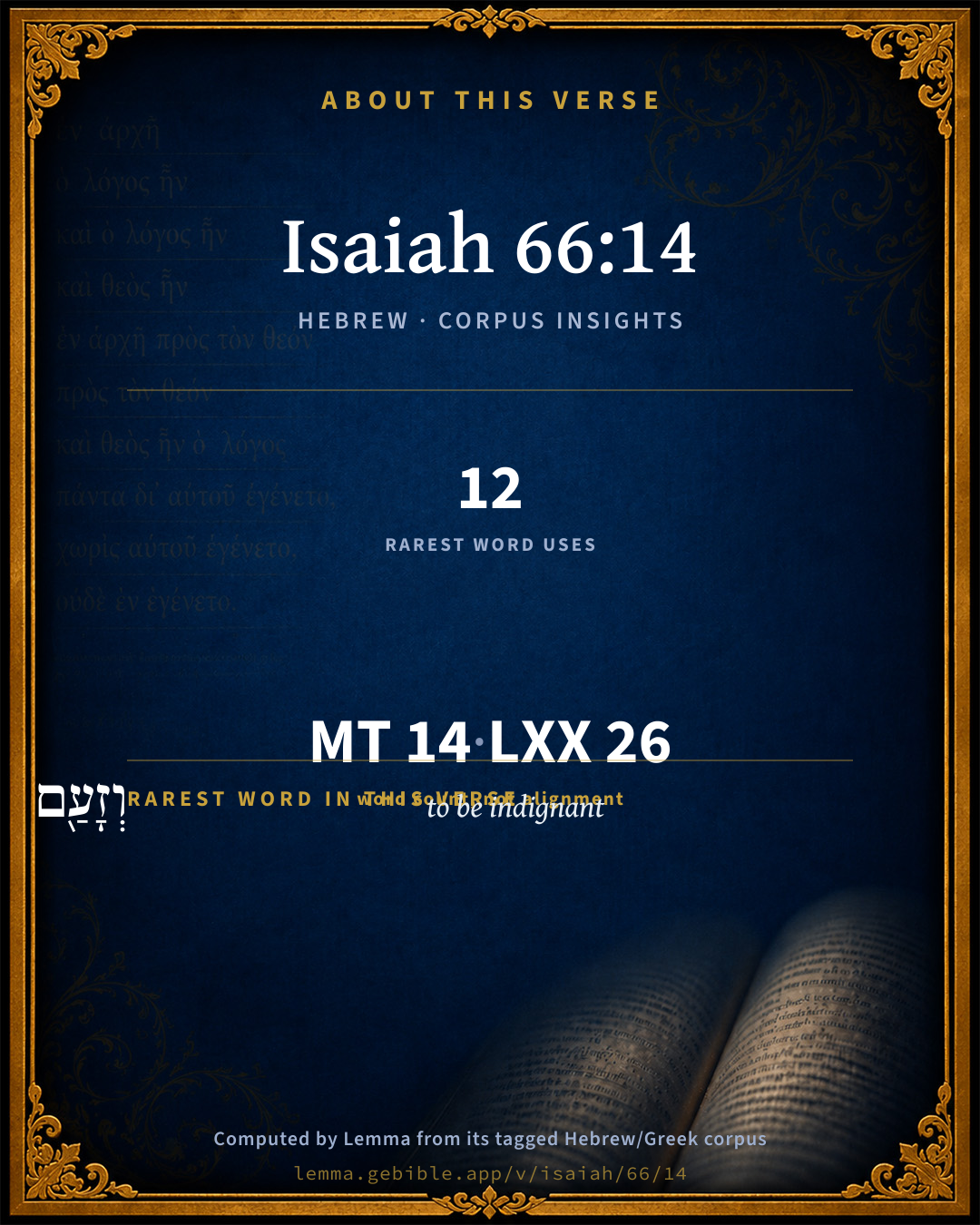
14
words
14
distinct lemmas
Prophets
section

Notable vocabulary

The rarest word here is וְזָעַ֖ם to be indignant H2194 — appearing just 12 times in the whole Hebrew Bible.

Shared distinctive vocabulary

וְזָעַ֖ם to be indignant H2194 occurs in 11 verses of the Hebrew Bible. Also found in:

Grammatical profile

  • 6 verbs
  • 6 nouns
  • 1 preposition
  • 1 particle

Verb forms

  • וּרְאִיתֶם֙ Qal · Sequential Perfect
  • וְשָׂ֣שׂ Qal · Sequential Perfect
  • תִפְרַ֑חְנָה Qal · Imperfect
  • וְנוֹדְעָ֤ה Niphal · Sequential Perfect
  • וְזָעַ֖ם Qal · Sequential Perfect
  • אֹיְבָֽיו Qal · Participle Active

Hebrew & Septuagint length

In English translation the verse runs 37 words from the Hebrew and 36 from the Septuagint (LXX English) — closely comparable.

A rough comparison of the two English renderings, which tokenize alike — not a word-level alignment.

Word counts can differ between the Hebrew and the Greek without any difference in meaning — e.g. the Hebrew direct-object marker אֵת has no separate Greek word, and Greek often adds the article ὁ.

In the original languages it is 14 Hebrew tokens and 26 Greek tokens — but the two are counted differently (Hebrew bundles its prefixes and suffixes into one token; the Greek is in lemma form), so that isn’t a like-for-like length.

Cross-references

17

Topical passages linked to Isaiah 66:14 in the Treasury of Scripture Knowledge — connected by theme and wording, ordered by reader-vote popularity; previews shown in the World English Bible.

  • Zechariah 10:7 Ephraim will be like a mighty man, And their heart will rejoice as through wine; Yes, their children will see it, and rejoice. Their heart will be glad in Yahweh.
  • Ezra 7:9 For on the first [day] of the first month began he to go up from Babylon; and on the first [day] of the fifth month came he to Jerusalem, according to the good hand of his God on him.
  • Ezra 8:22 For I was ashamed to ask of the king a band of soldiers and horsemen to help us against the enemy in the way, because we had spoken to the king, saying, The hand of our God is on all those who seek him, for good; but his power and his wrath is against all those who forsake him.
  • Ezra 8:31 Then we departed from the river Ahava on the twelfth [day] of the first month, to go to Jerusalem: and the hand of our God was on us, and he delivered us from the hand of the enemy and the bandit by the way.
  • Proverbs 3:8 It will be health to your body, And nourishment to your bones.
  • Proverbs 17:22 A cheerful heart makes good medicine, But a crushed spirit dries up the bones.
  • Ezekiel 37:1–14 The hand of Yahweh was on me, and he brought me out in the Spirit of Yahweh, and set me down in the midst of the valley; and it was full of bones.
  • Isaiah 65:12–16 I will destine you to the sword, and you shall all bow down to the slaughter; because when I called, you did not answer; when I spoke, you did not hear; but you did that which was evil in my eyes, and chose that in which I didn't delight.
  • Malachi 3:18 Then you shall return and discern between the righteous and the wicked, between him who serves God and him who doesn't serve him.
  • John 16:22 Therefore you now have sorrow, but I will see you again, and your heart will rejoice, and no one will take your joy away from you.
  • Ezra 8:18 According to the good hand of our God on us they brought us a man of discretion, of the sons of Mahli, the son of Levi, the son of Israel; and Sherebiah, with his sons and his brothers, eighteen;
  • Isaiah 10:5 Ho Assyrian, the rod of my anger, the staff in whose hand is my indignation!
  • Isaiah 26:19 Your dead shall live; my dead bodies shall arise. Awake and sing, you who dwell in the dust; for your dew is [as] the dew of herbs, and the earth shall cast forth the dead.
  • Isaiah 58:11 and Yahweh will guide you continually, and satisfy your soul in dry places, and make strong your bones; and you shall be like a watered garden, and like a spring of water, whose waters don't fail.
  • Isaiah 66:5 Hear the word of Yahweh, you who tremble at his word: Your brothers who hate you, who cast you out for my name's sake, have said, Let Yahweh be glorified, that we may see your joy; but it is those who shall be disappointed.
  • Hosea 14:4–8 "I will heal their waywardness. I will love them freely; For my anger is turned away from him.
  • Hebrews 10:27 but a certain fearful expectation of judgment, and a fierceness of fire which will devour the adversaries.

Cross-references courtesy of OpenBible.info (CC BY 4.0).

Hebrew and Greek witnesses Masoretic Hebrew ↔ Greek Septuagint

The same verse in the two great witnesses to the Old Testament, shown verse-for-verse.

These are two independent witnesses, not word-aligned to each other, and the Septuagint is shown in lemma (dictionary) form.

Hebrew Isaiah 66:14 Masoretic · Westminster Leningrad Codex

וּרְאִיתֶם֙ וְשָׂ֣שׂ לִבְּכֶ֔ם וְעַצְמוֹתֵיכֶ֖ם כַּדֶּ֣שֶׁא תִפְרַ֑חְנָה וְנוֹדְעָ֤ה יַד יְהוָה֙ אֶת עֲבָדָ֔יו וְזָעַ֖ם אֶת אֹיְבָֽיו

You shall see [it], and your heart shall rejoice, and your bones shall flourish like the tender grass: and the hand of Yahweh shall be known toward his servants; and he will have indignation against his enemies.

World English Bible · Public Domain

Greek LXX Isaiah 66:14 Septuagint · lemma form

καί ὁράω καί χαίρω σύ ὁ καρδία καί ὁ ὀστέον σύ ὡς βοτάνη ἀνατέλλω καί γιγνώσκω ὁ χείρ κύριος ὁ σέβομαι αὐτός καί ἀποεἰλέω ὁ ἀπειθέω

And you⌃ shall see, and your heart shall rejoice, and your bones shall thrive like grass: and the hand of the Lord shall be known to them that fear him, and he shall threaten the disobedient.

LXX2012 (modern English Septuagint) · Public Domain

Hebrew: Westminster Leningrad Codex (CC BY 4.0). Greek: Septuagint (public domain); English from LXX2012 (modern English Septuagint) (Public Domain). How the Septuagint differs from the Hebrew →

Targum (Aramaic paraphrase)

1

The Targum is the ancient Jewish Aramaic paraphrase of the Hebrew Scriptures — an interpretive translation, not the Hebrew text itself. Onkelos (literal) and Pseudo-Jonathan (expansive) render the Torah, and Jonathan the Prophets. Coverage is partial: where no permissively-licensed English translation exists for a verse, only the Aramaic is shown. This is verse-level text, not a word-by-word alignment to the Hebrew.

  1. Targum Jonathan Prophets (Joshua–Malachi)
    וְתֶחֱזוּן וְיֶחְדֵי לִבְּכוֹן וּגְוִיַתְכוֹן כְּדִתְאִין יִזְהֲרוּן וְתִתְגְלֵי גְבוּרְתָּא דַייָ לְאוֹטָבָא לְעַבְדוֹהִי צַדִיקַיָא וְיֵתֵי לְוָט לְבַעֲלֵי דְבָבוֹהִי:

    And when ye see this, your heart shall rejoice, and your bodies shall flourish like grass; and the power of the Lord shall be revealed to do good to His righteous servants; but a curse shall come upon His enemies.

    Targum Jonathan — Aramaic: “Mikraot Gedolot” (public domain). English: “Sefaria Community Translation” (CC0 1.0 (public-domain dedication)); “London "Chaldee Paraphrase," 1871” (public domain). Text via Sefaria.

Commentary

Notes on Isaiah 66:14 from classic Christian and Jewish commentators (each source and its license shown beneath its notes). The classic Christian expositions comment on the surrounding passage and are grouped to its opening verse, so a note may address several verses; the Jewish commentaries on the Tanakh (Rashi and others) are per-verse, so they appear only where the commentator wrote on this verse.

Lemma curates 59 commentaries, every one of them public domain or Creative Commons licensed, each selected and text-cleaned for this edition rather than reprinted as found. About our sources →

Trapp's Complete Commentary

John Trapp

Isa 66:14 And when ye see [this], your heart shall rejoice, and your bones shall flourish like an herb: and the hand of the LORD shall be known toward his servants, and [his] indignation toward his enemies.

Ver. 14. And when ye see this, your heart shall rejoice.] Videbitis, gaudebitis; you shall see that I do not give you good words only, but that I am in good earnest; ye shall know it within yourselves, in the workings of your own hearts. {as Heb 10:34}

And your bones shall flourish like an herb,] i.e., They shall be filled again with moisture and marrow. See Eze 37:10-11. You shall be fair liking and reflourish.

And the hand of the Lord,] i.e., His infinite power; tantorum beneficiorum in piis operatrix, the efficient cause of all these comforts.

John Trapp, A Commentary or Exposition upon All the Books of the Old and New Testament (1647–1656) — public domain. Text from a community e-Sword module.

The Biblical Illustrator

Joseph S. Exell

Isa_66:14

The hand of the Lord shall be known toward His servants

The Lords hand revealed

I.

SOME OF THE WAYS THE HAND OF THE LORD MAKES ITSELF KNOWN TOWARDS HIS SERVANTS.

1. In the character they bear.

2. In the work they do.

3. In the sufferings they endure.

4. In all the triumphs of their faith and patience.

II. THE CONDITION OF THIS VISIBLE DISPLAY OF GODS POWER. Simply to let it operate upon us and through us. We can, and often do, prevent His hand from being known. There must be humble recptiveness, believing prayer.

III. THE EFFECTS OF THIS MANIFESTATION OF THE LORDS HAND.

1. It encourages the Lords servants.

2. It rebukes the unbelief of the ungodly. Conclusion: Unconverted sinner I the Lord desires to show forth the power of His grace in you. Will you not allow Him to work upon you this miracle of His saving power? (W. Guthrie, M. A.)

The Biblical Illustrator, edited by Joseph S. Exell (c. 1880s–1900s) — public domain. Text from a community e-Sword module.

Joseph Benson's Commentary

Isa 66:14. And when ye see this — To what a happy state the church is restored; your heart shall rejoice — The peace of the church, and the extension of the kingdom of Christ, are always causes of real joy to such as fear God. And your bones shall flourish like an herb — The bones that were dried and withered, the marrow of them being quite exhausted, shall recover a youthful strength and vigour, and shall flourish like an herb in the spring, whose verdure and beauty in the winter were concealed in the root hid in the earth. In other words, you Jews shall recover your ancient strength and glory, and be renewed in as wonderful a manner as if dry, withered bones should recover their youth and moisture: or, as if the dead bones in a charnel-house should be united with sinews, clothed again with flesh and skin, and should have life and vigour infused into them. Then shall be effected that resurrection of the dry bones spoken of by Eze 37:1, &c., for that vision relates to the restoration of the Jewish nation, after it had lain for many ages in a dead, hopeless condition. In like manner St. Paul calls the receiving of the Jews into the church, life from the dead, Rom 11:15. And the hand of the Lord shall be known toward his servants — The power, protection, and influence of God shall be made manifest for, and upon, all such as truly serve and obey him. And his indignation toward his enemies — But the wicked shall experience a quite contrary dispensation, Psa 1:4. As God’s hand shall be upon and toward such as fear him, to cover, bless, and influence them, so his indignation shall in that day be showed toward those of your nation who have manifested themselves to be his enemies.

Joseph Benson's Commentary on the Old and New Testaments (1811–1818) — public domain. Text from a community e-Sword module.

The Preacher's Complete Homiletical Commentary

Joseph S. Exell (gen. ed.)

THE LORD’S HAND REVEALED

Isa_66:14. The hand of the LORD shall be known toward His servants.

I. Some of the ways the hand of the Lord makes itself known toward His servants.

1. In the character they bear.

2. In the work they do.

3. In the sufferings they endure.

4. In all the triumphs of their faith and patience.

II. The condition of this visible display of God’s power. Simply to let it operate upon us and through us. We can, and often do, prevent His hand from being known. There must be humble receptiveness, believing prayer.

III. The effects of this manifestation of the Lord’s hand.

1. It encourages the Lord’s servants.

2. It rebukes the unbelief of the ungodly. Conclusion. Unconverted sinner, the Lord desires to show forth the power of His grace in you. Will you not allow Him to work upon you His miracle of saving power? (See outlines on Isa_1:2; Isa_59:1).—W. Guthrie, M.A.

Isa_66:18-24. The ultimate issue of God’s judgments. I. The revelation of the Divine glory in the sight of all nations. II. The universal proclamation of truth. III. The enlargement and perpetuation of the Church. IV. The constant and universal celebration of the Divine praise. V. The everlasting shame and misery of the wicked.

Isa_66:23. I. God is the only true object of worship. Spiritual. Regular. II. His worship shall become universal. III. Shall be constantly perpetuated. What a great work the Church has before it!

Isa_66:24. I. The wickedness of the wicked. II. Its punishment. Certain. Terrible. Without alleviation or hope. III. The perpetuation of its moral lessons. (See also “Gatherings from a Ministry”: John Milne, pp. 229–236).—Dr. Lyth.

The Preacher's Complete Homiletical Commentary (gen. ed. Joseph S. Exell; Funk & Wagnalls, c. 1892) — public domain (pre-1929). A full-Bible homiletical/sermon-outline anthology covering 65 of 66 books (2 John is absent from the source module). Text from a community e-Sword module.

Tyndale Open Study Notes

Tyndale Open Resources

66:14 flourish like the grass: Contrast 40:7; 64:6. • God’s enemies included the disobedient from the foreign nations and from within Israel (see 61:2; 66:6).

Tyndale Open Study Notes — © Tyndale Open Resources, licensed CC BY-SA 4.0. Text via the HelloAO Bible API.

Geneva Bible (1599)

Geneva Bible translators

Ye shall have new strength and new beauty.

Geneva Bible (1599) marginal notes — public domain. Text via Bolls.life.

Jamieson, Fausset & Brown

Robert Jamieson, A. R. Fausset & David Brown

bones--which once were "dried up" by the "fire" of God's wrath (Lam 1:13), shall live again (Pro 3:8; Pro 15:30; Eze 37:1, &c.).

flourish . . . herb-- (Rom 11:15-24).

known toward--manifested in behalf of.

Jamieson, Fausset & Brown — Commentary Critical and Explanatory on the Whole Bible (1871) — public domain (CC PDM 1.0). Text via the HelloAO Bible API.

Ellicott's Commentary for English Readers

(14) Your bones shall flourish . . .—“Heart” and “bones” stand respectively as symbols of the inner and outer life. The “bones,” the branches, so to speak, of the body, which had been dry and sere, should revive as with the sap of a new life, and be as the succulent herbage. His “hand,” i.e., His manifested power, will show itself in love to His people, in indignation to their enemies.

A Bible Commentary for English Readers, edited by Charles John Ellicott (1878–1897) — public domain. Text from a community e-Sword module.

The Cambridge Bible for Schools and Colleges

gen. ed. J. J. S. Perowne

14. R.V. And ye shall see (it) and your heart &c.; recalling ch. Isa_60:5. your bones shall flourish like the tender grass (R.V.)] i.e. shall be fresh and full of sap (cf. Job_21:24; Pro_15:30). So when the strength is exhausted by sickness, the bones are said to be consumed or burn (Psa_31:10; Psa_32:3; Psa_102:3; Lam_1:13).

and his indignation] Strictly: and he will have indignation (as R.V.). A.V. would be a better construction if we might supply the suffix for “his” (so Duhm).

The Cambridge Bible for Schools and Colleges (gen. ed. J. J. S. Perowne; Cambridge University Press, 1878–1918) — public domain. Text from a community e-Sword module.

John Gill's Exposition

And when ye see this,.... All the above things prophesied of come to pass; the conversion of the Jews; the peaceable and prosperous condition of the church of Christ; and perceive, feel, and enjoy the comforts of God in an experimental manner:

your heart shall rejoice; for nothing can be matter of greater joy than these; these cause an inward, hearty, and sincere joy, and not mere outward expressions of it:

and your bones shall flourish like an herb; in a well watered garden, or on which the dew lies; which revives, lifts up its head, and is green and flourishing: so the hearts of God's people are comforted and filled with joy, it renews their spiritual strength; the bones that were dried up with sorrow become fat and flourishing and like a garden of herbs, whose springs fail not; see Pro 17:22. The people of the Jews, in their present state, are like dry hones; but these dry bones shall live at the word of God, and through the power of his grace, and stand upon their feet, and which will cause great joy to others, and be is life from the dead. This passage Abarbinel and other Jewish writers interpret of the resurrection of the dead; for they believe the same body will rise, and the same bones revive. They have indeed a fabulous notion of the bone "luz", which they say is never consumed, and from which the rest will be restored; but, letting this pass, it may be observed that they use these words with others at the funeral of their dead, and when they return from the grave, thereby expressing their faith in this article. The ceremony used by them is this,

"as they return from the grave, everyone of them plucks up grass from off the ground twice or thrice, and casts it over his head behind him, saying those words of the psalmist, "and they of the city shall flourish like grass of the earth", Psa 72:16 and this they do, to signify their hopes of the resurrection of the dead, who shall flourish as the grass, as the prophet says, "your bones shall flourish as the herb" (b),''

or tender grass; as that springs up after it is cut down, so will the bones of the dead revive again, after they have been reduced to dust in the grave; and if that experiment is fact, said to be made by chemists, that herbs may be caused to grow up out of their ashes, it will serve very much to illustrate the words taken in this sense; which is done in the following manner,

"they take a rose, gillyflower, or any other plant, in the spring, in its full consistence, and beat the whole of it in a mortar to a paste, and extract a kind of ashes or salt out of it, which they put up in glasses, stopped and sealed; and, by applying a candle or a soft fire to them, the herbs or plants are perceived, by little and little, to rise up again out of their salt or ashes, in their several proper forms, as they did in the field (c).''

And the hand of the Lord shall be known towards his servants: in making them thus joyful, prosperous, and fruitful; in protecting and preserving them, and, in supplying all their wants; his hand of power, which is not shortened that he cannot save; and his hand of grace, which is opened to distribute to the necessities of his people:

and his indignation towards his enemies; the worshipper, of the beast, the followers of antichrist, who will drink deep of the wine of the wrath of God, poured out without mixture into the cup of his indignation, he will put into their hands; whose indignation is such as is intolerable, there is no standing before it, or sustaining it, or abiding under it; see Rev 14:9. Kimchi says this will be fulfilled in the war of Gog and Magog.

(b) Vid. Buxtorf. Jud. Synagog. c. 49. p. 702, 703. Leo Modena, History of the Rites, &c. of the present Jews, part 5. c. 8. sect. 6. p. 237, 238. (c) See Gregory's Notes and Observations, &c. c. 26. p. 122, 123. and his Posthumua, p. 70. (This sounds like a wild fable to me. Editor.)

John Gill's Exposition of the Whole Bible (1746–1763) — public domain (CC PDM 1.0). Text via the HelloAO Bible API.

Albert Barnes' Notes on the Bible

And when ye see this - This great accession to the church from the Gentile world.

Your bones shall flourish like an herb - This is an image which is often employed in the Scriptures. When the vigor of the body fails, or when it is much afflicted, the bones are said to be feeble or weakened, or to be dried Psa 6:2; Psa 51:8; Psa 22:14, Psa 22:17; Psa 38:3; Lam 1:13; Pro 14:30; Pro 17:22. like manner, prosperity, health, vigor, are denoted by making the bones fat (see the notes at Isa 58:11; Pro 15:20), or by imparting health, marrow, or strength to them Pro 3:8; Pro 16:24. The sense here is, that their vigor would be greatly increased.

The hand of the Lord shall be known - That is, it shall be seen that he is powerful to defend his people, and to punish their enemies.

Albert Barnes' Notes on the Bible (1834–1885) — public domain. Text from a community e-Sword/MySword module.

Haydock's Catholic Bible Commentary

Herb, in baptism and the resurrection. --- Enemies, the Chaldeans, infidel Jews, and all the reprobate, ver 15. How many miracles were wrought by Christian preachers! Persecutors have come to an untimely end. (Calmet) --- Before judgment, the world shall be consumed. (Worthington)

George Leo Haydock (1774–1849), Haydock's Catholic Family Bible and Commentary, 1859 edition — public domain. Excludes Psalms (Douay-Rheims chapter numbering differs from Protestant) and Deuterocanonical books (Catholic canon only).

Matthew Poole's English Annotations

The peace and tranquillity of the church, and the propagation of the kingdom of Christ, is always the cause of a heart-rejoicing to such as fear God, Psa 105:3; the reason is, because it is the greatest object of their desires, which are then satisfied, and their thoughts are then at rest; and besides they are members of the same body, so as their own bones, which before are dry and withered, Eze 37:1,2, and the sinews, and the flesh, come again upon them, and the skin covers them above, so as they

flourish like an herb in the spring, all whose verdure and beauty in the winter was concealed in the root hid in the earth.

And the hand of the Lord shall be known toward his servants; and in this the power, protection, and influence of God for, of, and upon such as truly serve and obey him shall be made manifest and known.

And his indignation toward his enemies; but the wicked shall be under a quite contrary dispensation, Psa 1:4. As they have had a day which hath been to you the power of darkness, so you shall have a day which shall be to them the power of darkness; as God’s hand shall be upon and towards such as fear me, to cover, and bless, and influence them, so his indignation shall in that day be showed towards those of your nation who have declared themselves the enemies of the Lord.

Matthew Poole's English Annotations on the Holy Bible (1683–1685) — public domain. Text from a community e-Sword/MySword module.

The Pulpit Commentary

Your bones shall flourish like a herb. (comp. Isa_58:11) In the time of calamity, Israel"s "bones" have been "consumed", (Psa_31:10) and "waxed old", (Psa_32:3) and "burned with". (Job_30:30) Now they shall enjoy a time of refreshing from the Lord. New life shall enter them, and health and growth shall follow. The nation shall be rejuvenated, and "flourish" in more than its pristine strength. The hand of the Lord shall be known; or recognized, both in this merciful treatment of his servants, and also in the indignation with which he will visit his enemies. This last clause conveniently introduces the following "theophany" (vers. 15-18).

The Lord"s indignation; or, the Divine goodness and severity.

"The hand of the Lord shall be known towards his servants, and his indignation toward his enemies." Here two sides of the Divine nature are declared, which we find it difficult to conceive as harmonious in one person. It is not only true that God is gracious toward his people, and angry with the wicked; it is also true that in dealing with his people he is both gracious and severe.

I IN THE GOD OF REVELATION WE FIND BOTH MERCY AND INDIGNATION. Nature blends rains and storms, sunshine and hurricanes, spring breath and volcanoes. The revelation to the Jews provides illustration.

1. See the early traditions of the world preserved by the Jews Eden the Flood Sodom.

2. See the story of the great Patriarchs of Jacob, of the Israelites in the wilderness.

3. See the records of the Jews as a nation. Raised to heaven with privileges, crushed into the deep with judgments.

4. See the condition of the Jewish nation, as now scattered over the earth. Every scattered, landless, homeless Jew, against whom the world"s byword is east, is set forth before men to plead with them and say, "Behold therefore the goodness and severity of God.

5. See the last revelation made to men in Christ Jesus.

(1) Note how the Messiah was described beforehand in prophecy. (Isa_63:3, Isa_63:4)

(2) Note the exclamations of those who saw the babe Messiah.

(3) Note the outbursts of righteous indignation during the ministry of Christ.

(4) Note some sentences used in his public teaching (Matthew 25). The following words were characteristic of Christ"s teachings: "everlasting punishment;" "destruction:" "death;" "fire;" "worm that never dies;" "gnashing of teeth;" "thirst;" "torment;" "outer darkness.

(5) Note the apostolic doctrine of Christ. In it there is a place for the "wrath of the Lamb.

II IN THE GOD OF OUR APPREHENSION WE FIND BOTH MERCY AND INDIGNATION.

1. Give the testimony of man"s reason. It recognizes that the good man will be sure to blaze into indignation at wrong-doing.

2. Give the testimony of mans fear. What is man afraid of if he has no notion of God as able to, and bound to, punish transgressors? Men do not tremble before a God who is all mercy. We fear the God of indignations, who can cast body and soul into hell. How wicked it is for any of us to go on in sin, presuming upon God"s mercifulness! What sinners have to do with is Gods indignation. R.T.

The Pulpit Commentary (1880–1919), ed. H.D.M. Spence-Jones & Joseph S. Exell — public domain. Text from a community e-Sword module.

John Wesley's Explanatory Notes

Rejoice - The peace of the church and the propagation of the kingdom of Christ, is always the cause of an heart rejoicing to such as fear God, so that they flourish like an herb in the spring. The hand - The power, protection, and influence of God.

John Wesley, Explanatory Notes Upon the Whole Bible (1754–1765) — public domain. Text via the GEBible commentary corpus.

Keil & Delitzsch

C. F. Keil & F. Delitzsch

Wherever they look, joy now meets their eye. "And ye will see, and your heart will be joyful, and your bones will flourish like young herbage; and thus does the hand of Jehovah make itself known in His servants, and fiercely does He treat His enemies." They will see, and their heart will rejoice, i.e., (cf., Isa 53:11; Isa 60:5) they will enjoy a heart-cheering prospect, and revive again with such smiling scenery all around. The body is like a tree The bones are its branches. These will move and extend themselves in the fulness of rejuvenated strength (compare Isa 58:11, et ossa tua expedita faciet); and thus will the hand of Jehovah practically become known (venwde‛âh, perf. cons.) in His servants - that hand under whose gracious touch all vernal life awakens, whether in body or in mind. And thus is it with the surviving remnant of Israel, whereas Jehovah is fiercely angry with His foes. The first את is used in a prepositional sense, as in Psa 67:2, viz., "in His servants, so that they come to be acquainted with it"; the second in an accusative sense, for zâ'am is either connected with על, or as in Zac 1:12; Mal 1:4, with the accusative of the object. It is quite contrary to the usage of the language to take both את according to the phrase (עס) את (רעה) מובה עשׂה.

Keil & Delitzsch — Biblical Commentary on the Old Testament (1861–1891) — public domain (CC PDM 1.0). Text via the HelloAO Bible API. (Old Testament only.)

J. A. Alexander on Isaiah

Joseph Addison Alexander

“And ye shall see, and your heart shall leap (with joy), and your bones like grass shall sprout, and the hand of Jehovah shall be known to His servants, and He shall be indignant at His enemies.” The object of address still continues to be those who had loved Zion, and had mourned for her, and whom God had promised to comfort in Jerusalem. They are here assured that they shall see for themselves the fulfillment of these promises. The hand of God is known when His power is recognized as the cause of any given effect. This clause is important as affording a transition from the promise to the threatening, in accordance with the Prophet’s constant practice of presenting the salvation of God’s people as coincident and simultaneous with the destruction of his enemies.

Joseph Addison Alexander, The Prophecies of Isaiah (1846–1847; New York: Scribner, 1870–1878) — public domain. Text from a community e-Sword module.

unfoldingWord translationNotes

Door43 World Missions Community

General Information:

Isaiah is speaking to God's faithful people.

your bones will sprout

"Bones" refers to the whole body. (See: Synecdoche)

will sprout like the tender grass

"Tender grass" grows fast and strong and compares to the health and vigor of God's faithful people. (See: Simile)

The hand of Yahweh will be made known to his servants

Here "hand" refers to his power. This can be stated in active form. AT: "Yahweh will reveal his power to his servants" (See: Active or Passive and Metonymy)

translationWords

heart

joy

Yahweh

hand

reveal

servant

anger

adversary

unfoldingWord translationNotes — © Distant Shores Media and the Door43 World Missions Community, licensed CC BY-SA 4.0. Source: git.door43.org/Door43/en_tn.

Rashi

Rabbi Shlomo Yitzchaki (Rashi)

and the hand of the Lord shall be known When He wreaks His vengeance and His awesome acts, His servants shall know the strength of the might of His hand.

Rashi on the Tanakh — English translations: “The Judaica Press complete Tanach with Rashi, translated by A. J. Rosenberg” (CC BY 4.0); “Pentateuch with Rashi's commentary by M. Rosenbaum and A.M. Silbermann, 1929-1934” (public domain); “The Metsudah Tanach series, Lakewood, N.J” (CC BY 4.0); and “The Book of Joshua, Metsudah Publications, 1997” (CC BY 4.0). Text via Sefaria.

Ibn Ezra

Rabbi Abraham ibn Ezra

Your heart The soul is meant, which has its principal seat in the heart.

And your bones. The principal constituents of the human frame.

וזעם And He will be indignant. It is a verb; it has the accent on the last syllable, and a Kamez in the first, while the noun זעם has the accent on the last syllable but one, and in both syllables a Pathah (זַעַם)

Ibn Ezra on the Tanakh — English translations: “Sefaria Community Translation” (CC0 1.0 (public-domain dedication)); “Yalkut, Sifsei Chachomim Chumash, Metsudah Publications, 2009” (CC BY 4.0); and “Commentary of Ibn Ezra on Isaiah - trans. by M. Friedlander, 1873” (public domain). Text via Sefaria.

Lesson kit

Teaching starters — assembled from the data on this page, not authored interpretation. Every prompt links to the verse data it draws on. Edit before teaching.

Isaiah, in the Prophets, opens this verse with 14 words (14 distinct Hebrew lemmas). Its most distinctive word is zâʻam (“to be indignant”). A historical commentator’s framing appears above. Read the whole chapter for the surrounding context.

Discussion questions

  1. How does “to be indignant” (zâʻam) shape what this verse is saying?
  2. Numbers 23:7 shares the word «to be indignant» with this verse. How do the two illuminate each other?
  3. These translations render this verse differently; the difference is in the English rendering, not the original. What questions does that raise?
  4. The verb «וּרְאִיתֶם֙» is Qal Sequential Perfect. How does its form color the action?
  5. Reading how Trapp's Complete Commentary and The Biblical Illustrator read this verse, where do the two commentators agree and where do they part?

Things to notice

Reading settings

Reading text

Shown beneath each verse's original-language words.

Old Testament
Old Testament edition

Read the OT as the Masoretic Hebrew (MT) or the Greek Septuagint (LXX).

English shown for the Greek Septuagint (in the Hebrew ↔ Greek comparison).

Comparing translations? Open the Compare panel on any verse page to stack up to four side by side.