
Ecclesiastes 7:27

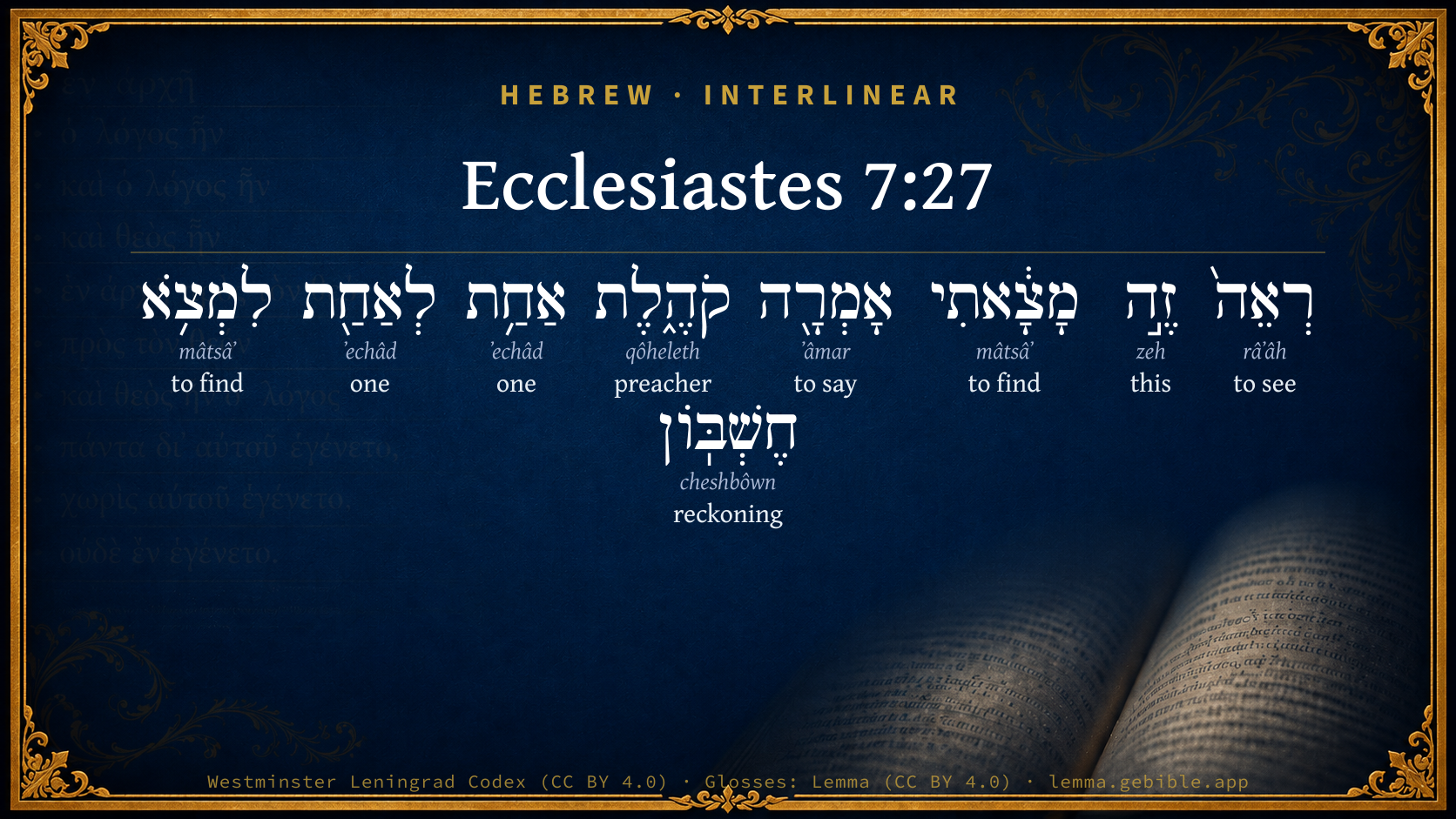
Hebrew (Westminster Leningrad Codex) Ecclesiastes 7:27 appears in the Hebrew Old Testament. The text above is from the Westminster Leningrad Codex. Each word links to its Strong’s number, a concise gloss, and parsing drawn from the Open Scriptures Hebrew Bible morphology. Click any word for its full Brown-Driver-Briggs (BDB) entry.
Download image
Cite this verse

Ecclesiastes 7:27 (World English Bible). Public Domain. Lemma interlinear Bible study tool, https://lemma.gebible.app/v/ecclesiastes/7/27.

Show BibTeX & RIS
BibTeX
RIS
English Translation
Behold, this have I found, says the Preacher, one to another, to find out the scheme;
World English Bible · Public Domain
Download a study sheet

One document with this verse’s original text, its word-by-word gloss line, the meaning frame, cross-references with their text, attributed commentary, and full source and license credits — printable, and it pastes into notes with its structure intact.

This verse Autodidact and up

Study sheet (.html) Plain text (.txt)

A passage Seminary Student

Up to 50 verses in one chapter. A passage sheet keeps up to 6 commentary sources and 12 cross-references per verse, in the order this page ranks them, and says so on the sheet whenever that leaves anything out. Ask for a single verse and you get the Autodidact verse sheet above.

Everything on this page stays free to read, with no account — the sheet is a download of what is already on screen, not access to it.

Want to remove ads? Support Godless Engineer
Compare translations 3

The same verse in 3 English versions, stacked beneath the original-language interlinear above. Click any original word for its lexicon entry.

Each is an independent rendering of the whole verse — the interlinear is not word-aligned to these translations.

Highlighted words mark where these versions differ — a whole-verse word diff, not a word-by-word alignment.

  • World English Bible Public Domain
    Behold, this have I found, says the Preacher, one to another, to find out the scheme;
  • King James Version Public Domain
    Behold, this have I found, saith the preacher, counting one by one, to find out the account:
  • unfoldingWord Literal Text CC BY-SA 4.0
    “See, this I have found,” says Qoheleth: One to one to find the scheme of things,

unfoldingWord Literal Text — © unfoldingWord, licensed CC BY-SA 4.0. Word-aligned USFM3 via Door43 (git.door43.org/unfoldingWord/en_ult).

Versions to compare (up to 4)

3 of 4 selected

Show all 18 translations

Every available English version of this verse, each an independent rendering of the whole verse.

  • World English Bible Public Domain
    Behold, this have I found, says the Preacher, one to another, to find out the scheme;
  • Berean Standard Bible Public Domain
    “Behold,” says the Teacher, “I have discovered this by adding one thing to another to find an explanation.
  • Majority Standard Bible Public Domain
    “Behold,” says the Teacher, “I have discovered this by adding one thing to another to find an explanation.
  • King James Version Public Domain
    Behold, this have I found, saith the preacher, counting one by one, to find out the account:
  • American Standard Version (1901) Public Domain
    Behold, this have I found, saith the Preacher, `laying' one thing to another, to find out the account;
  • Revised Version (1885) Public Domain
    Behold, this have I found, saith the Preacher; laying one thing to another, to find out the account:
  • Geneva Bible (1599) Public Domain
    I haue compassed about, both I and mine heart to knowe and to enquire and to search wisedome, and reason, and to knowe the wickednesse of follie, and the foolishnesse of madnesse,
  • Douay-Rheims (1899) Public Domain
    And I have found a woman more bitter than death, who is the hunter's snare, and her heart is a net, and her hands are bands. He that pleaseth God shall escape from her: but he that is a sinner, shall be caught by her.
  • Young's Literal Translation Public Domain
    See, this I have found, said the Preacher, one to one, to find out the reason
  • Literal Standard Version CC BY-SA 4.0
    See, this I have found, said the Preacher, one to one, to find out the reason
  • Unlocked Literal Bible CC BY-SA 4.0
    “Consider what I have discovered,” says the Teacher. “I have been adding one discovery to another in order to find an explanation of reality.
  • unfoldingWord Literal Text CC BY-SA 4.0
    “See, this I have found,” says Qoheleth: One to one to find the scheme of things,
  • Darby Bible Public Domain
    See this which I have found, saith the Preacher, [searching] one by one to find out the reason;
  • World Messianic Bible Public Domain
    “Behold, I have found this,” says Kohelet, “to one another, to find an explanation
  • Webster's Bible Public Domain
    Behold, this have I found, saith the preacher, counting one by one, to find out the account:
  • Free Bible Version CC BY-SA 4.0
    This is what I discovered after putting two and two together to try and find out what it all meant, says the Teacher.
  • Bible in Basic English Public Domain
    Look! this I have seen, said the Preacher, taking one thing after another to get the true account,
  • JPS Tanakh (1917) Public Domain
    Behold, this have I found, saith Koheleth, adding one thing to another, to find out the account;

Literal Standard Version (2020), Covenant Press — licensed CC BY-SA 4.0. Text via the HelloAO Bible API (eBible.org). Unlocked Literal Bible (unfoldingWord) — licensed CC BY-SA 4.0. Text via the HelloAO Bible API (eBible.org). unfoldingWord Literal Text — © unfoldingWord, licensed CC BY-SA 4.0. Word-aligned USFM3 via Door43 (git.door43.org/unfoldingWord/en_ult). Free Bible Version, Dr. Jonathan Gallagher — licensed CC BY-SA 4.0. Text via the HelloAO Bible API (eBible.org).

Word by word

More ways to search: Search by grammar → Find every occurrence → Compare this word →

Practice this passage: Drill this verse → Learn its vocabulary →

About this verse

These counts appear in no published source. They are computed here, from the morphology-tagged text and Lemma’s own curated glosses. What Lemma adds →

9
words
7
distinct lemmas
Wisdom
section

Notable vocabulary

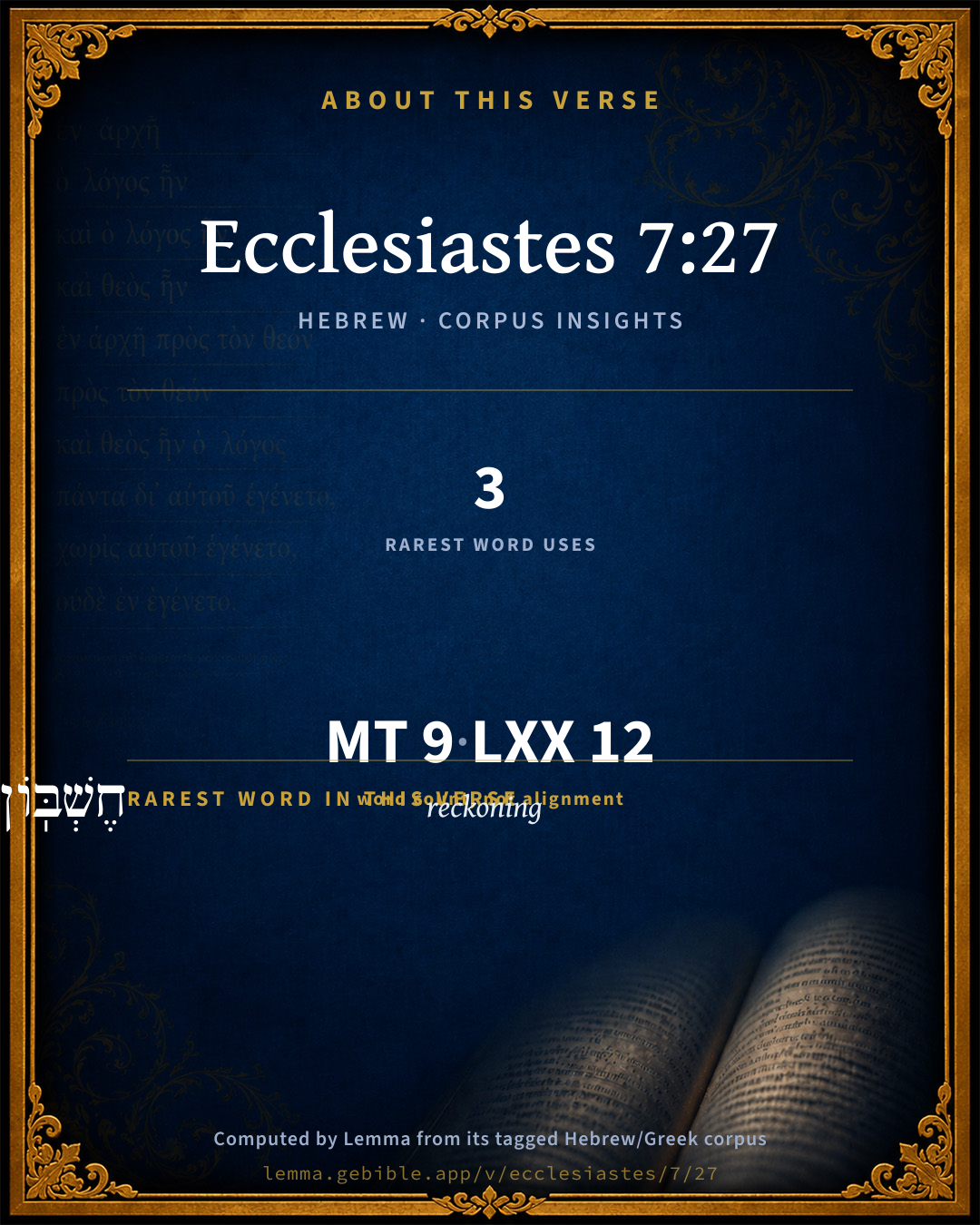
The rarest word here is חֶשְׁבּֽוֹן reckoning H2808 — appearing just 3 times in the whole Hebrew Bible.

Shared distinctive vocabulary

חֶשְׁבּֽוֹן reckoning H2808 occurs in 3 verses of the Hebrew Bible. Also found in:

Grammatical profile

  • 4 verbs
  • 2 nouns
  • 2 adjectives
  • 1 pronoun

Verb forms

  • רְאֵה֙ Qal · Imperative
  • מָצָ֔אתִי Qal · Perfect
  • אָמְרָ֖ה Qal · Perfect
  • לִמְצֹ֥א Qal · Infinitive Construct

Repetition

Words recur within this verse — often emphatic in Hebrew:

  • מָצָ֔אתִי to find H4672 ×2
  • אַחַ֥ת one H259 ×2

Hebrew & Septuagint length

In English translation the verse runs 16 words from the Hebrew and 55 from the Septuagint (LXX English) — the Septuagint runs noticeably longer here. See the side-by-side →

A rough comparison of the two English renderings, which tokenize alike — not a word-level alignment.

Word counts can differ between the Hebrew and the Greek without any difference in meaning — e.g. the Hebrew direct-object marker אֵת has no separate Greek word, and Greek often adds the article ὁ.

In the original languages it is 9 Hebrew tokens and 12 Greek tokens — but the two are counted differently (Hebrew bundles its prefixes and suffixes into one token; the Greek is in lemma form), so that isn’t a like-for-like length.

Cross-references

2

Topical passages linked to Ecclesiastes 7:27 in the Treasury of Scripture Knowledge — connected by theme and wording, ordered by reader-vote popularity; previews shown in the World English Bible.

Cross-references courtesy of OpenBible.info (CC BY 4.0).

Hebrew and Greek witnesses Masoretic Hebrew ↔ Greek Septuagint

The same verse in the two great witnesses to the Old Testament, shown verse-for-verse.

Here the Septuagint runs noticeably longer than the Hebrew — LXX2012 (modern English Septuagint) 55 words vs World English Bible 16. A rough length comparison of the two English translations, not a word-level alignment — read both below.

These are two independent witnesses, not word-aligned to each other, and the Septuagint is shown in lemma (dictionary) form.

Hebrew Ecclesiastes 7:27 Masoretic · Westminster Leningrad Codex

רְאֵה֙ זֶ֣ה מָצָ֔אתִי אָמְרָ֖ה קֹהֶ֑לֶת אַחַ֥ת לְאַחַ֖ת לִמְצֹ֥א חֶשְׁבּֽוֹן

Behold, this have I found, says the Preacher, one to another, to find out the scheme;

World English Bible · Public Domain

Greek LXX Ecclesiastes 7:27 Septuagint · lemma form

ὁράω οὗτος εὑρίσκω εἶπον ὁ ἐκκλησιαστής εἷς ὁ εἷς ὁ εὑρίσκω λογισμός

And I find her to be, and I will pronounce to be more bitter than death the woman which is a snare, and her heart nets, who has a band in her hands: he that is good in the sight of God shall be delivered from her; but the sinner shall be caught by her.

LXX2012 (modern English Septuagint) · Public Domain

On this verse, The Pulpit Commentary discusses the Septuagint’s reading. Read the note in Commentary ↓

Hebrew: Westminster Leningrad Codex (CC BY 4.0). Greek: Septuagint (public domain); English from LXX2012 (modern English Septuagint) (Public Domain). How the Septuagint differs from the Hebrew →

Commentary

Notes on Ecclesiastes 7:27 from classic Christian and Jewish commentators (each source and its license shown beneath its notes). The classic Christian expositions comment on the surrounding passage and are grouped to its opening verse, so a note may address several verses; the Jewish commentaries on the Tanakh (Rashi and others) are per-verse, so they appear only where the commentator wrote on this verse.

Lemma curates 59 commentaries, every one of them public domain or Creative Commons licensed, each selected and text-cleaned for this edition rather than reprinted as found. About our sources →

Trapp's Complete Commentary

John Trapp

Ecc 7:27 Behold, this have I found, saith the preacher, [counting] one by one, to find out the account:

Ver. 27. Behold, this I have found.] Eυρηκα, Eυρηκα, ‘I have found it, I have found it,’ said the philosopher. Vicimus, Vicimus, We have prevailed, we have prevailed, said Luther, when he had been praying in his closet for the good success of the consultation about religion in Germany. So the Preacher here, having by diligence set open the door of truth, {a} cries, Venite, videte, Come and see my discoveries, in the making whereof I have been very exact, "counting one by one," ne mole obruerer, lest I should be oppressed with many things at once.

{a} Aperit sibi diligentia ianuam veritatis. - Amb.

John Trapp, A Commentary or Exposition upon All the Books of the Old and New Testament (1647–1656) — public domain. Text from a community e-Sword module.

Joseph Benson's Commentary

Ecc 7:27-28. Behold, saith the preacher — Or, the penitent, who speaks what he hath learned, both by deep study and costly experience; this have I found — And it is a strange thing, and worthy of your serious observation; counting one by one — Considering things or persons, very exactly and distinctly, one after another; to find out the account — That I might make a true and just estimate in this matter; or, as it is in the margin, to find out the reason. Which yet my soul seeketh — It seems so wonderful to me, that I suspected that I had not made a sufficient inquiry, and therefore I returned and searched again, with more earnestness; but I find not — That it was so he found, but the reason of the thing he could not find out. One man — A wise and virtuous man; among a thousand — With whom I have conversed; have I found — He is supposed to mention this number in allusion to his thousand wives and concubines, as they are numbered, 1Ki 11:3; but a woman — One worthy of that name, one who is not a dishonour to her sex; among all those, have I not found — In that thousand whom I have taken into intimate society with myself. It is justly observed by different commentators here, that “we are not hence to infer, that Solomon thought there were fewer good women than men: but that he knew he had not gone the right way to find the virtuous woman, when he deviated so widely from the original law of marriage; and instead of seeking one rational companion, the sole object of his endeared affections, he had collected a vast multitude for magnificence and indulgence. The more valuable part of the sex would not willingly form one in such a group; and, if any of them were previously well disposed, the jealousies, party interests, contests, and artifices which take place in such situations, would tend exceedingly to corrupt them, and render them all nearly of the same character. Solomon therefore here speaks the language of a penitent, warning others against the sins into which he had been betrayed; and not that of a waspish satirist, lashing indiscriminately one half of the human species.” — Scott.

Joseph Benson's Commentary on the Old and New Testaments (1811–1818) — public domain. Text from a community e-Sword module.

Keil & Delitzsch

C. F. Keil & F. Delitzsch

"Behold what I have found, saith Koheleth, adding one thing to another, to find out the account: What my soul hath still sought, and I have not found, (is this): one man among a thousand have I found; and a woman among all these have I not found." It is the ascertained result, "one man, etc.," which is solemnly introduced by the words preceding. Instead of אם קה, the words ראמר הקּה are to be read, after Ecc 12:8, as is now generally acknowledged; errors of transcription of a similar kind are found at Sa2 5:2; Job 38:12. Ginsburg in vain disputes this, maintaining that the name Koheleth, as denoting wisdom personified, may be regarded as fem. as well as mas.; here, where the female sex is so much depreciated, was the fem. self-designation of the stern judge specially unsuitable. Hengst. supposes that Koheleth is purposely fem. in this one passage, since true wisdom, represented by Solomon, stands opposite to false philosophy. But this reason for the fem. rests on the false opinion that woman here is heresy personified; he further remarks that it is significant for this fem. personification, that there is "no writing of female authorship in the whole canon of the O.T. and N.T." But what of Deborah's triumphal song, the song of Hannah, the magnificat of Mary? We hand this absurdity over to the Clementines! The woman here was flesh and blood, but pulchra quamvis pellis est mens tamen plean procellis; and Koheleth is not incarnate wisdom, but the official name of a preacher, as in Assyr., for חזּנרם, curators, overseers, hazanâti

(Note: Vid., Fried. Delitzsch's Assyr. Stud. (1874), p. 132.)

is used. זה, Ecc 7:27, points, as at Ecc 1:10, to what follows. אחת ל, one thing to another (cf. Isa 27:12), must have been, like summa summarum and the like, a common arithmetical and dialectical formula, which is here subordinate to מצא, since an adv. inf. such as לקוח is to be supplemented: taking one thing to another to find out the חשׁבּון, i.e., the balance of the account, and thus to reach a facit, a resultat.

(Note: Cf. Aboth iv. 29, וגו ליתן, "to give account;" וגו הכל, "all according to the result.")

That which presented itself to him in this way now follows. It was, in relation to woman, a negative experience: "What my soul sought on and on, and I found not, (is this)." The words are like the superscription of the following result, in which finally the זה of Ecc 7:27 terminates. Ginsburg, incorrectly: "what my soul is still seeking," which would have required מבקּשׁת. The pret. בּקשׁה (with ק without Dagesh, as at Ecc 7:29)

(Note: As generally the Piel forms of the root בקשׁ, Masor. all have Raphe on the ,ק except the imper. בּקּשׁוּ; vid., Luzzatto's Gramm. 417.)

is retrospective; and עוד, from עוּד, means redire, again and again, continually, as at Gen.. Gen 46:29. He always anew sought, and that, as biqshah naphshi for בקשׁתי denotes, with urgent striving, violent longing, and never found, viz., a woman such as she ought to be: a man, one of a thousand, I have found, etc. With right, the accentuation gives Garshayim to adam; it stands forth, as at Ecc 7:20, as a general denominator - the sequence of accents, Geresh, Pashta, Zakef, is as at Gen 1:9. "One among a thousand" reminds us of Job 33:23, cf. Ecc 9:3; the old interpreters (vid., Dachselt's Bibl. Accentuata), with reference to these parallels, connect with the one man among a thousand all kinds of incongruous christological thoughts. Only, here adam, like the Romanic l'homme and the like, means man in sexual contrast to woman. It is thus ideally meant, like ish, Sa1 4:9; Sa1 6:15, and accordingly also the parall. אשּׁה. For it is not to be supposed that the author denies thereby perfect human nature to woman. But also Burger's explanation: "a human being, whether man or woman," is a useless evasion. Man has the name adam κατ ̓ ἐξ. by primitive hist. right: "for the man is not of the woman, but the woman of the man," Co1 11:8. The meaning, besides, is not that among a thousand human beings he found one upright man, but not a good woman (Hitz.), - for then the thousand ought to have had its proper denominator, אדם בני, - but that among a thousand persons of the male sex he found only one man such as he ought to be, and among a thousand of the female sex not one woman such as she ought to be; "among all these" is thus = among an equal number. Since he thus actually found the ideal of man only seldom, and that of woman still seldomer (for more than this is not denoted by the round numbers), the more surely does he resign himself to the following resultat, which he introduces by the word לבד (only, alone), as the clear gain of his searching:

Keil & Delitzsch — Biblical Commentary on the Old Testament (1861–1891) — public domain (CC PDM 1.0). Text via the HelloAO Bible API. (Old Testament only.)

Jamieson, Fausset & Brown

Robert Jamieson, A. R. Fausset & David Brown

this--namely, what follows in Ecc 7:28.

counting one by one--by comparing one thing with another [HOLDEN and MAURER].

account--a right estimate. But Ecc 7:28 more favors GESENIUS. "Considering women one by one."

Jamieson, Fausset & Brown — Commentary Critical and Explanatory on the Whole Bible (1871) — public domain (CC PDM 1.0). Text via the HelloAO Bible API.

Adam Clarke's Commentary

Verse 27. Counting one by one] I have gone over every particular. I have compared one thing with another; man with woman, his wisdom with her wiles; his strength with her blandishments; his influence with her ascendancy; his powers of reason with her arts and cunning; and in a thousand men, I have found one thoroughly upright man; but among one thousand women I have not found one such. This is a lamentable account of the state of morals in Judea, in the days of the wise King Solomon. Thank God! it would not be difficult to get a tithe of both in the same number in the present day.

The Targum gives this a curious turn: - "There is another thing which my soul has sought, but could not find: a man perfect and innocent, and without corruption, from the days of Adam until Abraham the just was born; who was found faithful and upright among the thousand kings who came together to construct the tower of Babel: but a woman like to Sarah among the wives of all those kings I have not found."

Adam Clarke's Commentary on the Bible (1810–1826) — public domain. Text from a community e-Sword/MySword module.

The Cambridge Bible for Schools and Colleges

gen. ed. J. J. S. Perowne

27. saith the Preacher] The passage is remarkable as being the solitary instance in the book in which the name Koheleth, feminine in form, yet elsewhere treated as masculine, is joined with the feminine form of the verb. It is possible, however, that this may be only an error of transcription, the transfer of a single letter from the end of one word to the beginning of another, restoring the verse to the more common construction, as found, e. g. in chap. Ecc_12:8, where, as here, adopting this reading, the article is prefixed to the word Koheleth, elsewhere treated as a proper name.

counting one by one] The words remind us, on the one hand, of Diogenes the Cynic, with his lantern, looking for an honest man at Athens, and answering, when asked where such men might be found, that good men were to be found nowhere, and good boys only in Sparta (Diog. Laert. vi. 2. 27); and on the other, of Jeremiah’s search to see “if there were any in Jerusalem that sought after God” (Jer_5:1-5). The words, as it were, drag their slow length along, as if expressing the toil and weariness of the search. And after all he had failed to find.

The Cambridge Bible for Schools and Colleges (gen. ed. J. J. S. Perowne; Cambridge University Press, 1878–1918) — public domain. Text from a community e-Sword module.

John Gill's Exposition

Behold, this have I found,.... That a harlot is more bitter than death; and which he found by his own experience, and therefore would have it observed by others for their caution: or one man among a thousand, Ecc 7:28;

(saith the preacher); of which title and character see Ecc 1:1; it is here mentioned to confirm the truth of what he said; he said it as a preacher, and, upon the word of a preacher, it was true; as also to signify his repentance for his sin, who was now the "gathered soul", as some render it; gathered into the church of God by repentance;

counting one by one, to find out the account; not his own sins, which he endeavoured to reckon up, and find out the general account of them, which yet he could not do; nor the good works of the righteous, and the sins of the wicked, which are numbered before the Lord one by one, till they are added to the great account; as Jarchi, from the Rabbins, interprets it, and so the Midrash: but rather the sense is, examining women, one by one, all within the verge of his acquaintance; particularly the thousand women that were either his wives or concubines; in order to take and give a just estimate of their character and actions. What follows is the result.

John Gill's Exposition of the Whole Bible (1746–1763) — public domain (CC PDM 1.0). Text via the HelloAO Bible API.

Haydock's Catholic Bible Commentary

Her. He speaks by experience, (St. Jerome) as none perhaps ever fell more terribly victims of impure love. (Calmet) --- Though a plurality of wives was then permitted, Solomon did wrong in marrying strangers; and in suffering himself to be deluded by them, so as to erect temples to their respective idols. (Haydock) --- All the attractions of women are replete with danger, and can only be overcome by God’s grace, and by flight, 1 Corinthians iv. 8., and Proverbs vii. 22., and xxii. 14. (Calmet)

George Leo Haydock (1774–1849), Haydock's Catholic Family Bible and Commentary, 1859 edition — public domain. Excludes Psalms (Douay-Rheims chapter numbering differs from Protestant) and Deuterocanonical books (Catholic canon only).

Matthew Poole's English Annotations

Behold; it is a strange thing, and worthy of your serious observation.

The preacher; or, the penitent, who speaks what he hath learned, both by deep, study and costly experience.

Counting one by one; considering things or persons very exactly and distinctly, one after another; and not only in general and confusedly, in which case a man may very easily be mistaken; and comparing them together, whereby I was enabled to make the truer judgment of them.

To find out the account, that I might make a true and just estimate in this matter. Or, as it is in the margin:, and was rendered Ecc 7:25, the reason, to wit, of that which I am about to say. I considered the persons severally and critically, that from thence I might understand the reason of the thing.

Matthew Poole's English Annotations on the Holy Bible (1683–1685) — public domain. Text from a community e-Sword/MySword module.

Whedon's Commentary on the Bible

Daniel D. Whedon

27. This have I found — He shows that his view is the result of sober examination of both sexes, looking for the result by weighing individual instances.

Daniel D. Whedon (gen. ed.), Commentary on the Old and New Testaments (1874–1909) — public domain. Text from a community e-Sword module.

The Pulpit Commentary

Behold, this have I found. The result of his search, thus forcibly introduced, follows in ver. 28. He has carefully examined the character and conduct of both sexes, and he is constrained to make the unsatisfactory remark which he there puts forth. Saith the preacher. Koheleth is here treated as a feminine noun, being joined with the feminine form of the verb, though elsewhere it is grammatically regarded as masculine. (see on Ecc_1:1) Many have thought that, after speaking so disparagingly of woman, it would be singularly inappropriate to introduce the official preacher as a female; they have therefore adopted a slight alteration in the text, viz. tljQojrma instead of tlhqo hrma which is simply the transference of he from the end of one word to the beginning of the next, thus adding the article, as in Ecc_12:8, and making the term accord with the Syriac and Arabic, and the Septuagint, eipen oJ jEkklhsiasth. The writer here introduces his own designation in order to call special attention to what is coming. Counting one by one. The phrase is elliptical, and signifies, adding one thing to another, or weighing one thing after another, putting together various facts or marks. To find out the account; to arrive at the reckoning, the desired result.

The Pulpit Commentary (1880–1919), ed. H.D.M. Spence-Jones & Joseph S. Exell — public domain. Text from a community e-Sword module.

John Wesley's Explanatory Notes

To find - That I might make a true and just estimate.

John Wesley, Explanatory Notes Upon the Whole Bible (1754–1765) — public domain. Text via the GEBible commentary corpus.

unfoldingWord translationNotes

Door43 World Missions Community

adding one discovery to another

The word "discovery" can be expressed as a verb. The word "adding" here is used as an idiom. AT: "discovering one thing after another" (See: Abstract Nouns and Idiom)

in order to find an explanation of reality

This word "explanation" can be expressed as a verb. See how the phrase "explanations of reality" is translated in Ecclesiastes 7:25. AT: "in order to be able to explain things in life" (See: Abstract Nouns)

one righteous man among a thousand

"1 righteous man among 1,000." Only one righteous man was found in a group of 1,000 people. (See: Numbers)

a woman among all those

There were no righteous women found in a group of 1,000 people.

translationWords

teacher

righteous

unfoldingWord translationNotes — © Distant Shores Media and the Door43 World Missions Community, licensed CC BY-SA 4.0. Source: git.door43.org/Door43/en_tn.

Rashi

Rabbi Shlomo Yitzchaki (Rashi)

See, this I have found, said Koheleth, adding one to another to find out the account All the commandments that the righteous perform and the transgressions that the wicked commit are counted before the Holy One, blessed be He, one to another, until they add up to a large sum. So did our Rabbis explain it in Tractate Sotah (8b).

said Koheleth said the collection of wisdom, and said his intellectual soul, which collects the wisdom.

Koheleth This is a feminine noun, and when it is used in the masculine sense, it refers to the one who gathers it, and that is Solomon. In the Midrash (Ecc. Zuta): Said Rabbi Jeremiah the son of Eleazar: The holy spirit sometimes speaks in the masculine gender and sometimes it speaks in the feminine gender. One verse says (Ps. 70:6): “You are my help (עֶזְרִי) and my rescuer,” and one verse says (ibid. 40:18): “You are my help (עֶזְרָתִי) and my rescuer.” One verse says: (Nahum 2:1): “a herald (מְבַשֵּׂר) announcing peace,” and one verse says (Isa. 40:9): “the voice of (sic) the herald (מְבַשֶּׂרֶת) of Zion.”

Rashi on the Tanakh — English translations: “The Judaica Press complete Tanach with Rashi, translated by A. J. Rosenberg” (CC BY 4.0); “Pentateuch with Rashi's commentary by M. Rosenbaum and A.M. Silbermann, 1929-1934” (public domain); “The Metsudah Tanach series, Lakewood, N.J” (CC BY 4.0); and “The Book of Joshua, Metsudah Publications, 1997” (CC BY 4.0). Text via Sefaria.

Lesson kit

Teaching starters — assembled from the data on this page, not authored interpretation. Every prompt links to the verse data it draws on. Edit before teaching.

Ecclesiastes, in the Wisdom, opens this verse with 9 words (7 distinct Hebrew lemmas). Its most distinctive word is cheshbôwn (“reckoning”). The Greek Septuagint runs longer here. A historical commentator’s framing appears above. Read the whole chapter for the surrounding context.

Discussion questions

  1. The word cheshbôwn carries the sense “reckoning.” How does it shape the verse?
  2. Ecclesiastes 7:25 shares the word «reckoning» with this verse. How do the two illuminate each other?
  3. “to find” occurs 2× in this one verse. What is the effect of the repetition?
  4. Compared with the Hebrew, the Septuagint runs longer here. What questions does that raise?
  5. The translations on this page render this verse differently — a whole-verse word diff, not a word-by-word alignment. What might account for the different wordings?
  6. The verb «רְאֵה֙» is Qal Imperative. How does its form color the action?
  7. Reading how Trapp's Complete Commentary and Joseph Benson's Commentary read this verse, where do the two commentators agree and where do they part?

Things to notice

Reading settings

Reading text

Shown beneath each verse's original-language words.

Old Testament
Old Testament edition

Read the OT as the Masoretic Hebrew (MT) or the Greek Septuagint (LXX).

English shown for the Greek Septuagint (in the Hebrew ↔ Greek comparison).

Comparing translations? Open the Compare panel on any verse page to stack up to four side by side.