
Isaiah 49:7

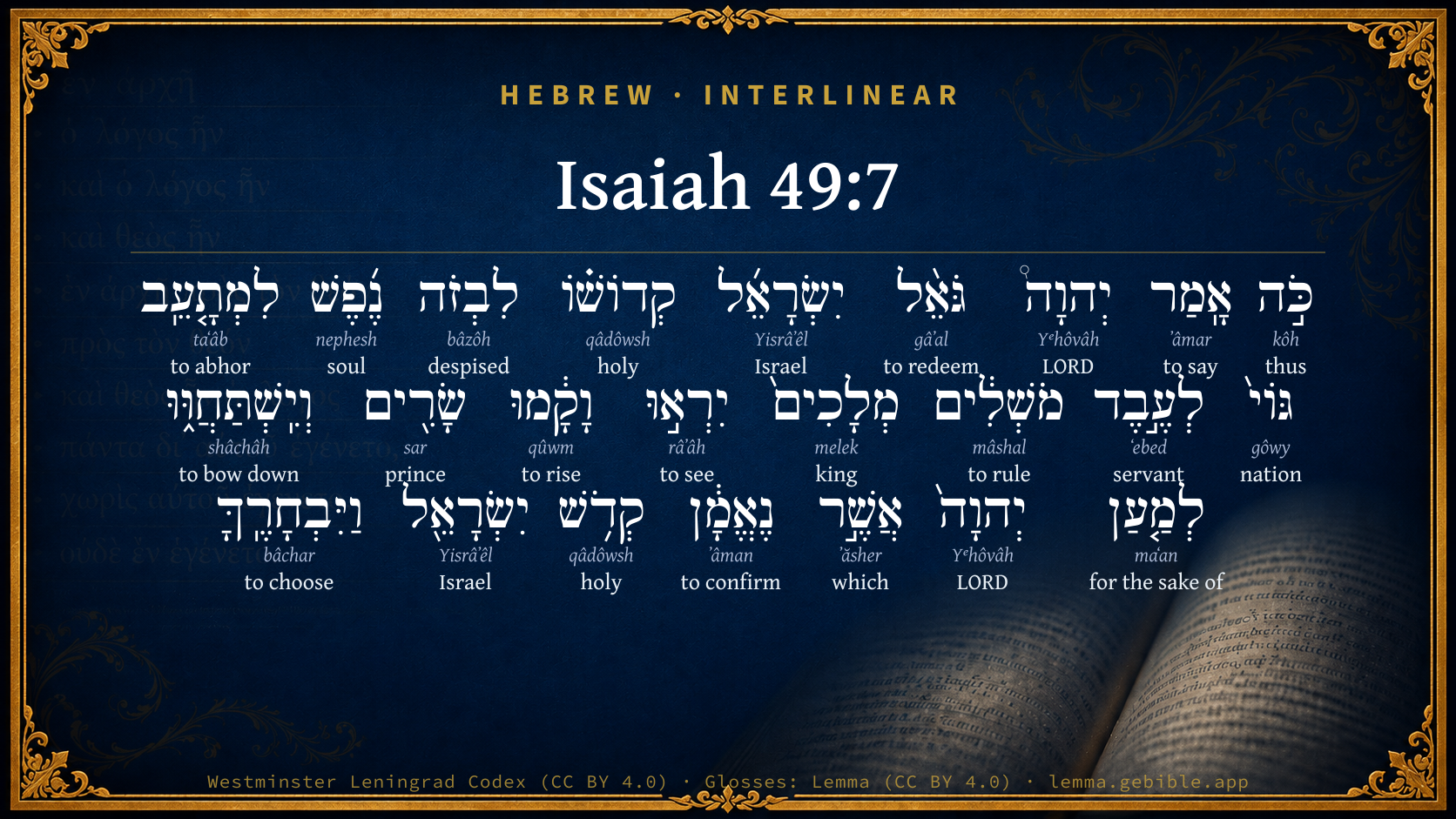
Hebrew (Westminster Leningrad Codex) Isaiah 49:7 appears in the Hebrew Old Testament. The text above is from the Westminster Leningrad Codex. Each word links to its Strong’s number, a concise gloss, and parsing drawn from the Open Scriptures Hebrew Bible morphology. Click any word for its full Brown-Driver-Briggs (BDB) entry.
Download image
Cite this verse

Isaiah 49:7 (World English Bible). Public Domain. Lemma interlinear Bible study tool, https://lemma.gebible.app/v/isaiah/49/7.

Show BibTeX & RIS
BibTeX
RIS
English Translation
Thus says Yahweh, the Redeemer of Israel, [and] his Holy One, to him whom man despises, to him whom the nation abhors, to a servant of rulers: Kings shall see and arise; princes, and they shall worship; because of Yahweh who is faithful, [even] the Holy One of Israel, who has chosen you.
World English Bible · Public Domain
Highlights
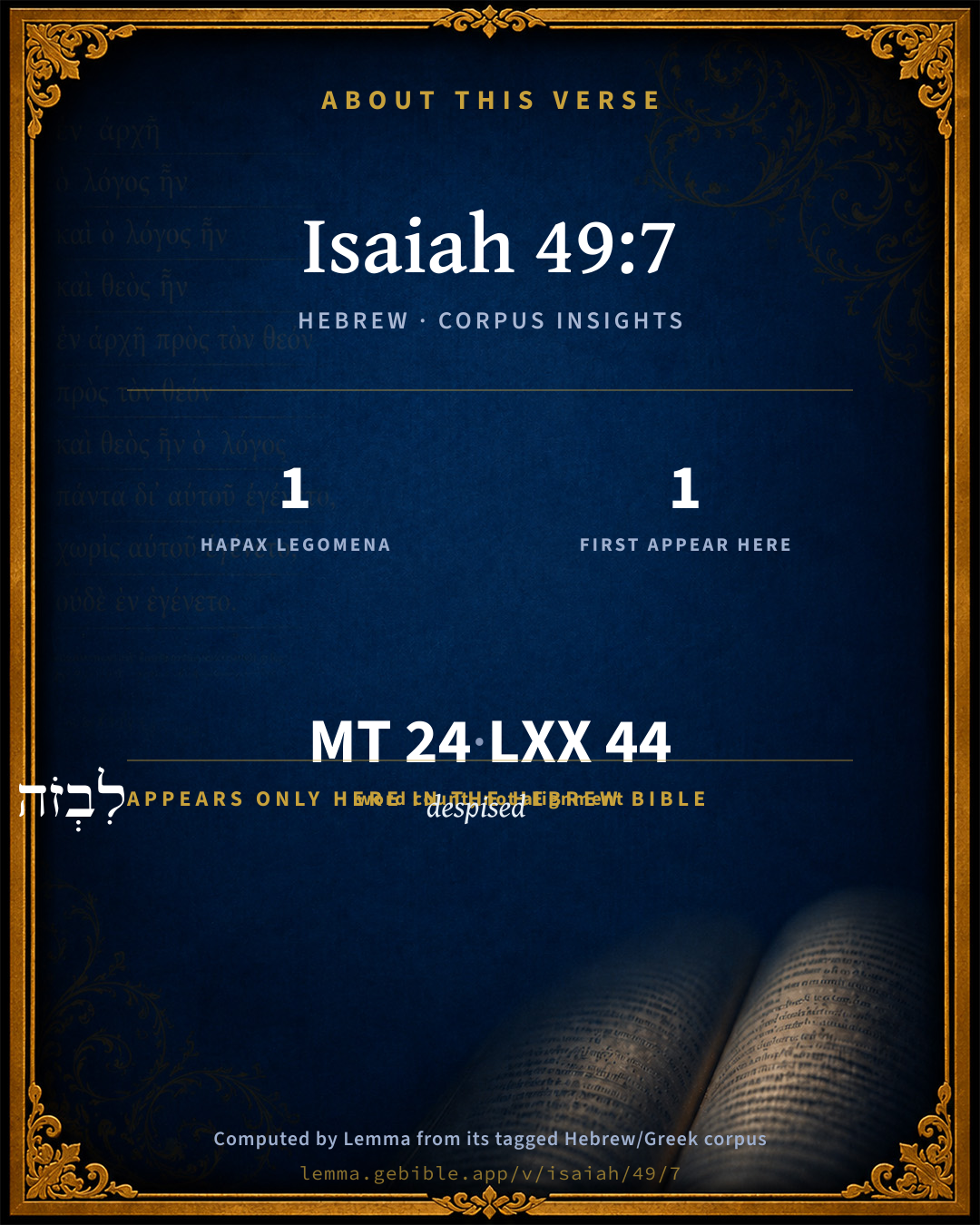
  • 1 hapax legomenon — only here in the Hebrew Bible
  • 1 first appearance in the Hebrew Bible
Full analysis ↓
Download a study sheet

One document with this verse’s original text, its word-by-word gloss line, the meaning frame, cross-references with their text, attributed commentary, and full source and license credits — printable, and it pastes into notes with its structure intact.

This verse Autodidact and up

Study sheet (.html) Plain text (.txt)

A passage Seminary Student

Up to 50 verses in one chapter. A passage sheet keeps up to 6 commentary sources and 12 cross-references per verse, in the order this page ranks them, and says so on the sheet whenever that leaves anything out. Ask for a single verse and you get the Autodidact verse sheet above.

Everything on this page stays free to read, with no account — the sheet is a download of what is already on screen, not access to it.

Want to remove ads? Support Godless Engineer
Compare translations 3

The same verse in 3 English versions, stacked beneath the original-language interlinear above. Click any original word for its lexicon entry.

Each is an independent rendering of the whole verse — the interlinear is not word-aligned to these translations.

Highlighted words mark where these versions differ — a whole-verse word diff, not a word-by-word alignment.

  • World English Bible Public Domain
    Thus says Yahweh, the Redeemer of Israel, [and] his Holy One, to him whom man despises, to him whom the nation abhors, to a servant of rulers: Kings shall see and arise; princes, and they shall worship; because of Yahweh who is faithful, [even] the Holy One of Israel, who has chosen you.
  • King James Version Public Domain
    Thus saith the LORD, the Redeemer of Israel, and his Holy One, to him whom man despiseth, to him whom the nation abhorreth, to a servant of rulers, Kings shall see and arise, princes also shall worship, because of the LORD that is faithful, and the Holy One of Israel, and he shall choose thee.
  • unfoldingWord Literal Text CC BY-SA 4.0
    Thus says Yahweh, the Redeemer of Israel, his Holy One, to the despiser of life, to the detester of the nation, to the servant of rulers: “Kings will see, and they will arise; princes, and they will prostrate themselves, because of Yahweh, who is faithful, the Holy One of Israel, and he has chosen you.”

unfoldingWord Literal Text — © unfoldingWord, licensed CC BY-SA 4.0. Word-aligned USFM3 via Door43 (git.door43.org/unfoldingWord/en_ult).

Versions to compare (up to 4)

3 of 4 selected

Show all 18 translations

Every available English version of this verse, each an independent rendering of the whole verse.

  • World English Bible Public Domain
    Thus says Yahweh, the Redeemer of Israel, [and] his Holy One, to him whom man despises, to him whom the nation abhors, to a servant of rulers: Kings shall see and arise; princes, and they shall worship; because of Yahweh who is faithful, [even] the Holy One of Israel, who has chosen you.
  • Berean Standard Bible Public Domain
    Thus says the LORD, the Redeemer and Holy One of Israel, to Him who was despised and abhorred by the nation, to the Servant of rulers: “Kings will see You and rise, and princes will bow down, because of the LORD, who is faithful, the Holy One of Israel, who has chosen You.”
  • Majority Standard Bible Public Domain
    Thus says the LORD, the Redeemer and Holy One of Israel, to Him who was despised and abhorred by the nation, to the Servant of rulers: “Kings will see You and rise, and princes will bow down, because of the LORD, who is faithful, the Holy One of Israel, who has chosen You.”
  • King James Version Public Domain
    Thus saith the LORD, the Redeemer of Israel, and his Holy One, to him whom man despiseth, to him whom the nation abhorreth, to a servant of rulers, Kings shall see and arise, princes also shall worship, because of the LORD that is faithful, and the Holy One of Israel, and he shall choose thee.
  • American Standard Version (1901) Public Domain
    Thus saith Jehovah, the Redeemer of Israel, `and' his Holy One, to him whom man despiseth, to him whom the nation abhorreth, to a servant of rulers: Kings shall see and arise; princes, and they shall worship; because of Jehovah that is faithful, `even' the Holy One of Israel, who hath chosen thee.
  • Revised Version (1885) Public Domain
    Thus saith the LORD, the redeemer of Israel, and his Holy One, to him whom man despiseth, to him whom the nation abhorreth, to a servant of rulers: Kings shall see and arise; princes, and they shall worship; because of the LORD that is faithful, even the Holy One of Israel, who hath chosen thee.
  • Geneva Bible (1599) Public Domain
    Thus sayeth the Lord the redeemer of Israel, and his Holie one, to him that is despised in soule, to a nation that is abhorred, to a seruaunt of rulers, Kinges shall see, and arise, and princes shall worship, because of the Lord, that is faithfull: and ye Holy one of Israel, which hath chosen thee.
  • Douay-Rheims (1899) Public Domain
    Thus saith the Lord the redeemer of Israel, his Holy One, to the soul that is despised, to the nation that is abhorred, to the servant of rulers: Kings shall see, end princes shall rise up, and adore for the Lord's sake, because he is faithful, and for the Holy One of Israel, who hath chosen thee.
  • Young's Literal Translation Public Domain
    Thus said Jehovah, Redeemer of Israel, His Holy One, To the despised in soul, To the abominated of a nation, To the servant of rulers: `Kings see, and have risen, princes, and worship, For the sake of Jehovah, who is faithful, The Holy of Israel, and He chooseth thee.'
  • Literal Standard Version CC BY-SA 4.0
    Thus said YHWH, Redeemer of Israel, His Holy One, || To the despised in soul, || To the detested of a nation, || To the Servant of rulers: “Kings see, and have risen, princes, and worship, || For the sake of YHWH, who is faithful, || The Holy of Israel, and He chooses You.”
  • Unlocked Literal Bible CC BY-SA 4.0
    This is what Yahweh says, the Redeemer of Israel, their Holy One, to the one whose life is despised, hated by the nations, and a slave of rulers, “Kings will see you and arise, and princes will see you and bow down, because of Yahweh who is faithful, even the Holy One of Israel, who has chosen you.”
  • unfoldingWord Literal Text CC BY-SA 4.0
    Thus says Yahweh, the Redeemer of Israel, his Holy One, to the despiser of life, to the detester of the nation, to the servant of rulers: “Kings will see, and they will arise; princes, and they will prostrate themselves, because of Yahweh, who is faithful, the Holy One of Israel, and he has chosen you.”
  • Darby Bible Public Domain
    Thus saith Jehovah, the Redeemer of Israel, his Holy One, to him whom man despiseth, to him whom the nation abhorreth, to the servant of rulers: Kings shall see and arise, princes, and they shall worship, because of Jehovah who is faithful, the Holy One of Israel, who hath chosen thee.
  • World Messianic Bible Public Domain
    The LORD, the Redeemer of Israel, and his Holy One, says to him whom man despises, to him whom the nation abhors, to a servant of rulers: “Kings shall see and rise up, princes, and they shall worship, because of the LORD who is faithful, even the Holy One of Israel, who has chosen you.”
  • Webster's Bible Public Domain
    Thus saith the LORD, the Redeemer of Israel, and his Holy One, to him whom man despiseth, to him whom the nation abhorreth, to a servant of rulers, kings shall see and arise, princes also shall worship, because of the LORD that is faithful, and the Holy One of Israel, and he shall choose thee.
  • Free Bible Version CC BY-SA 4.0
    This is what the Lord says, the Redeemer and Holy One of Israel, to the one who was despised and detested by the nation, to the one who is the servant of rulers: Kings will see you and stand up, and princes will bow down to you, because the Lord, who is trustworthy, the Holy One of Israel, has chosen you.
  • Bible in Basic English Public Domain
    The Lord who takes up Israel's cause, even his Holy One, says to him whom men make sport of, who is hated by the nations, a servant of rulers: Kings will see and get up from their places, and chiefs will give worship: because of the Lord who keeps faith; even the Holy One of Israel who has taken you for himself.
  • JPS Tanakh (1917) Public Domain
    Thus saith the LORD, the Redeemer of Israel, his Holy One, to him who is despised of men, to him who is abhorred of nations, to a servant of rulers: Kings shall see and arise, princes, and they shall prostrate themselves; because of the LORD that is faithful, even the Holy One of Israel, who hath chosen thee.

Literal Standard Version (2020), Covenant Press — licensed CC BY-SA 4.0. Text via the HelloAO Bible API (eBible.org). Unlocked Literal Bible (unfoldingWord) — licensed CC BY-SA 4.0. Text via the HelloAO Bible API (eBible.org). unfoldingWord Literal Text — © unfoldingWord, licensed CC BY-SA 4.0. Word-aligned USFM3 via Door43 (git.door43.org/unfoldingWord/en_ult). Free Bible Version, Dr. Jonathan Gallagher — licensed CC BY-SA 4.0. Text via the HelloAO Bible API (eBible.org).

Word by word

More ways to search: Search by grammar → Find every occurrence → Compare this word →

Practice this passage: Drill this verse → Learn its vocabulary →

לִבְזֹה
bâzôh
H960
“to/for · despised”
Preposition + Verb, Qal, Infinitive Construct
Part of Speech
Preposition + Verb
Stem
Qal
Form
Infinitive Construct
Full BDB Definition

Origin: from H959

TWOT: 224b (?)

scorned, despised
  1. כֹּ֣ה kôh H3541 “thus” Adverb
  2. אָֽמַר ʼâmar H559 “to say” Verb, Qal, Perfect, 3rd Person, Masculine, Singular
  3. יְהוָה֩ Yᵉhôvâh H3068 “LORD” Noun, Proper
  4. גֹּאֵ֨ל gâʼal H1350 “redeeming” Verb, Qal, Participle Active, Masculine, Singular, Construct
  5. יִשְׂרָאֵ֜ל Yisrâʼêl H3478 “Israel” Noun, Proper
  6. קְדוֹשׁ֗וֹ qâdôwsh H6918 “holy · his” Adjective, Adjective, Masculine, Singular, Construct + Suffix, Personal, 3rd Person, Masculine, Singular
  7. נֶ֜פֶשׁ nephesh H5315 “soul” Noun, Common, Both, Singular, Absolute
  8. לִמְתָ֤עֵֽב taʻâb H8581 “to/for · abhoring” Preposition + Verb, Piel, Participle Active, Masculine, Singular, Construct
  9. גּוֹי֙ gôwy H1471 “nation” Noun, Common, Masculine, Singular, Absolute
  10. לְעֶ֣בֶד ʻebed H5650 “to/for · servant of” Preposition + Noun, Common, Masculine, Singular, Construct
  11. מֹשְׁלִ֔ים mâshal H4910 “ruling” Verb, Qal, Participle Active, Masculine, Plural, Absolute
  12. מְלָכִים֙ melek H4428 “kings” Noun, Common, Masculine, Plural, Absolute
  13. יִרְא֣וּ râʼâh H7200 “to see” Verb, Qal, Imperfect, 3rd Person, Masculine, Plural
  14. וָקָ֔מוּ qûwm H6965 “and · to rise” Conjunction + Verb, Qal, Sequential Perfect, 3rd Person, Common, Plural
  15. שָׂרִ֖ים sar H8269 “princes” Noun, Common, Masculine, Plural, Absolute
  16. וְיִֽשְׁתַּחֲוּ֑וּ shâchâh H7812 “and · to bow down” Conjunction + Verb, Hishtaphel, Imperfect, 3rd Person, Masculine, Plural
  17. לְמַ֤עַן maʻan H4616 “for the sake of” Preposition
  18. יְהוָה֙ Yᵉhôvâh H3068 “LORD” Noun, Proper
  19. אֲשֶׁ֣ר ʼăsher H834 “which” Particle, Relative
  20. נֶאֱמָ֔ן ʼâman H539 “confirming” Verb, Niphal, Participle Active, Masculine, Singular, Absolute
  21. קְדֹ֥שׁ qâdôwsh H6918 “holy of” Adjective, Adjective, Masculine, Singular, Construct
  22. יִשְׂרָאֵ֖ל Yisrâʼêl H3478 “Israel” Noun, Proper
  23. וַיִּבְחָרֶֽךָּ bâchar H977 “and · to choose · you” Conjunction + Verb, Qal, Sequential Imperfect, 3rd Person, Masculine, Singular + Suffix, Personal, 2nd Person, Masculine, Singular

About this verse

These counts appear in no published source. They are computed here, from the morphology-tagged text and Lemma’s own curated glosses. What Lemma adds →

24
words
21
distinct lemmas
Prophets
section

Notable vocabulary

1 hapax legomenon — a word that appears only here in the entire Hebrew Bible:

  • לִבְזֹה despised H960

First appearance in Scripture

This word makes its first canonical appearance in the Hebrew Bible here:

  • לִבְזֹה despised H960

Shared distinctive vocabulary

לִמְתָ֤עֵֽב to abhor H8581 occurs in 20 verses of the Hebrew Bible. Also found in:

Grammatical profile

  • 10 verbs
  • 9 nouns
  • 2 adjectives
  • 1 preposition
  • 1 adverb
  • 1 particle

Verb forms

  • אָֽמַר Qal · Perfect
  • גֹּאֵ֨ל Qal · Participle Active
  • לִבְזֹה Qal · Infinitive Construct
  • לִמְתָ֤עֵֽב Piel · Participle Active
  • מֹשְׁלִ֔ים Qal · Participle Active
  • יִרְא֣וּ Qal · Imperfect
  • וָקָ֔מוּ Qal · Sequential Perfect
  • וְיִֽשְׁתַּחֲוּ֑וּ Hishtaphel · Imperfect
  • נֶאֱמָ֔ן Niphal · Participle Active
  • וַיִּבְחָרֶֽךָּ Qal · Sequential Imperfect

Repetition

Words recur within this verse — often emphatic in Hebrew:

  • יְהוָה֩ LORD H3068 ×2
  • יִשְׂרָאֵ֜ל Israel H3478 ×2
  • קְדוֹשׁ֗וֹ holy H6918 ×2

Hebrew & Septuagint length

In English translation the verse runs 53 words from the Hebrew and 59 from the Septuagint (LXX English) — closely comparable.

A rough comparison of the two English renderings, which tokenize alike — not a word-level alignment.

Word counts can differ between the Hebrew and the Greek without any difference in meaning — e.g. the Hebrew direct-object marker אֵת has no separate Greek word, and Greek often adds the article ὁ.

In the original languages it is 24 Hebrew tokens and 44 Greek tokens — but the two are counted differently (Hebrew bundles its prefixes and suffixes into one token; the Greek is in lemma form), so that isn’t a like-for-like length.

Cross-references

31

Topical passages linked to Isaiah 49:7 in the Treasury of Scripture Knowledge — connected by theme and wording, ordered by reader-vote popularity; previews shown in the World English Bible.

  • 1 Peter 2:4 coming to him, a living stone, rejected indeed by men, but chosen by God, precious.
  • Isaiah 53:3 He was despised, and rejected by men; a man of suffering, and acquainted with disease: and as one from whom men hide their face he was despised; and we didn't respect him.
  • Matthew 26:67 Then they spit in his face and beat him with their fists, and some slapped him,
  • Isaiah 48:17 Thus says Yahweh, your Redeemer, the Holy One of Israel: I am Yahweh your God, who teaches you to profit, who leads you by the way that you should go.
  • Psalms 22:6–8 But I am a worm, and no man; A reproach of men, and despised by the people.
  • Psalms 72:10–11 The kings of Tarshish and of the isles will bring tribute. The kings of Sheba and Seba shall offer gifts.
  • Isaiah 49:23 Kings shall be your nursing fathers, and their queens your nursing mothers: they shall bow down to you with their faces to the earth, and lick the dust of your feet; and you shall know that I am Yahweh; and those who wait for me shall not be disappointed.
  • Psalms 69:7–9 Because for your sake, I have borne reproach. Shame has covered my face.
  • Isaiah 49:1 Listen, isles, to me; and listen, you peoples, from far: Yahweh has called me from the womb; from the bowels of my mother has he made mention of my name:
  • Matthew 20:28 even as the Son of Man came not to be served, but to serve, and to give his life as a ransom for many."
  • Isaiah 42:1 Behold, my servant, whom I uphold; my chosen, in whom my soul delights: I have put my Spirit on him; he will bring forth justice to the Gentiles.
  • Isaiah 52:15 so shall he sprinkle many nations; kings shall shut their mouths at him: for that which had not been told them shall they see; and that which they had not heard shall they understand.
  • Zechariah 11:8 I cut off the three shepherds in one month; for my soul was weary of them, and their soul also loathed me.
  • Matthew 27:38–44 Then there were two robbers crucified with him, one on his right hand and one on the left.
  • Psalms 2:10–12 Now therefore be wise, you kings. Be instructed, you judges of the earth.
  • Psalms 68:31 Princes shall come out of Egypt. Ethiopia shall hurry to stretch out her hands to God.
  • Isaiah 48:7 They are created now, and not from of old; and before this day you didn't hear them; lest you should say, Behold, I knew them.
  • Isaiah 50:6 I gave my back to the strikers, and my cheeks to those who plucked off the hair; I didn't hide my face from shame and spitting.
  • Isaiah 60:3 Nations shall come to your light, and kings to the brightness of your rising.
  • Isaiah 60:10 Foreigners shall build up your walls, and their kings shall minister to you: for in my wrath I struck you, but in my favor have I had mercy on you.
  • Luke 23:23 But they were urgent with loud voices, asking that he might be crucified. Their voices and the voices of the chief priests prevailed.
  • Luke 23:35 The people stood watching. The rulers with them also scoffed at him, saying, "He saved others. Let him save himself, if this is the Christ of God, his chosen one!"
  • John 19:15 They cried out, "Away with him! Away with him! Crucify him!" Pilate said to them, "Shall I crucify your King?" The chief priests answered, "We have no king but Caesar!"
  • Psalms 69:19 You know my reproach, my shame, and my dishonor. My adversaries are all before you.
  • Isaiah 60:16 You shall also suck the milk of the nations, and shall suck the breast of kings; and you shall know that I, Yahweh, am your Savior, and your Redeemer, the Mighty One of Jacob.
  • Luke 22:27 For who is greater, one who sits at the table, or one who serves? Isn't it he who sits at the table? But I am in the midst of you as one who serves.
  • Luke 23:18 But they all cried out together, saying, "Away with this man! Release to us Barabbas!" --
  • John 18:40 Then they all shouted again, saying, "Not this man, but Barabbas!" Now Barabbas was a robber.
  • John 19:6 When therefore the chief priests and the officers saw him, they shouted, saying, "Crucify! Crucify!" Pilate said to them, "Take him yourselves, and crucify him, for I find no basis for a charge against him."
  • Revelation 3:7 "To the angel of the assembly in Philadelphia write: "He who is holy, he who is true, he who has the key of David, he who opens and no one can shut, and who shuts and no one opens, says these things:
  • Revelation 11:15 The seventh angel sounded, and great voices in heaven followed, saying, "The kingdom of the world has become the Kingdom of our Lord, and of his Christ. He will reign forever and ever!"

Cross-references courtesy of OpenBible.info (CC BY 4.0).

Hebrew and Greek witnesses Masoretic Hebrew ↔ Greek Septuagint

The same verse in the two great witnesses to the Old Testament, shown verse-for-verse.

These are two independent witnesses, not word-aligned to each other, and the Septuagint is shown in lemma (dictionary) form.

Hebrew Isaiah 49:7 Masoretic · Westminster Leningrad Codex

כֹּ֣ה אָֽמַר יְהוָה֩ גֹּאֵ֨ל יִשְׂרָאֵ֜ל קְדוֹשׁ֗וֹ לִבְזֹה נֶ֜פֶשׁ לִמְתָ֤עֵֽב גּוֹי֙ לְעֶ֣בֶד מֹשְׁלִ֔ים מְלָכִים֙ יִרְא֣וּ וָקָ֔מוּ שָׂרִ֖ים וְיִֽשְׁתַּחֲוּ֑וּ לְמַ֤עַן יְהוָה֙ אֲשֶׁ֣ר נֶאֱמָ֔ן קְדֹ֥שׁ יִשְׂרָאֵ֖ל וַיִּבְחָרֶֽךָּ

Thus says Yahweh, the Redeemer of Israel, [and] his Holy One, to him whom man despises, to him whom the nation abhors, to a servant of rulers: Kings shall see and arise; princes, and they shall worship; because of Yahweh who is faithful, [even] the Holy One of Israel, who has chosen you.

World English Bible · Public Domain

Greek LXX Isaiah 49:7 Septuagint · lemma form

οὕτως λέγω κύριος ὁ ῥύομαι σύ ὁ θεός ἰσραήλ ἁγιάζω ὁ φαυλίζω ὁ ψυχή αὐτός ὁ βδελύσσω ὑπό ὁ ἔθνος ὁ δοῦλος ὁ ἄρχων βασιλεύς ὁράω αὐτός καί ἀναἵστημι ἄρχων καί προςκυνέω αὐτός ἕνεκεν κύριος ὅτι πιστός εἰμί ὁ ἅγιος ἰσραήλ καί ἐκλέγω σύ

Thus says the Lord that delivered you, the God of Israel, Sanctify him that despises his life, him that is abhorred by the nations that are the servants of princes: kings shall behold him, and princes shall arise, and shall worship him, for the Lord's sake: for the Holy One of Israel is faithful, and I have chosen you.

LXX2012 (modern English Septuagint) · Public Domain

Hebrew: Westminster Leningrad Codex (CC BY 4.0). Greek: Septuagint (public domain); English from LXX2012 (modern English Septuagint) (Public Domain). How the Septuagint differs from the Hebrew →

Targum (Aramaic paraphrase)

1

The Targum is the ancient Jewish Aramaic paraphrase of the Hebrew Scriptures — an interpretive translation, not the Hebrew text itself. Onkelos (literal) and Pseudo-Jonathan (expansive) render the Torah, and Jonathan the Prophets. Coverage is partial: where no permissively-licensed English translation exists for a verse, only the Aramaic is shown. This is verse-level text, not a word-by-word alignment to the Hebrew.

  1. Targum Jonathan Prophets (Joshua–Malachi)
    כִּדְנַן אֲמַר יְיָ פַּרְקֵהּ דְיִשְׂרָאֵל קַדִישֵׁהּ לְדִבְּסִירִין בֵּינֵי עַמְמַיָא לְדִמְטַלְטְלִין בֵּינֵי מַלְכְּוָתָא לִדְהֲווֹ עָבְדִין לְשִׁלְטוֹנִין לְהוֹן מַלְכִין יֶחְזוּן וִיקוּמוּן רַבְרְבִין וְיִסְגְדוּן בְּדִיל יְיָ דִמְהֵימָן קַדִישָׁא דְיִשְׂרָאֵל וְאִתְרְעֵי בָךְ:

    Thus saith the Lord, the Redeemer of Israel, and His Holy One, to them that are despised among the nations, to them that are scattered among the kingdoms, to them that are the servants to rulers: Kings shall look at them; and princes shall rise and fall prostrate, because of the Lord that is faithful, and the Holy One of Israel, and He shall delight in thee.

    Targum Jonathan — Aramaic: “Mikraot Gedolot” (public domain). English: “Sefaria Community Translation” (CC0 1.0 (public-domain dedication)); “London "Chaldee Paraphrase," 1871” (public domain). Text via Sefaria.

Commentary

Notes on Isaiah 49:7 from classic Christian and Jewish commentators (each source and its license shown beneath its notes). The classic Christian expositions comment on the surrounding passage and are grouped to its opening verse, so a note may address several verses; the Jewish commentaries on the Tanakh (Rashi and others) are per-verse, so they appear only where the commentator wrote on this verse.

Lemma curates 59 commentaries, every one of them public domain or Creative Commons licensed, each selected and text-cleaned for this edition rather than reprinted as found. About our sources →

Matthew Henry's Commentary

In these verses we have,

I. The humiliation and exaltation of the Messiah (Isa 49:7): The Lord, the Redeemer of Israel, and Israel's Holy One, who had always taken care of the Jewish church and wrought out for them those deliverances that were typical of the great salvation, speaks here to him, who was the undertaker of that salvation. And, 1. He takes notice of his humiliation, the instances of which were uncommon, nay, unparalleled. He was one whom man despised. He is despised and rejected of men, Isa 53:3. To be despised by so mean a creature (man, who is himself a worm) bespeaks the lowest and most contemptible condition imaginable. Man, whom he came to save and to put honour upon, yet despised him and put contempt upon him; so wretchedly ungrateful were his persecutors. The ignominy he underwent was not the least of his sufferings. They not only made him despicable, but odious. He was one whom the nation abhorred; they treated him as the worst of men, and cried out, Crucify him, crucify him. The nation did it, the Gentiles as well as Jews, and the Jews herein worse than Gentiles; for his cross was to the one a stumbling-block and to the other foolishness. He was a servant of rulers; he was trampled upon, abused, scourged, and crucified as a slave. Pilate boasted of his power over him, Joh 19:10. This he submitted to for our salvation. 2. He promises him his exaltation. Honour was done him even in the depth of his humiliation. Herod the king stood in awe of him, saying, I it John the Baptist; noblemen, rulers, centurions came and kneeled to him. But this was more fully accomplished when kings received his gospel, and submitted to his yoke, and joined in the worship of him, and called themselves the vassals of Christ. Not that Christ values the rich more than the poor (they stand upon a level with him), but it is for the honour of his kingdom among men when the great ones of the earth appear for him and do homage to him. This shall be the accomplishment of God's promise, and he will give him the heathen for his inheritance, and therefore it shall be done, because of the Lord who is faithful and true to his promise; and this shall be an evidence that Christ had a commission for what he did, and that God had chosen him, and would own the choice he had made.

II. The blessings he has in store for all those to whom he is made salvation.

1. God will own and stand by him in his undertaking (Isa 49:8): In an acceptable time have I heard thee, that is, I will hear thee. Christ, in the days of his flesh, offered up strong cries, and was heard, Heb 5:7. He knew that the Father heard him always (Joh 11:42), heard him for himself (for, though the cup might not pass from him, yet he was enabled to drink it), heard him for all that are his, and therefore he interceded for them as one having authority. Father, I will, Joh 17:24. All our happiness results from the Son's interest in the Father and the prevalency of his intercession, that he always heard him; and this makes the gospel time an acceptable time, welcome to us, because we are accepted of God, both reconciled and recommended to him, that God hears the Redeemer for us, Heb 7:25. Nor will he hear him only, but help him to go through with his undertaking. The Father was always with him at his right hand, and did not leave him when his disciples did. Violent attacks were made upon our Lord Jesus by the powers of darkness, when it was their hour, to drive him off from his undertakings, but God promises to preserve him and enable him to persevere in it; on that one stone were seven eyes, Zac 3:9. God would preserve him, would preserve his interest, his kingdom among men, though fought against on all sides. Christ is preserved while Christianity is.

2. God will authorize him to apply to his church the benefits of the redemption he is to work out. God's preserving and helping him was to make the day of his gospel a day of salvation. And so the apostle understands it: Behold, now is the day of salvation, now the word of reconciliation by Christ is preached, Co2 6:2.

(1.) He shall be guarantee of the treaty of peace between God and man: I will give thee for a covenant of the people. This we had before (Isa 42:6), and it is here repeated as faithful, and well worthy of all acceptation and observation. He is given for a covenant, that is, for a pledge of all the blessings of the covenant. It was in him that God was reconciling the world to himself; and he that spared not his own Son will deny us nothing. He is given for a covenant, not only as he is the Mediator of the covenant, the blessed days-man who has laid his hand upon us both, but as he is all in all in the covenant. All the duty of the covenant is summed up in our being his; and all the privilege and happiness of the covenant are summed up in his being ours.

(2.) He shall repair the decays of the church and build it upon a rock. He shall establish the earth, or rather the land, the land of Judea, a type of the church. He shall cause the desolate heritages to be inherited; so the cities of Judah were after the return out of captivity, and so the church, which in the last and degenerate ages of the Jewish nation had been as a country laid waste, but was again replenished by the fruits of the preaching of the gospel.

(3.) He shall free the souls of men from the bondage of guilt and corruption and bring them into the glorious liberty of God's children. He shall say to the prisoners that were bound over to the justice of God, and bound under the power of Satan, Go forth, Isa 49:9. Pardoning mercy is a release from the curse of the law, and renewing grace is a release from the dominion of sin. Both are from Christ, and are branches of the great salvation. It is he that says, Go forth; it is the Son that makes us free, and then we are free indeed. He saith to those that are in darkness, Show yourselves; "not only see, but be seen, to the glory of God and your own comfort." When he discharged the lepers from their confinement, he said, Go show yourselves to the priest. When we see the light, let our light shine.

(4.) He shall provide for the comfortable passage of those whom he sets at liberty to the place of their rest and happy settlement, Isa 49:9-11. These verses refer to the provision made for the Jews' return out of their captivity, who were taken under the particular care of the divine Providence, as favourites of Heaven, and now so in a special manner; but they are applicable to that guidance of divine grace which all God's spiritual Israel are under, from their release out of bondage to their settlement in the heavenly Canaan. [1.] They shall have their charges borne and shall be fed at free cost with food convenient: They shall feed in the ways, as sheep; for now, as formerly, God leads Joseph like a flock. When God pleases even highway ground shall be good ground for the sheep of his pasture to feed in. Their pastures shall be not only in the valleys, but in all high places, which are commonly dry and barren. Wherever God brings his people he will take care they shall want nothing that is good for them, Psa 34:10. And so well shall they be provided for that they shall not hunger nor thirst, for what they need they shall have seasonably, before their need of it comes to an extremity. [2.] They shall be sheltered and protected from every thing that would incommode them: Neither shall the heat nor sun smite them, or God causes his flock to rest at noon, Sol 1:7. No evil thing shall befal those that put themselves under a divine protection; they shall be enabled to bear the burden and heat of the day. [3.] They shall be under God's gracious guidance: He that has mercy on them, in bringing them out of their captivity, shall lead them, as he did their fathers in the wilderness, by a pillar of cloud and fire. Even by springs of water, which will be ready to them in their march, shall he guide them. God will furnish them with suitable and seasonable comforts, not like the pools of rainwater in the valley of Baca, but like the water out of the rock which followed Israel. Those who are under a divine guidance, and follow that closely, while they do so, may, upon good grounds, hope for divine comforts and cordials. The world leads its followers by broken cisterns, or brooks that fail in summer; but God leads those that are his by springs of water. And those whom God guides shall find a ready road and all obstacles removed (Isa 49:11): I will make all my mountains a way. He that in times past made the sea a way, now with as much ease will make the mountains a way, though they seemed impassable. The highway, or causeway, shall be raised, to make it both the plainer and the fairer. Note, The ways in which God leads his people he himself will be the overseer of, and will take care that they be well mended and kept in repair, as of old the ways that led to the cities of refuge. The levelling of the roads from Babylon, as it was foretold (Isa 40:2, Isa 40:3), was applied to gospel work, and so may this be. Though there be difficulties in the way to heaven, which we cannot by our own strength get over, yet the grace of God shall be sufficient to help us over them and to make even the mountains a way, Isa 35:8.

(5.) He shall bring them all together from all parts, that they may return in a body, that they may encourage one another and be the more taken notice of. They were dispersed into several parts of the country of Babylon, as their enemies pleased, to prevent any combination among themselves. But, when God's time shall come to bring them home together, one spirit shall animate them all, all that lie at the greatest distance from each other, and those also that had taken shelter in other countries shall meet them in the land of Judah, Isa 49:12. Here shall a party come from far, some from the north, some from the west, some from the land of Sinim, which probably is some province of Babylon not elsewhere named in scripture, but some make it to be a country belonging to one of the chief cities of Egypt, called Sin, of which we read, Eze 30:15, Eze 30:16. Now this promise was to have a further accomplishment in the great confluence of converts to the gospel church, and its full accomplishment when God's chosen shall come from the east and from the west to sit down with the patriarchs in the kingdom of God, Mat 8:11.

Matthew Henry's Commentary on the Whole Bible (1708–1710) — public domain (CC PDM 1.0). Text via the HelloAO Bible API.

The Cambridge Bible for Schools and Colleges

gen. ed. J. J. S. Perowne

7. Israel shall be raised from the deepest degradation to the highest honour. The verse is remarkable as anticipating the main idea of ch. Isa 52:13–53:15.

to him whom man despiseth] Lit. to the despised of soul; i.e. “to one who is heartily despised,” the “soul” being the seat of emotion. Comp. Psa_17:9 (“my deadly enemies,” = “they that hate me in the soul,”). In the parallel phrase to the abhorred of people, “people” seems to be used of men in general (the German Leute) as in Gen_20:4 (“righteous folk”). The words for “despised” and “abhorred” are both peculiar in form.

a servant of rulers] of tyrants (ch. Isa_14:5).

kings shall see (the exaltation of Israel) and arise] in amazement and reverence (cf. ch. Isa_52:15). princes also shall worship] princes (sc. shall arise) and do homage (see R.V.).

and he shall choose thee] Better, as R.V. who hath chosen thee (strictly, “and he hath chosen thee”; see Driver’s Tenses, § 76a).

7–12. The Servant’s account of his calling forms the basis of a series of promises; Isa_49:7 referring to his influence on the nations, and Isa_49:8-12 to the narrower sphere of his activity, the restoration of Israel.

The Cambridge Bible for Schools and Colleges (gen. ed. J. J. S. Perowne; Cambridge University Press, 1878–1918) — public domain. Text from a community e-Sword module.

Trapp's Complete Commentary

John Trapp

Isa 49:7 Thus saith the LORD, the Redeemer of Israel, [and] his Holy One, to him whom man despiseth, to him whom the nation abhorreth, to a servant of rulers, Kings shall see and arise, princes also shall worship, because of the LORD that is faithful, [and] the Holy One of Israel, and he shall choose thee.

Ver. 7. To him whom man despiseth.] Christ was extremely despised in the state of his humiliation; {Isa 53:2-3} his soul was filled with scorn and contempt; {as Psa 123:3-4} he was heartily hated.

To him whom the nation abhorreth.] Jerome saith that, to this day, that execrable nation curseth Christ three times a day in their synagogues, and professeth that if their Messiah should come, rather than the Gentries should share with them in his benefits, they would crucify him over and over.

To a servant of rulers.] Christ was basely used by the rulers of the Jews, who never left till they had nailed him to the tree, which was a slave’s death among the Romans.

Kings shall see and arise, princes also shall worship.] As did Constantine, Theodosius, Valentinian, Charles the Great, &c., who called themselves vasallos Christi, the vassals of Christ.

And he shall choose thee,] i.e., He shall declare that he hath chosen thee to be the Saviour of his people.

John Trapp, A Commentary or Exposition upon All the Books of the Old and New Testament (1647–1656) — public domain. Text from a community e-Sword module.

The Biblical Illustrator

Joseph S. Exell

Isa_49:7

Thus saith the Lord, the Redeemer of Israel

The Redeemer of Israel

Israel shall be raised from the deepest degradation to the highest honour.

The verse is remarkable as anticipating the main idea of Isa_52:13-15. (Prof. J. Skinner, D. D.)

Christs future reign

I. THE DESCRIPTION GIVEN OF THE MESSIAH.

1. As despised, rejected, and contemned by men.

2. As abhorred by the Jewish nation.

3. As a servant of rulers. Though He was Ruler of all worlds, He voluntarily submitted Himself to human power, and yielded obedience to human rulers--the constituted authorities of His day. He conformed to the institutions of His country (Mat_17:27; Mat_26:52-53). He submitted to an unjust trial and verdict.

II. THE PURPOSE OF GOD RESPECTING THE MESSIAHS REIGN.

1. He is chosen of God to accomplish the worlds salvation.

2. All shall bow to His sceptre. Kings shall see the fulfilment of the Divine promise, by which He is destined to be the Light of the nations, and they shall rise up with demonstrations of respect and reverence; they shall render Him honour as their Teacher and Redeemer. They shall do homage to the great King-Saviour.

3. God, in His faithfulness, will accomplish His gracious purpose.

Conclusion--

1. What a glorious period is approaching!

2. What encouragement have all Christian workers! The success of our efforts is certain.

3. What is your relation to this great King-Saviour? (A. Tucker.)

Kings rendering homage to Jesus

Kings, being usually seated in the presence of others, are described as rising from their thrones; while princes and nobles, who usually stand in the presence of their sovereigns, are described as falling prostrate. (Hitzig.)

The Biblical Illustrator, edited by Joseph S. Exell (c. 1880s–1900s) — public domain. Text from a community e-Sword module.

Joseph Benson's Commentary

Isa 49:7. To him whom man despiseth — To Christ, to whom, in the days of his flesh, this description most truly and fully agreed, being the same in effect with that Isa 53:3, for men, both Jews and Gentiles, among whom he lived, did despise him from their hearts; and the nation, of which he was a member, abhorred both his person and his doctrine; and he was so far from being a temporal monarch that he came in the form of a servant, and was a servant of rulers, professing subjection, and paying tribute unto Cesar, and being treated by the rulers, both of the Jews and Romans, like a servant, being despitefully used and crucified, which was then a kind of punishment inflicted only on slaves or servants. Kings shall see — Though for a time thou shalt be despised, yet after a while thou shalt be advanced to such glory, that kings shall look upon thee with reverence: and arise — From their seats to worship thee. Because the Lord that is faithful — Because God shall make good his promises to thee. And he shall choose thee — And although thou shalt be rejected by thine own people, yet God will manifest to the world that thou, and thou only, art the person whom he hath chosen to be the Redeemer of mankind. The words imply the wonderful progress of the gospel from small beginnings; and show that the Author of it, from being the contempt of the great men of the world, should come to be the object of their adoration.

Joseph Benson's Commentary on the Old and New Testaments (1811–1818) — public domain. Text from a community e-Sword module.

The Preacher's Complete Homiletical Commentary

Joseph S. Exell (gen. ed.)

CHRIST’S FUTURE REIGN

Isa_49:7. Thus saith the Lord, &c.

In this and the subsequent verses we have a direct promise from Jehovah to the Messiah, of the ultimate success of His mediatorial work. Consider—

I. THE DESCRIPTION GIVEN OF THE MESSIAH.

1. As despised, rejected, and contemned by men. “Him whom man despiseth”—literally, whom the soul despiseth. It was a characteristic of Him that He was despised and rejected; and the prophet, in this verse, has given a summary of all that He has said respecting Him in chap. 53. (Joh_1:10-11). “Despised by the mere animal passion of man, which judges according to the outward appearance; and is therefore carnal, and not spiritual.”—Wordsworth.

2. As abhorred by the Jewish nation. “Him whom the nation abhorreth” (cf. chap. Isa_1:4; Isa_10:6). He was regarded as an abomination by the people (Luk_15:2). “This man”—this fellow—“receiveth sinners”—is in secret sympathy with them. In Mat_26:67; Luk_23:18-26, Isa_53:3-4 is literally fulfilled. He is still abhorred by the Jews. His name excites the utmost contempt among them, and they turn from Him and His claims with the deepest abhorrence. They contemptuously call Jesus Tolvi, the crucified; and nothing excites deeper abhorrence and contempt than the doctrine of salvation by the merits of the crucified Nazarene (1Co_1:23, and others).

3. As “a servant of rulers.” Though He was ruler of all worlds, He voluntarily submitted Himself to human power, and yielded obedience to human rulers—the constituted authorities of His day. He conformed to the institutions of His country (Mat_17:27; Mat_26:52-53). He submitted to an unjust trial and verdict. In the strictest sense He was “a servant of rulers,” for “He was deprived of His liberty, comfort, and life at their caprice.”

II. THE PURPOSE OF GOD RESPECTING THE MESSIAH’S REIGN.

1. He is “chosen of God” to accomplish the world’s salvation. “He shall choose thee.” He was elected to diffuse light and truth among all nations (Isa_49:6; also chap. Isa_42:1-10).

2. All shall bow to His sceptre. “Kings shall see,” &c. That is, kings shall see the fulfilment of the Divine promise by which He is destined to be the light of the nations, and they shall rise up with demonstrations of respect and reverence; they shall render Him honour as their Teacher and Redeemer. They shall do homage to the great King-Saviour. “Kings, being usually seated in the presence of others, are described as rising from their thrones; while princes and nobles, who usually stand in the presence of their sovereigns, are described as falling prostrate”—(Hitzig). The universality of His reign is distinctly foretold (Psa_2:6; Psa_2:8; Isa_42:1; Isa_42:4; Zec_14:19; Rev_19:6; Rev_19:11-17; and others). The text has been fulfilled. Kings and princes have bowed before the Redeemer, and the time is hastening on when throughout the world they shall adore Him.

3. God in His faithfulness will accomplish His gracious purpose. “Because of the Lord that is faithful, and the Holy One of Israel.” His purpose shall assuredly be brought to pass. For this He pledges the veracity of His word. The universality of Christ’s reign shall be traced entirely to the faithfulness of a covenant-keeping God.

CONCLUSION.—

1. What a glorious period is approaching! All the world shall see the salvation of God. He who is now despised and rejected by so many, shall be universally honoured, loved, adored. All shall bow to Him, as the ripe fields of autumn do to the winds of heaven. The day of His triumph draws nigh—all things betoken it! Glorious prospect! (H. E. I. 979, 1161, 1162; P. D. 475).

2. What encouragement have all Christian workers—Ministers, missionaries, &c. The success of our efforts is certain. What honour is conferred upon us as the instruments of diffusing light and truth! Christ deemed it the highest honour, so should we. Let us with all possible earnestness seek the advancement of His reign, and the increase of its glory. They who do most for the conversion of the world, are most like Christ, and will have the greatest reward in heaven.

3. What is your relation to this great King-Saviour? Is God’s gracious purpose accomplished in your salvation? Does He reign in your heart? Do you despise and reject the crucified Jesus, or do you receive Him as your prophet, priest, and king? It is of infinite importance that you belong to His kingdom. Without this, there can be no real holiness, happiness, security. Hostility to Christ, the Divinely appointed Saviour-King is utterly useless. He must and will be victorious (Psa_2:4-5, and others). How fearful will be the condition of all who refuse allegiance to Him! Let Him become without delay your Saviour and your King (Psa_2:11-12).

“O Thou Almighty Lord,

My Conqueror and my King,

Thy sceptre and Thy sword,

Thy reign of grace, I sing;

Thine is the power: behold, I sit

In willing bonds before Thy feet.”

—Dr. Watts.

—Alfred Tucker.

THE SUFFERING REDEEMER THE SOURCE AND DISPENSER OF BLESSING TO HIS PEOPLE

Isa_49:7-12. Thus saith the Lord, the Redeemer, &c.

I. THE HUMILIATION AND EXALTATION OF THE MESSIAH (Isa_49:7). He who had always taken care of the Jewish church, and wrought out for it those deliverances that were typical of the great salvation, here speaks to Him who was the Undertaker of that salvation.

1. He takes notice of His humiliation (Isa_49:7). “Whom man despiseth,” &c. (cf. Isa_53:3; Luk_23:21). “A servant of rulers.” Pilate boasted of his power over Him (Joh_19:10).

2. He promises Him exaltation. Honour was done Him, even in the days of His humiliation. Noblemen, rulers, centurions came and kneeled to Him; but this was more fully accomplished when kings received His Gospel, submitted to His yoke, joined in His worship, and called themselves His vassals. Not that Christ values the rich more than the poor (they stand on a level with Him), but it is for the honour of His kingdom among men, when the great ones of the earth appear for Him, and do homage to Him.

II. THE SUCCOUR AND SUCCESS PROMISED HIM.

1. The succour. God will hear His cry for help (Isa_49:8; Heb_5:7). In the days of His flesh Christ knew that His Father heard Him always (Joh_11:42; Joh_17:24). He will also help Him to go through with His undertaking. The Father was always at His right hand, and did not leave Him when His disciples did (Joh_16:32).

2. The success. He is assured

(1.) that He should be the Guarantee of the treaty of peace between God and man: “I will give Thee for a covenant of the people” (see pp. 113–115).

(2.) By Him the decays of the Church should be repaired, and the Church itself established on a “rock” (Isa_49:8). “Establish the earth,” or rather, “the land,” the land of Judah, a type of the Church.

(3.) To Him should be gathered those who were farthest from God and the good land He had promised to His people (Isa_49:12). The Jews were dispersed into several parts of the country of Babylon, as enemies pleased, to prevent any combination among them. But when God’s time is come to bring them home together, one spirit shall animate all them that lie at the greatest distance from each other; and those also that had taken shelter in other countries shall meet them in the land of Judah. This promise was to have a further accomplishment in the great confluence of converts to the Gospel-church, and its full accomplishment when God’s chosen shall come from the east and the west, to sit down with the patriarchs in the kingdom of God (Mat_8:11).

III. THE BLESSINGS IN STORE FOR ALL THOSE TO WHOM HE IS MADE SALVATION. It was by the foresight of these that He was encouraged to prosecute the great and costly work He had undertaken. He is assured—

1. That by Him the souls of men should be freed from the bondage of guilt, and brought into the glorious liberty of God’s children (Isa_49:9).

2. That He should be enabled to provide for the comfortable passage of those whom He set at liberty to the place of their rest and happy settlement (Isa_49:9-11). These verses refer to the provision made for the Jews’ return out of their captivity, who were taken under the particular care of Divine providence; but it is applicable to that guidance of Divine Grace which all God’s spiritual Israel are under, from their release out of bondage to their settlement in the heavenly Canaan.

(1.) They shall have their charges borne and shall be fed at free cost with food convenient. “They shall feed,” &c. Now, as formerly, God leads Joseph like a flock. When God pleases, even highway ground shall be good ground for His sheep to feed in. Their pastures shall be not only in the valleys, but “in all high places,” which are commonly dry and barren. Wherever God brings His people, He will take care they shall want nothing that is good for them (Psa_34:10). So well shall they be provided for, that “they shall not hunger nor thirst;” for what they need they shall have seasonably, before their need of it comes to any extremity.

(2.) They shall be sheltered and protected from everything that would incommode them. “Neither shall the heat nor sun smite them,” for God causes “His flock to rest at noon” (Son_1:7). No evil thing shall befall those who put themselves under Divine protection; they shall be enabled to bear “the burden and heat of the day.”

(3.) They shall be under God’s gracious guidance (Isa_49:10). He will lead them, as He did His people in the old time through the wilderness. The world leads its followers by broken cisterns, or brooks that fail in summer; but God leads those that are His “by the springs of water.” He will furnish them with suitable and seasonable comforts.

(4.) Those whom God guides shall find a ready road and all obstacles removed (Isa_49:11). He that in times past made the sea a way, now with as much ease will make the mountains a way, though they seem impassable. The causeway shall be raised, to make it both the plainer and the fairer. The ways in which God leads His people, He Himself will be the overseer of, and will take care that they be kept in good repair, as of old the ways that led to the cities of refuge. Though there be difficulties in the way to heaven, which we cannot by our own strength get over, yet the grace of God will be sufficient to help us over them, and to make even the “mountains a way.”—Matthew Henry: Commentary, in loco.

CHRIST DESPISED AND HONOURED

Isa_49:7. Thus saith the LORD, … to him whom man despiseth, &c.

This verse has been called “a prelude of chap. 53.” It anticipates that minute and graphic exhibition of the Messiah’s sufferings and glories, which we have so often pondered, and prize so highly. In brief compass it states the leading points presented in that chapter. This is the twig which is there expanded into a magnificent tree. Here, as there, the prophet transports himself into the time when our Lord lived and suffered on earth, and stands at the point of transition between the humiliation and the exaltation. The shame, the indignities, the rejection, the cruel sufferings are stated as present facts: the glory, the honour, the worship, the world-wide influence are viewed as future. When Jesus died upon the cross, and His body was consigned to Joseph’s tomb, His degradation seemed complete, His cause hopeless. His persecutors never dreamt that He would ever be heard of again, and even the faith of His disciples was shaken (Luk_24:21). Never were surmises more signally falsified; never were fears and doubts more effectually relieved than when the Redeemer rose on the third day, and, after showing Himself to His disciples, ascended to the seat of honour and power. From this time onward His career is an entire reversal of the circumstances connected with His previous earthly course.

I. View the prophecy in its historical fulfilment. “The sufferings of Christ and the glory that should follow” form the great theme of Old Testament prediction, and in this one verse, which contains the substance of chap, 53, both the sufferings and the subsequent glory are clearly foretold.

1. Look at the features of His humiliation. The Messiah is spoken of as one “whom man despiseth (or of contemptible soul), whom the nation abhorreth, a servant of rulers.” In these successive clauses the number of Christ’s enemies is narrowed from men to the Jewish people, and from the Jews to their rulers; but the feelings of hostility and the active opposition became more intense, passing from contempt to abhorrence, and from abhorrence to the infliction of cruel sufferings and abject degradation, culminating in the death of a slave. In Him men saw nothing to attract their admiration,—none of that earthly greatness and outward display which captivate the mob. His meekness and holiness repelled them, and His lowly station rendered Him an object of contempt (Isa_53:2-3). By the Jews he was regarded with abhorrence. He did not answer to their carnal notions, He shocked their prejudices: they reasoned from His sufferings and mean condition to His character, inferring that for some sin He was the object of the Divine displeasure, not knowing that the sin was their own. In fanatical zeal their rulers condemned Him to die a shameful death. Thus was He rejected by all classes. His cross was an offence. His mission, character, and work were strangely misunderstood. The ignorance and blindness of His adversaries explain their treatment of Him (Act_3:17; 1Co_2:8). The power and passions of the world were arrayed against Him.

2. His subsequent honours and influence. Behold how changed is the estimate formed of Him! Even kings rise from their thrones to pay Him homage, and princes worship Him, implying that if those of highest rank acknowledge His claims and bow before His throne, those of meaner position will likewise do so. Already we can witness the fulfilment in part of this prophecy, but more remains (Psa_72:11). The King of kings and Lord of lords has won the love and allegiance of all ranks, and sovereigns have given Him their personal service and the homage of their hearts. Crowned heads have appeared in the meetings of the Evangelical Alliance, and shown a deep interest in its proceedings. The Redeemer has won His conquests from all classes; all ranks grace His triumph. “The servant of rulers” has become their Master.

3. The explanation of this surprising change in men’s attitude towards Christ. All hinges on the word “see.” That is the secret of the transition. Men are brought to see the truth in reference to Christ’s person, character, and work. The veil is removed from their heart (2Co_3:14-16). They see the glory of the cross, the love and justice displayed in redemption. The Godhead of Christ, the surpassing beauty of His character, and the necessity and efficacy of His sacrifice flash upon their minds, and revolutionise their views and feelings. The real cause of their hostility was that they would not “come and see.” Honest inquiry removes every stumblingblock in the way of faith. The lowliness of the suffering Saviour would become His strongest attraction, for to this He condescended in His love for the guilty (2Co_8:9).

4. The result of this transition. “Because of, or for the sake of the Lord, who is faithful.” It manifests the Father’s faithfulness to His Son in crowning Him with the promised reward of His work (Isa_53:10-12), and to mankind in accomplishing the long-foretold redemption. When “every knee shall bow to Christ,” it will redound “to the glory of God the Father” (Php_2:11).

II. View the prophecy as a description of our own spiritual history. Once, it may be, we were indifferent to Christ and despised Him in our hearts, evading the very thought of Him. But now we have tasted and seen that the Lord is gracious. God has shown us the madness of despising His Son (Gal_1:15-16). Our experience resembles that of the Jewish converts as expressed in chap. Isa_53:2-6. They who hid their faces in shame at the sight of the Messiah now own Him as their Saviour. There is nothing in Him to draw the carnal eye. The sensual mind has no appreciation of His excellence; the self-deluded and impenitent can dispense with His sacrifice; the sin-loving soul is repelled by His holiness; the ignorant and indifferent disregard Him. If the unbeliever studies Christ at all, he is forced to maintain that He is not the Son of God, and that His death was the merited punishment of His claim to be the Son of God. But he whose eyes have been opened is entranced by the vision of His divine glory and self-sacrificing love (Eph_5:8; Joh_9:25; 2Co_5:17). “Would that all of us could see the glory of the cross, the true character and dignity of the Redeemer! As preachers we do all in our power to draw aside the veil of ignorance and prejudice, that the glories of Christ might break upon the benighted soul. What think ye of Christ, then? Do you despise Him, or do you worship Him?—William Guthrie, M.A.

THE FAITHFULNESS OF GOD

Isa_49:7. The Lord that is faithful.

This verse contains a promise of the future honour that should await the Redeemer, and of the success which should crown His work. Because Jehovah is faithful in the fulfilment of His promises, He will assuredly bring this to pass, and the fact that the Messiah shall be thus honoured shall be traced entirely to the faithfulness of a covenant-keeping God.

I. THE NATURE, CHARACTERISTICS, AND MANIFESTATIONS OF THE DIVINE FAITHFULNESS.

1. What is faithfulness in relation to God? It is that absolute perfection of the Deity by which He is true in Himself, and by which it is impossible for Him not to fulfil whatever He has promised, or not to bring to pass whatever He has purposed. “It is the attribute that pledges to man in infinite condescension—for it is the most anthropopathic of all His attributes—the fulfilment of every specific promise based upon the economy of His righteousness” (Dr. Pope). It is necessarily implied in His holiness. Testimonies of Scripture at once explain and prove this view of Divine truth, and place this topic in a clear and convincing light (Num_23:19; Psa_36:5; Psalms 6; 1Co_1:9; 1Co_10:13; 1Th_5:24; 2Th_3:2; Heb_6:16-18; Heb_10:23; Tit_1:2; 1Jn_1:9).

2. What are the distinguishing characteristics of the Divine faithfulness? It is declared to be—Established (Psa_89:5). Unfailing (Psa_89:33; 2Ti_2:13). Great (Lam_3:23). Incomparable (Psa_89:8). Infinite (Psa_36:5). Everlasting (Psa_119:90; Psa_146:6).

3. How is the Divine faithfulness manifested?

(1.) In the triumphs of Christianity in the world. See text and context, with records in “The Acts of the Apostles.” Modern triumphs of the Gospel at home and abroad.

(2.) In forgiving sin. Sinners repenting of their sin, and confessing it, are assured that God “is faithful and just to forgive us our sins” (1Jn_1:9).

(3.) In the preservation and establishment of believers. Believers oppressed by the weariness of the way, and their own instability, are reminded that “the Lord is faithful,” &c. (2Th_3:3).

(4.) In the entire sanctification of believers. The saints, encouraged to aspire to perfect holiness of body, and soul, and spirit, are assured that faithful is He that calleth you, who also will do it (1Th_5:24).

(5.) In the relations which He sustains. As a King, Friend, Father, &c.

(6.) In the afflictions of the godly (Psa_119:75).

(7.) In the fulfilment of His promises. However apparently improbable (1Ki_8:20; Psa_111:5; Psa_132:11; Mic_7:20; Heb_10:23). “There is not a promise which God has made but what either He has kept it, or else, being dated for the future, He will keep it when the time appointed comes.” “If God were to forget His engagements, He would cease to be God.”

These passages carry the Divine fidelity into the entire process of personal salvation from beginning to end.

II. THE LESSONS WHICH THE DIVINE FAITHFULNESS SHOULD TEACH US.

1. How it ought to warn the wicked! It is remarkable that this attribute is never expressly connected with the Divine threatenings, though equally applicable to it. God will inflict the punishment which He has denounced against sin (H. E. I., 2180–2184, 2296–2299, 4603–4610).

2. How it ought to encourage the penitent! The promises of forgiveness and grace are to be relied on with the utmost possible confidence.

3. How it ought to promote the abiding graces of the Christian life! Increase and strengthen our faith. Why mistrust Him? [1498] Raise and animate our hope (Psa_39:7; Psa_146:5; Jer_17:1). Augment and intensify our love.

[1498] “What makes you think that God will never forsake them that trust in Him?” was asked of an aged Christian. “Because He has promised,” was the reply. “And what makes you think that He will keep His word?” “Because He never yet broke it.” Here is encouragement for us all! Here is cause to cry aloud,—“Though He slay me,” &c. The past declares God’s faithfulness, the present confirms it, and the future will only make more clear His fidelity and truth.

4. How it should encourage pleading prayer! (Psa_143:1). “We should turn God’s promises into prayers, and He will turn His promises into performances, for with God saying and doing are not two things, as they often are with men. God will do as He hath said”—(Henry). “Thou hast said”—a mighty plea in prayer.

5. How it should incite us to bear our personal testimony! Every trusting soul can say, like Joshua (Jos_21:45). This testimony we should bear (Psa_40:10; Psa_89:1).

6. How it should teach us to cultivate faithfulness in all its forms and degrees!

(1). To God. “Be ye followers”—imitators—“of God as dear children,” Faithful as servants, &c. Faithful to His word—in holding it, and in seeking to spread it.

(2.) To our fellow-men. “The fruit of the Spirit is faith”—fidelity (Gal_5:22). True religion makes a man faithful—as a neighbour, friend, father, husband, son. He is faithful to his fellow-men. All pretensions of being the subject of the renewing influence of the Spirit, when such fidelity does not exist, are deceitful and vain.—Alfred Tucker.

The Preacher's Complete Homiletical Commentary (gen. ed. Joseph S. Exell; Funk & Wagnalls, c. 1892) — public domain (pre-1929). A full-Bible homiletical/sermon-outline anthology covering 65 of 66 books (2 John is absent from the source module). Text from a community e-Sword module.

Tyndale Open Study Notes

Tyndale Open Resources

49:7 The promised servant would be despised and rejected by the nations (see 52:14–53:5) as well as by his own people (see also 50:6-7; 53:8-9). • Kings and princes will also bow low to express respect and humility before the servant (see also 52:15), whom God will exalt after he has suffered. God is faithful to his servant.

Tyndale Open Study Notes — © Tyndale Open Resources, licensed CC BY-SA 4.0. Text via the HelloAO Bible API.

Geneva Bible (1599)

Geneva Bible translators

The benefit of their deliverance shall be so great, that great and small shall acknowledge it, and reverence God for it.

Meaning, the Jews, whom tyrants kept in bondage.

Geneva Bible (1599) marginal notes — public domain. Text via Bolls.life.

Jamieson, Fausset & Brown

Robert Jamieson, A. R. Fausset & David Brown

whom man despiseth--Hebrew, "the despised of soul," that is, by every soul, by all men (Isa 52:14-15; Isa 53:3; Isa 50:6-9; Psa 22:6). LOWTH translates, "whose person is despised."

abhorreth--literally, "who is an abomination to the nation" (Luk 23:18-23). The Jews contemptuously call Him always Tolvi, "the crucified." I prefer, on account of Goi, the Hebrew term for nation being usually applied to the Gentiles, and that for people to the Jews (Hos 1:9; so the Greek terms respectively also Laos and Ethne, Rom 9:25), to take "nation" here collectively for the Gentile world, which also spurned Him (Psa 2:1-3; Act 4:25-27).

servant of rulers-- (Mat 17:27). He who would not exert His power against the rulers (Mat 26:52-53).

shall see--namely the fulfilment of God's promises (Isa 49:3, Isa 49:6), "when He (shall be) a light to the Gentiles."

arise--to reverence Thee (Psa 72:10-11; Phi 2:10).

princes also--rather, for the parallelism, supply the ellipsis, thus, "Princes shall see and shall worship."

faithful--namely, to His promises.

choose thee--as God's elect (Isa 42:1).

Jamieson, Fausset & Brown — Commentary Critical and Explanatory on the Whole Bible (1871) — public domain (CC PDM 1.0). Text via the HelloAO Bible API.

Adam Clarke's Commentary

Verse 7. The Redeemer of Israel, and his Holy One - "The Redeemer of Israel, his Holy One"] "Perhaps we should read לקדושו likdosho," SECKER: that is, to his Holy One. The preceding word ends with a ל lamed, which might occasion that letter's being lost here. The Talmud of Babylon has וקדושו ukedosho, and his Holy One.

To him whom man despiseth - "To him whose person is despised"] "Perhaps we should read נבזה nibzeh," SECKER; or בזוי bazui, Le Clerc; that is, instead of the active, the passive form, which seems here to be required.

Adam Clarke's Commentary on the Bible (1810–1826) — public domain. Text from a community e-Sword/MySword module.

Ellicott's Commentary for English Readers

(7) To him whom man despiseth.—Literally, to one despised of soul, where “soul” may either stand for “men” as in the Authorised version, or imply that the contempt enters into the soul of the sufferer. (Comp. Psa_105:18.) The point of the words lies in the fact that the doer of the great work is to be despised by the world’s judgment or by his own people, by proud rulers (comp. 1Co_1:27); and yet he, and no other, will accomplish it.

A Bible Commentary for English Readers, edited by Charles John Ellicott (1878–1897) — public domain. Text from a community e-Sword module.

John Gill's Exposition

Thus saith the Lord, the Redeemer of Israel, and his Holy One,.... These are all the titles of the Father of Christ, who is the Jehovah, the self-existent Being, and from whom all have their Being; "the redeemer of Israel", being concerned with his Son in the redemption, of his people, in the contriving and settling the method of it, and bringing it about; "and his Holy One", or the Holy One of Israel, the sanctifier of them, together with the blessed Spirit; who speaks the following words, not to the Prophet Isaiah, as Aben Ezra, nor to the people of the Jews, as the Targum, Jarchi, and Kimchi, but to Christ:

to him whom man despiseth; whom the Jews despised, because of the meanness of his descent, parentage, and education; because of his doctrines, disciples, and followers; and because his kingdom was not of this world, and came not with observation: or "whom a soul despiseth", or "despised in soul" (w); heartily despised, as Christ was; or "who despiseth his soul" (x), or life, as Christ did his, for the sake of his people, for whom he freely laid his life down, and made his soul an offering for sin:

to him whom the nation abhorreth; the nation of the Jews abhorred Christ, his person, doctrine, and miracles; they hated him, and would not have him to rule over them: they persecuted him, and sought to slay him, and at last delivered him up to the Romans to be crucified:

to a servant of rulers; of Jewish rulers in subjection to them, being made under the law; and of Gentile rulers, paying tribute to Caesar, and when scourged by Pilate, and crucified by his order, which was the usual death of servants or slaves. But though he was so ill used, despised, and abhorred, he is encouraged by his divine Father, and great glory and honour are promised him:

kings shall see and arise, princes also shall worship; they shall see the glory and majesty of Christ, and rise up in reverence of him, and fall down before him and worship him; which has had its accomplishment in part in Constantine, Theodosius, Valentinian, and other Christian princes, and will have a further fulfilment in the latter day; see Isa 49:23. This passage is interpreted by the Jews of the Messiah (y):

because of the Lord that is faithful; to his promises to him in raising him from the dead, and giving him glory; in exalting him at his own right hand; in giving him gifts for men, which he bestowed on them; in spreading and succeeding his Gospel in the Gentile world; and in the enlargement of his kingdom and interest in it; all which obliged, and will oblige, the kings and princes of the earth to own him, and pay homage to him:

and the Holy One of Israel, and he shall choose thee; or make it appear that he has chosen thee to be the Saviour and Redeemer of his people, the Head of the church, and the Judge of the whole world.

(w) "ad eum quem contemnens est anima cujusque", Glassius; "ad contemptum anima", Montanus; "contemptui animae", Cocceius. (x) , Sept. "ad contemporem animea suae", Grotius; so the Arabic version. (y) Zohar in Gen. fol. 127. 2.

John Gill's Exposition of the Whole Bible (1746–1763) — public domain (CC PDM 1.0). Text via the HelloAO Bible API.

Albert Barnes' Notes on the Bible

Thus saith the Lord - This verse contains a promise of the future honor that should await the Redeemer, and of the success which should crown his work. The sense is, that Yahweh had promised to him who was despised and rejected, that kings and princes should yet rise up and honor him.

The Redeemer of Israel - (See the note at Isa 43:1).

To him whom man despiseth - On the construction of the Hebrew here, see Gesenius, Vitringa, and Hengstenberg. The phrase לבזה־נפשׁ libezoh-nephesh (to the despised of soul), means evidently one who is despised, rejected, contemned by people. The word ‘soul’ here (נפשׁ nephesh) means the same as man; that is, every man. It was a characteristic of him that he was despised and rejected by all; and the prophet, in this verse, has given a summary of all that be has said respecting him in Isa 53:1-12.

To him whom the nation abhorreth - The word ‘nation’ here refers doubtless to the Jewish people, as in Isa 1:4; Isa 10:6. The word rendered ‘abhorreth’ means “for an abomination” (למתעב limetâ‛ēb), Piel participle, from תעב tâ‛ab), and the idea is, that he was regarded as an abomination by the people. The same idea is more fully expressed in Isa 53:3-4, that the Messiah would be rejected and treated with abhorrence by the nation as such - a statement which the slightest acquaintance with the New Testament will lead anyone to see has been literally fulfilled. No being ever excited more abhorrence; no man was ever regarded with so much abomination by any people as Jesus of Nazareth was, and still is, by the Jewish people. He was condemned by the Sanhedrim; publicly rejected by the nation; and at the instigation and by the desire of the assembled people at Jerusalem, he was executed as a malefactor in the most shameful and ignominious manner then known (see Luk 23:18-23). To this day, his name excites the utmost contempt among Jews, and they turn from him and his claims with the deepest abhorrence. The common name by which he is designated in the Jewish writings is Tolvi - ‘the crucified;’ and nothing excites more deep abhorrence and contempt than the doctrine that they, and all others, can be saved only by the merits of ‘the crucified.’ The Chaldee renders all this in the plural, ‘To those who are contemned among the people, to those who have migrated to ether kingdoms, to those who serve other lords.’

To a servant of rulers - This probably means that the Messiah voluntarily submitted himself to human power, and yielded obedience to human rulers. The idea, if interpreted by the facts as recorded in the New Testament, is, that though he was the ruler of all worlds, yet he voluntarily became subject to human laws, and yielded submission and obedience to human rulers. For this purpose he conformed to the existing institutions of his country at the time when he lived; he paid the customary tax or tribute that was laid for the support of religion Mat 17:27; he submitted to a trial before the Sanhedrim, and before Pilate, though both were conducted in a manner that violated all the principles of justice; and he submitted to the unjust decree which condemned him to die. He was, therefore, all his life, subject to rulers. He was not only exemplary and strict in obeying the laws of the land; but he became, in a more strict sense, their servant, as he was deprived of his liberty, comfort, and life at their caprice. He refrained himself from exerting his divine power, and voluntarily became subject to the will of others.

Kings shall see and arise - That is, kings shall see this, and shall rise up with demonstrations of respect and reverence. They shall see the fulfillment of the divine promises by which he is destined to be the light of the nations, and they shall render him honor as their teacher and Redeemer. To rise up, or to prostrate themselves, are both marks of respect and veneration.

Princes also shall worship - The word used here, (ישׁתחווּ yı̂shettachăvû), from שׁחה shâchâh) means “to bow down, to incline oneself”; it then means “to prostrate oneself” before anyone, in order to do him honor or reverence. This was the customary mode of showing respect or reverence in the East. It consisted generally in falling upon the knees, and then touching the forehead to the ground, and is often alluded to in the Bible (see Gen 42:6; Gen 18:2; Gen 19:1; Neh 8:6). This honor was paid not only to kings and princes as superior 2Sa 9:8, but also to equals Gen 23:7; Gen 37:7, Gen 37:9-10. It was the customary form of religious homage, as it is still in the East, and denoted sometimes religious worship Gen 22:5; 1Sa 1:3; but not necessarily, or always (see the note at Mat 2:11; compare Mat 8:2; Mat 14:33; Mat 15:25; Mat 18:26; Mar 5:6). Here it does not mean that they would render to him religious homage, but that they would show him honor, or respect.

Because of the Lord that is faithful - It is because Yahweh is faithful in the fulfillment of his promises, and will certainly bring this to pass. The fact that he shall be thus honored shall be traced entirely to the faithfulness era covenant-keeping God.

And he shall choose thee - Select thee to accomplish this, and to be thus a light to the pagan world. It is needless to say that this has been fulfilled. Kings and princes have bowed before the Redeemer; and the time will yet come when in far greater numbers they shall adore him. It is as needless to say, that these expressions can be applied to no other one than the Messiah. It was not true of Isaiah that he was the light of the pagan, or for salvation to the ends of the earth; nor was it true of him that kings arose and honored him, or that princes prostrated themselves before him, and did him reverence. Of the Messiah, the Lord Jesus alone, was all this true; and the assurance is thus given, that though he was rejected by his own nation, yet the time will come when the kings and princes of all the world shall do him homage.

Albert Barnes' Notes on the Bible (1834–1885) — public domain. Text from a community e-Sword/MySword module.

Haydock's Catholic Bible Commentary

Despised, Christ, Cyrus, or Isaias; though it refer chiefly to our Saviour.

George Leo Haydock (1774–1849), Haydock's Catholic Family Bible and Commentary, 1859 edition — public domain. Excludes Psalms (Douay-Rheims chapter numbering differs from Protestant) and Deuterocanonical books (Catholic canon only).

Matthew Poole's English Annotations

His Holy One; the Holy One of Israel, as he is frequently called.

To him whom man despiseth; to Christ, to whom, as he was in the days of his flesh, this description doth most truly and fully agree, being the same in effect with that, Isa 53:3; for men, both Jews and Gentiles among whom he lived, did despise him from their very hearts and souls, as is here implied; and the whole nation of which he was a member, and among whom he conversed and preached, abhorred both his person and his doctrine; and he was so far from being a great temporal monarch, as the Jews vainly imagined, that he came in the form of a servant, and was

a servant of rulers, professing subjection and laying tribute unto Caesar, Mat 17:24,25; 22:21, and being treated by the rulers, both of the Jews and the Romans, like a servant, being despitefully used and crucified, which was the proper punishment of servants.

Kings shall see: though for a time thou shalt be despised, yet after a while thou shalt be advanced to such royal majesty and glory, that kings shall look upon thee with admiration and reverence,

and arise from their seats in token of reverence, as was usual, Lev 19:32; Jdg 3:20; Job 29:8, or to worship thee, as the next clause explains it:

shall see and arise, may be put for when they see thee they shall arise to thee; which is a common Hebraism.

Because of the Lord that is faithful; because God shall make good his promises to thee concerning the raising thee from the dead, and concerning the effusion of his Spirit upon thy disciples, by whose assistance they shall preach most powerfully, and confirm their doctrine by evident and glorious miracles, and concerning the

giving unto thee the heathen for thine inheritance, and the uttermost parts of the earth for thy possession, as he promised, Psa 2:8. These and such-like considerations were the great motives which prevailed with the princes and people of the Gentiles to receive thee as the true Messiah and Saviour of the world.

He shall choose thee: and although thou shalt be rejected by thine own people, and refused by their builders or rulers, as was prophesied, Psa 118:22, and for a time and in some respects forsaken by God himself, Mat 27:46; yet God will return to thee and choose thee again, and manifest unto the world, that thou, and thou only, art the person whom God hath chosen to be the Redeemer of mankind, and whom, in spite of all opposition, he will make the Head-stone of the corner. For the phrase, See Poole "Isa 48:10". But these words are well rendered by others, who will choose or hath chosen thee, the conjunction and being put for the pronoun relative, as Isa 44:14, and in many other places, as hath been observed before.

Matthew Poole's English Annotations on the Holy Bible (1683–1685) — public domain. Text from a community e-Sword/MySword module.

Whedon's Commentary on the Bible

Daniel D. Whedon

7. Till now the Servant of God, the Messiah, has spoken; but in these verses his words seem lost in those of Jehovah, who, though unchanged in nature with that of Messiah, enters on the function of another personality, that of the first Person in the divine Trinity. It seems otherwise difficult to account for these varied interactions, except it be to conceive Jehovah here as the Eternal Divinity of Christ addressing Messiah in his apparently human, lowly, condition of absolute subjection to his work during his period of humiliation. This view may best explain the difficulty. The words here used may, too, be but the prelude to those soon to be heard in Isa_53:3.

Redeemer — He who has, as Jehovah, always served Israel.

Holy One — The Holy God adored by Israel.

Whom man despiseth — The Hebrew is, לבזה נפשׁ, (libhzoh nephesh,) to the one hated from the soul; that is, one who is heartily contemned; “who is (chapter liii) despised and rejected.” Messiah is one who submits to this condition for the time being. But the promise is: Before such a one, though now rejected by the Jews, princes of the Gentiles shall yet bow to him, shall yield to him as ruler, as King of kings; because God who chose him is faithful. His covenant with Abraham and Israel reached in intent to all that the name and outcome of Israel imported.

Daniel D. Whedon (gen. ed.), Commentary on the Old and New Testaments (1874–1909) — public domain. Text from a community e-Sword module.

The Pulpit Commentary

His Holy One; i.e. "the Holy One of Israel." To him whom man despiseth; literally, who is despised of souls. This is the first place in the prophecies of Isaiah where this note of the Messiah is brought forward. It is found earlier in the Psalms, as especially in Psa_22:6, et seq. , "I am a worm, and no man; a reproach of men, and despised of the people;" and later on it is expanded into a chapter (Isa 53). Whom the nation abhorreth ; rather, whom mankind abhorreth. The term used is goi, which points to the Gentiles rather than to the Jews. Mankind at large dislikes a "Holy One," since he is a perpetual reproach to it. (see Isa_30:11; and comp. Plut., "Republ.," 7:2, ad fin. ) It is not the Jews only who exclaim in such a case, "Away with him! away with him!". (Joh_19:15) There is such an antagonism between sin and holiness, that the ungodly everywhere and in all ages detest the godly and virtuous. A servant of rulers; or, a slave of despots; treated as a slave, i.e. by such irresponsible rulers as Herod (Luk_23:11) and Pontius Pilate. (Joh_19:1, Joh_19:16) The "King of kings" bowed himself to a slave"s death. Kings shall see and arise, princes also shall worship. (comp. Psa_72:10, 11 Isa_52:15 Isa_50:3, Isa_50:10, Isa_50:11, etc.) According to a tradition which, however, cannot be traced back to any very ancient source the Magi who came to worship our Lord at Bethlehem were "kings." The prophecy is, however, to be regarded as having its main fulfilment in the coming to Christ of so many kings and princes, since his ascension into heaven (comp ver. 23). And the Holy One of Israel, and he shall choose thee; rather, the Holy One of Israel, that hath chosen thee. Kings will rise from their thrones, and prostrate themselves before Messiah, convinced that Jehovah is faithful in the performance of his promises, and has chosen the Son of Mary to be the Redeemer so long announced as about to appear on earth.

The Pulpit Commentary (1880–1919), ed. H.D.M. Spence-Jones & Joseph S. Exell — public domain. Text from a community e-Sword module.

John Wesley's Explanatory Notes

His Holy One - The Holy One of Israel. To him - To Christ, to whom, in the days of his flesh, this description fully agrees: for men, both Jews and Gentiles among whom he lived, did despise him from their hearts; and the nation, of which he was a member, abhorred both his person and his doctrine; and he was so far from being a temporal monarch, that he came in the form of a servant, and was a servant of rulers, professing subjection and paying tribute unto Caesar. Kings - Though for a time thou shalt be despised, yet after a while thou shalt be advanced to such glory, that kings shall look upon thee with reverence. Arise - From their seats to worship thee. Faithful - Because God shall make good his promises to thee. Chuse thee - And although thou shalt be rejected by thine own people, yet God will manifest to the world, that thou, and thou only, art the person whom he hath chosen to be the Redeemer of mankind.

John Wesley, Explanatory Notes Upon the Whole Bible (1754–1765) — public domain. Text via the GEBible commentary corpus.

Keil & Delitzsch

C. F. Keil & F. Delitzsch

The words of the servant of God, in which he enforces his claim upon the nations, are now lost in words of Jehovah to him, which are no longer reported by him, but are appended as an independent address. His present condition is one of the deepest humiliation. "Thus saith Jehovah, the Redeemer of Israel, His Holy One, to him of contemptible soul, to the abhorrence of the people, to the servant of tyrants: kings shall see and arise; princes, and prostrate themselves for the sake of Jehovah, who is faithful, the Holy One of Israel, that He hath chosen thee." As bâzōh with a changeable kamtez (cf., châmōts, Isa 1:17) has, if not exactly a passive force, yet something very like a passive circumstantial meaning, בּזה־נפשׁ must mean the man who is contemptible as regards his soul, i.e., held in contempt, or, as Hofmann explains it, whom men do not think worthy to live (though he follows Ewald, and takes bezōh as an infinitive treated as a substantive). Accordingly מתעב is also to be taken personally. The meaning abhorring is unsuitable; but תּעב is also used in a causative sense, to cause to abhor, i.e., to make a thing an abomination (Eze 16:25), or to excite abhorrence: hence, "to him who excites the people's abhorrence," which is the same, so far as the sense is concerned, as "to the object of their abhorrence." But even as a participial substantive מתעב would literally mean the thing exciting abhorrence, i.e., the abhorrence, just as mekhasseh in Isa 23:18 signifies the thing covering, i.e., the covering. All these participial substantives of the piel indicate the thing, place, or instrument accomplishing that which the piel affirms. We need not raise the question whether gōi refers to Israel or to the heathen. It signifies the mass of men, the people, like ‛âm in Psa 62:9, and in those passages in which it is used by our prophet for the human race generally. The mōsheilim, of whom the person here addressed is the servant or enslaved one, are obviously heathen tyrants. What is here affirmed of the "one servant of Jehovah" was no doubt also applicable to the nation generally, and more especially to that portion of the nation which was true to its calling and confession. He in whom Israel's relation of servant to Jehovah was fully realized, did indeed spring out of His own nation, when it was under the oppression of the powers of this world; and all the shame and persecution which those who remained faithful among His people had to endure from the heathen oppressors, and also from the ungodly among their own countrymen (see, for example, Isa 66:5), discharge their force like a violent storm upon Him as an individual. When, therefore, we find the sufferings of the people and the glory of which they became partakers described in other passages in just the same terms, we must not infer from this that "servant of Jehovah" is a collective epithet in the passage before us. The person addressed here is the Restorer of Israel, the Light of the Gentiles, the Salvation of Jehovah for all mankind. When kings and princes shall behold Him who was once brought so low, delivered from His humiliation, and exalted to the glorious height of the work to which He has been called, they will rise up with reverence from their thrones, and prostrate themselves upon the ground in worship for the sake of Jehovah, as before Him who (אשׁר emphatic, utpote qui) is faithful, showing Himself sincere in His promises, and for the sake of the Holy One of Israel, in that, as is now made manifest, "He hath chosen thee." The fut. consec. particularizes the general motive assigned, and carries it still further.

Keil & Delitzsch — Biblical Commentary on the Old Testament (1861–1891) — public domain (CC PDM 1.0). Text via the HelloAO Bible API. (Old Testament only.)

J. A. Alexander on Isaiah

Joseph Addison Alexander

“Thus saith Jehovah, the Redeemer of Israel, His Holy One, to the heartily despised, to the nation exciting abhorrence.” The two epithets in this clause are exceedingly obscure and difficult. Whom the nation abhorreth, who abhorreth the nation, who excites the abhorrence of the nation, the nation which excites abhorrence, all these are possible translations of the Hebrew words, among which interpreters choose according to their different views respecting the whole passage. In any case it is descriptive of deep abasement and general contempt, to be exchanged hereafter for an opposite condition. “To a servant of rulers,” one who has hitherto been subject to them but is now to receive their homage. “Kings shall see (not Him or them, but it, viz that which is to happen) and rise up (as a token of respect), princes (shall see) and bow themselves. For the sake of Jehovah Who is faithful (to His promises), the Holy One of Israel, and He hath chosen thee,” or in our idiom ‘who has chosen thee’. This last clause not only ascribes the promised change to the power of God, but represents it as intended solely to promote His glory.

Joseph Addison Alexander, The Prophecies of Isaiah (1846–1847; New York: Scribner, 1870–1878) — public domain. Text from a community e-Sword module.

Scofield Reference Notes

C. I. Scofield

the redeemer

Heb. "goel," Redemp. (Kinsman type). (See Scofield "Isa 59:20")

The Scofield Reference Bible (1917 edition), notes by C. I. Scofield — public domain. Text from a community e-Sword module.

unfoldingWord translationNotes

Door43 World Missions Community

Redeemer

See how you translated this word in Isaiah 41:14.

to the one whose life is despised, hated by the nations, and a slave of rulers

Here the word "life" represents the person. This can be stated in active form. AT: "to the one whom people despised, whom the nations hated and held as slaves" (See: Active or Passive)

Holy One of Israel

See how you translated this phrase in Isaiah 1:4.

translationWords

Yahweh

redeem

Israel

Holy One

nation

servant

rule

king

prince

bow

faithful

chosen one

unfoldingWord translationNotes — © Distant Shores Media and the Door43 World Missions Community, licensed CC BY-SA 4.0. Source: git.door43.org/Door43/en_tn.

Rashi

Rabbi Shlomo Yitzchaki (Rashi)

about him who is despised of men Heb. לִבְזֹה נֶפֶשׁ, a despised soul, about Israel, who are despised.

about him whom the nation abhors About him whom the nation abhors, and he is a slave to those who rule over him.

Kings shall see him and rise.

Who is faithful to keep His promise that He promised Abraham concerning the kingdoms, as the matter is stated (Gen. 15:17): “And behold a smoking stove, etc.”

the Holy One of Israel is He, and He chose you.

Rashi on the Tanakh — English translations: “The Judaica Press complete Tanach with Rashi, translated by A. J. Rosenberg” (CC BY 4.0); “Pentateuch with Rashi's commentary by M. Rosenbaum and A.M. Silbermann, 1929-1934” (public domain); “The Metsudah Tanach series, Lakewood, N.J” (CC BY 4.0); and “The Book of Joshua, Metsudah Publications, 1997” (CC BY 4.0). Text via Sefaria.

Ibn Ezra

Rabbi Abraham ibn Ezra

Thus saith the Lord, etc. The prophet continues to speak of himself: Thus says the Lord unto me, who am despised of the wicked men. לבזה To him who is despised. בזה is an adjective.

מתעב It is either a causative verb, meaning: causing to abhor, that is, saying things, for which the nations abhor him; or a transitive verb: abhorring, that is, abhorring all idolaters.

To a servant of rulers, that is of the nobles of Israel, as they consider themselves, or of the Babylonians. The latter rendering is preferable.

Kings shall see and arise. I have already alluded to the inference that may be drawn from those words (40:1). Most of the commentators explain this sentence thus: Kings, like Cyrus, will rise and worship, when they hear the words of the prophet.

Because of the Lord. For He remains faithful to His word.—

The suffix ך in ויבחרך and He chose thee, shows that this explanation is right.

Ibn Ezra on the Tanakh — English translations: “Sefaria Community Translation” (CC0 1.0 (public-domain dedication)); “Yalkut, Sifsei Chachomim Chumash, Metsudah Publications, 2009” (CC BY 4.0); and “Commentary of Ibn Ezra on Isaiah - trans. by M. Friedlander, 1873” (public domain). Text via Sefaria.

Lesson kit

Teaching starters — assembled from the data on this page, not authored interpretation. Every prompt links to the verse data it draws on. Edit before teaching.

Isaiah, in the Prophets, opens this verse with 24 words (21 distinct Hebrew lemmas). Its most distinctive word is bâzôh (“despised”). A historical commentator’s framing appears above. Read the whole chapter for the surrounding context.

Discussion questions

  1. What does “despised” (bâzôh) contribute to the verse as a whole?
  2. 1 word here appears nowhere else in the Hebrew Bible. Why might the author reach for such rare wording?
  3. This is the first place “despised” appears in Scripture (first appears here). What does its debut here establish?
  4. How does Deuteronomy 7:26, which shares the word «to abhor», read alongside this verse?
  5. What does the repetition of “LORD” (2× in this one verse) do in this verse?
  6. These translations render this verse differently; the difference is in the English rendering, not the original. What questions does that raise?
  7. «אָֽמַר» is a Qal Perfect verb. How does that grammatical form shape the action described?
  8. Compare how Matthew Henry's Commentary and The Cambridge Bible for Schools and Colleges read this verse. Where do they agree or differ?

Things to notice

  • 1 word in this verse appears nowhere else in the Hebrew Bible.
  • 1 word makes its first canonical appearance in Scripture here.
  • This verse counts 24 Hebrew ↔ 44 Greek words.
  • These translations choose different wording for 25 words in this verse.
  • “LORD” occurs 2× in this single verse.

Reading settings

Reading text

Shown beneath each verse's original-language words.

Old Testament
Old Testament edition

Read the OT as the Masoretic Hebrew (MT) or the Greek Septuagint (LXX).

English shown for the Greek Septuagint (in the Hebrew ↔ Greek comparison).

Comparing translations? Open the Compare panel on any verse page to stack up to four side by side.