Isaiah 38:11

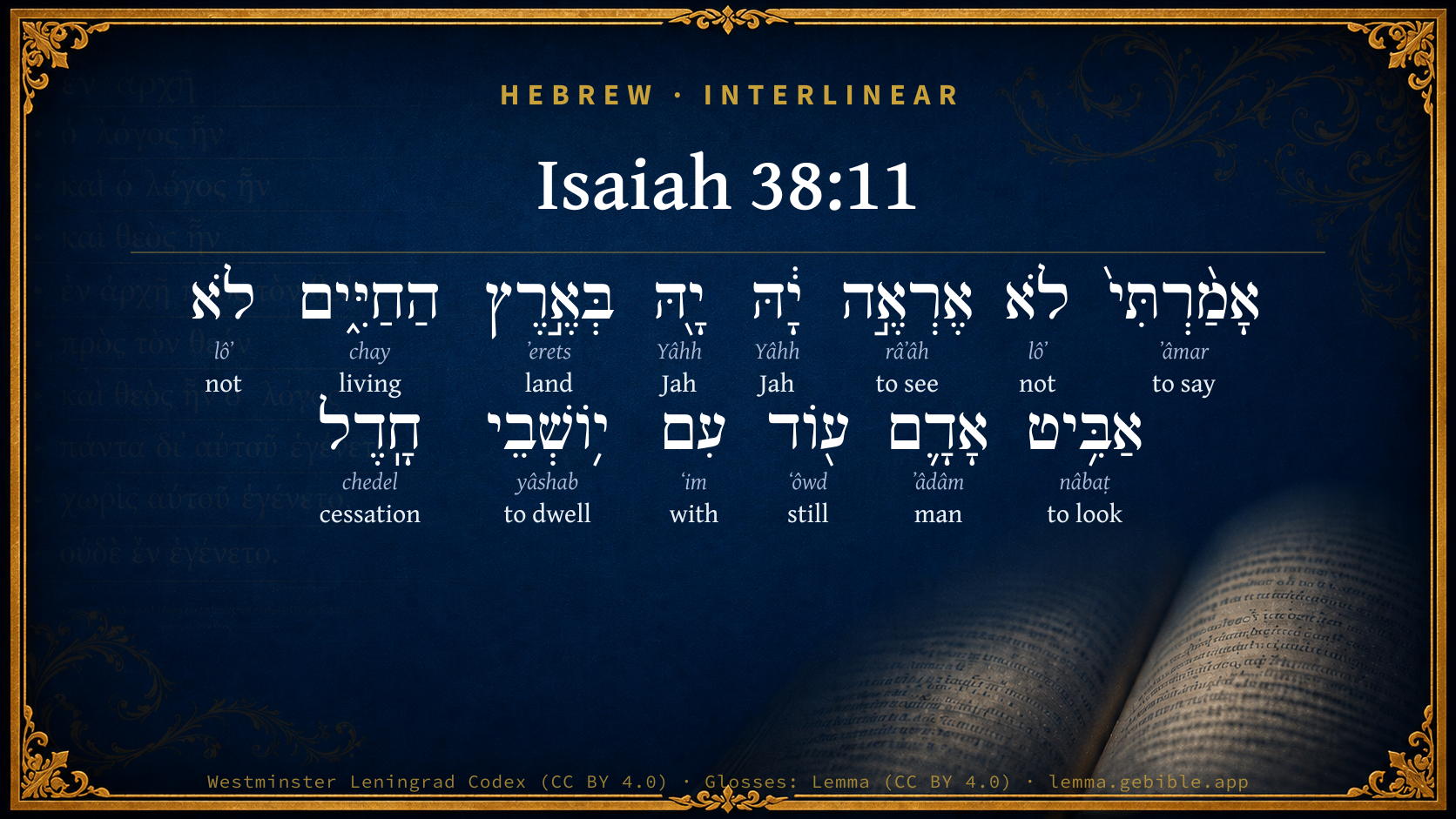
Hebrew (Westminster Leningrad Codex) Isaiah 38:11 appears in the Hebrew Old Testament. The text above is from the Westminster Leningrad Codex. Each word links to its Strong’s number, a concise gloss, and parsing drawn from the Open Scriptures Hebrew Bible morphology. Click any word for its full Brown-Driver-Briggs (BDB) entry.
Download image
Cite this verse

Isaiah 38:11 (World English Bible). Public Domain. Lemma interlinear Bible study tool, https://lemma.gebible.app/v/isaiah/38/11.

Show BibTeX & RIS
BibTeX
RIS
English Translation
I said, I shall not see Yah, Yah in the land of the living: I shall see man no more with the inhabitants of the world.
World English Bible · Public Domain
Highlights Full analysis ↓
Download a study sheet

One document with this verse’s original text, its word-by-word gloss line, the meaning frame, cross-references with their text, attributed commentary, and full source and license credits — printable, and it pastes into notes with its structure intact.

This verse Autodidact and up

Study sheet (.html) Plain text (.txt)

A passage Seminary Student

Up to 50 verses in one chapter. A passage sheet keeps up to 6 commentary sources and 12 cross-references per verse, in the order this page ranks them, and says so on the sheet whenever that leaves anything out. Ask for a single verse and you get the Autodidact verse sheet above.

Everything on this page stays free to read, with no account — the sheet is a download of what is already on screen, not access to it.

Want to remove ads? Support Godless Engineer
Compare translations 3

The same verse in 3 English versions, stacked beneath the original-language interlinear above. Click any original word for its lexicon entry.

Each is an independent rendering of the whole verse — the interlinear is not word-aligned to these translations.

Highlighted words mark where these versions differ — a whole-verse word diff, not a word-by-word alignment.

  • World English Bible Public Domain
    I said, I shall not see Yah, Yah in the land of the living: I shall see man no more with the inhabitants of the world.
  • King James Version Public Domain
    I said, I shall not see the LORD, even the LORD, in the land of the living: I shall behold man no more with the inhabitants of the world.
  • unfoldingWord Literal Text CC BY-SA 4.0
    I said, “I will not see Yah, Yah in the land of the living; I will no longer regard man with the dwellers of the world.

unfoldingWord Literal Text — © unfoldingWord, licensed CC BY-SA 4.0. Word-aligned USFM3 via Door43 (git.door43.org/unfoldingWord/en_ult).

Versions to compare (up to 4)

3 of 4 selected

Show all 18 translations

Every available English version of this verse, each an independent rendering of the whole verse.

  • World English Bible Public Domain
    I said, I shall not see Yah, Yah in the land of the living: I shall see man no more with the inhabitants of the world.
  • Berean Standard Bible Public Domain
    I said, “I will never again see the LORD, even the LORD, in the land of the living; I will no longer look on mankind with those who dwell in this world.
  • Majority Standard Bible Public Domain
    I said, “I will never again see the LORD, even the LORD, in the land of the living; I will no longer look on mankind with those who dwell in this world.
  • King James Version Public Domain
    I said, I shall not see the LORD, even the LORD, in the land of the living: I shall behold man no more with the inhabitants of the world.
  • American Standard Version (1901) Public Domain
    I said, I shall not see Jehovah, `even' Jehovah in the land of the living: I shall behold man no more with the inhabitants of the world.
  • Revised Version (1885) Public Domain
    I said, I shall not see the LORD, even the LORD in the land of the living: I shall behold man no more with the inhabitants of the world.
  • Geneva Bible (1599) Public Domain
    I said, I shall not see the Lord, euen the Lord in the land of the liuing: I shall see man no more among the inhabitants of the world.
  • Douay-Rheims (1899) Public Domain
    I said: I shall not see the Lord God in the land of the living. I shall behold man no more, nor the inhabitant of rest.
  • Young's Literal Translation Public Domain
    I said, I do not see Jah -- Jah! In the land of the living, I do not behold man any more, With the inhabitants of the world.
  • Literal Standard Version CC BY-SA 4.0
    I said, I do not see YAH—YAH! In the land of the living, || I do not behold man anymore, || With the inhabitants of the world.
  • Unlocked Literal Bible CC BY-SA 4.0
    I said that I will no longer see Yahweh, Yahweh in the land of the living; I will no longer look on mankind or the inhabitants of the world.
  • unfoldingWord Literal Text CC BY-SA 4.0
    I said, “I will not see Yah, Yah in the land of the living; I will no longer regard man with the dwellers of the world.
  • Darby Bible Public Domain
    I said, I shall not see Jah, Jah in the land of the living. With those who dwell where all has ceased to be, I shall behold man no more.
  • World Messianic Bible Public Domain
    I said, “I won’t see the LORD, the LORD in the land of the living. I will see man no more with the inhabitants of the world.
  • Webster's Bible Public Domain
    I said, I shall not see the LORD, even the LORD, in the land of the living: I shall behold man no more with the inhabitants of the world.
  • Free Bible Version CC BY-SA 4.0
    I said, “I will never again see the Lord, the Lord, in the land of the living. I won't see anyone else again, none of the inhabitants of this world.
  • Bible in Basic English Public Domain
    I said, I will not see the Lord, even the Lord in the land of the living: I will not see man again or those living in the world.
  • JPS Tanakh (1917) Public Domain
    I said: I shall not see the LORD, even the LORD in the land of the living; I shall behold man no more with the inhabitants of the world.

Literal Standard Version (2020), Covenant Press — licensed CC BY-SA 4.0. Text via the HelloAO Bible API (eBible.org). Unlocked Literal Bible (unfoldingWord) — licensed CC BY-SA 4.0. Text via the HelloAO Bible API (eBible.org). unfoldingWord Literal Text — © unfoldingWord, licensed CC BY-SA 4.0. Word-aligned USFM3 via Door43 (git.door43.org/unfoldingWord/en_ult). Free Bible Version, Dr. Jonathan Gallagher — licensed CC BY-SA 4.0. Text via the HelloAO Bible API (eBible.org).

Word by word

More ways to search: Search by grammar → Find every occurrence → Compare this word →

Practice this passage: Drill this verse → Learn its vocabulary →

חָֽדֶל
chedel
H2309
“cessation”
Noun, Common, Masculine, Singular, Absolute
Part of Speech
Noun
Type
Common
Gender
Masculine
Number
Singular
State
Absolute
Full BDB Definition

Origin: from H2308

TWOT: 609a

rest, cessation
  1. אָמַ֨רְתִּי֙ ʼâmar H559 “to say” Verb, Qal, Perfect, 1st Person, Common, Singular
  2. לֹא lôʼ H3808 “not” Particle, Negative
  3. אֶרְאֶ֣ה râʼâh H7200 “to see” Verb, Qal, Imperfect, 1st Person, Common, Singular
  4. יָ֔הּ Yâhh H3050 “Jah” Noun, Proper
  5. יָ֖הּ Yâhh H3050 “Jah” Noun, Proper
  6. בְּאֶ֣רֶץ ʼerets H776 “in/at · land of” Preposition + Noun, Common, Both, Singular, Construct
  7. הַחַיִּ֑ים chay H2416 “the · living” Particle, Definite Article + Adjective, Adjective, Masculine, Plural, Absolute
  8. לֹא lôʼ H3808 “not” Particle, Negative
  9. אַבִּ֥יט nâbaṭ H5027 “to look” Verb, Hiphil, Imperfect, 1st Person, Common, Singular
  10. אָדָ֛ם ʼâdâm H120 “man” Noun, Common, Masculine, Singular, Absolute
  11. ע֖וֹד ʻôwd H5750 “still” Adverb
  12. עִם ʻim H5973 “with” Preposition
  13. י֥וֹשְׁבֵי yâshab H3427 “dwelling” Verb, Qal, Participle Active, Masculine, Plural, Construct

About this verse

These counts appear in no published source. They are computed here, from the morphology-tagged text and Lemma’s own curated glosses. What Lemma adds →

14
words
12
distinct lemmas
Prophets
section

Notable vocabulary

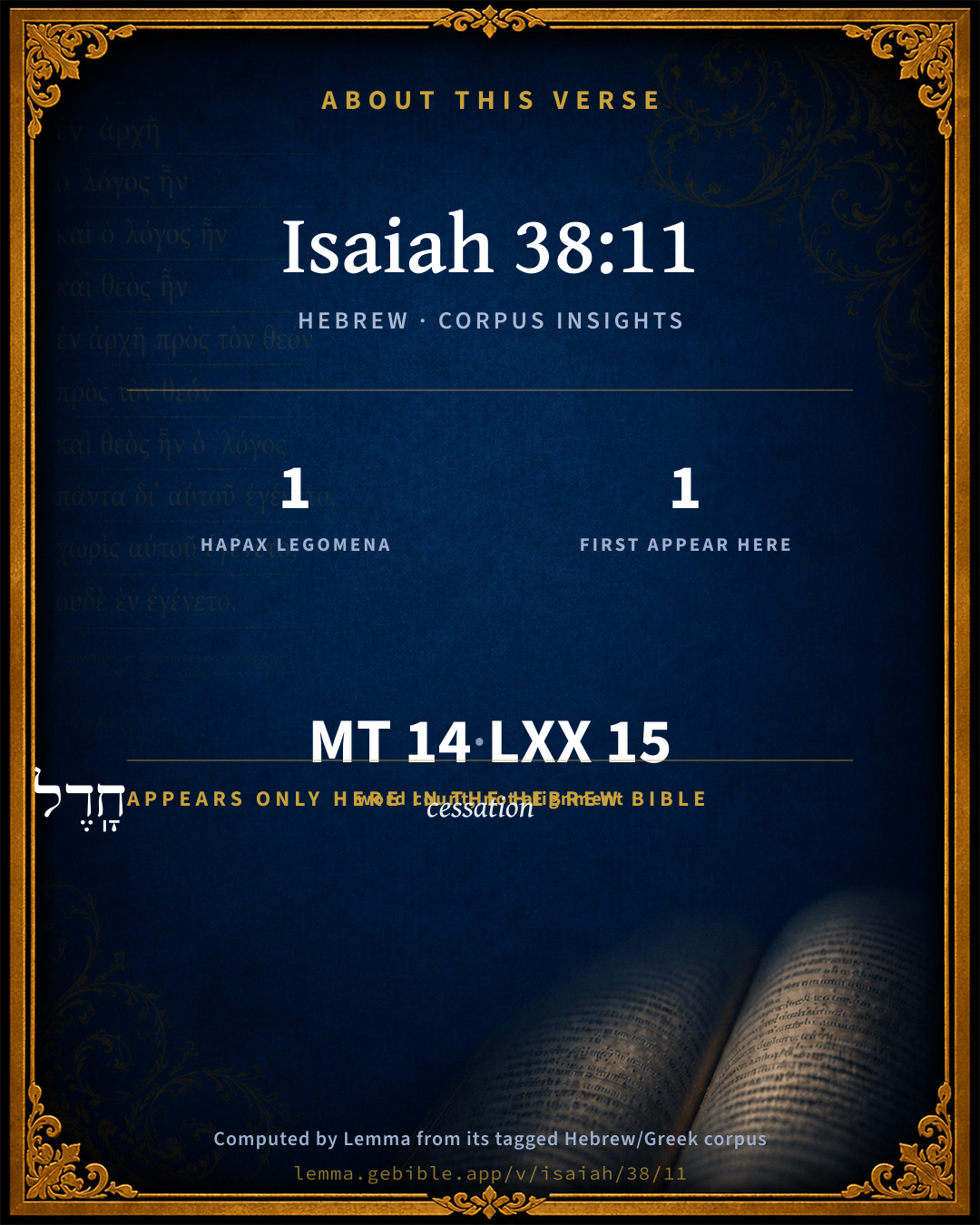
1 hapax legomenon — a word that appears only here in the entire Hebrew Bible:

  • חָֽדֶל cessation H2309

First appearance in Scripture

This word makes its first canonical appearance in the Hebrew Bible here:

  • חָֽדֶל cessation H2309

Shared distinctive vocabulary

יָ֔הּ Jah H3050 occurs in 46 verses of the Hebrew Bible. Also found in:

Grammatical profile

  • 4 verbs
  • 5 nouns
  • 1 adjective
  • 1 preposition
  • 1 adverb
  • 2 particles

Verb forms

  • אָמַ֨רְתִּי֙ Qal · Perfect
  • אֶרְאֶ֣ה Qal · Imperfect
  • אַבִּ֥יט Hiphil · Imperfect
  • י֥וֹשְׁבֵי Qal · Participle Active

Repetition

Words recur within this verse — often emphatic in Hebrew:

Hebrew & Septuagint length

In English translation the verse runs 26 words from the Hebrew and 41 from the Septuagint (LXX English) — the Septuagint runs noticeably longer here. See the side-by-side →

A rough comparison of the two English renderings, which tokenize alike — not a word-level alignment.

Word counts can differ between the Hebrew and the Greek without any difference in meaning — e.g. the Hebrew direct-object marker אֵת has no separate Greek word, and Greek often adds the article ὁ.

In the original languages it is 14 Hebrew tokens and 15 Greek tokens — but the two are counted differently (Hebrew bundles its prefixes and suffixes into one token; the Greek is in lemma form), so that isn’t a like-for-like length.

Cross-references

6

Topical passages linked to Isaiah 38:11 in the Treasury of Scripture Knowledge — connected by theme and wording, ordered by reader-vote popularity; previews shown in the World English Bible.

  • Psalms 27:13 I am still confident of this: I will see the goodness of Yahweh in the land of the living.
  • Psalms 116:8–9 For you have delivered my soul from death, My eyes from tears, And my feet from falling.
  • Job 35:14–15 How much less when you say you don't see him. The cause is before him, and you wait for him!
  • Psalms 6:4–5 Return, Yahweh. Deliver my soul, And save me for your loving kindness' sake.
  • Psalms 31:22 As for me, I said in my haste, "I am cut off from before your eyes." Nevertheless you heard the voice of my petitions when I cried to you.
  • Ecclesiastes 9:5–6 For the living know that they will die, but the dead don't know anything, neither do they have any more a reward; for the memory of them is forgotten.

Cross-references courtesy of OpenBible.info (CC BY 4.0).

Hebrew and Greek witnesses Masoretic Hebrew ↔ Greek Septuagint

The same verse in the two great witnesses to the Old Testament, shown verse-for-verse.

Here the Septuagint runs noticeably longer than the Hebrew — LXX2012 (modern English Septuagint) 41 words vs World English Bible 26. A rough length comparison of the two English translations, not a word-level alignment — read both below.

These are two independent witnesses, not word-aligned to each other, and the Septuagint is shown in lemma (dictionary) form.

Hebrew Isaiah 38:11 Masoretic · Westminster Leningrad Codex

אָמַ֨רְתִּי֙ לֹא אֶרְאֶ֣ה יָ֔הּ יָ֖הּ בְּאֶ֣רֶץ הַחַיִּ֑ים לֹא אַבִּ֥יט אָדָ֛ם ע֖וֹד עִם י֥וֹשְׁבֵי חָֽדֶל

I said, I shall not see Yah, Yah in the land of the living: I shall see man no more with the inhabitants of the world.

World English Bible · Public Domain

Greek LXX Isaiah 38:11 Septuagint · lemma form

εἶπον οὐκέτι μή ὁράω ὁ σωτήριον ὁ θεός ἐπί ὁ γῆ οὐκέτι μή ὁράω ἄνθρωπος

I said, I shall no more at all see the salvation of God in the land of the living: I shall no more at all see the salvation of Israel on the earth: I shall no more at all see man.

LXX2012 (modern English Septuagint) · Public Domain

On this verse, Ellicott's Commentary for English Readers discusses the Septuagint’s reading. Read the note in Commentary ↓

Hebrew: Westminster Leningrad Codex (CC BY 4.0). Greek: Septuagint (public domain); English from LXX2012 (modern English Septuagint) (Public Domain). How the Septuagint differs from the Hebrew →

Targum (Aramaic paraphrase)

1

The Targum is the ancient Jewish Aramaic paraphrase of the Hebrew Scriptures — an interpretive translation, not the Hebrew text itself. Onkelos (literal) and Pseudo-Jonathan (expansive) render the Torah, and Jonathan the Prophets. Coverage is partial: where no permissively-licensed English translation exists for a verse, only the Aramaic is shown. This is verse-level text, not a word-by-word alignment to the Hebrew.

  1. Targum Jonathan Prophets (Joshua–Malachi)
    אֲמָרֵית לָא אִתְחַזֵי עוֹד קֳדָם דְחֵילָא דַייָ בְּאַרְעָא בֵית שְׁכִינְתֵּהּ דִי בָה אֲרִיכוּת חַיָא וְלָא אֶפְלַח קֳדָמוֹהִי עוֹד בְּבֵית מַקְדְשָׁא דְמִתַּמָן עֲתִיד לְמִפַּק חֶדְוָא לְכָל יַתְבֵי אַרְעָא מִלְמֵידַר בִּירוּשְׁלֵם קַרְתָּא דְקוּדְשָׁא מְדוֹרֵי פְּסָק:

    I thought, I shall not appear again before the terrible God, in the land of the house of His Shekinah, in which is length of life: and I shall no more serve before Him in the house of the sanctuary, from whence shall go forth joy unto all the inhabitants of the earth; neither shall I dwell in Jerusalem the holy city; my habitation is cut down.

    Targum Jonathan — Aramaic: “Mikraot Gedolot” (public domain). English: “Sefaria Community Translation” (CC0 1.0 (public-domain dedication)); “London "Chaldee Paraphrase," 1871” (public domain). Text via Sefaria.

Commentary

Notes on Isaiah 38:11 from classic Christian and Jewish commentators (each source and its license shown beneath its notes). The classic Christian expositions comment on the surrounding passage and are grouped to its opening verse, so a note may address several verses; the Jewish commentaries on the Tanakh (Rashi and others) are per-verse, so they appear only where the commentator wrote on this verse.

Lemma curates 59 commentaries, every one of them public domain or Creative Commons licensed, each selected and text-cleaned for this edition rather than reprinted as found. About our sources →

Trapp's Complete Commentary

John Trapp

Isa 38:11 I said, I shall not see the LORD, [even] the LORD, in the land of the living: I shall behold man no more with the inhabitants of the world.

Ver. 11. I said, I shall not see the Lord.] In the glass of his ordinances, his love whereunto made Hezekiah so loath to depart; as also his delight in the communion of saints, and his desire to do more good among them on all occasions. This made good Paul "in a strait" also. {Php 1:23-24} I loved the man, said Theodosius concerning Ambrose, for that when he died he was more solicitous of the Church’s welfare than of his own.

Even the Lord.] Non videbo Iah Iah. I shall not see the Lord of the Lord, Deum Dei, vel Deum de Deo, {a} - that is, Christ in the flesh, as I had well hoped to have done: so some sense it. Others say he redoubleth the word "Jah" to express his ardent affection to God’s service, and to intimate his desire of life to that purpose. {Isa 38:22}

{a} Leo Castrius.

John Trapp, A Commentary or Exposition upon All the Books of the Old and New Testament (1647–1656) — public domain. Text from a community e-Sword module.

The Biblical Illustrator

Joseph S. Exell

Isa_38:11

I said, I shall not see the Lord

Hezekiahs distress

I.

HEZEKIAHS DISTRESS AT THE THOUGHT OF NOT SEEING GOD. This manifested--

1. True affection towards God.

2. Fervent desires for the revelation of Gods glory.

3. Spiritual power to apprehend God.

II. HEZEKIAHS DISAPPOINTMENT AT THE THOUGHT OF NOT SEEING GOD ON EARTH. He would see Him--

1. In deliverances wrought out for His people.

2. In Divine manifestations in the temple.

3. In Divine benediction upon himself and nation. Happy they who desire to see God. He may be seen in this land of death. In the true land of the living men ever behold Him face to face. (W. O. Lilley.)

I shall behold man no more with the inhabitants of the world

One, and only one probation, a benevolent arrangement

(with Luk_16:26):--There are two facts that give death profound solemnity.

1. It separates a man for ever from his connections in this world. Hezekiah felt this now. Job felt this. When a few years are come, &c. What living man has not been impressed with this idea! The old scene of his first impressions, anxious labours, tender friendships, and dear associations is left for ever. However trying this world may be, it contains very much that is dear to us. Here we felt the first sensations of life; here the first trains of thought arose; here we have received the elements of our character; here all our joys have been experienced, our trials endured, and our labours prosecuted. Here sleep the dust of our parents and our friends. To leave all this for ever is a sad thought.

2. It separates a man for ever from all probationary means of improvement. Abraham gave this idea to the rich man in the world of perdition: he assured him there was an impassable gulf fixed between him and all remedial means. After death character seems stereotyped. This is a more solemn fact than the other, though perhaps not so deeply and generally felt. To be cut off for ever, if we are wicked, from Bibles, sanctuaries, and all mediatorial influences and helps; to have an impassable gulf between all that is bright and fair in the universe and ones self;--how solemn this! This fact, which is profoundly solemn, is neither cruel nor unjust, but on the contrary highly benevolent.

I. THERE IS MORE GOODNESS IN THIS ARRANGEMENT TO THE INDIVIDUAL HIMSELF. Three facts will illustrate this.

1. In case a man had a second probation, and it failed, his guilt and misery would be considerably enhanced by it.

(1) Punishment will be propertioned by the privileges and opportunities abused. He that knoweth his Masters will, and doeth it not, &c. If I had not spoken to them, said Christ, they had not had sin. What is the guilt of a heathen compared with a man living in Christian lands?

(2) The privileges and opportunities connected with his first probation are such as to impose incalculable responsibility. He that despised Moses law died without mercy, &c. What, then, would be the guilt of a man who had not only lived through a first probation, but a second?

2. The man who abused the first probation would be most likely to abuse the second. If a man pass through all remedial influences of the first probation nature, sacred literature, sanctuaries, the counsels and admonitions of the pious, the Gospel ministry--and not be saved, but hardened, by all, would there not be a certainty that, if he entered upon a second probation, the second would also fail?

(1) Because he would enter upon the second with hardened sensibilities. He did not so the first. We began our existence here with tender consciences.

(2) He would enter on the second with confirmed habits. H it be asked, May not some new influences be brought to bear upon the soul in the second probation that did not act upon him in the first?--We ask, What new influences are possible? We can only conceive of two kinds--the penal and the merciful. Will penal sufferings convert? And as to merciful influences--can there be any more merciful power brought to bear upon the soul than now? Can God give a more moving and mighty expression of His love than in sending His only-begotten Son?

3. Mans knowledge of a second probation would tend to counteract upon his mind the saving influence of the first.

(1) It would strengthen that procrastinating principle in his nature which leads him now to postpone the question of his salvation.

(2) It would strengthen that presuming tendency of his nature which induces him to run the risk of the future. (Homilist.)

The Biblical Illustrator, edited by Joseph S. Exell (c. 1880s–1900s) — public domain. Text from a community e-Sword module.

Tyndale Open Study Notes

Tyndale Open Resources

38:11 Hezekiah lamented that if he died, he would not enjoy fellowship with God, his family, and his friends.

Tyndale Open Study Notes — © Tyndale Open Resources, licensed CC BY-SA 4.0. Text via the HelloAO Bible API.

Geneva Bible (1599)

Geneva Bible translators

I shall no more praise the Lord here in this Temple among the faithful: thus God suffereth his dearest children to want his consolation for a time, that his grace afterward may the more appear when they feel their own weakness.

Geneva Bible (1599) marginal notes — public domain. Text via Bolls.life.

Jamieson, Fausset & Brown

Robert Jamieson, A. R. Fausset & David Brown

Lord . . . Lord--The repetition, as in Isa 38:19, expresses the excited feeling of the king's mind.

See the Lord (Jehovah)--figuratively for "to enjoy His good gifts." So, in a similar connection (Psa 27:13). "I had fainted, unless I had believed to see the goodness of the Lord in the land of the living"; (Psa 34:12), "What man is he that desireth life that he may see good?"

world--rather, translate: "among the inhabitants of the land of stillness," that is, Hades [MAURER], in parallel antithesis to "the land of the living" in the first clause. The Hebrew comes from a root, to "rest" or "cease" (Job 14:6).

Jamieson, Fausset & Brown — Commentary Critical and Explanatory on the Whole Bible (1871) — public domain (CC PDM 1.0). Text via the HelloAO Bible API.

Adam Clarke's Commentary

Verse 11. The Lord - "JEHOVAH"] יה Yah, יה Yah, seems to be יהוה Yehovah, in MS. Bodl., and it was so at first written in another. So the Syriac. See Houbigant. I believe יהוה Yehovah was the original reading. See Clarke on Isa 12:2.

Adam Clarke's Commentary on the Bible (1810–1826) — public domain. Text from a community e-Sword/MySword module.

Ellicott's Commentary for English Readers

(11) I shall not see the Lord . . .—The words are eminently characteristic of the cheerless dimness of the Hebrew’s thoughts of death. To St. Paul and those who share his faith death is to “depart, and to be with Christ” (Php_1:23), to be “ever with the Lord” (1Th_4:17). To Hezekiah, it would seem, the outward worship of the Temple, or possibly, the consciousness of God’s presence in the full activity of brain and heart, was a joy which he could not bear to lose. The spiritual perceptions of the life after death would be spectral and shadowy, like the dead themselves. (Comp. the Greek idea of Hades in Homer (Od. xi. 12-19). It may be noted that the Hebrew for “the Lord” is the shorter, possibly the poetical, form “Jah” (as in Psa_68:4). The LXX paraphrases “I shall not see the salvation of God.”

A Bible Commentary for English Readers, edited by Charles John Ellicott (1878–1897) — public domain. Text from a community e-Sword module.

The Cambridge Bible for Schools and Colleges

gen. ed. J. J. S. Perowne

11. Death is the end of all communion both with God and men. To see the Lord is to enjoy the sense of His presence in the appointed acts of worship (see on ch. Isa_1:12), The thought that Sheol afforded no such opportunities of converse with the living God was that which made death a terror to O.T. believers (cf. Isa_38:18; Psa_88:5, &c.).

the inhabitants of the world] The received text has “the inhabitants of cessation” (ḥedel), i.e. “of the place where life ceases,” an expression for the underworld. The reading ḥeled (“the world”) is found in some Heb. MSS.; and is rightly preferred by A.V.

The Cambridge Bible for Schools and Colleges (gen. ed. J. J. S. Perowne; Cambridge University Press, 1878–1918) — public domain. Text from a community e-Sword module.

John Gill's Exposition

Mine age is departed, and is removed from me as a shepherd's tent,.... Or, my habitation (k); meaning the earthly house of his tabernacle, his body; this was just going, in his apprehension, to be unpinned, and removed like a shepherd's tent, that is easily taken down, and removed from place to place. Some understand it of the men of his age or generation; so the Targum,

"from the children of my generation my days are taken away; they are cut off, and removed from me; they are rolled up as a shepherd's tent;''

which being made of skins, as tents frequently were, such as the Arabian shepherds used, were soon taken down, and easily rolled and folded up and carried elsewhere:

I have cut off like a weaver my life; who, when he has finished his web, or a part of it, as he pleases, cuts it off from the loom, and disposes of it: this Hezekiah ascribes to himself, either that by reason of his sins and transgressions he was the cause of his being taken away by death so soon; or this was the thought he had within himself, that his life would now be cut off, as the weaver's web from the loom; for otherwise he knew that it was the Lord that would do it, whenever it was, as in the next clause:

he will cut me off with pining sickness; which was now upon him, wasting and consuming him apace: or, "will cut me off from the thrum" (l); keeping on the metaphor of the weaver cutting off his web from the thrum, fastened to the beam of his loom:

from day even tonight wilt thou make an end of me; he means the Lord by "he" in the preceding clause, and in this he addresses him; signifying that the affliction was so sharp and heavy upon him, which was the first day of it, that he did not expect to live till night, but that God would put a period to his days, fill them up, and finish his life, and dispatch him out of this world.

(k) "habitatio mea", Vatablus, Junius & Tremellius. (l) "a liciis resecturus est me", Piscator; "a primis filis resecat me", Vitringa.

John Gill's Exposition of the Whole Bible (1746–1763) — public domain (CC PDM 1.0). Text via the HelloAO Bible API.

Albert Barnes' Notes on the Bible

I shall not see the Lord - In the original, the Hebrew which is rendered ‘Lord,’ is not Yahweh, but יה יה yâhh yâhh. On the meaning of it, see the note at Isa 12:2 (compare the note at Isa 7:14). The repetition of the name here denotes emphasis or intensity of feeling - the deep desire which he had to see Yahweh in the land of the living, and the intense sorrow of his heart at the idea of being cut off from that privilege. The idea here is, that Hezekiah felt that he would not be spared to enjoy the tokens of divine favor on earth; to reap the fruits of the surprising and remarkable deliverance from the army of Sennacherib; and to observe its happy results in the augmenting prosperity of the people, and in the complete success of his plans of reformation.

I shall behold man no more - I shall see the living no more; I shall die, and go among the dead. He regarded it as a privilege to live, and to enjoy the society of his friends and fellow-worshippers in the temple - a privilege from which he felt that he was about to be cut off.

With the inhabitants of the world - Or rather, ‘among the inhabitants of the land of stillness;’ that is, of the land of shades - sheol. He would not there see man as he saw him on earth, living and active, but would be a shade in the land of shades; himself still, in a world of stillness. ‘I shall be associated with them there, and of course be cut off from the privileges of the society of living men.’ (See Supplementary Note at Isa 14:9.) The Hebrew word rendered ‘world’ (חדל chedel), is from חדל châdal, “to cease, to leave off, to desist; to become languid, flaccid, pendulous.” It then conveys the idea of leaving off, of resting, of being still Jdg 5:6; Job 3:17; Job 14:6; Isa 2:22. Hence, the idea of frailty Psa 39:5; and hence, the word here denotes probably the place of rest, the region of the dead, and is synonymous with the land of silence, such as the grave and the region of the dead are in contradistinction from the hurry and bustle of this world. Our translation seems to have been made as if the word was חלד cheled, “life, lifetime”; hence, the world Psa 17:14; Psa 49:2. The Vulgate renders it, ‘Habitatorem quietis.’ The Septuagint simply: ‘I shall behold man no more.’

Albert Barnes' Notes on the Bible (1834–1885) — public domain. Text from a community e-Sword/MySword module.

Haydock's Catholic Bible Commentary

Living. I shall not assist at the festivals of the Lord in the temple.

George Leo Haydock (1774–1849), Haydock's Catholic Family Bible and Commentary, 1859 edition — public domain. Excludes Psalms (Douay-Rheims chapter numbering differs from Protestant) and Deuterocanonical books (Catholic canon only).

Matthew Poole's English Annotations

I shall not see the Lord; I shall not enjoy him; for seeing is put for enjoying, as hath been frequently noted.

In the land of the living; in this world, which is so called, Psa 27:13; 116:9; Isa 53:8; in his sanctuary: which limitation is prudently added, to intimate that he expected to see God in another place and manner, even in heaven, face to face.

I shall behold man no more with the inhabitants of the world; I shall have no more society with men upon earth.

Matthew Poole's English Annotations on the Holy Bible (1683–1685) — public domain. Text from a community e-Sword/MySword module.

The Pulpit Commentary

I shall not see the Lord (comp. Psa_6:5, "In death there is no remembrance of thee; in the grave (Sheol) who shall give thee thanks?" and see also. (Psa_30:9 Psa_88:10-12 Psa_115:17) The Jews had not yet attained the conception of a blissful region in Hades, where God manifested himself, and the saints, who were awaiting the resurrection, saw him and praised him. Even the Lord. (For examples of repetition for the sake of emphasis, see Isa_29:1 Isa_33:22 Isa_38:19 Isa_40:1 Isa_51:17, etc.) In the land of the living; i.e. "as I do now in the land of the living". (comp. Psa_27:13 Psa_116:9)

Vers. 11, 12. The grief of old age.

"I said, I shall not see the Lord, even the Lord, in the land of the living: I shall behold man no more with the inhabitants of the world. Mine age is departed." Then it is not so strange an experience to love the busy city or the rural quietude. "Life, we"ve been long together." This is what, at Hezekiah"s time of life, we most of us feel. There is an old familiar friendship betwixt us and the world. We scarcely think things can go on well without us. The old village stream seems to look up and know us when we visit it in the after-years. Yet the reflection in it of our face and figure is very changed.

I THE SIGHT HE WOULD MISS. Not nature, but nature"s King and Lord. This always characterizes a living religion. We see God in all God in Christ. For by him God made the worlds. He is the Archetype of all beauty. His is the thought which has been fulfilled in creation"s glory and beauty. His the harmony which has found voice in the music of the woods and streams. And to rise to higher, even to human spheres all the loves of espousal and home these speak of him who ordered their joys and uses, and made them parables of his own love and care. "I shall behold man no more with the inhabitants of the world." Then this is cheerful and pleasant. So wrote Charles Lamb, when, in view of death, he said he should miss "the safe security of the streets," as well as the sweet rural scenes. And apart from revelation of the rest that remaineth, it would be sad indeed to lie down in a City of Sleepers, who will never know an awakening voice, whilst above the tomb there is busy life in the mart, the senate, and the field.

II THE MISTAKE HE MADE. "Mine age is departed." Not quite so yet, even in relation to this life. He was to continue amongst those of whom he said, "The living, the living, he shall praise thee, as I do this day." But then would surely come the time when (ver. 18) he would go down into the pit. The light on immortality burned dimly then. Here and there we trace it, like light that lingers on the higher mountains, in David and Isaiah; but to the mass of minds it was not, to say the least, a very potent influence or a very living faith. "Christ has brought light and immortality to light" by the gospel, and we need never say, "Mine age is departed;" but rather, "Mine age is transmuted" into immortal youth, and unending revelation of the Redeemer"s power and glory. W.M.S.

Vers. 11, 18, 19. The great disclosure.

"If a man die, shall he live again?" asks the anxious, hopeful, human spirit. This composition of Hezekiah either indicates or suggests

I THE LIGHT WHICH THE HEBREW SAINTS POSSESSED. They believed that death did not terminate man"s existence; that, after death, he dwelt in Sheol with the spirits of the departed, with "the inhabitants of the land of stillness;" in a region, deep, dark, shut up within impassable gates through which they that have entered may never more return (ver. 10).

II THE PAINFUL FEEBLENESS OF THEIR LIGHT. This abode of the dead was dismal in a high degree to their imagination; it was "the pit of corruption" (ver. 17); it was the place where God was unapproachable (ver. 11), where his praises were untold and unsung (ver. 18), where the delights of human fellowship were unknown (ver. 11), where the opportunities of gaining the highest wisdom were closed against the soul, where men "cannot hope for thy truth" (ver. 18). Such life as there was in those sepulchral region, s would hardly be worth having, where privations like these prevailed.

III THE GREAT DISCLOSURE BY JESUS CHRIST. He did not, indeed, for the first time announce that there was a life beyond death for men. But he did reveal such a life of blessedness and glory as gave a new meaning to immortality. As his disciples, we look for a life which will be characterized, not by the removal, but by the renewal and the immeasurable enlargement, of all the higher blessings of the present time. As exactly opposed to the privations here lamented, we look for:

1. The near presence of God. (Ver. 11.) To depart is to "be with Christ," is to "be with him that we may behold his glory," is to be at home in "the Father"s house.

2. A life of holiest, happiest worship. (Ver. 18.) Where the praises of God will never tire the tongue. Heaven is, to our hope, the very home of praise: "The living, they that live indeed, they will praise God in accents to which our fainter and feebler life is unequal now.

3. Communion with the perfected spirits of men. (Ver. 11.) We hope to behold and to have ennobling fellowship with men at their very best, when they and we shall be purged of all that hinders or lowers our intercourse on earth.

4. Access to Divine truth. (Ver. 18.) "Then shall we know even as also we are known"; (1Co_13:12) then shall we look "face to face" on many truths which here we have only dimly espied; then shall we grasp with firm, rejoicing hold what now we can but delicately touch, or are ineffectually pursuing.

5. Life in its large and blessed fulness. (Ver. 19.) It is they who dwell in the light of God of whom we rightly speak as "the living, the living;" it is they who "have life more abundantly." We conclude that:

(1) This language of lamentation does not suit Christian lips.

(2) We have no need to think of death as Hezekiah thought.

(3) We who have such high hopes in us as these should live lives of purity, and so of preparation. C. (1Jn_3:3)

The Pulpit Commentary (1880–1919), ed. H.D.M. Spence-Jones & Joseph S. Exell — public domain. Text from a community e-Sword module.

J. A. Alexander on Isaiah

Joseph Addison Alexander

“I said, I shall not see Jah, Jah in the land of the living; I shall not behold man again (or longer) with the inhabitants of the world.” Jah Jah is an intensive repetition similar to those in vs. 17, 19. Or the second may be added to explain and qualify the first. He did expect to see God, but not in the land of the living. For other explanations of the name see above, on Isa 12:2 and Isa 26:4. The land of the living is the present life. The preposition with may connect what follows either with the subject or the object of the verb; ‘I with the inhabitants’, or, ‘man with the inhabitants’. The last words of the verse bear the same relation to ‘I shall not see man’, that the words ‘in the land of the living’ bear to ‘I shall not see Jah’. If the latter designate the place it which he was no more to see God, then the former would naturally seem to designate the place in which he was no middle man.

Joseph Addison Alexander, The Prophecies of Isaiah (1846–1847; New York: Scribner, 1870–1878) — public domain. Text from a community e-Sword module.

Rashi

Rabbi Shlomo Yitzchaki (Rashi)

[Addendum: I will not see the Eternal (יָהּ) I will no longer use the name יָהּ.

in the land of the living The living use it, but the dead are not permitted, as it is said (Ps. 115:17): “The dead shall not praise the Eternal (יָהּ).” It is a rule for the dead that they may never mention the Name consisting of two letters.]

in the land of the living in the Temple.

I will no longer look upon man (I.e., I will) no longer (look upon) a living (man).

with those who dwell in withdrawal (חָדֶל) For I will be with the dead, who dwell in a land withdrawn and withheld from the living.

Rashi on the Tanakh — English translations: “The Judaica Press complete Tanach with Rashi, translated by A. J. Rosenberg” (CC BY 4.0); “Pentateuch with Rashi's commentary by M. Rosenbaum and A.M. Silbermann, 1929-1934” (public domain); “The Metsudah Tanach series, Lakewood, N.J” (CC BY 4.0); and “The Book of Joshua, Metsudah Publications, 1997” (CC BY 4.0). Text via Sefaria.

Ibn Ezra

Rabbi Abraham ibn Ezra

I shall not see the Lord, etc. God is not subject to accidents, that a human eye should be able to perceive Him; He is, however, known by His works. The meaning of this verse is therefore: I shall not see any longer the works of the Almighty; I shall not understand the works of the Lord in this world, in the land of the living. These latter words are thus added as a kind of explanation of the preceding phrase. The pleasure which man has in this world in understanding the works of the Almighty is first mentioned; and then, in the words, I shall behold man no more, his pleasure in seeing his fellow-men.

חדל World. חדל is perhaps the same as חלד life, as כשב is the same as כבש lamb; comp. חלדי my life (Ps. 39:6); it is possible that the word has the same meaning in the phrase מה חדל אני how long I am living (Ps. 39:5). The life of man in this world is perhaps called חדל because man must at some time cease to be therein.

Ibn Ezra on the Tanakh — English translations: “Sefaria Community Translation” (CC0 1.0 (public-domain dedication)); “Yalkut, Sifsei Chachomim Chumash, Metsudah Publications, 2009” (CC BY 4.0); and “Commentary of Ibn Ezra on Isaiah - trans. by M. Friedlander, 1873” (public domain). Text via Sefaria.

Lesson kit

Teaching starters — assembled from the data on this page, not authored interpretation. Every prompt links to the verse data it draws on. Edit before teaching.

Isaiah, in the Prophets, opens this verse with 14 words (12 distinct Hebrew lemmas). Its most distinctive word is chedel (“cessation”). The Greek Septuagint runs longer here. A historical commentator’s framing appears above. Read the whole chapter for the surrounding context.

Discussion questions

  1. How does “cessation” (chedel) shape what this verse is saying?
  2. This verse holds 1 word here found nowhere else in the Hebrew Bible. What might the rare word draw attention to?
  3. The word “cessation” first appears here in Scripture. What is being introduced at this debut?
  4. Exodus 15:2 shares the word «Jah» with this verse. How do the two illuminate each other?
  5. “Jah” occurs 2× in this one verse. What is the effect of the repetition?
  6. Compared with the Hebrew, the Septuagint runs longer here. What questions does that raise?
  7. The translations on this page render this verse differently — a whole-verse word diff, not a word-by-word alignment. What might account for the different wordings?
  8. The verb «אָמַ֨רְתִּי֙» is Qal Perfect. How does its form color the action?

Things to notice

  • 1 word in this verse appears nowhere else in the Hebrew Bible.
  • 1 word makes its first canonical appearance in Scripture here.
  • This verse counts 14 Hebrew ↔ 15 Greek words.
  • These translations choose different wording for 11 words in this verse.
  • “Jah” occurs 2× in this single verse.

Reading settings

Reading text

Shown beneath each verse's original-language words.

Old Testament
Old Testament edition

Read the OT as the Masoretic Hebrew (MT) or the Greek Septuagint (LXX).

English shown for the Greek Septuagint (in the Hebrew ↔ Greek comparison).

Comparing translations? Open the Compare panel on any verse page to stack up to four side by side.