Isaiah 18:3

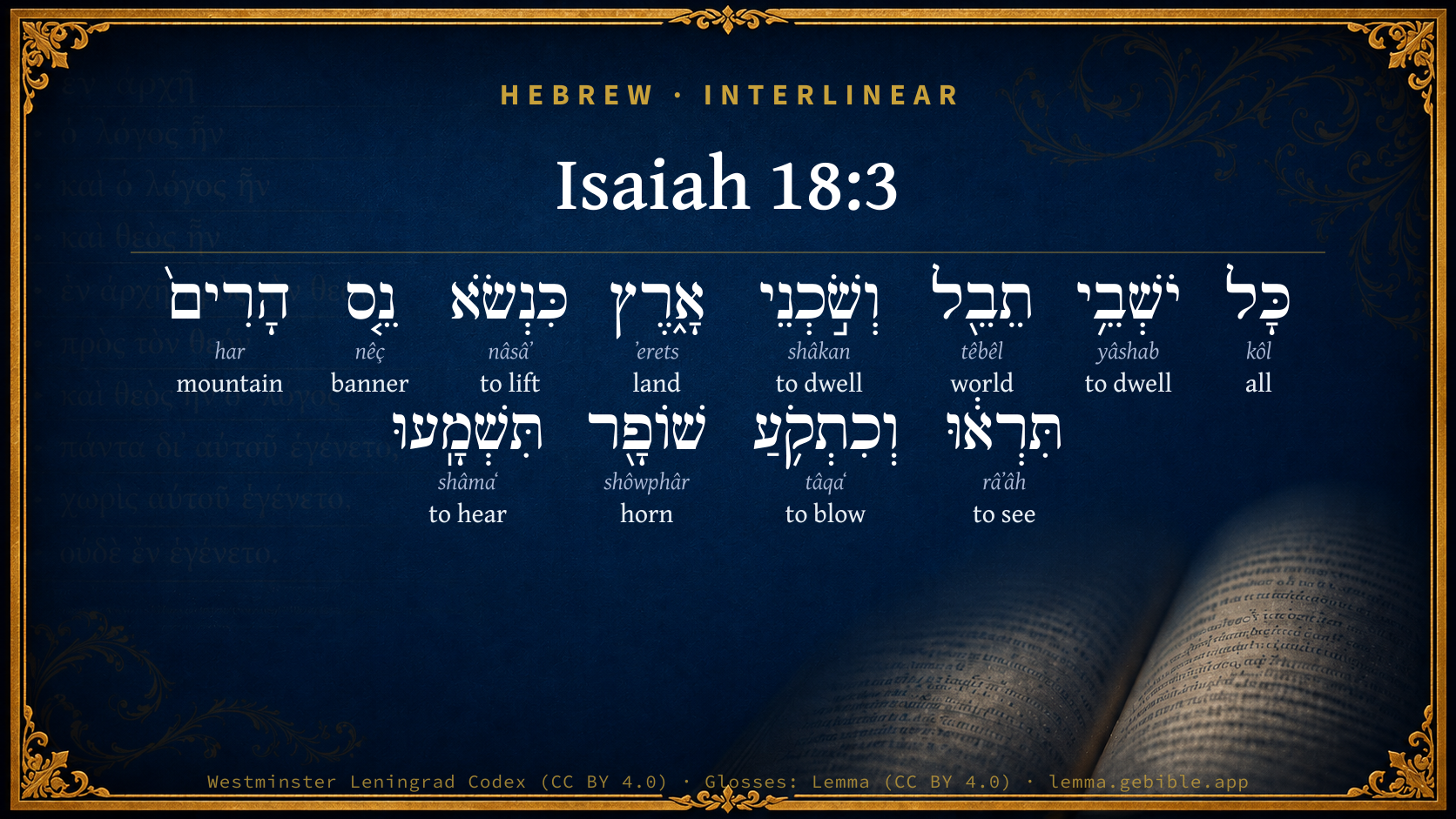
Hebrew (Westminster Leningrad Codex) Isaiah 18:3 appears in the Hebrew Old Testament. The text above is from the Westminster Leningrad Codex. Each word links to its Strong’s number, a concise gloss, and parsing drawn from the Open Scriptures Hebrew Bible morphology. Click any word for its full Brown-Driver-Briggs (BDB) entry.
Download image
Cite this verse

Isaiah 18:3 (World English Bible). Public Domain. Lemma interlinear Bible study tool, https://lemma.gebible.app/v/isaiah/18/3.

Show BibTeX & RIS
BibTeX
RIS
English Translation
All you inhabitants of the world, and you dwellers on the earth, when an ensign is lifted up on the mountains, look; and when the trumpet is blown, listen.
World English Bible · Public Domain
Download a study sheet

One document with this verse’s original text, its word-by-word gloss line, the meaning frame, cross-references with their text, attributed commentary, and full source and license credits — printable, and it pastes into notes with its structure intact.

This verse Autodidact and up

Study sheet (.html) Plain text (.txt)

A passage Seminary Student

Up to 50 verses in one chapter. A passage sheet keeps up to 6 commentary sources and 12 cross-references per verse, in the order this page ranks them, and says so on the sheet whenever that leaves anything out. Ask for a single verse and you get the Autodidact verse sheet above.

Everything on this page stays free to read, with no account — the sheet is a download of what is already on screen, not access to it.

Want to remove ads? Support Godless Engineer
Compare translations 3

The same verse in 3 English versions, stacked beneath the original-language interlinear above. Click any original word for its lexicon entry.

Each is an independent rendering of the whole verse — the interlinear is not word-aligned to these translations.

Highlighted words mark where these versions differ — a whole-verse word diff, not a word-by-word alignment.

  • World English Bible Public Domain
    All you inhabitants of the world, and you dwellers on the earth, when an ensign is lifted up on the mountains, look; and when the trumpet is blown, listen.
  • King James Version Public Domain
    All ye inhabitants of the world, and dwellers on the earth, see ye, when he lifteth up an ensign on the mountains; and when he bloweth a trumpet, hear ye.
  • unfoldingWord Literal Text CC BY-SA 4.0
    All dwellers of the world and inhabitants of the earth, when a banner is lifted up on the mountains, may you see, and when a shofar is blown, may you hear.

unfoldingWord Literal Text — © unfoldingWord, licensed CC BY-SA 4.0. Word-aligned USFM3 via Door43 (git.door43.org/unfoldingWord/en_ult).

Versions to compare (up to 4)

3 of 4 selected

Show all 18 translations

Every available English version of this verse, each an independent rendering of the whole verse.

  • World English Bible Public Domain
    All you inhabitants of the world, and you dwellers on the earth, when an ensign is lifted up on the mountains, look; and when the trumpet is blown, listen.
  • Berean Standard Bible Public Domain
    All you people of the world and dwellers of the earth, when a banner is raised on the mountains, you will see it; when a ram’s horn sounds, you will hear it.
  • Majority Standard Bible Public Domain
    All you people of the world and dwellers of the earth, when a banner is raised on the mountains, you will see it; when a ram’s horn sounds, you will hear it.
  • King James Version Public Domain
    All ye inhabitants of the world, and dwellers on the earth, see ye, when he lifteth up an ensign on the mountains; and when he bloweth a trumpet, hear ye.
  • American Standard Version (1901) Public Domain
    All ye inhabitants of the world, and ye dwellers on the earth, when an ensign is lifted up on the mountains, see ye; and when the trumpet is blown, hear ye.
  • Revised Version (1885) Public Domain
    All ye inhabitants of the world, and ye dwellers on the earth, when an ensign is lifted up on the mountains, see ye; and when the trumpet is blown, hear ye.
  • Geneva Bible (1599) Public Domain
    Al ye the inhabitants of ye world and dwellers in the earth, shall see when he setteth vp a signe in the mountaines, and when he bloweth the trumpet, ye shall heare.
  • Douay-Rheims (1899) Public Domain
    All ye inhabitants of the world, who dwell on the earth, when the sign shall be lifted up on the mountains, you shall see, and you shall hear the sound of the trumpet.
  • Young's Literal Translation Public Domain
    All ye inhabitants of the world, And ye dwellers of earth, At the lifting up of an ensign on hills ye look, And at the blowing of a trumpet ye hear.
  • Literal Standard Version CC BY-SA 4.0
    All you inhabitants of the world, || And you dwellers of earth, || At the lifting up of an ensign on hills you look, || And at the blowing of a horn you hear.
  • Unlocked Literal Bible CC BY-SA 4.0
    All you inhabitants of the world and you who live on the earth, when a signal is lifted up on the mountains, look; and when the trumpet is blown, listen.
  • unfoldingWord Literal Text CC BY-SA 4.0
    All dwellers of the world and inhabitants of the earth, when a banner is lifted up on the mountains, may you see, and when a shofar is blown, may you hear.
  • Darby Bible Public Domain
    All ye inhabitants of the world, and dwellers on the earth, when a banner is lifted up on the mountains, see ye, and when a trumpet is blown, hear ye!
  • World Messianic Bible Public Domain
    All you inhabitants of the world, and you dwellers on the earth, when a banner is lifted up on the mountains, look! When the shofar is blown, listen!
  • Webster's Bible Public Domain
    All ye inhabitants of the world, and dwellers on the earth, see ye, when he lifteth up an ensign on the mountains; and when he bloweth a trumpet, hear ye.
  • Free Bible Version CC BY-SA 4.0
    All you people of the world, everyone who lives on earth—you will see when a banner is raised on the mountains, you will hear when a trumpet sounds.
  • Bible in Basic English Public Domain
    All you peoples of the world, and you who are living on the earth, when a flag is lifted up on the mountains, give attention; and when the horn is sounded, give ear.
  • JPS Tanakh (1917) Public Domain
    All ye inhabitants of the world, and ye dwellers on the earth, when an ensign is lifted up on the mountains, see ye; and when the horn is blown, hear ye.

Literal Standard Version (2020), Covenant Press — licensed CC BY-SA 4.0. Text via the HelloAO Bible API (eBible.org). Unlocked Literal Bible (unfoldingWord) — licensed CC BY-SA 4.0. Text via the HelloAO Bible API (eBible.org). unfoldingWord Literal Text — © unfoldingWord, licensed CC BY-SA 4.0. Word-aligned USFM3 via Door43 (git.door43.org/unfoldingWord/en_ult). Free Bible Version, Dr. Jonathan Gallagher — licensed CC BY-SA 4.0. Text via the HelloAO Bible API (eBible.org).

Word by word

More ways to search: Search by grammar → Find every occurrence → Compare this word →

Practice this passage: Drill this verse → Learn its vocabulary →

נֵ֤ס
nêç
H5251
“banner”
Noun, Common, Masculine, Singular, Absolute
Part of Speech
Noun
Type
Common
Gender
Masculine
Number
Singular
State
Absolute
Full BDB Definition

Origin: from H5264

TWOT: 1379a

something lifted up, standard, signal, signal pole, ensign, banner, sign, sail - standard (as rallying point), signal - standard (pole) - ensign, signal
  1. כָּל kôl H3605 “all of” Noun, Common, Masculine, Singular, Construct
  2. יֹשְׁבֵ֥י yâshab H3427 “dwelling” Verb, Qal, Participle Active, Masculine, Plural, Construct
  3. תֵבֵ֖ל têbêl H8398 “world” Noun, Common, Feminine, Singular, Absolute
  4. וְשֹׁ֣כְנֵי shâkan H7931 “and · dwelling” Conjunction + Verb, Qal, Participle Active, Masculine, Plural, Construct
  5. אָ֑רֶץ ʼerets H776 “land” Noun, Common, Both, Singular, Absolute
  6. כִּנְשֹׂא nâsâʼ H5375 “like/as · to lift” Preposition + Verb, Qal, Infinitive Construct
  7. הָרִים֙ har H2022 “mountains” Noun, Common, Masculine, Plural, Absolute
  8. תִּרְא֔וּ râʼâh H7200 “to see” Verb, Qal, Imperfect, 2nd Person, Masculine, Plural
  9. וְכִתְקֹ֥עַ tâqaʻ H8628 “and · like/as · to blow” Conjunction + Preposition + Verb, Qal, Infinitive Construct
  10. שׁוֹפָ֖ר shôwphâr H7782 “horn” Noun, Common, Masculine, Singular, Absolute
  11. תִּשְׁמָֽעוּ shâmaʻ H8085 “to hear” Verb, Qal, Imperfect, 2nd Person, Masculine, Plural

About this verse

These counts appear in no published source. They are computed here, from the morphology-tagged text and Lemma’s own curated glosses. What Lemma adds →

12
words
12
distinct lemmas
Prophets
section

Notable vocabulary

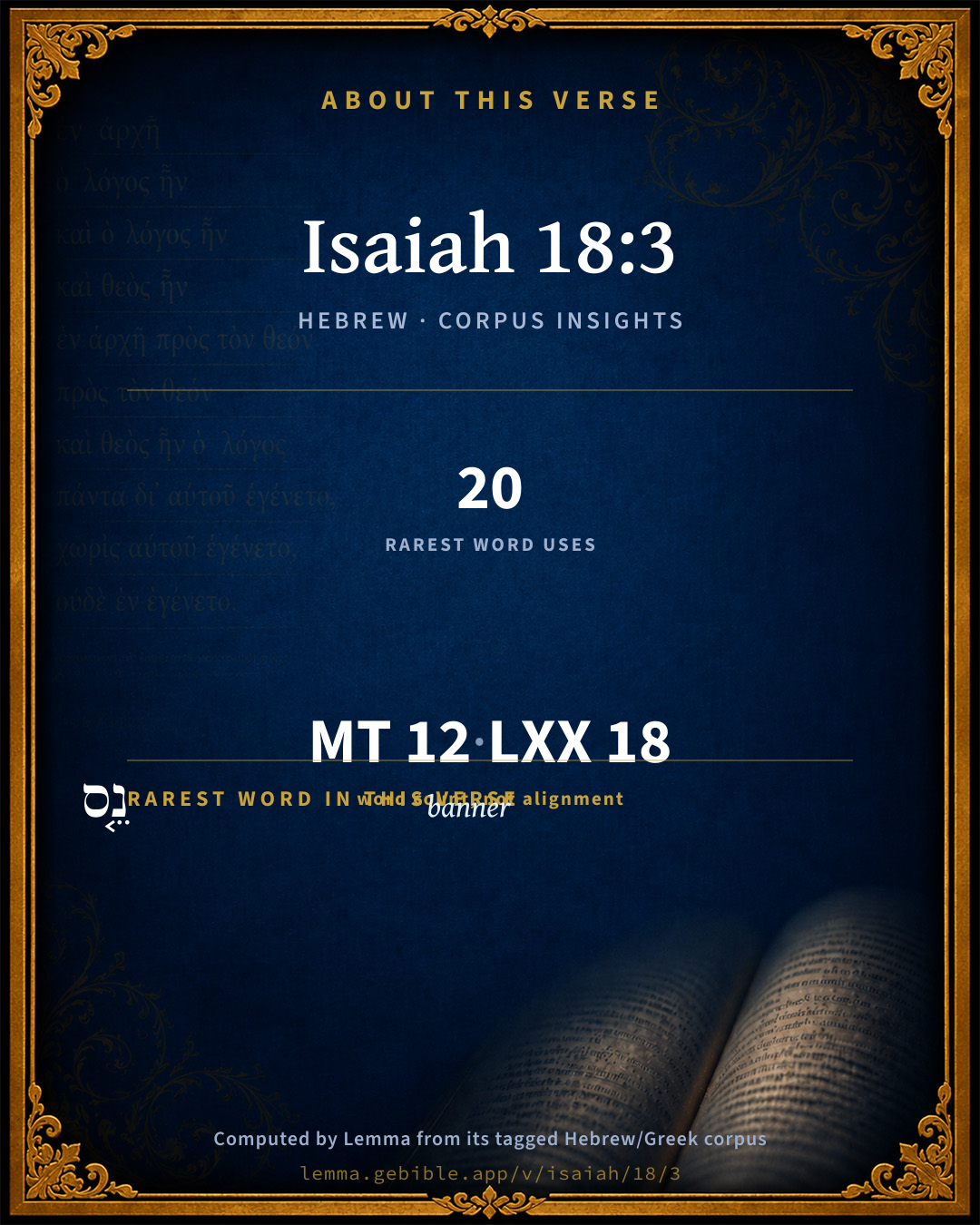
The rarest word here is נֵ֤ס banner H5251 — appearing just 20 times in the whole Hebrew Bible.

Shared distinctive vocabulary

נֵ֤ס banner H5251 occurs in 20 verses of the Hebrew Bible. Also found in:

Grammatical profile

  • 6 verbs
  • 6 nouns

Verb forms

  • יֹשְׁבֵ֥י Qal · Participle Active
  • וְשֹׁ֣כְנֵי Qal · Participle Active
  • כִּנְשֹׂא Qal · Infinitive Construct
  • תִּרְא֔וּ Qal · Imperfect
  • וְכִתְקֹ֥עַ Qal · Infinitive Construct
  • תִּשְׁמָֽעוּ Qal · Imperfect

Hebrew & Septuagint length

In English translation the verse runs 29 words from the Hebrew and 37 from the Septuagint (LXX English) — closely comparable.

A rough comparison of the two English renderings, which tokenize alike — not a word-level alignment.

Word counts can differ between the Hebrew and the Greek without any difference in meaning — e.g. the Hebrew direct-object marker אֵת has no separate Greek word, and Greek often adds the article ὁ.

In the original languages it is 12 Hebrew tokens and 18 Greek tokens — but the two are counted differently (Hebrew bundles its prefixes and suffixes into one token; the Greek is in lemma form), so that isn’t a like-for-like length.

Cross-references

15

Topical passages linked to Isaiah 18:3 in the Treasury of Scripture Knowledge — connected by theme and wording, ordered by reader-vote popularity; previews shown in the World English Bible.

  • Isaiah 5:26 He will lift up a banner to the nations from far, And he will whistle for them from the end of the earth. Behold, they will come speedily and swiftly.
  • Isaiah 26:11 Yahweh, your hand is lifted up, yet they don't see: but they shall see [your] zeal for the people, and be disappointed; yes, fire shall devour your adversaries.
  • Psalms 49:1–2 Hear this, all you peoples. Listen, all you inhabitants of the world,
  • Psalms 50:1 The Mighty One, God, Yahweh, speaks, And calls the earth from sunrise to sunset.
  • Isaiah 1:2 Hear, heavens, And listen, earth; for Yahweh has spoken: I have nourished and brought up children, And they have rebelled against me.
  • Isaiah 7:18 It will happen in that day that Yahweh will whistle for the fly that is in the uttermost part of the rivers of Egypt, and for the bee that is in the land of Assyria.
  • Isaiah 13:2 Set up an ensign on the bare mountain, lift up the voice to them, wave the hand, that they may go into the gates of the nobles.
  • Isaiah 13:4 The noise of a multitude in the mountains, as of a great people! the noise of a tumult of the kingdoms of the nations gathered together! Yahweh of Hosts is mustering the host for the battle.
  • Jeremiah 22:29 O earth, earth, earth, hear the word of Yahweh.
  • Amos 3:6–8 Does the trumpet alarm sound in a city, Without the people being afraid? Does evil happen to a city, And Yahweh hasn't done it?
  • Micah 6:2 Hear, you mountains, Yahweh's controversy, And you enduring foundations of the earth; For Yahweh has a controversy with his people, And he will contend with Israel.
  • Micah 6:9 Yahweh's voice calls to the city, And wisdom sees your name: "Listen to the rod, And he who appointed it.
  • Zechariah 9:14 Yahweh will be seen over them; And his arrow will go flash like lightning; And the Lord Yahweh will blow the trumpet, And will go with whirlwinds of the south.
  • Matthew 13:9 He who has ears to hear, let him hear."
  • Matthew 13:16 "But blessed are your eyes, for they see; and your ears, for they hear.

Cross-references courtesy of OpenBible.info (CC BY 4.0).

Hebrew and Greek witnesses Masoretic Hebrew ↔ Greek Septuagint

The same verse in the two great witnesses to the Old Testament, shown verse-for-verse.

These are two independent witnesses, not word-aligned to each other, and the Septuagint is shown in lemma (dictionary) form.

Hebrew Isaiah 18:3 Masoretic · Westminster Leningrad Codex

כָּל יֹשְׁבֵ֥י תֵבֵ֖ל וְשֹׁ֣כְנֵי אָ֑רֶץ כִּנְשֹׂא נֵ֤ס הָרִים֙ תִּרְא֔וּ וְכִתְקֹ֥עַ שׁוֹפָ֖ר תִּשְׁמָֽעוּ

All you inhabitants of the world, and you dwellers on the earth, when an ensign is lifted up on the mountains, look; and when the trumpet is blown, listen.

World English Bible · Public Domain

Greek LXX Isaiah 18:3 Septuagint · lemma form

πᾶς ὡς χώρα καταοἰκέω καταοἰκέω ὁ χώρα αὐτός ὡσεί σημεῖον ἀπό ὄρος αἴρω ὡς σάλπιγξ φωνή ἀκουστός εἰμί

Now all the rivers of the land shall be inhabited as an inhabited country; their land shall be as when a signal is raised from a mountain; it shall be audible as the sound of a trumpet.

LXX2012 (modern English Septuagint) · Public Domain

On this verse, Adam Clarke's Commentary discusses the Septuagint’s reading. Read the note in Commentary ↓

Hebrew: Westminster Leningrad Codex (CC BY 4.0). Greek: Septuagint (public domain); English from LXX2012 (modern English Septuagint) (Public Domain). How the Septuagint differs from the Hebrew →

Targum (Aramaic paraphrase)

1

The Targum is the ancient Jewish Aramaic paraphrase of the Hebrew Scriptures — an interpretive translation, not the Hebrew text itself. Onkelos (literal) and Pseudo-Jonathan (expansive) render the Torah, and Jonathan the Prophets. Coverage is partial: where no permissively-licensed English translation exists for a verse, only the Aramaic is shown. This is verse-level text, not a word-by-word alignment to the Hebrew.

  1. Targum Jonathan Prophets (Joshua–Malachi)
    כָּל דְיָתְבִין בְּתֵבֵל וּדְשָׁרָן בְּאַרְעָא כְּמִזְקַף אָתָא עַל טוּרַיָא תֶחְזוּן אָתָא וּכְמִתְקַע שׁוֹפָרָא תִּשְׁמְעוּן פוּרְקַן:

    All ye inhabitants of the world, and ye dwellers on the earth, when the standard is lifted up on the mountains, ye shall see the standard, and the trumpet shall sound, ye shall hear of redemption.

    Targum Jonathan — Aramaic: “Mikraot Gedolot” (public domain). English: “Sefaria Community Translation” (CC0 1.0 (public-domain dedication)); “London "Chaldee Paraphrase," 1871” (public domain). Text via Sefaria.

Commentary

Notes on Isaiah 18:3 from classic Christian and Jewish commentators (each source and its license shown beneath its notes). The classic Christian expositions comment on the surrounding passage and are grouped to its opening verse, so a note may address several verses; the Jewish commentaries on the Tanakh (Rashi and others) are per-verse, so they appear only where the commentator wrote on this verse.

Lemma curates 59 commentaries, every one of them public domain or Creative Commons licensed, each selected and text-cleaned for this edition rather than reprinted as found. About our sources →

Trapp's Complete Commentary

John Trapp

Isa 18:3 All ye inhabitants of the world, and dwellers on the earth, see ye, when he lifteth up an ensign on the mountains; and when he bloweth a trumpet, hear ye.

Ver. 3. All the inhabitants of the world, see ye.] Or, Ye shall see when he lifteth up a banner on the mountains; and when he bloweth a trumpet, ye shall hear - i.e., ye shall shortly see the Assyrians returning from the conquest of the Ethiopian with glory and great joy; but what will the Lord do the while?

John Trapp, A Commentary or Exposition upon All the Books of the Old and New Testament (1647–1656) — public domain. Text from a community e-Sword module.

The Biblical Illustrator

Joseph S. Exell

Isa_18:3

All ye inhabitants of the world . . . see ye

Missionary exertion

Our whole hope of success rests on the prophecies of the Word of God, declaring it to be His will.

We must first accurately examine what is the object we have in view, for if it be not in unison with the prophets it must be disappointed.

I. THE LANGUAGE OF THE NEW TESTAMENT ON THIS SUBJECT. What does that give us reason to expect under the present dispensation? An elect Church, though in one sense it is called an universal Church, because it is gathered out of all nations on the earth.

II. THE EXPERIENCE OF THE CHURCH AS STRENGTHENING THIS ARGUMENT. For long years the Gospel has been preached, and what is the result? But is it not written in the Scriptures that all flesh shall see the salvation of God, etc.? Do we not, then, rightly expect the conversion of all the people on the earth? Yes, it is written, and shall come to pass. But the means are also written, and the time. What are the means? What is the time? All ye inhabitants of the world, and dwellers on the earth, see ye! When? When He lifteth up an ensign on the mountains, and when He bloweth a trumpet, hear ye! I will read you an extract from a missionary sermon preached by Dr. Buchanan shortly before his death: The ensign to be lifted up is the Jewish Church restored to Zion; and the Gospel trumpet is to be sounded by Jewish missionaries, for to them is reserved the evangelising of the heathen. But before this will be the coming of the Son of God. (Hugh MNeile, M. A.)

The Biblical Illustrator, edited by Joseph S. Exell (c. 1880s–1900s) — public domain. Text from a community e-Sword module.

Joseph Benson's Commentary

Isa 18:3. All ye inhabitants of the world, &c,, see ye — Take notice of what I say, and what God will do: Or, Ye shall see. “We have here the declaration made to the other people of the world, to expect the fall of the Assyrian. God invites all the people of the earth to this sight; that, as soon as they should observe the sign appointed by God, namely, the standards lifted up by Sennacherib, on the mountains of Judea, and the sound of the trumpets of the hostile army preparing to besiege Jerusalem, they should attend to the execution of this divine judgment.” — Vitringa.

Joseph Benson's Commentary on the Old and New Testaments (1811–1818) — public domain. Text from a community e-Sword module.

Tyndale Open Study Notes

Tyndale Open Resources

18:3 Both the battle flag and ram’s horn were used to marshal and send signals to armies in battle (see Judg 3:27; 6:34; 2 Sam 2:28).

Tyndale Open Study Notes — © Tyndale Open Resources, licensed CC BY-SA 4.0. Text via the HelloAO Bible API.

Geneva Bible (1599)

Geneva Bible translators

When the Lord prepared to fight against the Ethiopians.

Geneva Bible (1599) marginal notes — public domain. Text via Bolls.life.

Jamieson, Fausset & Brown

Robert Jamieson, A. R. Fausset & David Brown

see ye . . . hear ye--rather, "ye shall see . . . shall hear." Call to the whole earth to be witnesses of what Jehovah ("He") is about to do. He will "lift up an ensign," calling the Assyrian motley hosts together (Isa 5:26) on "the mountains" round Jerusalem, to their own destruction. This (the eighteenth chapter) declares the coming overthrow of those armies whose presence is announced in Isa 17:12-13. The same motive, which led Hezekiah to seek aid from Egypt, led him to accept gladly the Ethiopian Tirhakah's aid (Isa 36:6; Isa 37:9). Ethiopia, Egypt, and Judea were probably leagued together against the common enemy, 713 B.C. See notes on the twenty-second chapter, where a difference of tone (as referring to a different period) as to Ethiopia is observable. HORSLEY takes the "ensign" to be the cross, and the "trumpet" the Gospel trumpet, which shall be sounded more loudly in the last days.

Jamieson, Fausset & Brown — Commentary Critical and Explanatory on the Whole Bible (1871) — public domain (CC PDM 1.0). Text via the HelloAO Bible API.

Adam Clarke's Commentary

Verse 3. When he lifteth up an ensign - "When the standard is lifted up"] I take God to be the Agent in this verse; and that by the standard and the trumpet are meant the meteors, the thunder, the lightning, the storm, earthquake, and tempest, by which Sennacherib's army shall be destroyed, or by which at least the destruction of it shall be accompanied; as it is described in Isa 10:16-17; Isa 29:6, and Isa 30:30-31. See also Ps 76:1-12, and the title of it, according to the Septuagint, Vulgate and AEthiopic. They are called, by a bold metaphor, the standard lifted up, and the trumpet sounded. The latter is used by Homer, I think with great force, in his introduction to the battle of the gods; though I find it has disgusted some of the minor critics: -

Βραχε δ' ευρεια χθων,

Αμφι δε σαλπιγζεν μεγας ουρανος.

Il. xxi. 388.

"Heaven in loud thunders bids the trumpet sound,

And wide beneath them groans the rending ground."

POPE.

Adam Clarke's Commentary on the Bible (1810–1826) — public domain. Text from a community e-Sword/MySword module.

Ellicott's Commentary for English Readers

(3) When he lifteth up an ensign . . .—Both clauses are better taken as indefinite, when an ensign is set up . . . when a trumpet is sounded. The prophet calls on all nations (Ethiopia being specially included) to watch for the signal that shall be given, distinct as the beacon-fire on the hill, or the alarm of the trumpet, to proclaim the downfall of Assyria.

A Bible Commentary for English Readers, edited by Charles John Ellicott (1878–1897) — public domain. Text from a community e-Sword module.

The Cambridge Bible for Schools and Colleges

gen. ed. J. J. S. Perowne

3. This verse gives the message which the ambassadors are to carry home to their countrymen, although it concerns all the world as much as the Ethiopians.

Render: when a signal is lifted up … when a trumpet is blown. Cf. ch. Isa_13:2. Since the whole process is supernatural it is idle to enquire what the “signal” and “trumpet” signify. The verse is simply a summons to be prepared for the moment of Jehovah’s decisive intervention.

The Cambridge Bible for Schools and Colleges (gen. ed. J. J. S. Perowne; Cambridge University Press, 1878–1918) — public domain. Text from a community e-Sword module.

John Gill's Exposition

All ye inhabitants of the world, and dwellers on the earth,.... All the men of the world are here called upon, either by the Lord, or rather by the prophet, to be eye and ear witnesses of the judgment that should be inflicted upon the above nation, and of the salvation of his own people; which should be so manifest, that all should see it as easily as an ensign set up on a mountain; and the news of it should ring through the earth, and be as plainly heard as when a trumpet is blown: unless it should be thought that these are the words of the messengers sent to the above nation, addressing them in such terms, assuring them, that, however stupid and secure they were now, they should quickly see the sign and hear the alarm of war; it being usual to call any large kingdom the world, and the earth:

see ye, when be lifteth up an ensign on the mountains; or ye shall see this as clearly as when a flag is set up on a mountain; or ye shall be sensible of this judgment coming on, when a standard shall be set up on the mountains, to gather the people to war. Vitringa interprets this of the mountains of Judea, where the Assyrians would set up their banners, and blow their trumpets, as follows:

and when he bloweth a trumpet, hear ye; or, "ye shall hear"; the trumpet sounding as an alarm of war, by which the people will be summoned, and come to execute the judgment threatened. The Targum is,

"ye shall hear the redemption;''

that is, of Israel, in the times of the Messiah, and in the war of Gog and Magog; of which times Jarchi and Kimchi interpret this whole prophecy.

John Gill's Exposition of the Whole Bible (1746–1763) — public domain (CC PDM 1.0). Text via the HelloAO Bible API.

Albert Barnes' Notes on the Bible

All ye inhabitants of the world - These are to be regarded as the words of the prophet summoning all nations to attend to that which was about to occur. Grotius, however, and some others, suppose that they are the words of the Ethiopians. The meaning is, that the events which are here predicted would be of so public a nature as to attract the attention of all the world.

When he - Vitringa supposes that this means the Assyrians lifting up a standard on the mountains of Judea. But the better interpretation is that which refers it to the people of Nubia, mustering their forces for war. ‘All nations behold when that people collects an army; sounds the trumpet for war; and arrays its military forces for battle. See then the judgments that God will inflict on them - their discomfiture Isa 18:4-7, and their turning to Yahweh, and sending an offering to him Isa 18:7.’ According to this interpretation, it will refer to the people making preparation for battle; and perhaps it may mean that they were preparing to join the enemies of Judea - “not improbably preparing to join the forces of Sennacherib, and to invade Judea.” For this purpose it may have been that the messengers were sent to negotiate the terms of alliance with Sennacherib; and the object of the prophecy is, to assure the Jews that this people, as well as Sennacherib, would be discomfited, and that they would yet bring an offering to God Isa 18:7.

Lifteth up an ensign - A military standard (see the note at Isa 5:26).

And when he bloweth a trumpet - Also a signal for an army to assemble (see the note at Isa 13:2).

Albert Barnes' Notes on the Bible (1834–1885) — public domain. Text from a community e-Sword/MySword module.

Matthew Poole's English Annotations

See ye; take notice of what I say and God will do. Or, ye shall see it; you shall be eye-witnesses of this dreadful woe or judgment which I am bringing upon the people of whom I have spoken: The prophet doth in a manner summon all nations to bear witness of his prophecy, and of the accomplishment thereof.

When he lifteth up an ensign on the mountains, and when he bloweth a trumpet; when God shall gather together the nations, as it were, by the lifting up of an ensign, or by the sound of a trumpet, to execute his judgments upon this people. Heb. as when a man

lifts up an ensign upon the mountains, which men can easily see; and as when a man sounds a trumpet, they can hear: no less visible and manifest shall this judgment of God be.

Hear ye; ye shall hear it, as in the other branch.

Matthew Poole's English Annotations on the Holy Bible (1683–1685) — public domain. Text from a community e-Sword/MySword module.

Whedon's Commentary on the Bible

Daniel D. Whedon

3. See ye, when, etc. — The picture takes in the prophet as saying to all the people in those far lands, “Be ready when ye shall see the signal raised on the mountains; note it, when the trumpet shall sound; listen, and be on the alert.” The prophet’s alarm is in the interest of Judah, or, which is the same thing, of Jehovah’s cause. The passage-way of the armies of the rival empires lay through Judah, now a dependent of Egypt, on account of which dependence Judah is to suffer if Assyria prevails. The implied prediction is, that God is about to deliver the world from the all-conquering might of Assyria.

Daniel D. Whedon (gen. ed.), Commentary on the Old and New Testaments (1874–1909) — public domain. Text from a community e-Sword module.

The Pulpit Commentary

All ye inhabitants of the world. From exhorting the messengers to hasten on their errand, Isaiah turns to the nations generally, and bids them attend to a coming signal an ensign is about to be raised, a trumpet is about to be sounded let them gaze and hearken; the result will be well worth noting. The imagery is not to be taken literally, but in the same way as the notices in Isa_11:10, 12 13:2. When he lifteth up an ensign... when he bloweth a trumpet; rather, when an ensign is lifted up... when a trumpet sounds. On the mountains. Wherever the great event took place, the signal for it was given on the mountains of Judea. (see 2Ki_19:20-34)

The Pulpit Commentary (1880–1919), ed. H.D.M. Spence-Jones & Joseph S. Exell — public domain. Text from a community e-Sword module.

John Wesley's Explanatory Notes

When - When God shall gather together the nations, as it were by the lifting up of an ensign, or by the sound of a trumpet, to execute his judgments upon this people.

John Wesley, Explanatory Notes Upon the Whole Bible (1754–1765) — public domain. Text via the GEBible commentary corpus.

J. A. Alexander on Isaiah

Joseph Addison Alexander

“All ye inhabitants of the world and dwellers one the earth shall see as it were the raising of a standard on the mountains, and shall hear as it were the blowing of a trumpet.” Another construction, more generally adopted, makes the verbs imperative. So the English Version: ‘see ye when he lifteth up an ensign on the mountains, and when he bloweth a trumpet hear ye.’ There seems, however, to be no sufficient reason for departing from the strict translation of the verbs as future. In either case, the verse invites the attention of the world to some great event.

‘All ye inhabitants of the world and dwellers on the earth shall see as it were the raising of a standard on the mountains, and shall hear as it were the blowing of a trumpet.’ Another construction, more generally adopted, makes the verbs imperative. So the English Version: ‘see ye when he lifteth up an ensign on the mountains, and when he bloweth a trumpet hear ye.’ There seems, however, to be no sufficient reason for departing from the strict translation of the verbs as future. In either case, the verse invites the attention of the world to some great event.

Joseph Addison Alexander, The Prophecies of Isaiah (1846–1847; New York: Scribner, 1870–1878) — public domain. Text from a community e-Sword module.

unfoldingWord translationNotes

Door43 World Missions Community

Connecting Statement:

Verse 3 tells what the messengers in Isaiah 18:2 must say to the people of the world.

All you inhabitants of the world ... you who live on the earth

These two phrases mean basically the same thing. AT: "All you people on the earth" (See: Parallelism)

when a signal is lifted up on the mountains, look; and when the trumpet is blown, listen

The signal and trumpet were to call people to battle. The commands to look and listen are commands to pay attention and prepare for battle. AT: "pay attention when the signal is lifted up on the mountains and the trumpet is blown"

when a signal is lifted up on the mountains, look

The signal was a flag used to call people to battle. This can be stated in active form. AT: "pay attention when you see the battle flag on the mountains" (See: Assumed Knowledge and Implicit Information and Active or Passive)

when the trumpet is blown, listen

The trumpets were used to call people to battle. This can be stated in active form. AT: "pay attention when you hear the sound of the battle trumpets" (See: Assumed Knowledge and Implicit Information and Active or Passive)

translationWords

earth

trumpet

unfoldingWord translationNotes — © Distant Shores Media and the Door43 World Missions Community, licensed CC BY-SA 4.0. Source: git.door43.org/Door43/en_tn.

Rashi

Rabbi Shlomo Yitzchaki (Rashi)

All inhabitants of the world, etc. You need not send messengers for this, for when a standard of the mountains is raised, you shall see the ingathering of the exiles, and when a shofar is sounded you shall hear.

Rashi on the Tanakh — English translations: “The Judaica Press complete Tanach with Rashi, translated by A. J. Rosenberg” (CC BY 4.0); “Pentateuch with Rashi's commentary by M. Rosenbaum and A.M. Silbermann, 1929-1934” (public domain); “The Metsudah Tanach series, Lakewood, N.J” (CC BY 4.0); and “The Book of Joshua, Metsudah Publications, 1997” (CC BY 4.0). Text via Sefaria.

Ibn Ezra

Rabbi Abraham ibn Ezra

All ye inhabitants of the world. As if a banner were raised over the whole earth.

You shall hear, so as to know the work of the Lord, which He has done in the camp of Sennacherib.

Ibn Ezra on the Tanakh — English translations: “Sefaria Community Translation” (CC0 1.0 (public-domain dedication)); “Yalkut, Sifsei Chachomim Chumash, Metsudah Publications, 2009” (CC BY 4.0); and “Commentary of Ibn Ezra on Isaiah - trans. by M. Friedlander, 1873” (public domain). Text via Sefaria.

Lesson kit

Teaching starters — assembled from the data on this page, not authored interpretation. Every prompt links to the verse data it draws on. Edit before teaching.

Isaiah, in the Prophets, opens this verse with 12 words (12 distinct Hebrew lemmas). Its most distinctive word is nêç (“banner”). A historical commentator’s framing appears above. Read the whole chapter for the surrounding context.

Discussion questions

  1. What does “banner” (nêç) contribute to the verse as a whole?
  2. How does Numbers 21:8, which shares the word «banner», read alongside this verse?
  3. The translations on this page render this verse differently — a whole-verse word diff, not a word-by-word alignment. What might account for the different wordings?
  4. «יֹשְׁבֵ֥י» is a Qal Participle Active verb. How does that grammatical form shape the action described?
  5. Compare how Trapp's Complete Commentary and The Biblical Illustrator read this verse. Where do they agree or differ?

Things to notice

Reading settings

Reading text

Shown beneath each verse's original-language words.

Old Testament
Old Testament edition

Read the OT as the Masoretic Hebrew (MT) or the Greek Septuagint (LXX).

English shown for the Greek Septuagint (in the Hebrew ↔ Greek comparison).

Comparing translations? Open the Compare panel on any verse page to stack up to four side by side.