Isaiah 47:3

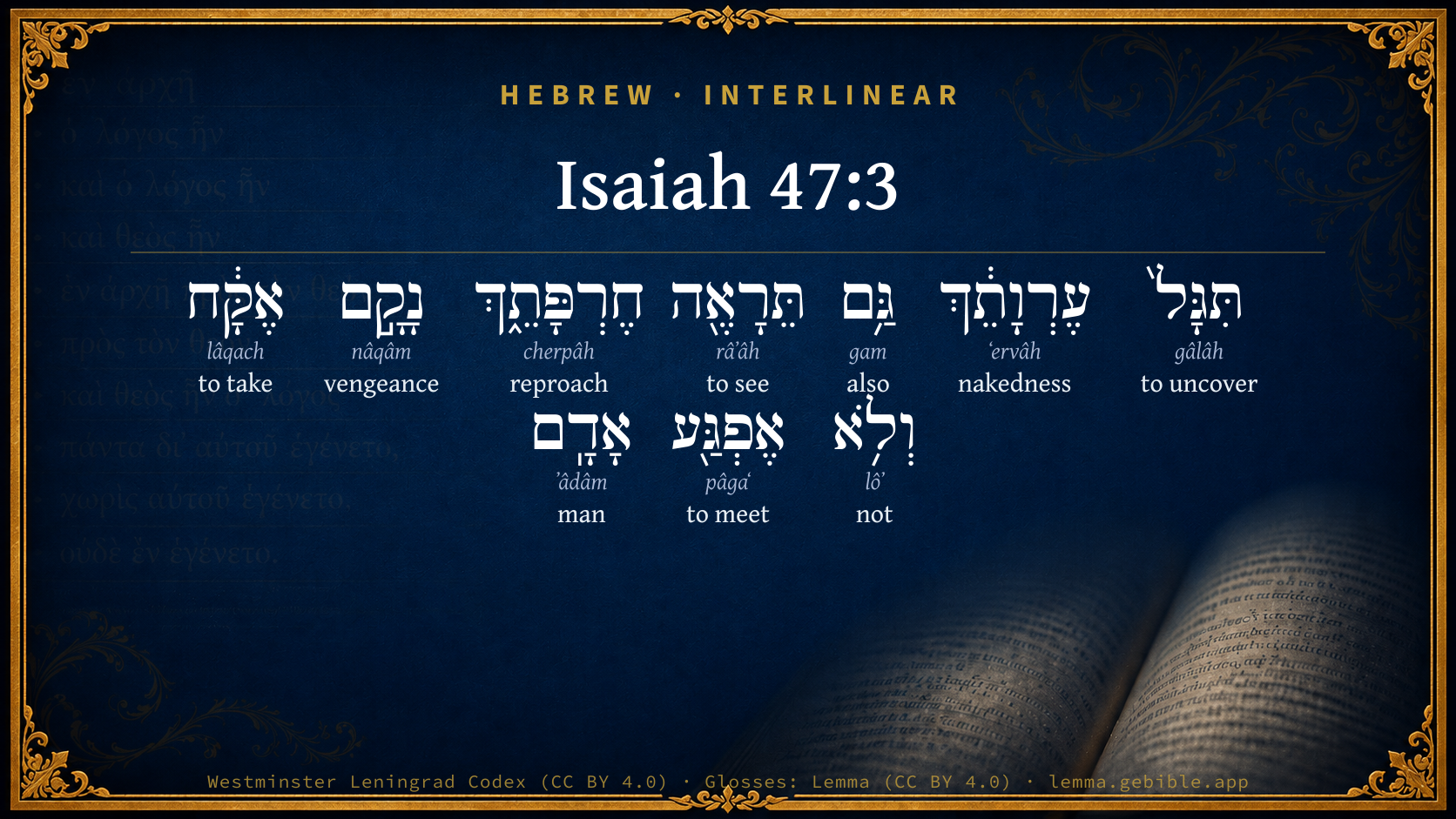
Hebrew (Westminster Leningrad Codex) Isaiah 47:3 appears in the Hebrew Old Testament. The text above is from the Westminster Leningrad Codex. Each word links to its Strong’s number, a concise gloss, and parsing drawn from the Open Scriptures Hebrew Bible morphology. Click any word for its full Brown-Driver-Briggs (BDB) entry.
Download image
Cite this verse

Isaiah 47:3 (World English Bible). Public Domain. Lemma interlinear Bible study tool, https://lemma.gebible.app/v/isaiah/47/3.

Show BibTeX & RIS
BibTeX
RIS
English Translation
Your nakedness shall be uncovered, yes, your shame shall be seen: I will take vengeance, and will spare no man.
World English Bible · Public Domain
Download a study sheet

One document with this verse’s original text, its word-by-word gloss line, the meaning frame, cross-references with their text, attributed commentary, and full source and license credits — printable, and it pastes into notes with its structure intact.

This verse Autodidact and up

Study sheet (.html) Plain text (.txt)

A passage Seminary Student

Up to 50 verses in one chapter. A passage sheet keeps up to 6 commentary sources and 12 cross-references per verse, in the order this page ranks them, and says so on the sheet whenever that leaves anything out. Ask for a single verse and you get the Autodidact verse sheet above.

Everything on this page stays free to read, with no account — the sheet is a download of what is already on screen, not access to it.

Want to remove ads? Support Godless Engineer
Compare translations 3

The same verse in 3 English versions, stacked beneath the original-language interlinear above. Click any original word for its lexicon entry.

Each is an independent rendering of the whole verse — the interlinear is not word-aligned to these translations.

Highlighted words mark where these versions differ — a whole-verse word diff, not a word-by-word alignment.

  • World English Bible Public Domain
    Your nakedness shall be uncovered, yes, your shame shall be seen: I will take vengeance, and will spare no man.
  • King James Version Public Domain
    Thy nakedness shall be uncovered, yea, thy shame shall be seen: I will take vengeance, and I will not meet thee as a man.
  • unfoldingWord Literal Text CC BY-SA 4.0
    Your nakedness will be uncovered; your reproach will also be seen. I will take vengeance, and I will not meet a man.” q1

unfoldingWord Literal Text — © unfoldingWord, licensed CC BY-SA 4.0. Word-aligned USFM3 via Door43 (git.door43.org/unfoldingWord/en_ult).

Versions to compare (up to 4)

3 of 4 selected

Show all 18 translations

Every available English version of this verse, each an independent rendering of the whole verse.

  • World English Bible Public Domain
    Your nakedness shall be uncovered, yes, your shame shall be seen: I will take vengeance, and will spare no man.
  • Berean Standard Bible Public Domain
    Your nakedness will be uncovered and your shame will be exposed. I will take vengeance; I will spare no one.”
  • Majority Standard Bible Public Domain
    Your nakedness will be uncovered and your shame will be exposed. I will take vengeance; I will spare no one.”
  • King James Version Public Domain
    Thy nakedness shall be uncovered, yea, thy shame shall be seen: I will take vengeance, and I will not meet thee as a man.
  • American Standard Version (1901) Public Domain
    Thy nakedness shall be uncovered, yea, thy shame shall be seen: I will take vengeance, and will spare no man.
  • Revised Version (1885) Public Domain
    Thy nakedness shall be uncovered, yea, thy shame shall be seen: I will take vengeance, and will accept no man.
  • Geneva Bible (1599) Public Domain
    Thy filthinesse shall be discouered, and thy shame shall be seene: I will take vengeance, and I will not meete thee as a man.
  • Douay-Rheims (1899) Public Domain
    Thy nakedness shall be discovered, and thy shame shall be seen: I will take vengeance, and no man shall resist me.
  • Young's Literal Translation Public Domain
    Revealed is thy nakedness, yea, seen is thy reproach, Vengeance I take, and I meet not a man.
  • Literal Standard Version CC BY-SA 4.0
    Your nakedness is revealed, indeed, your reproach is seen, || I take vengeance, and I do not meet a man.”
  • Unlocked Literal Bible CC BY-SA 4.0
    Your nakedness will be uncovered, yes, your shame will be seen: I will take vengeance and will not spare a man.
  • unfoldingWord Literal Text CC BY-SA 4.0
    Your nakedness will be uncovered; your reproach will also be seen. I will take vengeance, and I will not meet a man.” q1
  • Darby Bible Public Domain
    thy nakedness shall be uncovered, yea, thy shame shall be seen. I will take vengeance, and I will meet none [to stay me]....
  • World Messianic Bible Public Domain
    Your nakedness will be uncovered. Yes, your shame will be seen. I will take vengeance, and will spare no one.”
  • Webster's Bible Public Domain
    Thy nakedness shall be uncovered, yes, thy shame shall be seen: I will take vengeance, and I will not meet thee as a man.
  • Free Bible Version CC BY-SA 4.0
    You will be seen naked; what should be kept private will be shamefully exposed. I will take vengeance—I won't spare anyone.
  • Bible in Basic English Public Domain
    The shame of your unclothed condition will be seen by all: I will give punishment without mercy,
  • JPS Tanakh (1917) Public Domain
    Thy nakedness shall be uncovered, yea, thy shame shall be seen; I will take vengeance, and will let no man intercede.

Literal Standard Version (2020), Covenant Press — licensed CC BY-SA 4.0. Text via the HelloAO Bible API (eBible.org). Unlocked Literal Bible (unfoldingWord) — licensed CC BY-SA 4.0. Text via the HelloAO Bible API (eBible.org). unfoldingWord Literal Text — © unfoldingWord, licensed CC BY-SA 4.0. Word-aligned USFM3 via Door43 (git.door43.org/unfoldingWord/en_ult). Free Bible Version, Dr. Jonathan Gallagher — licensed CC BY-SA 4.0. Text via the HelloAO Bible API (eBible.org).

Word by word

More ways to search: Search by grammar → Find every occurrence → Compare this word →

Practice this passage: Drill this verse → Learn its vocabulary →

נָקָ֣ם
nâqâm
H5359
“vengeance”
Noun, Common, Masculine, Singular, Absolute
Part of Speech
Noun
Type
Common
Gender
Masculine
Number
Singular
State
Absolute
Full BDB Definition

Origin: from H5358

TWOT: 1413a

vengeance - vengeance (by God, by Samson, by enemies of Judah)
  1. תִּגָּל֙ gâlâh H1540 “to uncover” Verb, Niphal, Imperfect, 3rd Person, Feminine, Singular
  2. עֶרְוָתֵ֔ךְ ʻervâh H6172 “nakedness · your” Noun, Common, Feminine, Singular, Construct + Suffix, Personal, 2nd Person, Feminine, Singular
  3. גַּ֥ם gam H1571 “also” Particle, Accusative
  4. תֵּרָאֶ֖ה râʼâh H7200 “to see” Verb, Niphal, Imperfect, 3rd Person, Feminine, Singular
  5. חֶרְפָּתֵ֑ךְ cherpâh H2781 “reproach · your” Noun, Common, Feminine, Singular, Construct + Suffix, Personal, 2nd Person, Feminine, Singular
  6. אֶקָּ֔ח lâqach H3947 “to take” Verb, Qal, Imperfect, 1st Person, Common, Singular
  7. וְלֹ֥א lôʼ H3808 “and · not” Conjunction + Particle, Negative
  8. אֶפְגַּ֖ע pâgaʻ H6293 “to meet” Verb, Qal, Imperfect, 1st Person, Common, Singular
  9. אָדָֽם ʼâdâm H120 “man” Noun, Common, Masculine, Singular, Absolute

About this verse

These counts appear in no published source. They are computed here, from the morphology-tagged text and Lemma’s own curated glosses. What Lemma adds →

10
words
10
distinct lemmas
Prophets
section

Notable vocabulary

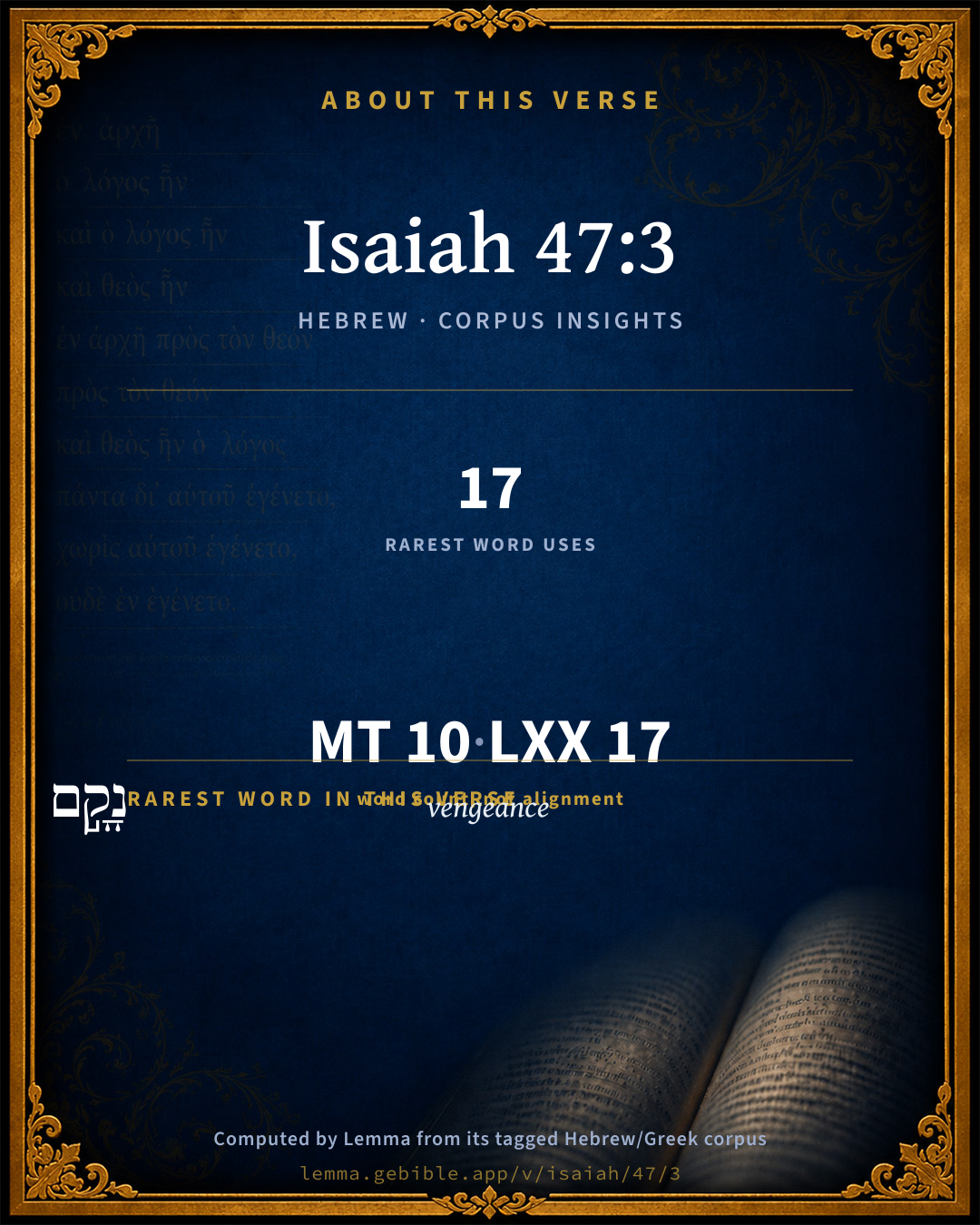
The rarest word here is נָקָ֣ם vengeance H5359 — appearing just 17 times in the whole Hebrew Bible.

Shared distinctive vocabulary

נָקָ֣ם vengeance H5359 occurs in 17 verses of the Hebrew Bible. Also found in:

Grammatical profile

  • 4 verbs
  • 4 nouns
  • 2 particles

Verb forms

  • תִּגָּל֙ Niphal · Imperfect
  • תֵּרָאֶ֖ה Niphal · Imperfect
  • אֶקָּ֔ח Qal · Imperfect
  • אֶפְגַּ֖ע Qal · Imperfect

Hebrew & Septuagint length

In English translation the verse runs 20 words from the Hebrew and 27 from the Septuagint (LXX English) — closely comparable.

A rough comparison of the two English renderings, which tokenize alike — not a word-level alignment.

Word counts can differ between the Hebrew and the Greek without any difference in meaning — e.g. the Hebrew direct-object marker אֵת has no separate Greek word, and Greek often adds the article ὁ.

In the original languages it is 10 Hebrew tokens and 17 Greek tokens — but the two are counted differently (Hebrew bundles its prefixes and suffixes into one token; the Greek is in lemma form), so that isn’t a like-for-like length.

Cross-references

23

Topical passages linked to Isaiah 47:3 in the Treasury of Scripture Knowledge — connected by theme and wording, ordered by reader-vote popularity; previews shown in the World English Bible.

  • Nahum 3:5 "Behold, I am against you," says Yahweh of Hosts, "and I will lift your skirts over your face. I will show the nations your nakedness, and the kingdoms your shame.
  • Jeremiah 51:20–24 You are my battle-axe and weapons of war: and with you will I break in pieces the nations; and with you will I destroy kingdoms;
  • Jeremiah 50:27–28 Kill all her bulls; let them go down to the slaughter: woe to them! for their day is come, the time of their visitation.
  • Revelation 16:19 The great city was divided into three parts, and the cities of the nations fell. Babylon the great was remembered in the sight of God, to give to her the cup of the wine of the fierceness of his wrath.
  • Deuteronomy 32:35 Vengeance is mine, and recompense, At the time when their foot shall slide: For the day of their calamity is at hand, The things that are to come on them shall make haste.
  • Deuteronomy 32:41–43 If I whet my glittering sword, My hand take hold on judgment; I will render vengeance to my adversaries, Will recompense those who hate me.
  • Psalms 94:1–2 Yahweh, you God to whom vengeance belongs, You God to whom vengeance belongs, shine forth.
  • Psalms 137:8–9 Daughter of Babylon, doomed to destruction, He will be happy who rewards you, As you have served us.
  • Isaiah 34:1–8 Come near, you nations, to hear; and listen, you peoples: let the earth hear, and the fullness of it; the world, and all things that come forth from it.
  • Isaiah 59:17–18 He put on righteousness as a breastplate, and a helmet of salvation on his head; and he put on garments of vengeance for clothing, and was clad with zeal as a mantle.
  • Isaiah 63:4–6 For the day of vengeance was in my heart, and the year of my redeemed is come.
  • Jeremiah 13:22 If you say in your heart, Why are these things come on me? for the greatness of your iniquity are your skirts uncovered, and your heels suffer violence.
  • Jeremiah 13:26 Therefore will I also uncover your skirts on your face, and your shame shall appear.
  • Jeremiah 51:4 They shall fall down slain in the land of the Chaldeans, and thrust through in her streets.
  • Jeremiah 51:11 Make sharp the arrows; hold firm the shields: Yahweh has stirred up the spirit of the kings of the Medes; because his purpose is against Babylon, to destroy it: for it is the vengeance of Yahweh, the vengeance of his temple.
  • Jeremiah 51:34–36 Nebuchadrezzar the king of Babylon has devoured me, he has crushed me, he has made me an empty vessel, he has, like a monster, swallowed me up, he has filled his maw with my delicacies; he has cast me out.
  • Jeremiah 51:56 for the destroyer is come on her, even on Babylon, and her mighty men are taken, their bows are broken in pieces; for Yahweh is a God of recompenses, he will surely requite.
  • Ezekiel 16:37 therefore see, I will gather all your lovers, with whom you have taken pleasure, and all those who you have loved, with all those who you have hated; I will even gather them against you on every side, and will uncover your nakedness to them, that they may see all your nakedness.
  • Romans 12:19 Don't seek revenge yourselves, beloved, but give place to God's wrath. For it is written, "Vengeance belongs to me; I will repay, says the Lord."
  • Hebrews 10:30–31 For we know him who said, "Vengeance belongs to me," says the Lord, "I will repay." Again, "The Lord will judge his people."
  • Revelation 6:9–10 When he opened the fifth seal, I saw underneath the altar the souls of those who had been killed for the Word of God, and for the testimony of the Lamb which they had.
  • Revelation 18:5–8 for her sins have reached to the sky, and God has remembered her iniquities.
  • Revelation 18:20 Rejoice over her, O heaven, you saints, apostles, and prophets; for God has judged your judgment on her."

Cross-references courtesy of OpenBible.info (CC BY 4.0).

Hebrew and Greek witnesses Masoretic Hebrew ↔ Greek Septuagint

The same verse in the two great witnesses to the Old Testament, shown verse-for-verse.

These are two independent witnesses, not word-aligned to each other, and the Septuagint is shown in lemma (dictionary) form.

Hebrew Isaiah 47:3 Masoretic · Westminster Leningrad Codex

תִּגָּל֙ עֶרְוָתֵ֔ךְ גַּ֥ם תֵּרָאֶ֖ה חֶרְפָּתֵ֑ךְ נָקָ֣ם אֶקָּ֔ח וְלֹ֥א אֶפְגַּ֖ע אָדָֽם

Your nakedness shall be uncovered, yes, your shame shall be seen: I will take vengeance, and will spare no man.

World English Bible · Public Domain

Greek LXX Isaiah 47:3 Septuagint · lemma form

ἀνακαλύπτω ὁ αἰσχύνη σύ φαίνω ὁ ὀνειδισμός σύ ὁ δίκαιος ἐκ σύ λαμβάνω οὐκέτι μή παραδίδωμι ἄνθρωπος

Your shame shall be uncovered, your reproaches shall be brought to light: I will exact of you due vengeance, I will no longer deliver you to men.

LXX2012 (modern English Septuagint) · Public Domain

On this verse, The Cambridge Bible for Schools and Colleges discusses the Septuagint’s reading. Read the note in Commentary ↓

Hebrew: Westminster Leningrad Codex (CC BY 4.0). Greek: Septuagint (public domain); English from LXX2012 (modern English Septuagint) (Public Domain). How the Septuagint differs from the Hebrew →

Targum (Aramaic paraphrase)

1

The Targum is the ancient Jewish Aramaic paraphrase of the Hebrew Scriptures — an interpretive translation, not the Hebrew text itself. Onkelos (literal) and Pseudo-Jonathan (expansive) render the Torah, and Jonathan the Prophets. Coverage is partial: where no permissively-licensed English translation exists for a verse, only the Aramaic is shown. This is verse-level text, not a word-by-word alignment to the Hebrew.

  1. Targum Jonathan Prophets (Joshua–Malachi)
    תִּתְגְלֵי בַּהֲתָתִיךְ אַף יִתְחֲזֵי קְלָנִיךְ פּוּרְעֲנוּת גְמִירָא אִתְפְּרַע מִינִיךְ וַאֲשַׁנֵי דִינִיךְ מִבְּנֵי אֱנָשָׁא:

    Thy nakedness shall be uncovered, thy shame shall be seen; I will take full vengeance, on thee and I will change thy judgment from the children of men.

    Targum Jonathan — Aramaic: “Mikraot Gedolot” (public domain). English: “Sefaria Community Translation” (CC0 1.0 (public-domain dedication)); “London "Chaldee Paraphrase," 1871” (public domain). Text via Sefaria.

Commentary

Notes on Isaiah 47:3 from classic Christian and Jewish commentators (each source and its license shown beneath its notes). The classic Christian expositions comment on the surrounding passage and are grouped to its opening verse, so a note may address several verses; the Jewish commentaries on the Tanakh (Rashi and others) are per-verse, so they appear only where the commentator wrote on this verse.

Lemma curates 59 commentaries, every one of them public domain or Creative Commons licensed, each selected and text-cleaned for this edition rather than reprinted as found. About our sources →

Trapp's Complete Commentary

John Trapp

Isa 47:3 Thy nakedness shall be uncovered, yea, thy shame shall be seen: I will take vengeance, and I will not meet [thee as] a man.

Ver. 3. Thy nakedness shall be uncovered.] Thou shalt be stripped, and worse dealt with - the ordinary lot of women prisoners. At the sack of Magdeburg by Monsieur Tilly, ladies, gentlewomen, and others, like beasts and dogs, being naked and coupled together, were led into the woods, and there ravished. Such as resisted, the soldiers stripped naked, whipped them, cropped their ears, and so sent them home again.

I will not meet thee as a man.] But as a lion rather; thou shalt have vengeance without mixture of mercy. See 2Sa 7:24 Isa 13:6; Isa 27:7-8 Hos 5:14. Men use sometimes to deal favourably with women, but they shall not do so with thee. {a}

{a} Absque omni humanitatis contemperatione. - Scult. Tractabo te pro divina potentia mea. - Piscat.

John Trapp, A Commentary or Exposition upon All the Books of the Old and New Testament (1647–1656) — public domain. Text from a community e-Sword module.

The Biblical Illustrator

Joseph S. Exell

Isa_47:3

Thy nakedness shall be uncovered

Mental and moral nakedness

Every person hath somewhat which may properly be called his nakedness or shame, in a figurative sense--such as a weak judgment, imprudence, inconsideration, injustice, cruelty, avarice, poverty, or contempt of religion.

Over that he studiously endeavours to throw a veil, that it may be preserved from public observation. Now, when the covering is taken away by which any of these things were concealed, then peoples nakedness or shame is laid open to the inspection of those who possess penetration and discernment. (R. Macculloch.)

A fearful meeting

I. THY NAKEDNESS SHALL BE UNCOVERED. Man practises deceit. He imposes upon himself, and, as far as possible, upon his fellows. He cloaks his sins, his motives, his evil ways. He is not sincere in his professions, not open in his conduct, not honest in his judgments. Sin itself is a monstrous deceit and lie. The author of sin is a liar. And so with the children of the devil. There is nothing in them--in their hearts, lives, characters--that will stand the light of the throne. The truth will flash the sunlight into the chamber of the soul, and into every transaction of life, and lay bare to the eye of God and the quest of the universe the true real state and status of the moral man. Then thy nakedness shall be uncovered. The awful sight of a rational and immortal soul, steeped in guilt, lost to virtue and to God, and deceived to its eternal undoing, will shock the very heavens.

II. YEA, THY SHAME SHALL BE SEEN. The shame of wanton rebellion against the great God, our Heavenly Father; the shame of sinning unto death against the Cross of the loving and dying Christ; the shame of consummating a character of incorrigible wickedness, and a doom more awful than that of sinning angels, under all the light and influences of the glorious Gospel of the blessed God. To look upon such shame in the judgment day will shock and confound the sinner himself, and fill all heaven with loathing and indignation.

III. I WILL TAKE VENGEANCE, AND I WILL NOT MEET THEE AS A MAN. The vengeance of God! Who can stand before it? The partial displays of it in this life, where wrath is restrained and clemency bears rule, are fearful tokens of what is in store for those who refuse offered mercy and exhaust Gods long-suffering goodness in the world of retribution. It is awful to face an angry man whom we have grievously wronged. It is more fearful still to confront a stern judge, who, as minister of the law we have broken, makes inquisition upon us. But oh, to stand face to face before the offended Majesty of heaven, now risen up to take vengeance upon the despisers of His grace, is a thought that may well fill us with the profoundest concern. (Homiletic Review.)

I will not meet thee as a man

I will not meet thee as a man

The sense is very obscure. (Skinner.)

I will run against no man, namely, that I should need to give way to him. (Stier.)

I will not intervene as a man. (Ruetschi.)

I shall not meet a man, so depopulated will Babylon be. (Hahn.)

I shall encounter no one who can resist Me. (Cheyne.)

It means to encounter, meet, hit upon one, not only in a hostile, but also, as here and Isa_64:5, in a friendly sense; so I will befriend no one, pardon no one. (Delitzsch.)

Vengeance I take, and strike treaty with none. (G. A. Smith.)

Possibly, I will take vengeance, and will not spare, saith our Redeemer. (A. B.Davidson, D. D.)

Independently of these minuter questions, it is clear that the whole clause is a laconic explanation of the figures which precede, and which are summed up in the simple, but terrific notion of resistless and inexorable vengeance. (J. A. Alexander.)

I will not meet thee as a man

I will not meet thee as a man, whose compassion may induce him to show ill-judged forbearance and clemency, but thou shalt have judgment without mercy, who hast showed no mercy: I will not meet thee with the justice of a man, that may be perverted, but with that impartial equity which can neither be corrupted nor evaded. I will not meet thee with the anger of a man, which for certain reasons may be concealed or deferred, but with my fierce wrath that shall inevitably consume thee. I will not meet thee with the strength of a man, that may be opposed or vanquished, but clothed with omnipotence that cannot be resisted, so that it shall appear that it is not the vengeance of man, but of God. (R. Macculloch.)

God meeting sinners as a man

His threat is a threat of departure from His usual course. Thus, the expression is resolvable into a statement, that there is a human character about Gods dealings with men, and that it is an evidence of His not having given them up to vengeance, that He continues to meet them as a man. Let us consider the evidences which we have, that as a God of love, God meet us as a man.

I. Let us begin with those OPERATIONS OF THE HOLY GHOST, through which God may emphatically be said to meet us, to come in contact with us. There is much of mystery around these operations; we recognise them by their effects. Not only are these operations hidden from others, but the very party himself, within whose breast they are making themselves felt, can give little or no account whence they come, or how they work. He resolves whatever he experiences into the strugglings of his own mind, and the wrestlings of his own conscience. Would it be for our advantage, that, in meeting us, God should meet us as a God, and not as a man? We could not have borne that God should have spoken with us by unearthly voices, and warned us by unearthly spectacles, and approached us through unearthly avenues. Hence, the evidence that God has dealt lovingly with us, when we observe the appointed method in which the Spirit operates it is, that Divinity may be said to identify itself with humanity.

II. The mind turns naturally to THE GREAT SCHEME OF REDEMPTION, and finds at once in that scheme full material of demonstration. Does it not commend itself to us as an arrangement beautifully indicative of the tenderness of God that the great High Priest of our profession, who was essentially Divine,-was, at the same time, a man? I the Divine nature had entered union with the angelic so that God had met us, not as a man, but as a cherub or seraph, we should have had no power, comparatively, of estimating what had been done on our behalf. We have little or no knowledge of higher orders of being, and there could consequently have been nothing which came home to the heart in the tidings of a Mediator, who, though essentially God, had assumed, for our sake, the likeness of one of those ranks. But when, in order to the meeting us in love in place of vengeance, God has become man, we can judge, we can feel the stupendousness of this humiliation.

III. WHEN CHRISTIANS COME TO DIE, how are they accompanied through the dark valley and across the dark waters? God still meets them as a man. Thy rod and Thy staff a sheperds implements, a mans implements--they comfort me.

IV. What shall we say to THE JUDGMENT SEAT, occupied by One so terrible in His splendour that the very earth and heavens flee away at His presence? This is the last great display of the mercy of that appointment through which a man has been given as a Mediator. How could an angel, with all his purity and his equity, make due allowance for human infirmity, or place himself in our circumstances, so as to decide with reference to our powers and opportunities, and thus throw into his verdict that consideration for our trials and temptations, without which, if there may be the strictness of justice, there can scarcely be the admixture of mercy? But the Man who hath borne our griefs and carried our sorrows this is the Being who is to gather all nations before Him, and determine the eternal condition of each individual.

V. We may draw one more striking illustration of the text from THE APPOINTED MEANS THROUGH WHICH THE GOSPEL IS PROPAGATED. In the great work of gathering in the nations, and shrining the religion of Christ in the households and hearts of the human population, the Almighty makes not use of lofty angels, who have kept their first estate, but of persons who are themselves in peril, themselves but wrestlers for immortality. God, in the person of His ambassadors, might have met us as an angel, and not as a man. You could not, as you listened to the angel, or reflected on his preaching, put from you the feeling that he knew nothing experimentally of your trials, nothing of your difficulties--that he had no evil heart to struggle with, no mighty foes to withstand him in a course of obedience; and very easy you would think it, for one pure as this exalted creature to urge upon men the practice of righteousness, and to declaim with lofty vehemence on the vanity and worthlessness of the best earthly pleasures; very easy to recommend that to which he is prompted by his nature, and to denounce that for which he has neither inclination nor capacity. And this feeling would tell quickly and fatally on the moral hold which he might gain on an audience; making them suspicious that he spake on a matter of which he was no fair judge, and giving to the whole discourse the aspect of an airy speculation. Therefore is it in love to you that God meets you as a man. (H. Melvill, B. D.)

The Biblical Illustrator, edited by Joseph S. Exell (c. 1880s–1900s) — public domain. Text from a community e-Sword module.

Joseph Benson's Commentary

Isa 47:3. Thy nakedness shall be uncovered — Either for want of raiment to cover it, or rather, by thine enemies in the way of scorn and contumely. I will take vengeance — Upon thee, for thy many and great injuries done to my people. I will not meet thee as a man — But like an Almighty God, whose power thou canst not resist. I will not treat thee with moderation and gentleness, as those men who have not quite put off humanity use to do, but like a lion, to tear thee to pieces: see Hos 5:14; and Hos 13:7-8. Thou shalt feel the most dreadful effects of my anger, and I will show no humanity or pity toward thee. The original expression, לא אפגע אדם, is peculiar, and is literally, I will not meet a man, which may be an inverted sentence put for, a man shall not meet me, that is, no man shall prevent or hinder the effects of my wrath. Bishop Lowth renders it, “Neither will I suffer a man to intercede with me.”

Joseph Benson's Commentary on the Old and New Testaments (1811–1818) — public domain. Text from a community e-Sword module.

The Preacher's Complete Homiletical Commentary

Joseph S. Exell (gen. ed.)

A DREADFUL MEETING

Isa_47:3. I will take vengeance, and I will not meet thee as a man.

Little did Babylon think with whom she now had to contend. This was no empty threat. It was carried into full and fearful execution. Thus it has fared with other nations, and will, at last, with every impenitent sinner. There is a time of vengeance, as well as of mercy. Then God will meet His enemies, but not as a man.

1. When men are about to meet their enemies, it is generally their policy to keep up the show of peace and friendship as long as they can; and to make their preparations secretly, so that when they strike, the blow may fall without warning—without affording any time for escape. But it is not in this manner that God meets His enemies. He gives them warning upon warning.

2. God does not meet His enemies in vengeance, till He has tried every means to recover and reclaim them. The crime of rebellion is commonly visited, by earthly rulers, with immediate condign punishment.

3. God never meets His enemies in vengeance, without a just and sufficient cause. Men often do.

4. God’s anger is infinitely removed from that which burns in the breasts of His fallen creatures. He has no private resentment to gratify, no bye-ends to answer. He acts as a moral governor, as guardian of the interests of the universe.

5. When God will meet impenitent sinners, there is no hope of resisting Him.

6. When He does meet His enemies, it is with a fixed determination to crush them. He will not spare.

7. Men sometimes, when they undertake to crush an enemy, leave the work unfinished. But it is not thus that God will deal with His enemies. Wherever His vengeance strikes, the blow will be fatal.

8. After an earthly prince has subdued his rebellious subjects, and laid them under his high displeasure, he may be moved by their entreaties and sufferings to release them from prison, and restore them to favour. But God will never show favour in another world to those who refuse submission to Him in this, and die with arms in their hands. “Behold, now is the accepted time.” When God shall have cast the impenitent into hell, the last ray of light will be extinguished for ever.—Heman Humphrey, D.D.: American National Preacher, vol. iv. pp. 269–274.

The Preacher's Complete Homiletical Commentary (gen. ed. Joseph S. Exell; Funk & Wagnalls, c. 1892) — public domain (pre-1929). A full-Bible homiletical/sermon-outline anthology covering 65 of 66 books (2 John is absent from the source module). Text from a community e-Sword module.

Tyndale Open Study Notes

Tyndale Open Resources

47:3 God’s vengeance against those who oppose him and those who oppress his people (see 34:8) will bring justice to the world by purging it of wickedness.

Tyndale Open Study Notes — © Tyndale Open Resources, licensed CC BY-SA 4.0. Text via the HelloAO Bible API.

Geneva Bible (1599)

Geneva Bible translators

I will use no humanity nor pity toward thee.

Geneva Bible (1599) marginal notes — public domain. Text via Bolls.life.

Jamieson, Fausset & Brown

Robert Jamieson, A. R. Fausset & David Brown

not meet . . . as a man--rather, "I will not meet a man," that is, suffer man to intercede with me--give man an audience [HORSLEY]. Or, "I will not make peace with any man," before all are destroyed. Literally, "strike a league with"; a phrase arising from the custom of striking hands together in making a compact [MAURER], (see on Pro 17:18; Pro 22:26; Pro 11:15, Margin). Or else from striking the victims sacrificed in making treaties.

Jamieson, Fausset & Brown — Commentary Critical and Explanatory on the Whole Bible (1871) — public domain (CC PDM 1.0). Text via the HelloAO Bible API.

Adam Clarke's Commentary

Verse 3. I will not meet thee as a man - "Neither will I suffer man to intercede with me."] The verb should be pointed, or written, אפגיע aphgia, in Hiphil.

Adam Clarke's Commentary on the Bible (1810–1826) — public domain. Text from a community e-Sword/MySword module.

Ellicott's Commentary for English Readers

(3) I will not meet thee as a man.—The words in italics show that the phrase is difficult. Omitting them we get I shall not meet a man, i.e., there will be none to oppose me, or I will not spare a man.

A Bible Commentary for English Readers, edited by Charles John Ellicott (1878–1897) — public domain. Text from a community e-Sword module.

The Cambridge Bible for Schools and Colleges

gen. ed. J. J. S. Perowne

3. Thy nakedness … seen] These words, which undoubtedly spoil the rhythm of the verse, are deleted by Duhm as a gloss suggested by the latter part of Isa_47:2.

and I will not meet thee as a man] The sense is very obscure. Either (a) “I will spare no man” (i.e. meet him with friendly intentions); the figure of the virgin being dropped: or (b) “I will not entreat any man (for help)”: or (c) the vowel-points being changed, “I will let no man intercede,”—all unacceptable on one ground or another. The difficulty lies in the word for “man”; this would be got rid of by simply changing ’âdâm into ’âmar (= “saith”) read by some MSS. of the LXX. as the first word of Isa_47:4. The verb then stands absolutely, and is best pointed and translated as Niphal tolerativum: “I will not (let myself) be entreated.” (Oort and Duhm). See further on Isa_47:4.

The Cambridge Bible for Schools and Colleges (gen. ed. J. J. S. Perowne; Cambridge University Press, 1878–1918) — public domain. Text from a community e-Sword module.

John Gill's Exposition

Thy nakedness shall be uncovered, yea, thy shame shall be seen,.... Not only stripped of their garments, and have nothing to cover their naked bodies, being spoiled of all by the soldiers; but should have nothing to cover those parts which women are most ashamed should be exposed to view, and which is often the case of such who fall into the hands of the conquerors. It is said of the whore of Rome, of mystical Babylon, that the kings of the earth should hate her, and make her desolate and naked, Rev 17:16,

I will take vengeance; for though the Medes and Persians were the instruments, the destruction was of the Lord, who took vengeance of the Chaldeans, for their ill usage of his people; as he will on mystical Babylon, Rev 18:20,

and I will not meet thee as a man; in a humane way, with lenity, tenderness, and compassion, but with inflexible wrath and fury; not with human strength, which is but weakness, but with the strength of the mighty God; as is said of mystical Babylon,

strong is the Lord God that judgeth her, Rev 18:8 or it may be rendered, "I will not meet a man" (d); or a man shall not meet me, to stop or hinder me, by strength or might, or by prayers and entreaties. So some give the sense, "I will not receive the "intercession of any man for thee"; which is observed by Kimchi. The Targum is, "I will change "thy judgment from the children of men"; which agrees with the first sense.

(d) "et non occurram homini", Cocceius; so some in Vatablus; "neque feram obstare quenquam mihi", Junius & Tremellius. So Ben Melech, "I will not receive the request of a man, his supplication for them."

John Gill's Exposition of the Whole Bible (1746–1763) — public domain (CC PDM 1.0). Text via the HelloAO Bible API.

Albert Barnes' Notes on the Bible

Thy nakedness - This denotes the abject condition to which the city would be reduced. All its pride would be taken away; and it would be brought to such a state as to fill its inhabitants with the deepest mortification and shame. Vitringa supposes that it means, that all the imbecility and weakness; the vileness; the real poverty; the cruelty and injustice of Babylon, would be exposed. But it more probably means, that it would be reduced to the deepest ignominy. No language could more forcibly express the depths of its shame and disgrace than that which the prophet here uses.

I will take vengeance - This expresses literally what had been before expressed in a figurative manner. The whole purpose of God was to inflict vengeance on her for her pride, her luxury, and oppression, and especially for her want of kindness toward his people (see Isa 47:6).

And I will not meet thee as a man - This phrase has been very variously interpreted. Jerome renders it, ‘And man shall not resist me.’ The Septuagint renders it, ‘I will take that which is just of thee, and will no more deliver thee up to men.’ The Syriac, ‘I will not suffer man to meet thee.’ Grotius, ‘I will not suffer any man to be an intercessor.’ So Lowth, ‘Neither will I suffer man to intercede with me.’ Noyes, ‘I will make peace with none.’ So Gesenius (Lex. by Robinson) renders it, ‘I will take vengeance, and will not make peace with man; that is, will make peace with none before all are destroyed.’ The word used here (אפגע 'epega‛) is derived from פגע pâga‛, which means, “to strike upon” or “to strike against”; “to impinge upon anyone, or anything; to fall upon in a hostile manner” 1Sa 22:17; “to kill, to slay” Jdg 8:21; Jdg 15:12; “to assail with petitions, to urge, entreat anyone” Rth 1:16; Jer 7:16; “to light upon, or meet with anyone” Gen 28:11, and then, according to Gesenius, “to strike a league with anyone, to make peace with him.” Jarchi renders it, ‘I will not solicit any man that he should take vengeance;’ that is, I will do it myself. Aben Ezra, ‘I will not admit the intercession of any man.’ Vitringa renders it. ‘I will take vengeance, and will not have a man to concur with me; that is, although I should not have a man to concur with me who should execute the vengeance which I meditate; on which account I have raised up Cyrus from Persia, of whom no one thought.’ In my view, the meaning which best accords with the usual sense of the word, is that proposed by Lowth, that no one should be allowed to interpose, or intercede for them. All the interpretations concur in the same general signification, that Babylon should be totally destroyed; and that no man, whether, as Jerome supposes, by resistance, or as Lowth, by intercession, should be allowed to oppose the execution of the divine purpose of vengeance.

Albert Barnes' Notes on the Bible (1834–1885) — public domain. Text from a community e-Sword/MySword module.

Matthew Poole's English Annotations

Thy nakedness shall be uncovered; either,

1. For want of raiment to cover it; or rather,

2. By thine enemies in way of scorn and contumely, by comparing this place with Eze 16:37; 23:29.

Thy shame shall be seen upon thee for thy many and great injuries done to my people.

I will take vengeance, as a man meets his enemy in the field, to contend with thee.

I will not meet thee as a man, with moderation and gentleness, as those men who have not quite put off humanity use to do; but like a lion tearing thee to pieces, to which God in such case compareth himself, as Hos 5:14; 13:7,8; compare Hos 11:4.

Matthew Poole's English Annotations on the Holy Bible (1683–1685) — public domain. Text from a community e-Sword/MySword module.

Whedon's Commentary on the Bible

Daniel D. Whedon

3. I will take vengeance — This, with the words following, has many versions. It is a divine threat against Babylonia; God himself is to execute it.

I will not meet thee as a man — There shall be no appeal to man about it: or, “I will appeal to no man:” (Nagelsbach:) “I will run on none out of whose way I must get myself:” (Stier:) “No man shall resist me:” (Grotius:) or, in executing vengeance “I will encounter no man:” (Rosenmuller:) that is, I will allow no man to resist me. This agrees with Grotius, and appears to be the true sense, and Noyes’s translation does not essentially vary from it: “I will make peace with none.”

Daniel D. Whedon (gen. ed.), Commentary on the Old and New Testaments (1874–1909) — public domain. Text from a community e-Sword module.

The Pulpit Commentary

I will not meet thee as a man; literally, I shall not meet a man; i.e. "I shall not find any one to oppose me."

The Pulpit Commentary (1880–1919), ed. H.D.M. Spence-Jones & Joseph S. Exell — public domain. Text from a community e-Sword module.

John Wesley's Explanatory Notes

Uncovered - Either for want of raiment to cover it; or rather, by thine enemies in way of scorn and contumely. As a man - With moderation and gentleness, as those men who have not quite put off humanity use to do.

John Wesley, Explanatory Notes Upon the Whole Bible (1754–1765) — public domain. Text via the GEBible commentary corpus.

J. A. Alexander on Isaiah

Joseph Addison Alexander

The same idea of exposure is now carried out to a revolting extreme. “Let thy nakedness be uncovered, likewise let thy shame be seen.” This conveys no new idea, but is simply the climax of the previous description. “I will take vengeance.” The metaphor is here exchanged for literal expressions by so easy a transition that it scarcely attracts notice. The destruction of Babylon is frequently set forth as a righteous retribution for the wrongs of Israel (see Jer 50:15; Jer 50:28). “I will not (or I shall not) meet a man.” The most probable sense of this obscure clause is, ‘I shall encounter no man,’ (i.e., no man will be able to resist me). This simple explanation is at the same time one of the most ancient. The whole clause is a laconic explanation of the figures which precede, and which are summed up in the simple but terrific notion of resistless and inexorable vengeance.

Joseph Addison Alexander, The Prophecies of Isaiah (1846–1847; New York: Scribner, 1870–1878) — public domain. Text from a community e-Sword module.

unfoldingWord translationNotes

Door43 World Missions Community

Connecting Statement:

Yahweh continues to speak to Babylon about her downfall as if she were a queen who is humiliated. (See: Metaphor and Personification)

Your nakedness will be uncovered

This can be stated in active form. AT: "You will be naked" (See: Active or Passive)

your shame will be seen

Here the word "shame" is a euphemism for one's private parts. This can be translated in active form. AT: "people will see your shame" or "people will see your private parts" (See: Euphemism and Active or Passive)

Our Redeemer

"Our" refers to Isaiah and the people of Israel. See how you translated "Redeemer" in Isaiah 41:14. (See: Inclusive "We")

Yahweh of hosts

See how you translated this phrase in Isaiah 1:24.

Holy One of Israel

See how you translated this phrase in Isaiah 5:16.

daughter of the Chaldeans

This phrase refers to the city, Babylon, which is spoken of as if it were a daughter. That the city is a "daughter" indicates how the Chaldeans think fondly of her. See how you translated this phrase in Isaiah 47:1.

for you will no longer be called

This can be stated in active form. AT: "for people will no longer call you" (See: Active or Passive)

queen of kingdoms

Yahweh speaks of Babylon being the capital city of the Babylonian empire as if it were a queen who ruled many kingdoms. (See: Metaphor)

translationWords

shame

avenge

redeem

Yahweh of hosts

name

Holy One

Israel

darkness

Chaldea

queen

kingdom

unfoldingWord translationNotes — © Distant Shores Media and the Door43 World Missions Community, licensed CC BY-SA 4.0. Source: git.door43.org/Door43/en_tn.

Rashi

Rabbi Shlomo Yitzchaki (Rashi)

I will not entreat any man I will ask no man to take My revenge.

Rashi on the Tanakh — English translations: “The Judaica Press complete Tanach with Rashi, translated by A. J. Rosenberg” (CC BY 4.0); “Pentateuch with Rashi's commentary by M. Rosenbaum and A.M. Silbermann, 1929-1934” (public domain); “The Metsudah Tanach series, Lakewood, N.J” (CC BY 4.0); and “The Book of Joshua, Metsudah Publications, 1997” (CC BY 4.0). Text via Sefaria.

Ibn Ezra

Rabbi Abraham ibn Ezra

תגל Shall be uncovered. It is Niphal of גלה.

ולא אפגע אדם And I shall not accept the intercession of any man. פגע means to entreat; comp. אל תפגעי בי entreat me not (Ruth 1:16); when פגע is constructed with the preposition ב, then the noun, to which the ב is prefixed, is the object to the verb. Some render the meaning of this sentence in the following way: I shall not take vengeance on thee, and I shall not meet a man (comp. ויפגעו and they met, Ex. 5:20) sc. standing in my way, or telling me not to do it, or I shall not meet a man, whom 1 should not cause joy by this.

Ibn Ezra on the Tanakh — English translations: “Sefaria Community Translation” (CC0 1.0 (public-domain dedication)); “Yalkut, Sifsei Chachomim Chumash, Metsudah Publications, 2009” (CC BY 4.0); and “Commentary of Ibn Ezra on Isaiah - trans. by M. Friedlander, 1873” (public domain). Text via Sefaria.

Lesson kit

Teaching starters — assembled from the data on this page, not authored interpretation. Every prompt links to the verse data it draws on. Edit before teaching.

Isaiah, in the Prophets, opens this verse with 10 words (10 distinct Hebrew lemmas). Its most distinctive word is nâqâm (“vengeance”). A historical commentator’s framing appears above. Read the whole chapter for the surrounding context.

Discussion questions

  1. What does “vengeance” (nâqâm) contribute to the verse as a whole?
  2. How does Leviticus 26:25, which shares the word «vengeance», read alongside this verse?
  3. These translations render this verse differently. What is at stake in choosing one wording over another?
  4. «תִּגָּל֙» is a Niphal Imperfect verb. How does that grammatical form shape the action described?
  5. Compare how Trapp's Complete Commentary and The Biblical Illustrator read this verse. Where do they agree or differ?

Things to notice

Reading settings

Reading text

Shown beneath each verse's original-language words.

Old Testament
Old Testament edition

Read the OT as the Masoretic Hebrew (MT) or the Greek Septuagint (LXX).

English shown for the Greek Septuagint (in the Hebrew ↔ Greek comparison).

Comparing translations? Open the Compare panel on any verse page to stack up to four side by side.