Deuteronomy 9:13

Hebrew (Westminster Leningrad Codex) Deuteronomy 9:13 appears in the Hebrew Old Testament. The text above is from the Westminster Leningrad Codex. Each word links to its Strong’s number, a concise gloss, and parsing drawn from the Open Scriptures Hebrew Bible morphology. Click any word for its full Brown-Driver-Briggs (BDB) entry.
Download image
Cite this verse

Deuteronomy 9:13 (World English Bible). Public Domain. Lemma interlinear Bible study tool, https://lemma.gebible.app/v/deuteronomy/9/13.

Show BibTeX & RIS
BibTeX
RIS
English Translation
Furthermore Yahweh spoke to me, saying, I have seen this people, and, behold, it is a stiff-necked people:
World English Bible · Public Domain
Download a study sheet

One document with this verse’s original text, its word-by-word gloss line, the meaning frame, cross-references with their text, attributed commentary, and full source and license credits — printable, and it pastes into notes with its structure intact.

This verse Autodidact and up

Study sheet (.html) Plain text (.txt)

A passage Seminary Student

Up to 50 verses in one chapter. A passage sheet keeps up to 6 commentary sources and 12 cross-references per verse, in the order this page ranks them, and says so on the sheet whenever that leaves anything out. Ask for a single verse and you get the Autodidact verse sheet above.

Everything on this page stays free to read, with no account — the sheet is a download of what is already on screen, not access to it.

Want to remove ads? Support Godless Engineer
Compare translations 3

The same verse in 3 English versions, stacked beneath the original-language interlinear above. Click any original word for its lexicon entry.

Each is an independent rendering of the whole verse — the interlinear is not word-aligned to these translations.

Highlighted words mark where these versions differ — a whole-verse word diff, not a word-by-word alignment.

  • World English Bible Public Domain
    Furthermore Yahweh spoke to me, saying, I have seen this people, and, behold, it is a stiff-necked people:
  • King James Version Public Domain
    Furthermore the LORD spake unto me, saying, I have seen this people, and, behold, it is a stiffnecked people:
  • unfoldingWord Literal Text CC BY-SA 4.0
    And Yahweh said to me, saying, ‘I have seen this people, and behold, it a people stiff of neck.

unfoldingWord Literal Text — © unfoldingWord, licensed CC BY-SA 4.0. Word-aligned USFM3 via Door43 (git.door43.org/unfoldingWord/en_ult).

Versions to compare (up to 4)

3 of 4 selected

Show all 18 translations

Every available English version of this verse, each an independent rendering of the whole verse.

  • World English Bible Public Domain
    Furthermore Yahweh spoke to me, saying, I have seen this people, and, behold, it is a stiff-necked people:
  • Berean Standard Bible Public Domain
    The LORD also said to me, “I have seen this people, and they are indeed a stiff-necked people.
  • Majority Standard Bible Public Domain
    The LORD also said to me, “I have seen this people, and they are indeed a stiff-necked people.
  • King James Version Public Domain
    Furthermore the LORD spake unto me, saying, I have seen this people, and, behold, it is a stiffnecked people:
  • American Standard Version (1901) Public Domain
    Furthermore Jehovah spake unto me, saying, I have seen this people, and, behold, it is a stiffnecked people:
  • Revised Version (1885) Public Domain
    Furthermore the LORD spake unto me, saying, I have seen this people, and, behold, it is a stiffnecked people:
  • Geneva Bible (1599) Public Domain
    Furthermore, the Lord spake vnto me, saying, I haue seene this people, and beholde, it is a stifnecked people.
  • Douay-Rheims (1899) Public Domain
    And again the Lord said to me: I see that this people is stiffnecked:
  • Young's Literal Translation Public Domain
    `And Jehovah speaketh unto me, saying, I have seen this people, and lo, a people stiff of neck it `is';
  • Literal Standard Version CC BY-SA 4.0
    And YHWH speaks to me, saying, I have seen this people, and behold, it [is] a people stiff of neck.
  • Unlocked Literal Bible CC BY-SA 4.0
    Furthermore, Yahweh spoke to me and said, 'I have seen this people; they are a stubborn people.
  • unfoldingWord Literal Text CC BY-SA 4.0
    And Yahweh said to me, saying, ‘I have seen this people, and behold, it a people stiff of neck.
  • Darby Bible Public Domain
    And Jehovah spoke unto me, saying, I have seen this people, and behold, it is a stiff-necked people.
  • World Messianic Bible Public Domain
    Furthermore the LORD spoke to me, saying, “I have seen these people, and behold, they are a stiff-necked people.
  • Webster's Bible Public Domain
    Furthermore, the LORD spoke to me, saying, I have seen this people, and behold, it is a stiff-necked people:
  • Free Bible Version CC BY-SA 4.0
    The Lord also told me, “I have been watching these people, and they really are stubborn and hard-hearted.
  • Bible in Basic English Public Domain
    And then the Lord said to me, I have seen that this people is stiff-necked:
  • JPS Tanakh (1917) Public Domain
    Furthermore the LORD spoke unto me, saying: 'I have seen this people, and, behold, it is a stiffnecked people;

Literal Standard Version (2020), Covenant Press — licensed CC BY-SA 4.0. Text via the HelloAO Bible API (eBible.org). Unlocked Literal Bible (unfoldingWord) — licensed CC BY-SA 4.0. Text via the HelloAO Bible API (eBible.org). unfoldingWord Literal Text — © unfoldingWord, licensed CC BY-SA 4.0. Word-aligned USFM3 via Door43 (git.door43.org/unfoldingWord/en_ult). Free Bible Version, Dr. Jonathan Gallagher — licensed CC BY-SA 4.0. Text via the HelloAO Bible API (eBible.org).

Word by word

More ways to search: Search by grammar → Find every occurrence → Compare this word →

Practice this passage: Drill this verse → Learn its vocabulary →

עֹ֖רֶף
ʻôreph
H6203
“neck”
Noun, Common, Masculine, Singular, Absolute
Part of Speech
Noun
Type
Common
Gender
Masculine
Number
Singular
State
Absolute
Full BDB Definition

Origin: from H6202

TWOT: 1700a

neck, back of the neck, back - back of the neck - of fleeing foe - of apostasy (figuratively) - stiff of neck, obstinate (figuratively)
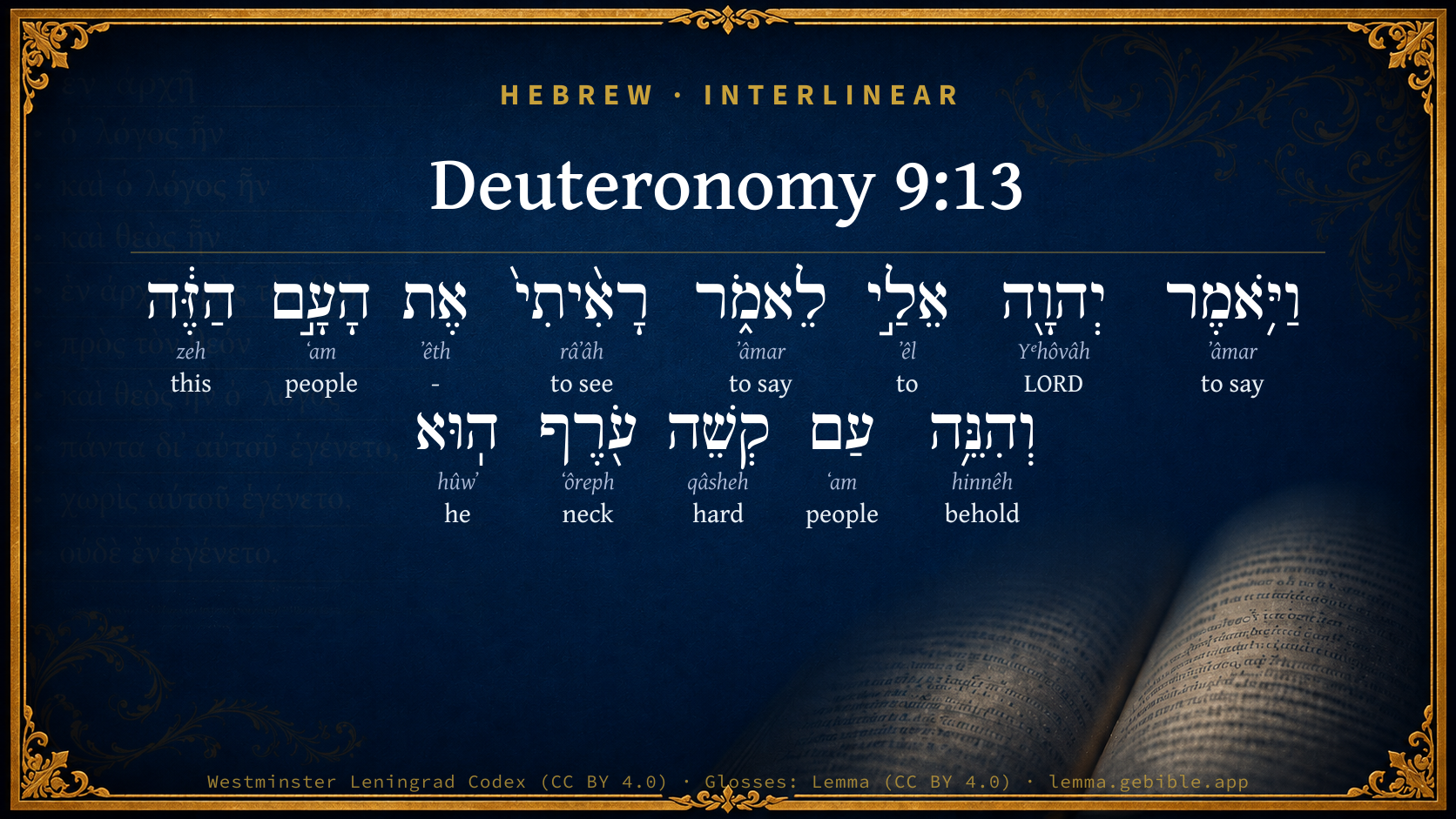
  1. וַיֹּ֥אמֶר ʼâmar H559 “and · to say” Conjunction + Verb, Qal, Sequential Imperfect, 3rd Person, Masculine, Singular
  2. יְהוָ֖ה Yᵉhôvâh H3068 “LORD” Noun, Proper
  3. אֵלַ֣י ʼêl H413 “to · me” Preposition + Suffix, Personal, 1st Person, Common, Singular
  4. לֵאמֹ֑ר ʼâmar H559 “to say” Preposition + Verb, Qal, Infinitive Construct
  5. רָאִ֨יתִי֙ râʼâh H7200 “to see” Verb, Qal, Perfect, 1st Person, Common, Singular
  6. אֶת ʼêth H853 “-” Particle, Direct Object
  7. הָעָ֣ם ʻam H5971 “the · people” Particle, Definite Article + Noun, Common, Masculine, Singular, Absolute
  8. הַזֶּ֔ה zeh H2088 “the · this” Particle, Definite Article + Pronoun, Demonstrative, Masculine, Singular
  9. וְהִנֵּ֥ה hinnêh H2009 “and · behold” Conjunction + Particle, Demonstrative
  10. עַם ʻam H5971 “people” Noun, Common, Masculine, Singular, Absolute
  11. קְשֵׁה qâsheh H7186 “hard of” Adjective, Adjective, Masculine, Singular, Construct
  12. הֽוּא hûwʼ H1931 “he” Pronoun, Personal, 3rd Person, Masculine, Singular

About this verse

These counts appear in no published source. They are computed here, from the morphology-tagged text and Lemma’s own curated glosses. What Lemma adds →

13
words
11
distinct lemmas
Pentateuch
section

Shared distinctive vocabulary

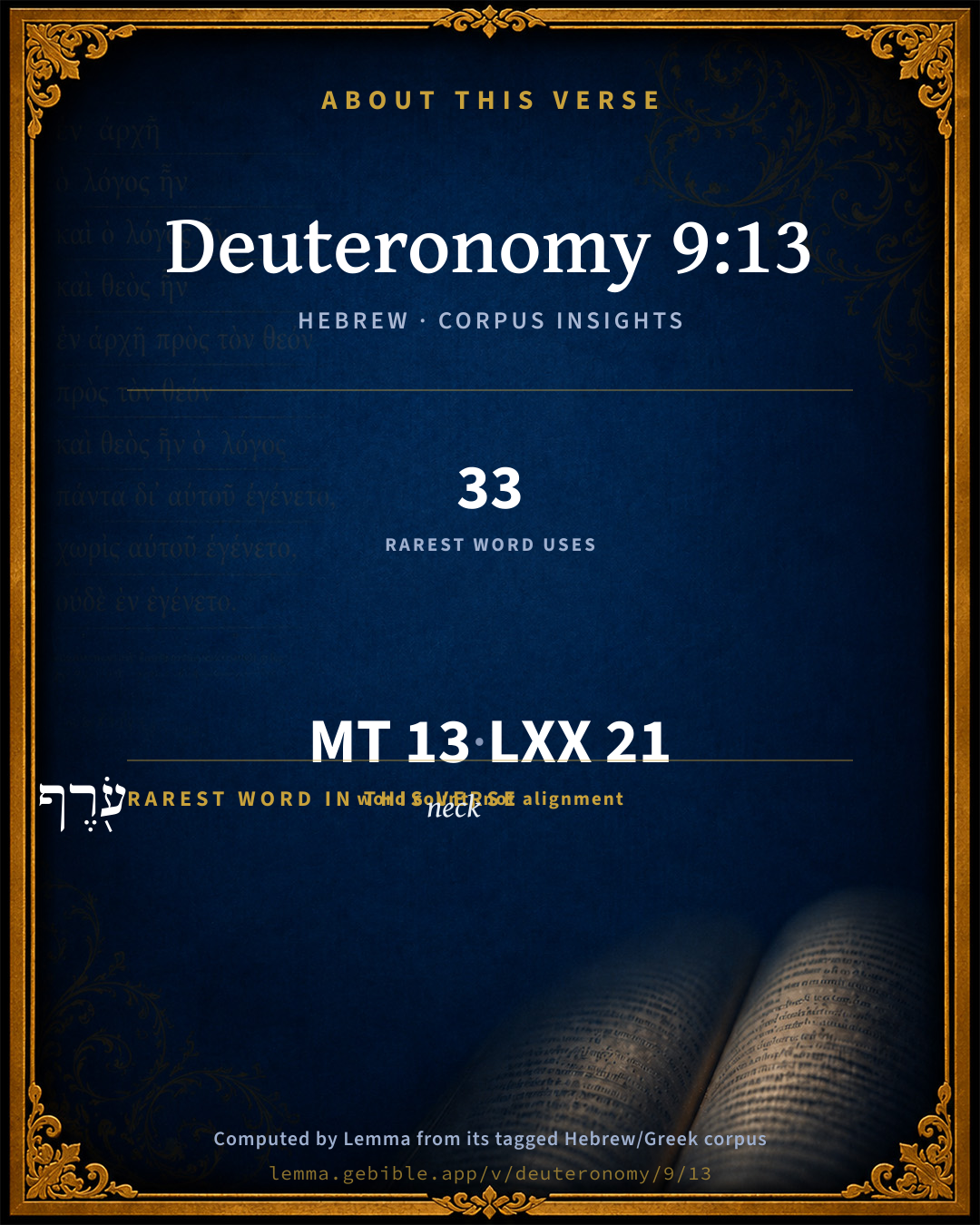
עֹ֖רֶף neck H6203 occurs in 32 verses of the Hebrew Bible. Also found in:

Grammatical profile

  • 3 verbs
  • 4 nouns
  • 1 adjective
  • 2 pronouns
  • 1 preposition
  • 2 particles

Verb forms

  • וַיֹּ֥אמֶר Qal · Sequential Imperfect
  • לֵאמֹ֑ר Qal · Infinitive Construct
  • רָאִ֨יתִי֙ Qal · Perfect

Repetition

Words recur within this verse — often emphatic in Hebrew:

  • וַיֹּ֥אמֶר to say H559 ×2
  • הָעָ֣ם people H5971 ×2

Hebrew & Septuagint length

In English translation the verse runs 18 words from the Hebrew and 28 from the Septuagint (LXX English) — the Septuagint runs noticeably longer here. See the side-by-side →

A rough comparison of the two English renderings, which tokenize alike — not a word-level alignment.

Word counts can differ between the Hebrew and the Greek without any difference in meaning — e.g. the Hebrew direct-object marker אֵת has no separate Greek word, and Greek often adds the article ὁ.

In the original languages it is 13 Hebrew tokens and 21 Greek tokens — but the two are counted differently (Hebrew bundles its prefixes and suffixes into one token; the Greek is in lemma form), so that isn’t a like-for-like length.

Cross-references

12

Topical passages linked to Deuteronomy 9:13 in the Treasury of Scripture Knowledge — connected by theme and wording, ordered by reader-vote popularity; previews shown in the World English Bible.

  • Deuteronomy 9:6 Know therefore, that Yahweh your God doesn't give you this good land to possess it for your righteousness; for you are a stiff-necked people.
  • Deuteronomy 10:16 Circumcise therefore the foreskin of your heart, and be no more stiff-necked.
  • 2 Kings 17:14 Notwithstanding, they would not hear, but hardened their neck, like the neck of their fathers, who didn't believe in Yahweh their God.
  • Exodus 32:9–10 Yahweh said to Moses, "I have seen these people, and, behold, they are a stiff-necked people.
  • Deuteronomy 31:27 For I know your rebellion, and your stiff neck: behold, while I am yet alive with you this day, you have been rebellious against Yahweh; and how much more after my death?
  • Genesis 11:5 Yahweh came down to see the city and the tower, which the children of men built.
  • Genesis 18:21 I will go down now, and see whether they have done altogether according to the cry of it, which is come to me. If not, I will know."
  • Psalms 50:7 "Hear, my people, and I will speak; Israel, and I will testify against you. I am God, your God.
  • Jeremiah 7:11 Is this house, which is called by my name, become a den of robbers in your eyes? Behold, I, even I, have seen it, says Yahweh.
  • Jeremiah 13:27 I have seen your abominations, even your adulteries, and your neighing, the lewdness of your prostitution, on the hills in the field. Woe to you, Jerusalem! you will not be made clean; how long shall it yet be?
  • Hosea 6:10 In the house of Israel I have seen a horrible thing. There is prostitution in Ephraim. Israel is defiled.
  • Malachi 3:5 I will come near to you to judgment; and I will be a swift witness against the sorcerers, and against the adulterers, and against the perjurers, and against those who oppress the hireling in his wages, the widow, and the fatherless, and who deprive the foreigner of justice, and don't fear me," says Yahweh of Hosts.

Cross-references courtesy of OpenBible.info (CC BY 4.0).

Hebrew and Greek witnesses Masoretic Hebrew ↔ Greek Septuagint

The same verse in the two great witnesses to the Old Testament, shown verse-for-verse.

Here the Septuagint runs noticeably longer than the Hebrew — LXX2012 (modern English Septuagint) 28 words vs World English Bible 18. A rough length comparison of the two English translations, not a word-level alignment — read both below.

These are two independent witnesses, not word-aligned to each other, and the Septuagint is shown in lemma (dictionary) form.

Hebrew Deuteronomy 9:13 Masoretic · Westminster Leningrad Codex

וַיֹּ֥אמֶר יְהוָ֖ה אֵלַ֣י לֵאמֹ֑ר רָאִ֨יתִי֙ אֶת הָעָ֣ם הַזֶּ֔ה וְהִנֵּ֥ה עַם קְשֵׁה עֹ֖רֶף הֽוּא

Furthermore Yahweh spoke to me, saying, I have seen this people, and, behold, it is a stiff-necked people:

World English Bible · Public Domain

Greek LXX Deuteronomy 9:13 Septuagint · lemma form

καί εἶπον κύριος πρός ἐγώ λαλέω πρός σύ ἅπαξ καί δίς λέγω ὁράω ὁ λαός οὗτος καί ἰδού λαός σκληροτράχηλος εἰμί

And the Lord spoke to me, saying, I have spoken to you once and again, saying, I have seen this people, and, behold, it is a stiff-necked people.

LXX2012 (modern English Septuagint) · Public Domain

Hebrew: Westminster Leningrad Codex (CC BY 4.0). Greek: Septuagint (public domain); English from LXX2012 (modern English Septuagint) (Public Domain). How the Septuagint differs from the Hebrew →

Targum (Aramaic paraphrase)

2

The Targum is the ancient Jewish Aramaic paraphrase of the Hebrew Scriptures — an interpretive translation, not the Hebrew text itself. Onkelos (literal) and Pseudo-Jonathan (expansive) render the Torah, and Jonathan the Prophets. Coverage is partial: where no permissively-licensed English translation exists for a verse, only the Aramaic is shown. This is verse-level text, not a word-by-word alignment to the Hebrew.

  1. Targum Onkelos Torah (Genesis–Deuteronomy)
    וַאֲמַר יְיָ לִי לְמֵימָר גְלֵי קֳדָמַי יָת עַמָא הָדֵין וְהָא עַם קְשֵׁי קְדַל הוּא

    (no public-domain English translation for this verse)

    Targum Onkelos — Aramaic: “Onkelos Genesis” (public domain); “Onkelos Exodus” (public domain); “Onkelos Leviticus” (public domain); “Onkelos Numbers” (public domain); “Onkelos Deuteronomy” (public domain). English: “Sefaria Community Translation” (CC0 1.0 (public-domain dedication)); “J.W. Etheridge. The Targums of Onkelos and Jonathan Ben Uzziel on the Pentateuch. London: Longmans, Green, 1862” (public domain). Text via Sefaria.

  2. Targum Pseudo-Jonathan Torah (Genesis–Deuteronomy)
    וַאֲמַר יְיָ לִי לְמֵימָר גְּלֵי קֳדָמַי סוּרְחָנוּת עַמָא הָדֵין וְהָא עַם קְשֵׁי קְדַל הוּא

    And the Lord spake to me saying, the sin of this people is revealed before Me, and behold this people is hard-necked:

    Targum Pseudo-Jonathan — Aramaic: “Targum Jonathan on Genesis” (public domain); “Targum Jonathan on Exodus” (public domain); “Targum Jonathan on Leviticus” (public domain); “Targum Jonathan on Numbers” (public domain); “Targum Jonathan on Deuteronomy” (public domain). English: “The Targum of Jonathan ben Uzziel, trans. J. W. Etheridge, London, 1862” (public domain). Text via Sefaria.

Commentary

Notes on Deuteronomy 9:13 from classic Christian and Jewish commentators (each source and its license shown beneath its notes). The classic Christian expositions comment on the surrounding passage and are grouped to its opening verse, so a note may address several verses; the Jewish commentaries on the Tanakh (Rashi and others) are per-verse, so they appear only where the commentator wrote on this verse.

Lemma curates 59 commentaries, every one of them public domain or Creative Commons licensed, each selected and text-cleaned for this edition rather than reprinted as found. About our sources →

The Cambridge Bible for Schools and Colleges

gen. ed. J. J. S. Perowne

13. stiffnecked] See on Deu_9:6.

The Cambridge Bible for Schools and Colleges (gen. ed. J. J. S. Perowne; Cambridge University Press, 1878–1918) — public domain. Text from a community e-Sword module.

John Gill's Exposition

Furthermore the Lord spake unto me, saying,.... After he had given him the two tables, and before his departure from the mount:

I have seen this people; took notice of them, their ways, and their works:

and, behold, it is a stiffnecked people; unwilling to submit to, and bear the yoke of my commandments; see Exo 32:9.

John Gill's Exposition of the Whole Bible (1746–1763) — public domain (CC PDM 1.0). Text via the HelloAO Bible API.

The Pulpit Commentary

Vers. 13-21, 25-29. True greatness manifested in a great emergency, by self-sacrifice and intercession.

As were marked in the previous Homily, these incidents can only be rightly arranged by a preacher, for the purpose of preaching thereon, so far as the entire narrative is before his view. Hence a junction of this paragraph with Exodus 32, is imperative, and will here be taken for granted. There would seem to have been a compilation of several documents. It is not easy to gather therefrom, with exact precision, the order of events, though there is no difficulty in setting the whole with sufficient consecutiveness for all the purposes of practical teaching, Note

I HERE IS A GREAT CRISIS. Israel was making a feast unto Jehovah, letting the calf represent to them the God who had brought them out of Egypt. The people were observing the customs of the very nation from which they had been redeemed dancing before the idol, polluting themselves with unclean and unhallowed rites, and making the hills to reecho with their boisterous revelry and song! And all this beneath that very mount where they had sworn, "All that the Lord hath spoken we will do!

1. In the first instance, the lamentable defection of the people was made known to Moses, either by a silent suggestion from the Great Invisible, with whom he was in adoring fellowship, or by one of the angel bands with whom he was surrounded. (Exo_32:7, Exo_32:8)

2. God bids Moses "go down not merely, as might at first seem, go down and see," but "Continue the fellowship no more; leave me alone; I will make of thee a great nation. Let my wrath wax hot against them, that I may consume them!" Awful words (vers. 13, 14) "Tis a terrible crisis in the great leader"s experience. With agonizing heart, he comes down to see not without pleading with God for Israel (see below) and he reachesJoshua, where, though even yet too far off to see, he is near enough to hear the shouts wildly ringing through the air.

3. At length Moses gets near enough to see (ver. 16). There they are the calf, the dancing, the impure orgies as of a heathen feast! Oh, how bitter must have been the anguish of Moses at such a sight!

4. And what an alarming possibility he had to face even that of the entire rupture of the whole covenant between the people and Jehovah! Hear how the Voice on the mount spake, "Thy people have broken the covenant; let me alone," etc. In what stronger way, ah! in what other way, could the people at such a time have been taught that, as they were now actually breaking the very covenant God was confirming with Moses for them, if God now dealt with them after their sins, he would have cast them off completely? They were not necessary to the fulfillment of the covenant made with their fathers. Moses was of Abraham"s seed, and God might have begun afresh with him, and have made of him a nation greater, mightier, more loyal than they! Was there ever such a crisis? With all the responsibility Moses had resting on him, he must have been crushed had he not been divinely sustained. But great crises bring out the greatness of great men. Moses was a man "slow of speech," and probably slow to act, but he had strong convictions of truth and duty, and when wrought up to a white heat, he would show the true nobility of his character.

II THE GREATNESS OF THE CRISIS OCCASIONS A REMARKABLE SERIES OF ACTS ON THE PART OF MOSES.

1. He is angry. (Exo_32:19) This was a holy anger; the sight roused the meekest of men, and well it might. It would have been wicked in Moses if he had not been angry! There is a wide difference between a passionate feeling of personal resentment, and indignation at witnessing an outrage on right. The holier a man is, the more will he suppress the one, the more will he develop the other!

2. He breaks the tables (ver. 18). This is a symbolic act, reminding the people that by their apostasy they had violated their covenant vows.

3. He grinds the calf to powder, etc. (ver. 21). Another symbolic act, meaning, "This sin will come back to them again; it will mar their joy for long to come.

4. He calls Aaron to account. (Exo_32:21-24) "There came out this calf." Aaron! you, the eloquent man, making a silly speech like that! Oh, the wonderful touches of nature in the Old Book! Moses, the truly brave man, though slow of speech, can speak to purpose at such a time as this; but Aaron, eloquent as he is, when his conscience is ill at ease, makes the lamest and tamest excuse.

5. He ascertains how far the contagion has spread. (Exo_32:25-29) Was it a revolt of all the people, or had many been drawn away at suggestion of the few? "Who is on the Lord"s side?" "Tis not enough for people to be on the Lord"s side, specially in days of abounding iniquity; they must say on which side they are. The sons of Levi come forward, and are entrusted with the awful task of stamping out the evil. Better for 3000 to die than for 2, 000, 000 to be infected with a mortal poison! That was a holy defensive war. And it speaks volumes for the grandeur of the moral power of Moses, that he could so inspire the men of his own tribe to chastise the revolt and save the people.

6. But the most striking feature of the spiritual heroism of Israel"s leader is, that he pleads with God. In this he reveals a force of character and an unselfishness of spirit which are far too rare even in these "advanced" times. Let us watch this pleader.

(1) He acknowledges the greatness of the sin. At first, before he was near enough to see, he asks, "Lord, why doth thy wrath?" etc. But afterwards, he puts no such question. "Oh! this people have sinned a great sin." He cannot palliate it.

(2) He entreats the Lord not to consume them, but to turn from his fierce wrath, and to bring them yet into the Promised Land.

(3) He uses arguments in prayer.

(a) The honor of God"s Name among the nations. Joshua, David, Jeremiah, did the same.

(b) He pleads the Divine acts already put forth on behalf of the people, as if he would say, "Didst thou not know from the first what they were?

(c) He pleads the Divine promises; "remember Abraham," etc.

(4) Moses prays for Aaron (ver. 20)! Aaron "can speak well," but he acted ill. He broke down when put in charge. Though appointed by God as special helper to Moses, he proved himself unreliable. Yet not. a word of complaint appears to have been uttered to him, only a prayer offered for him by the very brother who had relied on him in vain!

(5) There is a more wonderful feature still in his prayer, viz. this: a conception which to self-seekers would have been most captivating, has for him no charm whatever will make of thee a great nation;" "let me alone, that I may destroy them," and I will begin afresh with you, and make you the head of a less unworthy race! Would not that have fired his ambition, if he had had any? But no! see the lot which he preferred: (Exo_32:32, Exo_32:33) "No! I cannot accept any position, however elevated, if they perish! Oh, forgive them! If not, let us all perish together." Noble captain he! if the ship sinks, he will go down with it. He would rather not live if vessel and passengers are beneath the waves! (cf. Rom_9:2, Rom_9:3, with which passionate fervor the prayer of Moses may well be compared.)

(6) This intercession was long continued (ver. 25): "forty days and forty nights!" All this while the cry was ever and anon going up from his heart? "Forgive them! Forgive! Forgive!

Have we not here, in Moses, a model of intercessory prayer? Men who can thus plead with God are the greatest heroes of the Church. We can imagine that some may object, and may seek to turn the edge of the truth, so that it makes no impression, by saving, "Ah! but see what a great occasion that was! give us an occasion like that, and maybe we should pray like that! It is folly to bring the acts of a man at a period of such intense excitement, and tell us that we ought to pray like that. We are told that we cannot live at boiling point; then, why adduce Moses, on such an occasion, as a sample of what we should do on ordinary occasions?" No, we do not always want boiling water, but what sort of water would that be which no amount of heat ever could get to boil? We do not and cannot expect to be always in the midst of violent crises. But who are the men who are to be relied on when the crises come? Where was Aaron now? What of him? There is no indication that he ever caught a glimpse of the tremendous crisis he had helped to bring about! There came out this calf!" How Moses could restrain himself at such words, we cannot imagine. But even if Aaron had not shown such utter inability to perceive the seriousness of the moment, how could he now take any active part in vindicating the injured rights of God before the people, or in craving mercy for the people from God? Complicity with evil means paralysis of power in speeding the right. If Aaron had not had a brother to plead for him with God, he would have been swept away with the besom of destruction! He can talk well rather than stand firm. There is a similar contrast here between Moses and Aaron, to that between Abraham and Lot. Abraham pleaded for the doomed city. Lot"s aims in life had been too selfish for him to be a pleader. And we fear there are some who, if their own dear land were brought to a mighty crisis, would just read the daily papers to gratify curiosity, or to give them something to talk about, but as for taking the case of a nation on their hearts before God, they could do nothing of the kind! If they are succumbing to the evils of the day, they can have no strength in intercessory prayer, nor can they be of any use in national struggles. The Moses of Exodus 32, is the same self-forgetful Moses of Exodus 2. If men want to be the heroes of their age, let them try the power of intercessory prayer. Such heroism is of a kind the world cannot appreciate, but is recorded in God"s book of remembrance; "And they shall be mine, saith the Lord of hosts, in that day when I make up my jewels."

The Pulpit Commentary (1880–1919), ed. H.D.M. Spence-Jones & Joseph S. Exell — public domain. Text from a community e-Sword module.

unfoldingWord translationNotes

Door43 World Missions Community

blot out their name from under heaven

"make their name disappear completely" or "kill them all so no one will ever remember them." See how you translated a similar phrase in Deuteronomy 7:24.

translationWords

stiff-necked

blot out

name

nation

unfoldingWord translationNotes — © Distant Shores Media and the Door43 World Missions Community, licensed CC BY-SA 4.0. Source: git.door43.org/Door43/en_tn.

Lesson kit

Teaching starters — assembled from the data on this page, not authored interpretation. Every prompt links to the verse data it draws on. Edit before teaching.

Deuteronomy, in the Pentateuch, opens this verse with 13 words (11 distinct Hebrew lemmas). Its most distinctive word is ʻôreph (“neck”). The Greek Septuagint runs longer here. A historical commentator’s framing appears above. Read the whole chapter for the surrounding context.

Discussion questions

  1. What does “neck” (ʻôreph) contribute to the verse as a whole?
  2. Genesis 49:8 shares the word «neck» with this verse. How do the two illuminate each other?
  3. “to say” occurs 2× in this one verse. What is the effect of the repetition?
  4. Compared with the Hebrew, the Septuagint runs longer here. What questions does that raise?
  5. The translations on this page render this verse differently — a whole-verse word diff, not a word-by-word alignment. What might account for the different wordings?
  6. The verb «וַיֹּ֥אמֶר» is Qal Sequential Imperfect. How does its form color the action?
  7. Reading how The Cambridge Bible for Schools and Colleges and John Gill's Exposition read this verse, where do the two commentators agree and where do they part?

Things to notice

Reading settings

Reading text

Shown beneath each verse's original-language words.

Old Testament
Old Testament edition

Read the OT as the Masoretic Hebrew (MT) or the Greek Septuagint (LXX).

English shown for the Greek Septuagint (in the Hebrew ↔ Greek comparison).

Comparing translations? Open the Compare panel on any verse page to stack up to four side by side.