

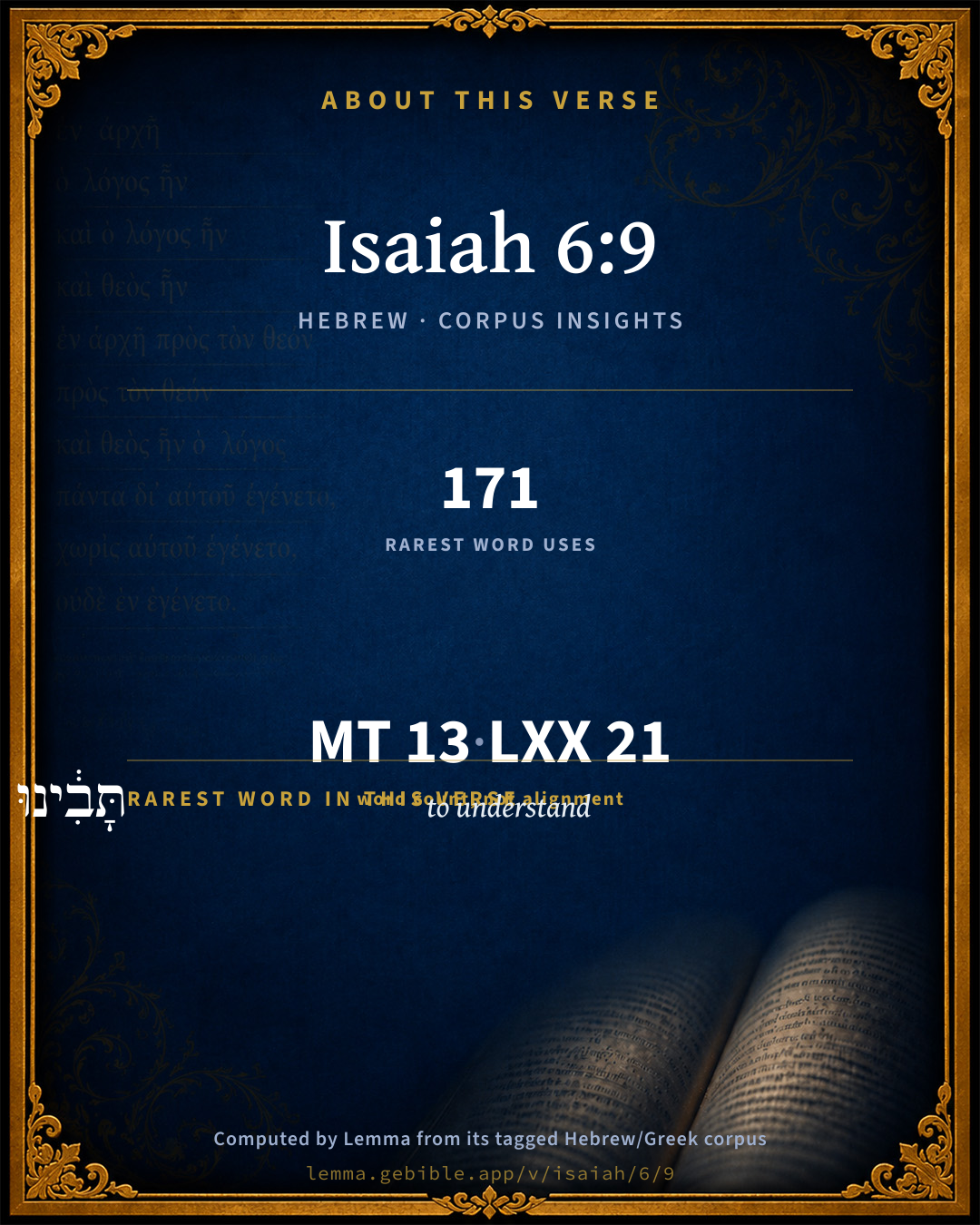
Isaiah 6:9

Hebrew (Westminster Leningrad Codex) Isaiah 6:9 appears in the Hebrew Old Testament. The text above is from the Westminster Leningrad Codex. Each word links to its Strong’s number, a concise gloss, and parsing drawn from the Open Scriptures Hebrew Bible morphology. Click any word for its full Brown-Driver-Briggs (BDB) entry.
Download image
Cite this verse

Isaiah 6:9 (World English Bible). Public Domain. Lemma interlinear Bible study tool, https://lemma.gebible.app/v/isaiah/6/9.

Show BibTeX & RIS
BibTeX
RIS
English Translation
He said, "Go, and tell this people, 'You hear indeed, But don't understand; And you see indeed, But don't perceive.'
World English Bible · Public Domain
Download a study sheet

One document with this verse’s original text, its word-by-word gloss line, the meaning frame, cross-references with their text, attributed commentary, and full source and license credits — printable, and it pastes into notes with its structure intact.

This verse Autodidact and up

Study sheet (.html) Plain text (.txt)

A passage Seminary Student

Up to 50 verses in one chapter. A passage sheet keeps up to 6 commentary sources and 12 cross-references per verse, in the order this page ranks them, and says so on the sheet whenever that leaves anything out. Ask for a single verse and you get the Autodidact verse sheet above.

Everything on this page stays free to read, with no account — the sheet is a download of what is already on screen, not access to it.

Want to remove ads? Support Godless Engineer
Compare translations 3

The same verse in 3 English versions, stacked beneath the original-language interlinear above. Click any original word for its lexicon entry.

Each is an independent rendering of the whole verse — the interlinear is not word-aligned to these translations.

Highlighted words mark where these versions differ — a whole-verse word diff, not a word-by-word alignment.

  • World English Bible Public Domain
    He said, "Go, and tell this people, 'You hear indeed, But don't understand; And you see indeed, But don't perceive.'
  • King James Version Public Domain
    And he said, Go, and tell this people, Hear ye indeed, but understand not; and see ye indeed, but perceive not.
  • unfoldingWord Literal Text CC BY-SA 4.0
    And he said, “Go, and you shall say to this people, ‘Hearing, hear, but do not understand, and seeing, see, but do not know.’

unfoldingWord Literal Text — © unfoldingWord, licensed CC BY-SA 4.0. Word-aligned USFM3 via Door43 (git.door43.org/unfoldingWord/en_ult).

Versions to compare (up to 4)

3 of 4 selected

Show all 18 translations

Every available English version of this verse, each an independent rendering of the whole verse.

  • World English Bible Public Domain
    He said, "Go, and tell this people, 'You hear indeed, But don't understand; And you see indeed, But don't perceive.'
  • Berean Standard Bible Public Domain
    And He replied: “Go and tell this people, ‘Be ever hearing, but never understanding; be ever seeing, but never perceiving.’
  • Majority Standard Bible Public Domain
    And He replied: “Go and tell this people, ‘Be ever hearing, but never understanding; be ever seeing, but never perceiving.’
  • King James Version Public Domain
    And he said, Go, and tell this people, Hear ye indeed, but understand not; and see ye indeed, but perceive not.
  • American Standard Version (1901) Public Domain
    And he said, Go, and tell this people, Hear ye indeed, but understand not; and see ye indeed, but perceive not.
  • Revised Version (1885) Public Domain
    And he said, Go, and tell this people, Hear ye indeed, but understand not; and see ye indeed, but perceive not.
  • Geneva Bible (1599) Public Domain
    And he sayd, Goe, and say vnto this people, Ye shall heare in deede, but ye shall not vnderstand: ye shall plainely see, and not perceiue.
  • Douay-Rheims (1899) Public Domain
    And he said: Go, and thou shalt say to this people: Hearing, hear, and understand not: and see the vision, and know it not.
  • Young's Literal Translation Public Domain
    And He saith, `Go, and thou hast said to this people, Hear ye -- to hear, and ye do not understand, And see ye -- to see, and ye do not know.
  • Literal Standard Version CC BY-SA 4.0
    And He says, “Go, and you have said to this people, Hearing you hear, and you do not understand, || And seeing you see, and you do not know.
  • Unlocked Literal Bible CC BY-SA 4.0
    He said, “Go and tell this people, 'Listen, but do not understand; see, but do not perceive.'
  • unfoldingWord Literal Text CC BY-SA 4.0
    And he said, “Go, and you shall say to this people, ‘Hearing, hear, but do not understand, and seeing, see, but do not know.’
  • Darby Bible Public Domain
    And he said, Go; and thou shalt say unto this people, Hearing ye shall hear and shall not understand, and seeing ye shall see and shall not perceive.
  • World Messianic Bible Public Domain
    He said, “Go, and tell this people, ‘You hear indeed, but don’t understand. You see indeed, but don’t perceive.’
  • Webster's Bible Public Domain
    And he said, Go, and tell this people, Hear ye indeed, but understand not; and see ye indeed, but perceive not.
  • Free Bible Version CC BY-SA 4.0
    He replied, “Go and tell this people: ‘Keep on listening, but never understanding. Keep on seeing, but never comprehending.’
  • Bible in Basic English Public Domain
    And he said, Go, and say to this people, You will go on hearing, but learning nothing; you will go on seeing, but without getting wiser.
  • JPS Tanakh (1917) Public Domain
    And He said: 'Go, and tell this people: hear ye indeed, but understand not; and see ye indeed, but perceive not.

Literal Standard Version (2020), Covenant Press — licensed CC BY-SA 4.0. Text via the HelloAO Bible API (eBible.org). Unlocked Literal Bible (unfoldingWord) — licensed CC BY-SA 4.0. Text via the HelloAO Bible API (eBible.org). unfoldingWord Literal Text — © unfoldingWord, licensed CC BY-SA 4.0. Word-aligned USFM3 via Door43 (git.door43.org/unfoldingWord/en_ult). Free Bible Version, Dr. Jonathan Gallagher — licensed CC BY-SA 4.0. Text via the HelloAO Bible API (eBible.org).

Word by word

More ways to search: Search by grammar → Find every occurrence → Compare this word →

Practice this passage: Drill this verse → Learn its vocabulary →

תָּבִ֔ינוּ
bîyn
H995
“to understand”
Verb, Qal, Jussive, 2nd Person, Masculine, Plural
Part of Speech
Verb
Stem
Qal
Form
Jussive
Person
2nd Person
Gender
Masculine
Number
Plural
Full BDB Definition

Origin: a primitive root

TWOT: 239

to discern, understand, consider - (Qal) - to perceive, discern - to understand, know (with the mind) - to observe, mark, give heed to, distinguish, consider - to have discernment, insight, understanding - (Niphal) to be discerning, intelligent, discreet, have understanding - (Hiphil) - to understand - to cause to understand, give understanding, teach - (Hithpolel) to show oneself discerning or attentive, consider diligently - (Polel) to teach, instruct - (TWOT) prudent, regard
  1. וַיֹּ֕אמֶר ʼâmar H559 “and · to say” Conjunction + Verb, Qal, Sequential Imperfect, 3rd Person, Masculine, Singular
  2. לֵ֥ךְ yâlak H3212 “walk” Verb, Qal, Imperative, 2nd Person, Masculine, Singular
  3. וְאָמַרְתָּ֖ ʼâmar H559 “and · to say” Conjunction + Verb, Qal, Sequential Perfect, 2nd Person, Masculine, Singular
  4. לָעָ֣ם ʻam H5971 “to/for the · people” Preposition, Determined + Noun, Common, Masculine, Singular, Absolute
  5. הַזֶּ֑ה zeh H2088 “the · this” Particle, Definite Article + Pronoun, Demonstrative, Masculine, Singular
  6. שִׁמְע֤וּ shâmaʻ H8085 “hear” Verb, Qal, Imperative, 2nd Person, Masculine, Plural
  7. שָׁמ֨וֹעַ֙ shâmaʻ H8085 “to hear” Verb, Qal, Infinitive Absolute
  8. וְאַל ʼal H408 “and · not” Conjunction + Particle, Negative
  9. וּרְא֥וּ râʼâh H7200 “and · see” Conjunction + Verb, Qal, Imperative, 2nd Person, Masculine, Plural
  10. רָא֖וֹ râʼâh H7200 “to see” Verb, Qal, Infinitive Absolute
  11. וְאַל ʼal H408 “and · not” Conjunction + Particle, Negative
  12. תֵּדָֽעוּ yâdaʻ H3045 “to know” Verb, Qal, Jussive, 2nd Person, Masculine, Plural

About this verse

These counts appear in no published source. They are computed here, from the morphology-tagged text and Lemma’s own curated glosses. What Lemma adds →

13
words
9
distinct lemmas
Prophets
section

Grammatical profile

  • 9 verbs
  • 1 noun
  • 1 pronoun
  • 2 particles

Verb forms

  • וַיֹּ֕אמֶר Qal · Sequential Imperfect
  • לֵ֥ךְ Qal · Imperative
  • וְאָמַרְתָּ֖ Qal · Sequential Perfect
  • שִׁמְע֤וּ Qal · Imperative
  • שָׁמ֨וֹעַ֙ Qal · Infinitive Absolute
  • תָּבִ֔ינוּ Qal · Jussive
  • וּרְא֥וּ Qal · Imperative
  • רָא֖וֹ Qal · Infinitive Absolute
  • תֵּדָֽעוּ Qal · Jussive

Repetition

Words recur within this verse — often emphatic in Hebrew:

  • וַיֹּ֕אמֶר to say H559 ×2
  • שִׁמְע֤וּ to hear H8085 ×2
  • וּרְא֥וּ to see H7200 ×2
  • וְאַל not H408 ×2

Hebrew & Septuagint length

In English translation the verse runs 20 words from the Hebrew and 19 from the Septuagint (LXX English) — closely comparable.

A rough comparison of the two English renderings, which tokenize alike — not a word-level alignment.

Word counts can differ between the Hebrew and the Greek without any difference in meaning — e.g. the Hebrew direct-object marker אֵת has no separate Greek word, and Greek often adds the article ὁ.

In the original languages it is 13 Hebrew tokens and 21 Greek tokens — but the two are counted differently (Hebrew bundles its prefixes and suffixes into one token; the Greek is in lemma form), so that isn’t a like-for-like length.

Cross-references

13

Topical passages linked to Isaiah 6:9 in the Treasury of Scripture Knowledge — connected by theme and wording, ordered by reader-vote popularity; previews shown in the World English Bible.

  • Matthew 13:14–15 In them the prophecy of Isaiah is fulfilled, which says, 'By hearing you will hear, And will in no way understand; Seeing you will see, And will in no way perceive:
  • Luke 8:10 He said, "To you it is given to know the mysteries of the Kingdom of God, but to the rest in parables; that 'seeing they may not see, and hearing they may not understand.'
  • Mark 4:12 that 'seeing they may see, and not perceive; and hearing they may hear, and not understand; lest perhaps they should turn again, and their sins should be forgiven them.'"
  • John 12:40 "He has blinded their eyes and he hardened their heart, Lest they should see with their eyes, And perceive with their heart, And would turn, And I would heal them."
  • Acts 28:26–27 saying, 'Go to this people, and say, In hearing, you will hear, But will in no way understand. In seeing, you will see, But will in no way perceive.
  • Romans 11:8 According as it is written, "God gave them a spirit of stupor, eyes that they should not see, and ears that they should not hear, to this very day."
  • Isaiah 29:13 The Lord said, Because this people draw near [to me], and with their mouth and with their lips to honor me, but have removed their heart far from me, and their fear of me is a commandment of men which has been taught [them];
  • Isaiah 43:8 Bring forth the blind people who have eyes, and the deaf who have ears.
  • Isaiah 44:18–20 They don't know, neither do they consider: for he has shut their eyes, that they can't see; and their hearts, that they can't understand.
  • Isaiah 30:8–11 Now go, write it before them on a tablet, and inscribe it in a book, that it may be for the time to come forever and ever.
  • Jeremiah 15:1–2 Then said Yahweh to me, Though Moses and Samuel stood before me, yet my mind would not be toward this people: cast them out of my sight, and let them go forth.
  • Exodus 32:7–10 Yahweh spoke to Moses, "Go, get down; for your people, who you brought up out of the land of Egypt, have corrupted themselves!
  • Hosea 1:9 He said, "Call his name Lo-Ammi; for you are not my people, and I will not be yours.

Cross-references courtesy of OpenBible.info (CC BY 4.0).

Hebrew and Greek witnesses Masoretic Hebrew ↔ Greek Septuagint

The same verse in the two great witnesses to the Old Testament, shown verse-for-verse.

These are two independent witnesses, not word-aligned to each other, and the Septuagint is shown in lemma (dictionary) form.

Hebrew Isaiah 6:9 Masoretic · Westminster Leningrad Codex

וַיֹּ֕אמֶר לֵ֥ךְ וְאָמַרְתָּ֖ לָעָ֣ם הַזֶּ֑ה שִׁמְע֤וּ שָׁמ֨וֹעַ֙ וְאַל תָּבִ֔ינוּ וּרְא֥וּ רָא֖וֹ וְאַל תֵּדָֽעוּ

He said, "Go, and tell this people, 'You hear indeed, But don't understand; And you see indeed, But don't perceive.'

World English Bible · Public Domain

Greek LXX Isaiah 6:9 Septuagint · lemma form

καί εἶπον πορεύομαι καί εἶπον ὁ λαός οὗτος ἀκοή ἀκούω καί οὐ μή συνἵημι καί βλέπω βλέπω καί οὐ μή ὁράω

You⌃ shall hear indeed, but you⌃ shall not understand; and you⌃ shall see indeed, but you⌃ shall not perceive.

LXX2012 (modern English Septuagint) · Public Domain

On this verse, The Biblical Illustrator discusses the Septuagint’s reading. Read the note in Commentary ↓

Hebrew: Westminster Leningrad Codex (CC BY 4.0). Greek: Septuagint (public domain); English from LXX2012 (modern English Septuagint) (Public Domain). How the Septuagint differs from the Hebrew →

Targum (Aramaic paraphrase)

1

The Targum is the ancient Jewish Aramaic paraphrase of the Hebrew Scriptures — an interpretive translation, not the Hebrew text itself. Onkelos (literal) and Pseudo-Jonathan (expansive) render the Torah, and Jonathan the Prophets. Coverage is partial: where no permissively-licensed English translation exists for a verse, only the Aramaic is shown. This is verse-level text, not a word-by-word alignment to the Hebrew.

  1. Targum Jonathan Prophets (Joshua–Malachi)
    וַאֲמַר אֱזֵיל וְתֵימָר לְעַמָא הָדֵין דְשָׁמְעִין מִשְׁמַע וְלָא מִסְתַּכְּלִין וַחֲזוֹ מֶחְזָא וְלָא יָדְעִין:

    And He said, Go, and tell this people, who are diligently hearing, but understand not, and see diligently, but know not.

    Targum Jonathan — Aramaic: “Mikraot Gedolot” (public domain). English: “Sefaria Community Translation” (CC0 1.0 (public-domain dedication)); “London "Chaldee Paraphrase," 1871” (public domain). Text via Sefaria.

Commentary

Notes on Isaiah 6:9 from classic Christian and Jewish commentators (each source and its license shown beneath its notes). The classic Christian expositions comment on the surrounding passage and are grouped to its opening verse, so a note may address several verses; the Jewish commentaries on the Tanakh (Rashi and others) are per-verse, so they appear only where the commentator wrote on this verse.

Lemma curates 59 commentaries, every one of them public domain or Creative Commons licensed, each selected and text-cleaned for this edition rather than reprinted as found. About our sources →

Matthew Henry's Commentary

God takes Isaiah at his word, and here sends him on a strange errand - to foretel the ruin of his people and even to ripen them for that ruin - to preach that which, by their abuse of it, would be to them a savour of death unto death. And this was to be a type and figure of the state of the Jewish church in the days of the Messiah, when they should obstinately reject the gospel, and should thereupon be rejected of God. These verses are quoted in part, or referred to, six times, in the New Testament, which intimates that in gospel time these spiritual judgments would be most frequently inflicted; and though they make the least noise, and come not with observation, yet they are of all judgments the most dreadful. Isaiah is here given to understand these four things: -

1. That the generality of the people to whom he was sent would turn a deaf ear to his preaching, and wilfully shut their eyes against all the discoveries of the mind and will of God which he had to make to them (Isa 6:9): "Go, and tell this people, this foolish wretched people, tell them their own, tell them how stupid and sottish they are." Isaiah must preach to them, and they will hear him indeed, but that is all; they will not heed him; they will no understand him; they will not take any pains, nor use that application of mind which is necessary to the understanding of him; they are prejudiced against that which is the true intent and meaning of what he says, and therefore they will not understand him, or pretend they do not. They see indeed (for the vision is made plain on tables, so that he who runs may read it); but they perceive not their own concern in it; it is to them as a tale that is told. Note, There are many who hear the sound of God's word, but do not feel the power of it.

2. That, forasmuch as they would not be made better by his ministry, they should be made worse by it; those that were wilfully blind should be judicially blinded (Isa 6:10): "They will not understand or perceive thee, and therefore thou shalt be instrumental to make their heart fat, senseless, and sensual, and so to make their ears yet more heavy, and to shut their eyes the closer; so that, at length, their recovery and repentance will become utterly impossible; they shall no more see with their eyes the danger they are in, the ruin they are upon the brink of, nor the way of escape from it; they shall no more hear with their ears the warnings and instructions that are given them, nor understand with their heart the things that belong to their peace, so as to be converted from the error of their ways, and thus be healed." Note, (1.) The conversion of sinners is the healing of them. (2.) A right understanding is necessary to conversion. (3.) God sometimes, in a way of righteous judgment, gives men up to blindness of mind and strong delusions, because they would not receive the truth in the love of it, Th2 2:10-12. He that is filthy let him be filthy still. (4.) Even the word of God oftentimes proves a means of hardening sinners. The evangelical prophet himself makes the heart of this people fat, not only as he foretels it, passing this sentence upon them in God's name, and seals them under it, but as his preaching had a tendency to it, rocking some asleep in security (to whom it was a lovely song), and making others more outrageous, to whom it was such a reproach that they were not able to bear it. Some looked upon the word as a privilege, and their convictions were smothered by it (Jer 7:4); others looked upon it as a provocation, and their corruptions were exasperated by it.

3. That the consequence of this would be their utter ruin, Isa 6:11, Isa 6:12. The prophet had nothing to object against the justice of this sentence, nor does he refuse to go upon such an errand, but asks, "Lord, how long?" (an abrupt question): "Shall it always be thus? Must I and other prophets always labour in vain among them, and will things never be better?" Or, (as should seem by the answer) "Lord, what will it come to at last? What will be in the end hereof?" In answer to this he is told that it should issue in the final destruction of the Jewish church and nation. "When the word of God, especially the word of the gospel, had been thus abused by them, they shall be unchurched, and consequently undone. Their cities shall be uninhabited, and their country houses too; the land shall be untilled, desolate with desolation (as it is in the margin), the people who should replenish the houses and cultivate the ground being all cut off by sword, famine, or pestilence, and those who escape with their lives being removed far away into captivity, so that there shall be a great and general forsaking in the midst of the land; that populous country shall become desert, and that glory of all lands shall be abandoned." Note, Spiritual judgments often bring temporal judgments along with them upon persons and places. This was in part fulfilled in the destruction of Jerusalem by the Chaldeans, when the land, being left desolate, enjoyed her sabbaths seventy years; but, the foregoing predictions being so expressly applied in the New Testament to the Jews in our Saviour's time, doubtless this points at the final destruction of that people by the Romans, in which it had a complete accomplishment, and the effects of it that people and that land remain under to this day.

4. That yet a remnant should be reserved to be the monuments of mercy, Isa 6:13. There was a remnant reserved in the last destruction of the Jewish nation (Rom 11:5, At this present time there is a remnant); for so it was written here: But in it shall be a tenth, a certain number, but a very small number in comparison with the multitude that shall perish in their unbelief. It is that which, under the law, was God's proportion; they shall be consecrated to God as the tithes were, and shall be for his service and honour. Concerning this tithe, this saved remnant, we are here told, (1.) That they shall return (Isa 6:13; Isa 10:21), shall return from sin to God and duty, shall return out of captivity to their own land. God will turn them, and they shall be turned. (2.) That they shall be eaten, that is, shall be accepted of God as the tithe was, which was meat in God's house, Mal 3:10. The saving of this remnant shall be meat to the faith and hope of those that wish well to God's kingdom. (3.) That they shall be like a timber-tree in winter, which has life, though it has no leaves: As a teil-tree and as an oak, whose substance is in them even when they cast their leaves, so this remnant, though they may be stripped of their outward prosperity and share with others in common calamities, shall yet recover themselves, as a tree in the spring, and flourish again; though they fall, they shall not be utterly cast down. There is hope of a tree, though it be cut down, that it will sprout again, Job 14:7. (4.) That this distinguished remnant shall be the stay and support of the public interests. The holy seed in the soul is the substance of the man; a principle of grace reigning in the heart will keep life there; he that is born of God has his seed remaining in him, Jo1 3:9. So the holy seed in the land is the substance of the land, keeps it from being quite dissolved, and bears up the pillars of it, Psa 75:3. See Isa 1:9. Some read the foregoing clause with this, thus: As the support at Shallecheth is in the elms and the oaks, so the holy seed is the substance thereof; as the trees that grow on either side of the causeway (the raised way, or terrace-walk, that leads from the king's palace to the temple, Kg1 10:5, at the gate of Shallecheth, Ch1 26:16) support the causeway by keeping up the earth, which would otherwise be crumbling away, so the small residue of religious, serious, praying people, are the support of the state, and help to keep things together and save them from going to decay. Some make the holy seed to be Christ. The Jewish nation was therefore saved from utter ruin because out of it, as concerning the flesh, Christ was to come, Rom 9:5. Destroy it not, for that blessing is in it (Isa 65:8); and when that blessing had come, it was soon destroyed. Now the consideration of this is designed for the support of the prophet in his work. Though far the greater part should perish in their unbelief, yet to some his word should be a savour of life unto life. Ministers do not wholly lose their labour if they be but instrumental to save one poor soul.

Matthew Henry's Commentary on the Whole Bible (1708–1710) — public domain (CC PDM 1.0). Text via the HelloAO Bible API.

Trapp's Complete Commentary

John Trapp

Isa 6:9 And he said, Go, and tell this people, Hear ye indeed, but understand not; and see ye indeed, but perceive not.

Ver. 9. And he said, Go and tell this people.] {a} Once my people, but now no more so, Loammi, but a people laden with iniquity, and so a people of my wrath and of my curse, no longer owned by me, but disavowed and abandoned, as their fathers once were. {Exo 32:7}

Hear ye, indeed, but understand not.] This is that heavy and dreadful doom, whereunto for authority’s sake is premised that glorious vision of the Lord sitting on his throne and passing sentence, together with the renewed mission of this prophet on so pleasing an errand. "Hear" ye shall for a mischief to you, but "understand" no more than the seats you sit on, or the pillars you lean against, because stupified, delivered up to a reprobate sense.

And see indeed,] sc., Both my words, {Jer 2:31} and my works, when my hand is lifted up especially. {Isa 26:11} See Isa 42:18-20.

But perceive not,] sc., That the cause of your calamity is your sin, the end repentance, the author God, with whom, therefore, it is a righteous thing to punish you with spiritual blindness and hardness of heart, that ye may proceed and perish. Now, then, "if any be ignorant, let him be ignorant" for me. {as 1Co 14:38} And, "let him that is filthy be filthy still," or let him be yet more filthy {Rev 22:11} Abeat in malam crucem, as a father saith to his incorrigible child. See the like angry expressions, Eze 20:39 Isa 50:11 Psa 81:12-13 Mat 23:32; Mat 23:34.

{a} Verba indignantis. - Piscat.

John Trapp, A Commentary or Exposition upon All the Books of the Old and New Testament (1647–1656) — public domain. Text from a community e-Sword module.

The Biblical Illustrator

Joseph S. Exell

Isa_6:9-13

And he said, Go, and tell this people, Hear ye indeed, but understand not

Isaiah: his heaviness and his consolation

1.

Isaiah summed up his whole future life in those two words, Behold me; send me. Then on his ardent soul was poured the heavy message, Go, and thou shalt tell this people (God speaks of them no more as His own), Hear ye on, and understand not; and see ye on, and know not. Make thou dull the heart of this people, and its ears make thou heavy, and its eyes close thou; lest it see with its eyes, and with its ears hearken, and its heart understand, and it return and one heal it. Startling office for one so sanguine and so young! Heavy burden to bear for probably sixty-one years of life, to be closed by a martyrs excruciating death! Outside of that commission there was hope: hope, because the promises of God could not fail of fulfilment: hope, because in the worst times of Israel there had been those seven thousand which the prophet knew not of, but whose number God revealed to him, who had stood faithful to God amid the national apostasy; hope, because when God pronounces not a doom, we may take refuge in the loving mercy of Him who swears by Himself, As I live, saith the Lord God, I have no pleasure individuals: the people, not to individuals, only as they were such as the mass of the nation was, as they themselves made up that mass. This, in all seeming, was the thankless office to which Isaiah was called, to be heard, to be listened to, by some with contempt, by others with seeming respect, and to leave things in the main worse than he found them.

3. Isaiahs office was towards those, in part at least, who were ever hearing, never doing, and so never understanding. And so (so to speak) he was only to make things worse. So St. Paul says, The earth which drinketh in the rain which cometh oft upon it--if it bring forth thorns and briars, is accounted worthless and nigh unto cursing, not yet accursed, yet nigh unto it, whose end--if it remains such unto the end--is to be burned. There were better among the people; there were worse; but such was the general character; it was an ever-hearing,--hearing,--hearing (such is the force of the words, hear ye hearing on, evermore), never wearied of hearing, yet never doing; ever seeing, as they thought, yet never gaining insight; and so becoming ever duller, their sight ever more and more bleared, until to hear and to see would become well-nigh, and to man, impossible. The more they heard and saw, the further they were from understanding, from being converted, from the reach of healing. Such they were, a little later, in Ezekiels time. So it was when He came of whom Isaiah prophesied. They thought that they knew the law, but only to allege their interpretation of it against Him. The more they heard, the more they were blinded. And their imagined seeing and their real blindness, was their condemnation (Joh_9:41). This is inseparable from every revelation of God, from every preaching of the Gospel, from every speaking of God inwardly to the soul, from every motion of God the Holy Ghost, from every drawing or forbidding of that, judge which He has placed within, our conscience, from every hearing of Gods Word. All and each leave the soul in a better condition or a worse. Not by any direct hardening from God, not through any agency of the prophet, but by mans free will, hearing but not obeying, seeing but not doing, feeling but resisting, the preaching of the prophet would leave them only more hopelessly far from that conversion, whereby God might heal them.

4. And what said the prophet? Contrary as the sentence must have been to all the yearnings of his soul, crushing to his hopes, he knew that it must be just, because the Judge of the whole world must do right. He intercedes, but only by those three words, Lord, how long? He appeals to God. Such could not be Gods ultimate purpose with His people. The night was to come; sin deserved it; but was it to have no dawn? Hope there is yet, but meanwhile a still-deepening night, a climax of woe; and that in two stages. In the first, cities left without inhabitants; and not cities only, as a whole, but houses too tenantless; nor these alone, but the whole land desolate, and God removes the inhabitants far away, and there shall be a great forsaking in the midst of the land. Nor this only, but when, in this sifting time, nine parts should be gone, and one-tenth only remain, this should be again consumed: only, like those trees which survived the winters and storms of a thousand years, while the glory, wherewith God once clad it, was gone, its hewn stem was still to live; a holy seed was to be the stock thereof. The vision, opened before him, stretches on until now and to the end. His question, How long? Until when? implied a hope that there would be an end; the answer until, declared that there would be an end. We have, in one, that first carrying away, the small remnant which should return; its new desolation; the holy seed which should survive; the restoration at the end, of which St. Paul says, then all Israel shall be saved.

5. And this message fell on one of the tenderest of hearts in its early freshness. As he is eminently the Gospel-prophet, the evangelist in the old covenant, so he had already been taught by the Holy Ghost the Gospel lesson, Love your enemies. He denounces Gods judgments; but he himself is the type of Him who wept over Jerusalem.

6. Yet where there is desolation for the sake of God, there is also consolation. Wherein was Isaiahs? Not in the solace of his married life. His daily dress was like John Baptists, the hair cloth pressing upon his loins, wearing to the naked flesh, although mentioned only when he was to put it off and himself to become a portent to his people, walking naked and barefoot (Isa_20:2). His two sons were, by their names, the continual pictures of that woe on his people. What, then, was his solace? Isaiah had seen, as man can see, Christs Deity (Joh_12:41). He had seen Him, the brightness of the Fathers glory and the express image of His person. Yet he had not seen the Son alone. He himself says, Mine eyes have seen the King, Him who is the Lord of hosts. And the Holy Ghost says by St. Paul that He spake by Isaiah in these words (Act_28:25-27). It was a human Form which he beheld, sitting enthroned as the Judge, and receiving the worship of the glowing love of the seraphim. How should not this vision live in him for those threescore years? So God prepared him to be, above all the goodly company of the prophets, the evangelic prophet, in that he had seen the glory of the Lord. He, too, was a man of longing. His darkest visions are the dawn streaks of the brightest light. He lived in a future for himself, a future which God had promised to the remnant of His people He looked on beyond this world of disappointment and shadows. God Himself is the everlasting bliss of those who wait for Him.

7. Be not dismayed, then, though men who think that they see, see not, or though they see not, because they think that they see. It is but the condition of the victories of faith over the soul, free, if it will, to disbelieve. Be not discouraged, if iniquity abound, or mankind seem to deafen itself in its pleasures or gains, or at the stupidity of an intellect which will not acknowledge a God whom it does not see, or own its own free will, which it has used against God continually, and, by repeated choices of its own evil against Gods good, has well-nigh enslaved to its master passion, which God would have subjected to it. Jesus foretold at once His victories and His sorrows; His victories in those who willed to look to Him as their Master, their Saviour, their Regenerator, their Life, their Resurrection, their Immortality of joy; His sorrows, in those who would not be redeemed. (E. B. Pusey, D. D.)

The prophets thoughts at this period

The prophets thoughts at this period are few, if great. They are in the main these three:

1. His though of the Lord, the King.

2. His thought of the people in their insensibility to the majesty and rule of the King.

3. These two thoughts when brought together inevitably create the third--that of the annihilation of the people down to a remnant, that the Lord may be exalted in that day. (A. B. Davidson, D. D.)

The importance of understanding truth

The vast importance of peoples understanding what they hear, our blessed Saviour frequently inculcated upon those who attended His ministry. He often introduced His subject by calling upon them to hear and understand: after discoursing to them He sometimes asked if they understood what they heard? He blamed them if they did not understated, and commended those who were so happy as to know the things which were freely given them of God. (R. Macculloch.)

Israels punishment necessary

We, reading this prophecy in the light of history, can say that if it were anywhere necessary thus to assert Gods righteousness against sin, most especially was it so in this the chosen nation of Israel. Israel had been set apart that in him all the nations of the earth should be blessed; and if he became reprobate, where were this promise to the world? If gold rusteth, what should iron do? Therefore the cities were to be wasted without inhabitant, and the land utterly desolate; and even after a partial recovery from this punishment, and a humble restoration of a small part of their ancient glory, the stern process should be repeated again and again: the invasion of Pekah and Rezin would be repaired only to be followed by that of Sennacherib; the captivity of Manasseh would succeed the peaceful reign of Hezekiah; Josiah would restore the kingdom only to be laid waste by the Egyptian and the Assyrian; the Roman would come after the Greek, and even Hadrian after Titus, All thought of an earthly glory of the nation must give way before such a, prospect. If the prophet could have looked so far forward, and with a patriots hopes alone, there was nothing but humiliation and despair before him; he could, at most, expect but such temporary alleviation and restoration as might enable him to do his work while he was there. (Sir E. Strachey, Bart.)

The meaning of the message intrusted to Isaiah

Did it represent the ministry to which he was solemnly deputed as a forlorn hope, because, from the moral temper and confirmed habits of the people, an unfavourable result was antecedently certain? This seems the sense in which it was understood by the authors of the LXX, and its form, if Hebrew idiom be taken into account, is by no means inconsistent with this meaning. It is a mode of expression, very characteristic of Hebrew thought, to represent the result of a course of action as designed which is only foreseen or confidently anticipated. Familiar with forms of government in which the sovereign power appeared wholly without control, the Hebrews transferred ideas derived from this source to the government of God. They had a conviction that the Judge of all the earth must do right, but the conception of the rights of the creature and correlative responsibilities of the Creator did not lie within the horizon of their thought. Their overwhelming sense of the Divine power, absolutely ordering all events and giving no account of its dealings, permitted them to say, without any idea that they were imputing evil to God, Why hast Thou made us to err from Thy ways, and hardened our heart from Thy fear? (E. W. Shalders.)

The message from God

It may be said that in the passage under consideration the utterance is not the prophets, but Gods. But this makes no difference, since Isaiahs mind was the field of revelation; and, strictly speaking, there is no more difficulty in the idea of Gods accommodating Himself to modes of human thought than in His employing our modes of speech. It is a necessity limiting the absolute truth of revelation. If mens minds are to be reached, the Spirit must use such avenues of approach as have been thrown up for other occasions. Gods communications to Isaiah would be tinctured by Isaiahs habits of thought as inevitably as the prophets publication of them. (E. W. Shalders.)

Incidental penalty

A college professor would not be doing his duty towards his conscientious and diligent students if he forbore to proceed to the higher branches of the subject of his prelections, because his teaching would have the inevitable effect of confusing and discouraging the idle men who had failed to master his elementary course. So it is the appointment of Isaiahs mission, notwithstanding its foreseen failure in the case of all but a remnant of the nation, which gives it a judicial character, and makes it a menace of judgment. (E. W. Shalders.)

Judgment and mercy

Hence our Lords use of the passage to justify His having recourse to parables while prosecuting His ministry in the midst of a nation that had already shown a strong disposition to reject Him. He puts His teaching into a form in which it could be apprehended by such as were willing to do the will of His Father, but which would hide it from those whose disobedience to known truth had deprived them of spiritual insight. This was a chastisement upon their perverse and prejudiced minds, because a virtual withdrawal of His saving ministry from them. It was like closing their day of visitation. Yet in another aspect the adoption of this course was an act of mercy; for teaching, the meaning of which is obscure to the unwilling hearer, is less hardening than plain truth, because it does not provoke such obstinate resistance. So also there was mercy in Isaiahs ministry to his hardened fellow countrymen. It was to be continued until their cities were desolate, without inhabitant, and the Lord had removed men far away. Then its gracious purpose to them would become manifest, for when suffering Divine judgments they would be thrown back upon neglected warnings. Though so long unavailing, as unavailing as if their very design had been to confirm them in their disobedience, these warnings would eventually become weird fingers pointing to the cause of their sufferings, and indicating the way of salvation through repentance and turning to God (verses 11-13). For the severest lines of the prophets message plainly imply that, even after a course of obstinate impenitence, to turn to put a constraint upon Gods mercy, and draw forth His forgiveness: lest, He says, they convert and be healed. (E. W. Shalders.)

A loud call to repentance

Four the prophet to represent God as actually no longer inviting men to repent, but only desiring their greater condemnation, was a new and most forcible call to repentance for men who had rejected many previous calls. It was like digging a grave for a man in his own sight, after you have failed to convince him by word that his course of conduct must end in death. It brought the far-off results of mens behaviour most vividly before their eyes. It roused them to thought by the unwonted cry that the hour of repentance was past. (P. Thomson, M. A.)

God vindicating Himself

It is most important, when a boy at school is careless, and makes little or no progress in learning, that his teacher should put himself in a right position--that he should be able to declare that he paid attention to him, and did his utmost to promote his education. It is most important, when a son turns out badly, that the parents should put themselves in a right position--that they should be able to declare that they did their duty by him. In like manner, it was most important that, relative to the people of Judah, God should put Himself in a right position, or in a position to appeal to facts; that He should be able even to appeal to themselves, as to whether He had not interested Him self in them, borne patiently with them, and wrought with them in every possible way to guide their feet into right paths. But if Isaiah had not been sent to them, would God have been in a position to appeal to facts? He would not. It is not strange, then, that he was commissioned to go to them in the character of a prophet, and deal with them in order to their reformation. (G. Cron, M. A.)

Opposite effects from the same agencies

The same fire reddens the gold and burns the dross. Under the same threshing sledge the grain is cleansed and the chaff crushed out. By the same press beam the oil is separated from the dregs. The same sunshine and rain which cause the living tree to grow and flourish, are the most potent influences to bring the dead tree to decay. (Sunday School Chronicle.)

A hard ministry

On the morning before I was licensed, says the late Rev. John Brown, that text was much impressed on my spirit. He said, Go and tell this people, Hear ye indeed, but understand not; and see ye indeed, but perceive not, etc. Since I was ordained at Haddington, I know not how often it hath been heavy to my heart to think how much this Scripture hath been fulfilled in my ministry. Frequently I have had an anxious desire to be removed by death, from being a plague to my poor congregation. Often, however, I have checked myself, and have considered this wish as my folly, and begged of the Lord, that if it were not for His glory to remove me by death, He would make me successful in my work.

See ye indeed, but perceive not

Sight without insight

(with Mar_8:18):--They had sight, but no insight. They exercised the power of observation, but had no imagination. They were ritualistic, but not poetic. In their company could be found scribes, but no prophets. They had many politicians, but no statesmen. Eyes had they, but no vision. Life to these people was a superficies, not a profundity. Facts were planes, not cubes. Everything was a surface phenomenon, a mere skin with no wondrous internal ministry to arouse the imagination and to fill the being with awe. Now the suggestion of the Scriptures is this: Life is cubical, every fact being a cube. To see only the surface is elementary and primitive. The crown of life consists in being able to comprehend with all saints what is the length, and breadth, and depth, and height, of every fact which we encounter in the common paths of daily life. The practical which we can measure with a foot rule has mystical relationships; the material has spiritual significance. To see the larger relationships of things, to discern their spiritual pose and set, to peer into their possible issues, is vision. Thousands of people can talk for one who can think, but thousands can think for one who can see. (J. H.Jowett, M. A.)

Two ways of looking at things: the superficial and the cubical

Let me illustrate a little more clearly these two ways o flocking at things, the superficial and the cubical; the so-called practical and the imaginative; the way of sight and the way of vision.

1. There are two ways of looking at a little child. Sight exercises the power of observation and beholds a little animal, compounded of material atoms in varying quality, a cunning product of material forces; a little bundle of hungers and thirsts. Insight beholds in the child a germ of wondrous possibility, a promise of the eternal, a vehicle of unnamed endowments, a possible image of Christ.

2. There are two ways of looking at a flower. There is the way of sight--

A primrose by the rivers brim

A yellow primrose was to him,

And it was nothing more.

And there is the way of insight--

Flower in the crannied wall,

I pluck you out of the cranny.

I hold you here root and all, in my hand,

Little flower, but if I could understand

What you are, root and all, and all in all,

I should know what God and man is.

3. There are two ways of looking at a book: sight and insight. Here is a book. It is a dictionary. A man gave years of ceaseless labour to its creation. What is it? A Chinese dictionary. Who compiled it? A missionary. And this when he might have been teaching the multitude, feeding the hungry, carrying consolation to the terrified and depressed. To what purpose is this waste? Why were not these years invested and given the poor? So says sight; How does insight regard the labour! The dictionary is a door of hope, the carrier of light, the key to an empire, a living way into the thought and heart of a vast people.

4. There are two ways of looking at the fabric of this building in which we at present worship. Sight says, How plain the structure, made of common brick! And the windows! nothing about them tasteful and refined. Insight gazes at the building and recalls the men and women who have found their Saviour here. A panorama of spiritual ministers passes before it, the consecration of wedlock, the dedication of little children, the illumination of death, the transfiguration of sorrow, the heightening of joy! To the souls vision this plain brick house is an earthly vessel, precious because of the heavenly treasure of which it has been, and is, the shrine.

5. There are two ways of looking at the bread upon the Communion table. To sight it is common bakers bread, bought at so much a loaf, and there is much more like it. To vision it is a token of a broken body and of shed blood. By vision we realise the spiritual significance of things, and by fixing our regard upon them we appropriate their contents into our own spirits. (J. H.Jowett, M. A.)

Religious, but without spiritual discernment

Now let me mention an astounding thing. This word of the prophets, and the stern warning as to the perils of blindness with which this book abounds, are addressed not to the men of the world, the jauntily irreligious, the men who treat the affairs of the Highest with levity or derision. They are addressed to the religious, to the regular churchgoers, to the recognised adherents of the synagogue and the temple. They are addressed to men and women who are religious but who have no vision, who pay scrupulous attention to ritual but who are devoid of spiritual discernment. They had given undue emphasis to the formal. Their life had been lived on the superficies. In the realm of religion they were geographers, not geologists; registrars, not poets. They lived and moved on the piano of rules, they did not enter into the roomy depths of principles. They were great at surface measurements; the measure of a Sabbath days journey, the length of a rope, the hang of a tassel, the fixing of a pin, the duration of a fast. Now when the formal is unduly emphasised it is at the expense of the moral. When ritual is obtrusive the spiritual is impaired. These exalted the trellis and forgot the fruit! But when the spiritual is minimised, life becomes callous. We become indurated by worship of form. What therefore do we find? We find that in the speech of the prophets it is the formally religious people who are denounced for their senselessness; the formal have become the brutal. They have lost their spiritual refinement, and with it their sympathy for their kind. And when the refinement has gone from the spirit, men lose their insight, their power of seeing the invisible. They have eyes, but they see not. (J. H.Jowett, M. A.)

Conditions of spiritual vision

How can we gain and keep the power of vision?

1. Let us seek our answer in the Book of Revelation: Anoint thine eyes with eye salve that thou mayest see. Mark the connection of this passage. The anointing follows an adorning; before the eyes are mentioned attention has been drawn to the garments. The garment must be changed; the raiment must be made white. The life must attain unto purity. Then, succeeding the purity, comes the vision--the insight. First, there is the washing of regeneration; then the vision and faculty Divine. Blessed are the pure in heart, for they shall see God. Open Thou mine eyes, that I may behold wondrous things.

2. And there is one other condition which must be named. It is suggested to us by a word of the Apostle Paul: I was not disobedient unto the heavenly vision. When we have discerned a heavenly meaning, when we have seen the Divine significance of things, when we have entered into the spiritual purpose, we are to be true to what we have seen. I must bring my life into conformity with my light. Hold fast that which thou hast. I must not batter the gates of heaven for more light if I am rebellious to the light already given. I must be true to what I see. If I live truly I shall see truly. Obedience is the way to the larger vision. (J. H. Jowett, M. A.)

Israels detective insight

The great objects which were presented to the view of this people were, the astonishing wonders which were brought before their eyes, the many terrible judgments inflicted upon their enemies, the signal victories with which they were crowned, the glorious deliverances and remarkable interpositions of kind Providence in their behalf. (R. Macculloch.)

Responsibility of having the Gospel

A writer says, You may buy a New Testament for a few pence, yet it may be to you at last the most costly possession you ever had. (Sunday School Chronicle.)

Petrifaction

The petrifying well at Knaresborough well known, and may illustrate this subject. It is a cascade from the river Nidd, about fifteen feet high and twice as broad, and forms an aqueous curtain to a cave. The dripping waters are used for petrifying anything that may be hung up in the drip of the water ledge, which flows over, as it were, the eaves of the cave. This ledge of limestone rock is augmented unceasingly by the action of the water--which flows over it. In the cascade a great variety of objects are hung up by short lengths of wire, and these are petrified, turned into rock, by the water trickling over them; sponges, books, gloves, veils, animals, and birds subjected to the action of the shower are changed into stone. A sponge is petrified in a few months; some things require a year or two. Petrifying streams threaten our spiritual life, and unless duly resisted, steal away our vitality and leave us with the coldness and hardness of stone. (W. L.Watkinson.)

The Biblical Illustrator, edited by Joseph S. Exell (c. 1880s–1900s) — public domain. Text from a community e-Sword module.

Joseph Benson's Commentary

Isa 6:9-10. And he said, Go, and tell this people — Not my people, for I disown them as they have rejected me. Hear ye indeed, but understand not, &c. — The Hebrew words are imperative; yet they are not to be taken as a command, enjoining what the people ought to do, but only as a prediction foretelling what they would do. The sense is, Because you have so long heard my words, and seen my works, to no purpose, and have hardened your hearts, and will not learn nor reform, I will punish you in your own way; your sin shall be your punishment. I will still continue my word and works to you, but will withdraw my Spirit, so that you shall be as unable, as now you are unwilling, to understand. Make the heart of this people fat — Stupid and senseless. This making of their hearts fat, is here ascribed to the prophet, as it is ascribed to God in the repetition of this prophecy, (Joh 12:40,) because God inflicted this judgment upon them by the ministry of the prophet, partly by way of prediction, foretelling that this would be the effect of his preaching, and partly by withdrawing the light and help of his Spirit. Make their ears heavy — Make them dull of hearing. Lest they see with their eyes — That they may not be able, as before they were not willing to see. And convert — Turn from their sinful practices unto God; and be healed — Of sin, (which is the disease of the soul,) by remission and sanctification, and of all the deadly effects of sin. This prophecy might relate, in some measure, to the state of the Jews before the Babylonish captivity, but certainly it did not receive its full accomplishment till the days of our Lord; and in this sense it is understood and applied by the writers of the New Testament, and by Christ himself.

Joseph Benson's Commentary on the Old and New Testaments (1811–1818) — public domain. Text from a community e-Sword module.

Tyndale Open Study Notes

Tyndale Open Resources

6:9 do not understand . . . learn nothing: The prophet’s words brought out the heart response of his audience. The people were so sunk in sin that when they heard the truth it did not bring them closer to God but actually drove them away (e.g., Ahaz, ch 7). Yet the truth had to be declared. Jesus also applied this principle in his own preaching (Matt 13:14-15; Luke 8:10; 19:42; John 12:40; see also Acts 28:26-27; Rom 11:8).

Tyndale Open Study Notes — © Tyndale Open Resources, licensed CC BY-SA 4.0. Text via the HelloAO Bible API.

Geneva Bible (1599)

Geneva Bible translators

Whereby is declared that for the malice of man God will not immediately take away his word, but he will cause it to be preached to their condemnation, when as they will not learn thereby to obey his will, and be saved: hereby he exhorteth the ministers to do their duty, and answereth to the wicked murmurers, that through their own malice their heart is hardened, Matt. 13:14; Acts 28:26; Rom. 11:8.

Geneva Bible (1599) marginal notes — public domain. Text via Bolls.life.

Jamieson, Fausset & Brown

Robert Jamieson, A. R. Fausset & David Brown

Hear . . . indeed--Hebrew, "In hearing hear," that is, Though ye hear the prophet's warnings again and again, ye are doomed, because of your perverse will (Joh 7:17), not to understand. Light enough is given in revelation to guide those sincerely seeking to know, in order that they may do, God's will; darkness enough is left to confound the wilfully blind (Isa 43:8). So in Jesus' use of parables (Mat 13:14).

see . . . indeed--rather, "though ye see again and again," yet, &c.

Jamieson, Fausset & Brown — Commentary Critical and Explanatory on the Whole Bible (1871) — public domain (CC PDM 1.0). Text via the HelloAO Bible API.

Adam Clarke's Commentary

Verse 9. And he said] לי li, to me, two MSS. and the Syriac. Thirteen MSS. have ראה raah, in the regular form.

Adam Clarke's Commentary on the Bible (1810–1826) — public domain. Text from a community e-Sword/MySword module.

Ellicott's Commentary for English Readers

(9) Go, and tell this people, Hear ye indeed, but understand not.—No harder task, it may be, was ever given to man. Ardent dreams of reformation and revival, the nation renewing its strength like the eagle, were scattered to the winds; and he had to face the prospect of a fruitless labour, of feeling that he did but increase the evil against which he strove. It was the very opposite mission of that to which St. Paul was sent, to “open men’s eyes, and turn them from darkness to light” (Act_26:18). It is significant that the words that followed were quoted both by the Christ (Mat_13:14-15; Mar_4:12), by St. John (Joh_12:40), and by St. Paul (Act_28:26-27), as finding their fulfilment in their own work and the analogous circumstances of their own time. History was repeating itself. To Isaiah, as with greater clearness to St. Paul (Romans 9-11), there was given the support of the thought that the failure which he saw was not total, that even then a “remnant should be saved;” that though his people had “stumbled,” they had not “fallen” irretrievably; that the ideal Israel should one day be realised. The words point at once to the guilt of “this people “—we note the touch of scorn (“populus iste”) in the manner in which they are mentioned (Isa_8:11; Isa_28:11; Isa_28:14; Mat_9:3; Mat_26:61)—and to its punishment. All was outward with them. Words did not enter into their minds (“heart,” i.e., “understanding,” rather than “feeling”). Events that were “signs of the times,” calls to repentance or to action, were taken as things of course. For such a state, after a certain stage, there is but one treatment. It must run its course and “dree its weird,” partly as a righteous retribution, partly as the only remedial process possible.

A Bible Commentary for English Readers, edited by Charles John Ellicott (1878–1897) — public domain. Text from a community e-Sword module.

The Cambridge Bible for Schools and Colleges

gen. ed. J. J. S. Perowne

9. this people] A contemptuous designation of Israel, peculiar to Isaiah: cf. ch. Isa_8:6; Isa_8:12, Isa_9:16, Isa_28:11; Isa_28:14, Isa_29:13 f.

Hear ye indeed …] Rather:

Hear ye continually, but perceive not

And see ye continually, but understand not.

The verbs, of course, are imperatives. On the force of the inf. abs. see Davidson, Synt. § 86 c (where, however, a different view of this particular passage is taken).

9, 10. The first effect of Isaiah’s prophetic work: to increase the spiritual insensibility of the people. The prophet’s words will go hand in hand with the “work of Jehovah,” the development of His purpose in history (Isa_6:12, cf. Amo_3:7); the people shall hear the one and see the other, but neither will bring them to true insight.

The Cambridge Bible for Schools and Colleges (gen. ed. J. J. S. Perowne; Cambridge University Press, 1878–1918) — public domain. Text from a community e-Sword module.

John Gill's Exposition

And he said, go, and tell this people,.... What is and will be their case and condition, as follows:

hear ye indeed; the words of the prophets sent unto them, yea, Christ himself incarnate preaching among them; the great Prophet Moses said should be raised up unto them:

but understand not; neither that he is the Messiah, nor the doctrines delivered by him; which were spoken to them in parables; see Mat 13:13,

and see ye indeed: the miracles wrought by him, as raising the dead, cleansing the lepers, restoring sight to the blind, causing the deaf to hear, and the dumb to speak:

but perceive not; that he is the Messiah, though all the characteristics pointed at in prophecy are upon him, and such miracles are done by him.

John Gill's Exposition of the Whole Bible (1746–1763) — public domain (CC PDM 1.0). Text via the HelloAO Bible API.

Albert Barnes' Notes on the Bible

And he said ... - The expressions which follow are those which denote hardness of heart and blindness of mind. They would hear the words of the prophet, but they would not understand him. They were so obstinately bent on iniquity that they would neither believe nor regard him. This shows the spirit with which ministers must deliver the message of God. It is their business to deliver the message, though they should know that it will neither be understood nor believed.

Hear ye indeed - Hebrew ‘In hearing, hear.’ This is a mode of expressing emphasis. This passage is quoted in Mat 13:14; see thenote at that place.

Albert Barnes' Notes on the Bible (1834–1885) — public domain. Text from a community e-Sword/MySword module.

Matthew Poole's English Annotations

This people; not

my people, for I disown them, as they have rejected me.

Understand not, perceive not: the Hebrew words are imperative; yet they are not to be taken as a command what the people ought to do, but only as a signification and prediction. what by their own wickedness, and by God’s just judgment, they did and would do, as is manifest by Mat 13:14; Act 28:26, where they are so rendered. And imperative words among the Hebrews are frequently put for the future, as is well known to the learned. The sense is, Because you have so long heard my words, and seen my works, to no purpose, and have hardened your hearts, and will not learn nor reform, I will punish you in your own kind, your sin shall be your punishment. I will still continue my word and works to you, not in mercy, and for your good, but to aggravate your sin and condemnation; for I will blind your minds, and withdraw my Spirit, so that you shall be as unable, as now you are unwilling, to understand or perceive any thing that may do you good.

Matthew Poole's English Annotations on the Holy Bible (1683–1685) — public domain. Text from a community e-Sword/MySword module.

Whedon's Commentary on the Bible

Daniel D. Whedon

9. Hear ye… but understand not — Not a command, but a recognition in imperative form of what their hard predispositions indicated they would do: Hear and (as it is clear you purpose to do) refuse to appreciate the truth; shut it out from your cognizance; ignore it and persistently misunderstand it.

Daniel D. Whedon (gen. ed.), Commentary on the Old and New Testaments (1874–1909) — public domain. Text from a community e-Sword module.

The Pulpit Commentary

Hear ye indeed... see ye indeed; literally, In hearing hear... in seeing see with the force of "Listen and bear; look and see;" "Attend, "that is," with the outward souse, and catch all that sense can catch, but without perception of the inward meaning". (see Mat_13:14 Mar_4:12, etc.) This is what they would do. Isaiah is bidden to exhort them, in grave irony, to do it.

Vers. 9-13. The shadow of sacred truth.

We may view these words in

I THEIR NATIONAL ASPECT. Thus regarded, they point to:

1. Painful and guilty obduracy. The prophet should speak, but the people would disregard; all that was froward and perverse in them would repel and reject the Divine message; their reception of the truth would only end in spiritual deterioration and greater moral distance than ever from deliverance (vers. 9, 10).

2. Protracted impenitence and Divine judgment (vers. 11, 12).

3. Long-lingering mercy ending in partial restoration (ver. 13). But we shall gain most from these verses by regarding them in

II THEIR INDIVIDUAL ASPECT. The ninth and tenth verses have the most direct and serious bearing on our condition now. They suggest to us that sacred truth not only sheds a bright light, but casts a deep shadow where it falls.

1. It casts the shadow of solemn responsibility everywhere. When a greater than Moses legislates, and a wiser than Solomon speaks to us, we have more to be responsible for than they who received the Law from Sinai, and they who lived under the reign of the son of David. From those to whom much is given will much be required.

2. It casts the shadow of a heavy condemnation on those who reject it. "Of how much sorer punishment," etc. "It shall be more tolerable for Sodom and Gomorrah in the day of judgment," etc.; "This is the condemnation, that light is come," etc.; "He that knew his Lord"s will and did it not shall be beaten with many stripes.

3. But the special lesson from our text is that it casts the shadow of spiritual deterioration on those who refuse it. "Make the heart of this people fat... shut their eyes; lest they see with their eyes," etc. The apparent sense of these words cannot be, and is not, the one that should be accepted. They cannot possibly be meant to signify that God desired his prophet deliberately and intentionally to cause moral obtuseness, spiritual blindness, in order that the people of Judah might be prevented from repenting and so from being saved. Such a thought not only outrages every reverent idea of the Divine character, but flatly contradicts the most express statements of the Divine Word. (see Eze_18:23 1Ti_2:4 2Pe_3:9 Jam_1:13) There is one sense of which the words are susceptible, and which is in accordance with the plainly revealed character of God; it is that the prophet was to declare such truth as would actually result in spiritual blindness, and therefore in incapacity for repentance and redemption, Now, it is the solemn duty of the minister of Christ to do the same thing continually. He knows that, as his Divine Master was "set for the fall" as well as for the "rising again of many in Israel", (Luk_2:34) and as he had occasion to say, "For judgment am I come into this world, that they who see may be made blind", (Joh_9:39) that as his gospel was in earliest times a "stone of stumbling and a rock of offence" (Isa_8:14; and see Mat_21:44 1Co_1:23 2Co_2:16), so now the truth of the living God must prove, to those who reject it, the occasion of moral and spiritual degeneracy. He must lay his account with this sad fact, must go forth, like Isaiah, well aware that it is a two-edged sword he wields. But let the sons of sacred privilege understand what is their peril as well as their opportunity. Deliberately rejected truth leads down to

(1) a diminished sensibility, the lessening of pure religious emotion;

(2) loss of spiritual apprehension, an enfeebled capacity to perceive the mind and meaning of the Divine Teacher;

(3) a vanishing likelihood of personal salvation. When the ear is shut and the eye is closed, is it likely that the feet will be found in the way of life? Will they not wander off to the fields of folly, up to and over the precipice of ruin? C.

A mission of hardening.

Dean Plumptre says, "No harder task, it may be, was ever given to man. Ardent dreams of reformation and revival, the nation renewing its strength like the eagle, were scattered to the winds; and he had to face the prospect of a fruitless labor, of feeling that he did but increase the evil against which he strove. It was the very opposite mission of that to which St. Paul was sent, to open men"s eyes, and turn them from darkness to light (Act_26:18) Mr. Hutton, in one of his essays, says, "When civilization becomes corrupt, and men are living below their faith, I think it may often be in mercy that God strikes the nations with blindness that the only remedy lies in thus taking away an influence which they resist, and leaving them the stern lesson of self-dependence." This gives the key to the view we propose to take of Isaiah"s mission. From one point of view a mission of hardening is a mission of judgment; but, from another point of view, it is a mission of mercy. From both points of view it is always a most trying mission for him to whom it is entrusted.

I A MISSION OF HARDENING IS A MISSION OF JUDGMENT. Compare Moses" mission to Pharaoh. It was a fact that Pharaoh"s heart was hardened. On natural mental laws we can explain the process of hardening. Yet we are hidden see deeper, and recognize that, in judgment on his willfulness, "God hardened his heart." If a man resists a gracious influence once, he finds it easier to resist a second time, and gradually the influence has no persuasive effect on him; he is "hardened." Illustrate by the Pharisees, who at first inquired concerning Christ. They resisted the witness of his words and works, until at last a blindness and hardness came upon them as a judgment. The Jews are under Divine judgment now; it is a blinding, veiling, hardening, which makes it impossible for them, as a whole nation, to see the Son of God and Savior of the world from sin in Jesus of Nazareth. The man who wont see shall come into this judgment he shall not be able to see. All missions, even Christ"s, have a side of hardening. Some missions are almost wholly the execution of this Divine judgment. Blindness is God"s punishment for refusing to see, and spiritual blindness comes through the very preaching of the truth that saves to unwilling hearts; and such preaching-work, that seems worse than fruitless, may be the mission given by God to some men. To us they may be ministers of judgment, even in their preaching of the gospel. J.A. Alexander says, "The thing predicted is judicial blindness, as the natural result and righteous retribution of the national depravity. This end would be promoted by the very preaching of the truth, and therefore a command to preach was in effect a command to blind and harden them.

II A MISSION OF HARDENING IS A MISSION OF MERCY. It may be

(1) considerateness for individuals, on whom it will prove the only effective agency. It may be

(2) the quickest way to secure the humbling of the soul. God may have to let men get hard in their pride that, through the fall that must surely follow, their pride may be broken; just as the mother lets the child, that is conceited with its first attempts to walk, stumble and fall, in order that henceforth the walking may be less venturesome. The thought is almost beyond us, but we are permitted even to believe that God works his work of grace by calamities that we call destructive, and by hardenings that seem to us hopeless. In Isaiah"s days, "events that were "signs of the times," calls to repentance or to action, were taken as things of course. For such a state, after a certain stage, there is but one treatment. It must run its course, and "dree its weird," partly as a righteous retribution, partly as the only remedial process possible." The evident results of his mission made Isaiah"s ministry extremely trying and depressing; his preaching rocked some to a fatal sleep, and made others outrageous and exasperated. And the final results of his work, as at heart a work of mercy, could not be revealed for his cheering during his life. He could only hold that before him as a mysterious vision of the far away. But he was nobly faithful; a servant of God who reaped no results such as he would himself desire, but actually seemed only a mischief-maker, an increaser of existing evils, and a hardener of hearts. But to none are the words more fitting than to tried Isaiah, "Well done, good and faithful servant," executor of Divine judgment, and ministrant of Divine mercy. R.T.

The Pulpit Commentary (1880–1919), ed. H.D.M. Spence-Jones & Joseph S. Exell — public domain. Text from a community e-Sword module.

John Wesley's Explanatory Notes

Perceive not - The Hebrew words are imperative; yet they are not to be taken as a command what the people ought to do, but only as a prediction what they would do. The sense is, because you have so long heard my words, and seen my works, to no purpose, and have hardened your hearts, and will not learn nor reform, I will punish you in your own kind, your sin shall be your punishment. I will still continue my word and works to you, but will withdraw my Spirit, so that you shall be as unable, as now you are unwilling, to understand.

John Wesley, Explanatory Notes Upon the Whole Bible (1754–1765) — public domain. Text via the GEBible commentary corpus.

Keil & Delitzsch

C. F. Keil & F. Delitzsch

This is confirmed by the words in which his commission is expressed, and the substance of the message. "He said, Go, and tell this people, Hear on, and understand not; and look on, but perceive not. Make ye the heart of this people greasy, and their ears heavy, and their eyes sticky; that they may not see with their eyes, and hear with their ears, and their heart understand, and they be converted, and one heal them." "This people" points back to the people of unclean lips, among whom Isaiah had complained of dwelling, and whom the Lord would not call "my people." It was to go to this people and preach to them, and therefore to be the prophet of this people, that he was called. But how mournful does the divine commission sound! It was the terrible opposite of that seraphic mission, which the prophet had experienced in himself. The seraph had absolved Isaiah by the burning coal, that he as prophet might not absolve, but harden his people by his word. They were to hear and see, and that continually as the gerundives imply (Ges. 131, 3, b; Ewald, 280, b), by having the prophet's preaching actu directo constantly before them; but not to their salvation. The two prohibitory expressions, "understand not" and "perceive not," show what the result of the prophet's preaching was to be, according to the judicial will of God. And the imperatives in v. 10 are not to be understood as simply instructing the prophet to tell the people what God had determined to do; for the fact that "prophets are often said to do what they announce as about to happen," in proof of which Jer 1:10 is sometimes quoted (cf., Jer 31:28; Hos 6:5; Eze 43:3), has its truth not in a rhetorical figure, but in the very nature of the divine word. The prophet was the organ of the word of God, and the word of God was the expression of the will of God, and the will of God is a divine act that has not yet become historical. For this reason a prophet might very well be said to perform what he announced as about to happen: God was the Causa efficiens principalis, the word was the Causa media, and the prophet the Causa ministerialis. This is the force of the three imperatives; they are three figurative expressions of the idea of hardening. The first, hishmin, signifies to make fat (pinguem), i.e., without susceptibility or feeling for the operations of divine grace (Psa 119:70); the second, hicbı̄d, to make heavy, more especially heavy or dull of hearing (Isa 59:1); the third, השׁע or השׁע (whence the imperative השׁע or השׁע), to smear thickly, or paste over, i.e., to put upon a person what is usually the result of weak eyes, which become firmly closed by the hardening of the adhesive substance secreted in the night. The three future clauses, with "lest" (pen), point back to these three imperatives in inverse order: their spiritual sight, spiritual hearing, and spiritual feeling were to be taken away, their eyes becoming blind, and their ears deaf, and their hearts being covered over with the grease of insensibility.

Under the influence of these futures the two preterites לו ורפא שׁב affirm what might have been the result if this hardening had not taken place, but what would never take place now. The expression ל רפא is used in every other instance in a transitive sense, "to heal a person or a disease," and never in the sense of becoming well or being healed; but in the present instance it acquires a passive sense from the so-called impersonal construction (Ges. 137, 3), "and one heal it," i.e., "and it be healed:" and it is in accordance with this sense that it is paraphrased in Mar 4:12, whereas in the three other passages in which the words are quoted in the New Testament (viz., Matthew, John, and Acts) the Septuagint rendering is adopted, "and I should heal them" (God Himself being taken as the subject). The commission which the prophet received, reads as though it were quite irreconcilable with the fact that God, as the Good, can only will what is good. But our earlier doctrinarians have suggested the true solution, when they affirm that God does not harden men positive aut effective, since His true will and direct work are man's salvation, but occasionaliter et eventualiter, since the offers and displays of salvation which man receives necessarily serve to fill up the measure of his sins, and judicialiter so far as it is the judicial will of God, that what was originally ordained for men's salvation should result after all in judgment, in the case of any man upon whom grace has ceased to work, because all its ways and means have been completely exhausted. It is not only the loving will of God which is good, but also the wrathful will into which His loving will changes, when determinately and obstinately resisted. There is a self-hardening in evil, which renders a man thoroughly incorrigible, and which, regarded as the fruit of his moral behaviour, is no less a judicial punishment inflicted by God, than self-induced guilt on the part of man. The two are bound up in one another, inasmuch as sin from its very nature bears its own punishment, which consists in the wrath of God excited by sin. For just as in all the good that men do, the active principle is the love of God; so in all the harm that they do, the active principle is the wrath of God. An evil act in itself is the result of self-determination proceeding from a man's own will; but evil, regarded as the mischief in which evil acting quickly issues, is the result of the inherent wrath of God, which is the obverse of His inherent love; and when a man hardens himself in evil, it is the inward working of God's peremptory wrath. To this wrath Israel had delivered itself up through its continued obstinacy in sinning. And consequently the Lord now proceeded to shut the door of repentance against His people. Nevertheless He directed the prophet to preach repentance, because the judgment of hardness suspended over the people as a whole did not preclude the possibility of the salvation of individuals.

Keil & Delitzsch — Biblical Commentary on the Old Testament (1861–1891) — public domain (CC PDM 1.0). Text via the HelloAO Bible API. (Old Testament only.)

J. A. Alexander on Isaiah

Joseph Addison Alexander

The Prophet now receives his commission, together with a solemn declaration that his labors will be fruitless. This prediction is clothed in the form of an exhortation or command addressed to the people themselves, for the purpose of bringing it more palpably before them, and of aggravating their insanity and wickedness in ruining themselves after such a warning. “And he said, Go and say to this people, Hear indeed, or hear on, but understand not, and see indeed, or continue to see, but know not.” Not only is their insensibility described in the strongest terms, implying extreme folly as well as extreme guilt, but, as if to provoke them to an opposite course, they are exhorted, with a sort of solemn irony, to do the very thing which would inevitably ruin that, but with an explicit intimation of that issue in the verse ensuing. This form of speech is by no means foreign from the dialect of common life. It is as if one man should say to another in whose good resolutions and engagements he had no faith, ‘Go now and do the very opposite of all that you have said.’ A similar expression is employed by Christ himself when He says to the Jews (Mat 23:32), ‘Fill ye up then the measure of your fathers.’ The Septuagint version renders the imperatives as futures, and this version is twice quoted in the New Testament (Mat 13:14; Act 28:26) as giving correctly the essential meaning of the sentence as a prophecy, though stripped of its peculiar form as an ironical command. The idea of hearing and seeing without perceiving may have been proverbial among the Jews, as it was among the Greeks.

Joseph Addison Alexander, The Prophecies of Isaiah (1846–1847; New York: Scribner, 1870–1878) — public domain. Text from a community e-Sword module.

Rashi

Rabbi Shlomo Yitzchaki (Rashi)

Indeed you hear I say to you, Indeed you hear, but you do not strive to understand, and indeed you see miracles that I have performed for you, yet you do not strive to know Me.

Rashi on the Tanakh — English translations: “The Judaica Press complete Tanach with Rashi, translated by A. J. Rosenberg” (CC BY 4.0); “Pentateuch with Rashi's commentary by M. Rosenbaum and A.M. Silbermann, 1929-1934” (public domain); “The Metsudah Tanach series, Lakewood, N.J” (CC BY 4.0); and “The Book of Joshua, Metsudah Publications, 1997” (CC BY 4.0). Text via Sefaria.

Ibn Ezra

Rabbi Abraham ibn Ezra

Hear ye, indeed, etc. Some assert that God does not accept the repentance of the sinner, when his earthly punishment is already decreed, to cancel the sentence. R. Moses Hakkohen is of opinion that this passage describes the benefit the people will derive from listening to the good advice of the prophet; that they will be delivered from their afflictions. This is, however, contradicted by Lest they return and be healed. The first explanation is the right one.

Ibn Ezra on the Tanakh — English translations: “Sefaria Community Translation” (CC0 1.0 (public-domain dedication)); “Yalkut, Sifsei Chachomim Chumash, Metsudah Publications, 2009” (CC BY 4.0); and “Commentary of Ibn Ezra on Isaiah - trans. by M. Friedlander, 1873” (public domain). Text via Sefaria.

Lesson kit

Teaching starters — assembled from the data on this page, not authored interpretation. Every prompt links to the verse data it draws on. Edit before teaching.

Isaiah, in the Prophets, opens this verse with 13 words (9 distinct Hebrew lemmas). Its most distinctive word is bîyn (“to understand”). A historical commentator’s framing appears above. Read the whole chapter for the surrounding context.

Discussion questions

  1. The word bîyn carries the sense “to understand.” How does it shape the verse?
  2. Matthew 13:14–15 shares this passage’s theme. How do the two illuminate each other?
  3. “to say” occurs 2× in this one verse. What is the effect of the repetition?
  4. The translations on this page render this verse differently — a whole-verse word diff, not a word-by-word alignment. What might account for the different wordings?
  5. The verb «וַיֹּ֕אמֶר» is Qal Sequential Imperfect. How does its form color the action?
  6. Reading how Matthew Henry's Commentary and Trapp's Complete Commentary read this verse, where do the two commentators agree and where do they part?

Things to notice

Reading settings

Reading text

Shown beneath each verse's original-language words.

Old Testament
Old Testament edition

Read the OT as the Masoretic Hebrew (MT) or the Greek Septuagint (LXX).

English shown for the Greek Septuagint (in the Hebrew ↔ Greek comparison).

Comparing translations? Open the Compare panel on any verse page to stack up to four side by side.