
Isaiah 28:4

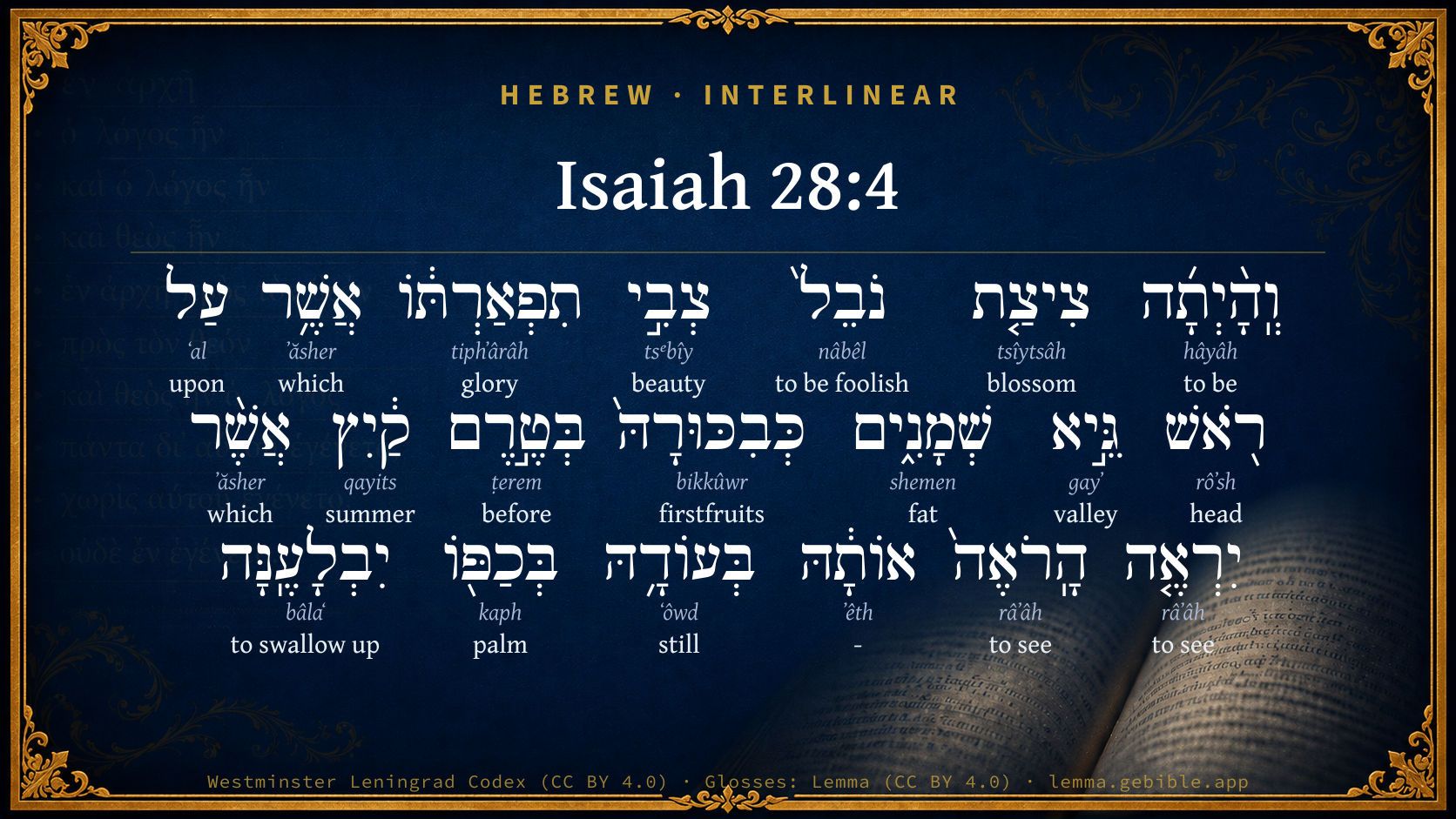
Hebrew (Westminster Leningrad Codex) Isaiah 28:4 appears in the Hebrew Old Testament. The text above is from the Westminster Leningrad Codex. Each word links to its Strong’s number, a concise gloss, and parsing drawn from the Open Scriptures Hebrew Bible morphology. Click any word for its full Brown-Driver-Briggs (BDB) entry.
Download image
Cite this verse

Isaiah 28:4 (World English Bible). Public Domain. Lemma interlinear Bible study tool, https://lemma.gebible.app/v/isaiah/28/4.

Show BibTeX & RIS
BibTeX
RIS
English Translation
and the fading flower of his glorious beauty, which is on the head of the fat valley, shall be as the first-ripe fig before the summer; which when he who looks on it sees, while it is yet in his hand he eats it up.
World English Bible · Public Domain
Highlights
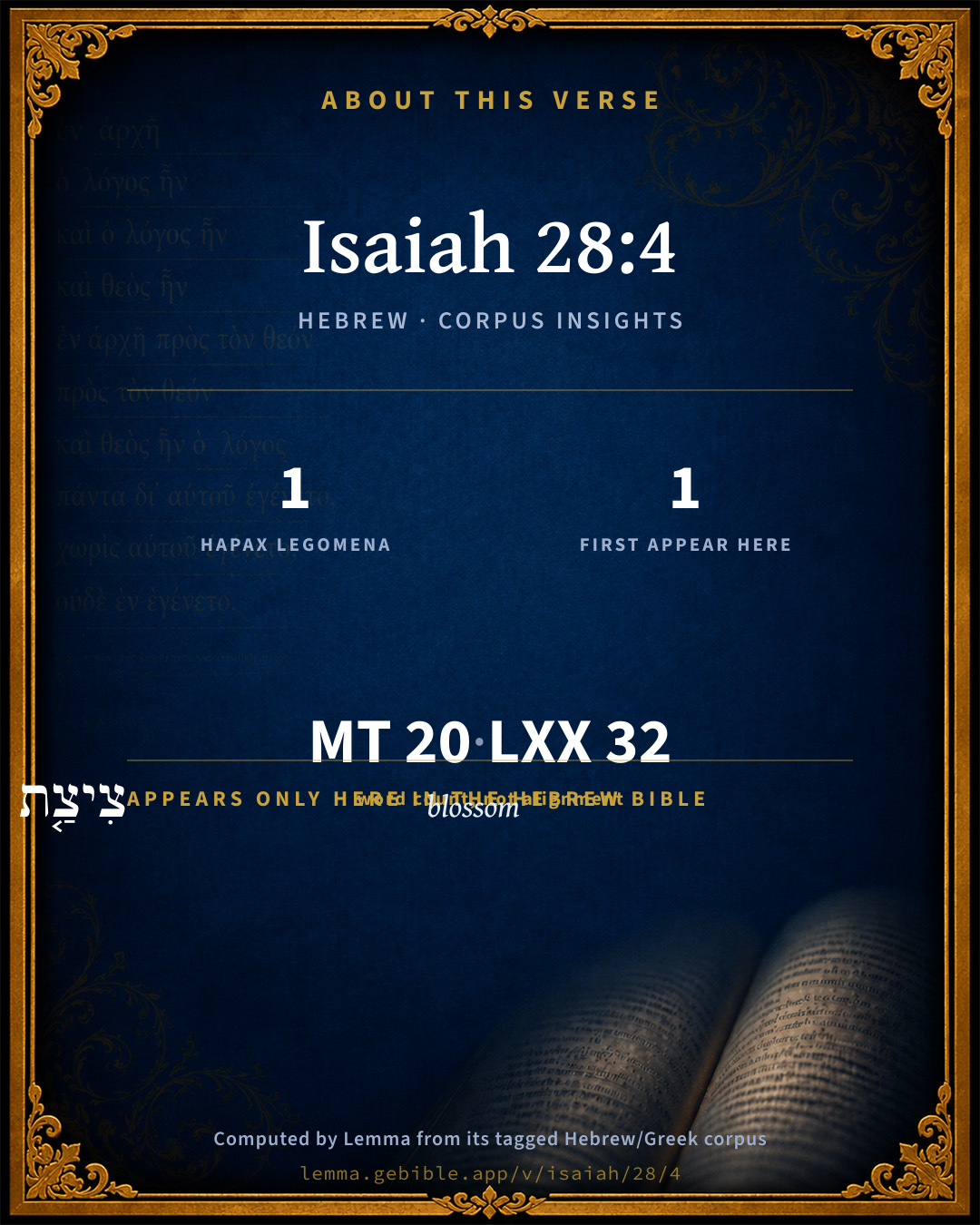
  • 1 hapax legomenon — only here in the Hebrew Bible
  • 1 first appearance in the Hebrew Bible
Full analysis ↓
Download a study sheet

One document with this verse’s original text, its word-by-word gloss line, the meaning frame, cross-references with their text, attributed commentary, and full source and license credits — printable, and it pastes into notes with its structure intact.

This verse Autodidact and up

Study sheet (.html) Plain text (.txt)

A passage Seminary Student

Up to 50 verses in one chapter. A passage sheet keeps up to 6 commentary sources and 12 cross-references per verse, in the order this page ranks them, and says so on the sheet whenever that leaves anything out. Ask for a single verse and you get the Autodidact verse sheet above.

Everything on this page stays free to read, with no account — the sheet is a download of what is already on screen, not access to it.

Want to remove ads? Support Godless Engineer
Compare translations 3

The same verse in 3 English versions, stacked beneath the original-language interlinear above. Click any original word for its lexicon entry.

Each is an independent rendering of the whole verse — the interlinear is not word-aligned to these translations.

Highlighted words mark where these versions differ — a whole-verse word diff, not a word-by-word alignment.

  • World English Bible Public Domain
    and the fading flower of his glorious beauty, which is on the head of the fat valley, shall be as the first-ripe fig before the summer; which when he who looks on it sees, while it is yet in his hand he eats it up.
  • King James Version Public Domain
    And the glorious beauty, which is on the head of the fat valley, shall be a fading flower, and as the hasty fruit before the summer; which when he that looketh upon it seeth, while it is yet in his hand he eateth it up.
  • unfoldingWord Literal Text CC BY-SA 4.0
    And the fading flower, the splendor of its beauty, which on the head of a valley of fatnesses, will be like the firstfruit before summer: When one seeing sees it, while it still in his palm, he swallows it. q1

unfoldingWord Literal Text — © unfoldingWord, licensed CC BY-SA 4.0. Word-aligned USFM3 via Door43 (git.door43.org/unfoldingWord/en_ult).

Versions to compare (up to 4)

3 of 4 selected

Show all 18 translations

Every available English version of this verse, each an independent rendering of the whole verse.

  • World English Bible Public Domain
    and the fading flower of his glorious beauty, which is on the head of the fat valley, shall be as the first-ripe fig before the summer; which when he who looks on it sees, while it is yet in his hand he eats it up.
  • Berean Standard Bible Public Domain
    The fading flower of his beautiful splendor, set on the summit above the fertile valley, will be like a ripe fig before the summer harvest: Whoever sees it will take it in his hand and swallow it.
  • Majority Standard Bible Public Domain
    The fading flower of his beautiful splendor, set on the summit above the fertile valley, will be like a ripe fig before the summer harvest: Whoever sees it will take it in his hand and swallow it.
  • King James Version Public Domain
    And the glorious beauty, which is on the head of the fat valley, shall be a fading flower, and as the hasty fruit before the summer; which when he that looketh upon it seeth, while it is yet in his hand he eateth it up.
  • American Standard Version (1901) Public Domain
    and the fading flower of his glorious beauty, which is on the head of the fat valley, shall be as the first-ripe fig before the summer; which when he that looketh upon it seeth, while it is yet in his hand he eateth it up.
  • Revised Version (1885) Public Domain
    and the fading flower of his glorious beauty, which is on the head of the fat valley, shall be as the firstripe fig before the summer; which when he that looketh upon it seeth, while it is yet in his hand he eateth it up.
  • Geneva Bible (1599) Public Domain
    For his glorious beautie shall be a fading floure, which is vpon the head of the valley of them that be fatte, and as the hastie fruite afore sommer, which when hee that looketh vpon it, seeth it, while it is in his hand, he eateth it.
  • Douay-Rheims (1899) Public Domain
    And the fading flower the glory of his joy, who is on the head of the fat valley, shall be as a hasty fruit before the ripeness of autumn: which when he that seeth it shall behold, as soon as he taketh it in his hand, he will eat it up.
  • Young's Literal Translation Public Domain
    And the fading flower of the beauty of his glory That `is' on the head of the fat valley, Hath been as its first-fruit before summer, That its beholder seeth, While it `is' yet in his hand he swalloweth it.
  • Literal Standard Version CC BY-SA 4.0
    And the fading flower of the beauty of his glory || That [is] on the head of the fat valley, || Has been as its first-fruit before summer, || That its beholder sees; He swallows it while it [is] yet in his hand.
  • Unlocked Literal Bible CC BY-SA 4.0
    The fading flower of his glorious beauty, that is on the head of the rich valley, will be as the first ripe fig before the summer, that, when someone sees it, while it is yet in his hand, he gulps it down.
  • unfoldingWord Literal Text CC BY-SA 4.0
    And the fading flower, the splendor of its beauty, which on the head of a valley of fatnesses, will be like the firstfruit before summer: When one seeing sees it, while it still in his palm, he swallows it. q1
  • Darby Bible Public Domain
    and the fading flower of his glorious adornment which is on the head of the fat valley shall be like an early fig before the summer: as soon as he that seeth it perceiveth it, scarcely is it in his hand, he swalloweth it down.
  • World Messianic Bible Public Domain
    The fading flower of his glorious beauty, which is on the head of the fertile valley, shall be like the first-ripe fig before the summer, which someone picks and eats as soon as he sees it.
  • Webster's Bible Public Domain
    And the glorious beauty, which is on the head of the rich valley, shall be a fading flower, and as the early fruit before the summer; which, when he that looketh upon it, seeth while it is yet in his hand he eateth it up.
  • Free Bible Version CC BY-SA 4.0
    That fading flower of wonderful beauty, sitting above a fertile valley, will be like figs ripe before the summer harvest—as soon as people discover them, they grab and eat them.
  • Bible in Basic English Public Domain
    And the dead flower of his glory, which is on the head of the fertile valley, will be like the first early fruit before the summer; which a man takes and puts in his mouth the minute he sees it.
  • JPS Tanakh (1917) Public Domain
    And the fading flower of his glorious beauty, which is on the head of the fat valley, shall be as the first-ripe fig before the summer, which when one looketh upon it, while it is yet in his hand he eateth it up.

Literal Standard Version (2020), Covenant Press — licensed CC BY-SA 4.0. Text via the HelloAO Bible API (eBible.org). Unlocked Literal Bible (unfoldingWord) — licensed CC BY-SA 4.0. Text via the HelloAO Bible API (eBible.org). unfoldingWord Literal Text — © unfoldingWord, licensed CC BY-SA 4.0. Word-aligned USFM3 via Door43 (git.door43.org/unfoldingWord/en_ult). Free Bible Version, Dr. Jonathan Gallagher — licensed CC BY-SA 4.0. Text via the HelloAO Bible API (eBible.org).

Word by word

More ways to search: Search by grammar → Find every occurrence → Compare this word →

Practice this passage: Drill this verse → Learn its vocabulary →

צִיצַ֤ת
tsîytsâh
H6733
“blossom”
Noun, Common, Feminine, Singular, Absolute
Part of Speech
Noun
Type
Common
Gender
Feminine
Number
Singular
State
Absolute
Full BDB Definition

Origin: fem. of H6731

TWOT: None

blossom, flower
  1. וְֽהָ֨יְתָ֜ה hâyâh H1961 “and · to be” Conjunction + Verb, Qal, Sequential Perfect, 3rd Person, Feminine, Singular
  2. נֹבֵל֙ nâbêl H5034 “being foolish” Verb, Qal, Participle Active, Masculine, Singular, Absolute
  3. צְבִ֣י tsᵉbîy H6643 “beauty of” Noun, Common, Masculine, Singular, Construct
  4. תִפְאַרְתּ֔וֹ tiphʼârâh H8597 “glory · his” Noun, Common, Feminine, Singular, Construct + Suffix, Personal, 3rd Person, Masculine, Singular
  5. אֲשֶׁ֥ר ʼăsher H834 “which” Particle, Relative
  6. עַל ʻal H5921 “upon” Preposition
  7. רֹ֖אשׁ rôʼsh H7218 “head of” Noun, Common, Masculine, Singular, Construct
  8. גֵּ֣יא gayʼ H1516 “valley of” Noun, Common, Both, Singular, Construct
  9. שְׁמָנִ֑ים shemen H8081 “fat” Noun, Common, Masculine, Plural, Absolute
  10. כְּבִכּוּרָהּ֙ bikkûwr H1061 “like/as · firstfruits” Preposition + Noun, Common, Both, Singular, Absolute
  11. בְּטֶ֣רֶם ṭerem H2962 “in/at · before” Preposition + Adverb
  12. קַ֔יִץ qayits H7019 “summer” Noun, Common, Masculine, Singular, Absolute
  13. אֲשֶׁ֨ר ʼăsher H834 “which” Particle, Relative
  14. יִרְאֶ֤ה râʼâh H7200 “to see” Verb, Qal, Imperfect, 3rd Person, Masculine, Singular
  15. הָֽרֹאֶה֙ râʼâh H7200 “the · seeing” Particle, Definite Article + Verb, Qal, Participle Active, Masculine, Singular, Absolute
  16. אוֹתָ֔הּ ʼêth H853 “- · her” Particle, Direct Object + Suffix, Personal, 3rd Person, Feminine, Singular
  17. בְּעוֹדָ֥הּ ʻôwd H5750 “in/at · still · her” Preposition + Adverb + Suffix, Personal, 3rd Person, Feminine, Singular
  18. בְּכַפּ֖וֹ kaph H3709 “in/at · palm · his” Preposition + Noun, Common, Feminine, Singular, Construct + Suffix, Personal, 3rd Person, Masculine, Singular
  19. יִבְלָעֶֽנָּה bâlaʻ H1104 “to swallow up · her” Verb, Qal, Imperfect, 3rd Person, Masculine, Singular + Suffix, Personal, 3rd Person, Feminine, Singular

About this verse

These counts appear in no published source. They are computed here, from the morphology-tagged text and Lemma’s own curated glosses. What Lemma adds →

20
words
18
distinct lemmas
Prophets
section

Notable vocabulary

1 hapax legomenon — a word that appears only here in the entire Hebrew Bible:

  • צִיצַ֤ת blossom H6733

First appearance in Scripture

This word makes its first canonical appearance in the Hebrew Bible here:

  • צִיצַ֤ת blossom H6733

Shared distinctive vocabulary

כְּבִכּוּרָהּ֙ firstfruits H1061 occurs in 16 verses of the Hebrew Bible. Also found in:

Grammatical profile

  • 5 verbs
  • 9 nouns
  • 1 preposition
  • 2 adverbs
  • 3 particles

Verb forms

  • וְֽהָ֨יְתָ֜ה Qal · Sequential Perfect
  • נֹבֵל֙ Qal · Participle Active
  • יִרְאֶ֤ה Qal · Imperfect
  • הָֽרֹאֶה֙ Qal · Participle Active
  • יִבְלָעֶֽנָּה Qal · Imperfect

Repetition

Words recur within this verse — often emphatic in Hebrew:

  • יִרְאֶ֤ה to see H7200 ×2
  • אֲשֶׁ֥ר which H834 ×2

Hebrew & Septuagint length

In English translation the verse runs 45 words from the Hebrew and 38 from the Septuagint (LXX English) — closely comparable.

A rough comparison of the two English renderings, which tokenize alike — not a word-level alignment.

Word counts can differ between the Hebrew and the Greek without any difference in meaning — e.g. the Hebrew direct-object marker אֵת has no separate Greek word, and Greek often adds the article ὁ.

In the original languages it is 20 Hebrew tokens and 32 Greek tokens — but the two are counted differently (Hebrew bundles its prefixes and suffixes into one token; the Greek is in lemma form), so that isn’t a like-for-like length.

Cross-references

11

Topical passages linked to Isaiah 28:4 in the Treasury of Scripture Knowledge — connected by theme and wording, ordered by reader-vote popularity; previews shown in the World English Bible.

  • Nahum 3:12 All your fortresses will be like fig trees with the first-ripe figs: if they are shaken, they fall into the mouth of the eater.
  • Micah 7:1 Misery is mine! Indeed, I am like one who gathers the summer fruits, as gleanings of the vinyard: There is no cluster of grapes to eat. My soul desires to eat the early fig.
  • Isaiah 28:1 Woe to the crown of pride of the drunkards of Ephraim, and to the fading flower of his glorious beauty, which is on the head of the fat valley of those who are overcome with wine!
  • Hosea 6:4 "Ephraim, what shall I do to you? Judah, what shall I do to you? For your love is like a morning cloud, And like the dew that disappears early.
  • Psalms 73:19–20 How they are suddenly destroyed! They are completely swept away with terrors.
  • Hosea 9:10–11 I found Israel like grapes in the wilderness. I saw your fathers as the first ripe in the fig tree at its first season; But they came to Baal Peor, and consecrated themselves to the shameful thing, And became abominable like that which they loved.
  • Hosea 9:16 Ephraim is struck. Their root has dried up. They will bear no fruit. Even though they bring forth, yet I will kill the beloved ones of their womb."
  • Hosea 13:1 When Ephraim spoke, there was trembling. He exalted himself in Israel, But when he became guilty in Baal, he died.
  • Hosea 13:15 Though he is fruitful among his brothers, an east wind will come, The breath of Yahweh coming up from the wilderness; And his spring will become dry, And his fountain will be dried up. He will plunder the storehouse of treasure.
  • James 1:10–11 and the rich, in that he is made humble, because like the flower in the grass, he will pass away.
  • Revelation 6:13 The stars of the sky fell to the earth, like a fig tree dropping its unripe figs when it is shaken by a great wind.

Cross-references courtesy of OpenBible.info (CC BY 4.0).

Hebrew and Greek witnesses Masoretic Hebrew ↔ Greek Septuagint

The same verse in the two great witnesses to the Old Testament, shown verse-for-verse.

These are two independent witnesses, not word-aligned to each other, and the Septuagint is shown in lemma (dictionary) form.

Hebrew Isaiah 28:4 Masoretic · Westminster Leningrad Codex

וְֽהָ֨יְתָ֜ה צִיצַ֤ת נֹבֵל֙ צְבִ֣י תִפְאַרְתּ֔וֹ אֲשֶׁ֥ר עַל רֹ֖אשׁ גֵּ֣יא שְׁמָנִ֑ים כְּבִכּוּרָהּ֙ בְּטֶ֣רֶם קַ֔יִץ אֲשֶׁ֨ר יִרְאֶ֤ה הָֽרֹאֶה֙ אוֹתָ֔הּ בְּעוֹדָ֥הּ בְּכַפּ֖וֹ יִבְלָעֶֽנָּה

and the fading flower of his glorious beauty, which is on the head of the fat valley, shall be as the first-ripe fig before the summer; which when he who looks on it sees, while it is yet in his hand he eats it up.

World English Bible · Public Domain

Greek LXX Isaiah 28:4 Septuagint · lemma form

καί εἰμί ὁ ἄνθος ὁ ἐκπίπτω ὁ ἐλπίς ὁ δόξα ἐπί ἄκρος ὁ ὄρος ὁ ὑψηλός ὡς πρόδρομος σύκον ὁ ὁράω αὐτός πρίν ἤ εἰς ὁ χείρ αὐτός λαμβάνω θέλω αὐτός καταπίνω

And the fading flower of the glorious hope on the top of the high mountain shall be as the early fig; he that sees it, before he takes it into his hand, will desire to swallow it down.

LXX2012 (modern English Septuagint) · Public Domain

Hebrew: Westminster Leningrad Codex (CC BY 4.0). Greek: Septuagint (public domain); English from LXX2012 (modern English Septuagint) (Public Domain). How the Septuagint differs from the Hebrew →

Targum (Aramaic paraphrase)

1

The Targum is the ancient Jewish Aramaic paraphrase of the Hebrew Scriptures — an interpretive translation, not the Hebrew text itself. Onkelos (literal) and Pseudo-Jonathan (expansive) render the Torah, and Jonathan the Prophets. Coverage is partial: where no permissively-licensed English translation exists for a verse, only the Aramaic is shown. This is verse-level text, not a word-by-word alignment to the Hebrew.

  1. Targum Jonathan Prophets (Joshua–Malachi)
    וִיהֵי דְיָהִיב מִצְנַפְתָּא לְרַשִׁיעַיָא דְבֵית מַקְדְשָׁא תּוּשְׁבַּחְתֵּהּ דִי עַל רֵישׁ חֵילָא שְׁמֵינָא כְּבִכּוּרָא עַד לָא קַיְטָא דְאִם יֶחֱזֵי דְחָזֵי יָתָהּ כְּאִלוּ הִיא בִּידֵהּ יְבַלְעִינָהּ:

    And the diadem, which He gave to the wicked of the house of the sanctuary of His praise, which is on the head of the valley of fatness, shall be as the first ripe fig before the summer, which, when one sees it, no sooner is it in the hand, than one devours it.

    Targum Jonathan — Aramaic: “Mikraot Gedolot” (public domain). English: “Sefaria Community Translation” (CC0 1.0 (public-domain dedication)); “London "Chaldee Paraphrase," 1871” (public domain). Text via Sefaria.

Commentary

Notes on Isaiah 28:4 from classic Christian and Jewish commentators (each source and its license shown beneath its notes). The classic Christian expositions comment on the surrounding passage and are grouped to its opening verse, so a note may address several verses; the Jewish commentaries on the Tanakh (Rashi and others) are per-verse, so they appear only where the commentator wrote on this verse.

Lemma curates 59 commentaries, every one of them public domain or Creative Commons licensed, each selected and text-cleaned for this edition rather than reprinted as found. About our sources →

Trapp's Complete Commentary

John Trapp

Isa 28:4 And the glorious beauty, which [is] on the head of the fat valley, shall be a fading flower, [and] as the hasty fruit before the summer; which [when] he that looketh upon it seeth, while it is yet in his hand he eateth it up.

Ver. 4. As the hasty fruit.] Quasi primae et praematurae ficus, early maturing fruits much coveted and caught at.

John Trapp, A Commentary or Exposition upon All the Books of the Old and New Testament (1647–1656) — public domain. Text from a community e-Sword module.

Geneva Bible (1599)

Geneva Bible translators

Which is not of long continuance, but is soon ripe and first eaten.

Geneva Bible (1599) marginal notes — public domain. Text via Bolls.life.

Jamieson, Fausset & Brown

Robert Jamieson, A. R. Fausset & David Brown

Rather, "the fading flower, their glorious beauty (Isa 28:1), which is on the head of the fat (fertile) valley, shall be as the early fig" [G. V. SMITH]. Figs usually ripened in August; but earlier ones (Hebrew bikkurah, Spanish bokkore) in June, and were regarded as a delicacy (Jer 24:2; Hos 9:10; Mic 7:1).

while it is yet--that is, immediately, without delay; describing the eagerness of the Assyrian Shalmaneser, not merely to conquer, but to destroy utterly Samaria; whereas other conquered cities were often spared.

Jamieson, Fausset & Brown — Commentary Critical and Explanatory on the Whole Bible (1871) — public domain (CC PDM 1.0). Text via the HelloAO Bible API.

Adam Clarke's Commentary

Verse 4. The hasty fruit before the summer - "The early fruit before the summer"] "No sooner doth the boccore, (the early fig,) draw near to perfection in the middle or latter end of June, than the kermez or summer fig begins to be formed, though it rarely ripens before August; about which time the same tree frequently throws out a third crop, or the winter fig, as we may call it. This is usually of a much longer shape and darker complexion than the kermez, hanging and ripening upon the tree even after the leaves are shed; and, provided the winter proves mild and temperate, is gathered as a delicious morsel in the spring;" Shaw, Travels, p. 370, fol. The image was very obvious to the inhabitants of Judea and the neighbouring countries, and is frequently applied by the prophets to express a desirable object; by none more elegantly than by Hosea, Ho 9:10: -

"Like grapes in the wilderness I found Israel;

Like the first ripe fig in her prime, I saw your fathers."

Which when he that looketh upon it seeth - "Which whoso seeth, he plucketh it immediately"] For יראה yireh, which with הראה haroeh makes a miserable tautology, read, by a transposition of a letter, יארה yoreh; a happy conjecture of Houbigant. The image expresses in the strongest manner the great ease with which the Assyrians shall take the city and the whole kingdom, and the avidity with which they shall seize the rich prey without resistance.

Adam Clarke's Commentary on the Bible (1810–1826) — public domain. Text from a community e-Sword/MySword module.

Ellicott's Commentary for English Readers

(4) And the glorious beauty . . .—Better, And the fading flower of his glorious beauty . . . shall be us the early fig before the fruit-gathering. The “early fig,” as a special delicacy (Hos_9:10; Mic_7:1), becomes a type of the beauty and pride of Samaria, doomed to inevitable destruction. (Comp. Nah_3:12.) Such a fig the passer-by seizes, and eagerly devours. So, the prophet says, with a Dante-like homeliness of comparison, should the Assyrian king treat Samaria.

A Bible Commentary for English Readers, edited by Charles John Ellicott (1878–1897) — public domain. Text from a community e-Sword module.

The Cambridge Bible for Schools and Colleges

gen. ed. J. J. S. Perowne

4. Render: And the fading flower of his glorious beauty, which is on the head of the fat valley (Isa_28:1), shall be like the early fig before the fruit-harvest, &c. These “early figs,” which might be found in the end of June, several weeks before the proper fig-season (in August), were esteemed a great delicacy; Hos_9:10; Mic_7:1; Nah_3:12; Jer_24:2.

which when he … seeth] Render: which when any one seeth (lit. “(the seer) seeth”; indef. subj., Davidson, Synt. § 108, R. 1). To see, to snatch, to swallow, is the work of a moment. So greedily and hastily and easily shall the Assyrians devour Samaria!

The Cambridge Bible for Schools and Colleges (gen. ed. J. J. S. Perowne; Cambridge University Press, 1878–1918) — public domain. Text from a community e-Sword module.

John Gill's Exposition

In that day shall the Lord of hosts be for a crown of glory,.... Or, "glorious crown" (p); surrounding, adorning, and protecting his people; granting them his presence; giving them his grace, and large measures of it; causing them to live soberly, righteously, and godly: this stands opposed to "the crown of pride" before mentioned, and refers to the time when that should be trampled under foot, or when the ten tribes should be carried into captivity, which was in the sixth year of Hezekiah's reign, Kg2 18:10 at which time, and in whose reign, as well as in the reign of Josiah, this prophecy had its accomplishment:

and for a diadem of beauty: or, "a beautiful diadem" (q); the same as expressed by different words, for the confirmation and illustration of it:

unto the residue of his people; the Arabic version adds, "in Egypt"; the people that remained there, when the others were carried captive, but without any foundation. Jarchi interprets it of the righteous that were left in it, in Samaria, or in Ephraim, in the ten tribes before spoken of; but it is to be understood, as Kimchi observes, of the other two tribes, Judah and Benjamin, which remained in their own land, when others were carried captive, to whom God gave his favours, spiritual and temporal, in the times of Hezekiah and Josiah; and especially the former is meant, and who was a type of Christ, to whom this passage may be applied, who is the glory of his people Israel; and so the Targum paraphrases it,

"in that day shall the Messiah of the Lord of hosts be for a crown of joy;''

and Kimchi says their Rabbins expound this of the King Messiah, in time to come, when both the kingly and priestly glory should be restored; the one being signified by the "crown of glory", the other by the "diadem of beauty".

(p) "pro corona decora", Piscator. (q) "et pro diademate ornante", Piscator.

John Gill's Exposition of the Whole Bible (1746–1763) — public domain (CC PDM 1.0). Text via the HelloAO Bible API.

Albert Barnes' Notes on the Bible

As the hasty fruit before the summer - The word rendered ‘hasty fruit’ (בכוּרה bikûrâh); in Arabic, bokkore; in Spanish, albacore), denotes the “early fig.” this ripens in June; the common fig does not ripen until August. Shaw, in his “Travels,” p. 370, says: ‘No sooner does the “boccore” (the early fig) draw near to perfection in the middle or latter end of June, than the “kermez” or summer fig begins to be formed, though it rarely ripens before August, about which time the same tree frequently throws out a third crop, or the winter fig, as we may call it. This is usually of a much longer shape and darker complexion than the kermez, hanging and ripening on the tree after the leaves are shed; and provided the winter be mild and temperate it is gathered as a delicious morsel in the spring.’ Robinson (George), (“Travels in Palestine and Syria,” vol. i. p. 354), says, ‘The fig tree, which delights in a rocky and parched soil, and is therefore often found in barren spots where nothing else will grow, is very common in Palestine and the East. The fruit is of two kinds, the “boccore” and the “kermouse.” The black and white boccore, or early fig, is produced in May; but the kermouse, or the fig properly so called, which is preserved and exported to Europe, is rarely ripe before September.’ Compare Hos 9:10. The phrase ‘before the summer’ means before the heat of the summer, when the common fig was usually ripe. The idea here is this, the early fig would be plucked and eaten with great greediness. So the city of Samaria would be seized upon and destroyed by its enemies.

Which when he that looketh upon it seeth ... - That is, as soon as he sees it he plucks it, and eats it at once. He does not lay it up for future use, but as soon as he has it in his hand he devours it. So soon as the Assyrian should see Samaria he would rush upon it, and destroy it. It was usual for conquerors to preserve the cities which they took in war for future use, and to make them a part of the strength or ornament of their kingdom. But Samaria was to be at once destroyed. Its inhabitants were to be carried away, and it would be demolished as greedily as a hungry man plucks and eats the first fig that ripens on the tree.

Albert Barnes' Notes on the Bible (1834–1885) — public domain. Text from a community e-Sword/MySword module.

Haydock's Catholic Bible Commentary

Up. Theglathphalassar was captivated with the beauty of the country, and made it tributary. But Salmanasar, fearing a revolt, destroyed it, 4 Kings xvii. 4.

George Leo Haydock (1774–1849), Haydock's Catholic Family Bible and Commentary, 1859 edition — public domain. Excludes Psalms (Douay-Rheims chapter numbering differs from Protestant) and Deuterocanonical books (Catholic canon only).

Matthew Poole's English Annotations

As the hasty fruit; which coming before the season, and before other fruits, is most acceptable; which as soon as a man sees he covets it, and plucks it off, yet doth not long enjoy it, but through greediness devours it almost as soon as he can get it into his hand. And so shall it be with Ephraim’s glory, which his enemies, as soon as they observe, shall covet and spoil, and devour it greedily, and with delight.

Matthew Poole's English Annotations on the Holy Bible (1683–1685) — public domain. Text from a community e-Sword/MySword module.

The Pulpit Commentary

And the glorious beauty, etc. Translate, And the fading flower of his glorious beauty, which is on the head of the fat valley, shall be like an early fig (that comes) before the harvest. Such an "early fig" is a tempting delicacy, devoured as soon as seen. (comp. Hos_9:10 Nah_3:12 Jer_24:2, etc.) The "beauty" of Samaria would tempt the Assyrians to desire it so soon as they saw it, and would rouse an appetite which would be content with nothing less than the speedy absorption of the coveted morsel. Samaria"s siege, once begun, was pressed without intermission, and lasted less than three years (2Ki_18:9, 2Ki_18:10) a short space compared to that of other sieges belonging to about the same period; e.g. that of Ashdod, besieged twenty-nine years (Herod., 2. 157); that of Tyre, besieged thirteen years ("Ancient Monarchies," vol. 3:492).

The Pulpit Commentary (1880–1919), ed. H.D.M. Spence-Jones & Joseph S. Exell — public domain. Text from a community e-Sword module.

John Wesley's Explanatory Notes

He eateth - Which, as soon as a man sees he plucks it off, and devours it, as soon as he can get it into his hand. And so shall it be with Ephraim's glory, which his enemies shall devour greedily.

John Wesley, Explanatory Notes Upon the Whole Bible (1754–1765) — public domain. Text via the GEBible commentary corpus.

J. A. Alexander on Isaiah

Joseph Addison Alexander

“And the fading flower of his glorious beauty, which is on the head of the fat valley, shall be like a first-ripe fig, which he that sees it sees, and while it is yet in his hand swallows it.” This comparison expresses the avidity with which the enemy would seize upon Samaria, and perhaps the completeness of its desolation. The fruit referred to is the early fig of Palestine which ripens in June, while the regular season of ingathering is from August to November, so that the former is regarded as a rarity and eaten with the greater relish. The figure is not here intended to express either ease or rapidity of conquest, for the siege of Samaria lasted three years (2Ki 17:5). The immediate eating of the fruit is only mentioned as a sign of eagerness or greediness. The last clause, though singularly worded, evidently means that as soon as one sees it and lays hold of it he swallows it without delay, or as Gill expresses it in homespun English, "as soon as he has got it into his hand, he can’t keep it there to look at, or forbear eating it, but greedily devours it and swallows it down at once."

Joseph Addison Alexander, The Prophecies of Isaiah (1846–1847; New York: Scribner, 1870–1878) — public domain. Text from a community e-Sword module.

Rashi

Rabbi Shlomo Yitzchaki (Rashi)

as a fig that ripens before the summer like the ripening of the young fruits of an inferior fig.

before the summer the time of the ripening of other figs, which, because of its early ripening, he pounces on it and swallows it while it is still in his hand. So (Dan. 9:14), “He hastened the evil and brought it upon us.”

Rashi on the Tanakh — English translations: “The Judaica Press complete Tanach with Rashi, translated by A. J. Rosenberg” (CC BY 4.0); “Pentateuch with Rashi's commentary by M. Rosenbaum and A.M. Silbermann, 1929-1934” (public domain); “The Metsudah Tanach series, Lakewood, N.J” (CC BY 4.0); and “The Book of Joshua, Metsudah Publications, 1997” (CC BY 4.0). Text via Sefaria.

Ibn Ezra

Rabbi Abraham ibn Ezra

ציצת נובל The blooming of the blossom which will fade away, —comp. בת בבל השדודה O daughter of Babylon, who art to be destroyed (Psa. 137:8)—or the blossom of the fading plant, and this is better.

כבכורה As the hasty fruit. As the fig that ripens before any of the summer fruit comes.

Ibn Ezra on the Tanakh — English translations: “Sefaria Community Translation” (CC0 1.0 (public-domain dedication)); “Yalkut, Sifsei Chachomim Chumash, Metsudah Publications, 2009” (CC BY 4.0); and “Commentary of Ibn Ezra on Isaiah - trans. by M. Friedlander, 1873” (public domain). Text via Sefaria.

Lesson kit

Teaching starters — assembled from the data on this page, not authored interpretation. Every prompt links to the verse data it draws on. Edit before teaching.

Isaiah, in the Prophets, opens this verse with 20 words (18 distinct Hebrew lemmas). Its most distinctive word is tsîytsâh (“blossom”). A historical commentator’s framing appears above. Read the whole chapter for the surrounding context.

Discussion questions

  1. The word tsîytsâh carries the sense “blossom.” How does it shape the verse?
  2. 1 word here appears nowhere else in the Hebrew Bible. Why might the author reach for such rare wording?
  3. This is the first place “blossom” appears in Scripture (first appears here). What does its debut here establish?
  4. How does Exodus 23:16, which shares the word «firstfruits», read alongside this verse?
  5. What does the repetition of “to see” (2× in this one verse) do in this verse?
  6. These translations render this verse differently. What is at stake in choosing one wording over another?
  7. «וְֽהָ֨יְתָ֜ה» is a Qal Sequential Perfect verb. How does that grammatical form shape the action described?
  8. Compare how Trapp's Complete Commentary and Geneva Bible (1599) read this verse. Where do they agree or differ?

Things to notice

  • 1 word in this verse appears nowhere else in the Hebrew Bible.
  • 1 word makes its first canonical appearance in Scripture here.
  • This verse counts 20 Hebrew ↔ 32 Greek words.
  • These translations choose different wording for 28 words in this verse.
  • “to see” occurs 2× in this single verse.

Reading settings

Reading text

Shown beneath each verse's original-language words.

Old Testament
Old Testament edition

Read the OT as the Masoretic Hebrew (MT) or the Greek Septuagint (LXX).

English shown for the Greek Septuagint (in the Hebrew ↔ Greek comparison).

Comparing translations? Open the Compare panel on any verse page to stack up to four side by side.