Isaiah 41:20

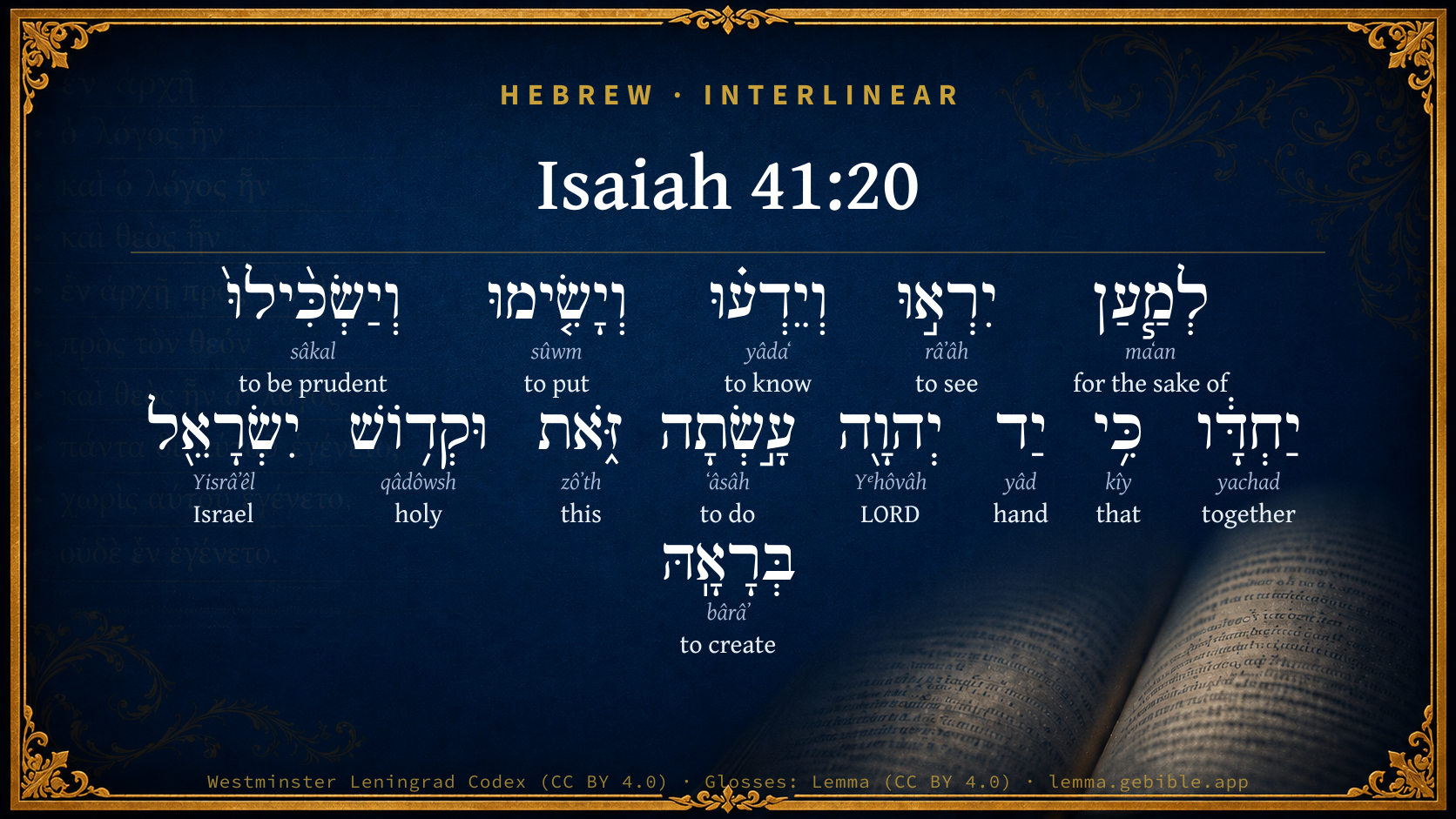
Hebrew (Westminster Leningrad Codex) Isaiah 41:20 appears in the Hebrew Old Testament. The text above is from the Westminster Leningrad Codex. Each word links to its Strong’s number, a concise gloss, and parsing drawn from the Open Scriptures Hebrew Bible morphology. Click any word for its full Brown-Driver-Briggs (BDB) entry.
Download image
Cite this verse

Isaiah 41:20 (World English Bible). Public Domain. Lemma interlinear Bible study tool, https://lemma.gebible.app/v/isaiah/41/20.

Show BibTeX & RIS
BibTeX
RIS
English Translation
that they may see, and know, and consider, and understand together, that the hand of Yahweh has done this, and the Holy One of Israel has created it.
World English Bible · Public Domain
Download a study sheet

One document with this verse’s original text, its word-by-word gloss line, the meaning frame, cross-references with their text, attributed commentary, and full source and license credits — printable, and it pastes into notes with its structure intact.

This verse Autodidact and up

Study sheet (.html) Plain text (.txt)

A passage Seminary Student

Up to 50 verses in one chapter. A passage sheet keeps up to 6 commentary sources and 12 cross-references per verse, in the order this page ranks them, and says so on the sheet whenever that leaves anything out. Ask for a single verse and you get the Autodidact verse sheet above.

Everything on this page stays free to read, with no account — the sheet is a download of what is already on screen, not access to it.

Want to remove ads? Support Godless Engineer
Compare translations 3

The same verse in 3 English versions, stacked beneath the original-language interlinear above. Click any original word for its lexicon entry.

Each is an independent rendering of the whole verse — the interlinear is not word-aligned to these translations.

Highlighted words mark where these versions differ — a whole-verse word diff, not a word-by-word alignment.

  • World English Bible Public Domain
    that they may see, and know, and consider, and understand together, that the hand of Yahweh has done this, and the Holy One of Israel has created it.
  • King James Version Public Domain
    That they may see, and know, and consider, and understand together, that the hand of the LORD hath done this, and the Holy One of Israel hath created it.
  • unfoldingWord Literal Text CC BY-SA 4.0
    that they may see and know and set and consider together that the hand of Yahweh has done this, and the Holy of Israel has created it. q1

unfoldingWord Literal Text — © unfoldingWord, licensed CC BY-SA 4.0. Word-aligned USFM3 via Door43 (git.door43.org/unfoldingWord/en_ult).

Versions to compare (up to 4)

3 of 4 selected

Show all 18 translations

Every available English version of this verse, each an independent rendering of the whole verse.

  • World English Bible Public Domain
    that they may see, and know, and consider, and understand together, that the hand of Yahweh has done this, and the Holy One of Israel has created it.
  • Berean Standard Bible Public Domain
    so that all may see and know, may consider and understand, that the hand of the LORD has done this and the Holy One of Israel has created it.”
  • Majority Standard Bible Public Domain
    so that all may see and know, may consider and understand, that the hand of the LORD has done this and the Holy One of Israel has created it.”
  • King James Version Public Domain
    That they may see, and know, and consider, and understand together, that the hand of the LORD hath done this, and the Holy One of Israel hath created it.
  • American Standard Version (1901) Public Domain
    that they may see, and know, and consider, and understand together, that the hand of Jehovah hath done this, and the Holy One of Israel hath created it.
  • Revised Version (1885) Public Domain
    that they may see, and know, and consider, and understand together, that the hand of the LORD hath done this, and the Holy One of Israel hath created it.
  • Geneva Bible (1599) Public Domain
    Therefore let them see and knowe, and let them consider and vnderstande together that the hand of the Lord hath done this, and the holy one of Israel hath created it.
  • Douay-Rheims (1899) Public Domain
    That they may see and know, and consider, and understand together that the hand of the Lord hath done this, and the Holy One of Israel hath created it.
  • Young's Literal Translation Public Domain
    So that they see, and know, And regard, and act wisely together, For the hand of Jehovah hath done this, And the Holy One of Israel hath prepared it.
  • Literal Standard Version CC BY-SA 4.0
    So that they see, and know, || And regard, and act wisely together, || For the hand of YHWH has done this, || And the Holy One of Israel has created it.
  • Unlocked Literal Bible CC BY-SA 4.0
    I will do this so that the people may see, recognize, and understand together, that the hand of Yahweh has done this, that the Holy One of Israel has created it.
  • unfoldingWord Literal Text CC BY-SA 4.0
    that they may see and know and set and consider together that the hand of Yahweh has done this, and the Holy of Israel has created it. q1
  • Darby Bible Public Domain
    that they may see, and know, and consider, and understand together, that the hand of Jehovah hath done this, and the Holy One of Israel hath created it.
  • World Messianic Bible Public Domain
    that they may see, know, consider, and understand together, that the LORD’s hand has done this, and the Holy One of Israel has created it.
  • Webster's Bible Public Domain
    That they may see, and know, and consider, and understand together, that the hand of the LORD hath done this, and the Holy One of Israel hath created it.
  • Free Bible Version CC BY-SA 4.0
    In this way everyone can see and know, they can think about it and draw the conclusion that it is the Lord who has done this, that the Holy One of Israel made it happen.
  • Bible in Basic English Public Domain
    So that they may see and be wise and give their mind to it, and that it may be clear to them all that the hand of the Lord has done this, and that the Holy One of Israel has made it.
  • JPS Tanakh (1917) Public Domain
    That they may see, and know, and consider, and understand together, that the hand of the LORD hath done this, and the Holy One of Israel hath created it.

Literal Standard Version (2020), Covenant Press — licensed CC BY-SA 4.0. Text via the HelloAO Bible API (eBible.org). Unlocked Literal Bible (unfoldingWord) — licensed CC BY-SA 4.0. Text via the HelloAO Bible API (eBible.org). unfoldingWord Literal Text — © unfoldingWord, licensed CC BY-SA 4.0. Word-aligned USFM3 via Door43 (git.door43.org/unfoldingWord/en_ult). Free Bible Version, Dr. Jonathan Gallagher — licensed CC BY-SA 4.0. Text via the HelloAO Bible API (eBible.org).

Word by word

More ways to search: Search by grammar → Find every occurrence → Compare this word →

Practice this passage: Drill this verse → Learn its vocabulary →

בְּרָאָֽהּ
bârâʼ
H1254
“to create · her”
Verb, Qal, Perfect, 3rd Person, Masculine, Singular + Suffix, Personal, 3rd Person, Feminine, Singular
Part of Speech
Verb
Stem
Qal
Form
Perfect
Person
3rd Person
Gender
Masculine
Number
Singular
Full BDB Definition

Origin: a primitive root

TWOT: 278

to create, shape, form - (Qal) to shape, fashion, create (always with God as subject) - of heaven and earth - of individual man - of new conditions and circumstances - of transformations - (Niphal) to be created - of heaven and earth - of birth - of something new - of miracles - (Piel) - to cut down - to cut out - to be fat - (Hiphil) to make yourselves fat
  1. לְמַ֧עַן maʻan H4616 “for the sake of” Preposition
  2. יִרְא֣וּ râʼâh H7200 “to see” Verb, Qal, Imperfect, 3rd Person, Masculine, Plural
  3. וְיֵדְע֗וּ yâdaʻ H3045 “and · to know” Conjunction + Verb, Qal, Imperfect, 3rd Person, Masculine, Plural
  4. וְיָשִׂ֤ימוּ sûwm H7760 “and · to put” Conjunction + Verb, Qal, Imperfect, 3rd Person, Masculine, Plural
  5. וְיַשְׂכִּ֨ילוּ֙ sâkal H7919 “and · to be prudent” Conjunction + Verb, Hiphil, Imperfect, 3rd Person, Masculine, Plural
  6. יַחְדָּ֔ו yachad H3162 “together” Adverb
  7. כִּ֥י kîy H3588 “that” Conjunction
  8. יַד yâd H3027 “hand of” Noun, Common, Both, Singular, Construct
  9. יְהוָ֖ה Yᵉhôvâh H3068 “LORD” Noun, Proper
  10. עָ֣שְׂתָה ʻâsâh H6213 “to do” Verb, Qal, Perfect, 3rd Person, Feminine, Singular
  11. זֹּ֑את zôʼth H2063 “this” Pronoun, Demonstrative, Feminine, Singular
  12. וּקְד֥וֹשׁ qâdôwsh H6918 “and · holy of” Conjunction + Adjective, Adjective, Masculine, Singular, Construct
  13. יִשְׂרָאֵ֖ל Yisrâʼêl H3478 “Israel” Noun, Proper

About this verse

These counts appear in no published source. They are computed here, from the morphology-tagged text and Lemma’s own curated glosses. What Lemma adds →

14
words
14
distinct lemmas
Prophets
section

Shared distinctive vocabulary

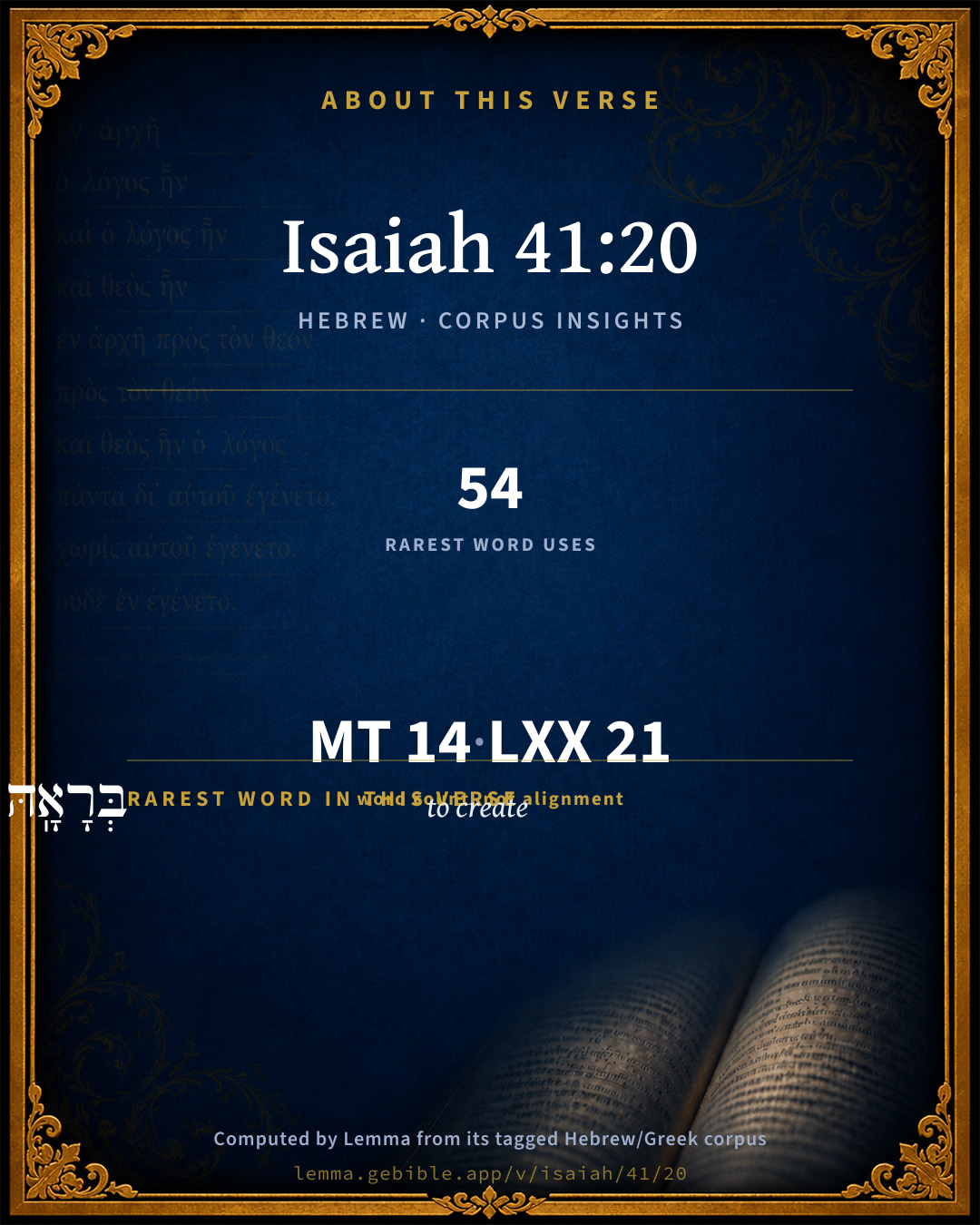
בְּרָאָֽהּ to create H1254 occurs in 46 verses of the Hebrew Bible. Also found in:

Grammatical profile

  • 6 verbs
  • 3 nouns
  • 1 adjective
  • 1 pronoun
  • 1 preposition
  • 1 conjunction
  • 1 adverb

Verb forms

  • יִרְא֣וּ Qal · Imperfect
  • וְיֵדְע֗וּ Qal · Imperfect
  • וְיָשִׂ֤ימוּ Qal · Imperfect
  • וְיַשְׂכִּ֨ילוּ֙ Hiphil · Imperfect
  • עָ֣שְׂתָה Qal · Perfect
  • בְּרָאָֽהּ Qal · Perfect

Hebrew & Septuagint length

In English translation the verse runs 28 words from the Hebrew and 30 from the Septuagint (LXX English) — closely comparable.

A rough comparison of the two English renderings, which tokenize alike — not a word-level alignment.

Word counts can differ between the Hebrew and the Greek without any difference in meaning — e.g. the Hebrew direct-object marker אֵת has no separate Greek word, and Greek often adds the article ὁ.

In the original languages it is 14 Hebrew tokens and 21 Greek tokens — but the two are counted differently (Hebrew bundles its prefixes and suffixes into one token; the Greek is in lemma form), so that isn’t a like-for-like length.

Cross-references

11

Topical passages linked to Isaiah 41:20 in the Treasury of Scripture Knowledge — connected by theme and wording, ordered by reader-vote popularity; previews shown in the World English Bible.

  • Job 12:9 Who doesn't know that in all these, The hand of Yahweh has done this,
  • Psalms 109:27 That they may know that this is your hand; That you, Yahweh, have done it.
  • Isaiah 43:21 the people which I formed for myself, that they might set forth my praise.
  • Isaiah 44:23 Sing, you heavens, for Yahweh has done it; shout, you lower parts of the earth; break forth into singing, you mountains, O forest, and every tree therein: for Yahweh has redeemed Jacob, and will glorify himself in Israel.
  • Exodus 9:16 but indeed for this cause I have made you stand: to show you my power, and that my name may be declared throughout all the earth;
  • Isaiah 43:7–13 everyone who is called by my name, and whom I have created for my glory, whom I have formed, yes, whom I have made.
  • Isaiah 45:6–8 that they may know from the rising of the sun, and from the west, that there is none besides me: I am Yahweh, and there is no one else.
  • 2 Thessalonians 1:10 when he comes to be glorified in his saints, and to be admired among all those who have believed (because our testimony to you was believed) in that day.
  • Numbers 23:23 Surely there is no enchantment with Jacob; Neither is there any divination with Israel: Now shall it be said of Jacob and of Israel, What has God done!
  • Isaiah 66:18 For I [know] their works and their thoughts: [the time] comes, that I will gather all nations and languages; and they shall come, and shall see my glory.
  • Ephesians 2:6–10 and raised us up with him, and made us to sit with him in the heavenly places in Christ Jesus,

Cross-references courtesy of OpenBible.info (CC BY 4.0).

Hebrew and Greek witnesses Masoretic Hebrew ↔ Greek Septuagint

The same verse in the two great witnesses to the Old Testament, shown verse-for-verse.

These are two independent witnesses, not word-aligned to each other, and the Septuagint is shown in lemma (dictionary) form.

Hebrew Isaiah 41:20 Masoretic · Westminster Leningrad Codex

לְמַ֧עַן יִרְא֣וּ וְיֵדְע֗וּ וְיָשִׂ֤ימוּ וְיַשְׂכִּ֨ילוּ֙ יַחְדָּ֔ו כִּ֥י יַד יְהוָ֖ה עָ֣שְׂתָה זֹּ֑את וּקְד֥וֹשׁ יִשְׂרָאֵ֖ל בְּרָאָֽהּ

that they may see, and know, and consider, and understand together, that the hand of Yahweh has done this, and the Holy One of Israel has created it.

World English Bible · Public Domain

Greek LXX Isaiah 41:20 Septuagint · lemma form

ἵνα ὁράω καί γιγνώσκω καί ἐννοέω καί ἐπιἵστημι ἅμα ὅτι χείρ κύριος ποιέω οὗτος πᾶς καί ὁ ἅγιος ὁ ἰσραήλ καταδεικνύω

that they may see, and know, and perceive, and understand together, that the hand of the Lord has wrought these works, and the Holy One of Israel has displayed them.

LXX2012 (modern English Septuagint) · Public Domain

Hebrew: Westminster Leningrad Codex (CC BY 4.0). Greek: Septuagint (public domain); English from LXX2012 (modern English Septuagint) (Public Domain). How the Septuagint differs from the Hebrew →

Targum (Aramaic paraphrase)

1

The Targum is the ancient Jewish Aramaic paraphrase of the Hebrew Scriptures — an interpretive translation, not the Hebrew text itself. Onkelos (literal) and Pseudo-Jonathan (expansive) render the Torah, and Jonathan the Prophets. Coverage is partial: where no permissively-licensed English translation exists for a verse, only the Aramaic is shown. This is verse-level text, not a word-by-word alignment to the Hebrew.

  1. Targum Jonathan Prophets (Joshua–Malachi)
    בְּדִיל דְיֶחֱזוּן וְיֵדְעוּן וִישַׁווּן דְחַלְתִּי עַל לִבְּהוֹן וְיִסְתַּכְּלוּן כַּחֲדָא אֲרֵי גְבוּרְתָא דַייָ עֲבָדַת דָא וְקַדִישָׁא דְיִשְׂרָאֵל בְּרָא יָתָהּ:

    In order that they may see, and know, and put my fear in their heart, and may consider together, that the might of the Lord hath done this, and the Holy One of Israel hath created it.

    Targum Jonathan — Aramaic: “Mikraot Gedolot” (public domain). English: “Sefaria Community Translation” (CC0 1.0 (public-domain dedication)); “London "Chaldee Paraphrase," 1871” (public domain). Text via Sefaria.

Commentary

Notes on Isaiah 41:20 from classic Christian and Jewish commentators (each source and its license shown beneath its notes). The classic Christian expositions comment on the surrounding passage and are grouped to its opening verse, so a note may address several verses; the Jewish commentaries on the Tanakh (Rashi and others) are per-verse, so they appear only where the commentator wrote on this verse.

Lemma curates 59 commentaries, every one of them public domain or Creative Commons licensed, each selected and text-cleaned for this edition rather than reprinted as found. About our sources →

Trapp's Complete Commentary

John Trapp

Isa 41:20 That they may see, and know, and consider, and understand together, that the hand of the LORD hath done this, and the Holy One of Israel hath created it.

Ver. 20. That they may see, and know, and consider.] Heb., Lay. Lay it upon their heart, which natural men are very hardly drawn to do. The best are so backward, that an Ezekiel may hear, "Son of man, behold with thine eye, and hear with thine ears, and set thine heart upon all that I shall show thee," &c., {Eze 40:4} and Haggai calleth upon the good people of his time to "consider" and better "consider." {Hag 1:5; Hag 1:7}

John Trapp, A Commentary or Exposition upon All the Books of the Old and New Testament (1647–1656) — public domain. Text from a community e-Sword module.

Geneva Bible (1599)

Geneva Bible translators

That is, hath appointed and determined that it shall come so to pass.

Geneva Bible (1599) marginal notes — public domain. Text via Bolls.life.

Jamieson, Fausset & Brown

Robert Jamieson, A. R. Fausset & David Brown

consider--literally, "lay it (to hear)"; turn (their attention) to it. "They" refers to all lands (Isa 41:1; Psa 64:9; Psa 40:3). The effect on the Gentiles of God's open interposition hereafter in behalf of Israel shall be, they shall seek Israel's God (Isa 2:3; Zac 8:21-23).

Jamieson, Fausset & Brown — Commentary Critical and Explanatory on the Whole Bible (1871) — public domain (CC PDM 1.0). Text via the HelloAO Bible API.

Adam Clarke's Commentary

Verse 20. And consider] The verb ישימו yasimu, without לב leb added, cannot signify to apply the heart, or to attend to a thing, as Houbigant has observed; he therefore reads ישמו yashshemu, they shall wonder. The conjecture is ingenious; but it is much more probable that the word לב leb is lost out of the text; for all the ancient versions render the phrase to the same sense, as if it were fully expressed, ישימו לב yasimu leb; and the Chaldee renders it paraphrastically, yet still retaining the very words in his paraphrase, ושוון דחלתי על לבהון vishavvun dechalti al lebehon, "that they may put my fear in their heart." See also Isa 41:22, where the same phrase is used.

Adam Clarke's Commentary on the Bible (1810–1826) — public domain. Text from a community e-Sword/MySword module.

Ellicott's Commentary for English Readers

(20) That they may see.—The outward blessings, yet more the realities of which they are the symbols, are given to lead men to acknowledge Him who alone would be the giver.

A Bible Commentary for English Readers, edited by Charles John Ellicott (1878–1897) — public domain. Text from a community e-Sword module.

The Cambridge Bible for Schools and Colleges

gen. ed. J. J. S. Perowne

20. The ultimate object of this miracle is the demonstration of the creative power of the true God; see ch. Isa_40:5, Isa_55:13. The verse seems to shew that the previous description is not merely figurative, but that an actual physical transformation of the desert is contemplated.

That they (men in general) may … consider] Lit. “lay (to heart),” a common ellipsis. together binds the four verbs of the sentence.

The Cambridge Bible for Schools and Colleges (gen. ed. J. J. S. Perowne; Cambridge University Press, 1878–1918) — public domain. Text from a community e-Sword module.

John Gill's Exposition

That they may see, and know, and consider, and understand together,.... Not the nations of the world, as Kimchi; but rather, as Aben Ezra, the poor and needy; who in all this, by subduing kingdoms and states, their enemies, supplying their wants when in the greatest distress, and in a marvellous manner, and converting sinners, might easily perceive, and so frankly own and acknowledge, as well as lay it to heart, and lay it up in their minds, and get understanding from it:

that the hand of the Lord hath done this, and the Holy One of Israel hath created it; for the things before said to be done carry in them plain marks of the hand of the Lord, and are as clear proofs of his almighty power, as what was done in the creation of all things; such as a worm to be made a threshing instrument, to beat down mountains and hills, kingdoms and states, and make them as chaff; rivers to be opened in high places, and all manner of excellent trees to be planted in a wilderness; and indeed the work of conversion is a creation work; men are by it made new creatures, and are manifestly the workmanship of the hand of God.

John Gill's Exposition of the Whole Bible (1746–1763) — public domain (CC PDM 1.0). Text via the HelloAO Bible API.

Albert Barnes' Notes on the Bible

That they - The Jews, the people who shall be rescued from their long captivity, and restored again to their own land. So rich and unexpected would be the blessings - as if in a pathless desert the most beautiful and refreshing trees and fountains should suddenly spring up - that they would have the fullest demonstration that they came from God.

Hath created it - That is, all this is to be traced to him. In the apocryphal book of Baruch there is an expression respecting the return from Babylon remarkably similar to that which is used here by Isaiah: ‘Even the woods and every sweet-smelling tree shall overshadow Israel by the commandment of God’ Isa 5:8.

Albert Barnes' Notes on the Bible (1834–1885) — public domain. Text from a community e-Sword/MySword module.

Matthew Poole's English Annotations

That they may see; or, that men may see; for it is an indefinite expression. The sense is, that all that see this wonderful change may consider it, and may know that this is the work of God alone.

Matthew Poole's English Annotations on the Holy Bible (1683–1685) — public domain. Text from a community e-Sword/MySword module.

The Pulpit Commentary

That they may see, etc. The change would be such that those who experienced it could not fail to recognize "Jehovah, the Holy One of Israel," as its Author.

The Pulpit Commentary (1880–1919), ed. H.D.M. Spence-Jones & Joseph S. Exell — public domain. Text from a community e-Sword module.

J. A. Alexander on Isaiah

Joseph Addison Alexander

“That they may see, and know, and consider, and understand together, that the hand of Jehovah hath done this, and the Holy One of Israel hath created it.” The verbs in the first clause may refer to men in general, or to those immediately concerned as subjects or spectators of the change described. There is a climax in the last clause: He has not only done it but created it, (i.e., produced a new effect by the exertion of almighty power).

Joseph Addison Alexander, The Prophecies of Isaiah (1846–1847; New York: Scribner, 1870–1878) — public domain. Text from a community e-Sword module.

Ibn Ezra

Rabbi Abraham ibn Ezra

That they may see, etc. That the poor may see with their own eyes, and take it to heart.

בראה According to my opinion, hath shaped it; according to others, hath created it, that is, has brought it from non-existence into existence, but not from one form of existence into another.

Ibn Ezra on the Tanakh — English translations: “Sefaria Community Translation” (CC0 1.0 (public-domain dedication)); “Yalkut, Sifsei Chachomim Chumash, Metsudah Publications, 2009” (CC BY 4.0); and “Commentary of Ibn Ezra on Isaiah - trans. by M. Friedlander, 1873” (public domain). Text via Sefaria.

Lesson kit

Teaching starters — assembled from the data on this page, not authored interpretation. Every prompt links to the verse data it draws on. Edit before teaching.

Isaiah, in the Prophets, opens this verse with 14 words (14 distinct Hebrew lemmas). Its most distinctive word is bârâʼ (“to create”). A historical commentator’s framing appears above. Read the whole chapter for the surrounding context.

Discussion questions

  1. The word bârâʼ carries the sense “to create.” How does it shape the verse?
  2. Genesis 1:1 shares the word «to create» with this verse. How do the two illuminate each other?
  3. These translations render this verse differently; the difference is in the English rendering, not the original. What questions does that raise?
  4. The verb «יִרְא֣וּ» is Qal Imperfect. How does its form color the action?
  5. Reading how Trapp's Complete Commentary and Geneva Bible (1599) read this verse, where do the two commentators agree and where do they part?

Things to notice

Reading settings

Reading text

Shown beneath each verse's original-language words.

Old Testament
Old Testament edition

Read the OT as the Masoretic Hebrew (MT) or the Greek Septuagint (LXX).

English shown for the Greek Septuagint (in the Hebrew ↔ Greek comparison).

Comparing translations? Open the Compare panel on any verse page to stack up to four side by side.