
Deuteronomy 33:9

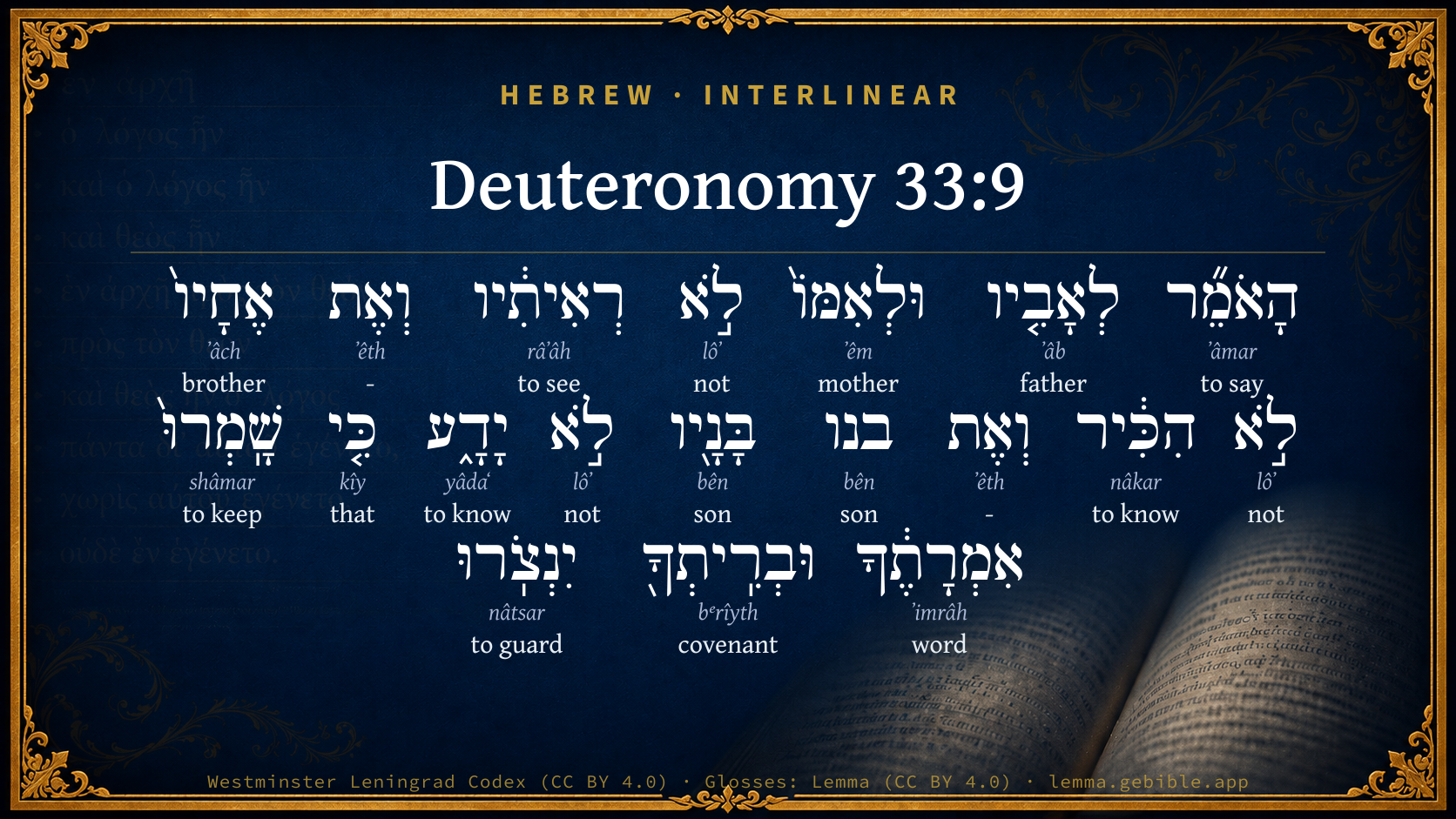
Hebrew (Westminster Leningrad Codex) Deuteronomy 33:9 appears in the Hebrew Old Testament. The text above is from the Westminster Leningrad Codex. Each word links to its Strong’s number, a concise gloss, and parsing drawn from the Open Scriptures Hebrew Bible morphology. Click any word for its full Brown-Driver-Briggs (BDB) entry.
Download image
Cite this verse

Deuteronomy 33:9 (World English Bible). Public Domain. Lemma interlinear Bible study tool, https://lemma.gebible.app/v/deuteronomy/33/9.

Show BibTeX & RIS
BibTeX
RIS
English Translation
Who said of his father, and of his mother, I have not seen him; Neither did he acknowledge his brothers, Nor knew he his own children: For they have observed your word, Keep your covenant.
World English Bible · Public Domain
Download a study sheet

One document with this verse’s original text, its word-by-word gloss line, the meaning frame, cross-references with their text, attributed commentary, and full source and license credits — printable, and it pastes into notes with its structure intact.

This verse Autodidact and up

Study sheet (.html) Plain text (.txt)

A passage Seminary Student

Up to 50 verses in one chapter. A passage sheet keeps up to 6 commentary sources and 12 cross-references per verse, in the order this page ranks them, and says so on the sheet whenever that leaves anything out. Ask for a single verse and you get the Autodidact verse sheet above.

Everything on this page stays free to read, with no account — the sheet is a download of what is already on screen, not access to it.

Want to remove ads? Support Godless Engineer
Compare translations 3

The same verse in 3 English versions, stacked beneath the original-language interlinear above. Click any original word for its lexicon entry.

Each is an independent rendering of the whole verse — the interlinear is not word-aligned to these translations.

Highlighted words mark where these versions differ — a whole-verse word diff, not a word-by-word alignment.

  • World English Bible Public Domain
    Who said of his father, and of his mother, I have not seen him; Neither did he acknowledge his brothers, Nor knew he his own children: For they have observed your word, Keep your covenant.
  • King James Version Public Domain
    Who said unto his father and to his mother, I have not seen him; neither did he acknowledge his brethren, nor knew his own children: for they have observed thy word, and kept thy covenant.
  • unfoldingWord Literal Text CC BY-SA 4.0
    who said of his father and of his mother, ‘I have not seen them,’ and his brothers he did not acknowledge, and his sons he did not know, for they guarded your speech and your covenant they kept.

unfoldingWord Literal Text — © unfoldingWord, licensed CC BY-SA 4.0. Word-aligned USFM3 via Door43 (git.door43.org/unfoldingWord/en_ult).

Versions to compare (up to 4)

3 of 4 selected

Show all 18 translations

Every available English version of this verse, each an independent rendering of the whole verse.

  • World English Bible Public Domain
    Who said of his father, and of his mother, I have not seen him; Neither did he acknowledge his brothers, Nor knew he his own children: For they have observed your word, Keep your covenant.
  • Berean Standard Bible Public Domain
    He said of his father and mother, ‘I do not consider them.’ He disregarded his brothers and did not know his own sons, for he kept Your word and maintained Your covenant.
  • Majority Standard Bible Public Domain
    He said of his father and mother, ‘I do not consider them.’ He disregarded his brothers and did not know his own sons, for he kept Your word and maintained Your covenant.
  • King James Version Public Domain
    Who said unto his father and to his mother, I have not seen him; neither did he acknowledge his brethren, nor knew his own children: for they have observed thy word, and kept thy covenant.
  • American Standard Version (1901) Public Domain
    Who said of his father, and of his mother, I have not seen him; Neither did he acknowledge his brethren, Nor knew he his own children: For they have observed thy word, And keep thy covenant.
  • Revised Version (1885) Public Domain
    Who said of his father, and of his mother, I have not seen him; Neither did he acknowledge his brethren, Nor knew he his own children: For they have observed thy word, And keep thy covenant.
  • Geneva Bible (1599) Public Domain
    Who said vnto his father and to his mother, I haue not seene him, neither knewe he his brethren, nor knewe his owne children: for they obserued thy word, and kept thy couenant.
  • Douay-Rheims (1899) Public Domain
    Who hath said to his father, and to his mother: I do not know you; and to his brethren: I know you not: and their own children they have not known. These have kept thy word, and observed thy covenant,
  • Young's Literal Translation Public Domain
    Who is saying of his father and his mother, I have not seen him; And his brethren he hath not discerned, And his sons he hath not known; For they have observed Thy saying, And Thy covenant they keep.
  • Literal Standard Version CC BY-SA 4.0
    Who is saying of his father and his mother, || I have not seen him; And he has not discerned his brothers, || And he has not known his sons; For they have observed Your saying, || And they keep Your covenant.
  • Unlocked Literal Bible CC BY-SA 4.0
    The man who said about his father and mother, “I have not seen them.” Neither did he acknowledge his brothers, nor did he take account of his own children. For he guarded your word and kept your covenant.
  • unfoldingWord Literal Text CC BY-SA 4.0
    who said of his father and of his mother, ‘I have not seen them,’ and his brothers he did not acknowledge, and his sons he did not know, for they guarded your speech and your covenant they kept.
  • Darby Bible Public Domain
    Who said to his father and to his mother, I see him not, And he acknowledged not his brethren, And knew not his own children; For they have observed thy word, And kept thy covenant.
  • World Messianic Bible Public Domain
    He said of his father, and of his mother, ‘I have not seen him.’ He didn’t acknowledge his brothers, nor did he know his own children; for they have observed your word, and keep your covenant.
  • Webster's Bible Public Domain
    Who said to his father and to his mother, I have not seen him, neither did he acknowledge his brethren, nor know his own children: for they have observed thy word, and kept thy covenant.
  • Free Bible Version CC BY-SA 4.0
    Levi said that he didn't pay attention to his father and mother, that he didn't acknowledge his brothers, and that he didn't recognize his children. The Levites did what you said and kept your agreement.
  • Bible in Basic English Public Domain
    Who said of his father, Who is he? and of his mother, I have not seen her; he kept himself separate from his brothers and had no knowledge of his children: for they have given ear to your word and kept your agreement.
  • JPS Tanakh (1917) Public Domain
    Who said of his father, and of his mother: 'I have not seen him'; neither did he acknowledge his brethren, nor knew he his own children; for they have observed Thy word, and keep Thy covenant.

Literal Standard Version (2020), Covenant Press — licensed CC BY-SA 4.0. Text via the HelloAO Bible API (eBible.org). Unlocked Literal Bible (unfoldingWord) — licensed CC BY-SA 4.0. Text via the HelloAO Bible API (eBible.org). unfoldingWord Literal Text — © unfoldingWord, licensed CC BY-SA 4.0. Word-aligned USFM3 via Door43 (git.door43.org/unfoldingWord/en_ult). Free Bible Version, Dr. Jonathan Gallagher — licensed CC BY-SA 4.0. Text via the HelloAO Bible API (eBible.org).

Word by word

More ways to search: Search by grammar → Find every occurrence → Compare this word →

Practice this passage: Drill this verse → Learn its vocabulary →

אִמְרָתֶ֔ךָ
ʼimrâh
H565
“word · your”
Noun, Common, Feminine, Singular, Construct + Suffix, Personal, 2nd Person, Masculine, Singular
Part of Speech
Noun
Type
Common
Gender
Feminine
Number
Singular
State
Construct
Full BDB Definition

Origin: from H561

TWOT: 118b

utterance, speech, word - word of God, the Torah
  1. הָאֹמֵ֞ר ʼâmar H559 “the · saying” Particle, Definite Article + Verb, Qal, Participle Active, Masculine, Singular, Absolute
  2. לְאָבִ֤יו ʼâb H1 “to/for · father · his” Preposition + Noun, Common, Masculine, Singular, Construct + Suffix, Personal, 3rd Person, Masculine, Singular
  3. וּלְאִמּוֹ֙ ʼêm H517 “and · to/for · mother · his” Conjunction + Preposition + Noun, Common, Feminine, Singular, Construct + Suffix, Personal, 3rd Person, Masculine, Singular
  4. לֹ֣א lôʼ H3808 “not” Particle, Negative
  5. רְאִיתִ֔יו râʼâh H7200 “to see · him” Verb, Qal, Perfect, 1st Person, Common, Singular + Suffix, Personal, 3rd Person, Masculine, Singular
  6. וְאֶת ʼêth H853 “and · -” Conjunction + Particle, Direct Object
  7. אֶחָיו֙ ʼâch H251 “brothers · his” Noun, Common, Masculine, Plural, Construct + Suffix, Personal, 3rd Person, Masculine, Singular
  8. לֹ֣א lôʼ H3808 “not” Particle, Negative
  9. הִכִּ֔יר nâkar H5234 “to know” Verb, Hiphil, Perfect, 3rd Person, Masculine, Singular
  10. וְאֶת ʼêth H853 “and · -” Conjunction + Particle, Direct Object
  11. בנו bên H1121 “son · his” Noun, Common, Masculine, Singular, Construct + Suffix, Personal, 3rd Person, Masculine, Singular
  12. בָּנָ֖יו bên H1121 “sons · his” Noun, Common, Masculine, Plural, Construct + Suffix, Personal, 3rd Person, Masculine, Singular
  13. לֹ֣א lôʼ H3808 “not” Particle, Negative
  14. יָדָ֑ע yâdaʻ H3045 “to know” Verb, Qal, Perfect, 3rd Person, Masculine, Singular
  15. כִּ֤י kîy H3588 “that” Conjunction
  16. שָֽׁמְרוּ֙ shâmar H8104 “to keep” Verb, Qal, Perfect, 3rd Person, Common, Plural
  17. וּבְרִֽיתְךָ֖ bᵉrîyth H1285 “and · covenant · your” Conjunction + Noun, Common, Feminine, Singular, Construct + Suffix, Personal, 2nd Person, Masculine, Singular
  18. יִנְצֹֽרוּ nâtsar H5341 “to guard” Verb, Qal, Imperfect, 3rd Person, Masculine, Plural

About this verse

These counts appear in no published source. They are computed here, from the morphology-tagged text and Lemma’s own curated glosses. What Lemma adds →

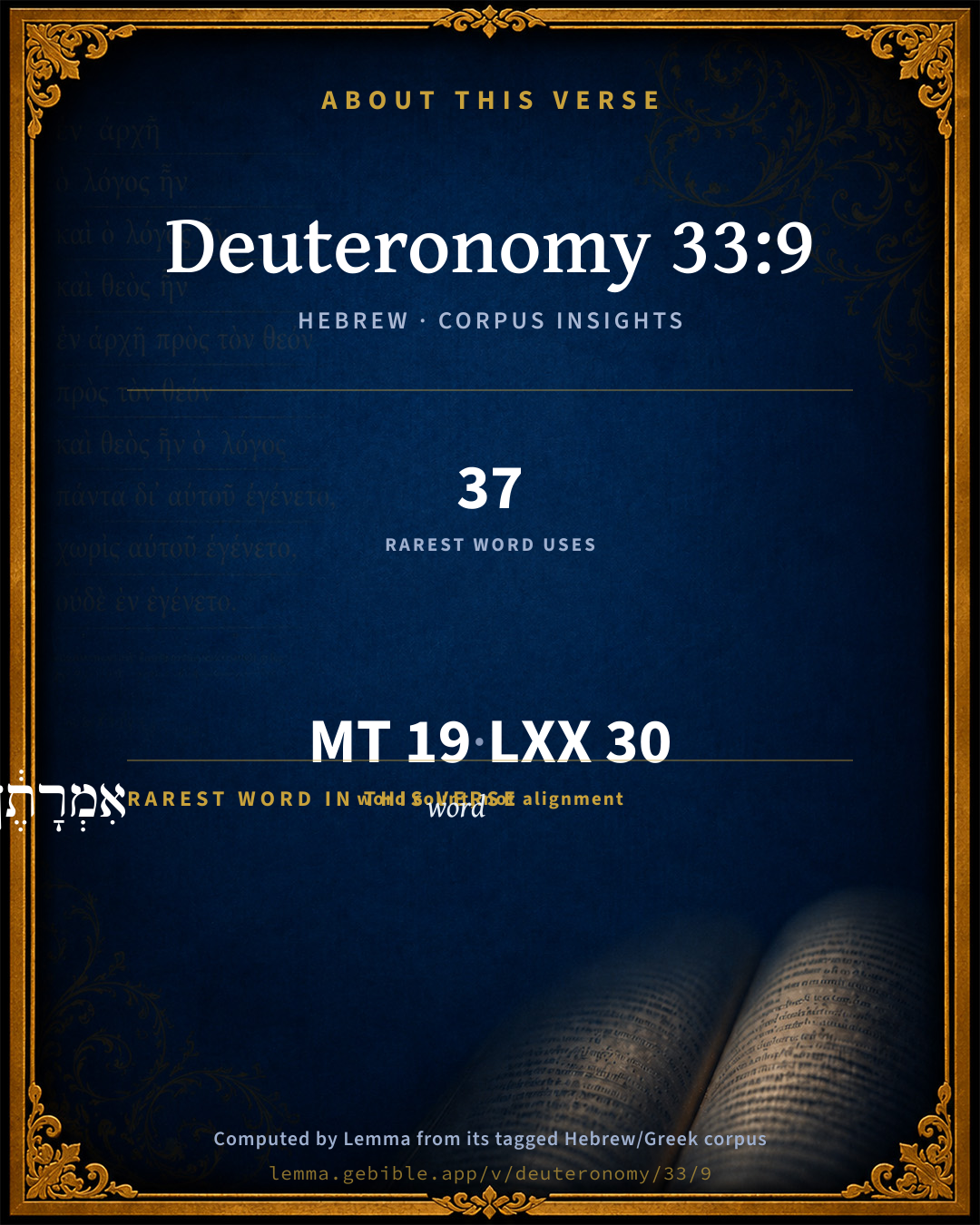
19
words
15
distinct lemmas
Pentateuch
section

Shared distinctive vocabulary

אִמְרָתֶ֔ךָ word H565 occurs in 35 verses of the Hebrew Bible. Also found in:

Grammatical profile

  • 6 verbs
  • 7 nouns
  • 1 conjunction
  • 5 particles

Verb forms

  • הָאֹמֵ֞ר Qal · Participle Active
  • רְאִיתִ֔יו Qal · Perfect
  • הִכִּ֔יר Hiphil · Perfect
  • יָדָ֑ע Qal · Perfect
  • שָֽׁמְרוּ֙ Qal · Perfect
  • יִנְצֹֽרוּ Qal · Imperfect

Repetition

Words recur within this verse — often emphatic in Hebrew:

Hebrew & Septuagint length

In English translation the verse runs 35 words from the Hebrew and 33 from the Septuagint (LXX English) — closely comparable.

A rough comparison of the two English renderings, which tokenize alike — not a word-level alignment.

Word counts can differ between the Hebrew and the Greek without any difference in meaning — e.g. the Hebrew direct-object marker אֵת has no separate Greek word, and Greek often adds the article ὁ.

In the original languages it is 19 Hebrew tokens and 30 Greek tokens — but the two are counted differently (Hebrew bundles its prefixes and suffixes into one token; the Greek is in lemma form), so that isn’t a like-for-like length.

Cross-references

16

Topical passages linked to Deuteronomy 33:9 in the Treasury of Scripture Knowledge — connected by theme and wording, ordered by reader-vote popularity; previews shown in the World English Bible.

  • Exodus 32:25–29 When Moses saw that the people had broken loose, (for Aaron had let them loose for a derision among their enemies),
  • Matthew 10:37 He who loves father or mother more than me is not worthy of me; and he who loves son or daughter more than me isn't worthy of me.
  • Leviticus 21:11 neither shall he go in to any dead body, nor defile himself for his father, or for his mother;
  • Jeremiah 18:18 Then said they, Come, and let us devise devices against Jeremiah; for the law shall not perish from the priest, nor counsel from the wise, nor the word from the prophet. Come, and let us strike him with the tongue, and let us not give heed to any of his words.
  • Matthew 12:48 But he answered him who spoke to him, "Who is my mother? Who are my brothers?"
  • Luke 14:26 "If anyone comes to me, and doesn't hate his own father, mother, wife, children, brothers, and sisters, yes, and his own life also, he can't be my disciple.
  • Genesis 29:32 Leah conceived, and bore a son, and she named him Reuben. For she said, "Because Yahweh has looked at my affliction. For now my husband will love me."
  • Leviticus 10:6 Moses said to Aaron, and to Eleazar and to Ithamar, his sons, "Don't let the hair of your heads go loose, neither tear your clothes; that you don't die, and that he not be angry with all the congregation: but let your brothers, the whole house of Israel, bewail the burning which Yahweh has kindled.
  • 1 Chronicles 17:17 This was a small thing in your eyes, God; but you have spoken of your servant's house for a great while to come, and have regarded me according to the estate of a man of high degree, Yahweh God.
  • Job 37:24 Therefore men revere him. He doesn't regard any who are wise of heart."
  • Malachi 2:5–7 "My covenant was with him of life and peace; and I gave them to him who he might be reverent toward me; and he was reverent toward me, and stood in awe of my name.
  • Matthew 22:16 They sent their disciples to him, along with the Herodians, saying, "Teacher, we know that you are honest, and teach the way of God in truth, no matter who you teach, for you aren't partial to anyone.
  • 2 Corinthians 5:16 Therefore we know no one after the flesh from now on. Even though we have known Christ after the flesh, yet now we know him so no more.
  • Galatians 1:10 For am I now seeking the favor of men, or of God? Or am I striving to please men? For if I were still pleasing men, I wouldn't be a servant of Christ.
  • 1 Thessalonians 2:4 But even as we have been approved by God to be entrusted with the Gospel, so we speak; not as pleasing men, but God, who tests our hearts.
  • 1 Timothy 5:21 I charge you in the sight of God, and Christ Jesus, and the chosen angels, that you observe these things without prejudice, doing nothing by partiality.

Cross-references courtesy of OpenBible.info (CC BY 4.0).

Hebrew and Greek witnesses Masoretic Hebrew ↔ Greek Septuagint

The same verse in the two great witnesses to the Old Testament, shown verse-for-verse.

These are two independent witnesses, not word-aligned to each other, and the Septuagint is shown in lemma (dictionary) form.

Hebrew Deuteronomy 33:9 Masoretic · Westminster Leningrad Codex

הָאֹמֵ֞ר לְאָבִ֤יו וּלְאִמּוֹ֙ לֹ֣א רְאִיתִ֔יו וְאֶת אֶחָיו֙ לֹ֣א הִכִּ֔יר וְאֶת בנו בָּנָ֖יו לֹ֣א יָדָ֑ע כִּ֤י שָֽׁמְרוּ֙ אִמְרָתֶ֔ךָ וּבְרִֽיתְךָ֖ יִנְצֹֽרוּ

Who said of his father, and of his mother, I have not seen him; Neither did he acknowledge his brothers, Nor knew he his own children: For they have observed your word, Keep your covenant.

World English Bible · Public Domain

Greek LXX Deuteronomy 33:9 Septuagint · lemma form

ὁ λέγω ὁ πατήρ καί ὁ μήτηρ οὐ ὁράω σύ καί ὁ ἀδελφός αὐτός οὐ ἐπιγιγνώσκω καί ὁ υἱός αὐτός ἀπογιγνώσκω φυλάσσω ὁ λόγιον σύ καί ὁ διαθήκη σύ διατηρέω

Who says to his father and mother, I have not seen you; and he knew not his brethren, and he refused to know his sons: he kept your oracles, and observed your covenant.

LXX2012 (modern English Septuagint) · Public Domain

On this verse, Haydock's Catholic Bible Commentary discusses the Septuagint’s reading. Read the note in Commentary ↓

Hebrew: Westminster Leningrad Codex (CC BY 4.0). Greek: Septuagint (public domain); English from LXX2012 (modern English Septuagint) (Public Domain). How the Septuagint differs from the Hebrew →

Targum (Aramaic paraphrase)

2

The Targum is the ancient Jewish Aramaic paraphrase of the Hebrew Scriptures — an interpretive translation, not the Hebrew text itself. Onkelos (literal) and Pseudo-Jonathan (expansive) render the Torah, and Jonathan the Prophets. Coverage is partial: where no permissively-licensed English translation exists for a verse, only the Aramaic is shown. This is verse-level text, not a word-by-word alignment to the Hebrew.

  1. Targum Onkelos Torah (Genesis–Deuteronomy)
    דְעַל אֲבוֹהִי וְעַל אִמֵהּ לָא רַחֵם כַּד חָבוּ מִן דִינָא וְאַפֵּי אֲחוֹהִי וּבְנוֹהִי לָא נְסִיב אֲרֵי נְטָרוּ מַטְרַת מֵימְרָךְ וּקְיָמָךְ לָא אַשְׁנִיוּ

    (no public-domain English translation for this verse)

    Targum Onkelos — Aramaic: “Onkelos Genesis” (public domain); “Onkelos Exodus” (public domain); “Onkelos Leviticus” (public domain); “Onkelos Numbers” (public domain); “Onkelos Deuteronomy” (public domain). English: “Sefaria Community Translation” (CC0 1.0 (public-domain dedication)); “J.W. Etheridge. The Targums of Onkelos and Jonathan Ben Uzziel on the Pentateuch. London: Longmans, Green, 1862” (public domain). Text via Sefaria.

  2. Targum Pseudo-Jonathan Torah (Genesis–Deuteronomy)
    נַפְקִין שֵׁיבַט לֵוִי לְפוּלְחַן מַשְׁכַּן זִמְנָא וּמִתְפַּרְשִׁין מִן מַשְׁכְּנֵיהוֹן אָמְרִין לַאֲבוּהוֹן וּלְאִימַתְהוֹן לָא חַמִיתִינוּן וְיַת אֲחוּהוֹן דְלָא בְּנֵי תְּלָתִין שְׁנִין לָא אִשְׁתְּמוֹדְעוּן יַתְהוֹן וְיַת בְּנֵיהוֹן לָא יָדְעִין מְטוֹל דְקַיְימִין עַשְרִין שְׁנִין בְּמַטַרְתְּהוֹן בְּמֵימְרָךְ וּקְיַים פּוּלְחַן קוּדְשָׁךְ נַטְרִין

    The tribe of Levi go forth to the service of the tabernacle, and separate themselves from their dwellings, saying of their fathers and mothers, I have not regarded them and of their brethren, Since we were of thirty years we have not known them or their children, for that they abide twenty years in their charge according to Thy Word, and keep the service of the holy covenant.

    Targum Pseudo-Jonathan — Aramaic: “Targum Jonathan on Genesis” (public domain); “Targum Jonathan on Exodus” (public domain); “Targum Jonathan on Leviticus” (public domain); “Targum Jonathan on Numbers” (public domain); “Targum Jonathan on Deuteronomy” (public domain). English: “The Targum of Jonathan ben Uzziel, trans. J. W. Etheridge, London, 1862” (public domain). Text via Sefaria.

Commentary

Notes on Deuteronomy 33:9 from classic Christian and Jewish commentators (each source and its license shown beneath its notes). The classic Christian expositions comment on the surrounding passage and are grouped to its opening verse, so a note may address several verses; the Jewish commentaries on the Tanakh (Rashi and others) are per-verse, so they appear only where the commentator wrote on this verse.

Lemma curates 59 commentaries, every one of them public domain or Creative Commons licensed, each selected and text-cleaned for this edition rather than reprinted as found. About our sources →

Trapp's Complete Commentary

John Trapp

Deu 33:9 Who said unto his father and to his mother, I have not seen him; neither did he acknowledge his brethren, nor knew his own children: for they have observed thy word, and kept thy covenant.

Ver. 9. Who said unto his father.] In that heroical fact, {Exo 32:26; Exo 32:29} in that terrible crisis about the golden calf. Not to be wryed or biassed by respect to carnal friends, is a high and hard point of self-denial. Mark was Barnabas’s sister’s son; hence he stood so stiff for him against Paul, his faithful fellow traveller. {Act 15:37 Col 4:10} Moses, to please Zipporah, displeased God, and it went hard with him. {Exo 4:24} Eli was too indulgent to his wicked sons; and so perhaps was Samuel too. {1Sa 8:1; 1Sa 8:3} How many of the holy martyrs denied themselves utterly in their dearest wives and children, either at the stake, or going thither! It is well observed, that the married martyrs, parents of many children, as Rogers, Watts, Guest, Rawlins, suffered with most alacrity.

John Trapp, A Commentary or Exposition upon All the Books of the Old and New Testament (1647–1656) — public domain. Text from a community e-Sword module.

Joseph Benson's Commentary

Deu 33:9. Who said to his father, &c., I have not seen him — That is, I have no respect unto them in comparison of God and my duty. The meaning is, Who followed God and his command fully, and executed the judgment enjoined without any respect of persons. It appears to refer to the whole tribe of Levi, who, fired with a holy zeal for God and his worship, performed impartial execution on the worshippers of the golden calf, not excepting even their nearest relations that were concerned in that wickedness: see Exo 32:26-29. They kept thy covenant — When the rest broke their covenant with God by the foul sin of idolatry, that tribe kept themselves pure from that infection, and adhered to God and his worship. Some also include herein their impartiality in the administration of justice, that they had not accepted, nor should accept the persons of any, not even their relations. To which we may add that the office of the priests and Levites, which engaged their constant attendance, at least by turns, at God’s altar, laid them under a necessity of being frequently absent from their families, which they could neither take such care of nor make such provision for, as other Israelites might. This constant self-denial they submitted to, that they might observe God’s word, and keep the covenant of priesthood. And all those, even under the gospel, who are called to minister in holy things, should remember that it is their duty to sit loose to the relations and interests which are dearest to them in this world, and prefer the fulfilling of their ministry before the gratifying the best friend they have, Act 20:24; Act 21:13. Our Lord Jesus knew not his mother and his brethren, when they would have taken him from his work, Mat 12:48.

Joseph Benson's Commentary on the Old and New Testaments (1811–1818) — public domain. Text from a community e-Sword module.

Tyndale Open Study Notes

Tyndale Open Resources

33:9 guarded your covenant: The verse alludes to the incident of the gold calf at Mount Sinai (Exod 32:25-29) and to the affair at Baal-peor (Num 25:6-9). The Levites’ love for the Lord and loyalty to his covenant eclipsed their devotion to their own families, averted God’s judgment, and brought them the honor expressed here.

Tyndale Open Study Notes — © Tyndale Open Resources, licensed CC BY-SA 4.0. Text via the HelloAO Bible API.

Geneva Bible (1599)

Geneva Bible translators

He preferred God’s glory to all natural affection, Exod. 32:29.

Geneva Bible (1599) marginal notes — public domain. Text via Bolls.life.

Adam Clarke's Commentary

Verse 9. Who said unto his father, c.] There are several difficulties in this and the following verses. Some think they are spoken of the tribe of Levi others, of all the tribes; others, of the Messiah, c. but several of the interpretations founded on these suppositions are too recondite, and should not be resorted to till a plain literal sense is made out. I suppose the whole to be primarily spoken of Aaron and the tribe of Levi. Let us examine the words in this way, Who said unto his father, c. The law had strictly enjoined that if the father, mother, brother, or child of the high priest should die, he must not mourn for them, but act as if they were not his kindred see Le 21:11-12. Neither must Aaron mourn for his sons Nadab and Abihu, c., though not only their death, but the circumstances of it, were the most afflicting that could possibly affect a parent's heart. Besides, the high priest was forbidden, on pain of death, to go out from the door of the tabernacle, Le 10:2-7, for God would have them more to regard their function (as good Mr. Ainsworth observes) and duty in his service, than any natural affection whatever. And herein Christ was figured, who, when he was told that his mother and brethren stood without, and wished to speak with him, said: "Who is my mother, and who are my brethren? whosoever shall do the will of my father who is in heaven, the same is my brother, and sister, and mother" Mt 12:46-50. It is likely also that Moses may refer here to the fact of the Levites, according to the command of Moses, killing every man his brother, friend, neighbour, and even son, who had sinned in worshipping the golden calf, Ex 32:26; and in this way the Chaldee paraphrast understands the words.

Adam Clarke's Commentary on the Bible (1810–1826) — public domain. Text from a community e-Sword/MySword module.

The Cambridge Bible for Schools and Colleges

gen. ed. J. J. S. Perowne

9. When thou goest forth] As Deu_20:1, Deu_21:10; cp. Deu_13:13 (14).

in camp] Heb. [as] a camp, maḥaneh: a term used of the encampment itself, Deu_33:10 ff., Jos_6:11; Jos_6:14, 1Sa_17:53, 2Ki_7:16; of those who encamp, Num_10:5 f.; and of a host on its way to encamp or to take up a position, as here, Jos_8:13; Jos_10:5; Jos_11:4 f. (Also used of hosts or companies without any reference to camping.) The camps of nomads were of tents; in time of war Israel’s were of booths, 2Sa_11:11.

thou shalt keep thee] Deu_2:4.

every evil thing] As the context shews, anything that would cause ritual uncleanness; in Deu_17:1 of a physical blemish unfitting for sacrifice, but in Psa_64:5 (6), Psa_141:4 of what is immoral.

9. Above all claims of kindred the tribe set their duty to the oracles and covenant of Jehovah (cp. Deu_13:6 (7) ff., Mat_10:37, Luk_14:26).

‘It is not blood but abnegation of blood that constitutes the priest. He must act for Jehovah’s sake as if he had neither father, nor mother, neither brothers nor children’ (Wellh. loc. cit.). Some interpret this specifically of the impartiality of the priests as ministers of justice, they did not respect persons (cp. Deu_1:16 f., Deu_17:9 ff.); others see an allusion to Exo_32:17-29; but both these interpretations are too particular.

Note that, as in D, the whole tribe of Levi are priests, and that in contrast to Gen_49:7 the tribe is consolidated. See Ryle’s note there.

‘The priests appear as a strictly close corporation, so close that they are mentioned only exceptionally in the plural number and for the most part are spoken of collectively in the singular as an organic unity which embraces not merely the contemporary members but also their ancestors and which begins its life with Moses, the friend of Jehovah, who as its beginning is identified with the continuation just as the man is identified with the child out of whom he has grown’ (Wellh. Hist. 135).

For may be rendered but.

The Cambridge Bible for Schools and Colleges (gen. ed. J. J. S. Perowne; Cambridge University Press, 1878–1918) — public domain. Text from a community e-Sword module.

John Gill's Exposition

They shall teach Jacob thy statutes, and Israel thy law,.... The priests and Levites, being dispersed among each of the tribes, having cities in them allotted to them, taught the people the laws, statutes, and ordinances of the Lord, moral, civil, and ceremonial, see Mal 2:6,

they shall put incense before thee; upon the altar of incense, which none but a priest might do, as the case of Uzziah shows; and which, the Jews say (k), he might do but once: the same priest might not offer incense twice; a new priest was always employed: in this they, were typical of Christ, the only Intercessor who is always at the golden altar, to offer up the prayers of all saints with his much incense, Rev 8:3,

and whole burnt offerings upon thine altar; the altar of burnt offering, typical of Christ, who is both altar, sacrifice, and priest.

(k) T. Bab. Yoma, fol. 26. 1.

John Gill's Exposition of the Whole Bible (1746–1763) — public domain (CC PDM 1.0). Text via the HelloAO Bible API.

Albert Barnes' Notes on the Bible

Who said unto his father and to his mother - Compare Mat 10:37; Luk 14:26.

Albert Barnes' Notes on the Bible (1834–1885) — public domain. Text from a community e-Sword/MySword module.

Haydock's Catholic Bible Commentary

Who hath said, &c. It is the duty of the priestly tribe to prefer God’s honour and service before all considerations of flesh and blood: in such manner as to behave as strangers to their nearest akin, when these would withdraw them from the business of their calling. (Challoner) --- The Levites shew no mercy to such of their brethren as had adored the golden calf, Exodus xxxii. 28, 29. The Chaldean, and many able interpreters, consider them here as judges, who must not be biased in passing sentence, by any natural affection. (Vatable) --- Others think they must not assist at the funerals of their relations, Leviticus xxi. 10. (Calmet) --- But the two former opinions seem much better. (Haydock) --- Covenant. Priests ought to be more exemplary in their conduct than other men. (Worthington) --- It is their duty also to instruct others, and to inculcate the observance of the law, as Hebrew and Septuagint more clearly specify. "They shall teach thy judgments to Jacob, and thy law to Israel." (Haydock) --- They were appointed judges (chap. xvii. 8., and xix. 17,) and monitors, Osee iv. 6., &c.

George Leo Haydock (1774–1849), Haydock's Catholic Family Bible and Commentary, 1859 edition — public domain. Excludes Psalms (Douay-Rheims chapter numbering differs from Protestant) and Deuterocanonical books (Catholic canon only).

Matthew Poole's English Annotations

I have not seen him, i.e. I have no respect unto them, for so knowledge is oft used, as Job 9:21; Pro 12:10,11; 1Th 5:12. The sense is, who followed God and his command fully, and executed the judgment enjoined by God without any respect of persons, Exo 32:26,27. This seems better than to refer it either to their not mourning for their next kindred, for that was allowed to all but the high priest in case of the death of father or mother, and that was only a ceremonial rite, and no matter of great commendation; or to their impartiality in executing the judgments committed to them, Deu 17:9, of which they had as yet given no considerable proof.

Kept thy covenant, i.e. when the rest broke their covenant with God by that foul sin of idolatry with the calf, that tribe kept themselves more pure from that infection, and adhered to God and his worship and service, as appears from Exo 32:26,28. Compare Mal 2:6,7.

Matthew Poole's English Annotations on the Holy Bible (1683–1685) — public domain. Text from a community e-Sword/MySword module.

Whedon's Commentary on the Bible

Daniel D. Whedon

9. Who said unto his father… I have not seen him — The sacred character of the high priest, his entire consecration to his holy duties, are implied in these words. He was not to pay the last duties of affection to his parents. See Lev_21:11-12. Aaron, Eleazar, and Ithamar were not to mourn for their sons and brothers. See Lev_10:6.

Daniel D. Whedon (gen. ed.), Commentary on the Old and New Testaments (1874–1909) — public domain. Text from a community e-Sword module.

John Wesley's Explanatory Notes

I have not seen him - That is, I have no respect unto them. The sense is, who followed God and his command fully, and executed the judgment enjoined by God without any respect of persons, Exod. xxxii, 26, 27. They kept thy covenant - When the rest broke their covenant with God by that foul sin of idolatry with the calf, that tribe kept themselves pure from that infection, and adhered to God and his worship.

John Wesley, Explanatory Notes Upon the Whole Bible (1754–1765) — public domain. Text via the GEBible commentary corpus.

unfoldingWord translationNotes

Door43 World Missions Community

General Information:

Moses continues to bless the tribes of Israel, which he began to do in Deuteronomy 33:2. The blessings are short poems. He continues describing the tribe of Levi, which he began to do in Deuteronomy 33:8. (See: Parallelism)

your word

"your commands"

guarded ... kept

These words both mean to watch over and to protect. They are often metaphors for "obeyed," but here they should be translated literally because they refer to a time when the Levites literally killed people who were rebelling against Yahweh. (See: Doublet and Metaphor)

translationWords

acknowledge

word of God

covenant

unfoldingWord translationNotes — © Distant Shores Media and the Door43 World Missions Community, licensed CC BY-SA 4.0. Source: git.door43.org/Door43/en_tn.

Rashi

Rabbi Shlomo Yitzchaki (Rashi)

האמר לאביו ולאמו לא ראיתיו WHO SAID TO HIS FATHER AND TO HIS MOTHER, I HAVE NOT SEEN HIM — When they sinned in the matter of the golden calf and I said, “Who is on the Lord’s side, let him come to me” (Exodus 32:26), all the sons of Levi gathered themselves unto me, and I ordered them each to kill his mother’s father, he being an ordinary Israelite, or his brother on the mother’s side, or the son of his daughter whose husband was an ordinary Israelite, and thus did they do. — It is impossible to explain the term “his father” literally, and “his brothers” as being those on his father's side, and similarly to understand “his sons” literally, for really all these are Levites, and of the tribe of Levi no one sinned., as it is said, “[And there gathered unto me) all the tribe of Levi” (Sifrei Devarim 350:1, Yoma 66b).

כי שמרו אמרתך BECAUSE THEY KEPT THY WORD, viz., Thou shalt have no other gods,

ובריתך ינצרו AND THEY GUARDED THY COVENANT viz., the covenant of circumcision (Sifrei Bamidbar 67 on בהעלתך); For the [ordinary] Israelites who were born in the desert did not circumcise their sons, whereas the Levites were [not only] circumcised themselves, [but they] also circumcised their sons.

Rashi on the Tanakh — English translations: “The Judaica Press complete Tanach with Rashi, translated by A. J. Rosenberg” (CC BY 4.0); “Pentateuch with Rashi's commentary by M. Rosenbaum and A.M. Silbermann, 1929-1934” (public domain); “The Metsudah Tanach series, Lakewood, N.J” (CC BY 4.0); and “The Book of Joshua, Metsudah Publications, 1997” (CC BY 4.0). Text via Sefaria.

Lesson kit

Teaching starters — assembled from the data on this page, not authored interpretation. Every prompt links to the verse data it draws on. Edit before teaching.

Deuteronomy, in the Pentateuch, opens this verse with 19 words (15 distinct Hebrew lemmas). Its most distinctive word is ʼimrâh (“word”). A historical commentator’s framing appears above. Read the whole chapter for the surrounding context.

Discussion questions

  1. How does “word” (ʼimrâh) shape what this verse is saying?
  2. Genesis 4:23 shares the word «word» with this verse. How do the two illuminate each other?
  3. “son” occurs 2× in this one verse. What is the effect of the repetition?
  4. The translations on this page render this verse differently — a whole-verse word diff, not a word-by-word alignment. What might account for the different wordings?
  5. The verb «הָאֹמֵ֞ר» is Qal Participle Active. How does its form color the action?
  6. Reading how Trapp's Complete Commentary and Joseph Benson's Commentary read this verse, where do the two commentators agree and where do they part?

Things to notice

Reading settings

Reading text

Shown beneath each verse's original-language words.

Old Testament
Old Testament edition

Read the OT as the Masoretic Hebrew (MT) or the Greek Septuagint (LXX).

English shown for the Greek Septuagint (in the Hebrew ↔ Greek comparison).

Comparing translations? Open the Compare panel on any verse page to stack up to four side by side.