Isaiah 14:16

Hebrew (Westminster Leningrad Codex) Isaiah 14:16 appears in the Hebrew Old Testament. The text above is from the Westminster Leningrad Codex. Each word links to its Strong’s number, a concise gloss, and parsing drawn from the Open Scriptures Hebrew Bible morphology. Click any word for its full Brown-Driver-Briggs (BDB) entry.
Download image
Cite this verse

Isaiah 14:16 (World English Bible). Public Domain. Lemma interlinear Bible study tool, https://lemma.gebible.app/v/isaiah/14/16.

Show BibTeX & RIS
BibTeX
RIS
English Translation
Those who see you shall gaze at you, they shall consider you, [saying], "Is this the man who made the earth to tremble, who shook kingdoms;
World English Bible · Public Domain
Download a study sheet

One document with this verse’s original text, its word-by-word gloss line, the meaning frame, cross-references with their text, attributed commentary, and full source and license credits — printable, and it pastes into notes with its structure intact.

This verse Autodidact and up

Study sheet (.html) Plain text (.txt)

A passage Seminary Student

Up to 50 verses in one chapter. A passage sheet keeps up to 6 commentary sources and 12 cross-references per verse, in the order this page ranks them, and says so on the sheet whenever that leaves anything out. Ask for a single verse and you get the Autodidact verse sheet above.

Everything on this page stays free to read, with no account — the sheet is a download of what is already on screen, not access to it.

Want to remove ads? Support Godless Engineer
Compare translations 3

The same verse in 3 English versions, stacked beneath the original-language interlinear above. Click any original word for its lexicon entry.

Each is an independent rendering of the whole verse — the interlinear is not word-aligned to these translations.

Highlighted words mark where these versions differ — a whole-verse word diff, not a word-by-word alignment.

  • World English Bible Public Domain
    Those who see you shall gaze at you, they shall consider you, [saying], "Is this the man who made the earth to tremble, who shook kingdoms;
  • King James Version Public Domain
    They that see thee shall narrowly look upon thee, and consider thee, saying, Is this the man that made the earth to tremble, that did shake kingdoms;
  • unfoldingWord Literal Text CC BY-SA 4.0
    The ones seeing you will stare at you; they will consider you: ‘ this the man having trembled the earth, having shaken kingdoms,

unfoldingWord Literal Text — © unfoldingWord, licensed CC BY-SA 4.0. Word-aligned USFM3 via Door43 (git.door43.org/unfoldingWord/en_ult).

Versions to compare (up to 4)

3 of 4 selected

Show all 18 translations

Every available English version of this verse, each an independent rendering of the whole verse.

  • World English Bible Public Domain
    Those who see you shall gaze at you, they shall consider you, [saying], "Is this the man who made the earth to tremble, who shook kingdoms;
  • Berean Standard Bible Public Domain
    Those who see you will stare; they will ponder your fate: “Is this the man who shook the earth and made the kingdoms tremble,
  • Majority Standard Bible Public Domain
    Those who see you will stare; they will ponder your fate: “Is this the man who shook the earth and made the kingdoms tremble,
  • King James Version Public Domain
    They that see thee shall narrowly look upon thee, and consider thee, saying, Is this the man that made the earth to tremble, that did shake kingdoms;
  • American Standard Version (1901) Public Domain
    They that see thee shall gaze at thee, they shall consider thee, `saying', Is this the man that made the earth to tremble, that did shake kingdoms;
  • Revised Version (1885) Public Domain
    They that see thee shall narrowly look upon thee, they shall consider thee, saying, Is this the man that made the earth to tremble, that did shake kingdoms;
  • Geneva Bible (1599) Public Domain
    They that see thee, shall looke vpon thee and consider thee, saying, Is this the man that made the earth to tremble, and that did shake the kingdomes?
  • Douay-Rheims (1899) Public Domain
    They that shall see thee, shall turn toward thee, and behold thee. Is this the man that troubled the earth, that shook kingdoms,
  • Young's Literal Translation Public Domain
    Thy beholders look to thee, to thee they attend, Is this the man causing the earth to tremble, Shaking kingdoms?
  • Literal Standard Version CC BY-SA 4.0
    Your beholders look to you, they attend to you, || Is this the man causing the earth to tremble, || Shaking kingdoms?
  • Unlocked Literal Bible CC BY-SA 4.0
    Those who see you will gaze at you and they will pay attention to you. They will say, 'Is this the man who made the earth tremble, who shook kingdoms,
  • unfoldingWord Literal Text CC BY-SA 4.0
    The ones seeing you will stare at you; they will consider you: ‘ this the man having trembled the earth, having shaken kingdoms,
  • Darby Bible Public Domain
    They that see thee shall narrowly look upon thee; they shall consider thee, [saying,] Is this the man that made the earth to tremble, that shook kingdoms;
  • World Messianic Bible Public Domain
    Those who see you will stare at you. They will ponder you, saying, “Is this the man who made the earth to tremble, who shook kingdoms,
  • Webster's Bible Public Domain
    They that see thee shall narrowly look upon thee, and consider thee, saying, Is this the man that made the earth to tremble, that shook kingdoms:
  • Free Bible Version CC BY-SA 4.0
    Those who see you will stare at you, examining you closely, asking, ‘Is this the man who shook the earth, who made kingdoms tremble?
  • Bible in Basic English Public Domain
    Those who see you will be looking on you with care, they will be in deep thought, saying, Is this the troubler of the earth, the shaker of kingdoms?
  • JPS Tanakh (1917) Public Domain
    They that saw thee do narrowly look upon thee, they gaze earnestly at thee: 'Is this the man that made the earth to tremble, that did shake kingdoms;

Literal Standard Version (2020), Covenant Press — licensed CC BY-SA 4.0. Text via the HelloAO Bible API (eBible.org). Unlocked Literal Bible (unfoldingWord) — licensed CC BY-SA 4.0. Text via the HelloAO Bible API (eBible.org). unfoldingWord Literal Text — © unfoldingWord, licensed CC BY-SA 4.0. Word-aligned USFM3 via Door43 (git.door43.org/unfoldingWord/en_ult). Free Bible Version, Dr. Jonathan Gallagher — licensed CC BY-SA 4.0. Text via the HelloAO Bible API (eBible.org).

Word by word

More ways to search: Search by grammar → Find every occurrence → Compare this word →

Practice this passage: Drill this verse → Learn its vocabulary →

יַשְׁגִּ֔יחוּ
shâgach
H7688
“to gaze”
Verb, Hiphil, Imperfect, 3rd Person, Masculine, Plural
Part of Speech
Verb
Stem
Hiphil
Form
Imperfect
Person
3rd Person
Gender
Masculine
Number
Plural
Full BDB Definition

Origin: a primitive root

TWOT: 2326

(Hiphil) to gaze, stare
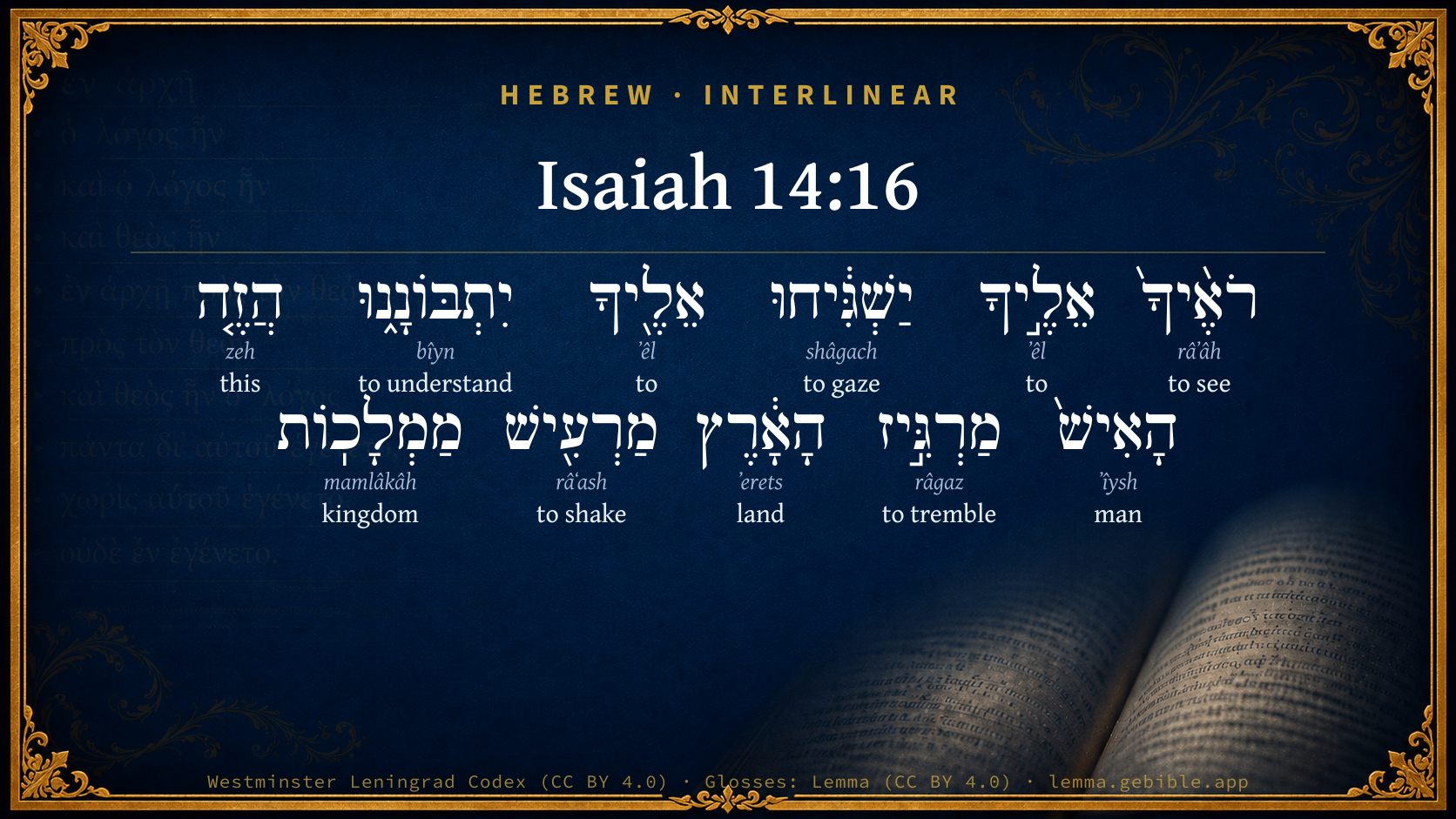
  1. רֹאֶ֨יךָ֙ râʼâh H7200 “seeing · you” Verb, Qal, Participle Active, Masculine, Plural, Construct + Suffix, Personal, 2nd Person, Masculine, Singular
  2. אֵלֶ֣יךָ ʼêl H413 “to · you” Preposition + Suffix, Personal, 2nd Person, Masculine, Singular
  3. אֵלֶ֖יךָ ʼêl H413 “to · you” Preposition + Suffix, Personal, 2nd Person, Masculine, Singular
  4. יִתְבּוֹנָ֑נוּ bîyn H995 “to understand” Verb, Hithpolel, Imperfect, 3rd Person, Masculine, Plural
  5. הֲזֶ֤ה zeh H2088 “this” Particle, Interrogative + Pronoun, Demonstrative, Masculine, Singular
  6. הָאִישׁ֙ ʼîysh H376 “the · man” Particle, Definite Article + Noun, Common, Masculine, Singular, Absolute
  7. מַרְגִּ֣יז râgaz H7264 “trembling” Verb, Hiphil, Participle Active, Masculine, Singular, Absolute
  8. הָאָ֔רֶץ ʼerets H776 “the · land” Particle, Definite Article + Noun, Common, Both, Singular, Absolute
  9. מַרְעִ֖ישׁ râʻash H7493 “shaking” Verb, Hiphil, Participle Active, Masculine, Singular, Absolute
  10. מַמְלָכֽוֹת mamlâkâh H4467 “kingdoms” Noun, Common, Feminine, Plural, Absolute

About this verse

These counts appear in no published source. They are computed here, from the morphology-tagged text and Lemma’s own curated glosses. What Lemma adds →

11
words
10
distinct lemmas
Prophets
section

Notable vocabulary

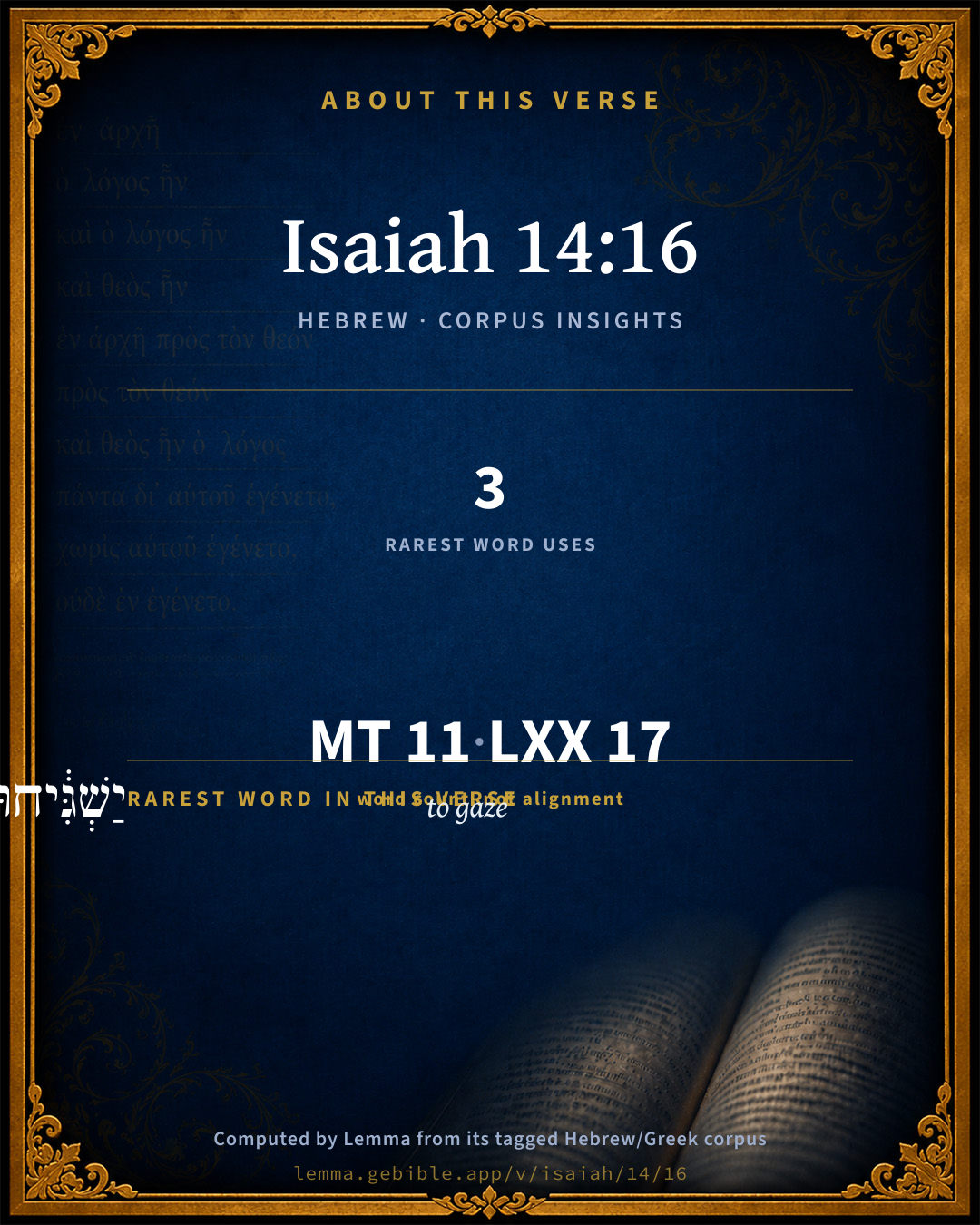
The rarest word here is יַשְׁגִּ֔יחוּ to gaze H7688 — appearing just 3 times in the whole Hebrew Bible.

Shared distinctive vocabulary

יַשְׁגִּ֔יחוּ to gaze H7688 occurs in 3 verses of the Hebrew Bible. Also found in:

Grammatical profile

  • 5 verbs
  • 3 nouns
  • 1 pronoun
  • 2 prepositions

Verb forms

  • רֹאֶ֨יךָ֙ Qal · Participle Active
  • יַשְׁגִּ֔יחוּ Hiphil · Imperfect
  • יִתְבּוֹנָ֑נוּ Hithpolel · Imperfect
  • מַרְגִּ֣יז Hiphil · Participle Active
  • מַרְעִ֖ישׁ Hiphil · Participle Active

Repetition

A word recurs within this verse — often emphatic in Hebrew:

  • אֵלֶ֣יךָ to H413 ×2

Hebrew & Septuagint length

In English translation the verse runs 26 words from the Hebrew and 23 from the Septuagint (LXX English) — closely comparable.

A rough comparison of the two English renderings, which tokenize alike — not a word-level alignment.

Word counts can differ between the Hebrew and the Greek without any difference in meaning — e.g. the Hebrew direct-object marker אֵת has no separate Greek word, and Greek often adds the article ὁ.

In the original languages it is 11 Hebrew tokens and 17 Greek tokens — but the two are counted differently (Hebrew bundles its prefixes and suffixes into one token; the Greek is in lemma form), so that isn’t a like-for-like length.

Cross-references

6

Topical passages linked to Isaiah 14:16 in the Treasury of Scripture Knowledge — connected by theme and wording, ordered by reader-vote popularity; previews shown in the World English Bible.

  • Jeremiah 50:23 How is the hammer of the whole earth cut apart and broken! how is Babylon become a desolation among the nations!
  • Psalms 58:10–11 The righteous shall rejoice when he sees the vengeance. He shall wash his feet in the blood of the wicked;
  • Jeremiah 51:20–23 You are my battle-axe and weapons of war: and with you will I break in pieces the nations; and with you will I destroy kingdoms;
  • Psalms 52:7 "Behold, this is the man who didn't make God his strength, But trusted in the abundance of his riches, And strengthened himself in his wickedness."
  • Psalms 64:9 All mankind shall be afraid. They shall declare the work of God, And shall wisely ponder what he has done.
  • Isaiah 14:4–5 that you shall take up this parable against the king of Babylon, and say, How has the oppressor ceased! the golden city ceased!

Cross-references courtesy of OpenBible.info (CC BY 4.0).

Hebrew and Greek witnesses Masoretic Hebrew ↔ Greek Septuagint

The same verse in the two great witnesses to the Old Testament, shown verse-for-verse.

These are two independent witnesses, not word-aligned to each other, and the Septuagint is shown in lemma (dictionary) form.

Hebrew Isaiah 14:16 Masoretic · Westminster Leningrad Codex

רֹאֶ֨יךָ֙ אֵלֶ֣יךָ יַשְׁגִּ֔יחוּ אֵלֶ֖יךָ יִתְבּוֹנָ֑נוּ הֲזֶ֤ה הָאִישׁ֙ מַרְגִּ֣יז הָאָ֔רֶץ מַרְעִ֖ישׁ מַמְלָכֽוֹת

Those who see you shall gaze at you, they shall consider you, [saying], "Is this the man who made the earth to tremble, who shook kingdoms;

World English Bible · Public Domain

Greek LXX Isaiah 14:16 Septuagint · lemma form

ὁ ὁράω σύ θαυμάζω ἐπί σύ καί εἶπον οὗτος ὁ ἄνθρωπος ὁ παραὀξύνω ὁ γῆ σείω βασιλεύς

They that see you shall wonder at you, and say, This is the man that troubled the earth, that made kings to shake;

LXX2012 (modern English Septuagint) · Public Domain

Hebrew: Westminster Leningrad Codex (CC BY 4.0). Greek: Septuagint (public domain); English from LXX2012 (modern English Septuagint) (Public Domain). How the Septuagint differs from the Hebrew →

Targum (Aramaic paraphrase)

1

The Targum is the ancient Jewish Aramaic paraphrase of the Hebrew Scriptures — an interpretive translation, not the Hebrew text itself. Onkelos (literal) and Pseudo-Jonathan (expansive) render the Torah, and Jonathan the Prophets. Coverage is partial: where no permissively-licensed English translation exists for a verse, only the Aramaic is shown. This is verse-level text, not a word-by-word alignment to the Hebrew.

  1. Targum Jonathan Prophets (Joshua–Malachi)
    חָזָךְ עֲלָךְ יְדוּקוּן בָּךְ יִסְתַּכְּלוּן וְיֵימְרוּן הָדֵין גַבְרָא אֲזִיעַ אַרְעָא אַצְדֵי מַלְכְּוָתָא:

    Those that see thee shall look attentively at thee, they shall consider thee, and say, "Is this the man that made the earth to tremble, that laid waste kingdoms?

    Targum Jonathan — Aramaic: “Mikraot Gedolot” (public domain). English: “Sefaria Community Translation” (CC0 1.0 (public-domain dedication)); “London "Chaldee Paraphrase," 1871” (public domain). Text via Sefaria.

Commentary

Notes on Isaiah 14:16 from classic Christian and Jewish commentators (each source and its license shown beneath its notes). The classic Christian expositions comment on the surrounding passage and are grouped to its opening verse, so a note may address several verses; the Jewish commentaries on the Tanakh (Rashi and others) are per-verse, so they appear only where the commentator wrote on this verse.

Lemma curates 59 commentaries, every one of them public domain or Creative Commons licensed, each selected and text-cleaned for this edition rather than reprinted as found. About our sources →

Jamieson, Fausset & Brown

Robert Jamieson, A. R. Fausset & David Brown

THE PASSERS-BY CONTEMPLATE WITH ASTONISHMENT THE BODY OF THE KING OF BABYLON CAST OUT, INSTEAD OF LYING IN A SPLENDID MAUSOLEUM, AND CAN HARDLY BELIEVE THEIR SENSES THAT IT IS HE. (Isa 14:16-20)

narrowly look--to be certain they are not mistaken.

consider--"meditate upon" [HORSLEY].

Jamieson, Fausset & Brown — Commentary Critical and Explanatory on the Whole Bible (1871) — public domain (CC PDM 1.0). Text via the HelloAO Bible API.

Trapp's Complete Commentary

John Trapp

Isa 14:16 They that see thee shall narrowly look upon thee, [and] consider thee, [saying, Is] this the man that made the earth to tremble, that did shake kingdoms;

Ver. 16. They that see thee shall narrowly look upon thee.] Shall look wishingly upon thee, as scarce believing their own eyes, for the strangeness of the thing.

Is this the man that made the earth to tremble?] The earth to quake, and men’s hearts to ache? yea, sure, this is very he. At one end of the library at Dublin was a globe, at the other a skeleton, to show, saith mine author, that though a man be lord of all the world, yet he must die, nullusque fiet, qui omnia esse affectabat.

John Trapp, A Commentary or Exposition upon All the Books of the Old and New Testament (1647–1656) — public domain. Text from a community e-Sword module.

Geneva Bible (1599)

Geneva Bible translators

In marveling at thee.

Geneva Bible (1599) marginal notes — public domain. Text via Bolls.life.

Ellicott's Commentary for English Readers

(16) They that see thee . . .—The context shows that the picture before the prophet’s eye is no longer the shadow-world of Hades, but the field of battle, Men look at the corpse of the mighty conqueror as it lies dishonoured, bloody, and unburied.

A Bible Commentary for English Readers, edited by Charles John Ellicott (1878–1897) — public domain. Text from a community e-Sword module.

The Cambridge Bible for Schools and Colleges

gen. ed. J. J. S. Perowne

16. made the earth to tremble] Better perhaps, troubled the earth.

16–19. The fourth strophe. The scene here is no longer in Hades, but on the battle-field, where the dead body of the king lies unburied, exposed to the derision of men.

The Cambridge Bible for Schools and Colleges (gen. ed. J. J. S. Perowne; Cambridge University Press, 1878–1918) — public domain. Text from a community e-Sword module.

John Gill's Exposition

They that see thee,.... These are the words of the dead, speaking of the living, who when they should see the carcass of the king of Babylon lying on the ground,

shall narrowly look upon thee, and consider thee; whether it is he or not, not knowing at first sight who he was, the alteration being so great; he that was but just now on his throne of glory, with all the ensigns of majesty about him, and on him, now cast to the earth, deprived of life, besmeared with blood, and so disfigured as scarcely to be known; these phrases are used to express the great change made in him, and in his state and condition:

saying; scarce believing what they saw, and as wondering at the sudden and strange alteration, and yet in an insulting manner:

Is this the man that made the earth to tremble: the inhabitants of it, when they heard of his coming against them, with his numerous and conquering army, dreading that he would do to them as he had done to others, destroy their cities, rob them of their substance, put them to the sword, or carry them captive, or make them tributary:

that did shake kingdoms; depose their kings, and set up others; alter their constitution, change their form of government, and added their kingdoms to his own.

John Gill's Exposition of the Whole Bible (1746–1763) — public domain (CC PDM 1.0). Text via the HelloAO Bible API.

Albert Barnes' Notes on the Bible

They that see thee - That is, after thou art dead. The scene here changes, and the prophet introduces those who would contemplate the body of the king of Babylon after he should be slain - the passers-by arrested with astonishment, that one so proud and haughty was at last slain, and cast out among the common dead Isa 14:19.

Shall narrowly look upon thee - To be certain that they were not deceived. This denotes great astonishment, as if they could scarcely credit the testimony of their senses. It also expresses insult and contempt. They ask whether it is possible that one who so recently shook the kingdoms of the earth should now lie east out as unworthy of a burial.

That made the earth to tremble - That agitated the world by his ambition.

Albert Barnes' Notes on the Bible (1834–1885) — public domain. Text from a community e-Sword/MySword module.

Haydock's Catholic Bible Commentary

Turn. From their respective holes in the monument.

George Leo Haydock (1774–1849), Haydock's Catholic Family Bible and Commentary, 1859 edition — public domain. Excludes Psalms (Douay-Rheims chapter numbering differs from Protestant) and Deuterocanonical books (Catholic canon only).

Matthew Poole's English Annotations

Shall narrowly look upon thee; as hardly believing their own eyes, because this change seemed impossible to them.

The earth; all the nations of the earth.

Matthew Poole's English Annotations on the Holy Bible (1683–1685) — public domain. Text from a community e-Sword/MySword module.

Whedon's Commentary on the Bible

Daniel D. Whedon

16, 17. The scene is now changed from sheol to earth; from a shadowy personage to an unburied corpse.

Look upon… consider thee — Intently examine thee as some strange sight.

Is this the man — Hardly a jibe, as some think, but a serious reflection on man’s feebleness.

Made the earth to tremble — By his former power and tyranny. But now how fallen!

Made the world as a wilderness — The world which would otherwise have been fruitful and habitable.

Opened not the house — Set not his captives free to go homeward.

Daniel D. Whedon (gen. ed.), Commentary on the Old and New Testaments (1874–1909) — public domain. Text from a community e-Sword module.

The Pulpit Commentary

They that see thee. Dr. Kay well observes that "here the scene of the parable is changed back to earth. The corpse of the mighty conqueror is lying unburied." Shall narrowly look upon thee. Like the inhabitants of hell (ver. 10), those of earth also shall scarcely believe their eyes. They shall look close to see if it is indeed the great king that is slain.

The Pulpit Commentary (1880–1919), ed. H.D.M. Spence-Jones & Joseph S. Exell — public domain. Text from a community e-Sword module.

Keil & Delitzsch

C. F. Keil & F. Delitzsch

The prophet then continues in the language of prediction. "They that see thee look, considering thee, look at thee thoughtfully: Is this the man that set the earth trembling, and kingdoms shaking? that made the world a wilderness, and destroyed its cities, and did not release its prisoners (to their) home?" The scene is no longer in Hades (Knobel, Umbreit). Those who are speaking thus have no longer the Chaldean before them as a mere shade, but as an unburied corpse that has fallen into corruption. As tēbēl is feminine, the suffixes in Isa 14:17 must refer, according to a constructio ad sensum, to the world as changed into a wilderness (midbâr). Pâthach, to open, namely locks and fetters; here, with baithâh, it is equivalent to releasing or letting go (syn. shillēach, Jer 50:33). By the "prisoners" the Jewish exiles are principally intended; and it was their release that had never entered the mind of the king of Babylon.

Keil & Delitzsch — Biblical Commentary on the Old Testament (1861–1891) — public domain (CC PDM 1.0). Text via the HelloAO Bible API. (Old Testament only.)

J. A. Alexander on Isaiah

Joseph Addison Alexander

“Those seeing thee shall gaze (or stare) at thee, they shall look at thee attentively, (and say) is this the man that made the earth shake, that made kingdoms tremble?” The scene in the other world is closed, and the Prophet, or triumphant Israel, is now describing what shall take place above ground. The gazing mentioned in the first clause is not merely the effect of curiosity but of incredulous surprise.

Joseph Addison Alexander, The Prophecies of Isaiah (1846–1847; New York: Scribner, 1870–1878) — public domain. Text from a community e-Sword module.

Rashi

Rabbi Shlomo Yitzchaki (Rashi)

shall look at you They will look through holes and cracks [aboater in O.F.].

shall gaze earnestly [Por panser in O.F.] To think of oneself.

Rashi on the Tanakh — English translations: “The Judaica Press complete Tanach with Rashi, translated by A. J. Rosenberg” (CC BY 4.0); “Pentateuch with Rashi's commentary by M. Rosenbaum and A.M. Silbermann, 1929-1934” (public domain); “The Metsudah Tanach series, Lakewood, N.J” (CC BY 4.0); and “The Book of Joshua, Metsudah Publications, 1997” (CC BY 4.0). Text via Sefaria.

Ibn Ezra

Rabbi Abraham ibn Ezra

ישגיחו. They shall look.

אליך יתבוננו. They shall become reasonable through thee.

Ibn Ezra on the Tanakh — English translations: “Sefaria Community Translation” (CC0 1.0 (public-domain dedication)); “Yalkut, Sifsei Chachomim Chumash, Metsudah Publications, 2009” (CC BY 4.0); and “Commentary of Ibn Ezra on Isaiah - trans. by M. Friedlander, 1873” (public domain). Text via Sefaria.

Lesson kit

Teaching starters — assembled from the data on this page, not authored interpretation. Every prompt links to the verse data it draws on. Edit before teaching.

Isaiah, in the Prophets, opens this verse with 11 words (10 distinct Hebrew lemmas). Its most distinctive word is shâgach (“to gaze”). A historical commentator’s framing appears above. Read the whole chapter for the surrounding context.

Discussion questions

  1. How does “to gaze” (shâgach) shape what this verse is saying?
  2. How does Psalms 33:14, which shares the word «to gaze», read alongside this verse?
  3. What does the repetition of “to” (2× in this one verse) do in this verse?
  4. These translations render this verse differently. What is at stake in choosing one wording over another?
  5. «רֹאֶ֨יךָ֙» is a Qal Participle Active verb. How does that grammatical form shape the action described?
  6. Compare how Jamieson, Fausset & Brown and Trapp's Complete Commentary read this verse. Where do they agree or differ?

Things to notice

Reading settings

Reading text

Shown beneath each verse's original-language words.

Old Testament
Old Testament edition

Read the OT as the Masoretic Hebrew (MT) or the Greek Septuagint (LXX).

English shown for the Greek Septuagint (in the Hebrew ↔ Greek comparison).

Comparing translations? Open the Compare panel on any verse page to stack up to four side by side.