Isaiah 44:18

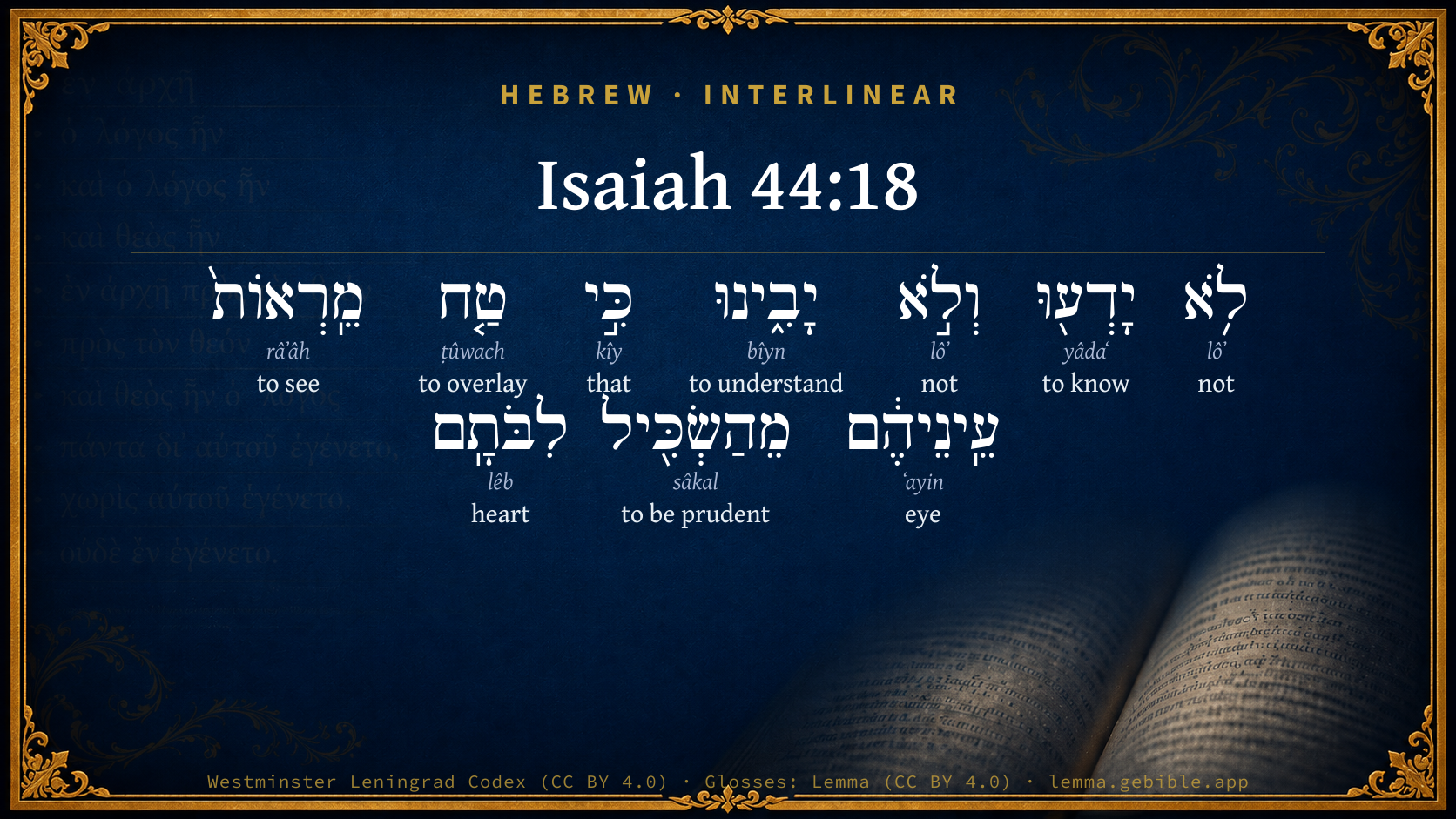
Hebrew (Westminster Leningrad Codex) Isaiah 44:18 appears in the Hebrew Old Testament. The text above is from the Westminster Leningrad Codex. Each word links to its Strong’s number, a concise gloss, and parsing drawn from the Open Scriptures Hebrew Bible morphology. Click any word for its full Brown-Driver-Briggs (BDB) entry.
Download image
Cite this verse

Isaiah 44:18 (World English Bible). Public Domain. Lemma interlinear Bible study tool, https://lemma.gebible.app/v/isaiah/44/18.

Show BibTeX & RIS
BibTeX
RIS
English Translation
They don't know, neither do they consider: for he has shut their eyes, that they can't see; and their hearts, that they can't understand.
World English Bible · Public Domain
Download a study sheet

One document with this verse’s original text, its word-by-word gloss line, the meaning frame, cross-references with their text, attributed commentary, and full source and license credits — printable, and it pastes into notes with its structure intact.

This verse Autodidact and up

Study sheet (.html) Plain text (.txt)

A passage Seminary Student

Up to 50 verses in one chapter. A passage sheet keeps up to 6 commentary sources and 12 cross-references per verse, in the order this page ranks them, and says so on the sheet whenever that leaves anything out. Ask for a single verse and you get the Autodidact verse sheet above.

Everything on this page stays free to read, with no account — the sheet is a download of what is already on screen, not access to it.

Want to remove ads? Support Godless Engineer
Compare translations 3

The same verse in 3 English versions, stacked beneath the original-language interlinear above. Click any original word for its lexicon entry.

Each is an independent rendering of the whole verse — the interlinear is not word-aligned to these translations.

Highlighted words mark where these versions differ — a whole-verse word diff, not a word-by-word alignment.

  • World English Bible Public Domain
    They don't know, neither do they consider: for he has shut their eyes, that they can't see; and their hearts, that they can't understand.
  • King James Version Public Domain
    They have not known nor understood: for he hath shut their eyes, that they cannot see; and their hearts, that they cannot understand.
  • unfoldingWord Literal Text CC BY-SA 4.0
    They do not know, and they do not understand, for one has plastered their eyes from seeing, their hearts from considering.

unfoldingWord Literal Text — © unfoldingWord, licensed CC BY-SA 4.0. Word-aligned USFM3 via Door43 (git.door43.org/unfoldingWord/en_ult).

Versions to compare (up to 4)

3 of 4 selected

Show all 18 translations

Every available English version of this verse, each an independent rendering of the whole verse.

  • World English Bible Public Domain
    They don't know, neither do they consider: for he has shut their eyes, that they can't see; and their hearts, that they can't understand.
  • Berean Standard Bible Public Domain
    They do not comprehend or discern, for He has shut their eyes so they cannot see and closed their minds so they cannot understand.
  • Majority Standard Bible Public Domain
    They do not comprehend or discern, for He has shut their eyes so they cannot see and closed their minds so they cannot understand.
  • King James Version Public Domain
    They have not known nor understood: for he hath shut their eyes, that they cannot see; and their hearts, that they cannot understand.
  • American Standard Version (1901) Public Domain
    They know not, neither do they consider: for he hath shut their eyes, that they cannot see; and their hearts, that they cannot understand.
  • Revised Version (1885) Public Domain
    They know not, neither do they consider: for he hath shut their eyes, that they cannot see; and their hearts, that they cannot understand.
  • Geneva Bible (1599) Public Domain
    They haue not knowen, nor vnderstand: for God hath shut their eyes that they cannot see, and their heartes, that they cannot vnderstand.
  • Douay-Rheims (1899) Public Domain
    They have not known, nor understood: for their eyes are covered that they may not see, and that they may not understand with their heart.
  • Young's Literal Translation Public Domain
    They have not known, nor do they understand, For He hath daubed their eyes from seeing, Their heart from acting wisely.
  • Literal Standard Version CC BY-SA 4.0
    They have not known, nor do they understand, || For He has coated their eyes from seeing, || Their heart from acting wisely.
  • Unlocked Literal Bible CC BY-SA 4.0
    They do not know, nor do they understand, for their eyes are blind and cannot see, and their hearts cannot perceive.
  • unfoldingWord Literal Text CC BY-SA 4.0
    They do not know, and they do not understand, for one has plastered their eyes from seeing, their hearts from considering.
  • Darby Bible Public Domain
    They have no knowledge, and understand not; for he hath plastered their eyes, that they may not see; and their hearts, that they may not understand.
  • World Messianic Bible Public Domain
    They don’t know, neither do they consider, for he has shut their eyes, that they can’t see, and their hearts, that they can’t understand.
  • Webster's Bible Public Domain
    They have not known nor understood: for he hath shut their eyes, that they cannot see; and their hearts, that they cannot understand.
  • Free Bible Version CC BY-SA 4.0
    How ignorant they are, how dumb! Their eyes have been plastered over so they can't see, their minds closed so they don't have insight.
  • Bible in Basic English Public Domain
    They have no knowledge or wisdom; for he has put a veil over their eyes, so that they may not see; and on their hearts, so that they may not give attention.
  • JPS Tanakh (1917) Public Domain
    They know not, neither do they understand; for their eyes are bedaubed, that they cannot see, and their hearts, that they cannot understand.

Literal Standard Version (2020), Covenant Press — licensed CC BY-SA 4.0. Text via the HelloAO Bible API (eBible.org). Unlocked Literal Bible (unfoldingWord) — licensed CC BY-SA 4.0. Text via the HelloAO Bible API (eBible.org). unfoldingWord Literal Text — © unfoldingWord, licensed CC BY-SA 4.0. Word-aligned USFM3 via Door43 (git.door43.org/unfoldingWord/en_ult). Free Bible Version, Dr. Jonathan Gallagher — licensed CC BY-SA 4.0. Text via the HelloAO Bible API (eBible.org).

Word by word

More ways to search: Search by grammar → Find every occurrence → Compare this word →

Practice this passage: Drill this verse → Learn its vocabulary →

טַ֤ח
ṭûwach
H2902
“to overlay”
Verb, Qal, Perfect, 3rd Person, Masculine, Singular
Part of Speech
Verb
Stem
Qal
Form
Perfect
Person
3rd Person
Gender
Masculine
Number
Singular
Full BDB Definition

Origin: a primitive root

TWOT: 795

to spread over, overlay, plaster, cover over, coat, besmear - (Qal) to overspread, coat, overlay - (Niphal) to be coated, be plastered - (Qal) to be besmeared
  1. לֹ֥א lôʼ H3808 “not” Particle, Negative
  2. יָדְע֖וּ yâdaʻ H3045 “to know” Verb, Qal, Perfect, 3rd Person, Common, Plural
  3. וְלֹ֣א lôʼ H3808 “and · not” Conjunction + Particle, Negative
  4. יָבִ֑ינוּ bîyn H995 “to understand” Verb, Qal, Imperfect, 3rd Person, Masculine, Plural
  5. כִּ֣י kîy H3588 “that” Conjunction
  6. מֵֽרְאוֹת֙ râʼâh H7200 “from · to see” Preposition + Verb, Qal, Infinitive Construct
  7. עֵֽינֵיהֶ֔ם ʻayin H5869 “eyes · their” Noun, Common, Both, Dual, Construct + Suffix, Personal, 3rd Person, Masculine, Plural
  8. מֵהַשְׂכִּ֖יל sâkal H7919 “from · to be prudent” Preposition + Verb, Hiphil, Infinitive Construct
  9. לִבֹּתָֽם lêb H3820 “hearts · their” Noun, Common, Masculine, Plural, Construct + Suffix, Personal, 3rd Person, Masculine, Plural

About this verse

These counts appear in no published source. They are computed here, from the morphology-tagged text and Lemma’s own curated glosses. What Lemma adds →

10
words
9
distinct lemmas
Prophets
section

Notable vocabulary

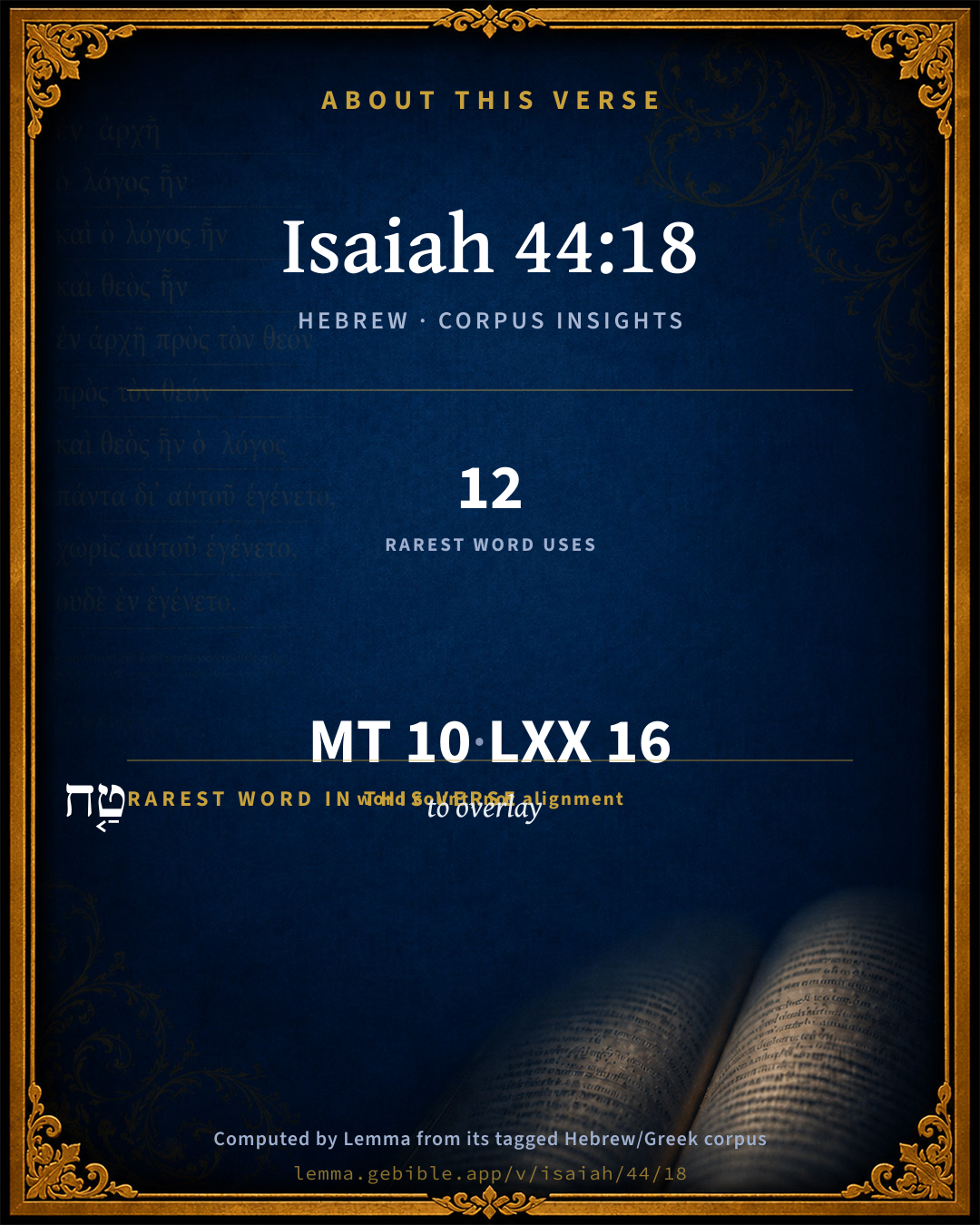
The rarest word here is טַ֤ח to overlay H2902 — appearing just 12 times in the whole Hebrew Bible.

Shared distinctive vocabulary

טַ֤ח to overlay H2902 occurs in 11 verses of the Hebrew Bible. Also found in:

Grammatical profile

  • 5 verbs
  • 2 nouns
  • 1 conjunction
  • 2 particles

Verb forms

  • יָדְע֖וּ Qal · Perfect
  • יָבִ֑ינוּ Qal · Imperfect
  • טַ֤ח Qal · Perfect
  • מֵֽרְאוֹת֙ Qal · Infinitive Construct
  • מֵהַשְׂכִּ֖יל Hiphil · Infinitive Construct

Repetition

A word recurs within this verse — often emphatic in Hebrew:

Hebrew & Septuagint length

In English translation the verse runs 24 words from the Hebrew and 25 from the Septuagint (LXX English) — closely comparable.

A rough comparison of the two English renderings, which tokenize alike — not a word-level alignment.

Word counts can differ between the Hebrew and the Greek without any difference in meaning — e.g. the Hebrew direct-object marker אֵת has no separate Greek word, and Greek often adds the article ὁ.

In the original languages it is 10 Hebrew tokens and 16 Greek tokens — but the two are counted differently (Hebrew bundles its prefixes and suffixes into one token; the Greek is in lemma form), so that isn’t a like-for-like length.

Cross-references

29

Topical passages linked to Isaiah 44:18 in the Treasury of Scripture Knowledge — connected by theme and wording, ordered by reader-vote popularity; previews shown in the World English Bible.

  • Isaiah 6:9–10 He said, "Go, and tell this people, 'You hear indeed, But don't understand; And you see indeed, But don't perceive.'
  • 2 Corinthians 4:3–4 Even if our Gospel is veiled, it is veiled in those who perish;
  • John 12:39–40 For this cause they couldn't believe, for Isaiah said again,
  • 2 Thessalonians 2:9–12 even he whose coming is according to the working of Satan with all power and signs and lying wonders,
  • Jeremiah 5:21 Hear now this, foolish people, and without understanding; who have eyes, and don't see; who have ears, and don't hear:
  • Psalms 81:12 So I let them go after the stubbornness of their hearts, That they might walk in their own counsels.
  • Proverbs 2:5–9 Then you will understand the fear of Yahweh, And find the knowledge of God.
  • Matthew 13:14–15 In them the prophecy of Isaiah is fulfilled, which says, 'By hearing you will hear, And will in no way understand; Seeing you will see, And will in no way perceive:
  • John 5:44 How can you believe, who receive glory from one another, and you don't seek the glory that comes from the only God?
  • Romans 1:21–23 Because, knowing God, they didn't glorify him as God, neither gave thanks, but became vain in their reasoning, and their senseless heart was darkened.
  • John 8:43 Why don't you understand my speech? Because you can't hear my word.
  • Isaiah 29:10 For Yahweh has poured out on you the spirit of deep sleep, and has closed your eyes, the prophets; and your heads, the seers, has he covered.
  • Romans 1:28 Even as they refused to have God in their knowledge, God gave them up to a reprobate mind, to do those things which are not fitting;
  • Daniel 12:10 Many shall purify themselves, and make themselves white, and be refined; but the wicked shall do wickedly; and none of the wicked shall understand; but those who are wise shall understand.
  • Romans 11:8–10 According as it is written, "God gave them a spirit of stupor, eyes that they should not see, and ears that they should not hear, to this very day."
  • Proverbs 28:5 Evil men don't understand justice; But those who seek Yahweh understand it fully.
  • Isaiah 1:3 The ox knows his owner, And the donkey his master's crib; But Israel doesn't know, My people don't consider.
  • Isaiah 44:20 He feeds on ashes; a deceived heart has turned him aside; and he can't deliver his soul, nor say, Is there not a lie in my right hand?
  • Jeremiah 10:14 Every man is become brutish [and is] without knowledge; every goldsmith is disappointed by his engraved image; for his molten image is falsehood, and there is no breath in them.
  • Isaiah 45:20 Assemble yourselves and come; draw near together, you who have escaped from the nations: they have no knowledge who carry the wood of their engraved image, and pray to a god that can't save.
  • Acts 14:16 who in the generations gone by allowed all the nations to walk in their own ways.
  • Isaiah 56:11 Yes, the dogs are greedy, they can never have enough; and these are shepherds who can't understand: they have all turned to their own way, each one to his gain, from every quarter.
  • Jeremiah 10:8 But they are together brutish and foolish: the instruction of idols! it is but a stock.
  • Hosea 14:9 Who is wise, that he may understand these things? Who is prudent, that he may know them? For the ways of Yahweh are right, And the righteous walk in them; But the rebellious stumble in them.
  • Matthew 12:34 You offspring of vipers, how can you, being evil, speak good things? For out of the abundance of the heart, the mouth speaks.
  • Psalms 92:6 A senseless man doesn't know, Neither does a fool understand this:
  • Isaiah 44:9 Those who fashion an engraved image are all of them vanity; and the things that they delight in shall not profit; and their own witnesses don't see, nor know: that they may be disappointed.
  • Isaiah 46:7–8 They bear it on the shoulder, they carry it, and set it in its place, and it stands, from its place it shall not move: yes, one may cry to it, yet it can not answer, nor save him out of his trouble.
  • 2 Peter 2:14 having eyes full of adultery, and who can't cease from sin; enticing unsettled souls; having a heart trained in greed; children of cursing;

Cross-references courtesy of OpenBible.info (CC BY 4.0).

Hebrew and Greek witnesses Masoretic Hebrew ↔ Greek Septuagint

The same verse in the two great witnesses to the Old Testament, shown verse-for-verse.

These are two independent witnesses, not word-aligned to each other, and the Septuagint is shown in lemma (dictionary) form.

Hebrew Isaiah 44:18 Masoretic · Westminster Leningrad Codex

לֹ֥א יָדְע֖וּ וְלֹ֣א יָבִ֑ינוּ כִּ֣י טַ֤ח מֵֽרְאוֹת֙ עֵֽינֵיהֶ֔ם מֵהַשְׂכִּ֖יל לִבֹּתָֽם

They don't know, neither do they consider: for he has shut their eyes, that they can't see; and their hearts, that they can't understand.

World English Bible · Public Domain

Greek LXX Isaiah 44:18 Septuagint · lemma form

οὐ γιγνώσκω φρονέω ὅτι ἀποἀμαυρόω ὁ βλέπω ὁ ὀφθαλμός αὐτός καί ὁ νοέω ὁ καρδία αὐτός

They have no understanding to perceive; for they have been blinded so that they should not see with their eyes, nor perceive with their heart.

LXX2012 (modern English Septuagint) · Public Domain

On this verse, Adam Clarke's Commentary discusses the Septuagint’s reading. Read the note in Commentary ↓

Hebrew: Westminster Leningrad Codex (CC BY 4.0). Greek: Septuagint (public domain); English from LXX2012 (modern English Septuagint) (Public Domain). How the Septuagint differs from the Hebrew →

Targum (Aramaic paraphrase)

1

The Targum is the ancient Jewish Aramaic paraphrase of the Hebrew Scriptures — an interpretive translation, not the Hebrew text itself. Onkelos (literal) and Pseudo-Jonathan (expansive) render the Torah, and Jonathan the Prophets. Coverage is partial: where no permissively-licensed English translation exists for a verse, only the Aramaic is shown. This is verse-level text, not a word-by-word alignment to the Hebrew.

  1. Targum Jonathan Prophets (Joshua–Malachi)
    לָא יָדְעוּן וְלָא מִסְתַּכְּלִין אֲרֵי מְטַמְטְמָן מִלְמֶחֱזֵי עֵינֵיהוֹן מִלְאִסְתַּכָּלָא בְּלִבְּהוֹן:

    They know not, neither do they understand; for their eyes are closely shut up, so that they cannot see, and their heart, that they cannot understand.

    Targum Jonathan — Aramaic: “Mikraot Gedolot” (public domain). English: “Sefaria Community Translation” (CC0 1.0 (public-domain dedication)); “London "Chaldee Paraphrase," 1871” (public domain). Text via Sefaria.

Commentary

Notes on Isaiah 44:18 from classic Christian and Jewish commentators (each source and its license shown beneath its notes). The classic Christian expositions comment on the surrounding passage and are grouped to its opening verse, so a note may address several verses; the Jewish commentaries on the Tanakh (Rashi and others) are per-verse, so they appear only where the commentator wrote on this verse.

Lemma curates 59 commentaries, every one of them public domain or Creative Commons licensed, each selected and text-cleaned for this edition rather than reprinted as found. About our sources →

Trapp's Complete Commentary

John Trapp

Isa 44:18 They have not known nor understood: for he hath shut their eyes, that they cannot see; [and] their hearts, that they cannot understand.

Ver. 18. They have not known nor understood.] How should they, say, when infatuated and given up to an injudicious mind, or reprobate sense, as those? {Rom 1:28}

For he hath shut their eyes.] Heb., Daubed up their eyes from seeing, their hearts from understanding.

“ Mons oblita Dei, vitiorumque oblita caeno. ”

John Trapp, A Commentary or Exposition upon All the Books of the Old and New Testament (1647–1656) — public domain. Text from a community e-Sword module.

Joseph Benson's Commentary

Isa 44:18-20. They have not known, &c. — They want common discretion, and have not the understanding of a rational being in them. For what an absurdity is it for a man to dress his meat and make his god with the same piece of wood! Or to think that a log of timber hath any more divinity in it than it had before, because of the form man can give it, or any thing he can do to it! “When,” says Minutius Felix, “does it become a god! Behold, it is cast, fashioned, and carved! It is not yet a god. It is soldered, put together, and set up. Neither is it yet a god. Behold, it is adorned, consecrated, and prayed to! Then at length it is a god when men have chosen and dedicated it.” He hath shut their eyes — God hath. Not as if God made men wicked; he only permits them so to be, and orders and overrules their wickedness to his own glorious ends. And none considereth in his heart — By which the prophet implies, that the true cause of this, as well as of other absurd and brutish practices of sinners, is the neglect of serious and impartial consideration. He feedeth on ashes — An unprofitable and pernicious food, and no less unsatisfying and mischievous is the worship of idols. A deceived heart — A mind corrupted and deceived by deep prejudice, gross error, and especially by his own lusts; hath turned him aside — From the way of truth, from the knowledge and worship of the true God, unto this irrational and foolish idolatry; that he cannot deliver his soul — From this error, and the vengeance that will follow upon it; nor say, Is there not a lie, &c. — Is not this idol which I honour and trust to a mere fiction and delusion which will deceive me?

Joseph Benson's Commentary on the Old and New Testaments (1811–1818) — public domain. Text from a community e-Sword module.

Tyndale Open Study Notes

Tyndale Open Resources

44:18-19 Their minds are shut: Idol worshipers cannot see the irony in using one part of a log to warm themselves and another part of the same log to be their god.

Tyndale Open Study Notes — © Tyndale Open Resources, licensed CC BY-SA 4.0. Text via the HelloAO Bible API.

Geneva Bible (1599)

Geneva Bible translators

The Prophet giveth here an answer to all them that wonder how it is possible that any should be so blind to commit such abomination, saying, that God hath blinded their eyes, and hardened their hearts.

Geneva Bible (1599) marginal notes — public domain. Text via Bolls.life.

Jamieson, Fausset & Brown

Robert Jamieson, A. R. Fausset & David Brown

he, &c.--God hath given them over to judicial blindness; not His direct physical, but His providential agency in administering His moral government, is meant (Isa 6:9-10). "Shut," literally, "daubed," plastered up; it is an Eastern custom in some cases to seal up the eyes of offenders.

Jamieson, Fausset & Brown — Commentary Critical and Explanatory on the Whole Bible (1871) — public domain (CC PDM 1.0). Text via the HelloAO Bible API.

Adam Clarke's Commentary

Verse 18. He hath shut their eyes - "Their eyes are closed up"] The Septuagint, Chaldee, and Vulgate, for טח tach, read טחו, tachu. See Clarke on Isa 6:10.

Adam Clarke's Commentary on the Bible (1810–1826) — public domain. Text from a community e-Sword/MySword module.

Ellicott's Commentary for English Readers

(18) He hath shut their eyes.—Better, their eyes are smeared over. The state described is the judicial blindness of Rom_1:20-25. It will be remembered that blindness thus inflicted was one of the tortures of Eastern cruelty.

A Bible Commentary for English Readers, edited by Charles John Ellicott (1878–1897) — public domain. Text from a community e-Sword module.

The Cambridge Bible for Schools and Colleges

gen. ed. J. J. S. Perowne

18–20. But such is the infatuation of idolatry, that its blinded votaries never pause to reflect on their actions; the idolater has not sense enough to say to himself in plain words what he has done.

They have not … understood] Better, as R.V. they know not, neither do they consider. he hath shut their eyes] Rather: their eyes are besmeared, as it were plastered over, so that they cannot see (a different verb, however, from that used by Isaiah in Isa_6:10, &c.).

The Cambridge Bible for Schools and Colleges (gen. ed. J. J. S. Perowne; Cambridge University Press, 1878–1918) — public domain. Text from a community e-Sword module.

John Gill's Exposition

They have not known nor understood,.... Who the true God is, nor the worship that is due to him alone; they do not know nor understand divine and spiritual things; nay, they have not the knowledge and understanding of men; they want common sense that can do and say such things as before mentioned, both idol makers and idol worshippers:

for he hath shut their eyes that they cannot see, and their heart that they cannot understand; either the devil, as some think, the god of this world, that blinds their eyes from seeing the folly of such gross idolatry, which he, deceiving them, leads them into; or rather God himself, who, because they like not to retain him in their knowledge, gives them up to a reprobate and injudicious mind, to believe a lie, and worship a false god; this he permits, orders, and overrules to some good ends and purposes: this is to be understood of the eyes of the understanding, which, as the word (i) signifies, are "daubed" and plastered over, that there is no opening of them, and seeing with them; which is the judicial blindness and hardness of heart, which God sometimes in righteous judgment gives up men unto; see Rom 1:28.

(i) "oblevit oculos eorum", Montanus; "obleverit", Cocceius; "quod sculptile oblinat", Piscator.

John Gill's Exposition of the Whole Bible (1746–1763) — public domain (CC PDM 1.0). Text via the HelloAO Bible API.

Albert Barnes' Notes on the Bible

They have not known nor understood - They are stupid, ignorant, and blind. Nothing could more strikingly show their ignorance and stupidity than this idol worship.

He hath shut their eyes - God hath closed their eyes. Margin, ‘Daubed.’ The word used here, טה ṭah from טוה ṭûah denotes properly “to spread over”; to besmear; to plaster; as, e. g., a wall with mortar Lev 14:42; 1Ch 29:4; Eze 13:10; Eze 22:28. Here it means to cover over the eyes so as to prevent vision; and hence, metaphorically, to make them stupid, ignorant, dull. It is attributed to God in accordance with the common statement of the Scriptures, that he does what he permits to be done (see the notes at Isa 6:9-10). It does not mean that God had done it by any physical, or direct agency, but that it had occurred under the administration of his Providence. It is also true that the Hebrew writers sometimes employ an active verb when the signification is passive, and when the main idea is, that anything was in fact done. Here the main point is not the agent by which this was done, but the fact that their eyes were blinded - and perhaps all the force of the verb טה ṭah used here would be expressed if it was rendered in an impersonal, or in a passive form, ‘it is covered as to their eyes,’ that is, their eyes are shut, without suggesting that it was done by God. So the Septuagint renders it, Ἀπημαυρώθησαν Apēmaurōthēsan - ‘They are blind,’ or involved in darkness.

So the Chaldee, מטמטמן meṭmeṭemân (also in the plural) - ‘Their eyes are obscured’ or blind. It cannot be proved from this text that God is, by direct agency, the author by whom it was done. It was not uncommon to shut up, or seal up the eyes for various purposes in the East, and unquestionably the prophet alludes to some such custom. ‘It is one of the solemnities at a Jewish wedding at Aleppo, according to Dr. Russell, who mentions it as the most remarkable thing in their ceremonies at that time. It is done by fastening the eyelids together with a gum, and the bridegroom is the person, he says, if he remembered right, that opens the bride’s eyes at the appointed time. It is also used as a punishment in those countries. So Sir Thomas Roe’s chaplain, in his account of his voyages to East India, tells us of a son of the Great Mogul, whom he had seen, and with whom Sir Thomas had conversed, that had before that time been cast into prison by his father, where his eyes were sealed up, by something put before them, which might not be taken off for three years; after which time the seal was taken away, that he might with freedom enjoy the light, though not his liberty.’ (Harmer’s Obs. vol. iii., pp. 507, 508. Ed. Lond. 8vo, 1808.)

Albert Barnes' Notes on the Bible (1834–1885) — public domain. Text from a community e-Sword/MySword module.

Haydock's Catholic Bible Commentary

Covered. Septuagint, "darkened." Are Catholics in the same predicament? (Chap. xl. 18.) (Haydock)

George Leo Haydock (1774–1849), Haydock's Catholic Family Bible and Commentary, 1859 edition — public domain. Excludes Psalms (Douay-Rheims chapter numbering differs from Protestant) and Deuterocanonical books (Catholic canon only).

Matthew Poole's English Annotations

They have not known or understood: this showeth that they want common discretion, and have not the understanding of a man in them. He, to wit, God; who is easily understood, and is oft expressed by this pronoun he; and to whom this very act is frequently ascribed in other places of Scripture. And therefore men need not to be shy in ascribing it to God here. Which yet is to be soberly understood; not as if God did make men wicked, but only permits them so to be, and orders and overrules their wickedness to his own glorious ends. And such passages as these are added in such cases to give an account of the prodigious madness of sinners herein; because, as they wilfully shut their own eyes, and harden their own hearts, so God judicially blinds and hardens them, and sends strong delusions upon them, and gives them up to believe lies, and then it is no wonder if they fall into such dotages.

Matthew Poole's English Annotations on the Holy Bible (1683–1685) — public domain. Text from a community e-Sword/MySword module.

Whedon's Commentary on the Bible

Daniel D. Whedon

18-20. The whole system of idol religion, in like manner, is simply foolish. Its votaries embrace it only to be blinded in conscience and reason. The makers and worshippers of idols are alike fools. And the sarcastic prophet cannot lament the dementing effects of the idol system in language more fitting than in the exactly literal words of Isa_44:19-20, which sufficiently explain themselves.

Daniel D. Whedon (gen. ed.), Commentary on the Old and New Testaments (1874–1909) — public domain. Text from a community e-Sword module.

The Pulpit Commentary

They have not known nor understood. The cause of all this folly is a Minding of the understanding, divinely caused in the way of punishment, on account of their having wilfully closed their eyes to the truth. Because they "did not like to retain God in their knowledge, God gave them up to a reprobate (or, undistinguishing) mind". (Rom_1:28; comp. Isa_29:10) He hath shut; or, One hath shut. But the reference is in either case to God. The word translated shut" means literally plastered" or "smeared."

The Pulpit Commentary (1880–1919), ed. H.D.M. Spence-Jones & Joseph S. Exell — public domain. Text from a community e-Sword module.

John Wesley's Explanatory Notes

Not known - This shews that they have not the understanding of a man. For he - God. Not as if God did make men wicked; he only permits them so to be, and orders, and over-rules their wickedness to his own glorious ends.

John Wesley, Explanatory Notes Upon the Whole Bible (1754–1765) — public domain. Text via the GEBible commentary corpus.

Keil & Delitzsch

C. F. Keil & F. Delitzsch

So irrational is idolatry; but yet, through self-hardening, they have fallen under the judgment of hardness of heart (Isa 6:9-10; Isa 19:3; Isa 29:10), and have been given up to a reprobate mind (Rom 1:28). "They perceive not, and do not understand: for their eyes are smeared over, so that they do not see; their hearts, so that they do not understand. And men take it not to heart, no perception and no understanding, that men should say, The half of it I have burned in the fire, and also baked bread upon the coals thereof; roasted flesh, and eaten: and ought I to make the rest of it an abomination, to fall down before the produce of a tree?" Instead of טח, Lev 14:42, the third person is written טח (from tâchach, Ges. 72, Anm. 8) in a circumstantial sense: their eyes are, as it were, smeared over with plaster. The expression אל־לב השׁיב or על־לב (Isa 46:8), literally to carry back into the heart, which we find as well as על־לב שׂים, to take to heart (Isa 42:25), answers exactly to the idea of reflection, here with reference to the immense contrast between a piece of wood and the Divine Being. The second and third לא in Isa 44:19 introduce substantive clauses, just as verbal clauses are introduced by ואין. לאמר is used in the same manner as in Isa 9:8 : "perception and insight showing themselves in their saying." On būl, see Job 40:20; the meaning "block" cannot be established: the talmudic būl, a lump or piece, which Ewald adduces, is the Greek βῶλος.

Keil & Delitzsch — Biblical Commentary on the Old Testament (1861–1891) — public domain (CC PDM 1.0). Text via the HelloAO Bible API. (Old Testament only.)

J. A. Alexander on Isaiah

Joseph Addison Alexander

“They have not known, and they will not understand, for he hath smeared their eyes from seeing, their hearts from doing wisely.” The combination of the preterit and future makes the description more complete and comprehensive. As the smearing of the eyes is merely a figure for spiritual blindness, it is here extended to the heart, of which it is not literally predicable.

Joseph Addison Alexander, The Prophecies of Isaiah (1846–1847; New York: Scribner, 1870–1878) — public domain. Text from a community e-Sword module.

unfoldingWord translationNotes

Door43 World Missions Community

for their eyes are blind and cannot see

Yahweh speaks of those who cannot understand the foolishness of worshiping idols as if they were blind. (See: Metaphor)

for their eyes are blind

Here "their eyes" represents the whole person. AT: "for they are blind" (See: Synecdoche)

their hearts cannot perceive

Here the people are represented by their "hearts." AT: "they cannot understand" (See: Synecdoche)

translationWords

know

heart

unfoldingWord translationNotes — © Distant Shores Media and the Door43 World Missions Community, licensed CC BY-SA 4.0. Source: git.door43.org/Door43/en_tn.

Ibn Ezra

Rabbi Abraham ibn Ezra

לא ידעו ולא יבינו They have not known nor understood. The seat of knowledge (רעת) is in those cavities of the brain that are nearer to the forehead; the understanding (בינה) is in the middle one, that is also in the middle of the head.

טח He hath shut. Comp. וטח and he shall plaister (Lev, 14:42); it is a transitive verb; the Lord is understood as the subject to it.

עיניהם Their eyes. The eye of each of them; this construction is not at all rare.

Ibn Ezra on the Tanakh — English translations: “Sefaria Community Translation” (CC0 1.0 (public-domain dedication)); “Yalkut, Sifsei Chachomim Chumash, Metsudah Publications, 2009” (CC BY 4.0); and “Commentary of Ibn Ezra on Isaiah - trans. by M. Friedlander, 1873” (public domain). Text via Sefaria.

Lesson kit

Teaching starters — assembled from the data on this page, not authored interpretation. Every prompt links to the verse data it draws on. Edit before teaching.

Isaiah, in the Prophets, opens this verse with 10 words (9 distinct Hebrew lemmas). Its most distinctive word is ṭûwach (“to overlay”). A historical commentator’s framing appears above. Read the whole chapter for the surrounding context.

Discussion questions

  1. What does “to overlay” (ṭûwach) contribute to the verse as a whole?
  2. Leviticus 14:42 shares the word «to overlay» with this verse. How do the two illuminate each other?
  3. “not” occurs 2× in this one verse. What is the effect of the repetition?
  4. These translations render this verse differently. What is at stake in choosing one wording over another?
  5. The verb «יָדְע֖וּ» is Qal Perfect. How does its form color the action?
  6. Reading how Trapp's Complete Commentary and Joseph Benson's Commentary read this verse, where do the two commentators agree and where do they part?

Things to notice

Reading settings

Reading text

Shown beneath each verse's original-language words.

Old Testament
Old Testament edition

Read the OT as the Masoretic Hebrew (MT) or the Greek Septuagint (LXX).

English shown for the Greek Septuagint (in the Hebrew ↔ Greek comparison).

Comparing translations? Open the Compare panel on any verse page to stack up to four side by side.