Isaiah 5:19

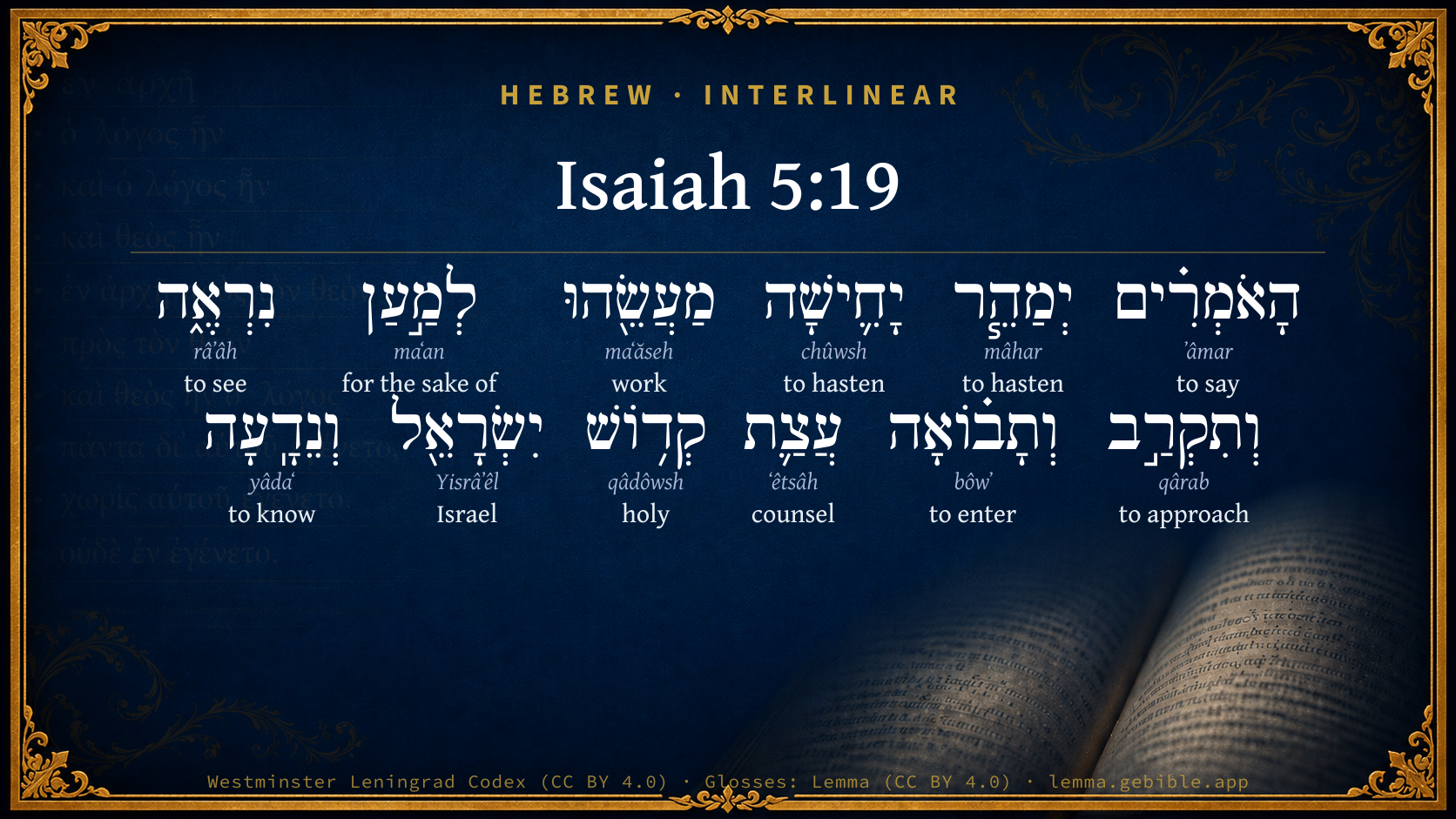
Hebrew (Westminster Leningrad Codex) Isaiah 5:19 appears in the Hebrew Old Testament. The text above is from the Westminster Leningrad Codex. Each word links to its Strong’s number, a concise gloss, and parsing drawn from the Open Scriptures Hebrew Bible morphology. Click any word for its full Brown-Driver-Briggs (BDB) entry.
Download image
Cite this verse

Isaiah 5:19 (World English Bible). Public Domain. Lemma interlinear Bible study tool, https://lemma.gebible.app/v/isaiah/5/19.

Show BibTeX & RIS
BibTeX
RIS
English Translation
Who say, "Let him make speed, let him hasten his work, that we may see it; And let the counsel of the Holy One of Israel draw near and come, That we may know it!"
World English Bible · Public Domain
Download a study sheet

One document with this verse’s original text, its word-by-word gloss line, the meaning frame, cross-references with their text, attributed commentary, and full source and license credits — printable, and it pastes into notes with its structure intact.

This verse Autodidact and up

Study sheet (.html) Plain text (.txt)

A passage Seminary Student

Up to 50 verses in one chapter. A passage sheet keeps up to 6 commentary sources and 12 cross-references per verse, in the order this page ranks them, and says so on the sheet whenever that leaves anything out. Ask for a single verse and you get the Autodidact verse sheet above.

Everything on this page stays free to read, with no account — the sheet is a download of what is already on screen, not access to it.

Want to remove ads? Support Godless Engineer
Compare translations 3

The same verse in 3 English versions, stacked beneath the original-language interlinear above. Click any original word for its lexicon entry.

Each is an independent rendering of the whole verse — the interlinear is not word-aligned to these translations.

Highlighted words mark where these versions differ — a whole-verse word diff, not a word-by-word alignment.

  • World English Bible Public Domain
    Who say, "Let him make speed, let him hasten his work, that we may see it; And let the counsel of the Holy One of Israel draw near and come, That we may know it!"
  • King James Version Public Domain
    That say, Let him make speed, and hasten his work, that we may see it: and let the counsel of the Holy One of Israel draw nigh and come, that we may know it!
  • unfoldingWord Literal Text CC BY-SA 4.0
    the ones saying, “Let him hurry, let him hasten his work that we may see, and let the counsel of the Holy of Israel approach, let it come, that we may know.” q1

unfoldingWord Literal Text — © unfoldingWord, licensed CC BY-SA 4.0. Word-aligned USFM3 via Door43 (git.door43.org/unfoldingWord/en_ult).

Versions to compare (up to 4)

3 of 4 selected

Show all 18 translations

Every available English version of this verse, each an independent rendering of the whole verse.

  • World English Bible Public Domain
    Who say, "Let him make speed, let him hasten his work, that we may see it; And let the counsel of the Holy One of Israel draw near and come, That we may know it!"
  • Berean Standard Bible Public Domain
    to those who say, “Let Him hurry and hasten His work so that we may see it! Let the plan of the Holy One of Israel come so that we may know it!”
  • Majority Standard Bible Public Domain
    to those who say, “Let Him hurry and hasten His work so that we may see it! Let the plan of the Holy One of Israel come so that we may know it!”
  • King James Version Public Domain
    That say, Let him make speed, and hasten his work, that we may see it: and let the counsel of the Holy One of Israel draw nigh and come, that we may know it!
  • American Standard Version (1901) Public Domain
    that say, Let him make speed, let him hasten his work, that we may see it; and let the counsel of the Holy One of Israel draw nigh and come, that we may know it!
  • Revised Version (1885) Public Domain
    that say, Let him make speed, let him hasten his work, that we may see it: and let the counsel of the Holy One of Israel draw nigh and come, that we may know it!
  • Geneva Bible (1599) Public Domain
    Which say, Let him make speede: let him hasten his worke, that wee may see it: and let the counsell of the holy one of Israel draw neere and come, that we may knowe it.
  • Douay-Rheims (1899) Public Domain
    That say: Let him make haste, and let his work come quickly, that we may see it: and let the counsel of the Holy One of Israel come, that we may know it.
  • Young's Literal Translation Public Domain
    Who are saying, `Let Him hurry, Let Him hasten His work, that we may see, And let the counsel of the Holy One of Israel Draw near and come, and we know.'
  • Literal Standard Version CC BY-SA 4.0
    Who are saying, “Let Him hurry, || Let Him hurry His work, that we may see, || And let the counsel of the Holy One of Israel || Draw near and come, and we know.”
  • Unlocked Literal Bible CC BY-SA 4.0
    Woe to those who say, “Let God hurry, let him act quickly, so we can see it happen; and let the plans of the Holy One of Israel come, so that we may know them.”
  • unfoldingWord Literal Text CC BY-SA 4.0
    the ones saying, “Let him hurry, let him hasten his work that we may see, and let the counsel of the Holy of Israel approach, let it come, that we may know.” q1
  • Darby Bible Public Domain
    who say, Let him hasten, let him speed his work, that we may see [it]; and let the counsel of the Holy One of Israel draw nigh and come, that we may know it!
  • World Messianic Bible Public Domain
    who say, “Let him make haste, let him hasten his work, that we may see it; let the counsel of the Holy One of Israel draw near and come, that we may know it!”
  • Webster's Bible Public Domain
    That say, Let him make speed, and hasten his work, that we may see it: and let the counsel of the Holy One of Israel draw nigh and come, that we may know it!
  • Free Bible Version CC BY-SA 4.0
    You are among the people who say, “God should hurry up! Why doesn't God get a move on with what he's doing so we can see it? Why doesn't the Holy One of Israel execute his plan? Let's see it happen so we can understand what it is!”
  • Bible in Basic English Public Domain
    Who say, Let him do his work quickly, let him make it sudden, so that we may see it: let the design of the Holy One of Israel come near, so that it may be clear to us.
  • JPS Tanakh (1917) Public Domain
    That say: 'Let Him make speed, let Him hasten His work, that we may see it; and let the counsel of the Holy One of Israel draw nigh and come, that we may know it!'

Literal Standard Version (2020), Covenant Press — licensed CC BY-SA 4.0. Text via the HelloAO Bible API (eBible.org). Unlocked Literal Bible (unfoldingWord) — licensed CC BY-SA 4.0. Text via the HelloAO Bible API (eBible.org). unfoldingWord Literal Text — © unfoldingWord, licensed CC BY-SA 4.0. Word-aligned USFM3 via Door43 (git.door43.org/unfoldingWord/en_ult). Free Bible Version, Dr. Jonathan Gallagher — licensed CC BY-SA 4.0. Text via the HelloAO Bible API (eBible.org).

Word by word

More ways to search: Search by grammar → Find every occurrence → Compare this word →

Practice this passage: Drill this verse → Learn its vocabulary →

יָחִ֛ישָׁה
chûwsh
H2363
“to hasten”
Verb, Hiphil, Imperfect, 3rd Person, Masculine, Singular + Suffix, h
Part of Speech
Verb
Stem
Hiphil
Form
Imperfect
Person
3rd Person
Gender
Masculine
Number
Singular
Full BDB Definition

Origin: a primitive root

TWOT: 631

to haste, make haste, hurry - (Qal) to make haste - (Hiphil) - to show haste, act quickly, hasten, come quickly - to enjoy, be excited
  1. הָאֹמְרִ֗ים ʼâmar H559 “the · saying” Particle, Definite Article + Verb, Qal, Participle Active, Masculine, Plural, Absolute
  2. יְמַהֵ֧ר mâhar H4116 “to hasten” Verb, Piel, Imperfect, 3rd Person, Masculine, Singular
  3. מַעֲשֵׂ֖הוּ maʻăseh H4639 “work · his” Noun, Common, Masculine, Singular, Construct + Suffix, Personal, 3rd Person, Masculine, Singular
  4. לְמַ֣עַן maʻan H4616 “for the sake of” Preposition
  5. נִרְאֶ֑ה râʼâh H7200 “to see” Verb, Qal, Imperfect, 1st Person, Common, Plural
  6. וְתִקְרַ֣ב qârab H7126 “and · to approach” Conjunction + Verb, Qal, Imperfect, 3rd Person, Feminine, Singular
  7. וְתָב֗וֹאָה bôwʼ H935 “and · to enter” Conjunction + Verb, Qal, Imperfect, 3rd Person, Feminine, Singular + Suffix, h
  8. עֲצַ֛ת ʻêtsâh H6098 “counsel of” Noun, Common, Feminine, Singular, Construct
  9. קְד֥וֹשׁ qâdôwsh H6918 “holy of” Adjective, Adjective, Masculine, Singular, Construct
  10. יִשְׂרָאֵ֖ל Yisrâʼêl H3478 “Israel” Noun, Proper
  11. וְנֵדָֽעָה yâdaʻ H3045 “and · to know” Conjunction + Verb, Qal, Cohortative, 1st Person, Common, Plural

About this verse

These counts appear in no published source. They are computed here, from the morphology-tagged text and Lemma’s own curated glosses. What Lemma adds →

12
words
12
distinct lemmas
Prophets
section

Notable vocabulary

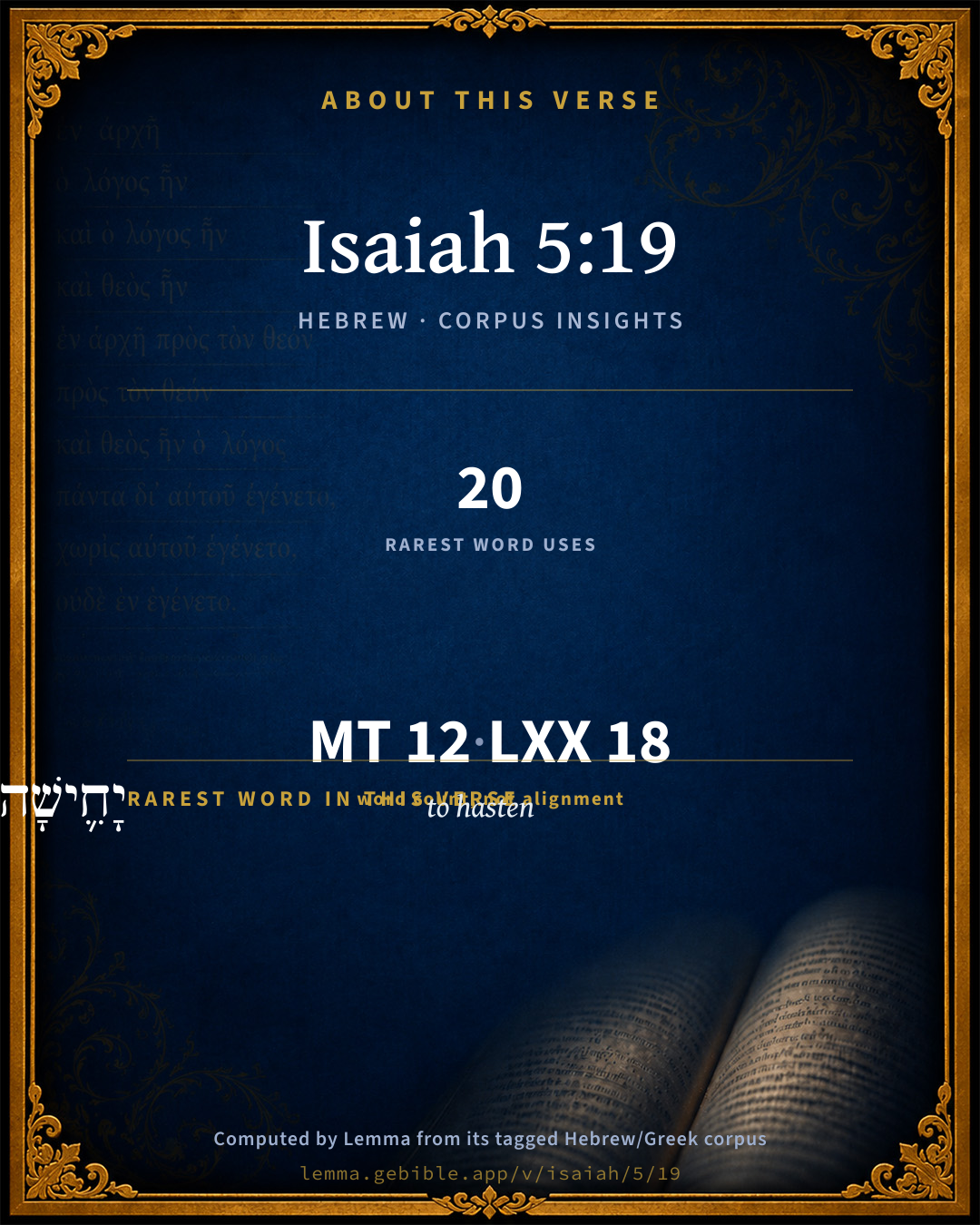
The rarest word here is יָחִ֛ישָׁה to hasten H2363 — appearing just 20 times in the whole Hebrew Bible.

Shared distinctive vocabulary

יָחִ֛ישָׁה to hasten H2363 occurs in 20 verses of the Hebrew Bible. Also found in:

Grammatical profile

  • 7 verbs
  • 3 nouns
  • 1 adjective
  • 1 preposition

Verb forms

  • הָאֹמְרִ֗ים Qal · Participle Active
  • יְמַהֵ֧ר Piel · Imperfect
  • יָחִ֛ישָׁה Hiphil · Imperfect
  • נִרְאֶ֑ה Qal · Imperfect
  • וְתִקְרַ֣ב Qal · Imperfect
  • וְתָב֗וֹאָה Qal · Imperfect
  • וְנֵדָֽעָה Qal · Cohortative

Hebrew & Septuagint length

In English translation the verse runs 35 words from the Hebrew and 31 from the Septuagint (LXX English) — closely comparable.

A rough comparison of the two English renderings, which tokenize alike — not a word-level alignment.

Word counts can differ between the Hebrew and the Greek without any difference in meaning — e.g. the Hebrew direct-object marker אֵת has no separate Greek word, and Greek often adds the article ὁ.

In the original languages it is 12 Hebrew tokens and 18 Greek tokens — but the two are counted differently (Hebrew bundles its prefixes and suffixes into one token; the Greek is in lemma form), so that isn’t a like-for-like length.

Cross-references

10

Topical passages linked to Isaiah 5:19 in the Treasury of Scripture Knowledge — connected by theme and wording, ordered by reader-vote popularity; previews shown in the World English Bible.

  • Ezekiel 12:22 Son of man, what is this proverb that you have in the land of Israel, saying, The days are prolonged, and every vision fails?
  • Jeremiah 17:15 Behold, they tell me, Where is the word of Yahweh? let it come now.
  • Isaiah 66:5 Hear the word of Yahweh, you who tremble at his word: Your brothers who hate you, who cast you out for my name's sake, have said, Let Yahweh be glorified, that we may see your joy; but it is those who shall be disappointed.
  • Jeremiah 5:12–13 They have denied Yahweh, and said, It is not he; neither shall evil come on us; neither shall we see sword nor famine:
  • Jeremiah 23:36 The burden of Yahweh shall you mention no more: for every man's own word shall be his burden; for you have perverted the words of the living God, of Yahweh of Hosts our God.
  • Amos 5:18–19 "Woe to you who desire the day of Yahweh! Why do you long for the day of Yahweh? It is darkness, And not light.
  • 2 Peter 3:3–4 knowing this first, that in the last days mockers will come, walking after their own lusts,
  • Isaiah 30:11 get out of the way, turn aside out of the path, cause the Holy One of Israel to cease from before us."
  • Jeremiah 23:18 For who has stood in the council of Yahweh, that he should perceive and hear his word? who has marked my word, and heard it?
  • Ezekiel 12:27 Son of man, behold, they of the house of Israel say, The vision that he sees is for many day to come, and he prophesies of times that are far off.

Cross-references courtesy of OpenBible.info (CC BY 4.0).

Hebrew and Greek witnesses Masoretic Hebrew ↔ Greek Septuagint

The same verse in the two great witnesses to the Old Testament, shown verse-for-verse.

These are two independent witnesses, not word-aligned to each other, and the Septuagint is shown in lemma (dictionary) form.

Hebrew Isaiah 5:19 Masoretic · Westminster Leningrad Codex

הָאֹמְרִ֗ים יְמַהֵ֧ר יָחִ֛ישָׁה מַעֲשֵׂ֖הוּ לְמַ֣עַן נִרְאֶ֑ה וְתִקְרַ֣ב וְתָב֗וֹאָה עֲצַ֛ת קְד֥וֹשׁ יִשְׂרָאֵ֖ל וְנֵדָֽעָה

Who say, "Let him make speed, let him hasten his work, that we may see it; And let the counsel of the Holy One of Israel draw near and come, That we may know it!"

World English Bible · Public Domain

Greek LXX Isaiah 5:19 Septuagint · lemma form

ὁ λέγω ὁ τάχος ἐγγίζω ὅς ποιέω ἵνα ὁράω καί ἐλθάτω ὁ βουλή ὁ ἅγιος ἰσραήλ ἵνα γιγνώσκω

who say, Let him speedily hasten what he will do, that we may see it: and let the counsel of the Holy One of Israel come, that we may know it.

LXX2012 (modern English Septuagint) · Public Domain

On this verse, Adam Clarke's Commentary discusses the Septuagint’s reading. Read the note in Commentary ↓

Hebrew: Westminster Leningrad Codex (CC BY 4.0). Greek: Septuagint (public domain); English from LXX2012 (modern English Septuagint) (Public Domain). How the Septuagint differs from the Hebrew →

Targum (Aramaic paraphrase)

1

The Targum is the ancient Jewish Aramaic paraphrase of the Hebrew Scriptures — an interpretive translation, not the Hebrew text itself. Onkelos (literal) and Pseudo-Jonathan (expansive) render the Torah, and Jonathan the Prophets. Coverage is partial: where no permissively-licensed English translation exists for a verse, only the Aramaic is shown. This is verse-level text, not a word-by-word alignment to the Hebrew.

  1. Targum Jonathan Prophets (Joshua–Malachi)
    דְאָמְרִין אֵימָתַי יוֹחֵי וִיגַלֵי פְּרִשְׁתֵּיהּ בְּדִיל דְנֶחֱזֵי וְיִקְרַב וְיֵיתֵי מַלְכֵי דְקַדִישָׁא דְיִשְׂרָאֵל וְנֵדְעִינֵיהּ:

    That say, When will He hasten and reveal His miracle, that we may see it: and let the counsel of the Holy One of Israel draw nigh and come, that we may know it!

    Targum Jonathan — Aramaic: “Mikraot Gedolot” (public domain). English: “Sefaria Community Translation” (CC0 1.0 (public-domain dedication)); “London "Chaldee Paraphrase," 1871” (public domain). Text via Sefaria.

Commentary

Notes on Isaiah 5:19 from classic Christian and Jewish commentators (each source and its license shown beneath its notes). The classic Christian expositions comment on the surrounding passage and are grouped to its opening verse, so a note may address several verses; the Jewish commentaries on the Tanakh (Rashi and others) are per-verse, so they appear only where the commentator wrote on this verse.

Lemma curates 59 commentaries, every one of them public domain or Creative Commons licensed, each selected and text-cleaned for this edition rather than reprinted as found. About our sources →

Adam Clarke's Commentary

Verse 19. Let the counsel of the Holy One] Tryphiodorus has an expression something like this: -

______ επει Διος ηλυθε βουλη

TRYPH. Il Excid. 239.

Because the counsel of Jupiter was come. "This expression, ηλυθε βουλη, is, I believe, something uncommon; but it is exactly paralleled and explained by a passage in Isaiah, Isa 5:19. The Septuagint has expressed it in the very same words with Tryphiodorus: αι ελθοι ἡ βουλ η του ἁγιου Ισραηλ, ἱνα γνωμεν." - Merrick's note, ad loc.

Adam Clarke's Commentary on the Bible (1810–1826) — public domain. Text from a community e-Sword/MySword module.

Trapp's Complete Commentary

John Trapp

Isa 5:19 That say, Let him make speed, [and] hasten his work, that we may see [it]: and let the counsel of the Holy One of Israel draw nigh and come, that we may know [it]!

Ver. 19. That say, Let him make speed.] That jeer when they should fear, jest at God’s judgments, and mock at his menaces, as if they were only bugbear terms, devised on purpose to frighten silly people, but that themselves had more wit than to regard them. This also was the guise of those atheists in later ages. {Jer 17:15 Eze 12:23 Amo 5:18 2Pe 3:3} Eμπαικται, they made children’s play of God’s direful threats, as the Greek word signifieth. And that they may not plead ignorance, the apostle addeth, {Isa 5:5} that they were "willingly ignorant"; they choked their natural light, and contradicted the testimony of their own consciences. Magna eorum hodieque seges est; such dust heaps are found in every corner.

And let the counsel of the Holy One of Israel.] Verba ludificantium Deum et prophetas, {a} These scoffers are here brought in deriding the very name whereby the holy prophets for more reverence sake commonly called the Lord, viz., "the Holy One of Israel." Or thus, God is the Holy One of Israel, which Israel we are; and thinkest thou that he will do us hurt? {b} Hereupon the prophet addeth,

{a} Mιμησις.

{b} Oecolamp.

John Trapp, A Commentary or Exposition upon All the Books of the Old and New Testament (1647–1656) — public domain. Text from a community e-Sword module.

The Preacher's Complete Homiletical Commentary

Joseph S. Exell (gen. ed.)

SCEPTICISM

Isa_5:19. That say, Let Him make speed and hasten His work, that we may see it: and let the counsel of the Holy One of Israel draw nigh and come, that we may know it.

Scepticism, I. Denies the judgments of God. II. Draws an argument from their delay [661] III. Impiously scoffs at the Divine counsels. IV. Defies God to do His worst.—J. Lyth, D.D.

[661] The whole force of life and experience goes to prove that right or wrong-doing, whether in relation to the physical or the spiritual nature, is sure, in the end, to meet its appropriate reward or punishment. Penalties are often so long delayed, that men think they shall escape them; but some time they are certain to follow. When the whirlwind sweeps through the forest, at its first breath, or almost as if the fearful stillness that precedes had crushed it, the giant tree, with all its boughs, falls crashing to the ground. But it had been preparing to fall for twenty years. Twenty years before it received a gash. Twenty years before the water commenced to settle in at some crotch, and from thence decay began to reach in with its silent fingers towards the heart of the tree. Every year the work of death progressed, till at length it stood, all rottenness, only clasped about by the bark with a semblance of life, and the first gale felled it to the ground. Now, there are men who, for twenty years, have shamed the day and wearied the night with their debaucheries, but who yet seem strong and vigorous, and exclaim, “You need not talk of penalties. Look at me! I have revelled in pleasure for twenty years, and I am as hale and hearty to-day as ever.” But in reality they are full of weakness and decay. They have been preparing to fall for twenty years, and the first disease strikes them down in a moment.

Ascending from the physical nature of man to the mind and character, we find the same laws prevail. People sometimes say, “Dishonesty is as good as honesty, for aught I see. There are such and such men who have pursued for years the most corrupt courses in their business, and yet they prosper, and are getting rich every day.” Wait till you see their end. Every year how many such men are overtaken with sudden destruction, and swept for ever out of sight and remembrance! Many a man has gone on in sin, practising secret fraud and villanies, yet trusted and honoured, till at length, in some unsuspected hour, he is detected, and, denounced by the world, he falls from his high estate as if a cannon-ball had struck him—for there is no cannon that can strike more fatally than outraged public sentiment—and flies over the mountains, or across the sea, to escape the odium of his life. He believed that his evil course was building him up in fame and fortune; but financiering is the devil’s forge, and his every act was a blow upon the anvil, shaping the dagger that should one day strike home to his heart and make him a suicide. The pea contains the vine, and the flower, and the pod, in embryo, and, I am sure, when I plant it, that it will produce them and nothing else. Now, every action of our lives is embryonic, and, according as it is right or wrong, it will surely bring forth sweet flowers of joy, or the poison fruits of sorrow. Such is the constitution of this world, and the Bible assures us that the next world only carries it forward. Here and hereafter, “whatsoever a man soweth, that shall he also reap.”—Beecher.

The Preacher's Complete Homiletical Commentary (gen. ed. Joseph S. Exell; Funk & Wagnalls, c. 1892) — public domain (pre-1929). A full-Bible homiletical/sermon-outline anthology covering 65 of 66 books (2 John is absent from the source module). Text from a community e-Sword module.

Keil & Delitzsch

C. F. Keil & F. Delitzsch

Isa 5:19 shows very clearly that the prophet referred to the free-thinkers of his time, the persons who are called fools (nabal) and scorners (lētz) in the Psalms and Proverbs. "Who say, Let Him hasten, accelerate His work, that we may see; and let the counsel of the Holy One of Israel draw near and come, that we may experience it." They doubted whether the day of Jehovah would ever come (Eze 12:22; Jer 5:12-13), and went so far in their unbelief as to call out for what they could not and would not believe, and desired it to come that they might see it with their own eyes and experience it for themselves (Jer 17:15; it is different in Amo 5:18 and Mal 2:17-3:1, where this desire does not arise from scorn and defiance, but from impatience and weakness of faith). As the two verbs denoting haste are used both transitively and intransitively (vid., Jdg 20:37, to hasten or make haste), we might render the passage "let His work make haste," as Hitzig, Ewald, Umbreit, and Drechsler do; but we prefer the rendering adopted by Gesenius, Caspari, and Knobel, on the basis of Isa 60:22, and take the verb as transitive, and Jehovah as the subject. The forms yâchishâh and taboâh are, with Psa 20:4 and Job 11:17, probably the only examples of the expression of a wish in the third person, strengthened by the âh, which indicates a summons or appeal; for Eze 23:20, which Gesenius cites (48, 3), and Job 22:21, to which Knobel refers, have no connection with this, as in both passages the âh is the feminine termination, and not hortative (vid., Comm. on Job, at Job 11:17, note, and at Job 22:21). The fact that the free-thinkers called God "the Holy One of Israel," whereas they scoffed at His intended final and practical attestation of Himself as the Holy One, may be explained from Isa 30:11 : they took this name of God from the lips of the prophet himself, so that their scorn affected both God and His prophet at the same time.

Keil & Delitzsch — Biblical Commentary on the Old Testament (1861–1891) — public domain (CC PDM 1.0). Text via the HelloAO Bible API. (Old Testament only.)

Tyndale Open Study Notes

Tyndale Open Resources

5:19 The people challenged God to hurry up and do something to prove that he really exists and is in control of this world. The verb hurry up translates two Hebrew verbs: maher (“be quick”) and khush (“be speedy”). The same Hebrew words are used in the name Maher-shalal-hash-baz (Isa 8:1). • God’s plan was revealed to Isaiah. Little did the people know that God’s purposes would turn against them.

Tyndale Open Study Notes — © Tyndale Open Resources, licensed CC BY-SA 4.0. Text via the HelloAO Bible API.

Geneva Bible (1599)

Geneva Bible translators

He showeth what are the words of the wicked, when they are menaced with God’s judgments, 2 Pet. 3:4.

Geneva Bible (1599) marginal notes — public domain. Text via Bolls.life.

Jamieson, Fausset & Brown

Robert Jamieson, A. R. Fausset & David Brown

work--vengeance (Isa 5:12). Language of defiance to God. So Lamech's boast of impunity (Gen 4:23-24; compare Jer 17:15; Pe2 3:3-4).

counsel--God's threatened purpose to punish.

Jamieson, Fausset & Brown — Commentary Critical and Explanatory on the Whole Bible (1871) — public domain (CC PDM 1.0). Text via the HelloAO Bible API.

Ellicott's Commentary for English Readers

(19) That say, Let him make speed.—We have here, as in Isa_28:10, and Jer_17:15, the very words of the wealthy scoffers of Judah. Such taunts are not peculiar to any age or country. We find them in the speech of Zedekiah (1Ki_22:24), in that of the mockers of 2Pe_3:4. In the name of Isaiah’s second son (Isa_8:3) we may probably find an answer to the taunt. The words “the counsel of the Holy One of Israel” were obviously emphasised with a sneer at the name on which Isaiah dwelt so constantly. (Comp. Isa_30:11.)

A Bible Commentary for English Readers, edited by Charles John Ellicott (1878–1897) — public domain. Text from a community e-Sword module.

The Cambridge Bible for Schools and Colleges

gen. ed. J. J. S. Perowne

19. An impious challenge to Jehovah to make good His words spoken through the prophet. This defiant unbelief seems to have been the reigning spirit in the political circles of Isaiah’s time; Isa_28:14 f., 22; cf. Jer_5:12; Jer_17:15.

The Cambridge Bible for Schools and Colleges (gen. ed. J. J. S. Perowne; Cambridge University Press, 1878–1918) — public domain. Text from a community e-Sword module.

John Gill's Exposition

That say, let him make speed, and hasten his work,.... Either the punishment of their sins, threatened by the prophets; which, because not speedily and immediately executed, therefore they did not believe it ever would; and in a daring and insolent manner call upon God to inflict it:

that we may see it, or feel it; for, as for words or threatenings, they regarded them not; thus deriding God and his judgments, and disbelieving both, like the mockers in the last days, described in Pe2 3:3 and, in contempt of him, do not so much as mention his name; though the Syriac version expresses the word "Lord", and the Arabic version "God": or rather the great work of redemption and salvation by the Messiah; for, as they did not believe Jesus to be the Messiah, so they ridiculed and despised salvation by him, mocking him as a Saviour, and calling upon him, in a sarcastic way, to hasten and do his work he pretended to come about; see Mat 27:42 for to the Jews in Christ's time this prophecy belongs. The Targum interprets it, "his miracle"; the Jews were always for signs and miracles; they sought them of Jesus of Nazareth; they urged the doing of them; they were very solicitous and importunate, and in haste to have them done, that they might see and believe, as they pretended; and expressed themselves in almost the same words as here; "what sign shewest thou then, that we may see and believe thee? what dost thou work?" Joh 6:30 this is an instance of their drawing iniquity and sin in the manner before complained of:

and let the counsel of the Holy One of Israel draw nigh and come, that we may know it! not that they believed him to be the Holy One of Israel, but because the prophet had made mention of this title, Isa 1:4 as he often does in this prophecy afterwards, and applies it to the Redeemer; therefore they use it: so the Jews put an "if" upon Christ being the King of Israel, Mat 27:42 wherefore, in a daring, jeering, and ironic manner, urge that what is said to be in the purposes and decrees of God, or what was agreed upon between him and the Messiah, who said he was the son of God, in the council and covenant of grace and peace, as pretended, might speedily come to pass; all which expresses their blasphemy, impiety, and unbelief; and shows that they did not believe, but derided any counsel or decree of God, respecting spiritual and eternal salvation by the Messiah, especially by Jesus of Nazareth: or the conversion of the Gentiles, or the spread of the Gospel, and the enlargement of the kingdom and interest of Christ in the world, are meant, Kimchi, on the text, owns that these words belong to the Jews in the present day, and makes this confession,

"it appears that our prophets said the truth for now we believe not.''

John Gill's Exposition of the Whole Bible (1746–1763) — public domain (CC PDM 1.0). Text via the HelloAO Bible API.

Albert Barnes' Notes on the Bible

That say ... - They add one sin to another for “the purpose of defying” God, and provoking him to anger. They pretend that he will not punish sin; and hence, they plunge deeply into it, and defy him to punish them.

Let him make speed - Let him come quick to punish.

And hasten his work - His punishment.

That we may see it - An expression of defiance. We would like to see him undertake it.

The counsel of the Holy One ... - His threatened purpose to punish. This is the language of all sinners. They plunge deep into sin; they mock at the threatenings of God; they defy him to do his utmost; they do not believe his declarations. It is difficult to conceive more dreadful and high-handed iniquity than this.

Albert Barnes' Notes on the Bible (1834–1885) — public domain. Text from a community e-Sword/MySword module.

Haydock's Catholic Bible Commentary

It. The Jews were often guilty of the like insolence, Jeremias xvii. 15.

George Leo Haydock (1774–1849), Haydock's Catholic Family Bible and Commentary, 1859 edition — public domain. Excludes Psalms (Douay-Rheims chapter numbering differs from Protestant) and Deuterocanonical books (Catholic canon only).

Matthew Poole's English Annotations

Let him, to wit, God, in whose name thou and other prophets are always reproving and threatening us.

Hasten his work, that we may see it; he only thinks to affright us with bugbears; but he either cannot or will not do us any harm: we do not fear him, let him do his worst; let him begin as soon as he pleaseth. Not that any of the Israelites were so impudent as to use these expressions; but this was the plain language of their actions; they lived as if they were of this opinion; their presumption and security showed their desperate contempt of God, and of all his judgments.

The Holy One of Israel; who by his holiness is engaged to punish us. They scornfully repeated the title usually given by the prophets unto God.

Matthew Poole's English Annotations on the Holy Bible (1683–1685) — public domain. Text from a community e-Sword/MySword module.

Whedon's Commentary on the Bible

Daniel D. Whedon

19. Let him make speed — In a tone of defiance they say, Let him come on.

And hasten his work — His work of direful providence and threatened judgment.

That we may see it — We are ready for him. When he does what he threatens, we will believe him.

Counsel — The prophet’s predictions; evident from the words Holy One of Israel, which not they, but only the prophet, would use. In effect they say: “‘The days are prolonged, and every vision faileth.’ Eze_12:22. We doubt their truth. Let him show his hand in these threatened woes. Only then can we believe you, his prophet.”

Daniel D. Whedon (gen. ed.), Commentary on the Old and New Testaments (1874–1909) — public domain. Text from a community e-Sword module.

The Pulpit Commentary

That say, Let him make speed, etc. Instead of trembling at the coming judgment of God, which Isaiah has announced, they pretend to desire its immediate arrival; they want to "see it." They walk, not by faith, but by sight. At the bottom of this pretended desire there lies a complete incredulity. The counsel; or, purpose, as in Isa_14:26. Of the Holy One of Israel. They use one of Isaiah"s favorite titles of God (see note on Isa_50:4), not from any belief in him, but rather in a mocking spirit.

The Pulpit Commentary (1880–1919), ed. H.D.M. Spence-Jones & Joseph S. Exell — public domain. Text from a community e-Sword module.

John Wesley's Explanatory Notes

Let him - God, in whose name thou and other prophets are always threatening us. This was the plain language of their actions; they lived as if they were of this opinion. The Holy One - They scornfully repeated the title usually given by the prophets to God.

John Wesley, Explanatory Notes Upon the Whole Bible (1754–1765) — public domain. Text via the GEBible commentary corpus.

J. A. Alexander on Isaiah

Joseph Addison Alexander

The degree of their presumption and depravity is now evinced by a citation of their language with respect to God’s threatened judgments, an ironical expression of impatience to behold them, and an implied refusal to believe without experience. The sentence is continued from the verse preceding, and further describes the sinners there denounced, “as the ones saying (those who say), let him speed, let him hasten his work (his providential work, as in v. 12), that we may see, and let the counsel (providential plan or purpose) of the Holy One of Israel (which, in the mouth of these blasphemers, seems to be a taunting irony) draw nigh and come, and we will know” (i.e., according to the Hebrew idiom and the parallel expression) that we may know what it is, or that it is a real purpose, and that he is able to accomplish it (compare Jer 17:15; Amo 5:18; Amo 6:13; Isa 30:10-11; Isa 28:15; 2Pe 3:4).

Joseph Addison Alexander, The Prophecies of Isaiah (1846–1847; New York: Scribner, 1870–1878) — public domain. Text from a community e-Sword module.

Rashi

Rabbi Shlomo Yitzchaki (Rashi)

Let Him hurry; let Him hasten His deed [i.e.,] the retribution He says He will bring.

so that we may see whose word will stand up.

Rashi on the Tanakh — English translations: “The Judaica Press complete Tanach with Rashi, translated by A. J. Rosenberg” (CC BY 4.0); “Pentateuch with Rashi's commentary by M. Rosenbaum and A.M. Silbermann, 1929-1934” (public domain); “The Metsudah Tanach series, Lakewood, N.J” (CC BY 4.0); and “The Book of Joshua, Metsudah Publications, 1997” (CC BY 4.0). Text via Sefaria.

Ibn Ezra

Rabbi Abraham ibn Ezra

ימהר Either transitive, let him bring hastily; comp. מהרו (Esth. 5:5), fetch hastily; or intransitive, let him make speed; and only יחישה transitive, let him accelerate. As to two verbs in the future following each other without conjunction, comp. אל תרבו תדברו Talk no more (1 Sam. 2:3).—Let these prophecies be fulfilled, that we may see whether they are true.

Ibn Ezra on the Tanakh — English translations: “Sefaria Community Translation” (CC0 1.0 (public-domain dedication)); “Yalkut, Sifsei Chachomim Chumash, Metsudah Publications, 2009” (CC BY 4.0); and “Commentary of Ibn Ezra on Isaiah - trans. by M. Friedlander, 1873” (public domain). Text via Sefaria.

Lesson kit

Teaching starters — assembled from the data on this page, not authored interpretation. Every prompt links to the verse data it draws on. Edit before teaching.

Isaiah, in the Prophets, opens this verse with 12 words (12 distinct Hebrew lemmas). Its most distinctive word is chûwsh (“to hasten”). A historical commentator’s framing appears above. Read the whole chapter for the surrounding context.

Discussion questions

  1. What does “to hasten” (chûwsh) contribute to the verse as a whole?
  2. Numbers 32:17 shares the word «to hasten» with this verse. How do the two illuminate each other?
  3. These translations render this verse differently. What is at stake in choosing one wording over another?
  4. The verb «הָאֹמְרִ֗ים» is Qal Participle Active. How does its form color the action?
  5. Reading how Adam Clarke's Commentary and Trapp's Complete Commentary read this verse, where do the two commentators agree and where do they part?

Things to notice

Reading settings

Reading text

Shown beneath each verse's original-language words.

Old Testament
Old Testament edition

Read the OT as the Masoretic Hebrew (MT) or the Greek Septuagint (LXX).

English shown for the Greek Septuagint (in the Hebrew ↔ Greek comparison).

Comparing translations? Open the Compare panel on any verse page to stack up to four side by side.