Ezekiel 32:31

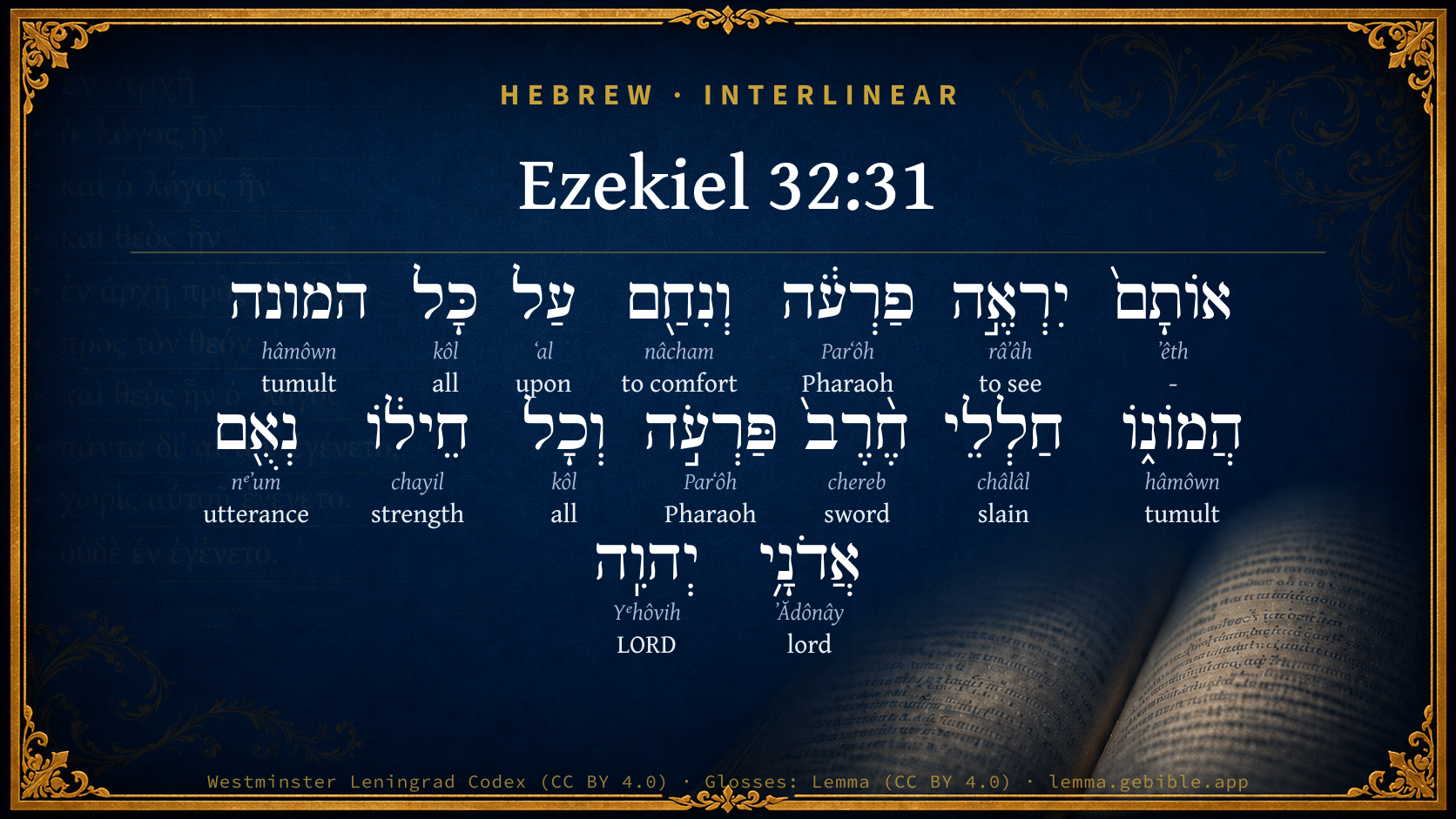
Hebrew (Westminster Leningrad Codex) Ezekiel 32:31 appears in the Hebrew Old Testament. The text above is from the Westminster Leningrad Codex. Each word links to its Strong’s number, a concise gloss, and parsing drawn from the Open Scriptures Hebrew Bible morphology. Click any word for its full Brown-Driver-Briggs (BDB) entry.
Download image
Cite this verse

Ezekiel 32:31 (World English Bible). Public Domain. Lemma interlinear Bible study tool, https://lemma.gebible.app/v/ezekiel/32/31.

Show BibTeX & RIS
BibTeX
RIS
English Translation
Pharaoh shall see them, and shall be comforted over all his multitude, even Pharaoh and all his army, slain by the sword, says the Lord Yahweh.
World English Bible · Public Domain
Download a study sheet

One document with this verse’s original text, its word-by-word gloss line, the meaning frame, cross-references with their text, attributed commentary, and full source and license credits — printable, and it pastes into notes with its structure intact.

This verse Autodidact and up

Study sheet (.html) Plain text (.txt)

A passage Seminary Student

Up to 50 verses in one chapter. A passage sheet keeps up to 6 commentary sources and 12 cross-references per verse, in the order this page ranks them, and says so on the sheet whenever that leaves anything out. Ask for a single verse and you get the Autodidact verse sheet above.

Everything on this page stays free to read, with no account — the sheet is a download of what is already on screen, not access to it.

Want to remove ads? Support Godless Engineer
Compare translations 3

The same verse in 3 English versions, stacked beneath the original-language interlinear above. Click any original word for its lexicon entry.

Each is an independent rendering of the whole verse — the interlinear is not word-aligned to these translations.

Highlighted words mark where these versions differ — a whole-verse word diff, not a word-by-word alignment.

  • World English Bible Public Domain
    Pharaoh shall see them, and shall be comforted over all his multitude, even Pharaoh and all his army, slain by the sword, says the Lord Yahweh.
  • King James Version Public Domain
    Pharaoh shall see them, and shall be comforted over all his multitude, even Pharaoh and all his army slain by the sword, saith the Lord GOD.
  • unfoldingWord Literal Text CC BY-SA 4.0
    Pharaoh will look and be comforted about all his multitudes who were pierced by the sword—Pharaoh and all his army—this is the Lord Yahweh’s declaration.

unfoldingWord Literal Text — © unfoldingWord, licensed CC BY-SA 4.0. Word-aligned USFM3 via Door43 (git.door43.org/unfoldingWord/en_ult).

Versions to compare (up to 4)

3 of 4 selected

Show all 18 translations

Every available English version of this verse, each an independent rendering of the whole verse.

  • World English Bible Public Domain
    Pharaoh shall see them, and shall be comforted over all his multitude, even Pharaoh and all his army, slain by the sword, says the Lord Yahweh.
  • Berean Standard Bible Public Domain
    Pharaoh will see them and be comforted over all his multitude—Pharaoh and all his army, slain by the sword, declares the Lord GOD.
  • Majority Standard Bible Public Domain
    Pharaoh will see them and be comforted over all his multitude—Pharaoh and all his army, slain by the sword, declares the Lord GOD.
  • King James Version Public Domain
    Pharaoh shall see them, and shall be comforted over all his multitude, even Pharaoh and all his army slain by the sword, saith the Lord GOD.
  • American Standard Version (1901) Public Domain
    Pharaoh shall see them, and shall be comforted over all his multitude, even Pharaoh and all his army, slain by the sword, saith the Lord Jehovah.
  • Revised Version (1885) Public Domain
    Pharaoh shall see them, and shall be comforted over all his multitude: even Pharaoh and all his army, slain by the sword, saith the Lord GOD.
  • Geneva Bible (1599) Public Domain
    Pharaoh shall see them, and hee shall be comforted ouer all his multitude: Pharaoh, and all his armie shall be slaine by the sword, saieth the Lord God.
  • Douay-Rheims (1899) Public Domain
    Pharao saw them, and he was comforted concerning all his multitude, which was slain by the sword: Pharao, and all his army, saith the Lord God:
  • Young's Literal Translation Public Domain
    Then doth Pharaoh see, And he hath been comforted for all his multitude, The pierced of the sword -- Pharaoh and all his force, An affirmation of the Lord Jehovah.
  • Literal Standard Version CC BY-SA 4.0
    Then Pharaoh sees, || And he has been comforted for all his multitude, || The pierced of the sword—Pharaoh and all his force, || A declaration of Lord YHWH.
  • Unlocked Literal Bible CC BY-SA 4.0
    Pharaoh will look and be comforted about all his multitudes who were pierced by the sword—Pharaoh and all his army—this is the Lord Yahweh's declaration.
  • unfoldingWord Literal Text CC BY-SA 4.0
    Pharaoh will look and be comforted about all his multitudes who were pierced by the sword—Pharaoh and all his army—this is the Lord Yahweh’s declaration.
  • Darby Bible Public Domain
    Pharaoh shall see them, and shall be comforted over all his multitude, Pharaoh and all his army slain by the sword, saith the Lord Jehovah.
  • World Messianic Bible Public Domain
    “Pharaoh will see them and will be comforted over all his multitude, even Pharaoh and all his army, slain by the sword,” says the Lord GOD.
  • Webster's Bible Public Domain
    Pharaoh shall see them, and shall be comforted over all his multitude, even Pharaoh and all his army slain by the sword, saith the Lord GOD.
  • Free Bible Version CC BY-SA 4.0
    Pharaoh will see them and be pleased that he and all his many people are not the only ones killed by the sword, declares the Lord God.
  • Bible in Basic English Public Domain
    Pharaoh will see them and be comforted on account of all his people: even Pharaoh and all his army, put to death by the sword, says the Lord.
  • JPS Tanakh (1917) Public Domain
    These shall Pharaoh see, and shall be comforted over all his multitude; even Pharaoh and all his army, slain by the sword, saith the Lord GOD.

Literal Standard Version (2020), Covenant Press — licensed CC BY-SA 4.0. Text via the HelloAO Bible API (eBible.org). Unlocked Literal Bible (unfoldingWord) — licensed CC BY-SA 4.0. Text via the HelloAO Bible API (eBible.org). unfoldingWord Literal Text — © unfoldingWord, licensed CC BY-SA 4.0. Word-aligned USFM3 via Door43 (git.door43.org/unfoldingWord/en_ult). Free Bible Version, Dr. Jonathan Gallagher — licensed CC BY-SA 4.0. Text via the HelloAO Bible API (eBible.org).

Word by word

More ways to search: Search by grammar → Find every occurrence → Compare this word →

Practice this passage: Drill this verse → Learn its vocabulary →

המונה
hâmôwn
H1995
“tumult · her”
Noun, Common, Masculine, Singular, Construct + Suffix, Personal, 3rd Person, Feminine, Singular
Part of Speech
Noun
Type
Common
Gender
Masculine
Number
Singular
State
Construct
Full BDB Definition

Origin: from H1993

TWOT: 505a

(Qal) murmur, roar, crowd, abundance, tumult, sound - sound, murmur, rush, roar - tumult, confusion - crowd, multitude - great number, abundance - abundance, wealth
  1. אוֹתָם֙ ʼêth H853 “- · them” Particle, Direct Object + Suffix, Personal, 3rd Person, Masculine, Plural
  2. יִרְאֶ֣ה râʼâh H7200 “to see” Verb, Qal, Imperfect, 3rd Person, Masculine, Singular
  3. פַרְעֹ֔ה Parʻôh H6547 “Pharaoh” Noun, Proper
  4. וְנִחַ֖ם nâcham H5162 “and · to comfort” Conjunction + Verb, Niphal, Sequential Perfect, 3rd Person, Masculine, Singular
  5. עַל ʻal H5921 “upon” Preposition
  6. כָּל kôl H3605 “all of” Noun, Common, Masculine, Singular, Construct
  7. הֲמוֹנ֑וֹ hâmôwn H1995 “tumult · his” Noun, Common, Masculine, Singular, Construct + Suffix, Personal, 3rd Person, Masculine, Singular
  8. חַלְלֵי châlâl H2491 “slain of” Adjective, Adjective, Masculine, Plural, Construct
  9. חֶ֨רֶב֙ chereb H2719 “sword” Noun, Common, Feminine, Singular, Absolute
  10. פַּרְעֹ֣ה Parʻôh H6547 “Pharaoh” Noun, Proper
  11. וְכָל kôl H3605 “and · all of” Conjunction + Noun, Common, Masculine, Singular, Construct
  12. חֵיל֔וֹ chayil H2428 “strength · his” Noun, Common, Masculine, Singular, Construct + Suffix, Personal, 3rd Person, Masculine, Singular
  13. נְאֻ֖ם nᵉʼum H5002 “utterance of” Noun, Common, Masculine, Singular, Construct
  14. אֲדֹנָ֥י ʼĂdônây H136 “Lord · my” Noun, Common, Masculine, Plural, Construct + Suffix, Personal, 1st Person, Common, Singular
  15. יְהוִֽה Yᵉhôvih H3069 “LORD” Noun, Proper

About this verse

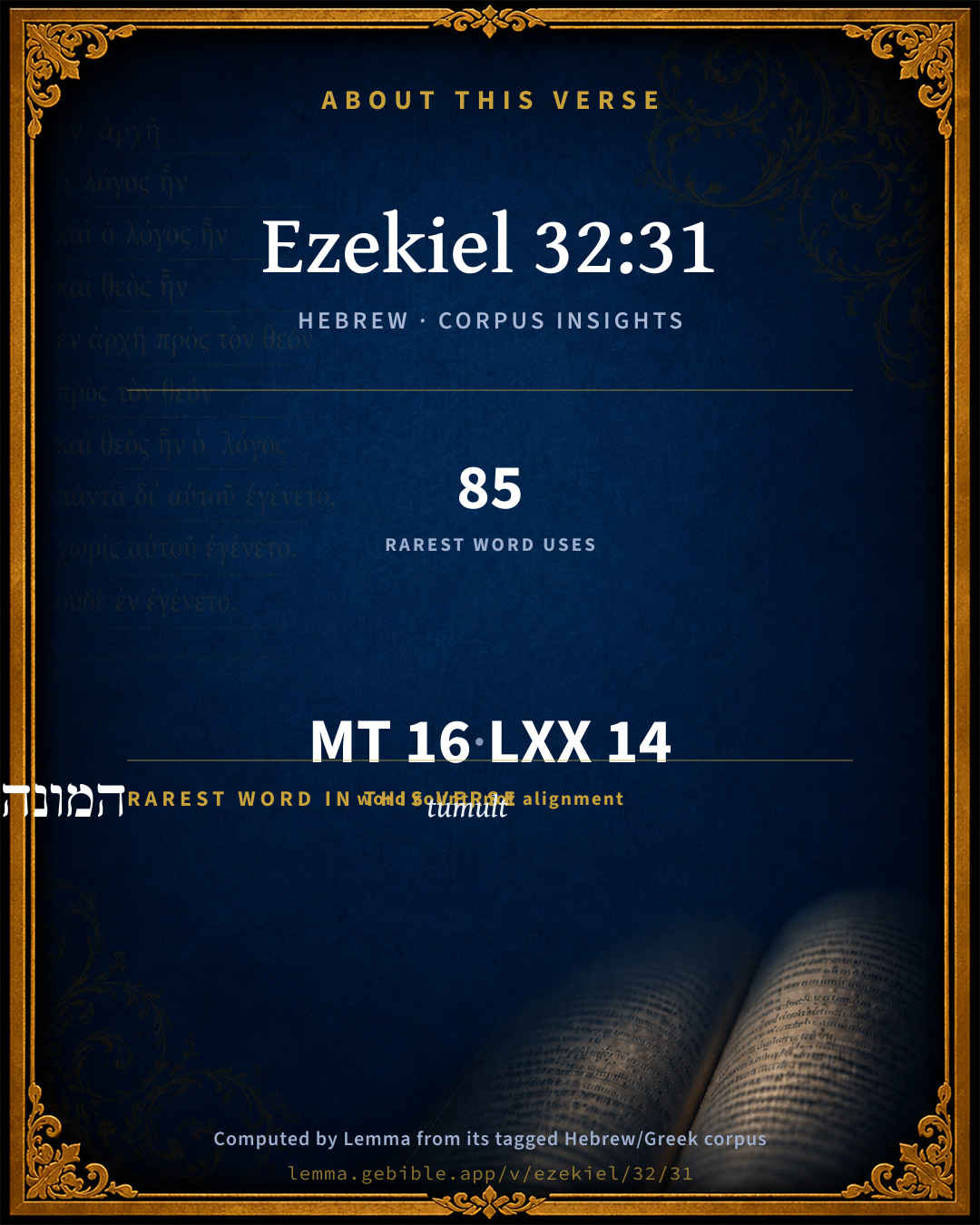
These counts appear in no published source. They are computed here, from the morphology-tagged text and Lemma’s own curated glosses. What Lemma adds →

16
words
13
distinct lemmas
Prophets
section

Grammatical profile

  • 2 verbs
  • 11 nouns
  • 1 adjective
  • 1 preposition
  • 1 particle

Verb forms

  • יִרְאֶ֣ה Qal · Imperfect
  • וְנִחַ֖ם Niphal · Sequential Perfect

Repetition

Words recur within this verse — often emphatic in Hebrew:

  • פַרְעֹ֔ה Pharaoh H6547 ×2
  • כָּל all H3605 ×2
  • המונה tumult H1995 ×2

Hebrew & Septuagint length

In English translation the verse runs 26 words from the Hebrew and 17 from the Septuagint (LXX English) — the Septuagint runs noticeably shorter here. See the side-by-side →

A rough comparison of the two English renderings, which tokenize alike — not a word-level alignment.

Word counts can differ between the Hebrew and the Greek without any difference in meaning — e.g. the Hebrew direct-object marker אֵת has no separate Greek word, and Greek often adds the article ὁ.

In the original languages it is 16 Hebrew tokens and 14 Greek tokens — but the two are counted differently (Hebrew bundles its prefixes and suffixes into one token; the Greek is in lemma form), so that isn’t a like-for-like length.

Cross-references

3

Topical passages linked to Ezekiel 32:31 in the Treasury of Scripture Knowledge — connected by theme and wording, ordered by reader-vote popularity; previews shown in the World English Bible.

  • Ezekiel 31:16 I made the nations to shake at the sound of his fall, when I cast him down to Sheol with those who descend into the pit; and all the trees of Eden, the choice and best of Lebanon, all that drink water, were comforted in the lower parts of the earth.
  • Ezekiel 14:22 Yet, behold, therein shall be left a remnant that shall be carried forth, both sons and daughters: behold, they shall come forth to you, and you shall see their way and their doings; and you shall be comforted concerning the evil that I have brought on Jerusalem, even concerning all that I have brought on it.
  • Lamentations 2:13 What shall I testify to you? what shall I liken to you, daughter of Jerusalem? What shall I compare to you, that I may comfort you, virgin daughter of Zion? For your breach is great like the sea: who can heal you?

Cross-references courtesy of OpenBible.info (CC BY 4.0).

Hebrew and Greek witnesses Masoretic Hebrew ↔ Greek Septuagint

The same verse in the two great witnesses to the Old Testament, shown verse-for-verse.

Here the Septuagint runs noticeably shorter than the Hebrew — LXX2012 (modern English Septuagint) 17 words vs World English Bible 26. A rough length comparison of the two English translations, not a word-level alignment — read both below.

These are two independent witnesses, not word-aligned to each other, and the Septuagint is shown in lemma (dictionary) form.

Hebrew Ezekiel 32:31 Masoretic · Westminster Leningrad Codex

אוֹתָם֙ יִרְאֶ֣ה פַרְעֹ֔ה וְנִחַ֖ם עַל כָּל המונה הֲמוֹנ֑וֹ חַלְלֵי חֶ֨רֶב֙ פַּרְעֹ֣ה וְכָל חֵיל֔וֹ נְאֻ֖ם אֲדֹנָ֥י יְהוִֽה

Pharaoh shall see them, and shall be comforted over all his multitude, even Pharaoh and all his army, slain by the sword, says the Lord Yahweh.

World English Bible · Public Domain

Greek LXX Ezekiel 32:31 Septuagint · lemma form

ἐκεῖνος ὁράω βασιλεύς φαραώ καί παρακαλέω ἐπί πᾶς ὁ ἰσχύς αὐτός λέγω κύριος κύριος

King Pharao shall see them, and shall be comforted over all their force, says the Lord God.

LXX2012 (modern English Septuagint) · Public Domain

On this verse, The Cambridge Bible for Schools and Colleges discusses the Septuagint’s reading. Read the note in Commentary ↓

Hebrew: Westminster Leningrad Codex (CC BY 4.0). Greek: Septuagint (public domain); English from LXX2012 (modern English Septuagint) (Public Domain). How the Septuagint differs from the Hebrew →

Targum (Aramaic paraphrase)

1

The Targum is the ancient Jewish Aramaic paraphrase of the Hebrew Scriptures — an interpretive translation, not the Hebrew text itself. Onkelos (literal) and Pseudo-Jonathan (expansive) render the Torah, and Jonathan the Prophets. Coverage is partial: where no permissively-licensed English translation exists for a verse, only the Aramaic is shown. This is verse-level text, not a word-by-word alignment to the Hebrew.

  1. Targum Jonathan Prophets (Joshua–Malachi)
    יַתְהוֹן יֶחֱזֵי פַּרְעֹה וְיִתְנְחֵם עַל כָּל אִתְרְגוּשְׁתֵּהּ קְטִילֵי חַרְבָּא פַּרְעֹה וְכָל מַשִׁרְיָתֵיהּ אֲמַר יְיָ אֱלֹהִים:

    (no public-domain English translation for this verse)

    Targum Jonathan — Aramaic: “Mikraot Gedolot” (public domain). English: “Sefaria Community Translation” (CC0 1.0 (public-domain dedication)); “London "Chaldee Paraphrase," 1871” (public domain). Text via Sefaria.

Commentary

Notes on Ezekiel 32:31 from classic Christian and Jewish commentators (each source and its license shown beneath its notes). The classic Christian expositions comment on the surrounding passage and are grouped to its opening verse, so a note may address several verses; the Jewish commentaries on the Tanakh (Rashi and others) are per-verse, so they appear only where the commentator wrote on this verse.

Lemma curates 59 commentaries, every one of them public domain or Creative Commons licensed, each selected and text-cleaned for this edition rather than reprinted as found. About our sources →

Trapp's Complete Commentary

John Trapp

Eze 32:31 Pharaoh shall see them, and shall be comforted over all his multitude, [even] Pharaoh and all his army slain by the sword, saith the Lord GOD.

Ver. 31. Pharaoh shall see them.] This is the epilogue or preclose of this doleful ditty.

And shall be comforted.] This was a miserable comfort, the Like whereto is that of some profane persons among us, who, when threatened for their foul practices, use to reply, If we do go to hell, yet we shall have company.

John Trapp, A Commentary or Exposition upon All the Books of the Old and New Testament (1647–1656) — public domain. Text from a community e-Sword module.

Tyndale Open Study Notes

Tyndale Open Resources

32:31-32 Pharaoh and all the power of Egypt will share a similar fate. For the time appointed by God, Pharaoh caused his terror to fall upon all the living, yet when God decided to act, Egypt’s power would be broken once and for all.

Tyndale Open Study Notes — © Tyndale Open Resources, licensed CC BY-SA 4.0. Text via the HelloAO Bible API.

Geneva Bible (1599)

Geneva Bible translators

As the wicked rejoice when they see others partakers of their miseries.

Geneva Bible (1599) marginal notes — public domain. Text via Bolls.life.

Jamieson, Fausset & Brown

Robert Jamieson, A. R. Fausset & David Brown

comforted--with the melancholy satisfaction of not being alone, but of having other kingdoms companions in his downfall. This shall be his only comfort--a very poor one!

Jamieson, Fausset & Brown — Commentary Critical and Explanatory on the Whole Bible (1871) — public domain (CC PDM 1.0). Text via the HelloAO Bible API.

Adam Clarke's Commentary

Verse 31. Pharaoh shall see them] Pharaoh also, who said he was a god, shall be found among the vulgar dead.

And shalt be comforted] Shall console himself, on finding that all other proud boasters are in the same circumstances with himself. Here is a reference to a consciousness after death.

Adam Clarke's Commentary on the Bible (1810–1826) — public domain. Text from a community e-Sword/MySword module.

Ellicott's Commentary for English Readers

(31) Shall be comforted.—Comp. Eze_31:16.

Here closes the series of prophecies against foreign nations. It is true that there are other prophecies against them in Ezekiel 35, 38, 39; but these, as already said, have much more of the character of promises to Israel than of simple denunciation of their enemies. The greater part of this series was uttered between the investment and the close of the siege of Jerusalem, a time during which the prophet was to be dumb towards the children of his people, and at the close of which his mouth was again to be opened. At this time, therefore, his prophetic gifts were appropriately exercised towards foreigners, and at the close, with the renewal of his instructions to Israel, a fresh charge is given as a sort of fresh induction to his prophetic office (Eze_33:1-30).

A Bible Commentary for English Readers, edited by Charles John Ellicott (1878–1897) — public domain. Text from a community e-Sword module.

The Cambridge Bible for Schools and Colleges

gen. ed. J. J. S. Perowne

31. comforted over all his multitude] The Heb. order is: over all his multitude, slain with the sword, even Pharaoh and all his army, saith, &c. The words “slain with … his army” are wanting in LXX. On “comforted,” cf. Eze_14:22, Eze_31:16. Pharaoh will be “comforted” by the sight of all these nations in the pit, suffering the same humiliation as himself and his multitude.

The Cambridge Bible for Schools and Colleges (gen. ed. J. J. S. Perowne; Cambridge University Press, 1878–1918) — public domain. Text from a community e-Sword module.

John Gill's Exposition

Pharaoh shall see them, and shall be comforted over his multitude,.... That is, when Pharaoh is brought to the grave, and into the state of the dead, he shall look about him, and see who lie by him; and he shall behold the above mentioned kings of Assyria, Persia, Idumea, and the princes of Tyre and Zidon, and all their mighty armies, generals and soldiers, in the same condition with himself; and this shall be some solace to him in his own death, and at the loss of so great a kingdom, such numerous subjects, and a vast army, that others as rich, as powerful as himself, lie in the same low and miserable condition; though such comfort as this must be poor comfort indeed! and yet this is all the comfort wicked men have in hell, that they have company with them there:

even Pharaoh and all his army slain by the sword. Pharaohhophra and his numerous army slain by the sword of the king of Babylon. This explains who is meant by Pharaoh and his multitude: and that this would certainly be his case it is added,

saith the Lord God; he hath spoken it, and it shall be done; whose words are continued in the next verse.

John Gill's Exposition of the Whole Bible (1746–1763) — public domain (CC PDM 1.0). Text via the HelloAO Bible API.

Albert Barnes' Notes on the Bible

Comforted - By the knowledge that his ruin is no more than that of every world-power.

Albert Barnes' Notes on the Bible (1834–1885) — public domain. Text from a community e-Sword/MySword module.

Matthew Poole's English Annotations

Hophra shall go to them by a like destruction, and, as he saw them all ruined as he was, should be comforted, rejoice that others before him met with the same fatal end and whatever comfort this might be, it is all he shall ever have, did he know all those things and persons that are here represented and personated to us.

Matthew Poole's English Annotations on the Holy Bible (1683–1685) — public domain. Text from a community e-Sword/MySword module.

The Pulpit Commentary

Shall be comforted, etc.. (comp. for the thought, Eze_31:16) That shall be all that he will have to console him. As before, other nations were comforted by the downfall of Egypt, so Egypt in her turn finds her comfort in their downfall. All are sharers alike in the fiend-like temper which exults in the miseries of others. Ewald and Hitzig, here as there, take the word as in the sense of "mourning over." As to the extent and manner in which the predictions of the chapter have been fulfilled, see notes on Ezekiel 29-31. Sufficient evidence has been given that Egypt was probably invaded and conquered by Nebuchadnezzar. The silence of the Greek historians, and notably of Herodotus, as to any such invasion goes for little or nothing. He could not read the Egyptian records, and derived his knowledge from the priests through an interpreter. They, after their manner, would draw a veil over all disasters, and so, while he records the revolution which placed Amasis upon the throne of Hophra, he is silent as to any invasion, and does not even mention the battle of Carchemish.

Pharaoh comforted.

After his death Pharaoh is comforted by what he beholds of his companions in the realm of departed spirits. He sees that the great ones who preceded him are as badly off as he is. Those kings and princes were not his enemies; they were his allies. Therefore Pharaoh could scarcely gain comfort from a malignant satisfaction in seeing them degraded. Accordingly, Hengstenberg understands the passage to say that Pharaoh sighs. But might he not find some consolation in the perception that he was not alone in his calamity.

I THERE MAY BE SOME MITIGATION OF THE FUTURE SUFFERINGS OF SINNERS. This is a dark and mysterious subject one about which it is very unwise to dogmatize. Still, we cannot but remember that the same merciful God who rules on earth also reigns over all the realms of the dead. Certainly we have the assurance of Christ that all will not suffer equally; some will be beaten with many stripes, and others with few stripes. (Luk_12:47, Luk_12:48)

II THE JUSTICE OF GOD SHOULD BE A CONSOLATION IN VIEW OF FUTURE PUNISHMENT. God will never exceed what is right. All his dealings will be fair and equable. His aim will be to maintain goodness, not to wreak personal vengeance on his victims. We should feel that righteousness is the supreme end of all things. The vision of sin is dark and dreadful. If there be any lightening of its gloom this must be seen in the fact that the Almighty God has set his hand to destroy it.

III THE UNIVERSALITY OF DEATH SUGGESTS THE BELIEF THAT IT FALLS IN WITH THE DIVINE ORDER OF HUMAN EXISTENCE. It may be said that, just as sin is universal through man"s own fault, so death is universal as the consequence of sin. Death in its horror is associated with sin: "The sting of death is sin". (1Co_15:56) But physiologically, death belongs to the order of nature. Everything that lives dies. We regard this fact with distress when it touches our friends, and perhaps with dread when it approaches ourselves. But we should learn to trust God, who orders all things well.

Like as the damask rose you see, Or like the blossom on the tree, Or like the dainty flower in May, Or like the morning of the day, Or like the sun, or like the shade, Or like the gourd which Jonah had, E"en such is man; whose thread is spun, Drawn out, and cut, and so is done. The rose withers, the blossom blasteth; The flower fades, the morning hasteth; The sun sets, the shadow flies; The gourd consumes and man he dies! (Simon Wastell. )

IV THE DEEPEST COMFORT IN VIEW OF DEATH IS ONLY TO BE DRAWN FROM FAITH IN CHRIST. All else leaves but a desolate prospect at best. But Christ sheds a glorious light on the realm beyond. For those who trust and follow him death has lost its terrors. The grim underworld is transferred into a peaceful sleep, from which to awake in Christ. "I am the Resurrection and the Life: he that believeth on me, though he were dead, yet shall he live". (Joh_11:25)

The Pulpit Commentary (1880–1919), ed. H.D.M. Spence-Jones & Joseph S. Exell — public domain. Text from a community e-Sword module.

John Wesley's Explanatory Notes

Comforted - Poor comfort! Yet all that he will find!

John Wesley, Explanatory Notes Upon the Whole Bible (1754–1765) — public domain. Text via the GEBible commentary corpus.

unfoldingWord translationNotes

Door43 World Missions Community

Pharaoh will look

It can be made explicit who Pharaoh will see. AT: "Pharaoh will see all the dead people from other nations" (See: Assumed Knowledge and Implicit Information)

be comforted about all his multitudes

It is implied that Pharaoh will be comforted because the armies of other great kings also died. AT: "will comfort himself that he was not the only king whose entire army died" (See: Assumed Knowledge and Implicit Information and Active or Passive)

who were pierced by the sword

See how you translated "who had been killed by the sword" in Ezekiel 31:17.

I put him as my terrifying one in the land of the living

"While Pharaoh was still alive, I made him to terrify people"

he will be laid down in the midst of the uncircumcised

This can be put in active form. AT: "Others will lay him in the midst of the uncircumcised" (See: Active or Passive)

translationWords

Pharaoh

comfort

Lord Yahweh

declare

circumcise

unfoldingWord translationNotes — © Distant Shores Media and the Door43 World Missions Community, licensed CC BY-SA 4.0. Source: git.door43.org/Door43/en_tn.

Lesson kit

Teaching starters — assembled from the data on this page, not authored interpretation. Every prompt links to the verse data it draws on. Edit before teaching.

Ezekiel, in the Prophets, opens this verse with 16 words (13 distinct Hebrew lemmas). Its most distinctive word is hâmôwn (“tumult”). The Greek Septuagint runs shorter here. A historical commentator’s framing appears above. Read the whole chapter for the surrounding context.

Discussion questions

  1. The word hâmôwn carries the sense “tumult.” How does it shape the verse?
  2. Ezekiel 31:16 shares this passage’s theme. How do the two illuminate each other?
  3. “Pharaoh” occurs 2× in this one verse. What is the effect of the repetition?
  4. Compared with the Hebrew, the Septuagint runs shorter here. What questions does that raise?
  5. These translations render this verse differently; the difference is in the English rendering, not the original. What questions does that raise?
  6. The verb «יִרְאֶ֣ה» is Qal Imperfect. How does its form color the action?
  7. Reading how Trapp's Complete Commentary and Tyndale Open Study Notes read this verse, where do the two commentators agree and where do they part?

Things to notice

Reading settings

Reading text

Shown beneath each verse's original-language words.

Old Testament
Old Testament edition

Read the OT as the Masoretic Hebrew (MT) or the Greek Septuagint (LXX).

English shown for the Greek Septuagint (in the Hebrew ↔ Greek comparison).

Comparing translations? Open the Compare panel on any verse page to stack up to four side by side.