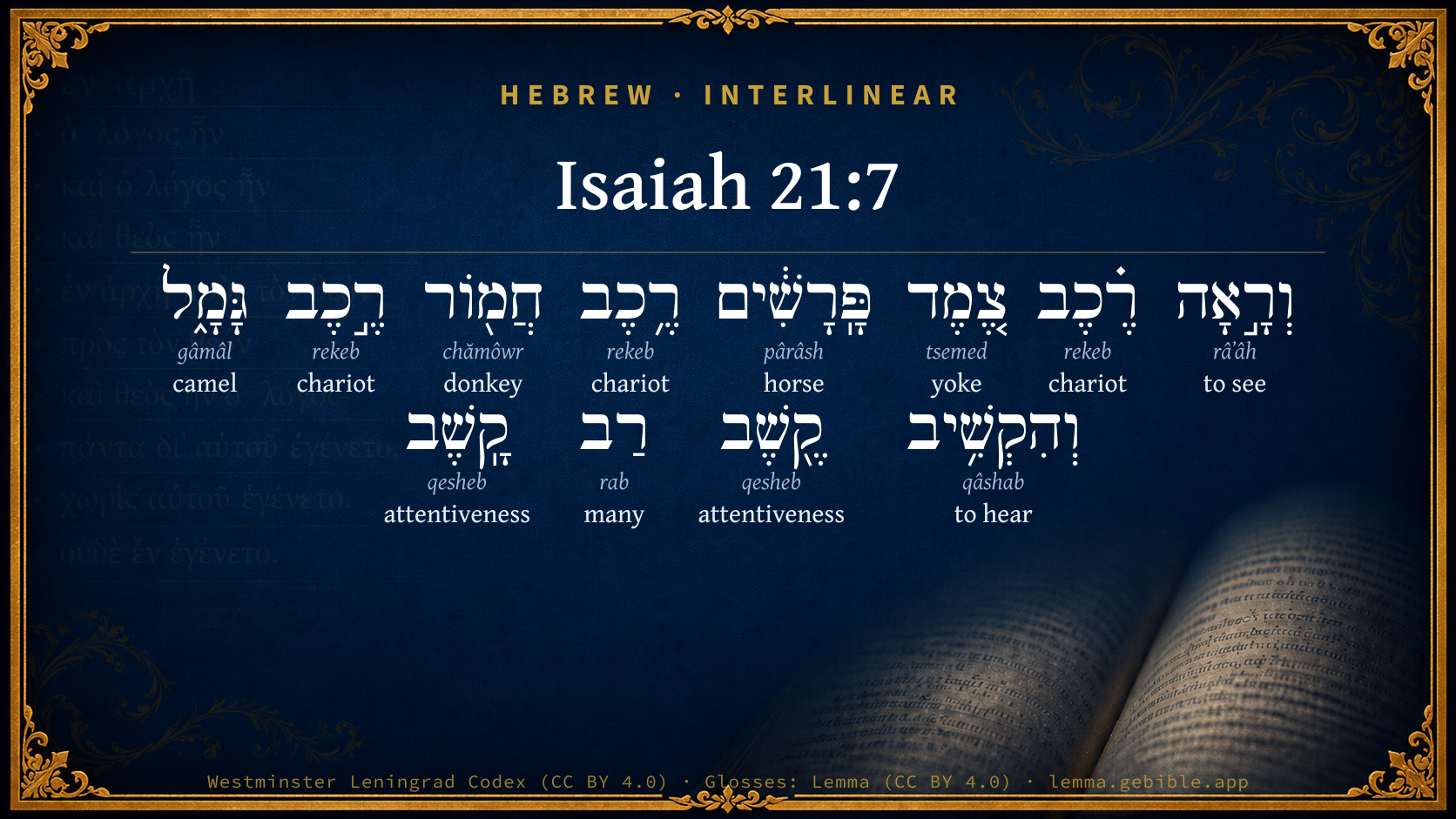
Isaiah 21:7

Hebrew (Westminster Leningrad Codex) Isaiah 21:7 appears in the Hebrew Old Testament. The text above is from the Westminster Leningrad Codex. Each word links to its Strong’s number, a concise gloss, and parsing drawn from the Open Scriptures Hebrew Bible morphology. Click any word for its full Brown-Driver-Briggs (BDB) entry.
Download image
Cite this verse

Isaiah 21:7 (World English Bible). Public Domain. Lemma interlinear Bible study tool, https://lemma.gebible.app/v/isaiah/21/7.

Show BibTeX & RIS
BibTeX
RIS
English Translation
and when he sees a troop, horsemen in pairs, a troop of donkeys, a troop of camels, he shall listen diligently with much heed.
World English Bible · Public Domain
Download a study sheet

One document with this verse’s original text, its word-by-word gloss line, the meaning frame, cross-references with their text, attributed commentary, and full source and license credits — printable, and it pastes into notes with its structure intact.

This verse Autodidact and up

Study sheet (.html) Plain text (.txt)

A passage Seminary Student

Up to 50 verses in one chapter. A passage sheet keeps up to 6 commentary sources and 12 cross-references per verse, in the order this page ranks them, and says so on the sheet whenever that leaves anything out. Ask for a single verse and you get the Autodidact verse sheet above.

Everything on this page stays free to read, with no account — the sheet is a download of what is already on screen, not access to it.

Want to remove ads? Support Godless Engineer
Compare translations 3

The same verse in 3 English versions, stacked beneath the original-language interlinear above. Click any original word for its lexicon entry.

Each is an independent rendering of the whole verse — the interlinear is not word-aligned to these translations.

Highlighted words mark where these versions differ — a whole-verse word diff, not a word-by-word alignment.

  • World English Bible Public Domain
    and when he sees a troop, horsemen in pairs, a troop of donkeys, a troop of camels, he shall listen diligently with much heed.
  • King James Version Public Domain
    And he saw a chariot with a couple of horsemen, a chariot of asses, and a chariot of camels; and he hearkened diligently with much heed:
  • unfoldingWord Literal Text CC BY-SA 4.0
    When he sees a chariot, a pair of horsemen, a rider of a donkey, a rider of a camel, then he shall attend attention, great attention.”

unfoldingWord Literal Text — © unfoldingWord, licensed CC BY-SA 4.0. Word-aligned USFM3 via Door43 (git.door43.org/unfoldingWord/en_ult).

Versions to compare (up to 4)

3 of 4 selected

Show all 18 translations

Every available English version of this verse, each an independent rendering of the whole verse.

  • World English Bible Public Domain
    and when he sees a troop, horsemen in pairs, a troop of donkeys, a troop of camels, he shall listen diligently with much heed.
  • Berean Standard Bible Public Domain
    When he sees chariots with teams of horsemen, riders on donkeys, riders on camels, he must be alert, fully alert.”
  • Majority Standard Bible Public Domain
    When he sees chariots with teams of horsemen, riders on donkeys, riders on camels, he must be alert, fully alert.”
  • King James Version Public Domain
    And he saw a chariot with a couple of horsemen, a chariot of asses, and a chariot of camels; and he hearkened diligently with much heed:
  • American Standard Version (1901) Public Domain
    and when he seeth a troop, horsemen in pairs, a troop of asses, a troop of camels, he shall hearken diligently with much heed.
  • Revised Version (1885) Public Domain
    and when he seeth a troop, horsemen in pairs, a troop of asses, a troop of camels, he shall hearken diligently with much heed.
  • Geneva Bible (1599) Public Domain
    And he sawe a charet with two horsemen: a charet of an asse, and a charet of a camel: and he hearkened and tooke diligent heede.
  • Douay-Rheims (1899) Public Domain
    And he saw a chariot with two horsemen, a rider upon an ass, and a rider upon a camel: and he beheld them diligently with much heed.
  • Young's Literal Translation Public Domain
    And he hath seen a chariot -- a couple of horsemen, The rider of an ass, the rider of a camel, And he hath given attention -- He hath increased attention!
  • Literal Standard Version CC BY-SA 4.0
    And he has seen a chariot—a couple of horsemen, || The rider of a donkey, the rider of a camel, || And he has given attention—He has increased attention!
  • Unlocked Literal Bible CC BY-SA 4.0
    When he sees a chariot, a pair of horsemen, riders on donkeys, and riders on camels, then he must pay attention and be very alert.”
  • unfoldingWord Literal Text CC BY-SA 4.0
    When he sees a chariot, a pair of horsemen, a rider of a donkey, a rider of a camel, then he shall attend attention, great attention.”
  • Darby Bible Public Domain
    And he saw chariots, horsemen by pairs, a chariot with asses, a chariot with camels; and he hearkened diligently with much heed.
  • World Messianic Bible Public Domain
    When he sees a troop, horsemen in pairs, a troop of donkeys, a troop of camels, he shall listen diligently with great attentiveness.”
  • Webster's Bible Public Domain
    And he saw a chariot with a couple of horsemen, a chariot of asses, and a chariot of camels; and he hearkened diligently with much heed:
  • Free Bible Version CC BY-SA 4.0
    When he sees chariots coming pulled by pairs of horses, riders on donkeys and on camels, he should watch very carefully, paying close attention.”
  • Bible in Basic English Public Domain
    And when he sees war-carriages, horsemen by twos, war-carriages with asses, war-carriages with camels, let him give special attention.
  • JPS Tanakh (1917) Public Domain
    And when he seeth a troop, horsemen by pairs, a troop of asses, a troop of camels, he shall hearken diligently with much heed.

Literal Standard Version (2020), Covenant Press — licensed CC BY-SA 4.0. Text via the HelloAO Bible API (eBible.org). Unlocked Literal Bible (unfoldingWord) — licensed CC BY-SA 4.0. Text via the HelloAO Bible API (eBible.org). unfoldingWord Literal Text — © unfoldingWord, licensed CC BY-SA 4.0. Word-aligned USFM3 via Door43 (git.door43.org/unfoldingWord/en_ult). Free Bible Version, Dr. Jonathan Gallagher — licensed CC BY-SA 4.0. Text via the HelloAO Bible API (eBible.org).

Word by word

More ways to search: Search by grammar → Find every occurrence → Compare this word →

Practice this passage: Drill this verse → Learn its vocabulary →

קֶ֖שֶׁב
qesheb
H7182
“attentiveness”
Noun, Common, Masculine, Singular, Absolute
Part of Speech
Noun
Type
Common
Gender
Masculine
Number
Singular
State
Absolute
Full BDB Definition

Origin: from H7181

TWOT: 2084a

attentiveness, attention
  1. וְרָ֣אָה râʼâh H7200 “and · to see” Conjunction + Verb, Qal, Sequential Perfect, 3rd Person, Masculine, Singular
  2. רֶ֗כֶב rekeb H7393 “chariot” Noun, Common, Masculine, Singular, Absolute
  3. צֶ֚מֶד tsemed H6776 “yoke of” Noun, Common, Masculine, Singular, Construct
  4. פָּֽרָשִׁ֔ים pârâsh H6571 “horses” Noun, Common, Masculine, Plural, Absolute
  5. רֶ֥כֶב rekeb H7393 “chariot of” Noun, Common, Masculine, Singular, Construct
  6. חֲמ֖וֹר chămôwr H2543 “donkey” Noun, Common, Both, Singular, Absolute
  7. רֶ֣כֶב rekeb H7393 “chariot of” Noun, Common, Masculine, Singular, Construct
  8. גָּמָ֑ל gâmâl H1581 “camel” Noun, Common, Masculine, Singular, Absolute
  9. וְהִקְשִׁ֥יב qâshab H7181 “and · to hear” Conjunction + Verb, Hiphil, Sequential Perfect, 3rd Person, Masculine, Singular
  10. רַב rab H7227 “many of” Adjective, Adjective, Masculine, Singular, Construct
  11. קָֽשֶׁב qesheb H7182 “attentiveness” Noun, Common, Masculine, Singular, Absolute

About this verse

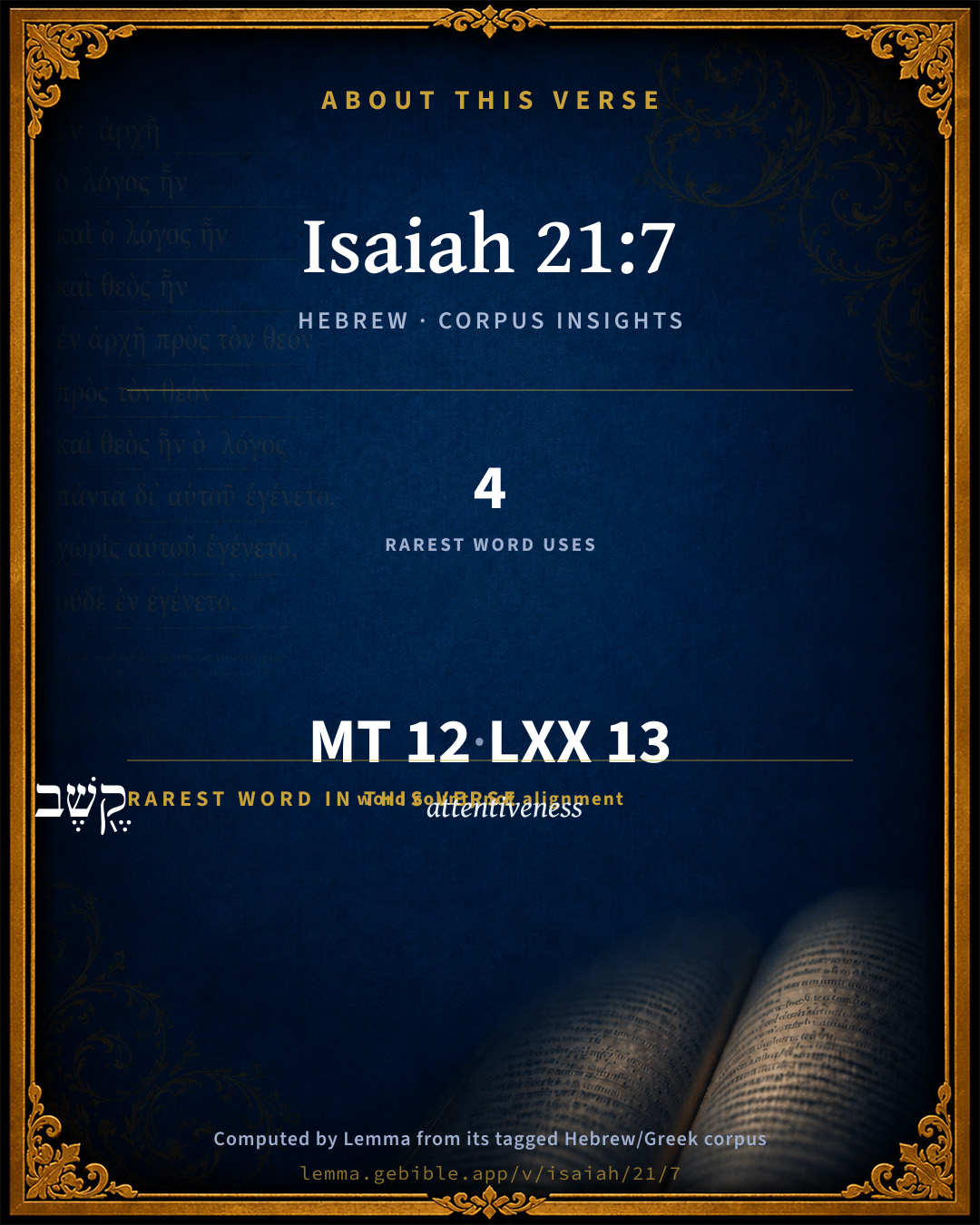
These counts appear in no published source. They are computed here, from the morphology-tagged text and Lemma’s own curated glosses. What Lemma adds →

12
words
9
distinct lemmas
Prophets
section

Notable vocabulary

The rarest word here is קֶ֖שֶׁב attentiveness H7182 — appearing just 4 times in the whole Hebrew Bible.

Shared distinctive vocabulary

קֶ֖שֶׁב attentiveness H7182 occurs in 3 verses of the Hebrew Bible. Also found in:

Grammatical profile

  • 2 verbs
  • 9 nouns
  • 1 adjective

Verb forms

  • וְרָ֣אָה Qal · Sequential Perfect
  • וְהִקְשִׁ֥יב Hiphil · Sequential Perfect

Repetition

Words recur within this verse — often emphatic in Hebrew:

  • רֶ֗כֶב chariot H7393 ×3
  • קֶ֖שֶׁב attentiveness H7182 ×2

Hebrew & Septuagint length

In English translation the verse runs 24 words from the Hebrew and 18 from the Septuagint (LXX English) — closely comparable.

A rough comparison of the two English renderings, which tokenize alike — not a word-level alignment.

Word counts can differ between the Hebrew and the Greek without any difference in meaning — e.g. the Hebrew direct-object marker אֵת has no separate Greek word, and Greek often adds the article ὁ.

In the original languages it is 12 Hebrew tokens and 13 Greek tokens — but the two are counted differently (Hebrew bundles its prefixes and suffixes into one token; the Greek is in lemma form), so that isn’t a like-for-like length.

Cross-references

3

Topical passages linked to Isaiah 21:7 in the Treasury of Scripture Knowledge — connected by theme and wording, ordered by reader-vote popularity; previews shown in the World English Bible.

  • Isaiah 21:9 and, behold, here comes a troop of men, horsemen in pairs. He answered, Fallen, fallen is Babylon; and all the engraved images of her gods are broken to the ground.
  • Isaiah 37:24 By your servants have you defied the Lord, and have said, With the multitude of my chariots am I come up to the height of the mountains, to the innermost parts of Lebanon; and I will cut down the tall cedars of it, and the choice fir trees of it; and I will enter into its farthest height, the forest of its fruitful field;
  • Hebrews 2:1 Therefore we ought to pay greater attention to the things that were heard, lest perhaps we drift away.

Cross-references courtesy of OpenBible.info (CC BY 4.0).

Hebrew and Greek witnesses Masoretic Hebrew ↔ Greek Septuagint

The same verse in the two great witnesses to the Old Testament, shown verse-for-verse.

These are two independent witnesses, not word-aligned to each other, and the Septuagint is shown in lemma (dictionary) form.

Hebrew Isaiah 21:7 Masoretic · Westminster Leningrad Codex

וְרָ֣אָה רֶ֗כֶב צֶ֚מֶד פָּֽרָשִׁ֔ים רֶ֥כֶב חֲמ֖וֹר רֶ֣כֶב גָּמָ֑ל וְהִקְשִׁ֥יב קֶ֖שֶׁב רַב קָֽשֶׁב

and when he sees a troop, horsemen in pairs, a troop of donkeys, a troop of camels, he shall listen diligently with much heed.

World English Bible · Public Domain

Greek LXX Isaiah 21:7 Septuagint · lemma form

καί ὁράω ἀναβάτης ἱππεύς δύο ἀναβάτης ὄνος καί ἀναβάτης κάμηλος ἀκροάομαι ἀκρόασις πολύς

And I saw two mounted horsemen, and a rider on an ass, and a rider on a camel.

LXX2012 (modern English Septuagint) · Public Domain

Hebrew: Westminster Leningrad Codex (CC BY 4.0). Greek: Septuagint (public domain); English from LXX2012 (modern English Septuagint) (Public Domain). How the Septuagint differs from the Hebrew →

Targum (Aramaic paraphrase)

1

The Targum is the ancient Jewish Aramaic paraphrase of the Hebrew Scriptures — an interpretive translation, not the Hebrew text itself. Onkelos (literal) and Pseudo-Jonathan (expansive) render the Torah, and Jonathan the Prophets. Coverage is partial: where no permissively-licensed English translation exists for a verse, only the Aramaic is shown. This is verse-level text, not a word-by-word alignment to the Hebrew.

  1. Targum Jonathan Prophets (Joshua–Malachi)
    וְיֶחֱזֵי רְתַךְ אֱנַשׁ וְעִמֵהּ זוֹג פָּרָשִׁים רָכֵב עַל חֲמַר רָכִב עַל גַמְלָא אֲמַר נְבִיָא אֲצֵיצִית אֲצָתָא וַחֲזֵית וְהָא מַשִׁרְיָן לַחֲדָא:

    And he saw a chariot, a man, and with him a couple of horsemen: a rider on an ass, a rider on a a camel. The prophet said, I listened diligently, and, behold, I saw mighty armies!

    Targum Jonathan — Aramaic: “Mikraot Gedolot” (public domain). English: “Sefaria Community Translation” (CC0 1.0 (public-domain dedication)); “London "Chaldee Paraphrase," 1871” (public domain). Text via Sefaria.

Commentary

Notes on Isaiah 21:7 from classic Christian and Jewish commentators (each source and its license shown beneath its notes). The classic Christian expositions comment on the surrounding passage and are grouped to its opening verse, so a note may address several verses; the Jewish commentaries on the Tanakh (Rashi and others) are per-verse, so they appear only where the commentator wrote on this verse.

Lemma curates 59 commentaries, every one of them public domain or Creative Commons licensed, each selected and text-cleaned for this edition rather than reprinted as found. About our sources →

Jamieson, Fausset & Brown

Robert Jamieson, A. R. Fausset & David Brown

chariot, &c.--rather, "a body of riders," namely, some riding in pairs on horses (literally, "pairs of horsemen," that is, two abreast), others on asses, others on camels (compare Isa 21:9; Isa 22:6). "Chariot" is not appropriate to be joined, as English Version translates, with "asses"; the Hebrew means plainly in Isa 21:7, as in Isa 21:9, "a body of men riding." The Persians used asses and camels for war [MAURER]. HORSLEY translates, "One drawn in a car, with a pair of riders, drawn by an ass, drawn by a camel"; Cyrus is the man; the car drawn by a camel and ass yoked together and driven by two postilions, one on each, is the joint army of Medes and Persians under their respective leaders. He thinks the more ancient military cars were driven by men riding on the beasts that drew them; Isa 21:9 favors this.

Jamieson, Fausset & Brown — Commentary Critical and Explanatory on the Whole Bible (1871) — public domain (CC PDM 1.0). Text via the HelloAO Bible API.

Trapp's Complete Commentary

John Trapp

Isa 21:7 And he saw a chariot [with] a couple of horsemen, a chariot of asses, [and] a chariot of camels; and he hearkened diligently with much heed:

Ver. 7. And he saw,] scil., In a vision.

A chariot with a couple of horsemen.] Darius and Cyrus.

A chariot of asses and a chariot of camels.] Beasts of both sorts - both for burden and service - great store of them.

And he hearkened diligently, with much heed.] Attendit attente, attentissime, the watchman did who was set to watch in the vision.

John Trapp, A Commentary or Exposition upon All the Books of the Old and New Testament (1647–1656) — public domain. Text from a community e-Sword module.

Joseph Benson's Commentary

Isa 21:7. And he saw a chariot with two riders, &c. — “This passage,” says Bishop Lowth, “is extremely obscure from the ambiguity of the term רכב,” (here rendered chariot,) “which is used three times; and which signifies a chariot, or any other vehicle, or the rider in it; or a rider on a horse, or any other animal; or a company of chariots or riders. The prophet may possibly mean a cavalry in two parts, with two sorts of riders; riders on asses, or mules, and riders on camels: or led on by two riders, one on an ass, and one on a camel.” Or, as some think, the verse may be rendered, He saw a cavalcade, two file of horse, (צמד פרשׁים,) with ass-carriages, and carriages of camels; and he attended with very close attention. According to this translation, the meaning is, that the watchman saw the army of the Medes and Persians, with their usual cavalcade of horse, (attended by those beasts of burden, asses and camels, which accompanied armies,) moving toward Babylon; upon which he gave the greatest attention possible. Or, according to the common reading, Darius and Cyrus, leading the Medes and Persians, are intended to be distinguished by the two riders, or the two sorts of cattle. The baggage of Cyrus’s army, Herodotus tells us, was carried on camels.

Joseph Benson's Commentary on the Old and New Testaments (1811–1818) — public domain. Text from a community e-Sword module.

Tyndale Open Study Notes

Tyndale Open Resources

21:7 The riders were messengers who reported what had taken place on the battlefield.

Tyndale Open Study Notes — © Tyndale Open Resources, licensed CC BY-SA 4.0. Text via the HelloAO Bible API.

Geneva Bible (1599)

Geneva Bible translators

Meaning, chariots of men of war, and others that carried the baggage.

Geneva Bible (1599) marginal notes — public domain. Text via Bolls.life.

Adam Clarke's Commentary

Verse 7. And he saw a chariot, c. - "And he saw a chariot with two riders a rider on an ass, a rider on a camel"] This passage is extremely obscure from the ambiguity of the term רכב recheb, which is used three times, and which signifies a chariot, or any other vehicle, or the rider in it; or a rider on a horse, or any other animal; or a company of chariots, or riders. The prophet may possibly mean a cavalry in two parts, with two sorts of riders; riders on asses or mules, and riders on camels; or led on by two riders, one on an ass, and one on a camel. However, so far it is pretty clear, that Darius and Cyrus, the Medes and the Persians, are intended to be distinguished by the two riders on the two sorts of cattle. It appears from Herodotus, i. 80, that the baggage of Cyrus' army was carried on camels. In his engagement with Croesus, he took off the baggage from the camels, and mounted his horsemen upon them; the enemy's horses, offended with the smell of the camels, turned back and fled. - L.

Adam Clarke's Commentary on the Bible (1810–1826) — public domain. Text from a community e-Sword/MySword module.

Ellicott's Commentary for English Readers

(7) A chariot with a couple of horsemen.—Better, a troop, a couple. Both asses and camels were employed in the Persian army (Herod., i. 80, iv. 129). They probably indicate, the former an Arab, the latter a Carmanian contingent. Both are named (11,173 asses, 5,230 camels) among the spoil taken by Sennacherib on the defeat of Merôdach-baladan (Bellino Tablet in Records of the Past, i. 26).

He hearkened diligently with much heed.—Literally, he listened sharply, listened sharply, with the iteration of intensity. What had met the watchman’s eye in his vision had passed by in silence, and had left him in doubt as to its meaning. Was it the symbol of a Babylonian army marching out against rebels, or of a rebel army on the way to attack Babylon? He listened, but no voice came out of the darkness to interpret the vision for him.

A Bible Commentary for English Readers, edited by Charles John Ellicott (1878–1897) — public domain. Text from a community e-Sword module.

The Cambridge Bible for Schools and Colleges

gen. ed. J. J. S. Perowne

7. The verse reads: And if he see a troop, horsemen in pairs (1Ki_9:25), a troop of asses, a troop of camels, then let him hearken, hearken hard. This apparently is the expected sign that great events are on foot; when the riders are seen the watchman is to listen intently to discover who they are and what they are doing. The word for “troop” means always “chariot” (usually collective); here it must be used in the sense of “riding train” like the Arab. rakb. The procession represents the Persian army. “Asses” and “camels” are probably introduced as beasts of burden, although both animals are reported to have been used by the Persians in actual battle.

The Cambridge Bible for Schools and Colleges (gen. ed. J. J. S. Perowne; Cambridge University Press, 1878–1918) — public domain. Text from a community e-Sword module.

John Gill's Exposition

And he saw a chariot with a couple of horsemen,.... The drivers of it, or the riders in it; perhaps meaning Cyrus and Darius:

a chariot of asses, and a chariot of camels; by the former may be meant the Persians, who very much used mules or asses; and the Medes by the latter, who abounded in camels: the words are in the singular number, and may be rendered, "a rider of an ass, and a rider of a camel" (w); and so may describe the couple of riders along with the chariot, which may signify the whole army of the Medes and Persians, chariots being much used in war; and the rider of the ass or mule may design Cyrus, who was called a mule, because of his mixed descent, being a Persian by his father, and a Mede by his mother's side; so the oracle of Apollo told the Babylonians, that their city should stand, until a mule was king of the Medes; and the rider of the camel may point at Darius:

and he hearkened diligently with much heed; the watchman that was set to watch used the utmost attention to what he saw, and listened diligently to the noise of this chariot and horsemen, as they came nearer.

(w) , , Sept.; "ascensorem asini, et ascensorem cameli", V. L. "unum equitantium in asinis, alterum equitantium in camelis", Piscator.

John Gill's Exposition of the Whole Bible (1746–1763) — public domain (CC PDM 1.0). Text via the HelloAO Bible API.

Albert Barnes' Notes on the Bible

And he saw a chariot with a couple of horsemen - This passage is very obscure from the ambiguity of the word רכב rekeb - ‘chariot.’ Gesenius contends that it should be rendered ‘cavalry,’ and that it refers to cavalry two abreast hastening to the destruction of the city. The word רכב rekeb denotes properly a chariot or wagon Jdg 5:28; a collection of wagons 2Ch 1:14; 2Ch 8:6; 2Ch 9:25; and sometimes refers to the “horses or men” attached to a chariot. ‘David houghed all the chariots’ 2Sa 8:4; that is, all the “horses” belonging to them. ‘David killed of the Syrians seven hundred chariots’ 2Sa 10:18; that is, all “the men” belonging to seven hundred chariots. According to the present Masoretic pointing, the word רכב rekeb does not mean, perhaps, anything else than a chariot strictly, but other forms of the word with the same letters denote “riders or cavalry.” Thus, the word רכב rakâb denotes a horseman 2Ki 9:17; a charioteer or driver of a chariot 1Ki 22:34; Jer 51:21. The verb רבב râbab means “to ride,” and is usually applied to riding on the backs of horses or camels; and the sense here is, that the watchman saw “a riding,” or persons riding two abreast; that is, “cavalry,” or men borne on horses, and camels, and asses, and hastening to attack the city.

With a couple of horsemen - The word ‘couple’ (צמד tsemed) means properly a “yoke or pair;” and it means here that the cavalry was seen “in pairs, that is,” two abreast.

A chariot of asses - Or rather, as above, “a riding” on donkeys - an approach of men in this manner to battle. Asses were formerly used in war where horses could not be procured. Thus Strabo (xv. 2, 14) says of the inhabitants of Caramania, ‘Many use donkeys for war in the want of horses.’ And Herodotus (iv. 129) says expressly that Darius Hystaspes employed donkeys in a battle with the Scythians.

And a chariot of camels - A “riding” on camels. Camels also were used in war, perhaps usually to carry the baggage (see Diod. ii. 54; iii. 44; Livy, xxxvii. 40; Strabo, xvi. 3). They are used for all purposes of burden in the East, and particularly in Arabia.

Albert Barnes' Notes on the Bible (1834–1885) — public domain. Text from a community e-Sword/MySword module.

Haydock's Catholic Bible Commentary

Camel. These two riders are the kings of the Persians and Medes. (Challoner) --- The sentinel, placed by Isaias, in spirit, or rather by the king of Babylon, brings these tidings. (Calmet)

George Leo Haydock (1774–1849), Haydock's Catholic Family Bible and Commentary, 1859 edition — public domain. Excludes Psalms (Douay-Rheims chapter numbering differs from Protestant) and Deuterocanonical books (Catholic canon only).

Matthew Poole's English Annotations

And he saw; a short speech for he told me that he saw.

A chariot, not for burden, but for war, in which chariots were then much used. With a couple of horsemen; attended with two horsemen. So there were both chariots and troops of horsemen. Or,

with a couple of horses, as this word is sometimes used, as 1Sa 8:11; 2Sa 1:6. The chariot was drawn with two horses.

A chariot of asses, and a chariot of camels; two chariots, one drawn by asses, (under which title some understand mules, as being engendered of asses,) and the other by camels; whereby he signifies the variety and abundance of warlike provisions which the Medes and Persians should have for this expedition, and particularly of chariots, whereof some were for the carriage of necessary things, and others for the battle.

He hearkened diligently; he carefully observed what he saw, and what he could further discover.

Matthew Poole's English Annotations on the Holy Bible (1683–1685) — public domain. Text from a community e-Sword/MySword module.

Whedon's Commentary on the Bible

Daniel D. Whedon

7. Chariot… horsemen… asses… camels — The first report is, the approach of a long procession, headed by horsemen, seen in perspective as two, a column of two, or two abreast, then successions of chariots drawn by asses and camels, which animals were used in ancient campaigns for different purposes, as both Herodotus and Xenophon testify of the Persians. (Xenophon, Cyrop., Isa_4:3.) They not only carried baggage and provisions, but were taken into battle to throw the enemy into confusion by fright, etc. The watchman not only saw, but he listened — listened with intense listening; yet he heard nothing, so still was the approach.

Daniel D. Whedon (gen. ed.), Commentary on the Old and New Testaments (1874–1909) — public domain. Text from a community e-Sword module.

The Pulpit Commentary

And he saw... he hearkened; rather, he shall see... he shall hearken (Kay). He is to wait and watch until he sees a certain sight; then he is to listen attentively, and he will hear the crash of the falling city. A chariot with a couple of horsemen; rather, a troop of horsemen riding two and two. This is exactly how a cavalry force was ordinarily represented by the Assyrians. Chariots are not intended either here or in ver. 9. They were not employed by the Persians until a late period of their history (see "Ancient Monarchies," vol. 4. pp. 113, 122). A chariot of asses, and a chariot of camels; rather, men mounted on asses and on camels. It is well known that both animals were employed by the Persians in their expeditions to carry the baggage (Herod., 1:80; 4:129; Xen., "Cyrop.," 7:1, etc.). But neither animal was ever attached to a chariot.

The Pulpit Commentary (1880–1919), ed. H.D.M. Spence-Jones & Joseph S. Exell — public domain. Text from a community e-Sword module.

John Wesley's Explanatory Notes

A chariot - Hereby he signifies the variety and abundance of warlike provisions which the Medes and Persians should have for their expedition, and particularly of chariots, whereof some were for the carriage of necessary things, and others for the battle.

John Wesley, Explanatory Notes Upon the Whole Bible (1754–1765) — public domain. Text via the GEBible commentary corpus.

Keil & Delitzsch

C. F. Keil & F. Delitzsch

What the man upon the watch-tower sees first of all, is a long, long procession, viz., the hostile army advancing quietly, like a caravan, in serried ranks, and with the most perfect self-reliance. "And he saw a procession of cavalry, pairs of horsemen, a procession of asses, a procession of camels; and listened sharply, as sharply as he could listen." Receb, both here and in Isa 21:9, signifies neither riding-animals nor war-chariots, but a troop seated upon animals - a procession of riders. In front there was a procession of riders arranged two and two, for Persians and Medes fought either on foot or on horseback (the latter, at any rate, from the time of Cyrus; vid., Cyrop. iv 3); and pârâsh signifies a rider on horseback (in Arabic it is used in distinction from râkib, the rider on camels). Then came lines of asses and camels, a large number of which were always taken with the Persian army for different purposes. They not only carried baggage and provisions, but were taken into battle to throw the enemy into confusion. Thus Cyrus gained the victory over the Lydians by means of the great number of his camels (Herod. i. 80), and Darius Hystaspis the victory over the Scythians by means of the number of asses that he employed (Herod. iv 129). Some of the subject tribes rode upon asses and camels instead of horses: the Arabs rode upon camels in the army of Xerxes, and the Caramanians rode upon asses. What the spy saw was therefore, no doubt, the Persian army. But he only saw and listened. It was indeed "listening, greatness of listening," i.e., he stretched his ear to the utmost (rab is a substantive, as in Isa 63:7; Psa 145:7; and hikshib, according to its radical notion, signifies to stiffen, viz., the ear);

(Note: Bttcher has very correctly compared kâshab (kasuba) with kâshâh (kasa), and Fleischer with sarra (tzâr), which is applied in the kal and hiphil (asarra) to any animal (horse, ass, etc.) when it holds its ears straight and erect to listen to any noise (sarra udhneı̄h, or udhnahu bi-udhneı̄h, or bi-udhnı̄h iv., asarra bi-udhnı̄h, and also absolutely asarra, exactly like hikshib).)

but he heard nothing, because the long procession was moving with the stillness of death.

Keil & Delitzsch — Biblical Commentary on the Old Testament (1861–1891) — public domain (CC PDM 1.0). Text via the HelloAO Bible API. (Old Testament only.)

J. A. Alexander on Isaiah

Joseph Addison Alexander

“And should he see cavalry — a pair (or pairs of horsemen) ass-riders — camel-riders — then shall he hearken with hearkening a great hearkening (i.e., listen attentively).” This construction of the sentence supposes the divine instructions to be still continued. This verse contains the order and the ninth its execution, while the eighth, as a preface to the latter, is exactly in is proper place. It is a slight but obvious coincidence of prophecy and history that Xenophon represents the Persians advancing two by two.

Joseph Addison Alexander, The Prophecies of Isaiah (1846–1847; New York: Scribner, 1870–1878) — public domain. Text from a community e-Sword module.

Rashi

Rabbi Shlomo Yitzchaki (Rashi)

And he shall see a chariot and I will show him there a sort of chariot with a pair of riders, one riding a donkey and one riding a camel, and that is a sign of Persia and Media.

and he shall listen attentively And there he shall hear in his prophecy a representation of the mighty rumbling and stirring of armies.

Rashi on the Tanakh — English translations: “The Judaica Press complete Tanach with Rashi, translated by A. J. Rosenberg” (CC BY 4.0); “Pentateuch with Rashi's commentary by M. Rosenbaum and A.M. Silbermann, 1929-1934” (public domain); “The Metsudah Tanach series, Lakewood, N.J” (CC BY 4.0); and “The Book of Joshua, Metsudah Publications, 1997” (CC BY 4.0). Text via Sefaria.

Ibn Ezra

Rabbi Abraham ibn Ezra

וראה וגו׳ When he sees ordinate, but the former is subordinate, and the latter is the principal sentence. a chariot with a couple of horsemen, a chariot of asses, or a chariot of camels, he will hearken diligently to learn what news they have to tell.

Ibn Ezra on the Tanakh — English translations: “Sefaria Community Translation” (CC0 1.0 (public-domain dedication)); “Yalkut, Sifsei Chachomim Chumash, Metsudah Publications, 2009” (CC BY 4.0); and “Commentary of Ibn Ezra on Isaiah - trans. by M. Friedlander, 1873” (public domain). Text via Sefaria.

Lesson kit

Teaching starters — assembled from the data on this page, not authored interpretation. Every prompt links to the verse data it draws on. Edit before teaching.

Isaiah, in the Prophets, opens this verse with 12 words (9 distinct Hebrew lemmas). Its most distinctive word is qesheb (“attentiveness”). A historical commentator’s framing appears above. Read the whole chapter for the surrounding context.

Discussion questions

  1. How does “attentiveness” (qesheb) shape what this verse is saying?
  2. How does 1 Kings 18:29, which shares the word «attentiveness», read alongside this verse?
  3. What does the repetition of “chariot” (3× in this one verse) do in this verse?
  4. These translations render this verse differently. What is at stake in choosing one wording over another?
  5. «וְרָ֣אָה» is a Qal Sequential Perfect verb. How does that grammatical form shape the action described?
  6. Compare how Jamieson, Fausset & Brown and Trapp's Complete Commentary read this verse. Where do they agree or differ?

Things to notice

Reading settings

Reading text

Shown beneath each verse's original-language words.

Old Testament
Old Testament edition

Read the OT as the Masoretic Hebrew (MT) or the Greek Septuagint (LXX).

English shown for the Greek Septuagint (in the Hebrew ↔ Greek comparison).

Comparing translations? Open the Compare panel on any verse page to stack up to four side by side.