
Deuteronomy 32:19

Hebrew (Westminster Leningrad Codex) Deuteronomy 32:19 appears in the Hebrew Old Testament. The text above is from the Westminster Leningrad Codex. Each word links to its Strong’s number, a concise gloss, and parsing drawn from the Open Scriptures Hebrew Bible morphology. Click any word for its full Brown-Driver-Briggs (BDB) entry.
Download image
Cite this verse

Deuteronomy 32:19 (World English Bible). Public Domain. Lemma interlinear Bible study tool, https://lemma.gebible.app/v/deuteronomy/32/19.

Show BibTeX & RIS
BibTeX
RIS
English Translation
Yahweh saw [it], and abhorred [them], Because of the provocation of his sons and his daughters.
World English Bible · Public Domain
Highlights
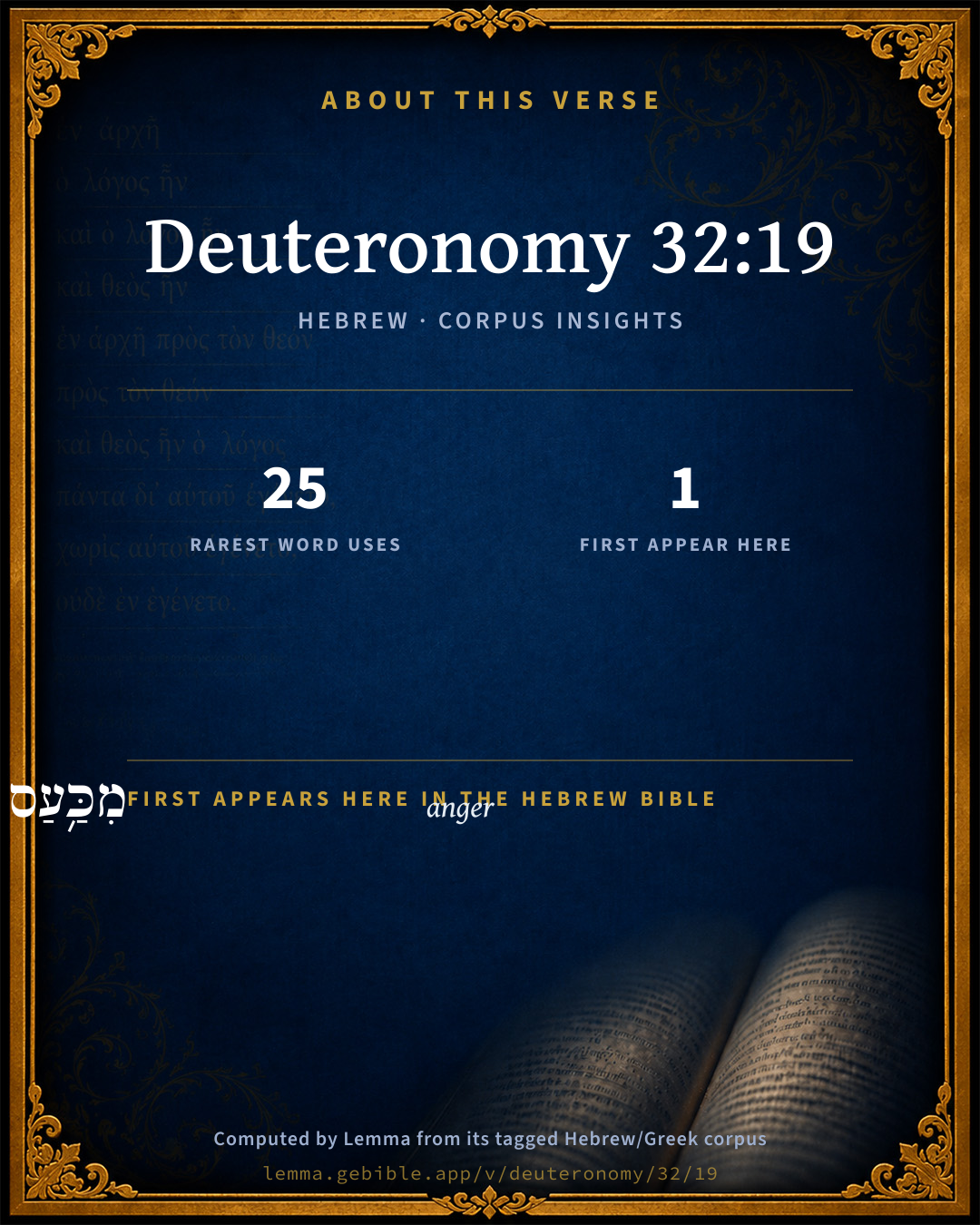
  • 1 first appearance in the Hebrew Bible
Full analysis ↓
Download a study sheet

One document with this verse’s original text, its word-by-word gloss line, the meaning frame, cross-references with their text, attributed commentary, and full source and license credits — printable, and it pastes into notes with its structure intact.

This verse Autodidact and up

Study sheet (.html) Plain text (.txt)

A passage Seminary Student

Up to 50 verses in one chapter. A passage sheet keeps up to 6 commentary sources and 12 cross-references per verse, in the order this page ranks them, and says so on the sheet whenever that leaves anything out. Ask for a single verse and you get the Autodidact verse sheet above.

Everything on this page stays free to read, with no account — the sheet is a download of what is already on screen, not access to it.

Want to remove ads? Support Godless Engineer
Compare translations 3

The same verse in 3 English versions, stacked beneath the original-language interlinear above. Click any original word for its lexicon entry.

Each is an independent rendering of the whole verse — the interlinear is not word-aligned to these translations.

Highlighted words mark where these versions differ — a whole-verse word diff, not a word-by-word alignment.

  • World English Bible Public Domain
    Yahweh saw [it], and abhorred [them], Because of the provocation of his sons and his daughters.
  • King James Version Public Domain
    And when the LORD saw it, he abhorred them, because of the provoking of his sons, and of his daughters.
  • unfoldingWord Literal Text CC BY-SA 4.0
    And Yahweh saw, and he spurned, from the provocation of his sons and his daughters.

unfoldingWord Literal Text — © unfoldingWord, licensed CC BY-SA 4.0. Word-aligned USFM3 via Door43 (git.door43.org/unfoldingWord/en_ult).

Versions to compare (up to 4)

3 of 4 selected

Show all 18 translations

Every available English version of this verse, each an independent rendering of the whole verse.

  • World English Bible Public Domain
    Yahweh saw [it], and abhorred [them], Because of the provocation of his sons and his daughters.
  • Berean Standard Bible Public Domain
    When the LORD saw this, He rejected them, provoked to anger by His sons and daughters.
  • Majority Standard Bible Public Domain
    When the LORD saw this, He rejected them, provoked to anger by His sons and daughters.
  • King James Version Public Domain
    And when the LORD saw it, he abhorred them, because of the provoking of his sons, and of his daughters.
  • American Standard Version (1901) Public Domain
    And Jehovah saw `it', and abhorred `them', Because of the provocation of his sons and his daughters.
  • Revised Version (1885) Public Domain
    And the LORD saw it, and abhorred them, Because of the provocation of his sons and his daughters.
  • Geneva Bible (1599) Public Domain
    The Lord then sawe it, and was angrie, for the prouocation of his sonnes and of his daughters.
  • Douay-Rheims (1899) Public Domain
    The Lord saw, and was moved to wrath: because his own sons and daughters provoked him.
  • Young's Literal Translation Public Domain
    And Jehovah seeth and despiseth -- For the provocation of His sons and His daughters.
  • Literal Standard Version CC BY-SA 4.0
    And YHWH sees and despises—For the provocation of His sons and His daughters.
  • Unlocked Literal Bible CC BY-SA 4.0
    Yahweh saw this and he rejected them, because his sons and his daughters provoked him so.
  • unfoldingWord Literal Text CC BY-SA 4.0
    And Yahweh saw, and he spurned, from the provocation of his sons and his daughters.
  • Darby Bible Public Domain
    And Jehovah saw it, and despised them, Because of the provoking of his sons and of his daughters.
  • World Messianic Bible Public Domain
    The LORD saw and abhorred, because of the provocation of his sons and his daughters.
  • Webster's Bible Public Domain
    And when the LORD saw it, he abhorred them, because of the provoking of his sons, and of his daughters.
  • Free Bible Version CC BY-SA 4.0
    The Lord rejected them when he saw this; his sons and daughters made him angry.
  • Bible in Basic English Public Domain
    And the Lord saw with disgust the evil-doing of his sons and daughters.
  • JPS Tanakh (1917) Public Domain
    And the LORD saw, and spurned, because of the provoking of His sons and His daughters.

Literal Standard Version (2020), Covenant Press — licensed CC BY-SA 4.0. Text via the HelloAO Bible API (eBible.org). Unlocked Literal Bible (unfoldingWord) — licensed CC BY-SA 4.0. Text via the HelloAO Bible API (eBible.org). unfoldingWord Literal Text — © unfoldingWord, licensed CC BY-SA 4.0. Word-aligned USFM3 via Door43 (git.door43.org/unfoldingWord/en_ult). Free Bible Version, Dr. Jonathan Gallagher — licensed CC BY-SA 4.0. Text via the HelloAO Bible API (eBible.org).

Word by word

More ways to search: Search by grammar → Find every occurrence → Compare this word →

Practice this passage: Drill this verse → Learn its vocabulary →

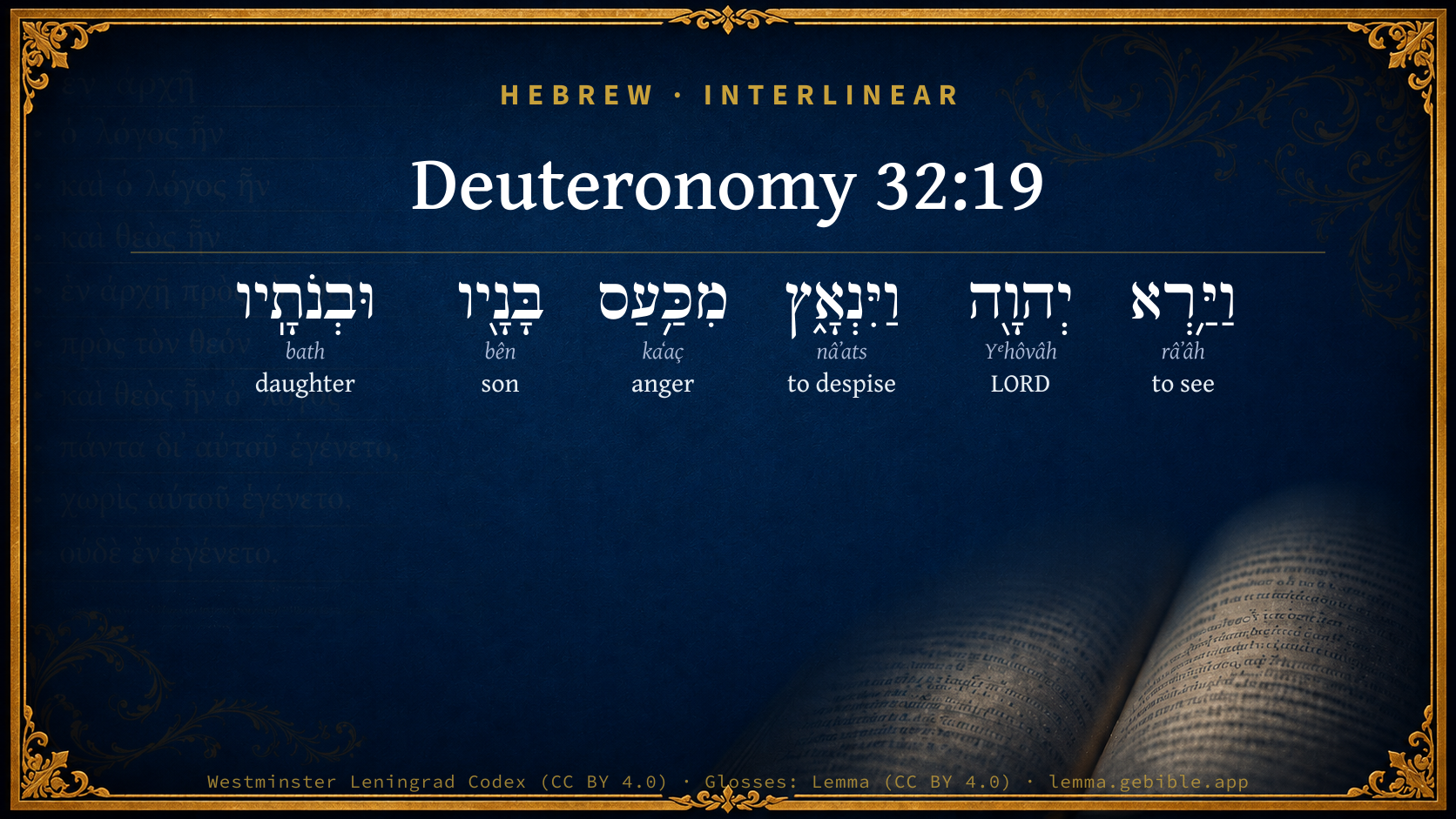
וַיִּנְאָ֑ץ
nâʼats
H5006
“and · to despise”
Conjunction + Verb, Qal, Sequential Imperfect, 3rd Person, Masculine, Singular
Part of Speech
Conjunction + Verb
Stem
Qal
Form
Sequential Imperfect
Person
3rd Person
Gender
Masculine
Number
Singular
Full BDB Definition

Origin: a primitive root

TWOT: 1274

to spurn, contemn, despise, abhor - (Qal) to spurn, contemn - (Piel) - to spurn - to cause to contemn - (Hiphil) to spurn - (Hithpolel) to be contemned
  1. וַיַּ֥רְא râʼâh H7200 “and · to see” Conjunction + Verb, Qal, Sequential Imperfect, 3rd Person, Masculine, Singular
  2. יְהוָ֖ה Yᵉhôvâh H3068 “LORD” Noun, Proper
  3. מִכַּ֥עַס kaʻaç H3708 “from · anger of” Preposition + Noun, Common, Masculine, Singular, Construct
  4. בָּנָ֖יו bên H1121 “sons · his” Noun, Common, Masculine, Plural, Construct + Suffix, Personal, 3rd Person, Masculine, Singular
  5. וּבְנֹתָֽיו bath H1323 “and · daughters · his” Conjunction + Noun, Common, Feminine, Plural, Construct + Suffix, Personal, 3rd Person, Masculine, Singular

About this verse

These counts appear in no published source. They are computed here, from the morphology-tagged text and Lemma’s own curated glosses. What Lemma adds →

6
words
6
distinct lemmas
Pentateuch
section

Notable vocabulary

The rarest word here is וַיִּנְאָ֑ץ to despise H5006 — appearing just 25 times in the whole Hebrew Bible.

First appearance in Scripture

This word makes its first canonical appearance in the Hebrew Bible here:

  • מִכַּ֥עַס anger H3708

Shared distinctive vocabulary

וַיִּנְאָ֑ץ to despise H5006 occurs in 24 verses of the Hebrew Bible. Also found in:

Grammatical profile

  • 2 verbs
  • 4 nouns

Verb forms

  • וַיַּ֥רְא Qal · Sequential Imperfect
  • וַיִּנְאָ֑ץ Qal · Sequential Imperfect

Hebrew & Septuagint length

In English translation the verse runs 16 words from the Hebrew and 18 from the Septuagint (LXX English) — closely comparable.

A rough comparison of the two English renderings, which tokenize alike — not a word-level alignment.

Word counts can differ between the Hebrew and the Greek without any difference in meaning — e.g. the Hebrew direct-object marker אֵת has no separate Greek word, and Greek often adds the article ὁ.

Cross-references

14

Topical passages linked to Deuteronomy 32:19 in the Treasury of Scripture Knowledge — connected by theme and wording, ordered by reader-vote popularity; previews shown in the World English Bible.

  • Psalms 106:40 Therefore Yahweh burned with anger against his people. He abhorred his inheritance.
  • Judges 2:14 The anger of Yahweh was kindled against Israel, and he delivered them into the hands of spoilers who despoiled them; and he sold them into the hands of their enemies round about, so that they could not any longer stand before their enemies.
  • Psalms 5:4 For you are not a God who has pleasure in wickedness. Evil can't live with you.
  • Isaiah 1:2 Hear, heavens, And listen, earth; for Yahweh has spoken: I have nourished and brought up children, And they have rebelled against me.
  • Leviticus 26:11 I will set my tent among you: and my soul won't abhor you.
  • Psalms 10:3 For the wicked boasts of his heart's cravings, He blesses the greedy, and condemns Yahweh.
  • Psalms 78:59 When God heard this, he was angry, And greatly abhorred Israel;
  • Psalms 82:6–7 I said, "You are gods, All of you are sons of the Most High.
  • Jeremiah 11:15 What has my beloved to do in my house, seeing she has worked lewdness [with] many, and the holy flesh is passed from you? when you do evil, then you rejoice.
  • Jeremiah 44:21–23 The incense that you burned in the cities of Judah, and in the streets of Jerusalem, you and your fathers, your kings and your princes, and the people of the land, didn't Yahweh remember them, and didn't it come into his mind?
  • Lamentations 2:6 He has violently taken away his tent, as if it were of a garden; he has destroyed his place of assembly: Yahweh has caused solemn assembly and Sabbath to be forgotten in Zion, Has despised in the indignation of his anger the king and the priest.
  • Amos 3:2–3 "You only have I chosen of all the families of the earth. Therefore I will punish you for all of your sins."
  • Zechariah 11:8 I cut off the three shepherds in one month; for my soul was weary of them, and their soul also loathed me.
  • Revelation 3:16 So, because you are lukewarm, and neither hot nor cold, I will vomit you out of my mouth.

Cross-references courtesy of OpenBible.info (CC BY 4.0).

Hebrew and Greek witnesses Masoretic Hebrew ↔ Greek Septuagint

The same verse in the two great witnesses to the Old Testament, shown verse-for-verse.

These are two independent witnesses, not word-aligned to each other, and the Septuagint is shown in lemma (dictionary) form.

Hebrew Deuteronomy 32:19 Masoretic · Westminster Leningrad Codex

וַיַּ֥רְא יְהוָ֖ה וַיִּנְאָ֑ץ מִכַּ֥עַס בָּנָ֖יו וּבְנֹתָֽיו

Yahweh saw [it], and abhorred [them], Because of the provocation of his sons and his daughters.

World English Bible · Public Domain

Greek LXX Deuteronomy 32:19 Septuagint · lemma form

καί ὁράω κύριος καί ζηλόω καί παραὀξύνω διά ὀργή υἱός αὐτός καί θυγάτηρ

And the Lord saw, and was jealous; and was provoked by the anger of his sons and daughters,

LXX2012 (modern English Septuagint) · Public Domain

On this verse, The Pulpit Commentary discusses the Septuagint’s reading. Read the note in Commentary ↓

Hebrew: Westminster Leningrad Codex (CC BY 4.0). Greek: Septuagint (public domain); English from LXX2012 (modern English Septuagint) (Public Domain). How the Septuagint differs from the Hebrew →

Targum (Aramaic paraphrase)

2

The Targum is the ancient Jewish Aramaic paraphrase of the Hebrew Scriptures — an interpretive translation, not the Hebrew text itself. Onkelos (literal) and Pseudo-Jonathan (expansive) render the Torah, and Jonathan the Prophets. Coverage is partial: where no permissively-licensed English translation exists for a verse, only the Aramaic is shown. This is verse-level text, not a word-by-word alignment to the Hebrew.

  1. Targum Onkelos Torah (Genesis–Deuteronomy)
    וּגְלֵי קֳדָם יְיָ וּתְקֵף רָגְזֵהּ מִדְאַרְגִיזוּ קֳדָמוֹהִי בְּנִין וּבְנָן

    (no public-domain English translation for this verse)

    Targum Onkelos — Aramaic: “Onkelos Genesis” (public domain); “Onkelos Exodus” (public domain); “Onkelos Leviticus” (public domain); “Onkelos Numbers” (public domain); “Onkelos Deuteronomy” (public domain). English: “Sefaria Community Translation” (CC0 1.0 (public-domain dedication)); “J.W. Etheridge. The Targums of Onkelos and Jonathan Ben Uzziel on the Pentateuch. London: Longmans, Green, 1862” (public domain). Text via Sefaria.

  2. Targum Pseudo-Jonathan Torah (Genesis–Deuteronomy)
    וּגְלֵי קֳדָם יְיָ וַהֲוָה רְגַז מִן קֳדָמוֹי מִן דְאַרְגִיזוּ קֳדָמוֹי בְּנַיָא חֲבִיבַיָא דְאִתְקְרוּן עַל שְׁמֵיהּ בְּנִין וּבְנָן

    And when it was manifest before the Lord, He was wroth, provoked thereto by His beloved children who were called upon His Name son and daughters.

    Targum Pseudo-Jonathan — Aramaic: “Targum Jonathan on Genesis” (public domain); “Targum Jonathan on Exodus” (public domain); “Targum Jonathan on Leviticus” (public domain); “Targum Jonathan on Numbers” (public domain); “Targum Jonathan on Deuteronomy” (public domain). English: “The Targum of Jonathan ben Uzziel, trans. J. W. Etheridge, London, 1862” (public domain). Text via Sefaria.

Commentary

Notes on Deuteronomy 32:19 from classic Christian and Jewish commentators (each source and its license shown beneath its notes). The classic Christian expositions comment on the surrounding passage and are grouped to its opening verse, so a note may address several verses; the Jewish commentaries on the Tanakh (Rashi and others) are per-verse, so they appear only where the commentator wrote on this verse.

Lemma curates 59 commentaries, every one of them public domain or Creative Commons licensed, each selected and text-cleaned for this edition rather than reprinted as found. About our sources →

Matthew Henry's Commentary

The method of this song follows the method of the predictions in the foregoing chapter, and therefore, after the revolt of Israel from God, described in the foregoing verses, here follow immediately the resolves of divine Justice concerning them; we deceive ourselves if we think that God will be thus mocked by a foolish faithless people, that play fast and loose with him.

I. He had delighted in them, but now he would reject them with detestation and disdain, Deu 32:19. When the Lord saw their treachery, and folly, and base ingratitude, he abhorred them, he despised them, so some read it. Sin makes us odious in the sight of the holy God; and no sinners are so loathsome to him as those that he has called, and that have called themselves, his sons and his daughters, and yet have been provoking to him. Note, The nearer any are to God in profession the more noisome are they to him if they are defiled in a sinful way, Psa 106:39, Psa 106:40.

II. He had given them the tokens of his presence with them and his favour to them; but now he would withdraw and hide his face from them, Deu 32:20. His hiding his face signifies his great displeasure; they had turned their back upon God, and now God would turn his back upon them (compare Jer 18:17 with Jer 2:27); but here it denotes also the slowness of God's proceedings against them in a way of judgment. They began in their apostasy with omissions of good, and so proceeded to commissions of evil. In like manner God will first suspend his favours, and let them see what the issue of that will be, what a friend they lose when they provoke God to depart, and will try whether this will bring them to repentance. Thus we find God hiding himself, as it were, in expectation of the event, Isa 57:17. To justify himself in leaving them he shows that they were such as there was no dealing with; for, 1. They were froward and a people that could not be pleased, or obstinate in sin, and that could not be convinced and reclaimed. 2. They were faithless, and a people that could not be trusted. When he saved them, and took them into covenant, he said, Surely they are children that will not lie (Isa 63:8); but when they proved otherwise, children in whom is no faith, they deserved to be abandoned, and that the God of truth should have no more to do with them.

III. He had done every thing to make them easy and to please them, but now he would do that against them which should be most vexatious to them. The punishment here answers the sin, Deu 32:21. 1. They had provoked God with despicable deities which were not gods at all, but vanities, creatures of their own imagination, that could not pretend either to merit or to repay the respects of their worshippers; the more vain and vile the gods were after which they went a whoring the greater was the offence to that great and good God whom they set them up in competition with and contradiction to. This put two great evils into their idolatry, Jer 2:13. 2. God would therefore plague them with despicable enemies, that were worthless, weak, and inconsiderable, and not deserving the name of a people, which was a great mortification to them, and aggravated the oppressions they groaned under The more base the people were that tyrannised over them the more barbarous they would be (none so insolent as a beggar on horseback), besides that it would be infamous to Israel, who had so often triumphed over great and mighty nations, to be themselves trampled upon by the weak and foolish, and to come under the curse of Canaan, who was to be a servant of servants. But God can make the weakest instrument a scourge to the strongest sinner; and those that by sin insult their might Creator are justly insulted by the meanest of their fellow-creatures. This was remarkably fulfilled in the days of the judges, when they were sometimes oppressed by the very Canaanites themselves, whom they had subdued, Jdg 4:2. But the apostle applies it to the conversion of the Gentiles, who had been a people not in covenant with God, and foolish in divine things, yet were brought into the church, sorely to the grief of the Jews, who upon all occasions showed a great indignation at it, which was both their sin and their punishment, as envy always is, Rom 10:19.

IV. He had planted them in a good land, and replenished them with all good things; but now he would strip them of all their comforts, and bring them to ruin. The judgments threatened are very terrible, Deu 32:22-25. 1. The fire of God's anger shall consume them, Deu 32:22. Are they proud of their plenty? It shall burn up the increase of the earth. Are they confident of their strength? It shall destroy the very foundations of their mountains: there is no fence against the judgments of God when they come with commission to lay all waste. It shall burn to the lowest hell, that is, it shall bring them to the very depth of misery in this world, which yet would be but a faint resemblance of the complete and endless misery of sinners in the other world. The damnation of hell (as our Saviour calls it) is the fire of God's anger, fastening upon the guilty conscience of a sinner, to its inexpressible and everlasting torment, Isa 30:33. 2. The arrows of God's judgments shall be spent upon them, till his quiver is quite exhausted, Deu 32:23. The judgments of God, like arrows, fly swiftly (Psa 64:7), reaching those at a distance who flatter themselves with hopes of escaping them, Psa 21:8, Psa 21:12. They come from an unseen hand, but wound mortally, for God never misses his mark, Kg1 22:34. The particular judgments here threatened are, (1.) Famine: they shall be burnt, or parched, with hunger. (2.) Pestilence and other diseases, here called burning heat and bitter destruction. (3.) The insults of the inferior creatures: the teeth of beasts and the poison of serpents, Deu 32:24. (4.) War and the fatal consequences of it, Deu 32:25. [1.] Perpetual frights. When the sword is without, there cannot but be terror within. Co2 7:5, Without were fightings, within were fears. Those who cast off the fear of God are justly exposed to the fear of enemies. [2.] Universal deaths. The sword of the Lord, when it is sent to lay all waste, will destroy without distinction; neither the strength of the young man nor the beauty of the virgin, neither the innocency of the suckling nor the gravity or infirmity of the man of gray hairs, will be their security from the sword when it devours one as well as another. Such devastation does war make, especially when it is pushed on by men as ravenous as wild beasts and as venomous as serpents, Deu 32:24. See here what mischief sin does, and reckon those fools that make a mock at it.

Matthew Henry's Commentary on the Whole Bible (1708–1710) — public domain (CC PDM 1.0). Text via the HelloAO Bible API.

Trapp's Complete Commentary

John Trapp

Deu 32:19 And when the LORD saw [it], he abhorred [them], because of the provoking of his sons, and of his daughters.

Ver. 19. Of his sons and of his daughters.] Titular at least; wherefore their sin was the greater. "What? Thou, my son Brutus?" {a} This cut Caesar to the heart.

{a} Kαι συ τεκνον Bρουτε.

John Trapp, A Commentary or Exposition upon All the Books of the Old and New Testament (1647–1656) — public domain. Text from a community e-Sword module.

Geneva Bible (1599)

Geneva Bible translators

He calleth them God’s children, not to honor them, but to show them from what dignity they are fallen.

Geneva Bible (1599) marginal notes — public domain. Text via Bolls.life.

Adam Clarke's Commentary

Verse 19. When the Lord saw it, &c.] More literally, And the Lord saw it, and through indignation he reprobated his sons and his daughters. That is, When the Lord shall see such conduct, he shall be justly incensed, and so reject and deliver up to captivity his sons and daughters.

Adam Clarke's Commentary on the Bible (1810–1826) — public domain. Text from a community e-Sword/MySword module.

Ellicott's Commentary for English Readers

(19) The Lord saw . . . abhorred.—Comp. Jer_14:21.

A Bible Commentary for English Readers, edited by Charles John Ellicott (1878–1897) — public domain. Text from a community e-Sword module.

The Cambridge Bible for Schools and Colleges

gen. ed. J. J. S. Perowne

19. abhorred] Spurned, contemned, discarded, Deu_31:20, Jer_14:21. The next line gives the motive, not as in R.V., but from grief with his sons, etc.

19–25. God’s Vengeance

19 But the Lord saw and He spurned,

From grief with His sons and His daughters.

20 ‘Let me hide my countenance from them,

I will see what their end shall be.

For an upsetting race are they,

Sons without steadfastness in them.

21 They moved me to jealousy with a nó-god,

With their vanities vexed me

And I make them jealous with a no-people,

With an infidel nation will vex them.

The Cambridge Bible for Schools and Colleges (gen. ed. J. J. S. Perowne; Cambridge University Press, 1878–1918) — public domain. Text from a community e-Sword module.

John Gill's Exposition

And he said, I will hide my face from them,.... Now the Lord proceeds to pass sentence on the Jews for their ill treatment of his Son, and of his followers; which respects judgments that should come upon them, both spiritual and temporal, or corporeal; the former lies in Deu 32:20, and the latter in Deu 32:22; and this the Lord said in his own heart and mind, decreed and determined it within himself, and declared it in his word by his prophets, as here and in other places: and this first part of the sentence denotes the withdrawing of the gracious presence of God, and the manifestation of his favour, from the people of the Jews, his dislike and contempt of them, having taken out from among them the remnant according to the election of grace, the disciples and followers of Christ; and the removal of the Gospel, and the ordinances of it, from them, the means of light and knowledge, joy and comfort, and the giving of them up to blindness and hardness of heart, which continues to this day; they have a vail of darkness and ignorance upon their hearts while reading the books of the Old Testament, which will be done away when they turn to the Lord, and not before; likewise this was fulfilled when all the symbols of the divine Presence were removed, when the temple was destroyed, and all things in it, or carried away; and this house, which was formerly the house of God, and where he dwelt, was left desolate by him; and it is remarkable, that a little before the destruction of Jerusalem, a voice was heard in the temple, "let us go hence", as Josephus relates (z):

I will see what their end shall be: their destruction, called in the New Testament "the end of the world"; the end of the Jewish church state and commonwealth: this the Lord said, not as ignorant what it should be, or when it would be; but the sense is, either that he would cause them and others to see it, when he should bring wrath upon them to the uttermost; or that he would look upon it with pleasure and delight, which would be an aggravation of their punishment, Pro 1:26,

for they are a very froward generation; men of perverse spirits, of a contrary and contradictory temper and disposition, who pleased not God, and were contrary to all men; as well as contradicted and blasphemed the Gospel of Christ, were men of distorted principles in religion, implicated and inconsistent, they wresting the Scriptures to their own destruction; and were obstinate, stubborn, and inflexible in their notions and practices, and that to the last, which was their ruin:

children in whom is no faith; for though they had faith in one God, in the Scriptures of the Old Testament as the word of God, in the law of Moses, and in a future state, the resurrection of the dead, and judgment to come; especially the Pharisees, the greater part of the Jews; yet though they were the children of Abraham, and would be thought to be the children of God, they had no faith in Jesus, the true Messiah; him they disbelieved and rejected; and as their fathers could not enter into the land of Canaan, whose carcasses fell in the wilderness, because of unbelief; so these were cast out of the land, and from the Lord, because of their unbelief in the rejection of the Messiah. Aben Ezra observes, that it may be interpreted there is no men of faithfulness, or no faithful men among them, as in Psa 12:1; they were a faithless generation, covenant breakers, broke their covenant with God, and therefore he rejected them.

(z) De Bello Jud. l. 6. c. 5. sect. 3.

John Gill's Exposition of the Whole Bible (1746–1763) — public domain (CC PDM 1.0). Text via the HelloAO Bible API.

Haydock's Catholic Bible Commentary

Daughters. The women of Israel, who were not less addicted to idolatry than the men. (Haydock)

George Leo Haydock (1774–1849), Haydock's Catholic Family Bible and Commentary, 1859 edition — public domain. Excludes Psalms (Douay-Rheims chapter numbering differs from Protestant) and Deuterocanonical books (Catholic canon only).

Matthew Poole's English Annotations

Because of their sins, whereby they provoked him to anger. Or, by reason of his great and just anger against them he abhorred, or reprobated, or cast off his sons and his

daughters, for such they were by calling and profession, but not in truth and reality, Deu 32:5.

Matthew Poole's English Annotations on the Holy Bible (1683–1685) — public domain. Text from a community e-Sword/MySword module.

Whedon's Commentary on the Bible

Daniel D. Whedon

19. The Lord… abhorred them — And Jehovah saw it and rejected them, because he was angry with his sons and his daughters. Jehovah saw their idolatry. In the apostasy of Israel the women became luxurious and corrupt. See Isa_3:16, and the following verses; also Isa_32:9; Jer_7:18; Jer_44:15.

Daniel D. Whedon (gen. ed.), Commentary on the Old and New Testaments (1874–1909) — public domain. Text from a community e-Sword module.

The Pulpit Commentary

Vers. 19-33. Because of their rebellion. God would cast them off and visit them with terrible calamities.

When the Lord saw how they had departed from him to serve idols, he abhorred (rather, spurned or rejected) them in consequence of the provocation which their unworthy conduct had given him.

Vers. 19-27. A God provoked.

Consider here

I THE REALITY OF WRATH IN GOD. Let it not be minimized or explained away. "Instead of being shocked at the thought that God is wrathful, we should rather ask, With whom? and For what? A God without wrath, and a God who is wrathful on other accounts than for sin, is not a God, but an idol" (Hengstenberg). It is only, as this writer observes, when "man himself is not displeased with sin, when it assumes to him the appearance of a bagatelle," that he no longer perceives why God should feel wrath at it. But man, we may observe, is by no means disposed to treat lightly sins against himself. He never feels that he does not "do well to be angry" on account of these or against the person who does them. A very slight wound to his honor makes him clamor for satisfaction. A God who is incapable of moral indignation would be equally incapable of moral love, and could not, with truth, be spoken of as dispensing mercy. Wrath and love are opposite poles of one affection. Where there is no offence, there needs no forgiveness.

II WRATH IN GOD, WHEN IT BURNS AGAINST MEN, IS TERRIBLE IN ITS EFFECTS. Two aspects of its operation:

1. Leaving men to themselves (ver. 20). When God hides his face from them, there need be little doubt what the "end" will be. Yet can the sinner complain if he is at length permitted to eat the fruit of the devices which nothing will persuade him to give up?

2. Heaping on them positive inflictions (vers. 22-25). It is a fire, burning to destroy them. It is noteworthy that the conflagration of the Divine wrath is represented as not only taking in sheol, but as widening till it embraces the whole earth (ver. 22). This, in connection with the glimpse at the calling of the Gentiles in ver. 21, points to the future universal extension of the outward dispensation of grace. The extension of the kingdom of God brings all nations within the range of the Messianic judgment. (Mat_25:31) The wrath of God is not represented in less terrible colors in the New Testament than it is in the Old. The individualized description of these verses (vers. 24, 25) figures out terrors of a future life too painful to allow the mind to dwell upon them.

III WRATH IN GOD IS, IN THIS LIFE, NOT DIVORCED FROM MERCY. Not at least so long as hope of recovery remains. He would fain make punishment subservient to conversion. This is the thought in ver. 21. Israel is not cast off forever. God is seeking to provoke it to jealousy by a transference of his regard to the Gentiles. His retaliation has a merciful as well as a wrathful design. Mercy waits on every sinner, courting his repentance.

IV THE MANIFESTATION OF WRATH IN GOD IS LIMITED BY REGARD TO HIS HONOR. (Vers. 26, 27.) God is jealous of his honor. He will take from his adversaries the power of boasting against him, by marvelously restoring those who, had they received their full deserts, would have been utterly destroyed. This stays his hand from expending his wrath against them to the uttermost. We may read this otherwise, and say that zeal for his honor leads God to spare them, that he may glorify his Name by causing mercy to rejoice over judgment. There is more honor to God in saving men than in destroying them.

And what provokes this wrath in God? Sin sin only. Most especially the sins of his own people.

1. "No faith want of fidelity to vows.

2. "Frowardness" persistence in sin (ver. 20).

Those who have stood in nearest relations to him, who have enjoyed most favors, are those who will be most severely punished. J.O. (Amo_3:2)

Vers. 19-47. Vengeance and recompense.

The reasonableness of the Divine jealousy being shown already, we can have little difficulty in recognizing the further reasonableness of the Divine vengeance. Paul"s treatment of the question is concise and conclusive. "Is God unrighteous who taketh vengeance? (I speak as a man). God forbid: for then how shall God judge the world?". (Rom_3:5, Rom_3:6) Vengeance is recognized, therefore, as belonging to God"s justice, which shall be called into play as vengeance through the ingratitude and folly of many of mankind. Let us briefly indicate the course of the Divine vengeance as presented in the remainder of this song.

I GOD PROPOSES TO MOVE HIS UNGRATEFUL PEOPLE BY INTRODUCING GENTILES TO THEIR PRIVILEGES. This is the first experiment of the holy jealousy, to see what effect the ingathering of the Gentiles will have. And to a Jewish mind there must be something striking and convincing in the history of Christianity. Surely the elevation and civilization of the heathen world must be due in large measure to that Divine favor which, as Jews, they despised and forfeited. Such a spectacle is calculated to lead them to earnest thought and deep contrition. Were their hearts not dull and gross, they would humble themselves before God, and acknowledge that they deserve other heirs to be put into their room.

II THE ACTUALITIES OF THE DIVINE VENGEANCE HAVE BEEN TERRIBLE. The Lord represents his anger as burning to the lowest hell (tyTijT lwOav), reaching manifestly to that "under world," as Kahle would call it, where the spirits of the faithless are confined. But in the present life there is a foretaste given of the vengeance which embraces the life to come, which may be summed up, as given in these verses (vers. 2325), in the terms hunger, pestilence, wild beasts , and war. The faithless nation experienced all these, as an earnest of the Divine vengeance which justly burns even to the lowest hell. The only limit to it is lest the enemies employed to execute part of the vengeance should say, "Our hand is high, and the Lord hath not done all this" (vers. 26, 27). The Lord will modify and limit his vengeance, lest his instruments should regard it as their work and not his.

III THE REGRET ABOUT POSSIBILITIES THROWN AWAY WILL FORM PART OF THE DIVINE VENGEANCE. Very pathetically is this put in this song (vers. 29-31). The Israelites, though in a vast minority sometimes, had been carried by their most faithful Father and God to victory, and this would have still characterized them had they remained faithful to him. They would have proved his "invincibles." And no effort of faithless souls can keep regret at bay. We see Milton very properly putting it into the mouth of the archangel when he says

Farewell, happy fields, Where joy forever dwells!

and subsequently summons his associates from "the oblivious pool," where they are lying astonished. Unholy spirits may doubtless see the vanity of regret, but they cannot dismiss it. Indeed, it is one of the test struggles of the Christian life to put regret away. We need the rousing words of the poetess continually

Rise! if the past detains you, Her sunshine and storms forget; No chains so unworthy to hold you As those of a vain regret.

Sad or bright, she is lifeless ever; Cast her phantom arms away, Nor look back, save to learn the lesson Of a nobler strife today.

How deep a sorrow this regret must be to all who despise God and reject his love we cannot in this life tell.

IV APPARENT PROSPERITY WILL PROVE REAL DISASTER. Just as the osher plant, which flourishes best near the site of Sodom and Gomorrha, presents apparently most luscious and attractive fruit, which yet prove but bags of air and ashes, so the apparent prosperity of the faithless souls proves emptiness and bitter disappointment at last. All the investments, so to speak, which seem so fortunate turn into splendid mistakes and miseries. Upon the whole life, opposed as it is to God, there broods a curse.

V THE PROGRAM OF VENGEANCE IS CAREFULLY PREPARED. This is the spirit of the remaining verses (vers. 35-43). God makes his calculations calmly and deliberately. The foot of his enemies shall slide in due time, and his work of vengeance, like all his other work, prove perfect. As God refuses to exercise "unprincipled mercy," so will he refuse to execute random wrath. The great Jonathan Edwards has a remarkable sermon on ver. 35, entitled "Sinners in the Hands of an Angry God," which may be distasteful to some easy-going theologians, but is nevertheless weighty with doctrinal and convincing truth. The idea should surely be got rid of that there is any difference in principle between the Old Testament and the New. The prerogative of vengeance so powerfully asserted in this song of the Lord, put into the mouth of Moses, has not been renounced nor laid down for an instant. The Lord still claims it, as Rom_12:19; Heb_10:30, and other passages show.

VI THE POLICY OF THE LORD SHALL HAVE A SPLENDID CONSUMMATION. After the cycle is complete, Jews and Gentiles, as ver. 43 distinctly indicates, shall be found rejoicing in concert before the Lord, who has shown himself merciful to his land and his people. We need not in this Homily enter upon the discussion of the great difference between the Hebrew of ver. 43 and the LXX It does not affect the truth we draw from the remarkable passage. However the individuals may suffer through the Divine vengeance, it will not be lost as a lesson upon the race. Jew and Gentile shall alike recognize its justice and the compensating mercy which always lay for men in the tender hands of God. The vengeance is forced upon him the judgment is his strange work; but he delighteth in mercy.

VII MOSES SUMS UP THE LESSON OF THE SONG BY URGING OBEDIENCE UPON THE PEOPLE AS THEIR LIFE. And when we remember that God is the source of life; that spiritual life lies in his favor and fellowship; then it is clear that the Israelites had but one duty to discharge to obey God and live. All the energy of Moses and all the urgency of God are devoted to secure this obedience. The remembrance of God"s love, the recognition of his vengeance and deserved wrath, and the consummate wisdom manifested in the whole policy pursued, should move our hearts to love and obey. Let us accept of the mercy, and not force the Lord to judgment! R.M.E.

The Pulpit Commentary (1880–1919), ed. H.D.M. Spence-Jones & Joseph S. Exell — public domain. Text from a community e-Sword module.

John Wesley's Explanatory Notes

His sons and daughters - Such they were by calling and profession.

John Wesley, Explanatory Notes Upon the Whole Bible (1754–1765) — public domain. Text via the GEBible commentary corpus.

Kretzmann's Popular Commentary

Paul E. Kretzmann

Jehovah’s Sentence and its Execution

v. 19. And when the Lord saw it, by the testimony of His own personal observation, He abhorred them, He rejected them with a feeling of bitterness, because of the provoking, the vexation, the grief, of His sons and of His daughters. The behavior of the children of Israel caused the Lord to plan their rejection with a severe punishment.

v. 20. And He said, I will hide My face from them, withdraw His mercy, be inaccessible to all their pleading for mercy. I will see what their end shall be, for their apostasy was bound to bring them everlasting destruction; for they are a very froward generation, perverse, wicked, children in whom is no faith, upon whom one cannot depend.

v. 21. They have moved Me to jealousy with that which is not God, by turning and clinging to idols of men’s imagination; they have provoked Me to anger with their vanities, literally, "their nothingnesses," Lev 19:4; and I will move them to jealousy with those which are not a people, by turning in mercy to such as did not belong to the chosen nation; I will provoke them to anger with a foolish nation, by laying the blessing rejected by Israel upon a people who till then were godless. Cf Rom 10:19.

v. 22. For a fire is kindled in Mine anger, and shall burn unto the lowest hell, and shall consume the earth with her increase, and set on fire the foundations of the mountains; for the judgment of God, as realized in the course of the centuries, not only upon Israel, but upon all those that rejected Him, in every form of severe punishment, extends beyond the earthly life and continues throughout eternity.

v. 23. I will heap mischiefs upon them, evils of every kind; I will send Mine arrows upon them, use them up in bringing retribution upon them.

v. 24. They shall be burned with hunger, become thin for lack of food, and devoured with burning heat, with a consuming pestilence, and with bitter destruction, an infectious epidemic; I will also send the teeth of beasts upon them, raging beasts of prey, with the poison of serpents of the dust. Cf Lev 26:22.

v. 25. The sword without and terror within, on account of the utter helplessness and the terrible fate which would await them in the hands of the victorious and cruel enemy, shall destroy both the young man and the virgin, cutting them off in the bloom of their youth, the suckling also with the man of gray hairs, the land thus being bereaved of its inhabitants.

v. 26. I said I would scatter them into corners, blow them away, exterminate them, I would make the remembrance of them to cease from among men;

v. 27. were it not that I feared the wrath of, that is, over, the enemy, lest their adversaries should behave themselves strangely, misunderstanding or ignoring the fact that Jehovah’s interference and not their power had destroyed Israel, and lest they should say, Our hand is high, has shown itself mighty, and the Lord hath not done all this. The transgression of Israel would be such as to merit annihilation, and it would be only the probable arrogance of the enemy in ascribing to themselves the punishment which was God’s alone that would prevent His carrying out that intention.

v. 28. For they, Israel, are a nation void of counsel, neither is there any understanding in them; they were utterly lacking in spiritual insight and wisdom.

v. 29. O that they were wise, that they understood this, that they would consider their latter end! Complete destruction is their inevitable lot if Jehovah for His name’s sake does not turn away His wrath.

v. 30. how should one chase a thousand and two put ten thousand to flight, except their Rock had sold them, and the Lord had shut them up? If they would only cling to Jehovah, the Rock of their salvation, then it would be a small matter for them to overthrow all their enemies; but now their apostasy would result in their being sold into the power of their enemies, deprived of all their strength by the Lord.

v. 31. For their rock is not as our Rock, even our enemies themselves being judges. The heathen themselves were obliged to confess that the gods in whom they put their trust could not really be compared with Jehovah, the true God.

v. 32. For their vine, that upon which Israel was placing its trust, is the vine of Sodom and of the fields of Gomorrah, Isa 1:10; Isaiah 3-9; Jer 23:14; their grapes are grapes of gall, on account of the bitterness of their transgressions, their clusters are bitter;

v. 33. their wine is the poison of dragons, of serpents, and the cruel venom of asps, of a very poisonous, deadly snake. Thus the vine and its fruits are a picture of the people and of its works. Cf Isa 5:2-4. In this entire section the punishment upon Sodom is suggested, as the formal announcement of the coming judgment, which now follows, indicates.

v. 34. Is not this laid up in store with Me, both the sins of the people and the judgments of God, and sealed up among my treasures? The registers of guilt were still secret, but would be opened in due time.

v. 35. To Me belongeth vengeance and recompense; their foot shall slide in due time, at that time, when the foot would begin to be uncertain, when their fall would be imminent, then God would prove Himself the avenger, the rewarder, then the secrets with regard to their punishment, which He had kept hidden, would be revealed. For the day of their calamity is at hand, and the things that shall come upon them make haste; then the judgment, the vengeance of God, would strike Israel, bringing them to the verge of destruction.

v. 36. For the Lord shall judge His people, and repent Himself for (comfort) His servants, by punishing those who are only outward members of His people, and by saving those who are found true worshipers of Jehovah, when He seeth that their power is gone, when all the earthly props of Israel’s power upon which it relied are taken away, and there is none shut up or left, that is, all men, all defenders, both married and single, are taken away.

v. 37. And He shall say, when He has thus brought punishment upon His people and avenged Himself upon His enemies in their midst, Where are their gods, their rock in whom they trusted,

v. 38. which, namely, the idols of the false Israelites, did eat the fat of their sacrifices, accepting what the foolish Israelites consecrated to them, and drank the wine of their drink-offerings? Let them rise up and help you, and be your protection. Thus the helplessness and vanity of the idols are brought out.

v. 39. See now, by contemplating the fate which struck the foolish idolaters, that I, even I, am He, and there is no god with Me; Jehovah alone is the true God. I kill, and I make alive; I wound, and I heal; neither is there any that can deliver out of My hand. To Him, as the almighty God, pertains the absolute power over the creatures of His hand.

v. 40. For I lift up My hand to heaven, in the gesture of one swearing a solemn oath, and say, I live forever.

v. 41. if I whet My glittering sword, in the capacity of champion of His people, and Mine hand take hold on judgment, namely, for the purpose of carrying it out, I will render vengeance to Mine enemies, and will reward them that hate Me, punish all the godless, not only among the heathen, but also among the Israelites.

v. 42. I will make Mine arrows drunk with blood, and My sword shall devour flesh, a very strong figure denoting the complete overthrow of the enemies; and that with the blood of the slain and of the captives, from the beginning of revenges upon the enemy, literally, "from the unbarbered head of the enemy," said of one possessing vigorous strength and exhibiting proud arrogance.

v. 43. Rejoice, O ye nations, with His people, since all men are included in God’s love; for He will avenge the blood of His servants, and will render vengeance to His adversaries, and will be merciful unto His land and to His people. By the punishment of the bold offenders and by the extirpation of idolatry God intended to expiate the guilt resting upon His people and their country, and thus to consecrate and sanctify both the land and the people, His congregation of believers. Thus Moses, at the end of his song, prophesies of the Church of the New Testament, which will serve the Lord in righteousness and holiness.

Paul E. Kretzmann, Popular Commentary of the Bible (1921–1924) — public domain. Text from a community e-Sword module.

unfoldingWord translationNotes

Door43 World Missions Community

General Information:

Moses speaks a poetic song to the people of Israel. (See: Parallelism)

his sons and his daughters

This refers to the people of Israel whom Yahweh gave life to and made into a nation. (See: Metaphor)

I will hide my face from them

This is an idiom. AT: "I will turn away from them" or "I will stop helping them" (See: Idiom)

I will see what their end will be

"I will see what happens to them"

translationWords

Yahweh

reject

son

face

perverse

generation

children

faithful

unfoldingWord translationNotes — © Distant Shores Media and the Door43 World Missions Community, licensed CC BY-SA 4.0. Source: git.door43.org/Door43/en_tn.

Ramban (Nachmanides)

Rabbi Moshe ben Nachman (Ramban / Nachmanides)

[AND THE ETERNAL SAW, AND SPURNED,] BECAUSE OF THE PROVOKING OF HIS SONS AND HIS DAUGHTERS. Scripture uncustomarily mentions here “the daughters” — for just as he said above lo banav [which although literally means “not His sons,” it is yet the custom of Scripture to use it for sons and daughters, rather than specify daughters separately], and so also wherever he mentions banim (sons) the daughters are included. [Why then does the verse before us make special reference to His daughters?] But this phrase is among his [Moses’] allusions, for, in the generation of the destruction [of the First Temple], the wickedness of the women and their sin would be very great because they provoked G-d. They were especially attached to the idols, and it was they who enticed the men to worship them, as is made clear in the words of Jeremiah, Then all the men who knew that their wives offered unto other gods, and all the women that stood by, a great assembly. It was they [the women] who were impudent against the prophet, saying to him, But we will certainly perform every word that is gone forth out of our mouth, to offer unto the queen of heaven., Verse 17. And it is further written there, in that ye provoke Me with the works of your hands, offering unto other gods, Verse 8. and again it is stated, Have ye forgotten the wicked deeds of your fathers, and the wicked deeds of the kings of Judah, and the wicked deeds of their wives?, Verse 9. And in the Book of Ezekiel it is further stated, He said also unto me: ‘Thou shalt again see yet greater abominations which they do.’ Then he brought me to the door of the gate of the Eternal’s House, which was toward the north; and, behold, there sat the women weeping for Tammuz.

Ramban (Nachmanides) on the Tanakh — English translation: “Commentary on the Torah by Ramban (Nachmanides). Translated and annotated by Charles B. Chavel. New York, Shilo Pub. House, 1971-1976” (CC BY 4.0). Text via Sefaria.

Lesson kit

Teaching starters — assembled from the data on this page, not authored interpretation. Every prompt links to the verse data it draws on. Edit before teaching.

Deuteronomy, in the Pentateuch, opens this verse with 6 words (6 distinct Hebrew lemmas). Its most distinctive word is nâʼats (“to despise”). A historical commentator’s framing appears above. Read the whole chapter for the surrounding context.

Discussion questions

  1. The word nâʼats carries the sense “to despise.” How does it shape the verse?
  2. The word “anger” first appears here in Scripture. What is being introduced at this debut?
  3. Numbers 14:11 shares the word «to despise» with this verse. How do the two illuminate each other?
  4. These translations render this verse differently; the difference is in the English rendering, not the original. What questions does that raise?
  5. The verb «וַיַּ֥רְא» is Qal Sequential Imperfect. How does its form color the action?
  6. Reading how Matthew Henry's Commentary and Trapp's Complete Commentary read this verse, where do the two commentators agree and where do they part?

Things to notice

  • 1 word makes its first canonical appearance in Scripture here.
  • These translations choose different wording for 8 words in this verse.
  • 6 distinct Hebrew lemmas span 6 words in this verse.

Reading settings

Reading text

Shown beneath each verse's original-language words.

Old Testament
Old Testament edition

Read the OT as the Masoretic Hebrew (MT) or the Greek Septuagint (LXX).

English shown for the Greek Septuagint (in the Hebrew ↔ Greek comparison).

Comparing translations? Open the Compare panel on any verse page to stack up to four side by side.