
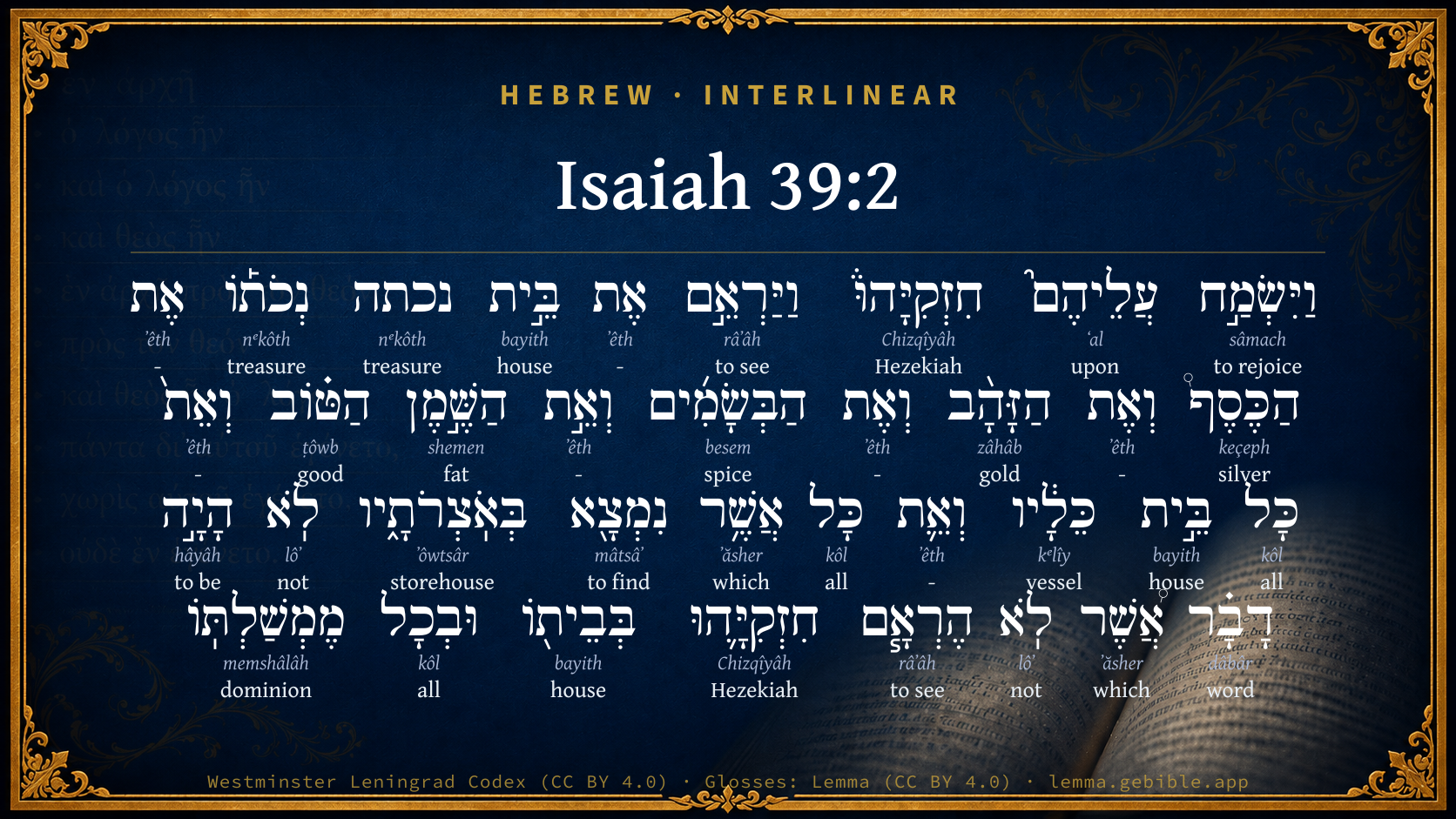
Isaiah 39:2

Hebrew (Westminster Leningrad Codex) Isaiah 39:2 appears in the Hebrew Old Testament. The text above is from the Westminster Leningrad Codex. Each word links to its Strong’s number, a concise gloss, and parsing drawn from the Open Scriptures Hebrew Bible morphology. Click any word for its full Brown-Driver-Briggs (BDB) entry.
Download image
Cite this verse

Isaiah 39:2 (World English Bible). Public Domain. Lemma interlinear Bible study tool, https://lemma.gebible.app/v/isaiah/39/2.

Show BibTeX & RIS
BibTeX
RIS
English Translation
Hezekiah was glad of them, and shown them the house of his precious things, the silver, and the gold, and the spices, and the precious oil, and all the house of his armor, and all that was found in his treasures: there was nothing in his house, nor in all his dominion, that Hezekiah didn't show them.
World English Bible · Public Domain
Download a study sheet

One document with this verse’s original text, its word-by-word gloss line, the meaning frame, cross-references with their text, attributed commentary, and full source and license credits — printable, and it pastes into notes with its structure intact.

This verse Autodidact and up

Study sheet (.html) Plain text (.txt)

A passage Seminary Student

Up to 50 verses in one chapter. A passage sheet keeps up to 6 commentary sources and 12 cross-references per verse, in the order this page ranks them, and says so on the sheet whenever that leaves anything out. Ask for a single verse and you get the Autodidact verse sheet above.

Everything on this page stays free to read, with no account — the sheet is a download of what is already on screen, not access to it.

Want to remove ads? Support Godless Engineer
Compare translations 3

The same verse in 3 English versions, stacked beneath the original-language interlinear above. Click any original word for its lexicon entry.

Each is an independent rendering of the whole verse — the interlinear is not word-aligned to these translations.

Highlighted words mark where these versions differ — a whole-verse word diff, not a word-by-word alignment.

  • World English Bible Public Domain
    Hezekiah was glad of them, and shown them the house of his precious things, the silver, and the gold, and the spices, and the precious oil, and all the house of his armor, and all that was found in his treasures: there was nothing in his house, nor in all his dominion, that Hezekiah didn't show them.
  • King James Version Public Domain
    And Hezekiah was glad of them, and shewed them the house of his precious things, the silver, and the gold, and the spices, and the precious ointment, and all the house of his armour, and all that was found in his treasures: there was nothing in his house, nor in all his dominion, that Hezekiah shewed them not.
  • unfoldingWord Literal Text CC BY-SA 4.0
    And Hezekiah rejoiced upon them, and he showed them the house of his treasure, the silver and the gold and the spices and the fine oil and all of the house of his armor and all that was found in his treasuries. There was not a thing that Hezekiah did not show them in his house or in all of his realm.

unfoldingWord Literal Text — © unfoldingWord, licensed CC BY-SA 4.0. Word-aligned USFM3 via Door43 (git.door43.org/unfoldingWord/en_ult).

Versions to compare (up to 4)

3 of 4 selected

Show all 18 translations

Every available English version of this verse, each an independent rendering of the whole verse.

  • World English Bible Public Domain
    Hezekiah was glad of them, and shown them the house of his precious things, the silver, and the gold, and the spices, and the precious oil, and all the house of his armor, and all that was found in his treasures: there was nothing in his house, nor in all his dominion, that Hezekiah didn't show them.
  • Berean Standard Bible Public Domain
    And Hezekiah welcomed the envoys gladly and showed them what was in his treasure house—the silver, the gold, the spices, and the precious oil, as well as his entire armory—all that was found in his storehouses. There was nothing in his palace or in all his dominion that Hezekiah did not show them.
  • Majority Standard Bible Public Domain
    And Hezekiah welcomed the envoys gladly and showed them what was in his treasure house—the silver, the gold, the spices, and the precious oil, as well as his entire armory—all that was found in his storehouses. There was nothing in his palace or in all his dominion that Hezekiah did not show them.
  • King James Version Public Domain
    And Hezekiah was glad of them, and shewed them the house of his precious things, the silver, and the gold, and the spices, and the precious ointment, and all the house of his armour, and all that was found in his treasures: there was nothing in his house, nor in all his dominion, that Hezekiah shewed them not.
  • American Standard Version (1901) Public Domain
    And Hezekiah was glad of them, and showed them the house of his precious things, the silver, and the gold, and the spices, and the precious oil, and all the house of his armor, and all that was found in his treasures: there was nothing in his house, nor in all his dominion, that Hezekiah showed them not.
  • Revised Version (1885) Public Domain
    And Hezekiah was glad of them, and shewed them the house of his precious things, the silver, and the gold, and the spices, and the precious oil, and all the house of his armour, and all that was found in his treasures: there was nothing in his house, nor in all his dominion, that Hezekiah shewed them not.
  • Geneva Bible (1599) Public Domain
    And Hezekiah was glad of them, and shewed them the house of the treasures, the siluer, and the golde, and the spices, and the precious ointment, and all the house of his armour, and all that was founde in his treasures: there was nothing in his house, nor in all his kingdome that Hezekiah shewed them not.
  • Douay-Rheims (1899) Public Domain
    And Ezechias rejoiced at their coming, and he shewed them the storehouses of his aromatical spices, and of the silver, and of the gold, and of the sweet odours, and of the precious ointment, and all the storehouses of his furniture, and all things that were found in his treasures. There was nothing in his house, nor in all his dominion that Ezechias shewed them not.
  • Young's Literal Translation Public Domain
    And Hezekiah rejoiceth over them, and sheweth them the house of his spices, the silver, and the gold, and the spices, and the good ointment, and all the house of his vessels, and all that hath been found in his treasures; there hath not been a thing in his house, and in all his dominion, that Hezekiah hath not shewed them.
  • Literal Standard Version CC BY-SA 4.0
    And Hezekiah rejoices over them, and shows them the house of his spices, the silver, and the gold, and the spices, and the good ointment, and all the house of his vessels, and all that has been found in his treasures; there has not been a thing in his house, and in all his dominion, that Hezekiah has not showed them.
  • Unlocked Literal Bible CC BY-SA 4.0
    Hezekiah was pleased by these things; he showed the messengers his storehouse of valuable things—the silver, the gold, the spices and precious oil, the storehouse of his weapons, and all that was found in his storehouses. There was nothing in his house, nor in all his kingdom, that Hezekiah did not show them.
  • unfoldingWord Literal Text CC BY-SA 4.0
    And Hezekiah rejoiced upon them, and he showed them the house of his treasure, the silver and the gold and the spices and the fine oil and all of the house of his armor and all that was found in his treasuries. There was not a thing that Hezekiah did not show them in his house or in all of his realm.
  • Darby Bible Public Domain
    And Hezekiah was glad of them, and shewed them the house of his precious things, the silver and the gold, and the spices and the fine oil, and all the house of his armour, and all that was found amongst his treasures: there was nothing in his house, nor in all his dominion, that Hezekiah did not shew them.
  • World Messianic Bible Public Domain
    Hezekiah was pleased with them, and showed them the house of his precious things, the silver, the gold, the spices, and the precious oil, and all the house of his armor, and all that was found in his treasures. There was nothing in his house, nor in all his dominion, that Hezekiah didn’t show them.
  • Webster's Bible Public Domain
    And Hezekiah was glad of them, and showed them the house of his precious things, the silver, and the gold, and the spices, and the precious ointment, and all the house of his armor, and all that was found in his treasures: there was nothing in his house, nor in all his dominion, that Hezekiah did not show them.
  • Free Bible Version CC BY-SA 4.0
    Hezekiah happily welcomed the visitors and showed them what he had in his treasury—all the silver, the gold, the spices, and the expensive oils. He also showed them his whole armory and all that he had in his storehouses. In fact there wasn't anything in his palace or in the whole of his kingdom that Hezekiah didn't show them.
  • Bible in Basic English Public Domain
    And Hezekiah was glad at their coming, and let them see all his store of wealth, the silver and the gold and the spices and the oil, and all the house of his arms, and everything there was in his stores: there was nothing in all his house or his kingdom which he did not let them see.
  • JPS Tanakh (1917) Public Domain
    And Hezekiah was glad of them, and showed them his treasure-house, the silver, and the gold, and the spices, and the precious oil, and all the house of his armour, and all that was found in his treasures; there was nothing in his house, nor in all his dominion, that Hezekiah showed them not.

Literal Standard Version (2020), Covenant Press — licensed CC BY-SA 4.0. Text via the HelloAO Bible API (eBible.org). Unlocked Literal Bible (unfoldingWord) — licensed CC BY-SA 4.0. Text via the HelloAO Bible API (eBible.org). unfoldingWord Literal Text — © unfoldingWord, licensed CC BY-SA 4.0. Word-aligned USFM3 via Door43 (git.door43.org/unfoldingWord/en_ult). Free Bible Version, Dr. Jonathan Gallagher — licensed CC BY-SA 4.0. Text via the HelloAO Bible API (eBible.org).

Word by word

More ways to search: Search by grammar → Find every occurrence → Compare this word →

Practice this passage: Drill this verse → Learn its vocabulary →

נכתה
nᵉkôth
H5238
“treasure · her”
Noun, Common, Feminine, Singular, Construct + Suffix, Personal, 3rd Person, Feminine, Singular
Part of Speech
Noun
Type
Common
Gender
Feminine
Number
Singular
State
Construct
Full BDB Definition

Origin: probably for H5219

TWOT: 1369

treasure
  1. וַיִּשְׂמַ֣ח sâmach H8055 “and · to rejoice” Conjunction + Verb, Qal, Sequential Imperfect, 3rd Person, Masculine, Singular
  2. עֲלֵיהֶם֮ ʻal H5921 “upon · them” Preposition + Suffix, Personal, 3rd Person, Masculine, Plural
  3. חִזְקִיָּהוּ֒ Chizqîyâh H2396 “Hezekiah” Noun, Proper
  4. וַיַּרְאֵ֣ם râʼâh H7200 “and · to see · them” Conjunction + Verb, Hiphil, Sequential Imperfect, 3rd Person, Masculine, Singular + Suffix, Personal, 3rd Person, Masculine, Plural
  5. אֶת ʼêth H853 “-” Particle, Direct Object
  6. בֵּ֣ית bayith H1004 “house of” Noun, Common, Masculine, Singular, Construct
  7. נְכֹת֡וֹ nᵉkôth H5238 “treasure · his” Noun, Common, Feminine, Singular, Construct + Suffix, Personal, 3rd Person, Masculine, Singular
  8. אֶת ʼêth H853 “-” Particle, Direct Object
  9. הַכֶּסֶף֩ keçeph H3701 “the · silver” Particle, Definite Article + Noun, Common, Masculine, Singular, Absolute
  10. וְאֶת ʼêth H853 “and · -” Conjunction + Particle, Direct Object
  11. הַזָּהָ֨ב zâhâb H2091 “the · gold” Particle, Definite Article + Noun, Common, Masculine, Singular, Absolute
  12. וְאֶת ʼêth H853 “and · -” Conjunction + Particle, Direct Object
  13. הַבְּשָׂמִ֜ים besem H1314 “the · spices” Particle, Definite Article + Noun, Common, Masculine, Plural, Absolute
  14. וְאֵ֣ת ʼêth H853 “and · -” Conjunction + Particle, Direct Object
  15. הַשֶּׁ֣מֶן shemen H8081 “the · fat” Particle, Definite Article + Noun, Common, Masculine, Singular, Absolute
  16. הַטּ֗וֹב ṭôwb H2896 “the · good” Particle, Definite Article + Adjective, Adjective, Masculine, Singular, Absolute
  17. וְאֵת֙ ʼêth H853 “and · -” Conjunction + Particle, Direct Object
  18. כָּל kôl H3605 “all of” Noun, Common, Masculine, Singular, Construct
  19. בֵּ֣ית bayith H1004 “house of” Noun, Common, Masculine, Singular, Construct
  20. כֵּלָ֔יו kᵉlîy H3627 “vessels · his” Noun, Common, Masculine, Plural, Construct + Suffix, Personal, 3rd Person, Masculine, Singular
  21. וְאֵ֛ת ʼêth H853 “and · -” Conjunction + Particle, Direct Object
  22. כָּל kôl H3605 “all of” Noun, Common, Masculine, Singular, Construct
  23. אֲשֶׁ֥ר ʼăsher H834 “which” Particle, Relative
  24. נִמְצָ֖א mâtsâʼ H4672 “to find” Verb, Niphal, Perfect, 3rd Person, Masculine, Singular
  25. בְּאֹֽצְרֹתָ֑יו ʼôwtsâr H214 “in/at · storehouses · his” Preposition + Noun, Common, Masculine, Plural, Construct + Suffix, Personal, 3rd Person, Masculine, Singular
  26. לֹֽא lôʼ H3808 “not” Particle, Negative
  27. הָיָ֣ה hâyâh H1961 “to be” Verb, Qal, Perfect, 3rd Person, Masculine, Singular
  28. דָבָ֗ר dâbâr H1697 “word” Noun, Common, Masculine, Singular, Absolute
  29. אֲ֠שֶׁר ʼăsher H834 “which” Particle, Relative
  30. לֹֽא lôʼ H3808 “not” Particle, Negative
  31. הֶרְאָ֧ם râʼâh H7200 “to see · them” Verb, Hiphil, Perfect, 3rd Person, Masculine, Singular + Suffix, Personal, 3rd Person, Masculine, Plural
  32. חִזְקִיָּ֛הוּ Chizqîyâh H2396 “Hezekiah” Noun, Proper
  33. בְּבֵית֖וֹ bayith H1004 “in/at · house · his” Preposition + Noun, Common, Masculine, Singular, Construct + Suffix, Personal, 3rd Person, Masculine, Singular
  34. וּבְכָל kôl H3605 “and · in/at · all of” Conjunction + Preposition + Noun, Common, Masculine, Singular, Construct
  35. מֶמְשַׁלְתּֽוֹ memshâlâh H4475 “dominion · his” Noun, Common, Both, Singular, Construct + Suffix, Personal, 3rd Person, Masculine, Singular

About this verse

These counts appear in no published source. They are computed here, from the morphology-tagged text and Lemma’s own curated glosses. What Lemma adds →

36
words
21
distinct lemmas
Prophets
section

Notable vocabulary

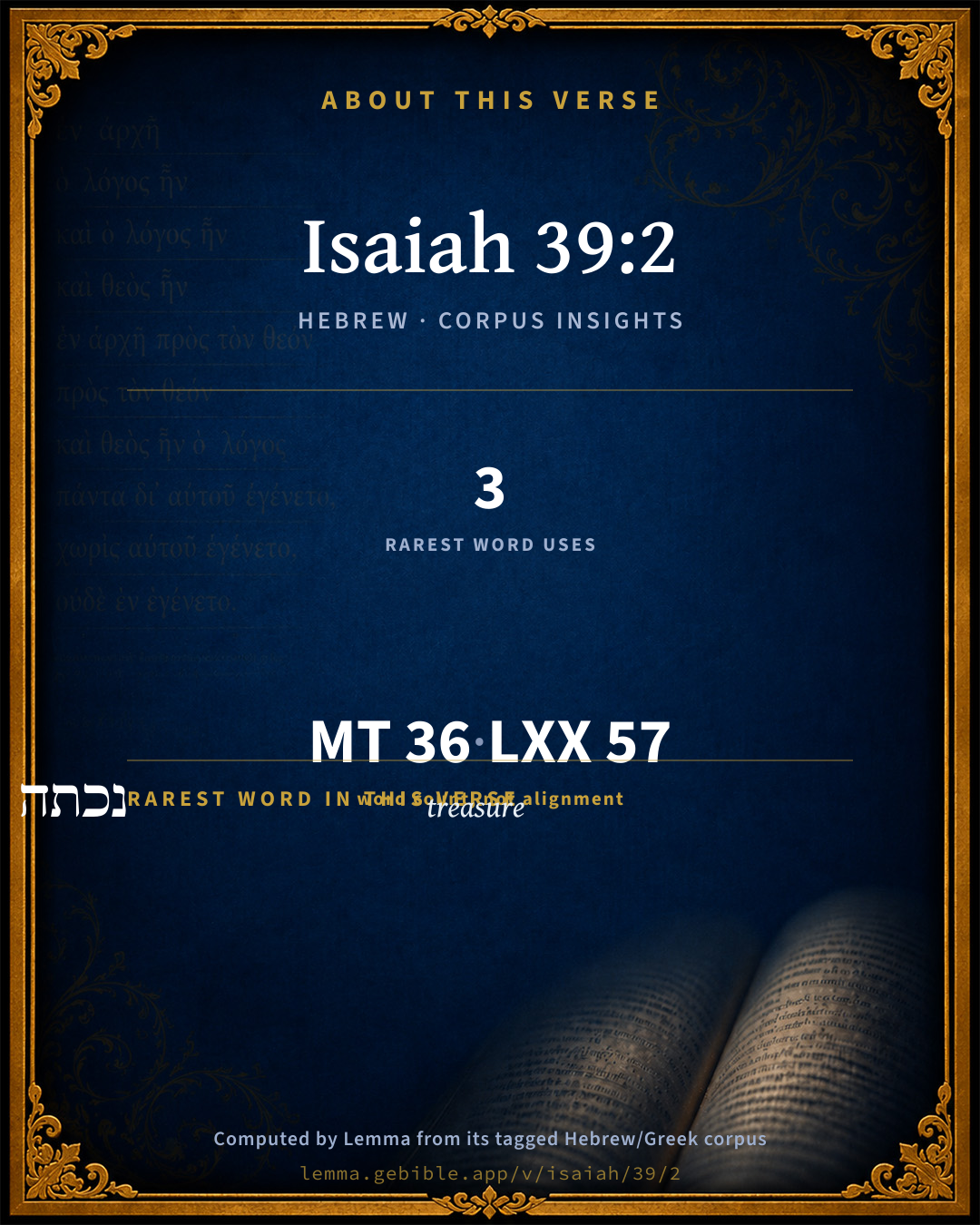
The rarest word here is נכתה treasure H5238 — appearing just 3 times in the whole Hebrew Bible.

Shared distinctive vocabulary

נכתה treasure H5238 occurs in 2 verses of the Hebrew Bible. Also found in:

Grammatical profile

  • 5 verbs
  • 18 nouns
  • 1 adjective
  • 1 preposition
  • 11 particles

Verb forms

  • וַיִּשְׂמַ֣ח Qal · Sequential Imperfect
  • וַיַּרְאֵ֣ם Hiphil · Sequential Imperfect
  • נִמְצָ֖א Niphal · Perfect
  • הָיָ֣ה Qal · Perfect
  • הֶרְאָ֧ם Hiphil · Perfect

Repetition

Words recur within this verse — often emphatic in Hebrew:

  • בֵּ֣ית house H1004 ×3
  • כָּל all H3605 ×3
  • חִזְקִיָּהוּ֒ Hezekiah H2396 ×2
  • וַיַּרְאֵ֣ם to see H7200 ×2
  • נכתה treasure H5238 ×2
  • אֲשֶׁ֥ר which H834 ×2
  • לֹֽא not H3808 ×2

Hebrew & Septuagint length

In English translation the verse runs 57 words from the Hebrew and 59 from the Septuagint (LXX English) — closely comparable.

A rough comparison of the two English renderings, which tokenize alike — not a word-level alignment.

Word counts can differ between the Hebrew and the Greek without any difference in meaning — e.g. the Hebrew direct-object marker אֵת has no separate Greek word, and Greek often adds the article ὁ.

In the original languages it is 36 Hebrew tokens and 57 Greek tokens — but the two are counted differently (Hebrew bundles its prefixes and suffixes into one token; the Greek is in lemma form), so that isn’t a like-for-like length.

Cross-references

18

Topical passages linked to Isaiah 39:2 in the Treasury of Scripture Knowledge — connected by theme and wording, ordered by reader-vote popularity; previews shown in the World English Bible.

  • 2 Chronicles 32:25 But Hezekiah didn't render again according to the benefit done to him; for his heart was lifted up: therefore there was wrath on him, and on Judah and Jerusalem.
  • 2 Chronicles 32:31 However in [the business of] the ambassadors of the princes of Babylon, who sent to him to inquire of the wonder that was done in the land, God left him, to try him, that he might know all that was in his heart.
  • Job 31:25 If I have rejoiced because my wealth was great, And because my hand had gotten much;
  • Psalms 146:3–4 Don't put your trust in princes, Each a son of man in whom there is no help.
  • Jeremiah 17:9 The heart is deceitful above all things, and it is exceedingly corrupt: who can know it?
  • 1 Kings 10:2 She came to Jerusalem with a very great train, with camels that bore spices, and very much gold, and precious stones; and when she was come to Solomon, she talked with him of all that was in her heart.
  • 1 Kings 10:10 She gave the king one hundred twenty talents of gold, and of spices very great store, and precious stones: there came no more such abundance of spices as these which the queen of Sheba gave to king Solomon.
  • 1 Kings 10:15 besides [that which] the traders [brought], and the traffic of the merchants, and of all the kings of the mixed people, and of the governors of the country.
  • 1 Kings 10:25 They brought every man his tribute, vessels of silver, and vessels of gold, and clothing, and armor, and spices, horses, and mules, a rate year by year.
  • 2 Kings 20:13 Hezekiah listened to them, and shown them all the house of his precious things, the silver, and the gold, and the spices, and the precious oil, and the house of his armor, and all that was found in his treasures: there was nothing in his house, nor in all his dominion, that Hezekiah didn't show them.
  • 2 Chronicles 9:1 When the queen of Sheba heard of the fame of Solomon, she came to prove Solomon with hard questions at Jerusalem, with a very great train, and camels that bore spices, and gold in abundance, and precious stones: and when she was come to Solomon, she talked with him of all that was in her heart.
  • 2 Chronicles 9:9 She gave the king one hundred and twenty talents of gold, and spices in great abundance, and precious stones: neither was there any such spice as the queen of Sheba gave to king Solomon.
  • 2 Chronicles 32:27 Hezekiah had exceeding much riches and honor: and he provided him treasuries for silver, and for gold, and for precious stones, and for spices, and for shields, and for all manner of goodly vessels;
  • Proverbs 4:23 Keep your heart with all diligence, For out of it is the wellspring of life.
  • Ecclesiastes 7:20 Surely there is not a righteous man on earth, who does good and doesn't sin.
  • 2 Corinthians 12:7 By reason of the exceeding greatness of the revelations, that I should not be exalted excessively, there was given to me a thorn in the flesh, a messenger of Satan to buffet me, that I should not be exalted excessively.
  • 2 Kings 18:15–16 Hezekiah gave [him] all the silver that was found in the house of Yahweh, and in the treasures of the king's house.
  • 1 John 1:8 If we say that we have no sin, we deceive ourselves, and the truth is not in us.

Cross-references courtesy of OpenBible.info (CC BY 4.0).

Hebrew and Greek witnesses Masoretic Hebrew ↔ Greek Septuagint

The same verse in the two great witnesses to the Old Testament, shown verse-for-verse.

These are two independent witnesses, not word-aligned to each other, and the Septuagint is shown in lemma (dictionary) form.

Hebrew Isaiah 39:2 Masoretic · Westminster Leningrad Codex

וַיִּשְׂמַ֣ח עֲלֵיהֶם֮ חִזְקִיָּהוּ֒ וַיַּרְאֵ֣ם אֶת בֵּ֣ית נכתה נְכֹת֡וֹ אֶת הַכֶּסֶף֩ וְאֶת הַזָּהָ֨ב וְאֶת הַבְּשָׂמִ֜ים וְאֵ֣ת הַשֶּׁ֣מֶן הַטּ֗וֹב וְאֵת֙ כָּל בֵּ֣ית כֵּלָ֔יו וְאֵ֛ת כָּל אֲשֶׁ֥ר נִמְצָ֖א בְּאֹֽצְרֹתָ֑יו לֹֽא הָיָ֣ה דָבָ֗ר אֲ֠שֶׁר לֹֽא הֶרְאָ֧ם חִזְקִיָּ֛הוּ בְּבֵית֖וֹ וּבְכָל מֶמְשַׁלְתּֽוֹ

Hezekiah was glad of them, and shown them the house of his precious things, the silver, and the gold, and the spices, and the precious oil, and all the house of his armor, and all that was found in his treasures: there was nothing in his house, nor in all his dominion, that Hezekiah didn't show them.

World English Bible · Public Domain

Greek LXX Isaiah 39:2 Septuagint · lemma form

καί χαίρω ἐπί αὐτός εζεκιας χαρά μέγας καί δεικνύω αὐτός ὁ οἶκος ὁ νεχωθα καί ὁ στακτή καί ὁ θυμίαμα καί ὁ μύρον καί ὁ ἀργύριον καί ὁ χρυσίον καί πᾶς ὁ οἶκος ὁ σκεῦος ὁ γάζα καί πᾶς ὅσος εἰμί ἐν ὁ θησαυρός αὐτός καί οὐ εἰμί οὐδείς ὅς οὐ δεικνύω εζεκιας ἐν ὁ οἶκος αὐτός

And Ezekias was glad of their coming, and he showed them the house of his spices, and of silver, and gold, and myrrh, and incense, and ointment, and all the houses of his treasures, and all that he had in his stores: and there was nothing in his house, nor in all his dominion, which Ezekias did not show.

LXX2012 (modern English Septuagint) · Public Domain

On this verse, The Cambridge Bible for Schools and Colleges discusses the Septuagint’s reading. Read the note in Commentary ↓

Hebrew: Westminster Leningrad Codex (CC BY 4.0). Greek: Septuagint (public domain); English from LXX2012 (modern English Septuagint) (Public Domain). How the Septuagint differs from the Hebrew →

Targum (Aramaic paraphrase)

1

The Targum is the ancient Jewish Aramaic paraphrase of the Hebrew Scriptures — an interpretive translation, not the Hebrew text itself. Onkelos (literal) and Pseudo-Jonathan (expansive) render the Torah, and Jonathan the Prophets. Coverage is partial: where no permissively-licensed English translation exists for a verse, only the Aramaic is shown. This is verse-level text, not a word-by-word alignment to the Hebrew.

  1. Targum Jonathan Prophets (Joshua–Malachi)
    וַחֲדֵי עֲלֵיהוֹן חִזְקִיָה וְאַחְזִנוּן יַת בֵּית גִנְזוֹהִי יַת כַּסְפָּא וְיַת דַהֲבָא וְיַת בּוּסְמָנָא וְיַת מִשְׁחָא טָבָא וְיַת כָּל בֵּית מְנוֹהִי וְיַת כָּל דְאִישְׁתַּכַח בְּגִנְזוֹהִי לָא הֲוָה מִדַעַם דְלָא אַחֲזִינוּן חִזְקִיָהוּ בְּבֵיתֵהּ וּבְכָל שׁוּלְטָנֵהּ:

    And Hezekiah was glad of them, and showed them the house of his treasures, the silver, and the gold, and the spices, and the precious ointment, and all the house of his vessels, and everything that was found in his treasury: and there was not anything in his house, nor in all his dominion, that Hezekiah showed them not.

    Targum Jonathan — Aramaic: “Mikraot Gedolot” (public domain). English: “Sefaria Community Translation” (CC0 1.0 (public-domain dedication)); “London "Chaldee Paraphrase," 1871” (public domain). Text via Sefaria.

Commentary

Notes on Isaiah 39:2 from classic Christian and Jewish commentators (each source and its license shown beneath its notes). The classic Christian expositions comment on the surrounding passage and are grouped to its opening verse, so a note may address several verses; the Jewish commentaries on the Tanakh (Rashi and others) are per-verse, so they appear only where the commentator wrote on this verse.

Lemma curates 59 commentaries, every one of them public domain or Creative Commons licensed, each selected and text-cleaned for this edition rather than reprinted as found. About our sources →

The Biblical Illustrator

Joseph S. Exell

Isa_39:2

And Hezekiah was glad of them

Hezekiahs great mistake

Look at Hezekiah; as he takes the men round he says in effect, What an ally I would make if Babylon should ever be in trouble! Or, What an opponent I would make if ever Babylon should be insolent! Or, You see I am one of the great powers of the world.

We want large quotation marks for great powers! This is the danger of all uncontrolled and unsanctified power, or position, or possibility of dominion: much would be more, more would be most, and most would explode because of its own dissatisfaction. (J. Parker, D. D.)

Character superior to material good

Was this all Hezekiah had to show? There is nothing in it then. All these things can be stolen. A half-educated thief could take away the silver and the gold; a very young felon could take away the spices and the precious ointment; a man with very poor resources could carry off the armour. Hezekiah laid up his riches where thieves could break through and steal. Ah me, how like us all this is! What should he have shown to the men from Babylon? What we ought to show to every inquirer into our method of life--individual, domestic, municipal, and national: he should have shown them character, high citizenship, large education, self-control developed to its highest point of discipline,--these are things which no king of Babylon can take away. (J. Parker, D. D.)

A misimproved opportunity

What a missionary Hezekiah might have been! How he would have astounded the Babylonian delegates had he said to them: I receive you with respect, courtesy, and thankfulness, but I must tell you of this miracle; come within, and you shall hear how it was, how it began, continued, culminated; this will be something for you to tell when you go home again. In this way every man might create a home missionary field for himself. Come and hear, all ye that fear God, and I will declare what He hath done for my soul. (J. Parker, D. D.)

A city to plunder

The Babylonian ambassadors had probably somewhat of the feeling which led Blucher to say, as he walked through the streets of London, Himmel! what a city to plunder! (E. H. Plumptre, D. D.)

The Biblical Illustrator, edited by Joseph S. Exell (c. 1880s–1900s) — public domain. Text from a community e-Sword module.

Tyndale Open Study Notes

Tyndale Open Resources

39:2 silver . . . aromatic oils . . . his armory: Showing these treasures demonstrated to Babylon’s envoys that Hezekiah had the resources to be a worthy ally.

Tyndale Open Study Notes — © Tyndale Open Resources, licensed CC BY-SA 4.0. Text via the HelloAO Bible API.

Geneva Bible (1599)

Geneva Bible translators

Read 2 Kings 20:13 and 2 Chron. 32:25, 31.

Geneva Bible (1599) marginal notes — public domain. Text via Bolls.life.

Jamieson, Fausset & Brown

Robert Jamieson, A. R. Fausset & David Brown

glad--It was not the mere act, but the spirit of it, which provoked God (Ch2 32:25), "Hezekiah rendered not again according to the benefit done unto him, for his heart was lifted up"; also compare Ch2 32:31. God "tries" His people at different times by different ways, bringing out "all that is in their heart," to show them its varied corruptions. Compare David in a similar case (Ch1 21:1-8).

precious things--rather, "the house of his (aromatic) spices"; from a Hebrew root, to "break to pieces," as is done to aromatics.

silver . . . gold--partly obtained from the Assyrian camp (Isa 33:4); partly from presents (Ch2 32:23, Ch2 32:27-29).

precious ointment--used for anointing kings and priests.

armour--or else vessels in general; the parallel passage (Ch2 32:27), "treasuries . . . for shields," favors English Version. His arsenal.

Jamieson, Fausset & Brown — Commentary Critical and Explanatory on the Whole Bible (1871) — public domain (CC PDM 1.0). Text via the HelloAO Bible API.

Ellicott's Commentary for English Readers

(2) Shewed them the house of his precious things.—This fixes the date of the embassy at a time prior to the payment to Sennacherib (2Ki_18:15-16), unless we were to assume that the treasury had been replenished by the gifts that followed on the destruction of Sennacherib’s army; but this, as we have seen, is at variance with both the received and the rectified chronology. The display was obviously something more than the ostentation of a Crœsus showing his treasures to Solon (Herod. i. 3). It was practically a display of the resources of the kingdom, intended to impress the Babylonian ambassadors with a sense of his importance as an ally.

The spices, and the precious ointment . . .—The mention of these articles as part of the king’s treasures is characteristic of the commerce and civilisation of the time. “Spices”—probably myrrh, gumbenzoin, cinnamon—had from a very early period been among the gifts offered to princes (Gen_43:11; 1Ki_10:10). The “ointment,” or perfumed oil, finds its parallel in the costly unguent of the Gospel history (Mat_26:7; Joh_12:3). Esar-haddon’s account of the magnificence of his palace (Records of the Past, iii., 122) supplies a contemporary instance of like ostentation.

A Bible Commentary for English Readers, edited by Charles John Ellicott (1878–1897) — public domain. Text from a community e-Sword module.

The Cambridge Bible for Schools and Colleges

gen. ed. J. J. S. Perowne

2. And Hezekiah was glad of them] Not only was his vanity flattered, but the arrival of the envoys fell in with political projects to which he was even then too ready to lend his ear. The reading is decidedly preferable to the flat and meaningless “heard of them” in 2Ki_20:13 (not LXX.).

the house of his precious things] R.V. marg. has “house of his spicery,” identifying the word with one found in Gen_37:25; Gen_43:11. But this rendering has only an apparent justification in the “spices” mentioned below. The right meaning is given by the Targ. and Peshito: treasure-house. According to the younger Delitzsch it is the Assyrian bit nakanti. It is obvious that Hezekiah’s treasury was still full, which could not have been the case after the ruinous fine exacted by Sennacherib (2Ki_18:14-16).

the spices, and the precious ointment] the spices and the fine oil. (Cf. 2Ch_32:27.) These natural products of the land were probably stored for commerce and are mentioned as a source of wealth.

the house of his armour] better: his armoury. It is probably the same as the “house of the forest (of Lebanon)” in ch. Isa_22:8.

The Cambridge Bible for Schools and Colleges (gen. ed. J. J. S. Perowne; Cambridge University Press, 1878–1918) — public domain. Text from a community e-Sword module.

John Gill's Exposition

And Hezekiah was glad of them,.... Not of the presents, for he was very rich, and stood in no need of them, nor does it appear that he was covetous; but of the ambassadors, and of the honour that was done him in having such sent to him from such a prince; his sin was vain glory; and because he might hope that such a powerful ally would be a security to him against any after attempt of the king of Assyria, in which he was guilty of another sin, vain confidence, or trusting in an arm of flesh; and being lifted up with pride that his name was become so famous abroad, and that he had got so good an ally: and in order to ingratiate himself the more into his esteem and favour, he "showed" these his ambassadors

the house of his precious things; where his jewels and precious stones lay, and where were

the silver and the gold; large quantities of not only which he and his predecessors had laid up, which had been very lately greatly exhausted by the demand of three hundred talents of silver, and thirty talents of gold, by the king of Assyria; to answer which Hezekiah had given all the silver in the temple, and in the treasures of the king's house, and was so drove by necessity, that he cut off the gold from the doors and pillars of the temple, Kg2 18:14, so that it might be reasonable to ask, how came he so soon by all this treasure? it is possible that some part of the royal treasure might be unalienable, and he might have since received presents from his own nobles, and from foreign princes; but this was chiefly from the spoils found in the Assyrian camp, after the angel had made such a slaughter of them, Kg2 19:35, as a learned (d) man observes:

and the spices, and precious ointment; which, as Jarchi notes, some say were oil of olives; others the balsam which grew in Jericho; great quantities of this, with other spices, were laid up in store for use, as occasion should require:

and all the house of his armour; where were all his military stores, shields, swords, spears, arrows, &c.:

and all that was found in his treasures; in other places:

there was nothing in his house; in his royal palace:

nor in all his dominion; that was rare, curious, and valuable:

that Hezekiah showed them not; even the book of the law, as Jarchi says.

(d) Nicolai Abrami Pharus Vet. Test. l. 6. c. 17. p. 164.

John Gill's Exposition of the Whole Bible (1746–1763) — public domain (CC PDM 1.0). Text via the HelloAO Bible API.

Albert Barnes' Notes on the Bible

And Hezekiah was glad of them - Possibly he regarded himself as flattered by an embassage from so great a distance, and so celebrated a place as Babylon. It is certain that he erred in some way in regard to the manner in which he received them, and especially in the ostentatious display which he made of his treasures 2Ch 32:31.

And showed them the house of his precious things - The Septuagint renders this, Νεχωθᾶ Nechōtha - ‘The house of Nechotha,’ retaining the Hebrew word. The Margin, ‘Spicery.’ The Hebrew word (נכתה nekotoh) properly means, according to Gesenius, a contusion, a breaking to pieces; hence, aromatic powder, or spices reduced to powder, and then any kind of aromatics. Hence, the word here may mean ‘the house of his spices,’ as Aquila, Symmachus, and the Vulgate translate it; or ‘a treasury,’ ‘a storehouse,’ as the Chaldee and the Syriac here render it. It was undoubtedly a treasure or store house; but it may have taken its name from the fact, that it was mainly employed as a place in which to keep spices, unguents, and the various kinds of aromatics which were used either in public worship, or for the purposes of luxury.

The silver and the gold - Possibly Hezekiah may have obtained no small quantity of silver and gold from what was left in the camp of the Assyrians. It is certain that after he was delivered from danger he was signally prospered, and became one of the most wealthy and magnificent monarchs of the east; 2Ch 32:27-28 : ‘And Hezekiah had exceeding much riches and honor; and he made himself treasuries for silver and for gold, and for precious stones, and for spices, and for shields, and for all manner of pleasant jewels; storehouses also for the increase of grain, and wine, and oil; and stalls for all manner of beasts, and cotes for flocks.’ A considerable part of this wealth arose from presents which were made to him, and from gifts which were made for the service of the temple 2Ch 32:23.

And the precious ointment - Used for anointing kings and priests. Or more probably the ointment here referred to was that which was in more common use, to anoint the body after bathing, or when they were to appear in public.

And all the house of his armor - Margin, ‘Vessels,’ or ‘instruments,’ or ‘jewels.’ The word כלי kelı̂y denotes any article of furniture, utensil, or vessel; any trapping, instrument, or tool; and any implement of war, weapon, or arms. Probably it here refers to the latter, and denotes shields, swords, spears, such as were used in war, and such as Hezekiah had prepared for defense. The phrase is equivalent to our word arsenal (compare 2Ch 32:27). Solomon had an extensive arsenal of this description 1Ki 10:16-17, and it is probable that these were regarded as a part of the necessary defense of the kingdom.

Nor in all his dominion - Everything that contributed to the defense, the wealth, or the magnificence of his kingdom he showed to them. The purpose for which Hezekiah thus showed them all that he had, was evidently display. In 2Ch 32:25, it is stated that ‘Hezekiah rendered not again according to the benefit done unto him, for his heart was lifted up;’ and in 2Ch 32:31, it is said, that in regard to this transaction, ‘God left him, to try him, that he might know all that was in his heart.’ The result showed how much God hates pride, and how certainly he will punish all forms of ostentation.

Albert Barnes' Notes on the Bible (1834–1885) — public domain. Text from a community e-Sword/MySword module.

Whedon's Commentary on the Bible

Daniel D. Whedon

2. Showed them the house of his precious things — Hezekiah was flattered by an embassy from so great a distance as Babylon: he showed them all he had of treasure, armour, spicery, beaten oil, and all the wealth he had collected at Jerusalem. He had prospered greatly since his sickness, perhaps he had greatly enriched himself from the valuable plunder left in the sudden retreat of the Assyrian army. From numerous resources, at any rate, he was again rich and powerful, and possibly he looked to an alliance with Babylon against the great power which had so annoyed him.

Daniel D. Whedon (gen. ed.), Commentary on the Old and New Testaments (1874–1909) — public domain. Text from a community e-Sword module.

The Pulpit Commentary

Hezekiah was glad of them. A more pregnant phrase than that which replaces it in 2 Kings, "hearkened unto them." Hezekiah, like Merodach-Baladan, was looking out for allies, and "was glad," thinking that in Babylon he had found one which might render him important service. Sargon"s promptness, however, frustrated his hopes. In B.C. 709 that prince, regarding Merodach-Baladan"s proceedings as constituting a real danger to his kingdom, made a great expedition into Babylonia, defeated Merodach-Baladan, and took him prisoner, after which he had himself crowned King of Babylon, and during the remainder of his life (B.C. 709 to 705) ruled both countries. Showed them the house of his precious things; i.e. his treasury, or store-house. The treasuries of ancient monarchs were actual store-chambers, in which large quantities of the precious metals and valuable objects of various kinds were deposited (see Herod., 2:121; Arrian, "Exp. Alex.," 3:16, 18, etc.). The flourishing state of the treasury is an indication that the events here narrated are anterior to the great surrender of treasure to Sennacherib (2Ki_18:15; "Epenym Canon," p. 135). All the house of his armour. (comp. Isa_22:8) If a warlike alliance was contemplated, it was as important to show the possession of arms as of treasures. There was nothing in his house, nor in all his dominion, that Hezekiah showed them not. We must allow for Oriental hyperbole. The meaning is, that, without any reserve, Hezekiah showed all that he could show.

Vers. 2-8. Carnal joy the prelude to spiritual sorrow.

The Babylonian embassy, a grand affair doubtless, comprising envoys in their rich clothing and with their jewelled arms, camels bearing valuable gifts, prancing steeds, and a vast train of slaves and attendants, was to Hezekiah an inspiriting fact, a circumstance that gladdened and excited him. With his imperfect knowledge of geography, the embassy seemed to him to come from the furthest limits of the earth"s circuit from a remote, almost from an unknown, region (ver. 3). He had hitherto not thought of attempting negotiations with any power further distant than Egypt. If the far-off Babylon courted his alliance, where might he not expect to find friends? from what remote quarter might he not look for overtures? What wonder that "his heart was lifted up"? (2Ch_32:25) that he rejoiced, though with a carnal joy, that had no substantial spiritual basis? Isaiah had warned him against all "arms of flesh." Isaiah had bidden him "trust in the Lord Jehovah," and in Jehovah only. No doubt he had been especially warned against Egypt; but all the reasons that were valid against Egypt were valid against Babylon also. Babylon was as idolatrous as Egypt; Babylon was as licentious as Egypt; Babylon was as selfish in her aims as Egypt. Hezekiah"s joy was thus a purely carnal joy, a rejoicing in his own honour, and in the prospect of material aid from a tainted source. In the midst of his joy the prophet announces himself. "What said those men?" he sternly asks. "Whence came they? What have they seen? Ah! they have seen thy treasures, have they? All of them? Thou thinkest those treasures will make them thy friends. Nay; they will make them thy bitterest enemies. It will not be forgotten at Babylon that thy temple and thy treasure-house are worth plundering. The days will come when all the wealth of thy house, and of the temple, and of the holy city will be carried off to enrich that city. The days will come when thou wilt have disgrace from Babylon instead of honour. Thy descendants they that have issued from thy loins will serve the King of Babylon, will be eunuchs, doing the menial offices in his palace." In a moment the king"s joy is gone, and replaced by sorrow. It is with a saddened spirit that he submits, and acquiesces in his punishment. "Good is the word of the Lord he spares, even when he punishes; he chastens me with a milder chastening than I deserved at his hands his wrath he remembereth mercy". (Hab_3:2)

The sin of presuming.

"And Hezekiah was glad of them, and showed them the house of his precious things." Presumption is taking the ordering of our lives into our own hands, without consulting God or remembering our dependence on him. It is the sin to which kings and rulers and men of masterful dispositions are specially exposed. Therefore David prayed so earnestly, "Keep back thy servant also from presumptuous sins; let them not have dominion over me." The singular thing, and the suggestive thing, in the case of Hezekiah is that he took the insulting Assyrian letter and at once spread it before the Lord. Trouble drove him at once to God, but flattery disarmed him, and he acted without consulting God. Not without good reason is it urged that prosperity is a severer test of character than adversity; that "woe is unto us when all men speak well of us;" and that added years after a serious illness are oftentimes a very doubtful blessing. The writer of the Chronicles (2Ch_32:25) helps us to read the heart of Hezekiah. He says that Isaiah was displeased with him because "his heart was lifted up." Vanity is indicated in this exhibition of all his treasures. Cheyne finds all the excuse that can be found for Hezekiah. He says, "Was it merely vanity which prompted the king thus to throw open his treasuries? Surely not. It was to satisfy the emissaries of Baladan that Hezekiah had considerable resources, and was worthy of becoming his ally on equal terms. To Isaiah, as a prophet of Jehovah, the king"s fault was principally in allowing himself to be courted by a foreign potentate, as if it were not true that "Jehovah had founded Zion," and that "the afflicted of his people could find refuge therein. Matthew Henry says of Hezekiah, "He was a wise and good man, but when one miracle after another was wrought in his favour, he found it hard to keep his heart from being lifted up, nay, a little thing then drew him into the snare of pride. Blessed Paul himself needed a thorn in the flesh to keep him from being lifted up with the abundance of revelations." The sin of presumption is a more common, and a more serious, sill than we are wont to consider it. It is one that finds frequent illustration in Holy Scripture. The sin that lost Eden was presumption. Jacob"s grasping at the birthright was presumption. Moses" smiting the rock twice was presumption. Saul"s forcing himself to sacrifice when Samuel tarried was presumption. David"s numbering the people was presumption. Peter striking off the ear of Malchus was presumption. These are but specimen cases, readily recalled. A careful estimate of many sins will reveal presumption at the root of them. Still, if we read our lives aright, we shall find that we are constantly presuming on what God would have us to do, and acting without making due inquiries of him.

I TEMPTATIONS TO PRESUMPTION.

1. These come partly out of natural disposition. There is an evil of over-meekness; sometimes we find a lack of energy and self-assertion which prevents men from impressing themselves on any sphere of life which they may be called to occupy. But there is much more frequently the evil of over-assertion, that belongs to energetic, enterprising natures, that take life with a strong grip. Many men cannot wait. They form their judgments quickly, and want them immediately acted on. And such persons are constantly tempted to presume. If good men, they act first, and ask of God the approval of their actions. Oftentimes this strong self-willedness is a hereditary disposition, which the Christian spirit has to battle with and overcome. Oftentimes it is sadly fostered by the pettings of childhood, and the false education of youth; and then it is the serious confirmed evil that is hardly overcome even in a lifelong struggle.

2. The temptations come partly out of circumstances. In the desperateness of business pressure, the almost bankrupt man presumes on his friends, acts wilfully, and even brings others down in his ruin. But circumstances of success prove even greater temptations. Nebuchadnezzar is the type of the presumers, as he stands in the midst of his city, saying, "Is not this great Babylon, that I have built?

II SIN OF PRESUMPTION.

1. It is sin against man"s creaturehood. Man is not an independent being. He cannot stand alone. "No man can keep alive his own soul." He has nothing of his own. Then he has no right to presume.

2. It is a sin against a man"s childhood. Parents have to repress this spirit in their children, because it is subversive of true home-life. And so must the great Father.

3. It is especially sin in man as redeemed. Because, as redeemed, man is the humbled sinner, who is made a monument of grace, and ought to walk humbly with God, always coming after him, and never pressing on before. The evil of this sin is seen in the deterioration of Christian character which follows whenever it is indulged.

III PUNISHMENT OF PRESUMPTION. Usually this comes by the failure of the self-willed plans; or the sad results that follow the self willed course that is taken. In the case of Hezekiah God sends a vision of what will follow out of that embassy of which the king was so proud. It was the thin end of a wedge. Driven home, by-and-by, it meant the destruction of Jerusalem, and the captivity of Judah, by those very Babylonians. Hezekiah boasted in order to get a worldly alliance. His boastings excited cupidity, which presently led to the carrying away of the exhibited treasures. "Let him that thinketh he standeth take heed lest he fall" into the sin of presumption. R.T.

The Pulpit Commentary (1880–1919), ed. H.D.M. Spence-Jones & Joseph S. Exell — public domain. Text from a community e-Sword module.

Keil & Delitzsch

C. F. Keil & F. Delitzsch

"And Hezekiah rejoiced (K. heard, which is quite inappropriate) concerning them, and showed them (K. all) his storehouse: the silver, and the gold, and the spices, and the fine oil (hasshâmen,K. shemen), and all his arsenal, and all that was in his treasures: there was nothing that Hezekiah had not shown them, in his house or in all his kingdom." Although there were spices kept in נכת בּית, נכת is not equivalent to נכאת (from נכא, to break to pieces, to pulverize), which is applied to gum-dragon and other drugs, but is the niphal נכת from כּוּת (piel, Arab. kayyata, to cram full, related to כּוּס (כּיס), נכס (נכס), and possibly also to כּתם, katama (Hitzig, Knobel, Frst), and consequently it does not mean "the house of his spices," as Aquila, Symmachus, and the Vulgate render it, but his "treasure-house or storehouse" (Targ., Syr., Saad.). It differs, however, from bēth kēilim, the wood house of Lebanon (Isa 22:8). He was able to show them all that was worth seeing "in his whole kingdom," inasmuch as it was all concentrated in Jerusalem, the capital.

Keil & Delitzsch — Biblical Commentary on the Old Testament (1861–1891) — public domain (CC PDM 1.0). Text via the HelloAO Bible API. (Old Testament only.)

J. A. Alexander on Isaiah

Joseph Addison Alexander

“And Hezekiah, was glad of them, and showed them his house of rarities, the silver, and the gold, and the spices, and the good oil (or ointment), and all his house of arms, and all that was found in his treasures; there was not a thing which Hezekiah did not show them, in his house and in all his dominion.” The parallel passage (2Ki 20:13) has ‘and he hearkened unto them’. There is no need of regarding either as an error of transcription, or as the correction of a later writer. Nothing could be more natural than such a variation on the part of the original writer, describing Hezekiah’s feelings in the one case and his conduct in the other. He hearkened to them courteously because he was glad of their arrival. The goodly or precious oil is supposed by some to have been that used in the unction of kings and priests, or perhaps applied to more ordinary purposes in the royal household.

Joseph Addison Alexander, The Prophecies of Isaiah (1846–1847; New York: Scribner, 1870–1878) — public domain. Text from a community e-Sword module.

Rashi

Rabbi Shlomo Yitzchaki (Rashi)

his entire treasure house (נְכֹתֹה) the storehouse of his spices, like (Gen. 37:25) “spices (נְכֹאת), balm, and lotus.”

and the good oil Some interpret this as the anointing oil (Ex. 30:22 33), and others say that it is balsam oil, which is found in Eretz Israel, and that is Pannag mentioned in Ezekiel (27:17): “Judah and the land of Israel, they were your merchants, with wheat of Minnith and Pannag.” I saw in the book of Josephon (book 4, ch. 22), Pannag is balsam, and it grows in Jericho. Therefore, it is called Jericho because of the aroma (רֵיחַ).

there was nothing Even the Scroll of the Law.

Rashi on the Tanakh — English translations: “The Judaica Press complete Tanach with Rashi, translated by A. J. Rosenberg” (CC BY 4.0); “Pentateuch with Rashi's commentary by M. Rosenbaum and A.M. Silbermann, 1929-1934” (public domain); “The Metsudah Tanach series, Lakewood, N.J” (CC BY 4.0); and “The Book of Joshua, Metsudah Publications, 1997” (CC BY 4.0). Text via Sefaria.

Lesson kit

Teaching starters — assembled from the data on this page, not authored interpretation. Every prompt links to the verse data it draws on. Edit before teaching.

Isaiah, in the Prophets, opens this verse with 36 words (21 distinct Hebrew lemmas). Its most distinctive word is nᵉkôth (“treasure”). A historical commentator’s framing appears above. Read the whole chapter for the surrounding context.

Discussion questions

  1. The word nᵉkôth carries the sense “treasure.” How does it shape the verse?
  2. How does 2 Kings 20:13, which shares the word «treasure», read alongside this verse?
  3. What does the repetition of “house” (3× in this one verse) do in this verse?
  4. These translations render this verse differently; the difference is in the English rendering, not the original. What questions does that raise?
  5. «וַיִּשְׂמַ֣ח» is a Qal Sequential Imperfect verb. How does that grammatical form shape the action described?
  6. Compare how The Biblical Illustrator and Tyndale Open Study Notes read this verse. Where do they agree or differ?

Things to notice

Reading settings

Reading text

Shown beneath each verse's original-language words.

Old Testament
Old Testament edition

Read the OT as the Masoretic Hebrew (MT) or the Greek Septuagint (LXX).

English shown for the Greek Septuagint (in the Hebrew ↔ Greek comparison).

Comparing translations? Open the Compare panel on any verse page to stack up to four side by side.