
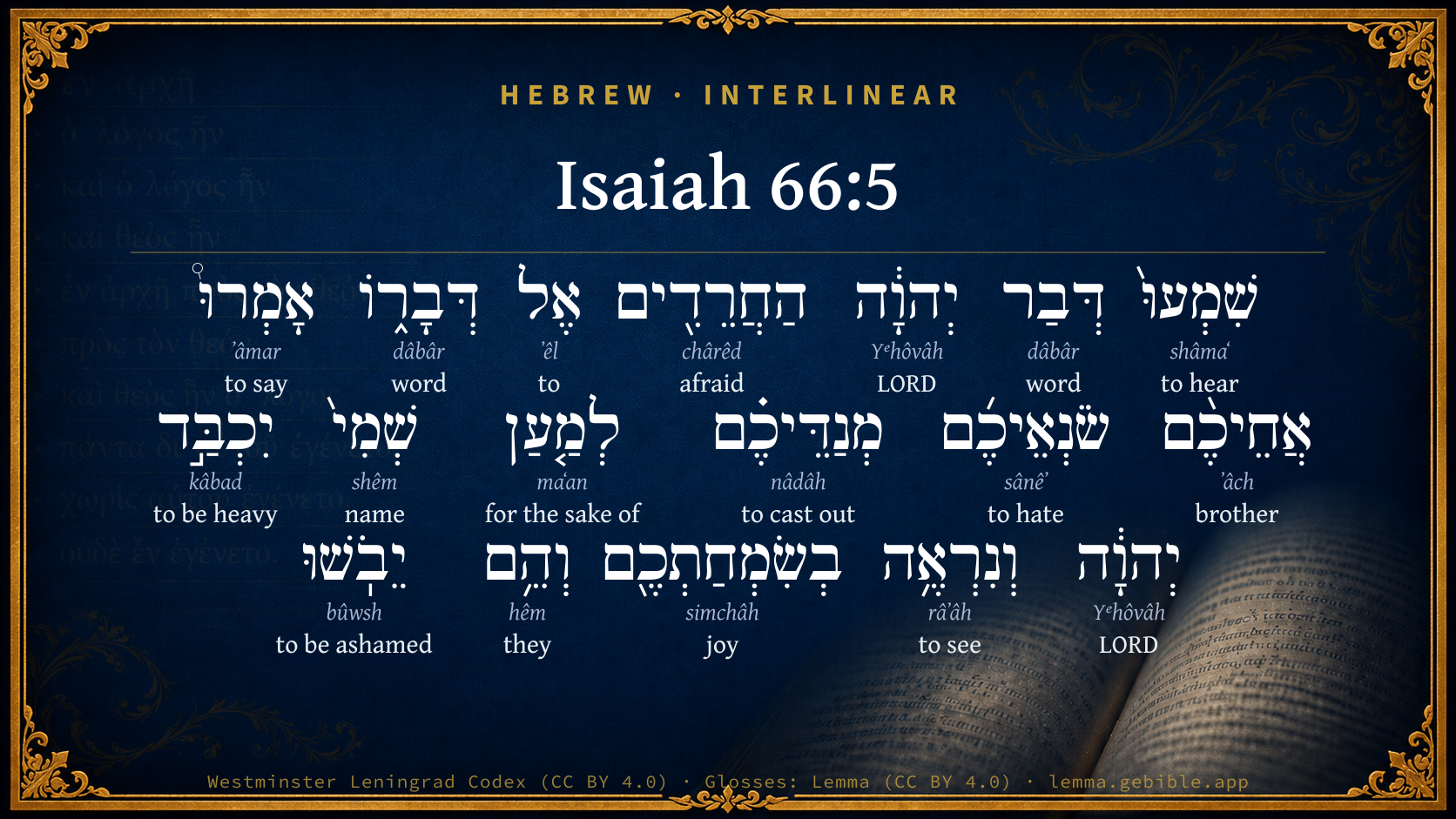
Isaiah 66:5

Hebrew (Westminster Leningrad Codex) Isaiah 66:5 appears in the Hebrew Old Testament. The text above is from the Westminster Leningrad Codex. Each word links to its Strong’s number, a concise gloss, and parsing drawn from the Open Scriptures Hebrew Bible morphology. Click any word for its full Brown-Driver-Briggs (BDB) entry.
Download image
Cite this verse

Isaiah 66:5 (World English Bible). Public Domain. Lemma interlinear Bible study tool, https://lemma.gebible.app/v/isaiah/66/5.

Show BibTeX & RIS
BibTeX
RIS
English Translation
Hear the word of Yahweh, you who tremble at his word: Your brothers who hate you, who cast you out for my name's sake, have said, Let Yahweh be glorified, that we may see your joy; but it is those who shall be disappointed.
World English Bible · Public Domain
Download a study sheet

One document with this verse’s original text, its word-by-word gloss line, the meaning frame, cross-references with their text, attributed commentary, and full source and license credits — printable, and it pastes into notes with its structure intact.

This verse Autodidact and up

Study sheet (.html) Plain text (.txt)

A passage Seminary Student

Up to 50 verses in one chapter. A passage sheet keeps up to 6 commentary sources and 12 cross-references per verse, in the order this page ranks them, and says so on the sheet whenever that leaves anything out. Ask for a single verse and you get the Autodidact verse sheet above.

Everything on this page stays free to read, with no account — the sheet is a download of what is already on screen, not access to it.

Want to remove ads? Support Godless Engineer
Compare translations 3

The same verse in 3 English versions, stacked beneath the original-language interlinear above. Click any original word for its lexicon entry.

Each is an independent rendering of the whole verse — the interlinear is not word-aligned to these translations.

Highlighted words mark where these versions differ — a whole-verse word diff, not a word-by-word alignment.

  • World English Bible Public Domain
    Hear the word of Yahweh, you who tremble at his word: Your brothers who hate you, who cast you out for my name's sake, have said, Let Yahweh be glorified, that we may see your joy; but it is those who shall be disappointed.
  • King James Version Public Domain
    Hear the word of the LORD, ye that tremble at his word; Your brethren that hated you, that cast you out for my name's sake, said, Let the LORD be glorified: but he shall appear to your joy, and they shall be ashamed.
  • unfoldingWord Literal Text CC BY-SA 4.0
    Hear the word of Yahweh, ones trembling at his word: “Your brothers, hating you, excluding you for the sake of my name, have said, ‘Let Yahweh be glorious, that we may see your joy!’ But they, they will have shame.”`

unfoldingWord Literal Text — © unfoldingWord, licensed CC BY-SA 4.0. Word-aligned USFM3 via Door43 (git.door43.org/unfoldingWord/en_ult).

Versions to compare (up to 4)

3 of 4 selected

Show all 18 translations

Every available English version of this verse, each an independent rendering of the whole verse.

  • World English Bible Public Domain
    Hear the word of Yahweh, you who tremble at his word: Your brothers who hate you, who cast you out for my name's sake, have said, Let Yahweh be glorified, that we may see your joy; but it is those who shall be disappointed.
  • Berean Standard Bible Public Domain
    You who tremble at His word, hear the word of the LORD: “Your brothers who hate you and exclude you because of My name have said, ‘Let the LORD be glorified that we may see your joy!’ But they will be put to shame.”
  • Majority Standard Bible Public Domain
    You who tremble at His word, hear the word of the LORD: “Your brothers who hate you and exclude you because of My name have said, ‘Let the LORD be glorified that we may see your joy!’ But they will be put to shame.”
  • King James Version Public Domain
    Hear the word of the LORD, ye that tremble at his word; Your brethren that hated you, that cast you out for my name's sake, said, Let the LORD be glorified: but he shall appear to your joy, and they shall be ashamed.
  • American Standard Version (1901) Public Domain
    Hear the word of Jehovah, ye that tremble at his word: Your brethren that hate you, that cast you out for my name's sake, have said, Let Jehovah be glorified, that we may see your joy; but it is they that shall be put to shame.
  • Revised Version (1885) Public Domain
    Hear the word of the LORD, ye that tremble at his word: Your brethren that hate you, that cast you out for my name’s sake, have said, Let the LORD be glorified, that we may see your joy; but they shall be ashamed.
  • Geneva Bible (1599) Public Domain
    Heare the worde of the Lord, all ye that tremble at his worde, Your brethren that hated you, and cast you out for my Names sake, said, Let the Lord be glorified: but he shall appeare to your ioy, and they shall be ashamed.
  • Douay-Rheims (1899) Public Domain
    Hear the word of the Lord, you that tremble at his word: Your brethren that hate you, and cast you out for my name's sake, have said: Let the Lord be glorified, and we shall see in your joy: but they shall be confounded.
  • Young's Literal Translation Public Domain
    Hear a word of Jehovah, Ye who are trembling unto His word, Said have your brethren who are hating you, Who are driving you out, for My name's sake: `Honoured is Jehovah, and we look on your joy,' But they are ashamed.
  • Literal Standard Version CC BY-SA 4.0
    Hear a word of YHWH, || You who are trembling at His word: “Your brothers who are hating you, || Who are driving you out for My Name’s sake, have said, || YHWH is honored, and we look on your joy, || But they are ashamed.”
  • Unlocked Literal Bible CC BY-SA 4.0
    Hear the word of Yahweh, you who tremble at his word, “Your brothers who hate and exclude you for my name's sake have said, 'May Yahweh be glorified, then we will see your joy,' but they will be put to shame.
  • unfoldingWord Literal Text CC BY-SA 4.0
    Hear the word of Yahweh, ones trembling at his word: “Your brothers, hating you, excluding you for the sake of my name, have said, ‘Let Yahweh be glorious, that we may see your joy!’ But they, they will have shame.”`
  • Darby Bible Public Domain
    Hear the word of Jehovah, ye that tremble at his word: Your brethren that hated you, that cast you out for my name's sake, said, Let Jehovah be glorified, and let us see your joy! but they shall be ashamed.
  • World Messianic Bible Public Domain
    Hear the LORD’s word, you who tremble at his word: “Your brothers who hate you, who cast you out for my name’s sake, have said, ‘Let the LORD be glorified, that we may see your joy;’ but it is those who shall be disappointed.
  • Webster's Bible Public Domain
    Hear the word of the LORD, ye that tremble at his word; Your brethren that hated you, that cast you out for my name's sake, said, Let the LORD be glorified: but he shall appear to your joy, and they shall be ashamed.
  • Free Bible Version CC BY-SA 4.0
    Listen to what the Lord has to say, those of you who tremble when he speaks. This is what some of your people who hate you and throw you out have said: “Let the Lord be glorified, so we can see how happy you are!” but it's them who are going to be humiliated.
  • Bible in Basic English Public Domain
    Give ear to the word of the Lord, you who are in fear at his word: your countrymen, hating you, and driving you out because of my name, have said, Let the Lord's glory be made clear, so that we may see your joy; but they will be put to shame.
  • JPS Tanakh (1917) Public Domain
    Hear the word of the LORD, ye that tremble at His word: Your brethren that hate you, that cast you out for My name's sake, have said: 'Let the LORD be glorified, that we may gaze upon your joy', but they shall be ashamed.

Literal Standard Version (2020), Covenant Press — licensed CC BY-SA 4.0. Text via the HelloAO Bible API (eBible.org). Unlocked Literal Bible (unfoldingWord) — licensed CC BY-SA 4.0. Text via the HelloAO Bible API (eBible.org). unfoldingWord Literal Text — © unfoldingWord, licensed CC BY-SA 4.0. Word-aligned USFM3 via Door43 (git.door43.org/unfoldingWord/en_ult). Free Bible Version, Dr. Jonathan Gallagher — licensed CC BY-SA 4.0. Text via the HelloAO Bible API (eBible.org).

Word by word

More ways to search: Search by grammar → Find every occurrence → Compare this word →

Practice this passage: Drill this verse → Learn its vocabulary →

מְנַדֵּיכֶ֗ם
nâdâh
H5077
“casting out · you”
Verb, Piel, Participle Active, Masculine, Plural, Construct + Suffix, Personal, 2nd Person, Masculine, Plural
Part of Speech
Verb
Stem
Piel
Form
Participle Active
Gender
Masculine
Number
Plural
State
Construct
Full BDB Definition

Origin: a primitive root

TWOT: 1302

(Hiphil) exclude, drive away, thrust aside - (Piel) cast out, put away
  1. שִׁמְעוּ֙ shâmaʻ H8085 “hear” Verb, Qal, Imperative, 2nd Person, Masculine, Plural
  2. דְּבַר dâbâr H1697 “word of” Noun, Common, Masculine, Singular, Construct
  3. יְהוָ֔ה Yᵉhôvâh H3068 “LORD” Noun, Proper
  4. הַחֲרֵדִ֖ים chârêd H2730 “the · afraid” Particle, Definite Article + Adjective, Adjective, Masculine, Plural, Absolute
  5. אֶל ʼêl H413 “to” Preposition
  6. דְּבָר֑וֹ dâbâr H1697 “word · his” Noun, Common, Masculine, Singular, Construct + Suffix, Personal, 3rd Person, Masculine, Singular
  7. אָמְרוּ֩ ʼâmar H559 “to say” Verb, Qal, Perfect, 3rd Person, Common, Plural
  8. אֲחֵיכֶ֨ם ʼâch H251 “brothers · your” Noun, Common, Masculine, Plural, Construct + Suffix, Personal, 2nd Person, Masculine, Plural
  9. שֹׂנְאֵיכֶ֜ם sânêʼ H8130 “hating · you” Verb, Qal, Participle Active, Masculine, Plural, Construct + Suffix, Personal, 2nd Person, Masculine, Plural
  10. לְמַ֤עַן maʻan H4616 “for the sake of” Preposition
  11. שְׁמִי֙ shêm H8034 “name · my” Noun, Common, Masculine, Singular, Construct + Suffix, Personal, 1st Person, Common, Singular
  12. יִכְבַּ֣ד kâbad H3513 “to be heavy” Verb, Qal, Imperfect, 3rd Person, Masculine, Singular
  13. יְהוָ֔ה Yᵉhôvâh H3068 “LORD” Noun, Proper
  14. וְנִרְאֶ֥ה râʼâh H7200 “and · to see” Conjunction + Verb, Qal, Imperfect, 1st Person, Common, Plural
  15. בְשִׂמְחַתְכֶ֖ם simchâh H8057 “in/at · joy · your” Preposition + Noun, Common, Feminine, Singular, Construct + Suffix, Personal, 2nd Person, Masculine, Plural
  16. וְהֵ֥ם hêm H1992 “and · they” Conjunction + Pronoun, Personal, 3rd Person, Masculine, Plural
  17. יֵבֹֽשׁוּ bûwsh H954 “to be ashamed” Verb, Qal, Imperfect, 3rd Person, Masculine, Plural

About this verse

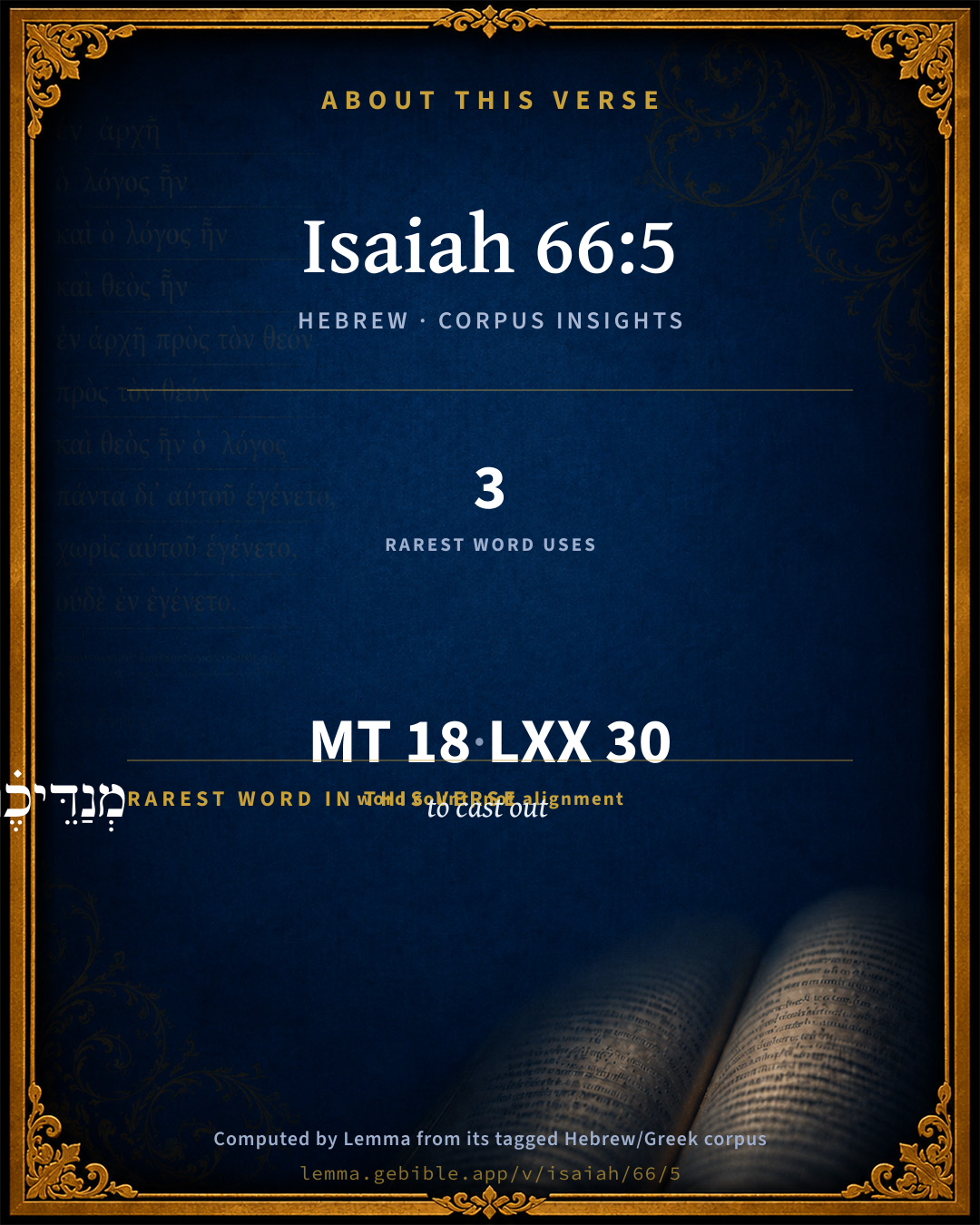
These counts appear in no published source. They are computed here, from the morphology-tagged text and Lemma’s own curated glosses. What Lemma adds →

18
words
16
distinct lemmas
Prophets
section

Notable vocabulary

The rarest word here is מְנַדֵּיכֶ֗ם to cast out H5077 — appearing just 3 times in the whole Hebrew Bible.

Shared distinctive vocabulary

מְנַדֵּיכֶ֗ם to cast out H5077 occurs in 3 verses of the Hebrew Bible. Also found in:

Grammatical profile

  • 7 verbs
  • 7 nouns
  • 1 adjective
  • 1 pronoun
  • 2 prepositions

Verb forms

  • שִׁמְעוּ֙ Qal · Imperative
  • אָמְרוּ֩ Qal · Perfect
  • שֹׂנְאֵיכֶ֜ם Qal · Participle Active
  • מְנַדֵּיכֶ֗ם Piel · Participle Active
  • יִכְבַּ֣ד Qal · Imperfect
  • וְנִרְאֶ֥ה Qal · Imperfect
  • יֵבֹֽשׁוּ Qal · Imperfect

Repetition

Words recur within this verse — often emphatic in Hebrew:

  • דְּבַר word H1697 ×2
  • יְהוָ֔ה LORD H3068 ×2

Hebrew & Septuagint length

In English translation the verse runs 44 words from the Hebrew and 43 from the Septuagint (LXX English) — closely comparable.

A rough comparison of the two English renderings, which tokenize alike — not a word-level alignment.

Word counts can differ between the Hebrew and the Greek without any difference in meaning — e.g. the Hebrew direct-object marker אֵת has no separate Greek word, and Greek often adds the article ὁ.

In the original languages it is 18 Hebrew tokens and 30 Greek tokens — but the two are counted differently (Hebrew bundles its prefixes and suffixes into one token; the Greek is in lemma form), so that isn’t a like-for-like length.

Cross-references

23

Topical passages linked to Isaiah 66:5 in the Treasury of Scripture Knowledge — connected by theme and wording, ordered by reader-vote popularity; previews shown in the World English Bible.

  • John 15:18–20 If the world hates you, you know that it has hated me before it hated you.
  • Isaiah 66:2 For all these things has my hand made, and [so] all these things came to be, says Yahweh: but to this man will I look, even to him who is poor and of a contrite spirit, and who trembles at my word.
  • Matthew 5:10–12 Blessed are those who have been persecuted for righteousness' sake, For theirs is the Kingdom of Heaven.
  • Psalms 38:20 They who also render evil for good are adversaries to me, Because I follow what is good.
  • Matthew 10:22 You will be hated by all men for my name's sake, but he who endures to the end will be saved.
  • Song of Solomon 1:6 Don't stare at me because I am dark, Because the sun has scorched me. My mother's sons were angry with me. They made me keeper of the vineyards. I haven't kept my own vineyard.
  • Isaiah 5:19 Who say, "Let him make speed, let him hasten his work, that we may see it; And let the counsel of the Holy One of Israel draw near and come, That we may know it!"
  • Jeremiah 36:16 Now it happened, when they had heard all the words, they turned in fear one toward another, and said to Baruch, We will surely tell the king of all these words.
  • Luke 6:22–23 Blessed are you when men shall hate you, and when they shall exclude and mock you, and throw out your name as evil, for the Son of Man's sake.
  • John 9:34 They answered him, "You were altogether born in sins, and do you teach us?" They threw him out.
  • 1 John 3:13 Don't be surprised, my brothers, if the world hates you.
  • Proverbs 13:13 Whoever despises instruction will pay for it, But he who respects a command will be rewarded.
  • Luke 13:17 As he said these things, all his adversaries were disappointed, and all the multitude rejoiced for all the glorious things that were done by him.
  • Jeremiah 36:23–25 It happened, when Jehudi had read three or four leaves, that [the king] cut it with the penknife, and cast it into the fire that was in the brazier, until all the scroll was consumed in the fire that was in the brazier.
  • John 16:2 They will put you out of the synagogues. Yes, the time comes that whoever kills you will think that he offers service to God.
  • Acts 26:9–10 "I myself most assuredly thought that I ought to do many things contrary to the name of Jesus of Nazareth.
  • 2 Thessalonians 1:6–10 Since it is a righteous thing with God to repay affliction to those who afflict you,
  • Titus 2:13 looking for the blessed hope and appearing of the glory of our great God and Savior, Jesus Christ;
  • Hebrews 9:28 so Christ also, having been once offered to bear the sins of many, will appear a second time, without sin, to those who are eagerly waiting for him for salvation.
  • 1 Peter 4:12–14 Beloved, don't be astonished at the fiery trial which has come upon you, to test you, as though a strange thing happened to you.
  • Isaiah 60:15 Whereas you have been forsaken and hated, so that no man passed through you, I will make you an eternal excellency, a joy of many generations.
  • Acts 2:33–47 Being therefore exalted by the right hand of God, and having received from the Father the promise of the Holy Spirit, he has poured out this, which you now see and hear.
  • 1 Thessalonians 2:15–16 who killed both the Lord Jesus and their own prophets, and drove us out, and didn't please God, and are contrary to all men;

Cross-references courtesy of OpenBible.info (CC BY 4.0).

Hebrew and Greek witnesses Masoretic Hebrew ↔ Greek Septuagint

The same verse in the two great witnesses to the Old Testament, shown verse-for-verse.

These are two independent witnesses, not word-aligned to each other, and the Septuagint is shown in lemma (dictionary) form.

Hebrew Isaiah 66:5 Masoretic · Westminster Leningrad Codex

שִׁמְעוּ֙ דְּבַר יְהוָ֔ה הַחֲרֵדִ֖ים אֶל דְּבָר֑וֹ אָמְרוּ֩ אֲחֵיכֶ֨ם שֹׂנְאֵיכֶ֜ם מְנַדֵּיכֶ֗ם לְמַ֤עַן שְׁמִי֙ יִכְבַּ֣ד יְהוָ֔ה וְנִרְאֶ֥ה בְשִׂמְחַתְכֶ֖ם וְהֵ֥ם יֵבֹֽשׁוּ

Hear the word of Yahweh, you who tremble at his word: Your brothers who hate you, who cast you out for my name's sake, have said, Let Yahweh be glorified, that we may see your joy; but it is those who shall be disappointed.

World English Bible · Public Domain

Greek LXX Isaiah 66:5 Septuagint · lemma form

ἀκούω ὁ ῥῆμα κύριος ὁ τρέμω ὁ λόγος αὐτός εἶπον ἀδελφός ἐγώ ὁ μισέω ἐγώ καί βδελύσσω ἵνα ὁ ὄνομα κύριος δοξάζω καί ὁράω ἐν ὁ εὐφροσύνη αὐτός καΐἐκεῖνος αἰσχύνω

Hear the words of the Lord, you⌃ that tremble at his word; speak you⌃, our brethren, to them that hate you and abominate you, that the name of the Lord may be glorified, and may appear their joy; but they shall be ashamed.

LXX2012 (modern English Septuagint) · Public Domain

On this verse, Adam Clarke's Commentary discusses the Septuagint’s reading. Read the note in Commentary ↓

Hebrew: Westminster Leningrad Codex (CC BY 4.0). Greek: Septuagint (public domain); English from LXX2012 (modern English Septuagint) (Public Domain). How the Septuagint differs from the Hebrew →

Targum (Aramaic paraphrase)

1

The Targum is the ancient Jewish Aramaic paraphrase of the Hebrew Scriptures — an interpretive translation, not the Hebrew text itself. Onkelos (literal) and Pseudo-Jonathan (expansive) render the Torah, and Jonathan the Prophets. Coverage is partial: where no permissively-licensed English translation exists for a verse, only the Aramaic is shown. This is verse-level text, not a word-by-word alignment to the Hebrew.

  1. Targum Jonathan Prophets (Joshua–Malachi)
    קַבִּילוּ פִּתְגָמָא דַייָ צַדִיקַיָא דְמִשְׁתְּוָן לִקֳבֵיל פִּתְגָמֵי רְעוּתֵיהּ אָמְרִין אֲחֵיכוֹן סַנְאֵיכוֹן מֵרַחֲקֵיכוֹן בְּדִיל שְׁמִי יִסְגֵי יְקָרָא דַייָ וְנֶחֱזֵי בְחֶדְוַתְכוֹן וְאִינוּן יִבְהֲתוּן:

    Hear the word of the Lord, O ye righteous! who tremble on account of the words of His will; your brethren that hate you, that cast you out for my name's sake, say “Let the glory of the Lord be magnified, that we may see your joy; but they shall be confounded.

    Targum Jonathan — Aramaic: “Mikraot Gedolot” (public domain). English: “Sefaria Community Translation” (CC0 1.0 (public-domain dedication)); “London "Chaldee Paraphrase," 1871” (public domain). Text via Sefaria.

Commentary

Notes on Isaiah 66:5 from classic Christian and Jewish commentators (each source and its license shown beneath its notes). The classic Christian expositions comment on the surrounding passage and are grouped to its opening verse, so a note may address several verses; the Jewish commentaries on the Tanakh (Rashi and others) are per-verse, so they appear only where the commentator wrote on this verse.

Lemma curates 59 commentaries, every one of them public domain or Creative Commons licensed, each selected and text-cleaned for this edition rather than reprinted as found. About our sources →

Matthew Henry's Commentary

The prophet, having denounced God's judgments against a hypocritical nation, that made a jest of God's word and would not answer him when he called to them, here turns his speech to those that trembled at his word, to comfort and encourage them; they shall not be involved in the judgments that are coming upon their unbelieving nation. Ministers must distinguish thus, that, when they speak terror to the wicked, they may not make the hearts of the righteous sad. Bone Christiane, hoc nihil ad te - Good Christian, this is nothing to thee. The prophet, having assured those that tremble at God's word of a gracious look from him (Isa 66:2), here brings them a gracious message from him. The word of God has comforts in store for those that by true humiliation for sin are prepared to receive them. There were those (Isa 66:4) who, when God spoke, would not hear; but, if some will not, others sill. If the heart tremble at the word, the ear will be open to it. Now what is here said to them?

I. Let them know that God will plead their just but injured cause against their persecutors (Isa 66:5): Your brethren that hated you said, Let the Lord be glorified. But he shall appear to your joy. This perhaps might have reference to the case of some of the Jews at their return out of captivity; but nothing like it appears in the history, and therefore it is rather to be referred to the first preachers and professors of the gospel among the Jews, to whose case it is very applicable. Observe, 1. How the faithful servants of God were persecuted: Their brethren hated them. The apostles were Jews by birth, and yet even in the cities of the Gentiles the Jews they met with there were their most bitter and implacable enemies and stirred up the Gentiles against them. The spouse complains (Sol 1:6) that her mother's children were angry with her. Pilate upbraided our Lord Jesus with this, Thy own nation have delivered thee unto me, Joh 18:35. Their brethren, who should have loved them and encouraged them for their work's sake hated them, and cast them out of their synagogues, excommunicated them as if they had been the greatest blemishes, when they were really the greatest blessings, of their church and nation. This was a fruit of the old enmity in the seed of the serpent against the seed of the woman. Those that hated Christ hated his disciples, because they supported his kingdom and interest (Joh 15:18), and they cast them out for his name's sake, because they were called by his name, and called upon his name, and laid out themselves to advance his name. Note, It is no new thing for church censures to be misapplied, and for her artillery, which was intended for her defence, to be turned against her best friends, by the treachery of her governors. And those that did this said, Let the Lord be glorified; they pretended conscience and a zeal for the honour of God and the church in it, and did it with all the formalities of devotion. Our Saviour explains this, and seems to have reference to it, Joh 16:2. They shall put you out of their synagogues, and whosoever kills you will think that he does God service. In nomine Domini incipit omne malum - In the name of the Lord commences evil of every kind. Or we may understand it as spoken in defiance of God: "You say God will be glorified in your deliverance; let him be glorified then; let him make speed and hasten his work (Isa 5:19); let him deliver him, seeing he delighted in him." Some take it to be the language of the profane Jews in captivity, bantering their brethren that hoped for deliverance, and ridiculing the expectations they often comforted themselves with, that God would shortly be glorified in it. They thus did what they could to shame the counsel of the poor, Psa 14:6. 2. How they were encouraged under these persecutions: "Let your faith and patience hold out yet a little while; your enemies hate you and oppress you, your brethren hate you and cast you out, but your Father in heaven loves you, and will appear for you when no one else will or dare. His providence shall order things so as shall be for comfort to you; he shall appear for your joy and for the confusion of those that abuse you and trample on you; they shall be ashamed of their enmity to you." This was fulfilled when, upon the signals given of Jerusalem's approaching ruin, the Jews' hearts failed them for fear; but the disciples of Christ, whom they had hated and persecuted, lifted up their heads with joy, knowing that their redemption drew nigh, Luk 21:26, Luk 21:28. Though God seem to hide himself, he will in due time show himself.

II. Let them know that God's appearances for them will be such as will make a great noise in the world (Isa 66:6): There shall be a voice of noise from the city, from the temple. Some make it the joyful and triumphant voice of the church's friends, others the frightful lamenting voice of her enemies, surprised in the city, and fleeing in vain to the temple for shelter. These voices do but echo to the voice of the Lord, who is now rendering a recompence to his enemies; and those that will not hear him speaking this terror shall hear them returning the alarms of it in doleful shrieks. We may well think what a confused noise there was in the city and temple when Jerusalem, after a long siege, was at last taken by the Romans. Some think this prophecy was fulfilled in the prodigies that went before that destruction of Jerusalem, related by Josephus in his History of the Wars of the Jews (4.388 and 6.311), that the temple-doors flew open suddenly of their own accord, and the priests heard a noise of motion or shifting in the most holy place, and presently a voice, saying, Let us depart hence. And, some time after, one Jesus Bar-Annas went up and down the city, at the feast of tabernacles, continually crying, A voice from the east, a voice from the west, a voice from the four winds, a voice against Jerusalem and the temple, a voice against all this people.

III. Let them know that God will set up a church for himself in the world, which shall be abundantly replenished in a little time (Isa 66:7): Before she travailed she brought forth. This is to be applied in the type to the deliverance of the Jews out of their captivity in Babylon, which was brought about very easily and silently, without any pain or struggle, such as was when they were brought out of Egypt; that was done by might and power (Deu 4:34), but this by the Spirit of the Lord of hosts, Zac 4:6. The man-child of the deliverance is rejoiced in, and yet the mother was never in labour for it; before her pain came she was delivered. This is altogether surprising, uncommon, and without precedent, unless in the story which the Egyptian midwives told of the Hebrew women (Exo 1:19), that they were lively and were delivered ere the midwives came in unto them. But shall the earth be made to bring forth her fruits in one day? No, it is the work of some weeks in the spring to renew the face of the earth and cover it with its products. Some read this to the same purport with the next clause, Shall a land be brought forth in one day, or shall a nation be born at once? Is it to be imagined that a woman at one birth should bring children sufficient to people a country and that they should in an instant grow up to maturity? No; something like this was done in the creation; but God has since rested from all such works, and leaves second causes to produce their effects gradually. Nihil facit per saltum - He does nothing abruptly. Yet, in this case, as soon as Zion travailed she brought forth. Cyrus's proclamation was no sooner issued out than the captives were formed into a body and were ready to make the best of their way to their own land. And the reason is given (Isa 66:9), because it is the Lord's doing; he undertakes it whose work is perfect. If he bring to the birth in preparing his people for deliverance, he will cause to bring forth in the accomplishment of the deliverance. When every thing is ripe and ready for their release, and the number of their months is accomplished, so that the children are brought to the birth, shall not I then give strength to bring forth, but leave mother and babe to perish together in the most miserable case? How will this agree with the divine pity? Shall I begin a work and not go through with it? How will that agree with the divine power and perfection? Am I he that causes to bring forth (so the following clause may be read) and shall I restrain her? Does God cause mankind, and all the species of living creatures, to propagate, and replenish the earth, and will he restrain Zion? Will he not make her fruitful in a blessed offspring to replenish the church? Or, Am I he that begat, and should I restrain from bringing forth? Did God beget the deliverance in his purpose and promise, and will he not bring it forth in the accomplishment and performance of it? But this was a figure of the setting up of the Christian church in the world, and the replenishing of that family with children which was to be named from Jesus Christ. When the Spirit was poured out, and the gospel went forth from Zion, multitudes were converted in a little time and with little pains compared with the vast product. The apostles, even before they travailed, brought forth, and the children born to Christ were so numerous, and so suddenly and easily produced, that they were rather like the dew from the morning's womb than like the son from the mother's womb, Psa 110:3. The success of the gospel was astonishing; that light, like the morning, strangely diffused itself till it took hold even of the ends of the earth. Cities and nations were born at once to Christ. The same day that the Spirit was poured out there were 3000 souls added to the church. And, when this glorious work was once begun, it was carried on wonderfully, beyond what could be imagined, so mightily grew the word of God and prevailed. He that brought to the birth in conviction of sin caused to bring forth in a thorough conversion to God.

IV. Let them know that their present sorrows shall shortly be turned into abundant joys, Isa 66:10, Isa 66:11. Observe, 1. How the church's friends are described; they are such as love her, and mourn with her and for her. Note, All that love God love Jerusalem; they love the church of God, and lay its interest very near their heart. They admire the beauty of the church, take pleasure in communion with it, and heartily espouse its cause. And those that have a sincere affection for the church have a cordial sympathy with her in all the cares and sorrows of her militant state. They mourn for her; all her grievances are their griefs; if Jerusalem be in distress, their harps are hung on the willow-trees. 2. How they are encouraged: Rejoice with her, and again and again I say, Rejoice. This intimates that Jerusalem shall have cause to rejoice; the days of her mourning shall be at an end, and she shall be comforted according to the time that she has been afflicted. It is the will of God that all her friends should join with her in her joys, for they shall share with her in those blessings that will be the matter of her joy. If we suffer with Christ and sorrow with his church, we shall reign with him and rejoice with her. We are here called, (1.) To bear our part in the church's praises: "Come, rejoice with her, rejoice for joy with her, rejoice greatly, rejoice and know why you rejoice, rejoice on the days appointed for public thanksgiving. You that mourned for her in her sorrows cannot but from the same principle rejoice with her in her joys." (2.) To take our part in the church's comforts. We must suck and be satisfied with the breasts of her consolation. The word of God, the covenant of grace (especially the promises of that covenant), the ordinances of God, and all the opportunities of attending on him and conversing with him, are the breasts, which the church calls and counts the breasts of her consolations, where her comforts are laid up, and whence by faith and prayer they are drawn. With her therefore we must suck from these breasts, by an application of the promises of God to ourselves and a diligent attendance on his ordinances; and with the consolations which are drawn hence we must be satisfied, and not be dissatisfied though we have ever so little of earthly comforts. It is the glory of the church that she has the Lord for her God, that to her pertain the adoption and the service of God; and with the abundance of this glory we must be delighted. We must take more pleasure in our relation to God and communion with him than in all the delights of the sons and daughters of men. Whatever is the glory of the church must be our glory and joy, particularly her purity, unity, and increase.

V. Let them know that he who gives them this call to rejoice will give them cause to do so and hearts to do so, Isa 66:12-14.

1. He will give them cause to do so. For, (1.) They shall enjoy a long uninterrupted course of prosperity: I will extend, or am extending, peace to her (that is, all good to her) like a river that runs in a constant stream, still increasing till it be swallowed up in the ocean. The gospel brings with it, wherever it is received in its power, such peace as this, which shall go on like a river, supplying souls with all good and making them fruitful, as a river does the lands it passes through, such a river of peace as the springs of the world's comforts cannot send forth and the dams of the world's troubles cannot stop nor drive back nor its sand rack up, such a river of peace as will carry us to the ocean of boundless and endless bliss. (2.) There shall be large and advantageous additions made to them: The glory of the Gentiles shall come to them like a flowing stream. Gentiles converts shall come pouring into the church, and swell the river of her peace and prosperity; for they shall bring their glory with them; their wealth and honour, their power and interest, shall all be devoted to the service of God and employed for the good of the church: "Then shall you suck from the breasts of her consolations. When you see such crowding for a share in those comforts you shall be the more solicitous and the more vigorous to secure your share, not for fear of having the less for others coming in to partake of Christ" (there is no danger of that; he has enough for all and enough for each), "but their zeal shall provoke you to a holy jealousy." It is well when it does so, Rom 11:14; Co2 9:2. (3.) God shall be glorified in all, and that ought to be more the matter of our joy than any thing else (Isa 66:14): The hand of the Lord shall be known towards his servants, the protecting supporting hand of his almighty power, the supplying enriching hand of his inexhaustible goodness; the benefit which his servants have by both these shall be known to his glory as well as theirs. And, to make this the more illustrious, he will at the same time make known his indignation towards his enemies. God's mercy and justice shall both be manifested and for ever magnified

2. God will not only give them cause to rejoice, but will speak comfort to them, will speak it to their hearts; and it is he only that can do that, and make it fasten there. See what he will do for the comfort of all the sons of Zion. (1.) Their country shall be their tender nurse: You shall be carried on her sides, under her arms, as little children are, and shall be dangled upon her knees, as darlings are, especially when they are weary and out of humour, and must be got to sleep. Those that are joined to the church must be treated thus affectionately. The great Shepherd gathers the lambs in his arms and carries them in his bosom, and so must the under-shepherds, that they may not be discouraged. Proselytes should be favourites. (2.) God will himself be their powerful comforter: As one whom his mother comforts, when he is sick or sore, or upon any account in sorrow, so will I comfort you; not only with the rational arguments which a prudent father uses, but with the tender affections and compassions of a loving mother, that bemoans her afflicted child when it has fallen and hurt itself, that she may quiet it and make it easy, or endeavours to pacify it after she has chidden it and fallen out with it (Jer 31:20): Since I spoke against him, my bowels are troubled for him; he is a dear son, he is a pleasant child. Thus the mother comforts. Thus you shall be comforted in Jerusalem, in the favours bestowed on the church, which you shall partake of, and in the thanksgivings offered by the church, which you shall concur with. (3.) They shall feel the blessed effects of this comfort in their own souls (Isa 66:13): When you see this, what a happy state the church is restored to, not only your tongues and your countenances, but your hearts shall rejoice. This was fulfilled in the wonderful satisfaction which Christ's disciples had in the success of their ministry. Christ, with an eye to that, tells them (Joh 16:22), Your heart shall rejoice and your joy no man taketh from you. Then your bones, that were dried and withered (the marrow of them quite exhausted), shall recover a youthful strength and vigour and shall flourish like a herb. Divine comforts reach the inward man; they are marrow and moistening to the bones, Pro 3:8. The bones are the strength of the body; those shall be made to flourish with these comforts. The joy of the Lord will be your strength, Neh 8:10.

Matthew Henry's Commentary on the Whole Bible (1708–1710) — public domain (CC PDM 1.0). Text via the HelloAO Bible API.

Trapp's Complete Commentary

John Trapp

Isa 66:5 Hear the word of the LORD, ye that tremble at his word; Your brethren that hated you, that cast you out for my name’s sake, said, Let the LORD be glorified: but he shall appear to your joy, and they shall be ashamed.

Ver. 5. Hear the word of the Lord, ye that tremble, &c.] Here is a word of comfort for you, who, being lowly and meek spirited, are more apt to be trampled on and abused by the fat bulls of Bashan: where the hedge is lowest, those beasts will leap over; and every crow will be pulling off wool from a sheep’s sides.

Your brethren.] By race and place, but not by grace.

That hated you.] For like cause as Cain hated Abel, {1Jn 3:12} for trembling at God’s judgments while they do yet hang in the threatenings.

And cast you out.] Either out of their company, as not fit to be conversed with, {Isa 65:5} or out of their synagogue by excommunications, as fit to be cut off: see 1Th 2:14. Papists at this day do the like; whence that proverb, In nomine Domini incipit omne malum. Ye begin in a wrong name, said that martyr, when they began the sentence of death against him with "In the name of God. Amen."

Let the Lord be glorified.] With suchlike goodly words and specious pretences did those odious hypocrites palliate and varnish over their abominations: they would persecute godly men, and molest them with Church censures, and say, "Let the Lord be glorified." So do Papists and other sectaries deal by the orthodox. Becket offered, but subdolously, to submit to his sovereign salvo honore Dei, so far as might stand with God’s glory. {a} The conspirators in King Richard II’s time endorsed all their letters with "Glory be to God on high, on earth peace, good-will towards men." The Swenckfeldians styled themselves, The Confessors of the glory of Christ; and Gentiles, the Anti-Trinitarian, when he was called to answer, said that he was drawn to maintain his cause through touch of conscience and when he was to die for his blasphemy, he said that he did suffer for the glory of the most high God; so easy a matter it is to draw a fair glove upon a foul hand. Some for "Let the Lord be glorified," render it, Gravis est Dominus, The Lord is burdensome, or heavy; and they parallel it with those sayings in the Gospel, "This is a hard saying": "Thou art an austere man"; "We will not have this man to reign over us," &c.

But he shall appear to your joy.] Parallel to that, "Your sorrow shall be turned into joy." How did some of the martyrs rejoice when excommunicated, degraded, &c.

{a} Speed, 508, A.D. 1386.

John Trapp, A Commentary or Exposition upon All the Books of the Old and New Testament (1647–1656) — public domain. Text from a community e-Sword module.

The Biblical Illustrator

Joseph S. Exell

Isa_66:5

Hear the word of the Lord

A godly minority

From the majority of the whole body, godless and heathen in character, the prophet now turns to the minority, who tremble with reverence when they hear Gods word.

Let them hear how Jehovah will help them against their persecutors. (F. Delitzsch, D. D.)

Hatred of the godly

They who hate them are their own brethren and, what aggravates the sin still more, Jehovahs name is the ground (cf. Luk_21:12) on which they are hated by them. (F. Delitzsch, D. D.)

Let the Lord be glorified

Be glorified means, Show His glory. They speak in incredulous mockery. (A. B. Davidson, D. D.)

Acceptable worship

I. THE DISTINGUISHING CHARACTER OF ACCEPTABLE WORSHIPPERS. They tremble at His word. This fear arises from--

1. Their tender love and reverence for the Author of the Word.

2. A settled delight in the holiness of that Word.

3. Produced alike by the terror of the threatenings and the sweetness of the promises.

II. THE SPIRITUAL REGARD WHICH GOD PAYS TO THEM.

1. He looks upon them.

2. He dwells with them.

3. He vindicates their cause from the rebuke of enemies.

4. He brings them for ever to dwell with Him. (S. Thodey.)

The Biblical Illustrator, edited by Joseph S. Exell (c. 1880s–1900s) — public domain. Text from a community e-Sword module.

Joseph Benson's Commentary

Isa 66:5. Hear, &c. — The prophet here, forbearing to proceed in denouncing judgments against the hypocrites and formalists among the Jews, now turns his discourse to such as feared God, whose religion is described by their trembling at his word, as in Isa 66:2. Such apostrophes, or diversions of his speech to other persons, we had Isa 50:10; Isa 51:1; Isa 51:7. The same addresses, it must be observed, belong not to saints and presumptuous sinners. It is highly probable, as Vitringa supposes, that the apostles and other disciples and followers of Christ, who embraced the gospel, who were the seed of the first church, and were to constitute that spiritual temple which God had determined to build and inhabit upon the abolition of the material temple, are here addressed and comforted by God, on account of the contempt, hatred, and excommunication of them by their brethren among the Jews and Pharisees. See Joh 16:2. Your brethren — By nation, or by an external profession of religion; though false brethren, that cast you out — That cast you out of their synagogues, cast you out of their city, and some of you out of the world; for my name’s sake — For your adherence to my law; said, Let the Lord be glorified — Thinking they did God good service, Joh 16:2. Or, we may understand it as spoken in defiance of God; as if he had said, You say God will be glorified in your deliverance. Let him be glorified then. Let him make speed and hasten his work, Isa 5:19. Thus they derided Christ, Let him deliver him since he delighted in him. But he shall appear to your joy, &c. — There will come a time, which is at no great distance, when God will come forth, and let them know his judgment concerning their unjust and violent proceedings. Then you shall have joy, and they shall be ashamed, 2Th 1:6-8. This was fulfilled when, upon the signal given of Jerusalem’s approaching destruction, the hearts of the Jews failed them for fear: but the disciples of Christ, whom they hated and persecuted, lifted up their heads with joy, knowing that their redemption drew nigh, Luk 21:26.

Joseph Benson's Commentary on the Old and New Testaments (1811–1818) — public domain. Text from a community e-Sword module.

The Preacher's Complete Homiletical Commentary

Joseph S. Exell (gen. ed.)

ACCEPTABLE WORSHIP

Isa_66:5. Hear the Word of the Lord, ye that tremble, &c.

In all ages, true and false professors of religion have been found within the precincts of the Church. So in Isaiah’s time, &c. The hypocritical party, instead of being humbled, &c., grew bolder in sin, and presumed upon their outward relationship to God. But the prophet reminds them that the worship of God must be suited to His nature—spiritual, &c.

I. The distinguishing character of acceptable worshippers. This fear arises from—

1. Their tender love and reverence for the Author of the Word.

2. A settled delight in the holiness of that Word.

3. Produced alike by the terror of the threatenings and the sweetness of the promises.

II. The special regard which God pays to them.

1. He looks upon them.

2. He dwells with them.

3. He vindicates their cause from the rebuke of enemies.

4. He brings them for ever to dwell with Him.—S. Thodey.

The Preacher's Complete Homiletical Commentary (gen. ed. Joseph S. Exell; Funk & Wagnalls, c. 1892) — public domain (pre-1929). A full-Bible homiletical/sermon-outline anthology covering 65 of 66 books (2 John is absent from the source module). Text from a community e-Sword module.

Geneva Bible (1599)

Geneva Bible translators

He encourageth the faithful by promising to destroy their enemies, which pretended to be as brethren, but were hypocrites, and hated them that feared God.

Geneva Bible (1599) marginal notes — public domain. Text via Bolls.life.

Jamieson, Fausset & Brown

Robert Jamieson, A. R. Fausset & David Brown

tremble at . . . word--the same persons as in Isa 66:2, the believing few among the Jews.

cast you out for my name's sake--excommunicate, as if too polluted to worship with them (Isa 65:5). So in Christ's first sojourn on earth (Mat 10:22; Joh 9:22, Joh 9:34; Joh 16:2; Joh 15:21). So it shall be again in the last times, when the believing shall be few (Luk 18:8).

Let the Lord be glorified--the mocking challenge of the persecutors, as if their violence towards you was from zeal for God. "Let the Lord show Himself glorious," namely, by manifesting Himself in your behalf; as the parallelism to, "He shall appear to your joy," requires (as in Isa 5:19; compare Isa 28:15; Isa 57:4). So again Christ on the cross (Mat 27:42-43).

appear to your joy--giving you "joy" instead of your "rebuke" (Isa 25:8-9).

Jamieson, Fausset & Brown — Commentary Critical and Explanatory on the Whole Bible (1871) — public domain (CC PDM 1.0). Text via the HelloAO Bible API.

Adam Clarke's Commentary

Verse 5. Your brethren that hated you - said - "Say ye to your brethren that hate you"] The Syriac reads אמרו לאחיכם imru laacheychem; and so the Septuagint, Edit. Comp. ειπατε αδελφοις ὑμων· and MS. Marchal. has αδελφοις and so Cyril and Procopius read and explain it. It is not easy to make sense of the reading of the Septuagint in the other editions; ειπατε αδελφοι ἡμων τοις μισουσιν ὑμας· but for ἡμων, our, MS. I. D. II. also has ὑμων your.

Adam Clarke's Commentary on the Bible (1810–1826) — public domain. Text from a community e-Sword/MySword module.

Ellicott's Commentary for English Readers

(5) Hear the word of the Lord . . .—The prophet turns from the hypocrites to the persecuted remnant. The self-righteous, self-exalting Pharisee (comp. Isa_65:5) repudiates, and, as it were, excommunicates, the true worshippers, and taunts them with their devotion to a God who does not help them. In words which find an echo in Mat_27:42, they said, “Let Jehovah glorify Himself, that we may look on your joy.” The prophet adds the doom that shall fall upon the mockers: “They, and not those whom they deride, shall be put to shame.”

A Bible Commentary for English Readers, edited by Charles John Ellicott (1878–1897) — public domain. Text from a community e-Sword module.

The Cambridge Bible for Schools and Colleges

gen. ed. J. J. S. Perowne

5, 6. A promise to the believing Jews, that they shall speedily witness the discomfiture of their enemies and persecutors.

ye that tremble at his word]—thus fulfilling the condition of Isa_66:2. The “word” of the Lord is that spoken by the prophets, and the “trembling” of these devout hearers expresses their scrupulous anxiety to conform with its requirements.

your brethren] men of the same stock with yourselves. The term could not be applied to the known leaders of the Samaritan community, like Sanballat and Tobiah (Neh_2:10 &c.), but might be used of the community as a whole, composed as it largely was of men of Israelitish descent and, in part, probably of Jews who had been spared in the general deportation of the people.

that hate you] as R.V. Cf. ch. Isa_57:4.

that cast you out] Perhaps “that put you far away” (in aversion). Comp. the use of the word in Amo_6:3 (“that put far away the evil day”). In later Hebr. it means to excommunicate.

said, Let the Lord &c.] Render: have said, Let Jehovah shew Himself glorious (pointing the verb as Niph.) that we may see your joy (cf. R.V.),—a sarcastic allusion to the enthusiastic hopes entertained by the pious Jews of a manifestation of Jehovah to their joy. Cf. ch. Isa_5:19.

but they shall be ashamed] Ch. Isa_65:13.

The Cambridge Bible for Schools and Colleges (gen. ed. J. J. S. Perowne; Cambridge University Press, 1878–1918) — public domain. Text from a community e-Sword module.

John Gill's Exposition

Hear the word of the Lord, ye that tremble at his word,.... This is said to the comfort of the believing Jews, who are thus described; See Gill on Isa 66:2,

your brethren that hated you, that cast you out for my name's sake; as the unbelieving Jews, the Pharisees; and so Jarchi interprets it of the children of the Pharisee, that say, Depart, ye defiled; who were brethren to them that believed in Christ, by blood, by birth, by country, yet hated them, though without cause; as they did Christ, in whom they believed; and cast them out of their affections, and company, and conversation; out of their own houses, and out of the synagogues; excommunicated them from fellowship with them, and that for the sake of their believing in Christ, and professing his name; having made a law, that whoever confessed him should be put out of the synagogue, or excommunicated; and the word here used signifies that excommunication among the Jews called "niddui"; see Joh 15:19 these said,

let the Lord be glorified; that is, they pretended, by all this hatred of and aversion to those of their brethren that believed in Christ, and by their persecution of them, that all their desire and design were the glory of God, imagining that, in so doing, they did God good service; see Joh 16:2. R. Moses the priest (not the Egyptian, or Maimonides, as some commentators suggest) thinks the sense is, that these unbelievers complained, as if the Lord was "heavy" unto them, and imposed burdensome precepts and commands upon them they were not able to perform; and which, he says, is always the sense of the word when in this form; but Aben Ezra observes, that he forgot the passage in Job 14:21, where it is used in the sense of honour and glory. This sense Kimchi also takes notice of; but seems not to be the sense of the passage; and, were it so, it was a false suggestion of those unbelievers; for Christ's "yoke is easy, and his burden light", Mat 11:30, see Joh 6:60,

but he shall appear to your joy, and they shall be ashamed: that is, the Lord shall appear, either in a providential way, as he did for the Christians at Jerusalem, before the destruction of it; directing them to go out from thence, as they did, to a place called Pella, where they were safe, and had a sufficiency of good things; while the unbelieving Jews were closely besieged, and reduced to the greatest straits and miseries, and so to shame and confusion: or else this may respect the second coming, the glorious appearance of Christ, which will be to the joy of those believing Jews, and of all his people; since he will appear to their salvation, and they shall appear with him in glory, and see him as he is, Heb 9:28, and to the shame, confusion, and destruction of those that have pierced him, despised and rejected him, and persecuted his people, Rev 1:7.

John Gill's Exposition of the Whole Bible (1746–1763) — public domain (CC PDM 1.0). Text via the HelloAO Bible API.

Albert Barnes' Notes on the Bible

Hear the word of the Lord - This is an address to the pious and persecuted portion of the nation. It is designed for their consolation, and contains the assurance that Yahweh would appear in their behalf, and that they should be under his protecting care though they were cast out by their brethren. To whom this refers has been a question with expositors, and it is perhaps not possible to determine with certainty. Rosenmuller supposes that it refers to the pious whom the ‘Jews and Benjaminites repelled from the worship of the temple.’ Grotius supposes that it refers to those ‘who favored Onias;’ that is, in the time of Antiochus Epiphanes. Vitringa supposes that the address is to the apostles, disciples, and followers of the Lord Jesus; and that it refers to the persecution which would be excited against them by the Jewish people. This seems to me to be the most probable opinion:

1. Because the whole structure of the chapter (see the analysis) seems to refer to the period when the Messiah should appear.

2. Because the state of things described in this verse exactly accords with what occurred on the introduction of Christianity. They who embraced the Messiah were excommunicated and persecuted; and they who did it believed, or professed to believe, that they were doing it for the glory of God.

3. The promise that Yahweh would appear for their joy, and for the confusion of their foes, is one that had a clear fulfillment in his interposition in behalf of the persecuted church.

Your brethren that hated you - No hatred of others was ever more bitter than was that evinced by the Jews for those of their nation who embraced Jesus of Nazareth as the Messiah. If this refers to his time, then the language is plain. But to whatever time it refers, it describes a state of things where the pious part of the nation was persecuted and opposed by those who were their kinsmen according to the flesh.

That cast you out - The word used here is one that is commonly employed to denote excommunication or exclusion from the privileges connected with the public worship of God. It is language which will accurately describe the treatment which the apostles and the early diciples of the Redeemer received at the hand of the Jewish people (see Joh 16:2, and the Acts of the Apostles generally).

For my name’s sake - This language closely resembles that which the Saviour used respecting his own disciples and the persecutions to which they would be exposed: ‘But all these things will they do unto you for my name’s sake, because they know not him that sent me’ (Joh 15:21; compare Mat 10:22; Mat 24:9). I have no doubt that this refers to that period, and to those scenes.

Said, Let the Lord be glorified - That is, they profess to do it to honor God; or because they suppose that he requires it. Or it means, that even while they were engaged in this cruel persecution, and these acts of excommunicating their brethren, they professed to be serving God, and manifested great zeal in his cause. This has commonly been the case with persecutors. The most malignant and cruel persecutions of the friends of God have been originated under the pretext of great zeal in his service, and with a professed desire to honor his name. So it was with the Jews when they crucified the Lord Jesus. So it is expressly said it would be when his disciples would be excommunicated and put to death Joh 16:2. So it was in fact in the persecutions excited by the Jews against the apostles and early Christians (see Act 6:13-14; Act 21:28-31). So it was in all the persecutions of the Waldenses by the Papists; in all the horrors of the Inquisition; in all the crimes of the Duke of Alva. So it was in the bloody reign of Mary; and so it has ever been in all ages and in all countries where Christians have been persecuted. The people of God have suffered most from those who have been conscientious persecutors; and the most malignant foes of the church have been found in the church, persecuting true Christians under great pretence of zeal for the purity of religion. It is no evidence of piety that a man is full of conscientious zeal against those whom he chooses to regard as heretics. And it should always be regarded as proof of a bad heart, and a bad cause, when a man endeavors to inflict pain and disgrace on others, on account of their religious opinions, under pretence of great regard for the honor of God.

But he shall appear to your joy - The sense is, that God would manifest himself to his people as their vindicator, and would ultimately rescue them from their persecuting foes. If this is applied to Christians, it means that the cause in which they were engaged would triumph. This has been the case in all persecutions. The effect has always been the permanent triumph and estalishment of the cause that was persecuted.

And they shall be ashamed - How true this has been of the Jews that persecuted the early Christians! How entirely were they confounded and overwhelmed! God established permanently the persecuted; he scattered the persecutors to the ends of the earth!

Albert Barnes' Notes on the Bible (1834–1885) — public domain. Text from a community e-Sword/MySword module.

Haydock's Catholic Bible Commentary

Brethren, the Idumeans, &c., or the Jews, who would not believe in Christ.

George Leo Haydock (1774–1849), Haydock's Catholic Family Bible and Commentary, 1859 edition — public domain. Excludes Psalms (Douay-Rheims chapter numbering differs from Protestant) and Deuterocanonical books (Catholic canon only).

Matthew Poole's English Annotations

The prophet turneth his discourse from denouncing judgment against the idolaters and formalists amongst the Jews to such as feared God, whose religion is described by a

trembling at his word, as Isa 66:2; such a turning of the prophet’s discourse was Isa 1:10; 51:1,7. The same words belong not to saints and presumptuous sinners. Your brethren, by nation, or by external profession in religion, though false brethren, Gal 2:4. Thus Paul calls all the rejected Jews

brethren, Rom 9:3. That cast you out; that either shut you out of their intimate society, or (which is more probable) excommunicate and cast you out of their synagogues, or cast you out of their city, and some of you out of the world, Joh 9:22,35; 16:2.

For my name’s sake, i.e. for my sake, for your owning me and adherence to my law. Said, Let the Lord be glorified; either mocking you, as the Jews did Christ, when hanging union the cross, Mat 27:43; Luk 23:35; thus they mocked at David, Psa 42:3. Or,

Let the Lord be glorified, thinking they did God good service, Joh 16:2.

But he shall appear to your joy, and they shall be ashamed; there will come a day when God shall appear and let them know his judgment concerning their violence and rage, then you shall have joy, and they shall be ashamed, 1Th 4:16-18.

Matthew Poole's English Annotations on the Holy Bible (1683–1685) — public domain. Text from a community e-Sword/MySword module.

Whedon's Commentary on the Bible

Daniel D. Whedon

5. Ye that tremble — These are Jehovah’s true followers. There were many such in Israel when Messiah came. To these he now turns. In these the true Israel is to be continued, and they are assured that though their unbelieving countrymen may cast them out with hatred and persecution for a time, their spite will soon work to their own confusion and destruction as a corporate nation. Every receiver of Messiah they reject from temple and synagogue, and they say in respect to them, Let the Lord be glorified. The Pharisees persecuted, and prayed this prayer! Time corrects delusion and sincerity, passing, hand in hand, together. So St. Paul, from experience, believed. The self-righteousness of the Jews in Christ’s time brought upon them a terrible deception; yet many were no doubt honest, and thought they were doing God service in persecuting the disciples of Christ. But the mass of the people were bitter toward the faithful remnant, and their prayer probably meant this: We persecute, it is true, but no doubt God will be glorified in your case, and we shall see your salvation notwithstanding. (Bitterly ironical here, as in Isa_5:19.) “But they (who thus speak) shall themselves be confounded by what they now consider so incredible.” — Alexander.

Daniel D. Whedon (gen. ed.), Commentary on the Old and New Testaments (1874–1909) — public domain. Text from a community e-Sword module.

The Pulpit Commentary

Vers. 5-14. THE GODLY EXILES ENCOURAGED. The scoffs which have long greeted those who believed God"s promises and expected the restoration of Zion, will be put to shame. The silence in which Zion has lain will be broken; she will be once more a city "full of stirs, a tumultuous. (Isa_22:2) Suddenly, without any pains of travail, she will bring forth; and her offspring will be "a nation born at once" (ver. 8). The godly exiles are called upon to rejoice at the prospect (ver. 10), and promised peace and comfort in the restored city (vers. 11-14).

Hear... ye that tremble. The godly are addressed those that have a reverent fear of God"s word. (comp. ver. 2, ad fin. ; and see also Ezr_9:4 Ezr_10:3) Your brethren that... cast you out; rather. that put you away (Cheyne), or thrust you from them (Delitzsch). The verb used came in later times to designate formal excommunication; but here it points merely to a practical renunciation of fellowship. Said, Let the Lord be glorified: but he shall appear to your joy; rather, said, Let Jehovah glorify himself, that ice may see your joy; i.e. "said sarcastically, May the prophecies be fulfilled, and God humble Babylon, and release Israel, and restore her, that we may witness your rejoicing. We should gladly see all this; but we do not in the least expect it." And they shall be ashamed; rather, but as for them (i.e. those who so speak) they shall be ashamed. The event shall shame them.

HOMILIES BY E. JOHNSON Ver. 5. Spiritual and unspiritual worship.

I THE ORACLE OF JEHOVAH. "The heavens are my throne." What majestic poetry in that word! How sacred, then, the heaven! How profane, if once we rightly think of the force of what we say, to use the adjuration, "By heaven"! So Jesus teaches. (Mat_5:34 Mat_23:22) It is natural to "look up" when we think of God; and then to "look down" on the "things of earth," which is but his footstool. "What manner of house would ye build for me?" The Infinite cannot be defined; God may not be localized. All forms may represent him; none can adequately set him forth. "His abode is not known; no shrine is found with painted figures; there is no building that can contain him" ("Records of the Past," vol. 4. p. 109). Herodotus says that the Persians impute folly to those who raise statues and temples and altars to the gods, "because they do not think the gods to be of human nature, as do the Greeks". (1:131; cf. Act_17:24) But why should God despise the beautiful temple? Is anything more beautiful or true than the work of art? To disparage art we have to give way to dark superstition. Everything that proceeds from the mind God has made, he must delight in it is his work. But, above all, he delights in the humble, throbbing, trembling human soul. "The most acceptable temple is a pious mind." The allusions which follow are to some of the darkest features of heathen worship the animal sacrifice, and the animal worship a form of religion hardly intelligible to ourselves, but once widely diffused in ancient times, and prevailing still in some parts of the world. According to the religion of Jehovah, man is made in the image of God, and in the logos or reason of man must be found the true reflection of him. To worship an animal must be to lower the intelligent and spiritual tone of religion. And some consciousness of this we must believe to have been dimly present in such worshippers" minds.

II THE DENUNCIATION OF JEHOVAH. False worship is rooted in the depraved will. They have "chosen their own ways;" they "have pleasure in their abominations." For religion is either stagnant or progressive. The soul rests in sloth upon custom, upon the clear and apprehensible object, or it strives and strains after the higher and yet higher and invisible good not to be found in the creature, but only in the Creator. God will exercise retribution upon such idolaters, sending on them calamity and terror. "The man who places all his confidence, hope, and comfort in his estate, his friend, or greatness, so that upon the failure of any of these his heart sinks, and he utterly desponds as to all enjoyment or apprehension of any good or felicity to be. enjoyed by man, does as really deify his estate, his friend, or his greatness, as if in direct terms he should say to each of them, "Thou art my god," and should rear an altar or temple to them, and worship before them in the humblest adoration. Nay, it is much more; since God looks upon himself as treated more like a deity by being loved, confided in, and depended upon, than if a man should throng his temple with a whole hetacomb, sacrifice thousands of rams, and pour ten thousand rivers of oil upon his altars" (South).

III WORDS TO THE FAITHFUL. "Men who tremble at his Word." It is another way of describing those of humble and contrite heart. They are hated by their brethren; they have suffered in the cause of true religion. They are exposed to taunts Where is their God? Let Jehovah show himself glorious! Nevertheless, his fiat has gone forth, "They shall be ashamed." Shame and pain are the inseparable effects of sin; the "wages assigned to it by the laws of Heaven:" the rightful inheritance of the sinner. Nor is there anything which the nature of man does so abhor as these. They are destructive of all our enjoyments. They touch both soul and body shame being the torment of the one, and pain of the other. "The mind of man can have no taste or relish of any pleasure in the world while it is oppressed and overwhelmed by shame. Nothing does so intolerably affect the soul as infamy; it drinks up and consumes the quickness, gaiety, and activity of the spirit; it dejects the countenance made by God to look upwards; so that this noble creature, the masterpiece of the creation, dares not much as lift up either his head or his thoughts, but it is a vexation to him even to look upon others, and yet a greater to be looked upon by them" (South). J.

The Pulpit Commentary (1880–1919), ed. H.D.M. Spence-Jones & Joseph S. Exell — public domain. Text from a community e-Sword module.

John Wesley's Explanatory Notes

You - That truly fear God. Your brethren -- by nation, cast you out -- that cast you out of their synagogues, cast you out of their city, and some of you out of the world. For my names sake -- For my sake; for your adherence to my law. Glorified - Thinking they did God good service, John xvi, 2.

John Wesley, Explanatory Notes Upon the Whole Bible (1754–1765) — public domain. Text via the GEBible commentary corpus.

Keil & Delitzsch

C. F. Keil & F. Delitzsch

From the heathenish majority, with their ungodly hearts, the prophet now turns to the minority, consisting of those who tremble with reverential awe when they hear the word of God. They are called to hear how Jehovah will accept them in defiance of their persecutors. "Hear ye the word of Jehovah, ye that tremble at His word: your brethren that hate you, that thrust you from them for my name's sake, say, 'Let Jehovah get honour, that we may see your joy:' they will be put to shame." They that hate them are their own brethren, and (what makes the sin still greater) the name of Jehovah is the reason why they are hated by them. According to the accents, indeed (מנדיכם rebia, סמי pashta), the meaning would be, "your brethren say ... 'for my name's sake (i.e., for me = out of goodness and love to us) will Jehovah glorify Himself,' - then we shall see your joy, but - they will be put to shame." Rashi and other Jewish expositors interpret it in this or some similar way; but Rosenmller, Stier, and Hahn are the only modern Christian expositors, who have done so, following the precedent of earlier commentators, who regarded the accents as binding. Luther, however, very properly disregarded them. If סמי למען be taken in connection with יכבד, it gives only a forced sense, which disturbs the relation of all the clauses; whereas this is preserved in all respects in the most natural and connected manner if we combine שמי למען with מנדּיכם שׂנאיכם, as we must do, according to such parallels as Mat 24:9. נדּה from נר, to scare away or thrust away (Amo 6:3, with the object in the dative), corresponds to ἀφορίζειν in Luk 6:22 (compare Joh 16:22, "to put out of the synagogue"). The practice of excommunication, or putting under the ban (niddūi), reaches beyond the period of the Herodians (see Eduyoth v. 6),

(Note: Compare Wiesner: Der Bann in seiner gesch. Entwickelung auf dem Boden des Judenthums, 1864.)

at any rate as far back as the times succeeding the captivity; but in the passage before us it is quite sufficient to understand niddâh in the sense of a defamatory renunciation of fellowship. To the accentuators this שמי למען מנדיכם appeared quite unintelligible. They never considered that it had a confessional sense here, which certainly does not occur anywhere else: viz., "for my name's sake, which ye confess in word and deed." With unbelieving scorn they say to those who confess Jehovah, and believe in the word of the true redemption: Let Jehovah glorify Himself (lit. let Him be, i.e., show Himself, glorious = yikkâbēd, cf., Job 14:21), that we may thoroughly satisfy ourselves with looking at your joy. They regard their hope as deceptive, and the word of the prophet as fanaticism. These are they, who, when permission to return is suddenly given, will desire to accompany them, but will be disappointed, because they did not rejoice in faith before, and because, although they do now rejoice in that which is self-evident, they do this in a wrong way.

Keil & Delitzsch — Biblical Commentary on the Old Testament (1861–1891) — public domain (CC PDM 1.0). Text via the HelloAO Bible API. (Old Testament only.)

J. A. Alexander on Isaiah

Joseph Addison Alexander

“Hear the word of Jehovah, ye that tremble at His word. Your brethren say, (those) hating you and casting you out for my name’s sake, Jehovah will be glorified and we shall gaze upon your joy, and they shall be ashamed.” ‘Trembling at (or rather to) Jehovah’s word’ seems to mean reverently waiting for it. ‘Ye that thus expect a message from Jehovah, now receive it.’ ‘Hear the word (or promise) of Jehovah, ye that wait for it with trembling confidence: your brethren (the unconverted Jews) who hate you and cast you out for my name’s sake, have said (in so doing), Jehovah will be glorious (or glorify himself in your behalf no doubt), and we shall witness your salvation (a bitter irony like that in Isa 5:19); but they (who thus speak) shall themselves be confounded’ (by beholding what they now consider so incredible). Besides the clearness and coherence of this exposition in itself considered, and its perfect harmony with what we have arrived at as the true sense of the whole foregoing context, it is strongly recommended by remarkable coincidences with the New Testament. That the unbelieving Jews might still be called the brethren of the converts, if it needed either proof or illustration, might derive it from Paul’s mode of address to them in Act 22:1, and of reference to them in Rom 9:3. The phrase ‘those hating you’ may be compared with Joh 15:18; Joh 17:14; Mat 10:22; 1Th 2:14; ‘casting you out’ with Joh 16:2; ‘for my name’s sake’ with Mat 24:9; to which may be added the interesting fact that the verb niddah and its derivatives are used to this day by the Jews in reference to excommunication. Thus understood the verse is an assurance to the chosen remnant in whom the true Israel was to be perpetuated, that although their unbelieving countrymen might cast them out with scorn and hatred for a time, their spite should soon be utterly confounded. The great truth involved in the change of dispensations may be signally developed and exemplified hereafter, as in the case of the restored Jews who receive the doctrine of the gospel and their brethren who persist in endeavoring to establish the old ritual; but we must not on that account abandon the fulfillment which has actually taken place.

Joseph Addison Alexander, The Prophecies of Isaiah (1846–1847; New York: Scribner, 1870–1878) — public domain. Text from a community e-Sword module.

unfoldingWord translationNotes

Door43 World Missions Community

May Yahweh be glorified

This can be stated in active form. AT: "Glorify Yahweh" or "May Yahweh glorify himself" (See: Active or Passive)

but they will be put to shame

This can be stated in active form. AT: "but I will put them to shame" (See: Active or Passive)

translationWords

word of God

brother

name

Yahweh

glory

joy

shame

unfoldingWord translationNotes — © Distant Shores Media and the Door43 World Missions Community, licensed CC BY-SA 4.0. Source: git.door43.org/Door43/en_tn.

Rashi

Rabbi Shlomo Yitzchaki (Rashi)

who quake at His word The righteous who hasten with quaking to draw near to His words.

Your brethren...said The transgressors of Israel mentioned above. Another explanation: Your brethren... who cast you out, said Who said to you (Lam. 4:15), “Turn away, unclean one.”

who hate you, who cast you out Who say (supra 65:5), “Keep to yourself, do not come near me.” [Because of the confusion, we quote other readings. Some manuscripts, as well as K’li Paz, read:] Your brethren... said The transgressors of Israel mentioned above. who hate you, who cast you out who say (supra 65: 5), “Keep to yourself, do not come near me.” Another explanation: Your brethren...said The children of Esau. who cast you out Who said to you (Lam. 4:15), “Turn away, unclean one.” For the sake of my name, the Lord shall be glorified With our greatness, the Holy One, blessed be He, is glorified, for we are closer to Him than you are.

but we will see your joy The prophet says, But it is not so as their words, for “we will see your joy, and they shall be ashamed.” Why? For sound a sound of their stirring has come before the Holy One, blessed be He, from what they did in His city, and a sound emanates from His Temple and accuses those who destroyed it, and then the voice of the Lord, recompensing His enemies.

Rashi on the Tanakh — English translations: “The Judaica Press complete Tanach with Rashi, translated by A. J. Rosenberg” (CC BY 4.0); “Pentateuch with Rashi's commentary by M. Rosenbaum and A.M. Silbermann, 1929-1934” (public domain); “The Metsudah Tanach series, Lakewood, N.J” (CC BY 4.0); and “The Book of Joshua, Metsudah Publications, 1997” (CC BY 4.0). Text via Sefaria.

Ibn Ezra

Rabbi Abraham ibn Ezra

מנדיכם That cast you out. Comp. ינדוהו they chase him (Job 18:18). Some render it those in whose eyes you are considered as doomed.

Your brethren is added, because this circumstance, that they are brethren, gives greater force to the offence.

יכבד יי R. Moses Hakkohen says, that it means, the Lord is heavy; that is, it is difficult to them to remember Him and to keep His commandments; as a proof of the correctness of this explanation he adds, that only the Niphal of כבד is found in the meaning of to be honoured, as e.g. נכבדת Thou art glorified (26:15); but he did not think of יִבְבְּדוּ they are honoured, which is the opposite of יצערו they are little (Job 14:21). According to this explanation the sense of the verse is clear. After יכבד יי the Lord is heavy the word yet must be supplied once, yet, or are the corruption of ותחסר מלת עוד, as adopted for the translation., as if the prophet said, yet a time will come, when we shall see your rejoicing, while they, that cast you out, will be confounded. But I think that these are the words of your brethren that cast you out, and that the whole verse must be explained thus: Your brethren say, For my name’s sake let the Lord be honoured [יכבד being derived from כבוד honour (11:10)], we wish it that the Lord be honoured, then we shall see your rejoicing and be ashamed; this is the meaning of the words והם יבשו and they shall be ashamed. They say it ironically and mean to indicate, that God will not be able to show His glory. In this way there is a connection between this verse and the next. Those that take these words, not as uttered by your brethren etc., but spoken by God, understand the plural in נראה as pluralis majestatis, like the plural in נעשה let us make (Gen. 1:26), or refer it to both, to God and the prophet together.

Ibn Ezra on the Tanakh — English translations: “Sefaria Community Translation” (CC0 1.0 (public-domain dedication)); “Yalkut, Sifsei Chachomim Chumash, Metsudah Publications, 2009” (CC BY 4.0); and “Commentary of Ibn Ezra on Isaiah - trans. by M. Friedlander, 1873” (public domain). Text via Sefaria.

Lesson kit

Teaching starters — assembled from the data on this page, not authored interpretation. Every prompt links to the verse data it draws on. Edit before teaching.

Isaiah, in the Prophets, opens this verse with 18 words (16 distinct Hebrew lemmas). Its most distinctive word is nâdâh (“to cast out”). A historical commentator’s framing appears above. Read the whole chapter for the surrounding context.

Discussion questions

  1. How does “to cast out” (nâdâh) shape what this verse is saying?
  2. 2 Kings 17:21 shares the word «to cast out» with this verse. How do the two illuminate each other?
  3. “word” occurs 2× in this one verse. What is the effect of the repetition?
  4. These translations render this verse differently; the difference is in the English rendering, not the original. What questions does that raise?
  5. The verb «שִׁמְעוּ֙» is Qal Imperative. How does its form color the action?
  6. Reading how Matthew Henry's Commentary and Trapp's Complete Commentary read this verse, where do the two commentators agree and where do they part?

Things to notice

Reading settings

Reading text

Shown beneath each verse's original-language words.

Old Testament
Old Testament edition

Read the OT as the Masoretic Hebrew (MT) or the Greek Septuagint (LXX).

English shown for the Greek Septuagint (in the Hebrew ↔ Greek comparison).

Comparing translations? Open the Compare panel on any verse page to stack up to four side by side.