
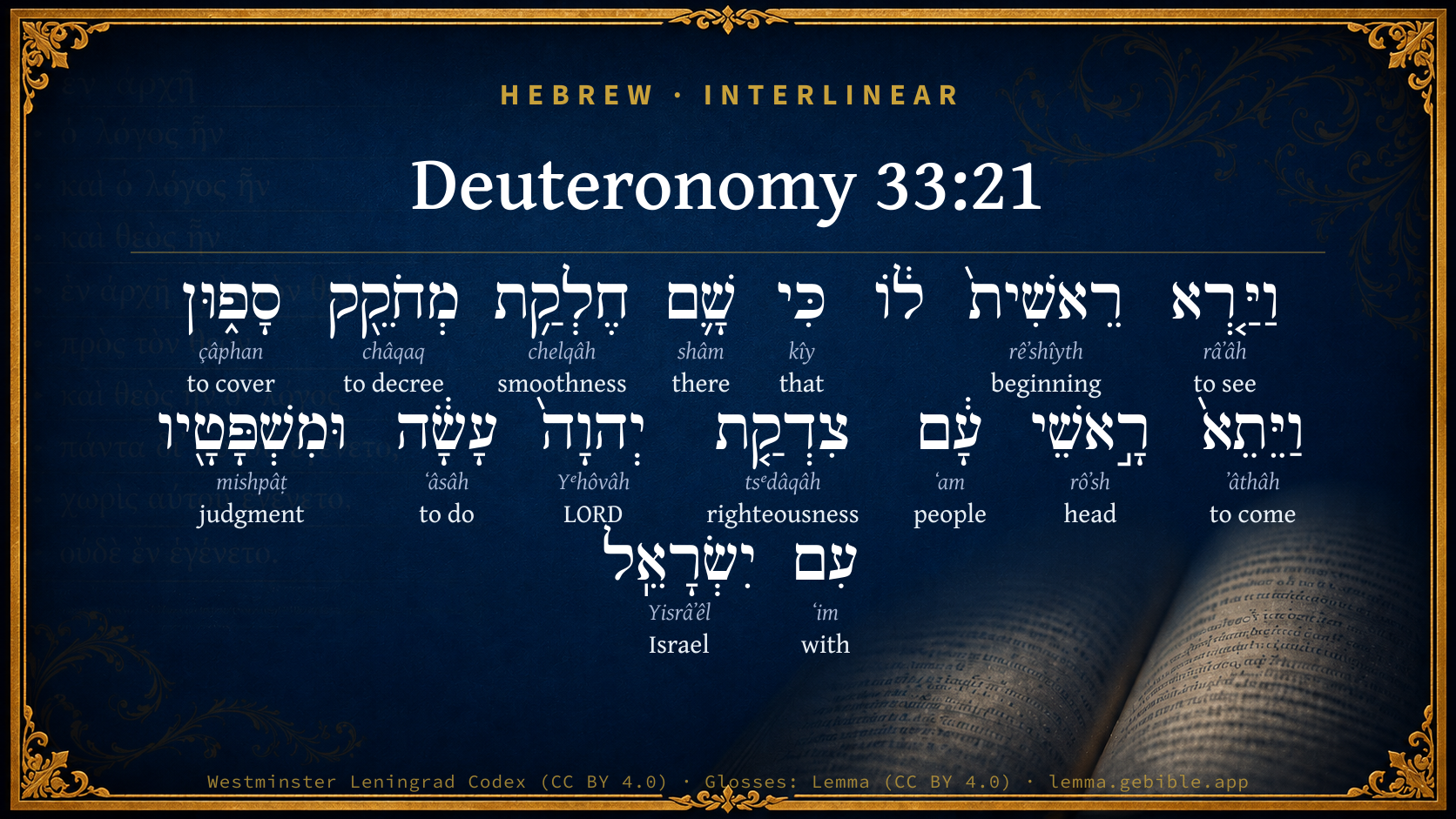
Deuteronomy 33:21

Hebrew (Westminster Leningrad Codex) Deuteronomy 33:21 appears in the Hebrew Old Testament. The text above is from the Westminster Leningrad Codex. Each word links to its Strong’s number, a concise gloss, and parsing drawn from the Open Scriptures Hebrew Bible morphology. Click any word for its full Brown-Driver-Briggs (BDB) entry.
Download image
Cite this verse

Deuteronomy 33:21 (World English Bible). Public Domain. Lemma interlinear Bible study tool, https://lemma.gebible.app/v/deuteronomy/33/21.

Show BibTeX & RIS
BibTeX
RIS
English Translation
He provided the first part for himself, For there was the lawgiver's portion reserved; He came [with] the heads of the people; He executed the righteousness of Yahweh, His ordinances with Israel.
World English Bible · Public Domain
Highlights
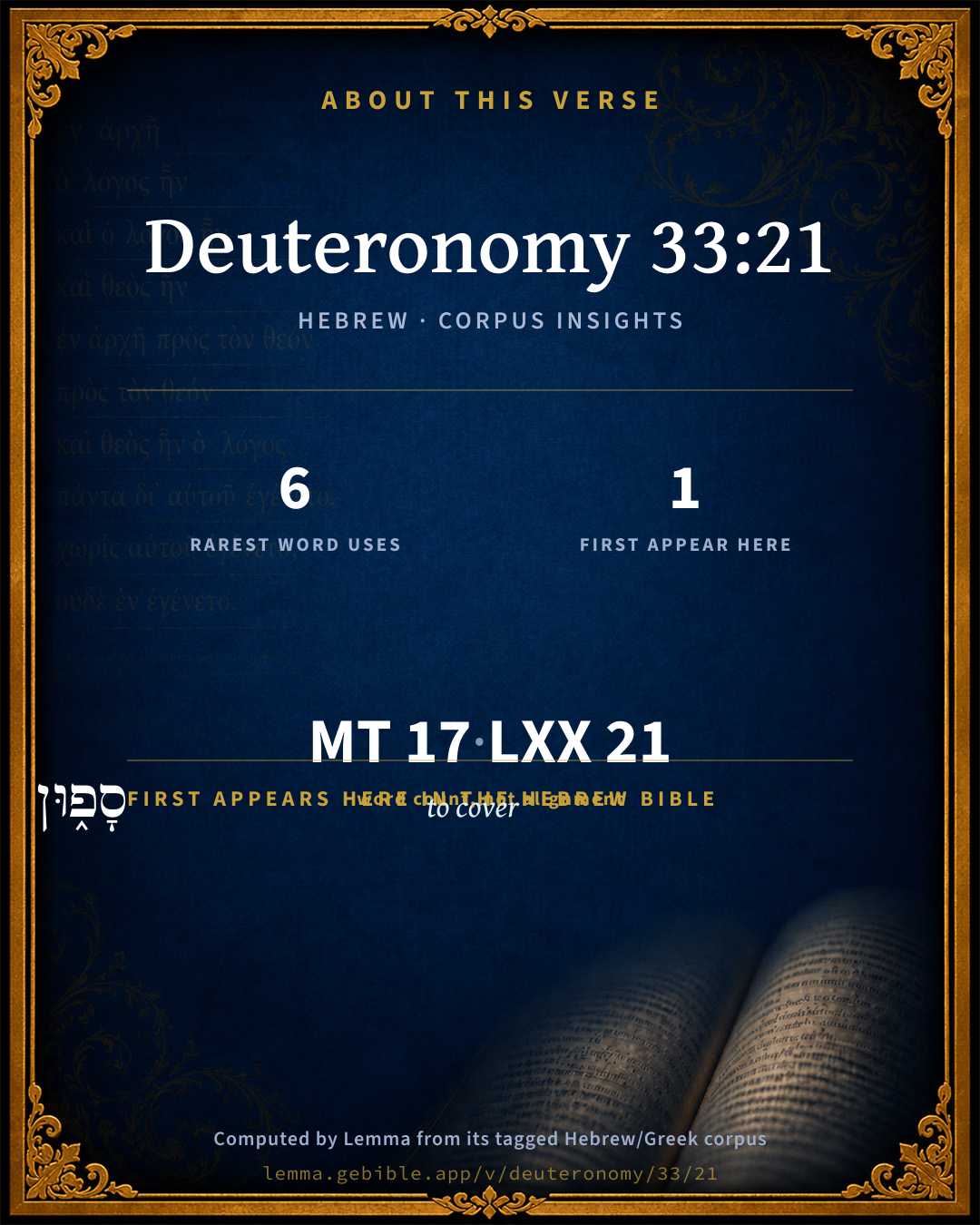
  • 1 first appearance in the Hebrew Bible
Full analysis ↓
Download a study sheet

One document with this verse’s original text, its word-by-word gloss line, the meaning frame, cross-references with their text, attributed commentary, and full source and license credits — printable, and it pastes into notes with its structure intact.

This verse Autodidact and up

Study sheet (.html) Plain text (.txt)

A passage Seminary Student

Up to 50 verses in one chapter. A passage sheet keeps up to 6 commentary sources and 12 cross-references per verse, in the order this page ranks them, and says so on the sheet whenever that leaves anything out. Ask for a single verse and you get the Autodidact verse sheet above.

Everything on this page stays free to read, with no account — the sheet is a download of what is already on screen, not access to it.

Want to remove ads? Support Godless Engineer
Compare translations 3

The same verse in 3 English versions, stacked beneath the original-language interlinear above. Click any original word for its lexicon entry.

Each is an independent rendering of the whole verse — the interlinear is not word-aligned to these translations.

Highlighted words mark where these versions differ — a whole-verse word diff, not a word-by-word alignment.

  • World English Bible Public Domain
    He provided the first part for himself, For there was the lawgiver's portion reserved; He came [with] the heads of the people; He executed the righteousness of Yahweh, His ordinances with Israel.
  • King James Version Public Domain
    And he provided the first part for himself, because there, in a portion of the lawgiver, was he seated; and he came with the heads of the people, he executed the justice of the LORD, and his judgments with Israel.
  • unfoldingWord Literal Text CC BY-SA 4.0
    And he saw the first for himself, for there the portion of a commander reserved. And he came the heads of the people. The justice of Yahweh he carried out, and his judgments with Israel.”

unfoldingWord Literal Text — © unfoldingWord, licensed CC BY-SA 4.0. Word-aligned USFM3 via Door43 (git.door43.org/unfoldingWord/en_ult).

Versions to compare (up to 4)

3 of 4 selected

Show all 18 translations

Every available English version of this verse, each an independent rendering of the whole verse.

  • World English Bible Public Domain
    He provided the first part for himself, For there was the lawgiver's portion reserved; He came [with] the heads of the people; He executed the righteousness of Yahweh, His ordinances with Israel.
  • Berean Standard Bible Public Domain
    He chose the best land for himself, because a ruler’s portion was reserved for him there. He came with the leaders of the people; he administered the LORD’s justice and His ordinances for Israel.”
  • Majority Standard Bible Public Domain
    He chose the best land for himself, because a ruler’s portion was reserved for him there. He came with the leaders of the people; he administered the LORD’s justice and His ordinances for Israel.”
  • King James Version Public Domain
    And he provided the first part for himself, because there, in a portion of the lawgiver, was he seated; and he came with the heads of the people, he executed the justice of the LORD, and his judgments with Israel.
  • American Standard Version (1901) Public Domain
    And he provided the first part for himself, For there was the lawgiver's portion reserved; And he came `with' the heads of the people; He executed the righteousness of Jehovah, And his ordinances with Israel.
  • Revised Version (1885) Public Domain
    And he provided the first part for himself, For there was the lawgiver’s portion reserved; And he came with the heads of the people, He executed the justice of the LORD, And his judgments with Israel.
  • Geneva Bible (1599) Public Domain
    And hee looked to himselfe at the beginning, because there was a portion of the Lawe-giuer hid: yet hee shall come with the heades of the people, to execute the iustice of the Lord, and his iudgements with Israel.
  • Douay-Rheims (1899) Public Domain
    And he saw his pre-eminence, that in his portion the teacher was laid up: who was with the princes of the people, and did the justices of the Lord, and his judgment with Israel.
  • Young's Literal Translation Public Domain
    And he provideth the first part for himself, For there the portion of the lawgiver is covered, And he cometh `with' the heads of the people; The righteousness of Jehovah he hath done, And His judgments with Israel.
  • Literal Standard Version CC BY-SA 4.0
    And he provides the first part for himself, || For there the portion of the lawgiver is covered, || And he comes [with] the heads of the people; He has done the righteousness of YHWH, || And His judgments with Israel.
  • Unlocked Literal Bible CC BY-SA 4.0
    He provided the best part for himself, for there was the leader's portion of land reserved. He came with the heads of the people. He carried out the justice of Yahweh and his decrees with Israel.
  • unfoldingWord Literal Text CC BY-SA 4.0
    And he saw the first for himself, for there the portion of a commander reserved. And he came the heads of the people. The justice of Yahweh he carried out, and his judgments with Israel.”
  • Darby Bible Public Domain
    And he provided the first part for himself, For there was reserved the portion of the lawgiver; And he came with the heads of the people; The justice of Jehovah and his judgments Hath he executed with Israel.
  • World Messianic Bible Public Domain
    He provided the first part for himself, for the lawgiver’s portion was reserved for him. He came with the heads of the people. He executed the righteousness of the LORD, His ordinances with Israel.”
  • Webster's Bible Public Domain
    And he provided the first part for himself, because there, in a portion of the lawgiver, was he seated: and he came with the heads of the people, he executed the justice of the LORD, and his judgments with Israel.
  • Free Bible Version CC BY-SA 4.0
    He chose the best land for himself, for he was allocated a ruler's share. He met with the people's leaders; he did what the Lord said was right, following the Lord's regulations for Israel.”
  • Bible in Basic English Public Domain
    He kept for himself the first part, for his was the ruler's right: he put in force the righteousness of the Lord, and his decisions for Israel.
  • JPS Tanakh (1917) Public Domain
    And he chose a first part for himself, for there a portion of a ruler was reserved; and there came the heads of the people, he executed the righteousness of the LORD, and His ordinances with Israel.

Literal Standard Version (2020), Covenant Press — licensed CC BY-SA 4.0. Text via the HelloAO Bible API (eBible.org). Unlocked Literal Bible (unfoldingWord) — licensed CC BY-SA 4.0. Text via the HelloAO Bible API (eBible.org). unfoldingWord Literal Text — © unfoldingWord, licensed CC BY-SA 4.0. Word-aligned USFM3 via Door43 (git.door43.org/unfoldingWord/en_ult). Free Bible Version, Dr. Jonathan Gallagher — licensed CC BY-SA 4.0. Text via the HelloAO Bible API (eBible.org).

Word by word

More ways to search: Search by grammar → Find every occurrence → Compare this word →

Practice this passage: Drill this verse → Learn its vocabulary →

סָפ֑וּן
çâphan
H5603
“covered”
Verb, Qal, Participle Passive, Masculine, Singular, Absolute
Part of Speech
Verb
Stem
Qal
Form
Participle Passive
Gender
Masculine
Number
Singular
State
Absolute
Full BDB Definition

Origin: a primitive root

TWOT: 1537

to cover, cover in, wainscotted, covered with boards or panelling - (Qal) - to cover in, panel - covered, panelled (participle)
  1. וַיַּ֤רְא râʼâh H7200 “and · to see” Conjunction + Verb, Qal, Sequential Imperfect, 3rd Person, Masculine, Singular
  2. רֵאשִׁית֙ rêʼshîyth H7225 “beginning” Noun, Common, Feminine, Singular, Absolute
  3. כִּי kîy H3588 “that” Conjunction
  4. שָׁ֛ם shâm H8033 “there” Adverb
  5. חֶלְקַ֥ת chelqâh H2513 “smoothness of” Noun, Common, Feminine, Singular, Construct
  6. מְחֹקֵ֖ק châqaq H2710 “decreeing” Verb, Poel, Participle Active, Masculine, Singular, Absolute
  7. וַיֵּתֵא֙ ʼâthâh H857 “and · to come” Conjunction + Verb, Qal, Sequential Imperfect, 3rd Person, Masculine, Singular
  8. רָ֣אשֵׁי rôʼsh H7218 “heads of” Noun, Common, Masculine, Plural, Construct
  9. עָ֔ם ʻam H5971 “people” Noun, Common, Masculine, Singular, Absolute
  10. צִדְקַ֤ת tsᵉdâqâh H6666 “righteousness of” Noun, Common, Feminine, Singular, Construct
  11. יְהוָה֙ Yᵉhôvâh H3068 “LORD” Noun, Proper
  12. עָשָׂ֔ה ʻâsâh H6213 “to do” Verb, Qal, Perfect, 3rd Person, Masculine, Singular
  13. וּמִשְׁפָּטָ֖יו mishpâṭ H4941 “and · judgments · his” Conjunction + Noun, Common, Masculine, Plural, Construct + Suffix, Personal, 3rd Person, Masculine, Singular
  14. עִם ʻim H5973 “with” Preposition
  15. יִשְׂרָאֵֽל Yisrâʼêl H3478 “Israel” Noun, Proper

About this verse

These counts appear in no published source. They are computed here, from the morphology-tagged text and Lemma’s own curated glosses. What Lemma adds →

17
words
16
distinct lemmas
Pentateuch
section

Notable vocabulary

The rarest word here is סָפ֑וּן to cover H5603 — appearing just 6 times in the whole Hebrew Bible.

First appearance in Scripture

This word makes its first canonical appearance in the Hebrew Bible here:

  • סָפ֑וּן to cover H5603

Shared distinctive vocabulary

סָפ֑וּן to cover H5603 occurs in 6 verses of the Hebrew Bible. Also found in:

Grammatical profile

  • 5 verbs
  • 8 nouns
  • 2 prepositions
  • 1 conjunction
  • 1 adverb

Verb forms

  • וַיַּ֤רְא Qal · Sequential Imperfect
  • מְחֹקֵ֖ק Poel · Participle Active
  • סָפ֑וּן Qal · Participle Passive
  • וַיֵּתֵא֙ Qal · Sequential Imperfect
  • עָשָׂ֔ה Qal · Perfect

Hebrew & Septuagint length

In English translation the verse runs 32 words from the Hebrew and 31 from the Septuagint (LXX English) — closely comparable.

A rough comparison of the two English renderings, which tokenize alike — not a word-level alignment.

Word counts can differ between the Hebrew and the Greek without any difference in meaning — e.g. the Hebrew direct-object marker אֵת has no separate Greek word, and Greek often adds the article ὁ.

In the original languages it is 17 Hebrew tokens and 21 Greek tokens — but the two are counted differently (Hebrew bundles its prefixes and suffixes into one token; the Greek is in lemma form), so that isn’t a like-for-like length.

Cross-references

7

Topical passages linked to Deuteronomy 33:21 in the Treasury of Scripture Knowledge — connected by theme and wording, ordered by reader-vote popularity; previews shown in the World English Bible.

  • Numbers 32:1–6 Now the children of Reuben and the children of Gad had a very great multitude of cattle: and when they saw the land of Jazer, and the land of Gilead, that behold, the place was a place for cattle;
  • Numbers 32:16–42 They came near to him, and said, We will build sheepfolds here for our cattle, and cities for our little ones:
  • Joshua 1:14 Your wives, your little ones, and your cattle, shall abide in the land which Moses gave you beyond the Jordan; but you shall pass over before your brothers armed, all the mighty men of valor, and shall help them;
  • Joshua 4:12–13 The children of Reuben, and the children of Gad, and the half-tribe of Manasseh, passed over armed before the children of Israel, as Moses spoke to them:
  • Joshua 22:1–4 Then Joshua called the Reubenites, and the Gadites, and the half-tribe of Manasseh,
  • Judges 5:2 For that the leaders took the lead in Israel, For that the people offered themselves willingly, Bless you Yahweh.
  • Judges 5:11 Far from the noise of archers, in the places of drawing water, There shall they rehearse the righteous acts of Yahweh, [Even] the righteous acts of his rule in Israel. Then the people of Yahweh went down to the gates.

Cross-references courtesy of OpenBible.info (CC BY 4.0).

Hebrew and Greek witnesses Masoretic Hebrew ↔ Greek Septuagint

The same verse in the two great witnesses to the Old Testament, shown verse-for-verse.

These are two independent witnesses, not word-aligned to each other, and the Septuagint is shown in lemma (dictionary) form.

Hebrew Deuteronomy 33:21 Masoretic · Westminster Leningrad Codex

וַיַּ֤רְא רֵאשִׁית֙ ל֔וֹ כִּי שָׁ֛ם חֶלְקַ֥ת מְחֹקֵ֖ק סָפ֑וּן וַיֵּתֵא֙ רָ֣אשֵׁי עָ֔ם צִדְקַ֤ת יְהוָה֙ עָשָׂ֔ה וּמִשְׁפָּטָ֖יו עִם יִשְׂרָאֵֽל

He provided the first part for himself, For there was the lawgiver's portion reserved; He came [with] the heads of the people; He executed the righteousness of Yahweh, His ordinances with Israel.

World English Bible · Public Domain

Greek LXX Deuteronomy 33:21 Septuagint · lemma form

καί ὁράω ἀπαρχή αὐτός ὅτι ἐκεῖ μερίζω γῆ ἄρχων συνἄγω ἅμα ἀρχηγός λαός δικαιοσύνη κύριος ποιέω καί κρίσις αὐτός μετά ἰσραήλ

And he saw his first fruits, that there the land of the princes gathered with the chiefs of the people was divided; the Lord wrought righteousness, and his judgment with Israel.

LXX2012 (modern English Septuagint) · Public Domain

On this verse, The Cambridge Bible for Schools and Colleges discusses the Septuagint’s reading. Read the note in Commentary ↓

Hebrew: Westminster Leningrad Codex (CC BY 4.0). Greek: Septuagint (public domain); English from LXX2012 (modern English Septuagint) (Public Domain). How the Septuagint differs from the Hebrew →

Targum (Aramaic paraphrase)

2

The Targum is the ancient Jewish Aramaic paraphrase of the Hebrew Scriptures — an interpretive translation, not the Hebrew text itself. Onkelos (literal) and Pseudo-Jonathan (expansive) render the Torah, and Jonathan the Prophets. Coverage is partial: where no permissively-licensed English translation exists for a verse, only the Aramaic is shown. This is verse-level text, not a word-by-word alignment to the Hebrew.

  1. Targum Onkelos Torah (Genesis–Deuteronomy)
    וְאִתְקַבֵּל בְּקַדְמֵתָא דִילֵהּ אֲרֵי תַמָן בְּאַחֲסַנְתֵּהּ מֹשֶׁה סָפְרָא רַבָּא דְיִשְׂרָאֵל קְבִיר וְהוּא נָפֵק וְעַל בְּרֵישׁ עַמָא זַכְוָן קֳדָם יְיָ עֲבַד וְדִינוֹהִי עִם יִשְׂרָאֵל

    (no public-domain English translation for this verse)

    Targum Onkelos — Aramaic: “Onkelos Genesis” (public domain); “Onkelos Exodus” (public domain); “Onkelos Leviticus” (public domain); “Onkelos Numbers” (public domain); “Onkelos Deuteronomy” (public domain). English: “Sefaria Community Translation” (CC0 1.0 (public-domain dedication)); “J.W. Etheridge. The Targums of Onkelos and Jonathan Ben Uzziel on the Pentateuch. London: Longmans, Green, 1862” (public domain). Text via Sefaria.

  2. Targum Pseudo-Jonathan Torah (Genesis–Deuteronomy)
    וַחֲמָא אַרְעָא טַבְתָּא וְקַבֵּיל חוּלְקֵיהּ בְּשֵׁירוּיָא אֲרוּם תַּמָן אֲתַר מִקְבַּע אַבְנִין טָבִין וּמַרְגַלְיָין דְבֵיהּ משֶׁה סַפְרֵיהוֹן דְיִשְרָאֵל גְנִיז וְהֵיכְמָא דַהֲוָה עָלֵיל וְנָפִיק בְּרֵישׁ עַמָא בְּעַלְמָא הָדֵין הֵיכְדֵין יְהֵי עָלֵיל וְנָפִיק בְּעַלְמָא דְאָתֵי מְטוֹל דְזַכְוָון קֳדָם יְיָ עָבַד וְסִידְרֵי דִינוֹי אַלִיף לְעַמֵיהּ בֵּית יִשְרָאֵל

    And he saw that the land was good, and took his portion among the first; for there was a place strown with precious stones and pearls; for there is the place where Mosheh the prophet is hidden, who, as he went in and out at the head of the people in this world, will go in and out in the world that cometh; because he wrought righteousness before the Lord, and taught the orders of the judgments to the house of Israel his people.

    Targum Pseudo-Jonathan — Aramaic: “Targum Jonathan on Genesis” (public domain); “Targum Jonathan on Exodus” (public domain); “Targum Jonathan on Leviticus” (public domain); “Targum Jonathan on Numbers” (public domain); “Targum Jonathan on Deuteronomy” (public domain). English: “The Targum of Jonathan ben Uzziel, trans. J. W. Etheridge, London, 1862” (public domain). Text via Sefaria.

Commentary

Notes on Deuteronomy 33:21 from classic Christian and Jewish commentators (each source and its license shown beneath its notes). The classic Christian expositions comment on the surrounding passage and are grouped to its opening verse, so a note may address several verses; the Jewish commentaries on the Tanakh (Rashi and others) are per-verse, so they appear only where the commentator wrote on this verse.

Lemma curates 59 commentaries, every one of them public domain or Creative Commons licensed, each selected and text-cleaned for this edition rather than reprinted as found. About our sources →

The Cambridge Bible for Schools and Colleges

gen. ed. J. J. S. Perowne

21. vow] Heb. nadar, as the parallel nazar shows, means originally ‘to dedicate.’ The term and the idea are found in practically all the Semitic languages.

be slack] Lit. be behind, delay. To pay, lit. to fulfil.

sin in thee] Cp. Deu_15:9.

21. provided] Lit. saw but = saw to.

first part] Or the best, Heb. reshîth. See above, Deu_33:15; and on Deu_18:4.

For there, etc.] Both the text of this line and the beginning of the next—kî sham ḥelḳath meḥoḳeḳ saphun (so far confirmed by Sam.) wayyeth—and the meaning, for there the lot of a ruler was laid up, and he came, etc., are very uncertain. The line is an odd one and may well be a gloss upon the preceding line.

If the Heb. text be accepted, the meaning is that although Gad had received his large and princely territory E. of Jordan yet he came with (Sam. associated himself with) the heads of the people to the conquest of W. Palestine, loyal to the righteous purpose of God, and executed His judgements on its peoples (Exo_23:31 ff.). Possible emendations are ḥelḳoh meḥuḳḳaḳ, and his lot was ordained (Giesebrecht); hullekah ḥelḳath meḥoḳḳeh (cp. LXX ἐμερίσθη γῆ ἀρχόντων), a ruler’s lot was allotted. The last word saphun, reserved or laid up, overloads the line and is by some ingeniously taken with wayyeth’ of the next line as an inversion of wayyith-assephun and there gathered themselves the heads of the peoples, LXX συνηγμένων ἄμα ἀρχηγοῖς λαῶν; and the line is taken as a gloss, or as the repetition by a scribe’s error of the line in Deu_33:5. On the whole v. see Numbers 32.

21–23 (22–24). Of Vows. A vow once made shall be paid without delay. God requires it, neglect is a sin (Deu_33:21). To forbear to vow is no sin, but every uttered promise of this kind must be observed (Deu_33:22 f.).—In the Sg., somewhat redundant, and probably expanded (see on Deu_33:23). Why it stands here is not evident; Steuern. draws attention to the presence of vow in Deu_33:18 (19) as apparently the reason. D has already stated that vows are to be paid at the one altar (Deu_12:6; Deu_12:11; Deu_12:17; Deu_12:26). There is no parallel in E, but one in P, Num_30:2 (3) with some identical phrases, the context of which deals with women’s vows in an elaborate fashion.

For the development of the casuistry thus begun see Mishna, ‘Nedarîm.’ In ancient times the vow was regarded as an essential part of religion (also in mediaeval Christianity) and was usually associated with prayer, cp. the Greek εὐχή, often conditionally on the prayer being granted. It might be a vow that the vower would devote himself to a god’s service, e.g. Jacob, Gen_28:20-22; Absalom, 2Sa_15:7 f.; or the dedication of a child, Hannah, 1Sa_1:11, or of other living thing, Jdg_11:30 (Jephthah), Mal_1:14, Leviticus 27, or houses or land, id. Cp. Psa_22:25 (26), Psa_50:14, Psa_61:8 (9), Psa_65:1 (2), Psa_66:13, Psa_76:11 (12), Psa_116:14; Psa_116:18; Job_22:27, Ecc_5:4 f. (based on our law). All these show that vows were a religious duty, that they were frequently and lightly made, and but indifferently performed. Cp. Mar_7:10 f., Mat_15:4 ff. For the Babylonians see Johns, op. cit. 137, Code of Ḫammurabi, § 181; and for the Arabs W. R. Smith, Rel. Sem. 314 f., 462 ff.

The Cambridge Bible for Schools and Colleges (gen. ed. J. J. S. Perowne; Cambridge University Press, 1878–1918) — public domain. Text from a community e-Sword module.

Trapp's Complete Commentary

John Trapp

Deu 33:21 And he provided the first part for himself, because there, [in] a portion of the lawgiver, [was he] seated; and he came with the heads of the people, he executed the justice of the LORD, and his judgments with Israel.

Ver. 21. In a portion of the lawgiver.] That portion that Moses the lawgiver assigned him on the other side Jordan. {Num 32:33}

He executed the justice of the Lord,] viz., Upon the Canaanites; which is so noble an act that even the good angels refuse not to be executioners of God’s judgments upon obstinate malefactors.

John Trapp, A Commentary or Exposition upon All the Books of the Old and New Testament (1647–1656) — public domain. Text from a community e-Sword module.

Joseph Benson's Commentary

Deu 33:21. He provideth the first part for himself — The first-fruits of the land of promise, the country of Sion, which was first conquered, and which he is said to provide for himself, because he asked and obtained it of Moses, and was the first who viewed his portion in the promised land. There, in a portion of the lawgiver, &c. — This is obscurely expressed, but the meaning seems to be, he was there settled in a portion or settlement allotted him by Moses the Jewish legislator himself, whereas the portions beyond Jordan were given to the several tribes by Joshua, according to the direction of the lot. Or perhaps this part of the land is termed a portion of the lawgiver, because, lying beyond Jordan, it was the only part which Moses was permitted to enter upon. Was he seated — Hebrew, ספון, sapun, covered, or protected: for their wives and children were secured in their cities, while many of the men went over to the war in Canaan. He came with the heads of the people, &c. — Or with the princes, captains, or rulers of the people; that is, under their command and conduct. Or, as ראשׁי, roshee, may be understood, with the first, or in the front of the people, as the Syriac renders it; for this tribe and their brethren, whose lot fell beyond Jordan, were to march into Canaan before their brethren. Thus, again, he speaks, in the prophetic style, of a thing as already done, because he foresaw it would be done. He executed the justice of the Lord — Or his just judgment against the Canaanites, as the rest of the Israelites did.

Joseph Benson's Commentary on the Old and New Testaments (1811–1818) — public domain. Text from a community e-Sword module.

Tyndale Open Study Notes

Tyndale Open Resources

33:21 the best land: Gad chose this territory prior to the conquest. It was the famously rich and productive land of Bashan (Num 32:1-5). The commendation of Gad for carrying out the Lord’s justice and obeying his regulations probably refers to the tribe’s faithfulness in assisting the western tribes in their conquest of Canaan (Josh 22:1-3).

Tyndale Open Study Notes — © Tyndale Open Resources, licensed CC BY-SA 4.0. Text via the HelloAO Bible API.

Geneva Bible (1599)

Geneva Bible translators

So the portion of the Gadites, and others on this side Jordan was God’s, though it was not so known.

Geneva Bible (1599) marginal notes — public domain. Text via Bolls.life.

Adam Clarke's Commentary

Verse 21. He provided the first part] That is, he chose for himself a very excellent portion, viz., the land of Sihon and Og, in which this tribe had requested to be settled by the lawgiver, viz., Moses, from whom they requested this portion, Nu 32:1-5.

He came with the heads of the people] Notwithstanding this portion fell unto them on the east side of Jordan, yet they proceeded with the heads of the people, the chiefs of the other tribes.

To execute the justice of the Lord] To extirpate the old inhabitants of the country, according to the decree and purpose of the Lord. See on Num. xxxii.

Adam Clarke's Commentary on the Bible (1810–1826) — public domain. Text from a community e-Sword/MySword module.

Ellicott's Commentary for English Readers

(21) The first part.—The first territory conquered by Moses was distributed between Reuben and Gad, and the half tribe of Manasseh.

A portion of the lawgiver is interpreted by Rashi as the field of the “burial-place” of the lawgiver. But this can hardly have been in the mind of Moses.

He came with the heads of the people.—The Gadites with their companion tribes passed over Jordan to the conquest of Canaan by Moses’ order.

A Bible Commentary for English Readers, edited by Charles John Ellicott (1878–1897) — public domain. Text from a community e-Sword module.

John Gill's Exposition

And of Dan he said,.... Of the tribe of Dan, as the Targums of Jonathan and Jerusalem:

Dan is a lion's whelp; or like one for boldness, strength, and courage; and was verified in Samson, who was of this tribe; who, when a young lion roared against him, the Spirit of the Lord came on him, and he tore it to pieces, Jdg 14:5,

he shall leap from Bashan; not Dan, for he was seated far from that country; but the sense is, he was like to a young lion for its strength, when it leaps from Bashan, as Aben Ezra rightly explains it. Bashan was a mountain in which lions haunted, and from whence they might be said to leap, as they do when they seize on their prey: it may have some respect to the leap of the Danites from the northwest part of the land of Israel, where they were settled, but was not sufficient for them, to the northeast of it, when they went against Leshem, and took it, and called it Dan; see Jos 19:47.

John Gill's Exposition of the Whole Bible (1746–1763) — public domain (CC PDM 1.0). Text via the HelloAO Bible API.

Albert Barnes' Notes on the Bible

The first fruits of the conquest made by Israel were assigned to Gad and Reuben by Moses, at their own request.

Because ... seated - Render, because there was the leader’s portion reserved, i. e., there was reserved the fitting portion for Gad as a leader in war.

And he came ... - i. e., he joined the other leaders to fulfill the commands of God respecting the conquest of Canaan (compare Num 32:17, Num 32:21, Num 32:32; Jos 1:14). Moses regards the promise of the Gadites to do this as already redeemed.

Albert Barnes' Notes on the Bible (1834–1885) — public domain. Text from a community e-Sword/MySword module.

Haydock's Catholic Bible Commentary

He saw, &c. The pre-eminence of the tribe of Gad, to which this alludes, was their having the lawgiver, Moses, buried in their borders; though the particular place was not known. (Challoner) --- Protestants, "and he provided the first part for himself; because there, in a portion of the lawgiver, was he seated, and he came with the heads of the people," &c. Septuagint, "And he saw his first-fruits," (the first conquered country of Sehon and of Og,) because there the land of the princes was divided, the leaders of the people being assembled, or who were assembled with the leaders. (Haydock) --- Gad and the two other tribes petitioned for that part of the country, and obtained their request of Moses, Numbers xxxii. 27. --- Israel. This is generally understood of Moses; but it may be explained of the tribe of Gad, which complied with the conditions imposed on him, and on his brethren, by the Lord, when he allotted the land of Galaad to them, chap. iii. 18. (Calmet) --- Hebrew, "he executed the justice of the Lord," &c. Septuagint, "the Lord did justice and his judgment with Israel," approving his choice. (Haydock)

George Leo Haydock (1774–1849), Haydock's Catholic Family Bible and Commentary, 1859 edition — public domain. Excludes Psalms (Douay-Rheims chapter numbering differs from Protestant) and Deuterocanonical books (Catholic canon only).

Matthew Poole's English Annotations

The first part; the first-fruits of the Land of Promise, the country of Sihon, which was first conquered, which he is said to provide for himself, because he desired and so obtained it of Moses, Num 32.

A portion of the lawgiver, i.e. of Moses, whose portion this is called, either because this part of the land beyond Jordan was the only part of the land which Moses was permitted to enter upon; or because it was given to him by Moses; whereas the portions beyond Jordan were given to the several tribes by Joshua, according to the direction of the lot.

Was he seated, Heb. hid or protected; for their wives and children were secured in their cities, whilst many of their men went over to the war in Canaan.

He came with the heads of the people, i.e. he went, or he will go, (the preter tense being put for the future, after the manner of the prophets,) to wit, to the war in Canaan, with the princes, or captains, or rulers of the people of Israel, i.e. under their command and conduct, as indeed they did; or with the first of the people; or, in the front of the people, as the Syriac renders it; for this tribe and their brethren, whose lot fell beyond Jordan, were to march, and did march, into Canaan before their brethren, as it is expressed, Jos 1:14. And the Hebrew word rosch oft signifies the beginning or first of a thing.

He executed the justice of the Lord, and his judgments with Israel, i.e. he did or will execute the just judgment of God against the Canaanites, as the rest of the Israelites did; he will join in the war against them, as he promised to do, Num 32:27, and actually did, Jos 1:14.

Matthew Poole's English Annotations on the Holy Bible (1683–1685) — public domain. Text from a community e-Sword/MySword module.

Whedon's Commentary on the Bible

Daniel D. Whedon

21. He provided the first part for himself — He chose the firstfruits for himself. The land on the east of the Jordan, the firstfruits of the conquest, was apportioned to Gad and Reuben. Comp. Numbers 32.

Because there, in a portion of the lawgiver, was he seated — For these was the leader’s portion reserved; kept as an appropriate reward for so brave and successful a leader.

Daniel D. Whedon (gen. ed.), Commentary on the Old and New Testaments (1874–1909) — public domain. Text from a community e-Sword module.

The Pulpit Commentary

Ver. 21 refers to Gad"s obtaining an inheritance for himself from Moses beyond Jordan. And he provided the first part for himself; literally, and he saw for himself (i.e. chose) the first, i.e. either the most excellent part or the firstfruits of the conquest. Because there, in a portion of the lawgiver, was he seated; rather, for there the portion of the leader was reserved. The word rendered t, lawgiver," or "leader" (qqejom), signifies primarily one who ordains or appoints, and is used in both the above senses (Exo_33:22; Jud_1:5:14) it is here applied to Gad, becausethat tribe displayed such promptitude and energy at the head of the tribes in the conquest of the land, that it might be regarded as their leader. An entirely different view of the passage has been taken by some, who by the mechokek understand Moses as the lawgiver, and his portion as the place of his grave, which was concealed, but was within the inheritance of Gad. But it is a fatal objection to this view that not only is the word rendered "portion" (tqlj) nowhere used of a grave, but the grave of Moses on Mount Nebo was in the territory of Reuben, not in that of Gad. Gesenius renders, "The portion of (assigned by) the lawgiver was preserved." But this does not tally with the immediately preceding statement, that Gad chose his portion for himself; at any rate, it could not be because of this that he chose it. Gad chose for himself a portion on the east of Jordan, and the portion he had chosen was sacredly kept for him, though he went with his brethren to the conquest of Canaan. And he came with the heads of the people ; i.e. his place of marching was with the leaders; his place was at the head of the tribes. (cf. Num_32:17, Num_32:21, Num_32:32, and Jos_1:14 Jos_4:12) He executed the justice of the Lord, etc.; i.e. he did what God required of him, obeying his commands, and thereby fulfilling all righteousness (cf. Mat_3:15; Php_3:6) With Israel; in the fellowship of Israel.

The Pulpit Commentary (1880–1919), ed. H.D.M. Spence-Jones & Joseph S. Exell — public domain. Text from a community e-Sword module.

John Wesley's Explanatory Notes

The first part - The first fruits of the land of promise, the country of Sihon, which was first conquered, which he is said to provide for himself, because he desired and obtained it of Moses. Of the law-giver - Of Moses, whose portion this is called, either because this part of the land beyond Jordan was the only part of the land which Moses was permitted to enter upon: or because it was given him by Moses, whereas the portions beyond Jordan were given to the several tribes by Joshua according to the direction of the lot. Seated - Hebrew. hid or protected: for their wives and children were secured in their cities, while many of their men went over to the war in Canaan. He came - He went, or he will go, to the war in Canaan, with the princes, or captains, or rulers of the people of Israel, that is, under their command and conduct, as indeed they did; or with the first of the people; or, in the front of the people, as the Syriack renders it; for this tribe and their brethren whose lot fell beyond Jordan, were to march into Canaan before their brethren. He executed - The just judgment of God against the Canaanites, as the rest of the Israelites did.

John Wesley, Explanatory Notes Upon the Whole Bible (1754–1765) — public domain. Text via the GEBible commentary corpus.

unfoldingWord translationNotes

Door43 World Missions Community

General Information:

Moses continues to bless the tribes of Israel; the blessings are short poems. He continues to describe the tribe of Gad as one man, which he began to do in Deuteronomy 33:20. (See: Parallelism)

the leader's portion

This means a larger piece of land that a leader normally took.

He came with the heads of the people

"They met with all the leaders of the Israelites"

He carried out the justice of Yahweh and his decrees with Israel

"They obeyed all that Yahweh had commanded the Israelites"

translationWords

head

just

decree

Israel

unfoldingWord translationNotes — © Distant Shores Media and the Door43 World Missions Community, licensed CC BY-SA 4.0. Source: git.door43.org/Door43/en_tn.

Rashi

Rabbi Shlomo Yitzchaki (Rashi)

וירא ראשית לו AND HE SAW THE FIRST PART FOR HIMSELF — i.e. he saw good to take for himself territory in the land of Sihon and Og, the subjugation of which was the beginning (ראשית) of the conquest of the Land,

כי שם חלקת BECAUSE THERE WAS THE PORTION — i.e., because he knew that there in his territory was the portion of the field where was the grave of the מחקק, THE LAWGIVER, viz., Moses,

ספון HIDDEN — i.e. that field was hidden and concealed from every creature, as it is said (Deuteronomy 34:6) “And no man knows his burial place” (Sifrei Devarim 355:6).

ויתא AND HE CAME — i.e. Gad came.

ראשי עם AT THE HEAD OF THE PEOPLE — They (the men of Gad) marched before the armed men at the conquest of the Land, because they were mighty, and thus does it state that Joshua said to them, (Joshua 1:14) “Ye shall pass armed before your brethren, etc.”.

צדקת ה' עשה HE DID THE RIGHTEOUSNESS OF THE LORD — because they proved true to their word and kept their promise to cross the Jordan and to remain there until they (the Israelites) had conquered it and divided it amongst the tribes. — Another explanation: ויתא AND HE — the Lawgiver, Moses — CAME ראשי עם AT THE HEAD OF THE PEOPLE, צדקת ה' עשה HE DID THE RIGHTEOUSNESS OF THE LORD — This, too, is spoken of Moses (cf. Sifrei Devarim 355:9).

Rashi on the Tanakh — English translations: “The Judaica Press complete Tanach with Rashi, translated by A. J. Rosenberg” (CC BY 4.0); “Pentateuch with Rashi's commentary by M. Rosenbaum and A.M. Silbermann, 1929-1934” (public domain); “The Metsudah Tanach series, Lakewood, N.J” (CC BY 4.0); and “The Book of Joshua, Metsudah Publications, 1997” (CC BY 4.0). Text via Sefaria.

Lesson kit

Teaching starters — assembled from the data on this page, not authored interpretation. Every prompt links to the verse data it draws on. Edit before teaching.

Deuteronomy, in the Pentateuch, opens this verse with 17 words (16 distinct Hebrew lemmas). Its most distinctive word is çâphan (“to cover”). A historical commentator’s framing appears above. Read the whole chapter for the surrounding context.

Discussion questions

  1. How does “to cover” (çâphan) shape what this verse is saying?
  2. The word “to cover” first appears here in Scripture. What is being introduced at this debut?
  3. 1 Kings 6:9 shares the word «to cover» with this verse. How do the two illuminate each other?
  4. The translations on this page render this verse differently — a whole-verse word diff, not a word-by-word alignment. What might account for the different wordings?
  5. The verb «וַיַּ֤רְא» is Qal Sequential Imperfect. How does its form color the action?
  6. Reading how The Cambridge Bible for Schools and Colleges and Trapp's Complete Commentary read this verse, where do the two commentators agree and where do they part?

Things to notice

Reading settings

Reading text

Shown beneath each verse's original-language words.

Old Testament
Old Testament edition

Read the OT as the Masoretic Hebrew (MT) or the Greek Septuagint (LXX).

English shown for the Greek Septuagint (in the Hebrew ↔ Greek comparison).

Comparing translations? Open the Compare panel on any verse page to stack up to four side by side.