
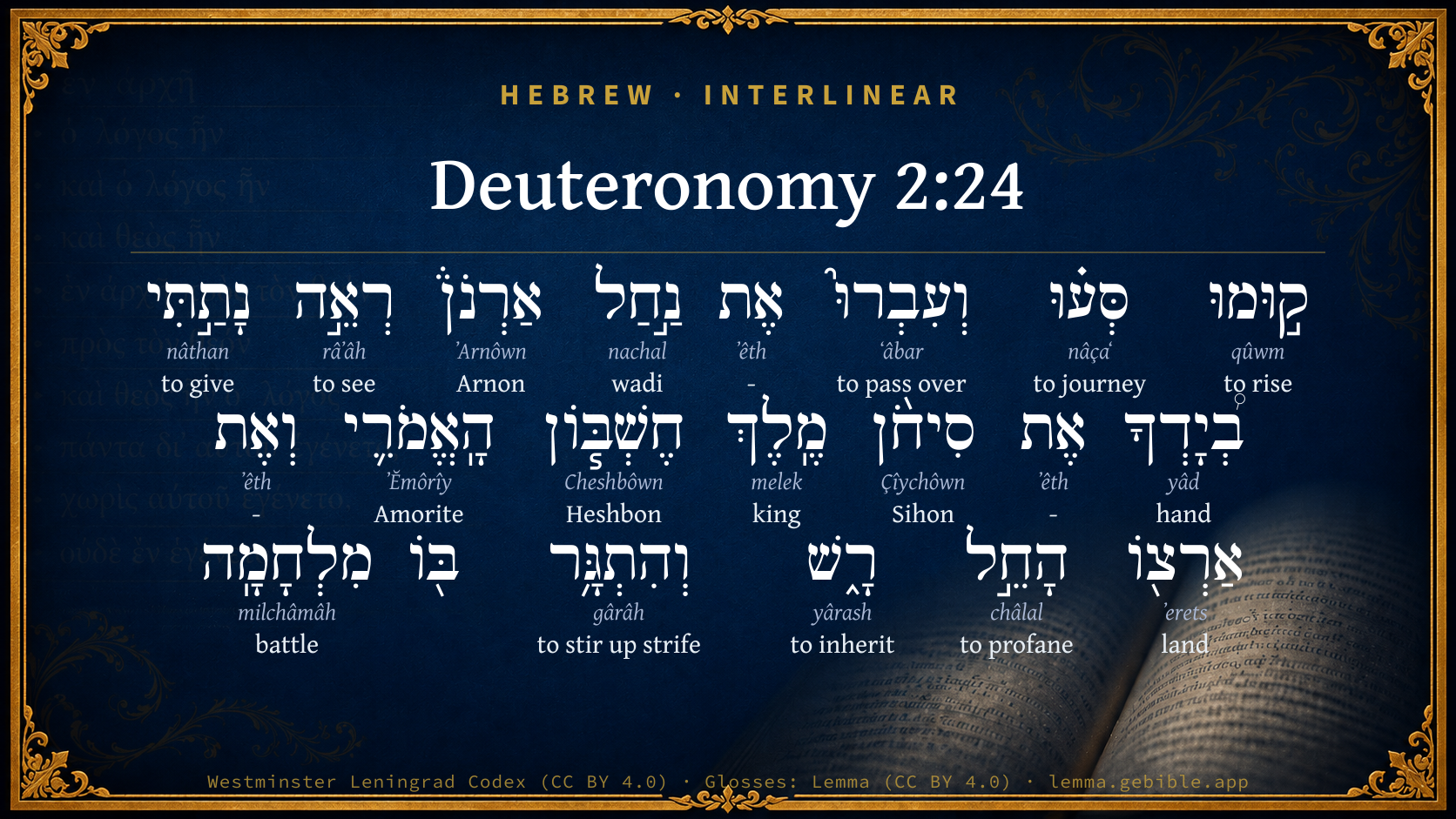
Deuteronomy 2:24

Hebrew (Westminster Leningrad Codex) Deuteronomy 2:24 appears in the Hebrew Old Testament. The text above is from the Westminster Leningrad Codex. Each word links to its Strong’s number, a concise gloss, and parsing drawn from the Open Scriptures Hebrew Bible morphology. Click any word for its full Brown-Driver-Briggs (BDB) entry.
Download image
Cite this verse

Deuteronomy 2:24 (World English Bible). Public Domain. Lemma interlinear Bible study tool, https://lemma.gebible.app/v/deuteronomy/2/24.

Show BibTeX & RIS
BibTeX
RIS
English Translation
Rise up, take your journey, and pass over the valley of the Arnon: behold, I have given into your hand Sihon the Amorite, king of Heshbon, and his land; begin to possess it, and contend with him in battle.
World English Bible · Public Domain
Download a study sheet

One document with this verse’s original text, its word-by-word gloss line, the meaning frame, cross-references with their text, attributed commentary, and full source and license credits — printable, and it pastes into notes with its structure intact.

This verse Autodidact and up

Study sheet (.html) Plain text (.txt)

A passage Seminary Student

Up to 50 verses in one chapter. A passage sheet keeps up to 6 commentary sources and 12 cross-references per verse, in the order this page ranks them, and says so on the sheet whenever that leaves anything out. Ask for a single verse and you get the Autodidact verse sheet above.

Everything on this page stays free to read, with no account — the sheet is a download of what is already on screen, not access to it.

Want to remove ads? Support Godless Engineer
Compare translations 3

The same verse in 3 English versions, stacked beneath the original-language interlinear above. Click any original word for its lexicon entry.

Each is an independent rendering of the whole verse — the interlinear is not word-aligned to these translations.

Highlighted words mark where these versions differ — a whole-verse word diff, not a word-by-word alignment.

  • World English Bible Public Domain
    Rise up, take your journey, and pass over the valley of the Arnon: behold, I have given into your hand Sihon the Amorite, king of Heshbon, and his land; begin to possess it, and contend with him in battle.
  • King James Version Public Domain
    Rise ye up, take your journey, and pass over the river Arnon: behold, I have given into thine hand Sihon the Amorite, king of Heshbon, and his land: begin to possess it, and contend with him in battle.
  • unfoldingWord Literal Text CC BY-SA 4.0
    “‘Rise up, journey, and pass through the wadi of Arnon. Look, I have given into your hand Sihon the Amorite, king of Heshbon, and his land. Begin to possess, and fight against him in battle.

unfoldingWord Literal Text — © unfoldingWord, licensed CC BY-SA 4.0. Word-aligned USFM3 via Door43 (git.door43.org/unfoldingWord/en_ult).

Versions to compare (up to 4)

3 of 4 selected

Show all 18 translations

Every available English version of this verse, each an independent rendering of the whole verse.

  • World English Bible Public Domain
    Rise up, take your journey, and pass over the valley of the Arnon: behold, I have given into your hand Sihon the Amorite, king of Heshbon, and his land; begin to possess it, and contend with him in battle.
  • Berean Standard Bible Public Domain
    “Arise, set out, and cross the Arnon Valley. See, I have delivered into your hand Sihon the Amorite, king of Heshbon, and his land. Begin to take possession of it and engage him in battle.
  • Majority Standard Bible Public Domain
    “Arise, set out, and cross the Arnon Valley. See, I have delivered into your hand Sihon the Amorite, king of Heshbon, and his land. Begin to take possession of it and engage him in battle.
  • King James Version Public Domain
    Rise ye up, take your journey, and pass over the river Arnon: behold, I have given into thine hand Sihon the Amorite, king of Heshbon, and his land: begin to possess it, and contend with him in battle.
  • American Standard Version (1901) Public Domain
    Rise ye up, take your journey, and pass over the valley of the Arnon: behold, I have given into thy hand Sihon the Amorite, king of Heshbon, and his land; begin to possess it, and contend with him in battle.
  • Revised Version (1885) Public Domain
    Rise ye up, take your journey, and pass over the valley of Arnon: behold, I have given into thine hand Sihon the Amorite, king of Heshbon, and his land: begin to possess it, and contend with him in battle.
  • Geneva Bible (1599) Public Domain
    Rise vp therefore, sayd the Lord: take your iourney, and passe ouer the riuer Arnon: beholde, I haue giuen into thy hand Sihon, the Amorite, King of Heshbon, and his land: begin to possesse it and prouoke him to battell.
  • Douay-Rheims (1899) Public Domain
    Arise ye, and pass the torrent Arnon: Behold I have delivered into thy hand Sehon king of Hesebon the Amorrhite, and begin thou to possess his land and make war against him.
  • Young's Literal Translation Public Domain
    `Rise ye, journey and pass over the brook Arnon; see, I have given into thy hand Sihon king of Heshbon, the Amorite, and his land; begin to possess, and stir up thyself against him `in' battle.
  • Literal Standard Version CC BY-SA 4.0
    Rise, journey, and pass over the Brook of Arnon; see, I have given into your hand Sihon king of Heshbon, the Amorite, and his land; begin to possess [it], and stir yourself up against him [in] battle.
  • Unlocked Literal Bible CC BY-SA 4.0
    “'Now rise up, go on your journey, and pass over the Valley of the Arnon; look, I have given into your hand Sihon the Amorite, king of Heshbon, and his land. Begin to possess it, and fight with him in battle.
  • unfoldingWord Literal Text CC BY-SA 4.0
    “‘Rise up, journey, and pass through the wadi of Arnon. Look, I have given into your hand Sihon the Amorite, king of Heshbon, and his land. Begin to possess, and fight against him in battle.
  • Darby Bible Public Domain
    Rise up, take your journey, and pass over the river Arnon. Behold, I have given into thy hand Sihon the king of Heshbon, the Amorite, and his land: begin, take possession, and engage with him in battle.
  • World Messianic Bible Public Domain
    “Rise up, take your journey, and pass over the valley of the Arnon. Behold, I have given into your hand Sihon the Amorite, king of Heshbon, and his land; begin to possess it, and contend with him in battle.
  • Webster's Bible Public Domain
    Arise ye, take your journey, and pass over the river Arnon: behold, I have given into thy hand Sihon the Amorite, king of Heshbon, and his land: begin to possess it, and contend with him in battle.
  • Free Bible Version CC BY-SA 4.0
    Then the Lord told us, “Get up, go and cross the Arnon Valley. Look, I have handed over to you Sihon the Amorite, king of Heshbon, as well as his land. Go and start taking it over, and fight him in battle.
  • Bible in Basic English Public Domain
    Get up now, and go on your journey, crossing over the valley of the Arnon: see, I have given into your hands Sihon, the Amorite, king of Heshbon, and all his land: go forward to make it yours, and make war on him,
  • JPS Tanakh (1917) Public Domain
    Rise ye up, take your journey, and pass over the valley of Arnon; behold, I have given into thy hand Sihon the Amorite, king of Heshbon, and his land; begin to possess it, and contend with him in battle.

Literal Standard Version (2020), Covenant Press — licensed CC BY-SA 4.0. Text via the HelloAO Bible API (eBible.org). Unlocked Literal Bible (unfoldingWord) — licensed CC BY-SA 4.0. Text via the HelloAO Bible API (eBible.org). unfoldingWord Literal Text — © unfoldingWord, licensed CC BY-SA 4.0. Word-aligned USFM3 via Door43 (git.door43.org/unfoldingWord/en_ult). Free Bible Version, Dr. Jonathan Gallagher — licensed CC BY-SA 4.0. Text via the HelloAO Bible API (eBible.org).

Word by word

More ways to search: Search by grammar → Find every occurrence → Compare this word →

Practice this passage: Drill this verse → Learn its vocabulary →

וְהִתְגָּ֥ר
gârâh
H1624
“and · stir up strife”
Conjunction + Verb, Hithpael, Imperative, 2nd Person, Masculine, Singular
Part of Speech
Conjunction + Verb
Stem
Hithpael
Form
Imperative
Person
2nd Person
Gender
Masculine
Number
Singular
Full BDB Definition

Origin: a primitive root

TWOT: 378

to cause strife, stir up, contend, meddle, strive, be stirred up - (Piel) to stir up strife, excite strife - (Hithpael) - to excite oneself against, engage in strife - to excite oneself (against foe), wage war
  1. ק֣וּמוּ qûwm H6965 “rise” Verb, Qal, Imperative, 2nd Person, Masculine, Plural
  2. סְּע֗וּ nâçaʻ H5265 “journey” Verb, Qal, Imperative, 2nd Person, Masculine, Plural
  3. וְעִבְרוּ֮ ʻâbar H5674 “and · pass over” Conjunction + Verb, Qal, Imperative, 2nd Person, Masculine, Plural
  4. אֶת ʼêth H853 “-” Particle, Direct Object
  5. נַ֣חַל nachal H5158 “wadi of” Noun, Common, Masculine, Singular, Construct
  6. אַרְנֹן֒ ʼArnôwn H769 “Arnon” Noun, Proper
  7. רְאֵ֣ה râʼâh H7200 “see” Verb, Qal, Imperative, 2nd Person, Masculine, Singular
  8. נָתַ֣תִּי nâthan H5414 “to give” Verb, Qal, Perfect, 1st Person, Common, Singular
  9. בְ֠יָדְךָ yâd H3027 “in/at · hand · your” Preposition + Noun, Common, Both, Singular, Construct + Suffix, Personal, 2nd Person, Masculine, Singular
  10. אֶת ʼêth H853 “-” Particle, Direct Object
  11. סִיחֹ֨ן Çîychôwn H5511 “Sihon” Noun, Proper
  12. מֶֽלֶךְ melek H4428 “king of” Noun, Common, Masculine, Singular, Construct
  13. חֶשְׁבּ֧וֹן Cheshbôwn H2809 “Heshbon” Noun, Proper
  14. הָֽאֱמֹרִ֛י ʼĔmôrîy H567 “the · Amorite” Particle, Definite Article + Noun, Gentilic, Masculine, Singular, Absolute
  15. וְאֶת ʼêth H853 “and · -” Conjunction + Particle, Direct Object
  16. אַרְצ֖וֹ ʼerets H776 “land · his” Noun, Common, Both, Singular, Construct + Suffix, Personal, 3rd Person, Masculine, Singular
  17. הָחֵ֣ל châlal H2490 “profane” Verb, Hiphil, Imperative, 2nd Person, Masculine, Singular
  18. רָ֑שׁ yârash H3423 “inherit” Verb, Qal, Imperative, 2nd Person, Masculine, Singular
  19. מִלְחָמָֽה milchâmâh H4421 “battle” Noun, Common, Feminine, Singular, Absolute

About this verse

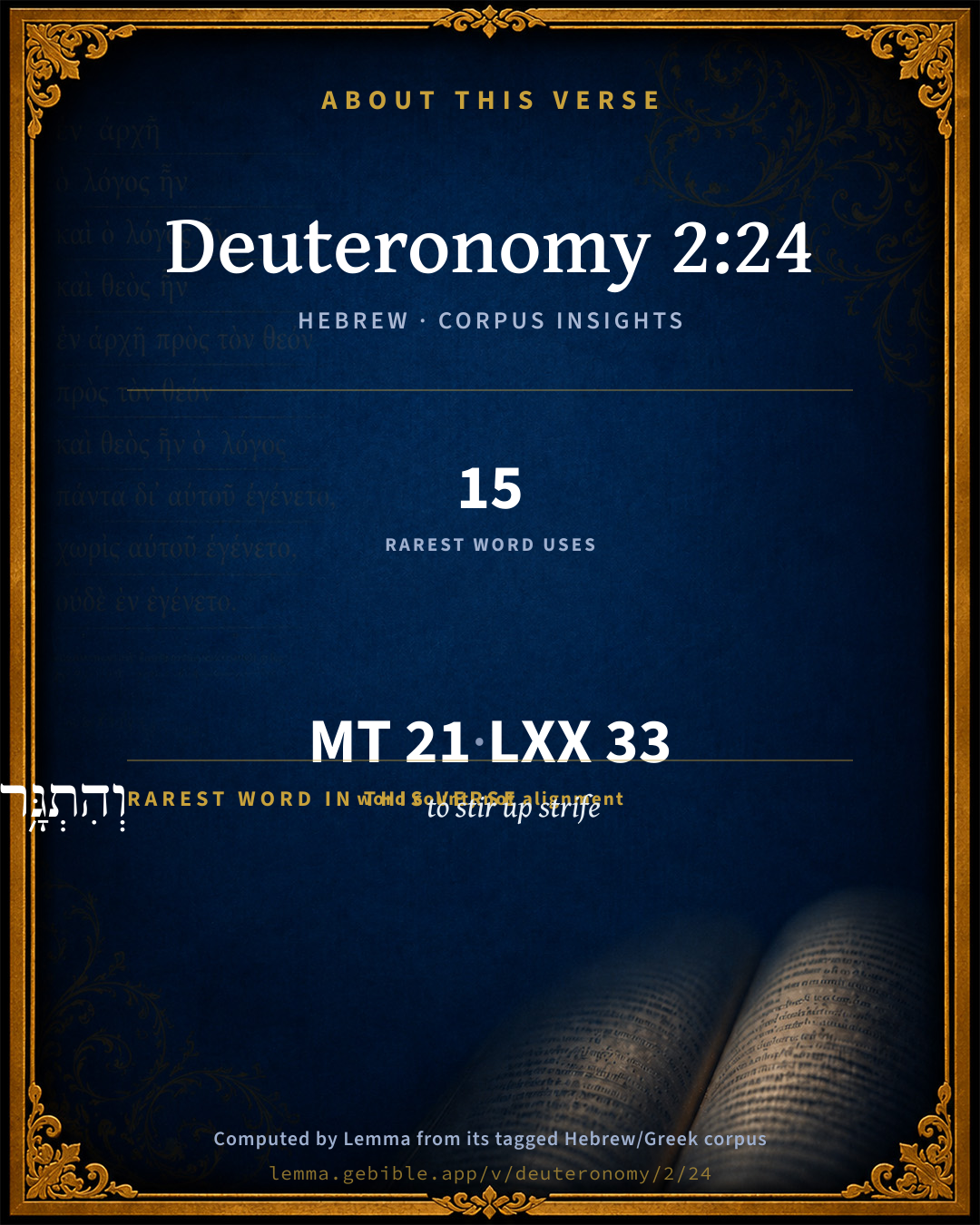
These counts appear in no published source. They are computed here, from the morphology-tagged text and Lemma’s own curated glosses. What Lemma adds →

21
words
18
distinct lemmas
Pentateuch
section

Notable vocabulary

The rarest word here is וְהִתְגָּ֥ר to stir up strife H1624 — appearing just 15 times in the whole Hebrew Bible.

Shared distinctive vocabulary

וְהִתְגָּ֥ר to stir up strife H1624 occurs in 13 verses of the Hebrew Bible. Also found in:

Grammatical profile

  • 8 verbs
  • 9 nouns
  • 1 preposition
  • 3 particles

Verb forms

  • ק֣וּמוּ Qal · Imperative
  • סְּע֗וּ Qal · Imperative
  • וְעִבְרוּ֮ Qal · Imperative
  • רְאֵ֣ה Qal · Imperative
  • נָתַ֣תִּי Qal · Perfect
  • הָחֵ֣ל Hiphil · Imperative
  • רָ֑שׁ Qal · Imperative
  • וְהִתְגָּ֥ר Hithpael · Imperative

Hebrew & Septuagint length

In English translation the verse runs 39 words from the Hebrew and 40 from the Septuagint (LXX English) — closely comparable.

A rough comparison of the two English renderings, which tokenize alike — not a word-level alignment.

Word counts can differ between the Hebrew and the Greek without any difference in meaning — e.g. the Hebrew direct-object marker אֵת has no separate Greek word, and Greek often adds the article ὁ.

In the original languages it is 21 Hebrew tokens and 33 Greek tokens — but the two are counted differently (Hebrew bundles its prefixes and suffixes into one token; the Greek is in lemma form), so that isn’t a like-for-like length.

Cross-references

10

Topical passages linked to Deuteronomy 2:24 in the Treasury of Scripture Knowledge — connected by theme and wording, ordered by reader-vote popularity; previews shown in the World English Bible.

  • Judges 11:18–21 Then they went through the wilderness, and went around the land of Edom, and the land of Moab, and came by the east side of the land of Moab, and they encamped on the other side of the Arnon; but they didn't come within the border of Moab, for the Arnon was the border of Moab.
  • Jeremiah 27:5 I have made the earth, the men and the animals that are on the surface of the earth, by my great power and by my outstretched arm; and I give it to whom it seems right to me.
  • Ezekiel 29:20 I have given him the land of Egypt as his recompense for which he served, because they worked for me, says the Lord Yahweh.
  • Daniel 4:17 The sentence is by the decree of the watchers, and the demand by the word of the holy ones; to the intent that the living may know that the Most High rules in the kingdom of men, and gives it to whoever he will, and sets up over it the lowest of men.
  • 2 Chronicles 36:23 Thus says Cyrus king of Persia, All the kingdoms of the earth has Yahweh, the God of heaven, given me; and he has charged me to build him a house in Jerusalem, which is in Judah. Whoever there is among you of all his people, Yahweh his God be with him, and let him go up.
  • Daniel 2:38 and wherever the children of men dwell, the animals of the field and the birds of the sky has he given into your hand, and has made you to rule over them all: you are the head of gold.
  • Numbers 21:13–15 From there they traveled, and encamped on the other side of the Arnon, which is in the wilderness, that comes out of the border of the Amorites: for the Arnon is the border of Moab, between Moab and the Amorites.
  • Deuteronomy 2:36 From Aroer, which is on the edge of the valley of the Arnon, and [from] the city that is in the valley, even to Gilead, there was not a city too high for us; Yahweh our God delivered up all before us:
  • Joshua 6:16 It happened at the seventh time, when the priests blew the trumpets, Joshua said to the people, Shout; for Yahweh has given you the city.
  • Ezra 1:2 Thus says Cyrus king of Persia, All the kingdoms of the earth has Yahweh, the God of heaven, given me; and he has charged me to build him a house in Jerusalem, which is in Judah.

Cross-references courtesy of OpenBible.info (CC BY 4.0).

Hebrew and Greek witnesses Masoretic Hebrew ↔ Greek Septuagint

The same verse in the two great witnesses to the Old Testament, shown verse-for-verse.

These are two independent witnesses, not word-aligned to each other, and the Septuagint is shown in lemma (dictionary) form.

Hebrew Deuteronomy 2:24 Masoretic · Westminster Leningrad Codex

ק֣וּמוּ סְּע֗וּ וְעִבְרוּ֮ אֶת נַ֣חַל אַרְנֹן֒ רְאֵ֣ה נָתַ֣תִּי בְ֠יָדְךָ אֶת סִיחֹ֨ן מֶֽלֶךְ חֶשְׁבּ֧וֹן הָֽאֱמֹרִ֛י וְאֶת אַרְצ֖וֹ הָחֵ֣ל רָ֑שׁ וְהִתְגָּ֥ר בּ֖וֹ מִלְחָמָֽה

Rise up, take your journey, and pass over the valley of the Arnon: behold, I have given into your hand Sihon the Amorite, king of Heshbon, and his land; begin to possess it, and contend with him in battle.

World English Bible · Public Domain

Greek LXX Deuteronomy 2:24 Septuagint · lemma form

νῦν οὖν ἀναἵστημι καί ἀποαἴρω καί παραἔρχομαι σύ ὁ φάραγξ αρνων ἰδού παραδίδωμι εἰς ὁ χείρ σύ ὁ σηων βασιλεύς εσεβων ὁ ἀμορραῖος καί ὁ γῆ αὐτός ἐνἄρχω κληρονομέω συνἅπτω πρός αὐτός πόλεμος

Now then arise and depart, and pass over the valley of Arnon: behold, I have delivered into your hands Seon the king of Esebon the Amorite, and his land: begin to inherit it: engage in war with him this day.

LXX2012 (modern English Septuagint) · Public Domain

On this verse, The Cambridge Bible for Schools and Colleges discusses the Septuagint’s reading. Read the note in Commentary ↓

Hebrew: Westminster Leningrad Codex (CC BY 4.0). Greek: Septuagint (public domain); English from LXX2012 (modern English Septuagint) (Public Domain). How the Septuagint differs from the Hebrew →

Targum (Aramaic paraphrase)

2

The Targum is the ancient Jewish Aramaic paraphrase of the Hebrew Scriptures — an interpretive translation, not the Hebrew text itself. Onkelos (literal) and Pseudo-Jonathan (expansive) render the Torah, and Jonathan the Prophets. Coverage is partial: where no permissively-licensed English translation exists for a verse, only the Aramaic is shown. This is verse-level text, not a word-by-word alignment to the Hebrew.

  1. Targum Onkelos Torah (Genesis–Deuteronomy)
    קוּמוּ טוּלוּ וְעִבָרוּ יָת נַחֲלָא דְאַרְנוֹן חֲזִי דִמְסָרִית בִּידָךְ יָת סִיחוֹן מַלְכָּא דְחֶשְׁבּוֹן אֱמוֹרָאָה וְיָת אַרְעֵהּ שְׁרֵי לְתָרָכוּתֵהּ וְאִתְגָרֵי לְמֶעְבַּד עִמֵהּ קְרָבָא

    (no public-domain English translation for this verse)

    Targum Onkelos — Aramaic: “Onkelos Genesis” (public domain); “Onkelos Exodus” (public domain); “Onkelos Leviticus” (public domain); “Onkelos Numbers” (public domain); “Onkelos Deuteronomy” (public domain). English: “Sefaria Community Translation” (CC0 1.0 (public-domain dedication)); “J.W. Etheridge. The Targums of Onkelos and Jonathan Ben Uzziel on the Pentateuch. London: Longmans, Green, 1862” (public domain). Text via Sefaria.

  2. Targum Pseudo-Jonathan Torah (Genesis–Deuteronomy)
    אִזְדְּקָפוּ טוּלוּ וְעִבְרוּ יַת נַחֲלֵי אַרְנוֹנָא חֲמוֹן דִּי מְסָרִית בִּידֵיכוֹן יַת סִיחוֹן מַלְכָּא דְחֶשְׁבּוֹן אֱמוֹרָאָה וְיַת אַרְעֵיהּ שָׁרֵי לְתַרְכוּתֵיהּ וְתִתְגָרֵי לִמְסַדְרָא לְקוּבְלֵיהּ סִדְרֵי קְרָבָא

    Arise, take your journey, and pass over the river Arnona; behold, I have delivered into your hands Sihon the king of Heshbon and the Amoraah, and his land: begin to drive them out, and to provoke him to wage war.

    Targum Pseudo-Jonathan — Aramaic: “Targum Jonathan on Genesis” (public domain); “Targum Jonathan on Exodus” (public domain); “Targum Jonathan on Leviticus” (public domain); “Targum Jonathan on Numbers” (public domain); “Targum Jonathan on Deuteronomy” (public domain). English: “The Targum of Jonathan ben Uzziel, trans. J. W. Etheridge, London, 1862” (public domain). Text via Sefaria.

Commentary

Notes on Deuteronomy 2:24 from classic Christian and Jewish commentators (each source and its license shown beneath its notes). The classic Christian expositions comment on the surrounding passage and are grouped to its opening verse, so a note may address several verses; the Jewish commentaries on the Tanakh (Rashi and others) are per-verse, so they appear only where the commentator wrote on this verse.

Lemma curates 59 commentaries, every one of them public domain or Creative Commons licensed, each selected and text-cleaned for this edition rather than reprinted as found. About our sources →

Matthew Henry's Commentary

God having tried the self-denial of his people in forbidding them to meddle with the Moabites and Ammonites, and they having quietly passed by those rich countries, and, though superior in number, not made any attack upon them, here he recompenses them for their obedience by giving them possession of the country of Sihon king of the Amorites. If we forbear what God forbids, we shall receive what he promises, and shall be no losers at last by our obedience, though it may seem for the present to be to our loss. Wrong not others, and God shall right thee.

I. God gives them commission to seize upon the country of Sihon king of Heshbon, Deu 2:24, Deu 2:25. This was then God's way of disposing of kingdoms, but such particular grants are not now either to be expected or pretended. In this commission observe, 1. Though God assured them that the land should be their own, yet they must bestir themselves, and contend in battle with the enemy. What God gives we must endeavour to get. 2. God promises that when they fight he will fight for them. Do you begin to possess it, and I will begin to put the dread of you upon them. God would dispirit the enemy and so destroy them, would magnify Israel and so terrify all those against whom they were commissioned. See Exo 15:14.

II. Moses sends to Sihon a message of peace, and only begs a passage through his land, with a promise to give his country no disturbance, but the advantage of trading for ready money with so great a body, Deu 2:26-29. Moses herein did neither disobey God, who bade him contend with Sihon, nor dissemble with Sihon; but doubtless it was by divine direction that he did it, that Sihon might be left inexcusable, though God hardened his heart. This may illustrate the method of God's dealing with those to whom he gives his gospel, but does not give grace to believe it.

III. Sihon began the war (Deu 2:32), God having made his heart obstinate, and hidden from his eyes the thing that belonged to his peace (Deu 2:30), that he might deliver him into the hand of Israel. Those that meddle with the people of God meddle to their own hurt; and God sometimes ruins his enemies by their own resolves. See Mic 4:11-13; Rev 16:14.

IV. Israel was victorious. 1. They put all the Amorites to the sword, men, women, and children (Deu 2:33, Deu 2:34); this they did as the executioners of God's wrath; now the measure of the Amorites' iniquity was full (Gen 15:16), and the longer it was in the filling the sorer was the reckoning at last. This was one of the devoted nations. They died, not as Israel's enemies, but as sacrifices to divine justice, in the offering of which sacrifices Israel was employed, as a kingdom of priests. The case being therefore extraordinary, it ought not to be drawn into a precedent for military executions, which make no distinction and give no quarter: those will have judgment without mercy that show no mercy. 2. They took possession of all they had; their cities (Deu 2:34), their goods (Deu 2:35), and their land, Deu 2:36. The wealth of the sinner is laid up for the just. What a new world did Israel now come into! Most of them were born, and had lived all their days, in a vast howling wilderness, where they knew not what either fields or cities were, had no houses to dwell in, and neither sowed nor reaped; and now of a sudden to become masters of a country so well built, so well husbanded, this made them amends for their long waiting, and yet it was but the earnest of a great deal more. Much more joyful will the change be which holy souls will experience when they remove out of the wilderness of this world to the better country, that is, the heavenly, to the city that has foundations.

Matthew Henry's Commentary on the Whole Bible (1708–1710) — public domain (CC PDM 1.0). Text via the HelloAO Bible API.

Whedon's Commentary on the Bible

Daniel D. Whedon

CONQUEST OF THE AMORITES, Deu_2:24-37.

The Israelites were not to make war upon the Edomites, nor Moabites, nor Ammonites, but they are told that Jehovah has given Sihon the Amorite and his land to them.

Daniel D. Whedon (gen. ed.), Commentary on the Old and New Testaments (1874–1909) — public domain. Text from a community e-Sword module.

The Pulpit Commentary

Vers. 24-37. CONQUEST OF THE KINGDOM OF SIHON. Sihon and his people were Amorites, who had settled on the east of the Jordan in Gilead. But though not included in the original promise to Abraham, God had assigned this territory to the Israelites; and, therefore, he commanded the people under Moses to cross the Amen, and take the first step towards possessing the Promised Land, by assailing Sihon, King of Heshbon, assuring them that from that day he would "put the dread and fear of them upon all nations under the whole heaven," that is, all nations, wherever placed, to whom the fame of the Israelites should come (comp. Ex 23, Deu_11:16) so that on hearing thereof, they should tremble and writhe as in pain. (Wljw, comp. Isa_13:8) Moses, however, in the first instance, sent a message of peace to Sihon, proposing to pass through his territory on the same terms as he had made with the Moabites and Edomites, traveling by the highway, and paying for such provisions as his followers required. But this Sihon refused, and came out against Israel, with all his people, to battle. The issue was that he was utterly discomfited; all his towns were captured, he and all his people utterly destroyed, and the cattle and spoil of the whole country taken for booty. Israel thus became possessed of that entire territory, though it did not lie within the bounds of the land promised by God to Abraham, which was the reason, probably, why Moses made overtures of peace to Sihon, and would have passed through his country amicably, had he been permitted; but comp. Deu_20:10.

Vers. 24-37. Warrantable warfare.

Sihon, King of Heshbon, opposed with physical force the fulfillment of Israel"s destiny; and, having provoked war, provokes it to his own destruction.

I THE NECESSITY FOR WAR. The question whether war is ever just and legitimate must be answered in the affirmative. Still, this does not justify all war. The majority of wars are indefensible. War is a barbarous instrument, and, as intelligence advances, can be replaced by better methods of conquest. But it sometimes becomes the last and desperate alternative. If war has been tolerated in heaven, it may be tolerated on earth. Even a war of extermination may be, under some conceivable circumstances, a necessity. In this case we may look:

1. At the human side of the war.

(1) There was an arrogant rejection of equitable demands. No man, and no State, holds an absolute and irresponsible right to the surface of the globe. "The earth is the Lord"s." We may acquire, by inheritance, or purchase, or culture, personal interests in the land, which others are bound to respect. Yet personal interests are to be subservient to a nation"s good. The lesser must yield to the greater. Israel justly demanded a right of way to his own possessions. The terms proposed by the Hebrews were fair and equitable, and the onus of war fell on him who rejected them.

(2) Israel could point to his pacific and honorable conduct in passing through the territories of Ammon and Esau. A reputation for trustworthiness in observing a treaty had been already established.

(3) The rejection of Israels proposal involved a deprivation of Israels natural rights. The patriarch Jacob had acquired by purchase and by culture much land in Canaan; and now, released from prolonged captivity, the people claim their ancestral estates. If we leave out of view the commands of Jehovah, there was ample reason, founded in common justice, why the Hebrews should demand a passage into Canaan.

2. Let us contemplate the matter on the Divine side. This invasion was a plain intimation of Jehovah"s will.

(1) It is not mans place to sit in judgment on his God. We are largely ignorant of all the factors in this case. There are vaster considerations than we can reach problems which we cannot solve. Our moral judgments are often warped by weak and morbid sentiments. Righteousness, in its very nature, is superior to pleasure. "Shall not the Judge of all the earth do right?

(2) We are assured that the guilt of the Amorites was great. What forms this guilt assumed we are not fully told, but certain it is that most flagrant corruptions flourished among them. He who uses elemental forces and angelic agents to execute his judicial verdicts, is equally at liberty to employ men as the officers of his vengeance.

(3) Very probably this was a signal act of retributive justice. Possibly they had acquired the. territory by violence and bloodshed, and had now to yield it again to the arbiter of war. They that take the sword shall perish with the sword.

(4) Certainly this calamity was in the line of the worlds progress. Mankind has been benefited by the overthrow of corrupt empires. This was the rough pathway along which Israel fulfilled its beneficent destiny.

II THE PRECISE OCCASION FOR THIS WAR. This is attributed to the stolid perverseness of one man Sihon, King of Heshbon. Is it to be tolerated that the march of a nation"s destiny is to be baffled by the ignorance, or lust, or stupidity of one man?

1. This obstinacy of the royal will must be attributed to natural causes. God never compels a man to be bad. Human nature was the same in Sihon"s day as in ours. Insolent arrogance is a growth. Sihon had for many years repressed nobler instincts, stifled generous feeling, pampered selfishness and pride; hence blind obstinacy became in him despotic. Corrupt principles spring from tiny seeds.

2. There are stages in a man"s career when his choice becomes his fate. By the operation of God"s unseen laws and mysterious forces, habits become as fixed as granite. The hardening process becomes irreversible, and truly it is said that God does it. We can choose whether or not to prepare our artillery, manufacture our explosives, or light the fuse, but at that point human control ends; the cannon-ball wings its way by laws imposed by God, and it is now entirely at his disposal. So in the moral sphere, there is a point at which human choice ends, and in his judicial capacity God steps in and fixes irreversibly the matter. "He that is filthy, let him be filthy still." We slowly and imperceptibly harden our sentient natures; then God fixes them with his judicial act, and we are held in the iron manacles of doom.

III THE SECRET OF SUCCESS IN WAR.

1. Gods promise of success does not exclude human exertion. His promise always presupposes man"s wise activity. His pledge of help is intended to stimulate, not supplant, brave endeavor. We can only move successfully in the line of God"s promise.

2. Gods initial processes should be closely followed by our activity. "I have begun," said God (ver. 31), therefore "begin to possess." We should follow hard upon God"s path, then his right hand will uphold us. If tardiness enchain our feet, we may soon lose the trace of his footprints.

3. One brave deed is the forerunner of many successes. The report of Israel"s martial prowess flew as on the wings of the wind, and the widespread fear it induced made further conquests easy. The fruits of good or evil deeds may reproduce themselves through all time. The first step in a new course is pregnant with importance.

4. Strict obedience is the highway to large success. When the command of God is plain, there is no place for hesitation. Bravery grows and flourishes in an atmosphere of loyalty. During the last thirty-eight years of wilderness life, the faith and love of the young Hebrews had immeasurably grown, and their prompt obedience was the early firstfruit. They were wedded in faithful love to God. Speaking of this period at a later date, God says by his prophet, "I remember thee... the love of thine espousals, when thou wentest after me in the wilderness." In keeping all the "commandments" of God, they found a large reward. D.

Vers. 24, 25The effects of Israel"s conquests.

Would induce widespread dread and anguish. Apply to the Church.

I GREAT VICTORIES OF THE CHURCH WOULD SPEEDILY GET NOISED ABROAD. The world has too roach lurking fear of the truth of Christianity not to be sensitive to such reports. They would soon spread. They would find their way into circles little thought of.

II GREAT VICTORIES OF THE CHURCH WOULD BE THE SUREST TOKEN THAT GOD WAS WITH HER. Were there a return of Pentecostal days, and conversions by thousands at a time; or were there such revivals as the Church has sometimes seen at special times and places; were these becoming general, and multitudes were filled with the powerof God"s Spirit as the result it would have a marvelous effect in producing widespread conviction that the religion of Christ was true, and that God"s might was being exerted through it. It would be the best "evidence" of Christianity. Why should not the Church work, pray, and hope for such glorious successes? They are possible; they are promised; they will yet come.

III GREAT VICTORIES OF THE CHURCH WOULD INSPIRE WIDESPREAD FEAR. Anything does that which brings the Divine sensibly near to human beings. (Luk_5:8) But sinners in particular fear any near manifestation of God. They know, like the devils who besought Christ to let them alone, what that means for them. One result of the conquests of the early Church was that "fear" fell on those who witnessed. (Act_2:43) The Church is never so safe as when she is bold, aggressive, and successful. J.O.

Vers. 24-37. The destruction of Sihon, King of the Amorites.

Moses here recalls the first stage in the conquest. By Divine direction, the pilgrims are to advance upon the land of the Amorites, and they are promised an important victory over them. And here we have to notice

I THE REASONABLE PROPOSAL MADE TO SIHON THE KING. (Vers. 26-29.) This was for permission to pass through his land to Canaan, undertaking to disturb nothing and to pay for all supplies. Nothing could be more reasonable. The onus was thus thrown on Sihon of determining whether he would befriend God"s people or oppose them. And this reminds us of the most reasonable offers God, in his gospel, makes to men. He acts the friendly part, and if men take it in good faith, all is well.

II THE REFUSAL OF THE HARD-HEARTED KING. (Ver. 30.) Sihon quite needlessly resolves to oppose their passage to Canaan. He likely had heard of or remembered the former unsuccessful attempt thirty-eight years before at Kadesh, and so he imagines that a little opposition will deter them and turn them from their purpose. The hardening of heart, here attributed to God, means simply that the providences, instead of softening Sihon"s nature, had through his own self-will an entirely opposite effect, The heart gets hardened through the corruption of the will. It is similarly with those who reject the offer of salvation.

III BATTLE IS THUS FORCED UPON THE PILGRIMS. (Vers. 31, 32.) This battle of Jahaz was a decisive one. The pilgrims were so numerous that Sihon had to bring out all his host. Into it the Israelites entered with the assurance of victory, and this largely secured it. It is so in the spiritual warfare. The enemies of God"s people are met by a host confident in success, because promised by God. This of itself is half the battle.

IV THE PENALTY OF OPPOSITION TO GOD"S PLANS IS EXTERMINATION. (Vers. 33, 34.) If men will oppose God, they must take the consequences. God must be supreme. He can allow no victorious opposition. His enemies must lick the dust. It is a mortal combat into which they must enter who fight against him. The propriety of the extermination rests in the Divine command. God has the right to dispose as he sees fit of his creatures. If they oppose his will, which is always right, they may justly be taken away with a stroke, and that without remedy.

V THE LIMITATIONS SET BEFORE THE CONQUERORS. (Vers. 35-37.) They took the cattle and a certain portion of the land, but they did not overrun the whole country. The land of the children of Ammon was exempt from the invasion. It was forbidden ground. So is it always. God sets limits to success. It is well he does. Ambition must abide by his decree, and not overstep due bounds. When his will is thus respected, and self-repression and self-discipline rigidly enforced, all is well. The dangers of success are thus avoided, and real elevation of spirit is experienced. R.M.E. HOMILETICS.

Deu_2:24-37; Deu_3:1-11. The last of the giants.

Though Israel was not allowed to plunder or in any way to behave uncourteously to peoples who permitted them to pass through their territory without obstruction, yet, if they were obstinately opposed, they were to maintain their ground, and to force a passage through. There are recorded here two conflicts of this kind, which were memorable in after-days, and which gave a coloring to the sanctuary songs. (cf. Ps 136) Sihon, King of the Amorites, and Og, the King of Bashan, fought against the people of God, were utterly vanquished, and their land was taken possession of by those whose course they obstructed. We may find in this apparently unpromising theme a topic for pulpit teaching, which may furnish instruction in the ways of God, of which we cannot afford to lose sight. Either of the two cases before us will equally avail for this purpose. We propose to study the overthrow of Og, and the passing await of the last of the giants. Observe

I THERE IS SOMETHING OF MYSTERY ABOUT THIS PASSAGE, WHICH WE PROPOSE TO CLEAR UP. There are three points respecting Og which, at first sight, have an aspect of romance about them:

1. The account of the king and his bedstead.

2. The race of giants.

3. The sixty great cities and unwalled towns a great many, and that within a space less than that covered by some ofour English counties. We can quite imagine a superficial reader, specially if he be one who has a keen appreciation of the liberty of doubting, and who restlessly chafes against the Old Book, saying, "There, it is absurd upon the face of it, just like the legends of other peoples a piece of mythology." That is the rough-and-ready way in which Moses is dealt with now by many who ought to know better. We are prepared to contest these skeptics at every point, and, what is more, to affirm that a careful study of the latest researches will confirm Moses" statements, and not overthrow them (see the Exposition on this passage; also Dr. Kitto"s "Daily Bible Readings," in loc.; specially Rev. J.L. Porter"s "Giant Cities of Bashan"). When we sufficiently avail ourselves of the light which modern travel and research have thrown upon-the Bible, we find that what seemed romantic and almost legendary before, appears to be exact, literal, sober truth. This is an age of skepticism as regards the old Word, and of resurrections as regards the old world; the latter at every step are putting the former to shame. Every word of God is pure, and, however some may load it with reproach, it shall be more than vindicated, and shall abide when the last of the skeptics, like the last of the giants, shall have passed away!

II THERE IS HERE VERY MUCH INSTRUCTION SUGGESTED IN THE WAYS OF GOD, TO WHICH IT BEHOVES US TO TAKE HEED: as we are presented with this topic for meditation. The passing away of nations and the incoming of others.

1. What a retrospect does the history of the rise, progress, and abandonment of these giant cities, and the dwindling away of a stalwart race, call up before our imagination! Sixty strong cities. More than forty unwalled towns, of which the remains may even now be seen! What a hum of busy life must there have been at one time! and what a degree of civilization at that remote period! "When Israel was a child," a world of strong, skilled life had reached its prime; of some arts a knowledge was then possessed which, somehow or other, we have lost and cannot regain. We can gather, to some extent, what they were, from silent, monumental speech; but while the cities remain, the nation which reared and owned them has quite passed away Strange spectacle! Huge mystery! That pillars and monuments and records (even on papyrus) should survive the wreck of ages, while the men who originated all have moldered long in dust!

2. How humiliating to see the powerlessness of a nation to guard itself, even when it erects buildings which for ages will survive itself! Those stout walls of Bashan have defied the tempests of three thousand years! But of the men whose wit devised and whose hands wrought them not a trace is left. Is it so? Can a nation fashion that which shall resist the wear and tear of millenniums, and yet do nothing to arrest its own decay? How insignificant does this make a nation seem! (cf. Isa_40:17)

3. How unimportant is it to the world at large whether one nation or another is uppermost! Bashan"s people are gone, and not for thousands of years has there been a lament that that race has ceased to be! We ought to learn this lesson: A nation that seems great at one moment, may disappear from the scene of busy life, and, after a temporary shock, a short inconvenience, perhaps, the world would soon adjust itself to the change, and would go on as before!

4. Nevertheless, no nation passes away without some advance in the unrolling of the great map of Gods providence. God may make much of that of which men make nothing. It was not for naught that Og and his people were dispossessed, Great strength was combined with ghastly wickedness. This is the reason why they were swept away. The wheels of providence are "full of eyes." Unless a nation is accomplishing God"s purposes, it will not be spared to fulfill its own! God will rid the world of plague-spots.

5. By sweeping away Og and his people, the way was cleared for planting in their territory a people who should have a nobler faith, even a faith in the One living and true God, and who should also set up a higher standard for national life and personal character. The corner stone of Israel"s polity was righteousness. Hence we should be prepared to sing right joyously the old Hebrew song in Psalm 136., and to see in the dispossession of Og a proof of the Divine mercy to the world! Hence:

6. Those who know God"s Name can look with calm serenity on national catastrophes. Nations have been, and may yet be, swept off; but in all the transitions of power from one people to another, we see the onward march of One who is bat putting down that which is ill, that he may ultimately reset the world in goodness, truth, and love. We can join anticipatively in the song in Re 15. Note, in conclusion:

(1) Whether a nation is likely to continue in being or no depends on the degree to which it is fulfilling Gods designs, and not at all on the measure with which it is carrying out its own.

(2) Whether it is best for the world that a nation should continue in being depends on the virtue, purity, and piety of the people who compose it.

(3) If virtue be a-wanting, no number of cities and towns, nor any strength and hardness in the race, will ever shield a nation from absolute extinction. God can raise up better soweth, that shall he also reap."

The Pulpit Commentary (1880–1919), ed. H.D.M. Spence-Jones & Joseph S. Exell — public domain. Text from a community e-Sword module.

Keil & Delitzsch

C. F. Keil & F. Delitzsch

The Help of God in the Conquest of the Kingdom of Sihon. - Deu 2:24. Whereas the Israelites were not to make war upon the kindred tribes of Edomites, Moabites, and Ammonites, or drive them out of the possessions given to them by God; the Lord had given the Amorites, who had forced as way into Gilead and Bashan, into their hands.

Deu 2:24-25

While they were encamped on the Arnon, the border of the Amoritish king of Sihon, He directed them to cross this frontier and take possession of the land of Sihon, and promised that He would give this king with all his territory into their hands, and that henceforward ("this day," the day on which Israel crossed the Arnon) He would put fear and terror of Israel upon all nations under the whole heaven, so that as soon as they heard the report of Israel they would tremble and writhe before them. רשׁ החל, "begin, take," an oratorical expression for "begin to take" (רשׁ in pause for רשׁ, Deu 1:21). The expression, "all nations under the whole heaven," is hyperbolical; it is not to be restricted, however, to the Canaanites and other neighbouring tribes, but, according to what follows, to be understood as referring to all nations to whom the report of the great deeds of the Lord upon and on behalf of Israel should reach (cf. Deu 11:25 and Exo 23:27). אשׁר, so that (as in Gen 11:7; Gen 13:16; Gen 22:14). וחלוּ, with the accent upon the last syllable, on account of the ו consec. (Ewald, 234, a.), from חוּל, to twist, or writhe with pain, here with anxiety.

Deu 2:26-30

If Moses, notwithstanding this, sent messengers to king Sihon with words of peace (Deu 2:26.; cf. Num 21:21.), this was done to show the king of the Amorites, that it was through his own fault that his kingdom and lands and life were lost. The wish to pass through his land in a peaceable manner was quite seriously expressed; although Moses foresaw, in consequence of the divine communication, that he would reject his proposal, and meet Israel with hostilities. For Sihon's kingdom did not form part of the land of Canaan, which God had promised to the patriarchs for their descendants; and the divine foreknowledge of the hardness of Sihon no more destroyed the freedom of his will to resolve, or the freedom of his actions, than the circumstance that in Deu 2:30 the unwillingness of Sihon is described as the effect of his being hardened by God Himself. The hardening was quite as much the production of human freedom and guilt, as the consequence of the divine decree; just as in the case of Pharaoh. On Kedemoth, see Num 21:13. בּדּרך בּדּרך, equivalent to "upon the way, and always upon the way," i.e., upon the high road alone, as in Num 20:19. On the behaviour of the Edomites towards Israel, mentioned in Deu 2:29, see Num 21:10. In the same way the Moabites also supplied Israel with provisions for money. This statement is not at variance with the unbrotherly conduct for which the Moabites are blamed in Deu 23:4, viz., that they did not meet the Israelites with bread and water. For קדּם, to meet and anticipate, signifies a hospitable reception, and the offering of food and drink without reward, which is essentially different from selling for money. "In Ar" (Deu 2:29), as in Deu 2:18. The suffix in בּו (Deu 2:30) refers to the king, who is mentioned as the lord of the land, in the place of the land itself, just as in Num 20:18.

Deu 2:31

The refusal of Sihon was suspended over him by God as a judgment of hardening, which led to his destruction. "As this day," an abbreviation of "as it has happened this day," i.e., as experience has now shown (cf. Deu 4:20, etc.).

Deu 2:32-33

Defeat of Sihon, as already described in the main in Num 21:23-26. The war was a war of extermination, in which all the towns were laid under the ban (see Lev 27:29), i.e., the whole of the population of men, women, and children were put to death, and only the flocks and herds and material possessions were taken by the conquerors as prey.

Deu 2:34-35

מתם עיר (city of men) is the town population of men.

Deu 2:36

They proceeded this way with the whole of the kingdom of Sihon. "From Aror on the edge of the Arnon valley (see at Num 32:34), and, in fact, from the city which is in the valley," i.e., Ar, or Areopolis (see at Num 21:15), - Aror being mentioned as the inclusive terminus a quo of the land that was taken, and the Moabitish capital Ar as the exclusive terminus, as in Jos 13:9 and Jos 13:16; "and as far as Gilead," which rises on the north, near the Jabbok (or Zerka, see at Deu 3:4), "there was no town too high for us," i.e., so strong that we could not take it.

Deu 2:37

Only along the land of the Ammonites the Israelites did not come, namely, along the whole of the side of the brook Jabbok, or the country of the Ammonites, which was situated upon the eastern side of the upper Jabbok, and the towns of the mountain, i.e., of the Ammonitish highlands, and "to all that the Lord had commanded," sc., commanded them not to remove. The statement, in Jos 13:25, that the half of the country of the Ammonites was given to the tribe of Gad, is not at variance with this; for the allusion there is to that portion of the land of the Ammonites which was between the Arnon and the Jabbok, and which had already been taken from the Ammonites by the Amorites under Sihon (cf. Jdg 11:13.).

Keil & Delitzsch — Biblical Commentary on the Old Testament (1861–1891) — public domain (CC PDM 1.0). Text via the HelloAO Bible API. (Old Testament only.)

Tyndale Open Study Notes

Tyndale Open Resources

2:24 The Arnon Gorge is the deep canyon formed by the Arnon River; it sometimes marked the border between Moab and Edom (see Num 21:13). It rises deep in the Arabian Desert and empties into the Dead Sea midway along its eastern shore. • Sihon the Amorite controlled the area east of the Jordan, north of the Arnon, and south of the Ammonite territories (see Num 21:21-35). He is not known outside of the Bible. His capital, Heshbon, was probably about fifteen miles southwest of Rabbath Ammon and is usually identified with the impressive ruins at Tell Hesban.

Tyndale Open Study Notes — © Tyndale Open Resources, licensed CC BY-SA 4.0. Text via the HelloAO Bible API.

Geneva Bible (1599)

Geneva Bible translators

According to his promise made to Abraham, Gen. 15:21.

Geneva Bible (1599) marginal notes — public domain. Text via Bolls.life.

Jamieson, Fausset & Brown

Robert Jamieson, A. R. Fausset & David Brown

Rise ye up . . . and pass over the river Arnon--At its mouth, this stream is eighty-two feet wide and four deep. It flows in a channel banked by perpendicular cliffs of sandstone. At the date of the Israelitish migration to the east of the Jordan, the whole of the fine country lying between the Arnon and the Jabbok including the mountainous tract of Gilead, had been seized by the Amorites, who, being one of the nations doomed to destruction (see Deu 7:2; Deu 20:16), were utterly exterminated. Their country fell by right of conquest into the hands of the Israelites. Moses, however, considering this doom as referring solely to the Amorite possessions west of Jordan, sent a pacific message to Sihon, requesting permission to go through his territories, which lay on the east of that river. It is always customary to send messengers before to prepare the way; but the rejection of Moses' request by Sihon and his opposition to the advance of the Israelites (Num 21:23; Jdg 11:26) drew down on himself and his Amorite subjects the predicted doom on the first pitched battlefield with the Canaanites. It secured to Israel not only the possession of a fine and pastoral country, but, what was of more importance to them, a free access to the Jordan on the east.

Next: Deuteronomy Chapter 3

Jamieson, Fausset & Brown — Commentary Critical and Explanatory on the Whole Bible (1871) — public domain (CC PDM 1.0). Text via the HelloAO Bible API.

Ellicott's Commentary for English Readers

(24) Pass over . . . Arnon.—The territory from Arnon northward to Jabbok had been taken from Moab by the Amorites, and was to be possessed by Israel. (See on Num_21:24.)

A Bible Commentary for English Readers, edited by Charles John Ellicott (1878–1897) — public domain. Text from a community e-Sword module.

The Cambridge Bible for Schools and Colleges

gen. ed. J. J. S. Perowne

24. Rise ye up, take your journey, and pass over] In this section the one clause in the Pl. address. Steuernagel connects it immediately with 16 f. On these formulas cp. Deu_1:7; Deu_1:19.

the valley of Arnon] No one doubts that the Naḥal Arnôn and the modern W. el-Môjeb are the same stream and valley. It is more than a coincidence that Arnon = sounding, and that some forms of the root of Môjeb, wajaba, mean to ‘fall with a noise or rush.’ The greatest of all the cañons that cut the plateau of Mo’ab, one understands how it has so often been a political frontier. A little W. of the Hajj road a valley is formed some 250 ft below the plateau by the conjunction of several wâdies, which have risen among the desert hills to the E. of the road. Under the successive names of W. Sa‘ideh, Seil eṣ-Ṣefei, and W. el-Môjeb, it runs with a mainly W. direction, and a rapidly increasing depth (at ‘Aro‘er 1800 or 2000 feet below the plateau) between almost precipitous walls to the Dead Sea, about 3500 ft below the plateau. The valley is entered from N. and S. by other cañons, of which two are almost as long as itself. About 15 miles from its mouth it receives from the S. its chief tributary, a stream which with its valley has already for some stretch above the confluence borne the name el Môjeb, but higher up is known as W. es-Sulṭâni; probably (see Deu_2:13) the Zered of Israel’s march. About 2 miles from its mouth enters from the N. the W. el-Wâleh, which draining all N.E. Mo’ab has cut the plateau in a S.W. direction. All these three cañons, with their tributaries, appear to be included in the (plural) valleys of Arnon, Num_21:14. But the valley of Arnon in the present verse is probably the direct E. and W. cañon on its upper stretch, W. Sa‘ideh, on which ‘Ar stood (see on Deu_2:9); this is certain if the identification of Ḳedemoth, stated below, Deu_2:26, is correct. Musil, Moab, 9 ff.; the present writer in PEFQ, 1904, 373–377.

behold, I have given into thine hand, etc.] Sg. address resumed: so too Sam., LXX. Cp. Deu_1:27.

Sihon the Amorite] For Sîḥôn, see below on Deu_2:26; for Amorite, see on Deu_1:7.

contend with him in battle] This does not agree with, or at least it should not come before, Deu_2:26 ff., the efforts of Moses to obtain a peaceable passage through Amorite territory; its originality is questionable if we are to assign to the discourse a reasonable measure of consistency.

The Cambridge Bible for Schools and Colleges (gen. ed. J. J. S. Perowne; Cambridge University Press, 1878–1918) — public domain. Text from a community e-Sword module.

John Gill's Exposition

Rise ye up, take your journey, and pass over the river Arnon,.... Which was on the border of Moab, and divided between Moab and the Amorites, Num 21:13.

behold, I have given into thy hand Sihon, the Amorite, king of Heshbon, and his land; that is, he had determined to give it to the Israelites, for as yet it was not actually given; of this king, and the place he was king of; see Gill on Num 21:21, Num 21:26 begin to possess it, and contend with him in battle; provoke him to war, fight with him, take his land from him, and enter upon the possession of it, hereby assuring of victory.

John Gill's Exposition of the Whole Bible (1746–1763) — public domain (CC PDM 1.0). Text via the HelloAO Bible API.

Haydock's Catholic Bible Commentary

Arise. God did not forbid Moses to ask for leave to pass through the land quietly, as the latter did; (ver. 26.) but he gives him to understand that his demand will be rejected with disdain, and he is at liberty to attack this insolent king, and thus to commence his conquests.

George Leo Haydock (1774–1849), Haydock's Catholic Family Bible and Commentary, 1859 edition — public domain. Excludes Psalms (Douay-Rheims chapter numbering differs from Protestant) and Deuterocanonical books (Catholic canon only).

unfoldingWord translationNotes

Door43 World Missions Community

General Information:

The writer has finished giving background information and is now again telling what Moses said to the Israelites.

Now rise up

Yahweh is telling Moses what the people should do. "Now get up" or "Now go."

go on your journey

"continue your journey"

Valley of the Arnon

This is the name of the valley of the Arnon River. It creates the border between Moab and the Amorites. (See: How to Translate Names)

I have given into your hand

The metonym "into your hand" means "into your control or power." AT: "I have given you the power to defeat" (See: Metonymy)

your hand ... Begin to possess it ... fight ... terror of you ... news about you ... because of you

Moses speaks to the Israelites as if they were one man, so all instances of "you" and "your" and the commands "begin to possess" and "fight" are singular. (See: Forms of You)

Sihon

This is the name of a king. See how you translated this in Deuteronomy 1:4. (See: How to Translate Names)

Heshbon

This is the name of a city. See how you translated this in Deuteronomy 1:4. (See: How to Translate Names)

fight with him

"fight against him and his army"

put the fear and terror

The words "fear" and "terror" mean basically the same thing and emphasize that the fear is intense. AT: "put a terrible fear" (See: Doublet)

peoples that are under the whole sky

This is an idiom. AT: "peoples in every land" (See: Idiom)

tremble and be in anguish

This is hendiadys and emphasizes that the people will "tremble in anguish." (See: Hendiadys)

translationWords

hand

Amorite

king

possess

fear

terror

people group

heaven

unfoldingWord translationNotes — © Distant Shores Media and the Door43 World Missions Community, licensed CC BY-SA 4.0. Source: git.door43.org/Door43/en_tn.

Ramban (Nachmanides)

Rabbi Moshe ben Nachman (Ramban / Nachmanides)

BEHOLD, I HAVE GIVEN INTO THY HAND SIHON. This statement is the same as the one stated below, Behold, I have begun to deliver up Sihon. Before that, Moses sent to him [Sihon] messengers out of the wilderness of Kedemoth, G-d’s command to him to begin the battle against Sihon as stated in Verse 24. but after G-d had commanded him, [Moses, in Verse 24 before us,] begin to possess it, and contend with him in battle he would no longer send him words of peace, saying: ‘Let me pass through thy land.’ For if Sihon were to hearken to him, Moses would have been transgressing the words of G-d [by not waging war against Sihon as he had been commanded in Verse 24], and if Moses knew in advance that Sihon would not hearken, his message would have been pointless. [Therefore, we must say that Moses’ message to Sihon, as stated in Verses 26-29, was sent before G-d’s command here in Verse 24.] Now, do not think of saying [that Moses’ message of peace] is in accordance with the commandment wherein we have been charged, When thou drawest nigh unto a city to fight against it, then proclaim peace unto it [and, therefore, you might think that even after G-d told Moses to begin to possess Sihon’s land he was still obligated to send the message of peace, here recorded in Verses 26-29 — that is not the case]. For [in the injunction to call for peace] it is written, And it shall be, if it make thee answer of peace, and open unto thee, then it shall be, that all the people that are found therein shall become tributary unto thee, and shall serve you., Verse 11. Here, however, if Sihon had hearkened to them, they would not have touched him at all. But the meaning of the expression, and I sent messengers, G-d’s command to him to begin the battle against Sihon as stated in Verse 24. is that “I had already sent messengers.” Moses, however, introduced the words of G-d [to begin contending with Sihon in battle with the fact that he sent a message of peace] in order to explain for the Eternal thy G-d hardened his spirit [a hardening of the spirit that took place following Moses’ earlier message when Sihon could have seized the opportunity to make peace], meaning to say that it was all caused by G-d, for so He told me.

Ramban (Nachmanides) on the Tanakh — English translation: “Commentary on the Torah by Ramban (Nachmanides). Translated and annotated by Charles B. Chavel. New York, Shilo Pub. House, 1971-1976” (CC BY 4.0). Text via Sefaria.

Lesson kit

Teaching starters — assembled from the data on this page, not authored interpretation. Every prompt links to the verse data it draws on. Edit before teaching.

Deuteronomy, in the Pentateuch, opens this verse with 21 words (18 distinct Hebrew lemmas). Its most distinctive word is gârâh (“to stir up strife”). A historical commentator’s framing appears above. Read the whole chapter for the surrounding context.

Discussion questions

  1. How does “to stir up strife” (gârâh) shape what this verse is saying?
  2. How does Deuteronomy 2:5, which shares the word «to stir up strife», read alongside this verse?
  3. The translations on this page render this verse differently — a whole-verse word diff, not a word-by-word alignment. What might account for the different wordings?
  4. «ק֣וּמוּ» is a Qal Imperative verb. How does that grammatical form shape the action described?
  5. Compare how Matthew Henry's Commentary and Whedon's Commentary on the Bible read this verse. Where do they agree or differ?

Things to notice

Reading settings

Reading text

Shown beneath each verse's original-language words.

Old Testament
Old Testament edition

Read the OT as the Masoretic Hebrew (MT) or the Greek Septuagint (LXX).

English shown for the Greek Septuagint (in the Hebrew ↔ Greek comparison).

Comparing translations? Open the Compare panel on any verse page to stack up to four side by side.