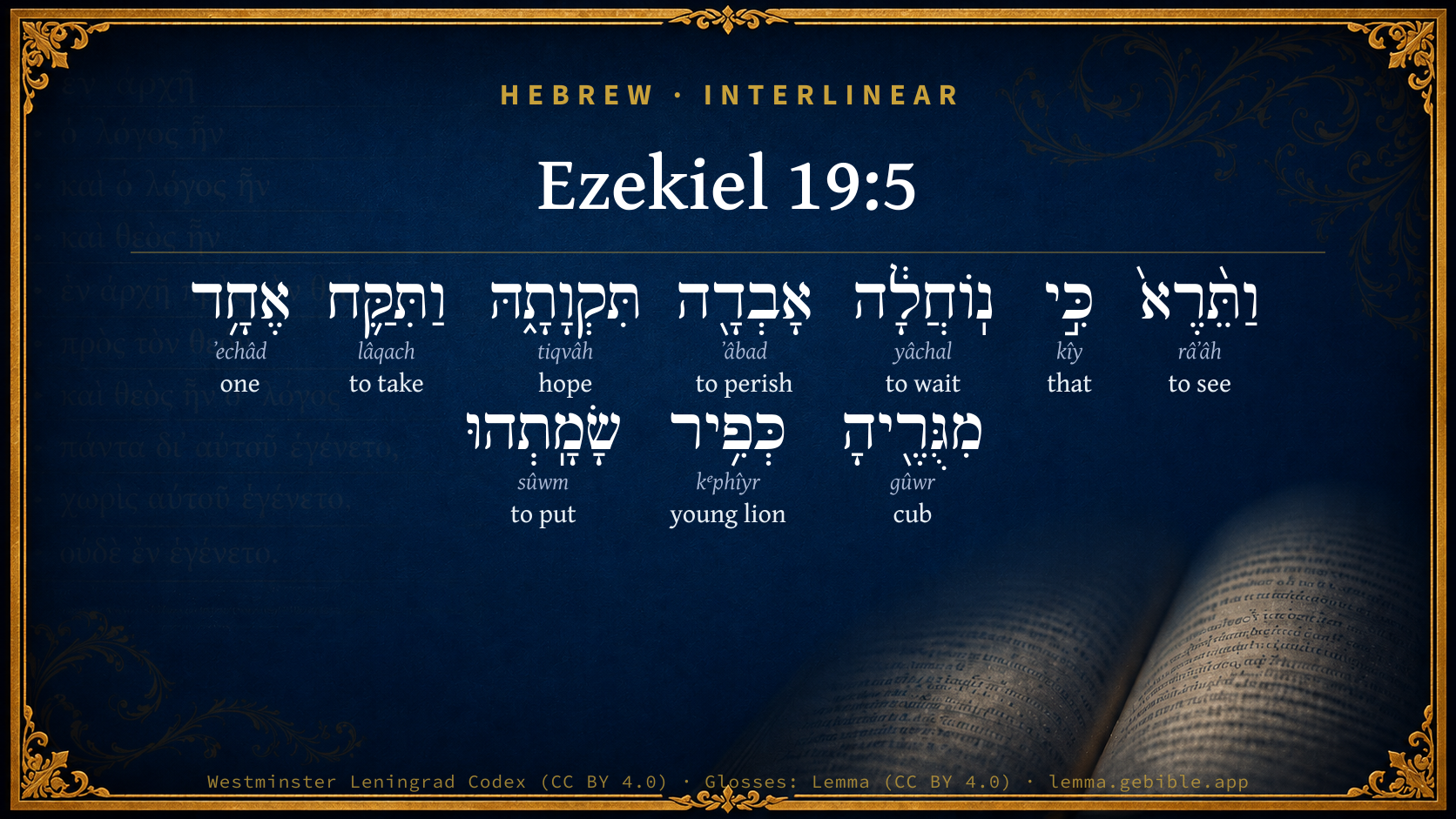
Ezekiel 19:5

Hebrew (Westminster Leningrad Codex) Ezekiel 19:5 appears in the Hebrew Old Testament. The text above is from the Westminster Leningrad Codex. Each word links to its Strong’s number, a concise gloss, and parsing drawn from the Open Scriptures Hebrew Bible morphology. Click any word for its full Brown-Driver-Briggs (BDB) entry.
Download image
Cite this verse

Ezekiel 19:5 (World English Bible). Public Domain. Lemma interlinear Bible study tool, https://lemma.gebible.app/v/ezekiel/19/5.

Show BibTeX & RIS
BibTeX
RIS
English Translation
Now when she saw that she had waited, and her hope was lost, then she took another of her cubs, and made him a young lion.
World English Bible · Public Domain
Download a study sheet

One document with this verse’s original text, its word-by-word gloss line, the meaning frame, cross-references with their text, attributed commentary, and full source and license credits — printable, and it pastes into notes with its structure intact.

This verse Autodidact and up

Study sheet (.html) Plain text (.txt)

A passage Seminary Student

Up to 50 verses in one chapter. A passage sheet keeps up to 6 commentary sources and 12 cross-references per verse, in the order this page ranks them, and says so on the sheet whenever that leaves anything out. Ask for a single verse and you get the Autodidact verse sheet above.

Everything on this page stays free to read, with no account — the sheet is a download of what is already on screen, not access to it.

Want to remove ads? Support Godless Engineer
Compare translations 3

The same verse in 3 English versions, stacked beneath the original-language interlinear above. Click any original word for its lexicon entry.

Each is an independent rendering of the whole verse — the interlinear is not word-aligned to these translations.

Highlighted words mark where these versions differ — a whole-verse word diff, not a word-by-word alignment.

  • World English Bible Public Domain
    Now when she saw that she had waited, and her hope was lost, then she took another of her cubs, and made him a young lion.
  • King James Version Public Domain
    Now when she saw that she had waited, and her hope was lost, then she took another of her whelps, and made him a young lion.
  • unfoldingWord Literal Text CC BY-SA 4.0
    Then she saw that although she had waited for his return, her expectation was now gone, so she took another of her cubs and raised him to become a young lion.

unfoldingWord Literal Text — © unfoldingWord, licensed CC BY-SA 4.0. Word-aligned USFM3 via Door43 (git.door43.org/unfoldingWord/en_ult).

Versions to compare (up to 4)

3 of 4 selected

Show all 18 translations

Every available English version of this verse, each an independent rendering of the whole verse.

  • World English Bible Public Domain
    Now when she saw that she had waited, and her hope was lost, then she took another of her cubs, and made him a young lion.
  • Berean Standard Bible Public Domain
    When she saw that she had waited in vain, that her hope was lost, she took another of her cubs and made him a young lion.
  • Majority Standard Bible Public Domain
    When she saw that she had waited in vain, that her hope was lost, she took another of her cubs and made him a young lion.
  • King James Version Public Domain
    Now when she saw that she had waited, and her hope was lost, then she took another of her whelps, and made him a young lion.
  • American Standard Version (1901) Public Domain
    Now when she saw that she had waited, and her hope was lost, then she took another of her whelps, and made him a young lion.
  • Revised Version (1885) Public Domain
    Now when she saw that she had waited, and her hope was lost, then she took another of her whelps, and made him a young lion.
  • Geneva Bible (1599) Public Domain
    Nowe when she sawe, that she had waited and her hope was lost, she tooke another of her whelps, and made him a lyon.
  • Douay-Rheims (1899) Public Domain
    But she seeing herself weakened, and that her hope was lost, took one of her young lions, and set him up for a lion.
  • Young's Literal Translation Public Domain
    And she seeth, that stayed -- perished hath her hope, And she taketh one of her whelps, A young lion she hath made it.
  • Literal Standard Version CC BY-SA 4.0
    And as she waited she sees that her hope has perished, || And she takes one of her whelps, || She has made him a young lion.
  • Unlocked Literal Bible CC BY-SA 4.0
    Then she saw that although she had waited for his return, her expectation was now gone, so she took another of her cubs and raised him to become a young lion.
  • unfoldingWord Literal Text CC BY-SA 4.0
    Then she saw that although she had waited for his return, her expectation was now gone, so she took another of her cubs and raised him to become a young lion.
  • Darby Bible Public Domain
    And when she saw that she had waited [and] her hope was lost, she took another of her whelps, [and] made him a young lion.
  • World Messianic Bible Public Domain
    “‘Now when she saw that she had waited, and her hope was lost, then she took another of her cubs, and made him a young lion.
  • Webster's Bible Public Domain
    Now when she saw that she had waited, and her hope was lost, then she took another of her whelps, and made him a young lion.
  • Free Bible Version CC BY-SA 4.0
    When she realized that the hope she had been waiting for was gone, she made another of her cubs into a young lion.
  • Bible in Basic English Public Domain
    Now when she saw that her hope was made foolish and gone, she took another of her little ones and made him into a young lion.
  • JPS Tanakh (1917) Public Domain
    Now when she saw that she was disappointed, and her hope was lost, then she took another of her whelps, and made him a young lion.

Literal Standard Version (2020), Covenant Press — licensed CC BY-SA 4.0. Text via the HelloAO Bible API (eBible.org). Unlocked Literal Bible (unfoldingWord) — licensed CC BY-SA 4.0. Text via the HelloAO Bible API (eBible.org). unfoldingWord Literal Text — © unfoldingWord, licensed CC BY-SA 4.0. Word-aligned USFM3 via Door43 (git.door43.org/unfoldingWord/en_ult). Free Bible Version, Dr. Jonathan Gallagher — licensed CC BY-SA 4.0. Text via the HelloAO Bible API (eBible.org).

Word by word

More ways to search: Search by grammar → Find every occurrence → Compare this word →

Practice this passage: Drill this verse → Learn its vocabulary →

מִגֻּרֶ֖יהָ
gûwr
H1482
“from · cubs · her”
Preposition + Noun, Common, Masculine, Plural, Construct + Suffix, Personal, 3rd Person, Feminine, Singular
Part of Speech
Preposition + Noun
Type
Common
Gender
Masculine
Number
Plural
State
Construct
Full BDB Definition

Origin: perhaps from H1481

TWOT: 331b

cub, whelp, young
  1. וַתֵּ֨רֶא֙ râʼâh H7200 “and · to see” Conjunction + Verb, Qal, Sequential Imperfect, 3rd Person, Feminine, Singular
  2. כִּ֣י kîy H3588 “that” Conjunction
  3. נֽוֹחֲלָ֔ה yâchal H3176 “to wait” Verb, Niphal, Perfect, 3rd Person, Feminine, Singular
  4. אָבְדָ֖ה ʼâbad H6 “to perish” Verb, Qal, Perfect, 3rd Person, Feminine, Singular
  5. תִּקְוָתָ֑הּ tiqvâh H8615 “hope · her” Noun, Common, Feminine, Singular, Construct + Suffix, Personal, 3rd Person, Feminine, Singular
  6. וַתִּקַּ֛ח lâqach H3947 “and · to take” Conjunction + Verb, Qal, Sequential Imperfect, 3rd Person, Feminine, Singular
  7. אֶחָ֥ד ʼechâd H259 “one” Adjective, Cardinal number, Masculine, Singular, Absolute
  8. כְּפִ֥יר kᵉphîyr H3715 “young lion” Noun, Common, Masculine, Singular, Absolute
  9. שָׂמָֽתְהוּ sûwm H7760 “to put · him” Verb, Qal, Perfect, 3rd Person, Feminine, Singular + Suffix, Personal, 3rd Person, Masculine, Singular

About this verse

These counts appear in no published source. They are computed here, from the morphology-tagged text and Lemma’s own curated glosses. What Lemma adds →

10
words
10
distinct lemmas
Prophets
section

Notable vocabulary

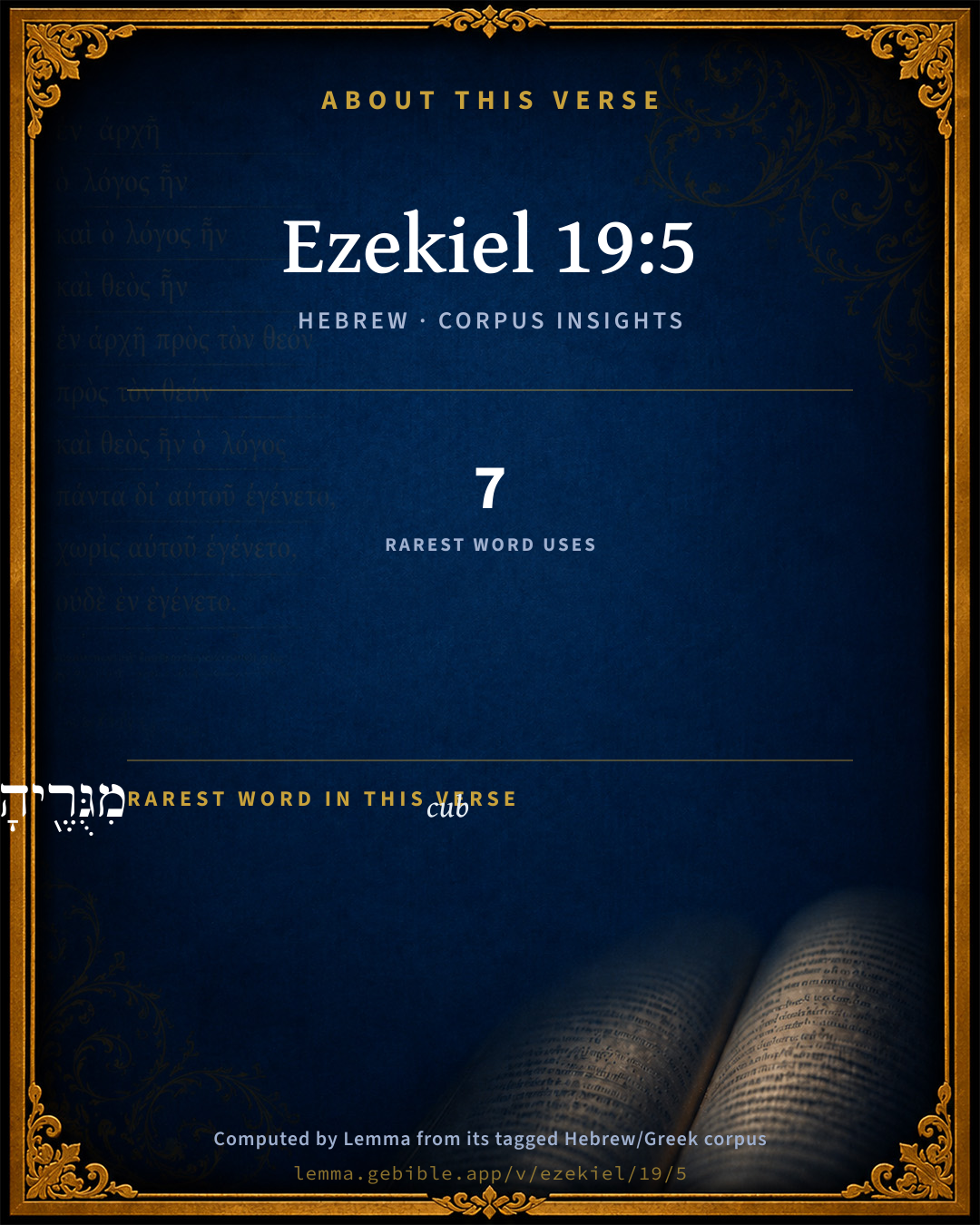
The rarest word here is מִגֻּרֶ֖יהָ cub H1482 — appearing just 7 times in the whole Hebrew Bible.

Shared distinctive vocabulary

מִגֻּרֶ֖יהָ cub H1482 occurs in 7 verses of the Hebrew Bible. Also found in:

Grammatical profile

  • 5 verbs
  • 3 nouns
  • 1 adjective
  • 1 conjunction

Verb forms

  • וַתֵּ֨רֶא֙ Qal · Sequential Imperfect
  • נֽוֹחֲלָ֔ה Niphal · Perfect
  • אָבְדָ֖ה Qal · Perfect
  • וַתִּקַּ֛ח Qal · Sequential Imperfect
  • שָׂמָֽתְהוּ Qal · Perfect

Hebrew & Septuagint length

In English translation the verse runs 26 words from the Hebrew and 28 from the Septuagint (LXX English) — closely comparable.

A rough comparison of the two English renderings, which tokenize alike — not a word-level alignment.

Word counts can differ between the Hebrew and the Greek without any difference in meaning — e.g. the Hebrew direct-object marker אֵת has no separate Greek word, and Greek often adds the article ὁ.

Cross-references

2

Topical passages linked to Ezekiel 19:5 in the Treasury of Scripture Knowledge — connected by theme and wording, ordered by reader-vote popularity; previews shown in the World English Bible.

  • 2 Kings 23:34–37 Pharaoh Necoh made Eliakim the son of Josiah king in the room of Josiah his father, and changed his name to Jehoiakim: but he took Jehoahaz away; and he came to Egypt, and died there.
  • Ezekiel 19:3 She brought up one of her cubs: he became a young lion, and he learned to catch the prey; he devoured men.

Cross-references courtesy of OpenBible.info (CC BY 4.0).

Hebrew and Greek witnesses Masoretic Hebrew ↔ Greek Septuagint

The same verse in the two great witnesses to the Old Testament, shown verse-for-verse.

These are two independent witnesses, not word-aligned to each other, and the Septuagint is shown in lemma (dictionary) form.

Hebrew Ezekiel 19:5 Masoretic · Westminster Leningrad Codex

וַתֵּ֨רֶא֙ כִּ֣י נֽוֹחֲלָ֔ה אָבְדָ֖ה תִּקְוָתָ֑הּ וַתִּקַּ֛ח אֶחָ֥ד מִגֻּרֶ֖יהָ כְּפִ֥יר שָׂמָֽתְהוּ

Now when she saw that she had waited, and her hope was lost, then she took another of her cubs, and made him a young lion.

World English Bible · Public Domain

Greek LXX Ezekiel 19:5 Septuagint · lemma form

καί ὁράω ὅτι ἀποὠθέω ἀπό αὐτός καί ἀποὀλλύω ὁ ὑπόστασις αὐτός καί λαμβάνω ἄλλος ἐκ ὁ σκύμνος αὐτός λέων τάσσω αὐτός

And she saw that he was driven away from her, and her hope of him perished, and she took another of her whelps; she made him a lion.

LXX2012 (modern English Septuagint) · Public Domain

Hebrew: Westminster Leningrad Codex (CC BY 4.0). Greek: Septuagint (public domain); English from LXX2012 (modern English Septuagint) (Public Domain). How the Septuagint differs from the Hebrew →

Targum (Aramaic paraphrase)

1

The Targum is the ancient Jewish Aramaic paraphrase of the Hebrew Scriptures — an interpretive translation, not the Hebrew text itself. Onkelos (literal) and Pseudo-Jonathan (expansive) render the Torah, and Jonathan the Prophets. Coverage is partial: where no permissively-licensed English translation exists for a verse, only the Aramaic is shown. This is verse-level text, not a word-by-word alignment to the Hebrew.

  1. Targum Jonathan Prophets (Joshua–Malachi)
    וַחֲזַת אֲרֵי פְּסַק אֲבַד סִבּוּרָה וְרַבִּיאַת חַד מִבְּנָהָא מַלְכָּא שַׁוְיָתֵיהּ:

    (no public-domain English translation for this verse)

    Targum Jonathan — Aramaic: “Mikraot Gedolot” (public domain). English: “Sefaria Community Translation” (CC0 1.0 (public-domain dedication)); “London "Chaldee Paraphrase," 1871” (public domain). Text via Sefaria.

Commentary

Notes on Ezekiel 19:5 from classic Christian and Jewish commentators (each source and its license shown beneath its notes). The classic Christian expositions comment on the surrounding passage and are grouped to its opening verse, so a note may address several verses; the Jewish commentaries on the Tanakh (Rashi and others) are per-verse, so they appear only where the commentator wrote on this verse.

Lemma curates 59 commentaries, every one of them public domain or Creative Commons licensed, each selected and text-cleaned for this edition rather than reprinted as found. About our sources →

Trapp's Complete Commentary

John Trapp

Eze 19:5 Now when she saw that she had waited, [and] her hope was lost, then she took another of her whelps, [and] made him a young lion.

Ver. 5. Now when she saw that she had waited and her hope was lost.] She looked for Jehoahaz’s return out of Egypt, as Sisera’s mother did for his safe and victorious return from the battle; but all in vain. "The hope of the hypocrite shall perish."

Then she took another of her whelps.] A brat of the same breed, and of no better condition. Judea changed her lords oft, but not her miseries. So did Rome in the times between Augustus and Constantine the Great; the names of those few of them that were good might be written within the compass of a signet, as one said. Scarce any of them died a natural death, unless it were Vespasian, qui solus imperatorum mutatus in melius, {a} who also was the only emperor that became better by his preferment.

{a} Tacitus.

John Trapp, A Commentary or Exposition upon All the Books of the Old and New Testament (1647–1656) — public domain. Text from a community e-Sword module.

Joseph Benson's Commentary

Eze 19:5-9. When she saw that she had waited — This seems to signify that the Jews waited some time before they thought of setting another king over them, hoping, probably, that the king of Egypt would restore unto them Jehoahaz, whom he had taken prisoner; but when they saw their hopes disappointed in this, and that there was no longer any room to expect it, then they, by the consent, and probably, direction of the king of Egypt, elected Jehoahaz’s brother, Eliakim, king in his stead, his name being changed to Jehoiakim. And he went up and down among the lions — He imitated the kings his neighbours, and became rapacious and cruel like them. And learned to catch the prey, &c. — He learned and practised all the methods of tyranny and oppression. And he knew their desolate palaces — Dr. Waterland and Houbigant render it, He destroyed their palaces; and Bishop Newcome, He brought evil upon their palaces. The meaning seems to be, that Jehoiakim made himself master of the riches and pleasant seats of the great men of the land. And the land was desolate, &c., by the noise of his roaring — His cruelty and oppression caused many of the inhabitants of Judea to remove out of it, and go and settle in other places, where they could live more secure. Then the nations set themselves against him, &c. — He was attacked by the Chaldeans, Syrians, Moabites, and Ammonites, and at last the king of Babylon took him prisoner, and carried him in fetters to Babylon: see 2Ch 36:6. That his voice should no more be heard, &c. — That he should be no more a terror to the land of Israel. For Jehoiakim being compared, in the foregoing verses, to a lion, whose voice, or roaring, strikes men with terror; by saying that his voice should no more be heard, is signified that he should be no longer a terror to any in the country.

Joseph Benson's Commentary on the Old and New Testaments (1811–1818) — public domain. Text from a community e-Sword module.

Tyndale Open Study Notes

Tyndale Open Resources

19:5-7 The behavior of the second cub was similar to that of the first but even more violent, as he destroyed their towns and cities. This cub could represent Jehoiakim, Jehoiachin, or Zedekiah. It is not clear which towns and cities the king of Judah destroyed—the prophet might have been thinking of the negative effect that foolish foreign policy had on the cities and towns of Judah.

Tyndale Open Study Notes — © Tyndale Open Resources, licensed CC BY-SA 4.0. Text via the HelloAO Bible API.

Geneva Bible (1599)

Geneva Bible translators

Which was Jehoiakim.

Geneva Bible (1599) marginal notes — public domain. Text via Bolls.life.

Jamieson, Fausset & Brown

Robert Jamieson, A. R. Fausset & David Brown

saw that she had waited, and her hope was lost--that is, that her long-waited-for hope was disappointed, Jehoahaz not being restored to her from Egypt.

she took another of her whelps--Jehoiakim, brother of Jehoahaz, who was placed on the throne by Pharaoh (Kg2 23:34), according to the wish of Judah.

Jamieson, Fausset & Brown — Commentary Critical and Explanatory on the Whole Bible (1871) — public domain (CC PDM 1.0). Text via the HelloAO Bible API.

Adam Clarke's Commentary

Verse 5. When she saw that she had waited] Being very weak, the Jews found that they could not resist with any hope of success; so the king of Egypt was permitted to do as he pleased.

She took another of her whelps] Jehoiakim.

And made him a young lion.] King of Judea.

Adam Clarke's Commentary on the Bible (1810–1826) — public domain. Text from a community e-Sword/MySword module.

John Calvin's Commentaries

We yesterday read over that sentence in which the Prophet says that Judea produced another lion after the former had been captured and led into Egypt. Now this ought to be referred to King Jehoiakim, who was appointed by King Nebuchadnezzar, when he had laid waste a part of Egypt, possessed the whole of Judea, and imposed laws by establishing a king, according to the rights of conquest. But since he also acted perfidiously, he was led away into captivity. The Prophet, therefore, means that the nation did not repent through this single chastisement; nor did it change its disposition, since its mother was a lioness: and not only did it bring forth young lions, but taught them to seize upon their prey till they became grown up. He says, therefore, that she saw what she had hoped, and her hope was futile. Some think that the noun “hope” is here repeated by the Prophet — she saw that her hope was lost; lost hope, I say. But the other reading is better — she saw that she had hoped; that is, she saw that her hope had not produced any fruit for some time, because the royal throne remained deserted; therefore she took another of her whelps, says he, and made him a lion. The Prophet again briefly teaches that the whole royal offspring was like young lions. Although, therefore, the lion alone is called king, yet he is said to be taken from a number of whelps; and hence it follows that this denotes the depraved and cruel nature of all. Thus we see that the Jews are indirectly reproved for not returning to soundness of mind, when God punished them severely, and King Jehoahaz was taken. Since, therefore, that punishment did not result in their correction, it follows that their dispositions were depraved; and the Prophet means this when he says, that she took one of her whelps, and again made it a lion. It follows —

John Calvin's Commentaries (1540-1563) — public domain. Text from the Calvin Translation Society English edition (1840s-50s) via the Christian Classics Ethereal Library (ccel.org). Calvin's coverage is partial (roughly two-thirds of the Bible); uncommented books and verses are honest gaps, never fabricated. The 19th-century editor's footnotes and remarks are omitted so the notes are faithfully Calvin's own voice.

Ellicott's Commentary for English Readers

(5) Another of her whelps.—After the three months’ reign of Jehoahaz, his brother Jehoiakim was appointed king by Pharaoh (2Ki_23:34). He was conquered and “bound in fetters” by Nebuchadnezzar, with the intention of carrying him to Babylon (2Ch_36:7): he died, however, in disgrace in Jerusalem (2Ki_24:6; comp. Jer_22:18-19), and was succeeded regularly by his son Jehoiachin without foreign interference. His character, as shown in Eze_19:6-7 (comp. 2Ki_24:9; 2Ch_36:9), was evil like that of his father.

A Bible Commentary for English Readers, edited by Charles John Ellicott (1878–1897) — public domain. Text from a community e-Sword module.

The Cambridge Bible for Schools and Colleges

gen. ed. J. J. S. Perowne

5–8. Jehoiachin carried captive to Babylon

The second young lion is Jehoiachin. The intermediate prince Jehoiakim could not be included in an elegy, because he died in peace. It is the princes of Israel whom foreign nations captured that are lamented. What is touched upon is more the humiliation and sorrow of Israel, the mother lioness, in her young lions being captured, than the fate of the two persons. The elegy is a national one, cf. on Eze_19:1.

5. And she saw that she had waited—her hope was lost;

And she took another of her whelps—she made him a young lion.

6. And he walked among the lions—he grew a young lion,

And he learned to catch the prey—he devoured men.

7. And he broke down their palaces—he wasted their cities;

And the land and its fulness was desolate—at the noise of his roaring.

8. Then the nations set themselves against him—on every side from the countries.

And they spread their net over him—he was taken in their pit.

5. that she had waited] If “she” be subject some such sense as deceived, “disappointed” (Ew.) would be suitable, though to reach this sense by adding “in vain” to waited is hardly permissible. The subject might be “her hope,” and waited might mean tarried, delayed. There might be reference to hope of the return of Jehoahaz, which appears to have been cherished, as Jeremiah takes occasion altogether to cut it off (Jer_22:10-12). Corn. proposes “acted foolishly,” but the word suggested is too strong (Num_12:11; Isa_19:13; Jer_5:4; Jer_50:36).

6. Jehoiachin ascended the throne on the death of his father at the age of 18. He reigned only 3 months, when Nebuchadnezzar carried him away to Babylon, 2Ki_24:8 seq.

7. knew their desolate palaces] R.V. knew their palaces. The word is usually “widows” as marg., but “palaces,” Isa_13:22. Neither translation gives any sense. Better: he broke down their palaces, (change of r for d); or cf. Jer_2:15-16 (marg. fed on), a passage very similar. If “widows” be read the verb would need to be altered to “multiplied,” ch. Eze_12:25, an important passage (Jer_15:8). Corn. (partly Hitz.): and he lay down in his den, he wasted the forests. This keeps up the figure, but requires serious alteration of the reading. Jer_2:15 shews that “young lions” may burn cities, and feed on the crown of the head.

8. in their pit] A well-known method of capturing dangerous beasts. The object to “set” may be voice or shout, Eze_19:4, Jer_7:8.

The Cambridge Bible for Schools and Colleges (gen. ed. J. J. S. Perowne; Cambridge University Press, 1878–1918) — public domain. Text from a community e-Sword module.

John Gill's Exposition

Now when she saw,.... That is, his mother, as the Syriac version expresses it; not his natural mother; as the mother of Sisera looked out and waited for him; but the congregation of Israel, as Jarchi interprets it, the body of the Jewish people:

that she had waited; for the return of Jehoahaz out of Egypt, which was expected for some time: or, "that she was become sick"; or "weak" (w), and feeble, and brought to a low estate by his captivity, and by the tax the king of Egypt put upon her:

and her hope was lost; of his return to her any more, and so of being eased of the tribute imposed, and of being restored by him to liberty and glory; for the Lord had declared that he should return no more to his native country, but die in the place where he was carried captive, Jer 22:10;

then she took another of her whelps; or sons, as the Targum:

and made him a young lion: a king, as the same Targum paraphrases it; that is, Jehoiakim, the brother of Jehoahaz, who before was called Eliakim, but his name was changed by Pharaohnecho; and though he is said to make him king, yet it was by the consent of the people of the Jews.

(w) "quod infirmatus esset", Cocceius, Starckius.

John Gill's Exposition of the Whole Bible (1746–1763) — public domain (CC PDM 1.0). Text via the HelloAO Bible API.

Haydock's Catholic Bible Commentary

Lions: Joakim. (Challoner) --- He reigned eleven years; but was such a monster, that the prophet does not speak of him or bewail his fate, 4 Kings xxiii. 34., and Jeremias xxii. 19. His words are applicable to Jechonias alone; who was cruel and banished to Babylon, ver. 8. (Calmet)

George Leo Haydock (1774–1849), Haydock's Catholic Family Bible and Commentary, 1859 edition — public domain. Excludes Psalms (Douay-Rheims chapter numbering differs from Protestant) and Deuterocanonical books (Catholic canon only).

Matthew Poole's English Annotations

Upon the ill success of Jehoahaz, Jerusalem and the Jews in the land fell from their hopes under great disappointments, for Jehoahaz is taken, deposed, carried captive by the Egyptians, instead of shaking off the Egyptian yoke. She took another; yet it is said, 2Ch 36:4; 2Ki 23:34, that the king of Egypt made the next king: both true; the Jews with Pharaoh’s liking, or Pharaoh with the Jews’ consent, advance him, whether it were Jehoiakim or Jehoiachin.

Made him a young lion; king, and infused the lion-like maxims for his rules.

Matthew Poole's English Annotations on the Holy Bible (1683–1685) — public domain. Text from a community e-Sword/MySword module.

The Pulpit Commentary

The second lion whelp is identified by ver. 9 with Jehoiachin. For some reason or other, probably because he, as having "slept with his fathers," was not so conspicuous an instance of retribution, Ezekiel passes over Jehoiakim (B.C. 607-599).

The Pulpit Commentary (1880–1919), ed. H.D.M. Spence-Jones & Joseph S. Exell — public domain. Text from a community e-Sword module.

John Wesley's Explanatory Notes

Made him - King, and infused the lion-like maxims into him.

John Wesley, Explanatory Notes Upon the Whole Bible (1754–1765) — public domain. Text via the GEBible commentary corpus.

unfoldingWord translationNotes

Door43 World Missions Community

General Information:

Yahweh continues to describe the nation of Israel as a lioness and the kings of the kingdom of Judah as her cubs. (See: Metaphor)

He seized their widows

"He seized the widows of the men whom he devoured"

The land and its fullness were abandoned

This can be stated in active form. AT: "People abandoned the land and its fullness" (See: Active or Passive)

its fullness

"everything in it"

translationWords

hope

lions

devour

ruin

unfoldingWord translationNotes — © Distant Shores Media and the Door43 World Missions Community, licensed CC BY-SA 4.0. Source: git.door43.org/Door43/en_tn.

Rashi

Rabbi Shlomo Yitzchaki (Rashi)

Now she saw His mother, the congregation of Israel.

that she had taken ill Heb. נוֹחַלָה, an expression of illness (חֹלִי).

and she took one of her cubs Jehoiakim.

and made him a young lion [i. e.,] a king. Every כְּפִיר in Scripture is a young and mighty lion.

Rashi on the Tanakh — English translations: “The Judaica Press complete Tanach with Rashi, translated by A. J. Rosenberg” (CC BY 4.0); “Pentateuch with Rashi's commentary by M. Rosenbaum and A.M. Silbermann, 1929-1934” (public domain); “The Metsudah Tanach series, Lakewood, N.J” (CC BY 4.0); and “The Book of Joshua, Metsudah Publications, 1997” (CC BY 4.0). Text via Sefaria.

Lesson kit

Teaching starters — assembled from the data on this page, not authored interpretation. Every prompt links to the verse data it draws on. Edit before teaching.

Ezekiel, in the Prophets, opens this verse with 10 words (10 distinct Hebrew lemmas). Its most distinctive word is gûwr (“cub”). A historical commentator’s framing appears above. Read the whole chapter for the surrounding context.

Discussion questions

  1. The word gûwr carries the sense “cub.” How does it shape the verse?
  2. Genesis 49:9 shares the word «cub» with this verse. How do the two illuminate each other?
  3. These translations render this verse differently; the difference is in the English rendering, not the original. What questions does that raise?
  4. The verb «וַתֵּ֨רֶא֙» is Qal Sequential Imperfect. How does its form color the action?
  5. Reading how Trapp's Complete Commentary and Joseph Benson's Commentary read this verse, where do the two commentators agree and where do they part?

Things to notice

Reading settings

Reading text

Shown beneath each verse's original-language words.

Old Testament
Old Testament edition

Read the OT as the Masoretic Hebrew (MT) or the Greek Septuagint (LXX).

English shown for the Greek Septuagint (in the Hebrew ↔ Greek comparison).

Comparing translations? Open the Compare panel on any verse page to stack up to four side by side.