Isaiah 29:18

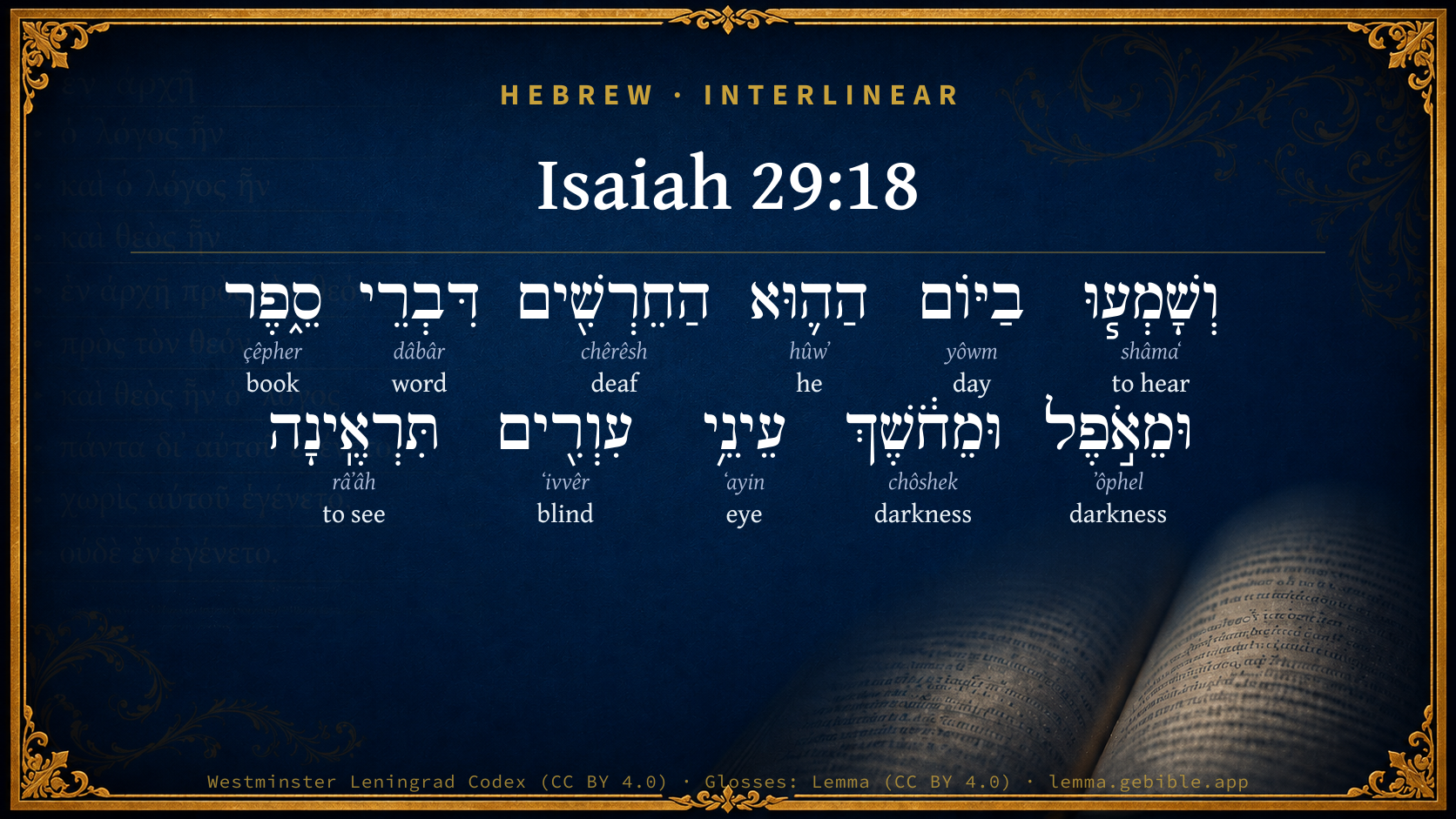
Hebrew (Westminster Leningrad Codex) Isaiah 29:18 appears in the Hebrew Old Testament. The text above is from the Westminster Leningrad Codex. Each word links to its Strong’s number, a concise gloss, and parsing drawn from the Open Scriptures Hebrew Bible morphology. Click any word for its full Brown-Driver-Briggs (BDB) entry.
Download image
Cite this verse

Isaiah 29:18 (World English Bible). Public Domain. Lemma interlinear Bible study tool, https://lemma.gebible.app/v/isaiah/29/18.

Show BibTeX & RIS
BibTeX
RIS
English Translation
In that day shall the deaf hear the words of the book, and the eyes of the blind shall see out of obscurity and out of darkness.
World English Bible · Public Domain
Download a study sheet

One document with this verse’s original text, its word-by-word gloss line, the meaning frame, cross-references with their text, attributed commentary, and full source and license credits — printable, and it pastes into notes with its structure intact.

This verse Autodidact and up

Study sheet (.html) Plain text (.txt)

A passage Seminary Student

Up to 50 verses in one chapter. A passage sheet keeps up to 6 commentary sources and 12 cross-references per verse, in the order this page ranks them, and says so on the sheet whenever that leaves anything out. Ask for a single verse and you get the Autodidact verse sheet above.

Everything on this page stays free to read, with no account — the sheet is a download of what is already on screen, not access to it.

Want to remove ads? Support Godless Engineer
Compare translations 3

The same verse in 3 English versions, stacked beneath the original-language interlinear above. Click any original word for its lexicon entry.

Each is an independent rendering of the whole verse — the interlinear is not word-aligned to these translations.

Highlighted words mark where these versions differ — a whole-verse word diff, not a word-by-word alignment.

  • World English Bible Public Domain
    In that day shall the deaf hear the words of the book, and the eyes of the blind shall see out of obscurity and out of darkness.
  • King James Version Public Domain
    And in that day shall the deaf hear the words of the book, and the eyes of the blind shall see out of obscurity, and out of darkness.
  • unfoldingWord Literal Text CC BY-SA 4.0
    And on that day the deaf will hear the words of a scroll, and from gloom and from darkness the eyes of the blind will see.

unfoldingWord Literal Text — © unfoldingWord, licensed CC BY-SA 4.0. Word-aligned USFM3 via Door43 (git.door43.org/unfoldingWord/en_ult).

Versions to compare (up to 4)

3 of 4 selected

Show all 18 translations

Every available English version of this verse, each an independent rendering of the whole verse.

  • World English Bible Public Domain
    In that day shall the deaf hear the words of the book, and the eyes of the blind shall see out of obscurity and out of darkness.
  • Berean Standard Bible Public Domain
    On that day the deaf will hear the words of the scroll, and out of the deep darkness the eyes of the blind will see.
  • Majority Standard Bible Public Domain
    On that day the deaf will hear the words of the scroll, and out of the deep darkness the eyes of the blind will see.
  • King James Version Public Domain
    And in that day shall the deaf hear the words of the book, and the eyes of the blind shall see out of obscurity, and out of darkness.
  • American Standard Version (1901) Public Domain
    And in that day shall the deaf hear the words of the book, and the eyes of the blind shall see out of obscurity and out of darkness.
  • Revised Version (1885) Public Domain
    And in that day shall the deaf hear the words of the book, and the eyes of the blind shall see out of obscurity and out of darkness.
  • Geneva Bible (1599) Public Domain
    And in that day shall the deafe heare the wordes of the booke, and the eyes of the blinde shall see out of obscuritie, and out of darkenesse.
  • Douay-Rheims (1899) Public Domain
    And in that day the deaf shall hear the words of the book, and out of darkness and obscurity the eyes of the blind shall see.
  • Young's Literal Translation Public Domain
    And heard in that day have the deaf the words of a book, And out of thick darkness, and out of darkness, The eyes of the blind do see.
  • Literal Standard Version CC BY-SA 4.0
    And the deaf have heard the words of a scroll in that day, || And out of thick darkness, and out of darkness, || The eyes of the blind see.
  • Unlocked Literal Bible CC BY-SA 4.0
    On that day the deaf will hear the words of a book, and the eyes of the blind will see out of the deep darkness.
  • unfoldingWord Literal Text CC BY-SA 4.0
    And on that day the deaf will hear the words of a scroll, and from gloom and from darkness the eyes of the blind will see.
  • Darby Bible Public Domain
    And in that day shall the deaf hear the words of the book, and, out of obscurity and out of darkness, the eyes of the blind shall see;
  • World Messianic Bible Public Domain
    In that day, the deaf will hear the words of the book, and the eyes of the blind will see out of obscurity and out of darkness.
  • Webster's Bible Public Domain
    And in that day shall the deaf hear the words of the book, and the eyes of the blind shall see out of obscurity, and out of darkness.
  • Free Bible Version CC BY-SA 4.0
    At that time the deaf will hear the words of the scroll, and the eyes of the blind will see through the gloomy darkness what's written there.
  • Bible in Basic English Public Domain
    And in that day those whose ears are stopped will be hearing the words of the book; and the eyes of the blind will see through the mist and the dark.
  • JPS Tanakh (1917) Public Domain
    And in that day shall the deaf hear the words of a book, and the eyes of the blind shall see out of obscurity and out of darkness.

Literal Standard Version (2020), Covenant Press — licensed CC BY-SA 4.0. Text via the HelloAO Bible API (eBible.org). Unlocked Literal Bible (unfoldingWord) — licensed CC BY-SA 4.0. Text via the HelloAO Bible API (eBible.org). unfoldingWord Literal Text — © unfoldingWord, licensed CC BY-SA 4.0. Word-aligned USFM3 via Door43 (git.door43.org/unfoldingWord/en_ult). Free Bible Version, Dr. Jonathan Gallagher — licensed CC BY-SA 4.0. Text via the HelloAO Bible API (eBible.org).

Word by word

More ways to search: Search by grammar → Find every occurrence → Compare this word →

Practice this passage: Drill this verse → Learn its vocabulary →

הַחֵרְשִׁ֖ים
chêrêsh
H2795
“the · deaf”
Particle, Definite Article + Adjective, Adjective, Masculine, Plural, Absolute
Part of Speech
Particle + Adjective
Type
Adjective
Gender
Masculine
Number
Plural
State
Absolute
Full BDB Definition

Origin: from H2790

TWOT: 761a

deaf
  1. וְשָׁמְע֧וּ shâmaʻ H8085 “and · to hear” Conjunction + Verb, Qal, Sequential Perfect, 3rd Person, Common, Plural
  2. בַיּוֹם yôwm H3117 “in/at the · day” Preposition, Determined + Noun, Common, Masculine, Singular, Absolute
  3. הַה֛וּא hûwʼ H1931 “the · he” Particle, Definite Article + Pronoun, Personal, 3rd Person, Masculine, Singular
  4. דִּבְרֵי dâbâr H1697 “words of” Noun, Common, Masculine, Plural, Construct
  5. סֵ֑פֶר çêpher H5612 “book” Noun, Common, Masculine, Singular, Absolute
  6. וּמֵאֹ֣פֶל ʼôphel H652 “and · from · darkness” Conjunction + Preposition + Noun, Common, Masculine, Singular, Absolute
  7. וּמֵחֹ֔שֶׁךְ chôshek H2822 “and · from · darkness” Conjunction + Preposition + Noun, Common, Masculine, Singular, Absolute
  8. עֵינֵ֥י ʻayin H5869 “eyes of” Noun, Common, Both, Dual, Construct
  9. עִוְרִ֖ים ʻivvêr H5787 “blind” Adjective, Adjective, Masculine, Plural, Absolute
  10. תִּרְאֶֽינָה râʼâh H7200 “to see” Verb, Qal, Imperfect, 3rd Person, Feminine, Plural

About this verse

These counts appear in no published source. They are computed here, from the morphology-tagged text and Lemma’s own curated glosses. What Lemma adds →

11
words
11
distinct lemmas
Prophets
section

Notable vocabulary

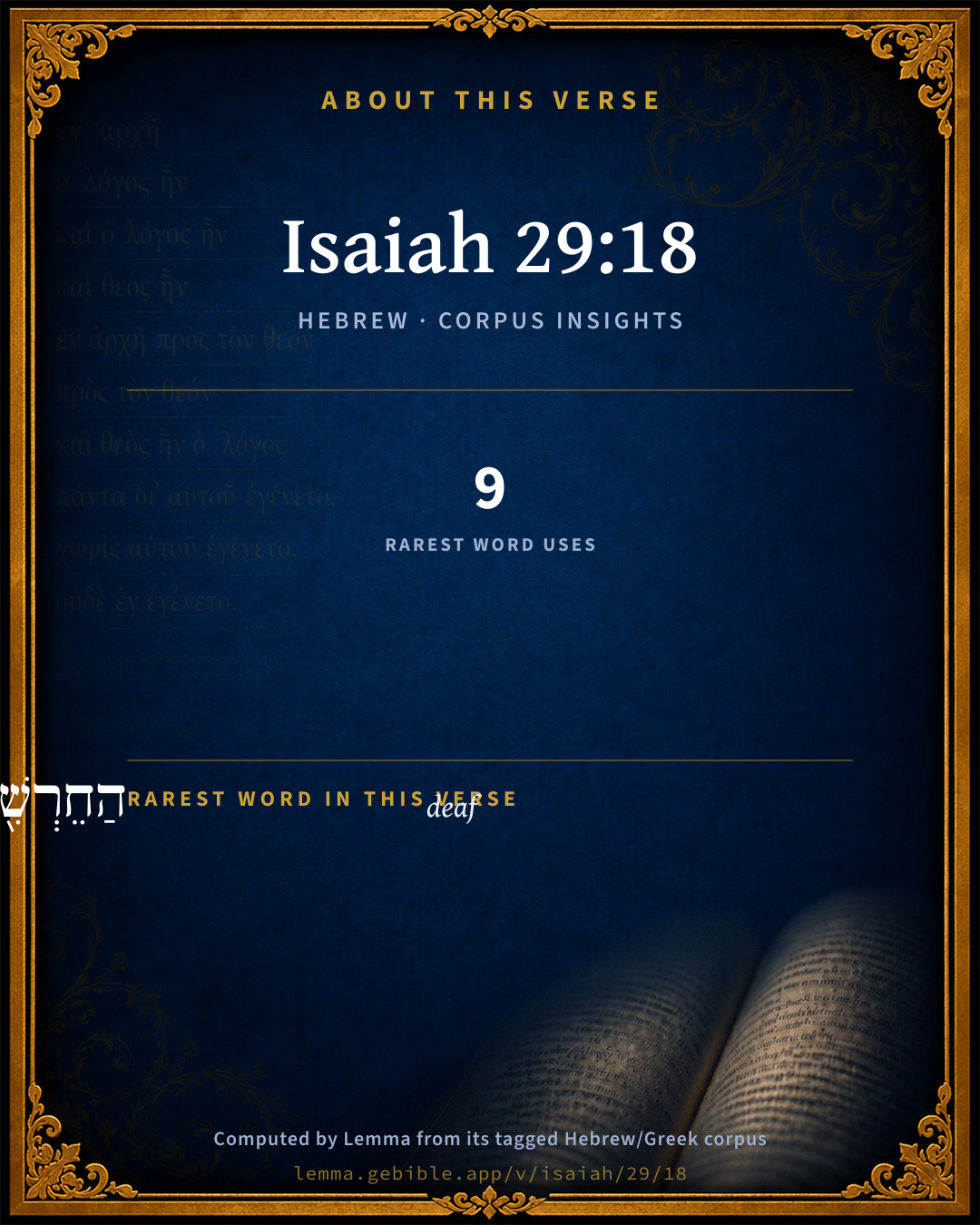
The rarest word here is הַחֵרְשִׁ֖ים deaf H2795 — appearing just 9 times in the whole Hebrew Bible.

Shared distinctive vocabulary

הַחֵרְשִׁ֖ים deaf H2795 occurs in 9 verses of the Hebrew Bible. Also found in:

Grammatical profile

  • 2 verbs
  • 6 nouns
  • 2 adjectives
  • 1 pronoun

Verb forms

  • וְשָׁמְע֧וּ Qal · Sequential Perfect
  • תִּרְאֶֽינָה Qal · Imperfect

Hebrew & Septuagint length

In English translation the verse runs 27 words from the Hebrew and 32 from the Septuagint (LXX English) — closely comparable.

A rough comparison of the two English renderings, which tokenize alike — not a word-level alignment.

Word counts can differ between the Hebrew and the Greek without any difference in meaning — e.g. the Hebrew direct-object marker אֵת has no separate Greek word, and Greek often adds the article ὁ.

Cross-references

23

Topical passages linked to Isaiah 29:18 in the Treasury of Scripture Knowledge — connected by theme and wording, ordered by reader-vote popularity; previews shown in the World English Bible.

  • Isaiah 35:5 Then the eyes of the blind shall be opened, and the ears of the deaf shall be unstopped.
  • Matthew 11:5 the blind receive their sight, the lame walk, the lepers are cleansed, the deaf hear, the dead are raised up, and the poor have good news preached to them.
  • Proverbs 20:12 The hearing ear, and the seeing eye, Yahweh has made even both of them.
  • Psalms 119:18 Open my eyes, That I may see wondrous things out of your law.
  • Isaiah 32:3 The eyes of those who see shall not be dim, and the ears of those who hear shall listen.
  • Mark 7:37 They were astonished beyond measure, saying, "He has done all things well. He makes even the deaf hear, and the mute speak!"
  • Ephesians 1:17–19 that the God of our Lord Jesus Christ, the Father of glory, may give to you a spirit of wisdom and revelation in the knowledge of him;
  • Acts 26:18 to open their eyes, that they may turn from darkness to light and from the power of Satan to God, that they may receive remission of sins and an inheritance among those who are sanctified by faith in me.'
  • Isaiah 42:16–18 I will bring the blind by a way that they don't know; in paths that they don't know will I lead them; I will make darkness light before them, and crooked places straight. These things will I do, and I will not forsake them.
  • 2 Corinthians 4:2–6 But we have renounced the hidden things of shame, not walking in craftiness, nor handling the word of God deceitfully; but by the manifestation of the truth commending ourselves to every man's conscience in the sight of God.
  • Deuteronomy 29:4 but Yahweh has not given you a heart to know, and eyes to see, and ears to hear, to this day.
  • Isaiah 29:10–12 For Yahweh has poured out on you the spirit of deep sleep, and has closed your eyes, the prophets; and your heads, the seers, has he covered.
  • Isaiah 29:24 They also who err in spirit shall come to understanding, and those who murmur shall receive instruction.
  • Luke 7:22 Jesus answered them, "Go and tell John the things which you have seen and heard: that the blind receive their sight, the lame walk, the lepers are cleansed, the deaf hear, the dead are raised up, and the poor have good news preached to them.
  • Jeremiah 31:33–34 But this is the covenant that I will make with the house of Israel after those days, says Yahweh: I will put my law in their inward parts, and in their heart will I write it; and I will be their God, and they shall be my people:
  • Matthew 13:14–16 In them the prophecy of Isaiah is fulfilled, which says, 'By hearing you will hear, And will in no way understand; Seeing you will see, And will in no way perceive:
  • Matthew 16:17 Jesus answered him, "Blessed are you, Simon Bar Jonah, for flesh and blood has not revealed this to you, but my Father who is in heaven.
  • Luke 4:18 "The Spirit of the Lord is on me, Because he has anointed me to preach good news to the poor. He has sent me to heal the brokenhearted, To proclaim release to the captives, Recovering of sight to the blind, To deliver those who are crushed,
  • John 6:45 It is written in the prophets, 'They will all be taught by God.' Therefore everyone who hears from the Father, and has learned, comes to me.
  • 2 Corinthians 3:14–18 But their minds were hardened, for until this very day at the reading of the old covenant the same veil remains, because in Christ it passes away.
  • Ephesians 5:14 Therefore he says, "Awake, you who sleep, and arise from the dead, and Christ will shine on you."
  • 1 Peter 2:9 But you are a chosen race, a royal priesthood, a holy nation, a people for God's own possession, that you may show forth the excellencies of him who called you out of darkness into his marvelous light:
  • Revelation 3:18 I counsel you to buy from me gold refined by fire, that you may become rich; and white garments, that you may clothe yourself, and that the shame of your nakedness may not be revealed; and eye salve to anoint your eyes, that you may see.

Cross-references courtesy of OpenBible.info (CC BY 4.0).

Hebrew and Greek witnesses Masoretic Hebrew ↔ Greek Septuagint

The same verse in the two great witnesses to the Old Testament, shown verse-for-verse.

These are two independent witnesses, not word-aligned to each other, and the Septuagint is shown in lemma (dictionary) form.

Hebrew Isaiah 29:18 Masoretic · Westminster Leningrad Codex

וְשָׁמְע֧וּ בַיּוֹם הַה֛וּא הַחֵרְשִׁ֖ים דִּבְרֵי סֵ֑פֶר וּמֵאֹ֣פֶל וּמֵחֹ֔שֶׁךְ עֵינֵ֥י עִוְרִ֖ים תִּרְאֶֽינָה

In that day shall the deaf hear the words of the book, and the eyes of the blind shall see out of obscurity and out of darkness.

World English Bible · Public Domain

Greek LXX Isaiah 29:18 Septuagint · lemma form

καί ἀκούω ἐν ὁ ἡμέρα ἐκεῖνος κωφός λόγος βιβλίον καί ὁ ἐν ὁ σκότος καί ὁ ἐν ὁ ὁμίχλη ὀφθαλμός τυφλός βλέπω

And in that day the deaf shall hear the words of the book, and they that are in darkness, and they that are in mist: the eyes of the blind shall see,

LXX2012 (modern English Septuagint) · Public Domain

Hebrew: Westminster Leningrad Codex (CC BY 4.0). Greek: Septuagint (public domain); English from LXX2012 (modern English Septuagint) (Public Domain). How the Septuagint differs from the Hebrew →

Targum (Aramaic paraphrase)

1

The Targum is the ancient Jewish Aramaic paraphrase of the Hebrew Scriptures — an interpretive translation, not the Hebrew text itself. Onkelos (literal) and Pseudo-Jonathan (expansive) render the Torah, and Jonathan the Prophets. Coverage is partial: where no permissively-licensed English translation exists for a verse, only the Aramaic is shown. This is verse-level text, not a word-by-word alignment to the Hebrew.

  1. Targum Jonathan Prophets (Joshua–Malachi)
    וְיִשְׁמְעוּן בְּעִדָנָא הַהִיא דִכְחַרְשִׁין מִלֵי סְפַר וּמִקְבֵיל וּמַחֲשׁוֹךְ עֵינֵי סָמָן יֶחְזְיָן:

    And at that time those that are like the deaf shall hear the words of the book, and the eyes of the blind shall see out of obscurity, and out of darkness.

    Targum Jonathan — Aramaic: “Mikraot Gedolot” (public domain). English: “Sefaria Community Translation” (CC0 1.0 (public-domain dedication)); “London "Chaldee Paraphrase," 1871” (public domain). Text via Sefaria.

Commentary

Notes on Isaiah 29:18 from classic Christian and Jewish commentators (each source and its license shown beneath its notes). The classic Christian expositions comment on the surrounding passage and are grouped to its opening verse, so a note may address several verses; the Jewish commentaries on the Tanakh (Rashi and others) are per-verse, so they appear only where the commentator wrote on this verse.

Lemma curates 59 commentaries, every one of them public domain or Creative Commons licensed, each selected and text-cleaned for this edition rather than reprinted as found. About our sources →

Trapp's Complete Commentary

John Trapp

Isa 29:18 And in that day shall the deaf hear the words of the book, and the eyes of the blind shall see out of obscurity, and out of darkness.

Ver. 18. In that day shall the deaf hear the words of the book,] i.e., The deaf and blind Gentiles being by the preaching of the gospel drawn out of darkness into God’s marvellous light, shall see and hear that which eye never saw nor ear heard, neither hath entered into the heart of any natural man to conceive. {1Co 2:9} They shall first be enlightened; secondly, to be cheered. {Isa 29:19 Act 13:48 Rom 14:17}

The words of the book.] The Holy Scriptures, that book which the proud would not read, the ignorant could not. {Isa 29:11-12}

Shall see out of obscurity.] See the Saviour, as Simeon; see that blissful vision. {Eph 1:18-19} See Job 9:3-9.

John Trapp, A Commentary or Exposition upon All the Books of the Old and New Testament (1647–1656) — public domain. Text from a community e-Sword module.

The Biblical Illustrator

Joseph S. Exell

Isa_29:18-19

The deaf . . . the blind . . . the meek . . . the poor

The Gospel day

I.

We may regard these words as containing A DESCRIPTION OF THE STATE IN WHICH THE GOSPEL FINDS THOSE TO WHOM IT IS ADDRESSED. The epithets are designed to be descriptive of their spiritual character.

II. THE PLEASING INTIMATION WHICH THE TEXT CONTAINS OF THEIR RECOVERY TO A BETTER AND HAPPIER CONDITION. In that day the deaf shall hear, and the blind shall see. That is, the spiritual ignorance and insensibility of men shall be subdued, and the delusion and stupidity of idolatrous Gentiles in particular, shall be succeeded by a clear and saving knowledge of the truth.

1. This prophecy may be considered as receiving its fulfilment, impart in every instance in which an individual is savingly converted to God.

2. But the prophecy refers to something on a more extensive and general scale.

3. The words, besides intimating the fact of their recovery, appear also to intimate the means by which their recovery shall be effected. They shall hear the words of the book. What is the book the hearing of whose words is connected with results so wondrous and delightful?

(1) Is it the book of nature? Alas, that book, all radiant as it is with the Divine glory of its Author, conveys little or no instruction on spiritual subjects to those whom sin has covered with its dark and stupefying shade.

(2) Or is it the book of human philosophy and arts and sciences? The history of all past ages, to say nothing of the present times, laughs to scorn all such pretensions on the part of the wisdom of this world.

(3) An inspired apostle tells us that the mystery of God is to be made known to all nations for the obedience of faith, by the scriptures of the prophets; and the gospel is the power of God unto salvation, to everyone that believeth: to the Jew first, and also to the Greek.

(4) And though not designed, perhaps, to intimate so much, yet does not the expression they shall hear the words of the book serve to remind us of the mode in which, chiefly, this book is intended to diffuse among mankind the experimental knowledge of the truth and grace which it reveals? Does it not remind us that, for that purpose, it is to be proclaimed by the oral teaching of a living ministry?

III. These latter words we may suppose to be descriptive of CERTAIN CIRCUMSTANCES WITH WHICH THE SPIRITUAL RECOVERY OF MEN IS FOUND TO BE CONNECTED.

1. As well as the preceding words, they are applicable to cases of individual conversion. In this view they remind us of the state to which the sinners heart is humbled when, having heard the words of the book, he is made to tremble under the threatenings which it thunders forth against the guilty and impenitent; and when, having begun to see out of obscurity and out of darkness, he discovers the tremendous ruin on the brink of which he has been standing.

2. But then, besides describing the state to which the sinners mind is humbled in the first instance, these words remind us also of the blessedness of that state to which, when he is once made truly meek and poor in spirit, he is designed to be exalted. For the meek shall increase their joy in the Lord. At first, indeed, this joy may not be anything beyond the joy of hope. But this joy he shall increase. It shall grow brighter and brighter to that perfect day in which it shall become a fulness of joy at Gods right hand for evermore.

3. If these words be more extensively applied, as having reference to those nations and communities of men amongst whom the Gospel is already known, or as having reference to the whole of that world throughout whose wide extent it must ultimately be proclaimed, they still point out the circumstances under which this Gospel shall be the power of God unto salvation, and the delightful effects which shall ensue on its reception, in the increase of human happiness, and in the turning of men from a vain confidence in lying vanities, to faith in the one living and eternal God.

4. It would appear also to be intimated, that these delightful results of evangelical instruction should be especially exemplified in the case of the most despised and degraded of mankind. For they are the poor amongst men, who shall especially rejoice in the Holy One of Israel.

5. These things are delightful to contemplate; but let us not forget, in the pleasure of such contemplations, the personal and practical interest which we are called to take in them. (J. Crowther.)

The Biblical Illustrator, edited by Joseph S. Exell (c. 1880s–1900s) — public domain. Text from a community e-Sword module.

Joseph Benson's Commentary

Isa 29:18-19. In that day, &c. — In these two verses we have the first happy consequence of Lebanon’s becoming a fruitful field, “the spiritual blessings of light and understanding in divine things, and of joy and consolation to be diffused among the Gentiles, formerly deaf and blind.” The deaf hear the words of the book — That is, the truths of divine revelation are declared to the heathen, and their ears are opened to hear, and their hearts to understand them. And the eyes of the blind to see — They who had been for ages in a state of the greatest spiritual blindness and darkness, shall be enlightened with the clear and satisfactory knowledge of God and his will. The meek also — Humble and meek believers of the Gentiles, opposed to these proud and scornful Jews, spoken of in the former part of this, and in the foregoing chapter; shall increase their joy in the Lord — Shall greatly rejoice in this, that Jehovah is now their God and portion. And the poor among men — The poor in spirit, or the poor of this world, to whom, especially, the gospel has been and is to be preached, or those whom the Jews viewed as a mean and despicable people; shall rejoice in the Holy One of Israel — Whom before they neither knew nor regarded.

Joseph Benson's Commentary on the Old and New Testaments (1811–1818) — public domain. Text from a community e-Sword module.

Tyndale Open Study Notes

Tyndale Open Resources

29:18 The people were deaf and blind in heart and spirit (see 6:10; 42:18; 43:8). Yet humanity and all of creation would be renewed (see 35:1-5).

Tyndale Open Study Notes — © Tyndale Open Resources, licensed CC BY-SA 4.0. Text via the HelloAO Bible API.

Jamieson, Fausset & Brown

Robert Jamieson, A. R. Fausset & David Brown

deaf . . . blind--(Compare Mat 11:5). The spiritually blind, &c., are chiefly meant; "the book," as Revelation is called pre-eminently, shall be no longer "sealed," as is described (Isa 29:11), but the most unintelligent shall hear and see (Isa 35:5).

Jamieson, Fausset & Brown — Commentary Critical and Explanatory on the Whole Bible (1871) — public domain (CC PDM 1.0). Text via the HelloAO Bible API.

Ellicott's Commentary for English Readers

(18) In that day shall the deaf hear the words of the book.—The open vision of the future is contrasted with the self-chosen ignorance of Isa_29:11. The “book” (the Hebrew has, however, no definite article) is, perhaps, the prophet’s own message, or the book of the law of the Lord, which will then be understood in all its spiritual fulness. The doom of the “closed eyes” of Isa_6:10 shall then be in force no more.

A Bible Commentary for English Readers, edited by Charles John Ellicott (1878–1897) — public domain. Text from a community e-Sword module.

The Cambridge Bible for Schools and Colleges

gen. ed. J. J. S. Perowne

18. the words of the book] There is a reference implied to Isa_29:11-12. “Deafness” and “blindness” are metaphors for the spiritual obtuseness which at present characterises the nation (Isa_29:10).

The Cambridge Bible for Schools and Colleges (gen. ed. J. J. S. Perowne; Cambridge University Press, 1878–1918) — public domain. Text from a community e-Sword module.

John Gill's Exposition

And in that day shall the deaf hear the words of the book,.... That is, in the Gospel day, or times of the Gospel dispensation, when that should be preached to the Gentiles; who before were deaf, but now should be made to hear, and be willing to hear, and hear so as to understand the doctrines contained in the Scriptures, the prophecies of them concerning the Messiah; even the words of that book that is sealed to the Jews, and could not be read, neither by the learned nor unlearned among them; but should be both read, heard, and understood, by the Gentiles, having ears given them to hear the Gospel, to receive its doctrines, and obey its ordinances:

and the eyes of the blind shall see out of obscurity, and out of darkness; such, who before were blind and ignorant as to spiritual things, being called, through the ministry of the word, out of darkness into marvellous light, and their eyes being opened by it, should now see their sin and misery, their lost and dangerous estate, the way of life and salvation by Christ, the great and glorious truths of the Gospel, and what eye has not seen, nor ear heard.

John Gill's Exposition of the Whole Bible (1746–1763) — public domain (CC PDM 1.0). Text via the HelloAO Bible API.

Albert Barnes' Notes on the Bible

Shall the deaf hear the words of the book - They who now have the law and do not understand it, the people who seem to be deaf to all that God says, shall hear and understand it.

Shall see out of obscurity ... - That is, the darkness being removed, they shall see clearly the truth of God, and discern and love its beauty. Their eyes are now blinded, but then they shall see clearly.

Albert Barnes' Notes on the Bible (1834–1885) — public domain. Text from a community e-Sword/MySword module.

Matthew Poole's English Annotations

The deaf; who were deaf before God by his word and grace did open their ears; even the deaf and blind Gentiles, as was now noted. Compare Isa 35:5.

Shall see out of obscurity, and out of darkness; being, by God’s grace, brought out of that gross and worse than Egyptian darkness of ignorance and wickedness, in which they formerly lived, unto a clear and saving knowledge of the truth.

Matthew Poole's English Annotations on the Holy Bible (1683–1685) — public domain. Text from a community e-Sword/MySword module.

Whedon's Commentary on the Bible

Daniel D. Whedon

18, 19. That day — The period of moral changes to be wrought by Jehovah, mentioned in the preceding verse. The revolution is to be complete. Hinderances to teaching the law, through blind leaders, shall be removed. The moral blindness of Isa_29:11-12, is here put in antithesis to the docility and consequent joy in God and his Gospel among the Gentile converts, and the people, now blind and deaf so far as the word of Jehovah is concerned, shall be changed into a people with open ears and seeing eyes. Words such as those the prophet in vain now holds forth, shall then be heard with willing distinctness, and their truth be clearly discerned.

The poor… rejoice in the Holy One of Israel — Poor men, the pious poor who fear God, and had been subjected to oppression.

Daniel D. Whedon (gen. ed.), Commentary on the Old and New Testaments (1874–1909) — public domain. Text from a community e-Sword module.

The Pulpit Commentary

In that dayi.e. , when that time comesshall the deaf hear the words of the book; the spiritually deaf shall have their ears opened, many of them, and shall not only hear, but understand, the words of Scripture addressed to them by God"s messengers. No particular "book" is intended sepher being without the article, but the words of any writing put forth with Divine authority. The eyes of the blind shall see also out of obscurity. Men shall shake off the "deep sleep" (ver. 10) in which they have long lain, and have once mute "eyes to see" the truth.

Vers. 18-24. The hour of revival.

I ITS CHARACTERISTICS.

1. The spirit of docility. Those once deaf now hear the words of the book" (ver. 18); They also that erred in spirit shall come to understanding, and they that murmured shall learn doctrine" (ver. 24). It is one of the surest signs of the presence of God"s Spirit that the attitude of insensibility or of captiousness is exchanged for the desire to learn the will of God that those who once held aloof altogether or came to carp and quibble now lend a reverent, inquiring ear, sit like Mary at the feet of Jesus, look heavenwards like Paul and say, "Lord, what wilt. thou have me to do?

2. The power of spiritual perception. "The eyes of the blind shall see," etc. (ver. 18). God awakens human souls from the sleep of sin or the languor of spiritual decline. Then, in the one case men see the guilt of continued rebellion against God"s will, also the terrible risks they run who remain rebellious, and also the excellency and openness of the salvation which is in Jesus Christ, etc.; in the other case they see the transcendent value of the human souls around them, the admirableness of Christian zeal, the desirableness of gaining the approval of Christ for carrying on his work of redeeming love, etc.

3. Gladness of heart in God and in man.

(1) In God. "Joy in the Lord" (ver. 19) will be increased, not only on the part of the meek, but in the heart of all those who are affected by the action of Divine truth and the influence of the Divine Spirit. Men will realize the closeness, the blessedness, the nobility of their relation to God, as his

(2) In man. Jacob "wilt not now be ashamed," his face will not wax pale (ver. 22) as he regards his children; on the contrary, he will behold them with unbounded joy when he sees them "sanctifying the Name of the Holy One" (ver. 23). The fathers and mothers in Israel, the leaders and teachers of the Church, will exult in the extension of piety and purity, of worth and wisdom, among all the people, and particularly among the young.

4. The disappearance of iniquity. (Vers. 20, 21.) The oppressor, the scorner, the vicious, the unrighteous, these and such as they are removed from the scene; they no longer linger about the gates or frequent the courts or walk the streets of Jerusalem. The force of sacred fervor, like the cleansing indignation of Christ himself, sweeps unholiness from the sanctuary; "that which defileth" is cast out with the strong hand of reawakened purity.

II THE DIVINE SOURCE OF IT. All those thus made true children of God are "the work of mine hands" (ver. 23); everything, as every one, is his workmanship; it is all of God. It is his Spirit that "renews the face of the earth," that also revives the souls of men and the condition of his Church.

III THE HOPE OF ITS COMING.

1. We may look to the promises of Gods Word, that hold out to us the hope of better and brighter days in the future.

2. Or to the grace and power of our Lord; for we cannot believe that his yearning compassion and his mighty power will leave outside forever the multitudes that are still afar off.

3. But we do well to look to devout and earnest preparation on our own part. Can we not "prepare the Lord"s way" by cleansing our hearts of selfishness and sin, of pride and unbelief; by devout expectation and eager readiness for the sound of his chariot-wheels; by earnest and believing prayer for the action of his reviving Spirit? C.

The Pulpit Commentary (1880–1919), ed. H.D.M. Spence-Jones & Joseph S. Exell — public domain. Text from a community e-Sword module.

John Wesley's Explanatory Notes

Shall see - Being, by God's grace, brought out of gross, ignorance and wickedness, unto a clear and saving knowledge of the truth.

John Wesley, Explanatory Notes Upon the Whole Bible (1754–1765) — public domain. Text via the GEBible commentary corpus.

J. A. Alexander on Isaiah

Joseph Addison Alexander

“And in that day shall the deaf hear the words of the book (or writing), and out of obscurity and darkness shall the eyes of the blind see.” This is a further description of the change just predicted under other figures. As the forest was to be transformed into a fruitful field, so the blind should be made to see and the deaf to hear. There is an obvious allusion to the figure of the sealed book or writing in vs. 13, 14. The Jews could only plead obscurity or ignorance as an excuse for not understanding the revealed will of God. The Gentiles, in their utter destitution, might be rather likened to the blind who cannot read, however clear the light or plain the writing, and the deaf who cannot even hear what is read by others. But the time was coming when they, who would not break the seal or learn the letters of the written word, should be abandoned to their chosen state of ignorance, while on the other hand, the blind and deaf, whose case before seemed hopeless, should begin to see and hear the revelation once entirely inaccessible. The perfect adaptation of this figurative language to express the new relation of the Jews and Gentiles after the end of the old economy affords a new proof that the prophecy relates to that event.

Joseph Addison Alexander, The Prophecies of Isaiah (1846–1847; New York: Scribner, 1870–1878) — public domain. Text from a community e-Sword module.

Rashi

Rabbi Shlomo Yitzchaki (Rashi)

And on that day...shall hear, etc. And the curse stated above (v. 10 14): “For the Lord has poured upon you, etc....And the vision of everything has been to you, etc....And the wisdom of his wise men shall be lost,” shall be repealed.

Rashi on the Tanakh — English translations: “The Judaica Press complete Tanach with Rashi, translated by A. J. Rosenberg” (CC BY 4.0); “Pentateuch with Rashi's commentary by M. Rosenbaum and A.M. Silbermann, 1929-1934” (public domain); “The Metsudah Tanach series, Lakewood, N.J” (CC BY 4.0); and “The Book of Joshua, Metsudah Publications, 1997” (CC BY 4.0). Text via Sefaria.

Ibn Ezra

Rabbi Abraham ibn Ezra

And in that day shall the deaf hear, etc. Then they will understand the words of the prophecy, and those blind men will not see, until they have already been in darkness.

Ibn Ezra on the Tanakh — English translations: “Sefaria Community Translation” (CC0 1.0 (public-domain dedication)); “Yalkut, Sifsei Chachomim Chumash, Metsudah Publications, 2009” (CC BY 4.0); and “Commentary of Ibn Ezra on Isaiah - trans. by M. Friedlander, 1873” (public domain). Text via Sefaria.

Lesson kit

Teaching starters — assembled from the data on this page, not authored interpretation. Every prompt links to the verse data it draws on. Edit before teaching.

Isaiah, in the Prophets, opens this verse with 11 words (11 distinct Hebrew lemmas). Its most distinctive word is chêrêsh (“deaf”). A historical commentator’s framing appears above. Read the whole chapter for the surrounding context.

Discussion questions

  1. What does “deaf” (chêrêsh) contribute to the verse as a whole?
  2. How does Exodus 4:11, which shares the word «deaf», read alongside this verse?
  3. These translations render this verse differently. What is at stake in choosing one wording over another?
  4. «וְשָׁמְע֧וּ» is a Qal Sequential Perfect verb. How does that grammatical form shape the action described?
  5. Compare how Trapp's Complete Commentary and The Biblical Illustrator read this verse. Where do they agree or differ?

Things to notice

Reading settings

Reading text

Shown beneath each verse's original-language words.

Old Testament
Old Testament edition

Read the OT as the Masoretic Hebrew (MT) or the Greek Septuagint (LXX).

English shown for the Greek Septuagint (in the Hebrew ↔ Greek comparison).

Comparing translations? Open the Compare panel on any verse page to stack up to four side by side.