Isaiah 30:10

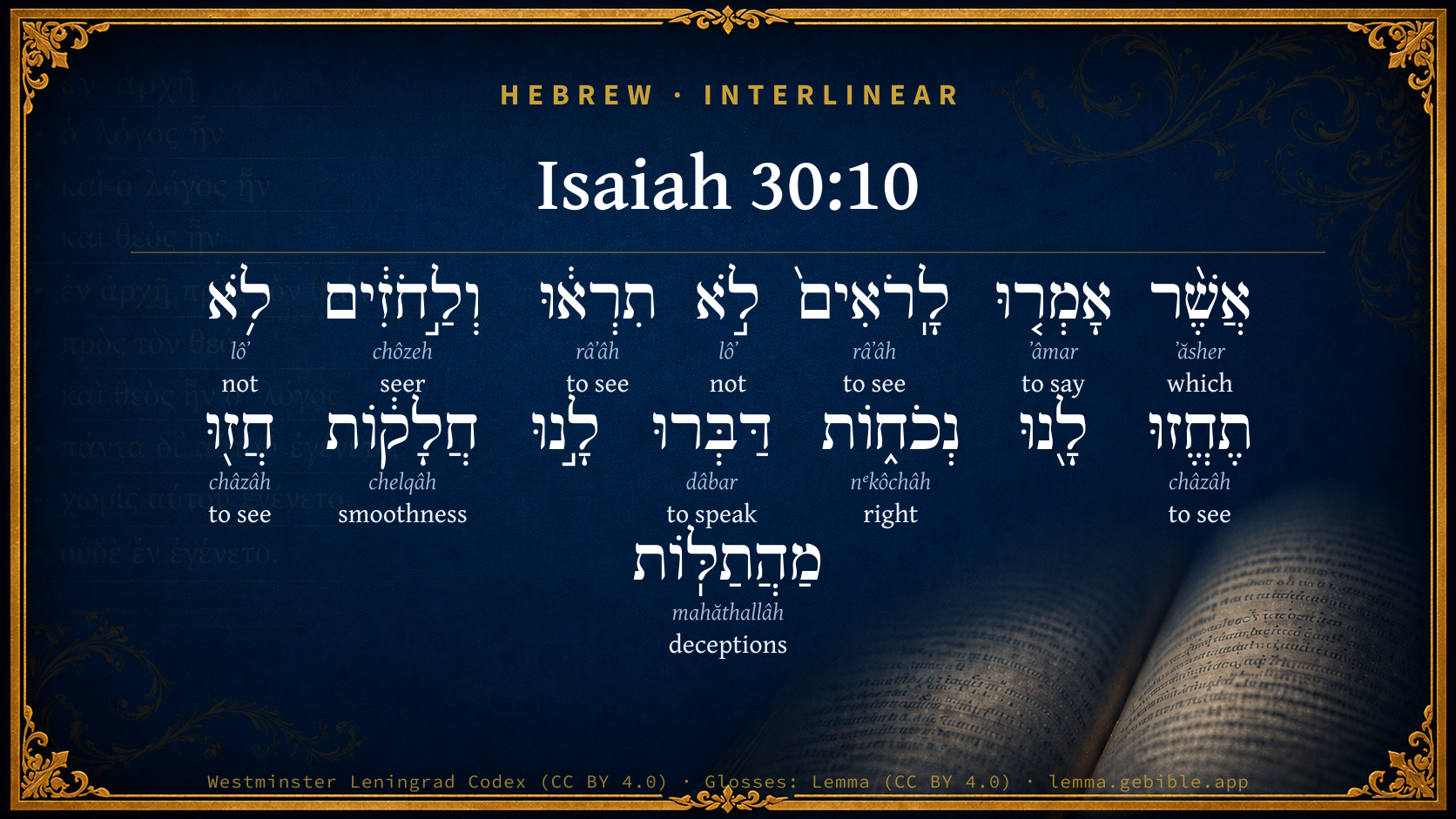
Hebrew (Westminster Leningrad Codex) Isaiah 30:10 appears in the Hebrew Old Testament. The text above is from the Westminster Leningrad Codex. Each word links to its Strong’s number, a concise gloss, and parsing drawn from the Open Scriptures Hebrew Bible morphology. Click any word for its full Brown-Driver-Briggs (BDB) entry.
Download image
Cite this verse

Isaiah 30:10 (World English Bible). Public Domain. Lemma interlinear Bible study tool, https://lemma.gebible.app/v/isaiah/30/10.

Show BibTeX & RIS
BibTeX
RIS
English Translation
who tell the seers, "Don't see;" and to the prophets, "Don't prophesy to us right things, speak to us smooth things, prophesy deceits,
World English Bible · Public Domain
Highlights
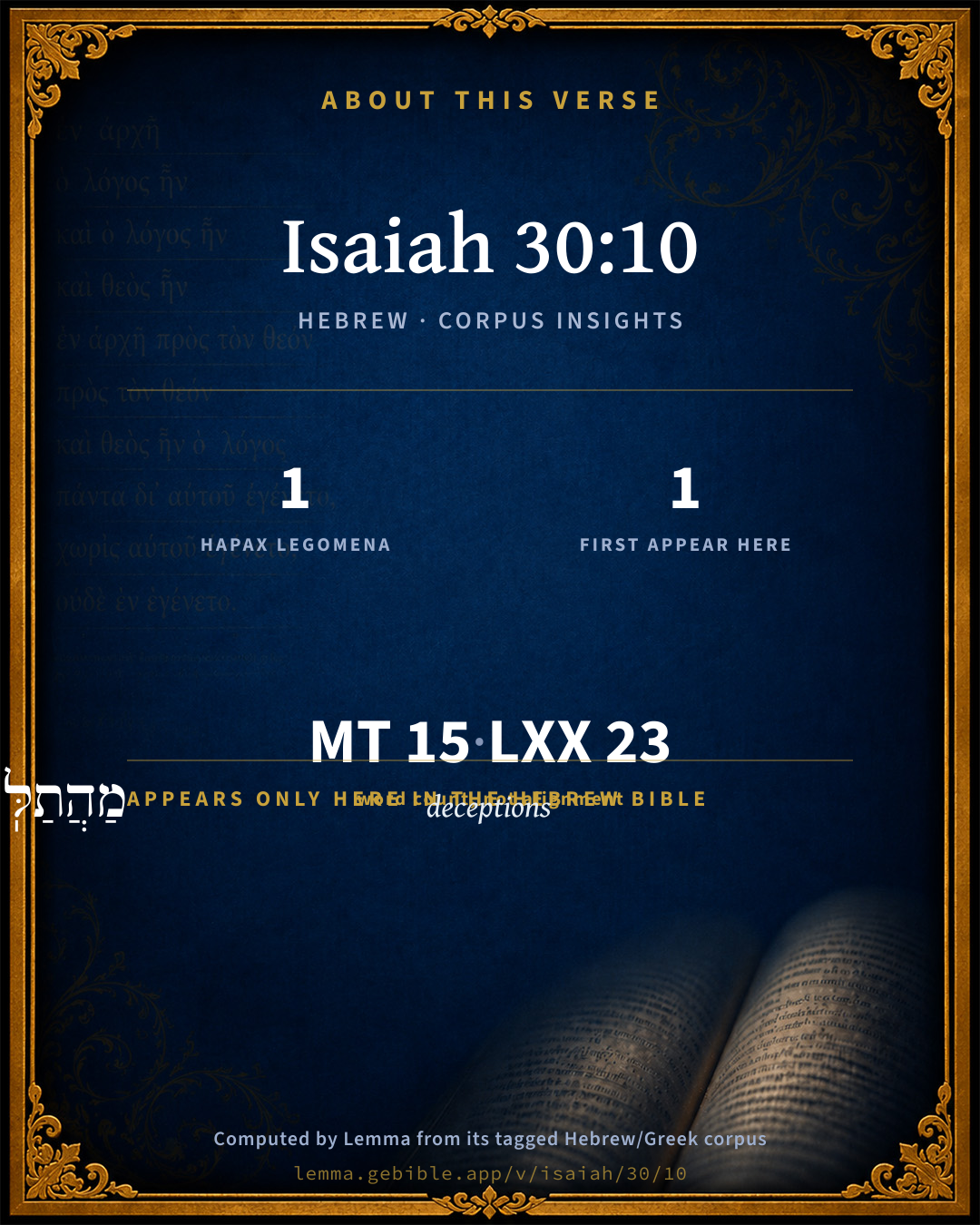
  • 1 hapax legomenon — only here in the Hebrew Bible
  • 1 first appearance in the Hebrew Bible
Full analysis ↓
Download a study sheet

One document with this verse’s original text, its word-by-word gloss line, the meaning frame, cross-references with their text, attributed commentary, and full source and license credits — printable, and it pastes into notes with its structure intact.

This verse Autodidact and up

Study sheet (.html) Plain text (.txt)

A passage Seminary Student

Up to 50 verses in one chapter. A passage sheet keeps up to 6 commentary sources and 12 cross-references per verse, in the order this page ranks them, and says so on the sheet whenever that leaves anything out. Ask for a single verse and you get the Autodidact verse sheet above.

Everything on this page stays free to read, with no account — the sheet is a download of what is already on screen, not access to it.

Want to remove ads? Support Godless Engineer
Compare translations 3

The same verse in 3 English versions, stacked beneath the original-language interlinear above. Click any original word for its lexicon entry.

Each is an independent rendering of the whole verse — the interlinear is not word-aligned to these translations.

Highlighted words mark where these versions differ — a whole-verse word diff, not a word-by-word alignment.

  • World English Bible Public Domain
    who tell the seers, "Don't see;" and to the prophets, "Don't prophesy to us right things, speak to us smooth things, prophesy deceits,
  • King James Version Public Domain
    Which say to the seers, See not; and to the prophets, Prophesy not unto us right things, speak unto us smooth things, prophesy deceits:
  • unfoldingWord Literal Text CC BY-SA 4.0
    who say to the seers, “Do not see,” and to the visionaries, “Do not envision truths for us. Speak flatteries to us; envision deceptions.

unfoldingWord Literal Text — © unfoldingWord, licensed CC BY-SA 4.0. Word-aligned USFM3 via Door43 (git.door43.org/unfoldingWord/en_ult).

Versions to compare (up to 4)

3 of 4 selected

Show all 18 translations

Every available English version of this verse, each an independent rendering of the whole verse.

  • World English Bible Public Domain
    who tell the seers, "Don't see;" and to the prophets, "Don't prophesy to us right things, speak to us smooth things, prophesy deceits,
  • Berean Standard Bible Public Domain
    They say to the seers, “Stop seeing visions!” and to the prophets, “Do not prophesy to us the truth! Speak to us pleasant words; prophesy illusions.
  • Majority Standard Bible Public Domain
    They say to the seers, “Stop seeing visions!” and to the prophets, “Do not prophesy to us the truth! Speak to us pleasant words; prophesy illusions.
  • King James Version Public Domain
    Which say to the seers, See not; and to the prophets, Prophesy not unto us right things, speak unto us smooth things, prophesy deceits:
  • American Standard Version (1901) Public Domain
    that say to the seers, See not; and to the prophets, Prophesy not unto us right things, speak unto us smooth things, prophesy deceits,
  • Revised Version (1885) Public Domain
    which say to the seers, See not; and to the prophets, Prophesy not unto us right things, speak unto us smooth things, prophesy deceits:
  • Geneva Bible (1599) Public Domain
    Which say vnto the Seers, See not: and to the Prophets, Prophecie not vnto vs right things: but speake flattering things vnto vs: prophecie errours.
  • Douay-Rheims (1899) Public Domain
    Who say to the seers: See not: and to them that behold: Behold not for us those things that are right: speak unto us pleasant things, see errors for us.
  • Young's Literal Translation Public Domain
    Who have said to seers, `Ye do not see,' And to prophets, `Ye do not prophesy to us Straightforward things, Speak to us smooth things, prophesy deceits,
  • Literal Standard Version CC BY-SA 4.0
    Who have said to seers, “Do not see,” || And to prophets, “Do not prophesy to us straightforward things, || Speak to us smooth things, prophesy deceits,
  • Unlocked Literal Bible CC BY-SA 4.0
    They say to the seers, “Do not see;” and to the prophets, “Do not prophesy the truth to us; speak flattering words to us, prophesy illusions.
  • unfoldingWord Literal Text CC BY-SA 4.0
    who say to the seers, “Do not see,” and to the visionaries, “Do not envision truths for us. Speak flatteries to us; envision deceptions.
  • Darby Bible Public Domain
    who say to the seers, See not; and to the prophets, Prophesy not unto us right things; speak unto us smooth things, prophesy deceits;
  • World Messianic Bible Public Domain
    who tell the seers, “Don’t see!” and the prophets, “Don’t prophesy to us right things. Tell us pleasant things. Prophesy deceits.
  • Webster's Bible Public Domain
    Who say to the seers, See not; and to the prophets, Prophesy not to us right things, speak to us smooth things, prophesy deceits:
  • Free Bible Version CC BY-SA 4.0
    They tell people who see visions, “Stop seeing visions!” and to the prophets, “Don't give us prophecies about doing right—just tell us pleasant things and give us fake prophecies.
  • Bible in Basic English Public Domain
    Who say to the seers, See not; and to the prophets, Do not give us word of what is true, but say false things to give us pleasure:
  • JPS Tanakh (1917) Public Domain
    That say to the seers: 'See not,' and to the prophets: 'Prophesy not unto us right things, speak unto us smooth things, prophesy delusions;

Literal Standard Version (2020), Covenant Press — licensed CC BY-SA 4.0. Text via the HelloAO Bible API (eBible.org). Unlocked Literal Bible (unfoldingWord) — licensed CC BY-SA 4.0. Text via the HelloAO Bible API (eBible.org). unfoldingWord Literal Text — © unfoldingWord, licensed CC BY-SA 4.0. Word-aligned USFM3 via Door43 (git.door43.org/unfoldingWord/en_ult). Free Bible Version, Dr. Jonathan Gallagher — licensed CC BY-SA 4.0. Text via the HelloAO Bible API (eBible.org).

Word by word

More ways to search: Search by grammar → Find every occurrence → Compare this word →

Practice this passage: Drill this verse → Learn its vocabulary →

מַהֲתַלּֽוֹת
mahăthallâh
H4123
“deceptions”
Noun, Common, Feminine, Plural, Absolute
Part of Speech
Noun
Type
Common
Gender
Feminine
Number
Plural
State
Absolute
Full BDB Definition

Origin: from H2048

TWOT: 2514a

deceptions, illusions
  1. אֲשֶׁ֨ר ʼăsher H834 “which” Particle, Relative
  2. אָמְר֤וּ ʼâmar H559 “to say” Verb, Qal, Perfect, 3rd Person, Common, Plural
  3. לָֽרֹאִים֙ râʼâh H7200 “to/for the · seeing” Preposition, Determined + Verb, Qal, Participle Active, Masculine, Plural, Absolute
  4. לֹ֣א lôʼ H3808 “not” Particle, Negative
  5. תִרְא֔וּ râʼâh H7200 “to see” Verb, Qal, Imperfect, 2nd Person, Masculine, Plural
  6. וְלַ֣חֹזִ֔ים chôzeh H2374 “and · to/for the · seer” Conjunction + Preposition, Determined + Verb, Qal, Participle Active, Masculine, Plural, Absolute
  7. לֹ֥א lôʼ H3808 “not” Particle, Negative
  8. תֶחֱזוּ châzâh H2372 “to see” Verb, Qal, Imperfect, 2nd Person, Masculine, Plural
  9. נְכֹח֑וֹת nᵉkôchâh H5229 “right” Adjective, Adjective, Feminine, Plural, Absolute
  10. דַּבְּרוּ dâbar H1696 “speak” Verb, Piel, Imperative, 2nd Person, Masculine, Plural
  11. חֲלָק֔וֹת chelqâh H2513 “smoothness” Adjective, Adjective, Feminine, Plural, Absolute
  12. חֲז֖וּ châzâh H2372 “see” Verb, Qal, Imperative, 2nd Person, Masculine, Plural

About this verse

These counts appear in no published source. They are computed here, from the morphology-tagged text and Lemma’s own curated glosses. What Lemma adds →

15
words
10
distinct lemmas
Prophets
section

Notable vocabulary

1 hapax legomenon — a word that appears only here in the entire Hebrew Bible:

  • מַהֲתַלּֽוֹת deceptions H4123

First appearance in Scripture

This word makes its first canonical appearance in the Hebrew Bible here:

  • מַהֲתַלּֽוֹת deceptions H4123

Shared distinctive vocabulary

נְכֹח֑וֹת right H5229 occurs in 4 verses of the Hebrew Bible. Also found in:

Grammatical profile

  • 7 verbs
  • 1 noun
  • 2 adjectives
  • 2 prepositions
  • 3 particles

Verb forms

  • אָמְר֤וּ Qal · Perfect
  • לָֽרֹאִים֙ Qal · Participle Active
  • תִרְא֔וּ Qal · Imperfect
  • וְלַ֣חֹזִ֔ים Qal · Participle Active
  • תֶחֱזוּ Qal · Imperfect
  • דַּבְּרוּ Piel · Imperative
  • חֲז֖וּ Qal · Imperative

Repetition

Words recur within this verse — often emphatic in Hebrew:

  • לָֽרֹאִים֙ to see H7200 ×2
  • תֶחֱזוּ to see H2372 ×2
  • לֹ֣א not H3808 ×2

Hebrew & Septuagint length

In English translation the verse runs 23 words from the Hebrew and 28 from the Septuagint (LXX English) — closely comparable.

A rough comparison of the two English renderings, which tokenize alike — not a word-level alignment.

Word counts can differ between the Hebrew and the Greek without any difference in meaning — e.g. the Hebrew direct-object marker אֵת has no separate Greek word, and Greek often adds the article ὁ.

In the original languages it is 15 Hebrew tokens and 23 Greek tokens — but the two are counted differently (Hebrew bundles its prefixes and suffixes into one token; the Greek is in lemma form), so that isn’t a like-for-like length.

Cross-references

30

Topical passages linked to Isaiah 30:10 in the Treasury of Scripture Knowledge — connected by theme and wording, ordered by reader-vote popularity; previews shown in the World English Bible.

  • Ezekiel 13:7–10 Haven't you seen a false vision, and haven't you spoken a lying divination, in that you say, Yahweh says; but I have not spoken?
  • Romans 16:18 For those who are such don't serve our Lord, Jesus Christ, but their own belly; and by their smooth and flattering speech, they deceive the hearts of the innocent.
  • Jeremiah 11:21 Therefore thus says Yahweh concerning the men of Anathoth, who seek your life, saying, You shall not prophesy in the name of Yahweh, that you not die by our hand;
  • Amos 2:12 "But you gave the Nazirites wine to drink, And commanded the prophets, saying, 'Don't prophesy!'
  • Amos 7:13 but don't prophesy again any more at Bethel; for it is the king's sanctuary, and it is a royal house!"
  • Jeremiah 23:17 They say continually to those who despise me, Yahweh has said, You shall have peace; and to everyone who walks in the stubbornness of his own heart they say, No evil shall come on you.
  • Jeremiah 23:26–29 How long shall this be in the heart of the prophets who prophesy lies, even the prophets of the deceit of their own heart?
  • Revelation 11:7 When they have finished their testimony, the beast that comes up out of the abyss will make war with them, and overcome them, and kill them.
  • 1 Kings 21:20 Ahab said to Elijah, Have you found me, my enemy? He answered, I have found you, because you have sold yourself to do that which is evil in the sight of Yahweh.
  • 1 Kings 22:27 and say, Thus says the king, Put this fellow in the prison, and feed him with bread of affliction and with water of affliction, until I come in peace.
  • Micah 2:6 "Don't you prophesy!" They prophesy. "Don't prophesy about these things. Disgrace won't overtake us."
  • John 7:7 The world can't hate you, but it hates me, because I testify about it, that its works are evil.
  • 1 Thessalonians 2:15–16 who killed both the Lord Jesus and their own prophets, and drove us out, and didn't please God, and are contrary to all men;
  • 1 Kings 22:8–13 The king of Israel said to Jehoshaphat, there is yet one man by whom we may inquire of Yahweh, Micaiah the son of Imlah: but I hate him; for he does not prophesy good concerning me, but evil. Jehoshaphat said, "Don't let the king say so."
  • 2 Chronicles 16:10 Then Asa was angry with the seer, and put him in the prison-house; for he was in a rage with him because of this thing. Asa oppressed some of the people at the same time.
  • 2 Chronicles 18:7–27 The king of Israel said to Jehoshaphat, There is yet one man by whom we may inquire of Yahweh: but I hate him; for he never prophesies good concerning me, but always evil: the same is Micaiah the son of Imla. Jehoshaphat said, Don't let the king say so.
  • 2 Chronicles 25:16 It happened, as he talked with him, that [the king] said to him, Have we made you of the king's counsel? Stop! Why should you be struck down? Then the prophet stopped, and said, I know that God has determined to destroy you, because you have done this, and have not listened to my counsel.
  • Jeremiah 5:31 the prophets prophesy falsely, and the priests bear rule by their means; and my people love to have it so: and what will you do in the end of it?
  • Jeremiah 6:13–14 For from the least of them even to the greatest of them everyone is given to covetousness; and from the prophet even to the priest everyone deals falsely.
  • Jeremiah 8:10–11 Therefore will I give their wives to others, and their fields to those who shall possess them: for everyone from the least even to the greatest is given to covetousness; from the prophet even to the priest every one deals falsely.
  • Jeremiah 26:11 Then spoke the priests and the prophets to the princes and to all the people, saying, This man is worthy of death; for he has prophesied against this city, as you have heard with your ears.
  • Jeremiah 29:27 Now therefore, why have you not rebuked Jeremiah of Anathoth, who makes himself a prophet to you,
  • Jeremiah 38:4 Then the princes said to the king, Let this man, we pray you, be put to death; because he weakens the hands of the men of war who remain in this city, and the hands of all the people, in speaking such words to them: for this man doesn't seek the welfare of this people, but the hurt.
  • Ezekiel 13:18–22 and say, Thus says the Lord Yahweh: Woe to the women who sew pillows on all elbows, and make kerchiefs for the head of [persons of] every stature to hunt souls! Will you hunt the souls of my people, and save souls alive for yourselves?
  • Micah 2:11 If a man walking in a spirit of falsehood lies: 'I will prophesy to you of wine and of strong drink;' He would be the prophet of this people.
  • John 8:45 But because I tell the truth, you don't believe me.
  • Acts 4:17 But so that this spreads no further among the people, let's threaten them, that from now on they don't speak to anyone in this name."
  • Acts 5:28 saying, "Didn't we strictly charge you not to teach in this name? Behold, you have filled Jerusalem with your teaching, and intend to bring this man's blood on us."
  • Galatians 4:16 So then, have I become your enemy by telling you the truth?
  • 2 Chronicles 24:19–21 Yet he sent prophets to them, to bring them again to Yahweh; and they testified against them: but they would not give ear.

Cross-references courtesy of OpenBible.info (CC BY 4.0).

Hebrew and Greek witnesses Masoretic Hebrew ↔ Greek Septuagint

The same verse in the two great witnesses to the Old Testament, shown verse-for-verse.

These are two independent witnesses, not word-aligned to each other, and the Septuagint is shown in lemma (dictionary) form.

Hebrew Isaiah 30:10 Masoretic · Westminster Leningrad Codex

אֲשֶׁ֨ר אָמְר֤וּ לָֽרֹאִים֙ לֹ֣א תִרְא֔וּ וְלַ֣חֹזִ֔ים לֹ֥א תֶחֱזוּ לָ֖נוּ נְכֹח֑וֹת דַּבְּרוּ לָ֣נוּ חֲלָק֔וֹת חֲז֖וּ מַהֲתַלּֽוֹת

who tell the seers, "Don't see;" and to the prophets, "Don't prophesy to us right things, speak to us smooth things, prophesy deceits,

World English Bible · Public Domain

Greek LXX Isaiah 30:10 Septuagint · lemma form

ὁ λέγω ὁ προφήτης μή ἀναἀγγέλλω ἐγώ καί ὁ ὁ ὅραμα ὁράω μή λαλέω ἐγώ ἀλλά ἐγώ λαλέω καί ἀναἀγγέλλω ἐγώ ἕτερος πλάνησις

who say to the prophets, Report not to us; and to them that see visions, Speak them not to us, but speak and report to us another error;

LXX2012 (modern English Septuagint) · Public Domain

Hebrew: Westminster Leningrad Codex (CC BY 4.0). Greek: Septuagint (public domain); English from LXX2012 (modern English Septuagint) (Public Domain). How the Septuagint differs from the Hebrew →

Targum (Aramaic paraphrase)

1

The Targum is the ancient Jewish Aramaic paraphrase of the Hebrew Scriptures — an interpretive translation, not the Hebrew text itself. Onkelos (literal) and Pseudo-Jonathan (expansive) render the Torah, and Jonathan the Prophets. Coverage is partial: where no permissively-licensed English translation exists for a verse, only the Aramaic is shown. This is verse-level text, not a word-by-word alignment to the Hebrew.

  1. Targum Jonathan Prophets (Joshua–Malachi)
    דְאָמְרִין לִנְבַיָיא לָא תִתְנַבּוּן וּלְמַלְפַיָא לָא תַלְפוּן לָנָא אוּלְפַן אוֹרַיְתָא בְּסִימָן מַלִילוּ עִמָנָא אִשְׁתַּעוּ לָנָא שְׁנִין:

    Who say to the prophets, Prophesy ye not: and as for doctrines, teach us not the doctrine of the law: speak ye with us with signs, relate unto us various things:

    Targum Jonathan — Aramaic: “Mikraot Gedolot” (public domain). English: “Sefaria Community Translation” (CC0 1.0 (public-domain dedication)); “London "Chaldee Paraphrase," 1871” (public domain). Text via Sefaria.

Commentary

Notes on Isaiah 30:10 from classic Christian and Jewish commentators (each source and its license shown beneath its notes). The classic Christian expositions comment on the surrounding passage and are grouped to its opening verse, so a note may address several verses; the Jewish commentaries on the Tanakh (Rashi and others) are per-verse, so they appear only where the commentator wrote on this verse.

Lemma curates 59 commentaries, every one of them public domain or Creative Commons licensed, each selected and text-cleaned for this edition rather than reprinted as found. About our sources →

Trapp's Complete Commentary

John Trapp

Isa 30:10 Which say to the seers, See not; and to the prophets, Prophesy not unto us right things, speak unto us smooth things, prophesy deceits:

Ver. 10. Which say to the seers, See not, &c.] Strange impudence! but in thus reciting their words, the prophet rather expresseth their spirit than their speeches. And yet it may be that the politicians of those times blamed the prophets, Isaiah and the rest, as pragmatic, for interposing and meddling in state matters, and pressing the law so strictly, since in cases of necessity, as now it was, they must make bold to borrow a little law of the Holy One of Israel.

Speak unto us smooth things.] Heb., Smoothnesses, toothless truths, and such as may speak you no meddlers.

John Trapp, A Commentary or Exposition upon All the Books of the Old and New Testament (1647–1656) — public domain. Text from a community e-Sword module.

Geneva Bible (1599)

Geneva Bible translators

Threaten us not by the word of God, neither be so rigorous, nor talk unto us in the Name of the Lord, as Jer. 11:21.

Geneva Bible (1599) marginal notes — public domain. Text via Bolls.life.

Jamieson, Fausset & Brown

Robert Jamieson, A. R. Fausset & David Brown

(Mic 2:6, Mic 2:11; Mic 3:5).

See not--as you now do, foretelling misfortune.

Prophesy not . . . right things--Not that they avowedly requested this, but their conduct virtually expressed it. No man, professedly, wished to be deceived; but many seek a kind of teaching which is deceit; and which, if they would examine, they might know to be such (Kg1 22:13). The Jews desired success to be foretold as the issue of their league with Egypt, though ill had been announced by God's prophet as the result; this constituted the "deceits."

Jamieson, Fausset & Brown — Commentary Critical and Explanatory on the Whole Bible (1871) — public domain (CC PDM 1.0). Text via the HelloAO Bible API.

The Cambridge Bible for Schools and Colleges

gen. ed. J. J. S. Perowne

10. the seers] (1Sa_9:9.)

the prophets] The word rightly rendered “seer” in Amo_7:12 and elsewhere. See on Isa_1:1. The prophets referred to can hardly (in view of Isa_30:11) be merely the false prophets, who were at the beck and call of the people, but all representatives of the prophetic office. Cf. Amo_2:12; Amo_7:12; Hos_9:7-8; Mic_2:6; Mic_2:11; Mic_3:5; Mic_3:11; Jer_6:14; Jer_14:13 ff.; Eze_13:10 ff.

deceits] illusions; the word is used only here. It is Isaiah’s own estimate that is put into the mouth of the people.

The Cambridge Bible for Schools and Colleges (gen. ed. J. J. S. Perowne; Cambridge University Press, 1878–1918) — public domain. Text from a community e-Sword module.

John Gill's Exposition

Which say to the seers, See not,.... The same with the prophets in the next clause, which explains this:

and to the Prophets, prophesy not unto us right things; things agreeable to the mind and will of God, and which ought to be done; not that they, in so many words, said this, but this was the language of their hearts and actions. The Targum is,

"who say to the prophets, prophesy not, and to the teachers, teach us not the doctrine of the law:''

speak unto us smooth things; that peace and prosperity should attend them, though they went on in their sinful courses:

prophesy deceits; for to prophesy peace to them, when destruction was at hand, was to deceive them; and yet they chose rather to be told the one than the other.

John Gill's Exposition of the Whole Bible (1746–1763) — public domain (CC PDM 1.0). Text via the HelloAO Bible API.

Albert Barnes' Notes on the Bible

Which say to the seers - The prophets (see the note at Isa 1:1).

See not - They desire not that they should communicate to them the will of Yahweh.

Prophesy not unto us right things - It is not probable that they “openly” demanded of the prophets that they should declare falsehood and deceit, but their conduct was as if they had required that. The sense is, they bore with impatience the theatenings and commands of the true prophets; they were offended at their plainness and their reproofs of their vices; and they preferred the false prophets, who fell in with their prejudices, and who did not denounce the judgment of God for their crimes.

Speak unto us smooth things - That is, those things which are in accordance with our feelings, prejudices, and desires; which assure us of prosperity and success, and which will not disturb us with the apprehension of punishment. This was spoken particularly of their desire to make a league with Egypt, an enterprise for which the true prophets threatened them with the divine displeasure, but which probably the false prophets encouraged.

Prophesy deceits - Not that they would openly and avowedly demand to be deceived, but they demanded that which the prophet says would be deceits. No man “professedly” desires to be deceived; but many a man is willing to put himself under that kind of teaching which is deceit, and which he might know to be falsehood if he would examine it.

Albert Barnes' Notes on the Bible (1834–1885) — public domain. Text from a community e-Sword/MySword module.

Haydock's Catholic Bible Commentary

See not. Such were the dispositions of their heart, chap. xxviii. 15.

George Leo Haydock (1774–1849), Haydock's Catholic Family Bible and Commentary, 1859 edition — public domain. Excludes Psalms (Douay-Rheims chapter numbering differs from Protestant) and Deuterocanonical books (Catholic canon only).

Matthew Poole's English Annotations

He speaks not of the words of their mouths; for none could be so mad of impudent as to have or profess a desire to be cheated, but of the language of their actions. They do so discourage and threaten God’s faithful prophets, and so encourage their own false prophets, as if they had rather be deceived to their destruction, than hear the truth for their preservation and salvation. They prefer the pleasing of their humours before the saving of themselves.

Matthew Poole's English Annotations on the Holy Bible (1683–1685) — public domain. Text from a community e-Sword/MySword module.

The Pulpit Commentary

Which say, etc. Not, of course, directly, in so many words. But indirectly they let it be understood that this was what they wished. Compare the advice given to Micaiah by Ahab"s messenger, who, no doubt, correctly interpreted the wishes of the monarch and his nobles. (1Ki_22:13) Seers... prophets. Not two classes of persons, but two names for the same class. The" parallelism" of Hebrew poetry leads to the constant employment of synonymous clauses. Right things; i.e. the truth in all its plainness. Smooth things; i.e. soft, pleasant announcements. Deceits; or, illusions. (comp. Jer_9:5, "They will deceive" or "mock where we have the same root)

Vers. 10, 11. Smooth things wore acceptable to man than the truth.

In connection with this subject there would seem to be three things to be specially set forth.

I THE FACT OF THE PREFERENCE. Man has no natural aversion to truth. On the contrary, truth is congenial to his nature and acceptable to his intellect. Scientific truth, historic truth, is readily received when offered to him, and, if not very eagerly desired or very carefully sought out, is at any rate, when put before him, generally to some extent appreciated. The truth that is disliked is moral truth. Even when set before him in an abstract form, moral teaching frets him, vexes him; and moralists have been always unpopular from the days of Socrates to those of Samuel Johnson. Especially disliked are the teachers who do not stop at abstract morality, but point their moral teaching by applying it to the life and conduct of those to whom they address themselves. On the other hand, there is no surer way of pleasing men than by flattering them, provided it is done skillfully and with a delicate hand. We like to have our conduct praised, our characters admired, our example held up as a model to be imitated. We detest being found fault with, criticized, told that we have done wrong. We do not perhaps ask men to prophesy unto us smooth things," but we make it very plain to all with whom we come into contact that smooth things" alone are agreeable to us.

II THE GROUND OF THE PREFERENCE. Moral truth is disliked because it is felt as a reproach. We are conscious to ourselves of our own moral imperfection; and every exhibition of a high moral standard, every inculcation of high moral principles, seems to us a reflection on our own shortcomings, not far short of actual personal censure. The smooth voice of flattery pleases us, partly, through its contrast with the rough tones of the unwelcome moralist, but further through its persuading us that we really have some of the good qualities which the flatterer imputes, and thus calling into play our self-respect and self-esteem. Moral warnings awaken fear for the future; flattery awakens hope. Moral warnings disturb; flattery soothes. Even when we perceive that the flatterer is cozening us, we let ourselves be cozened; our vanity is pleased at being tickled, and asks for nothing but a prolongation of the pleasurable excitement.

III THE ILL RESULTS THAT FLOW FROM THE PREFERENCE. Character, which would naturally improve under the bracing discipline of a stern and strict inculcation of moral truth, continually deteriorates, if flattery takes the place of honest plain-speaking. Men believe themselves better than they are, and take less pains to become better. They grow vain and self-satisfied, thinking themselves in need of nothing, when truly they are wretched, and miserable, and poor, and blind, and naked". (Rev_3:17) Spiritual teachers should beware of encouraging men"s self-indulgent desire for spiritual ease; and, while careful not to "quench the smoking flax," or break the bruised reed," should constantly sound in the ears of all denunciations of vice, warnings, rebukes, admonishments. In no other way can they be either faithful to their calling or truly serviceable to their fellow-men.

The Pulpit Commentary (1880–1919), ed. H.D.M. Spence-Jones & Joseph S. Exell — public domain. Text from a community e-Sword module.

J. A. Alexander on Isaiah

Joseph Addison Alexander

“Who say to the seers, Ye shall not see, and to the viewers, ye shall not view for us right things; speak unto us smooth things, view deceits.” There is great difficulty in translating this verse literally, as the two Hebrew verbs, meaning to see, have no equivalents in English, which of themselves suggest the idea of prophetic revelation. The common version (see not, prophesy not), although it conveys the true sense substantially, leaves out of view the near relation of the two verbs to each other in the original. In the translation above given, view is introduced merely as a synonym of see, both being here used to express supernatural or prophetic vision. With this use of the verbal noun (seer) we are all familiar through the English Bible. This is of course not given as the actual language of the people, but as the tendency and spirit of their acts. Smooth things or words is a common figurative term for flatteries. Luther’s expressive version is, preach soft to us.

Joseph Addison Alexander, The Prophecies of Isaiah (1846–1847; New York: Scribner, 1870–1878) — public domain. Text from a community e-Sword module.

unfoldingWord translationNotes

Door43 World Missions Community

General Information:

Yahweh continues speaking about the people of Judah.

Turn aside from the way, stray off the path

How Yahweh wants his people to behave is spoken of as if it were a way or path on which to walk. To disobey Yahweh is spoken of as if the person strays away from Yahweh's path. (See: Metaphor)

Holy One of Israel

See how you translated this name in Isaiah 1:4.

translationWords

prophet

true

deceive

turn

Holy One

Israel

unfoldingWord translationNotes — © Distant Shores Media and the Door43 World Missions Community, licensed CC BY-SA 4.0. Source: git.door43.org/Door43/en_tn.

Rashi

Rabbi Shlomo Yitzchaki (Rashi)

smooth talk Flattery.

prophesy (חֲזוּ, lit., envision) prophesy.

Rashi on the Tanakh — English translations: “The Judaica Press complete Tanach with Rashi, translated by A. J. Rosenberg” (CC BY 4.0); “Pentateuch with Rashi's commentary by M. Rosenbaum and A.M. Silbermann, 1929-1934” (public domain); “The Metsudah Tanach series, Lakewood, N.J” (CC BY 4.0); and “The Book of Joshua, Metsudah Publications, 1997” (CC BY 4.0). Text via Sefaria.

Ibn Ezra

Rabbi Abraham ibn Ezra

See not. You shall not prophesy.

לראים To the seers. To those that see a divine vision.

נכחות Upright things. Comp. טובים ונכוחים דבריך thy words are good and upright (2 Sam. 15:3). It is an adjective.

דברי חלקות ═ חלקות words of flattery; חלקות is a substantive; so also דברי מהתלות ═ מהתלות, words of mockery.

Ibn Ezra on the Tanakh — English translations: “Sefaria Community Translation” (CC0 1.0 (public-domain dedication)); “Yalkut, Sifsei Chachomim Chumash, Metsudah Publications, 2009” (CC BY 4.0); and “Commentary of Ibn Ezra on Isaiah - trans. by M. Friedlander, 1873” (public domain). Text via Sefaria.

Lesson kit

Teaching starters — assembled from the data on this page, not authored interpretation. Every prompt links to the verse data it draws on. Edit before teaching.

Isaiah, in the Prophets, opens this verse with 15 words (10 distinct Hebrew lemmas). Its most distinctive word is mahăthallâh (“deceptions”). A historical commentator’s framing appears above. Read the whole chapter for the surrounding context.

Discussion questions

  1. The word mahăthallâh carries the sense “deceptions.” How does it shape the verse?
  2. 1 word here appears nowhere else in the Hebrew Bible. Why might the author reach for such rare wording?
  3. This is the first place “deceptions” appears in Scripture (first appears here). What does its debut here establish?
  4. How does Isaiah 26:10, which shares the word «right», read alongside this verse?
  5. What does the repetition of “to see” (2× in this one verse) do in this verse?
  6. The translations on this page render this verse differently — a whole-verse word diff, not a word-by-word alignment. What might account for the different wordings?
  7. «אָמְר֤וּ» is a Qal Perfect verb. How does that grammatical form shape the action described?
  8. Compare how Trapp's Complete Commentary and Geneva Bible (1599) read this verse. Where do they agree or differ?

Things to notice

  • 1 word in this verse appears nowhere else in the Hebrew Bible.
  • 1 word makes its first canonical appearance in Scripture here.
  • This verse counts 15 Hebrew ↔ 23 Greek words.
  • These translations choose different wording for 17 words in this verse.
  • “to see” occurs 2× in this single verse.

Reading settings

Reading text

Shown beneath each verse's original-language words.

Old Testament
Old Testament edition

Read the OT as the Masoretic Hebrew (MT) or the Greek Septuagint (LXX).

English shown for the Greek Septuagint (in the Hebrew ↔ Greek comparison).

Comparing translations? Open the Compare panel on any verse page to stack up to four side by side.