
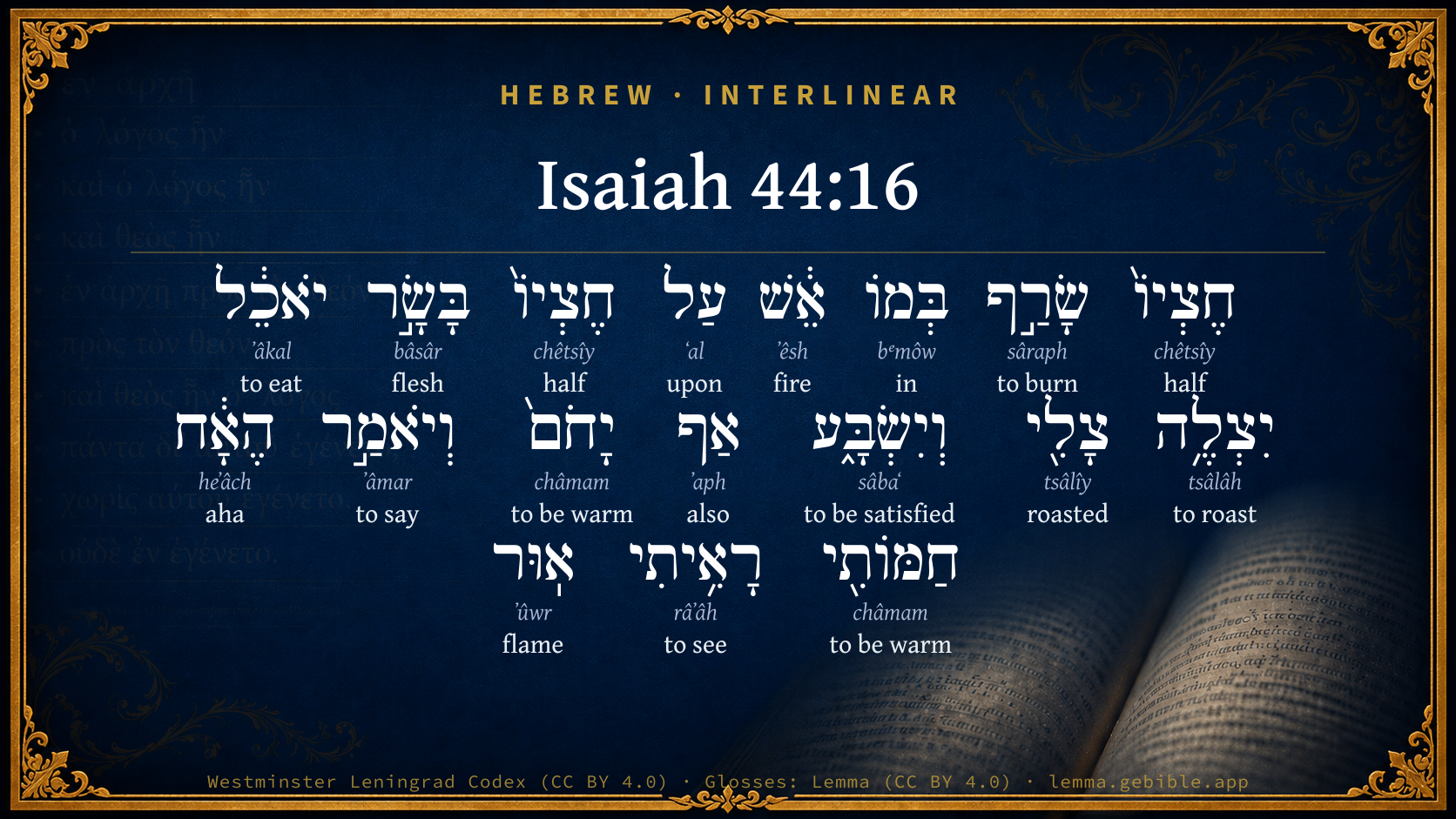
Isaiah 44:16

Hebrew (Westminster Leningrad Codex) Isaiah 44:16 appears in the Hebrew Old Testament. The text above is from the Westminster Leningrad Codex. Each word links to its Strong’s number, a concise gloss, and parsing drawn from the Open Scriptures Hebrew Bible morphology. Click any word for its full Brown-Driver-Briggs (BDB) entry.
Download image
Cite this verse

Isaiah 44:16 (World English Bible). Public Domain. Lemma interlinear Bible study tool, https://lemma.gebible.app/v/isaiah/44/16.

Show BibTeX & RIS
BibTeX
RIS
English Translation
He burns part of it in the fire; with part of it he eats flesh; he roasts roast, and is satisfied; yes, he warms himself, and says, Aha, I am warm, I have seen the fire.
World English Bible · Public Domain
Download a study sheet

One document with this verse’s original text, its word-by-word gloss line, the meaning frame, cross-references with their text, attributed commentary, and full source and license credits — printable, and it pastes into notes with its structure intact.

This verse Autodidact and up

Study sheet (.html) Plain text (.txt)

A passage Seminary Student

Up to 50 verses in one chapter. A passage sheet keeps up to 6 commentary sources and 12 cross-references per verse, in the order this page ranks them, and says so on the sheet whenever that leaves anything out. Ask for a single verse and you get the Autodidact verse sheet above.

Everything on this page stays free to read, with no account — the sheet is a download of what is already on screen, not access to it.

Want to remove ads? Support Godless Engineer
Compare translations 3

The same verse in 3 English versions, stacked beneath the original-language interlinear above. Click any original word for its lexicon entry.

Each is an independent rendering of the whole verse — the interlinear is not word-aligned to these translations.

Highlighted words mark where these versions differ — a whole-verse word diff, not a word-by-word alignment.

  • World English Bible Public Domain
    He burns part of it in the fire; with part of it he eats flesh; he roasts roast, and is satisfied; yes, he warms himself, and says, Aha, I am warm, I have seen the fire.
  • King James Version Public Domain
    He burneth part thereof in the fire; with part thereof he eateth flesh; he roasteth roast, and is satisfied: yea, he warmeth himself, and saith, Aha, I am warm, I have seen the fire:
  • unfoldingWord Literal Text CC BY-SA 4.0
    Half of it, he burns in the fire; on half of it he eats meat, he roasts a roast, and has enough. Indeed, he is warm, and he says, “Ah! I am warm; I have seen the fire.”

unfoldingWord Literal Text — © unfoldingWord, licensed CC BY-SA 4.0. Word-aligned USFM3 via Door43 (git.door43.org/unfoldingWord/en_ult).

Versions to compare (up to 4)

3 of 4 selected

Show all 18 translations

Every available English version of this verse, each an independent rendering of the whole verse.

  • World English Bible Public Domain
    He burns part of it in the fire; with part of it he eats flesh; he roasts roast, and is satisfied; yes, he warms himself, and says, Aha, I am warm, I have seen the fire.
  • Berean Standard Bible Public Domain
    He burns half of it in the fire, and he roasts meat on that half. He eats the roast and is satisfied. Indeed, he warms himself and says, “Ah! I am warm; I see the fire.”
  • Majority Standard Bible Public Domain
    He burns half of it in the fire, and he roasts meat on that half. He eats the roast and is satisfied. Indeed, he warms himself and says, “Ah! I am warm; I see the fire.”
  • King James Version Public Domain
    He burneth part thereof in the fire; with part thereof he eateth flesh; he roasteth roast, and is satisfied: yea, he warmeth himself, and saith, Aha, I am warm, I have seen the fire:
  • American Standard Version (1901) Public Domain
    He burneth part thereof in the fire; with part thereof he eateth flesh; he roasteth roast, and is satisfied; yea, he warmeth himself, and saith, Aha, I am warm, I have seen the fire.
  • Revised Version (1885) Public Domain
    He burneth part thereof in the fire; with part thereof he eateth flesh; he roasteth roast, and is satisfied: yea, he warmeth himself, and saith, Aha, I am warm, I have seen the fire:
  • Geneva Bible (1599) Public Domain
    He burneth the halfe thereof euen in the fire, and vpon the halfe thereof he eateth flesh: he rosteth the roste and is satisfied: also he warmeth himselfe and sayth, Aha, I am warme, I haue bene at the fire.
  • Douay-Rheims (1899) Public Domain
    Part of it he burnt with fire, and with part of it he dressed his meat: he boiled pottage, and was filled, and was warmed, and said: Aha, I am warm, I have seen the fire.
  • Young's Literal Translation Public Domain
    Half of it he hath burnt in the fire, By `this' half of it he eateth flesh, He roasteth a roasting, and is satisfied, Yea, he is warm, and saith: `Aha, I have become warm, I have enjoyed the light.
  • Literal Standard Version CC BY-SA 4.0
    Half of it he has burned in the fire, || By [this] half of it he eats flesh, || He roasts a roasting and is satisfied, || Indeed, he is warm and says: “Aha, I have become warm, I have enjoyed the light.”
  • Unlocked Literal Bible CC BY-SA 4.0
    He burns part of the wood for the fire, roasting his meat over it. He eats and is satisfied. He warms himself and says, “Ah, I am warm, I have seen the fire.”
  • unfoldingWord Literal Text CC BY-SA 4.0
    Half of it, he burns in the fire; on half of it he eats meat, he roasts a roast, and has enough. Indeed, he is warm, and he says, “Ah! I am warm; I have seen the fire.”
  • Darby Bible Public Domain
    He burneth part thereof in the fire; with part thereof he eateth flesh, he roasteth roast, and is satisfied; yea, he is warm, and saith, Aha, I am become warm, I have seen the fire.
  • World Messianic Bible Public Domain
    He burns part of it in the fire. With part of it, he eats meat. He roasts a roast and is satisfied. Yes, he warms himself and says, “Aha! I am warm. I have seen the fire.”
  • Webster's Bible Public Domain
    He burneth part of it in the fire; with part of it he eateth flesh; he roasteth meat, and is satisfied: yes, he warmeth himself, and saith, Aha, I am warm, I have seen the fire:
  • Free Bible Version CC BY-SA 4.0
    So he burns part of the wood to roast his meat to eat, and to warm him up, and says, “Ah! Look at that fire that keeps me warm!”
  • Bible in Basic English Public Domain
    With part of it he makes a fire, and on the fire he gets meat cooked and takes a full meal: he makes himself warm, and says, Aha! I am warm, I have seen the fire:
  • JPS Tanakh (1917) Public Domain
    He burneth the half thereof in the fire; with the half thereof he eateth flesh; he roasteth roast, and is satisfied; yea, he warmeth himself, and saith: 'Aha, I am warm, I have seen the fire';

Literal Standard Version (2020), Covenant Press — licensed CC BY-SA 4.0. Text via the HelloAO Bible API (eBible.org). Unlocked Literal Bible (unfoldingWord) — licensed CC BY-SA 4.0. Text via the HelloAO Bible API (eBible.org). unfoldingWord Literal Text — © unfoldingWord, licensed CC BY-SA 4.0. Word-aligned USFM3 via Door43 (git.door43.org/unfoldingWord/en_ult). Free Bible Version, Dr. Jonathan Gallagher — licensed CC BY-SA 4.0. Text via the HelloAO Bible API (eBible.org).

Word by word

More ways to search: Search by grammar → Find every occurrence → Compare this word →

Practice this passage: Drill this verse → Learn its vocabulary →

יִצְלֶ֥ה
tsâlâh
H6740
“to roast”
Verb, Qal, Imperfect, 3rd Person, Masculine, Singular
Part of Speech
Verb
Stem
Qal
Form
Imperfect
Person
3rd Person
Gender
Masculine
Number
Singular
Full BDB Definition

Origin: a primitive root

TWOT: 1915

(Qal) to roast
  1. חֶצְיוֹ֙ chêtsîy H2677 “half · his” Noun, Common, Masculine, Singular, Construct + Suffix, Personal, 3rd Person, Masculine, Singular
  2. שָׂרַ֣ף sâraph H8313 “to burn” Verb, Qal, Perfect, 3rd Person, Masculine, Singular
  3. בְּמוֹ bᵉmôw H1119 “in” Preposition
  4. אֵ֔שׁ ʼêsh H784 “fire” Noun, Common, Both, Singular, Absolute
  5. עַל ʻal H5921 “upon” Preposition
  6. חֶצְיוֹ֙ chêtsîy H2677 “half · his” Noun, Common, Masculine, Singular, Construct + Suffix, Personal, 3rd Person, Masculine, Singular
  7. בָּשָׂ֣ר bâsâr H1320 “flesh” Noun, Common, Masculine, Singular, Absolute
  8. יֹאכֵ֔ל ʼâkal H398 “to eat” Verb, Qal, Imperfect, 3rd Person, Masculine, Singular
  9. צָלִ֖י tsâlîy H6748 “roasted” Noun, Common, Masculine, Singular, Absolute
  10. וְיִשְׂבָּ֑ע sâbaʻ H7646 “and · to be satisfied” Conjunction + Verb, Qal, Imperfect, 3rd Person, Masculine, Singular
  11. אַף ʼaph H637 “also” Particle, Accusative
  12. יָחֹם֙ châmam H2552 “to be warm” Verb, Qal, Imperfect, 3rd Person, Masculine, Singular
  13. וְיֹאמַ֣ר ʼâmar H559 “and · to say” Conjunction + Verb, Qal, Imperfect, 3rd Person, Masculine, Singular
  14. הֶאָ֔ח heʼâch H1889 “aha” Particle, Interjection
  15. חַמּוֹתִ֖י châmam H2552 “to be warm” Verb, Qal, Perfect, 1st Person, Common, Singular
  16. רָאִ֥יתִי râʼâh H7200 “to see” Verb, Qal, Perfect, 1st Person, Common, Singular
  17. אֽוּר ʼûwr H217 “flame” Noun, Common, Masculine, Singular, Absolute

About this verse

These counts appear in no published source. They are computed here, from the morphology-tagged text and Lemma’s own curated glosses. What Lemma adds →

18
words
16
distinct lemmas
Prophets
section

Notable vocabulary

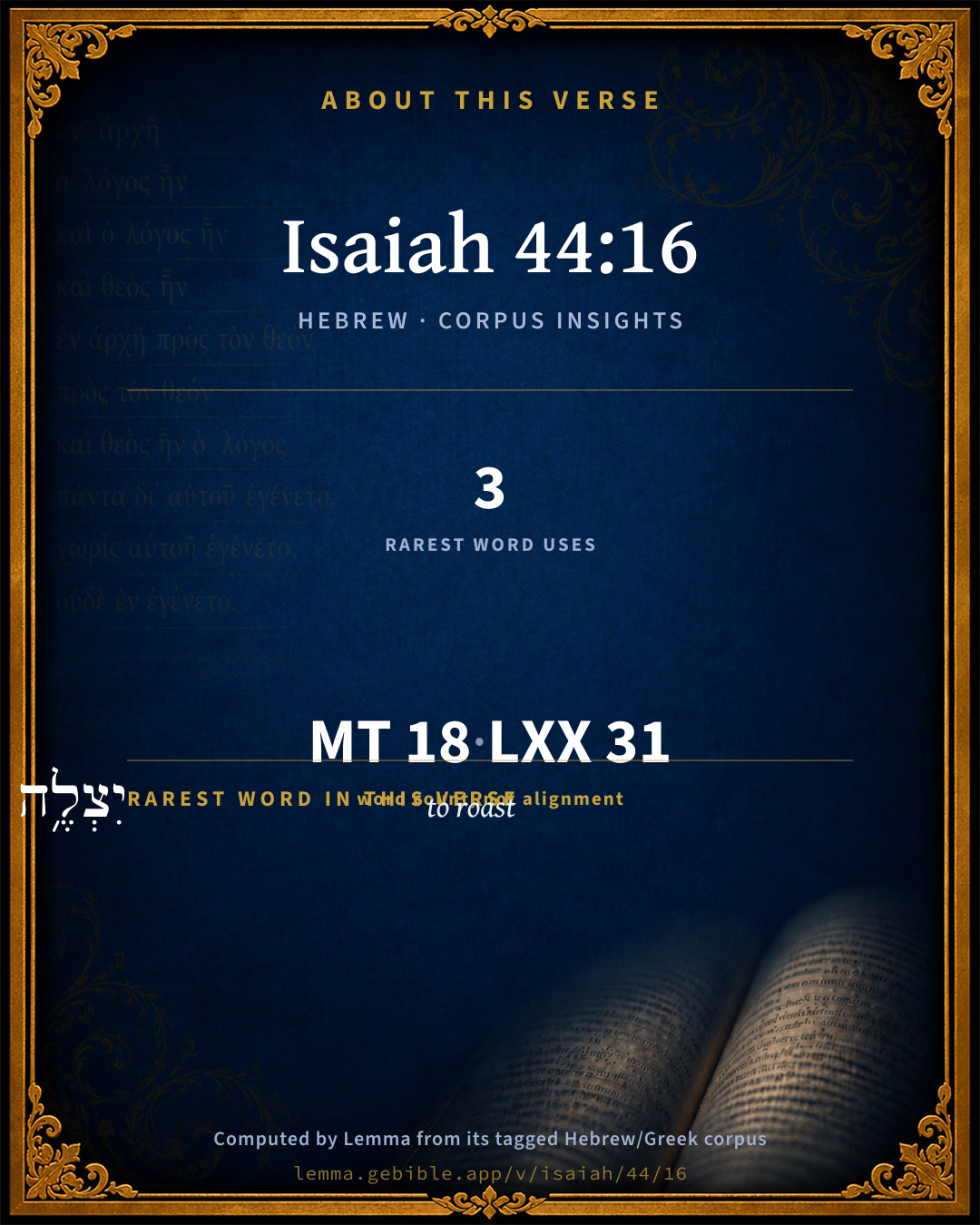
The rarest word here is יִצְלֶ֥ה to roast H6740 — appearing just 3 times in the whole Hebrew Bible.

Shared distinctive vocabulary

יִצְלֶ֥ה to roast H6740 occurs in 3 verses of the Hebrew Bible. Also found in:

Grammatical profile

  • 8 verbs
  • 6 nouns
  • 2 prepositions
  • 2 particles

Verb forms

  • שָׂרַ֣ף Qal · Perfect
  • יֹאכֵ֔ל Qal · Imperfect
  • יִצְלֶ֥ה Qal · Imperfect
  • וְיִשְׂבָּ֑ע Qal · Imperfect
  • יָחֹם֙ Qal · Imperfect
  • וְיֹאמַ֣ר Qal · Imperfect
  • חַמּוֹתִ֖י Qal · Perfect
  • רָאִ֥יתִי Qal · Perfect

Repetition

Words recur within this verse — often emphatic in Hebrew:

  • חֶצְיוֹ֙ half H2677 ×2
  • יָחֹם֙ to be warm H2552 ×2

Hebrew & Septuagint length

In English translation the verse runs 36 words from the Hebrew and 48 from the Septuagint (LXX English) — closely comparable.

A rough comparison of the two English renderings, which tokenize alike — not a word-level alignment.

Word counts can differ between the Hebrew and the Greek without any difference in meaning — e.g. the Hebrew direct-object marker אֵת has no separate Greek word, and Greek often adds the article ὁ.

In the original languages it is 18 Hebrew tokens and 31 Greek tokens — but the two are counted differently (Hebrew bundles its prefixes and suffixes into one token; the Greek is in lemma form), so that isn’t a like-for-like length.

Hebrew and Greek witnesses Masoretic Hebrew ↔ Greek Septuagint

The same verse in the two great witnesses to the Old Testament, shown verse-for-verse.

These are two independent witnesses, not word-aligned to each other, and the Septuagint is shown in lemma (dictionary) form.

Hebrew Isaiah 44:16 Masoretic · Westminster Leningrad Codex

חֶצְיוֹ֙ שָׂרַ֣ף בְּמוֹ אֵ֔שׁ עַל חֶצְיוֹ֙ בָּשָׂ֣ר יֹאכֵ֔ל יִצְלֶ֥ה צָלִ֖י וְיִשְׂבָּ֑ע אַף יָחֹם֙ וְיֹאמַ֣ר הֶאָ֔ח חַמּוֹתִ֖י רָאִ֥יתִי אֽוּר

He burns part of it in the fire; with part of it he eats flesh; he roasts roast, and is satisfied; yes, he warms himself, and says, Aha, I am warm, I have seen the fire.

World English Bible · Public Domain

Greek LXX Isaiah 44:16 Septuagint · lemma form

ὅς ὁ ἥμισυς αὐτός κατακαίω ἐν πῦρ καί καίω πέσσω ἄρτος ἐπί αὐτός καί ἐπί αὐτός κρέας ὀπτάω ἐσθίω καί ἐνπίμπλημι καί θερμαίνω εἶπον ἡδύς ἐγώ ὅτι θερμαίνω καί ὁράω πῦρ

Half thereof he burns in the fire, and with half of it he bakes loaves on the coals; and having roasted flesh on it he eats, and is satisfied, and having warmed himself he says, I am comfortable, for I have warmed myself, and have seen the fire.

LXX2012 (modern English Septuagint) · Public Domain

On this verse, Adam Clarke's Commentary discusses the Septuagint’s reading. Read the note in Commentary ↓

Hebrew: Westminster Leningrad Codex (CC BY 4.0). Greek: Septuagint (public domain); English from LXX2012 (modern English Septuagint) (Public Domain). How the Septuagint differs from the Hebrew →

Targum (Aramaic paraphrase)

1

The Targum is the ancient Jewish Aramaic paraphrase of the Hebrew Scriptures — an interpretive translation, not the Hebrew text itself. Onkelos (literal) and Pseudo-Jonathan (expansive) render the Torah, and Jonathan the Prophets. Coverage is partial: where no permissively-licensed English translation exists for a verse, only the Aramaic is shown. This is verse-level text, not a word-by-word alignment to the Hebrew.

  1. Targum Jonathan Prophets (Joshua–Malachi)
    פַּלְגֵהּ אוֹקִיד בְּנוּרָא עַל פַּלְגֵהּ בִּסְרָא אָכִיל טְוָא טָוִי וּסְבַע אַף שְׁחִין וַאֲמַר אָח שַׁחֵינִית חֲזֵיתִי נוּר:

    He burneth half thereof in the fire; and by the other half he eateth flesh, he roasteth meat, and is satisfied; he also warmeth himself, and saith, Aha, I am warm, I have seen the fire.

    Targum Jonathan — Aramaic: “Mikraot Gedolot” (public domain). English: “Sefaria Community Translation” (CC0 1.0 (public-domain dedication)); “London "Chaldee Paraphrase," 1871” (public domain). Text via Sefaria.

Commentary

Notes on Isaiah 44:16 from classic Christian and Jewish commentators (each source and its license shown beneath its notes). The classic Christian expositions comment on the surrounding passage and are grouped to its opening verse, so a note may address several verses; the Jewish commentaries on the Tanakh (Rashi and others) are per-verse, so they appear only where the commentator wrote on this verse.

Lemma curates 59 commentaries, every one of them public domain or Creative Commons licensed, each selected and text-cleaned for this edition rather than reprinted as found. About our sources →

Trapp's Complete Commentary

John Trapp

Isa 44:16 He burneth part thereof in the fire; with part thereof he eateth flesh; he roasteth roast, and is satisfied: yea, he warmeth [himself], and saith, Aha, I am warm, I have seen the fire:

Ver. 16. He burneth part thereof in the fire.] Which is to far better purpose than the other part made into an idol.

I have seen the fire,] i.e., I have felt it. One sense puts forth another.

John Trapp, A Commentary or Exposition upon All the Books of the Old and New Testament (1647–1656) — public domain. Text from a community e-Sword module.

The Biblical Illustrator

Joseph S. Exell

Isa_44:16

He burneth part thereof in the fire.

Which is to far better purpose than the other part made into an idol, (J. Trapp.)

Aha, I am warm

Cold

This is an expression of that natural joy which will escape from one in some way or other, when from a comfortless apartment, or from a frosty street, or from some wintry office of obligation, he sees the shining of his own hearth. If it could be introduced thus with an exclamation in the land of Judea, that mild land, it should certainly be repeated in this stern climate with a deep feeling of relief and thankfulness. The household gods of ancient Italy were set up about the fireplace of each dwelling, as about a sacred spot, deserving to be surrounded with the images of a divine protection; and even now, all over the world, altar and hearth are but another phrase for home. Who, asks the psalmist, can stand before His cold? God sends it; and He has filled the earth with materials, and the mind of man with resources, to repel and overcome it. He is the same Sovereign Wisdom and Goodness in this as in every other part of His works. And yet we must confess that it is one of His unwelcome ministers; but, like all the rest of what we account so in the natural world, subservient to high purposes in the holy providence of the Lord. Let us turn to the various instrumentality by which its vigour is mitigated and its power for mischief broken. I am warm, says the speaker in the text. So would the ground say if it had a tongue, while it lies sheltered under the fleecy garments of dazzling whiteness, which the very cold has woven for it out of the dark mists. I am warm, say the beast and the bird of the frozen zone, as the one lies close in his furry coat or the locks of his long hair, and the other is not afraid to cleave the inexorable sky with his breast of down. I am warm, repeat the animals who are natives of our own temperate circle, as they take shelter in the hollow retreats which their industry has contrived, or make their way towards the more genial countries whither their instincts direct them. I am warm, say the lake and the stream, while they are armed with the polished breast-plate which has been forged for them, not among furnaces of glowing heat, but in the magazines of the haft. I am warm, says man; he who commands the inferior creatures, he who makes a path for himself even over the deep, he who compels into his bond-service the substances and the elements of the world. He cuts clown the trees, and makes them do him a kinder office by their blaze than they had done before by their shadow. And better than this; he opens the dark treasures with which a gracious providence has stored the lower parts of the earth, and he finds them more precious than the vein for the silver, than the place of sapphires and dust of gold. What are the feelings which the consideration of the cold and all its alleviating circumstances should impress upon the mind?

1. Thankfulness towards God. There is no small danger of losing sight of the Almighty Benefactor in partaking of His benefits. There is no small danger of even turning those very benefits into a sort of idols that we substitute in His place. This was precisely and literally the case with the person whom the prophet describes as speaking in the text. You are like him, who transform your interest into your religion; making a show of worship, when you are thinking only how to be warmed and fed. You, too, are like him who shape your faith and your convenience out of the same material; making the concerns of the soul but part and parcel with common necessities. We are all like him, so far as we turn our comforts into our divinities.

2. Sympathy with His suffering creatures. (N. L. Frothingham.)

The wisdom of God in the freezing of water:

I cannot omit calling your attention to a remarkable fact in the freezing of water, which has nothing to surpass it in the surprising wisdom of its ordination, even if it has any perfect parallel in the whole economy of nature. We know it to be a general law of material substances, that they expand with the heat and contract with the cold. The particles of water are subjected to this rule, like all other particles of matter. But if this were allowed to hold on throughout, giving way to no exception, do but reflect what would be the consequences. The drops at the surface, as they were successively congealed, would sink. The process of freezing would begin at the bottom. Layer after layer would thus be deposited, which no returning suns could penetrate to dissolve; and the most that the summer could do would be to wet the face of the flinty mass. The water-courses would be for ever stopped in their glad and wholesome flow; and many a broad river would scarcely float a boat upon its plashy shallows. And now what has been done to avert such a calamity? A new law has been instituted, in direct contravention of the old, to meet the exigency of the case. The water, precisely at the moment of congelation, breaks away into the line of an opposite decree. It expands and grows lighter. It refuses to descend. It rests fixed upon the top, an ornament and a defence. I know not how others may be affected by a view like this; but it seems to me to call for an adoring acknowledgment of that all-pervading design which thus supplies the wants of its creation by a special departure from its own method, as invariable in its action as the method itself. (N. L. Frothingham.)

The Biblical Illustrator, edited by Joseph S. Exell (c. 1880s–1900s) — public domain. Text from a community e-Sword module.

Geneva Bible (1599)

Geneva Bible translators

That is, he either maketh a table or trenchers.

Geneva Bible (1599) marginal notes — public domain. Text via Bolls.life.

Jamieson, Fausset & Brown

Robert Jamieson, A. R. Fausset & David Brown

part . . . part--not distinct parts, but the same part of the wood (compare Isa 44:17).

eateth--that is, cooks so as to eat (Isa 44:19).

I have seen--I feel its power.

Jamieson, Fausset & Brown — Commentary Critical and Explanatory on the Whole Bible (1871) — public domain (CC PDM 1.0). Text via the HelloAO Bible API.

Adam Clarke's Commentary

Verse 16. With part - "AND with part"] Twenty-three MSS., the Septuagint, and Vulgate add the conjunction ו vau, and ועל veal.

Adam Clarke's Commentary on the Bible (1810–1826) — public domain. Text from a community e-Sword/MySword module.

The Cambridge Bible for Schools and Colleges

gen. ed. J. J. S. Perowne

16. part thereof] lit. “half thereof,” as opposed to “the residue thereof” in Isa_44:17. Cf. Isa_44:19, “upon the coals thereof.”

The Cambridge Bible for Schools and Colleges (gen. ed. J. J. S. Perowne; Cambridge University Press, 1878–1918) — public domain. Text from a community e-Sword module.

John Gill's Exposition

He burneth part thereof in the fire,.... To warm himself with, as before:

with part thereof he eateth flesh; that is, with part of it he dresses flesh, and makes it fit to eat; unless the meaning is, with part of it he makes tables and trenchers to eat meat off of; but the former sense seems most likely, and agrees with what follows:

he roasteth roast, and is satisfied; he roasts his meat with it, and eats it when roasted, and is highly pleased and delighted with it, and he eats of it to his satisfaction:

yea, he warmeth him, and saith, Aha; an expression of joy and delight, being before a good fire in winter time:

I am warm, I have seen the fire; have felt it, and enjoyed the comfort of it, which has given a sensible pleasure.

John Gill's Exposition of the Whole Bible (1746–1763) — public domain (CC PDM 1.0). Text via the HelloAO Bible API.

Albert Barnes' Notes on the Bible

With part thereof he eateth flesh - That is, he prepares flesh to eat, or prepares his food.

He roasteth roast - He roasts meat.

Albert Barnes' Notes on the Bible (1834–1885) — public domain. Text from a community e-Sword/MySword module.

Matthew Poole's English Annotations

He eateth flesh; he dresseth flesh for his eating.

I have seen the fire; I have felt the warmth of it. Seeing is oft put for other senses, as feeling, hearing, &c., as hath been oft observed before.

Matthew Poole's English Annotations on the Holy Bible (1683–1685) — public domain. Text from a community e-Sword/MySword module.

The Pulpit Commentary

He burneth part thereof; rather, half thereof; "With half thereof not the other half, but the same eateth flesh." One fire serves for the two purposes of warming him and cooking his victuals.

The Pulpit Commentary (1880–1919), ed. H.D.M. Spence-Jones & Joseph S. Exell — public domain. Text from a community e-Sword module.

J. A. Alexander on Isaiah

Joseph Addison Alexander

“Half of it he hath burned in the fire, on half of it he will eat flesh, he will roast and be filled; yea, he will warm himself and say, Aha, I am warm, I have seen fire.” The indefinite translation part, given in the English version, is intended to avoid the incongruity of making two halves and a remainder. But this incongruity has no existence in the original; because the first and second half of v. 16 are one and the same half, and the other is not introduced until the next verse. The phrase, on half of it he eats fish may be explained as a pregnant or concise expression of the idea, that over or by means of the fire made with half of it he cooks flesh for his eating. The obscurity of this clause is immediately removed by the addition of the unambiguous words, he roasts a roast and satisfies himself The force of ‘yea’, both here and in the foregoing verse, appears to be equivalent to that of our expression ‘nay more, not only this but also’, or ‘moreover’. The Hebrew verb in the last clause not only may but must have here its proper meaning, ‘I have seen’; because the noun which follows does not denote the heat of fire but its light, and there could not be a more natural expression of the feeling meant to be conveyed than by referring to the cheerful blaze of a large wood fire. To the indiscriminate translation of the verbs, both in this verse and the next, as descriptive presents, the same objections may be made as in the foregoing context.

Joseph Addison Alexander, The Prophecies of Isaiah (1846–1847; New York: Scribner, 1870–1878) — public domain. Text from a community e-Sword module.

Ibn Ezra

Rabbi Abraham ibn Ezra

האח Aha. Interjection of joy; comp. Ps. 35:21.

אור Fire, Comp. 31:9.

ראיתי I have seen. It is to be taken literally. R. Saadiah explains it I enjoyed, but he has no parallel instance to support his rendering.

Ibn Ezra on the Tanakh — English translations: “Sefaria Community Translation” (CC0 1.0 (public-domain dedication)); “Yalkut, Sifsei Chachomim Chumash, Metsudah Publications, 2009” (CC BY 4.0); and “Commentary of Ibn Ezra on Isaiah - trans. by M. Friedlander, 1873” (public domain). Text via Sefaria.

Lesson kit

Teaching starters — assembled from the data on this page, not authored interpretation. Every prompt links to the verse data it draws on. Edit before teaching.

Isaiah, in the Prophets, opens this verse with 18 words (16 distinct Hebrew lemmas). Its most distinctive word is tsâlâh (“to roast”). A historical commentator’s framing appears above. Read the whole chapter for the surrounding context.

Discussion questions

  1. What does “to roast” (tsâlâh) contribute to the verse as a whole?
  2. 1 Samuel 2:15 shares the word «to roast» with this verse. How do the two illuminate each other?
  3. “half” occurs 2× in this one verse. What is the effect of the repetition?
  4. The translations on this page render this verse differently — a whole-verse word diff, not a word-by-word alignment. What might account for the different wordings?
  5. The verb «שָׂרַ֣ף» is Qal Perfect. How does its form color the action?
  6. Reading how Trapp's Complete Commentary and The Biblical Illustrator read this verse, where do the two commentators agree and where do they part?

Things to notice

Reading settings

Reading text

Shown beneath each verse's original-language words.

Old Testament
Old Testament edition

Read the OT as the Masoretic Hebrew (MT) or the Greek Septuagint (LXX).

English shown for the Greek Septuagint (in the Hebrew ↔ Greek comparison).

Comparing translations? Open the Compare panel on any verse page to stack up to four side by side.