
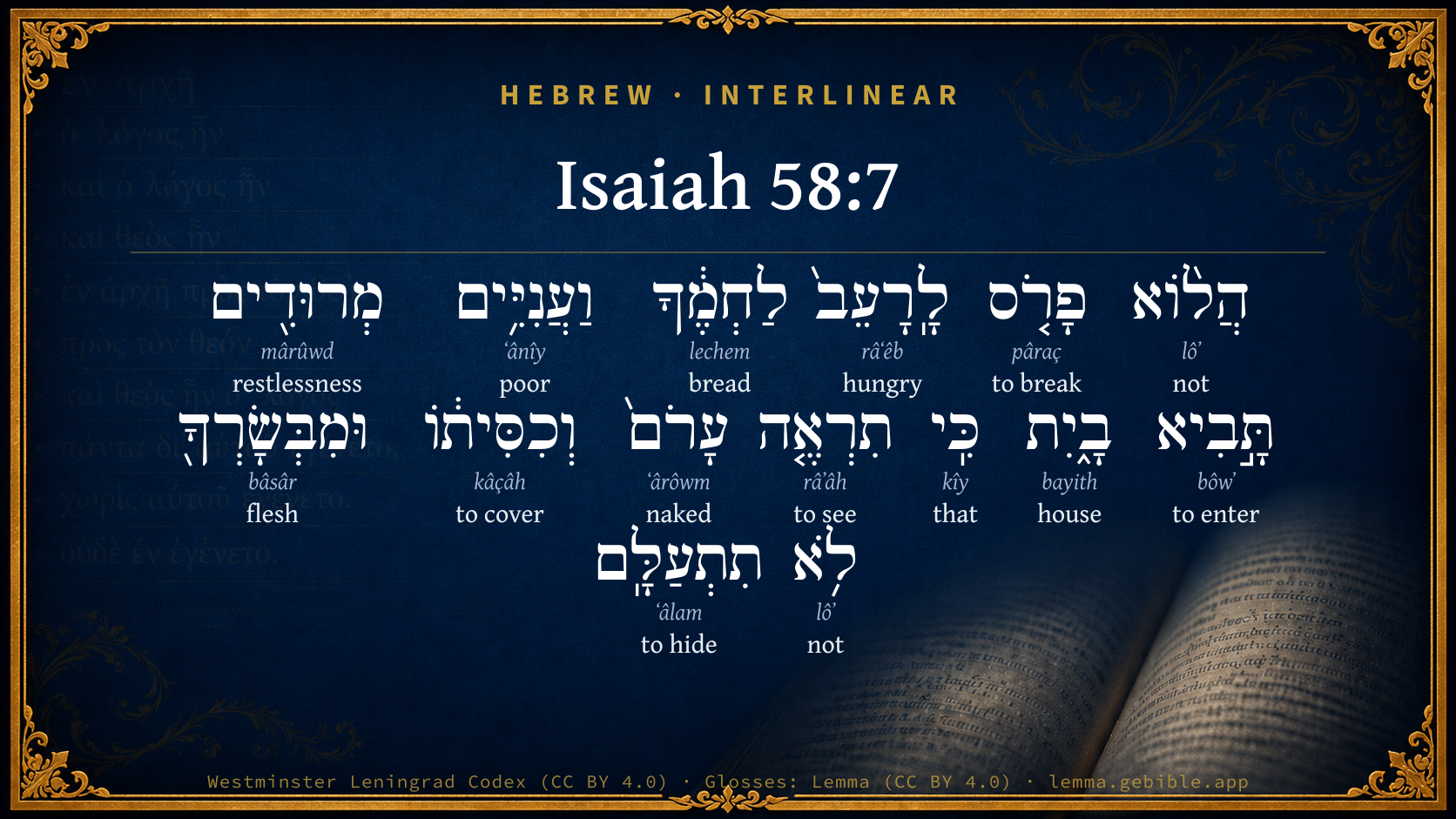
Isaiah 58:7

Hebrew (Westminster Leningrad Codex) Isaiah 58:7 appears in the Hebrew Old Testament. The text above is from the Westminster Leningrad Codex. Each word links to its Strong’s number, a concise gloss, and parsing drawn from the Open Scriptures Hebrew Bible morphology. Click any word for its full Brown-Driver-Briggs (BDB) entry.
Download image
Cite this verse

Isaiah 58:7 (World English Bible). Public Domain. Lemma interlinear Bible study tool, https://lemma.gebible.app/v/isaiah/58/7.

Show BibTeX & RIS
BibTeX
RIS
English Translation
Isn't it to deal your bread to the hungry, and that you bring the poor who are cast out to your house? when you see the naked, that you cover him; and that you not hide yourself from your own flesh?
World English Bible · Public Domain
Highlights
  • 1 first appearance in the Hebrew Bible
Full analysis ↓
Download a study sheet

One document with this verse’s original text, its word-by-word gloss line, the meaning frame, cross-references with their text, attributed commentary, and full source and license credits — printable, and it pastes into notes with its structure intact.

This verse Autodidact and up

Study sheet (.html) Plain text (.txt)

A passage Seminary Student

Up to 50 verses in one chapter. A passage sheet keeps up to 6 commentary sources and 12 cross-references per verse, in the order this page ranks them, and says so on the sheet whenever that leaves anything out. Ask for a single verse and you get the Autodidact verse sheet above.

Everything on this page stays free to read, with no account — the sheet is a download of what is already on screen, not access to it.

Want to remove ads? Support Godless Engineer
Compare translations 3

The same verse in 3 English versions, stacked beneath the original-language interlinear above. Click any original word for its lexicon entry.

Each is an independent rendering of the whole verse — the interlinear is not word-aligned to these translations.

Highlighted words mark where these versions differ — a whole-verse word diff, not a word-by-word alignment.

  • World English Bible Public Domain
    Isn't it to deal your bread to the hungry, and that you bring the poor who are cast out to your house? when you see the naked, that you cover him; and that you not hide yourself from your own flesh?
  • King James Version Public Domain
    Is it not to deal thy bread to the hungry, and that thou bring the poor that are cast out to thy house? when thou seest the naked, that thou cover him; and that thou hide not thyself from thine own flesh?
  • unfoldingWord Literal Text CC BY-SA 4.0
    not to divide your bread to the hungry, and you shall bring the wandering poor house? When you see the naked, then you shall cover him, and you shall not hide yourself from your flesh.

unfoldingWord Literal Text — © unfoldingWord, licensed CC BY-SA 4.0. Word-aligned USFM3 via Door43 (git.door43.org/unfoldingWord/en_ult).

Versions to compare (up to 4)

3 of 4 selected

Show all 18 translations

Every available English version of this verse, each an independent rendering of the whole verse.

  • World English Bible Public Domain
    Isn't it to deal your bread to the hungry, and that you bring the poor who are cast out to your house? when you see the naked, that you cover him; and that you not hide yourself from your own flesh?
  • Berean Standard Bible Public Domain
    Isn’t it to share your bread with the hungry, to bring the poor and homeless into your home, to clothe the naked when you see him, and not to turn away from your own flesh and blood?
  • Majority Standard Bible Public Domain
    Isn’t it to share your bread with the hungry, to bring the poor and homeless into your home, to clothe the naked when you see him, and not to turn away from your own flesh and blood?
  • King James Version Public Domain
    Is it not to deal thy bread to the hungry, and that thou bring the poor that are cast out to thy house? when thou seest the naked, that thou cover him; and that thou hide not thyself from thine own flesh?
  • American Standard Version (1901) Public Domain
    Is it not to deal thy bread to the hungry, and that thou bring the poor that are cast out to thy house? when thou seest the naked, that thou cover him; and that thou hide not thyself from thine own flesh?
  • Revised Version (1885) Public Domain
    Is it not to deal thy bread to the hungry, and that thou bring the poor that are cast out to thy house? when thou seest the naked, that thou cover him; and that thou hide not thyself from thine own flesh?
  • Geneva Bible (1599) Public Domain
    Is it not to deale thy bread to the hungry, and that thou bring the poore that wander, vnto thine house? when thou seest the naked, that thou couer him, and hide not thy selfe from thine owne flesh?
  • Douay-Rheims (1899) Public Domain
    Deal thy bread to the hungry, and bring the needy and the harbourless into thy house: when thou shalt see one naked, cover him, and despise not thy own flesh.
  • Young's Literal Translation Public Domain
    Is it not to deal to the hungry thy bread, And the mourning poor bring home, That thou seest the naked and cover him, And from thine own flesh hide not thyself?
  • Literal Standard Version CC BY-SA 4.0
    Is it not to deal your bread to the hungry, || And bring home the wandering poor, || That you see the naked and cover him, || And do not hide yourself from your own flesh?
  • Unlocked Literal Bible CC BY-SA 4.0
    Is it not to break your bread with the hungry and to bring the poor and homeless into your house?” When you see someone naked, you should clothe him; and you should not hide yourself from your own relatives.
  • unfoldingWord Literal Text CC BY-SA 4.0
    not to divide your bread to the hungry, and you shall bring the wandering poor house? When you see the naked, then you shall cover him, and you shall not hide yourself from your flesh.
  • Darby Bible Public Domain
    Is it not to deal thy bread to the hungry, and that thou bring to thy house the needy wanderers; when thou seest the naked, that thou cover him; and that thou hide not thyself from thine own flesh?
  • World Messianic Bible Public Domain
    Isn’t it to distribute your bread to the hungry, and that you bring the poor who are cast out to your house? When you see the naked, that you cover him; and that you not hide yourself from your own flesh?
  • Webster's Bible Public Domain
    Is it not to deal thy bread to the hungry, and that thou shouldst bring the poor that are cast out to thy house? when thou seest the naked, that thou shouldst cover him; and that thou shouldst not hide thyself from thy own flesh?
  • Free Bible Version CC BY-SA 4.0
    Share your food with the hungry, take the poor and homeless into your house. When you see people naked, give them clothes, and don't reject your own relatives.
  • Bible in Basic English Public Domain
    Is it not to give your bread to those in need, and to let the poor who have no resting-place come into your house? to put a robe on the unclothed one when you see him, and not to keep your eyes shut for fear of seeing his flesh?
  • JPS Tanakh (1917) Public Domain
    Is it not to deal thy bread to the hungry, and that thou bring the poor that are cast out to thy house? when thou seest the naked, that thou cover him, and that thou hide not thyself from thine own flesh?

Literal Standard Version (2020), Covenant Press — licensed CC BY-SA 4.0. Text via the HelloAO Bible API (eBible.org). Unlocked Literal Bible (unfoldingWord) — licensed CC BY-SA 4.0. Text via the HelloAO Bible API (eBible.org). unfoldingWord Literal Text — © unfoldingWord, licensed CC BY-SA 4.0. Word-aligned USFM3 via Door43 (git.door43.org/unfoldingWord/en_ult). Free Bible Version, Dr. Jonathan Gallagher — licensed CC BY-SA 4.0. Text via the HelloAO Bible API (eBible.org).

Word by word

More ways to search: Search by grammar → Find every occurrence → Compare this word →

Practice this passage: Drill this verse → Learn its vocabulary →

מְרוּדִ֖ים
mârûwd
H4788
“restlessness”
Noun, Common, Masculine, Plural, Absolute
Part of Speech
Noun
Type
Common
Gender
Masculine
Number
Plural
State
Absolute
Full BDB Definition

Origin: from H7300 in the sense of maltreatment

TWOT: 2129a

restlessness, straying, wanderer, refugee
  1. הֲל֨וֹא lôʼ H3808 “not” Particle, Interrogative + Particle, Negative
  2. פָרֹ֤ס pâraç H6536 “to break” Verb, Qal, Infinitive Absolute
  3. לָֽרָעֵב֙ râʻêb H7457 “to/for the · hungry” Preposition, Determined + Adjective, Adjective, Masculine, Singular, Absolute
  4. לַחְמֶ֔ךָ lechem H3899 “bread · your” Noun, Common, Both, Singular, Construct + Suffix, Personal, 2nd Person, Masculine, Singular
  5. וַעֲנִיִּ֥ים ʻânîy H6041 “and · poor” Conjunction + Adjective, Adjective, Masculine, Plural, Absolute
  6. תָּ֣בִיא bôwʼ H935 “to enter” Verb, Hiphil, Imperfect, 2nd Person, Masculine, Singular
  7. בָ֑יִת bayith H1004 “house” Noun, Common, Masculine, Singular, Absolute
  8. כִּֽי kîy H3588 “that” Conjunction
  9. תִרְאֶ֤ה râʼâh H7200 “to see” Verb, Qal, Imperfect, 2nd Person, Masculine, Singular
  10. עָרֹם֙ ʻârôwm H6174 “naked” Adjective, Adjective, Masculine, Singular, Absolute
  11. וְכִסִּית֔וֹ kâçâh H3680 “and · to cover · him” Conjunction + Verb, Piel, Sequential Perfect, 2nd Person, Masculine, Singular + Suffix, Personal, 3rd Person, Masculine, Singular
  12. וּמִבְּשָׂרְךָ֖ bâsâr H1320 “and · from · flesh · your” Conjunction + Preposition + Noun, Common, Masculine, Singular, Construct + Suffix, Personal, 2nd Person, Masculine, Singular
  13. לֹ֥א lôʼ H3808 “not” Particle, Negative
  14. תִתְעַלָּֽם ʻâlam H5956 “to hide” Verb, Hithpael, Imperfect, 2nd Person, Masculine, Singular

About this verse

These counts appear in no published source. They are computed here, from the morphology-tagged text and Lemma’s own curated glosses. What Lemma adds →

15
words
14
distinct lemmas
Prophets
section

Notable vocabulary

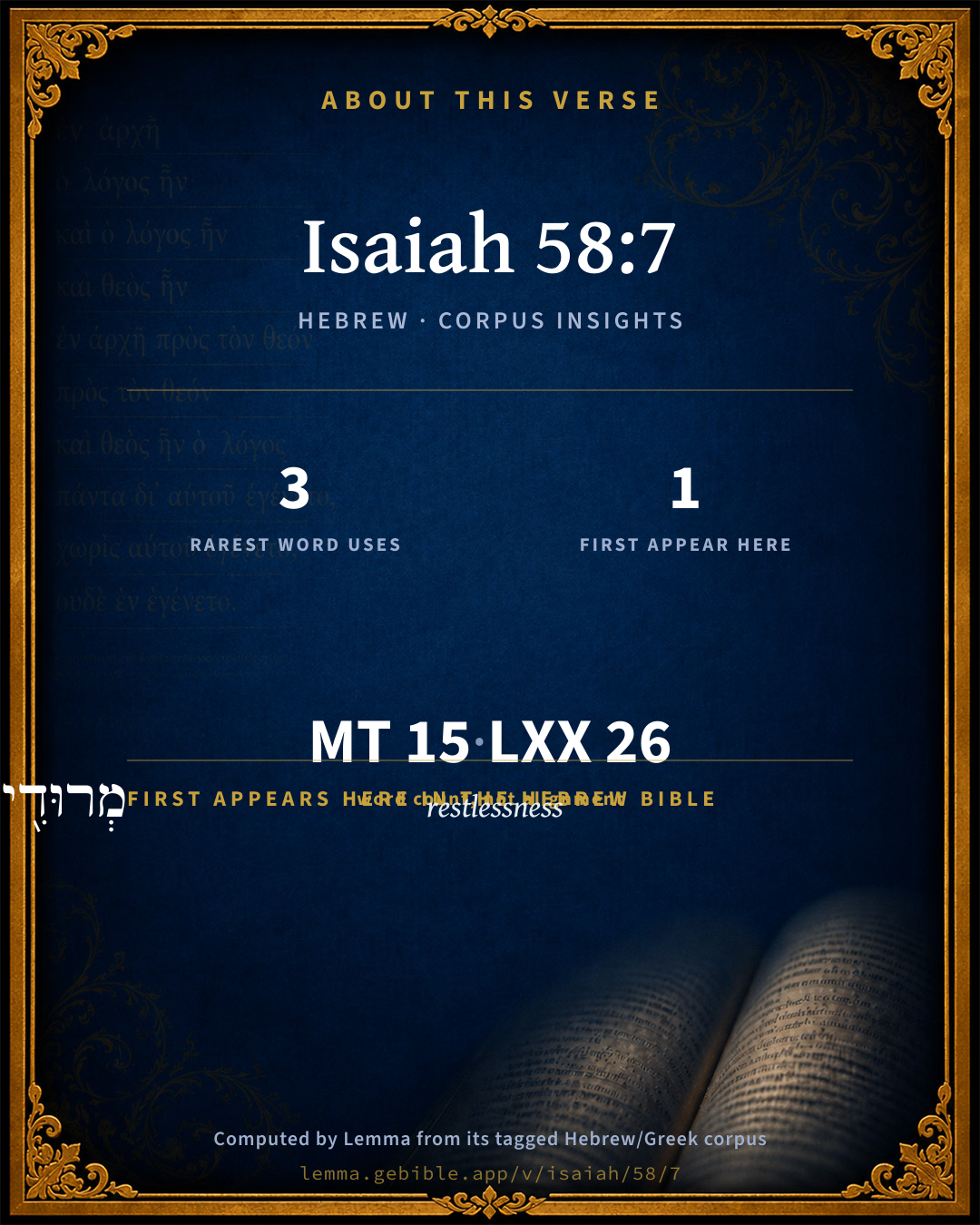
The rarest word here is מְרוּדִ֖ים restlessness H4788 — appearing just 3 times in the whole Hebrew Bible.

First appearance in Scripture

This word makes its first canonical appearance in the Hebrew Bible here:

  • מְרוּדִ֖ים restlessness H4788

Shared distinctive vocabulary

מְרוּדִ֖ים restlessness H4788 occurs in 3 verses of the Hebrew Bible. Also found in:

Grammatical profile

  • 5 verbs
  • 4 nouns
  • 3 adjectives
  • 1 conjunction
  • 2 particles

Verb forms

  • פָרֹ֤ס Qal · Infinitive Absolute
  • תָּ֣בִיא Hiphil · Imperfect
  • תִרְאֶ֤ה Qal · Imperfect
  • וְכִסִּית֔וֹ Piel · Sequential Perfect
  • תִתְעַלָּֽם Hithpael · Imperfect

Repetition

A word recurs within this verse — often emphatic in Hebrew:

  • הֲל֨וֹא not H3808 ×2

Hebrew & Septuagint length

In English translation the verse runs 41 words from the Hebrew and 32 from the Septuagint (LXX English) — closely comparable.

A rough comparison of the two English renderings, which tokenize alike — not a word-level alignment.

Word counts can differ between the Hebrew and the Greek without any difference in meaning — e.g. the Hebrew direct-object marker אֵת has no separate Greek word, and Greek often adds the article ὁ.

In the original languages it is 15 Hebrew tokens and 26 Greek tokens — but the two are counted differently (Hebrew bundles its prefixes and suffixes into one token; the Greek is in lemma form), so that isn’t a like-for-like length.

Cross-references

33

Topical passages linked to Isaiah 58:7 in the Treasury of Scripture Knowledge — connected by theme and wording, ordered by reader-vote popularity; previews shown in the World English Bible.

  • Matthew 25:35–45 for I was hungry, and you gave me food to eat; I was thirsty, and you gave me drink; I was a stranger, and you took me in;
  • Ezekiel 18:7 and has not wronged any, but has restored to the debtor his pledge, has taken nothing by robbery, has given his bread to the hungry, and has covered the naked with a garment;
  • Luke 3:11 He answered them, "He who has two coats, let him give to him who has none. He who has food, let him do likewise."
  • Proverbs 28:27 One who gives to the poor has no lack; But one who closes his eyes will have many curses.
  • 1 John 3:17–18 But whoever has the world's goods, and sees his brother in need, and closes his heart of compassion against him, how does the love of God remain in him?
  • Proverbs 25:21 If your enemy is hungry, give him food to eat; If he is thirsty, give him water to drink:
  • Isaiah 58:10 and if you draw out your soul to the hungry, and satisfy the afflicted soul: then shall your light rise in darkness, and your obscurity be as the noonday;
  • Romans 12:20–21 Therefore "If your enemy is hungry, feed him. If he is thirsty, give him a drink. For in doing so, you will heap coals of fire on his head."
  • Proverbs 22:9 He who has a generous eye will be blessed; For he shares his food with the poor.
  • Ezekiel 18:16 neither has wronged any, has not taken anything to pledge, neither has taken by robbery, but has given his bread to the hungry, and has covered the naked with a garment;
  • Hebrews 13:2–3 Don't forget to show hospitality to strangers, for in doing so, some have entertained angels without knowing it.
  • James 2:15–16 And if a brother or sister is naked and in lack of daily food,
  • Isaiah 16:3–4 Give counsel, execute justice; make your shade as the night in the midst of the noonday; hide the outcasts; don't betray the fugitive.
  • 2 Corinthians 9:6–10 Remember this: he who sows sparingly will also reap sparingly. He who sows bountifully will also reap bountifully.
  • Luke 11:41 But give for gifts to the needy those things which are within, and behold, all things will be clean to you.
  • Psalms 112:9 He has dispersed, he has given to the poor. His righteousness endures forever. His horn will be exalted with honor.
  • Job 31:18–21 (No, from my youth he grew up with me as with a father, Her have I guided from my mother's womb);
  • Daniel 4:27 Therefore, O king, let my counsel be acceptable to you, and break off your sins by righteousness, and your iniquities by showing mercy to the poor; if there may be a lengthening of your tranquillity.
  • Acts 16:34 He brought them up into his house, and set food before them, and rejoiced greatly, with all his household, having believed in God.
  • 1 Timothy 5:10 being approved by good works, if she has brought up children, if she has been hospitable to strangers, if she has washed the saints' feet, if she has relieved the afflicted, and if she has diligently followed every good work.
  • Job 22:7 You haven't given water to the weary to drink, And you have withheld bread from the hungry.
  • Romans 12:13 contributing to the needs of the saints; given to hospitality.
  • Philemon 1:7 For we have much joy and comfort in your love, because the hearts of the saints have been refreshed through you, brother.
  • Genesis 18:2–5 He lifted up his eyes and looked, and saw that three men stood opposite him. When he saw them, he ran to meet them from the tent door, and bowed himself to the earth,
  • Genesis 19:2 and he said, "See now, my lords, please turn aside into your servant's house, stay all night, wash your feet, and you will rise up early, and go on your way." They said, "No, but we will stay in the street all night."
  • Judges 19:20–21 The old man said, Peace be to you; howsoever let all your wants lie on me; only don't lodge in the street.
  • 2 Chronicles 28:15 The men who have been mentioned by name rose up, and took the captives, and with the spoil clothed all who were naked among them, and arrayed them, and shod them, and gave them to eat and to drink, and anointed them, and carried all the feeble of them on donkeys, and brought them to Jericho, the city of palm trees, to their brothers: then they returned to Samaria.
  • Nehemiah 5:5 Yet now our flesh is as the flesh of our brothers, our children as their children: and, behold, we bring into bondage our sons and our daughters to be servants, and some of our daughters are brought into bondage [already]: neither is it in our power to help it; for other men have our fields and our vineyards.
  • Luke 19:8 Zacchaeus stood and said to the Lord, "Behold, Lord, half of my goods I give to the poor. If I have wrongfully exacted anything of anyone, I restore four times as much."
  • Genesis 19:14 Lot went out, and spoke to his sons-in-law, who were pledged to marry his daughters, and said, "Get up! Get out of this place, for Yahweh will destroy the city." But he seemed to his sons-in-law to be joking.
  • Ecclesiastes 11:1–2 Cast your bread on the waters; For you shall find it after many days.
  • Luke 10:26–36 He said to him, "What is written in the law? How do you read it?"
  • Acts 16:15 When she and her household were baptized, she begged us, saying, "If you have judged me to be faithful to the Lord, come into my house, and stay." So she persuaded us.

Cross-references courtesy of OpenBible.info (CC BY 4.0).

Hebrew and Greek witnesses Masoretic Hebrew ↔ Greek Septuagint

The same verse in the two great witnesses to the Old Testament, shown verse-for-verse.

These are two independent witnesses, not word-aligned to each other, and the Septuagint is shown in lemma (dictionary) form.

Hebrew Isaiah 58:7 Masoretic · Westminster Leningrad Codex

הֲל֨וֹא פָרֹ֤ס לָֽרָעֵב֙ לַחְמֶ֔ךָ וַעֲנִיִּ֥ים מְרוּדִ֖ים תָּ֣בִיא בָ֑יִת כִּֽי תִרְאֶ֤ה עָרֹם֙ וְכִסִּית֔וֹ וּמִבְּשָׂרְךָ֖ לֹ֥א תִתְעַלָּֽם

Isn't it to deal your bread to the hungry, and that you bring the poor who are cast out to your house? when you see the naked, that you cover him; and that you not hide yourself from your own flesh?

World English Bible · Public Domain

Greek LXX Isaiah 58:7 Septuagint · lemma form

διαθρύπτω πεινάω ὁ ἄρτος σύ καί πτωχός ἄστεγος εἰςἄγω εἰς ὁ οἶκος σύ ἐάν ὁράω γυμνός περιβάλλω καί ἀπό ὁ οἰκεῖος ὁ σπέρμα σύ οὐ ὑπερὁράω

Break your bread to the hungry, and lead the unsheltered poor to your house: if you see one naked, clothe him, and you shall not disregard the relations of your own seed.

LXX2012 (modern English Septuagint) · Public Domain

On this verse, Adam Clarke's Commentary discusses the Septuagint’s reading. Read the note in Commentary ↓

Hebrew: Westminster Leningrad Codex (CC BY 4.0). Greek: Septuagint (public domain); English from LXX2012 (modern English Septuagint) (Public Domain). How the Septuagint differs from the Hebrew →

Targum (Aramaic paraphrase)

1

The Targum is the ancient Jewish Aramaic paraphrase of the Hebrew Scriptures — an interpretive translation, not the Hebrew text itself. Onkelos (literal) and Pseudo-Jonathan (expansive) render the Torah, and Jonathan the Prophets. Coverage is partial: where no permissively-licensed English translation exists for a verse, only the Aramaic is shown. This is verse-level text, not a word-by-word alignment to the Hebrew.

  1. Targum Jonathan Prophets (Joshua–Malachi)
    הֲלָא תְפַרְנֵס לְכַפְנָא מִלַחְמֵךְ וַחֲשִׁיבִין מְטַלְטְלִין תָּעֵיל לְגוֹ בֵיתָא אֲרֵי תֱחֶזֵי עַרְטִילָאָה וּתְכַסִינֵהּ וּמִקָרִיב בִּשְׂרָךְ לָא תִכְבּוֹשׁ עֵינָךְ:

    Shouldest not thou sustain the hungry with thy bread, and bring the poor that are cast out into the midst of thy house? When thou seest the naked, that thou cover him, and shouldest not hide thine eyes from the kindred who is thy flesh?

    Targum Jonathan — Aramaic: “Mikraot Gedolot” (public domain). English: “Sefaria Community Translation” (CC0 1.0 (public-domain dedication)); “London "Chaldee Paraphrase," 1871” (public domain). Text via Sefaria.

Commentary

Notes on Isaiah 58:7 from classic Christian and Jewish commentators (each source and its license shown beneath its notes). The classic Christian expositions comment on the surrounding passage and are grouped to its opening verse, so a note may address several verses; the Jewish commentaries on the Tanakh (Rashi and others) are per-verse, so they appear only where the commentator wrote on this verse.

Lemma curates 59 commentaries, every one of them public domain or Creative Commons licensed, each selected and text-cleaned for this edition rather than reprinted as found. About our sources →

Trapp's Complete Commentary

John Trapp

Isa 58:7 [Is it] not to deal thy bread to the hungry, and that thou bring the poor that are cast out to thy house? when thou seest the naked, that thou cover him; and that thou hide not thyself from thine own flesh?

Ver. 7. Is it not to deal thy bread to the hungry?] Thine "own bread" it must be, and that especially whereof thou hast on the fast day abridged thyself; for what the rich spare on such a day the poor should spend. Hereby (1.) Men’s prayers shall speed the better; {Act 10:4} (2.) They shall make God their debtor; {Pro 19:17} (3.) That is best and most pleasing alms to God that is given in Church assemblies; for (1.) It is an ordinance of God, and a Sabbath duty; {1Co 16:1-2} (2.) Christ there sitteth, and seeth the gift and mind of every almsgiver, {Luk 21:1-2} setting it down in his book of remembrance. {Mal 3:16}

And that thou briny the poor that are cast out.] Scilicet tanquam rebelles, as those poor Albigenses were in France, and their posterity lately in Piedmont; the Protestant Lorainers, proscribed for religion by their duke, and entertained by the state of Strasburg, at the earnest suit of the ministers there, till they could be conveniently provided for elsewhere, there being some thousands of them, which, till then, were forced to feed upon hips, haws, leaves of trees, and grass of the field. {a}

That thou cover him.] Duties of the second table only are here enjoined, because they are excellent evidences of true piety and pure religion. {Jas 1:27}

And that thou hide not thyself from thine own flesh.] Thy poor brother, who is of the same nature with thee, and is as capable of grace and glory as thyself. Learn to see Christ in thy poor petitioner, and thou wilt the sooner yield. {Mat 25:34-40} Consider also what is said of him that "shutteth up his bowels of compassion" from his necessitous brother. {1Jn 3:17}

{a} Scultet. Annal.

John Trapp, A Commentary or Exposition upon All the Books of the Old and New Testament (1647–1656) — public domain. Text from a community e-Sword module.

The Biblical Illustrator

Joseph S. Exell

Isa_58:7

Is it not to deal thy bread to the hungry?

--

Almsgiving

Why there are so many evils in the world is a question that has been agitated ever since man felt them. It becomes not us, with too presumptuous a curiosity, to assign the causes of the Divine conduct, or, with too daring a hand, to draw aside the veil which covers the councils of the Almighty. But from this state of things we see many good effects arise. The enjoyments of life are grafted upon its wants; from natural evil arises moral good, and the sufferings of some contribute to the happiness of all. Such being the state of human affairs, charity, or that disposition which leads us to supply the wants, and alleviate the sufferings, of unhappy men, as well as bear with their infirmities, must be a duty of capital importance. Accordingly, it is enjoined in our holy religion as being the chief of the virtues. It is assigned as the test and criterion by which we are to distinguish the disciples of Jesus, and it will be selected at the great day as being that part of the character which is most decisive of the life, and according to which the last sentence is to turn. Charity, in its most, comprehensive sense, signifies that disposition of mind which, from a regard and gratitude to God, leads to do all the good in our power to man. But all that I intend at present is, to consider that branch of charity which is called almsgiving.

I. WHAT IS THE MOST PROPER METHOD OF BESTOWING CHARITY.

1. The best method of bestowing charity upon the healthy and strong is to give them employment. One half of the vices of men take their orion from idleness. To support the indolent, therefore, to keep those idle who are able to work, is acting contrary to the intention of God; is doing an injury to society, which claims a right to the services of all its members; is defrauding real objects of charity of that which is their proper due,. and is fostering a race of sluggards to prey upon the vitals of a State. But he is a valuable member of society, and merits well of mankind, who, by devising means of employment for the industrious, delivers the public from a useless incumbrance, and makes those who would otherwise be the pests of society, useful subjects of the Commonwealth.

2. Another act of charity, of equal importance, is to supply the wants of the really indigent and necessitous. If the industrious, with all their efforts, are not able to earn a competent livelihood; if the produce of their labour be not proportionable to the demands of a numerous family; then they arc proper objects of your charity.

3. Another class of men that demand our charity is the aged and feeble, who, after a life of hard labour, are grown unfit for further business, and who add poverty to the other miseries of old age.

4. Children also bereft of their parents, orphans cast upon the care of Providence, are signal objects of compassion.

5. But there is a class of the unfortunate who are the greatest objects of all; those who, after having been accustomed to ease and plenty, are by some unavoidable reverse of fortune condemned to bear, what they are least able to bear, the galling load of poverty; who, after having been perhaps fathers to the fatherless in the day of their prosperity, are now become the objects of that charity which they were wont so liberally to dispense.

II. EXHORTATIONS TO THE PRACTICE OF THIS DUTY. This duty is so agreeable to the common notions of mankind, that every one condemns the mean and sordid spirit of that wretch whom God has blessed with abundance, and consequently with the power of blessing others, and who is yet relentless to the cries of the poor and miserable. The practice of this duty is incumbent upon all.

1. To the performance of it you are drawn by that pity and compassion which are implanted in the heart.

2. Consider the pleasure derived from benevolence. (J. Logan, F. R. S.)

Dealing bread to the hungry

Thine own bread it must be, and that especially whereof thou hast on the fast-day abridged thyself; for what the rich spare on such a day the poor should spend. Hereby,

1. Mens prayers shall speed the better (Act_10:4).

2. They shall make God their debtor (Pro_19:17).

3. That is best and most pleasing alms to God that is given in Church assemblies; for,

(1) it is an ordinance of God, and a Sabbath duty (1Co_16:1-2);

(2) Christ there sitteth, and seeth the gift and mind of every

13 almsgiver (Luk_21:1-2), setting it down in His book of remembrance (Mal_3:16). (J. Trapp.)

To break bread,

To break bread, meaning to distribute, from the Oriental practice of baking bread in thin flat cakes. (J. A. Alexander.)

Breaking bread to the hungry

Not only to give them that which is already broken meat, but break bread on purpose for them; give them loaves and do not put them off with scraps. (M. Henry.)

The Biblical Illustrator, edited by Joseph S. Exell (c. 1880s–1900s) — public domain. Text from a community e-Sword module.

Joseph Benson's Commentary

Isa 58:7. Is it not — Namely, the fast that pleases me. Having shown the evil they were to abstain from in order to keep an acceptable fast, namely, every species of cruelty, he here proceeds to speak of the duty that was required, namely, the exercise of every kind of mercy, as a necessary fruit of true repentance, Dan 4:27; Luk 19:8. For there are two parts of righteousness toward our neighbour; one, to do wrong to no man; the other, to do good to all: which two must always go together, and never be separated from each other, especially in acts and seasons of humiliation. And, as under the evils here mentioned are comprehended all other evils whatsoever, all which men must abstain from if they would give evidence of true humiliation and godly sorrow, so in the duties here spoken of are comprised all the duties, to the practice of which they ought to apply themselves as the effects of true repentance. To deal — The word פרסproperly signifies to divide, or to break into parts; thy bread to the hungry — Bread is here put for all things necessary for the support of human life, any or every kind of food. And that thou bring the poor — Those that are not only needy, as to their present condition, but helpless, and utterly unable to support themselves; that are cast out — Forced from their dwellings, deprived of house and harbour by the injustice of the powerful, or by persecution for conscience’ sake, and who are thereby become wanderers, and have no abiding place; to thy house — That thou be hospitable, and make thy house a shelter to them, or provide lodging for them. When thou seest the naked — Those that either have no clothes, or are so poorly clothed that their clothing is not sufficient to preserve them from perishing by cold; that thou cover him — That thou give them raiment suited to these wants, Jas 2:15-16. And that thou hide not thyself — That thou not only seek no occasion to excuse thyself, but that, out of compassion, thou apply thyself heartily and speedily to his relief; that thou be not like the priest and Levite, but like the good Samaritan, Luk 10:31-35. From thine own flesh — Some restrain this to our own kindred, but this would confine our charity within too narrow a compass, inasmuch as often, nay, perhaps most commonly, the necessities of others are greater than those of our own relations; neither is it congruous, that the other words here should be taken in the greatest latitude, and this alone be confined within such narrow limits. Our Saviour teaches us to consider every man as our neighbour. And surely we can look on no man but there we contemplate our own flesh; and therefore it is barbarous, not only to tear, but not to love and succour him. Therefore feed him as thou wouldest feed thyself, or be fed; shelter him as thou wouldest shelter thyself, or be sheltered; clothe him as thou wouldest clothe thyself, or be clothed, if in any of these respects thou wert in his circumstances.

Joseph Benson's Commentary on the Old and New Testaments (1811–1818) — public domain. Text from a community e-Sword module.

Geneva Bible (1599)

Geneva Bible translators

For in him thou seest thyself as in a glass.

Geneva Bible (1599) marginal notes — public domain. Text via Bolls.life.

Jamieson, Fausset & Brown

Robert Jamieson, A. R. Fausset & David Brown

deal--distribute (Job 31:16-21).

cast out--rather, reduced [HORSLEY].

naked . . . cover him-- (Mat 25:36).

hide . . . thyself--means to be strange towards them, and not to relieve them in their poverty (Mat 15:5).

flesh--kindred (Gen 29:14). Also brethren in common descent from Adam, and brethren in Christ (Jam 2:15).

Jamieson, Fausset & Brown — Commentary Critical and Explanatory on the Whole Bible (1871) — public domain (CC PDM 1.0). Text via the HelloAO Bible API.

Adam Clarke's Commentary

Verse 7. Deal thy bread to the hungry] But this thou canst not do, if thou eat it thyself. When a man fasts, suppose he do it through a religious motive, he should give the food of that day, from which he abstains, to the poor and hungry, who, in the course of providence, are called to sustain many involuntary fasts, besides suffering general privations. Wo to him who saves a day's victuals by his religious fast! He should either give them or their value in money to the poor. See Isa 58:6.

That thou bring the poor that are cast out to thy house - "To bring the wandering poor into thy house"] πτωχους αστεγους, Septuagint; egenos vagosque, Vulgate; and מטלטלין metaltelin, Chaldee. They read, instead of מרודים merudim, הנודים hanudim. מר mer is upon a rasure in the Bodleian MS. The same MS. reads ביתה bayethah, in domum, "into the house." - L.

Adam Clarke's Commentary on the Bible (1810–1826) — public domain. Text from a community e-Sword/MySword module.

Ellicott's Commentary for English Readers

(7) To deal thy bread.—Literally, to break bread, as in the familiar phrase of the New Testament (Mat_26:26; Act_20:11; Act_27:34). The bread of the Jews seems to have been made always in the thin oval cakes, which were naturally broken rather than cut.

The poor that are cast out.—The words include all forms of homelessness—tenants evicted by their landlords, debtors by their creditors, slaves fleeing from their masters’ cruelty, the persecuted for righteousness’ sake, perhaps even political refugees. Note the parallelism with Mat_25:35-36.

From thine own flesh.—Usage, as in Gen_29:14; Neh_5:5, leads us to refer the words primarily to suffering Israelites, but those who have learnt that “God hath made of one blood all the nations of the earth” (Act_17:26) will extend its range to every form of suffering humanity.

A Bible Commentary for English Readers, edited by Charles John Ellicott (1878–1897) — public domain. Text from a community e-Sword module.

The Cambridge Bible for Schools and Colleges

gen. ed. J. J. S. Perowne

7. Comp. Eze_18:7 f., 16 f.; Job_31:13 ff.

the poor that are cast out] the vagrant (homeless) poor. The word rendered “vagrant” is peculiar, but is supposed to come from a verb meaning “wander.” It occurs with an abstract sense, and along with the abstract noun corresponding to the word here rendered “poor,” in Lam_1:7; Lam_3:19.

hide not thyself (Deu_22:1; Deu_22:3-4) from thine own flesh] from thy fellow Israelites (as in Neh_5:5).

8 ff. When these conditions are complied with, the glory of the latter days shall break on the regenerated community.

thy light] (ch. Isa_60:1; Isa_60:3), the emblem of salvation; cf. ch. Isa_9:2.

break forth as the dawn] “Break forth” is the verb used in ch. Isa_35:6; Gen_7:11; Psa_74:15, of the bursting of waters through a fissure in the earth’s surface; by a vivid metaphor the dawn was conceived as “splitting” the heavens and flooding the world with light. The same word occurs on the Moabite Stone (50:15) in the phrase “from the splitting of the dawn.”

thine health] thy healing (as R.V.), or thy recovery. The word (Heb. ’ǎrûkah, Arab, ’arîka) seems to mean literally the new flesh which is formed when a wound is healing (see Delitzsch’s Commentary on the verse); it is used three times by Jeremiah with the sense of recovered health or prosperity; in Neh_4:7 (Isa_4:1 Heb.) and 2Ch_24:13 the metaphor is applied to the repairing of damages (in the walls or the Temple). Since Isa_58:12 shews that the prophet has the restoration of ruins in his mind, the coincidence with Neh_4:7 is certainly suggestive; but the figure here does not go beyond the general idea of recovered prosperity.

shall go before thee … shall be thy rereward] Comp. ch. Isa_52:12. It is difficult to say whether righteousness means in this case “right vindicated “by outward tokens of Jehovah’s favour, or ethical righteousness as described in Isa_58:6-7.

9 a. The immediate answer to prayer, in contrast to the complaint of Isa_58:3, is the evidence of harmony re-established between Jehovah and His worshippers; comp. ch. Isa_65:24, Isa_30:19.

9 b should be joined to Isa_58:10. The conditions of acceptance with God are recapitulated in terms differing slightly from those of Isa_58:6-7.

the putting forth of the finger] a gesture of contempt (Pro_6:13) towards the oppressed mentioned in Isa_58:6-7. Compare (with Gesenius) the infamis digitus (Pers. 11. 33).

The Cambridge Bible for Schools and Colleges (gen. ed. J. J. S. Perowne; Cambridge University Press, 1878–1918) — public domain. Text from a community e-Sword module.

John Gill's Exposition

Is it not to deal thy bread to the hungry?.... Or "to break" (f) it, divide it, and communicate it to them; that which is "bread", food fit to eat, wholesome and nourishing; which is thine, and not another's; which thou hast saved by fasting, and therefore should not be laid up, but given away; and that not to the rich, who need it not, but to the hungry and necessitous: and this may be understood of spiritual bread, of imparting the Gospel to such who are hungering and thirsting after righteousness, which to do is an acceptable service to God; and not to bind and oppress men's consciences with burdensome rites and ceremonies of men's own devising. These are husks, and not bread.

And that thou bring the poor that are cast out to thy house; poor ministers, cast out of the church, cast out of their livings, cast out of their houses, cast out of the land; and other Christian exiles for conscience sake; poor travellers and wanderers, as the Targum, obliged to flee from persecution into foreign countries, and wander about from place to place, having no certain dwelling place; these take into your house, and give them lodging: so some have entertained angels unawares, as Abraham and Lot, as indeed the faithful ministers of Christ are: or,

the poor rebels (g); for the word has this signification; such who have been accused and attainted as rebels; who have been charged with being rebels to church and state, though the quiet in the land, and so have been forced to flee and hide themselves; do not be afraid to receive them into your houses, though under such an imputation:

when thou seest the naked, that thou cover him; the naked Christian especially; not entirely so, but one that is thinly clothed, whose clothes are scarce anything but rags, not sufficient to keep him warm, or preserve him from the inclemencies of the weather; put a better garment upon him, to cover him with:

and that thou hide not thyself from thine own flesh; meaning not only those "near akin" (h), though more especially them; but such as are in the same neighbourhood, of the same country; and indeed all men are of one blood, and so are the same flesh; and from persons in distress, and especially such as are of the household of faith, of the same religion, that support the same Protestant cause, though differing in some lesser matters, a man should not hide himself, or turn his eyes from, or refuse to relieve them, or treat them with disdain and contempt; see Gal 6:10.

(f) "nonne ut frangas?" Pagninus; "nonne frangere?" Montanus. (g) Heb. "rebellatos, expulsos tanquam rebelles", Piscator; "qui persecutionem patiuntur", Vitringa. (h) "a cognatis tuis", Vatablus. So R. Sol. Urbin. Ohel Moed, fol. 85. 1.

John Gill's Exposition of the Whole Bible (1746–1763) — public domain (CC PDM 1.0). Text via the HelloAO Bible API.

Albert Barnes' Notes on the Bible

Is it not to deal thy bread to the hungry? - The word renderd ‘deal’ (פרס pâras), means to divide, to distribute. The idea is, that we are to apportion among the poor that which will be needful for their support, as a father does to his children. This is everywhere enjoined in the Bible, and was especially regarded among the Orientals as an indispensable duty of religion. Thus Job Job 31:16-22 beautifully speaks of his own practice:

If I have witheld the poor from his desire,

Or have caused the eyes of the widow to fail;

Or have eaten my morsel myself alone,

And the fatherless hath not eaten thereof;

If I have seen any perish for want of clothing,

Or any poor without covering; - ...

Then let mine arm fall from my shoulder blade,

And mine arm be broken from the bone.

And that thou bring the poor that are cast out to thy house - Margin, ‘Afflicted’ Hospitality to all, and especially to the friendless and the stranger, was one of the cardinal virtues in the Oriental code of morals. Lowth renders this, ‘The wandering poor.’

When thou seest the naked ... - This duty is also plain, and is everywhere enjoined in the Bible (compare Mat 25:38).

And that thou hide not thyself from thine own flesh - That is, from thine own kindred or relations who are dependent on thee. Compare Gen 29:14; Gen 37:27; where the word ‘flesh’ is used to denote near relations - relations as intimate and dear as if they were a part of our flesh and blood Gen 2:23. To hide oneself from them may denote either, first, to be ashamed of them on account of their poverty or humble rank in life; or, secondly, to witchold from them the just supply of their needs. Religion requires us to treat all our kindred, whatever may be their rank, with kindness and affection, and enjoins on us the duty of providing for the needs of those poor relatives who in the providence of God are made dependent on us.

Albert Barnes' Notes on the Bible (1834–1885) — public domain. Text from a community e-Sword/MySword module.

Haydock's Catholic Bible Commentary

Deal. Literally, "break." (Haydock) --- Thin cakes are still used in the East. --- Flesh, or relation, Genesis xxvii. 27.

George Leo Haydock (1774–1849), Haydock's Catholic Family Bible and Commentary, 1859 edition — public domain. Excludes Psalms (Douay-Rheims chapter numbering differs from Protestant) and Deuterocanonical books (Catholic canon only).

Matthew Poole's English Annotations

Is it, viz. the fast that pleaseth me, supplied from the former verse. Having showed the evil they are to abstain from in order to an acceptable fast, viz. cruelty, he here speaks of the duty that is required, viz. mercy, as a manifestation of repentance, Dan 4:27; Luk 19:8. For there are two parts of justice, one to do no man wrong, the other to do good to all; which two ought always to accompany each other, and cannot be parted, especially in acts of humiliation: and as by those evils mentioned he understands all other evil whatsoever, that they are to be abstained from as the consequence of a day of humiliation, so under these duties mentioned are comprised all the duties that we are to set upon as the effect of true repentance; and he instanceth rather in those of the second table than those of the first, not that they are to be neglected, but because cheerful performance of external duties to our neighbour is the clearest discovery and indication of our inward piety towards God, 1Jo 4:20.

To deal: the word properly signifies to divide, or break into parts, for the more equal and expeditious doing whereof they were wont of old to bake their loaves with cuts or clefts in them, more or fewer according to the bigness of the loaf, not much unlike that which we ordinarily call buns. It implies, that as none is obliged to give away all, so none is exempted from giving some, but a distribution to be made according to the abilities of rich and poor; or the meaning is, What thou sparest on thy fasting day from thine own belly, thou give it to refresh the bowels of the hungry; what thou takest from thyself give to another, that thy poor neighbour’s body may be refreshed by that from the abstinence whereof thine own is afflicted.

Thy bread: bread is taken for all necessaries for the support of human life, and here for all kind of food; and it is here limited by a term of propriety, thy, which may seem to have some emphasis in it: See Poole "Ecc 11:1". Speaking of their grinding and oppressing the poor, he would have them be sure to give of their own, not that which of right is another’s, and thou hast, it may be, unjustly gotten. For to refresh some poor with that which thou hast gotten by the oppressing of others, and thereby possibly made them poor, will turn but to a bad account; it will bring a curse upon thy house, or family, Pro 15:27, or will transfer thy estate over to such strangers that will manage it as thou shouldst have done, Pro 28:8.

That thou bring, i.e. voluntarily, without pressing. Invite, encourage, freely accommodate.

The poor, viz. that are not only needy and necessitous as to their present condition, but helpless and shiftless as to the means of getting out of it.

That are cast out; and thereby become wanderers, having no abiding place; or rather, suffered to abide no where, such are mentioned Heb 11:37,38. Or, this word coming from a root that signifies to rebel, it may be applied to such as have been adjudged, whether wrongfully or no, rebels, and therefore cast out, viz. of favour and protection, and so become as banished ones, or pilgrims in another country; or afflicted, as in the margin, viz. grievously oppressed by the cruelty of great men, whereby they are east out of their possessions, and so become wanderers, seeking relief abroad. To thy house; that thou be hospitable, and make thy house a shelter to them that have none of their own left, but, as we usually say, cast out of house and home: see Act 16:34.

The naked, i.e. either that have no clothes, or that are so meanly clothed that they have scarce enough to cover their nakedness, 1Co 4:11, where naked is to be taken as hunger and thirst is, not absolutely starved, so neither quite stripped; but either in a ragged and undecent condition, as to others’ sight, or so thinly and insufficiently clothed as not to defend him from the injury of weather, as to his own sense of feeling.

That thou cover him, i.e. that thou give him raiment suited to these wants, or that wherewith he may procure it, Jam 2:15,16; most of these circumstances we find were the eases of the apostles, 1Co 4:11.

That thou hide not thyself; that thou not only seek no occasion to excuse thyself, either by absence, or discountenancing and disowning of him; but that out of compassion thou apply thyself heartily to his speedy relief; that thou be not like that priest and Levite, Luk 10:31,32, but like the good Samaritan, Luk 10:33-35, not giving him occasion to complain as David, Psa 142:4.

From thine own flesh: some confine this to our own kindred, and relations, and family; and this the LXX. seem to favour, who render it, those of thine own house, of thine own seed, overlook not; agreeable to that of 1Ti 5:8, where the apostle useth the same word that the LXX. doth for kindred: but this would confine our charity within too narrow a compass, inasmuch as often, nay, most commonly, the necessities of others are greater than our own; neither is it congruous that the other words should be taken in the greatest latitude, and this alone confined within so narrow a compass. It is true the Hebrews by their own flesh do mostly understand those who are of the same stock, or lineage, and tribe, as Gen 37:27; 2Sa 19:12,13; and thus many understand Paul’s meaning, Rom 11:14. But here it is to be taken more generally, for every man, he being thine own nature; and in this latitude our Saviour interprets the relation of neighbour to that lawyer, Luk 10:29,30, &c. We can look on no man but there we contemplate our own flesh; and therefore it is barbarous, not only to tear, but not to love and succour, our own flesh, Neh 5:5. In which soever of these two senses you take it, there is a note of similitude to be understood; so that the sense is this, break thy bread, &c. to them as unto thine own flesh; be not more severe to them than thou wouldst be to thyself; and thus it agrees with that of our Saviour, Mat 22:39, and with that of the apostle, Eph 5:29. In short, feed him as thou wouldst feed thyself, or have it fed; shelter him as thou wouldst shelter thyself, or have it sheltered; clothe him as thou wouldst clothe thyself, or be clothed; if in any of these respects thou wert in his circumstances.

Matthew Poole's English Annotations on the Holy Bible (1683–1685) — public domain. Text from a community e-Sword/MySword module.

The Pulpit Commentary

Is it not to deal thy bread to the hungry? In the early Christian Church almsgiving was connected with fasting by law (Dressel"s "Patr. Apost.," p. 493). It was also accepted as a moral axiom that "fasting and alms were the wings of prayer." Cast out; or, homeless astegouv LXX). That thou hide not thyself from thine own flesh. Their "flesh" were not merely their near kindred, but their countrymen generally. (see Neh_5:5)

The Pulpit Commentary (1880–1919), ed. H.D.M. Spence-Jones & Joseph S. Exell — public domain. Text from a community e-Sword module.

John Wesley's Explanatory Notes

Cast out - And thereby become wanderers, having no abiding place. To thy house - That thou be hospitable, and make thy house a shelter to them that have none of their own left. Hide not - That seek no occasion to excuse thyself. Thy own flesh - Some confine this to our own kindred; but we can look on no man, but there we contemplate our own flesh, and therefore it is barbarous, not only to tear, but not to love and succor him. Therefore feed him as thou wouldest feed thyself, or be fed; shelter him as thou wouldest shelter thyself, or be sheltered; clothe him as thou wouldest clothe thyself, or be clothed; if in any of these respects thou wert in his circumstances.

John Wesley, Explanatory Notes Upon the Whole Bible (1754–1765) — public domain. Text via the GEBible commentary corpus.

J. A. Alexander on Isaiah

Joseph Addison Alexander

“Is it not to break unto the hungry thy bread? and the afflicted, the homeless, thou shalt bring home; for thou shalt see one naked and shalt clothe him, and from thine own flesh shalt not hide thyself.” The change of construction to the future in the first clause is precisely the same as in the preceding verse. The construction of the second clause is similar to that in v. 2. It is best to retain the form of the original, not only upon general grounds, but because ‘thou shalt see the naked’ seems to be a substantive command corresponding to ‘thou shalt not hide thyself’. For the use of flesh to signify near kindred, see Gen 29:14; Gen 37:27; 2Sa 5:1. With the general precepts of the verse compare Isa 32:6; Job 31:16-22; Eze 18:7; Pro 22:9; Psa 112:9; Mat 25:36; Rom 12:13; Heb 13:2-3; Jas 2:15-16; and with the last clause, Mat 15:5-6.

Joseph Addison Alexander, The Prophecies of Isaiah (1846–1847; New York: Scribner, 1870–1878) — public domain. Text from a community e-Sword module.

Rashi

Rabbi Shlomo Yitzchaki (Rashi)

moaning poor Heb. מְרוּדִים. Sighing and moaning about their distress. Comp. (Lam. 3:19) “my affliction and my sighing (וּמְרוּדִי)”; (Ps. 55:3) “I mourn (אָרִיד) in my grief.”

and from your flesh And from your kinsman.

Rashi on the Tanakh — English translations: “The Judaica Press complete Tanach with Rashi, translated by A. J. Rosenberg” (CC BY 4.0); “Pentateuch with Rashi's commentary by M. Rosenbaum and A.M. Silbermann, 1929-1934” (public domain); “The Metsudah Tanach series, Lakewood, N.J” (CC BY 4.0); and “The Book of Joshua, Metsudah Publications, 1997” (CC BY 4.0). Text via Sefaria.

Ibn Ezra

Rabbi Abraham ibn Ezra

פרוס Break. Comp. פרש אין להם no man breaketh it unto them (Lam. 4:4); פריסת is divided (Dan. 5:28). It means here to break a loaf of bread, in order to give a part of it to the poor.

מְרוּדִים That are cast out. The מ is radical, as in מְעוּנִים habitations (1 Chr. 4:41); comp. מרודי my exile (Lam. 3:19).

To the house. To thy house.

From thine own flesh. From thy relative. Comp. He is our brother and our flesh (Gen. 37:27)

Ibn Ezra on the Tanakh — English translations: “Sefaria Community Translation” (CC0 1.0 (public-domain dedication)); “Yalkut, Sifsei Chachomim Chumash, Metsudah Publications, 2009” (CC BY 4.0); and “Commentary of Ibn Ezra on Isaiah - trans. by M. Friedlander, 1873” (public domain). Text via Sefaria.

Lesson kit

Teaching starters — assembled from the data on this page, not authored interpretation. Every prompt links to the verse data it draws on. Edit before teaching.

Isaiah, in the Prophets, opens this verse with 15 words (14 distinct Hebrew lemmas). Its most distinctive word is mârûwd (“restlessness”). A historical commentator’s framing appears above. Read the whole chapter for the surrounding context.

Discussion questions

  1. The word mârûwd carries the sense “restlessness.” How does it shape the verse?
  2. This is the first place “restlessness” appears in Scripture (first appears here). What does its debut here establish?
  3. How does Lamentations 1:7, which shares the word «restlessness», read alongside this verse?
  4. What does the repetition of “not” (2× in this one verse) do in this verse?
  5. The translations on this page render this verse differently — a whole-verse word diff, not a word-by-word alignment. What might account for the different wordings?
  6. «פָרֹ֤ס» is a Qal Infinitive Absolute verb. How does that grammatical form shape the action described?
  7. Compare how Trapp's Complete Commentary and The Biblical Illustrator read this verse. Where do they agree or differ?

Things to notice

Reading settings

Reading text

Shown beneath each verse's original-language words.

Old Testament
Old Testament edition

Read the OT as the Masoretic Hebrew (MT) or the Greek Septuagint (LXX).

English shown for the Greek Septuagint (in the Hebrew ↔ Greek comparison).

Comparing translations? Open the Compare panel on any verse page to stack up to four side by side.